This guide covers the exact 12-criterion framework DevotedToDog uses to evaluate every golden retriever breeder before listing them. By the end, you’ll know how to verify OFA health certifications yourself, ask the right questions, and find pre-screened breeders in your state. Every breeder we recommend has passed all seven hard requirements described below.
Most guides on finding a reputable golden retriever breeder give you vague advice: “look for health testing” and “avoid puppy mills.” That tells you what to want, not how to verify it. When our team at DevotedToDog built our breeder directory, we needed concrete, checkable criteria. We developed a 12-point framework grounded in OFA standards, GRCA Code of Ethics requirements, and veterinary consensus on heritable disease in golden retrievers.
This guide shares that full framework. You can apply every step yourself before contacting a single breeder. We checked each criterion against current standards from the Orthopedic Foundation for Animals, the American Kennel Club, and the Golden Retriever Club of America.
One important fact before we start: golden retrievers have one of the highest cancer rates of any dog breed. In a UC Davis School of Veterinary Medicine study of 652 golden retrievers, 65% died of cancer (Kent et al., PLoS ONE, 2018). Responsible health testing during the breeding process doesn’t eliminate that risk, but it reduces heritable disease and gives the breed’s long-term health a better chance. The breeder you choose plays a direct role in that outcome.

What Makes a Golden Retriever Breeder Reputable?
A reputable golden retriever breeder completes all four OFA health tests on both parents, follows the GRCA Code of Ethics, provides a written contract with a lifetime take-back clause, and allows in-person visits before you commit. Responsible breeders prioritize the breed’s long-term health over profit or quick sales.
The word “reputable” means something specific in the golden retriever community. It’s not about professional photos or a polished website. It’s about verifiable standards: health certifications you can look up in a public database, club memberships with written ethics requirements, and breeding practices that reduce heritable disease across generations.
Here’s how the main breeder categories compare:
| Breeder Type | Health Testing | Club Membership | Contract | Facility Visits |
|---|---|---|---|---|
| Puppy Mill | None | None | None | Refused |
| Backyard Breeder | None or partial | None | Rarely | Varies |
| Hobby / Show Breeder | Full OFA | Often | Yes | Yes |
| DevotedToDog Standard | Full OFA + DNA | GRCA preferred | Full + take-back | Always |
The GRCA (Golden Retriever Club of America) publishes a Code of Ethics that member breeders must follow. That code requires OFA health testing for hips, elbows, eyes, and heart before every breeding. It’s the most widely accepted standard in the United States, and GRCA membership is one of the strongest trust signals available.
Golden retrievers are prone to several heritable conditions: hip dysplasia, elbow dysplasia, progressive retinal atrophy, hereditary cataracts, subvalvular aortic stenosis, and GR-NCL (a fatal neurological disease). A responsible breeder tests for these before every litter, not just once during the dog’s early life.
Our 7 Non-Negotiable Breeder Requirements
We apply seven hard requirements to every breeder we review at DevotedToDog. Missing any single one means the breeder does not appear on our recommended list. These standards come directly from OFA guidelines, the GRCA Code of Ethics, and veterinary recommendations for heritable disease prevention in golden retrievers.
| # | Requirement | Minimum Standard | How to Verify |
|---|---|---|---|
| 1 | OFA Hip Certification | Both parents, 24+ months at testing | ofa.org: search by registered name |
| 2 | OFA Elbow Certification | Both parents, 24+ months | ofa.org lookup |
| 3 | ACVO Eye Certification | Annual exam by board-certified ophthalmologist; current within 12 months | ofa.org: check certification date |
| 4 | Cardiologist Heart Exam | Board-certified ACVIM cardiologist, not a general veterinarian | OFA cardiac registry |
| 5 | Written Contract | Health guarantee of 1+ years, spay/neuter clause, return policy | Request before deposit |
| 6 | Lifetime Take-Back Policy | Breeder accepts dog back at any age, for any reason | Contract clause or explicit written statement |
| 7 | Facility Visits Allowed | You can visit in person and meet both parents | Ask directly; refusal is a red flag |
OFA Hip and Elbow Certification
OFA hip and elbow certification requires radiographs reviewed by board-certified radiologists through the Orthopedic Foundation for Animals. Both parents must be tested at 24 months or older. Before that age, permanent hip and elbow ratings cannot be issued because joint development isn’t complete.
According to OFA breed statistics, about 19% of golden retriever hip X-rays submitted to the OFA were rated dysplastic. That rate is lower in litters from parents with Good or Excellent hip ratings, which is exactly why this test matters before breeding. When you search ofa.org, you should see the official rating (Excellent, Good, Fair, or Borderline for hips; Normal for elbows) and the test date confirming the dog’s age at testing.
Annual ACVO Eye Examination
ACVO eye certification must come from a board-certified veterinary ophthalmologist and must be current within 12 months of breeding. The annual requirement exists for a reason: eye conditions in golden retrievers, including hereditary cataracts and progressive retinal atrophy, can develop or progress over time. A clear eye exam from two years ago doesn’t tell you anything about today.
Search ofa.org and check two things: the certifying doctor’s credentials (should indicate Diplomate ACVO) and the certification date.
The Cardiologist Heart Exam: Why a General Vet Is Not Enough
This is the requirement where many breeders fall short, often without realizing it. The cardiac exam must be performed by a board-certified ACVIM cardiologist, not a general veterinarian. Golden retrievers are prone to subvalvular aortic stenosis (SAS), a heart defect that can cause sudden death. General veterinarians miss SAS at higher rates than ACVIM-certified cardiologists because the condition requires specialized auscultation technique and, in many cases, echocardiogram confirmation.
When we reviewed breeders for our state articles, several listed a cardiac clearance on their website but the OFA record showed a general vet as the evaluator. Under GRCA Code of Ethics, that doesn’t meet the standard. Don’t accept “the vet listened to his heart.” Ask for the OFA cardiac registry entry and confirm the evaluator’s credentials.
Written Contract and Lifetime Take-Back Policy
A written contract protects you and signals the breeder’s long-term commitment to every dog they produce. At minimum, look for a health guarantee covering hip dysplasia for at least two years and other hereditary conditions for at least one year. The contract should also include a take-back clause: if you cannot keep the dog at any point in its life, the breeder takes the dog back without penalty.
Breeders who include lifetime take-back clauses are committing to every puppy they produce, not just the sale. That commitment is one of the most reliable indicators of responsible breeding.
How Do We Rate Quality? Our Scoring System
Beyond the 7 required standards, we evaluate 8 additional quality indicators worth up to 100 points total. These points determine our star rating: five stars requires all 7 hard requirements plus 70 or more quality points, four stars requires 40 to 69, and three stars means all 7 requirements are met but fewer than 40 points.
| Quality Indicator | Points | How to Verify |
|---|---|---|
| GRCA Membership | 20 | grca.org/find-a-golden/ member directory |
| DNA: GR-NCL Testing | 15 | Lab report (UC Davis VGL, Embark, Paw Print Genetics) |
| AKC Breeder of Merit | 15 | AKC Breeder of Merit registry |
| Puppy Socialization Program | 15 | ENS protocol, Puppy Culture, or documented procedure |
| DNA: PRA, Ichthyosis, CMS | 10 | Lab reports from accredited genetics lab |
| Buyer Screening | 10 | Breeder asks substantive questions about your home and lifestyle |
| Titled Dogs | 8 | AKC conformation, obedience, field, or therapy certifications |
| 5+ Years with Golden Retrievers | 7 | Website history or direct confirmation |
Why GRCA Membership Carries the Most Weight
GRCA membership is more than a credential. Members sign the GRCA Code of Ethics, which requires all four OFA health tests, responsible breeding frequency, and honest dealings with buyers. When we screened breeders for our state articles, GRCA members had all four OFA certifications publicly visible on ofa.org at a much higher rate than non-members, even among breeders who claimed to do full health testing.
Non-GRCA breeders sometimes had gaps: a cardiac exam by a general vet instead of a cardiologist, or an eye certification more than 12 months old. Those don’t meet the standard. GRCA membership doesn’t guarantee perfection, but it creates a layer of accountability that benefits every buyer.
Check current membership status at the GRCA breeder directory. Note that memberships can lapse, so always verify the current directory rather than assuming an older listing is still active.
DNA Testing: GR-NCL Is the One You Cannot Skip
GR-NCL (Golden Retriever Neuronal Ceroid Lipofuscinosis) is a fatal hereditary neurological disease. Affected dogs begin showing symptoms around 1 to 2 years of age and typically do not survive past age 5. The disease is autosomal recessive, meaning a puppy must inherit one copy of the mutation from each parent to be affected.
A simple DNA test from UC Davis Veterinary Genetics Lab, Embark, or Paw Print Genetics identifies carriers. When both parents are tested and at least one is clear, no affected puppies can be produced. The test is inexpensive relative to the cost of breeding and should be standard for every golden retriever breeder. We weight it at 15 points because it’s the highest-priority DNA test for the breed.
PRA (progressive retinal atrophy), ichthyosis, and CMS are also worth testing. We score them at 10 points combined because they’re lower urgency than GR-NCL. Ask to see the actual lab report, not just a verbal claim.
Puppy Socialization Programs
The first weeks of a puppy’s life shape temperament in ways that training cannot fully reverse later. Early Neurological Stimulation (ENS), performed from days 3 through 16, introduces mild controlled stressors that build stress tolerance. Puppy Culture is a more comprehensive protocol covering enrichment, sound exposure, early bite inhibition, and barrier frustration. Ask what protocol the breeder follows and request documentation or photos. “We handle them every day” is not a protocol.
How to Verify a Breeder’s Health Testing Yourself
You can verify any golden retriever breeder’s OFA certifications in about two minutes at ofa.org. Ask the breeder for the registered name of both parents, then search the OFA database yourself. You don’t need to take anyone’s word for it.
Here’s the step-by-step process:
- Go to ofa.org/advanced-search/
- Enter the registered name of the sire or dam. This is the AKC-registered name, not the kennel nickname.
- Look for four separate records: Hip rating, Elbow rating, Eye certification, and Cardiac certification.
- For Hips: the rating should be Fair, Good, or Excellent. Check the test date to confirm the dog was at least 24 months old.
- For Eyes: check the certification date. It must be within 12 months of the breeding.
- For Cardiac: open the entry and check the Evaluator Type. It must say “Cardiologist” or show ACVIM credentials. A general vet entry does not meet the standard.
- If any test is missing or shows a general vet for cardiac, ask the breeder to explain. Missing records from GRCA members are a red flag. GRCA Code of Ethics members are required to make health records publicly accessible.
When we researched breeders for our state listings, the OFA lookup was the fastest way to separate breeders who met the standard from those using “health tested” loosely. Breeders who passed gave us registered names without hesitation. Those who deflected, said records were private, or took several days to respond almost always had something missing when we looked it up ourselves.
A note: some breeders claim their OFA records are “set to private.” GRCA Code of Ethics members must allow public access to health certifications. If a breeder tells you this and identifies as a GRCA member, that’s a contradiction worth pressing.
This article is general information, not veterinary advice. If your dog shows any of the signs above, or you have questions about your Golden’s health, talk to your veterinarian.
What Should You Ask a Golden Retriever Breeder? 15 Questions
These 15 questions, organized by category, help you verify what a website can’t show you. A breeder can post beautiful photos and glowing testimonials, but these questions get at the specifics: actual OFA numbers, real contract terms, and how the breeder responds when pressed. Work through them before paying any deposit or signing any contract.
Health Testing (Questions 1-5)
1. Can I see OFA certification numbers for both parents’ hips, elbows, eyes, and heart?
Good answer: “Yes, here are the registered names. Look them up at ofa.org.” Red flag: “We have the paperwork but don’t share numbers publicly.”
2. Can I look them up myself at ofa.org? What are the parents’ registered names?
Good answer: Breeder provides names immediately. Red flag: “Our records are private” or vague deflection.
3. When was the most recent eye exam, and is it still current?
Good answer: Within the last 12 months, from a board-certified ACVO ophthalmologist. Red flag: Older than 12 months or performed by a general vet.
4. Was the heart exam performed by a board-certified ACVIM cardiologist?
Good answer: “Yes, by a cardiologist. You can confirm the evaluator type on OFA’s cardiac registry.” Red flag: “Our regular vet checked the heart at the last visit.”
5. Have both parents been DNA tested for GR-NCL?
Good answer: Lab report from UC Davis VGL, Embark, or Paw Print Genetics provided. Red flag: “We’ve never had a problem with it in our lines” (not an acceptable substitute for actual testing).
Breeding Practices (Questions 6-10)
6. How long have you been breeding golden retrievers specifically?
Look for 5 or more years focused on goldens, not dogs in general.
7. Are you a member of the GRCA or a local golden retriever club?
GRCA membership is the strongest signal. Local breed club involvement is a positive secondary indicator.
8. How often do you breed your females, and at what age was this dam first bred?
Good answer: No more than one litter per year per female; first litter at age 2 or older (when permanent OFA certifications are available). Red flag: Multiple litters per year, or first breeding before 18 months.
9. How many breeds do you currently work with?
Good answer: One or two breeds, with golden retrievers as the primary focus. Red flag: More than two unrelated breeds typically indicates a commercial operation.
10. Can I visit your facility and meet both parents before committing?
Good answer: “Absolutely. Here are some available times.” Red flag: Excuses, video call substitution, or flat refusal.
Puppies and Long-Term Support (Questions 11-15)
11. At what age will puppies go to their new homes?
Should be 8 weeks minimum. Eight to 10 weeks is ideal. Releasing before 8 weeks can cause lasting behavioral issues.
12. What socialization program do you use?
Look for ENS, Puppy Culture, or a specific documented protocol. “We spend a lot of time with them” is not a program.
13. Do you provide a written contract with a health guarantee?
Should be yes, with at least one year of hereditary health coverage and a clear return policy.
14. What is your policy if I can no longer keep the dog?
Good answer: “We take the dog back, no questions asked, at any age.” This is the lifetime take-back clause and a key indicator of responsible breeding.
15. Can you provide references from previous buyers?
Good answer: Two or three recent buyer references willing to talk by phone or email. Red flag: Refusal, or references who only respond through a form the breeder controls.
What Warning Signs Should Make You Walk Away?
Any one of these ten warning signs means you should end the conversation and move on, regardless of how appealing the website looks, how low the price is, or how much time you’ve already invested in the process. These aren’t minor concerns or negotiating points. Each one represents a pattern we’ve seen in breeders who prioritize sales over the welfare of the dogs they produce.
1. No OFA documentation. The breeder can’t produce certification numbers or registered names for both parents. “Trust me, they’re tested” is not documentation.
2. Refuses facility visits. There is no legitimate reason to refuse an in-person visit from a serious buyer. Refusal nearly always means something is being concealed.
3. Always has puppies available. Responsible breeders plan one to two litters per year and typically have waitlists. Breeders with puppies always ready are either overbreeding or brokering puppies from other sources.
4. No written contract. Without a contract, you have no legal recourse if health problems arise or the breeder refuses to accept the dog back. Walk away.
5. Asks no questions about you. A responsible breeder screens buyers as carefully as buyers screen them. Zero questions about your home, household, or experience with dogs means the breeder doesn’t care where the puppy goes.
6. Price unusually low. In 2026, reputable golden retrievers from fully health-tested parents cost $2,000 to $3,500 in most U.S. regions. Prices under $1,500 typically reflect breeders who have cut corners on health testing, which is costly when done correctly.
7. More than two unrelated breeds. Managing one or two complementary breeds responsibly is possible. More than two unrelated breeds usually signals a commercial operation where no breed gets the focused attention it requires.
8. Sells through pet stores or brokers. Responsible breeders sell directly to buyers and screen each one personally. Pet store puppies almost always originate from large-scale commercial operations, regardless of what the store claims.
9. Won’t let you meet the parents. Meeting the dam in person is standard practice. Breeding dogs should be healthy, social, and living as part of the household. If the breeder keeps parents separate from buyers, ask why.
10. Unhealthy or poor conditions. If dogs appear thin, fearful, or kept in dirty or overcrowded spaces, leave immediately. If conditions suggest neglect or commercial overbreeding, report to your state’s department of agriculture.
Where Can You Find Verified Golden Retriever Breeders?
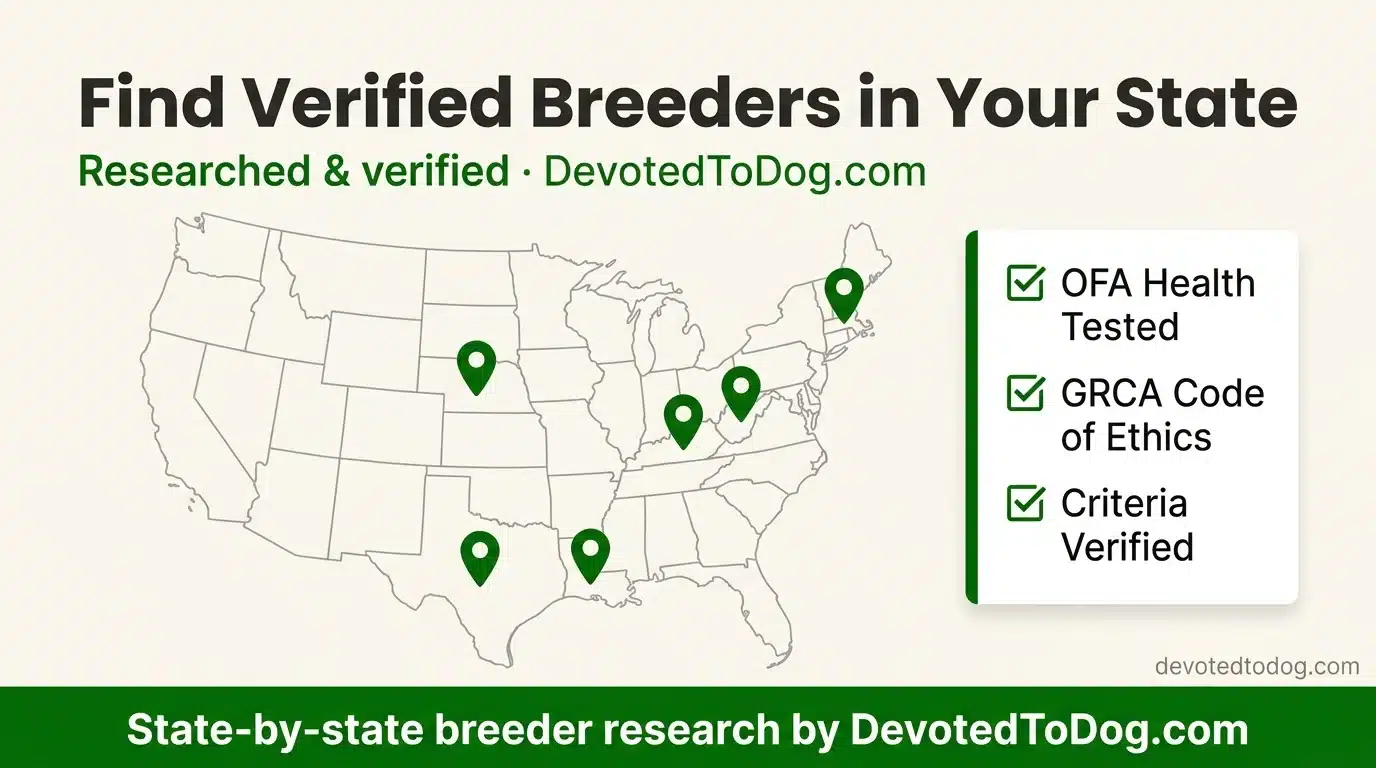
We’ve applied this framework to breeders across the country and published state-by-state lists with criteria verification tables for each breeder we researched. Every listing shows exactly which requirements the breeder met, which quality indicators they earned, and our star rating based on the scoring system above.
We note each data point clearly: verified means we confirmed it through a public database or official registry, claimed means the breeder stated it on their website but we couldn’t independently verify, and “not mentioned” means the information wasn’t available online.
Start with your state:
- Best Golden Retriever Breeders in Massachusetts
- Best Golden Retriever Breeders in Louisiana
- Best Golden Retriever Breeders in Texas
- Best Golden Retriever Breeders in Kentucky
- Best Golden Retriever Breeders in Nebraska
- Best Golden Retriever Breeders in West Virginia
We’re adding more states as we complete research. Each article lists 10 or more breeders with full criteria tables. If you’re a breeder who meets our requirements and would like to be considered, contact us through our site.
Frequently Asked Questions
How much does a reputable golden retriever breeder charge?
Reputable golden retriever breeders charge $2,000 to $3,500 in most U.S. regions as of 2026. That price reflects real costs: full OFA health testing, DNA panels, annual eye and cardiac certifications, quality puppy care, and proper socialization. Prices under $1,500 are a warning sign that corners are being cut somewhere in that process.
How long is the waitlist at a reputable golden retriever breeder?
Most reputable breeders have waitlists of 6 to 18 months. Some highly sought breeders with strong long-term reputations have longer waits. Getting on a waitlist typically doesn’t require a deposit at the initial inquiry. Be cautious of any breeder who has puppies available immediately with no waitlist at all.
What is the GRCA, and why does membership matter?
The Golden Retriever Club of America is the AKC national parent club for the breed. Member breeders sign a Code of Ethics requiring all four OFA health tests, responsible breeding frequency, and honest dealings with buyers. GRCA membership doesn’t guarantee perfection, but it creates accountability and a standard that benefits buyers. You can search the member breeder directory at grca.org/find-a-golden/.
Social media and Craigslist are not reliable starting points. Both are used by commercial operations and backyard breeders alongside responsible breeders, and there’s no way to distinguish them by listing alone. Start with the GRCA breeder directory, AKC Marketplace, or Good Dog. Then apply the criteria in this guide to verify any breeder you find, regardless of the source.
What should a health guarantee in a breeder contract cover?
A strong health guarantee covers hip dysplasia for at least two years from purchase and other hereditary conditions for at least one year. It should specify clear remedies: refund, replacement, or partial reimbursement if a covered condition is diagnosed. The contract should also include the lifetime take-back clause. If you can no longer care for the dog at any point, the breeder accepts the dog back.
Is it OK to visit a breeder’s facility before I’m on their waitlist?
Yes, and most reputable breeders encourage it. A visit lets you see where the dogs live, assess the dam’s temperament firsthand, and evaluate the operation before committing any money. Reputable breeders treat it as a mutual screening process. If a breeder requires a deposit before any visit, treat that as a red flag.
Ready to find breeders? Browse our verified Golden Retriever Breeders Directory — all 40 states, every breeder researched before listing.
Contact information for all breeders listed on our site is current as of April 2026. Verify before reaching out.
Related reading: