
The most common Golden Retriever health issues are cancer, hip and elbow dysplasia, skin allergies and hot spots, ear infections, hypothyroidism, inherited eye disease and the heart defect subaortic stenosis. PetMD lists the same conditions for the breed, with ear infections as a common result of its skin allergies. Most can be screened for or managed when they are caught early. Here is each one in a sentence, with where to read more. For the breed as a whole, see our Golden Retriever breed guide.
- Cancer: the leading cause of death in the breed, mostly hemangiosarcoma and lymphoma (see the cancer section below).
- Hip and elbow dysplasia: inherited joint problems that show as bunny-hopping, stiffness or front-leg lameness; see our hip dysplasia guide.
- Skin allergies and hot spots: itching, licking and moist red patches, often driven by allergies; see our allergies guide.
- Ear infections: floppy ears hold heat and moisture, especially after swimming; see ear infection prevention.
- Hypothyroidism: an underactive thyroid that causes weight gain, low energy and coat thinning, usually in middle age.
- Eye disease: pigmentary uveitis, progressive retinal atrophy (PRA) and cataracts.
- Heart disease: subaortic stenosis (SAS), an inherited narrowing below the aortic valve.
⚠️ MEDICAL DISCLAIMER: This article is for informational purposes only and does not constitute veterinary medical advice. Always consult a licensed veterinarian if your Golden Retriever shows any of the symptoms described below.
Golden Retrievers carry one of the highest cancer rates of any dog breed: cancer caused 65% of deaths in a UC Davis study of 652 Goldens (Kent et al., PLoS ONE, 2018). That number should fundamentally change how every owner thinks about preventive care.
Most Golden owners don’t learn about hemangiosarcoma, hip dysplasia, or bloat risk until their dog is already showing symptoms. By then, the window for early intervention has often closed. Understanding golden retriever common health issues before they become crises is the most powerful thing you can do as an owner.
In this guide, you’ll learn the most common golden retriever health issues, how to recognize early warning signs, and which screenings to ask your vet about , so you can give your Golden the longest, healthiest life possible. We cover everything from joint disease and skin conditions to the breed’s unique cancer vulnerabilities, age-based screening milestones, and even behavioral health.
“Cancer and hip dysplasia are big ones. Sensitive stomachs and skin seem to be relatively common as well.” , Golden Retriever owner, community consensus
Golden Retrievers face one of the highest disease burdens of any breed: cancer caused 65% of deaths in a UC Davis study of the breed (Kent et al., PLoS ONE, 2018).
- Cancer is the #1 killer: Hemangiosarcoma and lymphoma are the most aggressive threats , know the silent warning signs.
- The Cancer Threshold: ask your vet which cancer screening makes sense as your Golden reaches middle age.
- Joint problems are common: about 19% of Golden hip X-rays sent to the OFA are rated dysplastic; “bunny-hopping” is a key early sign.
- Spay/neuter timing matters: Sex-specific hormonal factors measurably affect cancer and joint disease risk.
- Early action saves lives: Age-based screening timelines (including the Nu.Q test) exist , most owners don’t know them.
Author Credentials
📝 Written by: Coral Drake
✅ Reviewed by: Brianna York, Former Veterinary Technician
📅 Last updated: 5 May 2026
ℹ️ Transparency Notice
This article reviews the most common Golden Retriever health issues based on AKC, GRCA, OFA, NCBI peer-reviewed studies, UC Davis veterinary research, and Morris Animal Foundation data. Health figures name their source, and our editorial team checked them against those sources. We are not veterinarians, and this guide is not veterinary advice.
| Condition | How Common | Onset Age | Screening Test | Outlook |
|---|---|---|---|---|
| Cancer (all types) | 65% of deaths in a UC Davis study | 6-10 years | Regular exams; ask your vet about cancer screening | Variable; depends on type, early detection critical (NCBI 2018) |
| Hemangiosarcoma | An estimated 1 in 5 (Cornell Baker Institute) | 8-12 years | Ask your vet whether abdominal ultrasound makes sense | Aggressive; median survival about 4-6 months with surgery and chemotherapy (University of Minnesota) |
| Hip Dysplasia | ~19% of OFA hip X-rays rated dysplastic | 4-12 months puppy onset | OFA hip x-ray after 24 months | Manageable with weight control, supplements, sometimes surgery |
| Elbow Dysplasia | Common; OFA screens for it | 5-8 months | OFA elbow x-ray | Surgery often needed for grade 2-3 |
| Subvalvular Aortic Stenosis (SAS) | One of the more common heart conditions in the breed | Detected as puppy | Cardiac echo or auscultation | Mild SAS lives normal life; severe needs cardiologist |
| Pigmentary Uveitis | Breed-specific; more common in older dogs | 5-9 years | Annual ophthalmology exam (CAER/CERF) | Manageable with eye drops, can lead to glaucoma |
| Hypothyroidism | Common in the breed | 4-10 years | T4 + TSH blood panel | Excellent on thyroid hormone replacement |
| Skin allergies / atopy | Common in the breed | 1-3 years | Allergy panel, elimination diet | Manageable; lifelong condition |
Health Fundamentals & Life Expectancy
Golden Retrievers are generally robust, social dogs , but they carry a disproportionate burden of serious breed-specific conditions that every owner should understand before symptoms appear. Cancer caused 65% of deaths in a UC Davis study of the breed (Kent et al., PLoS ONE, 2018). Knowing what to watch for, and when, is the single most effective intervention an owner can make.
For detailed guidance on Golden Retriever life expectancy and longevity, that companion resource goes deeper on lifespan and the factors that shape it.
What to Expect From Golden Health
The PetMD breed health profile , a veterinarian-reviewed resource , confirms that cancer, dysplasia, and skin conditions are the breed’s primary health concerns. Golden Retriever owners across forums and community groups consistently report the same pattern: cancer and hip dysplasia dominate the conversation, followed closely by sensitive stomachs and recurring skin issues. Veterinary data backs this up entirely.
The four major health categories you’ll encounter as a Golden owner are: cancer, joint and orthopedic disease, skin and ear conditions, and heart and endocrine disorders. Each has its own risk timeline and early warning signs. Golden Retrievers are not fragile dogs , they are loving, energetic companions , but their genetics create specific vulnerabilities that proactive owners can meaningfully address. Understanding these golden retriever common health issues upfront gives you a real advantage.
How Long Do Golden Retrievers Live?
The standard lifespan for a Golden Retriever is 10–12 years, which the AKC and most breed organizations cite as the expected range. However, a landmark UC Davis study found something genuinely encouraging: Golden Retrievers with a specific variant of the HER4 (ERBB4) gene averaged 13.5 years , nearly two years longer than the breed standard of 11.6 years (UC Davis longevity study, UC Davis Health, 2023).
“Golden Retrievers with the HER4 gene variant live an average of 13.5 years , nearly two years longer than the breed standard of 11.6 years” (UC Davis Health, 2023).
You cannot change your dog’s genetic makeup. But you can optimize every other factor , diet, weight management, exercise, and proactive screening. That’s the actionable takeaway from the UC Davis research: genetics matter, but so do the choices you make every year.
Preventive Care Basics
Ask your vet how often your Golden should be examined; some owners choose twice-yearly visits because conditions like cancer can progress between annual checkups. The GRCA confirms that dogs must be 24 months old for official OFA hip certification, making the two-year mark a critical milestone for orthopedic baseline screenings.
Here are the three foundational preventive steps every Golden owner should establish:
- Biannual veterinary exams starting from adulthood , don’t wait for symptoms to appear
- OFA hip and elbow evaluation at 24 months , establishes your dog’s orthopedic baseline
- GRCA health research participation , owners who engage with breed-specific health programs give their dogs a measurable advantage over those relying solely on reactive care
With the basics established, let’s get into the conditions your Golden is most likely to face , starting with the physical symptoms owners notice first.
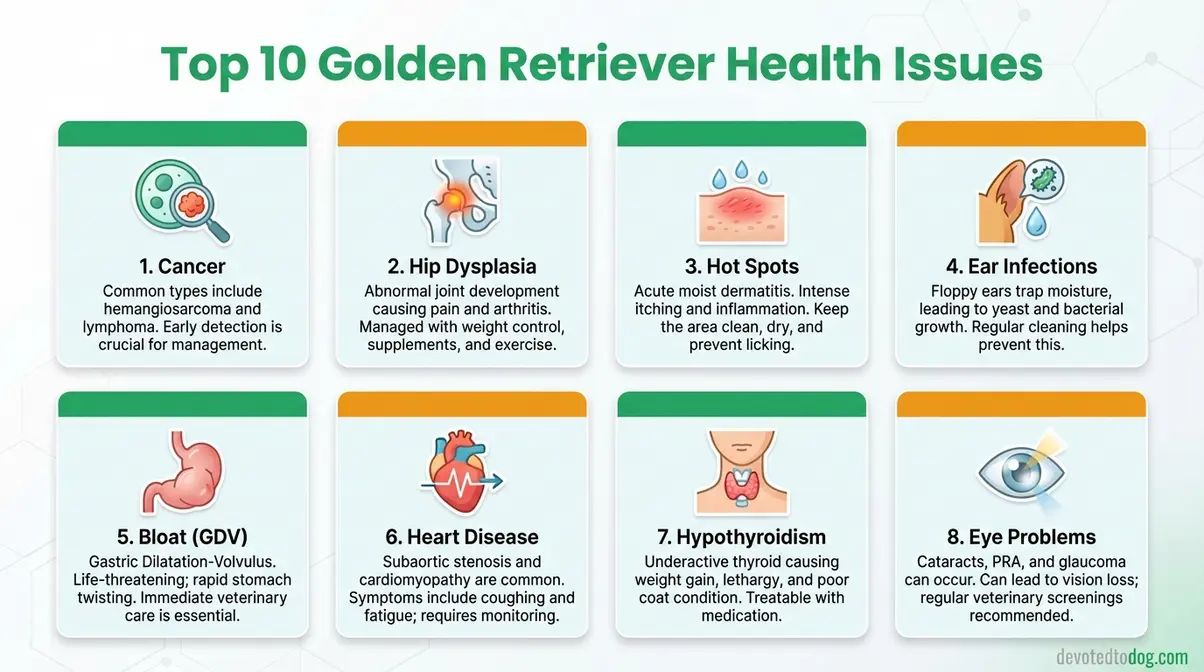
Caption: The 10 most common Golden Retriever health issues, from cancer and hip dysplasia to hot spots and bloat , with early warning signs every owner should know.
Physical Conditions, Symptoms & Sensitivities
Golden Retrievers experience a predictable set of physical health conditions , and most of them announce themselves with early warning signs that owners can spot before a crisis develops. The most common golden retriever health problems affecting the body include joint disease, skin and ear conditions, digestive sensitivity, and life-threatening bloat. Knowing what to look for is the first step.

Caption: Key anatomical areas where Golden Retrievers are most vulnerable , hips, skin folds, and ear canals , shown alongside their most common associated conditions.
Hip and Elbow Dysplasia (Bunny-Hopping)
Hip dysplasia is the abnormal formation of the hip socket, causing joint instability and progressive arthritis. It’s hereditary, but worsened by rapid growth, obesity, and over-exercise in puppies. The Orthopedic Foundation for Animals (OFA) has graded more than 193,000 Golden Retriever hip X-rays (OFA breed statistics).
In OFA breed statistics, about 19% of Golden Retriever hip X-rays were rated dysplastic, and ‘bunny-hopping’ in puppies is one of the earliest observable warning signs owners can spot at home.
The key early sign is bunny-hopping , a gait abnormality where a dog uses both hind legs simultaneously when running or going upstairs, like a rabbit. Additional signs include reluctance to jump, stiffness after rest, and decreased activity. These can appear as early as 4–6 months of age. A dog that eagerly ran to greet you last month but now hesitates at the stairs deserves a vet conversation , don’t wait for a full limp to develop. For nutrition for sensitive stomachs and joint health, dietary choices are an important part of managing orthopedic risk from puppyhood onward.
Elbow dysplasia is the same kind of developmental problem, but in the front legs. Watch for front-leg lameness, an elbow that turns outward as your Golden walks, or reluctance to stretch the leg fully. Extra weight adds load to joints that are already under strain, so our guide to checking your Golden’s body condition is a useful companion. If you notice any of these signs, ask your veterinarian for a joint evaluation. Our hip dysplasia guide covers the condition in more depth, and if your vet suggests a joint supplement, our roundup of the best joint supplements for Golden Retrievers compares the options.
Where joint disease affects the bones underneath, skin conditions show up on the surface , and Golden Retrievers are particularly prone to both.
Skin Conditions and Hot Spots
Hot spots , technically “moist dermatitis” , are red, moist, painful skin lesions that appear suddenly, often beneath matted fur. Goldens’ thick double coats make them especially vulnerable. According to the Cornell University veterinary overview of hot spots, hot spots are particularly common in long or thick-coated breeds like Golden Retrievers (Cornell University Riney Canine Health Center, 2024). Hot spots can grow quickly, so call your vet promptly rather than treating one at home. Your vet may clip and clean the area and will tell you how to care for it.
Allergies , both environmental and food-based , are a major driver of chronic skin irritation. Watch for recurring paw licking, redness around the eyes and muzzle, and recurrent ear infections, as these are often interconnected signs of the same underlying sensitivity. Ichthyosis, a genetic skin condition specific to Goldens, causes flaky or scaly skin from a young age; DNA testing for this condition is available through breed-specific panels. For guidance on managing Golden Retriever coat and skin health, grooming routines play a meaningful preventive role.
One point many owners miss: a hot spot is often a sign of something else going on. Cornell’s overview names allergies, fleas, ear infections, and a coat that stays damp after swimming as common triggers. If hot spots or ear infections keep coming back, ask your veterinarian whether allergy testing makes sense. Our guides to Golden Retriever allergies and preventing recurring ear infections go deeper.
Hot spots and allergies often go hand-in-hand with ear problems , and Goldens’ floppy ears create the perfect environment for recurring infections.
Ear Infections
Floppy ears trap heat and moisture, creating ideal conditions for bacterial and yeast overgrowth. Goldens that swim frequently are at especially high risk , water that enters the ear canal doesn’t drain efficiently, compounding the problem.
Early signs of an ear infection include head shaking, pawing at the ears, dark discharge, and a distinctive odor. These often appear before visible swelling, so don’t wait for your dog to show obvious discomfort before acting.
A practical prevention routine makes a real difference:
- Weekly ear checks , look for redness, discharge, or unusual odor
- Gentle cleaning with a vet-approved solution after swimming or bathing (see our picks for the best ear cleaners for Golden Retrievers)
- Keep the ear canal dry; avoid cotton swabs, which can push debris deeper
Ear infections are uncomfortable but manageable. Bloat, by contrast, is a life-threatening emergency that can kill a Golden Retriever within hours.
Bloat and GDV in Deep-Chested Dogs
Bloat , formally Gastric Dilatation-Volvulus (GDV) , occurs when the stomach fills with gas and twists on itself, cutting off blood supply. Deep-chested breeds like Goldens are at significantly higher risk due to their chest conformation. As the AKC explanation of bloat and deep chest risk notes, chest shape is one of the strongest predictors of GDV susceptibility (American Kennel Club).
Emergency symptoms that require an immediate emergency vet visit , do not wait:
- Distended, hard-looking abdomen
- Unproductive retching (attempting to vomit with nothing coming up)
- Extreme restlessness or inability to settle
- Excessive drooling
- Pale or white gums
- A racing heart rate with a weak pulse
Bloat can become life-threatening within hours; treat it as an emergency. Ask your vet how to lower the risk for your dog, for example meal size and timing around exercise or a slow-feeder bowl, and whether a preventive gastropexy (a surgery that fixes the stomach in place) makes sense for your Golden.
Feeding routine matters too. The same AKC article reports that dogs fed one meal a day are twice as likely to bloat as dogs fed two meals a day. It also notes that raised food bowls, once advised for deep-chested dogs, are now seen as a risk rather than a safeguard. Ask your veterinarian which feeding setup suits your Golden. If you see the emergency signs above, call the emergency clinic while you get your dog into the car.
Beyond the joints and skin, Goldens also face a cluster of internal health conditions that require regular monitoring but are often very manageable with early diagnosis.
Heart, Thyroid & Eye Problems
Subvalvular Aortic Stenosis (SAS) is a congenital heart defect causing a narrowing below the aortic valve. It ranges from mild , with no noticeable symptoms , to severe, where exercise intolerance, fainting, or sudden death may occur. For breeding dogs, the OFA’s health-screening program for the breed asks for a cardiac exam by a cardiologist at 12 months or older.
SAS is present from birth and can be hard to spot at home, because some affected dogs look completely healthy. That’s why the GRCA lists heart screening among the health clearances for the parents of a litter, alongside hips, elbows, and eyes. If you’re choosing a puppy, ask the breeder for the parents’ cardiac clearances. If your vet ever notes a new murmur, ask whether a cardiac ultrasound is appropriate.
Hypothyroidism , an underactive thyroid , causes weight gain, lethargy, coat thinning, and cold intolerance. The good news: it is highly manageable with lifelong oral medication once diagnosed. Watch for unexplained weight gain and persistent low energy as the earliest indicators, and consult your veterinarian for a thyroid panel if you observe these golden retriever health problems symptoms.
Eye conditions affecting Goldens include Pigmentary Uveitis (a Golden-specific chronic eye inflammation that can lead to blindness), Progressive Retinal Atrophy (PRA), and cataracts. Annual CAER (Companion Animal Eye Registry) eye exams are recommended for breeding dogs and encouraged for all Goldens from middle age onward.
Pigmentary Uveitis
PetMD describes pigmentary uveitis as an inherited eye condition in which brown or black cysts develop in the eye, usually when a Golden is at least 5 years old, and notes it can lead to cataracts and glaucoma over time.
Pigmentary uveitis is easy to miss because it builds slowly and isn’t always painful early on. Signs include squinting, redness, a cloudy look to the eye, and sensitivity to bright light. Left unchecked, the inflammation can lead to glaucoma. The GRCA keeps its pigmentary uveitis and PRA updates in its health research library.
Progressive Retinal Atrophy (PRA) is a genetic condition in which the retina slowly breaks down. It often shows first as poor night vision: your Golden may hesitate at a dark doorway or seem unsure on evening walks. There is no cure, but catching it early lets you plan ahead with your vet.
Cataracts cloud the lens of the eye and are more common in older Goldens; some are hereditary. Eye exam referrals aren’t always offered automatically, so ask your veterinarian about a CAER exam at the annual visit. Book a prompt visit for any squinting, redness, or new cloudiness.
As serious as these physical conditions are, nothing dominates the Golden Retriever health conversation more than cancer , and for good reason.
Cancer & the Silent Killer in Golden Retrievers
Cancer is the leading cause of death in Golden Retrievers , and understanding why requires grappling with a number many owners don’t know: in a UC Davis study of 652 Goldens, 65% died of cancer (Kent et al., PLoS ONE, 2018). This section covers the three most dangerous cancer types, their warning signs, and what early detection options are now available.
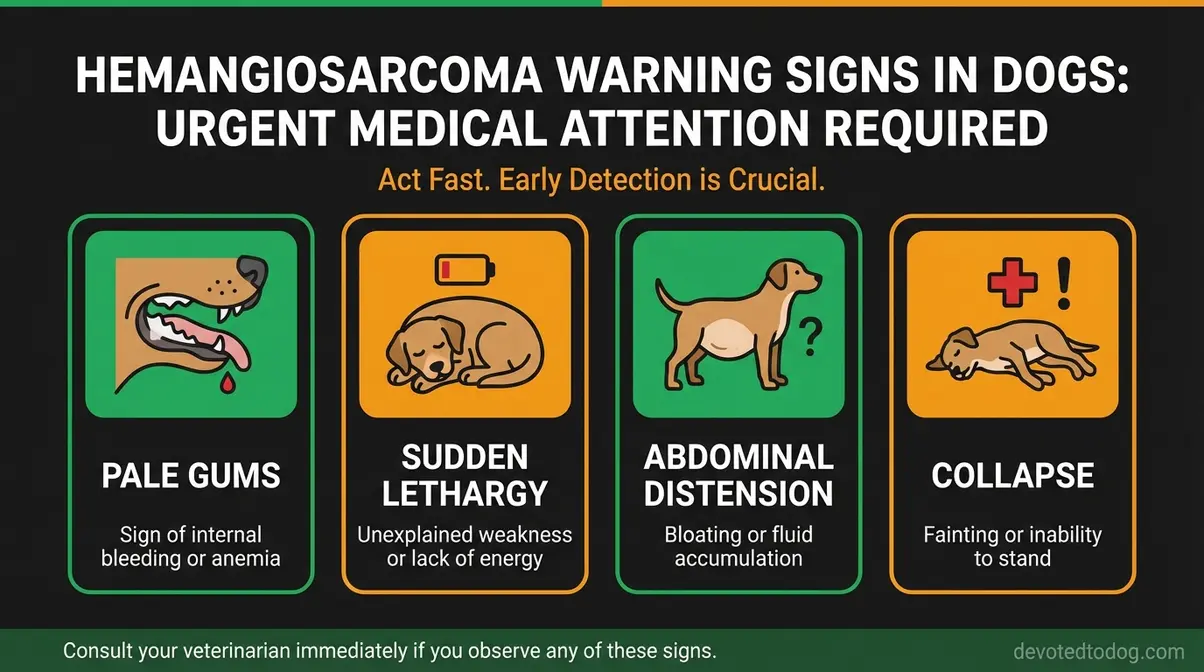
Caption: Hemangiosarcoma warning signs every Golden Retriever owner should be able to recognize , including pale gums, sudden lethargy, and abdominal distension.
For a visual walkthrough of hemangiosarcoma risk factors and early warning signs, watch our companion video above.
The Cancer Threshold
Golden retriever common health issues span many categories, but cancer stands apart. The UC Davis study of 652 Golden Retrievers confirms that cancer is the leading cause of death in Golden Retrievers, and the breed’s cancer risk is high relative to many breeds (Kent et al., PLoS ONE, 2018).
The four most common cancer types in Goldens are hemangiosarcoma, lymphoma, mast cell tumors, and osteosarcoma (bone cancer). Each has a different risk profile, different warning signs, and a different window for early intervention. Understanding all four is essential before we examine them individually.
Research on these cancers is still growing. The Morris Animal Foundation’s Golden Retriever Lifetime Study collects health data each year on more than 3,000 enrolled Goldens to find risk factors for cancer and other diseases.
The Cancer Threshold, the fact that cancer caused 65% of Golden Retriever deaths in a UC Davis study (Kent et al., PLoS ONE, 2018), is the number that should anchor every preventive care decision you make. It’s why regular vet visits matter for this breed, and why the leading causes of death and cancer rates in Golden Retrievers deserve their own dedicated attention in any longevity conversation.
Of all the cancers Goldens face, one is uniquely feared , because it kills quickly and quietly, often with no warning at all.
Hemangiosarcoma: The Silent Killer
Hemangiosarcoma is an aggressive cancer of the blood vessels, most commonly affecting the spleen or heart. It grows rapidly with few detectable symptoms until a tumor ruptures internally , which is precisely why it’s earned the name “the silent killer.” The AKC Canine Health Foundation hemangiosarcoma research underscores how rapidly this cancer advances with few early warning signs , which is why early detection tests like Nu.Q are gaining traction in veterinary oncology (AKC CHF, 2023).
“An estimated one in five Golden Retrievers will develop hemangiosarcoma , an aggressive blood vessel cancer that advances with few early warning signs” (Cornell University Baker Institute, 2021).
According to Cornell University research on hemangiosarcoma, approximately 1 in 5 Goldens will develop this cancer, making it one of the most critical silent threats to monitor (Cornell Baker Institute, 2021).
Emergency signs that warrant an immediate vet call:
- Sudden, extreme lethargy , a dog that won’t get up
- Pale or white gums (a sign of internal bleeding)
- Distended abdomen
- Collapse following exercise
If you observe any of these, treat it as an emergency. Do not wait until morning. Consult your veterinarian immediately.
Hemangiosarcoma is the most feared, but lymphoma and mast cell tumors are more common , and they come with warning signs that are much easier to spot.
Lymphoma & Early Detection Tests
Lymphoma is a cancer of the lymph nodes and immune system. Early signs include swollen lymph nodes , feel under the jaw, behind the knees, and in the armpits , alongside lethargy, weight loss, and decreased appetite. Lymphoma is more treatable when caught early, which makes routine lymph node checks a valuable habit during weekly grooming sessions.
Mast cell tumors are skin-based tumors that frequently look like innocent bumps , they can be soft, firm, raised, or flat. Any new lump on a Golden warrants a vet visit; your vet may recommend a fine needle aspirate to check it. The working rule among Golden communities: “when in doubt, test it out.” Most lumps are benign, but the ones that aren’t require fast action.
Osteosarcoma (bone cancer) tends to affect large breeds. It usually shows up as lameness or a firm swelling on one limb that doesn’t improve with rest. The pain often sits in one spot on the bone rather than in a joint. Lameness that doesn’t settle deserves a prompt vet visit so your veterinarian can find the cause.
Emerging detection options now give owners and vets a meaningful head start. The Nu.Q liquid biopsy test and the OncoK9 multi-cancer early detection test can screen for cancer markers in blood before symptoms appear. The AKC Canine Health Foundation hemangiosarcoma research highlights that these tools are gaining traction as part of proactive oncology protocols (AKC CHF, 2023). Ask your vet about these tests starting at age 6 , or age 4 if you want to establish an earlier baseline.
Knowing the cancer types is one thing. Knowing when to screen for them , based on your dog’s age and sex , is where owners can make a real difference.
Sex-Specific Spay/Neuter Risk Factors
This is the data point you won’t find in competitor guides , and it matters. In a study of dogs of all breeds, spayed females had more than five times the risk of hemangiosarcoma of the heart compared with intact females (Ware and Hopper, J Vet Intern Med, 1999). A UC Davis study of Golden Retrievers, however, found that being spayed or neutered did not change the risk of dying of cancer (Kent et al., PLoS ONE, 2018).
Joint disorders are a separate concern. In a UC Davis study of 759 Golden Retrievers, 10% of males neutered before 12 months were diagnosed with hip dysplasia, double the rate in intact males, and cranial cruciate ligament tears occurred only in early-neutered dogs (Torres de la Riva et al., PLoS ONE, 2013). The hormonal environment during skeletal development appears to affect how joints form.
This is not an argument against spaying or neutering. It is an argument for discussing timing with your veterinarian, who can weigh your individual dog’s risk factors. For owners of aging females, understanding serious illnesses in aging Golden Retrievers becomes especially relevant because hemangiosarcoma is more common in older dogs (University of Minnesota).
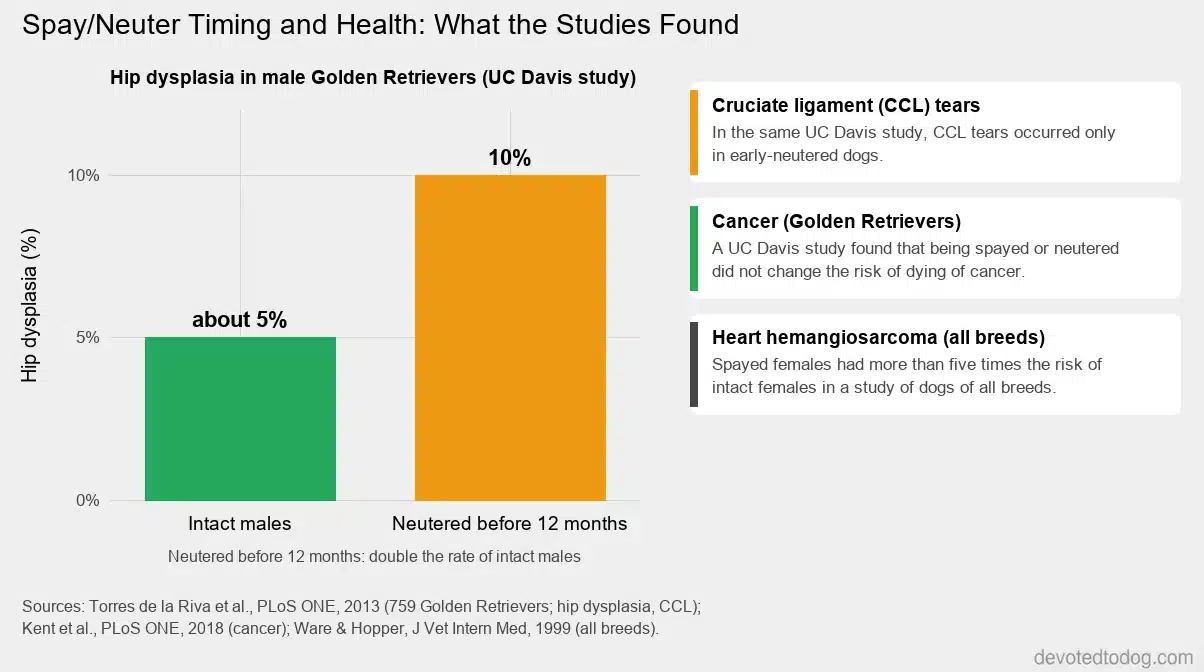
Caption: What studies found on spay/neuter timing: more hip dysplasia in early-neutered males, and no change in cancer deaths in a UC Davis study.
Understanding the risk factors is essential. The next step is knowing exactly when to act on them , with a screening timeline built around your dog’s age.
Health Testing to Ask a Breeder For
Many of these conditions are inherited, so the best time to lower the risk is before you bring a puppy home. The OFA Golden Retriever health screening page, set with the breed club, lists four basic screenings for every Golden used for breeding:
- Hips: an OFA hip X-ray evaluation or a PennHIP evaluation
- Elbows: an OFA elbow X-ray evaluation
- Eyes: an eye exam by a board-certified veterinary ophthalmologist (ACVO), repeated every year
- Heart: a cardiac exam by a cardiologist at 12 months or older, or an advanced cardiac exam
Ask the breeder for both parents’ results and check them yourself in the OFA database. The same OFA page also lists DNA tests that breeders run on Goldens, including ichthyosis (an inherited scaly-skin condition) and two forms of PRA. A breeder who shares these results openly is a good sign. Our Golden Retriever breeder directory lists breeders by state.
Age-Based Screening Timelines
Golden Retriever health screening isn’t one-size-fits-all , it’s age-dependent. The conditions most likely to threaten your dog shift significantly from puppyhood through the senior years. Here is the screening timeline every Golden owner should follow.
Ask your vet how often your Golden should be examined at each life stage.
Puppy to Age 2: Foundation Screenings
These early screenings establish the baseline that makes future comparisons meaningful , don’t skip them even if your puppy seems perfectly healthy.
- 8–16 weeks: Full puppy wellness series, core vaccinations, fecal parasite check, and initial physical exam.
- 6 months: Discuss spay/neuter timing with your vet. Given research on neutering age and joint and cancer risk in Golden Retrievers (Torres de la Riva et al., PLoS ONE, 2013), timing is a conversation worth having early.
- 12 months: Ask your vet whether baseline bloodwork, such as a complete blood count (CBC) and a thyroid panel, makes sense to establish your dog’s individual normal values.
- 24 months: OFA hip and elbow evaluation eligibility. Per GRCA guidelines, dogs must be 24 months old for official OFA diagnostic hip certification , this is the most important orthopedic milestone in the first two years.
- Every puppy visit: Ask your vet to listen for a heart murmur. If you’re buying from a breeder, ask for the parents’ hip, elbow, eye, and heart clearances.
Once the foundation is set, the middle years call for proactive monitoring , not reactive treatment.
Ages 2–6: Proactive Monitoring Phase
The middle years are when early intervention yields the greatest return. Annual exams feel sufficient during this period, but building in additional checkpoints pays dividends later.
- Annually: Full physical exam, comprehensive bloodwork, urinalysis, and heartworm test.
- Age 4: Begin discussing cancer screening options with your vet. Nu.Q and OncoK9 tests are available and can detect cancer biomarkers before symptoms appear , starting this conversation at age 4 gives you a two-year head start before peak risk.
- Ongoing: Monitor for bunny-hopping, unexplained weight changes (a hypothyroidism indicator), and any new lumps or bumps. Show your vet any new lump and ask whether it should be sampled, for example with a fine needle aspirate.
- Eye exams: Annual CAER eye examination is recommended by the GRCA for breeding dogs and encouraged for all Goldens from this age onward.
- Monthly at home: Weigh your Golden and, while grooming, run your fingers under the jaw, in front of the shoulders, and behind the knees. Tell your vet about any new firmness, swelling, or weight change.
- Dental care: Ask your vet how often your Golden needs a dental check or professional cleaning.
The senior years are when vigilance becomes most critical , and when the Cancer Threshold becomes most real.
Ages 7+: Senior Vigilance
This is the age range where most Golden Retriever cancer diagnoses occur. Escalating your monitoring schedule during these years is one of the most concrete actions you can take.
- Exam frequency: Ask your vet whether your senior Golden should be seen more often than once a year.
- Cancer screening priority: Discuss Nu.Q or OncoK9 testing annually if not already started. For spayed females over age 8, have a specific hemangiosarcoma risk conversation with your vet.
- Abdominal ultrasound: Ask your vet whether periodic abdominal ultrasound makes sense for your senior Golden. It can find splenic masses before they rupture.
- Quality-of-life monitoring: Track mobility, appetite, and behavior changes monthly. Ask your vet for a structured quality-of-life checklist at your next biannual visit.
- Cognitive changes: Watch for disorientation, changed sleep patterns, new house-training accidents, or staring at walls. These can be signs of canine cognitive dysfunction, so raise them with your vet.
Screening is reactive by nature. The most powerful tool you have is prevention , starting with what your Golden eats and how you shape their behavioral development from day one.
Prevention, Nutrition & Behavioral Health

Prevention works best when it starts early and covers more than just physical health. Nutrition and socialization both contribute to a Golden Retriever’s long-term wellbeing , yet these topics are largely absent from competitor guides.
Nutrition for Sensitive Stomachs
Golden Retrievers are prone to food sensitivities and inflammatory bowel issues , symptoms include chronic loose stools, gas, vomiting after meals, and skin flare-ups driven by the gut-skin connection. Veterinary nutritionists commonly recommend high-quality protein sources, limited-ingredient diets, and omega-3 fatty acid supplementation for Goldens with sensitive stomachs.
Obesity compounds virtually every other health problem in this breed. Excess weight worsens joint disease, measurably increases cancer risk, and strains the cardiovascular system. Weight management isn’t just aesthetics , it’s a genuine health intervention. For specific dietary guidance, our resource on best dog food for Golden Retrievers with sensitive stomachs covers current veterinary nutritionist recommendations in detail.
With all of this information, it’s worth being honest about where at-home monitoring ends , and when professional help is non-negotiable.
When Health Issues Become Emergencies
Proactive monitoring is valuable. But recognizing when a symptom crosses from “worth watching” to “call the vet today” is equally critical , and this distinction is where many well-intentioned owners lose precious time.
Common Health Monitoring Pitfalls
Across Golden Retriever veterinary communities and owner forums, three monitoring mistakes appear consistently:
- Assuming “he’s just getting old” , Lethargy, unexplained weight loss, and decreased appetite in a senior Golden are symptoms to investigate immediately, not accept as inevitable aging. These are the same early signs that precede hemangiosarcoma and lymphoma diagnoses. Consult your veterinarian if these signs persist beyond 48–72 hours.
- Delaying a vet visit for a new lump , Show your vet any new lump, especially one that is growing. Your vet may recommend a fine needle aspirate, a quick test that can help rule out mast cell tumors or worse. A quick check costs little; waiting can let a serious tumor progress.
- Treating hot spots at home with human products , Some human skin products can irritate a dog’s skin or slow healing. Ask your vet before putting anything on a hot spot.
When to Call Your Vet Immediately
Emergency vet NOW , do not wait:
- Pale or white gums
- Unproductive retching with a distended abdomen (GDV)
- Sudden collapse or extreme weakness
- Seizures
- Labored breathing or respiratory distress
Same-day call , schedule urgently:
- Any new lump discovered
- Sudden onset lameness
- Significant appetite change lasting more than 48 hours
- Eye discharge, cloudiness, or visible change in the eye
- Head shaking or ear odor suggesting infection
When to request a specialist referral: If your primary vet suspects cancer, request a referral to a board-certified veterinary oncologist. General practitioners provide excellent foundational care, but oncologists have access to staging tools, clinical trials, and treatment protocols that significantly expand your options. Don’t wait to ask.
What Can Home Monitoring Catch, and What Can’t It?
This guide can help you spot patterns earlier and ask your vet better questions. It can’t replace a physical exam, bloodwork, or imaging, and it can’t diagnose your dog. Some of the most dangerous problems in this breed, like a mass growing inside the spleen, can’t be felt or seen at home at all.
A few red flags are worth knowing in more detail:
- A lump that grows visibly within days: book a same-day or next-day appointment rather than waiting for a routine visit.
- Sudden lameness in a young dog: it may be more than soreness, so ask for a prompt exam.
- Persistent coughing or tiring quickly on walks: these can be heart signs. See your vet soon, and the same day if they get worse.
- Squinting, eye redness, or sudden cloudiness: ask for a same-day exam, since some eye problems progress quickly.
When you aren’t sure, call your vet first. Most clinics can tell you over the phone how urgent a symptom is. Use what you know to act earlier, not to second-guess a professional exam.
What heart problems do Golden Retrievers commonly get?
Golden Retrievers most commonly develop Subvalvular Aortic Stenosis (SAS), a congenital heart condition and one of the more common heart problems in the breed. SAS narrows the aorta below the heart valve, restricting blood flow. Other golden retriever heart problems include Dilated Cardiomyopathy (DCM) (linked in some cases to grain-free diets per FDA 2018), Mitral Valve Disease (more common in seniors), and rarely Patent Ductus Arteriosus (PDA). Ask your vet to listen for a heart murmur at puppy visits; if one is heard, your vet may refer you for an echocardiogram with a veterinary cardiologist. Mild SAS dogs often live normal lifespans with no restrictions; severe SAS requires lifelong management.
How can you tell if a Golden Retriever has heart issues?
Five warning signs of golden retriever heart issues: (1) exercise intolerance, tiring quickly during normal play, lying down after short walks; (2) coughing, especially at night or after exertion; (3) labored or rapid breathing at rest; (4) fainting / collapse during exercise; (5) bluish gums or tongue (cyanosis). A heart murmur (detected by stethoscope) is the most common early indicator; if your vet hears one, they may recommend an echocardiogram. Ask your vet to listen to your Golden’s heart at every checkup, even without symptoms.
What screening tests should every Golden Retriever owner know about?
The OFA’s CHIC program for Golden Retrievers lists four screenings for breeding dogs: (1) a hip evaluation (OFA X-ray, official rating from 24 months, or PennHIP); (2) an OFA elbow X-ray; (3) a cardiac exam by a cardiologist at 12 months or older; (4) an eye exam by a veterinary ophthalmologist every year (catches pigmentary uveitis, cataracts, retinal atrophy). For a pet Golden, ask your vet which of these checks it needs, and whether thyroid testing or abdominal ultrasound makes sense as it ages.
Frequently Asked Questions
What is the most common cause of death?
Cancer is the most common cause of death in Golden Retrievers, causing 65% of deaths in a UC Davis study of the breed (Kent et al., PLoS ONE, 2018). Golden Retrievers are especially vulnerable to aggressive forms including hemangiosarcoma, lymphoma, and mast cell tumors. This elevated cancer rate , significantly higher than most other breeds , makes regular veterinary screenings and early detection testing essential for any Golden owner focused on maximizing their dog’s lifespan. Always consult your veterinarian about breed-specific cancer screening options.
What is the silent killer in Goldens?
Hemangiosarcoma is known as the silent killer in Golden Retrievers , an aggressive cancer of the blood vessels that most often affects the spleen or heart. It advances rapidly with few early warning signs, so owners rarely realize there is a problem until a tumor ruptures internally. Treat sudden lethargy or pale gums as veterinary emergencies.
What are the top health problems?
The most common health problems in Golden Retrievers include cancer, hip and elbow dysplasia, and skin conditions like hot spots. They are also highly prone to ear infections due to their floppy ear anatomy. Heart conditions including subaortic stenosis are prevalent. Hypothyroidism and life-threatening bloat linked to their deep chest conformation also occur frequently. Regular veterinary exams help catch these issues early; ask your vet how often your Golden should be seen.
How common is cancer in puppies?
Cancer in Golden Retriever puppies is rare, but the breed’s high cancer risk (cancer caused 65% of deaths in a UC Davis study) means the threat grows significantly with age. Most cancer diagnoses occur in middle-aged to senior Goldens, typically from age 6 onward. Ask your vet when baseline health screenings should start and whether cancer detection tests like Nu.Q or OncoK9 make sense for your dog. Results vary based on individual genetics and environment.
What causes sudden death in Golden Retrievers?
Three conditions covered in this guide can turn fatal with little warning: bloat (GDV), a ruptured hemangiosarcoma, and severe subvalvular aortic stenosis (SAS). Bloat twists the stomach and cuts off its blood supply. A ruptured hemangiosarcoma causes internal bleeding, often with no earlier signs. Severe SAS can cause sudden cardiac death, sometimes in young dogs that seemed healthy. Unproductive retching with a hard belly, pale gums, or sudden collapse are emergencies: go to an emergency vet right away.
Are Golden Retrievers healthy dogs?
Generally yes, with some well-known breed risks. PetMD describes Goldens as typically healthy dogs with an average lifespan of 10-12 years, the same range the AKC gives. The main risks are cancer, joint problems, skin and ear trouble, thyroid, eye and heart conditions, and buying from a breeder who health-tests the parents lowers the inherited ones.
What health tests should a Golden puppy’s parents have?
Hips, elbows, eyes and heart. The OFA screening list for Golden Retrievers asks for an OFA or PennHIP hip evaluation, an OFA elbow evaluation, a yearly eye exam by a veterinary ophthalmologist, and a cardiac exam by a cardiologist at 12 months or older. Ask the breeder for the results and look them up in the OFA database.
What eye problems do Golden Retrievers get?
The three main eye conditions in Golden Retrievers are pigmentary uveitis, progressive retinal atrophy (PRA), and cataracts. Pigmentary uveitis is a slow inflammation inside the eye that can lead to glaucoma. PRA usually starts with poor night vision. Cataracts cloud the lens and are more common in older dogs. Ask your veterinarian about annual CAER eye exams, and book a prompt visit for any squinting, redness, or cloudiness.
Protecting Your Golden for the Long Haul
For Golden Retriever owners, understanding golden retriever common health issues is an act of love, not anxiety. Golden Retrievers carry one of the highest cancer burdens of any dog breed: cancer caused 65% of deaths in a UC Davis study of the breed (Kent et al., PLoS ONE, 2018) , but owners who understand the risks, recognize early warning signs, and follow age-based screening timelines give their dogs a measurably better chance at a long, healthy life. At devotedtodog.com, we believe knowledge is the most powerful tool in your pet care arsenal.
The Cancer Threshold isn’t meant to frighten you , it’s meant to focus you. Whether it’s scheduling that biannual vet exam, asking about the Nu.Q test, or recognizing that bunny-hopping in a young puppy warrants a vet conversation, owners who act early consistently get more time with their Goldens. Every proactive step you take is a direct investment in your dog’s longevity.
Start with one action today: if your Golden is 6 years or older and hasn’t had a cancer screening conversation with your vet, schedule that appointment this week. And if you want to go deeper on what shapes your dog’s longevity, explore our complete guide to Golden Retriever life expectancy , it covers the genetics, lifestyle factors, and owner choices that move the needle most.
Related reading:
For related background, see our guide on Golden Retriever Sleeping: Habits, Positions Health Signs.