
Last week your Goldendoodle knew “leave it.” This week, they look right at you and keep chewing. If this sounds familiar, you are not imagining things — and you are not failing as an owner.
Your 5 month old goldendoodle, a hybrid of Golden Retriever and Poodle known for their social, affectionate nature, is not broken. Without understanding what’s happening developmentally at this age, many owners mistake completely normal puppy behavior for a training failure — and respond in ways that make things worse. By the end of this guide, you’ll know exactly what’s happening inside your puppy’s body and brain right now, and have six proven techniques to handle the hardest behaviors. We’ll cover developmental milestones, size and weight benchmarks, training strategies, and daily care essentials.
⚠️ This article is for informational purposes only. Always consult your veterinarian for health concerns specific to your dog.
Key Takeaways: Your 5 month old goldendoodle at a Glance
At 5 months (20-24 weeks), your Goldendoodle is navigating The 5-Month Pivot — the point where teething, growth spurts, and an adolescent fear period hit simultaneously, making everything feel harder than it was last month.
- Size: Mini Goldendoodles weigh 12-22 lbs; Standards reach 28-45 lbs at this stage
- Behavior: Ignoring commands is normal — molar eruption makes focus physically difficult
- Sleep: Puppies at this age need approximately 16-18 hours of sleep daily (PetMD)
- Exercise: Limit walks to 25 minutes maximum per session to protect developing joints (AKC)
- Training: Positive redirection — not punishment — is the only approach that works at this stage
Contents
Developmental Milestones at 5 Months
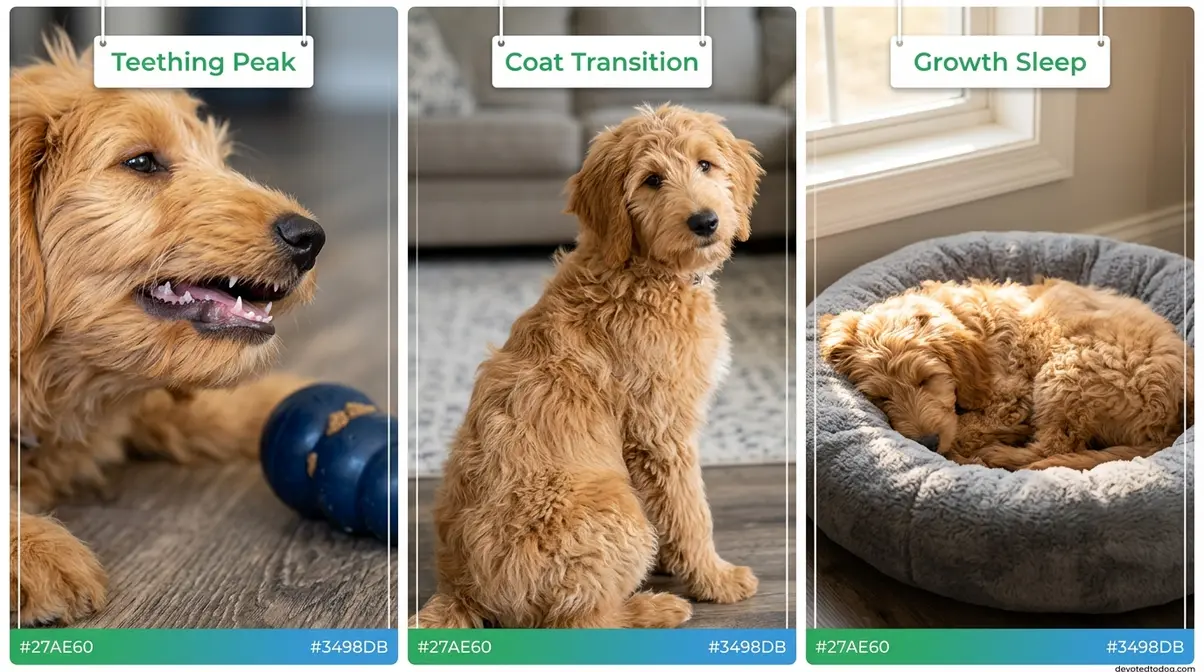
The 5-Month Pivot explains why your 5 month old goldendoodle seems to have changed overnight. Three developmental forces are colliding at once: their baby teeth are falling out and adult molars are pushing through, their brain is entering a temporary fear phase, and their body is growing at a pace that surprises even their owners. Understanding each force separately gives you a much clearer picture of what to do — and what not to do.
Picture this: your puppy was sleeping peacefully two hours ago, and now they’re destroying a throw pillow with focused intensity. They seem tired but wired. They’re chewing things they ignored last month. This is the typical 5-month experience — and it has a biological explanation for every frustrating moment. Across Goldendoodle owner communities, the consistent feedback is that this age feels like a sudden regression. It isn’t. It’s a convergence.
Teething: What’s Happening Now
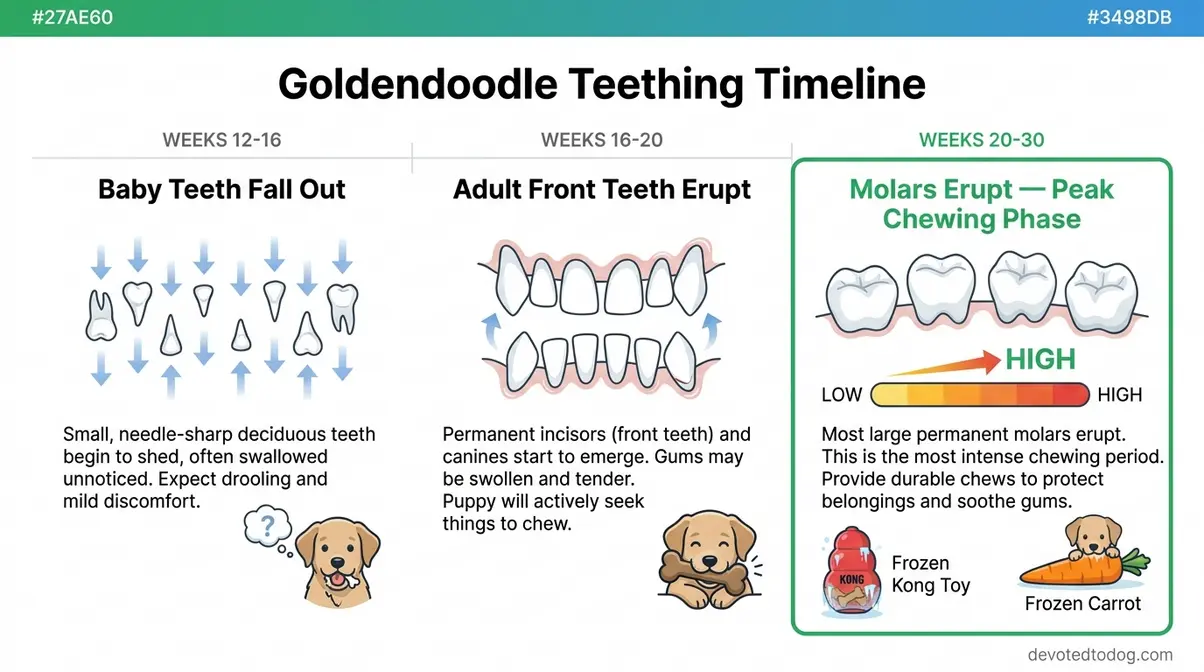
Goldendoodle molars typically erupt between 5 and 7 months of age (approximately weeks 20 to 30), making this the peak period for chewing and biting behavior in puppies at this stage (Texas Veterinary Dental Center, 2026). This single fact reframes everything. Your puppy isn’t being defiant — they are managing real physical discomfort.
Here’s the timeline in plain terms. Baby teeth (deciduous teeth — the small, sharp first set) fall out between 12 and 16 weeks. By 5 months, your puppy should have most of their adult front teeth already in place. What’s still actively pushing through right now are the molars — the large back teeth that have no baby-tooth equivalent and must break through the gum tissue entirely on their own. Think of it like a child losing teeth, except for dogs this process happens far faster and involves more teeth erupting simultaneously.
The practical result is a chewing spike. When a puppy is in molar pain, they chew to relieve pressure — the same way a teething infant chews on everything in reach. Safe options include frozen Kongs stuffed with peanut butter or plain Greek yogurt, solid rubber chew toys rated for aggressive chewers, and chilled (not frozen solid) carrots. Avoid rawhide, which poses a choking hazard, and any toy small enough to be swallowed whole. The American Veterinary Medical Association highlights the importance of providing an enriched environment with a variety of toys and structures to support healthy behavioral development in growing puppies (AVMA, 2026).
If your puppy has been leaving their favorite toy alone and suddenly destroying everything in sight — this is why. It’s not a personality change. It’s pain relief.
For context on what the teething phase looked like just a few weeks ago, see what to expect during 4-month-old Goldendoodle development.
Coat Transition to Adult Fur
Around 5 to 6 months, the soft, fluffy puppy coat your Goldendoodle was born with begins its transition to a thicker adult coat. This is a permanent change — the adult coat type (straight, wavy, or curly) becomes visible now, and it behaves very differently from the puppy fluff you’ve been managing.
The transition increases the risk of matting, particularly in high-friction areas: behind the ears, in the armpits, around the collar, and in the groin. Curly coats mat most aggressively during this period; straight coats shed more instead. Knowing your puppy’s emerging coat type helps you choose the right tools. A slicker brush works for surface tangles; a metal comb is essential for checking that no mats remain underneath after brushing.
Increase brushing to 3 to 4 times per week during this transition window (roughly 5 to 8 months). If you notice clumps forming behind your dog’s ears after a bath, that’s the coat transition in action. Dry thoroughly with a dryer or towel immediately after bathing, then brush while the coat is still slightly damp — water tightens mats and makes them significantly harder to remove once fully dry.
The adult coat type emerging now is also a preview of your grooming commitment for the next decade. A curlier coat means more professional grooming appointments; a wavier coat means more frequent home brushing. Both are manageable — but knowing what you’re working with now helps you plan.
Sleep and Bladder Control
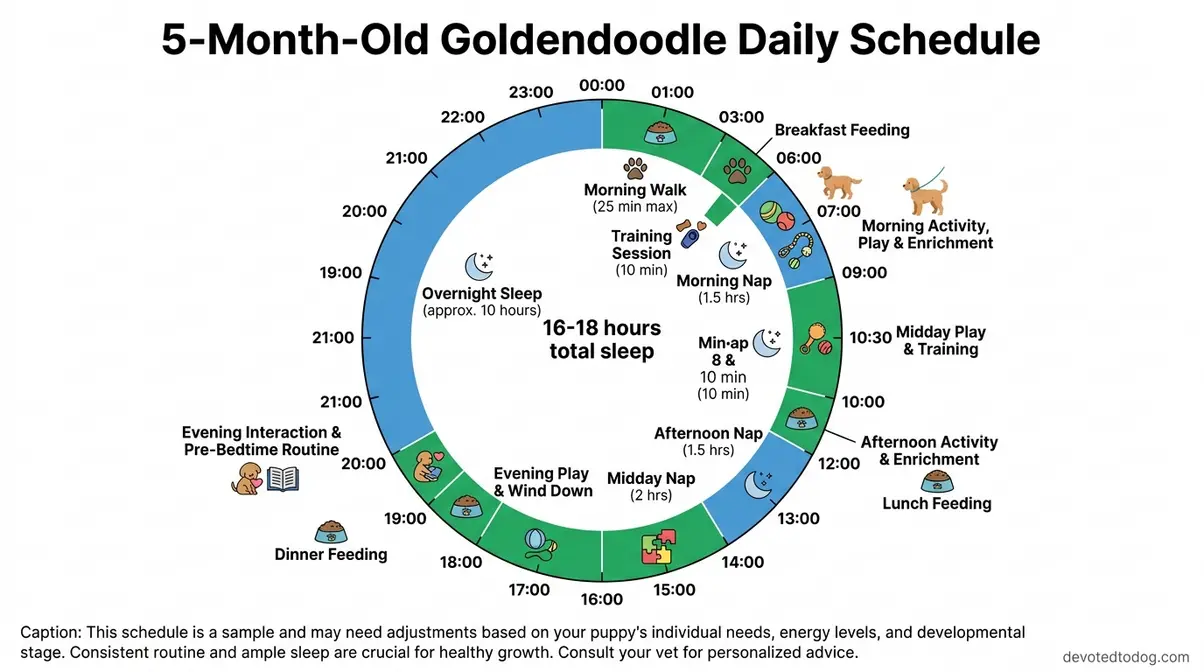
A 5-month-old Goldendoodle puppy needs approximately 16 to 18 hours of sleep per day, including nighttime sleep and daytime naps (PetMD; Petdirect, 2026). This is not laziness — it is biological necessity. Growth hormones release during sleep, and a puppy that isn’t getting enough rest will be crankier, harder to train, and more prone to biting. Uninterrupted nap time during the day is just as important as overnight sleep.
Bladder control is also maturing rapidly at this stage. The general rule of thumb is one hour per month of age, plus one — so a 5-month-old can typically hold their bladder for about 5 to 6 hours during the day. Many owners are successfully stopping crating at night around this age as bladder control improves. That said, accidents still happen, especially when a puppy is overstimulated or overtired.
Potty training milestones vary, but many 5-month Goldendoodles are largely “potty trained” and some have even learned to ring the bell for potty — a skill that signals strong communication between puppy and owner. If your puppy has had no accidents for several weeks and is consistently alerting you at the door, that’s a genuine developmental achievement worth acknowledging. UC Davis Veterinary Medicine notes that a 5-month-old puppy is past the primary socialization window (which closes around 14 weeks) and now requires ongoing positive reinforcement rather than initial socialization windows — meaning your focus now shifts from introducing new experiences to reinforcing learned behaviors through consistent routines.
As bladder control continues improving, see what to expect at 6 months to plan ahead.
✅ This Week’s Action: Teething Check
1. Run your finger along your puppy’s back gum line — if you feel swelling or new bumps, molars are erupting.
2. Freeze a Kong toy stuffed with peanut butter or plain Greek yogurt and offer it during peak chewing times (usually morning and evening).
3. Increase brushing to 3 sessions this week — check behind the ears and armpits for early mats.
What the Research Shows: UC Davis Veterinary Medicine confirms that a 5-month-old puppy is past the primary socialization window (which closes around 14 weeks). The focus now shifts from introducing new experiences to reinforcing learned behaviors through consistent, positive routines. This means the “regression” you’re seeing isn’t lost learning — it’s a shift in what your puppy needs from you (UC Davis Veterinary Medicine, vetmed.ucdavis.edu).
Common Misconception: “My puppy was doing so well — the biting and chewing must mean I did something wrong.”
Reality: Increased mouthiness at 5 months is almost always driven by molar pain, not a training regression. The puppy hasn’t forgotten their training — they’re distracted by discomfort. Redirect to appropriate chew toys rather than increasing correction frequency. Correction during a pain response builds anxiety, not compliance.
Physical Growth: Size and Weight at 5 Months

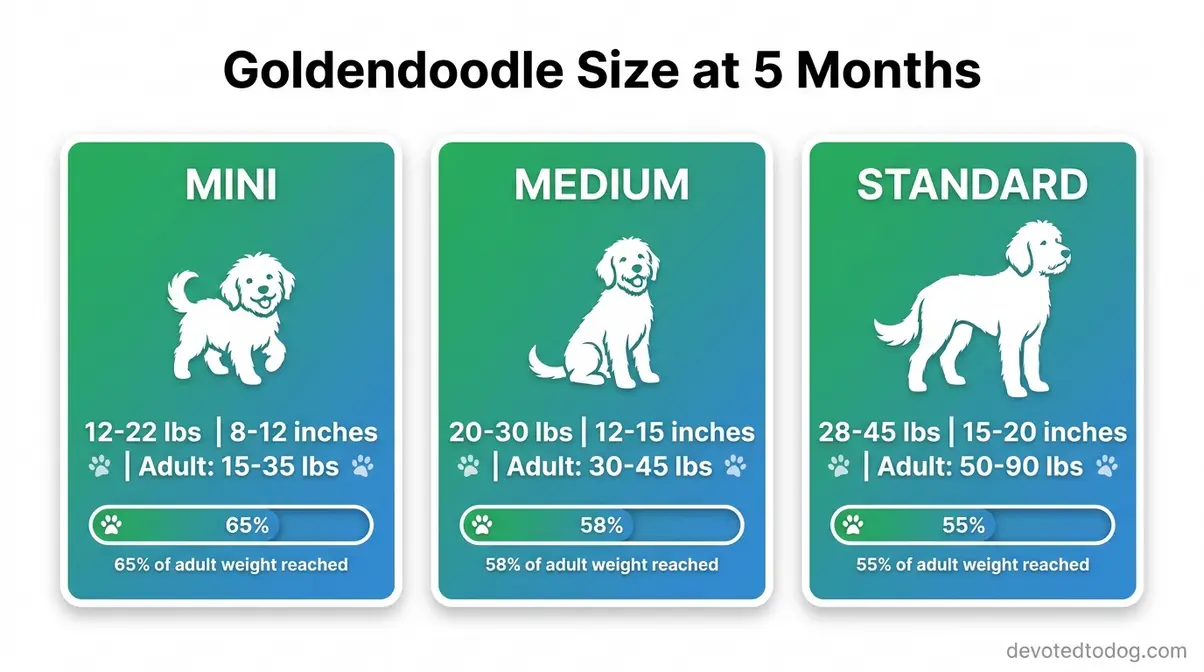
How much should a 5 month old goldendoodle weigh? The answer varies significantly by size category — and the range is wide enough that two puppies from different litters can look like entirely different breeds. Standard Goldendoodles, the larger variety that can reach 50 to 90 lbs as an adult, typically weigh 28 to 45 lbs at 5 months. Mini Goldendoodles, the smaller variety typically reaching 15 to 35 lbs at full maturity, weigh roughly 12 to 22 lbs at this stage. Medium Goldendoodles fall between 20 and 30 lbs.
“Do you ever look at your dog and question the size of them and wonder if they are really a standard size goldendoodle but then see a photo of them and see how big they are?”
If this is you — you are not imagining things. This is exactly what rapid, uneven growth looks like. Part of The 5-Month Pivot is that growth spurts are asynchronous — your puppy’s legs may outpace their body, creating the “gangly” look that makes owners question whether their dog is actually a Standard. It’s normal, and it’s temporary.
Mini Goldendoodle: Size & Weight
A 5-month-old Mini Goldendoodle typically weighs between 12 and 22 lbs, depending on sex and genetics (Goldilocks Goldendoodles growth chart, 2026; Premier Pups Goldendoodle Size Guide, 2026). Height at the shoulder is approximately 8 to 12 inches at this stage. Mini Goldendoodles are generally bred from a Miniature Poodle parent — which affects not just their ultimate size but their growth rate. They reach full size earlier than Standards, typically between 10 and 13 months.
By 5 months, Mini Goldendoodles are often at approximately 60 to 70% of their adult weight, meaning their growth is already decelerating. This is an important distinction from Standards, who are still in a steep growth phase at this age.
Use the list below as a quick reference for size benchmarks across all three Goldendoodle categories at 5 months:
- Mini Goldendoodle: 12-18 lbs (Female), 15-22 lbs (Male) | Adult Weight: 15-35 lbs
- Medium Goldendoodle: 20-26 lbs (Female), 22-30 lbs (Male) | Adult Weight: 30-45 lbs
- Standard Goldendoodle: 28-38 lbs (Female), 32-45 lbs (Male) | Adult Weight: 50-90 lbs
Cornell University College of Veterinary Medicine recommends weighing your dog every month to monitor their growth trajectory and prevent obesity-related joint stress — a particularly important habit during these rapid growth months. For full adult size expectations, see our complete Goldendoodle size and weight at full grown guide.
Standard Goldendoodle: Size & Weight
A 5-month-old Standard Goldendoodle typically weighs between 28 and 45 pounds — but their gangly appearance is caused by uneven growth, not a weight problem. At this stage, they are at roughly 50 to 60% of their adult weight, meaning significant growth still lies ahead (Premier Pups, 2026).
The “gangly” phase is a direct result of asynchronous growth — legs grow faster than the torso during this window, creating a disproportionate appearance that can make even a perfectly healthy puppy look awkward. This is completely normal and resolves on its own as the torso catches up, usually between 8 and 12 months.
As Cornell recommends, monthly weigh-ins help you spot growth curve deviations early. The easiest method: weigh yourself on a bathroom scale, then weigh yourself holding your puppy, and subtract. Do this on the same day each month. To compare current weight against growth benchmarks from 4 months, you can spot whether your puppy is tracking within the expected curve or diverging in a direction worth discussing with your vet.
Estimating Adult Weight
The most widely used estimation method is the 16-week formula: multiply your puppy’s weight at 16 weeks by two to estimate adult size (Ironstone Goldendoodles, 2026; Goldoodle.com, 2026). For example, if your Standard puppy weighed 20 lbs at 16 weeks, a rough adult estimate is 40 lbs. For Minis, double the weight at 14 to 16 weeks. This formula works best as a ballpark — genetics, diet, generation (F1 vs. F1b), and neutering timing all affect final size.
A more reliable day-to-day tool is the Body Condition Score (BCS) — a simple 1-to-9 scale vets use to assess whether your dog is at a healthy weight, where 4 to 5 is ideal for growing puppies. Tufts University’s Clinical Nutrition Service emphasizes that growing puppies should maintain a BCS of 4 to 5 on a 9-point scale and follow a single growth curve to prevent orthopedic issues (Tufts University, 2022).
At a healthy BCS of 4 to 5: you can feel the ribs but not see them, and there’s a visible waist when viewed from above. If ribs are prominently visible, your puppy may be underweight. If you can’t feel the ribs at all through the coat, that’s worth a conversation with your vet. Don’t adjust food portions based on visual appearance alone — use the BCS method first, then consult your veterinarian if you’re unsure.
How Big Is a GoldenDoodle at 5 Months?
A 5-month-old Goldendoodle’s size depends heavily on their size category: Standard Goldendoodles typically weigh 28 to 45 lbs, Medium Goldendoodles weigh 20 to 30 lbs, and Mini Goldendoodles weigh around 12 to 22 lbs. At this age, puppies often look “gangly” because their legs grow faster than their body. This uneven appearance is completely normal and temporary — the torso catches up over the following months. Results vary based on genetics, diet, and the specific Poodle parent size used in breeding (AKC, 2026).
✅ This Week’s Action: Weight Check
1. Weigh yourself on a bathroom scale, then weigh yourself holding your puppy. Subtract to get their weight.
2. Stand above your puppy and look for a visible waist — this is a quick BCS check.
3. Run your hands along their ribcage: you should feel the ribs but not see them. If ribs are visible, call your vet.
What the Research Shows: Cornell University College of Veterinary Medicine recommends weighing your dog monthly to monitor growth trajectory and prevent obesity-related joint stress — a particular concern for large breeds like Standard Goldendoodles during rapid growth phases. A consistent monthly record also makes it easier for your vet to identify growth curve deviations at wellness visits (Cornell University College of Veterinary Medicine, vet.cornell.edu).
Common Misconception: “My puppy looks too thin (or too big) — I must be feeding them the wrong amount.”
Reality: The “gangly” appearance at 5 months is caused by asynchronous growth, not malnutrition. Legs grow faster than the torso during this phase, making puppies look disproportionate. Use the Body Condition Score — not visual appearance alone — to assess weight, and consult your vet if you’re unsure. Adjusting food based on looks alone can create real nutritional problems where none existed.
Behavior and Training at 5 Months
A 5-month-old Goldendoodle’s behavior challenges are not a training failure — they are a neurological and physical event. Three simultaneous forces drive the behavioral changes you’re seeing: molar pain that makes sustained focus difficult, adolescent brain development that temporarily disrupts learned commands, and the early onset of a fear period that creates sudden fearfulness or hesitation. The behavioral challenges in this section are the most visible sign of The 5-Month Pivot — they’re not random, and they’re not permanent.
Why They Ignore Commands
A 5-month-old Goldendoodle’s sudden command regression has a specific cause: molar eruption creates physical discomfort that significantly lowers the threshold for distraction. “Stopped listening to ‘leave it'” is one of the most common concerns reported by owners at this exact age — and it’s almost always tied to teething, not stubbornness. When a puppy is in pain, they simply cannot maintain the same level of focus they could last month.
There’s also a neurological layer. Between 4 and 6 months, puppies experience a surge in hormones and neural rewiring that temporarily makes it harder to access learned behaviors under stress or distraction. The commands they “knew” are still in there — they’re just harder to retrieve when the puppy is overwhelmed. Think of it like trying to remember a phone number during a fire alarm. According to the American Kennel Club, puppies experience a second fear period between 6 and 14 months of age, which can explain sudden behavioral regressions or fearfulness beginning in a 5-month-old Goldendoodle (AKC, akc.org).
The right response is to lower the bar — not raise the correction. Practice “leave it” in a quiet room with low-value distractions, 3 to 5 repetitions at a time. If your puppy was reliably doing “leave it” at 4 months and now ignores it, they haven’t forgotten. They’re overwhelmed. Reduce difficulty and rebuild the habit gradually, rewarding each small success immediately. For a broader look at common Goldendoodle behavior problems and fixes, the pattern of adolescent regression applies to most commands during this window.
Biting: 6 Redirection Techniques

Mouthiness peaks during the molar eruption window — and positive reinforcement (rewarding the behavior you want, immediately after it happens) is the only approach that works reliably at this age. Here are six specific techniques, each with a clear action and the reason it works.
For a visual demonstration of biting redirection, watch the video below.
Estimated time: 10-15 minutes per day
Tools needed: Chew toys, frozen Kong, treats
Step 1: Execute the Toy Swap
The moment teeth touch skin, say “ouch” once, calmly. Immediately offer a chew toy. When your puppy takes the toy, say “yes!” in a bright tone. This works because it redirects the chewing instinct to an appropriate target without creating a negative association with play.
Step 2: Implement the Freeze
Stop all movement the instant you’re bitten. No yelling, no pulling away — go completely still. Movement triggers prey instinct, so stillness removes the reward. Most puppies lose interest within 10 to 15 seconds.
Step 3: Use the Time-Out
If biting continues after two attempts at redirection, step behind a baby gate or closed door for 30 to 60 seconds. Return calmly and resume interaction. This works because it removes the puppy’s access to the most rewarding thing in the room — you — as a natural consequence of the behavior.
Step 4: Yelp and Redirect
A high-pitched “ouch” (mimicking littermate feedback) followed immediately by a toy offer. It communicates bite inhibition in a language the puppy already understands from their litter. Note: this technique becomes less effective as puppies mature past 5 months — some dogs find the yelp exciting rather than corrective.
Step 5: Practice the “Leave It” Reset
Practice “leave it” with your hand closed around a treat. When the puppy backs away from your hand, open it and reward. It rebuilds impulse control — the exact skill that molar pain has temporarily disrupted — in a low-stakes setting that doesn’t involve their teeth on your skin.
Step 6: Provide a Kong Substitute
Before high-energy play sessions, offer a frozen Kong. Satisfying the chewing urge preemptively reduces biting during play. It prevents the behavior before it starts, rather than correcting it after.
Consistency matters more than any single technique — every family member must respond the same way, every time. During a play session, when your puppy bites your hand: freeze, say “ouch” once, offer the Kong. They take it. You say “yes!” and continue play. That’s one repetition — aim for 15 to 20 across the day during peak teething. The American Veterinary Medical Association supports providing an enriched environment with a variety of toys and structures to support healthy behavioral development in growing puppies (AVMA, 2026).
For a comprehensive training framework, see our guide to effective puppy training techniques.
The Adolescent Fear Period
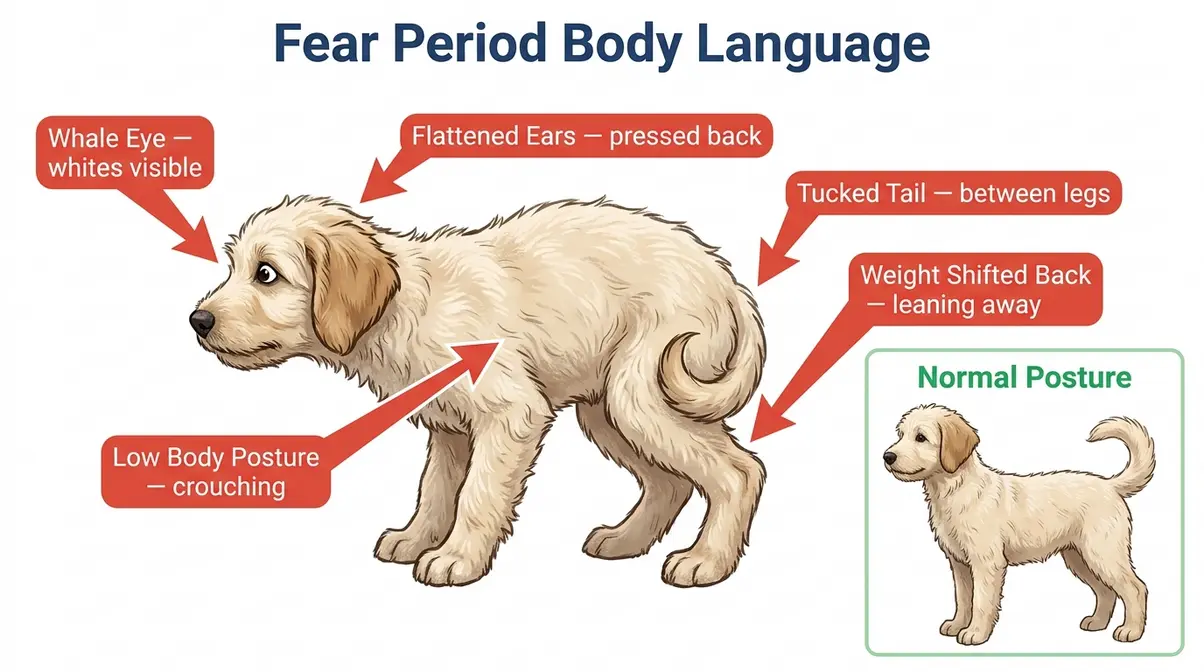
A fear period is a developmental phase when puppies become temporarily more cautious or fearful of things they previously ignored. The AKC identifies a second fear period between 6 and 14 months — but early signs can appear at 5 months, which is exactly why sudden behavioral changes at this age deserve understanding rather than increased correction (AKC, akc.org).
Signs to watch for include: sudden reluctance to approach familiar people or objects, “whale eye” (when you can see the whites of your puppy’s eyes), a tucked tail, trembling, or barking at things that never bothered them before. Your puppy might suddenly refuse to walk past the trash can they’ve walked past 50 times, or back away from a person they’ve greeted happily before.
Here’s what to do — and what not to do:
- Do: Remain calm and act as if the stimulus is no big deal. Give your puppy space to investigate at their own pace.
- Do NOT: Force them toward the scary thing. Do not flood them with the stimulus.
- Do NOT: Say “it’s okay, it’s okay” in a worried tone. This inadvertently reinforces the fear response by signaling that your concern is warranted.
- Do: Resume normal activities after brief acknowledgment. Walk past the trash can yourself, call them along casually, and reward when they follow.
This counterintuitive response — calm confidence rather than anxious reassurance — is the single most important thing you can do during the fear period. As your puppy approaches 6 months, this fear period may intensify before it resolves.
How to Discipline Your Puppy
Disciplining a Goldendoodle puppy means using positive reinforcement — rewarding the behavior you want, immediately and consistently — rather than physical correction or punishment. When biting occurs, redirect their attention to an appropriate chew toy rather than reacting with force. Goldendoodles are sensitive dogs who respond poorly to harsh methods, which can damage trust and worsen behavior during the already-challenging adolescent phase. Consistency across all family members matters more than any single technique. Consult a certified trainer (CPDT-KA) if biting escalates to actual aggression.
✅ This Week’s Action: Biting Redirection Drill
1. Set a timer for 10 minutes of structured play.
2. Each time teeth touch skin: freeze, say “ouch” once, offer chew toy.
3. When they take the toy: say “yes!” in a bright tone and continue play.
4. Aim for 15 to 20 repetitions across the day — not all at once.
5. Track progress: note which technique your puppy responds to fastest.
What the Research Shows: According to the American Kennel Club, puppies experience a second fear period between 6 and 14 months of age, which can begin showing early signs at 5 months. During this phase, behavioral regressions and sudden fearfulness are developmentally normal — not a training failure. Responding with punishment during this window damages trust and worsens the behavior long-term (American Kennel Club, akc.org).
Common Misconception: “My Goldendoodle is being dominant and needs firmer discipline.”
Reality: Dominance theory in dog training has been widely debunked by modern behavioral science. At 5 months, “defiant” behavior is driven by physical discomfort (teething), hormonal changes, and fear period anxiety — not a power struggle. Firmer discipline during this phase damages trust and worsens the behavior. Positive redirection is the evidence-based approach recommended by the AKC and AVMA alike.
Daily Care: Feeding, Exercise & Grooming
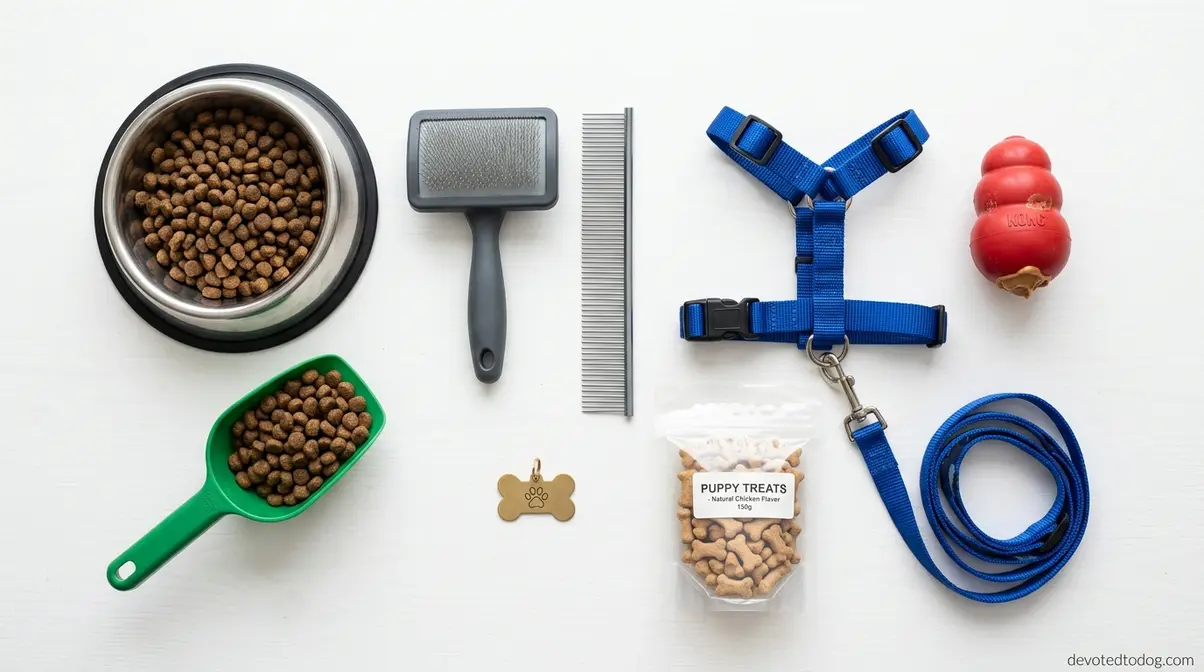
What does a 5-month-old Goldendoodle need every day? Three meals, 25 minutes of structured exercise per session, approximately 16 to 18 hours of sleep, and 3 to 4 brushing sessions per week. The 5-Month Pivot affects daily care too — a puppy experiencing molar pain needs more mental stimulation and less physical intensity, because their pain tolerance is already taxed. Getting the daily routine right at this stage lays the foundation for a healthy adult dog.
How Much to Feed at 5 Months
What’s the best food for a 5-month-old Goldendoodle? The answer depends on size — but the meal structure is consistent across all categories. By the time a puppy reaches 3 to 6 months, the American Kennel Club recommends decreasing feedings from four meals a day down to three appropriately portioned meals, spaced roughly 6 to 8 hours apart — for example, 7am, 1pm, and 7pm (AKC, akc.org). Structured meals also support potty training, since a predictable eating schedule creates a predictable elimination schedule.
For food type, Standard Goldendoodle owners should choose a formula labeled “large breed puppy.” These formulas have controlled calcium-to-phosphorus ratios that support healthy bone development during rapid growth — a critical distinction, since excess calcium in large breeds can contribute to skeletal problems. Mini Goldendoodles can use a standard puppy formula without the large-breed restriction.
Portion sizes should follow the feeding chart on your specific food’s packaging, then be adjusted using the Body Condition Score described in the Physical Growth section. Do not free-feed (leaving food out all day) — beyond the weight concerns, free-feeding makes it harder to track appetite changes that might signal a health issue. If your Standard Goldendoodle’s food says “1.5 cups per day” for a 30 lb puppy, divide that into three 0.5-cup meals rather than one large meal. Golden Retriever feeding guidelines apply similarly for size-matched puppies. For more guidance, see our recommendations for the best dog food for Goldendoodle puppies.
Exercise Limits: Safe Walking
How far can a 5-month-old Goldendoodle walk? The answer is more limited than most owners expect. The AKC’s guideline is 5 minutes of structured walking per month of age, per session — meaning a 5-month-old Goldendoodle’s maximum is 25 minutes per session (American Kennel Club, akc.org/expert-advice/health/puppies-mental-physical-exercise/). Two sessions per day is acceptable; more than that regularly risks growth plate stress.
- What to avoid:
- Jumping off furniture repeatedly (even from the couch)
- Long fetch sessions on hard surfaces like concrete or asphalt
- Running alongside adult dogs at full speed
- Multiple flights of stairs per day
Growth plates — the soft cartilage at the ends of bones where growth happens — are still open and vulnerable in Goldendoodles until 12 to 18 months, with larger breeds on the longer end. Damage to growth plates during this window can cause lasting joint problems. Many owners over-exercise their Goldendoodle at 5 months because the puppy seems to have unlimited energy. The energy is real; the joint durability is not.
Mental stimulation is your best tool for those high-energy days. A 10-minute training session, a sniff walk (let them smell everything at their own pace with no distance goal), or a puzzle feeder can tire a puppy as effectively as a walk — without the joint stress. If your Goldendoodle seems restless after their 25-minute walk, offer a Kong or a 5-minute training session instead of extending the outing. For a complete look at daily exercise needs for Goldendoodle puppies as they grow, the guidelines shift meaningfully after 12 months.
Grooming During the Coat Transition
Brush your Goldendoodle 3 to 4 times per week during the coat transition period, which runs roughly from 5 to 8 months. The high-mat areas are consistent across all coat types: behind the ears, in the armpits, around the collar, and in the groin. Start with a slicker brush to work through surface tangles, then follow with a metal comb to confirm no hidden mats remain underneath. A mat that’s caught early takes 30 seconds to remove; one that’s been there a week may require professional attention.
If your puppy hasn’t had their first professional groom yet, schedule it now. The ideal window is 4 to 6 months — not because the coat needs dramatic cutting yet, but because this is when puppies are most receptive to new experiences. Many groomers offer a “puppy’s first groom” session that’s shorter and gentler, focused on getting the puppy comfortable with the table, dryer, and clippers. A positive first experience makes every future groom easier.
For bathing, every 4 to 6 weeks is sufficient. Over-bathing strips the natural oils that protect the coat and skin, which can actually worsen the transition period. Always brush thoroughly before bathing — then dry completely and brush again immediately after. If your puppy now has no accidents and is ringing the bell for potty reliably, their routine is maturing right alongside their coat. Both are signs that the hardest part of puppyhood is beginning to settle.
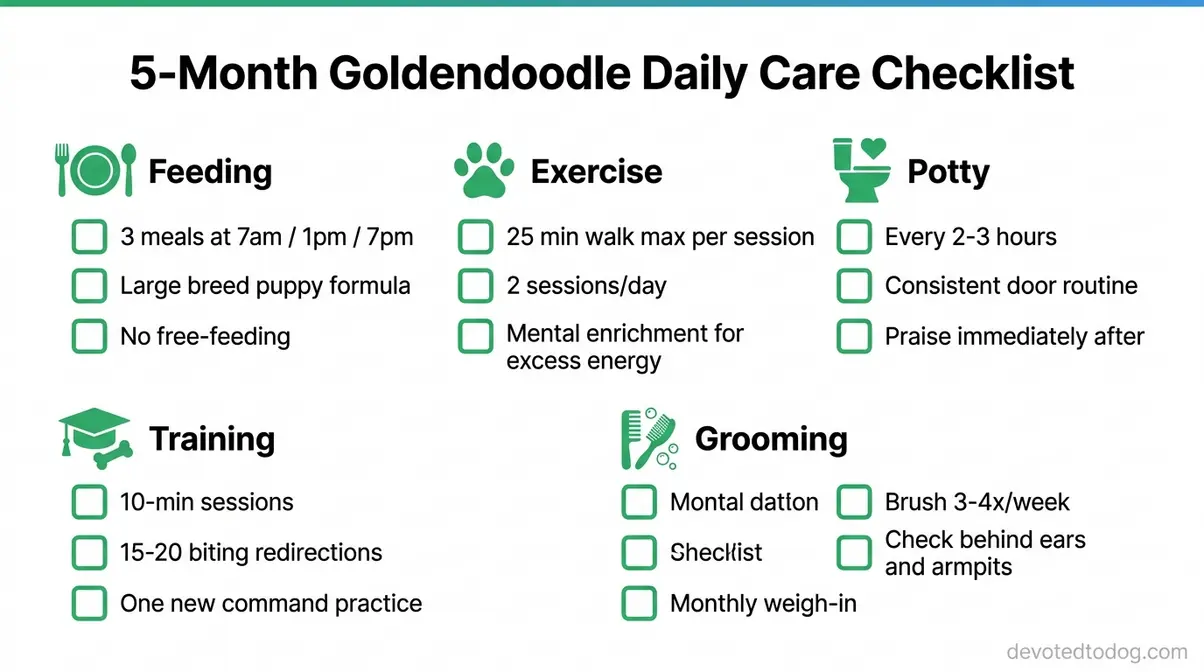
✅ This Week’s Action: Daily Care Audit
1. Check feeding: are you offering 3 meals per day at consistent times?
2. Check exercise: are walks staying at 25 minutes or under per session?
3. Check grooming: brush for 5 minutes today — check behind the ears first.
4. Check sleep: is your puppy getting uninterrupted nap time during the day, not just overnight?
What the Research Shows: The American Kennel Club recommends limiting structured walks to five minutes per month of age to protect developing joints — a 5-month-old Goldendoodle’s maximum is 25 minutes per session. Exceeding this regularly increases the risk of growth plate injuries, particularly in Standard Goldendoodles whose joints mature later than smaller breeds. Channeling excess energy into mental stimulation protects the joints while genuinely tiring the puppy (American Kennel Club, akc.org).
Common Misconception: “My Goldendoodle has so much energy — they obviously need more exercise than 25 minutes.”
Reality: High energy in puppies does not indicate readiness for adult exercise levels. Goldendoodle puppies have significant stamina but still-developing skeletal structures. Channeling excess energy into mental stimulation — training sessions, puzzle feeders, sniff walks — protects the joints while genuinely tiring the puppy, often more effectively than extended walks on hard surfaces.
When to Be Concerned: Warning Signs

Most of what a 5-month-old Goldendoodle does is normal, explainable, and temporary. But some signs warrant a call to your veterinarian — and knowing the difference helps you respond proportionately rather than either panicking over normal behavior or missing something real.
Signs Outside the Normal Range
Growth red flags — call your vet if you observe any of these:
- Significant weight loss, or failure to gain any weight over two or more consecutive weeks
- Limping or favoring a limb after exercise (potential growth plate injury — do not wait on this one)
- Swollen, hot, or painful joints
- Persistent vomiting or diarrhea lasting more than 24 hours
Behavioral red flags:
- Actual aggression — not mouthiness, but biting with clear intent, accompanied by growling, stiffening, or resource guarding behavior
- Extreme fearfulness that does not improve with gentle, positive exposure over 2 to 3 weeks
- Sudden personality change — lethargy, withdrawal, or disinterest in food or play that lasts more than 2 to 3 days
When in doubt, call your vet. The concerns above are always worth a phone call — and a brief consultation is far less costly than a missed early diagnosis. Your veterinarian can also help distinguish between normal adolescent behavior and something that needs intervention.
When Training Alone Isn’t Enough
Two specific scenarios call for professional support beyond what home training can provide.
Aggression: If biting is accompanied by growling, stiffening, or resource guarding — protecting food, toys, or spaces — this is meaningfully different from normal puppy mouthiness. Consult a certified professional dog trainer (CPDT-KA credential) or a veterinary behaviorist, not just a general obedience class. These professionals are trained to assess whether the behavior has a behavioral or medical root cause.
Extreme separation anxiety: If your puppy is destructive, howling continuously, or showing signs of self-harm when left alone — beyond the normal adjustment period of the first few weeks — this warrants a veterinary assessment first to rule out medical causes, followed by professional behavioral support. Separation anxiety at this level does not resolve on its own without structured intervention.
Both scenarios are manageable with the right help. Reaching out early produces significantly better outcomes than waiting to see if the behavior improves on its own.
Frequently Asked Questions
What Do Goldendoodles Not Like?
Goldendoodles dislike harsh training methods, prolonged isolation, and being ignored. As a highly social hybrid of Golden Retriever and Poodle, they are sensitive to tone of voice and respond poorly to yelling or physical correction. Being left alone for extended periods is particularly difficult for this breed, which is prone to separation anxiety. They also dislike overstimulating environments without access to a quiet retreat — especially during the adolescent fear period, when their stress threshold is lower than usual. Early socialization and consistent positive routines reduce these sensitivities significantly (AKC, 2026).
Do Goldendoodles Like Water?
Most Goldendoodles love water, thanks to their Golden Retriever and Poodle heritage — both breeds were originally developed for water-based work. However, individual dogs vary, and some puppies are hesitant at first. Introduce water slowly and positively: start with shallow puddles or a kiddie pool before attempting a lake or beach. Many Goldendoodles enjoy swimming as a joint-friendly, low-impact exercise option — particularly useful during the 5-month stage when high-impact exercise is limited. Never force a hesitant puppy into water (PetMD, 2026).
What Is a Teddy Bear Golden?
A “Teddy Bear” Goldendoodle (also called an English Goldendoodle) is bred from a Poodle and an English Cream Golden Retriever rather than an American Golden Retriever. They are known for their calm, gentle temperament, stockier build, and plush, light-colored coat that resembles a stuffed teddy bear. English Cream Goldendoodles are often considered slightly calmer than standard Goldendoodles, making them popular with families seeking a lower-energy companion (EuroGoldendoodle, 2026). At 5 months, their developmental milestones — teething, growth spurts, fear period — follow the same timeline as any other Goldendoodle variety.
Information in this guide was last reviewed March 2026 against veterinary sources from AKC, Cornell University College of Veterinary Medicine, Tufts University Clinical Nutrition Service, and UC Davis Veterinary Medicine. Consult your vet for the most current clinical guidance specific to your dog.
What This All Means for You and Your Goldendoodle
For owners of a 5 month old goldendoodle, this stage — The 5-Month Pivot — is defined by three simultaneous stressors: molar eruption (peaking between months 5 and 7), the onset of an adolescent fear period, and rapid, asynchronous growth spurts. Veterinary researchers recommend limiting walks to 25 minutes per session at this age to protect developing joints (AKC). The most effective approach combines consistent positive redirection for biting, monthly weight monitoring using the Body Condition Score, and structured daily routines for feeding, sleep, and grooming.
Naming this convergence matters. At Devoted To Dog, we constantly remind owners that when you understand that the “stopped listening to ‘leave it'” moment wasn’t defiance — it was a puppy distracted by molar pain — your entire response changes. The 5-Month Pivot is not a training failure. It is a developmental event with a beginning, a middle, and an end. Every behavior described in this guide is temporary, and every technique described here is proven to help you build a stronger bond with your dog. Your puppy is not broken, and neither are you.
Start with the 6-technique biting redirection drill this week — 15 to 20 repetitions per day, distributed across play sessions. Book a vet visit if you haven’t had a 5-month weight check to ensure their growth curve is on track. And if you’re already thinking ahead, read what to expect at 6 months — because the next stage brings its own milestones, and knowing what’s coming makes you a more confident owner.