That rich, chocolate-brown puppy you’re dreaming about might look completely different by the time it turns three. Most buyers don’t find out about coat fading until after they’ve already fallen in love — and paid $3,000 for the privilege.
Without understanding the genetics behind that chocolate color, you could end up confused, disappointed, and wondering why your “chocolate” dog now looks silver-beige. Knowing what to expect before you buy makes all the difference. In this guide, you’ll learn exactly what a chocolate Goldendoodle looks like, costs, and needs — including the science behind coat fading, how to spot a reputable breeder, and the honest downsides no breeder blog will tell you.
We cover appearance, genetics, grooming, pricing, and breeder red flags — everything you need to make a confident, informed decision.
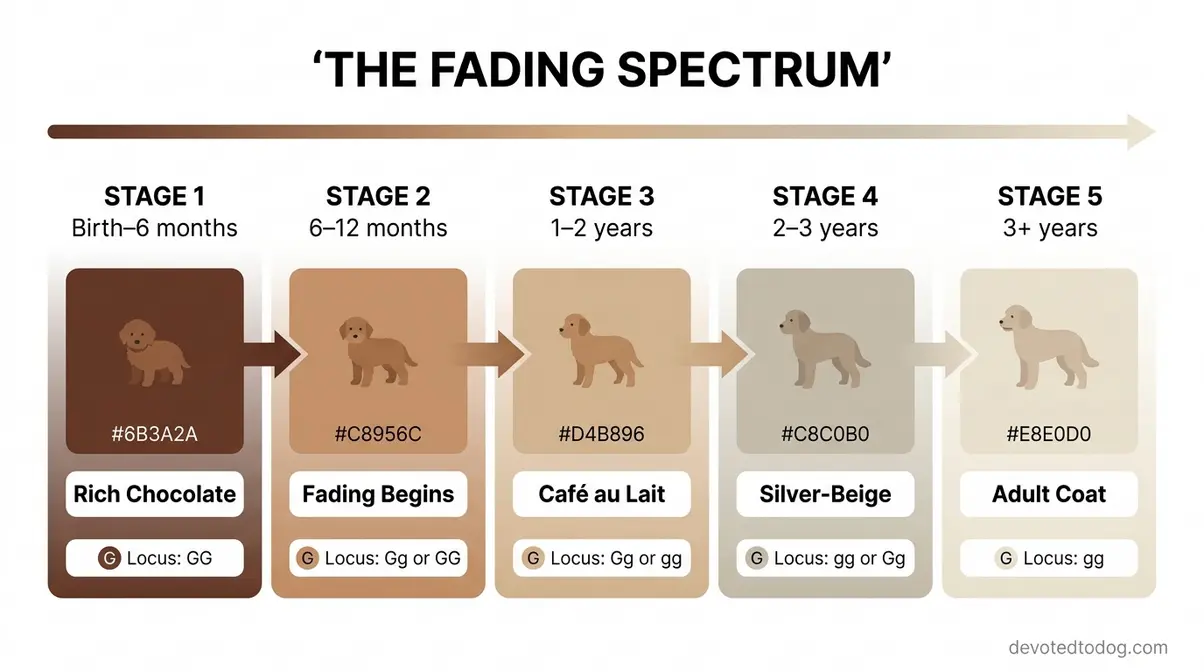
Chocolate Goldendoodles are rare, lovable dogs whose rich brown coats often fade to lighter shades by age 2–3 — a process called “The Fading Spectrum,” driven by the G Locus gene.
- Coat fading is normal: Most chocolate Goldendoodles lighten to silver-beige or café au lait — this is genetic, not a health issue
- They’re genuinely rare: The chocolate color requires a recessive gene from both parents, making them harder to find than cream or apricot Goldendoodles
- Prices range $2,000–$5,500+: Mini sizes and merle patterns command the highest premiums; verify directly with breeders as pricing changes frequently
- Grooming is non-negotiable: Their wavy or curly coats mat easily and need brushing at least 3–4 times per week
- “The Fading Spectrum” framework helps you predict your puppy’s adult color before you buy — ask your breeder for G Locus DNA test results
What Does a Chocolate Goldendoodle Look Like?
A chocolate Goldendoodle — a crossbreed of a Golden Retriever and a Poodle known for its rich brown coat — is one of the most visually striking dogs you’ll find. That deep, warm brown color comes from a recessive gene that both parents must carry. Here’s the part most buyers don’t know until it’s too late: the coat often changes color over time, a process we call “The Fading Spectrum.” Understanding this before you buy turns a potential disappointment into a fascinating part of your dog’s journey.
Chocolate Goldendoodles are among the rarest color variants in the breed, requiring a recessive brown gene from both the Poodle and Golden Retriever parent (Goldendoodle coat color guide).
Mini, Medium, and Standard Sizes
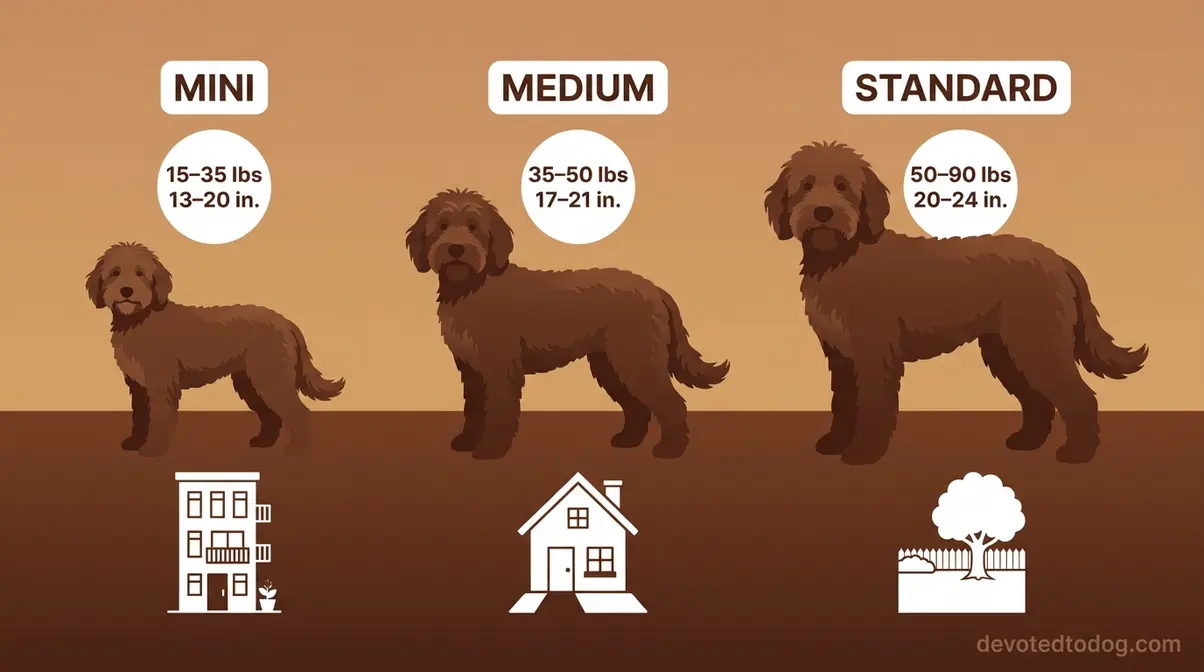
Chocolate Goldendoodles come in three main sizes, and the size you choose affects everything from your living space to your grooming budget. Here’s a clear breakdown.
| Size | Weight | Height | Best For |
|---|---|---|---|
| Mini | 15–35 lbs | 13–20 in. | Apartments, small homes |
| Medium | 35–50 lbs | 17–21 in. | Most families |
| Standard | 50–90 lbs | 20–24 in. | Active owners, large yards |
The mini chocolate Goldendoodle (15–35 lbs, 13–20 inches tall) is produced by crossing a Miniature Poodle with a Golden Retriever. It’s the most apartment-friendly option and great for families with small children or limited outdoor space. The medium size (35–50 lbs, 17–21 inches) is the sweet spot — manageable enough for most homes, substantial enough to keep up on long hikes. The standard (50–90 lbs, 20–24 inches) needs more room, more exercise, and more grooming time — produced using a Standard Poodle parent.
What this means for you: Mini chocolate Goldendoodles are the most in-demand size. Expect longer waitlists and sometimes higher prices because of that demand. If you want a mini, start your breeder search early.
For a deeper look at how how big Goldendoodles get at full grown, see our complete size guide.
Once you’ve chosen the right size, there’s another physical trait every buyer must understand — and it’s one that surprises almost everyone: the coat will almost certainly change color.
The Fading Spectrum Coat Changes
Many chocolate Goldendoodles carry the G Locus — the gene that controls progressive greying — which causes the coat to gradually lighten over time. This is NOT a health problem. It’s predictable genetics, and it has a name: The Fading Spectrum.
According to the progressive greying allele and coat depigmentation, the progressive greying allele causes a dog’s hair to depigment over time, often resulting in a coat that is almost completely white by 6 to 12 years of age (UC Davis Veterinary Genetics Laboratory). For chocolate Goldendoodles, the visible change is usually far more subtle — but it happens.
The timeline looks like this: fading typically begins around 6 months to 1 year old, progresses steadily through age 2, and is largely complete by age 3. The final color can range from silver-beige to café au lait to a lighter ash brown. Some dogs hold onto a richer chocolate tone; others become dramatically lighter. The difference comes down to whether the dog carries one or two copies of the G allele.
“In goldendoodles, all the shades are just called chocolate, though breeders can usually tell based on parentage if the puppies will fade.”
Buyers can ask breeders for DNA test results from services like Embark or Paw Print Genetics. If both parents carry the G allele, fading is very likely. If neither parent carries it, the chocolate coat is more likely to stay rich.
What this means for you: If you love the deep chocolate look, ask your breeder specifically about the G Locus status of the parents before you commit. A reputable breeder will have these test results on file.
Now that you know how the coat evolves, let’s address the question almost every buyer asks first: just how rare is this color?
Are Chocolate Goldendoodles Rare?
Chocolate Goldendoodles are relatively rare because the rich brown coat requires a recessive gene from both the Poodle and the Golden Retriever parent. Unlike dominant colors like cream or apricot — which only need one parent to carry the gene — chocolate requires both parents to contribute the recessive “b” allele for any puppies to be chocolate.
Think of a recessive gene like a hidden trait: it only shows up when a puppy inherits it from both parents, not just one. Cream and apricot Goldendoodles are far more common because those colors are dominant — they show up even when only one parent carries them. Chocolate is simply less frequently produced as a result of this genetic requirement (Goldendoodle coat color guide).
The practical implication? Expect longer waitlists — often 6–18 months at reputable breeders — and potentially higher prices due to scarcity. You may also find fewer available litters at any given time compared to cream or apricot puppies.
A fun fact for name inspiration: popular chocolate Goldendoodle names include Mocha, Coco, Brownie, Truffle, and Bear — all perfectly fitting for that rich brown coat (however long it lasts).
Beyond the solid chocolate coat, breeders are also producing some stunning pattern variations — each with its own genetics and price premium.
Chocolate Goldendoodle Coat Colors and Patterns
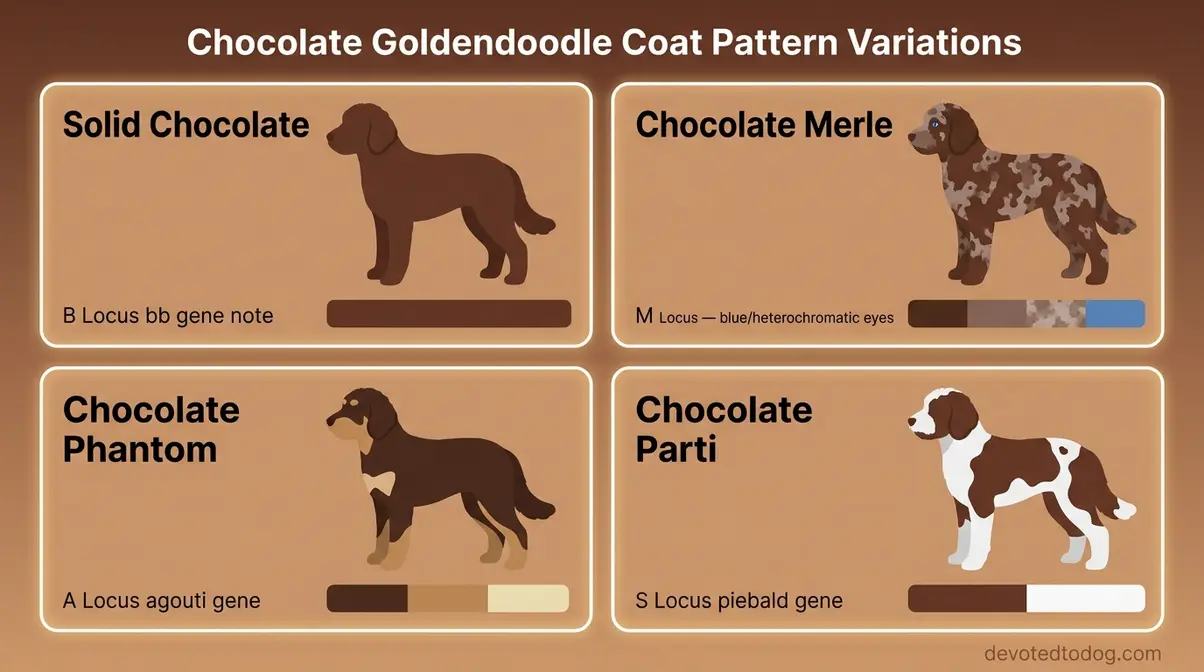
Chocolate Goldendoodles come in several pattern variations beyond solid brown — merle, phantom, parti, and tuxedo — each created by different genetic combinations. The merle pattern is the most sought-after and most expensive, but it also carries specific health considerations every buyer must understand before paying a premium. Knowing the difference between these patterns helps you ask the right questions and avoid an expensive mistake.
For a full breakdown of all color options, see all Goldendoodle coat colors and patterns explained.
Chocolate Merle Goldendoodle
A chocolate merle Goldendoodle is a dog with a mottled or marbled coat — patches of diluted color (lighter brown, grey, or cream) scattered across the base chocolate coat. This pattern is created by the merle (M Locus) gene, which affects pigmentation throughout the entire body.
One distinctive feature: chocolate merle Goldendoodles frequently have blue or heterochromatic (two-colored) eyes because the merle gene reduces pigmentation in the irises as well as the coat. It’s one reason this pattern is so visually striking.
However, there’s a critical health consideration buyers must know. When two merle-patterned dogs are bred together, each puppy has a 25% chance of being a “double merle” — inheriting two copies of the merle gene. Research shows that double merles face substantially elevated risks of deafness and vision impairment. A foundational study found 54.6% of double merle Dachshunds had hearing problems; blindness risk from eye malformation is also significantly elevated in double merles (PMC). Researchers at UPenn School of Veterinary Medicine have identified the genetic mutation causing day blindness in Doodles and Standard Poodles. Reputable breeders never breed merle × merle.
What to ask your breeder: “Are both parents tested for merle status? Is this puppy a double merle?”
For more on health risks and traits of merle Goldendoodles, see our dedicated guide.
If the merle pattern feels too risky, the phantom is a stunning alternative — with none of the health concerns.
Chocolate Phantom Goldendoodle
A chocolate phantom Goldendoodle has a solid dark chocolate body with lighter tan, cream, or apricot “points” in specific locations: above both eyes, on the sides of the muzzle, inside the ears, on the chest, inside the legs, and below the tail. Think of it like a Doberman’s color pattern on a fluffy, curly Doodle.
The phantom pattern is controlled by the A Locus (agouti gene) — the gene that determines whether a second color appears on specific body regions. It is NOT associated with any health risks. This makes it a popular choice for buyers who want a distinctive look without the concerns that come with merle breeding.
One important note for chocolate phantom buyers: the “points” (those tan or cream markings) may also fade over time via The Fading Spectrum. So the contrast between the dark base and the lighter points could shift as the dog ages. Chocolate phantom Goldendoodles typically command a $200–$500 price premium over solid chocolate — a reflection of their visual appeal and the additional genetic planning required from breeders.
Two more patterns — parti and tuxedo — offer a different kind of contrast: large patches of white on a chocolate base.
Chocolate Parti and Tuxedo Goldendoodles
A chocolate parti Goldendoodle has a coat that is at least 50% white, with chocolate patches distributed across the body. The white areas come from the S Locus (piebald gene), which suppresses pigment in certain regions. The result looks like a chocolate-and-white patchwork — bold, eye-catching, and increasingly popular. “Chocolate and white Goldendoodle” is essentially the same thing as parti; the terms are used interchangeably.
A chocolate tuxedo Goldendoodle is a subset of the parti pattern where the white is concentrated specifically on the chest, belly, chin, and paws — giving the appearance of a formal tuxedo. Very photogenic and a rising favorite among owners who want something distinctive.
A chocolate abstract Goldendoodle has less than 50% white — showing up as small white markings like a blaze on the face, a white chest spot, or white-tipped paws on a predominantly chocolate coat. These subtle markings are sometimes called “mismarks” by breeders, though many owners find them charming.
Finally, one of the most frequently asked questions about chocolate Goldendoodles: can they really have blue eyes?
Do They Have Blue or Green Eyes?
Yes, chocolate Goldendoodles can have blue eyes, but only when the merle gene is present. The merle gene reduces pigmentation throughout the body — including the irises — which is what creates that striking blue or heterochromatic eye color. Solid (non-merle) chocolate Goldendoodles almost always have warm brown or amber eyes.
Green eyes are even rarer than blue. They occur in some merle carriers and are considered a highly sought-after trait by buyers who specifically seek them out. Be cautious of breeders marketing “blue-eyed chocolate Goldendoodles” who cannot explain the genetic basis for those eyes — it may indicate undisclosed or irresponsible merle breeding.
Now that you understand what a chocolate Goldendoodle looks like, let’s dig into the genetics that create this color in the first place — and what different “generations” mean for your dog’s coat.
Generations and the Chocolate Gene
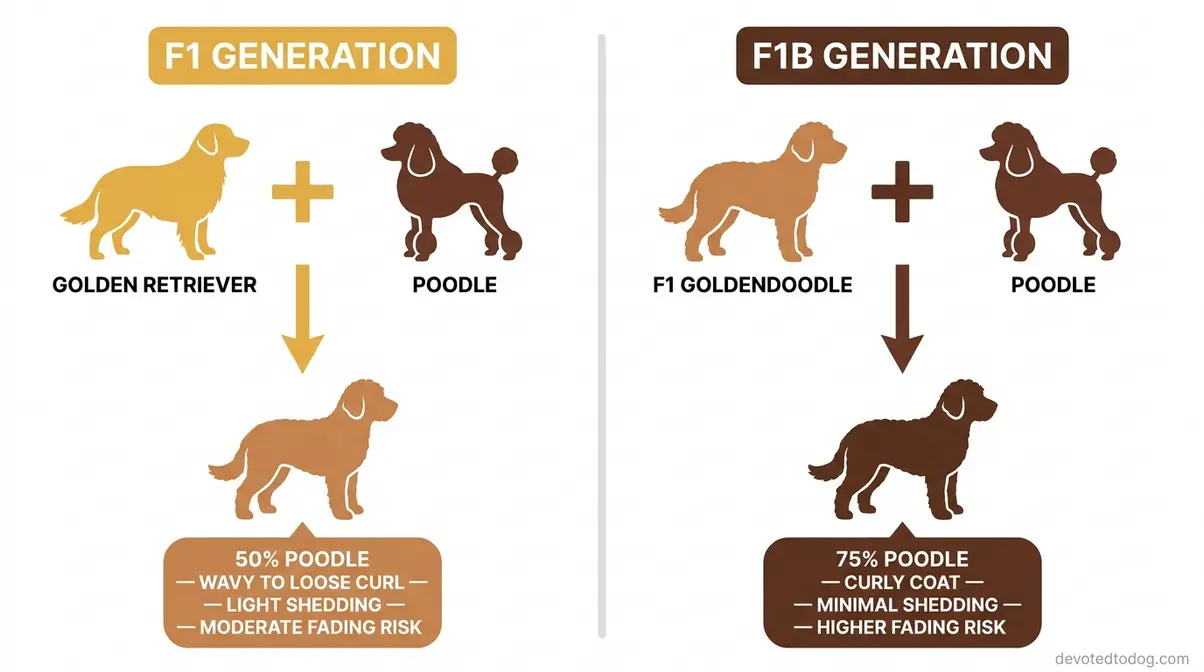
Goldendoodle “generations” (F1, F1B, F2, and so on) describe the percentage of Golden Retriever vs. Poodle in a dog’s DNA — and that percentage directly affects coat type, shedding level, and even the likelihood of coat fading. For chocolate coloring specifically, generation matters because a higher Poodle percentage means curlier, lower-shedding coat genes — but also more exposure to the G Locus fading gene that is more prevalent in Poodle lines. Understanding generations helps you choose the right dog for your allergy needs AND predict whether your chocolate coat will stay rich or lighten over time.
For a complete guide to Goldendoodle generations and genetics, see our in-depth resource.
F1 vs. F1B Chocolate Goldendoodle
An F1 chocolate Goldendoodle is a first-generation cross of one purebred Golden Retriever and one purebred Poodle — 50% of each. Coats range from wavy to loosely curly. F1s may shed lightly, and their chocolate coat traits come equally from both parent breeds.
An F1B chocolate Goldendoodle is a backcross — an F1 Goldendoodle bred back to a Poodle — resulting in a dog that is approximately 75% Poodle. Coats are curlier and lower-shedding, making F1B the better choice for allergy-sensitive families. Mini F1B chocolate Goldendoodle puppies are especially popular for allergy-sensitive families living in smaller spaces. The higher Poodle percentage also means a higher likelihood of inheriting the G Locus fading gene. If you’re buying an F1B, asking for G Locus test results becomes even more important.
| Generation | Poodle % | Coat Type | Shedding Level | Chocolate Fading Risk |
|---|---|---|---|---|
| F1 | 50% | Wavy to loose curl | Light | Moderate |
| F1B | 75% | Curly | Minimal | Higher |
| F2 | 50% | Variable (unpredictable) | Variable | Moderate |
| F2B | 62.5% | Moderately curly | Low | Moderate–High |
F2 Goldendoodles (F1 × F1) have the most unpredictable coats — some may even shed more than expected. F2B dogs (F1 × F1B) land in the middle, with moderately curly coats and moderate shedding. Some buyers also confuse Goldendoodles with chocolate Lab mixes — these are entirely different crossbreeds with straight, shorter coats and different temperament traits.
For details on F1B Goldendoodle traits and what to expect, see our dedicated guide.
But why is the chocolate color rare regardless of generation? The answer comes down to one specific gene.
Why Chocolate Is a Recessive Color
The chocolate coat color is controlled by the B Locus — the gene that determines whether dark pigment (called eumelanin, the pigment responsible for black and brown tones) expresses as black or brown (chocolate). For a puppy to be chocolate, it must inherit two copies of the recessive “b” allele — one from each parent.
Think of it like a recipe: both parents must contribute the chocolate ingredient for the final dish to taste like chocolate. If only one parent is a carrier and the other is not, the puppies will express black-based pigment or other colors — not chocolate.
Research published by the NIH confirms that all canine coat colors, including chocolate brown, are determined by the varied expression of two primary pigment molecules: eumelanin and pheomelanin — the B Locus controls which form eumelanin takes (genetic expression of canine coat pigments). This is exactly why chocolate Goldendoodles are rare — the recessive gene requirement means both parents must carry it, which happens less frequently than with dominant color genes.
A breeder who can show DNA test results proving both parents carry “bb” (two recessive alleles at the B Locus) is demonstrating genuine expertise — and giving you confidence that the litter will actually be chocolate.
Now for the question buyers ask most often: “Will my specific puppy’s coat fade?” Here’s how to predict it before you buy.
Predicting If Your Puppy Will Fade
The most reliable way to predict fading is to ask your breeder for G Locus (SILV gene) test results for both parents. If both parents carry the G allele, fading is very likely. If neither parent carries it, the chocolate coat is more likely to stay rich and dark into adulthood.
DNA testing services like Embark or Paw Print Genetics offer G Locus testing as part of their panels. Reputable breeders who invest in genetic health testing will have these results on file and should share them willingly. The UC Davis VGL offers genetic health testing for Goldendoodles to screen for inherited disorders and coat color genetics.
As noted earlier, F1B puppies (higher Poodle percentage) have statistically higher exposure to the G Locus because the Poodle breed has a higher prevalence of the progressive greying gene than Golden Retrievers. This is part of The Fading Spectrum — and it’s predictable, not random.
- 3 Questions to Ask Your Breeder About Fading:
- “What is the G Locus status of both parents?”
- “Do you have Embark or Paw Print Genetics results on file?”
- “Based on the parents’ genetics, how likely is this litter to fade?”
For more on Goldendoodle generations and how genetics affect coat type, see our full guide.
With the genetics covered, let’s get practical: what does it actually take to care for a chocolate Goldendoodle day-to-day?
Care, Grooming, and Behavior Guide
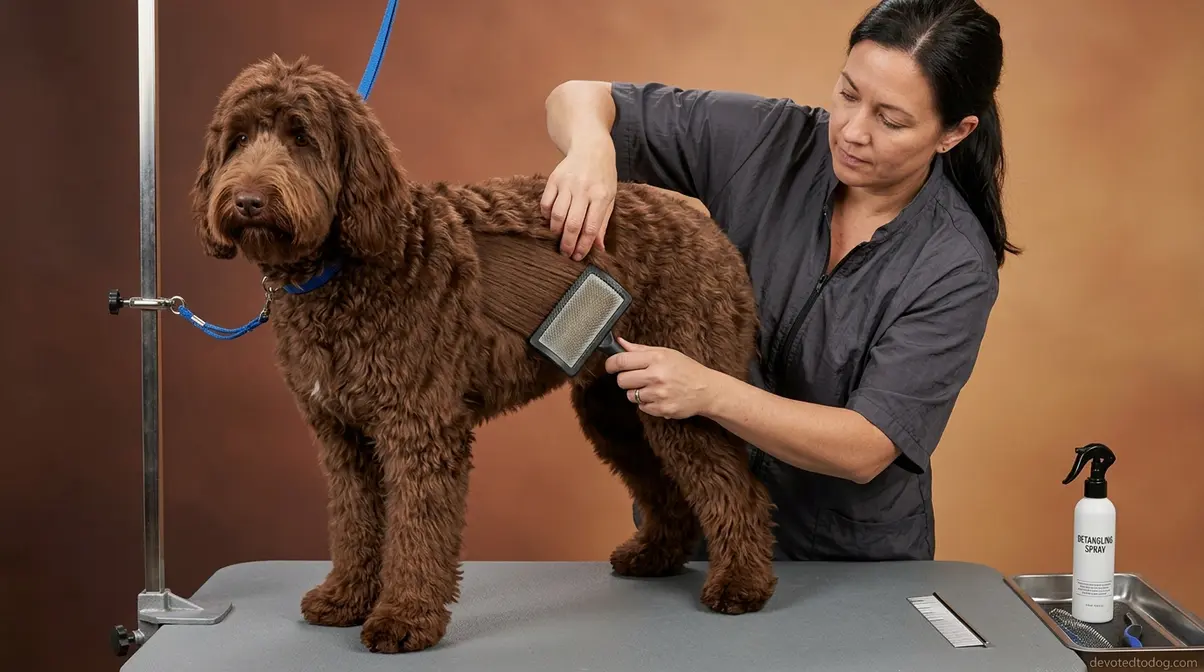
Chocolate Goldendoodle puppies and adults need more grooming, exercise, and mental stimulation than most buyers expect. Their curly or wavy coats can mat within days without proper brushing, and they need at least 30–60 minutes of active exercise daily. Knowing this upfront helps you decide if a Goldendoodle fits your lifestyle — before you fall in love with a puppy you can’t properly care for.
Grooming Curly or Wavy Coats
Grooming is where many new Goldendoodle owners get caught off guard. Generic advice like “brush regularly” doesn’t prepare you for the reality of a curly, chocolate coat. Here are 6 specific steps — the professional standard for keeping any wavy or curly Doodle coat mat-free.
Step 1: Detangle before bathing Never bathe a matted coat. Mats tighten when wet, making them nearly impossible to remove without cutting. Use a detangling spray and gently work through knots with your fingers first.
Step 2: Section the coat (line brushing) Part the fur into horizontal sections, starting at the legs and working up toward the back. Brush each section completely before moving to the next. This technique — called “line brushing” — is the professional grooming standard and the single most effective way to prevent mats.
Step 3: Use a slicker brush for surface fur A slicker brush — a paddle-shaped tool with fine wire bristles — removes loose fur and surface tangles. Brush in the direction of hair growth with light, consistent pressure.
Step 4: Follow with a steel comb Run a steel comb through each section after the slicker brush. If the comb catches on anything, there’s still a mat — go back with the slicker brush before moving on.
Step 5: Target mat-prone zones last Mats form fastest behind the ears, under the armpits, around the collar, and in the groin area. These spots deserve extra attention at every single session.
Step 6: Set your brushing frequency Curly-coated F1B Goldendoodles need brushing 4–5 times per week. Wavy-coated F1s need at least 2–3 times per week. Professional grooming every 6–8 weeks keeps the coat manageable and the dog comfortable.
A dark chocolate Goldendoodle’s coat shows matting more visibly than lighter coats — check behind the ears and under the legs at every brushing session.
Regular professional grooming (every 6–8 weeks) can also slightly influence The Fading Spectrum — clipping encourages new hair growth that may come in a shade lighter than the existing coat, gradually accelerating the color transition.
For a full comparison of tools, see best brushes for wavy and curly Goldendoodle coats.
Grooming takes care of the coat — but a Goldendoodle also needs significant daily exercise and consistent training to stay happy and well-behaved.
Exercise, Training, and Behavior
Chocolate Goldendoodle puppies are energetic, curious, and deeply social — and those traits don’t disappear with age. Adults need 30–60 minutes of active exercise per day: walks, fetch, swimming, or off-leash play all count. For puppies under 1 year, follow the “5 minutes per month of age, twice daily” rule — so a 4-month-old puppy gets two 20-minute walks per day — to protect their still-developing joints.
Goldendoodles respond best to positive reinforcement training — reward good behavior immediately with treats, praise, or play. Redirect unwanted behavior rather than punishing it. Their sensitive, eager-to-please temperament means they often shut down under harsh correction, making punishment-based methods counterproductive. Crate training works especially well for establishing routines and giving puppies a safe, calm space to decompress.
Owner communities on Reddit and Facebook consistently report separation anxiety as the #1 challenge of the breed. Goldendoodles are intensely social and consider every person a friend — the downside is they can struggle significantly when left alone for more than 4–6 hours. If you work full days, plan ahead for a dog walker, doggy daycare, or a canine companion.
For a step-by-step Goldendoodle puppy potty training guide, see our dedicated resource.
Now for one of the most urgent care topics — what happens if your Goldendoodle actually eats chocolate?
If Your Goldendoodle Eats Chocolate
This section matters more than it might seem — chocolate toxicity is a genuine emergency, and knowing what to do in the first few minutes can make a real difference.
Chocolate contains theobromine — the compound in chocolate that is toxic to dogs — along with caffeine. Dogs metabolize theobromine much slower than humans, causing it to build up to dangerous levels in the body. The darker the chocolate, the higher the theobromine content: baker’s chocolate and dark chocolate are the most dangerous; milk chocolate is less so; white chocolate contains very little theobromine. The FDA warns that chocolate contains theobromine and caffeine — two compounds dogs metabolize much slower than humans, making chocolate highly toxic to all dogs, including Goldendoodles (FDA warning on chocolate toxicity in dogs).
If your Goldendoodle eats chocolate, act immediately:
- Do NOT wait for symptoms to appear — act right away.
- Note the type and amount of chocolate consumed.
- Call your vet or the ASPCA Animal Poison Control Center (888-426-4435) immediately.
- Do NOT induce vomiting unless a vet specifically directs you to.
- Bring the chocolate packaging to the vet if possible — the label helps calculate theobromine dose.
Symptoms appear within 6–12 hours and include vomiting, diarrhea, restlessness, excessive urination, muscle tremors, and seizures. Cornell University’s Riney Canine Health Center notes that theobromine and caffeine in chocolate primarily cause dangerous stimulation of a dog’s central nervous system and heart (effects of theobromine on a dog’s nervous system).
A 50 lb Goldendoodle can experience toxic symptoms from as little as 1 oz of baker’s chocolate. When in doubt, call your vet.
With care covered, let’s tackle the most practical question: how do you actually find one of these dogs — and how much will it cost?
Breeders, Prices, and Expectations
Chocolate Goldendoodles for sale are available through reputable breeders and marketplace platforms, but finding one requires patience — expect 6–18 months on a waitlist at quality breeders. Prices range from $2,000 to $5,500+ depending on size, pattern, generation, and breeder reputation (Happy Doodle Farm). Understanding pricing benchmarks protects you from paying inflated premiums for “rare” marketing language.
Start your search with how to find a reputable Goldendoodle breeder before contacting any individual breeder.
How Much Does It Cost?
Based on recent market data from multiple breeder sources, here are current price ranges for chocolate Goldendoodles from health-tested, reputable breeders:
| Size | Standard Price | Merle/Phantom Premium | Notes |
|---|---|---|---|
| Mini | $2,500–$5,500+ | +$500–$1,500 | Highest demand, longest waitlists |
| Medium | $2,200–$4,000 | +$500–$1,000 | Sweet-spot size for most families |
| Standard | $2,000–$3,500 | +$500–$1,000 | More supply, relatively shorter waits |
Prices reflect current market averages; verify directly with breeders as pricing changes frequently.
Several factors drive price variation beyond size: health testing (OFA hip certification, eye certification, genetic DNA panels via Embark or Paw Print Genetics), GANA membership, breeder reputation, geographic location, and generation. F1B puppies typically cost more than F1 for the same size, reflecting the higher demand for their lower-shedding coats.
Beyond the purchase price, budget honestly for the first year. According to GoldendoodleInsurance.com, first-year ownership costs beyond the puppy price range from $4,500–$12,000+, covering supplies ($500–$1,500), vet care ($400–$2,000), food ($300–$1,000), and grooming ($400–$1,200). For a full cost breakdown of owning a Goldendoodle, see our complete ownership cost guide.
Now that you know what to budget, here’s how to find a breeder you can actually trust.
Finding a Reputable Breeder
A reputable chocolate Goldendoodle breeder should be a member of the Goldendoodle Association of North America (GANA), provide complete health testing documentation, and willingly share parent DNA results — including B Locus, G Locus, and merle status. Here are five criteria to verify before committing to any breeder:
- GANA membership — Check the Goldendoodle Association of North America member directory to confirm the breeder is listed. GANA sets health testing and ethical breeding standards.
- Health testing documentation — OFA hip certification, eye certification, and a genetic DNA panel (Embark or Paw Print Genetics) for both parents.
- Willingness to share DNA results — A good breeder proactively shares B Locus, G Locus, and merle (M Locus) test results. If they hesitate, that’s a red flag.
- References from past buyers — Ask for at least three references and actually call them.
- Puppy socialization program — Puppies should be raised in a home environment, not isolated in kennels. Early socialization shapes temperament.
For where to look: the GANA breeder directory is the best starting point. Avoid Craigslist, Facebook Marketplace, and any breeder who ships puppies without a home visit or video call. Reputable breeders have 6–18 month waitlists. A breeder with multiple colors of puppies always immediately available is a yellow flag worth investigating further.
For a step-by-step guide to finding a reputable Goldendoodle breeder, see our full evaluation checklist.
Unfortunately, the “chocolate is rare” narrative is also used by unscrupulous breeders to justify inflated prices. Here’s what to watch for.
Red Flags and Breeder Scams
When searching for chocolate Goldendoodles for sale, some sellers exploit the “rare color” angle to charge premiums that aren’t backed by genetics or health testing. Here’s what to watch for:
- “Chocolate is rare — that’s why it costs more” with no DNA documentation. Rarity should translate to longer waitlists, not arbitrary price inflation. If a breeder can’t show B Locus test results proving both parents carry the recessive allele, the premium isn’t justified.
- Merle chocolate Goldendoodle listings with no mention of double merle health risks. Any ethical breeder selling merle puppies should proactively discuss G Locus and M Locus test results and explain why they never breed merle × merle.
- Multiple colors of puppies always available. Reputable breeders plan litters carefully and have waitlists. Instant availability across multiple colors suggests high-volume, low-care breeding practices.
- No health guarantee or refusal to provide veterinary records for the parents. This is a non-negotiable baseline. If a breeder won’t share parent health records, walk away.
On a lighter note: chocolate Goldendoodle-themed merchandise — ornaments, stuffed animals, tote bags — is widely available on Etsy and Amazon. Fun gifts for Doodle owners, but not a substitute for genuine puppy research.
Even the best-researched buyer should go in with honest expectations about the challenges. Here’s what no breeder website will tell you.
Honest Downsides of Ownership
Goldendoodles are genuinely wonderful dogs — but they’re not the right fit for everyone. Our evaluation of breeder practices, owner community reports from Reddit and Facebook, and veterinary sources consistently reveals the same challenges. The buyers who thrive are the ones who knew these things going in.
Common Ownership Challenges
- Grooming cost. Professional grooming every 6–8 weeks costs $60–$120 per session — roughly $400–$900 per year (Insurify). For curly-coated dogs, this is non-negotiable. Skipping professional sessions leads to mats that require shaving.
- Separation anxiety. Goldendoodles are bred to be companion dogs. They struggle with 8+ hours alone. If you travel frequently or work long hours without a dog walker, this breed’s emotional needs may not be a good match.
- High energy in the first two years. Without adequate exercise and mental stimulation, Goldendoodles become destructive — chewing furniture, digging, and barking excessively.
- Health considerations. Goldendoodles can be prone to hip dysplasia, eye conditions, and — in some lines — sensory ataxic neuropathy (a progressive neurological disorder). Health testing of parents is essential. The UC Davis Veterinary Genetics Laboratory offers DNA testing panels for Goldendoodles to screen for inherited conditions including sensory ataxic neuropathy and progressive retinal atrophy (genetic health testing for Goldendoodles).
- Coat fading disappointment. If buyers aren’t prepared for The Fading Spectrum, the coat change can feel like a genuine loss. Setting accurate expectations before purchasing — by asking for G Locus results — prevents this entirely.
When This Breed Isn’t Right
Some lifestyles are simply a poor match for this breed, and knowing that upfront is far better than discovering it after you’ve brought a puppy home.
If you work 10+ hours a day without access to a dog walker or doggy daycare, the separation anxiety risk is too high for both you and the dog. If your grooming budget is under $400 per year, the coat maintenance cost will be a constant stressor — and a neglected Goldendoodle coat leads to painful matting and expensive dematting sessions. And if you want a dog that stays the color you chose, The Fading Spectrum means your chocolate puppy will very likely look different by age 3.
For buyers who want a lower-maintenance coat or more independence, consider a Labrador Retriever or a Golden Retriever — both share the Goldendoodle’s friendly, affectionate temperament with significantly less grooming commitment.
Now let’s answer the most common questions buyers have before making their final decision.
Frequently Asked Questions
How Rare Is a Chocolate Goldendoodle?
Chocolate Goldendoodles are relatively rare because the rich brown coat requires a recessive gene from both the Poodle and Golden Retriever parent. Unlike dominant colors such as cream or apricot — which only need one parent to carry the gene — chocolate requires both parents to carry and pass on the recessive “b” allele. This genetic requirement means chocolate Goldendoodles represent a smaller percentage of total Goldendoodle litters than most other colors. Expect longer waitlists (6–18 months) and slightly higher prices at reputable breeders compared to more common colors.
Disciplining a Goldendoodle Puppy
Discipline a Goldendoodle puppy through positive reinforcement — reward good behavior immediately with treats, praise, or play, and redirect unwanted behavior rather than punishing it. Goldendoodles have a sensitive, eager-to-please temperament that responds poorly to harsh correction — punishment often causes them to shut down or become anxious. Crate training is especially effective for establishing routines and giving puppies a safe, calm space. Consistency matters more than intensity — short, frequent training sessions of 5–10 minutes work better than long sessions for puppies under 6 months. If behavior issues persist beyond 6 months, consult a certified positive reinforcement trainer.
Best Brush for a Goldendoodle
The best brush for a Goldendoodle is a slicker brush for daily maintenance, paired with a steel comb for detecting and removing deeper tangles. The slicker brush — a paddle-shaped tool with fine wire bristles — removes loose fur and prevents surface mats from forming. A steel comb run through the coat after brushing reveals any remaining tangles that the slicker brush missed. For stubborn mats, a dematting comb or rake tool gently breaks apart knots without pulling painfully on the skin. Brush curly-coated Goldendoodles 4–5 times per week and wavy-coated dogs at least 2–3 times per week to prevent matting.
Do Goldendoodles Like Attention?
Yes, Goldendoodles thrive on attention and are one of the most socially oriented dog breeds — they consider every person a friend and want to be included in all family activities. This social nature makes them exceptional family dogs and strong therapy dog candidates, but it also means they struggle when left alone for long periods. Goldendoodles left alone for more than 4–6 hours regularly are at higher risk of developing separation anxiety. Signs of under-stimulation include destructive chewing, excessive barking, and anxious pacing. If you work full-time, plan for a dog walker, doggy daycare, or a second dog for companionship.
What Is the Downside to a Goldendoodle?
The biggest downsides to owning a Goldendoodle are high grooming demands, significant exercise requirements, and a strong tendency toward separation anxiety. Their wavy or curly coats require brushing 3–5 times per week and professional grooming every 6–8 weeks — a time and cost commitment many new owners underestimate. They also need at least 30–60 minutes of active exercise daily to prevent destructive behavior. The chocolate coat specifically adds one more consideration: expect it to fade to a lighter shade by age 2–3 due to the G Locus gene. For buyers who want a lower-maintenance coat or more independence, a Golden Retriever or Labrador may be a better match.
Putting It All Together
For prospective owners, a chocolate Goldendoodle offers a rare, deeply affectionate companion whose coat journey is as fascinating as it is surprising. Prices from health-tested breeders typically range $2,000–$5,500+ depending on size and pattern, with waitlists of 6–18 months at reputable programs (Happy Doodle Farm). The best approach combines understanding the genetics before you buy, budgeting honestly for grooming, and choosing a GANA-affiliated breeder who provides complete DNA test results — including B Locus and G Locus status.
The Fading Spectrum isn’t a flaw — it’s a feature. Knowing your puppy’s G Locus status before purchase means no surprises, no disappointment, and a deeper appreciation for the natural color journey your dog will take from rich chocolate brown to silver-beige café au lait. The buyers who love this breed most are the ones who understood The Fading Spectrum from the start — and embraced every shade along the way.
Ready to find your chocolate Goldendoodle? Start with our step-by-step guide to finding a reputable Goldendoodle breeder — then request G Locus and B Locus DNA test results from every breeder you contact. That single step separates responsible breeders from puppy mills, and it’s the best investment you can make before spending $3,000 or more on a puppy.
For owners interested in multi-color coat patterns rather than solid chocolate, the Parti Goldendoodle offers a contrasting two-color genetic option.