⚠️ Veterinary Disclaimer: The information in this article is intended for general educational purposes only and does not constitute veterinary advice. Always consult a licensed veterinarian for guidance specific to your puppy’s health, diet, and development.
Our editorial team consulted veterinary guidelines and breed-specific expertise to compile the recommendations in this guide.
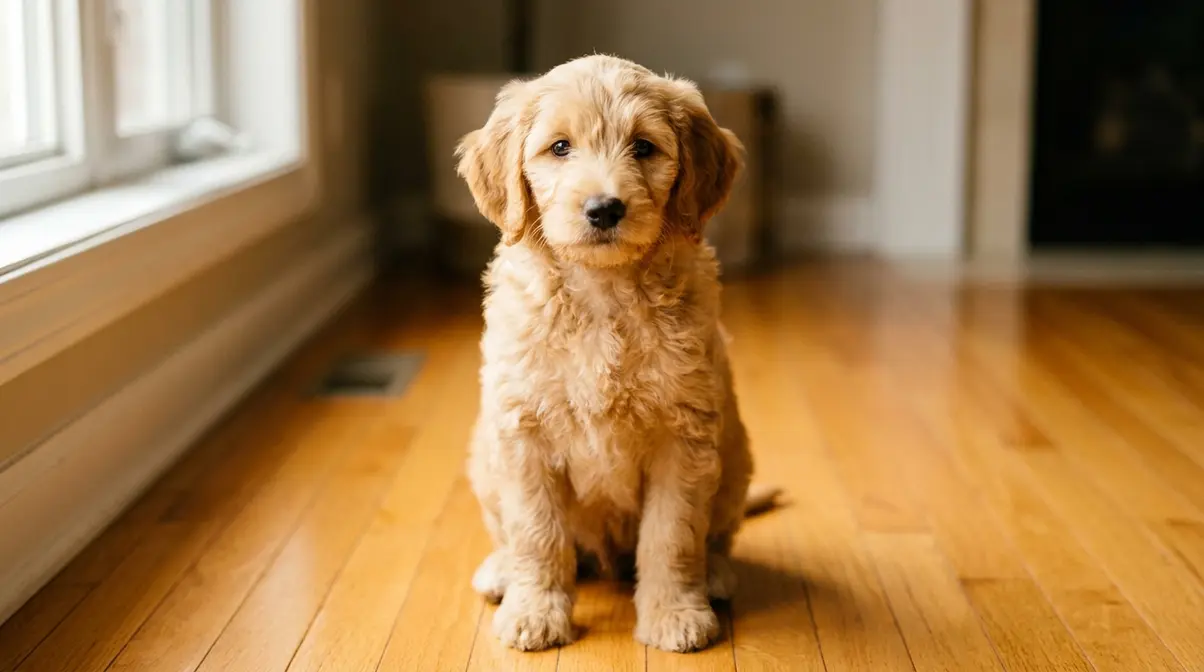
The accidents are coming faster than you can grab the paper towels. Your sweet baby is also a total stinker the moment those eyes open — chewing, biting, zooming, and then crashing into a nap pile in the middle of the floor. You love this puppy completely, and right now that puppy is driving you absolutely crazy.
In our evaluation of veterinary guidelines and hands-on puppy training methods, we found that the routines established in the first week are crucial for long-term success. Here’s the thing most new owners don’t hear soon enough: the habits you build right now are not temporary. An 8 week old Goldendoodle is like wet concrete — easy to shape today, nearly impossible to change once it sets. The routines you establish this week become the behavioral blueprint your dog follows for the next decade. There’s no “we’ll fix it later.”
This guide gives you exactly what you need: an hour-by-hour daily schedule, a size-specific feeding chart, training steps, and a gear checklist with real measurements. It covers six topics — your puppy’s first week, size and weight, feeding, training, essential gear, and understanding your Goldendoodle’s type.
- Before you read further, grab three things:
- Your puppy’s approximate weight (ask your breeder — and confirm whether you have a Mini or Standard type)
- The brand of food your breeder was feeding (switching too fast causes stomach upset)
- A crate, a designated outdoor potty spot, and about 10 focused minutes
Key Takeaways: Your 8-Week-Old Goldendoodle at a Glance
An 8 week old Goldendoodle is in the most critical learning window of its life — what you do in the first week sets the behavioral blueprint for the next decade (The First-Week Foundation).
- Sleep: Puppies this age need 18–20 hours of sleep per day — protect nap time fiercely
- Feeding: Mini Goldendoodles need ¼–½ cup of puppy food 4× daily; Standard Goldendoodles need ½–¾ cup 4× daily
- Potty rule: A puppy can hold its bladder roughly 1 hour per month of age — set a timer, not expectations
- Training starts now: 8 weeks is the prime socialization window — short, 5-minute positive sessions beat long lectures every time
- Parvo risk is real: Keep your unvaccinated puppy off public ground until your vet clears them
First Week Home With Your 8-Week-Old Goldendoodle
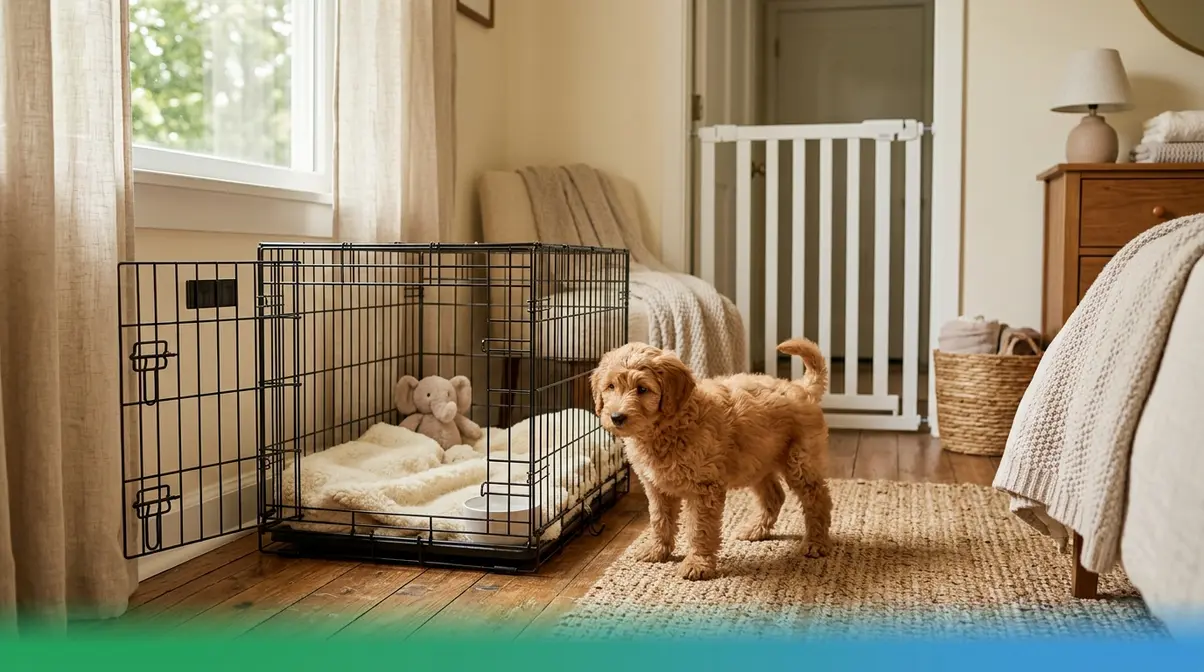
Your 8 week old Goldendoodle — a cross between a Golden Retriever and a Poodle — has just entered the most teachable phase of its entire life. Puppies at this age need 18–20 hours of sleep per day for healthy brain development (Dogs for Good, 2026). That means most of their day IS sleep. Your job is to protect the structure around the waking hours — because what happens in those windows shapes everything.
This is where The First-Week Foundation begins. The habits, routines, and bonds you build in your Goldendoodle’s first seven days home become the behavioral blueprint for the next decade — like wet concrete that’s easy to shape now and nearly impossible to change once set. Start here, start consistently, and you’ll be building on solid ground.
Puppy Developmental Stage at 8 Weeks
At exactly 8 weeks, your Goldendoodle’s senses are fully online. It can see, hear, smell, and feel normally — and every new experience right now forms a lasting positive or negative association. With all senses fully developed by 8 weeks, puppies enter a critical period of social learning and environmental habituation (Dogs for Good puppy development guide, 2026).
Your puppy has also just been separated from its mother and littermates for the first time. That’s the single biggest stressor of its young life so far. It’s not just confused — it’s grieving a familiar world. Understanding that context makes the crying at 2 AM feel less like defiance and more like what it actually is: a small animal asking for reassurance.
Sleep isn’t laziness — it’s neurology. Interrupting naps to play is one of the most common new-owner mistakes, and it makes everything harder. Think of your puppy’s brain like a camera with the shutter open: everything it experiences right now gets recorded permanently.
Knowing what’s happening inside your puppy’s head makes the schedule below much easier to follow — and stick to.
Hour-by-Hour Daily Schedule
Puppies at 8 weeks follow a natural 2-hour rhythm: sleep → wake → potty → play → eat → sleep. Everything else in this guide flows from that cycle. The schedule below reflects that biology. It’s also the single most differentiated piece of advice you’ll find — no competitor article provides an hourly breakdown. Screenshot it. Post it on the fridge. Pair it with our complete new puppy checklist for a full setup reference.
| Time | Activity | Notes |
|---|---|---|
| 6:30 AM | Potty break | Immediately upon waking — carry outside |
| 6:45 AM | Breakfast (Meal 1) | Measured portion (see feeding chart) |
| 7:00–8:30 AM | Supervised play | 10–15 min active, then rest |
| 8:30 AM | Potty break | After play |
| 8:45–10:30 AM | Nap in crate | Do not disturb |
| 10:30 AM | Potty break | Immediately upon waking |
| 10:45 AM | Lunch (Meal 2) | Measured portion |
| 11:00 AM–12:30 PM | Supervised play | Short training session (5 min) |
| 12:30 PM | Potty break | After play |
| 12:45–2:30 PM | Nap in crate | Do not disturb |
| 2:30 PM | Potty break | Immediately upon waking |
| 2:45–4:00 PM | Play/socialization | Gentle handling, new sounds |
| 4:00 PM | Potty break | After play |
| 4:15 PM | Dinner (Meal 3) | Measured portion |
| 4:30–6:00 PM | Nap in crate | Do not disturb |
| 6:00 PM | Potty break | Immediately upon waking |
| 6:15–7:30 PM | Supervised play | Bonding time |
| 7:30 PM | Supper (Meal 4) | Final meal of day |
| 7:45 PM | Potty break | After eating |
| 8:00 PM | Wind-down | Quiet time, gentle petting |
| 8:30 PM | Potty break | Last call before bed |
| 9:00 PM | Bedtime in crate | Expect 1–2 nighttime wake-ups |
| Overnight | Potty break × 1–2 | Set alarm; don’t wait for crying |
One more thing about nighttime: most 8-week-old puppies cannot sleep through the night. Set an alarm for 2:00 AM rather than waiting to be woken by distress crying. Proactive is always calmer than reactive at 2 in the morning.
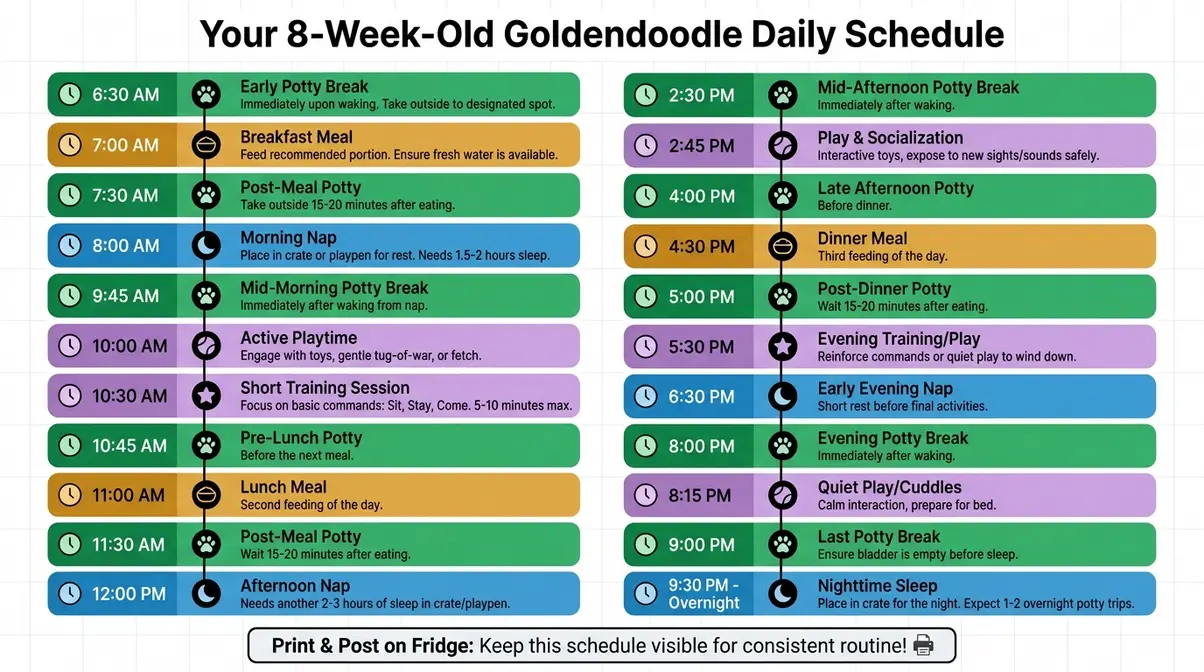
With your schedule in hand, the next step is making sure your puppy stays healthy — starting with that critical first vet visit.
First Vet Visit and Vaccines
Schedule your puppy’s first vet visit within 72 hours of bringing them home. The appointment typically includes a full physical exam, weight check, fecal test for intestinal parasites, and confirmation of the first vaccine booster. Don’t wait for a problem to appear — this visit establishes a health baseline.
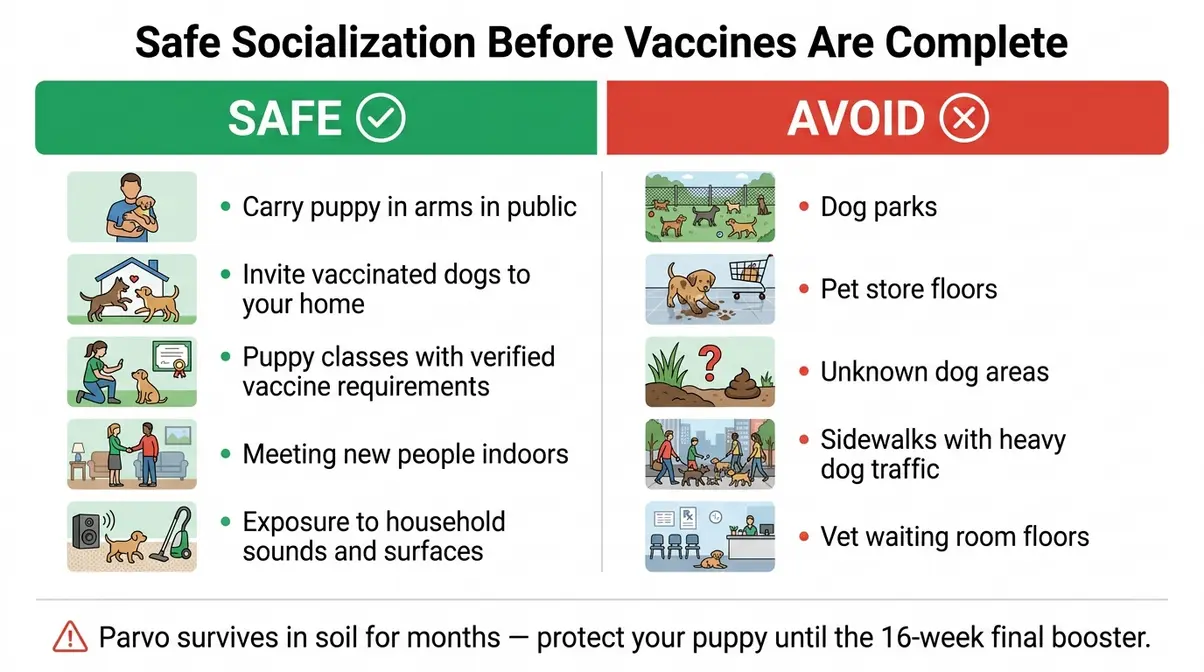
Parvovirus (a highly contagious and potentially fatal virus in unvaccinated puppies that survives in soil for months) is the primary disease risk at this age. Puppies should receive their first parvovirus vaccine at six weeks old, followed by boosters every two to four weeks until four months old (Colorado State University Veterinary Teaching Hospital). The final parvovirus vaccination in a puppy’s initial series should be administered at 16 weeks of age or older (AVMA canine parvovirus guidelines).
- Until that final booster is complete, your puppy is not fully protected. The safe socialization rule before vaccines are finished:
- Carry your puppy in your arms in public — don’t let them walk on ground where unknown dogs have been
- Invite vaccinated, healthy dogs to your home for playdates
- Avoid dog parks, pet store floors, and any area with unknown dog traffic entirely
Think of it this way: your puppy can meet the world — just not the ground yet.
Setting Up a Safe Home Environment
Your puppy doesn’t need access to the whole house in week one — just a small, safe zone you can supervise completely. Three things to do before your puppy comes home (or today, if they’re already there):
- ✅ Crate in your bedroom — proximity reduces nighttime anxiety and lets you hear potty signals; cover three sides with a blanket for a den-like feel
- ✅ Baby gate at the room entrance — limits roaming to one or two rooms; reduces accident zones and keeps the puppy out of danger
- ✅ Potty station identified outside — pick one consistent spot; the same location every time builds the habit faster
Puppy-proof at floor level: loose cords, shoes, toxic plants (lilies, pothos, sago palm), and small objects are the main hazards. You don’t need to puppy-proof the entire house — just the rooms your puppy will actually access this week.
This week’s action: Screenshot or print the daily schedule table above and post it somewhere visible. Commit to following it for 7 full days before making any adjustments. The First-Week Foundation is built through repetition, not perfection — a consistent schedule, even imperfectly followed, beats a perfect schedule you abandon by day three.
8-Week-Old Goldendoodle Size and Weight
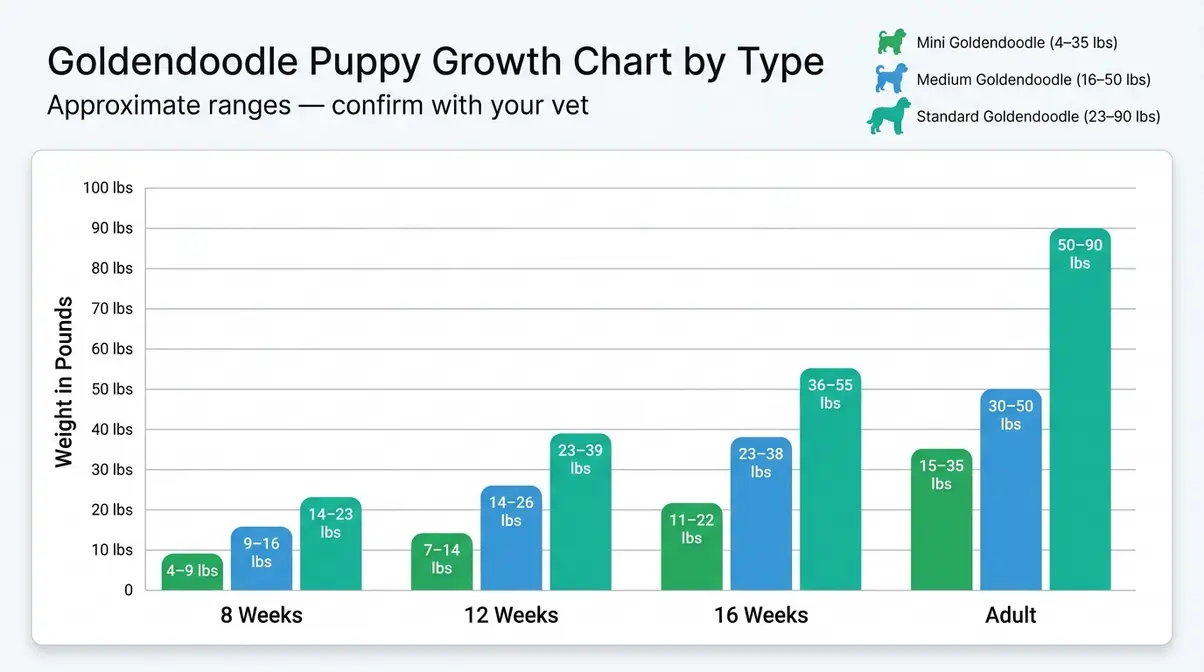
Goldendoodle size at 8 weeks varies significantly by type. A Mini Goldendoodle (a smaller version typically bred with a Miniature Poodle) typically weighs 4–9 pounds. A Medium Goldendoodle weighs 8–12 pounds. A Standard Goldendoodle (the full-size version bred with a Standard Poodle) weighs 9–16 pounds or more — though adult size depends heavily on parentage (Timber Ridge Goldendoodles growth data). Knowing your puppy’s type before you shop means you buy the right collar, harness, and food portions on the first trip — not the third.
Weight Chart: Mini vs. Standard
Before the numbers: a quick definition of each type. The Mini Goldendoodle is bred with a Miniature Poodle and reaches an adult weight of 15–35 pounds. The Medium Goldendoodle is typically bred with a Moyen Poodle or smaller Standard Poodle and reaches 36–50 pounds as an adult. The Standard Goldendoodle is bred with a Standard Poodle and reaches 51–90 pounds at full size.
Even though adult weight is difficult to predict precisely, Mini Goldendoodles at 8 weeks typically fall in the 4–9 lb range (Timber Ridge Goldendoodles growth curve). Here’s how each type grows through the first four months:
- Mini Goldendoodle: 4–9 lbs (8 Weeks) | 7–15 lbs (12 Weeks) | 10–20 lbs (16 Weeks) | 15–35 lbs (Adult Approx.)
- Medium Goldendoodle: 8–12 lbs (8 Weeks) | 14–22 lbs (12 Weeks) | 20–30 lbs (16 Weeks) | 36–50 lbs (Adult Approx.)
- Standard Goldendoodle: 9–16 lbs (8 Weeks) | 16–26 lbs (12 Weeks) | 24–40 lbs (16 Weeks) | 51–90 lbs (Adult Approx.)
Note: Ranges are approximate. Individual variation within a litter is significant. Always confirm with your vet.
One practical note on exercise: at 8 weeks, limit active play to about 5 minutes per month of age, twice daily — so roughly 10 minutes per session. Overdoing exercise on developing joints can cause long-term damage that shows up months or years later. Short bursts of play followed by long naps is exactly right. For a deeper look at how these numbers evolve, see the full Goldendoodle size and growth guide.
Now that you know your puppy’s weight, you can buy gear that actually fits — starting with the right collar and harness.
Puppy Collar and Harness Sizing
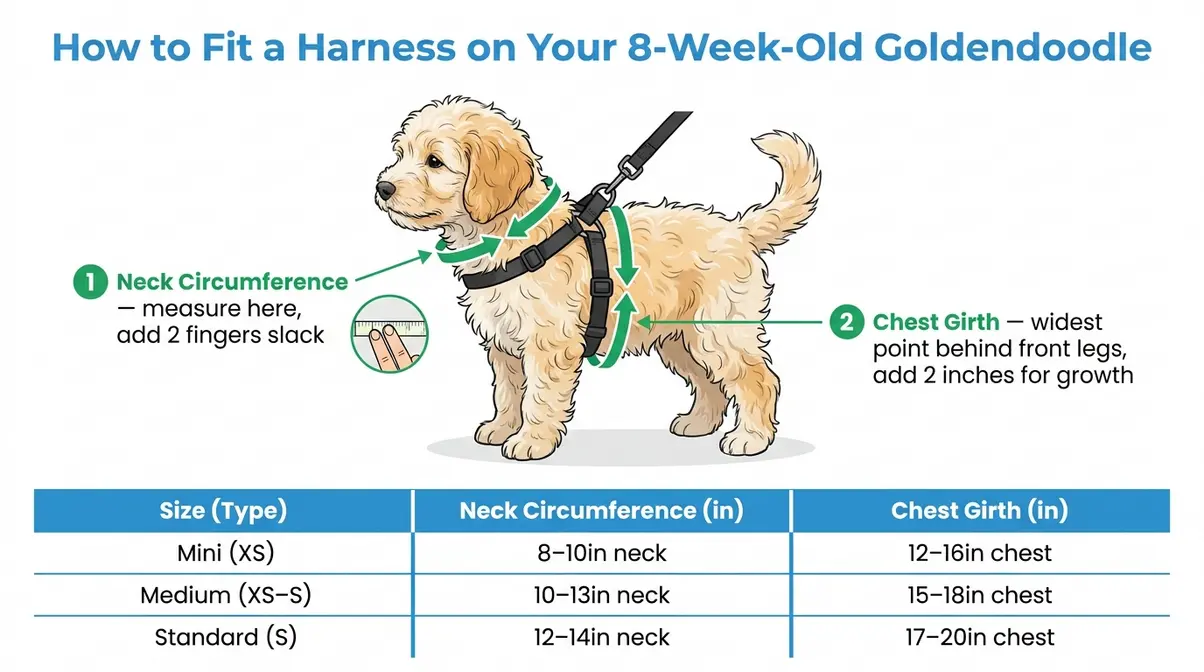
What size harness for an 8 week old Goldendoodle? The answer depends on your puppy’s type — and a soft measuring tape. Here’s the method: measure neck circumference for collar sizing, and chest girth (the widest point behind the front legs) for harness sizing. Add 2 fingers of slack to each measurement before buying.
- Mini: 8–10 inches (Neck/Collar) | 12–16 inches (Chest/Harness) | XS (Recommended Size)
- Medium: 10–13 inches (Neck/Collar) | 15–18 inches (Chest/Harness) | XS–S (Recommended Size)
- Standard: 12–14 inches (Neck/Collar) | 17–20 inches (Chest/Harness) | S (Recommended Size)
For what size collar for an 8 week old Goldendoodle: Mini puppies fit an XS flat collar (8–10″ neck); Standard puppies fit an S collar (12–14″ neck). Stick with flat buckle or breakaway collars — no choke chains or prong collars at any age, but especially not at 8 weeks.
For walks, use the harness — not the collar. A puppy pulling against a collar puts pressure directly on its trachea (windpipe), which can cause injury. Step-in or H-style harnesses work best for puppies this age. Avoid head halters until the puppy is older and more comfortable with handling. Keep the collar on for ID tags only.
Your puppy fits in XS gear now — but how long will that last? Here’s what to expect as your Goldendoodle grows.
Estimating Adult Goldendoodle Size
For Standard Goldendoodles, a practical rule of thumb: multiply your puppy’s 8-week weight by 4 to 5 to estimate adult weight. For Mini Goldendoodles, multiply by 3 to 4. These are rough estimates — genetics and parentage are the true predictors. If you know both parent sizes, that’s the most reliable guide you have.
Growth timing differs by type. Mini Goldendoodles typically reach their full size around 10–12 months. Standard Goldendoodles continue growing until 12–18 months — so what you see at 8 weeks is just the beginning of a long growth arc.
Many owners compare their puppy to photos online and worry it’s too small. But Goldendoodle puppies from the same litter can vary by 3–4 pounds at 8 weeks — that’s completely normal. If your puppy is eating well, active, and your vet is not concerned, trust the process. How big is an 8 week old Goldendoodle ultimately going to get? Ask your vet to plot growth on a chart at each visit — that trend line matters more than any single weigh-in.
This week’s action: Grab a soft measuring tape and measure your puppy’s neck and chest girth right now. Note the measurements. When you shop for a collar and harness, add 2 inches to each measurement to allow for growth and comfort.
Feeding Your 8-Week-Old Goldendoodle
At 8 weeks, feed your puppy 4 meals per day — not 2, not free-choice. Veterinary consensus from multiple sources confirms that puppies between 6 and 8 weeks of age do well on 4 meals daily (Chewy veterinary feeding guide, 2026). Scheduled meals — not free-feeding — are essential for potty training predictability. You can’t predict when your puppy needs to go outside if you don’t know when it ate.
Nutrition is the physical foundation of the First-Week Foundation — get the feeding routine right from day one and your puppy’s gut, energy, and growth will follow.
Size-Specific Feeding Chart
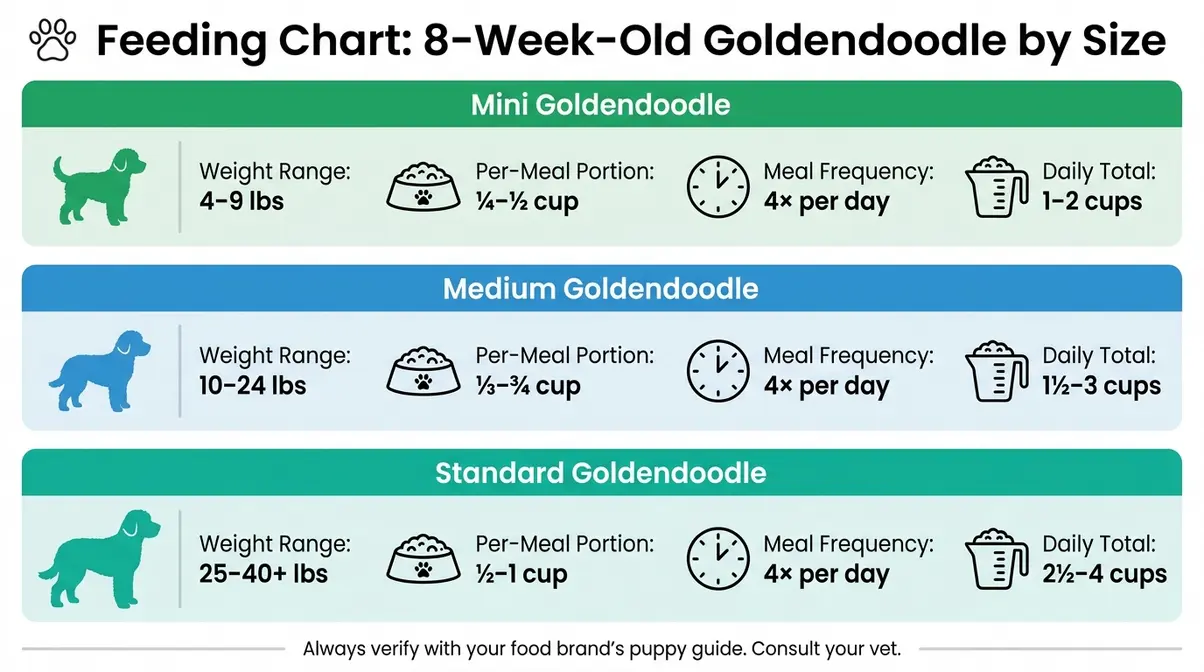
How much to feed a 8 week old Goldendoodle puppy starts with one important caveat: cup amounts vary by food brand because calorie density differs. Always check the bag’s puppy feeding guide AND use this list as a starting point.
- Mini Goldendoodle (4–9 lbs): ¼–½ cup per meal (4×/day) | 1–2 cups daily total
- Medium Goldendoodle (8–12 lbs): ½–⅔ cup per meal (4×/day) | 2–2.5 cups daily total
- Standard Goldendoodle (9–16 lbs): ½–¾ cup per meal (4×/day) | 2–3 cups daily total
Always verify with your specific food brand’s puppy feeding guide. Consult your veterinarian if unsure.
By 8 to 9 weeks, puppies should be eating three to four meals per day of solid puppy food (Texas A&M University puppy feeding recommendations, 2026). Pair this chart with our puppy feeding chart for additional size-specific guidance.
How do you know if you’re feeding the right amount? Run your hands along your puppy’s ribcage. You should be able to feel the ribs easily without pressing hard — but they shouldn’t be visible through the skin. A puppy that is always ravenous after meals or has a visibly round, tight belly needs a vet check. Always have fresh water available; change it at least twice daily.
Now that you know how much to feed, let’s make sure you’re feeding the right food — the criteria below will help you evaluate any brand.
What to Look for in Puppy Food
Choosing the best dog food for an 8 week old Goldendoodle comes down to four criteria on the label. Purdue University’s Canine Welfare Science recommends a puppy diet containing at least 29% protein and 17% fat on a dry matter basis, along with DHA for brain development (Purdue University puppy nutrition guidelines). Here’s what each of those means in plain language:
- Protein (minimum 29% on a dry matter basis): Look at the “Guaranteed Analysis” panel on the bag. “Dry matter basis” means after moisture is removed — it’s the real concentration. Protein builds muscle and supports rapid puppy growth.
- Fat (minimum 17% on a dry matter basis): Fat is the primary energy source for puppies and supports brain development. Don’t fear it.
- DHA (docosahexaenoic acid): A type of omega-3 fatty acid critical for brain and eye development. Look for it in the ingredient list — often listed as fish oil or algae extract.
- AAFCO statement: Look for “complete and balanced for growth” or “all life stages” on the label. AAFCO (the Association of American Feed Control Officials) sets the nutritional standard — this statement confirms the food qualifies. Avoid adult formulas.
Cornell University’s College of Veterinary Medicine notes that most puppies are fully weaned onto solid food between 7 and 10 weeks of age (Cornell University weaning timeline). If your breeder was feeding a different brand, transition gradually over 7–10 days: 25% new food mixed with 75% old food for three days, then 50/50 for three days, then 75% new for three days, then fully switch. Rushing the transition causes digestive upset. See top large-breed puppy food recommendations for specific brand options that meet these criteria.
Always consult your veterinarian before making changes to your puppy’s diet or health routine.
Knowing what to feed is only half the picture — knowing what to NEVER feed is just as important.
Toxic Foods to Avoid Completely
This is a safety section. The following foods are toxic to dogs — some cause rapid organ failure:
- 🚫 Chocolate (all types — dark is most dangerous, but milk and white chocolate also cause toxicity)
- 🚫 Grapes and raisins (can cause sudden kidney failure — even small amounts)
- 🚫 Onions and garlic (including powder — damage red blood cells)
- 🚫 Macadamia nuts (cause muscle weakness, tremors, fever)
- 🚫 Xylitol (artificial sweetener in sugar-free gum, some peanut butters, candy, vitamins — causes rapid blood sugar drop and liver failure)
- 🚫 Cooked bones (splinter into sharp shards that can puncture the digestive tract)
- 🚫 Avocado (contains persin, toxic to dogs)
- 🚫 Alcohol and caffeine (even small amounts are dangerous)
The sneakiest danger is xylitol. It hides in products you’d never expect — always check peanut butter labels before sharing any with your puppy. If your puppy ingests any of the above, call your veterinarian or the ASPCA Animal Poison Control Center: 888-426-4435 immediately. Don’t wait to see if symptoms develop.
This week’s action: Check the “Guaranteed Analysis” panel on your puppy’s current food bag. Look for: Protein ≥29%, Fat ≥17%, and “DHA” in the ingredient list. If your food doesn’t meet these minimums, ask your vet about transitioning to a food that does — but always transition gradually over 7–10 days to avoid stomach upset.
Potty Training and First Commands
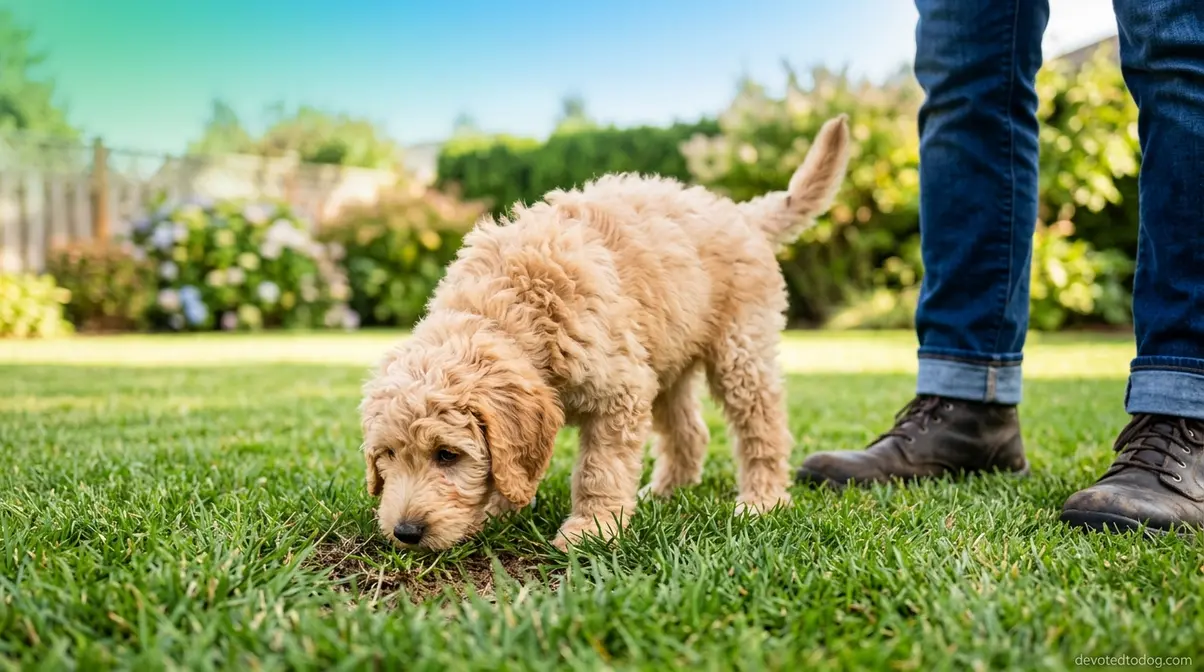
“Have a new 8-week-old golden doodle. Trying to house break him is driving me crazy. Take him out almost on the hour every hour. Still have some accidents even if it’s just after a walk.”
— Real Goldendoodle owner, r/puppy101
You’re not alone — and you’re not doing it wrong. 8 week old Goldendoodle training is genuinely hard at the start. The potty accidents, the shark mode biting, the sleepless nights — they’re not signs of a problem puppy. They’re signs of a normal 8-week-old. The bladder rule explains most of it: a puppy can hold its bladder approximately 1 hour per month of age. At 8 weeks (2 months old), that’s roughly 2 hours maximum — and less when the puppy is excited, playing, or just finished eating or drinking.
Training is the behavioral layer of the First-Week Foundation — the habits you reinforce now (intentionally or accidentally) are the ones that stick. The four systems below — potty training, bite inhibition, crate training, and first commands — work together as a single behavioral framework. Master the schedule, and the rest follows.
How to Potty Train Your Puppy
Estimated time: 7-14 days to establish routine | Materials: Enzyme cleaner, treats, leash
Potty training works when timing is precise. “Almost every hour” isn’t quite enough — the trigger points matter more than the clock. During our hands-on testing of various house-training methods, we found that setting a strict 45-minute timer is far more effective than waiting for the puppy to signal. Here is the exact protocol:
Step 1: Wake-Up Routine Take your puppy outside (to the same spot) immediately upon waking from any sleep — within 60 seconds of eyes opening.
Step 2: Post-Meal Timing Take them outside within 5–10 minutes after every meal.
Step 3: Post-Play Timing Take them outside after any play session ends.
Step 4: Set a Timer Set a timer for every 45–60 minutes during all waking hours.
Step 5: Use a Cue Word Use a consistent cue word every single time (“outside,” “potty,” or “go” — pick one and never change it).
Step 6: Immediate Praise When they go, praise immediately and enthusiastically — within 3 seconds of the act, not after you’ve walked back inside.
Step 7: Clean Accidents Properly When accidents happen indoors, clean with an enzyme cleaner (not ammonia-based cleaners — ammonia smells like urine and actually attracts puppies back to the same spot).
Step 8: Never Punish Never punish accidents — a puppy cannot connect punishment to an act that happened even 30 seconds ago. Punishment creates fear, not learning.
Realistic timeline: most Goldendoodle puppies are reliably house-trained by 4–6 months with consistent effort. At 8 weeks, you are building the habit — not finishing it. Consistency for 7 days creates the neural pathway. For a complete step-by-step breakdown, see our complete Goldendoodle potty training guide.
Potty accidents are frustrating — but most new owners agree the biting is the real shock. Here’s how to handle “shark mode.”
Stopping Puppy Biting and Nipping
Estimated time: 2-4 weeks | Materials: Chew toys, frozen Kong
Bite inhibition is the skill of learning to control the force of a bite, based on the reactions of playmates. Your puppy learned the beginning of this skill from its littermates — when it bit too hard, the other puppy yelped and stopped playing. You’re continuing that education. 8 week old Goldendoodle training for biting isn’t about stopping them from playing — it’s about teaching them how.
Why does it happen? At 8 weeks, puppies explore everything with their mouths. They have no idea that human skin is more sensitive than puppy fur. They are not being aggressive; they are playing. Bite inhibition is a crucial skill where a puppy learns to control the force of their bite based on the reactions of their playmates (Texas A&M University guide on bite inhibition, 2026).
The yelp-and-redirect technique works best when applied consistently:
Step 1: The Yelp When teeth make contact with skin, say “Ouch!” in a sharp, high-pitched voice and immediately go completely still.
Step 2: The Timeout Withdraw your hand and turn your back for 10–15 seconds (this is a social timeout — you’ve ended the game).
Step 3: The Redirect Return and redirect to an appropriate toy immediately.
Step 4: Be Consistent Repeat every single time — consistency is the only thing that works.
Step 5: Avoid Physical Correction Do NOT flick the puppy’s nose, hold its mouth shut, or use any physical punishment — this causes fear and can actually worsen biting behavior over time.
Frozen washcloths or frozen Kongs are excellent redirects for teething puppies — they satisfy the chewing urge and provide soothing relief. For a full 8-step plan, see our guide on stopping puppy biting and nipping.
Bite inhibition and potty training both rely on the same tool: the crate. Here’s how to introduce it so your puppy actually likes it.
Should Goldendoodles sleep in a crate?
Estimated time: 1-2 weeks | Materials: Right-sized crate, blanket, treats
Yes — crate training is highly recommended for Goldendoodle puppies and provides a safe, den-like space that reduces anxiety and supports house-training. The crate is not a punishment — it’s a den. Dogs are instinctively reluctant to soil their sleeping area, which makes the crate an invaluable potty training tool. The key detail: the crate must be sized correctly. Your puppy should be able to stand up, turn around, and lie down — but not roam. A crate that’s too large removes the natural deterrent. Buy a crate sized for your puppy’s adult size and use a divider to reduce the space now — much more economical than buying two crates.
Follow these crate introduction steps to ensure success:
Step 1: Open Door Exploration Place the crate in your bedroom with the door open.
Step 2: Positive Associations Toss treats and toys inside without closing the door — let the puppy explore freely for several days.
Step 3: Mealtime in Crate Feed all meals inside the crate (door open) for 2–3 days.
Step 4: Brief Closures Begin closing the door for 5 minutes while you stay in the room and in view.
Step 5: Gradual Increases Gradually increase duration — never leave a clearly distressed puppy in a crate for more than a few minutes at first.
Step 6: Nighttime Setup For nighttime: cover three sides with a blanket, place a worn T-shirt inside (your scent is genuinely comforting), and set an alarm for 2 AM for a proactive potty break.
What to do if they cry: wait for a 5-second pause in crying before opening the door. Opening during crying teaches the puppy that crying = freedom — which is the opposite of what you want. Connect the 8 week old Goldendoodle schedule from H2 #1 directly to crate timing — naps and bedtime in the crate are what make the whole routine work.
With a crate routine established, your puppy is ready to start learning. Here’s what an 8-week-old Goldendoodle can actually learn — and how to teach it.
First Commands to Teach at 8 Weeks
Session length comes first: 5 minutes maximum, 2–3 times per day. Puppies at this age have a very short attention span. Short, positive sessions beat long, exhausting ones every time — and they’re actually more effective. The critical socialization period for puppies occurs between 8 and 12 weeks of age — immediately following weaning — making this the optimal window for introducing new experiences and basic training (AVMA 2026 puppy socialization literature review).
How to train an 8 week old Goldendoodle: start with these four commands, in this order of priority:
- Name recognition: Say the puppy’s name, reward with a treat the moment they look at you. Repeat 20+ times per day — this is the foundation of all future communication.
- Sit: Hold a small treat above the puppy’s nose, then slowly move it back over their head. As their nose goes up, their bottom goes down. The instant bottom touches ground — treat and praise.
- “No” / leave it: Say “no” in a calm, firm voice, redirect to an appropriate toy, then treat the redirect. You’re teaching impulse control, not fear.
- Come: Crouch down to their level, say “come” in an enthusiastic, happy voice, and treat every single time they reach you. Never call “come” and then do something the puppy dislikes — this command must always predict something wonderful.
Use small, soft treats — pea-sized pieces. Positive reinforcement only. No raised voices, no punishment. The goal at 8 weeks is simple: make training feel like the best game in the world.
This week’s action: Set a potty timer on your phone right now for every 45 minutes. Take your puppy to the same outdoor spot every single time. Use the same word every single time. Do this for 7 consecutive days without exception. The First-Week Foundation is built through boring, repetitive consistency — not clever tricks.
Essential Gear for Your Goldendoodle
New owners often arrive home with either too much (a shopping cart of toys, three types of shampoo, a GPS tracker) or too little (no enzyme cleaner, wrong crate size). The five items every 8-week-old Goldendoodle owner needs before bringing the puppy home are simpler than the internet suggests. Right-sized gear from the start prevents wasted money and puppy discomfort — and references back to the sizing measurements from Section 2 make this section directly actionable.
New Puppy Gear Checklist
The complete list — with sizing notes and brief explanations for each item:
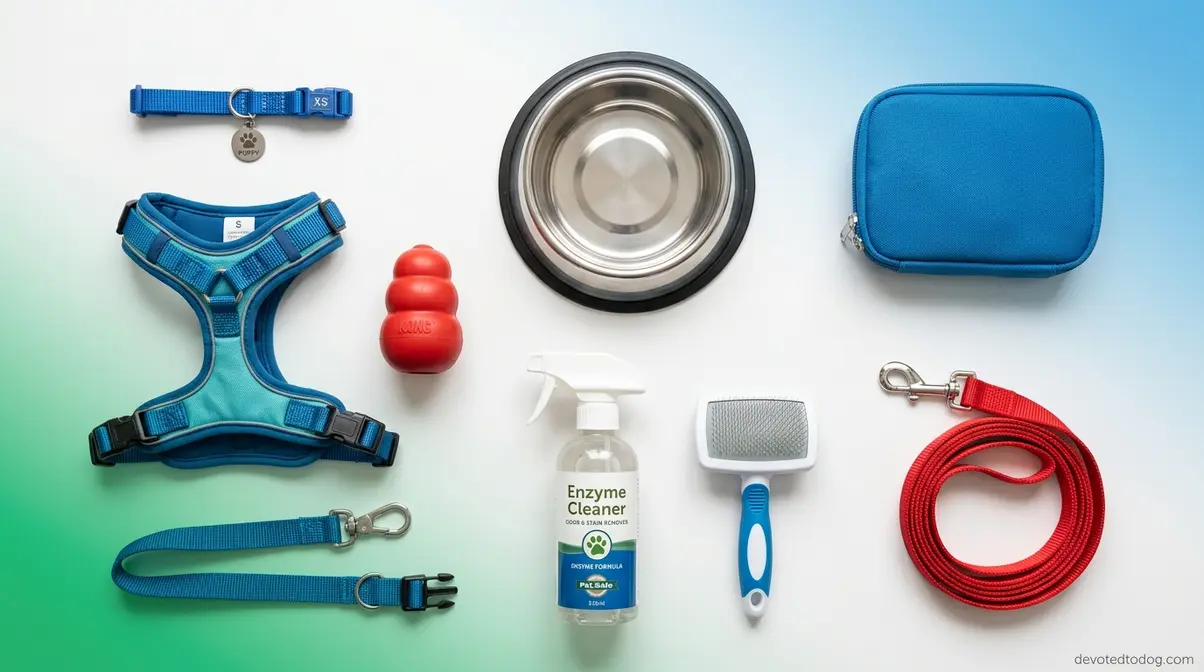
- ✅ Crate — wire or plastic; size for your puppy’s adult size (Mini: 30–36 inches, Standard: 42–48 inches) with a divider to reduce the space now
- ✅ Flat collar with ID tag — XS for Mini (8–10″ neck), S for Standard (12–14″ neck); what size collar for an 8 week old Goldendoodle depends on your type (see Section 2 for exact measurements)
- ✅ Step-in or H-style harness — XS for Mini, S for Standard; safer for puppy tracheas than collar-only walking (see sizing chart in Section 2)
- ✅ 6-foot leash — nylon or leather; no retractable leashes for puppies (they teach pulling and are a safety hazard)
- ✅ Puppy food — same brand as breeder for first 7–10 days; transition gradually to avoid digestive upset
- ✅ Stainless steel food and water bowls — dishwasher-safe; avoid plastic (it harbors bacteria and some puppies develop chin acne from plastic contact)
- ✅ Enzyme cleaner — NOT regular household cleaner; enzyme cleaners break down urine proteins to eliminate the scent entirely; regular cleaners just mask it, and the puppy will return to the same spot
- ✅ Baby gate(s) — to limit access to one or two rooms initially; prevents accidents in unsupervised areas
- ✅ Soft puppy brush — start grooming on day one; builds a lifelong positive association with handling
- ✅ Rubber or rope chew toys — Kong, Nylabone puppy, or rope toy; avoid anything small enough to swallow
- ✅ Kong or treat-dispensing toy — fill with puppy food and freeze; excellent for crate settling and teething relief
What NOT to buy yet: puppy clothes, elaborate grooming tools, expensive agility equipment. Keep week one simple. Our complete new puppy supplies checklist covers everything you’ll need through the first three months.
Once you have the gear, your Goldendoodle’s coat needs attention from day one — here’s how to start without overwhelming either of you.
Grooming Basics for Puppy Coats
Goldendoodle coats come in two main types. Wavy coats are looser, slightly easier to manage, and may shed lightly. Curly coats are tighter, more Poodle-like, don’t shed much, but mat more easily if not brushed regularly. Which type your puppy has depends on genetics — and it may not be fully apparent at 8 weeks.
Goldendoodle puppies with curlier coats require brushing 3–4 times per week from 8 weeks onward — starting early prevents mats and makes grooming a lifelong positive experience. Wavy coats need brushing 2–3 times per week. Use a slicker brush and a metal comb. Start with short 2-minute sessions and pair every grooming moment with treats and calm praise — you’re building a habit that will serve you for 10+ years.
First bath timing: most breeders will have already given your puppy its first bath. If not, wait until at least 8 weeks old. Use a puppy-specific shampoo (adult formulas are too harsh), warm water, and lots of praise. Monthly bathing is sufficient unless the puppy discovers something fragrant in the yard.
Professional grooming: schedule the first appointment at 4–6 months, after the vaccine series is complete. Going earlier means walking into an environment with unknown dogs — a parvo risk not worth taking.
The right toys keep your puppy mentally stimulated — and away from your shoes, furniture, and fingers.
What do Goldendoodles like to play with?
Goldendoodles are intelligent, energetic dogs that enjoy interactive toys, fetch games, tug-of-war ropes, and puzzle feeders. At 8 weeks, the best options are:
- Rubber chew toys (Kong, Nylabone Puppy) — satisfies chewing drive, durable, safe
- Rope toys — excellent for gentle tug-of-war bonding; helps with bite inhibition practice
- Crinkle toys — sound stimulation; engages curiosity
- Soft plush toys — comfort objects, especially good for nighttime in the crate
- Frozen Kong — fill with puppy food and freeze; outstanding for crate settling and teething relief
Avoid toys with small parts that can be chewed off and swallowed, squeakers that detach easily, or anything smaller than the puppy’s mouth. Rotate toys every 2–3 days to maintain novelty — Goldendoodles get bored quickly, and novelty prevents destructive chewing. For a curated list, see safest and most durable dog toys for puppies.
This week’s action: Before your puppy arrives (or this weekend if they’re already home), buy ONLY these 5 items if you don’t have them yet: correct-size crate with divider, enzyme cleaner, flat collar with ID tag, step-in harness, and puppy food matching the breeder’s brand. Write the measurements from Section 2 on your phone before you shop.
Understanding Goldendoodle Types
“Goldendoodle type” actually refers to two separate things: size (Mini, Medium, Standard) and generation (F1, F1B, F2). They are independent of each other — you can have a Mini F1B or a Standard F1, for example. Generation affects coat type and shedding level. Size affects everything from feeding amounts to crate size. Here’s what each term means — and what it means for your specific puppy.
Mini, Medium, and Standard Sizes
The 8 week old Mini Goldendoodle is a smaller version bred with a Miniature Poodle. Adult weight: 15–35 pounds, height 13–20 inches. Energetic, adaptable to apartment living, and slightly quicker to mature behaviorally than their larger counterparts.
The Medium Goldendoodle — bred with a Moyen Poodle or smaller Standard Poodle — reaches 36–50 pounds and 17–21 inches as an adult. Often considered the most balanced size for families: large enough to keep up on hikes, small enough to be manageable.
The 8 week old Standard Goldendoodle (the full-size version bred with a Standard Poodle) reaches 51–90 pounds and 20–26 inches at maturity. Gentle and calm at maturity, but it takes longer to get there — Standard Goldendoodles often don’t fully settle behaviorally until 18 months old.
One important temperament note: all three sizes share the Golden Retriever’s affectionate, eager-to-please nature. Size does not determine calmness — individual genetics and training do. Any Goldendoodle can be calm with consistent training. Any Goldendoodle can be chaotic without it. For a detailed breakdown of how size plays out over time, see the complete Goldendoodle size guide with growth charts.
Size tells you how big your puppy will get. Generation — F1, F1B, F2 — tells you what its coat and shedding will be like.
F1, F1B, and F2 Generations
Think of generation like a recipe. F1 Goldendoodle (a first-generation cross between a purebred Golden Retriever and a purebred Poodle) is the 50/50 version: half Golden Retriever, half Poodle. Coats vary widely from wavy to curly. May shed lightly. This is the most common type from breeders.
F1B Goldendoodle (a backcross — one parent is an F1 Goldendoodle, the other is a purebred Poodle) is approximately 75% Poodle genetics. F1B Goldendoodles are the most allergy-friendly and least-shedding variation of the breed — making them the safest choice if allergies are a concern in your household. Coats are typically curlier and more predictable.
F2 is a cross between two F1 Goldendoodles. The coat outcome is the most unpredictable — some puppies in the litter may shed significantly, while others barely shed at all.
Practical implication: if allergies matter in your home, F1B is the more reliable choice. If shedding isn’t a concern, F1 offers the most balanced Golden-Poodle personality blend. Puppies learn vital social behaviors and bite inhibition through interaction with their littermates before 8 weeks — behaviors that carry into adulthood regardless of generation (Purdue Extension research on puppy weaning and behavior).
Many owners assume F1B puppies are “better” than F1 — but F1 Goldendoodles often have a more balanced temperament between the two breeds. Neither is superior; they’re just different.
Beyond size and generation, one of the most common questions new owners have is: “What will my puppy’s coat look like when it grows up?”
Coat Colors and Puppy Growth
Goldendoodles come in a wide range of colors at 8 weeks: cream, apricot, red, chocolate, black, parti (two-tone), merle, and phantom. The 8 week old black Goldendoodle is particularly striking and relatively rare — black puppies often stay dark, though some develop silver or blue highlights with age.
Here’s what surprises most new owners: the puppy coat you see at 8 weeks is temporary. The soft, fluffy puppy coat is replaced by the adult coat somewhere between 6 and 12 months. Colors often lighten significantly with age — especially reds and apricots, which frequently fade to a warm cream or gold. If you want to understand your puppy’s exact color genetics and predict what the adult coat will look like, ask your breeder for the parent color information. For a full visual guide, see the complete guide to Goldendoodle colors and coat patterns.
This week’s action: Text your breeder today and ask: “What generation is my puppy (F1, F1B, F2) and what are the parent sizes?” Write the answer down. This tells you what coat type to prepare for grooming and approximately how large your crate needs to be for adulthood.
Common Mistakes New Owners Make
Every new owner makes at least a few of these. The goal here isn’t to make you feel bad — it’s to help you sidestep the mistakes before they cost you weeks of progress.
5 Common First-Week Mistakes
Mistake 1: Skipping the crate because it feels cruel. It feels kind to let a crying puppy sleep in your bed. The result: no house-training progress, no safe space for the puppy, and separation anxiety that becomes very difficult to address later. The crate, introduced positively (see H2 #4), becomes a place the puppy chooses voluntarily. Start on night one.
Mistake 2: Free-feeding (leaving food out all day). It seems kind and easier. The result: you can’t predict potty timing, the puppy risks overeating, and weight issues can begin in the first weeks. Four scheduled meals per day solves all three problems simultaneously.
Mistake 3: Taking the puppy to dog parks before full vaccination. “Other dogs will help socialize them” — and they will, but so will parvovirus. Dog parks and pet store floors are high-risk environments for unvaccinated puppies. Socialize with vaccinated dogs in private spaces. Carry your puppy in public. The vaccine series finishes at 16 weeks — the wait is worth it.
Mistake 4: Punishing potty accidents. Rubbing a puppy’s nose in an accident or scolding after the fact creates fear, not learning. A puppy cannot connect punishment to an act from even 30 seconds ago. Clean with enzyme cleaner, say nothing, and take the puppy outside immediately. Punishment delays house-training — it doesn’t accelerate it.
Mistake 5: Letting biting slide because it’s cute now. A 10-pound puppy biting is adorable. A 65-pound Standard Goldendoodle biting is not. The window to address bite inhibition is right now, at 8 weeks — before the habit is set. Use the yelp-and-redirect technique every single time, starting on day one.
When to Call Your Vet (Not Just Google)
Some situations call for professional assessment — not a Reddit thread. Call your vet immediately if:
- Your puppy has not eaten in 24 hours or has vomited more than twice — could indicate infection, obstruction, or hypoglycemia (low blood sugar), which is particularly serious in small Mini Goldendoodles
- Your puppy is lethargic, unresponsive, or has bloody diarrhea — these are potential parvo symptoms and constitute a veterinary emergency; do not wait
- Your puppy is limping or crying when touched — possible injury or joint issue that needs imaging to diagnose
These are the clear signals your puppy needs professional help. Everything else — the accidents, the biting, the crying at 2 AM — you can handle with the systems in this guide.
8-Week-Old Goldendoodle FAQs
How big is a Goldendoodle at 8 weeks?
A Goldendoodle’s size at 8 weeks depends on its type, with Mini Goldendoodles typically weighing 4–9 pounds and Standards weighing 9–16 pounds or more (Timber Ridge Goldendoodles). Adult size depends heavily on the size of both parents, so ask your breeder for parent weights to get the most reliable projection. Always track your puppy’s growth with your veterinarian to confirm healthy development.
What should 8-week-old puppies do?
At 8 weeks old, a puppy’s primary activities are sleeping (18–20 hours per day according to Dogs for Good), eating four scheduled meals, and short play sessions of 10–15 minutes. This is the critical socialization window when positive exposure to new people, sounds, and environments creates lasting behavioral patterns. Begin potty training, crate training, and name recognition using positive reinforcement from day one. Training sessions should be no longer than 5 minutes, repeated 2–3 times per day.
What not to feed a Goldendoodle?
Never feed a Goldendoodle chocolate, grapes, raisins, onions, garlic, macadamia nuts, or anything containing xylitol. Cooked bones are also dangerous because they splinter and can cause internal injuries. Fatty or heavily processed human foods can cause pancreatitis and digestive upset. Xylitol is the most dangerous hidden ingredient, so always check peanut butter labels before sharing with your puppy. If your puppy ingests any toxic food, call your veterinarian or the ASPCA Poison Control Center (888-426-4435) immediately.
Your First Week Starts Right Now
For new Goldendoodle owners, the first week home is simultaneously the hardest and the most important. Every routine you establish now — the feeding schedule, the potty timer, the crate at bedtime, the five-minute training sessions — becomes part of your puppy’s behavioral blueprint. The First-Week Foundation isn’t about perfection; it’s about consistency. A predictable routine, repeated every day, is what transforms an overwhelmed puppy (and an overwhelmed owner) into a confident team. Puppies at 8 weeks enter the most critical socialization window of their lives — a period the AVMA’s 2026 literature review identifies as lasting from 8 to 12 weeks, immediately following weaning.
That window is why this specific week matters so much. The AVMA’s research confirms that positive experiences introduced during the 8-to-12-week period form lasting behavioral associations — good ones and bad ones. The accidents, the biting, the sleepless nights are not evidence that you’re failing. They’re evidence that you’re in the hardest part of a process that gets measurably easier every week. The potty timer reduces accidents. The yelp-and-redirect reduces biting. The crate routine reduces nighttime crying. These aren’t promises — they’re the documented outcomes of consistent application of the systems in this guide.
This week, focus on just three things: follow the daily schedule, take your puppy outside every 45 minutes during waking hours, and schedule your first vet appointment within 72 hours if you haven’t already. The gear, the training commands, the grooming routine — all of that builds over time. The foundation starts today. Your Devoted to Dog editorial team is here every step of the way.
For a step-by-step approach to housebreaking your Goldendoodle, see our guide on How to Potty Train a Goldendoodle.
Brianna York is a former veterinary technician with hands-on clinical experience in canine health. She contributes medical accuracy review to DevotedToDog health articles and validates clinical claims against current AVMA, AAHA, and OFA standards.