“Does anyone have a red doodle that stayed red?”
That question gets asked hundreds of times each year across Goldendoodle owner communities, and it captures the single biggest fear of every prospective buyer. You’ve fallen for that rich, mahogany coat in a breeder photo. But a nagging thought follows: will it actually stay that color?
Here’s the uncomfortable truth. Paying $3,000 for a puppy without understanding the genetics behind coat fading is a real financial risk. Many buyers receive a stunning deep-red puppy at 8 weeks, and a pale cream dog once the adult coat comes in. That’s not a defect. It’s biology. And you can judge the odds much better once you know what to look for.
By the end of this guide, you’ll understand exactly why some of these dogs fade and others don’t, so you can ask the right questions before you hand over a deposit. We’ll cover temperament and daily care, the genetics of coat color, all four size categories, generation differences, 2026 pricing, and how to vet a breeder like a pro.
Key Takeaways: Red Goldendoodle at a Glance
Red Goldendoodles are rare, affectionate hybrid dogs, but many red coats fade to apricot or cream as the dog matures, a pattern this guide calls “The Fade Factor”. The genetics of this fading are not fully mapped.
- Coat shade is largely genetic: Five genetic variants explain over 70% of the variation in how deep or pale red and yellow coats are (Slavney et al., PLoS ONE, 2021); many puppies still fade to apricot or cream as their adult coat comes in
- Expect to pay $2,500–$4,000 upfront from a reputable breeder in 2026; lifetime ownership costs run into the tens of thousands of dollars over a 12–15 year lifespan
- F1B generation dogs are 75% Poodle, producing the curliest, lowest-shedding coats and the best option for allergy sufferers
- Miniature sizes (15–35 lbs) are the most popular choice for apartment and family living
- “The Fade Factor” framework: Seeing the parents’ and previous litters’ adult coats before choosing a breeder is the single most important step to avoid buying a puppy that won’t stay red
What Is a Red Goldendoodle?
For more on this topic, see our guide on the Phantom Goldendoodle: Markings, Colors & Price Guide.
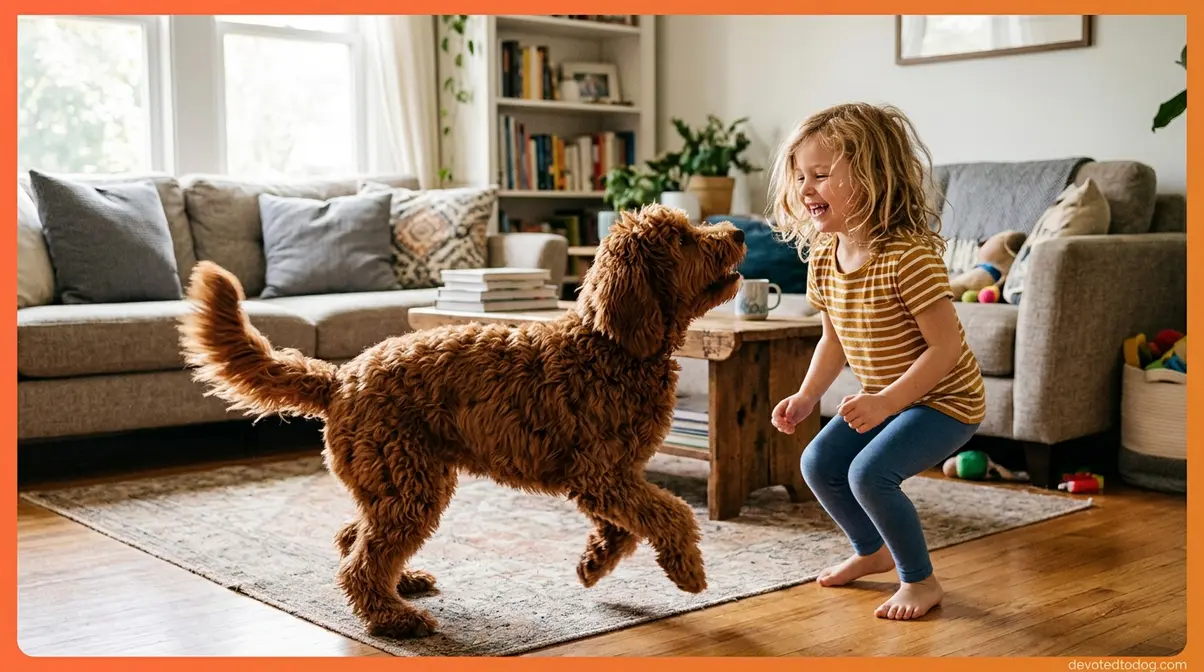
This hybrid dog breed is created by crossing a Golden Retriever with a Poodle, distinguished by its rich, reddish-mahogany coat and warm, outgoing personality. As one of the most trainable and affectionate designer breeds available, this crossbreed combines the Golden Retriever’s legendary family-friendly temperament with the Poodle’s sharp intelligence and low-shedding coat. Their striking red color, and whether it stays that way, is covered in detail in the next section through our Fade Factor framework.
Red Goldendoodles inherit the Golden Retriever’s loyalty and the Poodle’s intelligence, making them one of the most trainable family dogs available today. Think of them as the Labrador of the designer dog world, friendly with everyone, eager to please, and almost impossibly enthusiastic about their people.
Personality and Temperament
This designer dog combines two of the most people-oriented breeds in existence. The Golden Retriever, beloved for its gentle, family-friendly temperament, contributes eagerness to please and a near-endless capacity for affection. The Poodle, one of the most intelligent and low-shedding dog breeds, adds quick learning ability and a playful sharpness. The result is a dog that picks up new commands faster than most breeds, most learn “sit,” “stay,” and “come” within the first week of consistent positive reinforcement training.
Socially, they are what trainers often describe as “everybody’s friend.” Across owner communities, the consistent feedback is that these dogs greet strangers with excitement rather than suspicion. That’s wonderful for families, but it does mean they make poor guard dogs. They may bark at a knock on the door, but it’s out of enthusiasm, not aggression.
The flip side of all that social energy is a genuine vulnerability to separation anxiety. These dogs struggle when left alone for extended periods. The RSPCA advises that dogs are left for no longer than four hours at a stretch, so they have opportunities to exercise, go to the toilet, and spend time with people. Dogs left alone regularly beyond that threshold may develop destructive behaviors, chewing furniture, persistent barking, or accidents indoors. Why does this matter for you? If your household has someone home most of the day, this breed will thrive. If both adults work 9-to-5 with no midday check-in, a dog walker or doggy daycare is not optional, it’s part of the ownership budget.
Affection, for this breed, is physical and constant. They lean against you, follow you from room to room, and maintain prolonged eye contact, a behavior researchers associate with oxytocin release in both dogs and humans. This is a breed that genuinely wants to be with you, not just near you.
learn more about the Red Goldendoodle
Their personality makes them wonderful companions, but owning one is a bigger commitment than many new owners expect, especially when it comes to grooming and exercise.
Exercise, Grooming, and Daily Care Needs
As a full-grown adult, your dog will need a minimum of 30–60 minutes of active exercise every single day. “Active” matters here, a stroll around the block does not qualify. Think a 20-minute brisk morning walk plus 20–30 minutes of fetch, off-leash play, or swimming in the afternoon. Dogs that don’t get adequate physical outlet are significantly more likely to develop the destructive behaviors mentioned above.
Grooming is the commitment most new owners underestimate. Because their wavy or curly coat traps shed fur instead of releasing it, mats form quickly without regular brushing. Plan on brushing 3–4 times per week at home, plus a professional grooming appointment every 6–8 weeks. At an average of $80–$150 per session, that’s $640–$1,200 in grooming costs annually, a number worth building into your budget before you fall in love with a puppy photo.
Training should rely exclusively on positive reinforcement. These dogs respond quickly to reward-based methods and poorly to harsh corrections. Crate training from week one is one of the most effective tools for establishing boundaries and reducing separation anxiety.
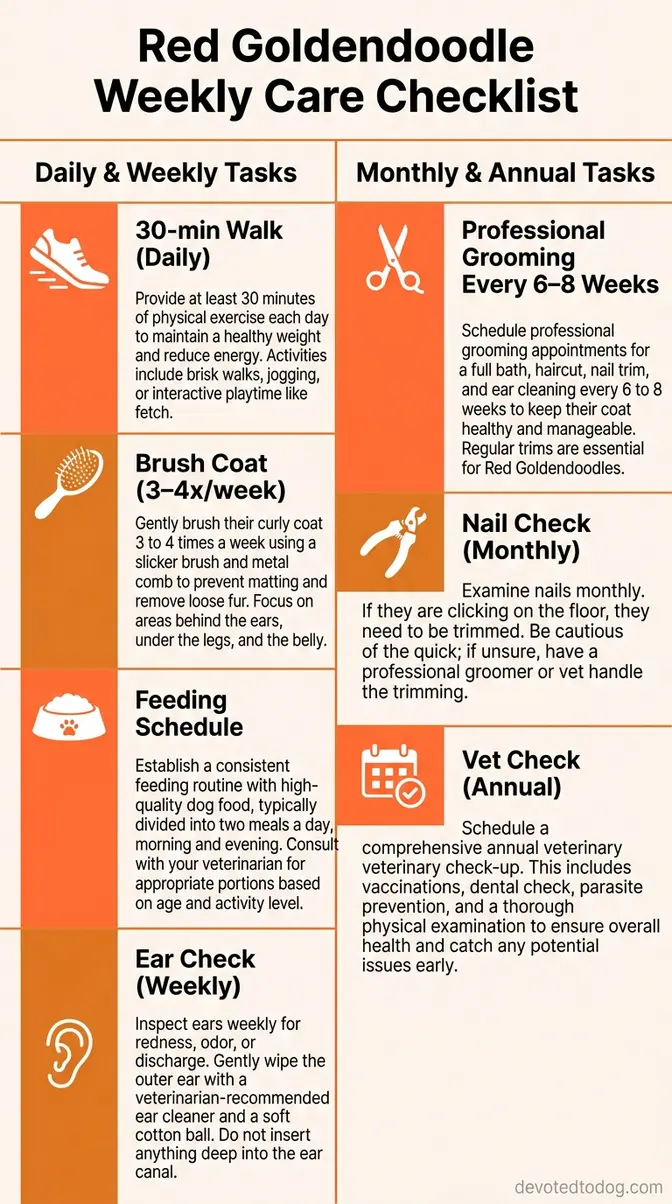
Here’s a sample weekly routine that works for most owners:
- Monday: 30-minute walk + full brushing session
- Wednesday: 20–30 minutes of fetch or off-leash play + quick brush
- Friday: 30-minute walk + ear check (moisture in floppy ears creates infection risk)
- Sunday: Full brush-through + nail check
Now that you know what owning this dog involves day-to-day, let’s look at whether this breed is genuinely the right fit for your specific living situation.
Is This Breed Right for You?
Not every household is the right match for this breed, and knowing that before you commit is a sign of a responsible owner. These dogs are exceptional companions for the right situation. They can be a poor fit for others.
| Lifestyle | Match Level | Why |
|---|---|---|
| Active families with children ages 5–12; work-from-home households | Best Match | Gentle temperament, high energy, constant companionship, they thrive with daily human contact and active kids |
| Retired individuals or couples with time for daily walks and social engagement | Good Match | Older adults who can commit to exercise and grooming will find this breed deeply rewarding |
| Households where the dog would be alone 8+ hours daily; very small apartments with no outdoor access; owners who cannot afford professional grooming | Poor Match | Separation anxiety, energy levels, and grooming needs create welfare concerns in these scenarios |
The honest answer: if you have kids between 5 and 12, a work-from-home schedule, and space for a dog to move around, this crossbreed is close to an ideal family dog. If you’re away all day, live in a studio apartment, or can’t budget $640–$1,200 annually for grooming, this may not be the right breed, and a different dog will make both of you happier.
Assuming a red Goldendoodle fits your lifestyle, the next question every buyer asks is: “Will that beautiful red coat actually stay red?” The answer depends on genetics, and it’s more complicated than most breeders will tell you.
Coat Colors, Patterns, and Fading
“Does anyone have a red doodle that stayed red?”
The honest answer is: it depends on genetics, and the genetics of fading are not fully mapped. Understanding dark red coat science and the full spectrum of colors is the most important research you can do before choosing a breeder. Here’s what you need to know.
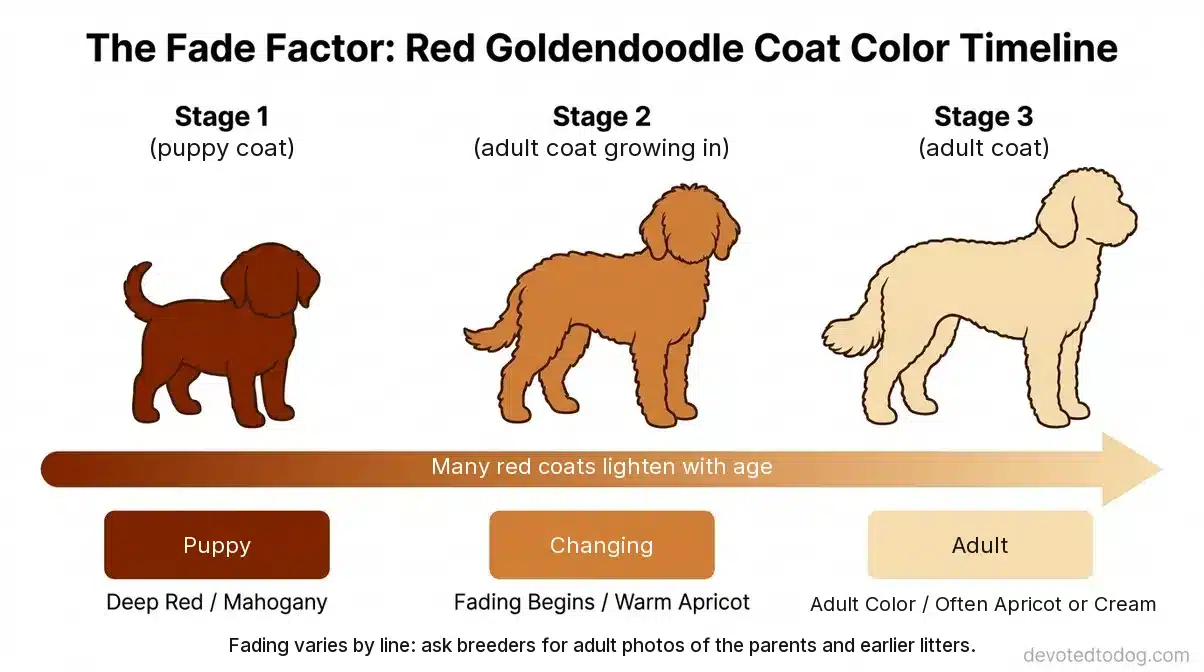
The Fade Factor: Why Coats Change
Will my red Goldendoodle change color? For most buyers, the answer is yes, at least partially. We call this predictable color change “The Fade Factor”, and understanding it is the single most important thing you can do before choosing a breeder.
The Fade Factor is not a defect. It is not a sign of poor breeding. It is a natural change that is common in red coats, even though the genes behind it are not fully mapped.
Fading with age: In many red Goldendoodles, the amount of red pigment, pheomelanin (the red pigment responsible for your dog’s coat color), visibly drops as the puppy coat gives way to the adult coat. Breeders often link this to the Poodle side of the family tree, but the genes involved have not been mapped, and we found no DNA test that predicts it.
The D Locus (Dilution Gene): A separate gene, the D locus, is often blamed for fading, but it does something different. The UC Davis Veterinary Genetics Laboratory describes it as a recessive gene that lightens base colors to paler shades, for example black to gray-blue and chocolate brown to a pale silvery shade; it does not describe red coats fading with age.
Genetic research on coat shade found that five genetic variants explain over 70% of the variation in how deep or pale red and yellow coats are (Slavney et al., PLoS ONE, 2021); that study measured coat shade, not change with age. Separately, a Tufts University veterinary nutritionist notes that coat color is decided mostly by genetics, although in some cases diet can also play a role, for example when a black coat turns reddish because the diet is short of the amino acids tyrosine and phenylalanine (Linder, Tufts Petfoodology, 2021).
The Fading Timeline: Color change usually shows as the puppy coat gives way to the adult coat. Breeders commonly report that it starts in the second half of the first year and that the coat settles by about age 2; we found no published study that times this for red Goldendoodles, so treat these ages as a rough guide. Here’s what that progression typically looks like:
| Stage | Approximate age (breeder reports) | Typical Coat Color |
|---|---|---|
| Puppy | 0–6 months | Deep red, mahogany, or copper |
| Adolescent | 6–18 months | Fading begins; warm red to golden apricot |
| Adult | 2+ years | Final color, often apricot or cream unless from non-fading lines |
Now that you understand why fading happens, let’s look at the full spectrum of red shades, because “red” covers a much wider range of colors than most buyers expect.
Shades of Red: Dark to Copper
Buyers seeking dark coats are often surprised to learn that “red” is not a single, standardized color in breeding. It describes a spectrum, and where your puppy sits on that spectrum at 8 weeks tells you less than you’d hope about where they’ll land at age three.
From lightest to darkest, the red spectrum runs:
- Light Copper, A warm, penny-like tone; the lightest shade most breeders would still call “red”
- Warm Red, A classic strawberry-red; the most commonly advertised shade
- Dark Red, A deeper, richer auburn tone; buyers specifically searching “dark red goldendoodle” typically want this shade or darker
- Mahogany, A brown-red with deep warmth; often the most striking at puppyhood
- Deep Red, The darkest, most saturated shade; breeders advertising deep red lines should provide photo evidence of adult dogs from previous litters
Here’s the critical insight: the puppy’s current shade at 8 weeks is NOT a reliable predictor of adult color. A mahogany puppy can fade to warm apricot. A deep-red puppy from a line whose adults stay red can remain rich red at age five. The parents’ adult coats are a better guide than the puppy’s current coat color.
Breeders who advertise “dark red, non-fading lines” should be able to show you photo documentation of adult dogs from at least two previous litters, not just puppy photos.
explore all Goldendoodle coat colors and patterns
Knowing your puppy’s shade is useful, but the color that trips most buyers up is the difference between red and apricot. These two look similar in photos, but they differ in how much red pigment the coat carries.
Red vs. Apricot: Key Differences
The apricot vs. red confusion is the most common color misunderstanding in this niche, and it’s made worse by The Fade Factor. Here’s the clear breakdown:
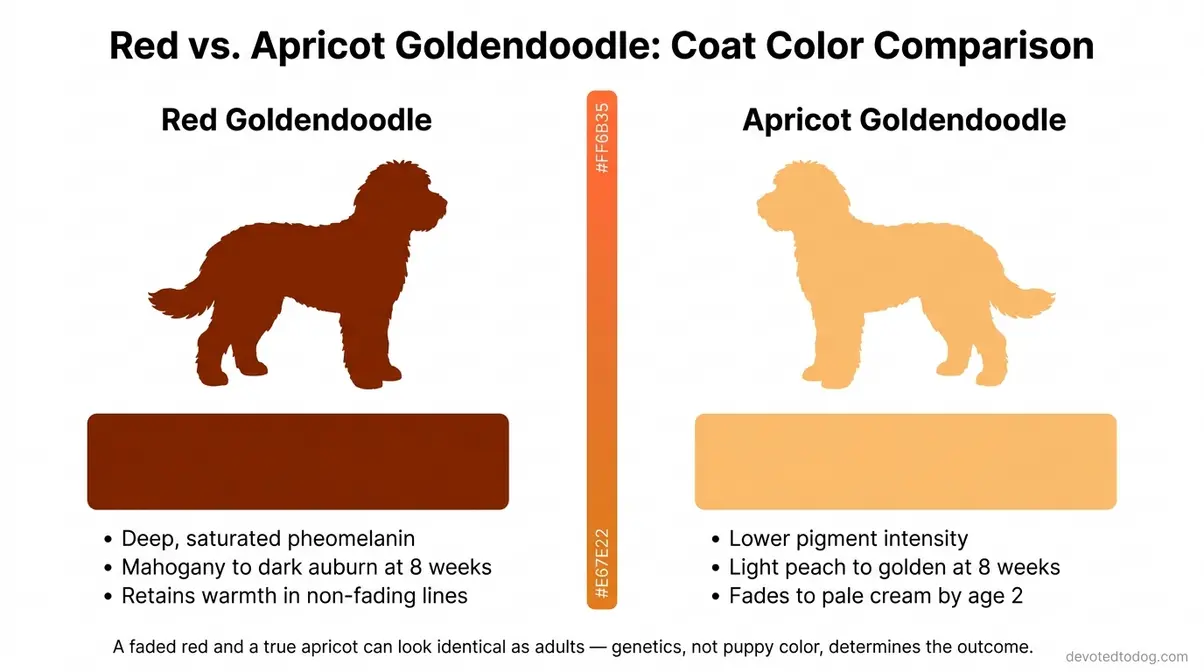
Red Goldendoodles have a deeper, richer concentration of pheomelanin, the coat carries a warm, auburn-like tone with visible depth. Apricot Goldendoodles have a lighter, peachy-yellow tone, the pigment intensity is lower. The difference is not a different color gene; it’s the concentration of the same pigment.
The problem: a faded red dog and a true apricot dog can look identical as adults. A buyer who paid a premium for “red” may not realize the dog was never going to stay that color. This is why asking about parental genetics matters far more than looking at the puppy.
| Feature | Red Goldendoodle | Apricot Goldendoodle |
|---|---|---|
| Pigment intensity | High (deep, saturated) | Lower (pale, peachy) |
| Typical puppy color | Mahogany to deep auburn | Light peach to golden |
| Typical adult color | Warm red (if non-fading line) or apricot | Pale apricot to cream |
| Fading likelihood | High | Moderate |
| Price premium | Yes, true red lines cost more | Standard pricing |
The practical buying tip: ask the breeder for photos of the sire and dam as adult dogs. If both parents show deep red coats at age 3–4, the puppies are meaningfully more likely to retain color. If the breeder can only show you puppy photos, that’s information worth noting.
Beyond the base red color, these dogs can also appear in striking multi-color patterns, each with its own name and visual signature.
Coat Patterns: Parti, Tuxedo, Merle
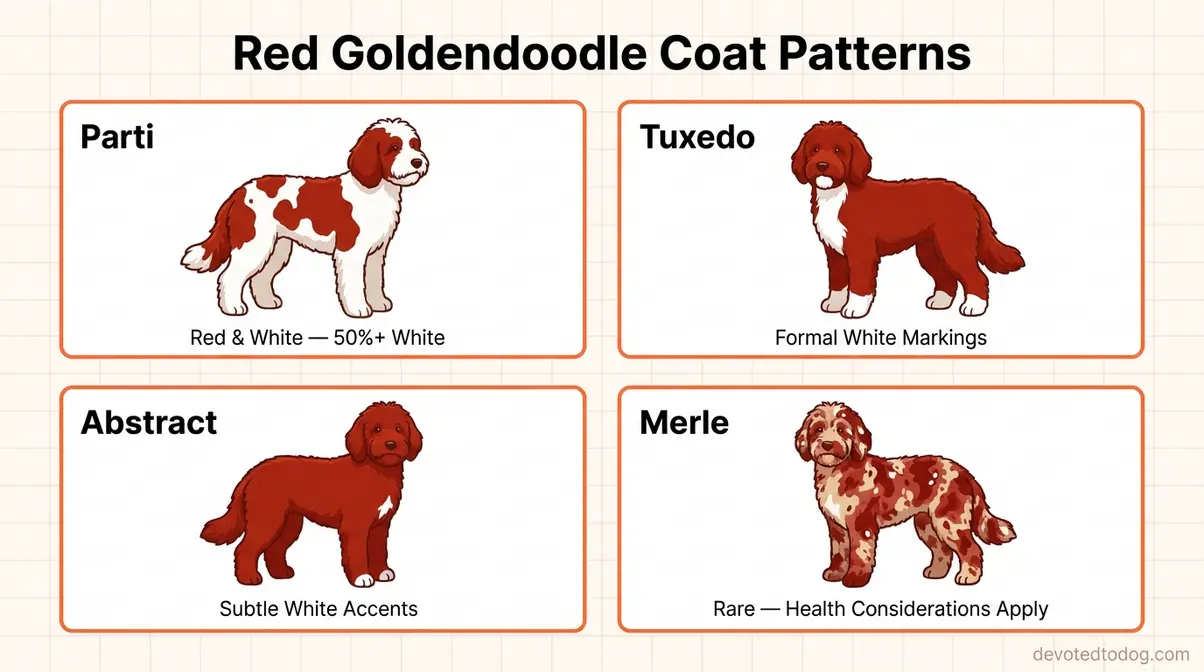
These dogs aren’t limited to a single solid coat. Several multi-color patterns occur within the red category, and some carry strong buyer interest:
- Parti (Red and White): A dog where more than 50% of the coat is white with red patches. The red parti is one of the most visually striking variations, bold white with warm red patches distributed across the body. This is a popular pattern among buyers who want clear visual contrast.
- Tuxedo: A specific parti pattern where white appears on the chest, chin, and paws, resembling a formal tuxedo jacket. The red tuxedo is particularly sought after for its elegant, distinctive appearance. Like all parti patterns, it is accepted by GANA under their coat standard guidelines.
- Abstract (Mismark): Small white patches, usually on the chin, chest, or toes, against a primarily red coat. The red abstract offers a mostly-red look with subtle white accents. This is the most common multi-color variation from reputable breeders.
- Merle: A marbled, dappled pattern with irregular patches of color. The red merle carries significant search interest, but it is extremely rare and controversial. Some breed associations discourage merle breeding due to serious health concerns associated with double-merle genetics (deafness, blindness). The Goldendoodle Association coat standards recognize parti, phantom, and abstract as accepted patterns; merle is not a recognized standard color (GANA). If a breeder is producing merle puppies, ask detailed questions about their genetic testing protocol.
The pattern of the coat is one thing, the texture is another. And texture affects everything from how much the dog sheds to how often you’ll need to book a grooming appointment.
Coat Textures: Curly, Wavy, and Straight
The coat can fall into three distinct texture categories, and the texture has direct, practical consequences for grooming, shedding, and allergy compatibility.
Coat texture comes mainly from the parents: the curlier Poodle coat or the flatter Golden Retriever coat.
| Texture | Shedding Level | Grooming Frequency | Best For |
|---|---|---|---|
| Curly | Very low | Daily brushing + grooming every 5–6 weeks | Allergy sufferers; F1B and Multigen generations |
| Wavy | Low to moderate | 3–4x weekly brushing + grooming every 6–8 weeks | Most families; F1 generation |
| Straight | Moderate | 2–3x weekly brushing + grooming every 8 weeks | Owners who prefer easier home brushing; some F1 dogs |
The curly variation, closest to the Poodle parent, sheds the least but requires the most intensive grooming. Tight curls mat quickly without daily attention. The wavy coat is the most common in F1 dogs and offers a balance most families find manageable. Straight hair is closest to the Golden Retriever parent, sheds more, and is less hypoallergenic, but it’s easier to brush at home between appointments.
Now that you understand the coat, let’s talk about size. Because this breed comes in four very different sizes, and picking the wrong one for your living situation is one of the most common buyer mistakes.
Sizes: Toy, Mini, Medium, and Standard
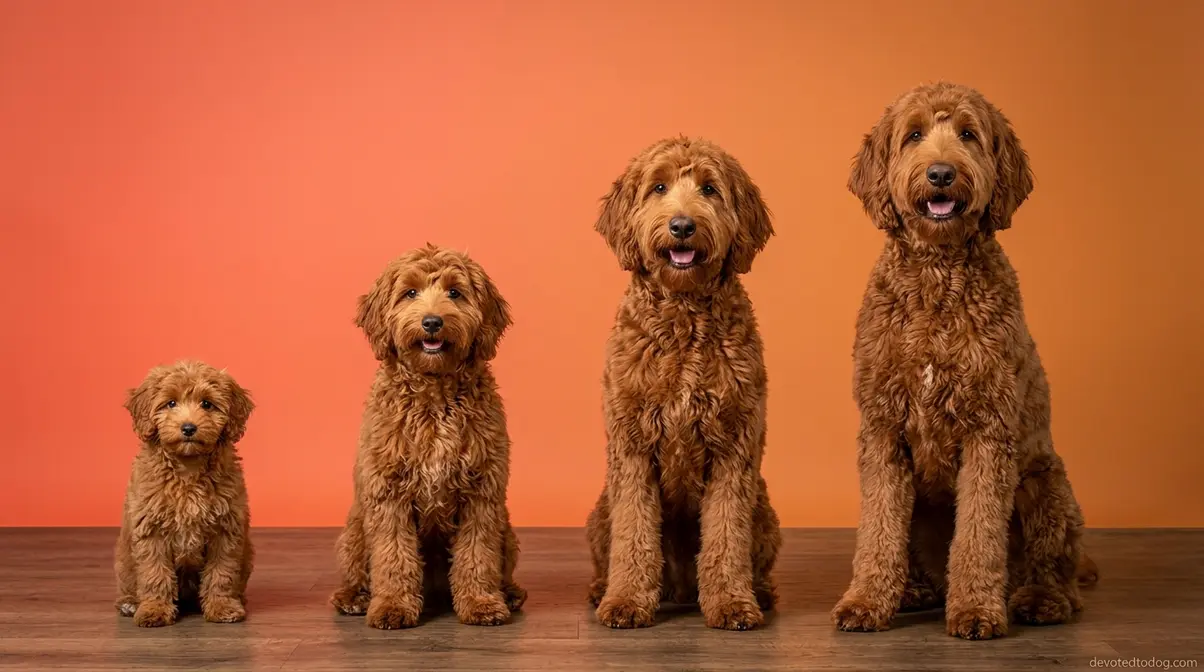
This breed comes in four size categories, Toy/Petite, Miniature, Medium, and Standard, and the size you choose will affect everything from your apartment lease to your grooming bill. Here’s what each size looks like full grown.
Regardless of size, The Fade Factor applies equally, a toy variation is just as likely to experience coat fading as a standard one. Don’t let size choice distract from the genetics question.
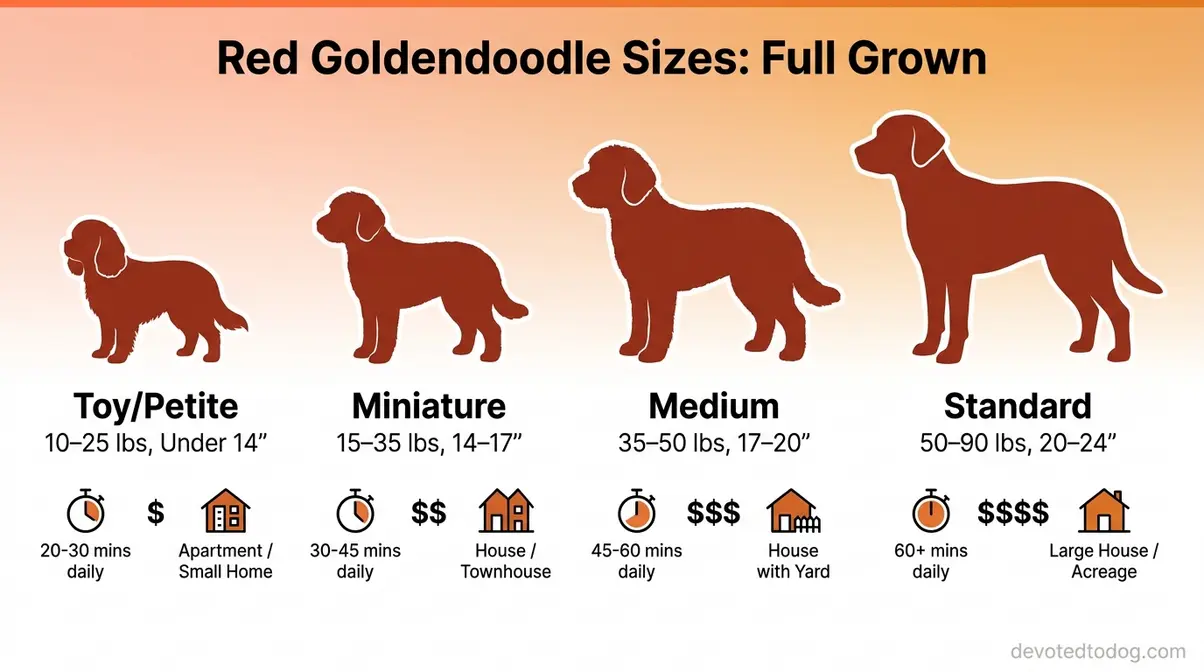
| Size | Adult Weight | Adult Height | Lifespan | Best For |
|---|---|---|---|---|
| Toy/Petite | 10–25 lbs | Under 14″ | 13–17 yrs | Apartments, seniors |
| Miniature | 15–35 lbs | 14–17″ | 12–16 yrs | Families, smaller homes |
| Medium | 35–50 lbs | 17–20″ | 12–15 yrs | Active families, houses |
| Standard | 50–90 lbs | 20–24″ | 10–14 yrs | Large homes, active owners |
For a complete breakdown of all size categories, see our dedicated guide to help you understand Goldendoodle sizes.
Toy and Petite Sizes
The toy version is the smallest size variation in the category, and one of the easiest ranking opportunities for buyers to find because demand is high relative to supply. Weighing 10–25 lbs and standing under 14 inches at the shoulder, toy and petite sizes are created by breeding a miniature or toy Poodle with a smaller Golden Retriever or an existing hybrid.
Breeders use several names for this size category interchangeably: toy, petite, micro, and micro mini all refer to essentially the same size range. The petite variation is another common term you’ll encounter on breeder websites. Don’t be confused by the naming, ask for the expected adult weight in pounds, not the category label.
Despite their small size, toy dogs still need 20–30 minutes of daily active exercise. They are not couch dogs. A toy is roughly the size of a Cavalier King Charles Spaniel, small enough for a lap but energetic enough to demand a daily walk.
Best for: Apartment dwellers, seniors, households with limited outdoor space, or anyone who travels frequently and needs a portable companion.
One size up from the toy is the miniature, and it’s by far the most popular choice for buyers in 2026.
Miniature Size
The miniature, weighing 15–35 lbs at full maturity, is the most popular size for apartment living and families with small children (Premier Pups, 2026). The mini balances portability with the feeling of a “real dog”, not so small it feels fragile, not so large it overwhelms a smaller home.
Many buyers search specifically for what a full grown mini looks like, and the answer is compact, fluffy, and often strikingly beautiful. Standing 14–17 inches at the shoulder, a full grown mini typically reaches its adult size between 12–18 months of age. The coat is usually wavy to curly, and the red coloring, if from a non-fading line, gives the adult dog a warm, auburn appearance that photographs exceptionally well.
Exercise needs for a mini sit at 30–45 minutes daily. Grooming requirements are the same as larger sizes: professional appointments every 6–8 weeks plus 3–4x weekly brushing at home. One important financial note: miniature puppies for sale from reputable breeders typically command a slight premium of $200–$500 above standard-sized puppies, reflecting the additional breeding complexity of producing consistently smaller dogs. Expect to pay $2,800–$3,500 for a mini from a quality breeder in 2026.
A mini is roughly the size of a Cocker Spaniel, perfect for a home with a small yard or suburban neighborhood, and manageable in most apartment buildings that allow dogs up to 35 lbs.
For a complete breakdown of all size categories, see our dedicated guide to help you understand Goldendoodle sizes.
If a mini still feels too small, the medium size offers more dog without the full commitment of a standard-sized breed.
Medium Size
The medium size occupies the sweet spot for active families, substantial enough to hike, run, and play fetch without the bulk and food costs of a standard. Weighing 35–50 lbs and standing 17–20 inches tall, the medium is often described by owners as “the perfect active family dog.”
Exercise needs step up to 45–60 minutes daily. Temperament remains consistent with all sizes, size does not significantly alter personality. One practical note: “medium” is not universally recognized as a distinct category by all breeders. Some use only mini, standard, and petite. When shopping, ask the breeder explicitly about the expected adult weight range of the specific litter, not just the size label they use.
A medium is roughly the size of a Border Collie, athletic, agile, and suited to homes with a yard and an active lifestyle.
At the largest end of the spectrum, the standard is the closest to the original hybrid that made the breed famous.
Standard Size
The standard is the largest size category, weighing 50–90 lbs and standing 20–24 inches at the shoulder, closest in size and presence to a Golden Retriever. This is a full, substantial family dog that requires the most space, exercise, food, and grooming investment of any size.
Exercise needs: 60+ minutes daily. Food: approximately 3–4 cups of quality dry food per day, compared to 1–2 cups for a mini, a difference that adds up meaningfully over a 12–14 year lifespan. Grooming costs are also higher, as larger dogs take longer to groom and often cost $20–$40 more per session.
Best for: Active families with large homes and yards, people who enjoy hiking or running with a dog, or owners who specifically want a dog that “fills a room.” A standard is roughly the size of a Labrador Retriever, a full-bodied, energetic companion that thrives with space and activity.
Now that you know the sizes, the most important question: which one is actually right for your life?
Which Size Is Right for You?
The right size depends on your living situation, activity level, and budget, not on which puppy looks most adorable in the photo.
- Small space (apartment, no yard): Toy or Petite, including the micro mini, the smallest option available
- Moderate space (townhouse, small yard): Miniature, the most popular choice, and for good reason
- Active family, medium home with yard: Medium or Standard
- Active outdoor lifestyle (hiking, running, large property): Standard
Before finalizing your size decision, factor in grooming costs (larger = more expensive per session), food costs, and your realistic daily exercise commitment. A standard dog in a studio apartment is a welfare concern, for the dog, not just the owner.
With size chosen, the next critical factor is generation, because whether a dog is F1 or F1B affects coat type, shedding, and allergy compatibility more than almost anything else.
Generations Explained: F1, F1B, and Beyond
What does “F1B” mean on a breeder’s website? The letters and numbers describe a dog’s generation, specifically, how many times the breed has been crossed back toward a Poodle. The generation determines coat type, shedding level, and allergy compatibility. For prospective buyers, it also connects to The Fade Factor: Poodle-heavy generations are often said to fade more, although the genetic reason has not been established.
When speaking with breeders, always ask which generation both parents are, it’s one of the most important questions in your vetting conversation.
| Generation | Parents | % Poodle | Coat Type | Shedding | Best For |
|---|---|---|---|---|---|
| F1 | Golden Retriever × Poodle | 50% | Wavy/Straight | Moderate | Families without allergies |
| F1B | F1 × Poodle | 75% | Wavy/Curly | Low | Mild to moderate allergy sufferers |
| F2 | F1 × F1 | 50% | Variable | Variable | Less predictable outcomes |
| Multigen | F1B+ × Poodle/Goldendoodle | 75%+ | Curly | Very Low | Severe allergy sufferers |
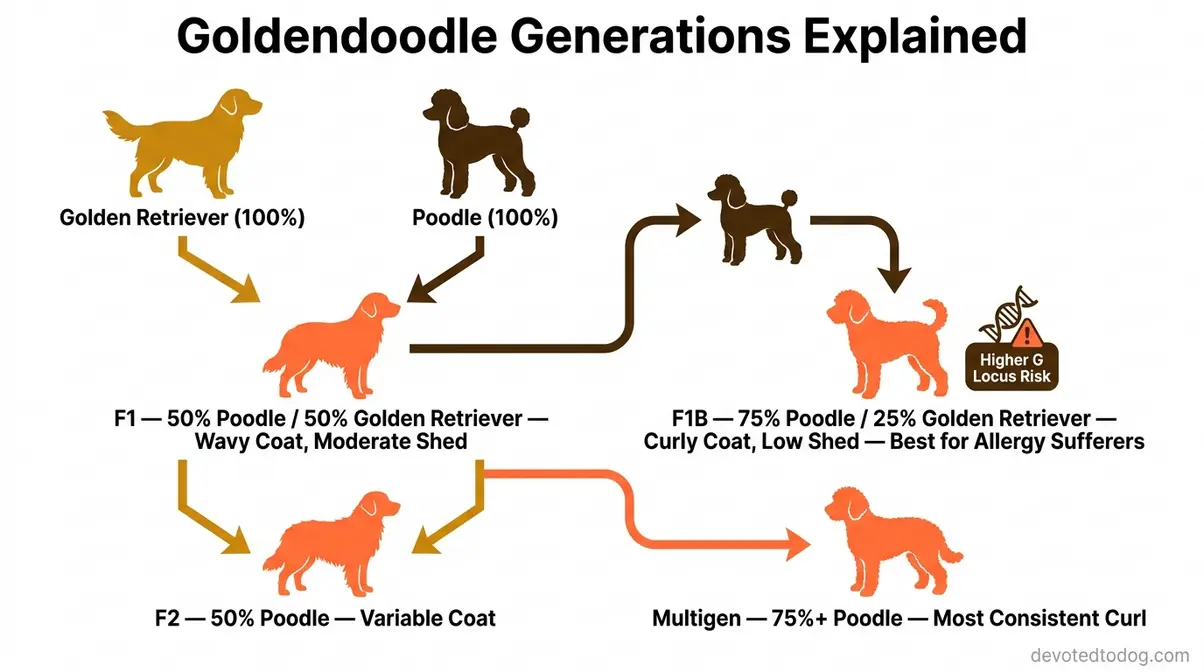
For a deeper dive, see our guide to F1B Goldendoodle genetics and generations.
F1 Generation Basics
An F1 is a first-generation cross, one purebred Golden Retriever parent bred with one purebred Poodle parent. The result is 50% Golden Retriever, 50% Poodle. This is the original cross, and it remains a popular choice for buyers who want predictable temperament with a slightly more Golden Retriever-like appearance.
The F1 coat is typically wavy, sitting between the Retriever’s flat, straight coat and the Poodle’s tight curls. Shedding is moderate. The dog is partially hypoallergenic, but not as reliably as an F1B. For households without significant allergy concerns, the F1 is often the most “balanced” generation.
Many breeders and owners associate F1 dogs with “hybrid vigor”, the idea that genetic diversity from a first cross produces overall better health and vitality. This is a widely held community belief, though the scientific evidence is mixed. It’s worth noting as context, not as a guarantee.
The Fade Factor connection: F1 dogs can fade too. With only 50% Poodle genetics, an F1 is often said to fade less than an F1B, though this is breeder experience rather than a tested genetic rule. An F1 is the most “Golden Retriever-like” in temperament and appearance, predictable, friendly, with a wavy coat that most owners find manageable.
If you or a family member has allergies, the F1B generation is almost always the better choice, here’s why.
F1B: Best for Allergy Sufferers
An F1B is 75% Poodle, making it the most hypoallergenic generation commonly available and the most likely to have a curly, low-shedding coat (Goldilocks Goldendoodles, 2026). The “B” stands for backcross: an F1 bred back to a purebred Poodle. The extra Poodle genetics produce a curlier coat that sheds significantly less than an F1.
Why does less shedding matter for allergies? It’s not actually the fur that triggers most allergic reactions, it’s the dander (dead skin cells) that attaches to shed fur and disperses through the air. Less shedding means less dander circulating in your home. That said, no dog is 100% hypoallergenic. F1B minimizes allergen exposure but cannot eliminate it entirely. If someone in your household has severe reactions to dogs, consult an allergist before purchasing any dog.
The F1B mini, combining F1B genetics with the miniature size, is the single most popular combination for apartment dwellers with allergies. It’s worth naming explicitly because many buyers don’t realize they can specify both generation and size when placing a waitlist deposit with a breeder.
The Fade Factor connection is critical here: F1B dogs have MORE Poodle genetics and are often said to fade more. If you specifically want a red coat that lasts, ask the breeder for photos of adult dogs from their F1B litters.
F1B puppies typically cost slightly more than F1 due to the additional breeding step and higher demand from allergy sufferers. “If someone in your household sneezes around dogs, an F1B is your safest choice, but always ask the breeder for references from allergy-sufferer buyers in previous litters.”
For a complete guide to this generation, see our resource on F1B Goldendoodle genetics and generations.
Beyond F1 and F1B, breeders also produce F2 and Multigen dogs, here’s a quick overview of what those terms mean.
F2, Multigen, and Other Generations
The generations beyond F1B are less common but worth understanding before you speak with breeders.
F2: Two F1 dogs bred together. The result is still approximately 50% Poodle and 50% Golden Retriever on average, but with significantly more genetic variability than an F1. Coat type and shedding are less predictable in F2 litters; some puppies may be nearly straight-coated, others nearly curly. For buyers who prioritize coat predictability, F2 is generally not the recommended choice.
F2B: An F1 bred to an F1B, producing approximately 62.5% Poodle genetics. Coat predictability improves compared to F2, approaching F1B in hypoallergenic potential.
Multigen: Any generation beyond F2 involving further backcrossing to Poodles. Multigen dogs offer the most consistent coats and the highest hypoallergenic potential, but they are the furthest from the original “hybrid” cross that gave the breed its initial appeal. Coat color, including red, can be more variable in Multigen lines.
Practical advice: For most buyers, F1 or F1B is the clearest, most predictable choice. F2 and Multigen generations are best pursued when working with a breeder who performs comprehensive genetic testing and can speak specifically to coat outcomes in their lines. Refer back to the generations table above to compare options at a glance.
You now know the breed, the coat, the size, and the generation. The final piece of the puzzle: how much does a puppy actually cost, and how do you find one without getting scammed?
Cost and Finding a Reputable Breeder
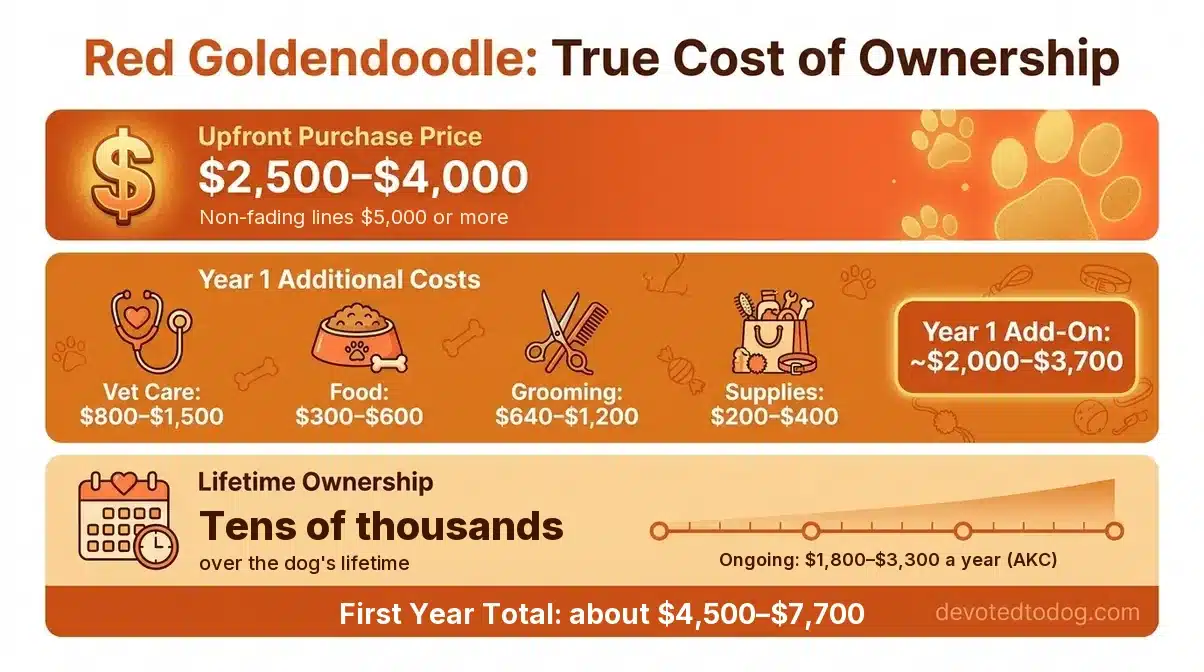
Puppies for sale from reputable breeders typically range from $2,500 to $4,000 in 2026, with some premium non-fading lines reaching $5,000 or more (Dogster, 2026; Jenna Lee Doodles, 2026). Prices vary based on size, generation, coat genetics, and breeder location. Understanding what drives the price, and what price signals a scam, is the most important buyer skill you can develop before puppy searches lead you somewhere you’ll regret.
Upfront and Lifetime Costs
The full financial picture of ownership goes well beyond the purchase price. Here’s what to budget across three time horizons:
Upfront cost: $2,500–$4,000 for a puppy from a reputable breeder. Factors that push prices higher include lines whose adults stay red, miniature size, F1B generation, established breeder reputation, and geographic location (urban areas typically run $300–$500 higher than rural breeders for the same puppy). Miniature puppies from quality breeders typically fall in the $2,800–$3,500 range.
- First-year additional costs:
- Veterinary care (initial checkup, core vaccines, spay/neuter): $800–$1,500
- Food: $300–$600/year
- Professional grooming (every 6–8 weeks at $80–$150/session): $640–$1,200/year
- Supplies (crate, bed, toys, leash, collar): $200–$400
- First-year add-on total: approximately $2,000–$3,700
Lifetime cost: AKC data on annual dog ownership costs shows that annual dog ownership runs about $1,800–$3,300 depending on size, with first-year one-time costs averaging an additional $2,100 (AKC owner survey). Over a 12–15 year lifespan, total ownership costs, including the purchase price, can run into the tens of thousands of dollars.
According to AKC data, the annual cost of owning a dog is approximately $1,800–$3,300 depending on size, with first-year one-time costs averaging an additional $2,100 (AKC). By this guide’s own breakdown, the first year, including the purchase price, comes to roughly $4,500–$7,700.
| Cost Category | Range |
|---|---|
| Upfront (purchase price) | $2,500–$4,000 |
| Year 1 additional costs | $2,000–$3,700 |
| Annual ongoing costs | $1,800–$3,300 |
| Estimated lifetime total | Tens of thousands of dollars |
Before putting down a deposit on a puppy, ensure your annual budget can accommodate $1,800–$3,300 in ongoing costs, every year for the next 12–15 years. This is a long-term financial commitment, not a one-time purchase.
Before we get to how to find a breeder, it’s worth addressing a question that comes up constantly in buyer communities: are these dogs actually rare?
Are Red Goldendoodles Rare?
Yes, and the answer deserves some nuance. True, non-fading coats are genuinely rare. Many puppies are sold as “red” by breeders who don’t show adult dogs from their lines or don’t disclose how often their puppies fade. The Fade Factor means that a significant portion of puppies marketed as “red” will be apricot or cream as adults.
Breeders who consistently produce red coats that last into adulthood are uncommon, and demand for their puppies far exceeds supply. Waitlists at these breeders can stretch 6–12 months. This supply-demand gap explains both the price premium and the scam risk: when buyers are desperate and supply is limited, bad actors fill the gap.
An important caveat: “red” in breeding is not a standardized, regulated color designation. Any breeder can label a puppy “red” even if the puppy is a medium apricot that will fade further. Buyers should ask for photos of the parent dogs and of adult dogs from previous litters, not just puppy photos.
“If a breeder has immediate availability for a ‘red’ puppy at a low price with no waitlist, that should prompt careful questions, reputable breeders with true red, non-fading lines typically maintain waitlists for a reason.”
So how do you actually find one of these rare, reputable breeders, and avoid the scammers and puppy mills that flood the market? Here’s the checklist.
Breeder Vetting Checklist
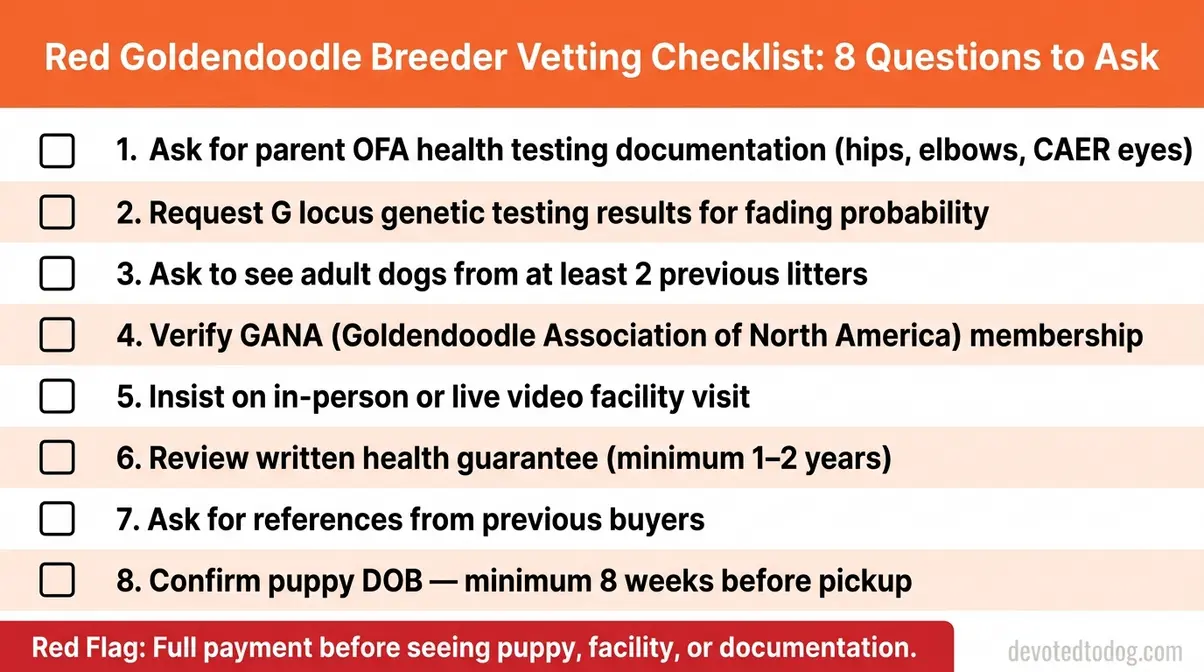
A reputable breeder health-tests both parent dogs, welcomes in-person or video visits, and provides a written health guarantee with supporting paperwork. Here is the complete vetting checklist to use in every breeder conversation:
- Ask for parent health testing documentation, both parents should be OFA certified for hips and elbows, and eye-certified through CAER (Companion Animal Eye Registry). These tests screen for genetic conditions common in Golden Retrievers and Poodles.
- Request evidence of color retention, such as photos of the parents and of earlier puppies as adults. A breeder advertising “non-fading red” lines should have documentation, not just a verbal claim.
- Ask to see adult dogs from previous litters, photos of parent dogs at age 3–4 are the single best predictor of whether puppies will retain their coat color.
- Verify Goldendoodle Association of North America (GANA) membership, the Goldendoodle Association of North America (GANA), the breed’s official registry, lists verified breeders who meet health and ethics standards.
Beyond health and genetics, a reputable breeder will also prioritize transparency and responsible placement for every puppy they sell.
- Insist on an in-person or live video visit, reputable breeders welcome visits to their facility. Refusal or repeated excuses are a significant red flag.
- Review the health guarantee, a minimum 1–2 year guarantee against heritable genetic defects is standard among quality breeders.
- Ask for references from previous buyers, specifically allergy sufferers if that’s relevant to your household. A breeder confident in their work will provide references readily.
- Confirm the puppy’s date of birth and pickup date, puppies should be a minimum of 8 weeks old before leaving the litter. Earlier pickup is a welfare concern.
A deposit of $200–$500 to hold a spot on a waitlist is normal and expected at quality breeders. Full payment before you’ve seen the puppy, the facility, or any documentation is a red flag. Geography matters less than quality, a reputable breeder 500 miles away is a better choice than a local puppy mill.
For a full evaluation resource, see our guide on how to find a reputable Goldendoodle breeder.
The checklist tells you what to look for. Now let’s be equally specific about what to walk away from.
Puppy Mill Warning Signs
When searching for puppies for sale online, the volume of listings from disreputable sources can be overwhelming. Here’s what to watch for:
- Pricing under $1,500 for a puppy, below-market pricing almost always signals a puppy mill or backyard breeder cutting corners on health testing and genetic screening
- No health testing documentation for parent dogs, any breeder who cannot produce OFA results and eye certifications is not meeting basic standards
- Multiple breeds available simultaneously, reputable breeders specialize; a website offering 10 different breeds suggests a commercial operation, not a dedicated program
- Pressure to buy immediately, “this puppy won’t be available tomorrow” urgency tactics are a classic scam signal
- No in-person visit allowed, legitimate breeders want you to see their facility and meet the parent dogs
- Payment by wire transfer or gift card only, these payment methods offer buyers zero recourse if the transaction is fraudulent
Owner communities consistently report that many buyers skip vetting steps when they encounter a cute photo online. Don’t let a photo override the checklist. The Fade Factor framework exists precisely because the most important things about a puppy, its genetics, are invisible in a photograph.
Now that you’re equipped to find a great breeder, let’s address a few common concerns that first-time owners often raise too late.
Common Concerns Before You Commit
Common Owner Mistakes
Across owner communities, the same mistakes appear again and again. Recognizing them before you commit can save significant money, time, and heartbreak:
- Buying based on puppy photos without asking about genetics, The Fade Factor is the most common and most expensive mistake. A stunning 8-week photo does not tell you what the dog will look like as an adult. Always ask to see the parents’ and earlier puppies’ adult coats.
- Underestimating the grooming commitment, Many new owners are genuinely shocked by the every-6-8-week professional grooming requirement and the cost that comes with it. A dog with a matted coat is a dog in discomfort. Budget and schedule for it before you commit.
- Choosing size based on aesthetics rather than lifestyle, A standard dog in a studio apartment, or a toy variation in an extremely active hiking household, creates a mismatch that affects the dog’s wellbeing. Let your lifestyle guide the size decision.
And for some buyers, this breed simply isn’t the right fit, and that’s worth knowing before you commit.
When It Isn’t the Right Fit
Honest self-assessment before purchasing is one of the most responsible things a prospective owner can do.
Severe dog allergies: No dog is truly hypoallergenic, not even an F1B. If someone in your household has a history of severe allergic reactions to dogs (not just mild sneezing), consult an allergist before purchasing any breed. Spending $3,000+ on a puppy that triggers a serious allergic response is a preventable outcome.
Long daily absences: Households where the dog would routinely be alone for 8+ hours should consider a more independent breed. They are bred for human companionship, prolonged isolation causes genuine behavioral and emotional distress.
Limited grooming budget: Professional grooming every 6–8 weeks is not optional for this breed, it’s a welfare requirement. If that cost is not financially feasible, a short-haired breed will be a better match for your budget and the dog’s comfort.
Alternative to consider: For buyers who love the personality but find the grooming cost prohibitive, a Labradoodle with a fleece coat may require slightly less intensive maintenance, though grooming is still a significant commitment for any doodle breed. Consult with a groomer familiar with both breeds before deciding.
This article is general information, not veterinary advice. If your dog shows any of the signs above, or you have questions about your Goldendoodle’s health, talk to your veterinarian.
Frequently Asked Questions
Are Red Goldendoodles Rare?
True, non-fading red Goldendoodles are considered rare because many red coats fade to apricot or cream as the dog matures. Many breeders sell puppies as “red” that will not retain their color as adults, making breeders who consistently produce non-fading red lines highly sought after. Expect to pay a premium of $500–$1,000 above average prices for a verified non-fading red line according to pricing data from Dogster.
How Much Does a Red Goldendoodle Cost?
A red Goldendoodle from a reputable breeder typically costs $2,500 to $4,000 in 2026, with non-fading red lines and premium breeders reaching $5,000 or more (Dogster, 2026). Prices vary based on breeder reputation, geographic location, size, and generation. First-year ownership costs typically add another $2,000–$3,700 for veterinary care, food, grooming, and supplies. Be aware that prices under $1,500 should be treated as a warning sign of a puppy mill operation.
What to Know Before Buying?
The most common surprise for new owners is the grooming commitment. Professional grooming every 6–8 weeks and brushing 3–4 times per week at home are non-negotiable to prevent painful matting. These dogs also require a minimum of 30–60 minutes of active exercise daily. Furthermore, they struggle when left alone for extended periods; the RSPCA advises no longer than four hours at a stretch. Research both the financial and time commitment thoroughly before purchasing a puppy.
How Do Goldendoodles Show Affection?
These dogs show affection through physical closeness, frequently leaning against you, nudging for pets, and following you from room to room. They also maintain prolonged eye contact with their owners, which researchers associate with the release of oxytocin in both dogs and humans. Tail wagging, bringing you toys, and greeting you enthusiastically after even brief absences are all typical affection signals consistent across all sizes.
How to Discipline a Puppy?
Discipline a puppy exclusively through positive reinforcement. Reward good behavior immediately with treats, praise, or play. It is much more effective to redirect unwanted behaviors rather than punishing them. For biting, redirect to a chew toy immediately and end playtime briefly if biting continues. Consistent crate training from week one establishes healthy boundaries and reduces destructive behavior when left alone. Physical punishment is counterproductive and can permanently damage the trust-based bond these dogs form with their owners.
What Is Bad Behavior in Goldendoodles?
Common behavioral issues include jumping on people, excessive barking, chewing, and resource guarding. Most of these stem from under-stimulation or insufficient training rather than breed temperament. Dogs that receive less than 30 minutes of daily exercise are significantly more likely to develop destructive behaviors like furniture chewing. Separation anxiety is also a frequently reported challenge, but most issues resolve with consistent positive reinforcement training and adequate daily exercise.
Should You Push a Biting Puppy?
Pushing a puppy away when it bites is generally not recommended because the physical interaction can be interpreted as play, inadvertently reinforcing the behavior. Instead, trainers recommend a sharp verbal “ouch” followed by immediately turning away and ending play for 30–60 seconds. Puppies learn bite inhibition most effectively when they experience the social consequence of the game stopping, though you should consult a professional trainer if biting persists beyond 16 weeks.
What Is the Least Wanted Dog?
There is no single “least wanted” dog breed, as shelter intake rates vary significantly by region, year, and socioeconomic factors. However, large, high-energy breeds like American Pit Bull Terriers and certain hound mixes historically represent higher percentages of shelter populations in many U.S. regions. In contrast, designer hybrid breeds rarely appear in shelters due to high demand and active breed-specific rescue networks. Adoption from a breed-specific rescue is always worth exploring before purchasing from a breeder. It remains a meaningful option that deserves a place in your research.
The Final Word on Red Goldendoodles
For prospective buyers, the single most important insight from this guide is this: the coat color you fall in love with in a puppy photo is not guaranteed to last, unless you understand The Fade Factor and choose a breeder who can show you adult dogs from their red lines. By this guide’s cost breakdown, first-year costs come to roughly $4,500–$7,700 when you include the purchase price, veterinary care, grooming, and supplies, making this a significant commitment on every level, not just emotionally.
The Fade Factor framework gives you a clear decision lens: before choosing a breeder, request photos of adult dogs from previous litters and verify the breeder’s membership in the Goldendoodle Association of North America (GANA). These two steps, not the puppy’s current color, are your best guide to whether your dog will still be red at age five. Every other factor in this guide, size, generation, coat texture, pricing, feeds into that central framework.
Start by bookmarking the Breeder Vetting Checklist in this guide and using it in your very first breeder conversation. Check out our comprehensive Goldendoodle sizes guide to find your perfect match, and download the Breeder Vetting Checklist to start your search safely. This breed is one of the most rewarding dogs you can share your life with, as long as you go in with both eyes open and the right questions ready.
If you are exploring multi-color Goldendoodle options, the Parti Goldendoodle (a two-color base coat with at least 50% white) is another distinctive coat pattern worth comparing to the red coat.