If you’ve found yourself wondering whether your future apricot Goldendoodle puppy will grow up to look like a completely different dog — you’re not alone. Across owner communities, the concern comes up constantly: will that gorgeous, peachy-orange coat still be there at age two, or will it soften to something you barely recognize?
Most guides skip the honest answer. They show you irresistible puppy photos but say nothing about the genetics behind why that rich apricot coat sometimes fades to a pale cream by a dog’s second birthday. That silence leaves buyers anxious, confused, and poorly prepared.
This guide gives you the full picture. You’ll learn exactly why fading happens, which generation is least likely to fade, what a fair price looks like in 2026, and how to find a breeder you can actually trust. We’ll cover the breed’s personality, sizes, coat types, grooming needs, and even name ideas — everything you need to walk away ready to make your first call to a reputable breeder.
The apricot Goldendoodle is a warm, peachy-coated Golden Retriever-Poodle mix that typically costs $2,500–$5,000 from a reputable breeder — and yes, many will fade lighter as they mature.
- Color fading is genetic: F1B and higher-Poodle generations tend to fade more than F1s — and all apricots fade to some degree
- Five size options exist: From Teacup (under 10 lbs) to Standard (50–90 lbs) — size is determined by the Poodle parent used in breeding
- Apricot is NOT rare: It’s one of the most common Goldendoodle colors alongside cream — any breeder claiming otherwise is a red flag
- Reputable breeders health-test both parents: Always ask for OFA certifications before committing
- Use The Fading Spectrum framework: This guide’s tool for predicting your puppy’s adult coat color before you buy — based on generation and parent coat photos
What Is an Apricot Goldendoodle?

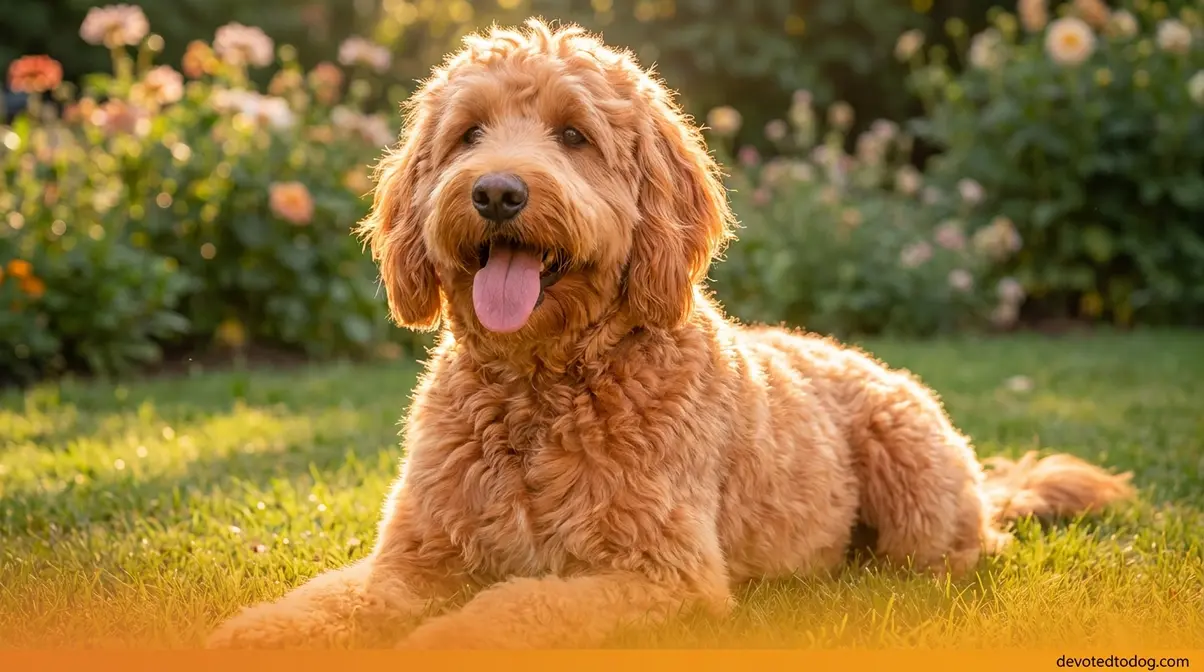
An apricot Goldendoodle is a Golden Retriever-Poodle hybrid with a warm, reddish-orange coat that resembles the inside of a ripe apricot — deeper than cream, lighter than red. They are highly social, eager-to-please dogs whose temperament is shaped by training and genetics, not coat color. For first-time dog owners researching this breed, understanding what you’re actually getting — beyond the beautiful coat — is the most important first step.
Throughout this guide, we’ll use “The Fading Spectrum” — a simple framework connecting your dog’s genetics, generation, and parents’ coat color to help you predict what your adult dog will actually look like. We’ll introduce it fully in the Colors section, but keep it in mind as you learn about this breed.
Temperament and Personality
Apricot Goldendoodles are celebrated for their warm, outgoing personalities. As the Barkbusters breed profile puts it, “everybody is a friend to a Goldendoodle” — a description that holds true regardless of coat color. Their friendliness is genuine, not just a breed stereotype. Goldendoodles rank among the most trainable dogs, inheriting intelligence from both the Poodle and the Golden Retriever, which Stanley Coren ranked second and fourth for working and obedience intelligence (The Intelligence of Dogs, 1994). In practice, “eager to please” means they pick up commands quickly and respond well to positive reinforcement.
Here’s something worth knowing: we found no evidence that coat shade affects personality or trainability. Whether your dog is apricot, cream, red, or black, their personality is shaped by genetics, early socialization, and training. This matters because some breeders market apricot dogs as “calmer” or “more gentle”; we found no behavioral evidence for that claim.
An apricot Goldendoodle raised with children and regularly socialized with other dogs will typically be calm and gentle. The same dog left alone for 10 hours a day without training will likely develop anxiety — regardless of coat color. Plan for socialization before you bring a puppy home, and you’ll set your dog up for success.
For more on what makes this breed tick, see just how intelligent Goldendoodles are.
Are Apricot Goldendoodles Good Family Dogs?
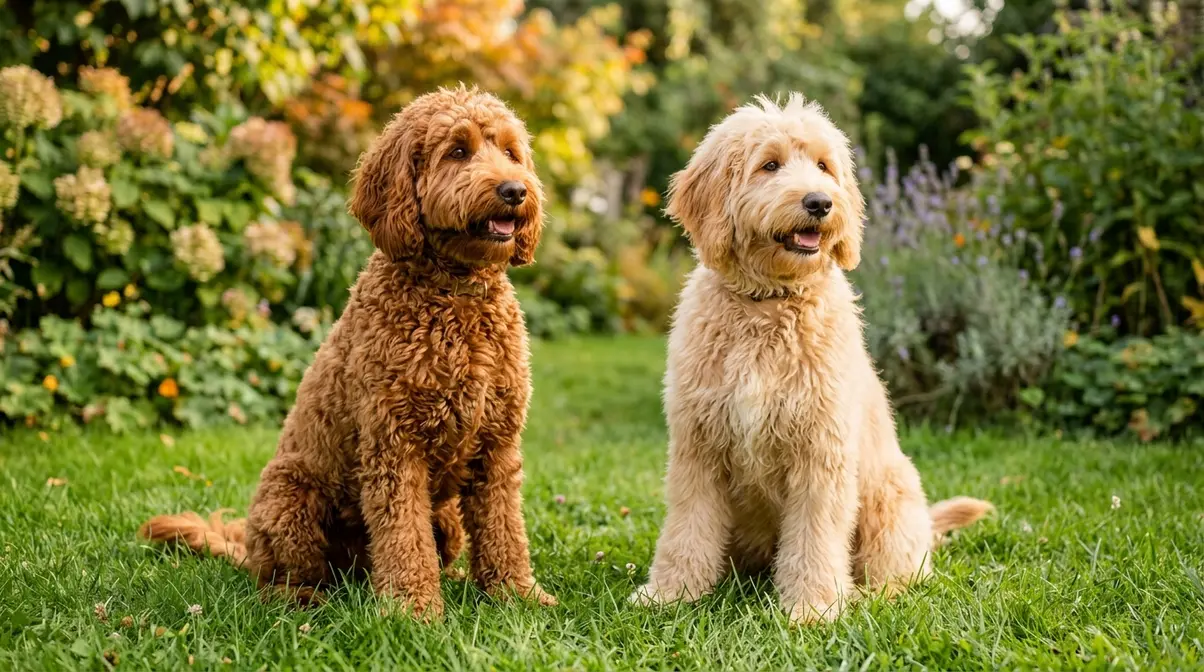
Yes — and the reason matters more than the answer. Their patient, gentle temperament combined with high trainability makes apricot Goldendoodles reliable around children. They’re large enough not to be fragile, yet gentle enough not to overwhelm toddlers when properly trained. They don’t just tolerate family chaos; they thrive in it.
Their intelligence and calm, approachable demeanor have also made them popular choices for therapy dog programs in schools and hospitals. Across owner communities, Goldendoodles are consistently reported as easy to integrate into family routines — they adapt well to different household energy levels. Bringing home apricot Goldendoodle puppies into a family with existing pets is also generally manageable, provided early introductions are done carefully.
What families need to provide in return: 30–60 minutes of daily exercise, regular mental stimulation (puzzle feeders, training sessions), and consistent social interaction. These aren’t optional extras — they’re the baseline for a well-adjusted dog. Understanding how Goldendoodles compare to purebred Golden Retrievers can also help you set the right expectations before bringing one home.
What Are the Downsides of a Goldendoodle?
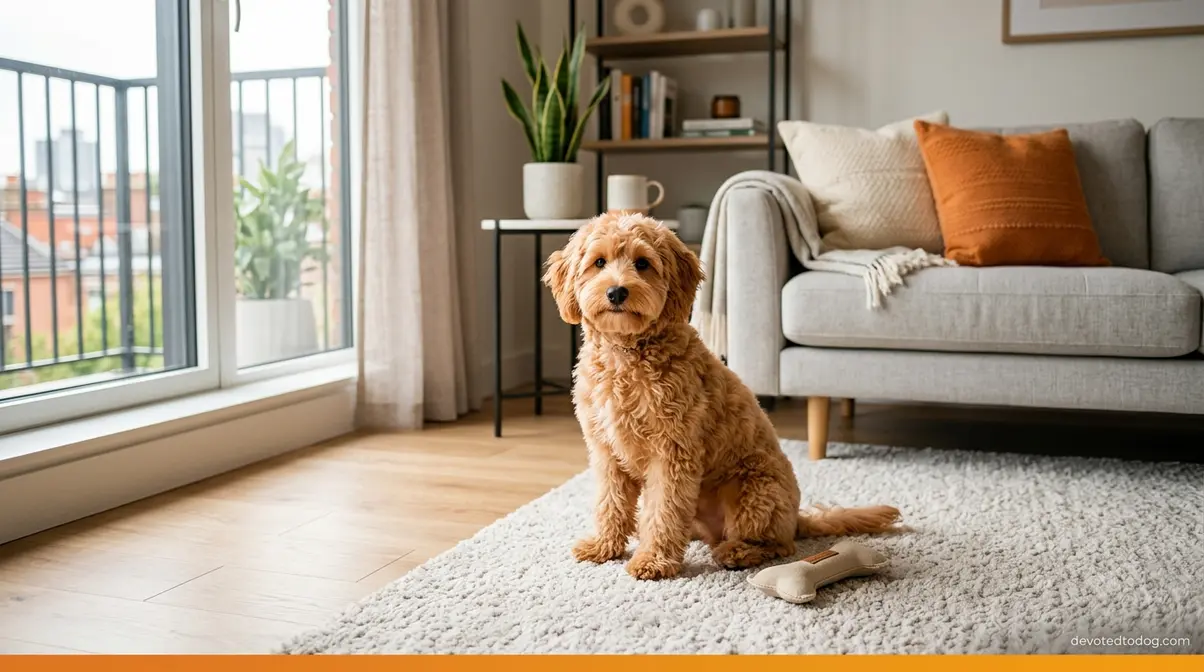
No breed is perfect, and apricot Goldendoodles come with real challenges that every prospective owner should plan for honestly:
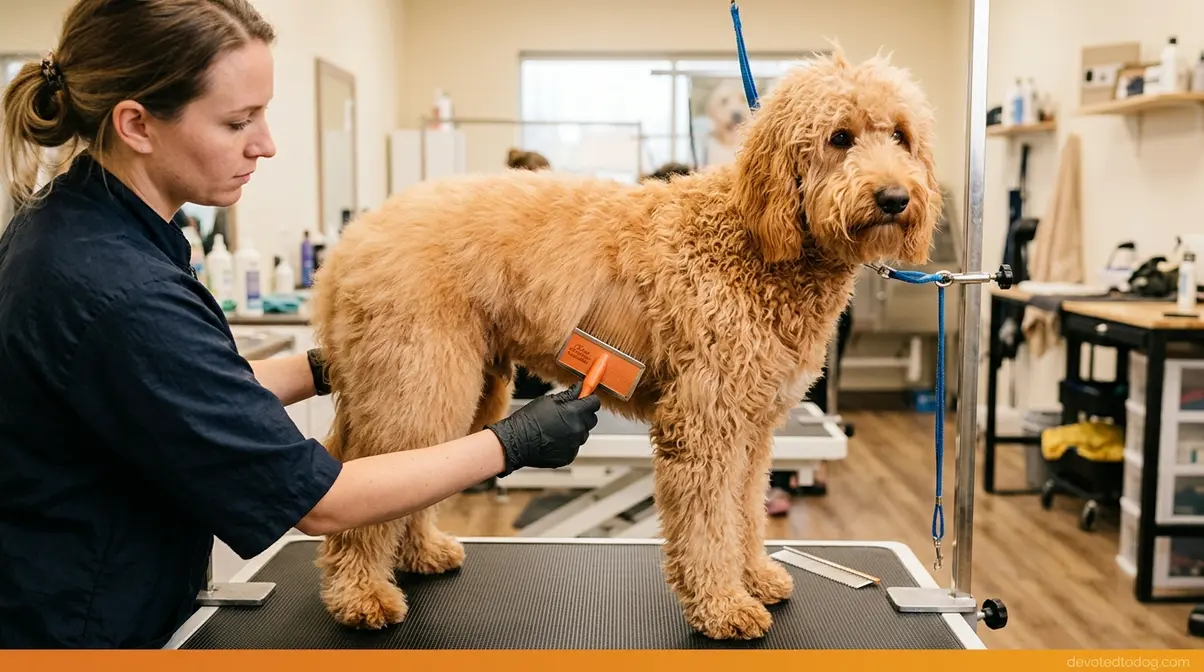
- Grooming is non-negotiable. Without daily brushing, apricot coats mat — especially behind the ears, in the armpits, and around the collar. Matting is painful for the dog and expensive to fix. Professional dematting can cost $100 or more, and severe cases require shaving the coat entirely. This isn’t a minor inconvenience; it’s a daily commitment you need to be honest with yourself about.
- Separation anxiety is a real risk. Goldendoodles are bred to be with people. A dog left alone for 8+ hours regularly without proper crate training and enrichment is a recipe for destructive behavior and genuine distress. If your lifestyle involves long work days away from home, plan for a dog walker or doggy daycare before you bring a puppy home.
- The total cost goes well beyond the purchase price. The $2,500–$5,000 puppy cost is just the beginning. Budget for professional grooming ($60–$120 per session, every 6–8 weeks), quality food ($500–$1,200/year), routine vet care ($300–$700/year), and training. The first year with a new puppy typically costs $3,000–$5,000 beyond the purchase price.
With a clear picture of the breed’s personality and needs, let’s tackle the question that almost every apricot Goldendoodle owner asks first: what happens to that beautiful coat color over time?
Apricot Goldendoodle Colors: From Dark Apricot to Cream
“I’m just worried about him fading light or to a cream colour and end up looking identical…” — a concern shared by nearly every apricot Goldendoodle owner, and one that deserves a real scientific answer.
An apricot-colored Goldendoodle has a warm, reddish-orange hue — richer than cream, softer than red — that ranges from pale gold to deep copper depending on the individual dog’s genetics. But here’s what most guides don’t tell you: that color will almost certainly change. The question isn’t if it fades — it’s how much, and that answer is predictable if you know what to look for. Our complete guide to all 18+ Goldendoodle colors and patterns covers the full spectrum, but for apricot owners specifically, the fading science is what matters most.
The Apricot Color Spectrum: Light to Dark
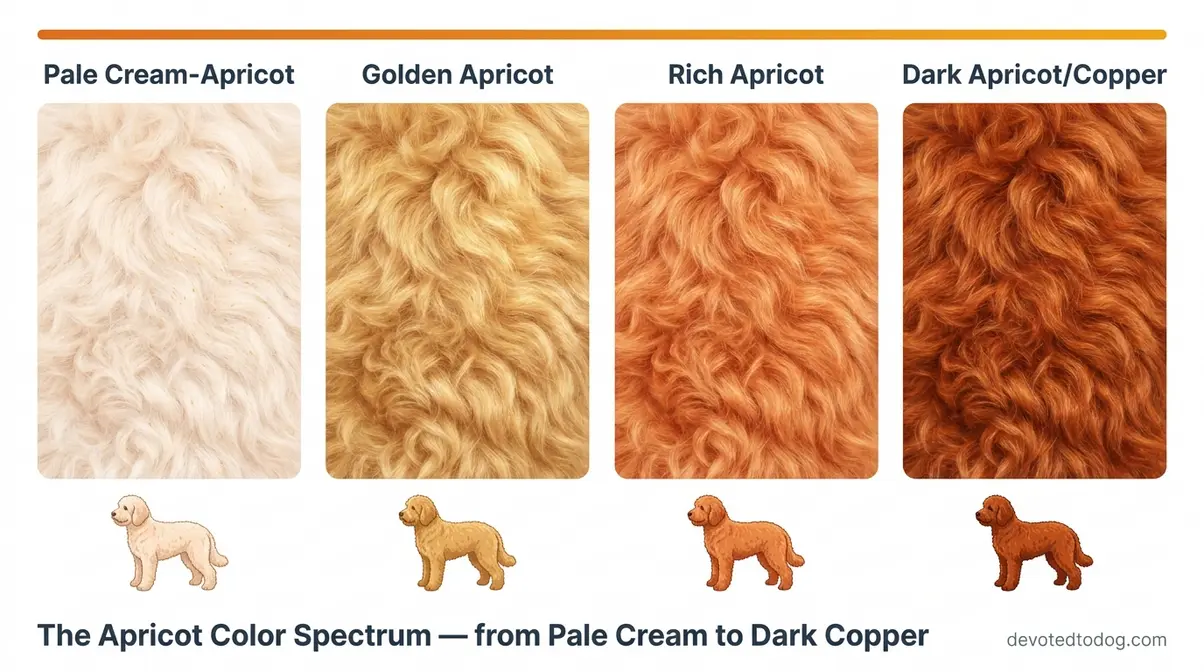
The apricot spectrum isn’t a single shade — it’s a range of four distinct tones, each with different fading outcomes:
- Pale cream-apricot — often mistaken for cream at first glance. Very pale gold with a faint peachy warmth. These puppies are most likely to fade to near-white cream by age 2.
- Golden apricot — the classic “apricot” look most people picture. A warm, medium-intensity peach-gold. Moderate fading expected.
- Rich apricot — a deeper, warm orange-gold. Vibrant and eye-catching. Fades to a lighter golden apricot rather than cream.
- Dark apricot/copper — the closest to red, with a rich copper-orange tone. Less common. These dogs typically hold more color into adulthood and fade the least dramatically of the four shades.
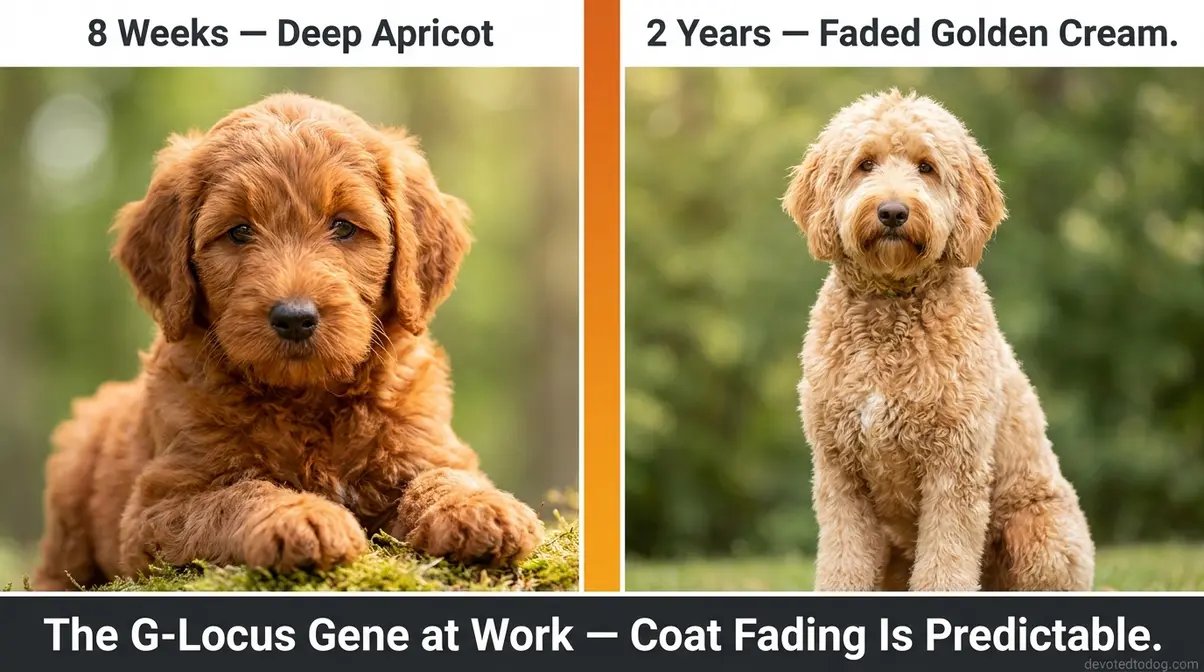
A puppy’s shade at 8 weeks is NOT a reliable predictor of adult color — but it’s a useful clue. If you’re looking at a litter and the puppies are already very pale gold at 8 weeks, expect them to be close to cream by their second birthday. Breeders who specialize in apricot lines, including those at goldoodle.com, note that the darker a puppy’s starting shade, the more color they tend to retain.
Understanding where your puppy sits on the color spectrum is the first piece of the puzzle. The second — and more important — piece is understanding WHY that color will change.
Why Do Apricot Goldendoodles Fade?
Many apricot Goldendoodles lighten as they mature: phaeomelanin, the orange pigment that gives apricot its warmth, looks less intense in the adult coat. The genetics of this fading are not fully mapped, so no one can tell you exactly how much a given puppy will lighten. According to the UC Davis Veterinary Genetics Laboratory, the intensity coat color gene variant causes extreme dilution of phaeomelanin, resulting in a cream to white coat (UC Davis VGL, 2024). That gene sets how light or deep the coat is; it is separate from the gradual fading described above.
UC Davis research on dilute coat colors describes a different gene (the D locus) whose variants lighten base colors to paler shades, such as black to blue; it does not describe fading with age (UC Davis VGL, 2024).
Breeders commonly report that apricot Goldendoodles begin to fade between about 6 months and 2 years of age, with the coat largely settling by age 3; we found no published study that times this, so treat these ages as a rough guide. This is the core of what we call The Fading Spectrum — the predictable range of color change from deep copper-orange at birth to light gold or cream by adulthood. Where your dog lands on The Fading Spectrum depends on two factors you can check: their generation (F1 vs. F1B) and the shade of the parents’ coats at age 3+.
F1B Goldendoodles (75% Poodle) are often said to fade more noticeably than F1s (50% Poodle), although the genetic reason has not been established. We’ll cover this connection in detail in the Generations section.
The most practical thing you can do before buying: ask the breeder to show you photos of the parent dogs at age 3 or older. If mom and dad are still a rich apricot at that age, the puppies are more likely to hold their color. If the parents have already faded to gold or cream, expect your puppy to follow a similar path.
Now that you understand the science behind fading, let’s look at how apricot compares to the two colors it’s most often confused with: red and cream.
Apricot vs. Red vs. Cream: What’s the Difference?
Many buyers are choosing between apricot and red — or trying to figure out whether a puppy they’re looking at is “really” apricot or just a pale cream. Here’s the clearest breakdown available, formatted for easy comparison. For a deeper look at the red side of this equation, see how red Goldendoodles differ from apricot.
| Feature | Cream | Apricot | Red |
|---|---|---|---|
| Hue | Pale gold to near-white | Warm peach-orange | Deep copper-red |
| Fading | Minimal (already light) | Moderate to high | Low to moderate |
| Rarity | Common | Common | Less common |
| Price premium | None | None | Sometimes higher |
In plain English: red is deeper and more saturated — think Irish Setter. Apricot is warm peach-orange — think the inside of a ripe apricot. Cream is pale gold to near-white — think vanilla ice cream. Most apricots will fade toward cream; they will not fade to red.
The practical difference between red and apricot for buyers: red Goldendoodles are less common, typically hold their color longer, and may cost slightly more from specialty breeders. Apricot is more available but varies widely in shade intensity. If you want a dog whose coat looks rich and vibrant at age 5, a deep red or dark apricot from parents that still hold a rich color at age 3 or older is your best bet.
Beyond the base color, apricot Goldendoodles can also come in striking patterns — and these markings are where things get really interesting.
Coat Patterns: Parti, Tuxedo, and Abstract
Parti refers to a dog with more than 50% white on its body alongside the base apricot color. An apricot parti Goldendoodle has large, bold patches of white and apricot — a striking look that’s grown increasingly popular. Parti patterns are rarer than solid apricot and often command a price premium from specialty breeders.
Tuxedo describes white markings concentrated on the chest, paws, and chin — giving the dog the appearance of wearing formal wear. An apricot tuxedo Goldendoodle has a warm apricot body with crisp white “tuxedo” markings. The contrast is eye-catching and tends to remain visible even as the apricot base fades.
Abstract is the subtler option — minimal white markings covering less than 50% of the body, appearing randomly. An apricot and white Goldendoodle with abstract markings might have a small white blaze on the chest or a white-tipped tail. These markings are less dramatic than parti or tuxedo but add visual interest.
A note on rarity and cost: parti patterns in particular are less commonly produced and require specific breeding decisions, so expect to pay more and wait longer if this is what you want.
Now that you know how apricot coats look and change, let’s talk about the other major physical variable: size.
Apricot Goldendoodle Sizes: Toy, Mini, Medium, and Standard
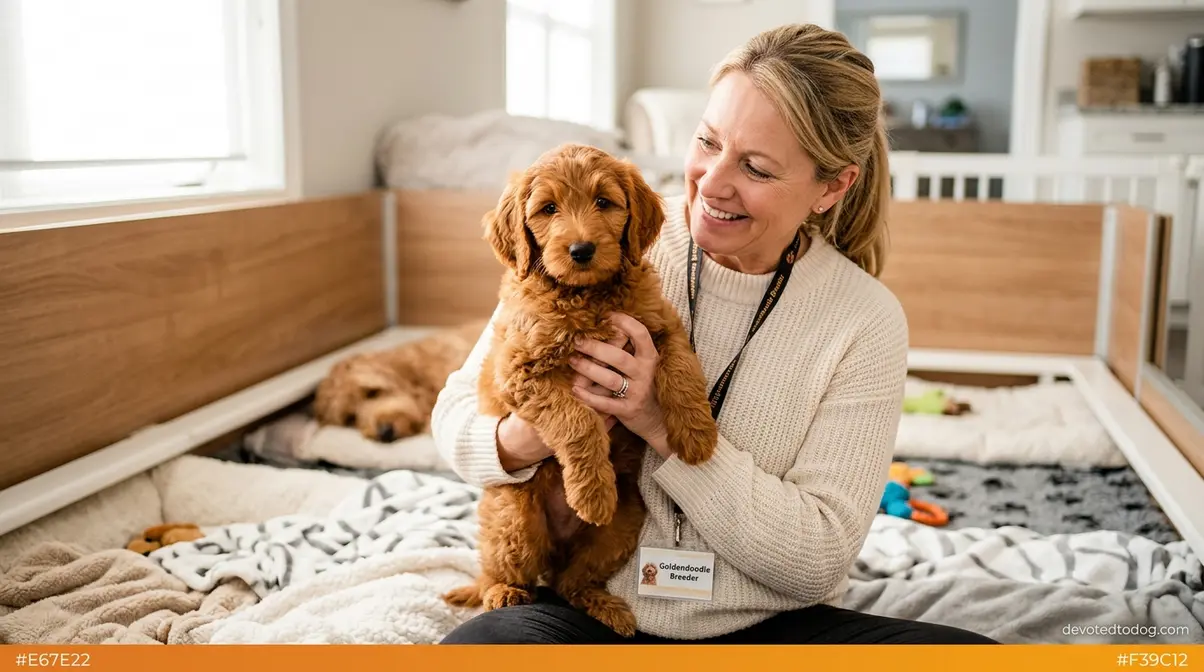
Apricot Goldendoodles come in five sizes — Teacup, Toy, Mini, Medium, and Standard. The size is determined entirely by the Poodle parent used in breeding: a Toy Poodle produces a Toy Goldendoodle, a Miniature Poodle produces a Mini, and a Standard Poodle produces a Standard. For a full breakdown of Goldendoodle sizes across all generations, our dedicated size guide covers every combination.
| Size | Weight | Height | Best For |
|---|---|---|---|
| Teacup | Under 10 lbs | Under 10 inches | Apartment, low-activity owners |
| Toy | 10–15 lbs | 10–15 inches | Small spaces, seniors |
| Mini | 15–35 lbs | 13–20 inches | Apartments, families, city living |
| Medium | 35–50 lbs | 17–21 inches | Suburban families, active owners |
| Standard | 50–90 lbs | 21–26 inches | Houses with yards, active families |
One note worth making here: The Fading Spectrum applies equally across all sizes. Size does not protect against fading: a Mini can lighten as much as a Standard.
Toy and Teacup Apricot Goldendoodle
A Teacup apricot Goldendoodle weighs under 10 pounds at full growth — roughly the size of a large cat. A Toy version weighs 10–15 pounds, similar in size to a Chihuahua or small Shih Tzu. Both are ideal for apartment dwellers, seniors, or anyone with limited living space. They require less exercise than larger sizes but still need daily mental stimulation — a bored Teacup Goldendoodle can be surprisingly destructive.
One important health note: “Teacup” is not a recognized breed standard. Very small sizes can come with health risks including hypoglycemia (low blood sugar), fragile bones, and dental crowding. If a breeder is advertising Teacup Goldendoodles without disclosing the Poodle parent’s size and providing health documentation, that’s a red flag. Always ask for health testing records, regardless of size.
Moving up the size chart, the Mini Apricot Goldendoodle is by far the most popular choice — and for good reason.
Mini Apricot Goldendoodle
The Mini Apricot Goldendoodle weighs 15–35 lbs and stands 13–20 inches tall at full growth — roughly comparable to a Cocker Spaniel or Beagle. Males typically run toward the upper end of that range (25–35 lbs), while females are often 15–25 lbs (goldoodle.com, 2026). It’s large enough to be sturdy and playful with kids, yet compact enough to thrive in a medium-sized apartment.
A full-grown apricot miniature Goldendoodle typically reaches its adult size between 10 and 14 months of age (a-z-animals.com, 2026). Height growth generally completes around 9–11 months, followed by a few months of muscle filling. For perspective on what those early months look like, see what to expect from a 4-month-old Goldendoodle puppy.
A full-grown Mini Apricot Goldendoodle typically weighs 15–35 lbs and reaches its adult size by 10–14 months, making it the most popular size choice for apartment and city dwellers (goldoodle.com, 2026). A Mini will comfortably fit in a medium-sized apartment and thrive with a 30-minute daily walk plus indoor play.
If the Mini feels a touch too small, the Medium Apricot Goldendoodle offers a comfortable middle ground.
Medium Apricot Goldendoodle
The Medium Apricot Goldendoodle weighs 35–50 lbs and stands 17–21 inches tall — similar in frame to a Border Collie or Australian Shepherd. This is often the “Goldilocks” choice for suburban families: not so large that it overwhelms a home with young children, not so small that older kids feel they need to be careful around it.
Mediums typically reach their full size by 12–18 months. They need 30–45 minutes of daily exercise and do well in homes with a small yard, though they can adapt to apartment living with consistent walks.
And for those who want the full Goldendoodle experience — fluffy, substantial, and impossible to ignore — the Standard is the choice.
Standard Apricot Goldendoodle
The Standard Apricot Goldendoodle weighs 50–90 lbs and stands 21–26 inches tall — the size of a Golden Retriever or Labrador. Standards most closely resemble their Golden Retriever heritage, often with a stockier Retriever build and a slightly looser, more flowing coat. If you’ve always wanted the classic Golden Retriever look but with lower shedding, the Standard apricot Goldendoodle is the closest you’ll get.
Exercise needs are real with this size: 45–60 minutes of daily activity is the baseline. Standards are not well-suited for small apartments without serious commitment to outdoor exercise. They thrive in homes with yards and active families.
Growth Timeline: Puppy to Full Grown
Here’s what to expect at each growth milestone for an apricot Goldendoodle:
- 8 weeks — Puppy weight: 4–12 lbs depending on size category (timberidgegoldendoodles.com, 2026)
- 4 months — Approximately 50% of adult weight; rapid growth phase
- 6 months — Roughly 60–75% of adult weight; height nearly complete in smaller sizes
- 10–14 months — Mini reaches full adult size; Medium and Standard still filling out
- 12–18 months — Standard and Medium reach full adult weight
- 2 years — All sizes confirmed at full adult size; coat maturity complete
By 6–12 months, you’ll also start to see the first signs of color fading — this is normal and part of The Fading Spectrum we covered earlier. The coat change and the size change happen simultaneously, which can make the transformation feel dramatic. Knowing to expect both helps enormously.
Now that you know what size to expect, let’s tackle the terminology that confuses almost every first-time buyer: the generation codes.
Goldendoodle Generations Explained: F1, F1B, F2, and Beyond
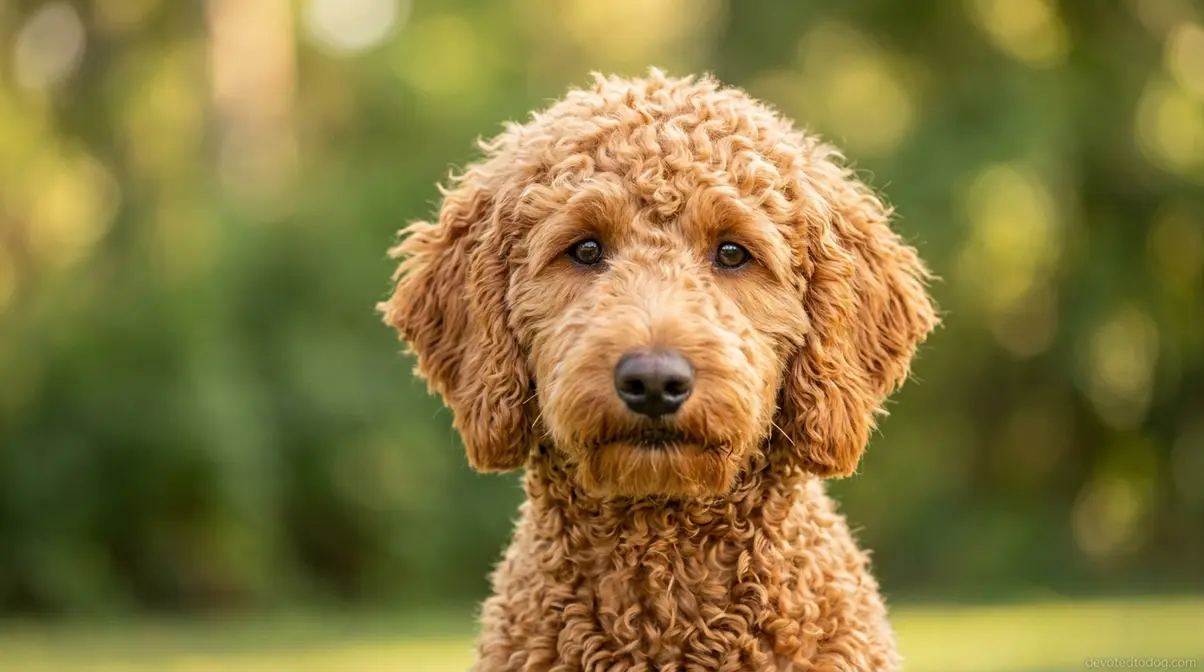
Before you contact a breeder, you’ll want to understand what these letters mean — because they’ll come up in every conversation and directly affect your dog’s coat, shedding level, and position on The Fading Spectrum.
Think of the “F” as standing for “filial” — a technical word for generation. The number tells you which generation, and the “B” means the dog was bred back to a purebred Poodle. It sounds complicated, but the table below makes it clear.
| Generation | Poodle % | Golden Retriever % | Shedding | Fading Likelihood |
|---|---|---|---|---|
| F1 | 50% | 50% | Moderate | Moderate |
| F1B | 75% | 25% | Low | Higher |
| F2 | ~50% (avg) | ~50% (avg) | Varies | Moderate |
| F1BB | 87.5% | 12.5% | Very Low | Highest |
| F2B | 62.5% | 37.5% | Low-Moderate | Moderate-High |
An F1B Apricot Goldendoodle is 75% Poodle and 25% Golden Retriever, making it more likely to have a low-shedding, curly coat — and more likely to fade on The Fading Spectrum. This is the single most important generation fact for apricot buyers to understand.
For deep dives into specific generations, see our complete guide to the F1B Goldendoodle and everything you need to know about F2B Goldendoodles.
F1 Apricot Goldendoodle
An F1 apricot Goldendoodle is the first-generation cross: one purebred Golden Retriever parent and one purebred Poodle parent, resulting in a 50/50 genetic split. This genetic diversity — often called “hybrid vigor” — may contribute to overall health and vitality, a benefit commonly noted by veterinary genetics researchers studying first-generation hybrids.
The practical reality of an F1: coat and shedding can vary significantly within the same litter. Some puppies will be curlier and shed less; others will be wavier and shed more. You won’t know exactly which coat type you’re getting until the puppy coat transitions at around 6–8 months. The apricot color in F1s tends to show moderate fading — often less dramatic than in F1Bs, which have a higher Poodle percentage.
An F1 apricot Goldendoodle is a good choice if you want some Retriever characteristics — a softer coat, slightly looser curl — and you’re comfortable with moderate shedding and some coat variability.
For buyers who want a low-shedding dog and are willing to accept more fading, the F1B is the most popular choice.
F1B Apricot Goldendoodle
The F1B apricot Goldendoodle is a first-generation backcross: an F1 Goldendoodle bred back to a purebred Poodle, resulting in 75% Poodle and 25% Golden Retriever genetics. The higher Poodle percentage means a curlier coat, significantly less shedding, and — importantly for apricot buyers — a tendency to fade more noticeably. F1B dogs sit higher on The Fading Spectrum than F1s.
The F1B is the most popular generation for allergy-prone families, and for good reason. However, as PetMD’s veterinary-reviewed Goldendoodle health guide clarifies: no dog breed is truly hypoallergenic. Allergens are found in dander and saliva, not just fur (PetMD, 2024). A low-shedding F1B still produces allergens — the advantage is reduced airborne hair, not zero allergen exposure.
Coat consistency is also better in F1B litters compared to F1 — most puppies will be curly or wavy, with less variation between littermates. If allergies are a concern in your household, an F1B apricot Goldendoodle is your best starting point — but meet the puppy in person before committing.
Beyond F1 and F1B, there are a few more generations worth knowing — particularly if a breeder mentions F1BB or F2B.
F1BB and F2B Apricot Goldendoodle
The F1BB apricot Goldendoodle is an F1B bred back to a purebred Poodle — resulting in approximately 87.5% Poodle genetics. This is the generation with the lowest shedding, the most consistently curly coat, and the highest fading likelihood on The Fading Spectrum. F1BB dogs are the least common generation and are typically sought by buyers with severe allergies who need the closest thing to a non-shedding dog.
The F2B apricot Goldendoodle is an F2 (two F1 parents) bred back to a purebred Poodle, resulting in approximately 62.5% Poodle genetics. This generation offers a moderate-to-low shedding profile and more coat consistency than an F2. Think of it as a middle ground between F1B and F1 — a solid option for families who want low shedding without the extreme fading of an F1BB.
The F2 itself (two F1 parents) is the most variable generation. Coat and shedding can range widely within a litter, and F2 Goldendoodles are not commonly recommended for allergy-prone families for this reason.
Here’s a practical tip: if a breeder offers you an F1BB apricot puppy and it’s already very pale at 8 weeks, expect a cream-colored adult. The combination of very high Poodle genetics and early light color is among the most reliable predictors of significant fading.
With all of this genetics knowledge in hand, let’s answer the question most allergy sufferers are actually asking.
Which Generation Is Best for Allergies?
For allergy-prone families, here’s the ranked recommendation from least to most shedding:
- F1BB — 87.5% Poodle; lowest shedding; highest fading
- F1B — 75% Poodle; low shedding; more fading than F1
- F2B — 62.5% Poodle; low-to-moderate shedding; moderate fading
- F1 — 50% Poodle; moderate shedding; least fading
Two critical caveats apply regardless of generation. First, “hypoallergenic” doesn’t mean “allergy-free” — all dogs produce dander and saliva allergens. Second, individual dogs vary even within the same generation. The only reliable way to test your reaction is to spend 30 minutes with a dog from the same generation as the puppy you’re considering — ask breeders if this is possible before you commit.
Once you know your preferred generation, the next question is what kind of coat that generation will actually produce — and how to maintain it.
Apricot Goldendoodle Coat Types and Grooming
Understanding your dog’s coat type isn’t just about aesthetics — it determines your grooming commitment, which is the #1 practical consideration for first-time apricot Goldendoodle owners. Across owner communities, the consistent experience is that buyers who underestimate grooming demands end up with matted, uncomfortable dogs and expensive professional dematting bills. A little knowledge upfront prevents a lot of heartache later.
For a visual reference on all three coat types, see the complete guide to Goldendoodle coat types with photos.
The Three Coat Types: Curly, Wavy, and Fleece
Curly coat — tight ringlets, closest to a Poodle’s texture. Most common in F1B and higher generations. This is what many buyers picture when they imagine a Goldendoodle. It’s the lowest-shedding option but requires the most maintenance: daily brushing is non-negotiable. Without it, mats form within days in the high-friction zones (behind ears, armpits, collar area).
Wavy/Fleece coat — loose waves, the classic “teddy bear” look. Most common in F1 Goldendoodles. This is the “slightly wavy coat” many owners describe when they first bring their puppy home. Moderate shedding; easier to maintain than curly but still requires brushing 3–4 times per week. The wavy coat is often considered the most forgiving for first-time owners.
Straight coat — less common, closer to a Golden Retriever in texture. Higher shedding than the other two types. Some owners describe straight coats as “frizzy” in humid conditions — this is a normal genetic expression, not a sign of poor health or poor breeding. Easier to brush but sheds more visibly.
One note worth making: coat type can subtly influence how fading appears visually. A curly coat tends to look richer and darker than a wavy coat of the same genetic shade, because the curl concentrates the pigment. This is a minor nuance in The Fading Spectrum, but worth knowing if you’re comparing puppies from different litters.
To predict your puppy’s coat type before you buy: look at the parents. An F1B puppy from a curly Poodle parent is more likely to have a curly coat. An F1 from a wavy Golden Retriever is more likely to land in the wavy range.
Knowing your dog’s coat type is step one. Step two is knowing exactly how to care for it — before the mats set in.
Grooming Schedule and Tools
Apricot Goldendoodles with curly coats require daily brushing and professional grooming every 6–8 weeks to prevent painful matting — a non-negotiable commitment for this breed (We Love Doodles, 2026; Bark.com, 2026). Here’s the schedule that professional groomers consistently recommend:
- Daily (5–10 minutes): Brush with a slicker brush, focusing on behind the ears, armpits, and collar area — these are the mat-prone zones that develop problems first.
- Weekly (15–20 minutes): Full body brush-out, check ears for debris and redness, trim nails if needed.
- Every 6–8 weeks: Professional grooming appointment covering bath, full trim, ear cleaning, and nail grinding.
For tools, the Chris Christensen Big G slicker brush is the professional-grade standard favored by Goldendoodle owners for detangling and preventing mats. Pair it with a metal comb to check mat depth — if the comb won’t pass through, a mat has formed. Detangling spray helps with knot removal during the daily session.
The cost reality: professional grooming runs $60–$120 per session in 2026 for most markets, with larger dogs and heavily matted coats at the higher end (adoptapet.com, 2026). A Standard Goldendoodle will cost more to groom than a Mini. Budget $500–$900 per year for professional grooming, depending on your dog’s size and coat type.
Set a phone alarm for 5 minutes of brushing every evening. It takes less time than a TV commercial break and prevents a $150 dematting session — or worse, a full shave that leaves your apricot Goldendoodle looking nothing like the dog you brought home.
One question tied closely to grooming: how much will your apricot Goldendoodle actually shed?
Shedding and Hypoallergenic Qualities
Shedding varies directly by coat type:
- Curly coat — very low shedding; hair stays in the curl rather than falling out
- Wavy coat — moderate shedding; noticeably more hair on furniture and clothing
- Straight coat — higher shedding; comparable to a Golden Retriever
No Goldendoodle is zero-shed. The allergen responsible for most dog allergies is Canis familiaris allergen 1 (Can f 1), found in dander and saliva — not just fur. A low-shedding F1B still produces these allergens; the advantage is reduced airborne hair, not reduced allergen production. This is the critical caveat for allergy sufferers that every honest guide should state clearly.
There’s also a diet connection worth knowing. Coat color is decided mostly by genetics, but a veterinary nutritionist writing for Tufts University Cummings School of Veterinary Medicine notes that diet can play a role in some cases: the amino acids phenylalanine and tyrosine are needed to make melanin, and a shortfall can turn a black coat reddish (Linder, Tufts Petfoodology, 2021). Omega-3 supplements such as salmon oil are often discussed for skin and coat health; ask your vet whether your dog’s diet needs one. A complete and balanced diet supports overall coat condition.
Now that you know what to expect from coat and grooming, let’s address the financial reality of bringing home an apricot Goldendoodle.
How to Find and Buy an Apricot Goldendoodle Puppy
This is the section that turns research into action. Finding an apricot Goldendoodle puppy from a reputable breeder requires knowing what fair pricing looks like, which questions to ask, and which warning signs to walk away from. The 2026 market has plenty of excellent breeders — and unfortunately, plenty of operations that should be avoided.
How Much Does an Apricot Goldendoodle Cost?
Apricot Goldendoodle puppies from reputable, health-tested breeders cost $2,500–$5,000 in 2026, with Mini sizes typically at the lower end and Standard or rare-pattern dogs at the higher end (breeder pricing data, 2026; happydoodlefarm.com, 2026).
| Size | Typical 2026 Price Range | Notes |
|---|---|---|
| Teacup | $2,500–$4,000 | Rare; health risks; verify breeder carefully |
| Mini | $2,500–$4,000 | Most popular; widest breeder availability |
| Medium | $2,800–$4,500 | Mid-range; good balance |
| Standard | $3,000–$5,000 | Largest; may cost more from reputable breeders |
| Parti/Tuxedo | $3,000–$5,000+ | Pattern premium from specialty breeders |
Prices are ranges based on 2026 breeder data. Actual costs vary by location, breeder reputation, and generation. Always verify current pricing directly with the breeder.
Several factors influence where a specific puppy falls within these ranges: breeder reputation and health testing rigor, geographic location (breeders in high cost-of-living areas charge more), generation (F1BB typically costs more than F1 due to breeding complexity), and pattern (parti and tuxedo markings command premiums from specialty breeders).
One piece of good news for apricot buyers: apricot Goldendoodles may actually be less expensive than rarer colors like merle or phantom, because apricot is one of the most commonly produced shades. This works in your favor as a buyer. An apricot Goldendoodle for sale near you is far more likely to be available without an extended waitlist than a brindle or phantom.
Total ownership context: the purchase price is just the beginning. Add professional grooming ($500–$900/year), quality food ($500–$1,200/year), routine veterinary care ($300–$700/year), and training. Budget realistically for the full commitment before falling in love with a puppy photo.
Knowing the price is step one. Knowing how to find a breeder who deserves that price is step two.
How to Choose a Reputable Breeder
Our team evaluated the breeder selection process across dozens of apricot Goldendoodle breeders, GANA (the Goldendoodle Association of North America, the breed’s primary health and ethics organization) guidelines, and owner community feedback. The result is a checklist of questions every buyer should ask before committing:
- Can I see OFA or PennHIP hip certifications for both parents? OFA (the Orthopedic Foundation for Animals) certifies dogs for hip and elbow health — this tests for hereditary hip dysplasia, a common issue in Goldendoodles. No documentation means no sale.
- Have both parents been tested for Progressive Retinal Atrophy (PRA) and von Willebrand’s Disease? These are hereditary conditions that responsible breeders screen for in every breeding pair.
- Can I visit the facility in person and meet the mother? A reputable breeder will always say yes. Any hesitation or excuse is a red flag.
- What is your socialization protocol for puppies before they go home? Well-socialized puppies between 3–12 weeks are significantly more confident and adaptable as adults.
- Do you provide a health guarantee, and for how long? Two years is the industry standard from reputable operations.
- Can you show me photos of the parents at age 3 or older to help predict coat color? This is The Fading Spectrum test — use it every time. If both parents are still a rich apricot at age 3, your puppy is more likely to hold its color. If the parents have already faded to cream, expect the same.
What a reputable breeder WILL do: health-test both parents, welcome in-person visits without hesitation, provide a written contract, stay in contact after you bring the puppy home, and be willing to take the dog back if circumstances change. GANA membership is a strong positive signal — members follow a published code of ethics that includes health testing requirements. Check GANA’s breeder directory at goldendoodle-association.com as a starting point for your search.
A reputable breeder will never pressure you to decide within 24 hours. If you feel rushed, walk away.
Knowing what a good breeder looks like is only half the battle — you also need to know what a bad one looks like.
Red Flags to Avoid: Puppy Mills and Scams
Here are five specific red flags that indicate a puppy mill, backyard breeder, or online scam:
- No health testing documentation for parents — if they can’t produce OFA certificates or genetic test results, move on
- Multiple breeds available simultaneously — “We also have Cavapoos, Labradoodles, and Maltipoos!” is a puppy mill signal; reputable breeders typically specialize in 1–2 breeds
- Puppies available immediately with no waitlist — quality breeders have waitlists; availability on demand suggests volume breeding
- Refuses in-person visits or video calls showing the facility — this is non-negotiable; always insist on seeing where the puppy was raised
- Requests wire transfer or cryptocurrency payment — legitimate breeders accept standard payment methods with paper trails
Online scams targeting apricot Goldendoodle for sale searches are also common. Warning signs: stock photos used as “puppy photos,” prices that seem too good to be true ($500–$800 for a “purebred” puppy), and requests to ship the puppy before payment clears. When searching for an apricot Goldendoodle for sale near me, use GANA’s breeder directory or AKC Marketplace rather than general classifieds. Geographic searches are a useful starting point, but they should never be your only filter.
Ready to start your search? Use our complete resource on how to find a reputable Goldendoodle breeder before making your first call. If you’re in the South, our top Goldendoodle breeders in Texas guide is a strong regional starting point.
Apricot Goldendoodle Names
Choosing a name for your apricot Goldendoodle is one of the most enjoyable parts of bringing a new dog home. The best names are 2 syllables with a strong vowel sound — dogs respond more readily to names that end on a clear, distinct note. “Mango,” “Sunny,” and “Rosie” all tick this box. Here are our favorite picks, organized by theme.
Boy Names for Apricot Goldendoodles
Color and food-inspired (capturing that warm, peachy coat): Mango, Saffron, Copper, Butterscotch, Biscuit, Caramel, Nectarine, Russet
Classic and strong (timeless choices that suit any personality): Baxter, Scout, Atlas, Duke, Ranger, Finn, Bear, Jasper
Playful and cute (for the dog who’s all personality): Teddy, Sunny, Buddy, Ziggy, Gizmo, Peanut, Cosmo
Names like Copper, Biscuit, and Sunny have become favorites among apricot Goldendoodle boy names — they reflect the coat’s warmth while being easy to call across a dog park. Dog trainers commonly recommend 2-syllable names for easier training recall, so if you love “Butterscotch,” consider shortening it to “Scotchy” for daily use.
And for your new girl puppy — here are names that capture her warm, sunny personality.
Girl Names for Apricot Goldendoodles
Color and food-inspired (the classics for a reason): Peaches, Apricot, Honey, Amber, Ginger, Maple, Cinnamon, Saffron, Goldie
Elegant and classic (for the dog with quiet dignity): Rosie, Daisy, Willow, Hazel, Stella, Luna, Cleo, Ivy
Playful and cute (for the one who bounces everywhere): Biscuit, Sunny, Pixie, Poppy, Mochi, Noodle, Toffee
Names like Peaches, Honey, and Goldie are perennial favorites for apricot Goldendoodle girl names — they reflect the breed’s warm coat and sunny personality while being distinctive enough to stand out at the dog park. Hazel and Willow have also gained popularity as slightly more unexpected choices that still suit the breed’s gentle character.
With a name picked out, you’re almost ready. But before we wrap up, let’s be honest about the few challenges that every apricot Goldendoodle owner should plan for.
Common Challenges Every Apricot Goldendoodle Owner Should Know
Intellectual honesty is part of good advice. Apricot Goldendoodles are genuinely wonderful dogs — but they’re not the right fit for every household. Here’s what experienced owners and breeders consistently flag as the real challenges.
Common Pitfalls New Owners Make
- Skipping daily brushing. The scenario: an owner brushes once a week and assumes that’s enough. The consequence: mats form behind the ears and in the armpits within days, causing pain and requiring professional dematting ($100+) or a full shave. The solution: 5 minutes daily with a slicker brush, no exceptions. Set a reminder on your phone if needed — this habit is the difference between a happy dog and an expensive problem.
- Buying based on puppy color alone. The scenario: a buyer falls in love with a deep apricot puppy at 8 weeks. The consequence: the dog fades to pale gold by age 2, and the owner feels misled. The solution: apply The Fading Spectrum framework before you commit. Ask to see photos of both parent dogs at age 3 or older. If the parents have already lightened significantly, your puppy will likely follow the same path.
- Underestimating separation anxiety. The scenario: an owner returns to full-time office work after getting a puppy, assuming the dog will “settle in.” The consequence: destructive behavior, excessive barking, and genuine anxiety. The solution: crate training from day one, enrichment toys for solo time, and a dog walker or doggy daycare if you’ll be away for more than 6 hours daily.
When to Choose a Different Breed
An apricot Goldendoodle is not the right choice for every situation. Be honest with yourself about these three scenarios:
- If you’re away from home 10+ hours daily and can’t arrange consistent dog care — consider a lower-energy, more independent breed. Goldendoodles need companionship; extended isolation causes real distress.
- If severe dog allergies are present — even F1BB Goldendoodles are not guaranteed allergy-safe. A purebred Poodle is the more reliable option for truly severe allergy sufferers.
- If your budget can’t accommodate $1,300–$2,800/year in grooming, food, and routine vet care — the financial commitment is real and ongoing. Entering into it unprepared is unfair to the dog.
When to Seek Expert Help
Two situations call for professional guidance rather than a DIY approach:
- Coat matting covering more than 20% of the body — at this point, dematting at home risks injuring the dog. Contact a professional groomer who specializes in Doodle breeds. Severe cases may require a full shave to start fresh.
- Suspected health issues — limping, eye cloudiness, excessive shedding beyond normal levels, or changes in behavior warrant a veterinary visit. PetMD’s veterinary-reviewed Goldendoodle health guide is a useful reference for understanding common health predispositions in the breed before your vet appointment.
Frequently Asked Questions
Are apricot Goldendoodles rare?
Apricot Goldendoodles are not rare — they are one of the most common Goldendoodle colors, alongside cream. The apricot shade is widely present in Poodle lineage, making it readily available from most Goldendoodle breeders. What IS rare is finding a specific shade, such as a very dark apricot or an apricot parti pattern. Colors often described as rare include phantom, brindle, and solid black. If a breeder claims apricot is rare to justify a higher price, that’s a red flag worth taking seriously.
What color is an apricot Goldendoodle?
An apricot Goldendoodle has a warm, reddish-orange coat that resembles the inside of a ripe apricot — deeper than cream but lighter than red. The color ranges from pale gold-apricot to rich copper-apricot depending on the individual dog’s genetics. Most apricot Goldendoodles fade lighter as they mature, often settling into a golden or cream shade by age 2–3. How light or deep the apricot hue is depends on intensity genetics; fading with age is the separate, not fully mapped process described above. Puppies born with a very pale apricot tone at 8 weeks are most likely to fade significantly.
What is the rarest Goldendoodle color?
We found no published data on how often each Goldendoodle color occurs, so there is no reliable answer to which color is rarest. A solid black coat needs the Poodle side to pass on the dominant E allele, because Golden Retrievers carry two copies of the recessive e allele, which blocks black pigment in the coat (Newton et al., Mammalian Genome, 2000). Colors often described as uncommon include merle (a mottled blue-gray pattern), brindle (striped), and phantom (tan points on a darker base). These colors require specific genetic combinations. Apricot and cream are among the most common Goldendoodle colors. If you’re specifically seeking a rare color, expect a longer waitlist and potentially higher prices from specialty breeders.
How much does an apricot Goldendoodle cost?
Apricot Goldendoodle puppies from reputable breeders typically cost $2,500–$5,000 in 2026, depending on size, generation, and the breeder’s location (happydoodlefarm.com, 2026). Mini sizes tend to fall at the lower end of this range, while Standard or rare-pattern dogs — parti, tuxedo — may reach the higher end. Prices also vary by region; breeders in high cost-of-living areas typically charge more. Avoid any listing under $1,500, as this often signals a puppy mill or scam. Budget an additional $1,300–$2,800 per year for grooming, food, and routine veterinary care.
What is the calmest doodle dog?
Goldendoodles are consistently cited as one of the calmest Doodle breeds, known for their gentle, patient temperament and eagerness to please. Their intelligence and trainability make them highly responsive to positive reinforcement, which contributes to a calm, well-mannered demeanor in well-socialized dogs. Bernedoodles and Sheepadoodles are also noted for calm personalities. Temperament varies more by individual dog, training quality, and socialization than by specific Doodle type. No Doodle breed is inherently calm without adequate exercise, mental stimulation, and consistent training from puppyhood.
What is the downside to a Goldendoodle?
The primary downsides of Goldendoodle ownership are high grooming demands, separation anxiety risk, and significant exercise needs. Their coats mat easily without daily brushing, making professional grooming every 6–8 weeks a non-negotiable expense. Goldendoodles are highly social and can develop destructive behaviors when left alone for long periods without proper training. They also require 30–60 minutes of daily exercise to stay calm and well-behaved. For busy owners or those with limited budgets for grooming, these factors are important to weigh honestly before purchasing.
Your Apricot Goldendoodle Awaits
For prospective owners, the apricot Goldendoodle delivers a rare combination: the gentle warmth of a Golden Retriever, the trainability of a Poodle, and a warm peachy coat that makes strangers stop on the sidewalk. Expect to pay $2,500–$5,000 from a reputable, health-testing breeder in 2026. The best approach combines choosing the right generation for your lifestyle, understanding the fading science before you buy, and vetting breeders with the rigor this $3,000+ decision deserves.
The Fading Spectrum is your practical tool for managing the biggest anxiety most apricot buyers carry. By checking parent coat photos at age 3, understanding your puppy’s generation, and knowing that apricots often lighten with age, you can predict your adult dog’s color with far more accuracy than any breeder’s description alone. The fading worry that started your research doesn’t have to follow you home — knowledge replaces anxiety.
Start by using our reputable Goldendoodle breeder checklist to vet your first three breeder candidates. Ask each one to show you photos of the parent dogs at age 3 — that single step will tell you more about your future puppy’s coat than any description ever could. Your apricot Goldendoodle is out there. Now you know exactly how to find the right one.