📝 Written by: Coral Drake · Last updated: August 2026
You saw a breeder’s listing for blue merle Goldendoodles, and suddenly you weren’t sure if you’d stumbled onto something real or something too good to be true.“I am looking to get a goldendoodle and the breeder actually has some that are blue merle? Is this a legit coloring? I thought only aussiedoodles could have…”That question captures exactly what thousands of prospective buyers feel. The good news: a merle Goldendoodle is absolutely a legitimate, stunning dog. The one real risk, the double merle, is serious but entirely preventable when you know what to ask. Buying without that knowledge is where things go wrong. In this guide, you’ll learn exactly what makes this designer breed merle, every color variation that exists, what the double merle risk really means, and how to find a healthy puppy from a vetted breeder. We cover five topics: genetics and appearance, color variations, sizes and generations, health risks and ethical breeder verification, and pricing and sourcing.
Key TakeawaysA merle Goldendoodle is a designer dog with a unique marbled coat caused by the dominant PMEL gene, not naturally found in Golden Retrievers or Poodles. From an ethical breeder, they are as healthy as any other doodle.
- The merle pattern creates a one-of-a-kind marbled or patched coat in colors like blue, chocolate, and red, no two dogs look the same
- Double merle is the only real risk, it occurs when two merle dogs are bred together; ethical breeders always avoid this
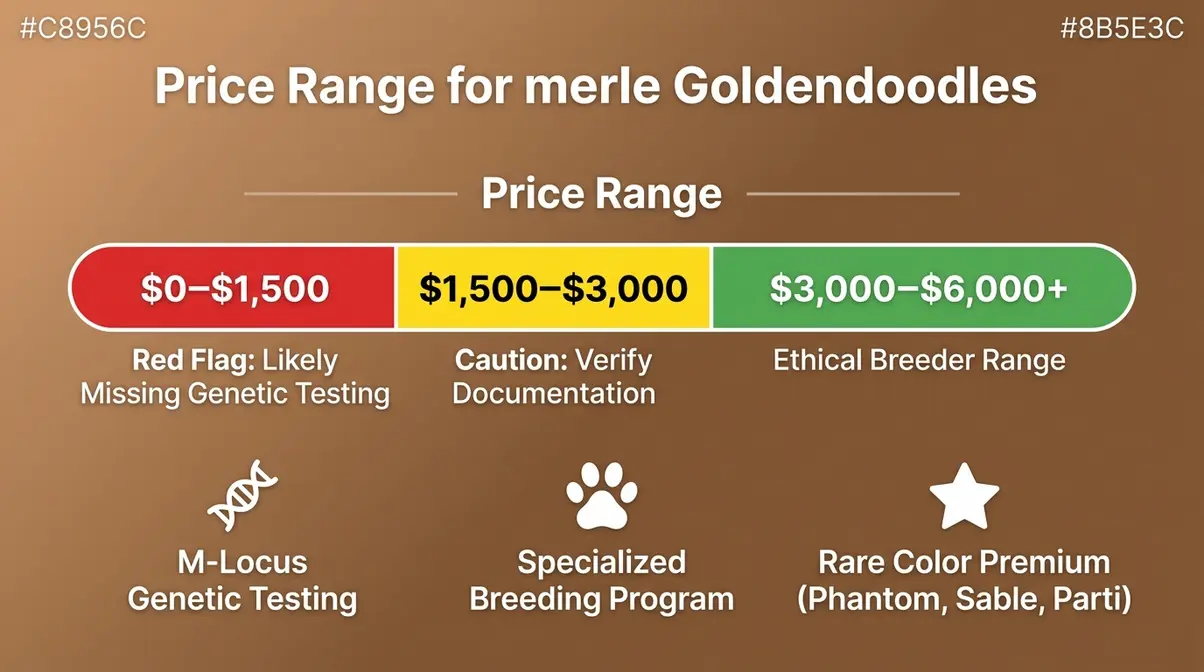
- Prices range from $3,000–$6,000+ from ethical breeders, reflecting specialized breeding and genetic testing costs
- The Merle Safety Filter, our 5-question framework, gives you the exact questions to ask any breeder before committing
What Is a Merle Goldendoodle?
For more on this topic, see our guide on the Phantom Goldendoodle: Markings, Colors & Price Guide. For more on this topic, see our guide on the Top 7 Goldendoodle Rescues In Texas (TX).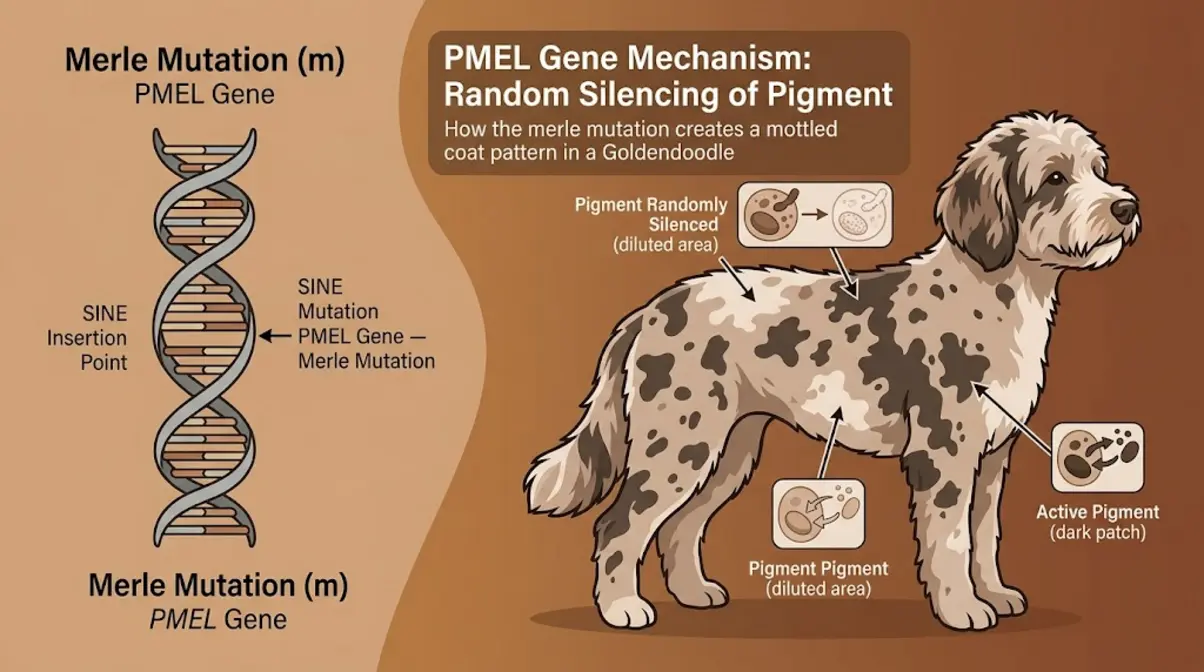
The Marbled Coat Pattern Explained
A merle-colored dog has an irregular, watercolor-like coat, imagine a painting where the pigment pools in some areas and fades in others. Darker patches sit against a lighter diluted base, creating a marbled or mottled effect that looks different from every angle. No two merle dogs look identical, and that’s not just a marketing line. The reason is genuinely scientific. The PMEL gene silences pigment production randomly during embryonic development. Because the silencing happens at different times and in different cell groups for every individual puppy, the resulting pattern is literally unique to each dog, the same way no two fingerprints are identical. This randomness is a genuine selling point that competitors never explain. Common secondary traits add to the visual drama. Blue merles frequently have blue eyes, green eyes, or heterochromia, one blue eye and one brown, caused by the same pigment-dilution mechanism affecting the coat (Dialavet). Pink or mottled nose leather may also appear. When you look at a breeder’s listing photo, the telltale signs are those blue-gray patches on a lighter base (blue merle) or warm brown patches on cream (chocolate merle).Where Does the Merle Gene Come From?
Here’s the answer to the question that started your search: yes, this IS a legit coloring, but it requires intentional, specialized breeding to achieve. The PMEL gene, also called the SILV gene or PMEL17, is the gene responsible for the merle pattern. In plain English, it works by partially “turning off” pigment production in random sections of the coat, leaving those areas lighter than the surrounding base color. The AKC explanation of the PMEL gene describes this as a SINE (short interspersed nuclear element) insertion in the SILV gene, meaning a small piece of extra genetic material gets inserted into the gene and disrupts its normal function (AKC). Neither Golden Retrievers nor standard Poodles naturally carry this gene. The merle pattern enters the lineage through deliberate crossbreeding, most commonly via Australian Shepherd or Catahoula Leopard Dog ancestry introduced into the Poodle line over generations. This is what makes it legitimate: it IS real, but it requires a specialized, intentional breeding program, not a lucky accident. Critically, the gene is dominant. As the Royal Kennel Club on merle gene dominance explains, a dog only needs to inherit one copy of the gene from either parent to express a merle coat (Royal Kennel Club). Think of it like a dominant trait in humans, just one copy produces the full marbled effect. This is why a merle puppy can be born from a merle Poodle parent and a standard Golden Retriever, with no merle gene on the Golden Retriever side at all.Why Are They So Rare?
Rarity here is structural, not artificial. Because the PMEL gene isn’t native to either parent breed, breeders must maintain a specialized merle line, typically built over years of careful crossing and genetic testing. This takes real time, real expertise, and real money. The supply is further constrained by ethical breeding practice. Responsible breeders never pair two merle dogs together (you’ll learn exactly why in the health section). That means each litter from an ethical breeder will produce a mix of merle and non-merle puppies, not an all-merle litter. The merle puppies are a minority of every responsibly-bred litter. Compare this to standard cream or apricot doodles. Those colors appear naturally in both parent breeds and require no specialized breeding program whatsoever. Merle requires an entirely different approach, which is why learning more about the merle Goldendoodle before you contact a breeder is such a worthwhile investment of your time. That rarity shows up in every aspect of these dogs, especially their coat colors. Here’s a complete visual breakdown of every merle variation you’ll encounter.Merle Goldendoodle Colors Explained
These dogs come in several distinct color variations, all sharing the same marbled patterning but with dramatically different visual characters. The major variations include: blue merle, chocolate merle, brown merle, red merle, black merle, phantom merle, sable merle, and parti merle combinations. Blue merle is the most sought-after of the merle colour variations, and breeders price it accordingly. The merle mutation follows an autosomal semidominant inheritance pattern, making it one of the most complex coat color mutations in dogs (NIH research on merle coat genetics, PubMed Central, NIH). No matter which color you fall in love with, The Merle Safety Filter in the next section applies equally to all merle variations. You can explore all Goldendoodle colors and patterns for a broader look at how merle sits within the full spectrum of coat options.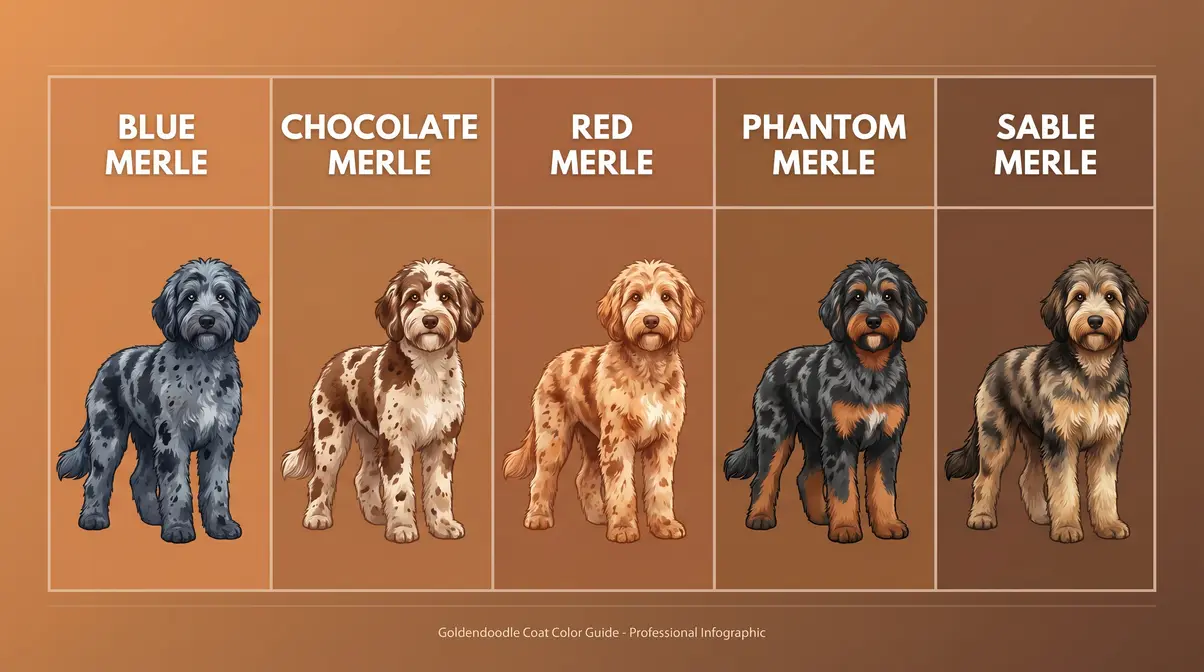
https://www.youtube.com/watch?v=e0Y-Rrpdh2U
Blue Merle Variations
The blue merle variety is the most sought-after color variation in the merle family, and one of the most commonly misunderstood. “Blue merle” is actually a misnomer. The coat is a diluted black base that produces a gray-blue marbled effect with darker charcoal patches. Most owners describe it as “silver and charcoal” rather than any true blue. The contrast is striking and dramatic, which explains why it generates the most search interest by a significant margin. Eye color is one of the most distinctive features of this variation. Blue merles frequently have blue eyes, green eyes, or heterochromia, one blue eye and one brown. The same pigment-dilution mechanism that affects the coat also influences melanin production in the iris, producing these unusual eye colors (Dialavet). One thing many buyers don’t expect: coat fading. Many blue merle puppies look dramatically lighter or darker at 8 weeks than they will at 12–18 months. A striking blue-gray puppy may fade to a softer silver as an adult, or deepen depending on the genetic background. This isn’t a defect, it’s a normal part of the merle coat’s development. Always ask your breeder for photos of adult dogs from the same bloodline, not just puppy photos from the current litter.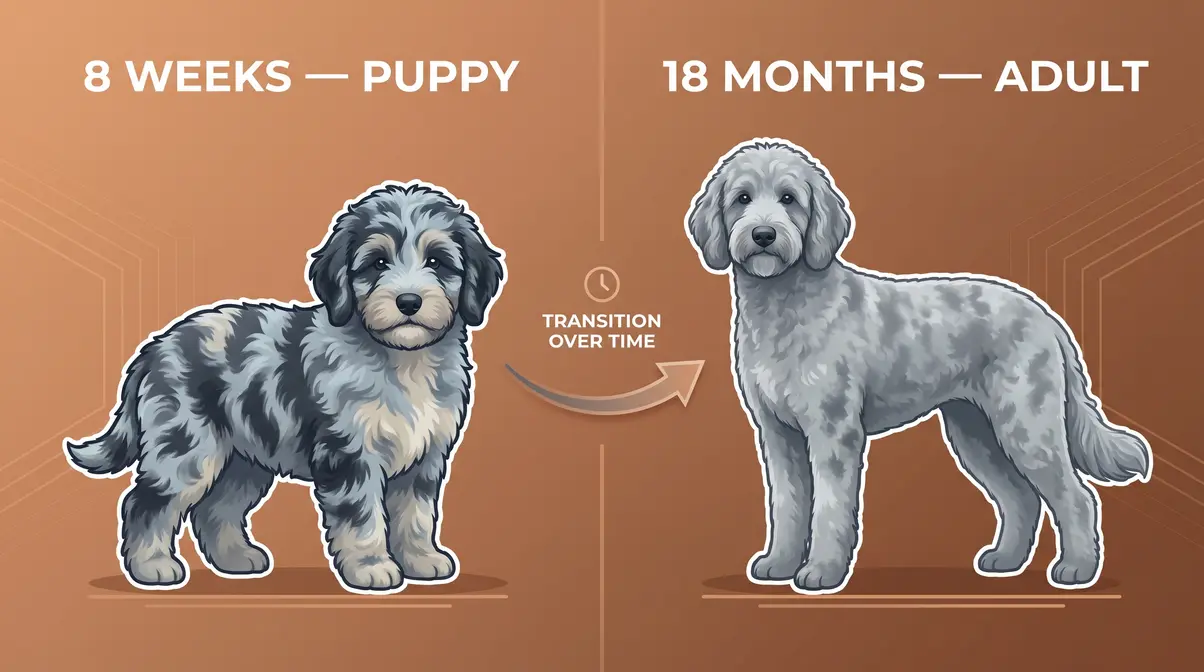
Chocolate & Brown Merle
The chocolate merle pairs warm brown patches with a cream or lighter base coat, creating a softer, more approachable visual than the cool tones of a blue merle. Many owners describe the effect as painterly, the warm tones of the brown patches against a cream base photograph beautifully in natural light, with a soft, earthy quality that blue merle doesn’t have. Eye color in chocolate merle dogs typically runs amber, hazel, or light brown rather than blue. Blue eyes in a chocolate merle are rare and may indicate additional dilution genes at work in the genetic background. The brown merle and chocolate merle labels are often used interchangeably by breeders. Technically, “chocolate” refers to a deeper, richer brown base (the bb genotype in dog color genetics) while “brown merle” may describe a lighter tan-brown. For buyers, the practical visual difference is subtle, what matters most is asking your breeder for adult photos to confirm the exact tone you’re seeing in a puppy photo persists to maturity. Red and black merles are rarer still, and each carries its own distinct visual character.Red & Black Merle
The red merle features a warm apricot or reddish base with lighter cream patches. The contrast is less dramatic than blue or chocolate merle, giving a more subtle marbled effect that can be mistaken for a heavily patterned standard doodle by buyers unfamiliar with the distinction. Some red merles fade to a lighter apricot-cream at maturity, if a breeder calls a dog “red merle,” always ask for adult photos to confirm the redness persists. The black merle has a true black base (not a diluted one) with gray or silver merle patches overlaid. Because both Poodles and Golden Retrievers are less frequently black in most breeding programs, black merle is among the rarer base color options. It can appear similar to a blue merle at first glance, but a knowledgeable breeder will distinguish between the two based on the genetic background of the parents. Beyond these four main color bases, some dogs carry secondary patterning genes, producing phantom, sable, and parti combinations that are among the rarest in the breed.Phantom, Sable & Parti Merle
These three variations are where the merle coat reaches its most complex and visually striking expressions, and where the terminology most often confuses beginner buyers. The phantom merle combines the merle coat with specific tan or gold markings in defined locations: above the eyes, on the cheeks, chest, legs, and under the tail. This is the “phantom” patterning (similar to what you see in Dobermans or Rottweilers), layered on top of the merle base. The result is extremely rare and visually complex. Note: “phantom merle” in genetics terminology refers to something different, a dog that carries the merle gene but expresses it so faintly the coat appears nearly solid. The phantom pattern and the phantom merle gene expression are two distinct concepts. Sable merle is another layered variation. Sable refers to a coat where individual hairs are tipped with a darker color. Combined with merle, the result changes appearance with movement and light, a coat that seems to shift as the dog moves. Parti merle combinations add large white patches to the merle patterning. A blue merle parti, for example, will have three distinct color zones: white areas, gray-blue merle areas, and darker patches. The phantom blue merle and blue phantom merle variations sit at the intersection of these categories and command the highest prices in the merle family. Phantom, sable, and parti merles are significantly harder to find and will typically command the highest prices from specialist breeders. Regardless of which color catches your eye, the size and generation of your dog will shape your daily life just as much as the coat. Here’s what to know about sizes and generations.Sizes & Generations: Mini to Standard
Mini vs. Standard Size & Weight
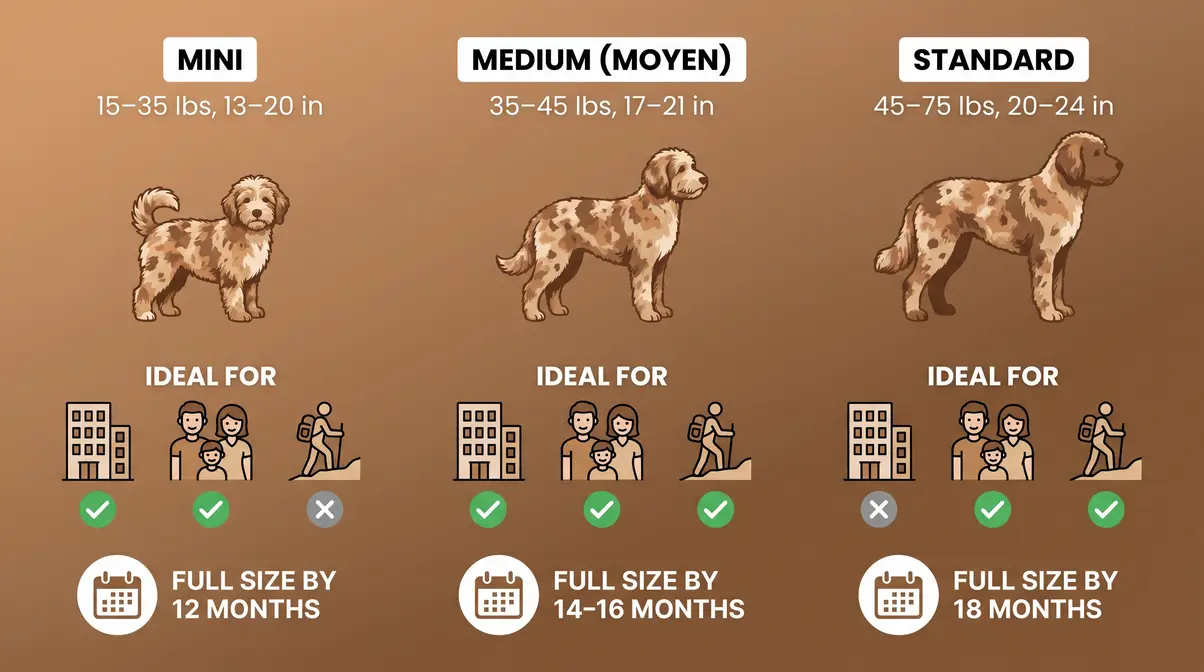
The mini merle typically weighs 15–35 pounds and stands 13–20 inches at the shoulder at full maturity (confirmed across multiple breeder and veterinary sources). Achieved by crossing a miniature Poodle with a Golden Retriever or a smaller doodle, mini merles are well-suited to apartment living or families with limited outdoor space. They reach adult weight by approximately 12 months. The standard merle typically reaches 45–75 pounds and stands 20–24 inches at the shoulder. Standards require more space, more daily exercise, and more grooming time due to the larger, denser coat. Most standard doodles continue filling out until 18 months. A medium size, sometimes called “moyen” or “medium”, exists between mini and standard, roughly 35–45 pounds. Some breeders offer this as a distinct size category, and it can be an appealing middle ground for families who want a manageable but not tiny dog.| Size Category | Weight | Height | Ideal For | Reaches Full Size |
|---|---|---|---|---|
| Mini | 15–35 lbs | 13–20 in | Apartments, small homes | ~12 months |
| Medium (Moyen) | 35–45 lbs | 17–21 in | Families, moderate space | ~14–16 months |
| Standard | 45–75 lbs | 20–24 in | Active families, larger homes | ~18 months |
Generations: F1, F1B, and Beyond
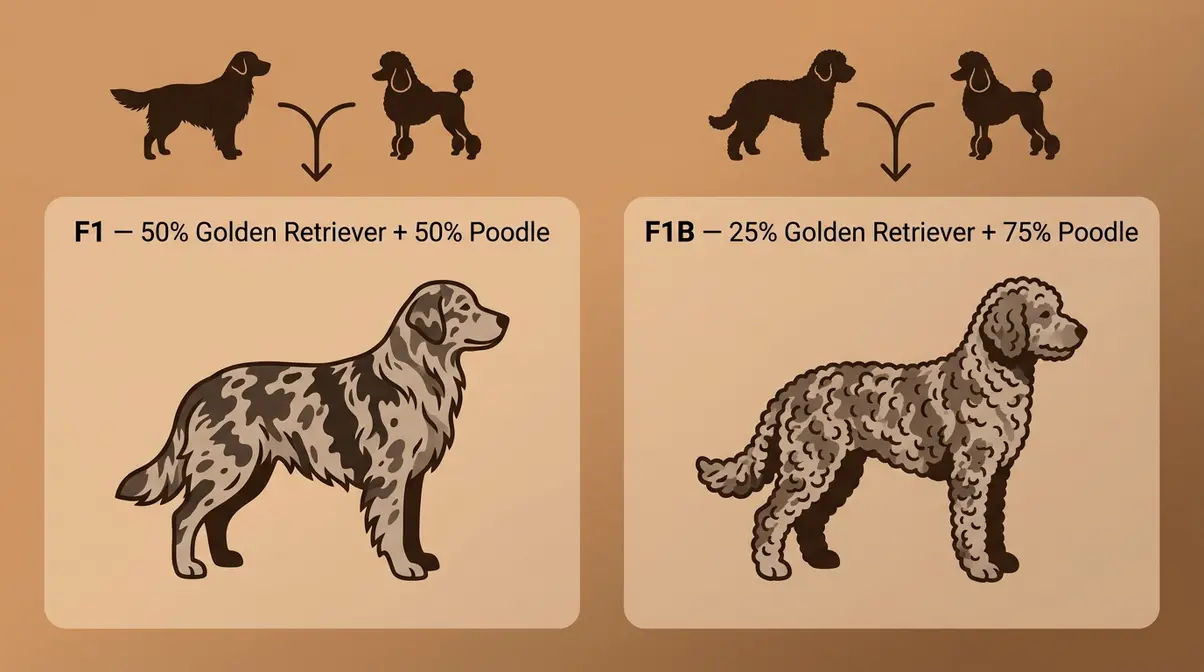
Think of F1 as a 50/50 mix, and F1B as a mix that’s been “leaned” 75% toward one parent. Here’s what that means in practice: F1 (First Generation): 50% Golden Retriever + 50% Poodle. The merle pattern is typically most visually clear in F1 dogs because the straighter or wavier coat shows the marbling more distinctly than a tightly curled coat does. If seeing a dramatic, well-defined merle pattern is your priority, an F1 merle is worth asking about specifically. F1B (First Generation Backcross): 25% Golden Retriever + 75% Poodle. The F1B merle is often marketed as “more hypoallergenic” due to higher Poodle content, and that’s largely accurate, as the curlier coat sheds less. However, that same curlier coat can slightly reduce the visual prominence of the merle pattern. The marbling is still present, but the curl can obscure it compared to the cleaner expression in a straighter F1 coat. This nuance is absent from virtually all competitor content, but it matters if coat pattern visibility is important to you. F2 and multigenerational: Less common for merle bloodlines, as the breeding program becomes more complex with each generation. Some specialist breeders work with multigenerational merle lines, but these require even more careful genetic management. If you want the clearest merle pattern, ask breeders specifically about F1 bloodlines and request adult photos. If you want lower shedding and the merle pattern is secondary, an F1B is a strong choice. More detail on F1B Goldendoodle genetics and sizes can help you weigh these trade-offs.Full Grown Size Expectations
A full grown merle often surprises owners who fell in love with a puppy photo. Coat maturity is the biggest variable. The merle pattern can lighten, deepen, or become less visually distinct as the adult coat grows in over the first 12–18 months. Colors that looked dramatic at 8 weeks may soften considerably, or intensify, by the time the dog is fully grown. A merle adult reaches full size between 12–18 months depending on size category. Mini merles typically reach adult weight by 12 months; standards may continue filling out until 18 months. Temperament at maturity is consistent with all Goldendoodles: affectionate, people-oriented, eager to please, and highly social. The merle gene affects coat pattern and sometimes eye color, it has no effect on personality or temperament. Now that you know your ideal size and generation, there’s one critical health topic every buyer must understand before spending a dollar.Double Merle Risk & Ethical Breeders
A puppy from a responsible breeder is as healthy as any other Goldendoodle. The only significant health concern is the double merle, a dog that inherits the merle gene from both parents. This is entirely preventable with the right breeding practices and genetic testing. Breeding two merle dogs together, regardless of color, may produce double merle offspring prone to severe blindness and deafness, according to the UC Davis Veterinary Genetics Laboratory. The LSU School of Veterinary Medicine has confirmed that the merle gene is one of two primary pigmentation genes frequently associated with congenital deafness in dogs. Understanding this risk, and how to avoid it, is the most important thing you can do before contacting any breeders. You can review health concerns of merle Goldendoodles for additional context, and use this section alongside our guide to find reputable Goldendoodle breeders who meet the standards described below.What Is a Double Merle?
A double merle is a dog that inherits the merle gene (one copy) from each parent, resulting in two copies of the mutation, what geneticists call a homozygous genotype. Because the PMEL gene randomly silences pigment, having two copies can cause excessive pigment loss, including in the sensory cells of the eyes and inner ear. The health consequences are serious. Double merle dogs have a significantly elevated risk of congenital blindness, deafness, or both. Some are born with microphthalmia, abnormally small, underdeveloped eyes. These are not minor cosmetic issues; they are lifelong disabilities that affect the dog’s quality of life from birth. The UC Davis Veterinary Genetics Laboratory confirms that double merle offspring may be prone to severe health problems including blindness and deafness. The statistics are clear: when two merle dogs are bred together, there is approximately a 25% chance that each puppy in the litter will be a double merle (NIH PubMed; Adopt a Pet). Merle-to-merle matings are officially prohibited by kennel clubs precisely because of this 25% probability of producing homozygous double merle offspring (NIH research on merle coat genetics, PubMed Central). There’s a hidden danger that competitors never mention: cryptic merle. Some dogs carry the merle gene but don’t visually express it, their coat looks solid or near-solid. Breeding a cryptic merle with a visible merle can still produce double merle puppies. This is precisely why genetic testing is essential. Visual inspection alone is not enough to confirm safe breeding pairs.The PMEL Gene: Science of the Risk
The merle mutation is a SINE insertion in the PMEL gene. In plain English: a small piece of genetic material gets inserted into the gene, partially disrupting its function. When this disruption happens once (single merle), the coat shows the marbled pattern, and sensory cells are largely unaffected. When it happens twice (double merle), the disruption is more severe, sensory cells in the eyes and ears may lose pigment entirely, leading to the blindness and deafness risks described above. Research published in PubMed Central confirms that the merle mutation follows an autosomal semidominant inheritance pattern, making it one of the most complex coat color mutations phenotypically and genotypically (NIH PubMed research on the merle mutation, PubMed Central, NIH). “Semidominant” means the single-copy dog (single merle) and the two-copy dog (double merle) look and behave differently, the gene’s effects are dose-dependent. This is why the M-locus test, offered by the UC Davis Veterinary Genetics Laboratory, is so valuable. It identifies whether a dog carries one or two copies of the merle gene before any breeding decisions are made. Ethical breeders use this test on both parent dogs, every time. Now that you understand the risk, here’s the practical tool to protect yourself: The Merle Safety Filter.Are Merle Goldendoodles Healthy?
When sourced from a responsible breeder, the merle variety is generally as healthy as any other Goldendoodle. The primary concern is the “double merle” risk, a dog that inherits the merle gene from both parents, which can cause congenital blindness or deafness. Ethical breeders prevent this by always pairing a merle dog with a non-merle partner, ensuring no puppy receives two copies of the gene. Reputable breeders perform M-locus genetic testing on both parents before breeding to confirm safe pairings. Always request genetic test documentation before purchasing any merle puppy to ensure long-term health.Ethical Breeder Verification Checklist
The Merle Safety Filter is the five-question framework we recommend asking every breeder before committing to a puppy. An ethical breeder will answer all five questions confidently and provide documentation. Hesitation or vague answers on questions 1 or 2 are immediate red flags. Use The Merle Safety Filter checklist below when contacting any breeder, ethical breeders will answer every question without hesitation. Step 1: Request M-locus Test Results “Can you provide the M-locus genetic test results for BOTH parents?” This confirms that neither parent is an undetected cryptic merle,the hidden risk that visual inspection cannot catch. Step 2: Verify Parent Coat Patterns “Are both parents non-merle, or is one parent definitively single-merle only?” This confirms the ethical pairing: merle × non-merle. If both parents are merle, walk away. Step 3: Check Health Clearances “Do you have health clearances for hips, elbows, and eyes from a licensed veterinarian?” This confirms general health screening beyond genetics. A reputable breeder tests for more than just coat color. Step 4: Review Adult Photos “Can I see photos of adult dogs from this bloodline at 12+ months?” This confirms transparency about coat fading and shows the breeder has an established, mature breeding program. Step 5: Confirm the Health Policy “What is your policy if a puppy develops a health condition within the first year?” This confirms breeder accountability. A health guarantee is a standard commitment from responsible breeders. The AKC recommended questions for vetting breeders reinforces this structured approach, noting that ethical practices and proper health testing should be documentable on request (AKC). You can also use our guide to finding reputable Goldendoodle breeders alongside this checklist for additional vetting resources.Warning Signs of an Unethical Breeder
- No M-locus genetic test results for one or both parents, this is the single most important document to request
- Both parents are visually merle-patterned, a strong indicator of double merle risk in the litter
- Prices under $1,500 for a “merle Goldendoodle”, may indicate a puppy mill or backyard breeder who skips genetic testing
- No health guarantee or return policy, reputable breeders stand behind their puppies
- Reluctance to let you visit the breeding facility or see the parent dogs in person
- Litter photos show all-merle puppies, statistically unlikely from an ethical single-merle × non-merle pairing; a red flag for merle × merle breeding
⚠️ Professional Consultation Advisory: Before purchasing a merle Goldendoodle, consult with a licensed veterinarian who can review the breeder’s genetic health clearances. This guide provides educational information only and is not a substitute for professional veterinary advice.Armed with The Merle Safety Filter, you’re ready for the next step: understanding what these dogs actually cost and where to find reputable puppies for sale.
Price, Puppies for Sale & Breeders
Before You Buy: Complete all five questions in The Merle Safety Filter before committing to any puppy listing. Ethical breeders welcome these questions, hesitation is a signal to look elsewhere.
How Much Does It Cost?
The price from a reputable ethical breeder ranges from $3,000 to $6,000 or more, placing it at 2–3× the price of a standard cream or apricot doodle. That premium exists for three concrete reasons: the gene isn’t native to parent breeds, the breeding program requires years of careful development, and genetic testing adds per-litter costs that standard breeders don’t incur. Blue merle is the most popular colour variation, so demand is highest and prices reflect that. Blue merles from reputable breeders typically sit at the higher end of the range, $4,000 to $6,000 or more. Phantom, sable, and parti combinations, the rarest variations, may exceed $6,000 from specialist breeders. An important inverse relationship that competitors never mention: unusually low prices are a red flag, not a bargain. A “merle Goldendoodle for sale” listed under $1,500 almost certainly comes from a breeder who has skipped genetic testing. You may be getting a dog at risk for preventable health problems. The price you pay reflects the safety of the breeding program. You can review merle Goldendoodle price and reputable breeders for additional pricing context alongside this guide.Why Are They So Expensive?
Merle Goldendoodles are expensive because the PMEL gene is not naturally found in Golden Retrievers or Poodles, requiring specialized multi-generational breeding programs to introduce and maintain the trait. Ethical breeders must perform M-locus genetic testing on parent dogs, adding meaningful per-litter costs. High demand for the unique marbled coat further drives prices upward. Prices from reputable breeders typically range from $3,000 to over $6,000, depending on color, size, and breeder reputation. Unusually low prices, under $1,500, may indicate a breeder who skips essential genetic testing.Factors That Affect the Price
Several variables determine where within the $3,000–$6,000+ range a specific puppy falls:- Color rarity: Blue and chocolate merle are the most common within the merle category. Phantom, sable, and parti merle command the highest premiums due to additional genetic complexity.
- Size: Mini merles often cost slightly more than standards. Breeding a miniature Poodle line that also carries the merle gene requires additional specialized management.
- Generation: F1B merles may cost more due to higher demand for low-shedding coats. The higher Poodle content requires maintaining a separate breeding line.
- Breeder reputation and testing investment: Breeders who perform M-locus testing, hip and elbow clearances, and eye certifications have higher operating costs, reflected in puppy prices. This is where the price premium is most justified.
- Geographic location: Breeders in high cost-of-living areas charge more. Shipping or flight nanny transport adds $300–$600 if you’re not purchasing locally.
Where to Find Puppies for Sale
Finding a puppy for sale from an ethical source requires patience and targeted searching. Specialized doodle breeder networks, particularly breeders who explicitly advertise M-locus genetic testing and display parent health clearances on their websites, are your best starting point. Breed-specific communities on Facebook and forums like r/Goldendoodles can surface verified breeder recommendations from current owners. Avoid pet store listings and general puppy marketplaces. Dogs for sale through unknown sources frequently lack genetic testing documentation, exactly the documentation The Merle Safety Filter requires. If you’re searching “merle goldendoodle for sale near me” or “merle goldendoodle puppies for sale near me,” be prepared to travel or use transport. Ethical merle specialists are genuinely rare, and the nearest reputable breeder may be several states away. Most reputable breeders offer flight nanny puppy transport, a professional service where a handler accompanies the puppy on a commercial flight, which is a safe and widely accepted option.When This Breed Isn’t the Right Choice
This designer dog is remarkable, but it isn’t the right choice for every buyer or every situation. Knowing this is a sign of informed decision-making, not hesitation.Common Pitfalls When Choosing
Pitfall 1: Prioritizing color over health documentation. If you fall in love with a coat pattern and skip The Merle Safety Filter, you risk purchasing from an unethical breeder. The most beautiful coat is worthless if the dog has preventable health issues. The checklist exists precisely for this moment. Pitfall 2: Assuming “merle” automatically signals rarity and value. Some breeders use the “merle” label loosely or without proper genetic documentation. Always request M-locus test results for both parents, not just the breeder’s word that the pairing was safe. Pitfall 3: Underestimating grooming needs. These dogs have the same high-maintenance coat as any Goldendoodle. Budget for professional grooming every 6–8 weeks and daily brushing to prevent matting, regardless of coat length preference.Considering a Different Breed
Strict budget under $2,000: A healthy merle from an ethical breeder is unlikely to be available at this price point. Prices below $2,000 should trigger immediate concern about whether genetic testing was performed. A standard cream or apricot Goldendoodle from a reputable local breeder is a safer, more accessible choice at this budget. Cannot travel to a vetted breeder: Long-distance puppy transport adds logistical complexity and some risk. If no ethical merle breeder is accessible within a reasonable distance and you’re not comfortable with flight nanny transport, a local reputable standard Goldendoodle breeder is the more straightforward path to a healthy puppy. You can find a reputable Goldendoodle breeder near you to explore both merle specialists and standard breeders in your area.Frequently Asked Questions
What is a merle Goldendoodle?
A merle Goldendoodle is a designer dog with a unique marbled or patched coat pattern created by the dominant PMEL gene. This gene dilutes random sections of the base coat color, producing striking variations like blue merle (gray-blue patches) and chocolate merle (warm brown patches on a cream base). Because the pattern is random at the cellular level, no two dogs look exactly alike.What is a “double merle” Goldendoodle?
A double merle is a dog that inherits the merle gene from both parents, resulting in two copies of the mutation. This genetic combination significantly increases the risk of congenital blindness, deafness, or both, because excessive pigment loss can affect sensory cells in the eyes and inner ear. When two merle dogs are bred together, approximately 25% of each litter may be double merle (NIH PubMed Central). The condition is entirely preventable when breeders follow ethical pairing practices and perform genetic testing.Do Goldendoodles like attention?
Yes, Goldendoodles, including merle varieties, are highly social dogs that thrive on human companionship and attention. They are known for being affectionate, eager to please, and excellent with families and children. The merle gene affects coat pattern only, not personality or temperament.Do merle Goldendoodles shed?
The shedding level of a merle Goldendoodle depends entirely on their generation and coat type, not their color. F1B generations (75% Poodle) with curly coats are typically low-to-non-shedding and are often considered more hypoallergenic. F1 generations (50% Poodle) with wavier or straighter coats may shed lightly. Regardless of shedding, all merle coats require significant daily brushing and professional grooming every 6-8 weeks to prevent severe matting.Can you breed two merle Goldendoodles together?
No, ethical breeders will never breed two merle Goldendoodles together. Doing so creates a 25% statistical probability of producing “double merle” puppies, which are prone to severe congenital blindness and deafness. Responsible breeding requires pairing one merle dog with a non-merle dog to ensure the health of the entire litter.Next Step: Choosing a Puppy Safely
For prospective buyers, a merle Goldendoodle from an ethical breeder is a healthy, stunning dog, and the only real risk (the double merle) is entirely preventable with the right questions. These dogs are genuinely rare because the PMEL gene requires a specialized breeding program not native to either parent breed, which explains both the unique marbled coat and the $3,000–$6,000+ price tag (Happy Doodle Farm). The best approach combines three steps: identifying your preferred color and size, running every breeder through The Merle Safety Filter, and requesting M-locus genetic test documentation for both parent dogs before committing to any puppy. The Merle Safety Filter is this article’s core framework, and it exists because the “is this legit?” question you started with deserves a real, actionable answer. Yes, these dogs are legitimate. Yes, they are genuinely rare. And yes, the one real risk is fully preventable when you ask the right five questions. That’s what the Safety Filter gives you: the confidence to evaluate any breeder on your terms, not theirs. Contact two or three vetted breeders, run each through The Merle Safety Filter, and compare their answers and documentation before committing. Ethical breeders welcome these questions, it’s a signal that you’re a serious, discerning buyer. Use our guide to finding reputable Goldendoodle breeders as your starting point, and give yourself the time to find a breeder who passes every question with confidence.Another visually distinctive Goldendoodle coat option is the Parti Goldendoodle, which combines white with a second color rather than the merle dilution pattern.