
Your future black Goldendoodle puppy looks jet-black at six weeks — but a nagging question keeps you up at night: will that stunning dark coat fade away by the time they’re two years old? You’re not alone in asking. Black doodles are genuinely rare, and most articles give you a few vague sentences about genetics — nowhere near enough to make a confident decision about a dog you’ll have for 10–15 years.
Here’s what most prospective owners don’t realize: the color of a Goldendoodle’s coat isn’t random luck. It comes down to three specific gene switches — and once you understand them, you can predict whether that jet-black coat will stay dark for life or fade to silver. That knowledge gap between “black puppies are just rare” and “here’s exactly why, and how to find a breeder who actually understands it” is what we call The Genetics Gap — and this guide closes it completely.
In this complete guide, you’ll learn exactly what causes the black coat, whether it will fade, which size fits your home, what you should pay, and how to care for your new companion. We cover coat genetics (in plain language), all three size categories, a step-by-step breeder vetting checklist, grooming routines, and honest downsides — everything you need to become the most informed black doodle owner on your street.
Black Goldendoodles are real, rare, and just as lovable as their cream-colored cousins — they are among the least common color variations in the breed due to specific genetic requirements.
- Rarity is genetic: Black coats require specific gene combinations at the B, E, and K loci — this is “The Genetics Gap” most owners never learn about before buying.
- Fading is possible: The G locus (the “fading gene”) can shift black coats to silver or grey by age two — but not all dark-coated doodles fade.
- Three sizes available: Toy (under 15 lbs), Mini (15–35 lbs), and Standard (50–90 lbs) — each suits a different lifestyle and living situation.
- Expect to pay $2,000–$5,500 for a black doodle puppy from a reputable breeder, depending on size, generation, and location.
- Grooming is non-negotiable: Professional grooming every 6–8 weeks prevents painful matting (Goldendoodle Association of North America).
Table of Contents
- Traits, Temperament & Rarity
- Appearance, Coat Types & Fading Gene
- Sizes: Toy, Mini & Standard
- Finding & Buying Puppies
- Grooming: Haircut Styles & Ear Care
- Real Downsides of Black Goldendoodles
- Gifts & Themed Merchandise
- Frequently Asked Questions
- Conclusion: Ready to Make the Leap?
What Is a Black Goldendoodle? Traits, Temperament & Rarity
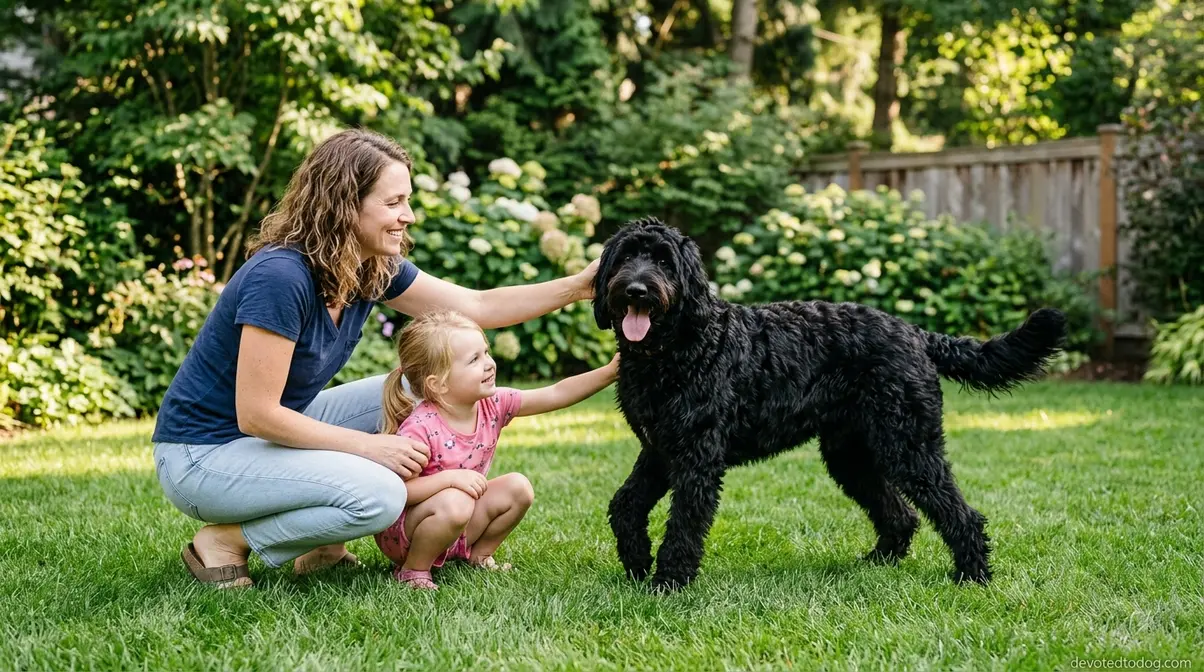
A black Goldendoodle is a Golden Retriever–Poodle crossbreed that carries specific recessive coat-color genes, producing a rich jet-black coat instead of the more common cream or apricot. Black is one of the rarest color outcomes in Goldendoodle breeding — significantly less common than golden, cream, or red varieties — because producing it requires precise genetic alignment from both parent dogs. Despite the rare coat, the black doodle shares the same friendly, intelligent temperament that makes the breed one of America’s most popular family dogs.
A black Goldendoodle is genetically identical to any other Goldendoodle — the only difference is which coat-color genes were activated at conception. That single fact is what most competitor articles fail to state clearly, and it’s the foundation of everything you’ll learn in this guide.
Can Goldendoodles Actually Be Black?
Yes — absolutely. Black is a naturally occurring coat color in Goldendoodles, not a dye, a trick, or an anomaly. Both the Golden Retriever and the Poodle carry the genetic potential for black pigment, specifically a dark pigment called eumelanin (the dark pigment responsible for black and brown coat colors in all dogs). When the right combination of genes aligns in a puppy, the result is a stunning, solid-black coat.
Here’s why black is less common in standard F1 (first-generation) Goldendoodles: Golden Retrievers typically carry a recessive genotype at the E locus — often written as “e/e” — that actively suppresses black pigment expression. That means even when black genes are present, the Golden Retriever’s genetics can block them from showing. This is the first glimpse of The Genetics Gap — the missing knowledge between what most owners are told and what the science actually shows.
One of the most common misconceptions is that a black Goldendoodle must be a Labradoodle in disguise. If you’ve seen a jet-black doodle and wondered whether it was secretly a Lab mix, you’re far from alone. The difference lies in the parent breeds: Goldendoodles always have Golden Retriever lineage, regardless of coat color. Color does not affect breed status. A black doodle is a full, genuine Goldendoodle — confirmed by the established genetic identity of the breed, as documented in the UC Davis Goldendoodle genetic profile (UC Davis VGL, 2026).
Black Goldendoodle Temperament and Personality

The black Goldendoodle temperament is exactly what you’d expect from any Goldendoodle: warm, joyful, and deeply devoted to the people around them. Coat color has zero impact on personality. That jet-black puppy is a total heart-stealer — and it will grow into an adult dog that is just as affectionate, goofy, and loyal as any cream or apricot Goldendoodle you’ve ever met.
Goldendoodles are famously friendly with children, other pets, and strangers. They are highly intelligent — ranked among the most trainable of all hybrid breeds — and they thrive on mental stimulation and human connection. They are also genuinely social dogs, which means they can develop separation anxiety when left alone for extended periods. This is an honest, balanced point worth knowing before you bring one home.
According to Texas A&M veterinary researchers, mixed-breed dogs like Goldendoodles show similar rates of dental and joint conditions as purebred dogs, suggesting that hybrid vigor does not eliminate all health risks (Texas A&M School of Veterinary Medicine, 2026). What this means for you: don’t assume a Goldendoodle is automatically healthier than a purebred — good genetics and health-tested parents still matter enormously.
Do Goldendoodles Have a Favorite Person?
Yes — Goldendoodles often form a particularly strong bond with one person, typically the individual who feeds, trains, and spends the most consistent one-on-one time with them. This doesn’t mean they’re cold or unfriendly with other family members — Goldendoodles are highly social dogs that bond warmly with everyone in the household. The “favorite person” connection simply runs deepest with their primary caregiver, and it manifests as consistent shadowing, seeking comfort from that person first, and displaying the most exuberant greetings.
Research on dog bonding suggests that consistent, positive training sessions are the fastest path to becoming a dog’s primary attachment figure. If you want to strengthen your bond with a Goldendoodle that seems more attached to someone else in the household, take over feeding duties and lead daily training sessions — the relationship shifts relatively quickly.
Lifespan and Health Considerations
Black Goldendoodle lifespan follows the same range as all Goldendoodles: typically 10–15 years, with smaller sizes trending toward the higher end of that range. Mini Goldendoodles commonly live 12–16 years, while Standard Goldendoodles tend to live 10–13 years — consistent with the general pattern of smaller dogs outliving larger ones (multiple veterinary-aligned sources, 2026). For a deeper look at what affects longevity, see our full Goldendoodle lifespan guide.
There are three key health conditions every Goldendoodle owner should know about:
- Hip and elbow dysplasia: Inherited primarily from the Golden Retriever side. A condition where the joint doesn’t develop properly, causing pain and mobility issues in later life. OFA (Orthopedic Foundation for Animals) health clearances from both parent dogs are your best protection.
- Certain eye conditions: Including progressive retinal atrophy (PRA), which can lead to vision loss. Reputable breeders screen for this.
- Sensory ataxic neuropathy (SAN): A progressive neurological disorder documented as a known genetic risk specific to Goldendoodles — UC Davis Veterinary Genetics Laboratory has documented this condition as part of the breed’s genetic profile (UC Davis VGL, 2026).
Importantly, the black coat color is not associated with any additional health risks. Some owners worry about color-linked conditions — these are real in merle-patterned dogs, for example — but standard solid-black coats carry no such risks. The color is purely cosmetic. To screen for genetic conditions before you buy, ask your breeder for OFA health clearances for both parent dogs — this is standard practice with reputable breeders and a non-negotiable green flag.
How Rare Is a Black Goldendoodle?
Black doodles are genuinely rare — significantly less common than the golden, cream, apricot, and red coat colors that dominate most Goldendoodle litters. Across breeder communities and owner forums, the consistent feedback is that black puppies represent a small fraction of overall Goldendoodle production, with multiple sources describing them as rare or “significantly less common” than standard colors (Goldoodle.com, 2026; Goldendoodles.net, 2026).
The reason is genetic, and it’s exactly what most breeders fail to explain clearly. Golden Retrievers almost universally carry the “e/e” genotype at the E locus — the gene switch that controls whether any dark pigment is expressed at all. When a dog carries two copies of the recessive “e” allele, black pigment is suppressed entirely, which is why most Golden Retrievers are cream, gold, or red. For a Goldendoodle to be black, the Poodle parent must contribute a dominant E allele AND a dominant B allele — a combination that requires careful, intentional breeding.
This is what we call The Genetics Gap — the missing knowledge between “my breeder says black puppies are just rare” and “here’s the exact genetic reason why, and how to find a breeder who actually understands it.” F1 black Goldendoodles (first-generation Golden Retriever × Poodle crosses) are rarer than F1B or multigenerational blacks, because the Golden Retriever’s genetic profile actively suppresses black expression in the first cross. F1B and multigen breeders, working with predominantly Poodle genetics, can produce black coats far more reliably.
“Black Goldendoodles are among the rarest color variants in the breed — their scarcity comes not from low demand, but from the precise genetic alignment required to produce them.”
Appearance: Coat Types, Colors & Fading Gene
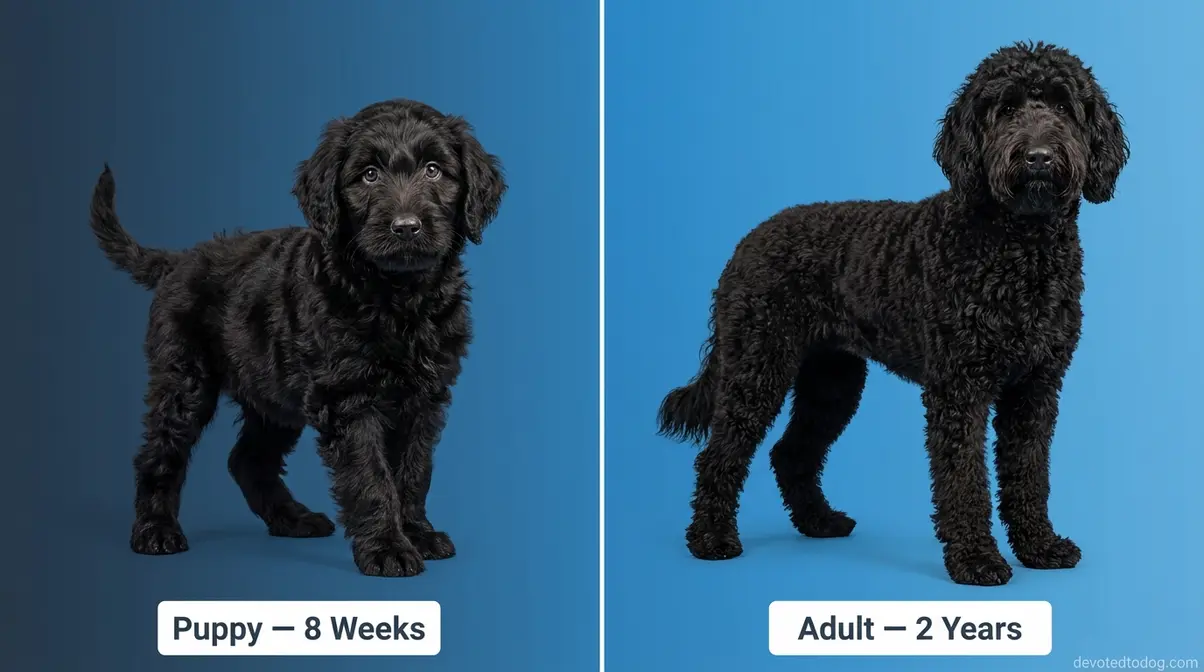
“We are getting a goldendoodle-German shepherd puppy. She and all her siblings are jet black at 6 weeks. Anyone have experience with this mix? Wondering if color will change due to the ‘fading gene’?”
— A new owner’s question, shared by thousands every year
Whether your black doodle’s coat stays jet-black or fades to silver depends on three specific gene switches — the B, E, and K loci — plus one additional “fading switch” called the G locus. Understanding these four switches closes what we call The Genetics Gap, and it takes less than five minutes. This section is the scientific heart of the guide — and the part that no competitor article comes close to covering.
The Genetics Behind the Black Coat (B, E & K Loci Simply Explained)
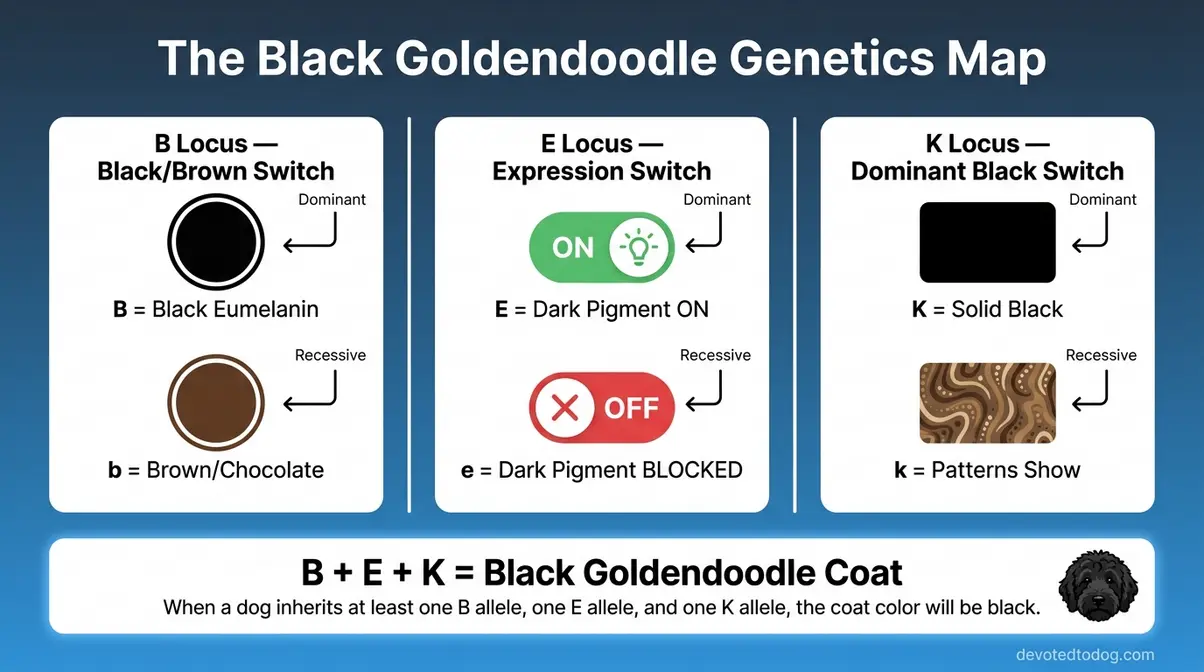
Black Goldendoodle coat color isn’t random — it’s the result of three genetic “light switches” working in combination. Think of each locus (a specific location on a chromosome) as a switch that controls one aspect of your dog’s coat color. When the right switches are flipped to “on,” the result is a rich, solid-black coat.
Here’s how each switch works:
- B locus (black/brown switch): The B locus determines whether your dog produces black or brown pigment. “B” produces black eumelanin (the dark pigment responsible for black coats). “b” produces brown/chocolate pigment instead. A dog needs at least one dominant B allele (B/B or B/b) to produce black pigment.
- E locus (expression switch): The E locus controls whether any dark pigment is expressed at all. “E” means dark pigment is expressed. “e” means dark pigment is masked — this is exactly why most Golden Retrievers appear cream or gold. They’re often “e/e,” meaning their dark pigment is completely suppressed. For a black doodle, at least one dominant E allele must be present.
- K locus (dominant black switch): The K locus determines whether the dominant black color overrides other pattern genes. “K” means dominant black (the coat stays solidly black). “k” allows other patterns to show through. Most solid-black doodles carry at least one dominant K allele.
According to the UC Davis Veterinary Genetics Laboratory, the dilution gene (MLPH) dilutes both black and red pigments, and the B, E, and K loci interact to determine final coat color expression in dogs (UC Davis VGL, 2026).
What this means for you: If your breeder says “I can guarantee a black puppy,” ask them: “What are the genotypes of both parent dogs at the B, E, and K loci?” A reputable breeder who understands genetics can answer this confidently. One who looks confused is guessing — and guessing is exactly how The Genetics Gap perpetuates itself. A black Poodle sire (K/K, B/B, E/E) bred to a Golden Retriever dam (k/k, B/b, E/e) will produce some black puppies, but not an entire black litter.
Will Your Black Goldendoodle Fade? The G Locus Explained

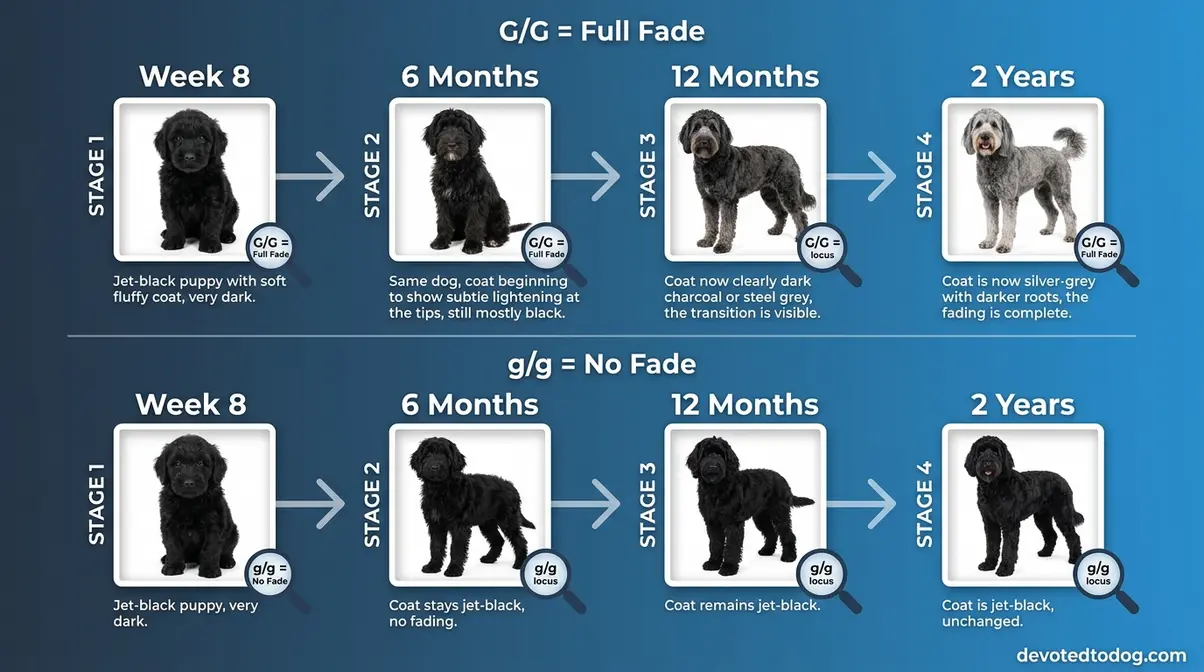
Whether your black Goldendoodle keeps its coat for life or gradually lightens is determined by a fourth gene switch: the G locus, commonly called the “fading gene.” The G locus causes a puppy’s dark coat to progressively lighten as they age — a process that typically begins between 6 months and 2 years of age.
Here’s how the G locus works in practice:
- G/G (two copies): The dog will almost certainly fade. A jet-black puppy with this genotype will likely be dark silver or charcoal grey by its second birthday.
- G/g (one copy): Partial fading is likely. The coat may lighten to a dark steel-grey rather than true silver.
- g/g (no copies): The dog should retain its original color. A g/g black doodle may stay jet-black for life.
The fading gene comes from the Poodle parent — Poodles commonly carry it, which is why so many Goldendoodles of all colors lighten with age. “Whether a black Goldendoodle’s coat fades depends on the G locus gene — a dog with two copies of the G allele (G/G) will almost certainly lighten by age two, while a G/g or g/g dog may retain its jet-black coat for life” — consistent with coat color research from UC Davis VGL (2026). Research from Cornell University Animal Genetics also confirms that the “dd” genotype modifies the B gene by fading its color, creating coat colors like blue or faded black through the progressive graying mechanism (Cornell University, 2026).
Beyond genetics, nutrition can also play a role. Tufts University veterinary researchers note that nutritional deficiencies in phenylalanine or tyrosine can cause a black coat to shift toward reddish or faded tones — a secondary cause of color change beyond genetics (Tufts University Cummings School of Veterinary Medicine, 2026).
What this means for you: Ask your breeder whether the parent Poodle has faded from its puppy color. If the Poodle parent is now silver or grey but was born black, your puppy very likely carries the G allele. A breeder who shows you photos of their parent dogs at both puppy age and current adult age is demonstrating transparency about fading — that’s a genuine green flag.
Black Goldendoodle Color Variations: Parti, Phantom, Merle & More
Not every “black Goldendoodle” is a single uniform color. Several stunning black-based coat patterns exist, each produced by different genetic combinations:
- Solid Black: Uniform jet-black coat from nose to tail. The most common black type and what most people picture when they hear “black Goldendoodle.”
- Black and White (Parti): Large patches of black and white, typically with 50% or more white coverage. A “black and white goldendoodle” or “black parti goldendoodle” requires the parti gene (S locus) in addition to the standard black-producing genes.
- Black Phantom: Black base coat with tan or gold “phantom” markings above the eyes, on the muzzle, chest, and legs. A “black phantom goldendoodle” is one of the most striking and sought-after patterns currently available — phantom doodles are among the most requested color patterns from breeders.
- Black and Tan: Similar to phantom but with tan markings distributed slightly differently across the body.
- Black Merle: A mottled black and grey pattern, often with blue or odd-colored eyes. Rare and beautiful — but note that merle-to-merle breeding carries serious health risks, including deafness and blindness. Always verify that your breeder uses responsible merle breeding practices.
- Black and Silver / Black and Grey: Variations where black mixes with other pigments through partial fading or parti gene expression, producing a two-toned appearance.
What this means for you: If you want a specific pattern — especially a black phantom — you must find a breeder who deliberately produces that pattern. It cannot be guaranteed without both parents carrying the right genotypes. For a deeper look at all Goldendoodle color combinations, see our complete guide to Goldendoodle colors and patterns.
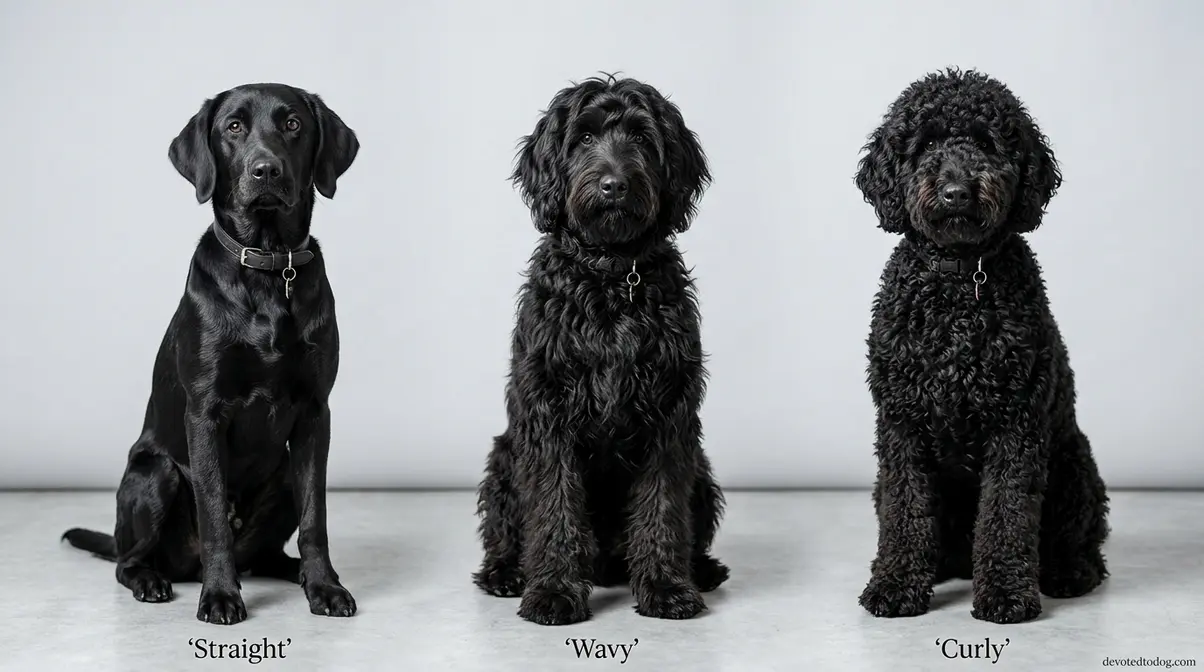
Coat Texture Types: Straight, Wavy & Curly
A straight haired black goldendoodle looks very different from a curly-coated one — and the difference matters enormously for your daily grooming commitment. Three coat textures exist in Goldendoodles, each determined by how much Poodle vs. Golden Retriever genetics the puppy inherits:
- Straight (flat coat): More Golden Retriever genes expressed. The lowest grooming need of the three types, but also the most likely to shed noticeably. If you chose a Goldendoodle for its low-shedding reputation, a straight-coated black pup may surprise you.
- Wavy: The most common Goldendoodle coat type. Moderate maintenance, low to moderate shedding, and highly versatile for different haircut styles.
- Curly: More Poodle genes expressed. The most hypoallergenic coat type and the least likely to shed — but it demands the most grooming. Daily brushing is non-negotiable for curly coats.
What this means for you: Coat type is more predictable in F1B and F1BB generations (which carry more Poodle DNA) than in F1 (first generation). If a low-shedding, hypoallergenic coat is a priority, ask your breeder specifically about the parent Poodle’s coat type and confirm the generation. For a full breakdown of what each coat type looks like, see our Goldendoodle coat types explained with pictures.
Generation Types and How They Affect Coat Color (F1, F1B & F1BB)
The letters and numbers after “Goldendoodle” on a breeder’s website aren’t just jargon — they directly affect how likely you are to get a black puppy. Here’s what each generation means in plain language:
| Generation | Genetic Mix | Black Coat Likelihood | Notes |
|---|---|---|---|
| F1 | 50% Golden Retriever + 50% Poodle | Lowest | Golden Retriever’s e/e genotype suppresses black in most cases |
| F1B | 25% Golden Retriever + 75% Poodle | Moderate–High | More Poodle DNA = more opportunity for dominant K gene expression |
| F1BB / Multigen | 87.5%+ Poodle | Highest | Most consistent black coat production; most hypoallergenic |
F1 (First Generation): Black coats are rarest here. The Golden Retriever’s e/e genotype suppresses black expression in the majority of F1 litters. A “f1 black goldendoodle” is genuinely uncommon.
F1B (First Generation Backcross): This is why “black goldendoodle f1b” is such a popular search term. With 75% Poodle genetics, breeders have far more control over coat color outcomes. Black coats appear more reliably in F1B litters when a black Poodle parent is used.
F1BB / Multigenerational: The most predictable generation for black coat production. At 87.5%+ Poodle, breeders can select for specific coat color genotypes with much higher accuracy. These generations are also the most hypoallergenic.
One quick note on a common misconception: a black Goldendoodle is NOT a Goldendoodle-Lab mix. The black color comes entirely from dominant black genes inherited from the Poodle parent — there’s no Labrador involved. If a breeder suggests otherwise, that’s a red flag worth noting.
What this means for you: If finding a black doodle is your top priority, focus your search on F1B or multigenerational breeders. They have far more control over coat color outcomes and can speak to their parent dogs’ genotypes with confidence.
Black Goldendoodle Sizes: Toy, Mini & Standard
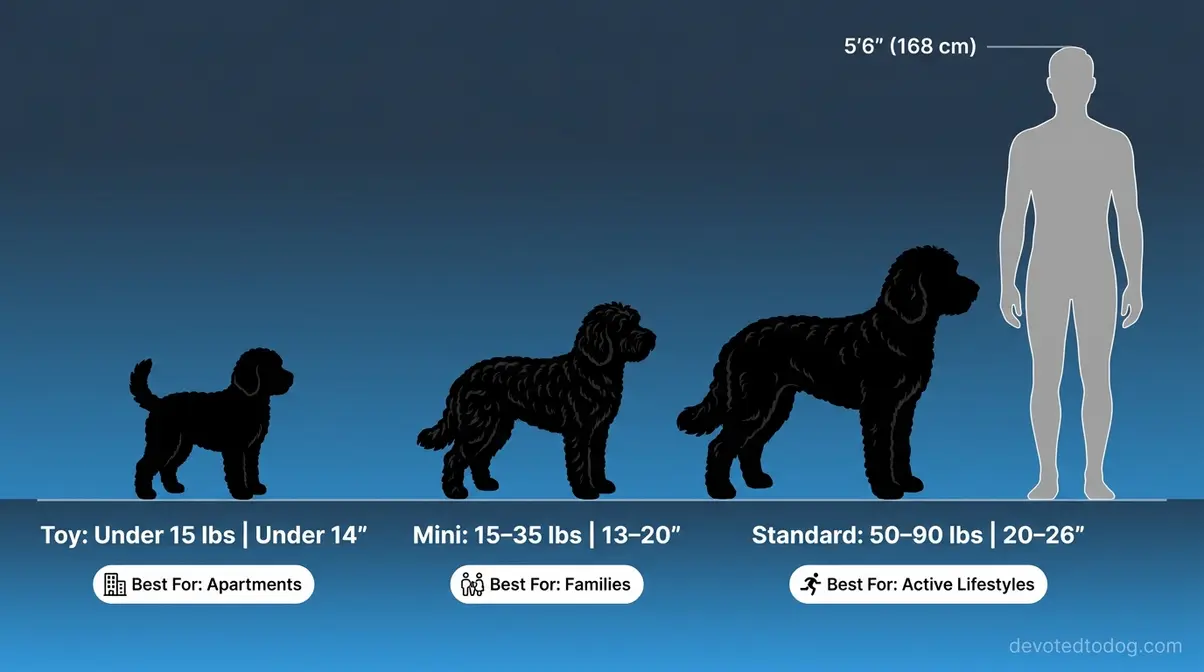
Black Goldendoodles come in three size categories — Toy, Miniature (Mini), and Standard — each produced by crossing the Golden Retriever with a different size of Poodle. The size you choose will affect your dog’s exercise needs, living space requirements, and annual care costs more than any other single factor. Getting this decision right is as important as getting the genetics right.
| Size | Weight | Height | Best For |
|---|---|---|---|
| Toy | Under 15 lbs | Under 14″ | Apartments, seniors, minimal outdoor space |
| Mini/Miniature | 15–35 lbs | 13–20″ | Families, small homes, first-time owners |
| Standard | 50–90 lbs | 20–26″ | Active families, homes with yards |
Toy Black Goldendoodle
The Toy Black Goldendoodle is the smallest of the three size categories, typically weighing under 15 pounds. Produced by crossing a Toy Poodle with a Golden Retriever (or a very small Miniature Poodle), true Toy Goldendoodles are less common than Mini or Standard sizes. The size difference between a Toy Poodle and a Golden Retriever is significant, which makes this cross more technically complex and less frequently offered by breeders.
A toy goldendoodle black is an ideal fit for apartment living, seniors, or owners with limited outdoor space. They require less daily exercise than larger sizes but remain mentally active and curious — they’ll still need playtime, puzzle toys, and training to stay happy. Don’t mistake small size for low energy.
One honest note: some breeders use the “Toy” label loosely to describe dogs that weigh up to 20 pounds. Always ask for both parent dogs’ weights — not just the breeder’s category label. True Toy Goldendoodles can be harder to find and more expensive due to the complexity of the cross, so verify before you commit to a waitlist.
The most popular size by far is the Mini — and for good reason.
Mini Black Goldendoodle (Miniature)
The mini black goldendoodle is the most popular size category for good reason: it fits comfortably into most living situations, it’s manageable for first-time owners, and it strikes the perfect balance between Goldendoodle personality and practical size. The terms “mini black goldendoodle” and “miniature black goldendoodle” are completely interchangeable — both refer to the same size category, typically 15–35 pounds and 13–20 inches at the shoulder at full maturity (Dogster, 2026; Royal Mini Doodles, 2026).
Why is the Mini the most requested size? A few specific reasons:
- Families with children: The Mini is large enough to play robustly with kids but small enough to avoid accidentally knocking over a toddler.
- City dwellers and apartment residents: Fits comfortably in smaller spaces without feeling cramped.
- First-time dog owners: Easier to manage on leash, at the vet, and during grooming than a 70-pound Standard.
- Travel: Lower airline fees, fits under airplane seats in some configurations, easier in hotel rooms.
- Which size is right for me?
- ✔ You have a yard and an active lifestyle → Standard or Mini both work well
- ✔ You’re in an apartment or a first-time dog owner → Mini is the safer, more manageable choice
- ✔ You want a compact lap dog with Goldendoodle personality → Mini or Toy
- ✔ You want a large, athletic companion → Standard
For a complete breakdown with detailed weight charts by age, see our full Goldendoodle size guide with weight charts.
If you have space and an active lifestyle, the Standard Black Goldendoodle might be the stunning large companion you’re looking for.
Standard Black Goldendoodle
The standard black goldendoodle is the full-sized version of the breed — typically 50–90 pounds and 20–26 inches at the shoulder at maturity. Produced by crossing a Standard Poodle with a Golden Retriever, this is the “stunning LARGE Goldendoodle” that turns heads at the dog park. If you’ve ever seen a jet-black, fluffy dog roughly the size of a Labrador Retriever and done a double-take, it was probably a Standard Black Goldendoodle.
Standard Goldendoodles are high-energy dogs that need 45–60 minutes of vigorous activity per day at minimum. They are not well-suited to apartment living — they thrive with a yard and an active family that enjoys outdoor activities. If your lifestyle includes hiking, running, or regular park visits, a Standard is a natural fit.
The higher size comes with higher costs across the board:
- Food: A Standard eats roughly 3–4 cups of quality dry food per day vs. 1–2 cups for a Mini.
- Grooming: More coat to manage means longer grooming sessions and slightly higher professional grooming costs.
- Veterinary care: Larger breed dogs have a higher statistical risk of hip and elbow dysplasia — health testing of both parents is especially important at this size.
- Lifespan: Standard Goldendoodles trend toward the lower end of the 10–15 year range compared to smaller sizes, consistent with the general pattern of larger dogs aging faster.
Whatever size you choose, you’ll want to know when your puppy stops growing — and what “full grown” actually looks like.
When Is a Black Goldendoodle Fully Grown?
Growth timelines vary significantly by size. Here’s what to expect:
- Toy: Full size typically reached by 7–10 months
- Mini: Height plateaus around 9–12 months; full adult weight reached by 12–14 months, with continued muscle development through 18 months (A-Z Animals, 2026; Dogster, 2026)
- Standard: Full size by 18–24 months — large breed dogs mature more slowly
Physical maturity and behavioral maturity are two very different things. A Standard Goldendoodle may reach its full size at 18 months but remain “puppy-brained” — high energy, easily distracted, needs consistent training reinforcement — until 2–3 years of age. Don’t mistake a physically adult dog for a behaviorally settled one.
There’s also an important black goldendoodle full grown coat note: the most significant fading from the G locus typically occurs during this same growth window. Your puppy’s adult coat color may look quite different from its 8-week color, and the change happens gradually enough that many owners don’t notice until they compare old photos. If you’re adopting an adult black doodle, what you see is what you get — the fading has already happened. This is one genuine advantage of adopting an older dog rather than a puppy.
Finding & Buying Black Goldendoodle Puppies
Finding a black Goldendoodle puppy takes more research than finding a standard cream or apricot puppy — the rare coat color means fewer breeders reliably produce them. Expect to pay $2,000–$5,500 and wait 3–12 months on a reputable breeder’s waitlist. Here’s exactly how to navigate the process without overpaying or landing with a puppy mill dog.
After reviewing data from multiple reputable breeders and pricing aggregators, the market for black Goldendoodle puppies shows consistent pricing patterns across size and generation — with significant premiums for rare patterns like phantom and merle.
How Much Does a Black Goldendoodle Cost?
Black Goldendoodle price varies by size, generation, pattern, and geographic location. Here’s a current breakdown based on breeder market data:
| Type | Price Range | Notes |
|---|---|---|
| Standard Black Goldendoodle | $2,000–$4,000 | F1 rarest; F1B/Multigen more available |
| Mini Black Goldendoodle | $2,500–$4,500 | Most popular; high demand drives prices up |
| Toy Black Goldendoodle | $3,000–$5,500 | Rarest; premium pricing for breeding complexity |
| Black Phantom Goldendoodle | $3,500–$5,500+ | Pattern premium on top of standard pricing |
(Sources: Happy Doodle Farm pricing guide, 2026; Spot Pet Insurance, 2026)
Several factors push prices higher or lower within these ranges:
- Breeder reputation and GANA (Goldendoodle Association of North America) membership: Members must meet health testing standards, which increases operational costs — and price.
- Generation: F1B and multigenerational black Goldendoodles command higher prices because they’re produced more predictably. You’re paying for intentionality, not luck.
- Geographic location: Coastal cities and major metro areas typically run 20–30% higher than rural areas for the same quality puppy.
- Health testing: Breeders who conduct full OFA clearances (hips, elbows, eyes, heart) charge more. This is worth every dollar.
- Color pattern rarity: Phantom and merle patterns carry a premium on top of the base black pricing.
One critical red flag: prices below $1,000–$1,200 for a “black Goldendoodle” almost always indicate a puppy mill, a backyard breeder, or a misrepresented breed. Do not make a 10–15 year decision based on a low price. The mini black goldendoodle price sits slightly above the standard range in some markets due to high demand — don’t be surprised to see Minis priced competitively with or above Standards.
The most important step is finding a breeder who actually knows what they’re producing.
How to Find a Reputable Black Goldendoodle Breeder
Black goldendoodle breeders who reliably produce black puppies are a specific subset of the broader Goldendoodle breeding community — and finding them requires more than a Google search. After reviewing data from breeder communities and genetic testing resources, here’s where to start:
- Where to look:
- GANA (Goldendoodle Association of North America) member directory — breeders must meet health testing standards to join. This is your most reliable starting filter.
- AKC Marketplace — useful for finding the Poodle parent’s lineage and confirming registration.
- State-level Goldendoodle breeder groups — often more current than national directories for regional availability.
- Lancaster Puppies — a marketplace where listings appear, but still requires your own vetting. Use it to find candidates, not to vet them.
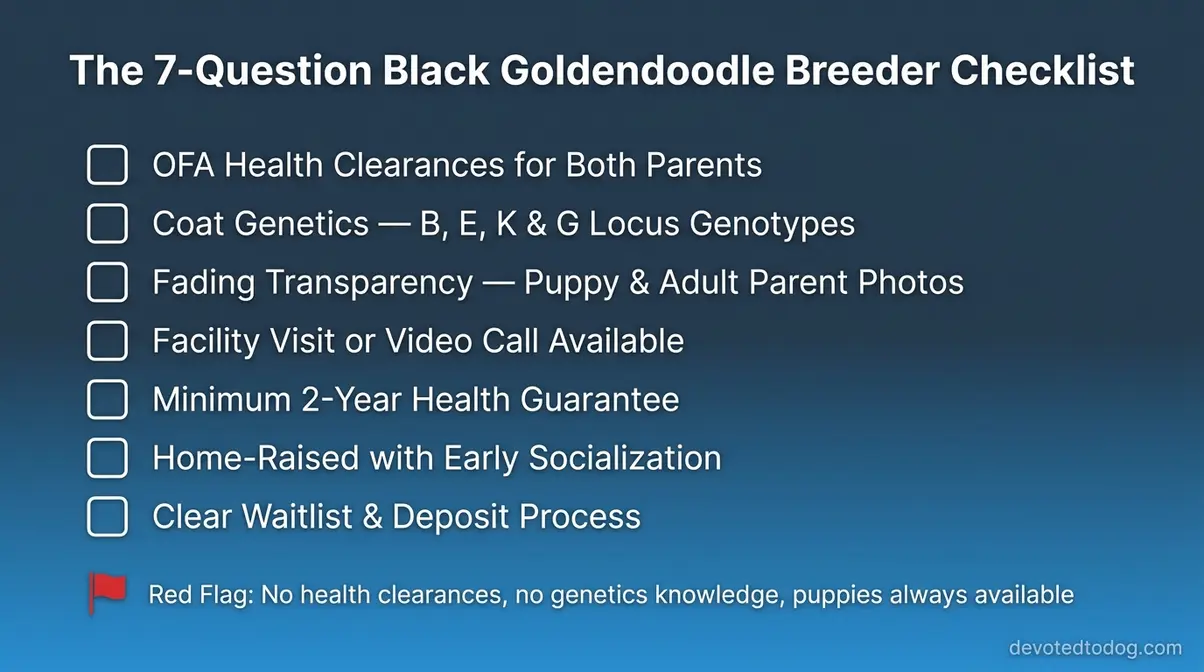
The 7-Question Breeder Checklist — print this and use it on every breeder call:
Step 1: Request OFA Health Clearances Can you provide OFA health clearances for both parent dogs (hips, elbows, eyes, heart)?
Step 2: Ask About Coat Genetics What is the genotype of the parent Poodle at the B, E, K, and G loci? (This question directly tests The Genetics Gap — a knowledgeable breeder answers confidently.)
Step 3: Verify Fading Transparency Do you have photos of parent dogs at both puppy age and current adult age? (Checks for fading transparency.)
Step 4: Request a Facility Visit or Video Call Can I visit the facility, or can we do a video call with the puppy and both parents?
Step 5: Check the Health Guarantee Do you offer a health guarantee, and for how long? (Reputable breeders offer a minimum 2-year genetic guarantee.)
Step 6: Confirm Early Socialization Are your puppies raised in a home environment with early socialization?
Step 7: Understand the Waitlist Process What is your waitlist process, and what deposit is required?
Red flags to walk away from: Breeders who won’t answer genetic questions. No health clearances offered. Puppies always “available immediately” with no waitlist. Multiple unrelated breeds available simultaneously. Prices significantly below market rate.
A note on the “black goldendoodle breeders near me” search: use Google Maps combined with the GANA directory to filter by location, but do NOT limit yourself to local only. A reputable breeder 500 miles away is a far better choice than a questionable local operation. Many top breeders ship puppies safely with airline-approved transport.
For a deeper dive into evaluating breeders, see our guide to finding a reputable Goldendoodle breeder — it includes a full directory of GANA-certified breeders and a downloadable vetting checklist.
If the idea of a waitlist or high price feels overwhelming, there’s another path: adoption.
Breeder vs. Rescue: Which Is Right for You?
Both paths lead to a wonderful dog. The right choice depends on your priorities.
Reputable breeder advantages: Known genetics, health-tested parents, early socialization in a home environment, and ongoing support from someone who knows your specific dog’s lineage. You’ll know the parent dogs’ coat genotypes, which means no fading surprises. The disadvantage: cost ($2,000–$5,500) and waitlist time (3–12 months are typical for reputable breeders).
Rescue advantages: Lower cost — adoption fees typically run $200–$500 and usually include vaccinations and spay/neuter. You’re giving a dog a second chance. Adult rescues often arrive already house-trained. The disadvantage: unknown coat genetics (you won’t know the G locus status, and the coat may already be fading), and unknown early history, which can affect socialization.
One important caution: “black goldendoodle for sale” searches will surface both reputable breeders and third-party resellers. Resellers sometimes purchase from puppy mills and mark up prices without conducting any health testing. Always trace the puppy back to the actual breeding facility, not just the listing website.
Our recommendation: If having a guaranteed black coat and known genetics is important to you → reputable breeder. If you’re open to any Goldendoodle mix in need of a home and the coat color is secondary → rescue is a wonderful, meaningful option.
Whether you go breeder or rescue, here’s what to look for when you’re actually choosing a specific puppy.
What to Look for When Choosing a Puppy
When you’re finally meeting black goldendoodle puppies in person (or via video call), here’s what to evaluate:
- Physical health indicators:
- Clear, bright eyes with no discharge
- Clean ears with no dark wax or odor (more on this in the grooming section)
- No visible skin irritation, redness, or bare patches
- Energetic and curious, not lethargic or hiding in a corner
- Well-fed but not bloated or pot-bellied
- Clean, odor-free coat
- Behavioral indicators:
- Should approach you with curiosity, not extreme fear or excessive cowering
- Observe interaction with littermates — moderate play is healthy; extreme aggression or total withdrawal are warning signs
- A puppy that hides the entire visit and never warms up may have been under-socialized
- Coat-specific questions for black puppies:
- Ask the breeder: “Has this puppy’s coat changed color since birth?” An early shift from black to grey at 8 weeks is a strong indicator of significant fading ahead.
- Request photos of the puppy at 2 weeks, 4 weeks, and 6 weeks — compare to the current color. Progression matters.
- If the black has already shifted noticeably toward grey or silver by 8 weeks, expect significant adult fading.
- Documentation to request before leaving:
- Health records and first vaccination records
- Parent dogs’ OFA clearance certificates (hips, elbows, eyes, heart)
- Health guarantee document — minimum 2-year genetic guarantee from reputable breeders
- Microchip registration paperwork
Black Goldendoodle Grooming: Haircut Styles & Ear Care
Black goldendoodle haircuts and at-home grooming routines are the most underserved practical topic in this entire niche — competitors say “grooming needed” and stop there. Black Goldendoodles require professional grooming every 6–8 weeks and daily at-home brushing to prevent matting, regardless of coat type (Goldendoodle Association of North America; Goldoodle.com, 2026). The good news: their dark coat hides dirt remarkably well between sessions, and with the right haircut style, they look stunning year-round.
“Black Goldendoodles with wavy or curly coats require professional grooming every 6–8 weeks and daily brushing at home to prevent painful matting — skipping even two weeks can result in pelting that requires a full shave-down.” (Goldoodle.com, 2026; Platinum Goldendoodles, 2026)
Popular Black Goldendoodle Haircut Styles
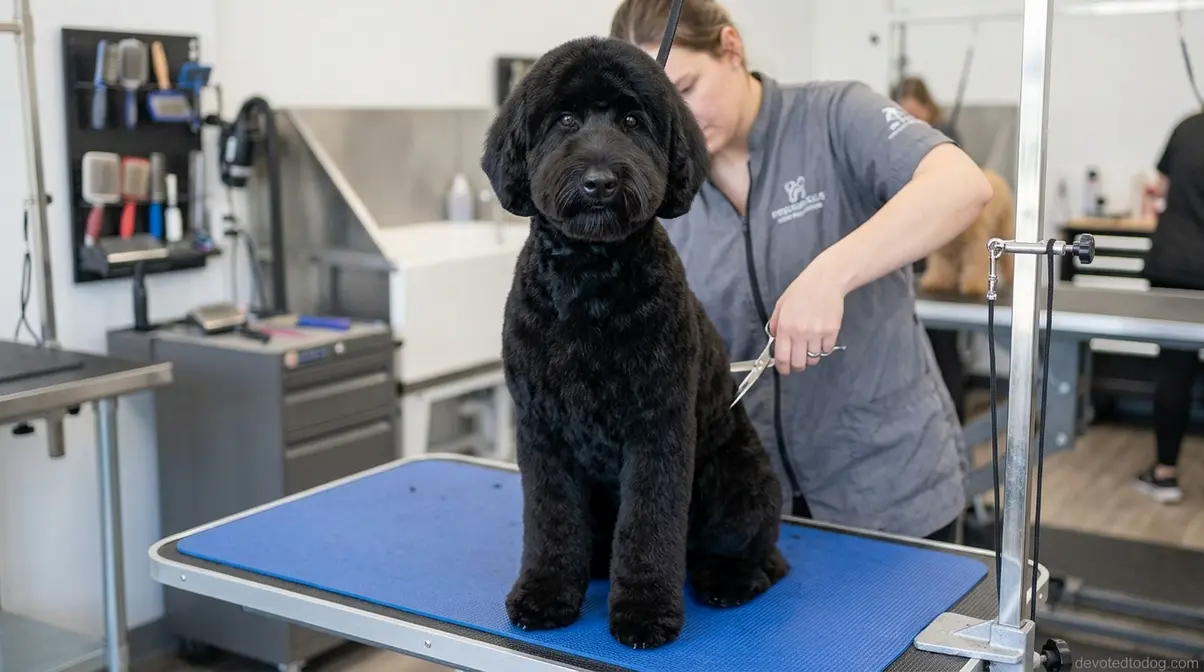
Four main black goldendoodle haircut styles work beautifully on this breed, each with different maintenance demands and visual effects. A black coat is particularly forgiving — the dark color shows texture and dimension in a way that lighter coats don’t, making every style look polished.
- Teddy Bear Cut — The most popular style by a significant margin. A 1–2 inch uniform length all over the body, with a rounded head and face shape that mimics the look of a stuffed animal. On a black Goldendoodle, this emphasizes the plush, “living teddy bears” appearance that makes the breed so irresistible. The black goldendoodle teddy bear cut works best on wavy and curly coats, where the rounded shape holds its form between grooming sessions.
- Kennel Cut (Puppy Cut) — A short all-over trim, typically 1 inch or less. The lowest-maintenance style between professional sessions. Ideal for summer (“trim him up for summer”), for dogs prone to matting, or for owners who want to extend the time between grooming appointments. On a black coat, even a short kennel cut looks sleek and intentional.
- Lamb Cut — Shorter body with slightly longer legs and head. Creates a classic poodle-adjacent silhouette that looks particularly elegant on curly-coated black Goldendoodles. Less common than the Teddy Bear but gaining popularity with owners who want a more structured look.
- Doodle Cut (Natural) — A longer, fluffier trim that preserves the natural wave or curl pattern. The most visually dramatic style on a black coat — the dark color makes the texture pop in a way that’s genuinely stunning. Also the most maintenance-intensive: without daily brushing, this style mats quickly.
Wavy black goldendoodle haircuts are the most versatile — wavy coats suit all four styles well. Straight coats look best with the Kennel or Puppy cut (the natural wave isn’t there to support the Teddy Bear shape). Curly coats are most striking in the Teddy Bear or Doodle Cut.
Whatever style you choose for your groomer, the work between appointments is equally important. Here’s the at-home routine that keeps a black Goldendoodle coat healthy.
At-Home Grooming Routine
Estimated completion time: 10–15 minutes daily
- Before you start, gather the right tools:
- Slicker brush — removes tangles and loose hair from the top layer of the coat
- Metal comb — the real test: if the comb won’t pass through the coat down to the skin, there’s a hidden mat
- Detangling spray — for working through knots without breaking the coat
- Nail clippers or a nail grinder — trim when nails click on hard floors
- Dog-safe ear cleaning solution — veterinarian-approved formulas only
Step 1: Start with the slicker brush Work in the direction of coat growth, section by section, from the rear legs forward. Ensure you are getting through the top layer of curls.
Step 2: Follow immediately with the metal comb This is the step most owners skip, and it’s the most important. The comb reaches mats that the slicker brush slides over. Run it gently down to the skin.
Step 3: Apply detangling spray to mats If you find a mat, apply detangling spray and work from the outside of the mat inward with your fingers. Never rip through a mat with the comb, as this causes pain and coat damage.
Step 4: Clean the ears Clean ears with a veterinarian-approved cleaning solution (see the Ear Care section below for exactly what to look for). Wipe the outer folds gently.
Step 5: Check and trim nails Check nails — if they click on hard floors, they’re too long. Trim or grind to a comfortable length.
One genuine perk of a black coat: dirt, debris, and muddy paw prints are far less visible than on a cream or white coat. Between professional grooming sessions, your black pup will look cleaner longer — a small but real quality-of-life advantage for owners.
The one grooming task that catches most new Goldendoodle owners off guard is ear care — and it’s more important than most people realize.
Ear Care and the Black Wax Warning
Goldendoodles have floppy, heavily furred ears that trap moisture — this creates a warm, dark environment where bacteria and yeast thrive. According to the Washington State University Veterinary Teaching Hospital, dogs with heavy floppy ears have the most problems with ear infections due to restricted airflow and moisture buildup (WSU Veterinary Teaching Hospital, 2026). For Goldendoodles specifically, this is one of the most common and preventable health issues owners face.
The black wax goldendoodle ear infection warning: Normal earwax is light tan or pale yellow. If you’re cleaning your dog’s ears and notice dark brown or black wax — especially combined with an unpleasant odor, head shaking, or the dog pawing at its ear — this is a probable sign of a yeast or bacterial infection. Do not wait. See a veterinarian.
Prevention is straightforward: clean ears every 2–4 weeks with a vet-approved cleaning solution. Never insert cotton swabs into the ear canal — wipe the outer ear fold only. The Cornell University Riney Canine Health Center notes that dogs with a history of allergies, recurrent ear infections, or floppy ears may need their ears cleaned more frequently to prevent secondary infections (Cornell University, 2026). If your black Goldendoodle has seasonal allergies — common in the breed — bump ear cleaning to weekly during allergy season.
What Is the Downside to a Goldendoodle?
Every honest breed guide includes this section. The black Goldendoodle is a genuinely wonderful dog — but specific challenges catch new owners off guard. Knowing them in advance doesn’t diminish the joy; it makes you a better, more prepared owner.
High Grooming Demands (The #1 Complaint)
The #1 complaint among Goldendoodle owners — regardless of coat color — is the grooming commitment. A wavy or curly Goldendoodle coat can begin matting within 2–3 weeks of a missed brushing session. Matting is painful for the dog and can require a full shave-down by a professional groomer, which costs $150–$300 or more on top of the standard appointment fee.
The specific pitfall: Owners underestimate the time and cost before they bring the puppy home. Daily brushing takes 5–10 minutes minimum. Professional grooming runs every 6–8 weeks at $80–$200 per session depending on size and location — which means budgeting approximately $600–$2,400 per year just for grooming.
How to avoid it: Budget for professional grooming before you buy. Set a daily phone reminder for brushing — make it a routine from the first week home, not something you start when the coat gets long. Start brushing habits in puppyhood so your dog learns to enjoy (or at least tolerate) the process.
The Fading Gene Surprise
You fell in love with a jet-black puppy at 8 weeks. By age 2, that puppy has faded to dark silver or charcoal. This is not a bait-and-switch — it’s the G locus gene doing exactly what it’s designed to do. But for owners who weren’t warned, it can feel like a genuine emotional loss.
What goes wrong: Breeders don’t always disclose the G locus risk. Some don’t know about it themselves — which is precisely why The Genetics Gap matters. Owners who expected a lifelong jet-black dog feel misled, even when no one intended to deceive them.
How to avoid it: Apply what you’ve learned in this guide. Ask the breeder for the parent Poodle’s G locus genotype before purchasing. If they don’t know, that’s your answer — keep searching. A breeder who can confidently discuss the G locus is the kind of breeder who’s worth your $3,000 and your 12-month wait.
When to Seek a Vet or Professional Help
Some situations require professional intervention, not a home remedy. See a vet promptly if you notice any of the following:
- Dark or black ear wax + odor + head shaking → probable ear infection; early treatment prevents it from becoming severe
- Excessive scratching, skin redness, or recurring hot spots → allergies, which are common in Goldendoodles and manageable with proper diagnosis
- Limping, reluctance to climb stairs, or difficulty rising → possible hip or elbow dysplasia, especially in Standard Goldendoodles; early intervention improves outcomes significantly
- Changes in gait, coordination, or balance → possible neurological issue; refer to the UC Davis documentation on sensory ataxic neuropathy (SAN) risk in Goldendoodles
Grooming keeps your black Goldendoodle looking and feeling their best — but your veterinarian is your partner in keeping them healthy for the full 10–15 years of their life.
Black Goldendoodle Gifts & Themed Merchandise
Once a black Goldendoodle steals your heart, you’ll want them everywhere — on your Christmas tree, on your bookshelf, and wrapped in a bow for every dog-loving friend you know. Here’s a curated guide to the best black Goldendoodle-themed merchandise, organized by category.
Stuffed Animals & Plush Toys
Black goldendoodle stuffed animals are among the most searched merchandise items for the breed — and for good reason. A realistic black doodle plush captures that irresistible curly-coated look in a form that can sit on a desk, a bed, or in a child’s arms year-round.
Where to shop: Etsy is the primary destination for custom-made options, while Amazon carries mass-produced versions at lower price points. Custom Etsy options allow you to match the specific coat type (curly, wavy, straight) and markings (solid black vs. phantom) of your actual dog — a detail that matters enormously to people who are genuinely obsessed with their specific dog’s look.
- What to look for when buying:
- Realistic coat texture: Curly plush fabric for curly-coated dogs, flatter plush for straight coats — the difference is noticeable side by side
- Correct black coloring: Some “black” dog plushes photograph as grey or dark brown — check product photos in multiple lighting conditions before ordering
- Size options: Desk-sized (6–8 inches) for an office, medium (12–16 inches) for a bookshelf, large (20+ inches) for children
- Safety certification: If gifting to young children, look for CE or ASTM safety certification on the product listing
Custom portrait plushes are a step above the standard options. Several Etsy shops create fully custom plush toys from photos of your actual dog — they capture the specific ear shape, face markings, and coat texture of your individual animal. These run $50–$150 or more, but they make deeply personal gifts for Goldendoodle-obsessed owners.
Search tip: Use the exact search tag “black goldendoodle” on Etsy — the platform’s tag system will surface the most specifically matched results. The broader “doodle stuffed animal” search returns too many mixed results. A black goldendoodle plush search on Amazon surfaces mass-produced options that ship quickly for last-minute gifts.
For seasonal gifting, black Goldendoodle ornaments have become a holiday staple for doodle-obsessed families.
Ornaments & Seasonal Gifts
Black goldendoodle ornaments have become a staple of the holiday season for Goldendoodle families — and the selection grows every year. The best place to find them is Etsy, where independent artists offer ceramic, glass, and resin options in both standard and personalized formats. Search “black goldendoodle christmas ornament” on Etsy for the widest current selection. Personalized options with your dog’s name, breed details, or a custom portrait photo are particularly popular as gifts.
Occasion-based black goldendoodle gifts by category:
- Birthday: Personalized mugs, phone cases, and tote bags featuring custom black Goldendoodle illustrations — search Etsy for “black doodle portrait” to find artists who specialize in the breed
- New puppy gifts: Bandana sets, engraved collar charms, and pet ID tags featuring a black Goldendoodle silhouette — practical and breed-specific
- Holiday: Advent calendars designed for dogs, matching owner/dog holiday pajamas, and breed-specific ornament sets
- Housewarming: Custom portrait commissions from Etsy artists — a framed illustration of someone’s specific dog is consistently one of the most emotionally resonant gifts in this category
- Practical gifts for black Goldendoodle owners (that they’ll actually use):
- High-quality lint rollers — yes, even black Goldendoodles shed, particularly straight-coated ones, and the dark hair shows on light furniture
- Grooming kit sets (slicker brush + metal comb combinations) — functional and breed-appropriate
- Custom portrait commissions from Etsy artists who specialize in doodle breeds
Frequently Asked Questions About Black Goldendoodles
Is a Black Goldendoodle Rare?
Black Goldendoodles are genuinely rare — significantly less common than cream, apricot, red, or golden coat colors. The rarity comes directly from genetics: Golden Retrievers commonly carry an “e/e” genotype that suppresses black pigment, making it difficult to produce black offspring in a Golden Retriever × Poodle cross without careful, intentional breeding selection. F1B and multigenerational Goldendoodles produce black coats more reliably than F1s because they carry more Poodle genetics — but even then, black remains a minority color outcome. This rarity typically adds $500–$1,500 to the price of a black puppy compared to more common colors (Goldendoodle Association of North America). Results vary significantly by breeder — those who specialize in black Goldendoodles and test parent dogs’ genotypes can produce them far more consistently than general Goldendoodle breeders.
What Foods Are Toxic to Goldendoodles?
Goldendoodles should never eat chocolate, grapes, raisins, onions, garlic, macadamia nuts, alcohol, or anything containing xylitol — an artificial sweetener found in sugar-free gum, some peanut butters, and certain baked goods. These foods cause reactions ranging from gastrointestinal distress to kidney failure and neurological damage — even small amounts of grapes or xylitol can be fatal to dogs. Cooked bones are also dangerous, as they splinter and can cause internal punctures or blockages. If your Goldendoodle ingests any of these substances, contact your veterinarian or the ASPCA Animal Poison Control Center (888-426-4435) immediately — do not wait for symptoms to develop. Always read ingredient labels on any human food before sharing it with your dog, including “natural” products that may contain hidden xylitol.
How Do You Discipline a Goldendoodle Puppy?
The most effective way to discipline a Goldendoodle puppy is through positive reinforcement — immediately rewarding desired behavior with treats, praise, or play, and redirecting unwanted behavior rather than punishing it. Goldendoodles are highly intelligent and emotionally sensitive; they respond quickly to reward-based training and shut down under harsh correction. Punishment-based methods create anxiety and confusion in this breed and are counterproductive to long-term training progress. When your puppy bites, calmly say “no,” immediately redirect to an appropriate chew toy, and reward enthusiastically when they engage with it. Crate training is particularly effective for house training and establishing safe boundaries during the first year. Consistency from all family members is essential — mixed signals slow training significantly, and a Goldendoodle will exploit any inconsistency with cheerful, persistent enthusiasm.
Conclusion: Ready to Make the Leap?
For families and individuals drawn to a rare, striking companion, the black Goldendoodle delivers everything the breed is famous for — intelligence, affection, and that irresistible “living teddy bear” quality — in a jet-black coat that turns heads everywhere it goes. Understanding The Genetics Gap (the B, E, K, and G loci that determine coat color and fading risk) is the single most important preparation any prospective owner can do before contacting a breeder. Armed with that knowledge, you can ask the right questions, recognize the right answers, and walk away from breeders who are producing black puppies by accident rather than by design.
The Genetics Gap isn’t just about coat color — it’s about finding a breeder who actually understands what they’re producing. When you ask a breeder about their parent dogs’ genotypes and they answer confidently, you’ve found a keeper. When they look confused or change the subject, keep searching. Your 10–15 year companion deserves that extra diligence — and now you have the specific knowledge to apply it.
Ready to start your search? Begin with our comprehensive guide to finding a reputable Goldendoodle breeder — it includes a full directory of GANA-certified breeders and a downloadable vetting checklist. Your jet-black, heart-stealing, living-teddy-bear Goldendoodle is out there. Now you have everything you need to find them responsibly.
If a two-tone coat appeals more than the solid black, the Parti Goldendoodle variant combines white with a secondary color and has its own dedicated owner community.