An F1B Goldendoodle is a Goldendoodle that is about 75% Poodle and 25% Golden Retriever, made by breeding an F1 Goldendoodle back to a Poodle. The coat is usually curlier and sheds less visibly than an F1’s, but no dog breed or mix can be called hypoallergenic. For the wider picture see our Goldendoodle guide, or go straight to Goldendoodle breeders once you know the generation you want.
You’ve seen “F1B Goldendoodle” in every breeder listing — but nobody seems to agree on what it actually means for your family. Is it really less shedding? Is it worth the higher price? And what does that “B” even stand for?
Families who skip understanding the generation difference often end up with a dog that sheds far more than expected, and with real disappointment after a $3,000+ commitment. Across online forums, hundreds of families ask the same questions every month before buying their first doodle.
By the end of this guide, you’ll understand exactly what an f1b goldendoodle is, how it compares to other generations, what it costs today, and how to find a reputable breeder — so you can make the right choice for your family. We cover genetics, sizes, temperament, grooming, pricing, and breeder red flags all in one place.
An F1B Goldendoodle is 75% Poodle and 25% Golden Retriever — making it a popular choice for families who want a lower-shedding dog. Here’s what you need to know:
- The 75% Advantage: More Poodle genetics = curlier coat and less visible shedding, which is the core reason F1Bs command a price premium
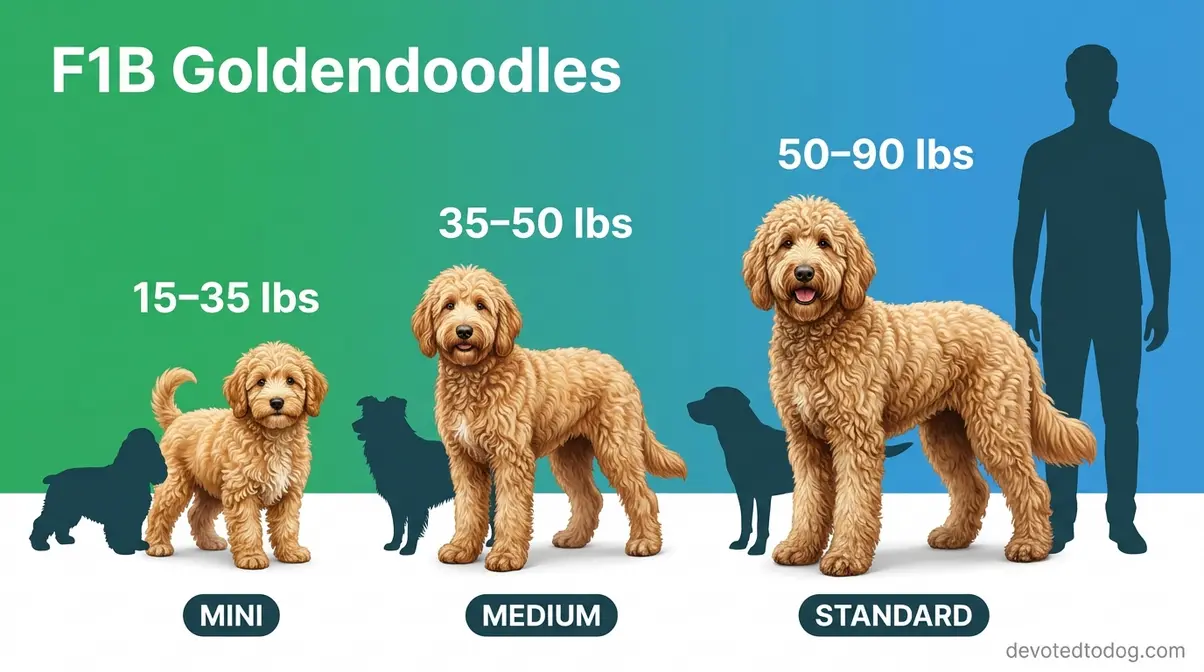
- Size options: Mini (15–35 lbs), Medium (35–50 lbs), Standard (50–90 lbs) — all full grown
- Estimated price range: $2,000–$5,500+ from a reputable breeder, depending on breeder, size, and location
- Important caveat: No dog is truly 100% hypoallergenic — a 2012 study found no evidence that any dog breed can be called hypoallergenic (Vredegoor et al., J Allergy Clin Immunol, PubMed 22728082)
- Grooming reality: Professional grooming every 6–8 weeks is non-negotiable for this coat type
What Is an F1B Goldendoodle? Genetics Explained
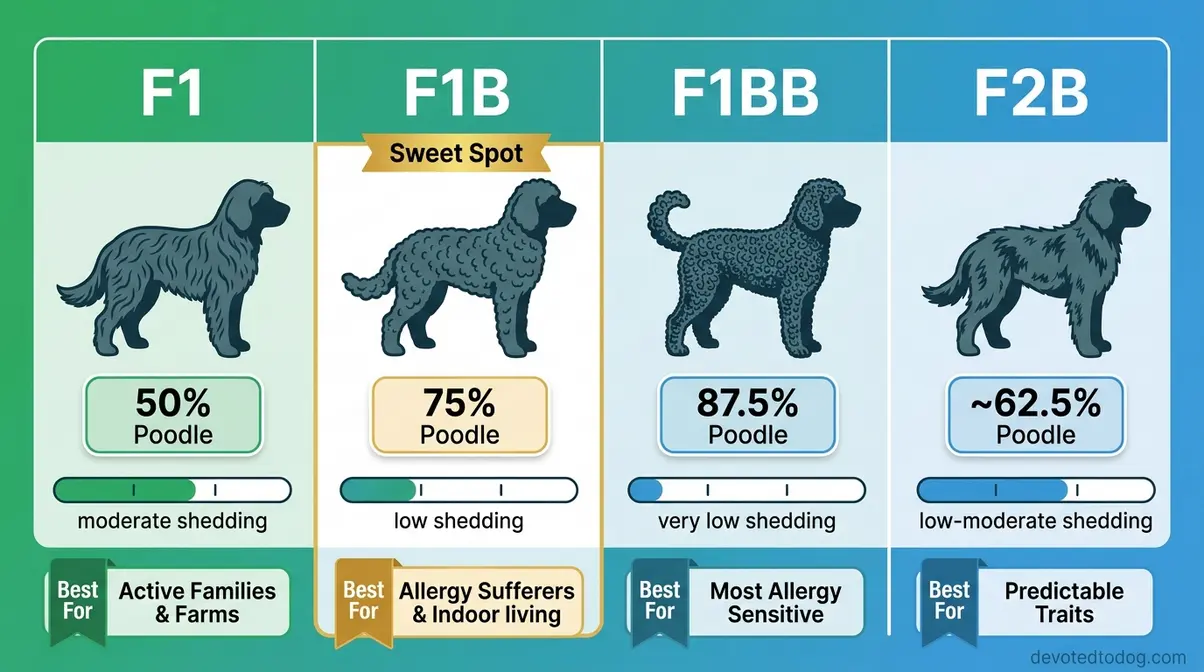
An F1B Goldendoodle is a crossbred dog that is 75% Poodle and 25% Golden Retriever, created by breeding a first-generation Goldendoodle (F1) back to a purebred Poodle. This extra Poodle contribution is precisely what makes the F1B different from the standard Goldendoodle most people picture. For families concerned about shedding and allergies, this genetic split matters enormously — and it’s the foundation of what we call “The 75% Advantage”: the idea that 75% Poodle genetics creates a meaningfully different, more predictable, lower-shedding ownership experience than the 50/50 F1 mix.
What F, 1, and B Actually Mean
What does F1B Goldendoodle mean? The name is a genetics shorthand — and once you break it down letter by letter, it makes complete sense.
- F stands for filial, a standard genetics term meaning “offspring of a cross.” It’s not a brand name or breeder invention — it’s the same terminology used across animal genetics.
- 1 stands for first generation. The dog’s parents are purebred animals, not mixed-breed dogs themselves. An F2 would mean both parents are Goldendoodles.
- B stands for backcross. This means one parent is a purebred Poodle — the breed is being “crossed back” to one of its original parent breeds.
Think of the family tree this way: F1 Goldendoodle mom + purebred Poodle dad = F1B puppies. That single extra step toward the Poodle line changes everything about the coat.
The 75/25 Genetic Split Explained
Here’s how the math works. An F1 Goldendoodle is already 50% Poodle and 50% Golden Retriever (the affectionate parent breed). When you breed that F1 back to a purebred Poodle (the low-shedding parent breed), each puppy inherits roughly 75% of their genes from the Poodle side and 25% from the Golden Retriever side.
Think of it like mixing paint: the more Poodle “paint” in the mix, the curlier and less-shedding the coat. That’s The 75% Advantage in action — and it’s the core reason F1B Goldendoodles are in higher demand and cost more than F1s.
PetMD’s breakdown of F1B Goldendoodle genetics confirms that an F1B Goldendoodle is genetically 75% Standard Poodle and 25% Golden Retriever, resulting in a curlier coat that can be better for allergy-sensitive owners, though PetMD also notes that no dog is 100% allergen-free (PetMD). GANA (the Goldendoodle Association of North America) recognizes the F1B as a backcross breed specifically bred for more predictable coat traits.
One important caveat: The 75% Advantage tends to mean a curlier, lower-shedding coat, but it does not make a hypoallergenic dog. We address the hypoallergenic question fully in the next section.
The F1B Goldendoodle’s Coat
F1B coats range from wavy to tightly curly. Because of the higher Poodle percentage, most F1Bs lean toward curly rather than the “shaggy look” you’d see on an F1. If you’ve heard owners describe wanting a “curlier look” or a “non-shedding doodle,” the F1B is what they’re describing.
The low-shedding reality is this: “NOT shed” and “zero shedding” are not the same thing. Most F1Bs shed minimally compared to purebred Golden Retrievers — but some light shedding can still occur. The curly coat traps loose hair rather than releasing it onto your furniture, which reduces visible shedding. The trade-off is that trapped hair becomes matted without regular brushing, which we cover in detail in the grooming section. For every coat type in detail, see our Goldendoodle coat types guide.
F1B vs. Other Goldendoodle Generations
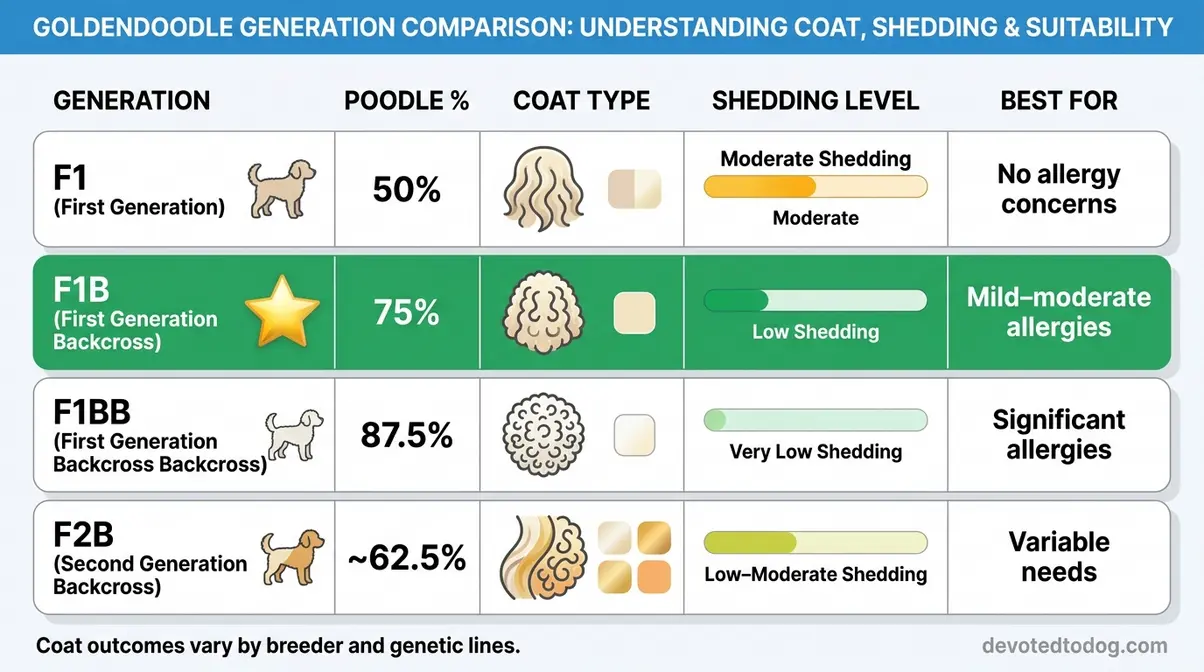
When comparing the F1 vs. F1B Goldendoodle, neither is universally better — the right choice depends on your family’s specific situation. The Poodle percentage is the single biggest predictor of shedding behavior, and The 75% Advantage of the F1B makes it a common choice for households that want a lower-shedding coat. For families with zero allergy concerns who love the “shaggy look,” the F1 may actually be the better fit.
F1 vs. F1B: Coat and Shedding
Here’s how the two most popular generations compare on the three factors that matter most:
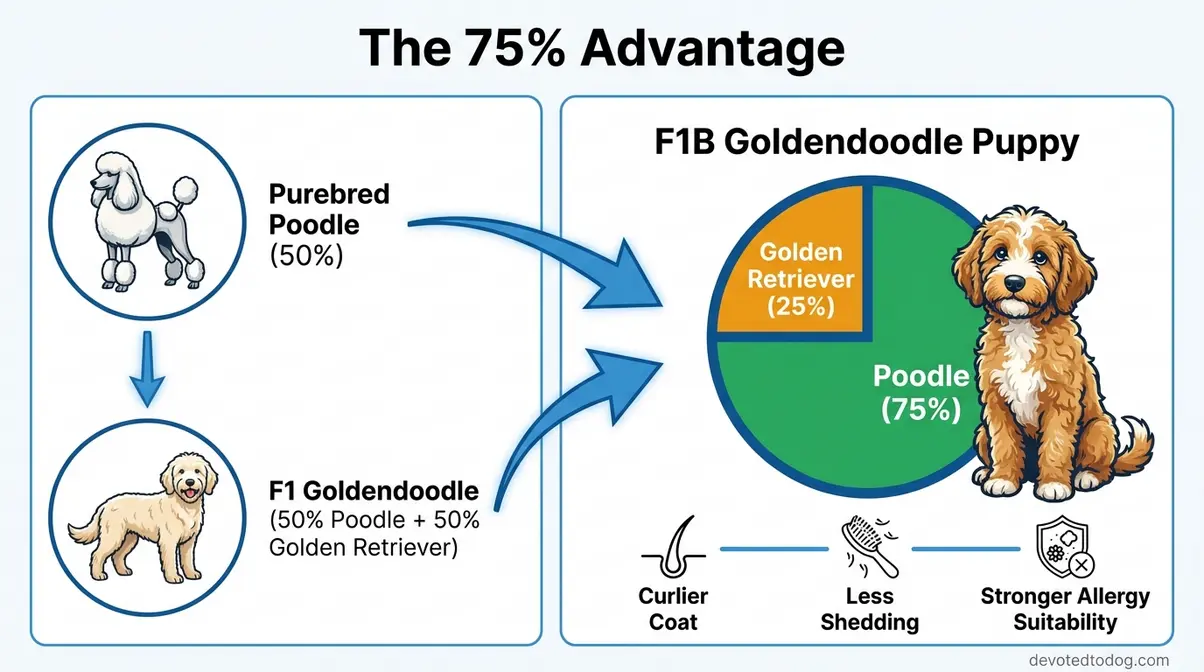
F1 Goldendoodle (the original 50/50 cross): 50% Poodle, 50% Golden Retriever. Wavy to slightly curly coat, moderate shedding, less predictable from puppy to puppy. This is the “shaggy look” most people picture. A good choice for families with no allergy concerns who want a slightly lower-maintenance coat.
F1B Goldendoodle: 75% Poodle, 25% Golden Retriever. Curly coat, low shedding, more predictable coat outcome. Often chosen by families who want a lower-shedding coat. This is The 75% Advantage made visible — you can see and feel the difference in the coat.
Now for the honest truth about “hypoallergenic” dogs. A 2012 study measured the main dog allergen, Can f 1, in hair and in homes of so-called hypoallergenic breeds (including Poodles and Labradoodles) and other dogs. Its conclusion: there is no evidence for classifying any dog breed as hypoallergenic (Vredegoor et al., J Allergy Clin Immunol, 2012, PubMed 22728082).
The F1B’s benefit is a coat that sheds less visibly, not a guarantee of fewer allergens. If anyone in your home has pet allergies, talk to your allergist before choosing any dog.
F1BB and F2B: For Less Shedding
Two other generations are worth knowing about if the F1B isn’t quite enough.
F1BB (a second-generation backcross that is 87.5% Poodle): Created by breeding an F1B back to a purebred Poodle again. Extremely curly, very low shedding. Aimed at families who want the lowest-shedding coat. The trade-off is real: with only 12.5% Golden Retriever genetics, you lose some of the Golden’s famously warm, gentle personality. For a deeper look at the F2B generation, see our complete F2B Goldendoodle guide.
F2B (a second-generation backcross with a more complex genetic mix): Approximately 62.5% Poodle. More genetic variation than an F1B — coat and shedding outcomes are less predictable. Can be an excellent option, but requires a breeder who does genetic coat testing to predict outcomes accurately.
For most families, the F1B hits the sweet spot: enough Poodle genetics for low shedding, enough Golden Retriever genetics for the classic Goldendoodle temperament. The F1BB is for families who want the lowest-shedding coat. Through the AKC Canine Partners program for mixed breeds, all these generations can be officially enrolled to compete in agility, obedience, and rally events (AKC).
Generation Comparison Table
Use this table to find your best-fit generation at a glance:
| Generation | Poodle Percentage | Coat Type | Shedding Level | Best Fit For |
|---|---|---|---|---|
| F1 | 50% | Wavy–Curly | Moderate | No allergy concerns |
| F1B | 75% | Curly | Low | Lower-shedding coat |
| F1BB | 87.5% | Tightly Curly | Very Low | Lowest shedding |
| F2B | ~62.5% | Variable | Low–Moderate | Variable needs |
Note: Actual coat outcomes vary by breeder reputation and specific genetic lines. Always confirm parent genetics directly with the breeder.
F1B Temperament and Daily Care
“I was wondering if F1B Goldendoodle owners could share some information about them. How they are, what they absolutely need just anything!”
— Real question from a prospective F1B Goldendoodle owner (Reddit)
This is the question every prospective F1B owner asks — and it’s the right one. An F1B Goldendoodle is an intelligent, affectionate, and social dog that thrives on human connection. But “what they absolutely need” is specific: daily exercise, consistent grooming, and mental stimulation to match their Poodle-level intelligence.
Personality: The “Velcro Dog”
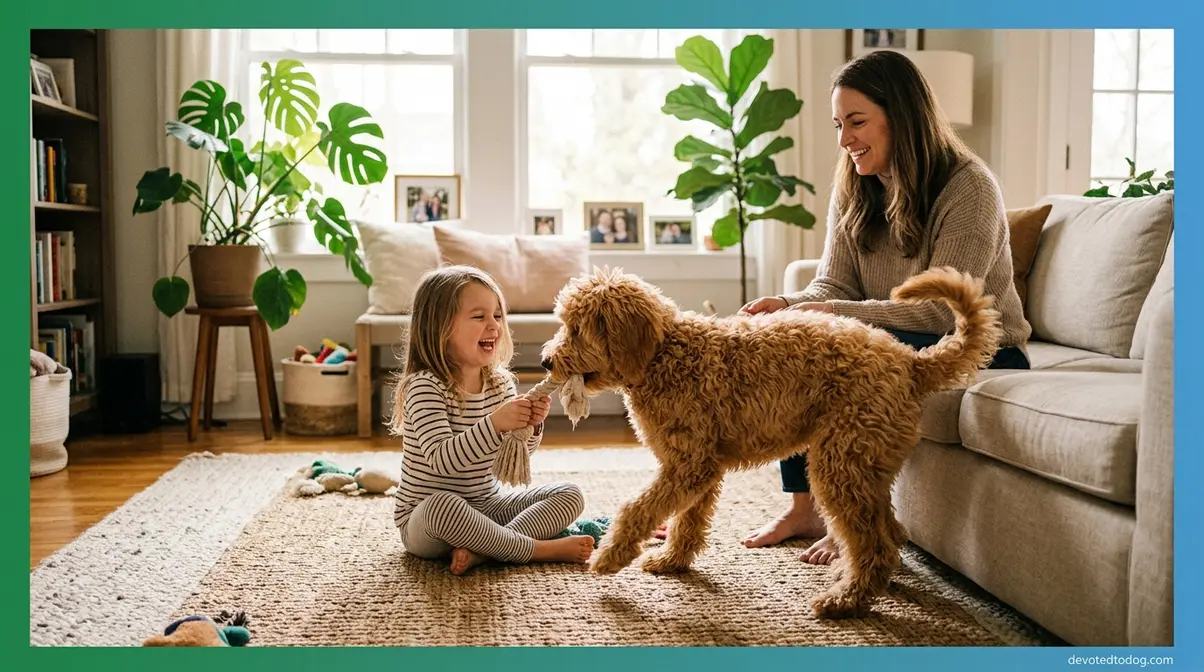
The nickname “velcro dog” is earned. F1Bs love to follow their owners from room to room, settle at your feet while you work, and be wherever you are. They are affectionate, rarely aggressive, and genuinely excellent with children and other pets — qualities that make them “wonderful family dogs,” as owners consistently describe them.
The Poodle genetics responsible for The 75% Advantage in the coat also show up in the brain. F1Bs are highly trainable, but they get bored quickly without enough mental engagement. This is the trade-off side of the concept: more Poodle means a smarter dog, and smarter dogs need more stimulation. For more on this, see how intelligent Goldendoodles really are.
One honest reality: F1Bs can develop separation anxiety and destructive behaviors — chewing, barking, even escaping — when left alone for long periods without proper training. This is one of the most common reasons doodles are rehomed. Across Goldendoodle owner communities, the consistent feedback is: “super friendly, wonderful family dogs — but they need you around.”
Exercise and Mental Stimulation Needs
F1Bs need 30–60 minutes of active exercise per day. This includes walking, fetch, or swimming. Mini F1B Goldendoodles (the miniature f1b goldendoodle) need slightly less than their Standard-sized counterparts, but no size of this breed does well with a sedentary lifestyle.
Mental stimulation is equally important. Puzzle toys, short obedience sessions (10–15 minutes, twice daily), and social interaction all count. Without mental engagement, intelligent dogs find their own entertainment — and you won’t like what they choose.
- A practical daily schedule:
- Morning: 20–30 minute walk or active play
- Afternoon: 15–20 minutes of fetch or off-leash time
- Evening: 10-minute training session + calm indoor time
Mini F1Bs can adapt to apartment living if they receive sufficient daily walks and playtime. Standard F1Bs generally prefer a home with a yard.
Step-by-Step Grooming Schedule
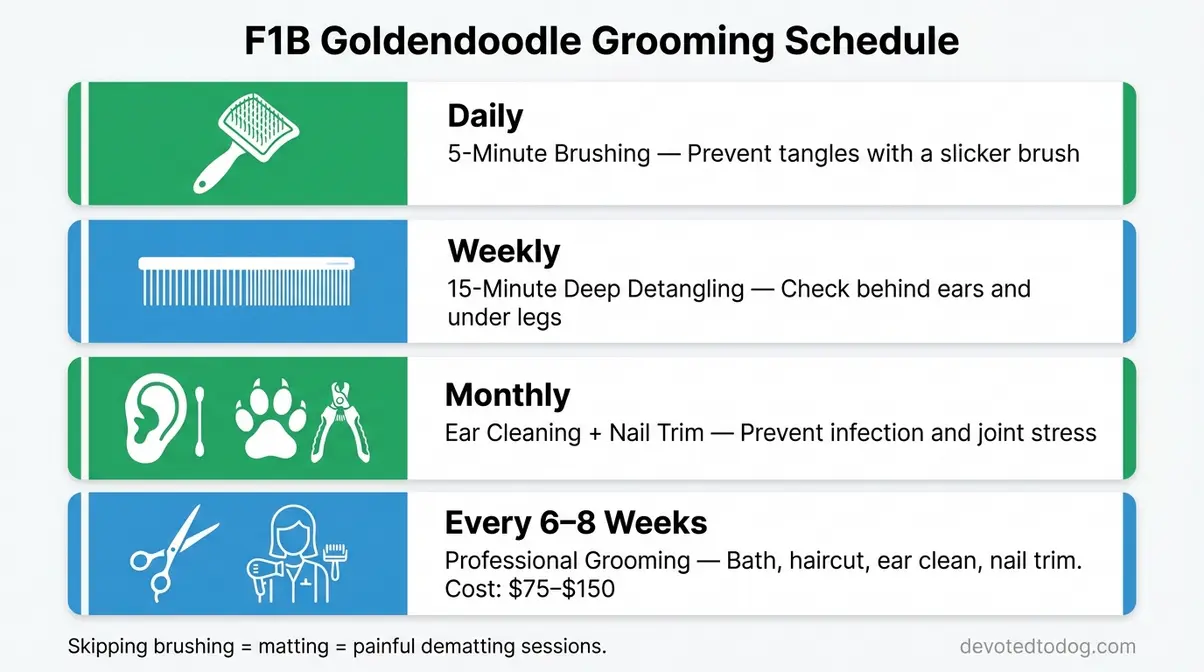
Because of their Poodle genetics, Goldendoodles require professional grooming appointments every six to eight weeks to prevent painful coat matting — a non-negotiable cost of ownership (Forbes Advisor on Goldendoodle grooming frequency, Forbes Advisor). Professional sessions cost $75–$150 depending on size and location, putting your annual grooming budget at $600–$1,800.
Here’s the at-home maintenance routine every F1B owner needs:
Step 1: Daily Brushing (5 minutes) Run a slicker brush (a flat brush with fine wire bristles) through the coat to prevent tangles from forming. This step takes five minutes and saves hours of dematting later.
Step 2: Weekly Deep Detangling (15 minutes) Use a metal comb (a wide-toothed comb for deep detangling) to check for mats. Focus especially behind the ears and under the legs where friction causes the most tangling.
Step 3: Monthly Maintenance Check ears for redness, odor or discharge, and ask your vet how often to clean them. Trim nails to prevent discomfort and joint stress.
Step 4: Professional Grooming (Every 6–8 weeks) Schedule a professional groom for a bath, haircut, ear cleaning, and nail trim. Popular styles include the Teddy Bear cut, Puppy cut, and Kennel cut (covered in detail in the sizes and appearance section).
Why does matting happen? The curly coat traps loose hair instead of releasing it. Without regular brushing, that trapped hair tangles into dematting situations — removing tangled knots from the coat — which is painful for the dog and expensive to fix.
How Do You Discipline a Puppy?
How do you discipline a Goldendoodle puppy? The answer is straightforward: positive reinforcement only. VCA Hospitals’ guide to positive reinforcement training confirms that positive reinforcement is the most effective training method for intelligent breeds, relying on rewarding good behavior rather than punishing mistakes (VCA Animal Hospitals). Punishment-based methods can create anxiety in a sensitive dog — and anxiety in a smart dog is a recipe for destructive behavior.
Start sit, stay, and recall training at 8–10 weeks. Crate training from day one helps prevent separation anxiety from developing. Potty training typically takes 4–8 weeks with consistency — see our step-by-step Goldendoodle potty training guide for the full process.
For discipline, redirect unwanted behavior immediately. If your puppy chews the couch leg, calmly move them to an appropriate chew toy in that moment. Never use physical punishment. Short training sessions (10 minutes, twice daily) consistently outperform one long session — they match the F1B’s high attention and energy levels. Responsible breeding f1b goldendoodle practices, including early socialization by the breeder, also contribute significantly to how trainable a puppy will be from day one.
F1B Goldendoodle Sizes, Colors, and Coat Types
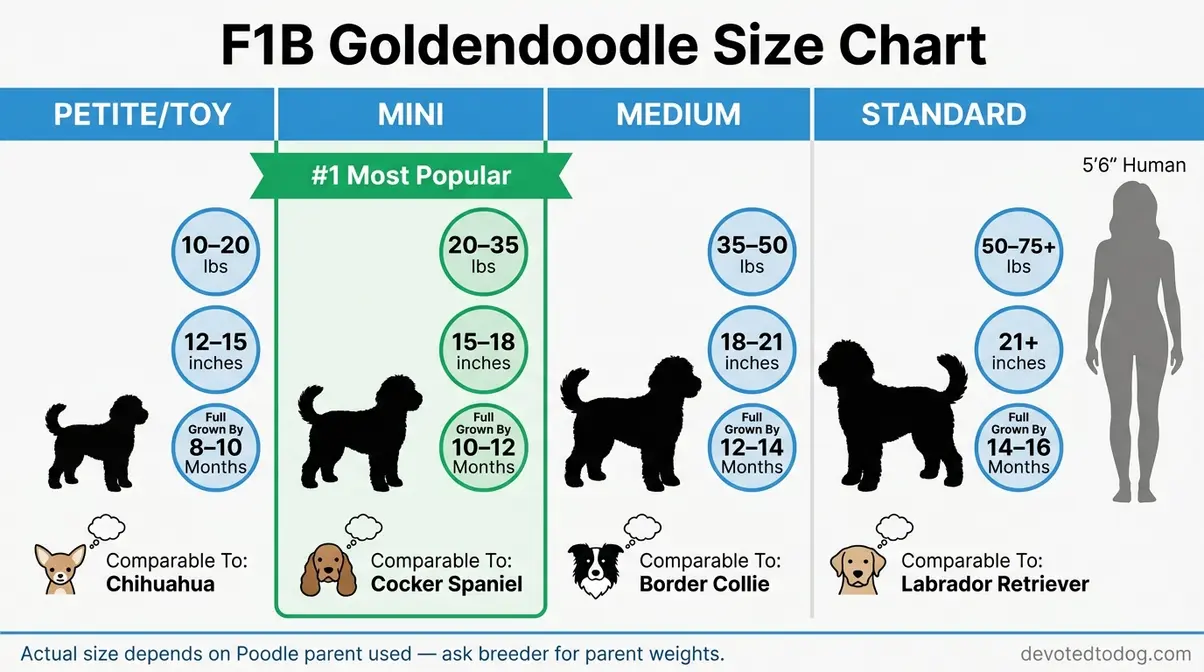
The F1B Goldendoodle comes in three main sizes — and choosing the right one matters more than most buyers realize. A full grown f1b goldendoodle can weigh anywhere from 15 to 90 pounds depending on which size Poodle parent was used. Getting this choice wrong means either a dog too large for your apartment or one too small for your active outdoor lifestyle.
Size Chart: Mini, Medium, Standard
Use this table as your quick reference, then read the notes below for real-world context:
| Size | Weight (Adult) | Height (Adult) | Full Grown By | Comparable To |
|---|---|---|---|---|
| Petite/Toy | Under 15 lbs | Under 13 in | 7–9 months | Chihuahua mix |
| Mini (Miniature) | 15–35 lbs | 13–20 in | 7–11 months | Cocker Spaniel |
| Medium | 35–50 lbs | 17–21 in | 11–13 months | Border Collie |
| Standard | 50–90 lbs | 20–26 in | 12–16 months | Labrador Retriever |
Weight ranges are estimates based on breed standards. Actual adult size depends on the specific Poodle parent used (Toy, Miniature, or Standard Poodle). Ask your breeder for the parent dogs’ weights for the most accurate prediction.
Miniature F1B Goldendoodle (the smallest common size variant): At 15–35 lbs, a Mini F1B is roughly the size of a Cocker Spaniel. It reaches full size by 7–11 months. This is the most apartment-friendly option and consistently the highest-demand size — which is why Mini F1Bs often cost more than Standard F1Bs. A full-grown Miniature F1B Goldendoodle typically weighs 15–35 lbs and reaches full size by 7–11 months, making it one of the most apartment-friendly low-shedding breeds available.
Medium F1B: The “middle ground” option at 35–50 lbs, roughly the size of a Border Collie. Full grown by 11–13 months. Fits most home sizes and lifestyle types.
Standard F1B Goldendoodle (the largest size variant): 50–90 lbs, closer in size to a Labrador Retriever. Full grown by 12–16 months. Needs space and ideally a yard. The f1b goldendoodle standard size suits active families with room to run.
Petite/Toy F1B variants (under 15 lbs) exist but are less common and require a Toy Poodle parent. Ask your breeder specifically about parent weights if size is a priority.
For a comprehensive breakdown of all Goldendoodle size variants, see our complete Goldendoodle size guide.
Colors: From Cream to Phantom
F1Bs come in a surprisingly wide range of coat colors. The most common are cream, apricot, golden/caramel, red (f1b goldendoodle red), chocolate/brown, black (f1b goldendoodle black), and white.
Rare and premium colors — parti (two-tone patches), phantom (specific markings on the face, chest, and paws), and merle (a mottled, swirled pattern) — often command a price premium of $300–$800 over standard solid colors.
One important heads-up about color fading: many F1Bs are born darker and fade as they age, a trait inherited from the Poodle side. A red F1B puppy may become a warm apricot as an adult. If color matters to your family, always ask to see photos of the parent dogs as adults, not just as puppies. For a full visual breakdown of every available shade, see 18+ Goldendoodle coat colors explained.
Popular F1B Haircut Styles
Once you’re ready for your first professional groom, you’ll need to choose a style. The three most popular f1b goldendoodle haircuts are:
Teddy Bear Cut: Rounded face, fluffy and full body coat — the most popular style by far. Maintains the cuddly, plush appearance most owners want. Requires more frequent grooming to keep the shape clean.
Puppy Cut: Uniform short length all over the body. The easiest to maintain between professional appointments. A practical choice for active dogs and warmer climates.
Kennel Cut: Very short, practical, and low-maintenance. Best for summer months or very active dogs who spend time outdoors. Minimal grooming upkeep between visits.
All three cuts require professional grooming — the F1B coat grows continuously (like human hair) and will mat without regular trims regardless of the style you choose.
What Is a Teddy Bear Doodle?
A “Teddy Bear” Goldendoodle is not a separate generation — it’s a descriptive term for a Goldendoodle bred for a specific look: round face, shorter snout, and an extra-fluffy coat. This appearance comes from specific breeding lines (often English Goldendoodles), not a different genetic formula. Any generation — F1, F1B, or F1BB — can be bred for the Teddy Bear look if the breeding lines emphasize those physical traits. When you see this term in breeder listings, ask which generation the puppy actually is to ensure you get the coat you expect.
How Much Does an F1B Goldendoodle Cost?
F1B Goldendoodles typically cost $2,000–$5,500+ from a reputable breeder, depending on size, location, and health testing standards. The cost of an f1b goldendoodle puppy has risen significantly over the past several years — the New York Times reported that demand for doodle crossbreeds pushed prices to $3,000–$5,000 from reputable breeders (New York Times report on Goldendoodle costs). Current market data suggests prices remain in that range, with premium breeders and Mini F1Bs often reaching $5,500 or higher. F1Bs cost more than F1s because demand for their predictable, low-shedding coat drives a consistent price premium.
Puppy Price: Regional Breakdown
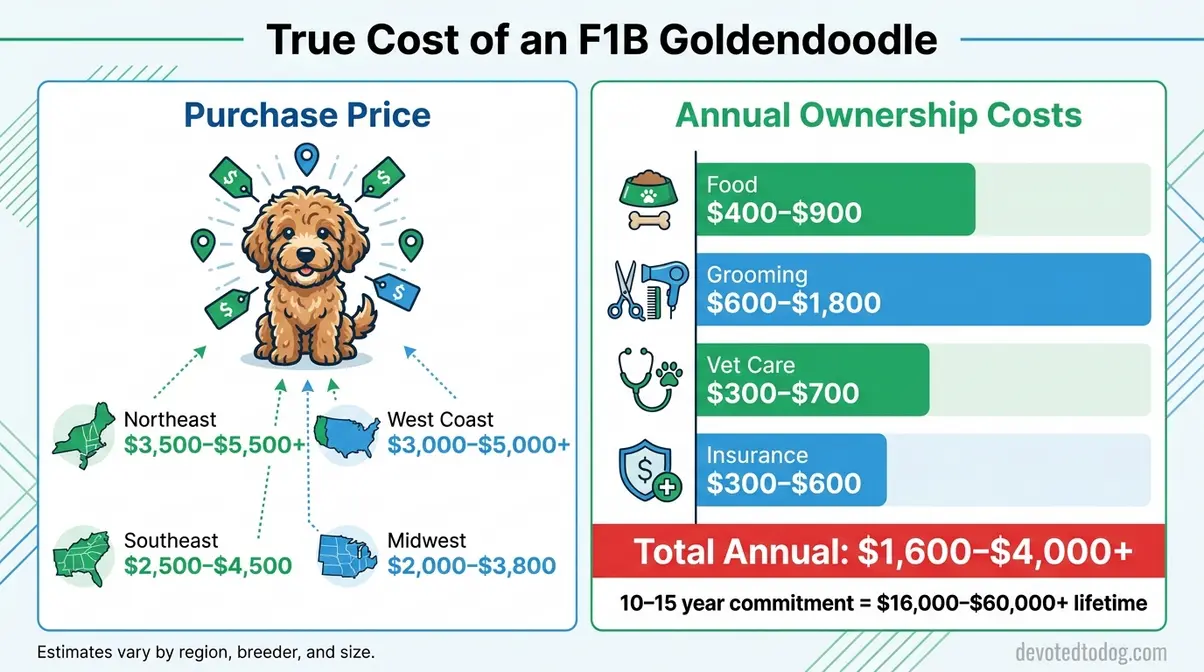
No two regions price F1B puppies the same way. Here’s what current market research found:
| Region | Mini F1B | Medium F1B | Standard F1B |
|---|---|---|---|
| Northeast (NY, MA, CT) | $3,500–$5,500+ | $3,000–$4,500 | $2,500–$4,000 |
| West Coast (CA, WA, OR) | $3,000–$5,000+ | $2,800–$4,200 | $2,500–$3,800 |
| Southeast (FL, GA, TX) | $2,500–$4,500 | $2,200–$3,800 | $2,000–$3,500 |
| Midwest (IL, OH, MN) | $2,000–$3,800 | $1,800–$3,200 | $1,500–$3,000 |
| Southwest (AZ, NV, NM) | $2,500–$4,000 | $2,200–$3,500 | $2,000–$3,200 |
These are estimates based on market research. Prices vary significantly by individual breeder, health testing standards, coat color, and demand. Always confirm current pricing directly with your chosen breeder. Consult with a veterinarian before making your final decision.
Hidden Costs Breeders Don’t Tell You
The purchase price is just the beginning. Here’s what many f1b goldendoodle breeders don’t disclose upfront:
Application and reservation deposits: Most ethical breeders charge $200–$500 as a non-refundable reservation deposit. This is normal and covers puppy care costs — but it must be budgeted for separately from the final purchase price.
Premium add-ons: Rare color premiums ($300–$800), training packages ($500–$2,000), spay/neuter packages, and microchipping fees are often presented as optional but strongly recommended. These can add $1,000–$3,000 to your total cost before the puppy even comes home.
Health testing transparency: Ask breeders for OFA (the Orthopedic Foundation for Animals — a registry that certifies dogs have been tested for hip, elbow, and eye conditions) and PennHIP certifications for both parent dogs. Breeders who skip health testing may charge less upfront, but the long-term vet bills often cost far more than the savings.
Long-Term Ownership Costs
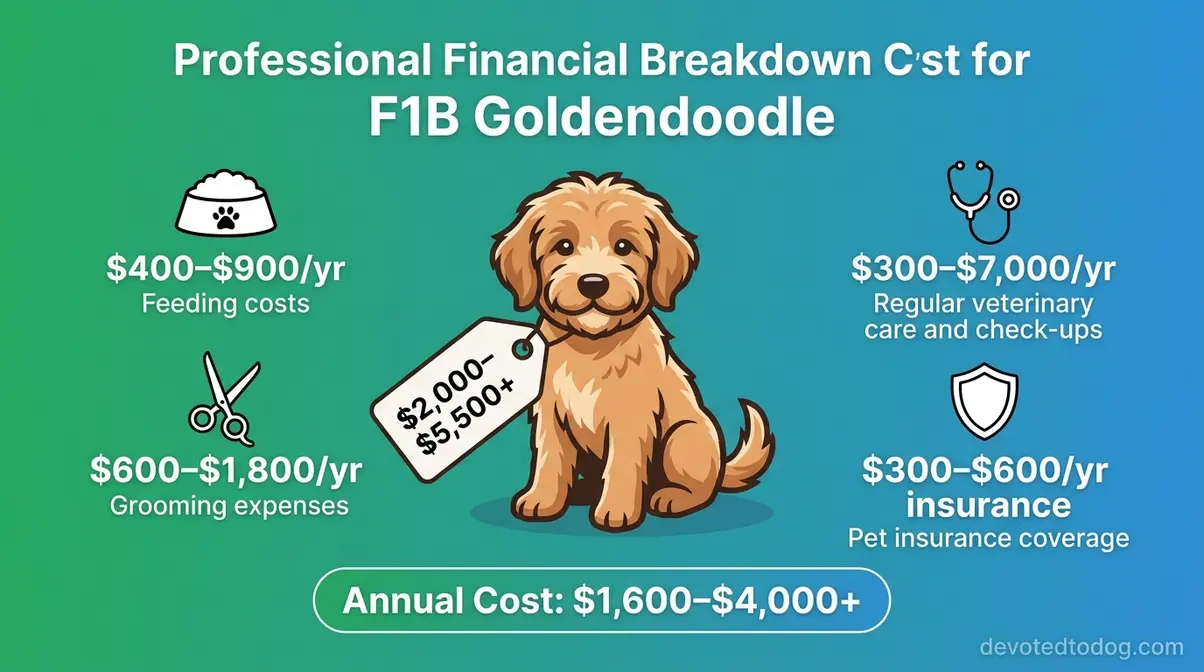
F1B Goldendoodles live 10–15 years. Here’s what to budget annually:
| Annual Expense | Estimated Cost |
|---|---|
| Food (quality dry kibble) | $400–$900/year |
| Professional grooming (every 6–8 weeks) | $600–$1,800/year |
| Routine vet care | $300–$700/year |
| Pet insurance | $300–$600/year |
| Total estimated annual cost | $1,600–$4,000/year |
As noted in our grooming section, the $600–$1,800 annual grooming cost is non-negotiable for this coat type. Budget these costs before getting the dog, not after. Current market data puts total annual Goldendoodle ownership costs at $2,000–$3,000 for most families.
Prices listed are estimates and can vary significantly by breeder, geographic location, coat color, and size. Always consult directly with breeders for current pricing, and consult with a veterinarian before making your final decision.
Finding Reputable F1B Breeders
Reputable F1B Goldendoodle puppies for sale from ethical breeders typically involve a waiting list of 3–12 months, a reservation deposit, and full health documentation for both parent dogs. The F1B’s popularity has made it a prime target for puppy mills and backyard breeders who cut corners on health testing and socialization. Knowing the right questions to ask protects both your family and the puppies.
Spotting a Reputable Breeder
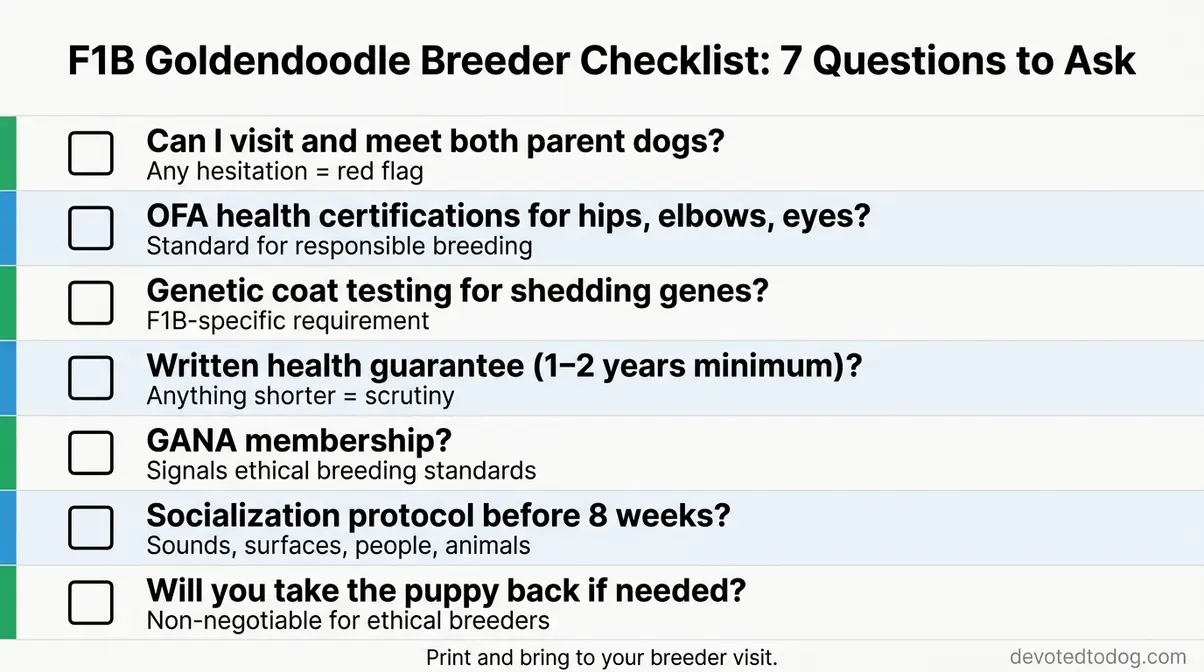
Ask every potential breeder these seven questions before committing:
- Can I visit the facility and meet both parent dogs in person?
- A reputable breeder will always say yes. If they hesitate, that’s your first red flag.
- Do you provide OFA health certifications for the parents’ hips, elbows, and eyes?
- OFA (Orthopedic Foundation for Animals) testing is the standard for responsible breeding.
- Have the parents been genetically tested for coat type and shedding genes?
- This is F1B-specific — it’s how breeders predict whether puppies will be wavy or curly, low-shedding or moderate.
- Do you provide a written health guarantee, and for how long?
- Minimum 1–2 years from a reputable breeder. Anything shorter warrants scrutiny.
- Are you a member of GANA (Goldendoodle Association of North America)?
- GANA membership signals a commitment to ethical breeding standards, though it’s not a guarantee on its own.
- What is your socialization protocol before puppies go home?
- Well-socialized puppies are exposed to sounds, surfaces, people, and other animals before 8 weeks.
- Will you take the puppy back if I can no longer care for it?
- Ethical breeders always say yes. This is a non-negotiable mark of responsible breeding.
For more guidance on the full process, see our complete guide to finding a reputable Goldendoodle breeder.
Warning Signs of a Puppy Mill
Knowing what a bad breeder looks like is as important as knowing what a good one looks like. Walk away if you see any of these:
- Multiple litters available at once with no waiting list — ethical breeders typically have waitlists of months, not instant availability
- Refuses to let you visit the facility or meet the parent dogs — no legitimate breeder should decline an in-person visit
- Cannot provide health certifications for the parent dogs — OFA, PennHIP, and genetic coat testing are baseline expectations
- Offers to ship the puppy without an in-person meeting — this is a common puppy mill tactic
- Price is significantly below market rate — under $1,000 for an “F1B Goldendoodle” is a serious warning sign
- Puppies available at 4–5 weeks old — ethical breeders send puppies home at 8 weeks minimum; early separation causes lasting behavioral issues
- No contract, no health guarantee, no return policy — every reputable breeder provides these in writing
Puppies from mills and careless breeders often arrive with health and behavior problems, and the upfront “savings” can turn into vet bills. Vet any breeder carefully before you buy.
Always consult with a veterinarian before bringing any puppy home, and perform your own due diligence on any breeder. Prices and breeder standards vary significantly by region.
When an F1B Might Not Be Right
Our team evaluated owner community feedback across multiple Goldendoodle forums and breed groups, and the honest truth is this: F1Bs are rehomed more often than most breeders advertise — usually because of mismatched expectations, not because the dogs are difficult. Here’s what to watch for before you commit.
Common Pitfalls New F1B Owners Face
Pitfall 1: Underestimating grooming costs. Families who budget for the puppy price but not the $600–$1,800/year in professional grooming often find themselves overwhelmed within the first year. When grooming is skipped, the coat mats severely — causing pain for the dog and requiring expensive emergency dematting sessions. The fix: build grooming into your monthly budget before you bring the puppy home.
Pitfall 2: Leaving an F1B alone for 8+ hours daily. These “velcro dogs” are prone to separation anxiety and destructive behavior when chronically under-stimulated. Chewing, excessive barking, and escaping are common outcomes. The fix: arrange dog daycare, a dog walker, or a work-from-home situation before buying — not as an afterthought.
Pitfall 3: Expecting 100% hypoallergenic. Severe allergy sufferers who skip an in-person test visit sometimes discover they still react to F1B Goldendoodles. The fix: spend 30–60 minutes with an adult F1B (not just a puppy) before committing. A puppy may not predict how you will react to the adult dog, so ask your allergist how to test.
Choosing a Different Breed
Scenario 1: You have severe dog allergies. Consider an F1BB (87.5% Poodle) or a purebred Standard Poodle instead. Both typically shed even less than the F1B, but less shedding does not mean fewer allergens: no breed is allergen-free, so talk to your allergist before committing.
Scenario 2: You want a lower-maintenance coat. Consider an F1 Goldendoodle — the wavier coat is less grooming-intensive and still a beautiful dog. A Labrador Retriever is another low-drama option if the doodle look isn’t essential.
Scenario 3: You live in a small apartment and work full-time with no flexibility. A cat or a less people-dependent breed may genuinely be a better fit than any Goldendoodle generation. Choosing the right dog is a 10–15 year decision. Taking time to assess your lifestyle honestly is the most responsible thing you can do — for the dog and your family.
This article is general information, not veterinary advice. For questions about your dog’s coat, skin, ears or health, or about allergies in your household, talk to your veterinarian or allergist.
Frequently Asked Questions
Is F1 or F1B Doodle Better?
Neither generation is universally better — the right choice depends entirely on your family’s specific needs. An F1B Goldendoodle is a common pick for families who want a lower-shedding coat, thanks to its 75% Poodle genetics, though no dog is hypoallergenic. An F1 Goldendoodle suits families with no allergy concerns who prefer the wavier, “shaggy” look.
Are F1B Goldendoodles More Expensive?
Yes, F1B Goldendoodles typically cost $500–$1,500 more than F1 Goldendoodles from the same breeder. The price premium reflects higher demand for the F1B’s predictable, low-shedding coat. Expect to pay $2,000–$5,500+ from a reputable breeder, according to market data reported by the New York Times. Mini F1Bs often cost more than Standard F1Bs due to consistently high demand for smaller, apartment-friendly dogs.
Why Are So Many Doodles Being Rehomed?
Doodles are frequently rehomed due to mismatched expectations. New owners are often completely unprepared for their high energy levels, need for daily mental stimulation, and significant grooming requirements. Professional grooming every 6–8 weeks adds up to $600–$1,800 per year, which catches many families off guard. Furthermore, their Poodle-inherited intelligence can lead to destructive behavior — chewing, barking, escaping — when they’re under-stimulated or left alone too long. Thorough research before buying dramatically reduces rehoming risk.
What to Do Next: Your F1B Decision
For families who need a low-shedding, intelligent, and affectionate dog, the F1B Goldendoodle delivers a compelling combination of traits. Its 75% Poodle genetics — “The 75% Advantage” — produce a more predictable, curly coat than the F1 generation, making it a common choice for households that want a lower-shedding coat. Expect to invest $2,000–$5,500+ upfront and $1,600–$4,000 per year in food, grooming, and veterinary care — a 10–15 year commitment that rewards thorough preparation.
“The 75% Advantage” isn’t just a genetics fact — it’s the reason F1Bs cost more, require more grooming, and attract the waiting lists they do. Understanding this trade-off before you buy is what separates happy F1B owners from the families who end up rehoming their dog within a year. The genetics that give you a low-shedding coat are the same genetics that demand consistent grooming, mental stimulation, and your presence.
Start by spending time with an adult F1B Goldendoodle in person — not just a puppy photo online. Then use the breeder vetting checklist in this guide to find a GANA-affiliated breeder in your area, and talk to your allergist if anyone in your household has known pet allergies. The right dog is worth the research — and the F1B is a genuinely exceptional family companion for the family prepared for it.