
⚠️ Medical Disclaimer: This article is for informational purposes only and does not constitute veterinary medical advice. Always consult a licensed veterinarian for guidance specific to your dog.
🩺 Reviewed by Sonya Wyrick, Veterinary Professional — April 2026
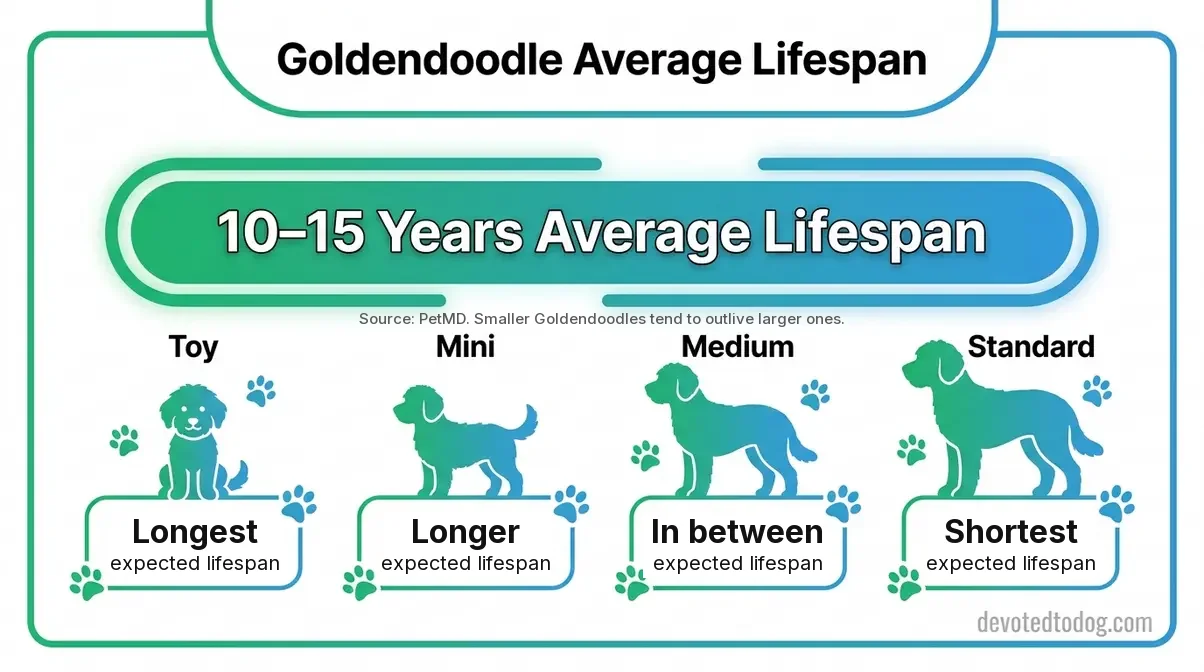
If you’ve ever watched your Goldendoodle bound across the yard, you’ve probably had the thought: I wish this could last forever. So how long do Goldendoodles live? Most live between 10 and 15 years — but that number shifts significantly based on one factor most owners don’t know about: their dog’s size (PetMD).
Without knowing how your dog’s size affects their lifespan — or which health risks to watch for — you could miss years of preventive care that actually make a difference.
By the end of this guide, you’ll know exactly how long your specific Goldendoodle is likely to live, what threatens that timeline, and seven concrete steps you can take starting today. We cover lifespan by size, the role of genetics and generation, aging signs to watch for, and the most common questions Goldendoodle owners ask.
Goldendoodles typically live 10–15 years, and smaller Goldendoodles tend to live longer than larger ones — and the right care can extend any dog’s life.
- Size is the #1 factor: Smaller Goldendoodles live longer than larger ones
- Cancer is a major risk, inherited from the Golden Retriever side — ask your vet about early detection
- The Longevity Equation: Half genetics (fixed), half care (your choice)
- 7 proven strategies can meaningfully extend your dog’s healthy years
- Mini Goldendoodles typically live longer than Standards; no study gives size-specific Goldendoodle ranges
How Long Do Goldendoodles Live? The Direct Answer

Goldendoodles typically live 10 to 15 years on average. Research on canine longevity confirms that mixed-breed dogs like the Goldendoodle — a popular hybrid dog breed created by crossing a Golden Retriever with a Poodle — often enjoy a longer median lifespan than purebred dogs of the same weight, a benefit known as hybrid vigor (PubMed, 1997). Knowing your dog’s expected lifespan helps you plan their care — and gives you a target to beat.
Whatever the number, most owners feel it is never long enough. The goal of this guide is to help you understand — and actively improve — the odds.
Average Lifespan in Human Years
Goldendoodle lifespan in plain terms: 10–15 years is the confirmed range, and to make that feel real, a Goldendoodle who lives to 12 is well into its senior years. That’s a full, rich life — but it also means the decisions you make in your dog’s first few years matter enormously.
The range exists primarily because of size. A Teacup Goldendoodle and a Standard Goldendoodle are both “Goldendoodles,” but their expected lifespans can differ. No study has measured Goldendoodle lifespan by size, but across breeds smaller dogs live longer than larger ones.
Here’s a quick way to think about it: your 70 lb Standard Goldendoodle is likely to fall toward the lower part of the 10–15 year range, and your neighbor’s Mini Goldendoodle toward the higher part. Knowing which category your dog falls into shapes every care decision that follows — from when to start cancer screening to how often to schedule senior vet visits.
For a deeper look at the breed overall, our complete Goldendoodle owner’s guide covers temperament, training, and health in full detail.
The range of 10–15 years is helpful — but it hides a bigger story. Your Goldendoodle’s size is the single biggest predictor of how long they’ll live, and the research on dog size is consistent.
What Is Hybrid Vigor and Does It Help?
Hybrid vigor — also called heterosis — is the tendency for crossbred dogs to be healthier and longer-lived than their purebred parents, because they inherit a wider, more diverse set of genes. In practical terms, a Goldendoodle may dodge some of the inherited diseases common in purebred Golden Retrievers (like certain cancers) or purebred Poodles (like progressive retinal atrophy — a gradual vision loss condition).
According to research on canine longevity, mixed-breed dogs show a higher median age at death compared to purebreds of the same weight (PubMed, 1997). Compared to Golden Retriever life expectancy of 10–12 years, this represents a meaningful advantage for most Goldendoodles.
That said, hybrid vigor is a tendency, not a guarantee. This is where The Longevity Equation comes in. Think of your Goldendoodle’s lifespan as an equation: Genetic Baseline + Care Multiplier = Total Years. The first half — size, generation, and sex — is set the moment they’re born. The second half — what you feed them, how often they see the vet, and how much they exercise — is entirely up to you.
Hybrid vigor covers the genetic baseline. The rest of this guide covers everything you can control.
So you know the average. You understand the genetic advantage. Now let’s get specific — because whether you have a Teacup, a Mini, or a full Standard Goldendoodle, your dog’s size tells a very different story.
Goldendoodle Lifespan by Size: Mini to Standard
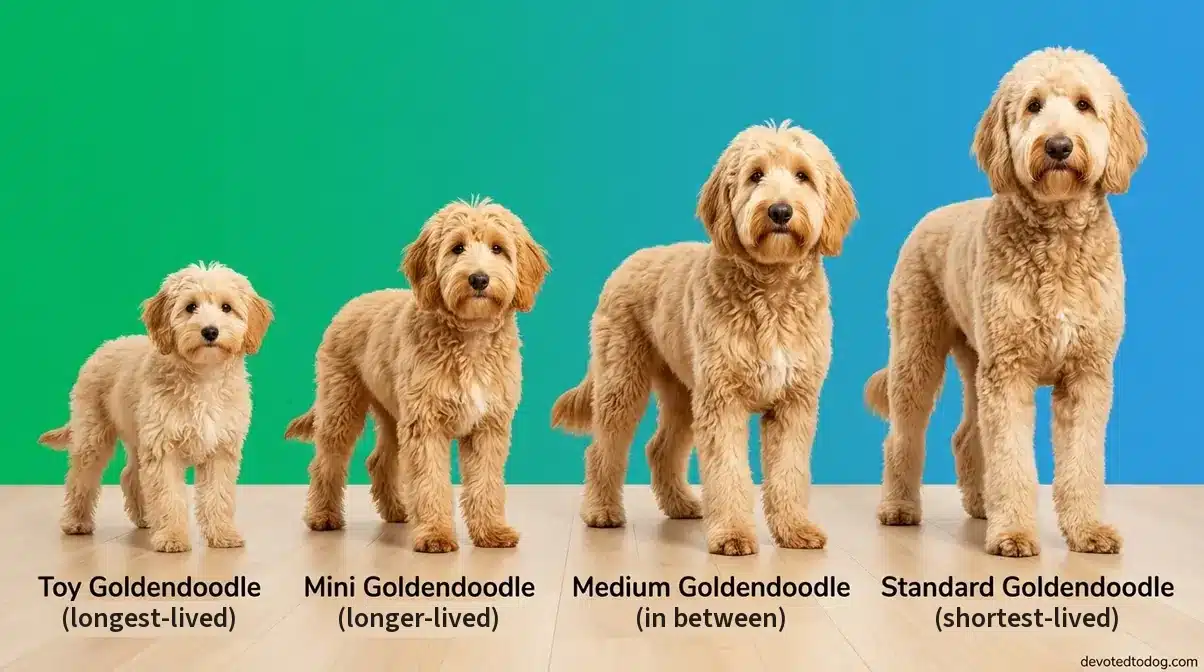
The most important factor in how long your Goldendoodle lives is their size. A statistical analysis of dog lifespans found that weight is a statistically significant predictor of canine longevity (p<0.001), with smaller dogs consistently outliving heavier ones (Greer et al., Research in Veterinary Science, 2007). That suggests a Toy Goldendoodle is likely to outlive a Standard, although no study has measured the gap in Goldendoodles.
For a full breakdown of different Goldendoodle sizes and how big they get, our dedicated size guide covers weight ranges, temperament differences, and which size fits which lifestyle.
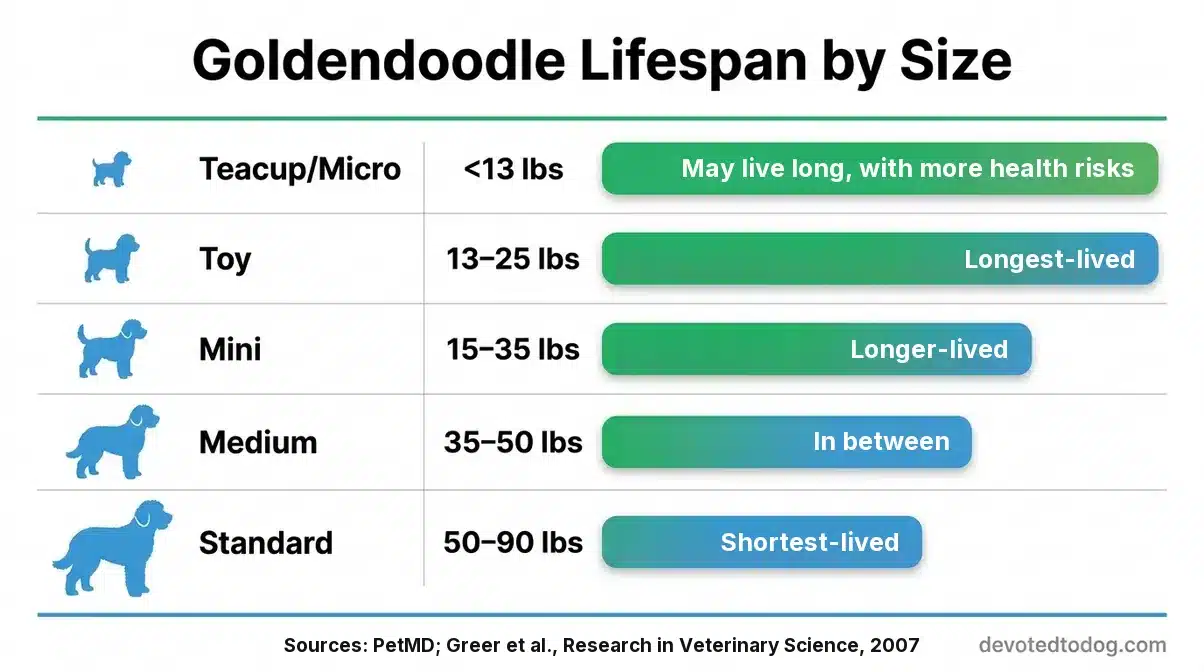
| Goldendoodle Size | Weight Range | Key Health Notes |
|---|---|---|
| Teacup / Micro | Under 13 lbs | Extreme miniaturization carries health risks — see note below |
| Toy | 13–25 lbs | Longest-lived size category |
| Mini | 15–35 lbs | Most popular size; strong longevity |
| Medium | 35–50 lbs | Balanced size with moderate lifespan |
| Standard | 50–90 lbs | Shortest lifespan; highest bloat risk |
Smaller dogs generally live longer than heavier ones, a pattern shown in peer-reviewed research on canine longevity (Greer et al., Research in Veterinary Science, 2007).
Think of it like engine size: a smaller engine runs at lower intensity and lasts longer. A study published in The American Naturalist of 74 breeds found that large dogs die younger mainly because they age faster (Kraus et al., The American Naturalist, 2013). Goldendoodles fall across that entire spectrum depending on their size.
Teacup and Toy Goldendoodle Lifespan

How long do toy Goldendoodles live? Toy Goldendoodles (13–25 lbs) are expected to be among the longest-lived sizes, because smaller dogs generally age more slowly; no study gives a Toy Goldendoodle range.
Teacup and micro Goldendoodles (under 13 lbs) may also live long, but they carry additional health risks from extreme miniaturization. These include hypoglycemia (low blood sugar — a condition where the dog’s body can’t maintain normal glucose levels), fragile bones, and dental crowding. How long do micro Goldendoodles live? The range is similar to Toy, but the path to that lifespan may involve more medical intervention.
It’s also worth noting that Teacup is not an official AKC-recognized breed category. These dogs are bred by selecting for the smallest possible size, which can introduce new health vulnerabilities not present in larger Goldendoodle sizes. If you’re choosing a Teacup Goldendoodle specifically for the longer lifespan, weigh that against the additional vet costs and fragility concerns that come with extreme miniaturization.
Step up to the Mini Goldendoodle — the most popular size — and you get a long expected lifespan with a more robust health profile.
Mini Goldendoodle Lifespan
How long do mini Goldendoodles live? Mini Goldendoodles, typically weighing 15–35 lbs, typically live longer than larger Goldendoodles (PetMD). This is the most popular Goldendoodle size, and their lifespan reflects the benefits of small-dog longevity without the fragility risks of Teacup miniaturization.
How long do miniature Goldendoodles live? The answer is the same — “Mini” and “Miniature” refer to the same size category. What makes Minis stand out is not just their lifespan ceiling, but how long they stay active. Many Mini Goldendoodles stay active well into their senior years, giving owners a longer window of high-energy companionship.
If you’re asking “how long do mini Goldendoodles live?” — expect the upper part of the typical 10–15 year range, with the right care helping your dog get there. Size is the biggest fixed input in your Goldendoodle’s genetic baseline, and Mini Goldendoodles have a genuine biological advantage here.
Between the Mini and the Standard sits the Medium Goldendoodle — a size that’s often overlooked but has its own lifespan profile worth knowing.
Medium Goldendoodle Lifespan
How long do medium Goldendoodles live? Medium Goldendoodles are expected to fall between Minis and Standards. They often result from breeding a Standard Goldendoodle with a Miniature Poodle, landing in a middle weight range of 35–50 lbs.
Mediums share some health considerations with Standards — a larger frame means more joint stress over time — but they benefit from being lighter than full Standards. For families who want a larger companion dog without sacrificing as much lifespan, the Medium is often the sweet spot.
If you’re wondering how big medium Goldendoodles get, they typically top out at 35–50 lbs and reach full height by 12–14 months. Their expected lifespan makes them a middle-ground option between the longer-lived Minis and the larger-framed Standards.
At the other end of the scale, Standard Goldendoodles are the largest and the most beloved — but they carry the shortest expected lifespan of any size.
Standard Goldendoodle Lifespan
How long do Standard Goldendoodles live? Standard Goldendoodles, the full-sized version weighing 50–90 lbs, have the shortest expected lifespan of the sizes, toward the lower part of the 10–15 year range. How long do large Goldendoodles live? The answer is the same — “large Goldendoodle” and “Standard Goldendoodle” describe the same size category.
The study published in The American Naturalist points to the reason: large dogs age faster (Kraus et al., 2013). This is why your 70 lb Goldendoodle has a shorter expected lifespan than your neighbor’s Mini — it’s biology, not luck.
Standard Goldendoodles also carry a higher risk of bloat — formally known as gastric dilatation-volvulus, or GDV. Bloat is a medical emergency where the stomach fills with gas and twists on itself. It can be fatal within hours without emergency surgery. Large, deep-chested breeds are most vulnerable, and Standard Goldendoodles fit that profile. Understanding this baseline helps you plan preventive care — especially around joint health and bloat prevention — from year one.
A Standard’s lifespan is still a long, full life. The goal isn’t to alarm you — it’s to help you make every year count.
Size is fixed — you can’t change it. But the next two factors — generation and sex — are worth understanding before you dismiss them as irrelevant.
Generation & Gender Effects on Lifespan
Beyond size, two other factors influence your Goldendoodle’s lifespan: their genetic generation (F1, F1B, or Multigen) and their sex. Neither factor is as significant as size — but they’re worth understanding, especially if you’re choosing between puppies or wondering whether your male or female dog has different longevity odds.
F1 vs. F1B vs. Multigen Lifespans
How long do F1B Goldendoodles live? To answer that, it helps to understand what the terms mean. An F1 Goldendoodle — the first-generation cross — is 50% Golden Retriever and 50% Poodle. An F1B Goldendoodle, a second-generation cross, is 75% Poodle and 25% Golden Retriever — bred back to a Poodle for lower shedding. A Multigen Goldendoodle is a multi-generational cross where both parents are Goldendoodles or Goldendoodle mixes.
For more on what makes F1B Goldendoodle genetics and what makes them different, our dedicated guide covers coat types, health considerations, and breeding details. For Multigen Goldendoodle traits and lifespan, the picture is more variable.
How long do F1 Goldendoodles live? Here’s the honest answer: generation has a smaller impact on lifespan than size. F1B dogs may carry slightly stronger hybrid vigor due to increased Poodle genetics, but peer-reviewed research on generation-specific lifespan in Goldendoodles is limited. Breeders often claim generation matters significantly — but the science doesn’t yet support strong conclusions either way. As one practical observation: rolling the “genetic dice” on generation matters less than picking the right size for your lifestyle. A Mini F1 will likely outlive a Standard F1B simply because of the size difference.
The gender question gets a clearer answer — and it may matter more than you’d expect.
Do Females Live Longer Than Males?
How long do female Goldendoodles live compared to males? Research published in the Journals of Gerontology found that neutered females live longer than any other group, while intact males live slightly longer than intact females (Oxford Academic, 2017). The practical takeaway: spaying and neutering status has a larger influence than sex alone, and the difference between males and females is modest — typically in the range of months rather than years.
How long do Goldendoodles live — female vs. male? If you have a spayed female Mini Goldendoodle, she may land toward the higher end of the 10–15 year range, since smaller Goldendoodles tend to live longer (PetMD). Research also suggests that spaying and neutering may improve longevity outcomes overall, though the timing of the procedure matters — a conversation worth having with your vet during your dog’s first year.
The bottom line: sex is a real but minor input in the genetic baseline. Excellent care matters far more than whether your dog is male or female.
Genetics gives your Goldendoodle a starting point. But what happens next — the care they receive, the food they eat, the health risks you catch early — that’s where you take over.
7 Factors That Shape Goldendoodle Lifespan
Knowing your Goldendoodle’s genetic baseline is step one. Step two is the care multiplier — the choices you make every day that can add meaningful years to your dog’s life. These seven factors, supported by veterinary research, have the greatest impact on how long your Goldendoodle lives.
Always consult your veterinarian before making changes to your dog’s health routine.
Research from the Dog Aging Project shows that larger dogs not only have shorter lifespans but also manifest different patterns of age-related diseases compared to smaller dogs (Nam et al., PLoS ONE, 2024) — which is why size-specific preventive care matters.
Cancer: The Leading Cause of Death
No study has measured causes of death in Goldendoodles specifically, but cancer is the health risk owners ask about most. The risk comes mainly from the Golden Retriever side: cancer is the leading cause of death in Golden Retrievers in U.S. studies, and the breed’s cancer risk is high relative to many breeds. A Nationwide pet-insurance analysis found fewer cancer claims for Goldendoodles than for Golden Retrievers and Standard Poodles, so a cross may not carry the full Golden risk.
The specific cancer types most associated with this breed include:
- Osteosarcoma — an aggressive bone cancer that causes pain and swelling, often in the limbs
- Hemangiosarcoma — a cancer of the blood vessel walls that is common in Golden Retrievers and can affect the spleen, heart, or skin
- Lymphoma — a cancer of the lymph nodes and immune system, often presenting as swollen glands under the jaw or behind the knees
For a full picture of common health issues inherited from Golden Retrievers, our dedicated guide covers cancer types, screening recommendations, and management strategies.
Early detection is the most powerful tool you have. Regular wellness exams, with your vet checking for lumps, lymph node swelling, and abdominal changes, form the baseline. Ask your vet when cancer screening makes sense for your dog. Catching a lump early, rather than waiting until it causes pain, can be the difference between a treatable diagnosis and a terminal one. Consult your veterinarian about an appropriate screening schedule for your dog’s size and age.
Joint disease is the second major health threat — and it affects your Goldendoodle’s quality of life long before it threatens their lifespan.
Joint Problems: Hip and Elbow Dysplasia
Hip dysplasia — a painful condition where the hip joint doesn’t develop properly and can cause arthritis — and elbow dysplasia (the same issue affecting the front legs) are common in Goldendoodles, particularly larger Standard-sized dogs. Published research on canine size and disease confirms that canine size is a major factor in the risk of age-related joint conditions, emphasizing the need for tailored health monitoring by Goldendoodle size (PLoS ONE, 2024).
These conditions are inherited from both parent breeds — Golden Retrievers and Poodles both carry risk. Think of it this way: hip dysplasia means your dog’s hip joint doesn’t fit together properly — imagine a ball that doesn’t sit right in its socket. Over time, this causes pain and arthritis that limits mobility and quality of life.
Maintaining a healthy weight is the single most impactful thing you can do to reduce joint stress. A Standard Goldendoodle who is 10 lbs overweight is putting significantly more stress on their joints with every step — accelerating the wear that leads to arthritis years before it would otherwise appear.
Now for the part you’ve been waiting for — the 7 specific actions that can meaningfully extend your Goldendoodle’s healthy years.
7 Ways to Help Your Dog Live Longer
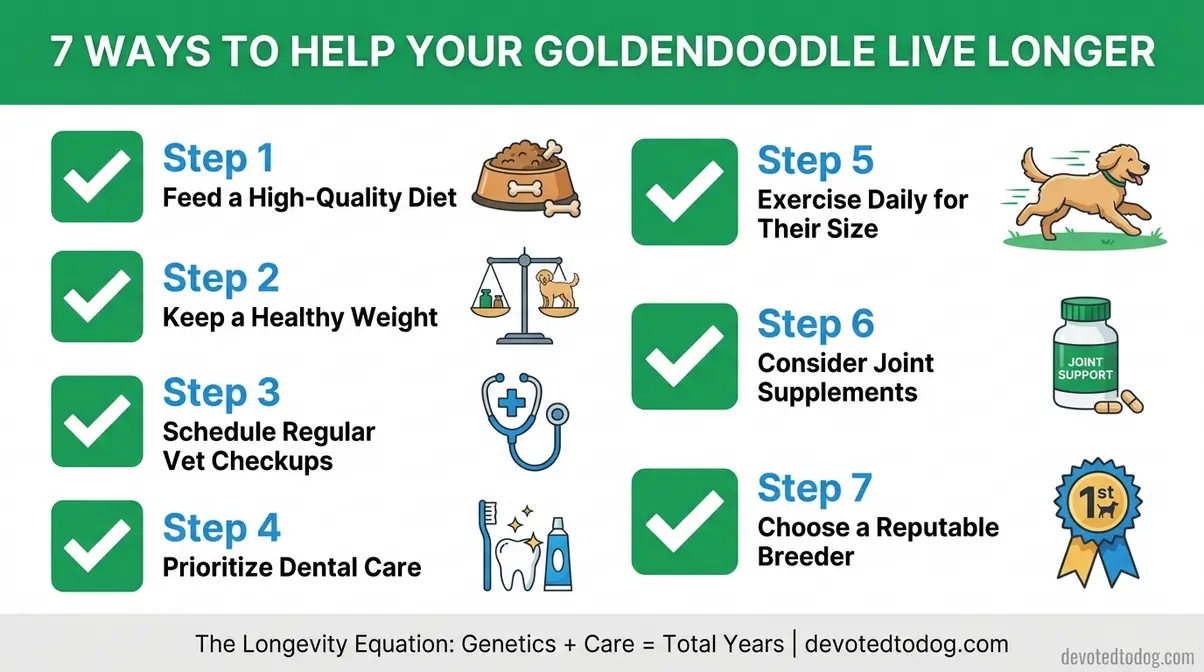
These seven actions are how you increase the care side of The Longevity Equation. Each one is backed by veterinary research or consensus — and every one is within your control starting today.
Step 1: Feed a High-Quality Diet
Look for dog foods where the first ingredient is a named protein — chicken, beef, or salmon, not “meat meal.” Avoid fillers like corn syrup and artificial preservatives. Ask your vet when to switch to a “senior” formula; larger Goldendoodles usually reach that point sooner than Minis. Ask your vet for a specific brand recommendation based on your dog’s size and health history.
Step 2: Keep a Healthy Weight
Obesity is one of the most preventable causes of shortened lifespan in dogs. A simple check: you should be able to feel — but not see — your dog’s ribs with light pressure. If you press lightly and can’t feel them, your dog may be overweight. Consult your vet about body condition scoring at your next exam.
Step 3: Schedule Regular Vet Checkups
Ask your vet how often your Goldendoodle should be examined at each life stage, and whether visits should become more frequent as your dog ages. Regular exams can catch early signs of cancer, joint disease, dental disease, and organ decline before they become emergencies.
Step 4: Prioritize Dental Care
Periodontal disease is very common in adult dogs, and the bacteria from dental infections can enter the bloodstream and damage the heart and kidneys. Ask your vet which home routine suits your dog (tooth brushing or vet-recommended dental chews) and how often professional cleanings under anesthesia are needed.
Step 5: Exercise Daily for Their Size
Mini Goldendoodles need 30–45 minutes of moderate exercise per day. Standards need 60 or more minutes. Exercise supports joint health, maintains healthy weight, and supports cardiovascular function. For puppies under 12 months, avoid high-impact jumping and hard running — their growth plates are still developing and can be damaged by excessive stress.
Step 6: Consider Joint Supplements
Glucosamine and chondroitin supplements are commonly recommended by vets for large-breed Goldendoodles showing early joint stiffness. These compounds support cartilage health and may slow the progression of arthritis. Ask your vet about appropriate dosage for your dog’s specific weight before starting any supplement — dosing varies significantly by size.
Step 7: Choose a Reputable Breeder
A breeder who screens parent dogs for hip dysplasia (OFA certification), elbow dysplasia, heart conditions, and eye diseases is rolling the “genetic dice” in your favor before your puppy is even born. Health-tested parents dramatically reduce the odds of your dog inheriting the conditions most likely to shorten their life.
The care multiplier is entirely in your hands. But even with perfect care, every Goldendoodle eventually enters their senior years — and knowing what to expect at each life stage helps you give them the best quality of life all the way through.
Goldendoodle Life Stages & Expectations

Understanding your Goldendoodle’s life stages helps you give them exactly the right care at the right time. The milestones below apply across all sizes, though the timing shifts slightly — larger Goldendoodles tend to enter their senior years earlier than smaller ones.
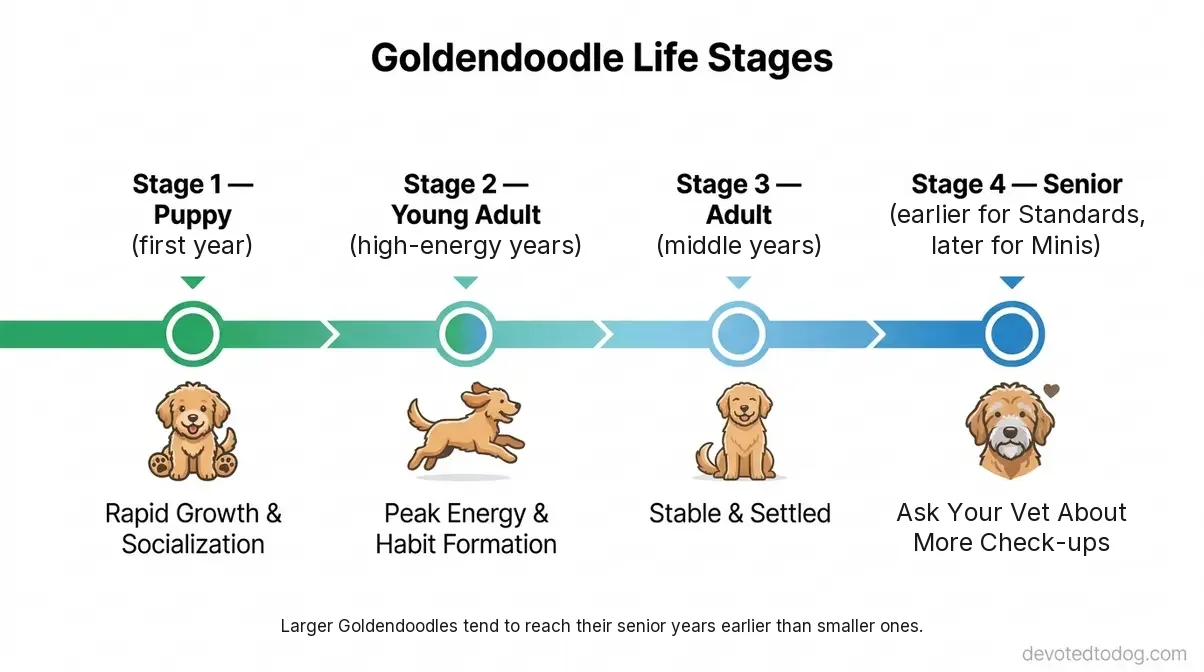
Goldendoodle Life Stages at a Glance
Here’s how your Goldendoodle’s life unfolds across four distinct stages:
- Puppy Stage (first year): Rapid growth, the critical socialization window, and developing growth plates that need protection from high-impact exercise. How big do Goldendoodles get? Most reach full height by 12 months, though Standard Goldendoodles may continue filling out until 18–24 months. How long until Goldendoodles are fully grown? For Minis, 10–12 months; for Standards, up to 24 months. For what to expect at 6 months, our guide covers growth milestones, training progress, and behavioral development. See also developmental milestones at 5 months old for earlier-stage guidance.
- Young Adult (the high-energy years): Peak energy and physical development. This is the prime window to establish exercise habits, dental care routines, and a healthy weight baseline. Dogs who enter adulthood at a healthy weight have a significantly easier time maintaining it.
- Adult (the middle years, up to the senior stage): Settled, stable personality. Maintain regular vet visits. Ask your vet when to start discussing joint supplements and cancer screening — before symptoms appear.
- Senior (the last quarter of expected lifespan, so earlier for Standards than for Minis): Ask your vet whether to schedule more frequent checkups. Adjust exercise to lower-impact activities. Monitor weight carefully, as reduced activity means lower calorie needs. Watch for the signs of aging covered in the next section.
There is no single senior age for Goldendoodles: AAHA defines a dog’s senior stage as the last 25% of its estimated lifespan (2023 AAHA Senior Care Guidelines), so Standard-sized dogs, with shorter expected lifespans, reach it earlier than Minis.
Once your Goldendoodle hits their senior years, certain physical and behavioral changes become common. Knowing what’s normal aging — and what’s a warning sign — helps you act early.
Signs Your Dog Is Getting Older
Signs of aging appear as your dog reaches the senior stage. Standard Goldendoodles often show these changes earlier than Mini Goldendoodles, which may stay noticeably active for longer.
Physical signs to watch for:
- Graying muzzle (often one of the first visible signs — this is cosmetic, not a health concern)
- Cloudy or bluish eyes (often nuclear sclerosis — a normal age-related lens change, distinct from cataracts; your vet can differentiate)
- Thinning coat or changes in coat texture
- Stiffness after resting, especially in the morning or after lying down
- Reduced hearing or vision responsiveness
- Slower gait on walks
Behavioral signs to watch for:
- Shorter play sessions and lower overall energy
- Longer and more frequent naps
- Increased anxiety or confusion — which may indicate canine cognitive dysfunction (the dog equivalent of dementia, where the brain gradually loses function)
- Changes in appetite or water intake
When to call the vet immediately: A graying muzzle is just your Goldendoodle becoming distinguished. A graying muzzle combined with a noticeable drop in appetite and sudden lethargy is a reason to call your vet today. Sudden weight loss, rapid behavior change, difficulty breathing, persistent limping, and loss of bladder control are NOT normal aging — these warrant an immediate vet call, not a “wait and see” approach.
At What Age Do Goldendoodles Slow Down?
Most Goldendoodles begin to slow down noticeably as they transition into their senior years, which AAHA defines as the last 25% of a dog’s estimated lifespan (2023 AAHA Senior Care Guidelines). Standard-sized Goldendoodles often show signs of reduced energy and increased stiffness earlier, while Mini Goldendoodles may stay active for longer. Common changes include shorter play sessions, more frequent naps, and a preference for calmer activities over vigorous running or fetch. Ask your vet whether more frequent checkups and lower-intensity exercise make sense at this stage.
Even with all the right care and early detection, some health challenges are hard to predict. Here’s an honest look at what can shorten a Goldendoodle’s life — and how to respond.
When Your Goldendoodle May Not Reach the Average
The 10–15 year average is achievable for most Goldendoodles — but it’s not guaranteed. Some dogs face challenges that cut their lives short, and most of them are either preventable or detectable early. Here’s what to watch for.
Several reasons Goldendoodles fall short of their full lifespan can be prevented: obesity, lack of regular vet care, and buying from breeders who don’t health-test their parent dogs.
Health Pitfalls That Shorten Lifespans
Three preventable pitfalls can shorten a Goldendoodle’s life:
Obesity is the most preventable risk. Overweight Goldendoodles develop joint problems, diabetes, and heart disease earlier and more severely than dogs at a healthy weight. It’s also the easiest risk factor to monitor and address at home.
Poor breeding practices dramatically increase the odds of genetic diseases like hip dysplasia and cancer. Buying from a breeder who skips health testing on parent dogs is rolling the genetic dice in the worst possible way — and the consequences may not appear until your dog is an adult.
Delayed veterinary care allows treatable conditions to become fatal. Cancer, bloat, and heart disease are all conditions where early detection dramatically changes outcomes. Waiting until symptoms are severe is often waiting too long.
Why Advise Against the Breed?
Some people caution against Goldendoodles because of their high grooming costs, cancer predisposition, and potential for separation anxiety. Professional grooming every 6–8 weeks is typically required to prevent matting, and cancer treatment — if needed — can cost thousands of dollars without pet insurance. Goldendoodles also tend to bond intensely with their families, which can lead to anxiety when left alone for long periods. These are not reasons to avoid the breed — but they are important realities to plan for before bringing one home.
Knowing the pitfalls is only half the equation. The other half is knowing when a symptom is serious enough to call your vet today — not next week.
When to Call Your Vet (Not Wait)
Call your vet immediately — do not wait:
- Sudden bloating of the abdomen (possible GDV/bloat — life-threatening)
- Collapse or extreme lethargy
- Difficulty breathing or labored panting
- Seizures or loss of consciousness
- Inability to walk or bear weight on a limb
- Blood in urine or stool
Schedule an appointment within 48 hours:
- Unexplained weight loss
- Persistent limping lasting more than 24 hours
- Loss of appetite lasting more than 24 hours
- A new lump or bump anywhere on the body
- Changes in bathroom habits (frequency, consistency, color)
Annual exams catch most issues before they become emergencies. The best time to call your vet is before you’re worried — not after. As a general rule: when in doubt, call. Veterinarians would rather hear from you than have you wait.
This list is not exhaustive. Always consult a licensed veterinarian when you have concerns about your dog’s health.
You now have the complete picture — from genetics to care, from puppy stages to senior signs. Below are the most common questions Goldendoodle owners ask, with direct answers.
Frequently Asked Questions
Main Cause of Death for Goldendoodles?
No study has measured causes of death in Goldendoodles specifically. Cancer is the leading cause of death in Golden Retrievers in U.S. studies, and a Goldendoodle can inherit some of that risk, although Nationwide pet-insurance data show fewer cancer claims for Goldendoodles than for their parent breeds. Proactive veterinary care can detect many health problems before they become serious. Consult your veterinarian to discuss an appropriate screening schedule for your dog’s size and age.
Longest Goldendoodle Lifespan?
The longest Goldendoodle lifespan we found reported is 18 years, a claim from Fox Creek Farm, a Goldendoodle breeder, that we could not verify independently. Most Goldendoodles live 10–15 years, making 18 years exceptionally rare but not impossible. Exceptional longevity typically reflects an ideal combination of small body size, strong genetics from health-tested parents, and consistent preventive veterinary care throughout the dog’s life.
Can a Goldendoodle Live 20 Years?
It is extremely rare for a Goldendoodle to live 20 years — their average lifespan is 10–15 years. While some small dog breeds occasionally reach 20 years, Goldendoodles are a medium-to-large breed mix, which works against extreme longevity. Reaching 16–18 years would be considered an exceptional lifespan for this breed, but 20 years has not been reliably documented. Focusing on quality of life through proper nutrition, exercise, and regular vet care is far more meaningful than chasing a maximum age.
What Are the Signs of Aging?
Common signs of aging in Goldendoodles include a graying muzzle, cloudy eyes, reduced energy, and stiffness after resting. You may also notice shorter play sessions, longer sleep periods, changes in appetite, and mild confusion or anxiety. Behavioral changes like increased clinginess or disorientation may indicate canine cognitive dysfunction, which your vet can help manage. Regular vet check-ups help distinguish normal aging from treatable health conditions.
Make Every Year Count With Your Goldendoodle
For Goldendoodle owners, how long their dog lives depends on a combination of genetics and daily care. Goldendoodles typically live 10–15 years, with smaller Mini and Toy sizes often reaching the higher end of that range — a difference confirmed by peer-reviewed research showing weight is a statistically significant predictor of canine longevity (Greer et al., Research in Veterinary Science, 2007). The best approach combines choosing a reputable breeder who health-tests their parent dogs, maintaining a healthy weight, scheduling regular vet exams, and talking with your vet about cancer screening as your dog ages.
You can’t control the genetic dice — but you control the care multiplier, and that matters enormously. The Longevity Equation is the framework to keep in mind: genetic baseline plus care multiplier equals total years. The first half was set the moment your dog was born. The second half is written by you, every single day. Every preventive step you take is an investment in more years with the dog who stole your heart.
Ready to maximize your dog’s healthy years? Start today by booking your Goldendoodle’s next wellness exam if it’s been more than 12 months. Ask your vet specifically about cancer screening timelines tailored to your dog’s size. Take action now, because the best time to start preventive care is always today.