You’ve fallen in love with a rich red Goldendoodle puppy in a breeder’s photo — only to discover that by age two, that vibrant coat may have faded to a soft cream. It happens more often than buyers expect, and it all comes down to genetics.
Without understanding goldendoodle colors and patterns before you visit a breeder, you risk choosing a coat that looks completely different within two years — or paying a premium for a rare pattern you could have found at a lower price point.
What You’ll Need to Know
- Goldendoodles inherit coat traits from both Golden Retrievers and Poodles
- Colors and patterns are determined by genetics, not size or gender
- Some colors fade significantly as your dog matures
- Rare patterns often come with a higher price tag
In this guide, you’ll discover every Goldendoodle color and pattern — from the most common cream to the striking merle — along with our Fading Predictor ratings so you can choose a coat you’ll love for life. We’ll cover solid colors, complex patterns, the science behind fading, and what affects price — all with labeled photos.
Goldendoodle colors and patterns span 18+ variations — from the ever-popular apricot to the rare merle — and genetics determine which coat your puppy will have and whether it will fade.
- The most popular color is apricot, followed by cream and red
- The rarest solid color is black; the rarest pattern is merle
- The Fading Predictor shows red and chocolate are most likely to lighten significantly by year two
- Generation matters: F1B Goldendoodles are more likely to carry rare patterns like phantom and parti
- Prices vary: Merle, phantom, and tuxedo coats can cost $3,000–$5,000 (goldoodle.com, 2026)
What Makes a Goldendoodle’s Coat So Special?
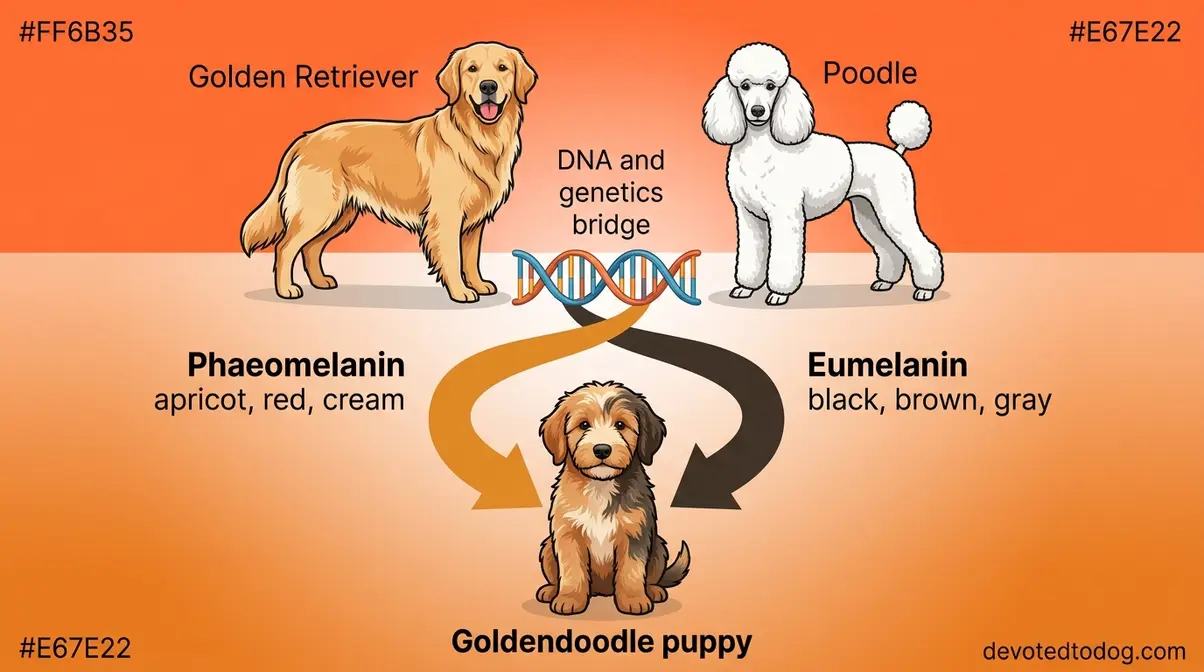
A Goldendoodle’s coat can appear in more than 18 distinct colors and patterns, all determined by genetics inherited from its Golden Retriever and Poodle parents. The Poodle parent contributes the greatest variety, carrying genes for everything from jet-black to parti-patterned coats (Goldendoodle Association of North America). Understanding this genetic foundation helps you know exactly what to ask a breeder before you visit — and which coats are most likely to change as your puppy grows.
Throughout this guide, we’ll use our Fading Predictor ratings to help you estimate how much each color or pattern will change from puppyhood to adulthood. Think of it as your buyer’s cheat sheet.
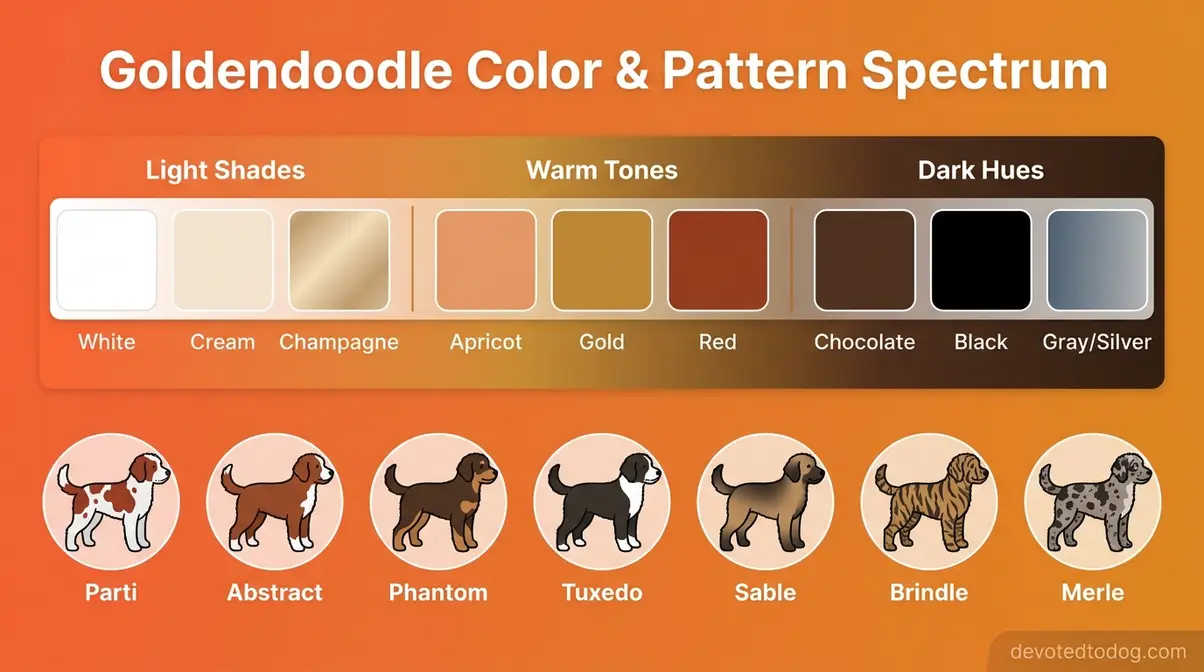
Golden Retriever + Poodle: A Rainbow of Coat Possibilities
Every Goldendoodle coat color traces back to two basic pigments. Eumelanin (the pigment responsible for black, brown, and gray tones) and Phaeomelanin (the pigment responsible for red, gold, and cream tones) are the dark paint and warm paint in your puppy’s genetic palette — and every shade is a variation of these two building blocks.
Modifier genes further alter these base pigments. The D Locus (dilution gene), for example, lightens Eumelanin-based colors into silver, champagne, and blue-gray tones. A chocolate Goldendoodle gets its brown coat from Eumelanin, while an apricot Goldendoodle’s warm peachy tone comes from Phaeomelanin. Genetic variants that cause cream or white coats involve the PMEL17 gene, which dilutes red or black pigment to a pale cream or white coat (UC Davis Veterinary Genetics Laboratory).
compare Goldendoodles with their Golden Retriever parent breed to see how the parent breed’s dominant gold coloring influences the most common Goldendoodle shades.
How Goldendoodle Generations Shape Color (F1, F1B, F2)
Generation matters more than most buyers realize. An F1 Goldendoodle (first-generation: 50% Golden Retriever + 50% Poodle) most commonly appears in apricot, cream, or gold — the Golden Retriever’s dominant color influence showing through. An F1B Goldendoodle (backcross: 25% Golden Retriever + 75% Poodle) carries a much stronger Poodle genetic influence. An F2 Goldendoodle (second-generation: two F1 parents) lands somewhere in between, with more variable coat outcomes.
F1B and multigen Goldendoodles are significantly more likely to express rare recessive patterns — like phantom and parti — because the higher Poodle percentage increases the chance of those recessive genes expressing. Keratin-71 gene variants responsible for curly coats also follow generational lines, with wavy coats typical of F1 generations and curly coats typical of F1B generations (UC Davis Veterinary Genetics Laboratory).
If you’re dreaming of a phantom or parti Goldendoodle, ask breeders specifically about F1B or multigen lineage — it significantly increases your odds. We’ll use generation information throughout our Fading Predictor ratings in this guide.
Learn more about F1B Goldendoodle genetics to understand how the backcross affects coat color and texture.
Do Mini, Medium, and Standard Goldendoodles Come in Different Colors?
Here’s a question that surprises many first-time buyers: Goldendoodle sizes do not affect coat color or pattern. A Mini Goldendoodle can be just as likely to be merle or phantom as a Standard — size is about stature, not coat genetics. Whether you’re looking at a 15-pound Mini or a 65-pound Standard, the color possibilities are determined entirely by the Poodle parent’s genetics. Explore Goldendoodle size differences to understand what actually does change across size categories.
With that foundation in place, let’s explore every solid Goldendoodle color — from the most common to the hardest to find.
Solid Goldendoodle Colors: Every Shade Explained
Solid Goldendoodle colors are single-color coats with no distinct markings or patches — and they range from the palest white to the deepest black. All solid colors stem from two genetic pigments: Eumelanin (dark tones) and Phaeomelanin (warm tones), modified by genes inherited from the Poodle parent (Goldendoodle Association of North America). Here’s every solid color you might encounter, along with a Fading Predictor rating — our guide to how much each color is likely to change as your puppy matures.
The eight solid colors you’ll encounter most often are: cream, champagne, apricot, red, gold, chocolate, black, gray/silver, and white. Each has its own genetic story — and its own fading risk.
Cream and Champagne Goldendoodles
Cream Goldendoodles are a very pale, warm off-white — often associated with English Cream lines, a term for Goldendoodles bred from European Golden Retriever ancestry known for their lighter, more platinum coats. Champagne sits slightly warmer and more golden than cream, with a faint honey undertone that sets it apart in side-by-side comparisons.
Both are considered low-fading colors. What you see in the puppy is largely what you get in the adult — a reassuring consistency that makes cream one of the most reliably popular choices among buyers who prioritize coat stability. If you love the cream look, ask the breeder whether the puppy comes from English Cream lines. These tend to maintain their pale coat most reliably over time.
🔆 Fading Risk: Low
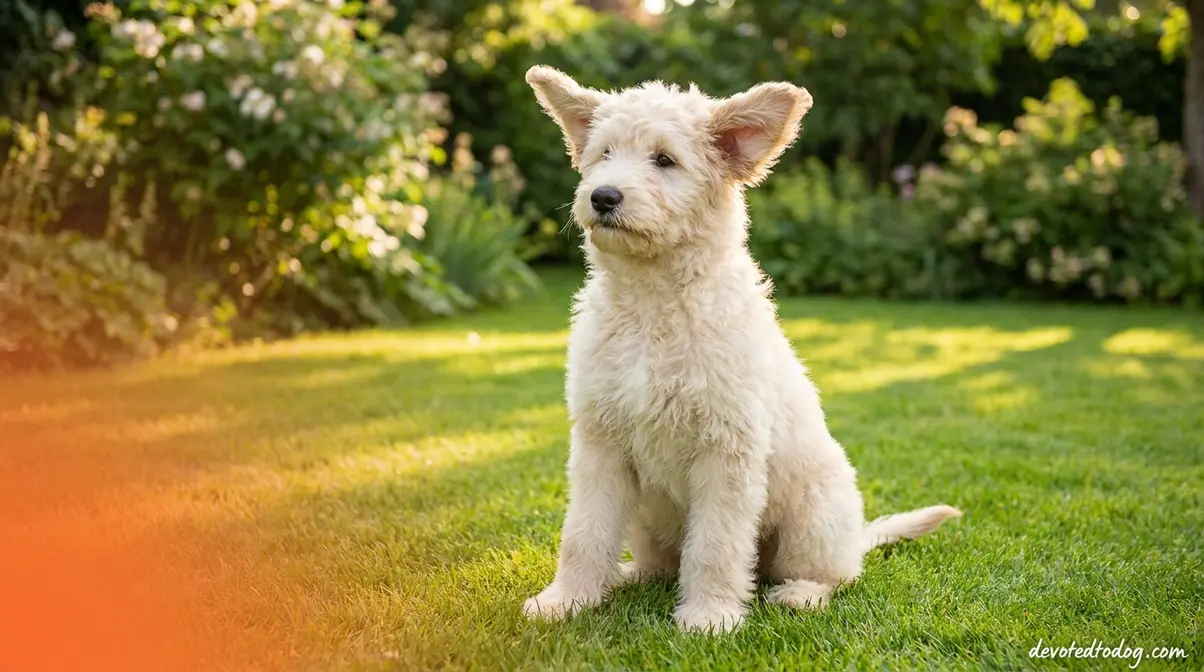
Closely related to cream, apricot is the most popular Goldendoodle color — and for good reason.
Apricot Goldendoodles (The Most Popular)
Apricot is the most popular Goldendoodle color, prized for its warm, peachy tone that echoes the classic Golden Retriever look (goldoodle.com, 2026). Picture the color of a ripe peach or a golden sunrise — lighter than red, deeper than cream — and you’ve got the apricot palette exactly right.
This peachy tone is Phaeomelanin-driven, placing apricot in the same warm pigment family as red and gold. Apricot Goldendoodles commonly fade to a lighter cream or champagne by age two, so color consistency matters here. Deep apricot puppies tend to fade more than lighter apricot puppies — if coat stability is important to you, choose a lighter apricot puppy from a breeder who can show you adult photos from previous litters.
🔆 Fading Risk: Medium
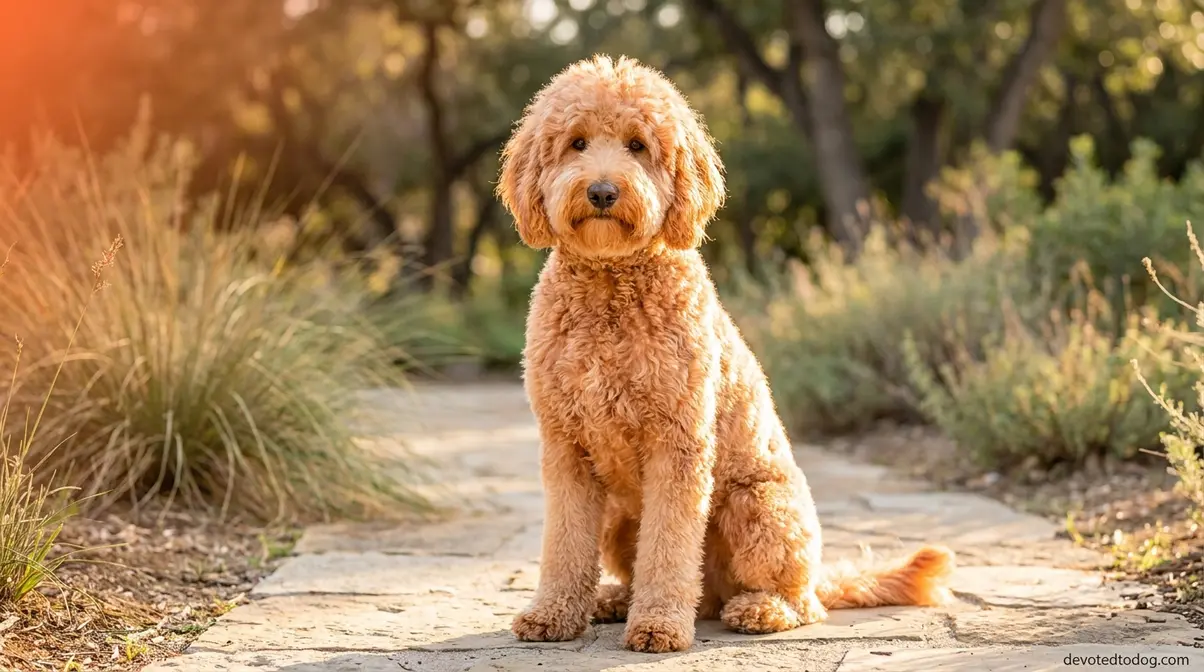
Learn more about apricot Goldendoodles including what to look for when selecting an apricot puppy.
Red Goldendoodles are often confused with deep apricot — here’s how to tell them apart.
Red Goldendoodles
A truly red Goldendoodle is noticeably darker than apricot in a side-by-side comparison — closer to an Irish Setter’s rich auburn coat than a peach. The saturation is the tell: red has a depth and intensity that apricot simply doesn’t reach, even at its darkest.
Red is also one of the highest-fading colors and the coat most dramatically affected by The Fading Predictor. Many red Goldendoodles lighten significantly to apricot or cream by age two, with the most dramatic changes often beginning as early as six months. Red is more common in F1B lines, where the Poodle’s genetic influence is stronger. Before committing to a red puppy, ask to see photos of the puppy’s parents as adults — if both parents have retained their red coat, your puppy is more likely to as well.
🔆 Fading Risk: High
For those who love the classic Golden Retriever look, gold and yellow Goldendoodles are the closest match.
Gold and Yellow Goldendoodles
Gold and yellow Goldendoodles reflect the classic Golden Retriever coat most faithfully — a warm, medium-golden tone that’s neither pale cream nor deep apricot. Think of the color of raw honey or autumn wheat, and you’re in the right range.
This is the most common color in F1 Goldendoodles because the Golden Retriever’s dominant gold coloring often expresses first in first-generation crosses. Gold coats carry a low-to-medium fading risk — they may lighten slightly with age, but typically retain a recognizable golden hue well into adulthood. For buyers who want the “classic doodle” look, gold is the most reliable choice — it’s the color that stays closest to the puppy photo.
🔆 Fading Risk: Low–Medium
Moving to the darker end of the spectrum, chocolate and brown Goldendoodles are a rich, warm choice — but they come with a fading caveat.
Chocolate and Brown Goldendoodles
Chocolate Goldendoodles have a rich, warm brown coat driven by Eumelanin with a modifier gene that prevents full black expression — a trait inherited from the Poodle parent. True chocolate has a warm, reddish-brown undertone that distinguishes it from cooler dark browns.
Chocolate is a high-fading color, and one of the most dramatic transformations in the breed. Many chocolate puppies lighten to a café-au-lait or even cream tone by adulthood, with fading beginning as early as six months of age. Ask your breeder for photos of adult dogs from previous litters — chocolate coats vary widely in how much they fade, and seeing the parents’ adult coats is your best predictor.
🔆 Fading Risk: High
Black is the opposite end of the spectrum — and one of the rarest solid colors in the Goldendoodle world.
Black Goldendoodles (Rare Solid)
Black Goldendoodles are among the rarest solid colors you’ll encounter. To produce a true black puppy, both the Golden Retriever and Poodle parent must carry the recessive black gene — and since Golden Retrievers don’t naturally come in black, this combination is genuinely uncommon.
True black Goldendoodles have a low fading risk overall — their coats often remain dark, though they may develop a slight silver or gray sheen with age. One important caveat: some “black” Goldendoodles are actually very dark chocolate or sable that appears black in photos. Always ask to see the puppy in natural daylight before committing — indoor lighting can make dark coats look far blacker than they are.
🔆 Fading Risk: Low (may develop silver sheen over time)
Explore black Goldendoodle rarity and care to understand what makes this color so uncommon and how to find a reputable black Goldendoodle breeder.
Silver and gray Goldendoodles are closely related to black — they often start life as black puppies and lighten dramatically over time.
Gray and Silver Goldendoodles
Gray and silver Goldendoodles are typically born black or dark chocolate — then lighten progressively as they mature. This transformation is driven by the D Locus (dilution gene, also called the MLPH gene), which suppresses Eumelanin pigment over time, turning dark coats into striking silver-gray adult coats. UC Davis Veterinary Genetics Laboratory on coat dilution confirms that variants in the MLPH gene cause these colors to lighten to paler shades as the dog ages.
By age two, a gray Goldendoodle may look dramatically different from its puppy photos — one of the most visually stunning transformations in the breed. “Blue” Goldendoodles, sometimes listed by breeders, are simply a blue-gray dilution of black following the same mechanism. If you want a silver or gray adult coat, look for dark black or chocolate puppies — they’re the ones most likely to develop this distinctive color.
🔆 Fading Risk: Very High (intentional transformation)
Finally, at the palest end of the spectrum, white Goldendoodles are a striking and relatively rare solid option.
White Goldendoodles
True white Goldendoodles are almost snow-white and are distinct from cream, which carries a warm undertone. White is driven by extreme dilution of Phaeomelanin — the same pigment family as apricot and cream, pushed to its lightest possible expression.
White Goldendoodles are relatively rare as a solid coat. Most pale Goldendoodles are cream rather than true white, and the difference is subtle but real. White coats have a very low fading risk — they can’t get much lighter — but may develop slight apricot or cream toning in certain areas as the dog matures. Ask your breeder to confirm whether the puppy is “true white” or “light cream” — the distinction matters for adult appearance.
🔆 Fading Risk: Low
Now that you know every solid color, let’s explore the patterns — the multi-color combinations that make some Goldendoodles truly one-of-a-kind.
Goldendoodle Coat Patterns: From Subtle to Striking
Goldendoodle coat patterns describe the distribution of color across the coat — and they range from subtle white accents to dramatic marbled swirls. Unlike solid colors, patterns often require specific genetic combinations, which is why they’re rarer and sometimes more expensive (Goldendoodle Association of North America). Here are the seven patterns you’re most likely to encounter — and what each one means for your puppy’s appearance and price.
The major patterns are: parti, abstract (mismark), phantom, tuxedo, sable, brindle, and merle. Each carries its own visual signature — and its own place on the Fading Predictor scale.
Parti Goldendoodles
Imagine a Goldendoodle wearing a bold patchwork coat — that’s the parti. A parti Goldendoodle has a coat that is at least 50% white, with large, irregular patches of a second solid color — apricot, red, black, or chocolate. Every parti dog’s patch pattern is completely unique, making each one a one-of-a-kind combination.
The parti pattern requires both parents to carry the recessive parti gene — it cannot be produced by breeding two solid-colored Goldendoodles. This genetic requirement makes parti coats one of the most eye-catching and sought-after patterns, and they command higher prices as a result. Ask your breeder whether both parents carry the parti gene — this is the only way to guarantee a parti-patterned puppy.
🔆 Fading Risk: Medium (colored patches may fade; white areas remain stable)
Discover everything about parti Goldendoodles including genetics, breeder questions, and what to expect as your parti matures.
Similar to parti but much more subtle, abstract Goldendoodles have small white markings on an otherwise solid coat.
Abstract (Mismark) Goldendoodles
Ever wondered what makes an abstract different from a parti? The answer is percentage. An abstract (also called a mismark) Goldendoodle has a solid base color — apricot, red, black, or chocolate — with small, irregular white markings covering less than 50% of the coat. Common marking locations include the chest, chin, paws, and tip of the tail.
Abstract is the most common Goldendoodle pattern after solid — many Goldendoodles carry at least a small white patch somewhere on their coat without buyers even realizing it’s a distinct pattern. The white markings in an abstract pattern don’t fade — they remain white throughout the dog’s life, even as the base color lightens. Abstract markings can be subtle in puppy photos, so ask for clear, close-up images of the chest and paws before committing.
🔆 Fading Risk: Medium (base color may fade; white markings remain stable)
Phantom Goldendoodles take the two-tone concept further — with very specific markings in very specific locations.
Phantom Goldendoodles
A phantom Goldendoodle has a solid dark base — typically black or chocolate — with lighter “points” appearing in exactly six specific locations: above each eye, on the sides of the muzzle, across the chest, and on the lower legs. If you’ve seen a Rottweiler or Doberman, you know this pattern instantly — it’s that same precise, structured two-tone placement.
Phantom requires both parents to carry the phantom gene, making it a recessive pattern less common than abstract or parti. The lighter point markings may soften or blend slightly over time, but the overall phantom pattern remains recognizable throughout the dog’s life. For buyers who want a dramatic, structured look without the full white coverage of a parti, phantom offers a striking middle ground.
🔆 Fading Risk: Low–Medium (points may soften but pattern remains)
Tuxedo Goldendoodles share some similarities with phantom — but their markings create a very different, formal look.
Tuxedo Goldendoodles
A tuxedo Goldendoodle has a dark-colored body — black, chocolate, or deep apricot — with a white chest, white paws, and sometimes a white chin, creating the appearance of a dog dressed in formal wear. Unlike phantom (which has tan points in six specific locations), tuxedo’s white markings are concentrated on the underside and extremities in a way that reads as a distinct, elegant contrast.
Tuxedo is not an officially standardized pattern by the Goldendoodle Association of North America (GANA) — it’s a descriptive term breeders use for Goldendoodles with this specific marking distribution. Because of this, tuxedo markings can vary significantly from dog to dog. Ask your breeder for photos of adult tuxedo dogs from previous litters to see exactly how the pattern develops and how much white coverage to expect.
🔆 Fading Risk: Low (white markings stable; dark body may develop slight silver sheen)
Sable Goldendoodles are unique because the pattern lives within the individual hairs themselves — not in patches or markings.
Sable Goldendoodles
Sable Goldendoodles have individual hairs with dark tips and lighter roots — creating a shimmering, multi-toned effect that can look almost like a gradient across the coat. The overall impression is often described as “wolf-like” or wild, with depth and movement that solid coats simply can’t replicate.
Sable puppies often look dramatically different from their adult selves. The dark-tipped hairs frequently shed out as the puppy coat transitions to the adult coat, leaving a much lighter result. This is one of the most dramatic puppy-to-adult transformations in the breed — and one of the most important to understand before falling in love with a sable puppy photo. Sable can appear in any base color: apricot sable, red sable, or chocolate sable are all possible.
🔆 Fading Risk: Very High (dramatic puppy-to-adult transformation)
Brindle Goldendoodles are among the rarest patterns in the breed — and the most dramatic to look at.
Brindle Goldendoodles
Brindle Goldendoodles display a tiger-stripe pattern — alternating dark and light stripes running through the coat, similar to the striking pattern seen in Boxers or Mastiffs. In Goldendoodles, this is an extremely rare pattern because the Golden Retriever does not carry brindle genes at all — the pattern must come entirely from the Poodle parent’s lineage.
True brindle in Goldendoodles is uncommon for exactly this reason: you need a Poodle parent with brindle genetics, which is itself an unusual find. Brindle patterns may also soften or blur as the dog’s coat grows longer — the striping is most visible in short or trimmed coats, which is worth factoring in if your grooming plan involves keeping the coat longer.
🔆 Fading Risk: Medium (stripes may blur but pattern remains)
The most visually dramatic and genetically complex pattern of all is the merle — and it comes with important health considerations.
Merle Goldendoodles (Rare — Health Consultation Required)
Merle-patterned Goldendoodles have a marbled, patchwork coat where random sections of pigment are diluted — creating a stunning mix of full-color and pale areas. Blue merle (gray/black marbling) and red merle (apricot/cream marbling) are the most common variants, and no two merle dogs look exactly alike.
“Merle-patterned Goldendoodles are truly unique and captivating, showcasing a marbled coat that makes each dog look like a living work of art.”
Merle is a heterozygous gene (Mm) — one copy creates the beautiful pattern. Two copies (double merle, MM) causes serious health risks, including congenital deafness, vision impairment, and skeletal defects. The health risks associated with double merle dogs include auditory, ophthalmologic, and potential skeletal defects, making merle-to-merle breeding highly discouraged (UC Davis Veterinary Genetics Laboratory). Additionally, Clemson University research on cryptic merles confirms that if a cryptic merle is mated with another merle, 25% of the puppies will be double merles at risk for deafness and blindness.
⚠️ If you’re considering a merle Goldendoodle, consult a reputable breeder who conducts genetic testing. Never breed two merle dogs together — this is not veterinary advice; please consult a licensed veterinarian or certified geneticist.
🔆 Fading Risk: Low (merle pattern is stable; diluted areas remain)
Understand how coat type affects Goldendoodle patterns including how curly vs. wavy coats display merle and other patterns differently.
You’ve now seen every color and pattern. But here’s the question most buyers don’t think to ask until after they bring their puppy home: will it stay this color?
The Fading Predictor: How Goldendoodle Colors Change Over Time
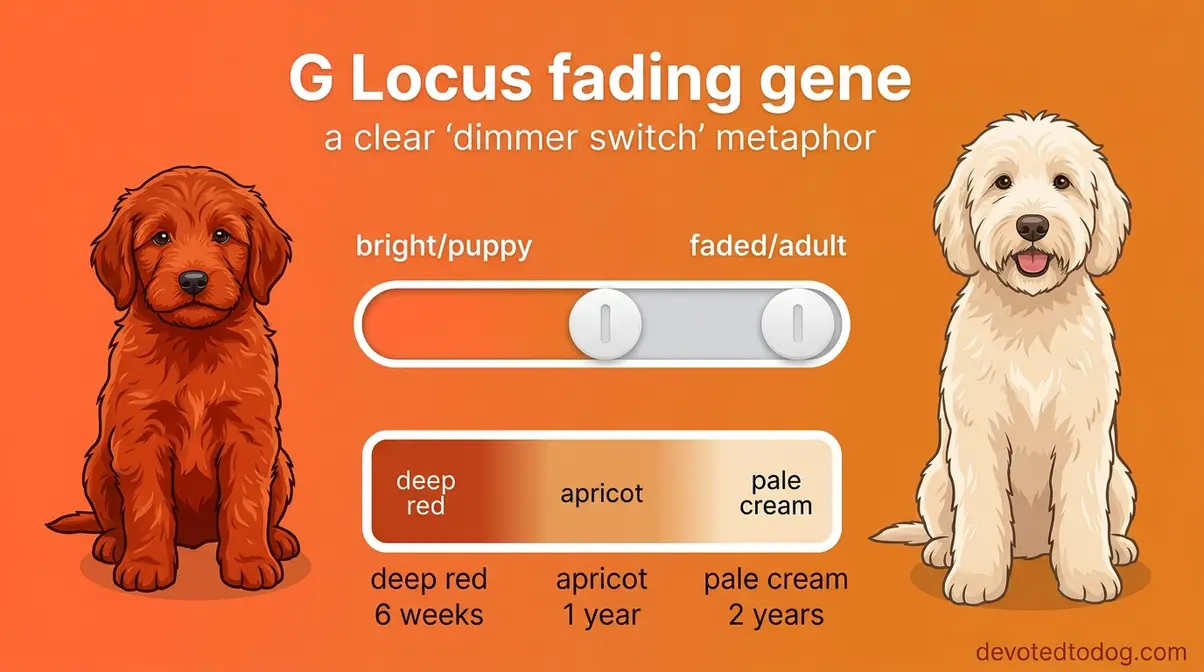
The Fading Predictor is our rating system for estimating how much a Goldendoodle’s color will change from puppyhood to adulthood, based on the G Locus gene and generational background. No competitor has a dedicated section like this — because most guides treat color fading as a mystery. Research from Cornell University and UC Davis shows it follows a consistent genetic pattern, which means buyers can predict it if they know what to look for.
The G Locus fading gene — inherited from the Poodle parent — causes many Goldendoodle coats to progressively lighten from puppyhood, with the most dramatic changes occurring in the first two years of life.
Your Fading Predictor Action Step: Before choosing a puppy, ask your breeder:
1. “Do either of the parents carry the G Locus fading gene?”
2. “Can I see photos of adult dogs from previous litters?”
3. “How has this specific puppy’s color changed since birth?”
What Is the Fading Gene (G Locus)?
The G Locus (also called the Progressive Graying gene) is a genetic variant inherited from the Poodle side of the family. Think of it like a built-in dimmer switch — it gradually reduces the intensity of your puppy’s coat color over time, without any visible trigger or warning. Dogs with the G Locus produce less pigment as they age, causing their coat to lighten progressively.
This is why a rich red puppy can become a soft apricot adult, and why a dark chocolate puppy can fade to café-au-lait by its second birthday. Cornell University research on the fading gene shows that the ‘dd’ genotype modifies the ‘B’ gene by fading its color through a process called epistasis (Cornell University Animal Science) — confirming that fading follows a predictable genetic pattern, not random chance.
Not all Goldendoodles carry the G Locus — it’s more common in F1B and multigen lines due to higher Poodle influence. We initially assumed fading was random, but the research shows it follows a consistent pattern — which means you can prepare for it.
Which Goldendoodle Colors Fade the Most?
Here’s your quick-reference Fading Predictor summary — the same ratings you’ve seen throughout the solid colors and patterns sections, now in one place:
| Color / Pattern | Fading Risk | Notes |
|---|---|---|
| Red | High | Often fades to apricot or cream by age 2 |
| Chocolate | High | Can lighten to café-au-lait; begins as early as 6 months |
| Sable | Very High | Dark-tipped hairs shed out; adult coat dramatically lighter |
| Gray / Silver | Very High (intentional) | Born black; fades to silver by design |
| Apricot | Medium | May lighten to cream; deeper apricots fade more |
| Parti (colored patches) | Medium | White areas stable; colored patches may lighten |
| Gold | Low–Medium | Lightens slightly but retains golden hue |
| Cream | Low | Stable; English Cream lines most consistent |
| Black | Low | May develop silver sheen; otherwise stable |
| White | Low | Can’t get much lighter; minimal change |
| Phantom | Low–Medium | Points may soften; pattern remains visible |
| Tuxedo | Low | White stable; dark body may develop slight sheen |
The D Locus (dilution gene) is a separate mechanism from the G Locus — it affects Eumelanin-based colors like black and chocolate by lightening them to gray or cream. UC Davis Veterinary Genetics Laboratory on coat dilution confirms that variants in the MLPH gene cause colors to dilute to paler shades, explaining why some Goldendoodles fade as they age (UC Davis Veterinary Genetics Laboratory). F1B Goldendoodles (75% Poodle) are more likely to carry both the G Locus and D Locus than F1 Goldendoodles — meaning their colors are statistically more likely to change.
If keeping your puppy’s color is a priority, choose cream, white, or black — these are the most stable solid colors. Learn how multigen Goldendoodle genetics affect color consistency for a deeper look at how multiple generations of Poodle influence amplify fading likelihood.
The Fading Timeline: Puppy to Adult
Knowing which colors fade is one thing — knowing when is another. Here’s what the typical fading timeline looks like:
- 6 weeks: Puppy coat is at its most vibrant — this is what you see in breeder photos
- 3–6 months: First signs of fading may appear, particularly in red and chocolate coats
- 1 year: Significant lightening often complete for high-fading colors; sable’s dark tips typically shed out
- 2 years: Adult coat is fully established; most fading is complete
- 3+ years: Some gray/silver development may continue in black-based coats
The timeline varies by individual dog and generational background — F1B dogs often fade faster and more dramatically than F1 dogs. Ask your breeder for photos of the same dog at 6 weeks, 6 months, and 2 years. That single request is the clearest predictor of your puppy’s adult coat you can get.
Understanding fading is crucial — but so is understanding why certain colors and patterns come with a higher price tag.
Rarity, Genetics, and What Affects the Price
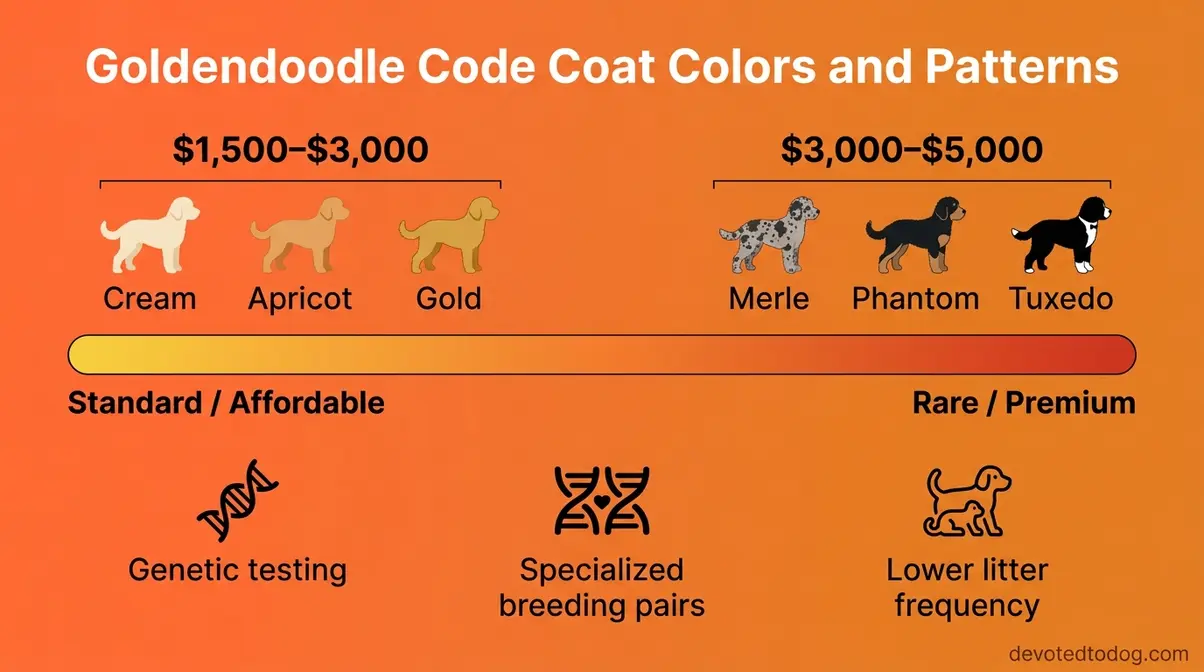
Rare Goldendoodle patterns like merle, phantom, and tuxedo can cost $3,000–$5,000 due to the specialized genetic testing and selective breeding required to produce them safely (goldoodle.com, 2026). Understanding what drives that price — and how generation affects which colors and patterns are even possible — helps you shop smarter and avoid paying a premium for the wrong reasons.
What Is the Rarest Goldendoodle Color?
Among solid colors, black is considered the rarest — it requires both parents to carry a recessive black gene that Golden Retrievers don’t naturally possess. Since the Golden Retriever side of the equation typically contributes gold, apricot, and cream genetics, the black gene must come almost entirely from the Poodle parent.
Among patterns, merle is the rarest — it requires a specific heterozygous gene combination and responsible breeding practices that limit how often it can be produced safely. Phantom and parti are also uncommon, each requiring both parents to carry specific recessive genes that aren’t present in all Poodle lines.
If rarity is important to you, black solid or merle-patterned Goldendoodles are your rarest options — but expect a longer waitlist and a higher price.
Why Do Some Goldendoodles Cost More?
The price premium for rare-pattern Goldendoodles reflects three real costs that responsible breeders absorb before a puppy is ever born. Rare-pattern Goldendoodles — merle, phantom, tuxedo — typically range from $3,000 to $5,000, compared to $1,500–$3,000 for standard solid-color Goldendoodles (goldoodle.com, 2026).
Those costs break down as: (a) genetic testing to confirm parent gene status, (b) the need for specialized breeding pairs — not every Poodle carries the required recessive genes, so breeders must maintain or source specific lines, and (c) lower litter frequency, since rare-pattern litters are planned and less common than solid-color litters.
A higher price is not automatically a quality signal. Always verify that your breeder conducts full health and genetic screening — not just that they produce rare colors. Never pay a premium for color alone; ask to see genetic test results from both parents before committing. Learn about multigen Goldendoodle traits and pricing to understand how generation affects both rarity and cost.
Genetics & Generations Matrix (F1 vs. F1B vs. F2)
To tie it all together, here’s how generation affects color and pattern likelihood — at a glance. This table is a general guide; individual litters vary based on specific parent genetics.
| Generation | Genetic Mix | Most Common Colors | Rare Pattern Likelihood | Fading Risk |
|---|---|---|---|---|
| F1 | 50% Golden Retriever + 50% Poodle | Gold, Apricot, Cream | Low | Low–Medium |
| F1B | 25% Golden Retriever + 75% Poodle | Apricot, Red, Chocolate | Medium | Medium–High |
| F2 | F1 × F1 cross | Variable | Medium | Medium |
| Multigen | Multiple Poodle generations | All colors possible | High | High |
Understand F1B Goldendoodle genetics and coat traits for a deeper breakdown of how the backcross generation affects color expression and texture.
Before you contact a breeder, there’s one more topic every prospective Goldendoodle owner needs to understand — the health considerations tied to certain colors and patterns.
Health Considerations When Choosing a Color or Pattern

Breeding two merle Goldendoodles — including ‘cryptic merles’ that appear solid — produces a 25% chance of double-merle puppies at high risk for congenital deafness and blindness (Clemson University + LSU School of Veterinary Medicine). This section addresses that risk directly, with the citations and practical steps you need to make a responsible choice.
Your Health Check Action Step:
Before buying a merle Goldendoodle, ask your breeder:
1. “Have both parents been genetically tested for the merle gene?”
2. “Can I see the test results from a certified lab (e.g., UC Davis VGL or Embark)?”
3. “Have any puppies from this breeder been born with hearing or vision issues?”
The Double Merle Warning
A double merle Goldendoodle (MM genotype) results from breeding two merle-patterned dogs. When two merles are paired, 25% of the puppies in that litter will be double merle — at significantly higher risk for congenital deafness, vision impairment, and skeletal defects (Clemson University, glimpse.clemson.edu).
The risk extends beyond visibly merle-patterned parents. Cryptic merles — dogs with minimal merle patterning that appear solid-colored — still carry the merle gene. Only genetic testing reveals cryptic merle status, making DNA screening from a certified lab non-negotiable before any merle breeding. LSU School of Veterinary Medicine’s findings on merle gene deafness confirm that the merle gene produces a mingled patchwork coat but is heavily associated with congenital deafness due to the suppression of melanocytes (LSU School of Veterinary Medicine). A 2020 clinical study on merle-related vision impairments further confirms that vision-impaired dogs frequently exhibit ophthalmic abnormalities directly related to the merle gene (PubMed Central).
Counter-narrative: Merle Goldendoodles are NOT inherently unhealthy — the risk applies specifically to double-merle (MM) dogs. A responsibly bred single-copy merle (Mm) is no more prone to health issues than any other Goldendoodle.
⚠️ This information is for educational purposes only and is not veterinary advice. Consult a licensed veterinarian or certified geneticist before selecting a merle Goldendoodle.
The good news: a responsible breeder makes all the difference. Here’s how to verify you’re working with one.
When to Consult a Reputable Breeder or Veterinarian
Consult a reputable breeder — ideally one affiliated with the Goldendoodle Association of North America (GANA) — before selecting any rare-pattern Goldendoodle, especially merle, phantom, or parti. Ask for genetic test results from a certified lab such as UC Davis VGL or Embark. These tests confirm whether both parents carry the relevant genes — and whether any hidden cryptic merle status exists.
Consult a veterinarian if you’re considering a merle puppy and want independent verification of genetic health status before committing. GANA maintains a breeder directory on their website — a useful starting point for finding ethical breeders who prioritize health testing alongside rare coat production.
Compare Goldendoodle breed traits with Golden Retrievers to understand how the parent breeds’ distinct genetic profiles shape both coat outcomes and health considerations.
Frequently Asked Questions
What is the rarest color for a Goldendoodle?
Solid black is considered the rarest solid color for a Goldendoodle, requiring both parents to carry a recessive black gene that Golden Retrievers don’t naturally possess. Among patterns, the merle is the rarest, requiring a specific heterozygous genetic combination and responsible breeding practices that limit production. Phantom and parti patterns are also uncommon, each requiring both parents to carry specific recessive genes. Rarity varies by breeder and region — expect longer waitlists and higher prices for these colors and patterns.
Which Goldendoodle is the most expensive?
Merle, phantom, and tuxedo Goldendoodles are typically the most expensive, often ranging from $3,000 to $5,000 due to the specialized breeding required (goldoodle.com, 2026). Producing these patterns safely requires genetic testing of both parents and carefully planned breeding pairs — costs that responsible breeders pass on to buyers. Standard solid-color Goldendoodles (apricot, cream, gold) typically range from $1,500–$3,000 depending on generation and breeder reputation. A higher price does not guarantee quality — always verify that your breeder conducts full health and genetic screening, not just that they produce rare colors.
Do Goldendoodle colors change over time?
Yes — many Goldendoodles experience significant color fading as they mature, driven by the fading gene (G Locus) inherited from their Poodle ancestry. The most dramatic changes occur in the first two years of life, with vibrant colors like deep red and rich chocolate most likely to lighten significantly. Fading can begin as early as six weeks of age and is typically complete by age two. Colors with the lowest fading risk include cream, white, and black — the most stable solid options for buyers who want consistency.
What are phantom Goldendoodles?
A phantom Goldendoodle has a solid dark base color — typically black or chocolate — with distinct lighter “points” appearing in exactly six specific locations. These lighter markings appear above the eyes, on the sides of the muzzle, across the chest, and on the lower legs — a pattern similar to the markings on a Rottweiler or Doberman. Phantom is a recessive pattern, meaning both parents must carry the phantom gene to produce a phantom puppy. The pattern remains visible throughout the dog’s life, though the lighter points may soften slightly as the base coat matures.
What is a parti Goldendoodle?
A parti Goldendoodle has a coat that is at least 50% white, with large irregular patches of a second solid color — apricot, red, black, or chocolate. The patch pattern is unique to each dog, creating a striking two-tone appearance that’s immediately recognizable and highly sought after. Unlike the abstract pattern (which has small white markings on a solid base), parti coats are defined by their significant white base coverage. Producing a parti puppy requires both parents to carry the recessive parti gene — which is why they’re rarer and more expensive than solid-color Goldendoodles.
Goldendoodle colors and patterns span 18+ variations — from the ever-popular apricot and cream to the rare merle and phantom. Every coat is determined by genetics inherited from the Golden Retriever and Poodle parents, and many colors will change significantly in the first two years of life. At devotedtodog.com, we recommend using The Fading Predictor ratings throughout this guide to choose a coat you’ll love at every life stage.
The Fading Predictor is your most important tool as a buyer — it shifts the question from “What color is this puppy now?” to “What color will this dog be at age three?” That question changes everything about how you evaluate a breeder’s photos and make your final choice. Red and chocolate puppies may fade dramatically; cream and black are your most stable bets.
Before you contact your first breeder, note your top three colors and patterns from this guide — then ask to see photos of adult dogs from previous litters in those specific coats. That single step will save you from the most common buyer disappointment: a puppy whose coat looks nothing like the adult dog you fell in love with.