
“Our F1 Goldendoodle is a walking typhoon.”
If that quote sounds exactly like something you’d say about your puppy right now, you’re in exactly the right place. Raising a 4 month old goldendoodle can feel overwhelming, but understanding the phase changes everything.
At four months, your 4-month-old Goldendoodle is simultaneously teething, testing every boundary you’ve set, and entering a developmental phase that makes recall training feel impossible. Without the right framework, this stage can feel like it will never end — but it will, and faster than you think.
By the end of this guide, you’ll understand exactly why your puppy behaves this way, how to predict their adult size, and what a healthy daily routine looks like — so you can stop reacting and start raising the dog you always imagined. We’ll walk through growth and weight benchmarks, the training strategies that actually work at this age, a complete daily care schedule, and what your puppy’s personality is telling you about who they’ll become.
Key Takeaways: Your 4-Month-Old Goldendoodle
Month four is “The 4-Month Pivot Point” — the predictable shift from baby to adolescent that explains everything from the zoomies to selective hearing. Here’s what you need to know right now:
- Weight check: Mini Goldendoodles typically weigh 10–15 lbs; Medium Goldendoodles 15–25 lbs; Standards 25–35 lbs at 4 months (Premier Pups, 2026)
- Exercise rule: Follow the 5-minute rule — 20 minutes of walking, twice daily, to protect developing growth plates (VCA Animal Hospitals)
- Training window: 16 weeks is the tail end of the critical socialization period — every positive experience counts now (UC Davis School of Veterinary Medicine)
- Behavior context: Hyperactivity and recall refusal are normal at this age, not signs of a problem dog
Growth and Size Expectations at 4 Months
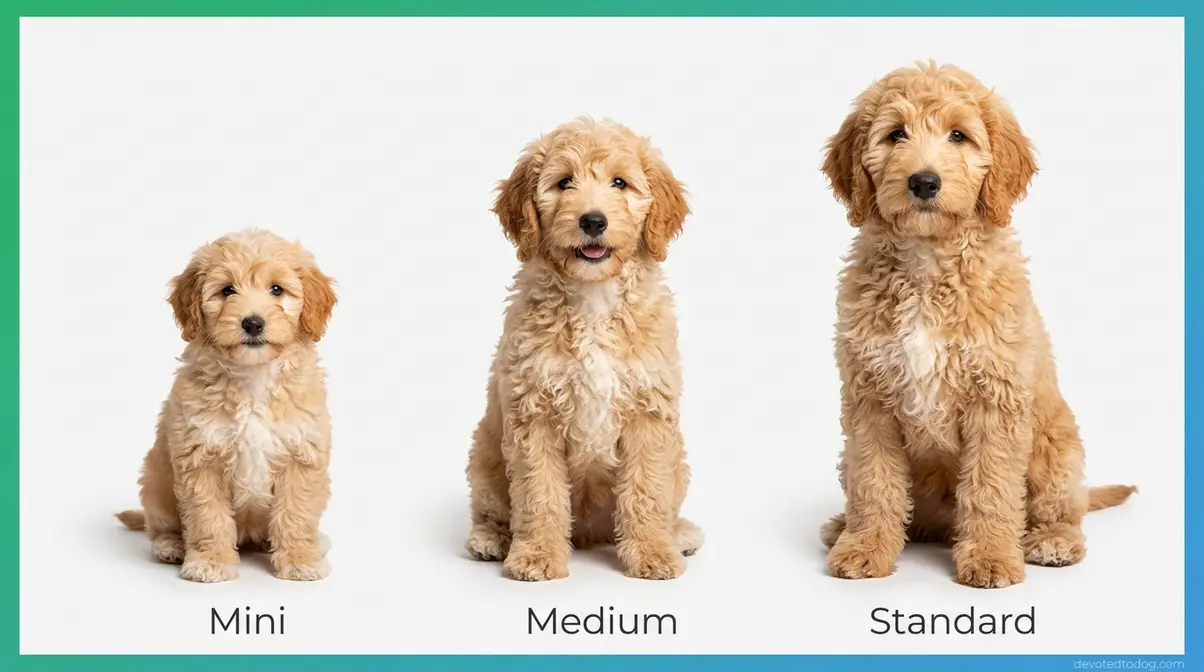
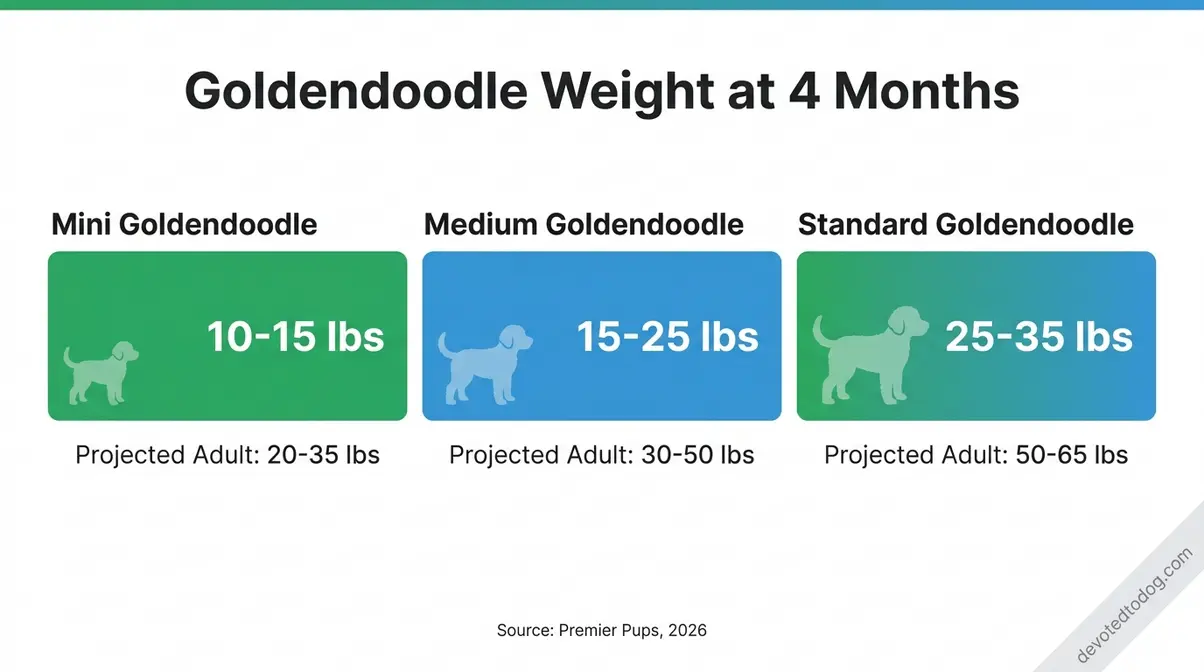
At 4 months, a Goldendoodle’s weight varies significantly depending on their size type — Mini, Medium, or Standard. A four-month-old Mini Goldendoodle typically weighs 10–15 lbs, while a Standard can reach 25–35 lbs by the same age (Premier Pups, 2026). That’s a wide range, and knowing where your puppy falls helps you benchmark their growth without unnecessary worry.
Tracking the development of a 4 month old goldendoodle is one of the most reassuring things you can do right now. Most owners are anxious because they simply don’t know what “normal” looks like — and the answer depends entirely on which size Goldendoodle you have.
Weight Ranges by Size Category
Here’s the data you came for. The list below shows typical 4-month weight ranges and projected adult sizes for each Goldendoodle size category:
- Mini Goldendoodle: 10–15 lbs at 4 months (Estimated Adult Weight: 20–35 lbs)
- Medium Goldendoodle: 15–25 lbs at 4 months (Estimated Adult Weight: 30–50 lbs)
- Standard Goldendoodle: 25–35 lbs at 4 months (Estimated Adult Weight: 50–65 lbs)
(Source: Premier Pups size guide, 2026; Goldilocks Goldendoodles weight chart, 2026)
The Miniature Goldendoodle — the smallest of the three size categories, typically weighing under 35 lbs as an adult — is bred from a Miniature or Toy Poodle parent. Mini Goldendoodles reach their adult size faster than their larger cousins, usually hitting full weight between 11 and 13 months. At 4 months, a Mini weighing 10–15 lbs is right on track. Use the full Goldendoodle size guide to compare your puppy’s measurements against breed-specific benchmarks.
The Standard Goldendoodle — the largest variety, bred from a Standard Poodle — is the slowest to mature, often reaching full size between 18 and 24 months. Their 4-month weight is the least reliable predictor of adult size because so much growth still lies ahead. A 30-lb Standard puppy at 4 months is perfectly normal; don’t be alarmed if they seem to grow in waves.
The Medium Goldendoodle falls between the Mini and Standard in size, typically landing in the 15–25 lb range at this age. Medium Goldendoodles generally reach adult size around 12–16 months, making them slightly more predictable than Standards.
A word on variation: A puppy at the lower or upper end of their category’s range is not necessarily underweight or overweight. Individual genetics — especially the specific Poodle parent’s size — influence weight more than breed averages at this stage. PetMD’s healthy weight tool can help you benchmark your puppy’s weight against breed-appropriate ranges (PetMD, 2026).
“At 4 months, a Miniature Goldendoodle typically weighs 10–15 lbs — roughly half their projected adult weight, with the growth rate slowing significantly after this point” (Premier Pups, 2026).
Now that you know what’s normal on the scale, the next question most owners ask is: how big will my puppy actually be when they’re fully grown?
Predicting Your Puppy’s Adult Size
The most widely used rule of thumb is the 16-week doubling formula: take your puppy’s weight at 16 weeks (4 months) and double it to estimate their adult weight. A puppy weighing 18 lbs at 4 months is likely to reach approximately 36 lbs as an adult (Goldilocks Goldendoodles, 2026; Sydney Animal Hospitals puppy weight calculator).
More precisely, Goldendoodle-specific calculators suggest that puppies at 16 weeks are approximately 42–45% of their adult weight — meaning you can also divide your puppy’s current weight by 0.42 for a slightly more refined estimate (Goldoodle.com weight calculator, 2026). Both methods give you a useful ballpark.
16-Week Weight × 2 = Estimated Adult Weight
Let’s walk through a real example. Your 4-month-old Mini Goldendoodle weighs 14 lbs. Using the formula: 14 × 2 = 28 lbs estimated adult weight. That puts them solidly in the Mini range (20–35 lbs). Easy.
This formula is an estimate, not a guarantee. Genetics, diet, and the specific Poodle parent’s size all influence final weight. Standard Goldendoodles are the least predictable because their growth extends longest — doubling the 4-month weight works best for Mini and Medium Goldendoodles.
The American Animal Hospital Association (AAHA) recommends monitoring puppy body weight at 14–16 weeks and again at 20–22 weeks during office visits as the gold standard for tracking healthy growth progression — AAHA weight monitoring guidelines (AAHA, 2019). These two checkpoints give your vet the data points needed to catch any growth concerns early.
For a deeper look at developmental milestones beyond weight, see our guide to 4-month-old Goldendoodle milestones for a full developmental timeline.
Weight is just one part of the picture. Your puppy’s body is changing in other visible ways right now too — here’s what to look for.
Physical Changes Happening Right Now
Between 3 and 6 months, Goldendoodles enter a rapid growth phase that shows up in several visible ways (Purdue University College of Veterinary Medicine, 2026). The most noticeable: your puppy’s legs grow before their body fills out, creating that classic gangly, uncoordinated look. If your puppy suddenly seems taller and clumsier than last month — that’s growth, not a problem.
The “leggy” phase is temporary. Within a few months, their body will catch up to their legs and they’ll look proportional again. During The 4-Month Pivot Point, these growth spurts can cause brief bouts of clumsiness that are completely harmless — just watch the stairs.
The coat transition is another change happening right now. Goldendoodles begin switching from their soft, fluffy puppy coat to their adult coat between 4 and 8 months. The adult coat may be curlier, wavier, or straighter than the puppy coat — often a surprise to owners who expected one texture and got another. Some shedding during this transition is normal, even in dogs marketed as low-shedding.
At 4 months, puppies are also losing their 28 baby teeth and growing their 42 adult teeth. Sore gums drive the chewing behavior you’re probably dealing with right now. This is pain relief, not aggression — and we’ll cover exactly how to redirect it in the Behavior section. According to Purdue University puppy development research, physical development milestones like teething and coat transition are tightly linked to the juvenile developmental stage beginning around 12–16 weeks (Purdue, 2026).
Quick Action — Growth Check
1. Weigh your puppy today (most pet stores have free scales).
2. Write down the date and weight.
3. Multiply by 2 to estimate adult weight (Mini/Medium) or reference the list above for Standards.
4. If weight falls significantly outside the ranges for your puppy’s size, contact your vet.
Reminder: Always consult your veterinarian for personalized growth and health guidance.
With growth benchmarks established, let’s tackle what’s really driving you to search at midnight: the behavior.
Behavior: Surviving the 4-Month Pivot
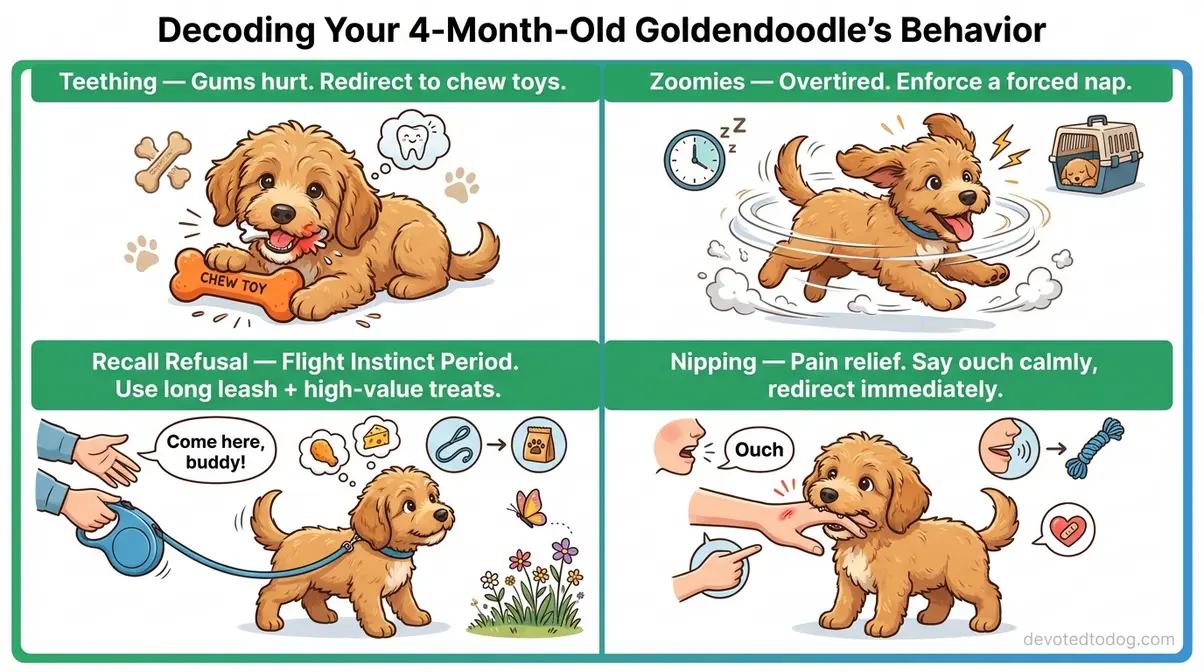
Behavioral challenges at four months are a predictable developmental phase — not a training failure, and not a sign your puppy is broken. The 4-Month Pivot Point is the simultaneous onset of the Flight Instinct Period, peak teething, and boundary-testing that makes month four feel like your puppy forgot everything they learned. This section gives you a step-by-step plan for each major behavior, so you can stop reacting and start guiding.
Understanding how to train a 4-month-old Goldendoodle starts with understanding why they’re behaving this way — because the “why” changes everything about your response.
Understanding the Flight Instinct Period
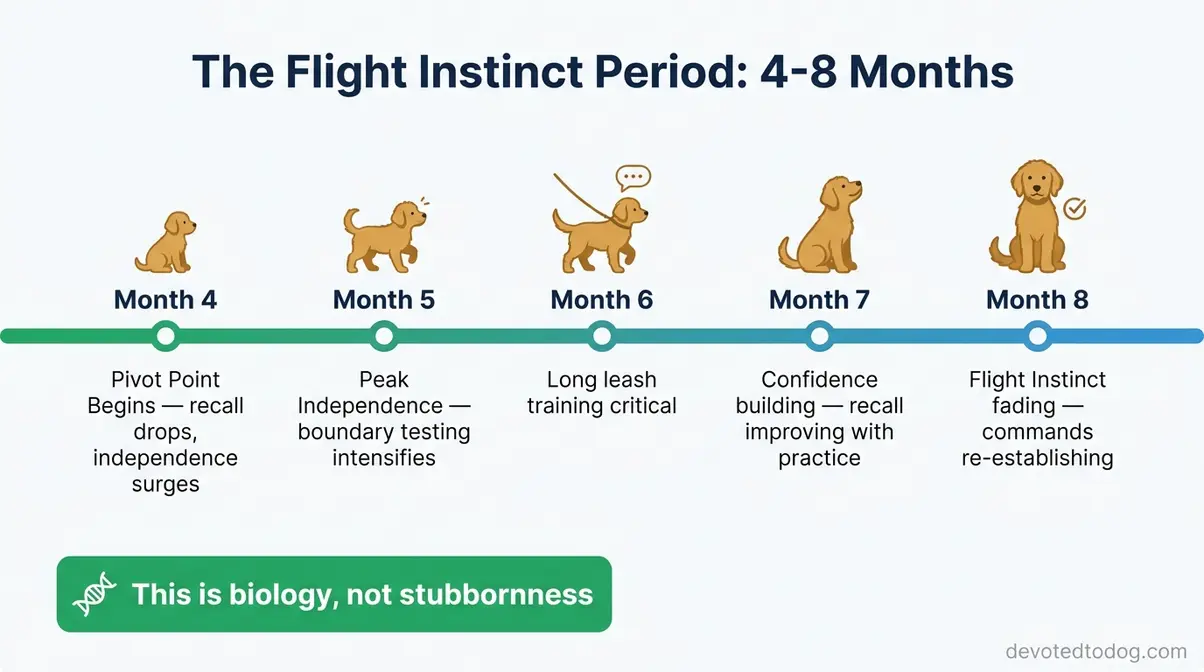
The Flight Instinct Period — a developmental phase between 4 and 8 months where a puppy’s growing confidence causes them to ignore commands and explore independently — is one of the least understood behaviors new owners encounter. Your Goldendoodle may suddenly stop responding to “come,” bolt toward the neighbor’s yard, or look directly at you and run the other direction. This isn’t stubbornness. It’s biology.
Biologically, this coincides with the puppy entering the juvenile developmental stage. The sensitive period for socialization ends around 12–16 weeks, meaning your puppy is now past peak socialization and entering a confidence-building phase where independence is a survival instinct. According to Purdue University puppy development research, this shift from the socialization-sensitive period to the juvenile phase is well-documented across canine development studies (Purdue University College of Veterinary Medicine, 2026).
“At 4 months, a puppy’s growing independence is a biological drive — not a personality flaw. Understanding this reframes every training challenge at this age.”
What should you do during the Flight Instinct Period? Never punish a puppy for running off — it will make recall worse, not better. Instead, practice recall on a long leash (15–30 feet) in a safely enclosed area. Always reward coming back with extreme enthusiasm, your highest-value treat, and genuine excitement.
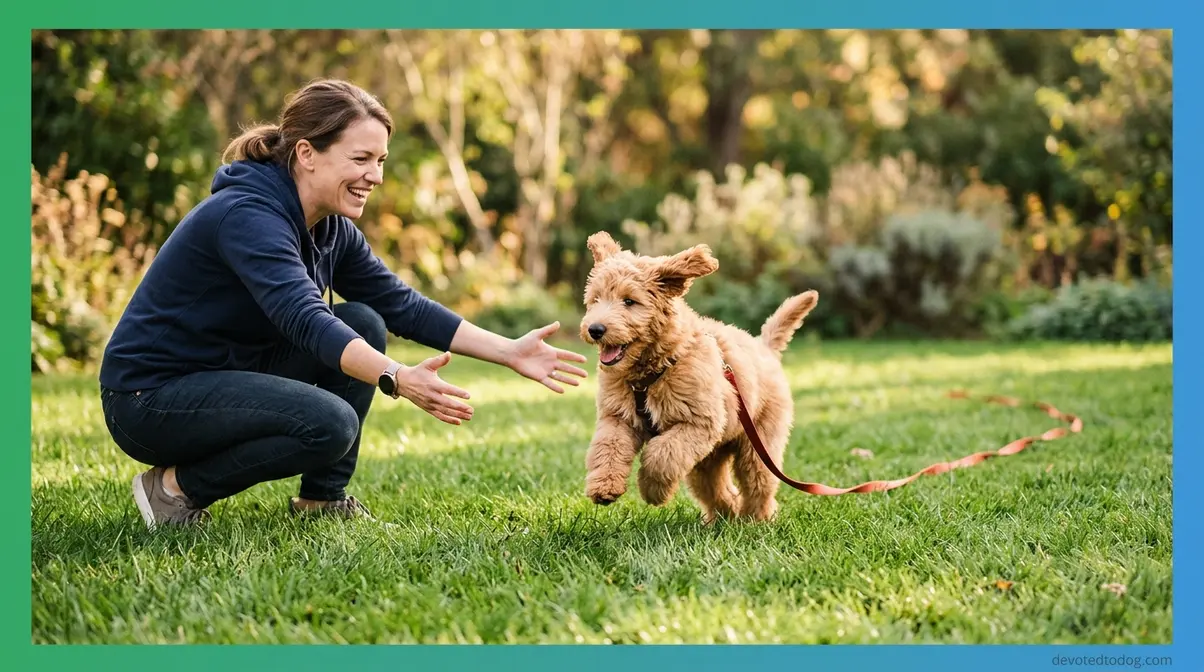
If your Goldendoodle bolts and ignores your calls, don’t chase. Call once, then crouch down and make yourself the most exciting thing in the yard. Make it a game they want to win.
The Flight Instinct explains the recall problem. But what about the puppy who seems to have unlimited energy and zero off switch? That’s where forced naps come in.
Managing Hyperactivity with Forced Naps
A “forced nap” is a structured crate rest period (30–90 minutes) used to interrupt the overstimulation cycle that causes extreme hyperactivity in young puppies. When a puppy has been awake and active for more than 1–2 hours, their behavior escalates — not because they’re bad, but because they’re overtired and overstimulated.
Puppies at 3–6 months need approximately 16–18 hours of sleep per day (Petdirect, 2026). When they don’t get it, you see the behavior spiral: biting harder, zoomies that won’t stop, complete inability to respond to simple commands. Structured rest breaks that cycle.
VCA Animal Hospitals note that structured routines — including scheduled rest — are foundational to positive behavior development in puppies (VCA Animal Hospitals training guidance, VCA, 2026). A forced nap isn’t punishment. It’s maintenance.
How to implement a forced nap:
Step 1: Watch for signs of overstimulation
Look for biting harder than usual, inability to respond to simple commands, or zoomies that don’t stop.
Step 2: Guide them to the crate
Calmly lead (do not carry) your puppy to their crate.
Step 3: Provide a distraction
Offer a chew toy or Kong filled with frozen peanut butter.
Step 4: Enforce the rest period
Close the crate and leave the room for 30–60 minutes.
Step 5: Wait for calm
Do not respond to whining — wait for a moment of quiet before releasing.
Crate training and forced naps also make potty training your Goldendoodle puppy significantly easier, because a rested puppy is a puppy who can actually focus on signals from their body.
Once your puppy is rested, they’re ready to learn. Here’s how to build the three commands every 4-month-old Goldendoodle should be starting.
Teaching Sit, Stay, and Recall
Training a 4-month-old Goldendoodle is one of the most rewarding things you can do right now — and the timing couldn’t be better. The American Kennel Club recommends enrolling puppies in formal training classes at 16 weeks, which is exactly where your puppy is now (AKC puppy training timeline, AKC, 2026). This is the ideal window for establishing foundational commands.
“At 16 weeks, puppies are ready for formal training classes — and this is also the tail end of their critical socialization window” (American Kennel Club, 2026).
Understanding Goldendoodle intelligence and trainability helps explain why they pick up commands quickly when the approach is right — and why they shut down when it’s not.
- What you’ll need before starting:
- Small, soft training treats (pea-sized — chicken, cheese, or commercial training treats)
- A quiet room with minimal distractions
- 5-minute sessions only (attention spans are short at this age — two sessions per day beats one long one)
Teaching “Sit”:
Step 1: Position the treat
Hold a treat at your puppy’s nose.
Step 2: Guide the movement
Slowly move your hand back over their head — their bottom will naturally lower.
Step 3: Mark and reward
The moment their bottom touches the ground, say “Sit” and give the treat.
Step 4: Practice in short bursts
Repeat 3–5 times per session. Stop before they lose interest.
Teaching “Come” / Recall (most critical during the Flight Instinct Period):
Step 1: Prepare the environment
Attach a 15-foot long leash to your puppy’s collar in a safe outdoor area.
Step 2: Initiate the cue
Let them wander, then crouch down, open your arms, and say “Come!” in a happy voice.
Step 3: Guide if necessary
If they don’t respond within 3 seconds, give a gentle tug on the leash and continue encouraging.
Step 4: Reward heavily
When they reach you, reward with the highest-value treat you have and enthusiastic praise.
Step 5: Protect the command
Never call “Come” and then do something your puppy dislikes (bath, crate) — it poisons the cue.
Common mistake to avoid: Repeating commands multiple times (“Sit, sit, SIT!”) teaches your puppy to ignore the first one. Say it once, wait, then guide them physically if needed. Consistency here matters more than anything else.
Redirection Techniques for Nipping
At 4 months, puppies are losing all 28 baby teeth and growing 42 adult teeth. Their gums ache. Chewing and mouthing is pain relief — not aggression, not dominance, not a sign of a “bad” dog.
Ohio State University’s Veterinary Medical Center recommends positive redirection over punishment for puppy nipping, noting that harsh methods can increase anxiety in sensitive breeds like Goldendoodles (OSU Veterinary Medical Center behavior guidelines, OSU VMC, 2026).
The redirection method:
Step 1: Mark the bite
When your puppy mouths your hand, say “ouch” in a calm, flat tone — not a yelp, which can excite some puppies further.
Step 2: Provide an alternative
Immediately redirect to an appropriate chew toy.
Step 3: Reinforce the good choice
Praise and reward when they chew the toy instead.
What NOT to do: Don’t flick their nose, hold their mouth shut, or raise your voice. Goldendoodles are sensitive dogs — harsh corrections create anxiety, not compliance. Frozen Kongs, bully sticks, and rubber chew toys work best for this age.
Today’s Training Starter Plan
1. Set a timer for 5 minutes, twice today.
2. Practice “Sit” (5 repetitions) and “Come” (5 repetitions) each session.
3. If your puppy gets overstimulated mid-session, end early and schedule a forced nap.
4. End every session with play — training should always feel like a good thing.
Consistency beats intensity. Five minutes daily beats one 30-minute session weekly.
You’ve got the behavior and training foundation. Now let’s make sure the basics of daily life — feeding, exercise, and grooming — are dialed in.
Daily Care: Feeding, Exercise & Grooming

At 4 months, a Goldendoodle needs three meals daily, 20 minutes of structured walking twice daily, and basic weekly grooming. The American Animal Hospital Association’s canine life stage guidelines emphasize consistent feeding schedules and regular weight monitoring during this phase to support healthy development (AAHA, 2019). Getting these three pillars right prevents most behavioral problems and most physical health issues — they’re more connected than they seem.
One important note for owners navigating The 4-Month Pivot Point: the surge in energy during this stage can tempt you to exercise your puppy more than recommended. More exercise does not equal a calmer puppy. It often creates the opposite effect — an over-stressed, overtired dog whose behavior gets worse, not better.
How Much to Feed Your Puppy
At 4 months, feed your Goldendoodle 3 meals per day, at consistent times — breakfast, lunch, and dinner. This schedule supports stable blood sugar, reduces digestive upset, and makes potty training significantly easier because meals happen at predictable times.
Portion size depends on your puppy’s current weight and the specific food brand’s guidelines. Follow the feeding chart on your puppy food bag for their current weight, then divide that daily amount into three equal meals. The American Kennel Club recommends not exceeding the daily recommended intake across all meals for small and toy breeds — this applies especially to Mini Goldendoodles (AKC small breed feeding guidance, AKC, 2026).
- Food type matters too. Choose a high-quality puppy food formulated for the appropriate size:
- Mini Goldendoodles: Small breed puppy formula
- Standard Goldendoodles: Large breed puppy formula — large breed puppy food has controlled calcium levels that support healthy bone development and reduce joint stress
Common mistake: Free-feeding (leaving food out all day) makes it impossible to monitor intake and can cause digestive issues. Scheduled meals also give you a clear signal if your puppy goes off food — which can indicate illness.
For example: if your Standard Goldendoodle weighs 30 lbs at 4 months, check your puppy food bag for the 25–35 lb weight range and divide that daily amount into 3 meals.
Food fuels the energy. But how much of that energy should you channel into physical exercise — and how much is too much for a 4-month-old’s joints?
The 5-Minute Rule for Exercise
The “5-minute rule” — a widely cited guideline for puppy exercise that limits structured walks to 5 minutes per month of age — means a 4-month-old Goldendoodle should walk no more than 20 minutes per session, up to twice daily. Crockett Doodles exercise guidelines confirm this framework, citing veterinary consensus on protecting developing joints (Crockett Doodles, 2026).
The 5-Minute Rule: 5 min × months of age × 2 daily walks = 20 min/walk at 4 months
Why does this matter? A 4-month-old Goldendoodle’s growth plates — the soft cartilage tissue at the ends of bones — have not yet closed. Repetitive impact from over-exercising can damage these plates permanently, leading to joint issues in adulthood. This is especially important for Standard Goldendoodles, whose growth plates close later than Minis (VCA Animal Hospitals, 2026).
“A 4-month-old Goldendoodle should walk no more than 20 minutes twice daily — over-exercise at this age risks damage to still-developing growth plates” (Canine Health and Rehabilitation, citing veterinary consensus, 2026).
- What counts toward the limit — and what doesn’t:
- Counts: Structured, on-leash walking on hard surfaces
- Doesn’t count: Free play in the yard, puppy play sessions, short zoomies — these are self-regulating
For more detail on building a safe activity plan, see appropriate exercise for a Goldendoodle puppy as your puppy grows through each stage.
Now that feeding and exercise are sorted, let’s talk about the one thing that surprises most new Goldendoodle owners: the coat.
Grooming and the Coat Transition
Between 4 and 8 months, Goldendoodles transition from their puppy coat to their adult coat. The adult coat may be curlier, wavier, or straighter than the puppy coat — this is genetics-dependent and varies widely, even within the same litter.
Some Goldendoodles shed during the coat transition; others barely shed at all. This depends on their specific Poodle-to-Golden Retriever ratio. For a full breakdown of what to expect by coat type, see managing Goldendoodle shedding and grooming — including which generations tend to shed most during the 4 month old Goldendoodle shedding phase.
- Grooming basics at 4 months:
- Brush 2–3 times per week to prevent matting during the coat transition
- Schedule your first professional grooming appointment between 4 and 6 months — early acclimation makes future grooming stress-free
- Keep the area around eyes, ears, and paws trimmed to prevent irritation
Daily Care Quick Reference
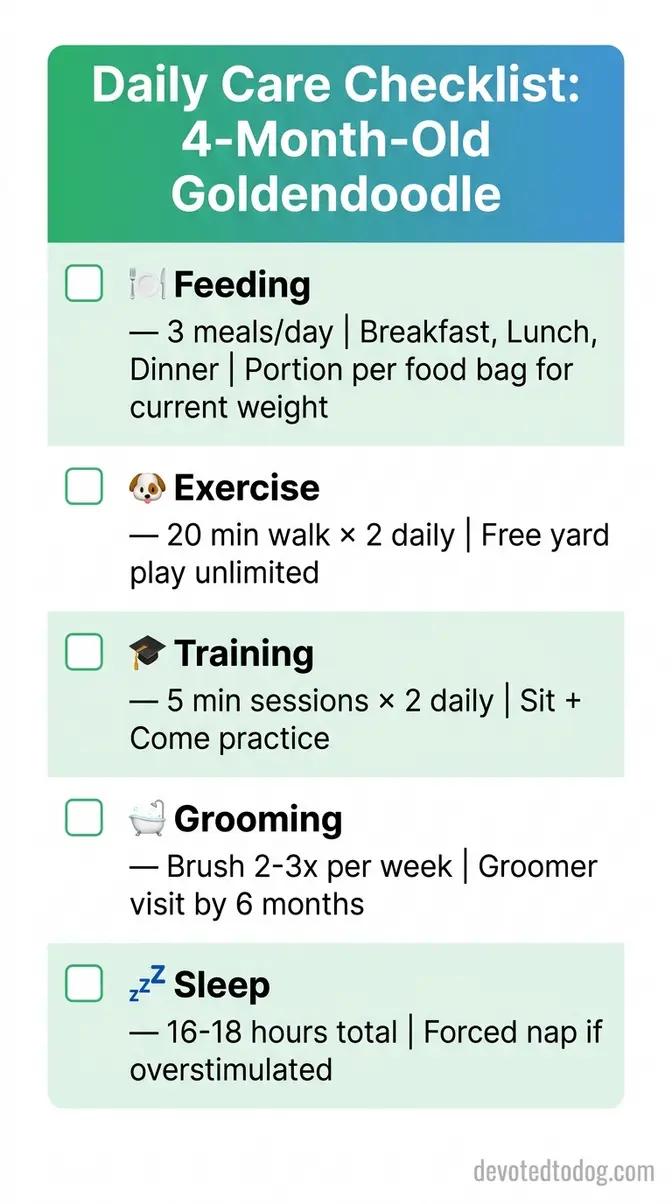
- 🍽️ Feeding: 3 meals/day at consistent times | Portion per food bag guidelines for current weight
- 🦮 Exercise: 20 minutes walking, twice daily (the 5-minute rule) | Free yard play: unlimited
- 🛁 Grooming: Brush 2–3× per week | First groomer visit by 6 months
- 💤 Sleep: 16–18 hours per day (3–6 month puppies) | Use forced naps during overstimulation
Always consult your veterinarian for personalized feeding and health guidance.
Daily care is the foundation. But what about the bigger questions — what does your puppy’s personality tell you about who they’ll become, and where can you find a 4-month-old Goldendoodle if you’re still looking?
Personality, Appearance, and Adoption
At 4 months, a Goldendoodle — a hybrid breed created by crossing a Golden Retriever with a Poodle — is in full “toddler” mode: curious, affectionate, and beautifully unpredictable. Goldendoodles are consistently ranked among the most popular family dogs in the United States, valued for their friendly temperament and lower-shedding coats (Rover, 2026). Beyond the chaos of this stage, there’s a personality forming right now that will be with you for 10–15 years — and it’s worth getting to know.
“Goldendoodles are consistently ranked among the most popular family dogs in the United States, valued for their low-shedding coats and friendly temperament” (Rover, 2026).
What Does Your Puppy Look Like?
If you’ve been searching for 4-month-old Goldendoodle pictures to compare with your own puppy, here’s what you’ll typically see: oversized paws, a fluffy puppy coat, and that characteristic “leggy” look from the recent growth spurt. They often resemble a stuffed animal come to life — which is exactly where the “teddy bear” nickname comes from.
Goldendoodles come in a wide range of colors: cream, apricot, red, chocolate, black, and multi-color patterns. A 4-month-old black Goldendoodle may lighten as their adult coat comes in — another genetics-driven surprise. For a full overview of color possibilities by generation, see Goldendoodle coat colors and patterns.
What is a teddy bear golden?
A “Teddy Bear Goldendoodle” is not a separate breed — it’s a nickname for Goldendoodles with a rounder face, shorter muzzle, and dense, plush coat resembling a stuffed animal. This look is most common in F1B or F2B Goldendoodles, which have a higher Poodle percentage and tend to have curlier, denser coats. The teddy bear appearance is most pronounced in puppyhood and may change as the adult coat grows in between 4 and 8 months. Coat texture and facial structure vary widely even within the same litter, so the teddy bear look is not guaranteed even in F1B puppies.
The look is just the beginning. The personality that’s developing right now is what will make your Goldendoodle uniquely yours.
Personality Traits at 4 Months

Yes — Goldendoodles often develop a primary bond with one person. Typically, that’s the person who provides the most feeding, training, and daily affection. This isn’t exclusionary; they love the whole family. But they will follow their primary caregiver most closely, especially during the bonding-intensive months between 3 and 6 months.
At 4 months, this bonding pattern is still forming. Whoever is most consistent with training and care right now will likely become the “favorite.” Rotating training responsibilities among family members can help distribute the bond more evenly.
Most Goldendoodles inherit the Golden Retriever’s love of water. At 4 months, introduce water gradually — a shallow kiddie pool or calm lake edge makes an ideal first experience. Never force a puppy into water; positive first experiences are critical for building a lifelong love of swimming.
One important counter-narrative worth naming: the Instagram version of a Goldendoodle is perfectly groomed and endlessly calm. The 4-month reality is a rambunctious, muddy, chewing machine who is also desperately trying to love you. Both things are true — and the messy version is the one that actually bonds with you.
What do Goldendoodles not like?
Goldendoodles are sensitive dogs that dislike harsh correction, being left alone for long periods, loud sudden noises, and being ignored. They are prone to separation anxiety and thrive on human companionship — a 4-month-old should not be left alone for more than 2–3 hours at a stretch. Owners consistently report that Goldendoodles are particularly sensitive to raised voices, which can cause anxiety even during routine household activity. Providing consistent routines, positive training, and adequate companionship prevents most of the behaviors that stem from these dislikes. For more on how their intelligence shapes these sensitivities, see how intelligent Goldendoodles are.
Finding a Puppy for Sale
If you’re still looking for a 4-month-old Goldendoodle for sale, this is actually a reasonable age to adopt. The critical socialization window — approximately 3 to 14 weeks — is closing, but a 4-month-old puppy is still young enough to bond deeply and adapt to a new home with consistent care. According to UC Davis puppy socialization guidelines, puppies remain highly adaptable at the tail end of this window (UC Davis School of Veterinary Medicine).
- What to look for in a reputable breeder:
- Health testing documented for both parents (hips, eyes, heart)
- Puppies raised in a home environment, not a kennel
- Breeder provides full vaccination and deworming records
- No sales through pet stores or third-party brokers
Breed-specific rescues are also a valid and ethical option — some have 4-month-old Goldendoodles available through surrender or foster networks.
4-Month Milestone Check: Is Your Goldendoodle on Track?
By 4 months, your Goldendoodle should:
- [ ] Recognize their name and respond at least some of the time
- [ ] Be starting to understand “Sit” with consistent practice
- [ ] Be on a 3-meal-per-day feeding schedule
- [ ] Be sleeping 16–18 hours per day (3–6 month range)
- [ ] Have started or scheduled their first groomer visit
- [ ] Be walking 20 minutes, twice daily (no more)
If your puppy is significantly behind on any of these — especially weight milestones — consult your veterinarian.
Before we get to your most pressing questions in the FAQ, here’s an honest look at what doesn’t always go right at this age — and when to call the vet.
Common Pitfalls and When to Call Your Vet
Even with the best intentions, new Goldendoodle owners make predictable mistakes at this stage. Knowing what they are — and why they backfire — is half the battle.
Common Mistakes New Owners Make
1. Over-exercising because the puppy “seems fine.”
The 5-minute rule feels conservative when your puppy is pulling toward the park. But growth plates don’t signal pain until damage is done. Stick to 20 minutes twice daily, even when your puppy seems to want more. Long-term joint health is built in these early months.
2. Skipping crate training.
Free-roaming a 4-month-old Goldendoodle leads to destructive behavior, potty training regression, and a puppy who never learns to self-regulate. The crate is not punishment — it’s a tool for building independence and preventing the behavior spiral that comes from chronic overstimulation.
3. Using inconsistent commands.
Saying “come” sometimes and “here” other times — or letting different family members use different cues — confuses your puppy and slows recall training significantly. Pick one word per command and use it every time, with every person in the household.
4. Punishing Flight Instinct behavior.
Punishing a puppy for not coming back during the Flight Instinct Period makes recall worse, not better. Your puppy will learn to avoid you, not run toward you. Use positive reinforcement exclusively during this phase.
5. Delaying socialization because the puppy is “too young.”
The socialization window is closing at 4 months. Every week you wait is a week of missed positive experiences with people, dogs, sounds, and environments. Enroll in a puppy class now — safely vaccinated puppies can socialize in controlled settings.
When to Call Your Veterinarian
Knowing when to call the vet is part of being a responsible owner — not a sign of failure. Contact your veterinarian if you notice:
- Weight significantly outside the range for their size type (more than 20% above or below the benchmarks in this guide)
- Refusal to eat for more than 24 hours — this is not normal puppy behavior
- Limping or reluctance to bear weight on any limb — possible joint stress from over-exercise or injury
- Extreme lethargy or unresponsiveness that doesn’t improve after a rest period
This guide is for informational purposes only. Always consult your veterinarian for any health concerns specific to your puppy.
Frequently Asked Questions
How big should they be at 4 months?
At 4 months, a Goldendoodle’s weight varies significantly by size type — Mini Goldendoodles typically weigh 10–15 lbs, Mediums 15–25 lbs, and Standards 25–35 lbs (Premier Pups, 2026). These ranges reflect normal genetic variation; a puppy at the lower or upper end of their size category’s range is not necessarily underweight or overweight. A common rule of thumb is to double your puppy’s 4-month weight to estimate their adult size. If your puppy’s weight falls significantly outside their size range, consult your veterinarian for a personalized assessment.
How do you discipline a puppy?
Discipline a 4-month-old Goldendoodle using positive reinforcement — reward good behavior immediately with treats or praise. For hyperactivity or nipping, redirect their attention to a chew toy and use a structured forced nap in their crate to interrupt the overstimulation cycle. Harsh corrections like yelling increase anxiety in Goldendoodles and make behavior worse, not better.
Do Goldendoodles pick a favorite person?
Yes — Goldendoodles often form a primary bond with the person who provides the most feeding, training, and daily affection. This doesn’t mean they’re unfriendly to the rest of the family; they love everyone, but they’ll follow their primary caregiver most closely. At 4 months, this bonding pattern is still forming — whoever is most consistent with training and care now will likely become the “favorite.” Rotating training responsibilities among family members can help distribute the bond more evenly.
How much exercise do they need?
A 4-month-old Goldendoodle needs approximately 20 minutes of structured walking, twice daily (according to veterinary consensus from Crockett Doodles, 2026). This limit protects their still-developing growth plates from repetitive impact damage. Free play in a yard or puppy play sessions are self-regulating and do not need to be strictly time-limited.
What is the flight instinct?
The Flight Instinct Period is a developmental phase between 4 and 8 months where a puppy’s growing confidence causes them to ignore commands and explore independently. During this phase, your Goldendoodle may suddenly stop responding to “come” — not because they’ve forgotten it, but because independence is a biological drive at this stage. Practice recall training on a long leash (15–30 feet) in a safely enclosed area, rewarding every successful return enthusiastically. Never punish a puppy for not coming back during this period — it will make recall training significantly harder.
Do Goldendoodles like water?
Most Goldendoodles love water, inheriting this trait from their Golden Retriever parent, which was bred as a water-retrieving dog. Introduce water gradually at this age using a shallow kiddie pool, and never force a cautious puppy in.
Information in this guide verified as of July 2026. Consult your veterinarian for health guidance specific to your puppy.
You’ve Got This: Your Action Plan from Here
For new owners of a 4 month old goldendoodle, this stage is one of the most challenging — and most formative — of your puppy’s development. Puppies at 3–6 months need 16–18 hours of sleep daily, benefit from no more than 20 minutes of structured walking twice per day, and are at the tail end of their critical socialization window (Petdirect, 2026; Crockett Doodles, 2026). At Devoted to Dog, the most effective approach we’ve seen combines size-specific weight monitoring, the 5-minute exercise rule to protect developing growth plates, and consistent positive reinforcement training before that socialization window closes entirely.
The chaos you’re experiencing right now is not a sign of a problem dog. It’s The 4-Month Pivot Point — the predictable, temporary transition between puppy and companion that explains the zoomies, the selective hearing, and the “walking typhoon” moments. Knowing that it’s a phase — with a name, a timeline, and a playbook — changes everything. The Pivot Point ends. Your dog’s best self is already forming.
Start today: one 5-minute “Sit” and “Come” session before dinner, followed by a forced nap if your puppy is overstimulated. Write down their weight and use the doubling formula from this guide to predict their adult size. Check the milestone list. Then do it again tomorrow. The small, consistent actions you take during the 4-Month Pivot Point will shape the dog they become for the next 12 years — and that’s worth every chaotic, rambunctious, muddy moment.
For related background, see our guide on 6 Month Old Goldendoodle: Complete Owners Guide.
For related background, see our guide on 3 Month Old Goldendoodle: Complete Owners Guide.
Readers comparing options often find our piece on 5-Month-Old Goldendoodle: Growth, Behavior Care (2026) helpful for additional context.
For a step-by-step approach to housebreaking your Goldendoodle, see our guide on How to Potty Train a Goldendoodle.
Brianna York is a former veterinary technician with hands-on clinical experience in canine health. She contributes medical accuracy review to DevotedToDog health articles and validates clinical claims against current AVMA, AAHA, and OFA standards.