“We have met three different golden retrievers on our walks and all of them were extremely aggressive. They snarled and snapped and bared their teeth like they wanted to attack us.”
, Real owner account, shared in a Golden Retriever community forumReactivity and aggression are the behaviors owners worry about most. Our Golden Retriever behavior guide puts them in developmental context.
If you’ve witnessed something like this, your worry makes complete sense. Golden Retrievers are famous for being gentle and friendly, so watching one snarl and snap is genuinely alarming. But here’s what the research actually shows: Golden Retrievers are not aggressive dogs. They consistently rank among the least aggressive breeds toward both humans and other dogs (Duffy, Hsu & Serpell, Applied Animal Behaviour Science, 2008).
But “not naturally aggressive” doesn’t mean “can never become aggressive.” When it does happen, there’s always a reason, and almost always a solution. Are golden retrievers aggressive by nature? No. But any dog can show aggression under the right circumstances, and understanding those circumstances is everything.
In this guide, you’ll learn exactly what causes aggression in Golden Retrievers, how to tell the difference between play and real danger, and the step-by-step actions you can take to prevent and address it. We’ll cover everything from body language cues to health-related triggers to what the science says about breed comparisons, so you can make confident decisions for your dog and your family.
Our team at Devoted to Dog compiled this guide from peer-reviewed research (including Duffy, Hsu & Serpell, 2008, and van den Berg et al., 2006 and 2008) and from resources published by Purdue University and Cornell University’s College of Veterinary Medicine.
Duffy et al. 2008
all 3 needed
van den Berg 2006
owner-reported change
Author Credentials
📝 Written by: Coral Drake
✅ Reviewed by: Brianna York, Former Veterinary Technician
📅 Last updated: 5 May 2026
ℹ️ Transparency Notice
This article addresses Golden Retriever aggression myths and triggers based on AKC breed standard, AVMA bite-incident research, and certified canine behaviorist analysis. Health figures name their source, and our editorial team checked them against those sources. We are not veterinarians, and this article is not veterinary advice.
| Breed | Aggression Risk Profile | Triggers |
|---|---|---|
| Golden Retriever | Low , bred for soft mouth and friendliness | Pain, fear, food/resource guarding (rare), poor socialization |
| Labrador Retriever | Low | Similar to Goldens |
| German Shepherd | Moderate (working/protective) | Stranger threat, territorial, untrained guard drive |
| Pit Bull / APBT | Higher dog-directed aggression by owner survey (Duffy et al., 2008), but aggression ≠ breed | Inadequate socialization, reactive triggers |
| Chihuahua | High aggression rate by survey, low bite damage | Fear, small-dog syndrome, poor handling |
Table of Contents
For more on this topic, see our guide on the How Fast Can Golden Retrievers Run? Speed & Safety Guide.
- Are Golden Retrievers Actually Aggressive?
- Causes of Golden Retriever Aggression
- Play vs. Aggression: Body Language
- Aggression Toward Dogs and Strangers
- Age, Gender, and Coat Color Effects
- Golden Retrievers vs. Other Breeds
- Why People Love and Hate Goldens
- When Health Problems Cause Aggression
- When to Seek Professional Help
- Frequently Asked Questions
- Start Understanding Your Golden
Are Golden Retrievers Actually Aggressive?

Golden Retrievers are not aggressive dogs. The American Kennel Club (AKC), the United States’ primary dog breed registry, describes the breed standard as “friendly, reliable, and trustworthy”, and the data backs that up. In a survey of owners of more than 30 breeds, Golden Retrievers were among the least aggressive breeds toward both humans and dogs (Duffy, Hsu & Serpell, 2008). If you’re worried that the breed is secretly dangerous, the science consistently says otherwise.
That said, understanding why Goldens are so reliably gentle, and what would have to go wrong for one to become aggressive, is far more useful than a simple “they’re fine” reassurance. Later in this guide, we’ll introduce The Aggression Trigger Triangle, a framework that explains exactly when and why aggression occurs. For now, let’s look at what the research actually shows.
The AKC Breed Standard
The AKC breed standard, the official written description of ideal traits for a breed, used by breeders to guide their decisions, describes the Golden Retriever as “friendly, reliable, and trustworthy.” Those words aren’t just marketing language. They describe specific behavioral tendencies that breeders have selected for over generations.
“Friendly” means a Golden is expected to approach unfamiliar people and animals with curiosity rather than wariness. “Reliable” means their behavior is predictable, they don’t flip between calm and reactive unpredictably. “Trustworthy” means they can be placed in situations involving children, strangers, and other animals without requiring constant supervision to prevent aggression.
The Golden Retriever is a sporting breed (first: “a sporting breed, dogs originally developed to assist hunters, prized for their cooperative nature and trainability”) developed in 19th-century Scotland for waterfowl retrieval. That origin matters. A retriever working alongside hunters needed to be calm around gunshots, comfortable with strangers, and cooperative with other dogs, traits that were intentionally selected and reinforced for over 150 years. This is a centuries-long intentional design, not luck.
Compare that to a breed like the German Shepherd, whose standard emphasizes “self-confidence” and “aloofness with strangers”, traits that reflect a different historical purpose (protection and herding). The breed standard tells you what a dog was designed to be. For Goldens, that design is fundamentally non-aggressive.
The breed standard tells us what Golden Retrievers were built to be. But what does the actual research say about how they compare to other breeds?
What the Research Actually Says
How aggressive are Golden Retrievers, really? The most comprehensive answer comes from a landmark study by Duffy, Hsu, and Serpell (2008), published in Applied Animal Behaviour Science. Researchers used the C-BARQ (Canine Behavioral Assessment and Research Questionnaire), a validated 101-item owner survey, to measure aggression toward strangers, owners, and other dogs across more than 30 breeds. The study used two independent samples (breed-club members and an online survey) covering thousands of dogs.
Golden Retrievers were among the least aggressive breeds toward both humans and dogs in this multi-breed study (Duffy, Hsu & Serpell, Applied Animal Behaviour Science, 2008), along with Labrador Retrievers, Bernese Mountain Dogs, Brittany Spaniels, Greyhounds and Whippets. Dachshunds and Chihuahuas scored higher than average for aggression toward both people and dogs, while Akitas and Pit Bull Terriers scored high mainly for aggression toward other dogs.
Purdue University’s canine welfare resource library also summarizes this study.
Are golden retrievers becoming more aggressive? Some behavioral scientists have raised concerns about temperament variability in dogs sourced from backyard-bred lines, and this is worth noting. However, the breed as a whole remains among the least aggressive. Think of it this way: just as some human families have a calm, easygoing culture passed down through generations, Golden Retrievers have been selectively bred for over 150 years to be gentle and people-friendly. That’s a powerful baseline.
So we know what the data says. But what does that look like in real life, and how does it match up against what most people believe about the breed?
Myth vs. Fact: Temperament Table
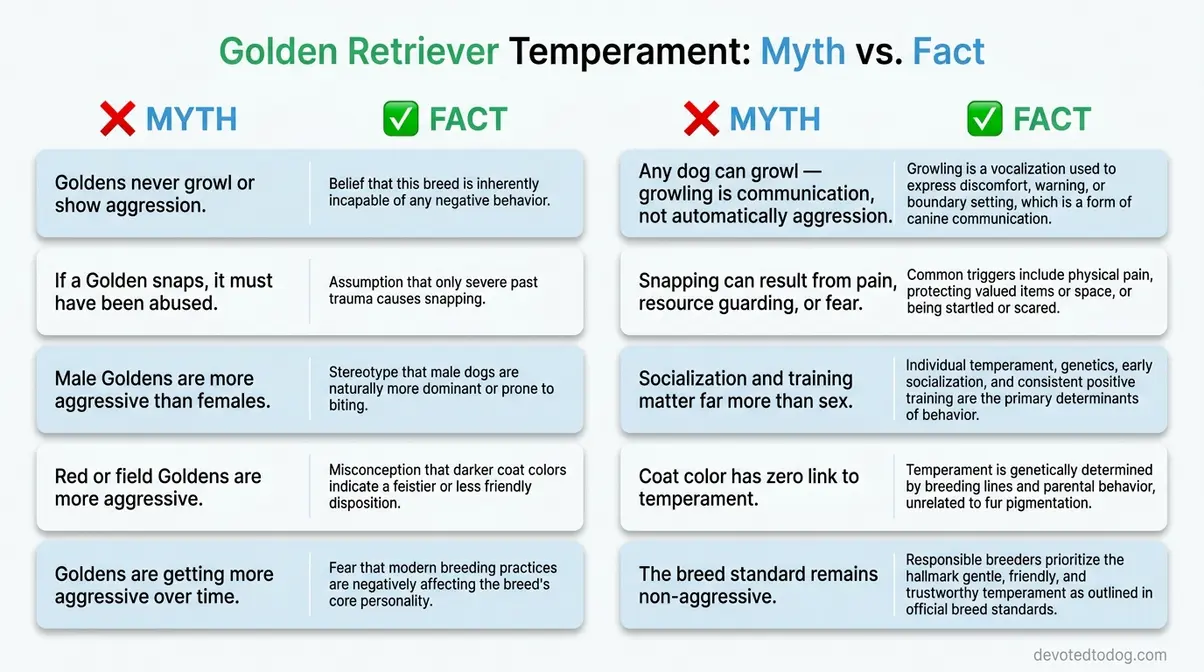
Are golden retrievers ever aggressive? The honest answer is: rarely, and almost never without a specific cause. But several persistent myths cloud the conversation. Here’s what the research actually shows:
| Myth | Fact |
|---|---|
| “Goldens never growl or show aggression.” | Any dog can growl, growling is communication, not automatically aggression. |
| “If a Golden snaps, it must have been abused.” | Snapping can result from pain, resource guarding, or fear, not necessarily abuse. |
| “Male Goldens are more aggressive than females.” | Hormones can play a role, but individual training and socialization matter far more. |
| “Red or field Goldens are more aggressive.” | Coat color has zero link to temperament; field lines may have higher energy, not higher aggression. |
| “Golden Retrievers are getting more aggressive over time.” | Backyard breeding can affect temperament variability, but the breed standard remains non-aggressive. |
For a deeper look at the behavioral nuances behind these myths, see our guide on understanding Golden Retriever aggression.
With the myths out of the way, let’s answer one of the most common Google questions on this topic: where do Golden Retrievers rank among the least aggressive dog breeds?
The Least Aggressive Dog Breeds
The least aggressive dog breeds in the Duffy, Hsu & Serpell (2008) owner survey include Golden Retrievers, Labrador Retrievers, and Bernese Mountain Dogs. These breeds share a common trait: they were developed for cooperative work alongside humans, which required selecting against territorial or aggressive tendencies over many generations.
What does “least aggressive” actually mean? It doesn’t mean these dogs never growl or snap. It means their baseline threshold for aggression is higher than that of many breeds. A Golden needs more provocation, more fear, more pain, more resource pressure, to reach a point of aggression than, say, a Chihuahua or a Dachshund. That higher threshold is what makes them so reliably safe around children and strangers.
Notably, Golden Retrievers are not used as guard dogs or police dogs specifically because of their non-aggressive temperament. They’re bred to retrieve, not to protect. When you see a Golden in a working role, it’s almost always as a service dog, therapy dog, or search-and-rescue dog, roles that require friendliness, not threat. In the Duffy, Hsu & Serpell (2008) survey, Golden Retrievers were among the least aggressive toward both humans and dogs.
Are Goldens on the Aggressive List?
Golden Retrievers are not on any aggressive dog list. In a survey of owners of more than 30 breeds, they were among the least aggressive breeds toward both humans and other dogs. Their breed standard emphasizes a friendly, reliable, and trustworthy temperament, traits that have been selectively reinforced for over 150 years. Individual dogs may show aggression due to pain or poor breeding, but the breed as a whole is not considered aggressive (Duffy, Hsu & Serpell, 2008).
Now that you know Golden Retrievers are naturally gentle, the next question is: what would it take to make one aggressive? This is where it gets important, and where most owners need the most help.
What Causes Golden Retriever Aggression?

Every week, Golden Retriever owners post variations of the same question in dog forums: “My dog has never been aggressive, and then yesterday he snapped at my child. What happened?” This question floods online communities and Reddit threads, and it deserves a real answer. The answer isn’t “your dog is dangerous.” The answer is The Aggression Trigger Triangle.
The Aggression Trigger Triangle is a framework for understanding why Golden Retriever aggression almost always requires three converging factors: (1) a genetic predisposition from poor breeding, (2) an environmental trigger such as fear, pain, or resource pressure, and (3) an inadequate socialization or training response. Remove any one leg of that triangle, and aggression becomes highly unlikely. This framework is the organizing principle for everything in this section, and it’s what separates informed owners from anxious ones.
The five root causes below each map onto one or more legs of the Triangle. Understanding which cause is at work in your dog’s situation tells you exactly what to do about it.
⚠️ Important: If your Golden Retriever is showing sudden or escalating aggression, consult a licensed veterinarian or certified professional dog trainer (CPDT-KA) before attempting any training interventions. Aggression can have medical causes that require diagnosis.
Resource Guarding: The Top Trigger
Resource guarding is when a dog protects something they value, food, toys, a favorite spot, or even a person, by growling, snapping, or biting when someone gets too close. It’s one of the most commonly reported aggression triggers in Golden Retrievers, and it often catches owners completely off guard.
Picture this: your Golden is eating dinner. You walk by. They snarl and snap at you, the same dog who was cuddling you an hour ago. This is classic resource guarding. Are golden retrievers aggressive in these moments? Not in the breed-level sense. They’re communicating: “This is mine, and I feel threatened.”
Food-related aggression can often be improved with gradual desensitization; ask a qualified trainer or veterinary behaviorist to set up a plan. According to a genetic study of aggression in Golden Retrievers, aggression toward people and dogs has a strong heritable component, which is one reason to choose a breeder who temperament-tests their breeding stock (van den Berg et al., Behavior Genetics, 2008).
Here is a 5-step counter-conditioning protocol (counter-conditioning, a training technique that replaces a fearful or aggressive response with a calm, positive one) for resource guarding:
Step 1: Never take the resource away by force
This escalates, not resolves, the behavior and teaches the dog that humans near their food are a threat.
Step 2: Approach calmly while tossing a high-value treat
Toss the treat from a distance and don’t crowd the dog. Let them learn that your approach predicts good things.
Step 3: Gradually decrease the toss distance
Do this over multiple sessions as the dog remains calm and relaxed.
Step 4: Practice “trade up”
Offer something better in exchange for the item, then return it. This teaches the dog that giving things up leads to good outcomes.
Step 5: Consult a certified trainer if needed
If growling persists after 2 weeks of consistent practice, consult a certified trainer (CPDT-KA). Entrenched guarding often requires professional behavior modification.
For a visual demonstration of the “drop it” command, one of the most effective tools for managing resource guarding, watch the video below.
Resource guarding is usually learned or genetic. But the second major trigger is almost entirely environmental, and it’s one that owners can directly prevent.
Fear From Poor Socialization
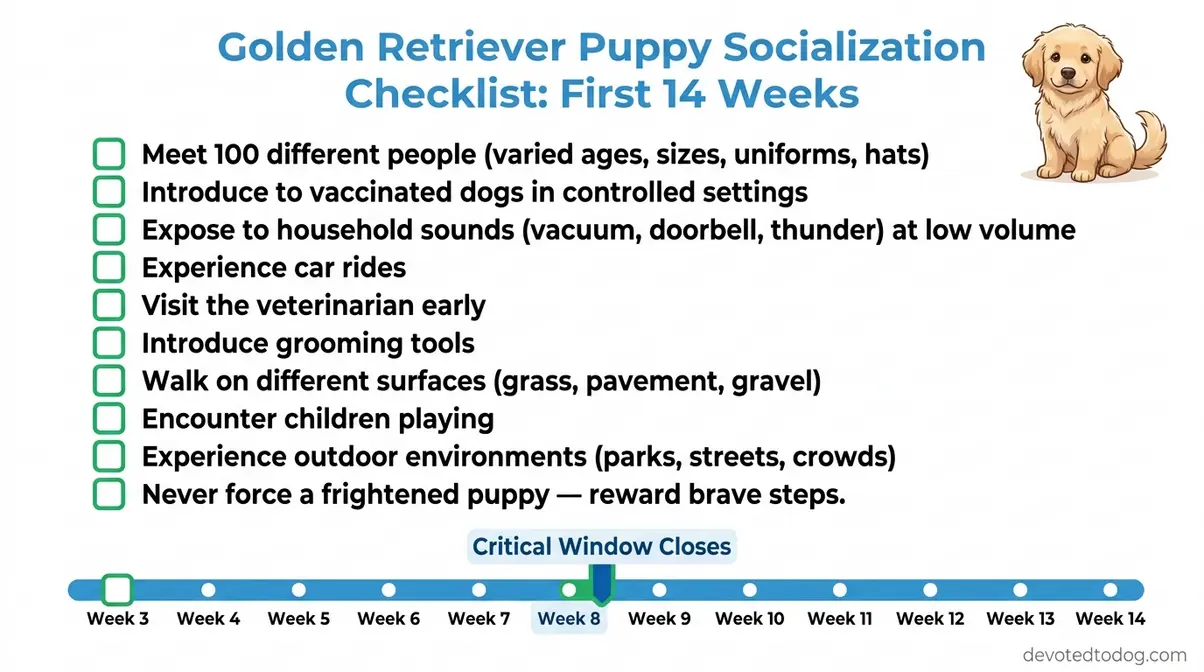
Socialization means exposing your puppy to a wide range of people, animals, sounds, and environments during the critical developmental window of 3-14 weeks of age. Miss this window, and your dog may grow up fearful of unfamiliar things, and fearful dogs bite.
A Golden that wasn’t socialized as a puppy might cower when a stranger approaches, and then snap when the stranger gets too close. The “red zone” is the point at which fear tips over into aggression: the dog feels cornered, sees no escape, and bites as a last resort. This is not a mean dog. It’s a scared one. According to Cornell Veterinary Medicine guidance on canine anxiety, resource guarding and territorial aggression are often manifestations of underlying anxiety, requiring careful management to help the dog cope.
Are golden retrievers aggressive towards other dogs when under-socialized? Yes, a Golden that had limited exposure to other dogs during puppyhood may react with anxiety and snapping toward unfamiliar dogs, even though the breed’s baseline is highly sociable.
Use this 5-item puppy socialization checklist:
Step 1: Expose to 100 different people by 12 weeks
Include different ages, sizes, ethnicities, hats, and uniforms. Variety is the goal.
Step 2: Introduce to other vaccinated dogs
Do this in controlled settings. Puppy classes and calm, friendly adult dogs work well.
Step 3: Expose to common household sounds
Play sounds like a vacuum, doorbell, or thunder recordings at low volume first, pairing each sound with treats.
Step 4: Introduce car rides, vet visits, and grooming early
Make every new experience positive with high-value treats and calm handling.
Step 5: Never force a frightened puppy
Do not push them into a scary situation. Let them approach at their own pace, and reward every brave step.
Poor socialization is preventable, but pain is not always obvious. This next cause of aggression is the one most owners miss entirely.
Pain and Medical Conditions
When a dog is in pain, from hip dysplasia, an ear infection, arthritis, or any other condition, their tolerance for discomfort drops dramatically. A dog that normally accepts being touched anywhere may snap when someone touches a sore spot. This isn’t “aggression” in the traditional sense; it’s a pain response.
A Golden that “snapped at my child out of nowhere” may have been experiencing ear pain that the child accidentally aggravated. The dog wasn’t being dangerous, it was communicating: “That hurts. Stop.” This is one of the most important distinctions any owner can make.
The medical conditions most commonly associated with behavior changes in Golden Retrievers include:
- Hip dysplasia (hip dysplasia, a genetic joint condition where the hip socket doesn’t fully cover the ball of the femur, causing pain and mobility issues), causes snapping when touched or asked to move
- Ear infections, Golden Retrievers’ floppy ears trap moisture, making infections common; infected ears cause significant sensitivity to head-touching
- Hypothyroidism, thyroid dysfunction is linked to irritability and behavioral changes in dogs
- Neurological conditions including “rage syndrome”, a rare but real condition; according to Texas A&M veterinary insights on sudden canine aggression, sudden uncharacteristic aggression can sometimes be linked to medical conditions requiring neurological evaluation rather than behavioral training (Texas A&M, 2026)
- Cognitive dysfunction in older dogs, canine dementia can cause confusion-based aggression as the dog becomes disoriented
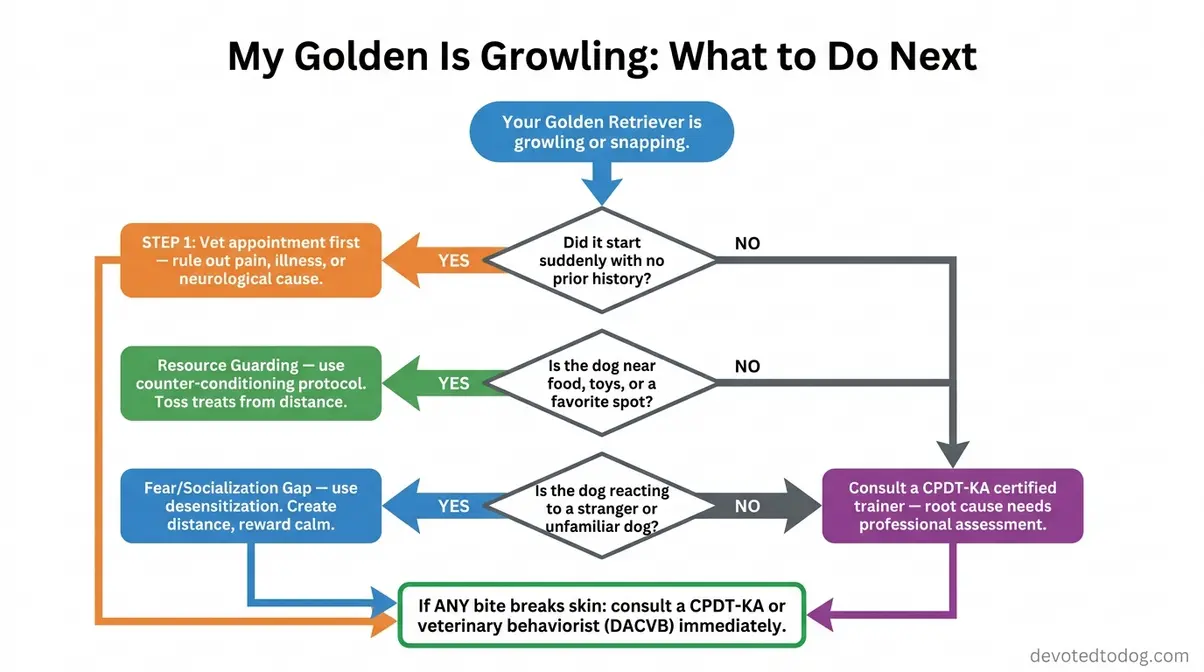
If your Golden Retriever’s aggression appeared suddenly and without an obvious trigger, treat it as a medical issue until proven otherwise. Schedule a veterinary appointment before implementing any training changes. This is the single most important piece of advice in this entire section.
Pain-related aggression can strike any dog at any age. But one cause of aggression is built in from birth, and it’s one that prospective owners can research before ever bringing a puppy home.
Breeding and Genetic Factors
Are golden retrievers aggressive dogs? Not by breed standard, but genetics can change the picture significantly. This is the leg of The Aggression Trigger Triangle that owners can prevent before getting a dog.
Reputable breeders temperament-test their breeding dogs and exclude any with aggression tendencies from their programs. Backyard breeders, unlicensed, informal breeders who prioritize profit or convenience over health and temperament testing, often skip this step entirely. The result is offspring that may carry a significantly higher genetic risk for aggression.
The data on this is striking. In a group of 325 Golden Retrievers made up of dogs referred for aggression and their relatives, researchers found a heritability of about 0.8 for both human-directed and dog-directed aggression (genetic study on Golden Retriever aggression, van den Berg et al., Behavior Genetics, 2008). In plain terms: aggressive tendencies can run in families, so a breeder’s temperament screening matters. This may help explain why many “my Golden is aggressive” posts in online communities trace back to dogs from unknown or informal breeders, not from established, health-tested breeding programs.
Before purchasing a Golden Retriever puppy, ask any breeder these 4 questions:
- “Can I meet both parent dogs?”, Temperament should be observable in person; a reputable breeder will welcome this.
- “Do you temperament-test your breeding stock?”, Reputable breeders do; if the answer is vague, that’s a red flag.
- “Are your dogs OFA health-tested?”, OFA (the Orthopedic Foundation for Animals) certifies genetic health including hip, elbow, and cardiac conditions.
- “Can I see references from previous buyers?”, Look for buyers who have had their dogs for 2+ years and can speak to long-term temperament.
Genetics and health are largely outside an owner’s control once a puppy comes home. But the fifth cause of aggression, how we handle our dogs, is 100% within our control.
Mishandling and Owner Behavior
Punitive training methods, hitting, alpha rolling (forcing a dog onto its back as a dominance display), yelling, can trigger fear-based aggression in Golden Retrievers. This breed is particularly sensitive to harsh correction. A Golden that’s been repeatedly punished learns that human hands approaching it are a threat, not a source of comfort.
The “teenage brattiness” phase, roughly 8-18 months, is when owners most commonly make this mistake. Golden Retriever adolescents test boundaries, ignore commands, and generally push limits. Owners who respond with punishment during this phase can accidentally create a negative association with human hands approaching them. The snap that follows isn’t dominance, it’s a conditioned fear response.
“A Golden that snaps when you reach for its collar has often been grabbed or yanked by the collar during discipline. The snap is the dog saying: ‘I’ve learned that reaching near my head means something painful is coming.’”
The solution is positive reinforcement, rewarding the behavior you want (with treats, praise, or play) rather than punishing the behavior you don’t want. This is the approach recommended by the American Veterinary Society of Animal Behavior (AVSAB) and is the most evidence-supported method for training sensitive breeds. For a comprehensive look at how these patterns develop, see our guide on common Golden Retriever behavior problems.
Now that you understand what causes aggression, the next critical skill is knowing what it actually looks like, and how to tell it apart from your dog just having fun.
Can Golden Retrievers be aggressive?
Yes, Golden Retrievers can be aggressive in specific circumstances, but breed-typical aggression is rare. When a “mean golden retriever” or “aggressive golden retriever” does appear, the trigger is almost always one of: pain (medical condition like ear infection, joint issues, hip dysplasia, or untreated injury), fear (under-socialized puppy, traumatic event), resource guarding (food, toys, owner), or territorial response (strangers approaching the home). The breed itself was selected for soft mouth and friendliness, so aggression is a behavioral red flag, not a breed default.
Are Golden Retrievers dangerous dogs?
No. Golden Retrievers are not dangerous dogs. Serious aggression is uncommon in the breed and is usually linked to pain, fear, or poor early socialization. The “are golden retrievers dangerous” question often comes from confusion with similar-looking dogs (Goldador, Golden mixes) or one-off behavior incidents. A properly socialized, healthy Golden Retriever from a reputable breeder is among the safest dog breeds for households with children, elderly family members, and other pets. If your Golden displays aggression, consult a vet first to rule out pain, then a certified canine behaviorist.
What makes a Golden Retriever mean or aggressive?
Three root causes account for nearly all “mean golden retriever” cases: (1) Pain, the leading cause, especially undiagnosed orthopedic issues (hip/elbow dysplasia), ear infections, dental disease, or thyroid imbalance. A Golden in chronic pain may snap when touched. (2) Inadequate socialization, puppies that miss the 3-14 week socialization window often grow into fearful adults that react aggressively to strangers, dogs, or new environments. (3) Resource guarding from poor early management, food, toy, or owner guarding learned during puppyhood. None of these are breed-inherent. The fix sequence: vet exam first (rule out medical), then behavior modification with a certified trainer (CPDT-KA or KPA-CTP), never punishment-based methods.
How Do You Tell Play vs. Aggression in Body Language?
Your Golden is playing tug with your child. There’s growling. Should you be worried? Probably not, but knowing the difference between play growling and real aggression could prevent a bite. A dog displaying a stiff body, raised hackles, bared teeth, and a low-pitched growl is communicating genuine distress, not playfulness, and requires immediate space and de-escalation (Cornell University College of Veterinary Medicine).
When you see true aggression signals, one or more of The Aggression Trigger Triangle’s three factors is likely at play, a genetic predisposition, an environmental pressure, or a gap in socialization. Understanding the body language tells you which factor to investigate first.
According to Cornell Veterinary Medicine on canine anxiety and aggression, these body language signals indicate a dog in distress, not a dog choosing to be aggressive. The distinction matters enormously for how you respond.
Signs of True Aggression
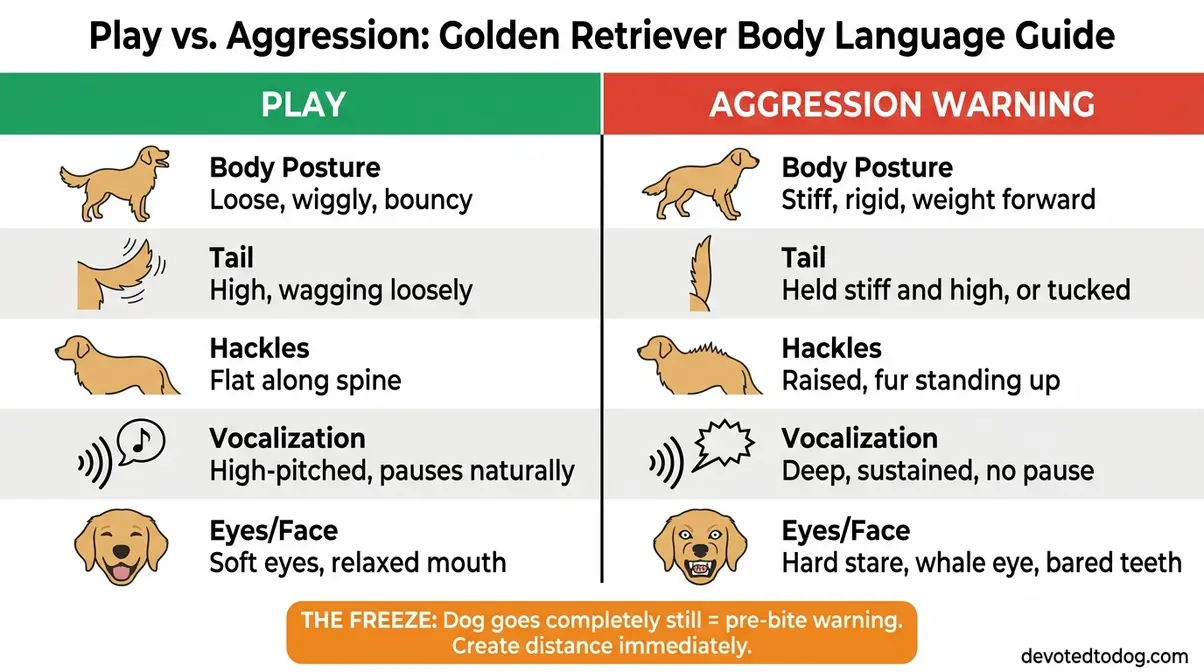
Are golden retrievers aggressive when they growl during play? Not necessarily. The key is reading the whole body, not just the sound. Here’s the definitive comparison:
| Body Part / Signal | Normal Play | True Aggression Warning |
|---|---|---|
| Body posture | Loose, wiggly, bouncy | Stiff, rigid, weight shifted forward |
| Tail | High and wagging loosely | Held high and stiff, or tucked low |
| Hackles | Flat | Raised (fur standing up along spine) |
| Vocalization | High-pitched bark, play growl with natural pauses | Deep, sustained, low-pitched growl, no pause |
| Eyes/Face | Soft eyes, relaxed open mouth | Hard stare, whale eye (whites showing), bared teeth with snarl |
Hackles, the fur along a dog’s back and neck that stands up when they’re aroused, frightened, or aggressive, are one of the clearest involuntary signals. A play bow, when a dog lowers its front legs while keeping its rear end up, is the opposite signal: a universal dog invitation to play.
“Whale eye” means you can see the whites of a dog’s eyes, usually because they’re turning their head away while keeping their gaze fixed, a sign of stress or fear rather than confident aggression. It’s easy to miss but important to recognize.
The most critical signal of all is the freeze. If a Golden Retriever suddenly goes completely still during an interaction, stops moving, stops vocalizing, stiffens, this is a pre-bite warning. A freeze often precedes a snap. Create distance immediately and calmly.
For practical guidance on managing mouthing behavior, see our resource on stop Golden Retriever puppy biting.
The table above applies to adult dogs. But what about puppies, is all that nipping and growling normal, or is it a sign of something more serious?
Puppy Nipping: Normal or Red Flag?
Are golden retrievers aggressive as puppies? Almost never, but they are famously mouthy. Golden Retriever puppies explore the world with their mouths and learn bite inhibition (how hard is too hard to bite) through play with their littermates and through human feedback. “Puppy nipping” is not aggression; it’s communication and learning.
The critical distinction: normal puppy nipping is soft, playful, and stops when the puppy sees your reaction (a yelp, a pause, a turn away). Aggressive puppy behavior looks different, it includes hard biting that breaks skin, growling with a stiff body while biting, and biting that escalates despite consistent corrections. True aggressive behavior before 12 weeks warrants immediate consultation with a veterinary behaviorist.
The “3-strike” guideline works well for most puppies:
- If a puppy bites hard, say “ouch” clearly and withdraw attention completely for 30 seconds.
- Three hard bites in one play session without improvement = end the session entirely.
- Most puppies learn bite inhibition by 5-6 months with consistent, calm application of this approach.
One important note: puppies from backyard breeders are often removed from their littermates too early, before 8 weeks, which means they missed the critical period for learning bite inhibition from siblings. These puppies may nip harder and more persistently than puppies from reputable breeders who keep litters together until 8-10 weeks.
Puppy nipping is manageable with consistency. The trickier challenge for many Golden owners is handling situations where their dog reacts to strangers or other dogs, which we’ll cover next.
How Does Aggression Toward Dogs and Strangers Differ?
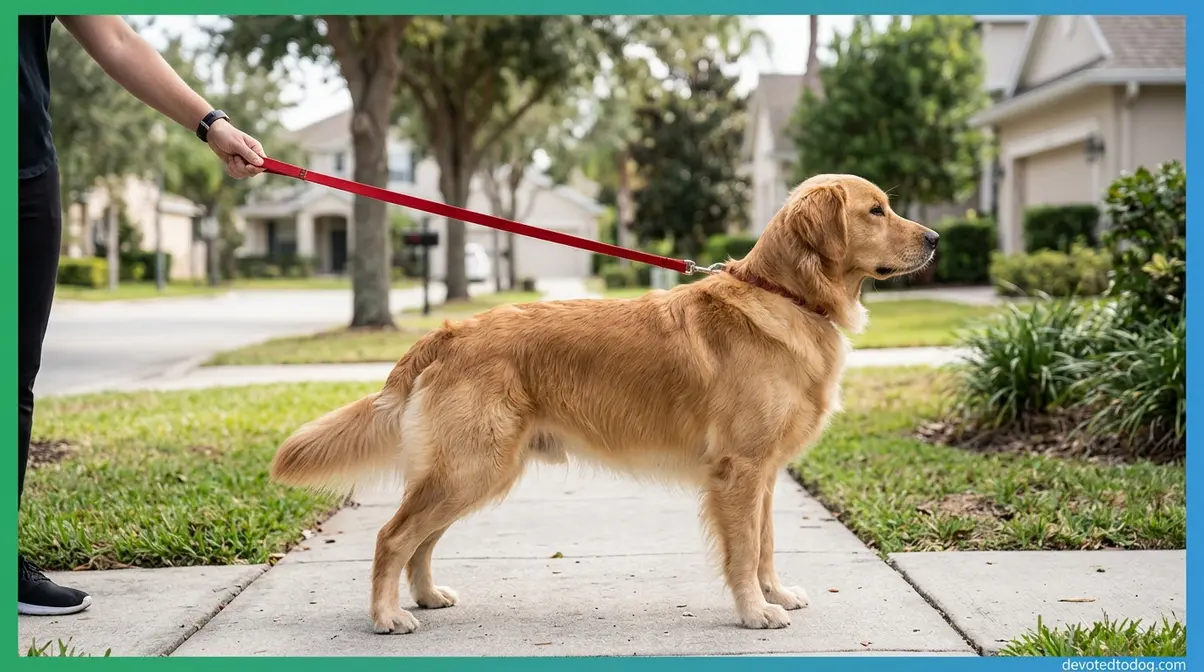
Most Golden Retriever reactivity toward other dogs stems from leash frustration or poor early socialization, not from inherent aggression toward other dogs. This is an important distinction, because the management approach differs depending on the cause. A questionnaire study of Golden Retrievers referred to a Utrecht clinic for aggression, or related to aggressive dogs, found that after an average interval of 4.3 years, over 50% of the dogs had become less aggressive, according to their owners (PubMed study on Golden Retriever aggression; van den Berg et al., Behavior Genetics, 2006). That’s genuinely good news for owners who feel like they’re running out of options.
The key is knowing which situation you’re dealing with, dog-directed reactivity or stranger-directed reactivity, because each has its own set of causes and its own management protocol.
Growling at Other Dogs
Are golden retrievers aggressive towards other dogs? The breed-level answer is no, but leash reactivity (leash reactivity, when a dog that is calm off-leash becomes agitated, barks, or lunges at other dogs or people while on a leash, often due to the frustration of being restrained) is common even in otherwise friendly Goldens.
Here’s what happens: the leash prevents the dog from moving freely and greeting naturally. That restraint creates tension. The tension gets directed at the other dog, producing growling, lunging, and barking that looks like aggression but is actually frustration. A Golden that plays happily at the dog park may still react on leash, these are two different behavioral systems.
The secondary cause is fear from poor socialization. A Golden that wasn’t exposed to many dogs as a puppy may react to unfamiliar dogs out of anxiety rather than frustration. The behavior looks similar; the cause is different.
5-step leash reactivity management protocol:
Step 1: Identify your dog’s threshold
This is the distance at which they notice but don’t react to another dog. This is your starting point for all training. If your dog reacts at 30 feet, begin working at 40 feet.
Step 2: Redirect attention at threshold distance
When another dog appears at threshold distance, immediately redirect your Golden’s attention to you with a high-value treat (cheese, chicken, hot dog pieces).
Step 3: Ask your dog to “sit” or “look at me”
Reward generously the moment they comply, even partially.
Step 4: Gradually decrease the distance
Do this over multiple sessions as your dog remains calm. Never rush this step, slow progress is real progress.
Step 5: Never yank the leash or yell
This increases arousal level and worsens reactivity over time, even though it feels like you’re doing something.
What not to do: Pulling your dog away abruptly or shouting “no!” when they react actually increases their arousal level and makes the reactivity worse. Stay calm, create distance, and reward any moment of calm behavior, even a brief glance away from the other dog counts.
If your Golden “growls at other dogs” on walks, try crossing the street before they react. Work at a distance where they can notice the other dog without going over threshold (threshold, the distance at which your dog can remain calm when seeing a trigger). Ask a certified trainer or veterinary behaviorist to help you plan this work.
Dog-to-dog reactivity is one challenge. Aggression toward strangers and visitors is a different problem, and it has its own set of causes and solutions.
Aggression Toward Strangers
Are golden retrievers aggressive to strangers? Usually no, but a Golden that wasn’t socialized with diverse people as a puppy may be fearful of unfamiliar faces, uniforms, or hats. Fear is the engine; the growling is the exhaust.
There are two main causes. First: inadequate socialization to diverse types of people during puppyhood, a Golden that only met a narrow range of people as a puppy may react with anxiety to anyone who looks, sounds, or moves differently than what it learned was “normal.” Second: territorial behavior at the home’s threshold, the doorbell represents a stranger entering the dog’s space, which triggers a protective response even in otherwise friendly dogs.
What this looks like in practice: your Golden is perfectly friendly at the park but barks, growls, or lunges at delivery drivers or new guests at the front door. This is territorial behavior, not random aggression. The dog is protecting their home environment.
4-step desensitization protocol for stranger-reactive Goldens:
Step 1: Ask visitors to ignore the dog completely
When they enter, there should be no eye contact, no reaching to pet, and no high-pitched greetings. Let the dog control the pace of interaction.
Step 2: Have visitors toss treats toward the dog
They should do this without approaching. Let the dog decide to approach the visitor on their own terms.
Step 3: Only allow petting when voluntarily approached
Wait until the dog approaches the visitor and shows a relaxed, wiggly body. Never force the greeting.
Step 4: Practice “go to your place”
Teaching your Golden to go to a specific mat when the doorbell rings creates a calm alternative behavior that replaces the reactive one.
What not to do: Never force your Golden to greet a visitor by pushing them forward or holding them still while someone pets them. This removes their choice and increases fear, which directly increases aggression risk over time.
For broader guidance on managing reactivity, see our resource on reactivity toward other dogs and people.
Stranger reactivity and dog reactivity are both manageable with the right approach. But many owners also wonder whether certain types of Golden Retrievers, by age, gender, or even coat color, are more prone to aggression. Let’s clear that up.
How Do Age, Gender, and Coat Color Affect Aggression?
The short answer: not meaningfully. Breeding line matters far more than any of these factors. The PMC genetic study on Golden Retriever aggression heritability estimated a high heritability (about 0.8) for human- and dog-directed aggression in a group of Golden Retrievers referred for aggression and their relatives, which suggests breeding line matters far more than gender or coat color (van den Berg et al., Behavior Genetics, 2008). Still, owners ask about these factors constantly, and they deserve direct answers.
Are Puppies Aggressive?
Are golden retrievers aggressive as puppies? Golden Retriever puppies are not aggressive, but they are mouthy, energetic, and sometimes relentless. Puppy growling, wrestling, and nipping are all normal developmental behaviors, not signs of aggression.
The key distinction is worth repeating: true puppy aggression is rare. It typically involves hard biting that doesn’t respond to correction, growling with a stiff body while guarding resources, or showing fear-based aggression toward people before 12 weeks of age. Any of these patterns warrants immediate consultation with a veterinary behaviorist, not because the puppy is “bad,” but because early intervention is far more effective than waiting.
What passes naturally: most puppy “teenage brattiness” peaks at 8-18 months and improves substantially with consistent training and adequate socialization. The vast majority of Golden Retriever puppies grow into gentle, cooperative adults.
Here’s a practical test: if your 4-month-old Golden growls during tug-of-war, that’s play. If your 4-month-old Golden growls and snaps every single time you reach for their food bowl, that’s resource guarding that needs addressing now, before it becomes an entrenched habit.
Puppies grow out of most of their mouthiness. But do adult male or female Goldens differ in aggression? This is one of the most common questions we receive.
Male vs. Female Differences
Are female golden retrievers aggressive? Are male golden retrievers aggressive? Neither male nor female Golden Retrievers are inherently aggressive. The breed standard applies equally to both sexes, and the temperament research reflects that.
Hormonal nuances do exist. Intact (unneutered) male Goldens may show more resource guarding or inter-male aggression, particularly around intact females in heat. This is hormonal, not temperamental, and typically resolves with neutering. Intact females may show increased territorial behavior during heat cycles, again, hormonal rather than a permanent character trait.
The heritability research (about 0.8 in a group of Goldens referred for aggression and their relatives, van den Berg et al., 2008) points to breeding line, not sex, as the factor to focus on. A well-bred female and a well-bred male are both unlikely to be aggressive.
Are female golden retrievers aggressive? Not inherently, but an intact female may be more reactive around other intact females due to hormonal competition. Spaying typically resolves this. For a comprehensive look at behavioral differences between the sexes, see our guide on male vs. female Golden Retriever behavioral differences.
Gender has minimal impact on aggression. What about the type of Golden Retriever, does having a field line or a red coat make any difference?
Field, Show, and Red Goldens
Are field golden retrievers aggressive? Are red golden retrievers aggressive? These questions come from a reasonable place, if there are different “types” of Goldens, maybe some are more reactive than others. The answer requires understanding what those differences actually are.
Here’s how the three types break down:
- Show Golden Retrievers, dogs bred for AKC conformation competitions. Stockier build, longer coat, typically calmer energy level. Bred to stand calmly in a show ring while being examined by strangers.
- Field Golden Retrievers, field Golden Retrievers are dogs bred for hunting and working performance, with higher energy and drive than show-line Goldens. Leaner, more athletic, more intense focus. But NOT more aggressive.
- Red Golden Retrievers, red Golden Retrievers are simply a coat color variation within the Golden Retriever breed, not a separate breed or type. The mahogany or dark red coat is determined by a separate gene from temperament.
The critical distinction between energy and aggression: field Goldens have higher prey drive and energy levels than show lines, which can be mistaken for aggression if they’re not given adequate exercise and mental stimulation. High energy is not the same as aggression. An under-stimulated field Golden may develop destructive or reactive behaviors, but those are boredom and frustration, not inherent aggression.
As for red Goldens: the idea that red Golden Retrievers are more aggressive has zero scientific basis. Coat color is determined by a separate gene from temperament. A red Golden from a reputable breeder will have the same gentle temperament as any other Golden.
Are field golden retrievers aggressive? No, but they need 2+ hours of structured exercise daily. An under-exercised field Golden may develop behaviors that look like aggression but are actually unmet physical and mental needs. For a detailed comparison, see our guide on field vs. show Golden Retriever temperament differences.
Now that we’ve cleared up the age, gender, and type questions, let’s tackle the biggest comparison question: how do Golden Retrievers stack up against breeds actually known for aggression?
How Do Golden Retrievers Compare to Other Breeds?
In a survey of owners of more than 30 breeds, Golden Retrievers were among the least aggressive breeds toward both humans and dogs, while Dachshunds and Chihuahuas scored higher than average (Duffy, Hsu & Serpell, Applied Animal Behaviour Science, 2008). That finding consistently surprises people who assume large breeds are the most dangerous. Purdue University’s canine welfare resource library summarizes the same study.
The comparison most people search for is the Golden Retriever vs. Pit Bull question, so let’s address that directly with data.
Goldens vs. Pit Bulls: The Data
Are golden retrievers more aggressive than pit bulls? No, Golden Retrievers are not more aggressive than Pit Bulls. The research shows they’re significantly less aggressive on standardized measures. In the Duffy, Hsu & Serpell (2008) survey, Golden Retrievers were among the least aggressive breeds; Pit Bull Terriers, a term applied to several breeds including the American Pit Bull Terrier and American Staffordshire Terrier, score higher on some aggression measures, particularly dog-directed aggression.
However, this comparison requires an important nuance. Breed-level statistics describe populations, not individual dogs. A well-bred, well-socialized Pit Bull will be gentle. A poorly bred, under-socialized Golden can be reactive. Individual temperament, training history, and socialization quality matter enormously, sometimes more than breed.
Here’s how the relative aggression rankings look across three breeds, based on the Duffy, Hsu & Serpell (2008) data:
| Breed | Aggression Toward Strangers | Aggression Toward Other Dogs | Notes |
|---|---|---|---|
| Golden Retriever | Very Low | Very Low | Bred for cooperative, gentle temperament |
| Labrador Retriever | Very Low | Very Low | Similar sporting-dog breeding background |
| Akita | Not a standout (aggression mainly dog-directed) | High | Bred for guarding; territorial by design |
(Rankings represent relative positioning from published breed comparison data, not absolute scores.)
So where do the most aggressive breeds actually fall? This is one of the most commonly asked questions on Google, and the answer might surprise you.
The Most Aggressive Dog Breeds
According to the Duffy, Hsu & Serpell 2008 study of dogs across 30+ breeds, the breeds with the greatest share of dogs biting or attempting to bite strangers included Dachshunds, Chihuahuas, Jack Russell Terriers, and Australian Cattle Dogs, breeds that many people don’t expect to top the list. Akitas stood out for aggression toward unfamiliar dogs. Goldens were among the least aggressive toward both humans and dogs.
Why do smaller breeds often top aggression lists? The study’s authors suggest that aggression in small breeds may be easier to tolerate or manage, so it can go uncorrected. They also found differences between show and field lines within the same breed, which suggests genetics plays a part too.
Golden Retrievers are not on any legitimate list of aggressive dog breeds. Their appearance in bite statistics is typically linked to individual circumstances, pain, poor breeding, or mishandling, not breed tendency. The same factors that make up The Aggression Trigger Triangle. A Golden from a reputable breeder, properly socialized and handled with positive reinforcement, is among the safest family dogs available.
With the aggression comparisons settled, let’s address something many prospective Golden owners search for but rarely find answered honestly: the real pros and cons of the breed.
Why Do People Love and Hate Goldens?
Golden Retrievers are one of the most popular dog breeds in the United States. Yet “why golden retrievers are the worst” generates significant search volume every month. Both things are true, and both deserve honest answers.
The same factors in The Aggression Trigger Triangle, breeding, environment, and handling, also determine whether a Golden’s challenging traits become manageable realities or daily frustrations. Understanding both sides of the coin is what separates successful Golden owners from exhausted ones.
5 Reasons Goldens Can Be “The Worst”
If you’ve searched “why golden retrievers are the worst,” you’re not alone, it’s one of the most searched Golden Retriever phrases online. And honestly? The people asking this question usually already have a Golden and are exhausted. Their complaints are legitimate. Let’s take them seriously.
Here are 5 genuine challenges of Golden Retriever ownership, framed honestly, not defensively:
- Shedding. Goldens shed year-round and blow their coat heavily twice a year. If you’re not okay with dog hair on your furniture, clothes, and food, this breed is genuinely challenging. The solution: weekly brushing with an undercoat rake, a good vacuum, and realistic expectations.
- Energy demands. Goldens need 1-2 hours of vigorous exercise daily. Under-exercised Goldens become destructive, hyperactive, and reactive, behaviors that are sometimes mistaken for aggression but are actually unmet physical needs. The solution: structured exercise plus daily mental enrichment (puzzle feeders, training sessions, sniff walks).
- Health costs. Goldens are predisposed to hip dysplasia, cancer, and heart conditions. According to an academic review of cancer-related mortality in Golden Retrievers, a comprehensive review of veterinary records from 1989 to 2016 confirmed that Golden Retrievers have significantly elevated cancer-related mortality rates compared to other breeds (PubMed, 2018). Lifetime veterinary costs can be substantial. The solution: pet insurance purchased from puppyhood, before conditions develop.
- Separation anxiety. Goldens are bred to be with people, they struggle when left alone for long periods. An anxious Golden may be destructive or vocal. The solution: crate training from puppyhood, gradual alone-time building, and enrichment toys for independent time.
- Adolescent “brattiness.” The 8-18 month phase is notoriously challenging, jumping, leash pulling, selective deafness to commands. The solution: consistent positive reinforcement training starting at 8 weeks, before bad habits form.
None of these are reasons not to get a Golden. They’re reasons to go in with realistic expectations, and a solid plan before the puppy comes home.
Every challenge above has a solution. And for most Golden owners, those challenges are vastly outweighed by what makes the breed genuinely exceptional.
Why Goldens Are Actually the Best
Why golden retrievers are the best comes down to a combination of traits that few breeds can match simultaneously. This isn’t cheerleading, it’s a description of what selective breeding for cooperation, gentleness, and human attunement actually produces.
Trainability. Golden Retrievers are among the most trainable dog breeds in the world. They were developed to work closely with humans, take direction, and problem-solve, which makes them exceptionally responsive to positive reinforcement. A motivated Golden can learn a new command in 5-10 repetitions. This trainability is why they dominate service dog, therapy dog, and search-and-rescue roles.
Consistent friendliness. Goldens are uniquely reliable in their warmth toward children, strangers, other dogs, and cats. This isn’t an accident, it’s 150+ years of selective breeding for cooperative temperament. You’re not hoping for a friendly Golden. You’re working with a breed that was engineered to be friendly.
Emotional intelligence. Golden Retrievers are highly attuned to human emotions. They’re used as therapy dogs and emotional support animals precisely because they are attentive to human emotional cues. A 2026 study of more than 1,300 Golden Retrievers from the Golden Retriever Lifetime Study, published in the Proceedings of the National Academy of Sciences, found that some genes linked to behavior in Goldens are also linked to human traits such as anxiety and depression (reported by ScienceDaily, March 2026).
Adaptability. Goldens adapt well to both active and quieter lifestyles, urban and rural environments, families with children and single owners. Few breeds are this genuinely versatile.
The joy factor. Ask any Golden owner what they love most, and you’ll hear the same thing: the way a Golden looks at you. Their warmth and expressiveness is something owners describe as almost human. This is also why the same people who google “why golden retrievers are the worst” on a hard day are googling “why golden retrievers are the best” when their dog curls up next to them at night.
For more on the breed’s protective qualities, see our guide on Golden Retriever protective instincts and loyalty.
One of the qualities owners cite most often is loyalty, which brings us to a question that gets its own search volume.
Are Golden Retrievers Loyal?
Yes, Golden Retrievers are exceptionally loyal dogs. Their loyalty is breed-deep: they were developed as working partners who needed to stay close to and attentive to their human handlers across long days in the field.
What loyalty looks like in a Golden: following their owner from room to room, checking in during play, seeking physical contact, showing visible distress when separated for extended periods, and greeting family members with the same enthusiasm whether they’ve been gone 5 minutes or 5 hours.
Loyalty in Goldens doesn’t look like guarding or protectiveness, it looks like devotion. They’re not trying to defend you. They simply want to be near you.
With the pros and cons addressed, there’s one more dimension of Golden Retriever health that every owner needs to understand, because it directly links to aggression.
When Do Health Problems Cause Aggression?

Health and behavior are more connected than most owners realize. When a Golden Retriever’s personality changes suddenly, becoming irritable, snapping at touch, withdrawing from interaction, the first question should never be “what did I do wrong in training?” It should be: “Is my dog in pain?”
A UC Davis study of 652 Golden Retrievers found that 65% died of cancer, making it the most significant health and mortality concern for the breed (Kent et al., PLoS ONE, 2018). Cancer and other serious health conditions can affect behavior long before obvious physical symptoms appear. This is why understanding the health-behavior link isn’t optional for Golden owners, it’s essential.
How Pain Triggers Sudden Aggression
When a dog is in pain, their threshold for tolerating discomfort drops dramatically. A Golden that normally accepts being petted anywhere may snap when someone touches a sore hip, infected ear, or arthritic joint. This is not aggression, it’s pain communication. The dog is saying the only way it knows how: “Stop. That hurts.”
Sudden aggression in a previously gentle adult Golden is a veterinary emergency, not a training problem. If your dog has never shown aggression before and suddenly starts, rule out medical causes first. This point cannot be overstated.
Health conditions most commonly associated with behavior changes in Golden Retrievers:
- Hip dysplasia, pain when touched or asked to move; common in the breed and often develops gradually
- Ear infections, Golden Retrievers’ floppy ears trap moisture, making infections frequent; infected ears cause significant head-touching sensitivity
- Hypothyroidism, thyroid dysfunction is linked to irritability, lethargy, and mood changes in dogs
- Cognitive dysfunction (canine dementia), confusion-based aggression in older dogs; the dog may not recognize family members or may become disoriented and fearful
- “Rage syndrome”, a rare neurological condition causing sudden, unpredictable aggression; according to Texas A&M veterinary insights on sudden canine aggression, this requires neurological evaluation rather than behavioral training (Texas A&M, 2026)
⚠️ Always consult a veterinarian if your Golden Retriever shows sudden behavioral changes. Pain, illness, and neurological conditions require medical diagnosis, they cannot be resolved through training alone.
For more on health conditions that affect behavior, see our guide on Golden Retriever health issues that can affect behavior.
Pain-related aggression can be triggered by any health condition, but one health issue is uniquely prevalent in Golden Retrievers and deserves special attention.
What is the Silent Killer in Goldens?
Why are golden retrievers prone to cancer? The “silent killer” in Golden Retrievers is hemangiosarcoma, a highly malignant cancer of the blood vessels that most commonly strikes the spleen or heart. It earns the name “silent” because it rarely shows obvious symptoms until it has reached a critical, often fatal stage. A UC Davis study of 652 Golden Retrievers found that 65% died of cancer (Kent et al., PLoS ONE, 2018).
Why are Goldens disproportionately affected? The full answer is not yet known. Genetic studies have found inherited risk factors for hemangiosarcoma and lymphoma in the breed (Tonomura et al., PLoS Genetics, 2015), and the Golden Retriever Lifetime Study is examining both genetic and environmental factors. According to Cornell Veterinary Medicine on hemangiosarcoma in dogs, hemangiosarcoma is a highly malignant, often “silent” cancer of the blood vessels that most commonly strikes the spleen or heart of older large-breed dogs like Golden Retrievers (Cornell University College of Veterinary Medicine).
The behavior connection is critical for owners to understand. A Golden with undetected internal cancer may show behavioral changes, increased lethargy, reduced tolerance for being touched around the abdomen, sudden irritability, before any obvious physical symptoms appear. What looks like “aggression” may be a dog trying to communicate that something is wrong internally.
An academic review of cancer-related mortality in Golden Retrievers confirmed significantly elevated cancer-related mortality in Golden Retrievers compared to other breeds (PubMed, 2018). What owners should do: schedule annual veterinary checkups, especially after age 6. Discuss cancer screening options, abdominal ultrasound, chest X-rays, with your vet. Know the warning signs: lethargy, distended abdomen, sudden weakness, pale gums, or unexplained behavioral changes.
Understanding your Golden’s health risks is one of the most important things you can do for their long-term wellbeing, and for preventing the health-related behavioral changes that can look like aggression.
When Should You Seek Professional Help?
Owner-level management handles most Golden Retriever behavioral challenges. But some situations require professional intervention, and knowing when to make that call is itself an important skill.
Common Pitfalls to Avoid
Across Golden Retriever communities and owner forums, a consistent pattern emerges. Well-meaning owners inadvertently make aggression worse by falling into one of these five traps:
1. Using punishment
Yelling, leash corrections, and physical reprimands escalate fear-based aggression. This damages the dog’s trust in humans, often making the problem significantly worse over time.
2. Waiting too long to intervene
Minor resource guarding that is ignored for months quickly becomes an entrenched habit. Once established, it requires professional behavior modification to address properly.
3. Assuming it’s “just a phase”
Sudden adult-onset aggression requires immediate veterinary evaluation. It is not a phase; it is a critical medical signal.
4. Forcing exposure
Trying to socialize an aggressive dog by putting a reactive or fearful dog into overwhelming situations worsens fear. Desensitization must be gradual and controlled.
5. Relying on online advice
Certified professionals exist for a reason. An internet forum cannot observe your dog’s body language, history, or medical status accurately.
When to Consult a Professional
Three specific scenarios always require professional help:
- Any bite that breaks skin, consult a certified professional dog trainer (CPDT-KA) or veterinary behaviorist (DACVB) immediately. Do not attempt to manage this alone.
- Sudden behavioral change in an adult dog, schedule a veterinary appointment before any training intervention. Rule out medical causes first.
- Aggression that doesn’t improve after 4 weeks of consistent positive reinforcement work, seek a certified behaviorist. Some behavioral patterns require professional assessment to identify the root cause.
⚠️ Professional Disclaimer: The information in this article is for educational purposes only. If your Golden Retriever is showing aggression, please consult a licensed veterinarian to rule out medical causes, and a certified professional dog trainer (CPDT-KA) or veterinary behaviorist (DACVB) for behavioral intervention. Aggression in dogs can be dangerous, professional guidance is always recommended.
For more guidance on when professional help is appropriate, see our resource on Golden Retriever behavior problems and professional solutions.
Frequently Asked Questions
Does Spaying or Neutering Change Your Golden’s Personality?
Neutering reduces urine marking and roaming in males. Spaying eliminates heat cycle behavioral changes in females, including restlessness, increased vocalization, and clingy behavior. However, research on neutering and fear-based behavior indicates that neutering does not positively affect non-sexually dimorphic behaviors (behaviors not tied to reproductive hormones), such as fear-based responses. In some cases, it may actually increase them (NCBI, 2025).
VCA Animal Hospitals guidance on neutering notes that behavioral training remains essential regardless of neuter status. The surgery changes hormones, not habits. For female Goldens specifically, the heat cycle and related behaviors in female Golden Retrievers guide covers what to expect during each cycle.
Once you understand your Golden’s individual traits and life stage, the final question most prospective owners ask is how it compares to the other popular retriever: the Labrador.
What Is the Adolescent Reset, and How Do You Survive It?
The Adolescent Reset is the 8-18 month window when a Golden Retriever’s brain undergoes rapid rewiring, causing them to temporarily test every boundary they previously accepted. This is the article’s most important concept for frustrated owners to understand, because it reframes regression as biology rather than failure.
Canine adolescence involves the same prefrontal-cortex-lagging-behind-impulse-control pattern seen in human teenagers. The AVMA behavioral research on senior Golden Retrievers highlights the Golden Retriever Lifetime Study’s tracking of behavioral changes across life stages (2021), confirming this window is well-documented. Across owner communities on forums and Facebook groups, the consistent feedback is: “golden retrievers often enter a teenager phase around 9 months, testing boundaries and showing independence, with most returning to obedient behavior by age 2-3.”
Here are four protocols that work during this phase:
Field Lines vs. Show Lines: Does It Change the Personality?
The behavior of golden retriever individuals varies more than most people realize, and one of the biggest reasons is breeding line. This is a concrete, practical distinction that most breed guides skip entirely.
Field-line Goldens (sometimes called working-line or American-type) were bred for stamina, focus, and drive. They can require 90 minutes or more of vigorous exercise per day. Under-stimulated, they become destructive fast.
Show-line Goldens (the blocky, cream-colored type many people picture) were bred for temperament and conformation. They are generally calmer and more tolerant of downtime, but still need 45-60 minutes of daily activity.
What causes a Golden Retriever to become aggressive?
Aggression in Golden Retrievers is almost always caused by external factors, not inherent temperament. The most common causes include resource guarding (protecting food or toys), fear from poor socialization during the critical 3-14 week developmental window, pain from an underlying medical condition like hip dysplasia, genetic factors from irresponsible backyard breeding, and mishandling using punishment-based methods. Identifying which factor is involved determines the correct response. Sudden-onset aggression in an adult dog requires veterinary evaluation before any training intervention.
What are the warning signs of aggression in a Golden Retriever?
True aggression warning signs include a stiffened, rigid body, raised hackles (fur standing up along the spine), bared teeth with a snarl, and a deep, sustained, low-pitched growl with no pauses. These differ clearly from play signals, which include a loose wiggly body, wagging tail, and higher-pitched sounds. The “freeze”, when a dog suddenly goes completely still during an interaction, is a critical pre-bite warning that requires immediate space and calm de-escalation.
What is the least aggressive dog breed?
Golden Retrievers, Labrador Retrievers, and Bernese Mountain Dogs were among the least aggressive dog breeds in a survey of owners of more than 30 breeds, along with Brittany Spaniels, Greyhounds and Whippets (Duffy, Hsu & Serpell, Applied Animal Behaviour Science, 2008). “Least aggressive” describes owner-reported averages for the breed, not a promise that an individual dog will never growl or snap under sufficient provocation.
Which dog has the highest aggression?
In the Duffy, Hsu & Serpell (2008) owner survey, Dachshunds and Chihuahuas scored above average for aggression toward both people and dogs, and Akitas stood out for aggression toward unfamiliar dogs, a finding that surprises many people who expect large breeds to top the list. The authors suggest aggression in small breeds may be easier to tolerate or manage, so it can go uncorrected. Breed-level statistics describe populations, not individual dogs, training and socialization matter enormously regardless of breed.
What is the #1 most aggressive dog breed?
No single breed can be definitively labeled the #1 most aggressive, as aggression is shaped by individual genetics, socialization history, training, and environment. The Duffy, Hsu & Serpell (2008) study of dogs across 30+ breeds found that Dachshunds scored among the highest for aggression toward strangers and owners, and Akitas among the highest for aggression toward unfamiliar dogs. Golden Retrievers were among the least aggressive toward both humans and dogs.
What dog turns on its owner the most?
No breed “turns on” owners by nature, but owner-directed aggression is most commonly reported in dogs subjected to punishment-based training, dogs in chronic pain, or dogs that were inadequately socialized. In the Duffy, Hsu & Serpell (2008) survey, the breeds with the greatest share of dogs biting or attempting to bite their owners included Dachshunds, Chihuahuas, Jack Russell Terriers, American Cocker Spaniels and Beagles, while Golden Retrievers were among the least aggressive toward both humans and dogs.
How do you say “I love you” in dog language?
Dogs express affection differently than humans, but several behaviors consistently signal bonding and trust. Slow blinking while making gentle eye contact mimics the “soft eyes” dogs show to trusted companions. Leaning against you, following you from room to room, bringing you a toy, and offering a relaxed “belly up” posture are all affection signals. For Golden Retrievers specifically, the “lean”, pressing their full body weight against your legs, is one of the most consistent and unmistakable love signals the breed displays.
How Do You Start Understanding Your Golden?
For worried dog owners, the research on whether golden retrievers are aggressive delivers a clear verdict: they were among the least aggressive breeds in a survey of owners of more than 30 breeds (Duffy, Hsu & Serpell, 2008). The most effective approach to preventing aggression combines selecting a reputable breeder, investing in early socialization during the critical 3-14 week window, and responding to behavioral concerns with positive reinforcement rather than punishment. These three pillars aren’t complicated, but they require intention.
The Aggression Trigger Triangle is your roadmap. When you understand that Golden Retriever aggression almost always requires three converging factors, poor breeding, an environmental trigger, and an inadequate socialization response, the fear dissolves into a checklist. The dog that snarled and snapped on your walk wasn’t a random act of danger. It was one or more legs of that triangle at work. Remove any leg, and aggression becomes highly unlikely. That’s not optimism, it’s what the data consistently shows.
If you’re seeing aggressive behaviors in your Golden right now, start with a veterinary checkup to rule out pain or illness, that’s always step one for sudden behavioral changes. Then work with a certified dog trainer (CPDT-KA) on the socialization and counter-conditioning protocols outlined in this guide. Most Golden Retrievers with reactive or guarding behaviors show meaningful improvement within weeks of consistent, positive management. Your dog is not broken. You just need the right framework.
Related reading: