
⚠️ Veterinary Disclaimer: This article is for educational purposes only and is not a substitute for professional veterinary advice. Always consult your veterinarian for specific concerns about your Golden Retriever puppy’s dental health.
If your Golden Retriever puppy has turned into a full-blown landshark — nipping at everything from your fingers to the furniture legs — you’re right in the thick of one of the most intense phases of puppyhood. It’s exhausting, a little painful, and completely normal. Without understanding what’s actually happening inside your puppy’s mouth, and when it will peak, it’s easy to misread normal teething behavior as a training problem and respond in ways that don’t help.
In this guide, you’ll get a complete breakdown of golden retriever puppy teeth growth and development — from the first baby teeth at 3 weeks through a full adult set by 7 months — plus exactly how to survive the hardest weeks. We’ll cover the development timeline, practical management strategies, warning signs to watch for, and when to call the vet.
Golden Retriever puppies grow 28 baby teeth starting at 3 weeks, then lose them all between 3–7 months as 42 adult teeth emerge — with the hardest teething window falling between 4 and 6 months.
- The “Landshark Window” peaks at 4–6 months: maximum chewing intensity, gum soreness, and behavioral challenge define this predictable phase
- 28 baby teeth → 42 adult teeth: the full transition completes by 7–8 months in most Goldens
- Frozen chew toys and consistent redirection are your most effective tools during peak teething
- Retained baby teeth are a breed-relevant risk — check your puppy’s mouth monthly and flag any “double teeth” to your vet
Understanding Golden Retriever Puppy Teeth
Related Golden Retriever guides: Golden Retriever Growth Chart: Puppy to Adult Guide 2026; Golden Retriever Puppy Training: 7 Proven Daily Rules; How to Choose a Golden Retriever Puppy: 4-Step Guide.

Golden retriever puppy teeth growth and development follows a predictable timeline: puppies are born without teeth, grow 28 sharp baby teeth by 8 weeks, and replace all of them with 42 adult teeth by around 7 months. According to the USDA APHIS guide on aging puppies by teeth, the eruption of permanent teeth begins around 12–16 weeks and follows a consistent sequence from incisors toward the back molars (USDA APHIS, 2026). Knowing exactly when each stage happens helps you anticipate the Landshark Window — and respond with the right tools rather than frustration.
Our team reviewed veterinary literature and university sources, including USDA APHIS, the University of Florida College of Veterinary Medicine, and Texas A&M’s School of Veterinary Medicine, to compile this breed-specific timeline. Here’s everything you need to know.
28 Baby Teeth to 42 Adult Teeth
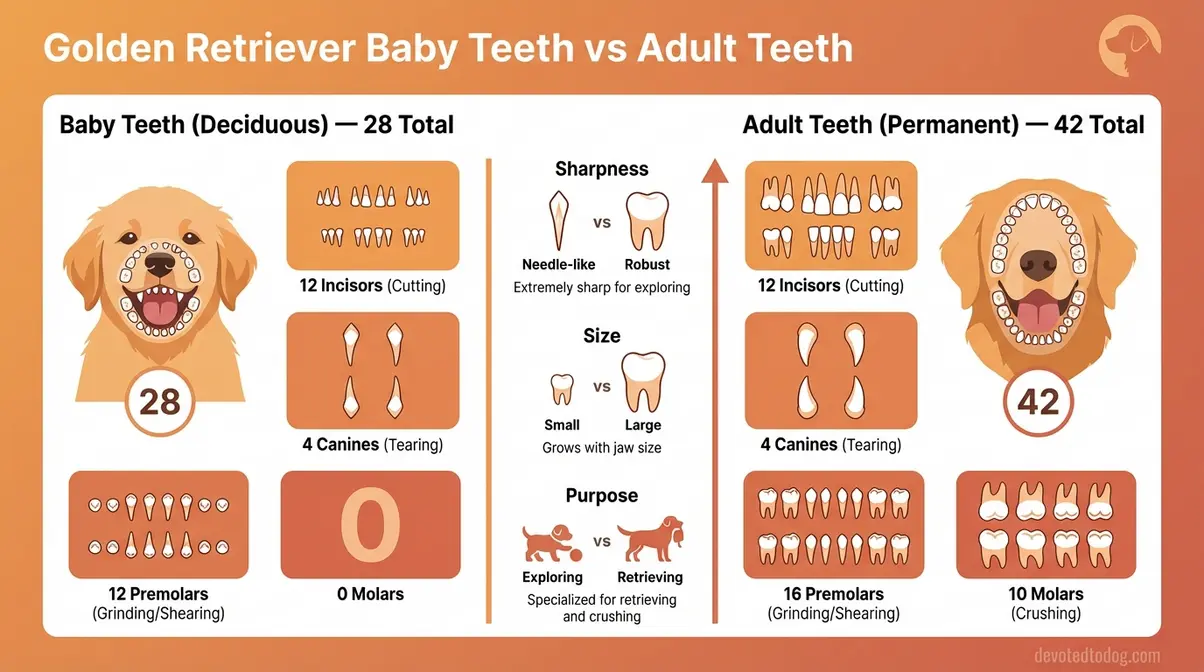
Understanding the difference between baby and adult teeth — both in count and character — helps explain a lot about why those early nips hurt so much.
Golden Retriever puppies develop 28 deciduous teeth (baby teeth): 12 incisors, 4 canines, and 12 premolars. What makes them particularly unpleasant for your fingers is their shape — baby teeth are notably sharper and thinner than adult teeth, almost needle-like. They weren’t designed for crushing; they were designed for a puppy learning to interact with the world through its mouth.
Adult teeth tell a different story. Your Golden will eventually have 42 permanent teeth: 12 incisors, 4 canines, 16 premolars, and 10 molars. These are larger, blunter, and built for durability — designed for the retrieving work the breed was bred to do. A University of Florida veterinary guide on puppy incisors notes that a puppy’s permanent incisors, consisting of 12 teeth at the front of the mouth, come in at a predictable rate that veterinarians use as a reliable aging benchmark (University of Florida College of Veterinary Medicine).
The table below shows the full comparison at a glance:
| Feature | Baby Teeth (Deciduous) | Adult Teeth (Permanent) |
|---|---|---|
| Total Count | 28 | 42 |
| Sharpness | Very sharp (needle-like) | Blunter, more robust |
| Incisors | 12 | 12 |
| Canines | 4 | 4 |
| Premolars | 12 | 16 |
| Molars | 0 | 10 |
| Typical Presence | 3 weeks – 3 months | 3 months – 7 months+ |
When your Golden’s baby canine is still in place but the adult canine has already erupted right behind it — that’s the classic “double tooth” retained tooth scenario to watch for. More on that in the third section.
For a deeper look at how these stages connect to your puppy’s broader development, see Golden Retriever puppy teeth development stages.
Now that you know what’s in your puppy’s mouth — and why those baby teeth feel so sharp — let’s walk through exactly when each stage happens.
When Do Puppies Start Losing Teeth?
Golden Retriever puppies typically begin losing their baby teeth around 12 to 16 weeks of age (3 to 4 months) according to USDA APHIS. The process starts with the front incisors and progresses toward the back teeth over the following weeks. By 6 to 7 months, most adult teeth have fully erupted and the transition is essentially complete. Finding tiny teeth on the floor or embedded in chew toys is perfectly normal — many puppies simply swallow them without any issue.
Week-by-Week Teething Timeline

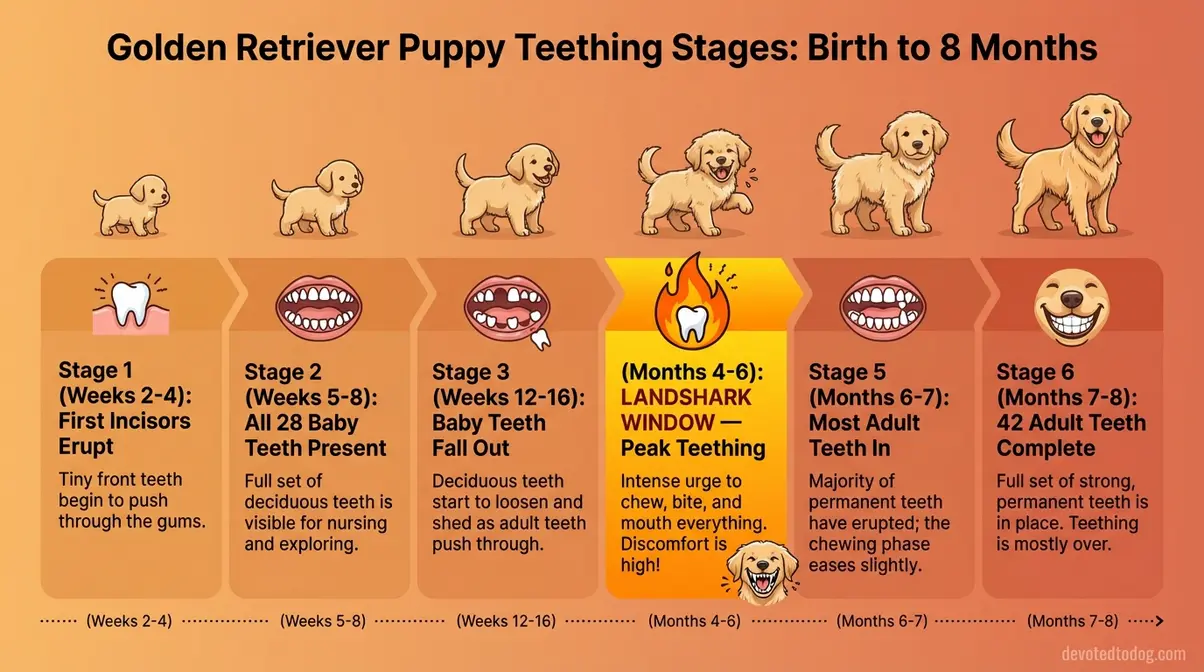
Golden Retriever puppies are born toothless and develop all 28 baby teeth by 8 weeks of age, then transition to 42 permanent adult teeth by 7–8 months (USDA APHIS, 2026). The timeline below is the most valuable reference you’ll have during your puppy’s first year.
Stage 1 — Weeks 2–4: The first baby incisors begin pushing through. Your puppy’s eyes have just opened, and they’re already exploring the world with their mouth. No owner action is needed yet, but this is the very beginning of the oral fixation that defines the breed.
Stage 2 — Weeks 5–8: All 28 baby teeth are fully erupted. Puppies are in full “landshark mode” during play — sharp nipping is completely normal at this stage. By 8 weeks, when most owners bring their Golden home, the full set of baby teeth is already present and accounted for.
Stage 3 — Weeks 12–16 (3–4 months): Baby teeth start loosening and falling out, beginning with the incisors. You may find tiny teeth on the floor or embedded in chew toys. Light spots of blood on toys are normal and expected — adult incisors are pushing through from below.
Stage 4 — Months 4–6 (THE LANDSHARK WINDOW): This is the peak. Adult canines, premolars, and molars all erupt in rapid succession. Gum soreness reaches its maximum, chewing intensity spikes, and owners consistently report this as the hardest stretch of puppyhood. The discomfort is real — your Golden isn’t acting out; their mouth genuinely hurts.
“The consensus seems to be that it improves after 6 months once they stop teething.” — Golden Retriever owner community
Stage 5 — Months 6–7: Most adult teeth are fully in place. Chewing behavior gradually decreases as gum discomfort eases. Some Goldens continue intense chewing as a learned habit even after teething ends — this is common and addressable with continued redirection.
Stage 6 — Months 7–8: Full adult dentition is complete (42 teeth). The Landshark Window is closed.
| Age | What’s Happening | What You’ll Notice |
|---|---|---|
| Weeks 2–4 | First baby incisors erupt | Puppy begins mouthing and exploring |
| Weeks 5–8 | All 28 baby teeth present | Sharp nipping during play |
| Weeks 12–16 | Baby teeth start falling out | Teeth on floor, light blood on toys |
| Months 4–6 | Adult teeth erupt (peak) | Maximum chewing, gum soreness, irritability |
| Months 6–7 | Most adult teeth in place | Chewing gradually decreases |
| Months 7–8 | Full 42 adult teeth complete | Calmer oral behavior |
According to the USDA APHIS guide on aging puppies by teeth, puppy teeth erupt and are replaced by permanent teeth on a consistent schedule — though sometimes deciduous teeth fail to fall out, leading to retained teeth that require veterinary attention (USDA APHIS, 2026).
Understanding the timeline is step one. Now let’s talk about what you can actually do to make the Landshark Window survivable — for both of you.
Why Golden Retrievers Are So Mouthy
Golden Retrievers were selectively bred over generations to retrieve waterfowl using a “soft mouth” — meaning they carry objects gently without crushing them. That breeding history wired this breed to be more orally focused than almost any other. Teething doesn’t create the mouthiness; it amplifies an instinct that was already there.
This matters practically because teething behavior in Goldens often outlasts the physical teething period itself. The chewing habit can persist well past 8 months, even after all 42 adult teeth are fully in place. That is not a training failure — it’s breed nature. As the Texas A&M veterinary timeline of puppy development notes, major physical and behavioral changes during the transitional stage between 2 to 4 weeks of age coincide with early dental development and set the foundation for lifelong oral behavior (Texas A&M School of Veterinary Medicine, 2026).
Unlike breeds with less oral drive, a Golden may still seek out chew toys and carry objects well into adulthood — this is actually a sign of a well-bred retriever, not a problem to fix.
Now that you understand why your Golden’s mouth is always busy, let’s focus on making the toughest weeks more manageable.
Managing the Landshark Window

The Landshark Window — months 4 through 6 — is the most intense phase of Golden Retriever puppy teeth growth and development. Your puppy isn’t misbehaving; their gums genuinely hurt. Here are the strategies that actually work.
The 4-to-6-month Landshark Window is the peak of Golden Retriever teething discomfort — and frozen chew toys combined with consistent redirection are the most effective tools for surviving it (veterinary community consensus).
What Age Is Teething Worst?
The most intense teething phase for puppies — including Golden Retrievers — typically occurs between 4 and 6 months of age, as noted by Virginia Tech Veterinary Teaching Hospital. During this window, adult teeth are actively pushing through the gums, causing maximum discomfort, increased drooling, and a strong urge to chew everything in sight. This is what we call the Landshark Window. Most owners notice a significant improvement once their puppy passes the 6-month mark and the bulk of adult teeth are fully seated.
How to Soothe Sore Puppy Gums
Sore gums are the driving force behind almost every challenging behavior in the Landshark Window. The good news is that several simple, low-cost remedies genuinely help. The Virginia Tech veterinary advice on puppy chewing phases confirms that by about 6 months of age a puppy should have all adult teeth, and between 6 to 12 months they typically go through a significant chewing phase — meaning relief strategies matter well beyond the teething window itself (Virginia Tech Veterinary Teaching Hospital, 2026).
Here are five methods that consistently work:
- Frozen washcloth: Wet a clean washcloth, twist it, and freeze for 30 minutes. Let your puppy chew on it — the cold directly numbs sore gum tissue. Supervise at all times to prevent tearing and ingestion.
- Frozen Kong stuffed with puppy-safe fillings: Fill a Kong, a rubber chew toy brand popular for teething puppies, with mashed banana or plain unsweetened yogurt, then freeze overnight. This provides extended soothing chew time and keeps your puppy occupied for 15–20 minutes.
- Frozen carrots: A natural, low-calorie option that works well for puppies over 10 weeks. Offer whole carrots and monitor closely to prevent large chunks from breaking off and becoming a choking hazard.
- Cold water bowl: Keeping fresh, cold water available at all times helps ease mild gum irritation between chew sessions. It’s simple and often overlooked.
- Pause brushing during peak soreness: If your puppy’s gums are visibly inflamed or lightly bleeding, skip tooth brushing for a few days. Resume gently once the acute soreness eases — forcing it causes setbacks in dental care habits.
Soothing the gums is only half the battle — you also need to give your Golden something appropriate to chew, or your furniture will pay the price.
Safe Chew Toys for Teething Goldens
Not all chew toys labeled “for puppies” are actually safe for a teething Golden Retriever. Goldens are powerful chewers even as young puppies, and choosing the wrong toy can fracture developing teeth or create a choking hazard.
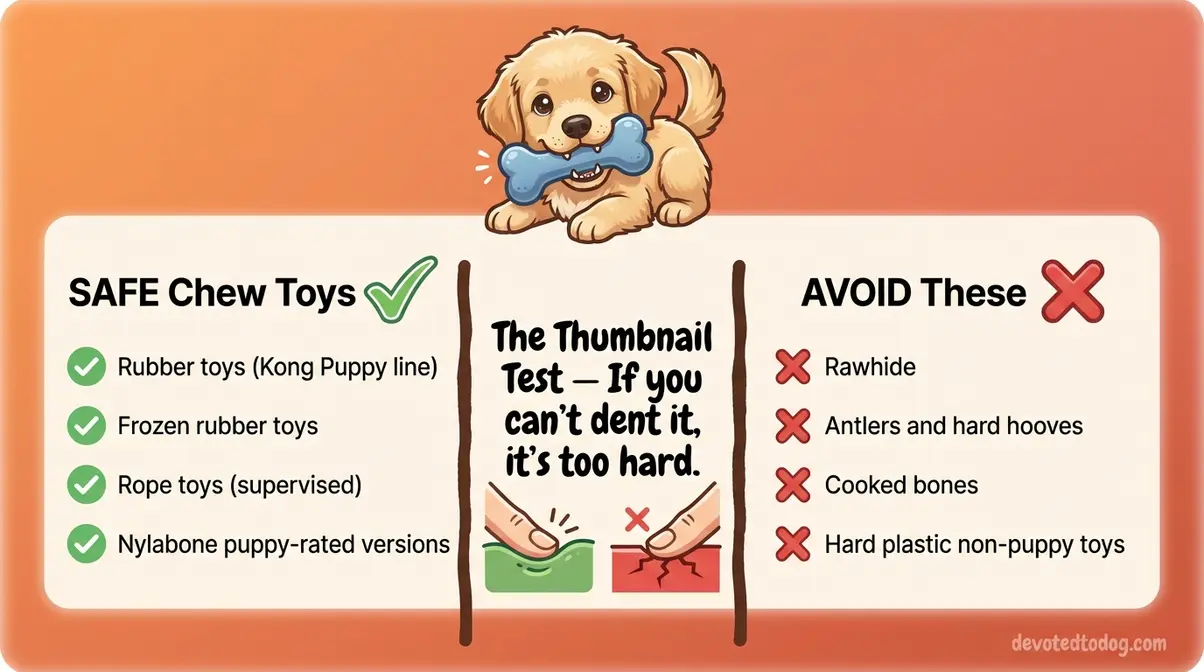
The single most useful test is the Thumbnail Test: press your thumbnail firmly into the toy’s surface. If you can’t make an indent, the toy is too hard for a puppy. This immediately rules out antlers, hard nylon bones, and large cooked bones — all of which are common causes of fractured puppy teeth. The Clemson University research on canine tooth eruption sequence notes that tooth eruption in dogs begins with the incisors and progresses sequentially toward the back of the jaw, meaning developing teeth at all stages are vulnerable to fracture from overly hard objects (Clemson University).
Size matters just as much as hardness. For a Golden Retriever puppy, always choose toys labeled for medium to large breeds. A toy that fits entirely in your puppy’s mouth is a choking hazard — and Goldens have large mouths even at 10 weeks.
- Safe options for teething Goldens:
- ✓ Rubber toys (Kong Puppy line — soft enough to pass the thumbnail test)
- ✓ Frozen rubber toys (doubles as soothing)
- ✓ Rope toys (supervised only — not for unsupervised chewing; loose strands can be swallowed)
- ✓ Nylabone, a nylon chew toy brand — choose puppy-rated versions only, not adult formulations
- Avoid during the teething window:
- ✗ Rawhide (choking and digestive risk)
- ✗ Antlers and hard hooves (too hard — tooth fracture risk)
- ✗ Cooked bones of any kind
- ✗ Hard plastic toys not specifically rated for puppies
Once you have the right toys, the next skill is teaching your Golden to use them instead of you.
Redirecting the Nip During Teething
Consistent redirection — not punishment — is what gets you through the Landshark Window with your relationship with your puppy intact. The key insight: nipping during this phase is almost always pain-driven, not dominance. Your puppy isn’t testing you; their gums hurt and chewing provides relief.
The Yelp and Redirect method is the most effective approach during active teething:
- When your puppy nips skin, say “OW” or “ouch” in a high-pitched, surprised voice.
- Immediately stop all play and withdraw attention for 10–15 seconds.
- Offer an appropriate chew toy — a frozen Kong works especially well here because it addresses the underlying gum discomfort.
- Resume play as soon as your puppy engages with the toy. This is the reward.
- Repeat this sequence every single time, without exception.
What you should not do matters just as much. Pulling your hand away quickly triggers the chase-and-grab instinct and makes nipping more intense, not less. Tapping the nose or pushing the muzzle can increase anxiety and sometimes worsens the behavior. Across Golden Retriever owner communities, the consistent experience is that this method takes 4–6 weeks of repetition to fully take effect — which conveniently aligns with the end of the Landshark Window.
While you’re managing behavior, don’t overlook one frequently missed strategy: supporting your Golden’s comfort through diet during peak teething.
Nutritional Support for Teething
Most teething guides focus entirely on toys and training — but what your puppy eats during peak teething matters too. Sore gums make hard kibble genuinely painful, and some puppies eat less or skip meals entirely during the Months 4–6 window.
- Soften dry kibble: Add warm water to your puppy’s kibble and let it sit for 5–10 minutes before serving. This small change can prevent appetite loss during the most uncomfortable weeks.
- Cooling soft foods in a Kong: Plain unsweetened yogurt, mashed sweet potato, or pureed pumpkin (not pie filling) can be frozen in a Kong as both a soothing tool and a nutritional supplement. These are safe, gentle on sore gums, and easy to prepare.
- Switch to soft training treats: During peak teething, trade hard training treats for soft alternatives. Maintaining training momentum during this phase is important — you don’t want to abandon consistency just because your puppy’s mouth hurts.
Beyond managing the teething phase, there’s one dental issue specific to Golden Retrievers that every owner should know how to spot.
Retained Baby Teeth & Warning Signs
Retained deciduous teeth — a condition where a baby tooth stays in place even after the adult tooth has erupted in the same spot — are a real and manageable risk in Golden Retrievers. This isn’t a reason to panic, but it is something to monitor actively throughout the Landshark Window. Zero competitors in the current SERP address this topic in meaningful depth for Golden Retriever owners, which is exactly why it belongs here.
Persistent deciduous teeth that fail to fall out are associated with malocclusion and soft tissue trauma in dogs, making early identification and veterinary intervention important (PubMed, 2026).
What Are Retained Deciduous Teeth?
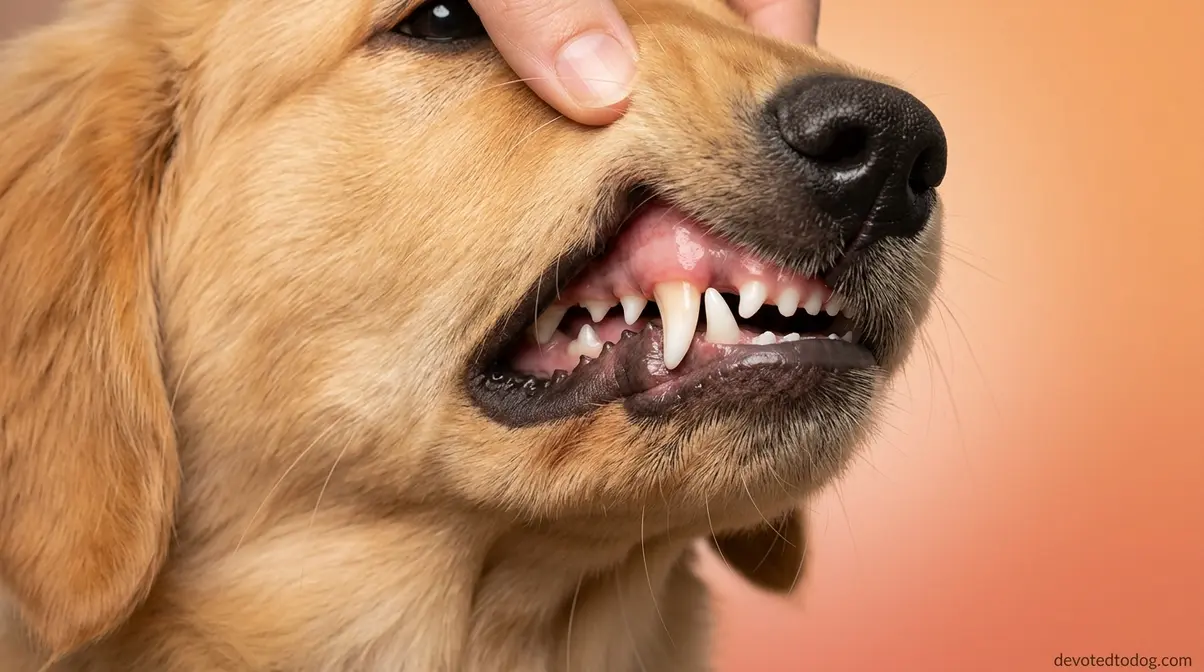
Retained deciduous teeth occur when a baby tooth fails to fall out even after the adult tooth has already begun erupting in the same socket. The result is two teeth occupying the same space — owners often describe this as “shark teeth” or “double teeth,” and it’s a fairly accurate description.
The consequences go beyond aesthetics. The retained baby tooth forces the incoming adult tooth to erupt at an abnormal angle, leading to malocclusion (a misaligned bite), crowding, and soft tissue trauma where teeth press against the gums or cheek. Left untreated, retained teeth can cause persistent pain and accelerate tooth damage in a dog that hasn’t even reached full size yet.
According to an NIH study on persistent deciduous teeth in dogs, persistent deciduous teeth that fail to fall out at the appropriate time are associated with malocclusion and soft tissue trauma in dogs (PubMed, 2026). The condition has an overall prevalence of approximately 7% in purebred dogs in the US — and while it is more common in small breeds, Golden Retrievers are identified as a susceptible breed. The intense chewing behavior during the Landshark Window can sometimes mask early signs, since owners attribute all oral discomfort to normal teething.
The good news is that retained teeth are easy to spot if you know what to look for — and a simple monthly mouth check is all it takes.
How to Check Your Puppy’s Mouth
This five-step check takes under two minutes and can catch a retained tooth weeks before it becomes a serious problem. Research on the veterinary sequence of deciduous dentition confirms that longitudinal studies on the emergence of deciduous teeth in puppies provide a reliable baseline for identifying when teeth are overdue to fall out (PubMed, 2026).
- Choose a calm moment — after a walk or play session when your puppy is relaxed and not amped up.
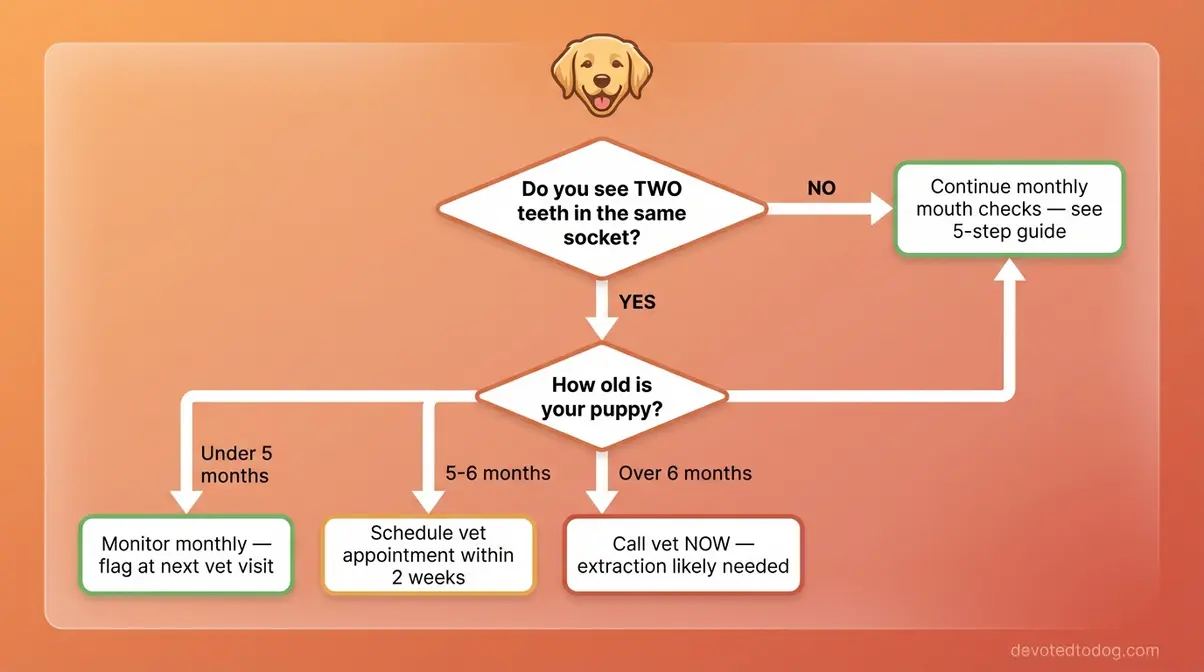
- Gently lift the upper lip on one side and look at the canine teeth — the large “fang” teeth. If you see two canines side by side (one behind the other), that’s a retained tooth. Flag it for your vet at the next appointment or sooner if your puppy is approaching 6 months.
- Check the incisors (the small front teeth) for any that appear crowded, overlapping, or noticeably misaligned.
- Scan the gum line for redness, swelling, or visible bleeding beyond the light spotting that’s normal during teething.
- Repeat monthly from 3 months through 8 months — covering the full Landshark Window and transition period.
When to Call the Vet for Your Puppy
Home management handles most of what the Landshark Window throws at you — but some signs require professional evaluation. Knowing the difference protects your puppy and gives you confidence to act at the right moment.
Common Pitfalls and Red Flags
The University of Minnesota guidelines on pet dental health recommend brushing a pet’s teeth with a soft bristle brush once daily or every other day using dog-safe toothpaste — a standard that becomes especially important to establish before the Landshark Window so your puppy tolerates it when it matters most (University of Minnesota).
Three specific pitfalls trip up many Golden Retriever owners:
- Assuming all bleeding is normal. Light spotting on chew toys is expected and harmless. Persistent or heavy bleeding — especially without an obvious cause like a lost tooth — warrants a call to your vet.
- Missing retained teeth at 6 months. If you see two teeth occupying the same socket space by the time your puppy hits 6 months, schedule a vet appointment promptly. Retained deciduous teeth rarely fall out on their own after this point and almost always require extraction.
- Dismissing reduced appetite as pickiness. If your puppy consistently avoids hard kibble for more than 3–4 days during peak teething, consult your vet to rule out significant gum inflammation rather than assuming it’s a preference issue.
When to Seek Veterinary Help
Call your vet if you observe any of the following:
- Retained baby teeth (double teeth in the same socket) still present at 6 months
- Significant bleeding beyond light spotting on chew toys
- Refusal to eat for more than 2–3 consecutive days
- Visible signs of infection — swelling, discharge, or a foul smell from the mouth
- Extreme pain signals — whimpering when chewing, pawing at the mouth, or reluctance to open the mouth at all
Persistent bleeding or refusal to eat for over 48 hours indicates potential infection — requiring immediate veterinary care.
Consult your veterinarian for any persistent dental concerns. This article provides educational information only and is not a substitute for professional veterinary advice.
Frequently Asked Questions
How long is the Golden Retriever biting stage?
The intense biting phase in Golden Retrievers is directly tied to teething and usually subsides between 6 and 8 months old. While teething ends around that time, some puppies continue mouthing out of habit or play. Consistent bite inhibition training and redirection, started as early as 8 weeks, can reduce the severity of biting well before the 6-month mark. Most owners report a noticeable improvement by 8-10 months with regular training.
How long does the teething stage last for golden retrievers?
The main teething stage for Golden Retrievers runs from roughly 3-4 months until 6-8 months of age. During this time, your puppy loses all 28 baby teeth, which are replaced by 42 permanent adult teeth. The most intense chewing and discomfort typically occurs between 4 and 6 months when the larger canines and molars push through. Most puppies complete the process by 7-8 months. Results vary slightly based on individual development and genetics.
How Do You Survive the Land Shark Phase?
The intense biting stage in Golden Retrievers typically subsides between 6 and 8 months, but consistent training starting as early as 8 weeks can dramatically reduce the severity before it peaks. The American Society for the Prevention of Cruelty to Animals (ASPCA) describes bite inhibition as a dog’s learned ability to control the force of their mouthing, a skill that is most easily shaped during early puppyhood (ASPCA). The techniques below work best inside the Teething-to-Training Window, before adult jaw strength fully develops.
What Are the Hardest Teething Months?
Most Golden Retriever owners find months 4 to 6 to be the most challenging stretch of early puppyhood. This is when teething peaks, chewing becomes most destructive, and the early stages of adolescent energy begin to show. The combination of physical gum discomfort from erupting adult teeth and increased overall activity can feel genuinely overwhelming. Consistent management strategies — frozen toys, redirection, softened kibble — and patience through this window typically lead to meaningful improvement by 6 to 7 months, aligning with USDA APHIS dental timelines.
How Can I Soothe Sore Puppy Gums?
To soothe sore gums, offer frozen washcloths, frozen Kongs stuffed with plain yogurt or mashed banana, or whole frozen carrots. When your puppy nips, say “OW” in a high-pitched voice, pause play briefly, then redirect to an appropriate chew toy. Avoid tooth brushing when gums are visibly inflamed during the 4–6 month peak identified by Virginia Tech. Keeping cold water available at all times also helps ease mild discomfort between chew sessions.
What Are the Signs of Teething?
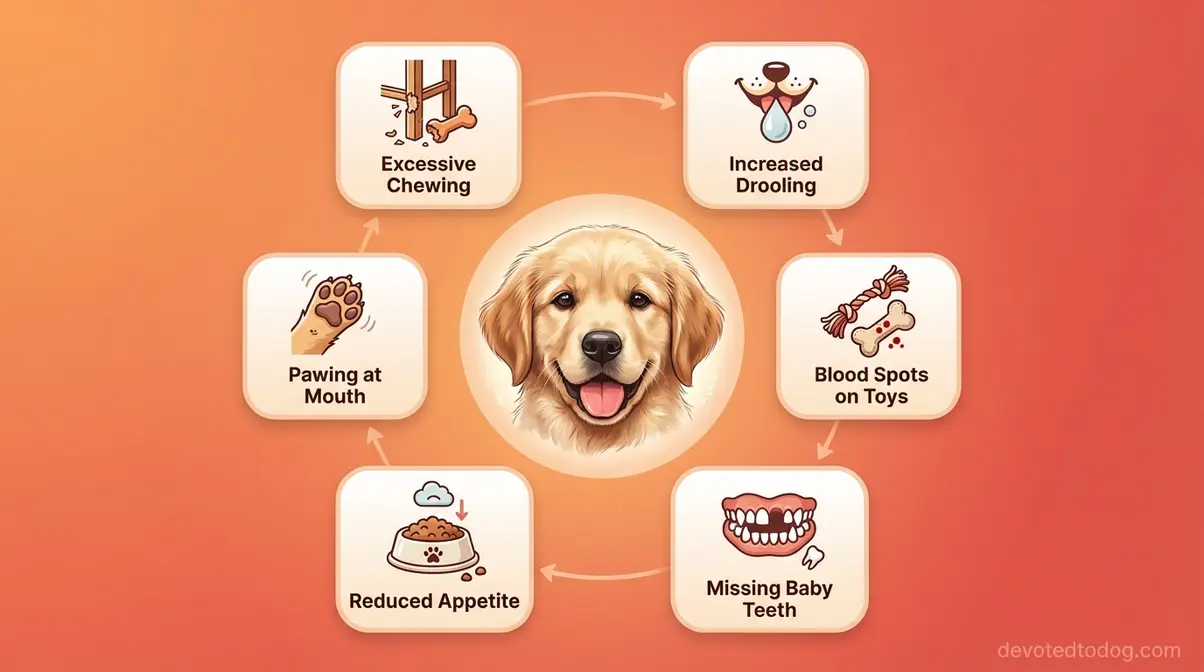
Common teething signs in Golden Retriever puppies include excessive chewing on furniture, shoes, and hands; increased drooling; small spots of blood on chew toys; missing baby teeth (you may find them on the floor); and temporary irritability or reduced appetite for hard kibble. Some puppies also paw at their mouths or seem briefly reluctant to eat. These signs typically peak between 4 and 6 months and ease significantly by 7 months as adult teeth settle in, according to veterinary dental sequences.
When Should I Be Concerned?
Contact your veterinarian if your puppy has retained baby teeth (two teeth visible in the same socket, still present at 6 months, a condition noted in NIH studies). You should also call if there is heavy or persistent bleeding beyond light spotting, or if they refuse to eat for more than 2-3 days. Showing signs of infection such as swelling, discharge, or foul odor from the mouth, or appearing to be in significant pain while chewing also warrant a visit. These specific signs require professional evaluation rather than continued home management.
The Landshark Window Is Temporary
For Golden Retriever puppy owners, understanding golden retriever puppy teeth growth and development is the key to surviving — and even enjoying — one of the breed’s most intense phases. Your Golden grows 28 baby teeth by 8 weeks and replaces them all with 42 adult teeth by 7–8 months, with the hardest stretch — the Landshark Window — concentrated between 4 and 6 months. The best approach combines a consistent frozen chew toy rotation, the Yelp and Redirect method for nipping, softened kibble during peak soreness, and a quick monthly mouth check for retained teeth.
The Landshark Window is temporary and survivable. By recognizing it as a predictable, breed-specific developmental phase rather than a behavior problem, you can respond with the right tools instead of frustration. Keep frozen Kongs stocked, redirect every nip consistently, and check your puppy’s mouth monthly from 3 months through 8 months. The window closes — and your Golden will be noticeably calmer on the other side.
If you’re in the thick of it right now, start with one frozen Kong tonight. And if you notice any double teeth, heavy bleeding, or other concerning signs during your next mouth check, schedule a quick vet visit — most retained teeth issues are straightforward to address when caught before 6 months. You’ve got this.
To curb destructive chewing during teething, see the best anti-chew sprays for dogs.
Brianna York is a former veterinary technician with hands-on clinical experience in canine health. She contributes medical accuracy review to DevotedToDog health articles and validates clinical claims against current AVMA, AAHA, and OFA standards.