
Key TakeawaysIf you are wondering when do golden retrievers calm down, most mature between 2 and 3 years old , though the “teenage phase” from 6 to 18 months is the hardest stretch for most owners.
- The Maturity Arc has three phases: puppy zeal (0–6 months), the teenage tornado (6–18 months), and couch potato graduation (2–4 years)
- The teenage phase (6–18 months) is peak energy and boundary-testing , the AKC calls this the “Teenage Rebellion Phase”
- Mental stimulation (puzzle toys, training sessions) calms Goldens faster than physical exercise alone
- Impulse control exercises like “capturing calmness” can be started as early as 8 weeks
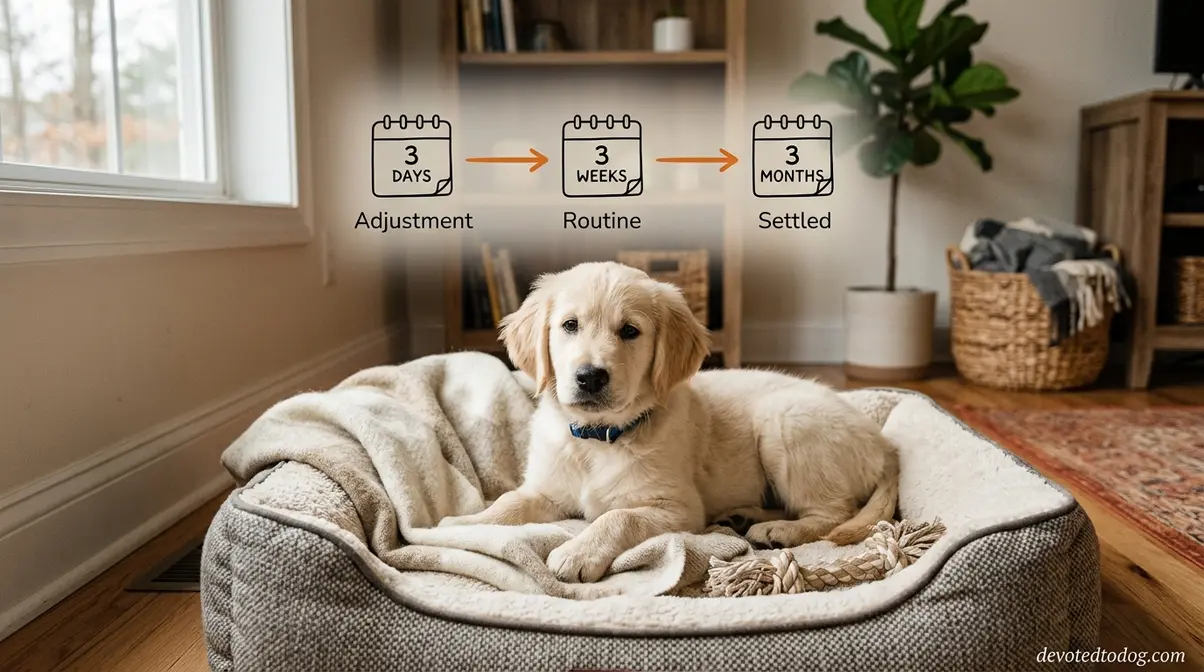
- Adopted Goldens follow the 3-3-3 rule: 3 days to decompress, 3 weeks to learn routine, 3 months to feel at home
The Golden Retriever Calming Timeline
Most Golden Retrievers calm down between 2 and 3 years old, though the journey from bouncy puppy to settled companion follows a predictable three-phase arc. A longitudinal study by the University of Arizona Canine Cognition Center found that dogs’ cognitive traits , including inhibitory control , continue maturing until approximately 2 years of age (Bray et al.). Understanding which phase your Golden is in right now changes everything about how you respond to their behavior. We call this progression The Maturity Arc , the three-phase developmental progression of Golden Retrievers from “puppy zeal” (0–6 months) through “the teenage tornado” (6–18 months) to “couch potato graduation” (2–4 years). Each phase has a distinct behavioral signature, a biological explanation, and a specific set of strategies that actually work.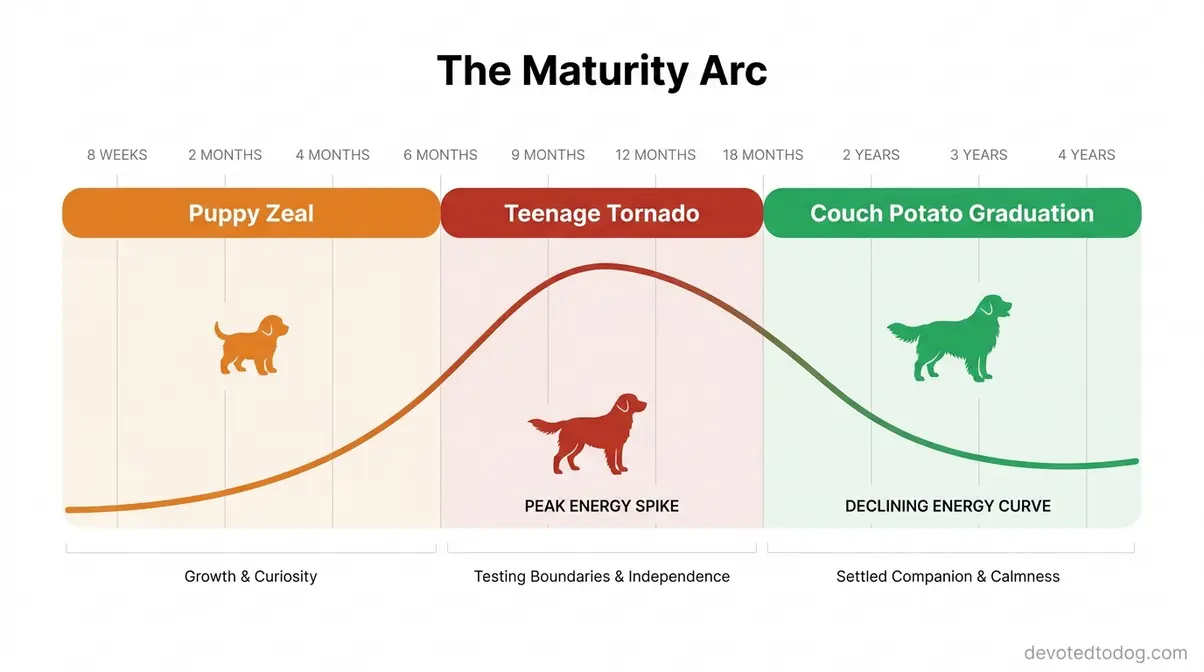
“Between 2 and 3 , especially now at 3 years old mine is calmed down. But appreciate the craziness while it lasts! The high energy just means they are enjoying.” , Golden Retriever owner, r/goldenretrieversFor a deep dive into managing specific behavior problems at each stage, see our guide to common Golden Retriever behavior problems.
The Puppy Phase (8 Weeks to 6 Months)
The puppy phase is intense , but it’s also mercifully brief. What you’re seeing is normal developmental behavior, not a character flaw in your dog (or yours). Golden Retriever puppies at this stage are experiencing the world through their mouths and their legs: zoomies (sudden, frantic sprinting that seems to come from nowhere), mouthing and biting as a form of exploration, and a complete inability to settle unless they’ve absolutely crashed. Here’s the surprising part: puppies at this age sleep 16–18 hours a day. The chaos happens in the gaps between naps. Think of it like an overtired toddler , when they’re up, they’re really up. The bursts of wild energy are neurologically driven and self-limiting. They end because the puppy runs out of fuel, not because they’ve learned restraint. This is also when foundational training matters most. The Ohio State University Veterinary Medical Center notes that behavior problems in puppies can largely be prevented through proper training during the critical developmental window before 14 weeks of age. The American Kennel Club (AKC), the leading registry for purebred dogs in the United States, confirms that the socialization window closes around 14–16 weeks , what happens here shapes adult behavior significantly. Specific behaviors to expect: jumping on guests, chewing shoes, pulling on the leash. These are “exploration behaviors,” not defiance. When do Golden Retrievers stop being puppies? Technically around 6 months , but the teenage phase that follows is a whole different challenge. The puppy phase is exhausting, but it’s the next stage , the teenage phase , where most Golden Retriever owners hit their breaking point.What Is the Most Difficult Age?
The most difficult age for Golden Retrievers is typically 6 to 18 months, the adolescent “teenage phase.” During this period, dogs have adult-sized energy but puppy-level impulse control, making them challenging to manage. They may seem to “forget” commands they previously knew. This phase is neurologically driven , the brain is still developing , and typically subsides as dogs approach their second birthday.The Teenage Phase (6 to 18 Months)
Welcome to “The Teenage Tornado” , the second phase of The Maturity Arc and the one that sends the most owners to Google at midnight. The AKC Golden Retriever training timeline officially calls this the “Teenage Rebellion Phase,” and the name earns it: your Golden now has the physical size of an adult but the impulse control (the ability to pause before reacting) of a 10-week-old puppy. Golden Retrievers typically enter their “Teenage Rebellion Phase” between 6 and 18 months , the period when energy peaks and boundary-testing is most intense (American Kennel Club). The neuroscience is worth understanding, because it changes how you respond. The prefrontal cortex equivalent in dogs , the brain region governing self-regulation and impulse control , is still developing during this phase. This is why commands that worked perfectly at 12 weeks suddenly seem “forgotten” at 8 months. Your dog isn’t being defiant. Their brain literally hasn’t finished wiring. Think of the teenage phase like a toddler who can run but hasn’t yet learned to wait. Across Reddit’s r/goldenretrievers community, the consistent report is that 8–14 months is the peak frustration window, with many owners noting a noticeable shift around 14–18 months. This is anecdotal but remarkably consistent. Specific behaviors that show up in this phase , and not in the puppy phase , include counter-surfing, selective hearing, leash lunging, and destroying furniture when left alone for even short periods. When Goldens finally calm down from this phase depends partly on what you do during it. The good news? The teenage phase is temporary , and around 18 months, most owners start to see the first real signs that their Golden is finally growing up.Young Adulthood (18 Months to 2 Years)
The turning point arrives gradually, then all at once. Around 18 months, something shifts. Your Golden starts offering longer settle times after exercise. Their greetings are still enthusiastic, but they’re not launching themselves at every visitor. Commands land more reliably. The dog begins to develop what trainers call an “off-switch” , the ability to genuinely rest after stimulation, not just pass out from exhaustion. This is also when training investment begins paying visible dividends. The impulse-control work you started during the teenage phase starts producing consistent results, because the brain is now mature enough to hold those lessons. One important health note for this stage: research from the UC Davis School of Veterinary Medicine indicates that the timing of neutering/spaying affects joint development and overall health trajectory in Golden Retrievers. Behavioral changes post-neuter vary significantly by individual. Always consult your veterinarian for personalized guidance on timing. Many owners on Reddit’s r/goldenretrievers report that 18 months felt like “a light switch flipping” , not a complete transformation, but the first genuine glimpse of the calm dog they’d been promised. When do golden retrievers calm down completely? For a meaningful number of owners, this 18-month mark is the answer. By 2–4 years, most Golden Retrievers complete what we call “couch potato graduation” , the moment the breed’s famously gentle, calm temperament finally arrives.Full Maturity (2 to 4 Years)
“Calm” for a Golden Retriever doesn’t mean sedentary. It means balanced. At full maturity, your dog remains playful and enthusiastic , that’s the Golden spirit , but they can now self-regulate. They settle after exercise. They don’t demand constant attention. They can relax in the same room as guests without turning into a 70-pound greeting committee. The AKC Golden Retriever breed standard notes a life expectancy of 10–12 years and describes the Golden’s characteristic gentle, calm temperament as a defining adult trait. The “calm years” represent the majority of a Golden’s life. That’s the reward for surviving the teenage tornado. Bloodline variation matters here. Field-line Golden Retrievers, bred for hunting and retrieving work, may remain higher-energy into years 3–4. Show-line Goldens tend to settle closer to 2 years. English Cream Golden Retrievers, a lighter-coated variant known for calmer temperament, are generally the most settled across all life stages. When do field Golden Retrievers calm down? Often 12–18 months later than their show-line counterparts. Community consensus across Golden Retriever forums echoes this , many owners describe the 3-year mark as when their “wild child” suddenly became a “couch potato.” But “waiting it out” isn’t a strategy. Understanding what’s driving your Golden’s energy , and addressing those specific factors , can meaningfully accelerate the path to calm.What Affects How Fast Your Golden Calms Down?
Not all Goldens follow the same schedule , and three specific factors explain the variation. Understanding these helps you stop comparing your dog to an average and start working with your individual animal. Three variables have the clearest impact on how quickly a Golden moves through The Maturity Arc: gender, bloodline, and the type of stimulation they receive daily.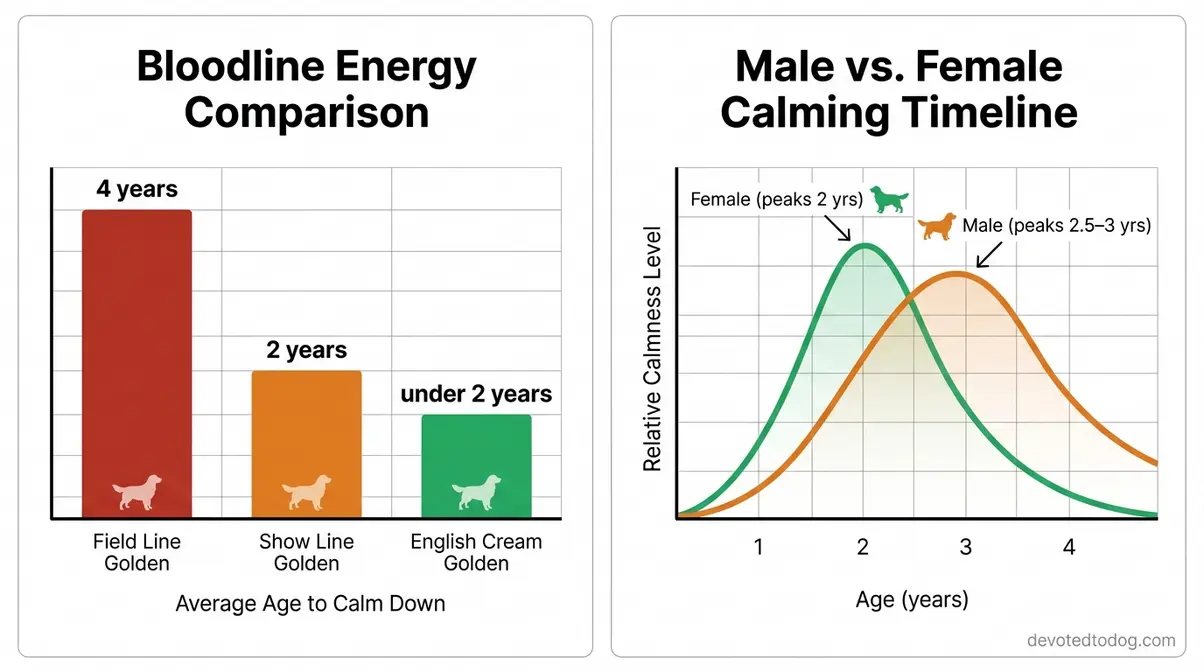
Male vs. Female Differences
The short answer: yes, but less than most people expect. Male Golden Retrievers tend to mature slightly later than females , often showing more pronounced teenage-phase behaviors and not fully settling until 2.5–3 years. Females typically show earlier signs of emotional maturity, often calming noticeably by 2 years. When do male Golden Retrievers calm down? On average, 6–12 months later than females. When do female Golden Retrievers calm down? Closer to the 2-year mark is the consistent community report. That said, the individual variation within each sex is greater than the average difference between sexes. A well-trained, adequately stimulated male Golden will be calmer than an under-stimulated female. Neutering and spaying timing can also influence the trajectory, though the effect varies by individual (another reason to discuss timing with your vet). Gender is a factor, not a destiny. Bloodline has an even bigger impact on energy levels than gender , and it’s something many first-time Golden owners never consider.Show Line vs. Field Line
Think of field-line Goldens like marathon runners and show-line Goldens like sprinters. Both are athletic , they just express it differently. Field-line Golden Retrievers, bred for hunting and retrieving work, carry higher prey drive, greater endurance, and a genuine need for a “job.” They often don’t settle until 3–4 years and may never be truly calm without structured activities like agility, nose work, or regular retrieving sessions. If your Golden came from a hunting or working bloodline, adjust your expectations to 3–4 years rather than 2. When do field Golden Retrievers calm down? Often not until their third or fourth birthday , and only then with adequate mental outlets. Show-line Golden Retrievers, bred for conformation and temperament, tend to calm closer to 2 years and are more content with standard daily walks and training sessions. English Cream Golden Retrievers are generally the calmest variant across all life stages. If you have one and they’re still in full “wild child” mode at 2 years, that’s individual variation , not a breed norm. Bloodline sets the ceiling , but mental stimulation determines how close to that ceiling your dog actually operates every day.Mental vs. Physical Stimulation
Here’s the insight most owners miss: physical exercise burns calories, but mental stimulation tires the brain. A Golden who runs 5 miles can still have enough energy to redecorate your living room. A Golden who completes a 20-minute training session is genuinely, deeply tired. According to VCA Animal Hospitals, sniff walks , walks where dogs lead by nose and sniff freely , function as a genuine mental workout, expending energy in ways that physical-only exercise doesn’t replicate. Bay Path Humane Society reports that 15–20 minutes of focused sniffing can be as mentally fatiguing as a much longer physical walk. The mechanism: sniffing activates the parasympathetic nervous system (the “rest and digest” state), lowering cortisol and producing genuine calm rather than just physical depletion. Golden Retrievers who lack adequate daily exercise and mental stimulation are more likely to develop destructive behaviors, according to community consensus reported across Golden Retriever breed guides. Specific mental enrichment tools that work for beginners: snuffle mats, stuffed Kong toys, and short training sessions (5–10 minutes, 2–3 times daily). A tired brain equals a calm dog. This principle underpins every exercise in the next section. Now that you understand what’s driving the energy, here are six specific exercises , all beginner-friendly , to build impulse control during the hardest phase.6 Impulse Control Exercises for the Teenage Phase
The most effective way to help a Golden Retriever calm down faster isn’t more exercise , it’s impulse control training (teaching your dog to pause before reacting). These six exercises are ranked from easiest to most advanced, and all can be started during the teenage phase. Each session takes 5–15 minutes. Consistency matters more than duration. Impulse control , the ability to pause before reacting , is the single most trainable skill for calming a teenage Golden Retriever (Ohio State University Veterinary Medical Center).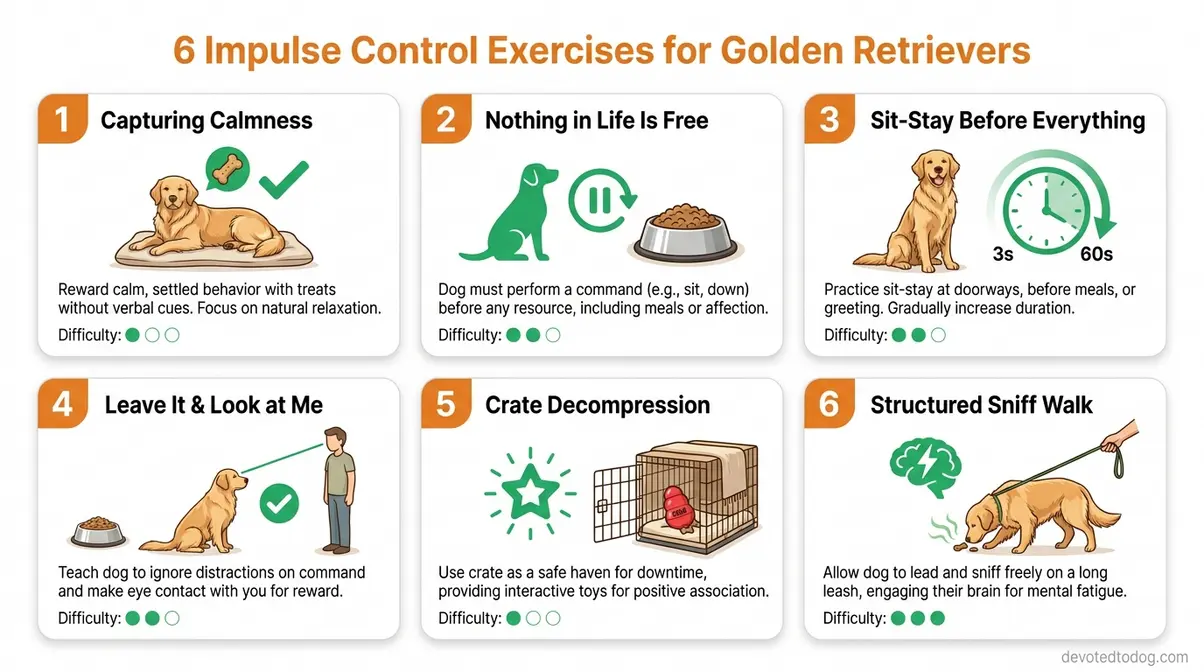
Exercise 1: Capturing Calmness
Estimated Time: 5 minutes, ongoing throughout the day When to start: 8 weeks and up This is the most beginner-friendly exercise , no commands, no clicker required. You’re simply teaching your dog that calm behavior is the most rewarding option. Step 1: Prepare Your Treats Keep small treats in your pocket or a nearby bowl at all times. Step 2: Mark and Reward When your Golden lies down or stops moving voluntarily, quietly say “yes” and deliver a treat gently , no excitement. Step 3: Maintain Calmness Do NOT call them to you or make a fuss. Calm delivery only. Step 4: Repeat Daily Repeat 10–20 times daily in normal household situations. Why it works: You’re marking and reinforcing the exact state you want more of. Over time, your dog begins choosing to settle because calm behavior consistently pays.Exercise 2: Nothing in Life Is Free
Estimated Time: No dedicated sessions , this runs all day When to start: 8 weeks, especially powerful during the 6–18 month phase Every reward , food, play, affection, going outside , requires a brief calm moment first. Structure your dog’s entire day around impulse control without extra training sessions. Step 1: Wait for Meals Before placing the food bowl down, wait for a sit. No sit, no bowl. Step 2: Wait for Walks Before opening the door for a walk, wait for four paws on the floor. Step 3: Wait for Play Before play begins, ask for a “sit” and release with “okay.” Why it works: Every interaction becomes a micro-training moment. Your dog learns that self-control is the key that unlocks everything good , and that lesson compounds quickly.Exercise 3: Sit-Stay Before Everything
Estimated Time: 5–10 minutes, 2–3 times daily When to start: 3 months and up This exercise directly builds the duration and distraction tolerance that teenage dogs desperately lack. Step 1: Start Simple Ask for a sit in a low-distraction environment. Step 2: Build Duration Wait 3 seconds, then reward with a treat and “free.” Step 3: Increase the Wait Gradually increase the wait to 10, then 30, then 60 seconds over several sessions. Step 4: Introduce Distractions Add distractions (tossing a toy nearby, doorbell sound) only after the 30-second baseline is reliable. Why it works: You’re directly exercising the prefrontal inhibition that’s still developing in teenage dogs. Each successful stay is a literal brain workout.Exercise 4: “Leave It” and “Look at Me”
Estimated Time: 5–10 minutes daily When to start: 10 weeks and up Two commands taught together that interrupt impulsive behavior in real-world situations , jumping, counter-surfing, leash lunging. This combo gives you a verbal interrupt for the most common teenage-phase behaviors. Step 1: Cover the Treat Place a treat on the floor and cover it with your hand. Step 2: Reward the Release When your dog stops pawing at your hand, say “leave it” and immediately reward with a different treat from your other hand. Step 3: Add Eye Contact Once “leave it” is solid, add “look at me” , say it, then reward the moment your dog makes eye contact. Step 4: Change Environments Practice in increasingly distracting environments: kitchen floor, backyard, then sidewalk. Why it works: “Leave it” interrupts the impulse; “look at me” redirects attention back to you. Together they create a two-step reset for any teenage misbehavior.Exercise 5: Crate Decompression
Estimated Time: Gradual buildup over 1–2 weeks When to start: Day one. Essential during the 6–18 month phase The crate isn’t punishment , it’s a voluntary “decompression zone.” Adolescent dogs are often overtired but don’t know how to self-settle. The crate provides a structured rest environment that mirrors what they need biologically. Step 1: Positive Association Feed all meals in the crate with the door open for the first week. Step 2: Random Rewards Toss high-value treats inside randomly throughout the day so the dog chooses to enter. Step 3: Short Closures Once your Golden walks in voluntarily, close the door for 5 minutes, then open without fanfare. Step 4: Extend and Enrich Gradually extend crate time, always pairing with a stuffed Kong toy to associate the crate with calm pleasure. Why it works: You’re creating a conditioned relaxation response. The crate becomes a cue for calm, not a source of stress.Exercise 6: Structured Sniff Walks
Estimated Time: 20–30 minutes When to start: Any age. Especially useful for high-energy teenage dogs A sniff walk is different from a regular walk. There’s no heel required , just a long line and permission to follow their nose wherever it leads. Step 1: Gear Up Attach a 15–20 foot long line in a safe, enclosed area. Step 2: Follow Their Lead Let your dog choose the direction and sniff freely , follow their lead. Step 3: Allow Exploration Allow 20–30 minutes of uninterrupted nose-led exploration. Why it works: Sniffing activates the parasympathetic nervous system , the “rest and digest” state , and produces genuine mental fatigue. VCA Animal Hospitals describes sniff walks as “nature’s mental workout” for dogs. Bay Path Humane Society reports that focused sniff sessions can be as mentally tiring as significantly longer physical exercise , making this one of the most efficient calming tools available. For a complete training foundation to support these exercises, see our Golden Retriever puppy training guide. These exercises work for Goldens you’ve raised from puppyhood. But what if you’ve adopted an adolescent or adult Golden who arrived with the teenage phase already in full swing?The 3-3-3 Rule for Adopted Goldens
The First 3 Days: Overwhelm and Shutdown
Newly adopted Goldens are in sensory overload. They may be unusually quiet, refuse food, hide under furniture, or , at the opposite extreme , be frantic and completely unable to settle. Neither response is their “real” personality. Both are stress responses to an overwhelming transition. Think of it like an iceberg: the behavior you see in the first 3 days is only the surface. What to do: limit visitors, keep the environment calm, give them a safe space (a crate with a familiar-smelling blanket), and resist the urge to overwhelm them with affection or activity. What not to do: don’t test obedience commands, don’t introduce other pets yet, and don’t take them to busy public places. Let them breathe.The First 3 Weeks: Learning the Routine
Around week 2–3, most adopted Goldens begin showing their personality , including any teenage-phase behaviors that were suppressed by stress. This is also when separation anxiety often surfaces. The dog has bonded to you but now fears abandonment. This is actually a sign of healthy attachment forming, not a problem. What to do: establish a consistent daily routine , feed, walk, train, and sleep at the same times every day. Begin the impulse-control exercises from the previous section. Practice short departures (5–10 minutes at first) to build confidence that you always come back.The First 3 Months: Becoming Themselves
At 3 months, your adopted Golden’s true temperament emerges. An adolescent Golden adopted at 10 months will still go through the teenage phase , but now from a secure base rather than a place of anxiety. The calming timeline from the earlier section applies from this point forward: expect full maturity 2–3 years from their birth date, not their adoption date. Many adopted Golden owners report that the 3-month mark is when their dog truly became “theirs” , when the personality they’d hoped for finally showed up fully. The Maturity Arc is the same; it just starts from a different place. Whether you’re raising a Golden from puppyhood or navigating the 3-3-3 adjustment with a rescue, teething is one of the early behavioral triggers most owners underestimate.Teething and Puppy Biting: What to Expect
Teething is a significant , and often underestimated , driver of biting and chewing behavior in the 3–6 month window. Golden Retriever puppies begin losing their 28 baby teeth at 3–4 months old; all 42 adult teeth are fully emerged by 6 months of age, per the AKC puppy teething timeline (AKC). This is normal developmental behavior, not early aggression. During teething, puppies chew to relieve gum discomfort , and everything in reach is a candidate. Two practical strategies that consistently help: first, offer frozen Kongs or frozen baby carrots to soothe inflamed gums (the cold reduces discomfort directly). Second, redirect biting to appropriate chew toys immediately and consistently , every single time. The key word is immediately: a 3-second delay teaches nothing. The moment teeth touch skin or furniture, calmly redirect to an approved toy. Biting behavior typically peaks between 3–5 months and then decreases as adult teeth settle in. If biting continues past 6 months with the same intensity, that’s a training issue rather than a teething issue , and the impulse-control exercises in the previous section become your primary tool. For a complete timeline of puppy teeth development and specific strategies for managing biting, see our guide to puppy teething timeline and dental milestones.When Do Golden Retrievers Stop Growing?
Physical growth and behavioral maturity follow parallel , but not identical , timelines. Golden Retrievers reach their full skeletal height by 9–12 months but continue “filling out” (muscle mass and weight) until 18–24 months. Males typically reach 65–75 lbs; females 55–65 lbs at full adult weight. The adult double coat begins replacing the puppy coat around 6 months and is typically complete by 18 months. You’ll notice a significant change in texture and density during this transition , it’s normal, and it’s coming. Here’s the connection most owners miss: the “filling out” phase (12–24 months) corresponds directly with the most intense period of the teenage phase. Your Golden’s body is adult-sized, but their brain is still catching up. That mismatch , big dog, puppy brain , is exactly why this period feels so overwhelming. Males generally fill out slightly later than females, which aligns with the behavioral maturity gap discussed earlier. Understanding your dog’s physical development timeline helps set realistic expectations for the behavioral timeline. They’re not the same clock, but they tick in sync. For detailed weight and height milestones, see our Golden Retriever growth chart and developmental stages. For the full coat transition timeline, see our guide to Golden Retriever coat development stages.Heat Cycles, Shedding, and Lifespan
Three lifecycle questions come up repeatedly in Golden Retriever communities , and each one connects to energy and behavior in ways that aren’t always obvious. Heat cycles: Female Golden Retrievers typically experience their first heat cycle between 6 and 24 months, depending on individual maturation rate, according to VCA Animal Hospitals. Unspayed females may show increased restlessness, anxiety, and energy spikes during heat , even in dogs who are otherwise settled. If your 2-year-old female suddenly seems to have regressed in calmness, a heat cycle may be the explanation. Shedding: Golden Retrievers shed year-round and “blow their coat” , heavy seasonal shedding , twice a year, typically in spring and fall. Daily brushing during blow-coat season significantly reduces the amount of fur that ends up on your furniture and clothing. This is not a behavioral issue, but it is a significant ownership commitment. Lifespan: Golden Retrievers live an average of 10–12 years (AKC). Cancer is a significant health concern in the breed , hemangiosarcoma and lymphoma are most commonly referenced in community discussions as the “silent killer.” For any health concerns, regular veterinary check-ups and early detection are the most protective measures available. Always consult your veterinarian for individual health guidance. For complete guidance on reproductive health, see our Golden Retriever heat cycle guide. For health and longevity information, see our Golden Retriever life expectancy and health factors guide.When Behavior Problems Signal Trouble

Common Behavior Problems
Here are the most common teenage-phase behaviors, their root causes, and what actually helps:- Destructive chewing: Root cause is boredom plus residual teething drive. Management: appropriate chew toys, stuffed Kongs, mental enrichment, and crate training for unsupervised time.
- Excessive jumping: Root cause is greeting excitement combined with underdeveloped impulse control. Management: the four-on-floor rule (no attention until all paws are down), consistently applied by every person who interacts with your dog.
- Excessive barking: Root cause is under-stimulation or anxiety. Management: identify the trigger first, then increase mental exercise and address the anxiety source directly.
- Attention-seeking (pawing, nudging): Root cause is insufficient structured engagement. Management: reward calm waiting behavior using the “Capturing Calmness” exercise rather than responding to demands.
What Are the Behavioral Issues?
Common behavioral issues in Golden Retrievers stem primarily from under-stimulation rather than aggression or defiance. These include destructive chewing, excessive jumping, leash pulling, attention-seeking behaviors, and excessive barking. Because Goldens are high-energy working dogs, they require significant daily physical exercise and mental enrichment , puzzle toys, training sessions, sniff walks , to stay well-behaved. Most issues resolve with consistent training and adequate stimulation.When to Call a Vet or Trainer
Some situations call for professional help , and asking for it is not a failure. It’s the fastest path to a calmer dog. Call a certified trainer (look for CPDT-KA credentials) if: jumping or biting breaks skin, reactivity toward other dogs or strangers is escalating rather than improving, resource guarding (growling over food or toys) is present, or anxiety is severe enough to prevent eating or settling for extended periods. Call your vet if: a previously calm dog shows a sudden behavior change (pain frequently manifests as aggression or irritability), hyperactivity is combined with physical symptoms like excessive thirst or unexplained weight changes, or you suspect separation anxiety severe enough to cause self-injury. Professional intervention at the right moment saves months of frustration and prevents small problems from becoming entrenched habits.Frequently Asked Questions
What Age Do Golden Retrievers Chill Out?
Most Golden Retrievers noticeably chill out between 2 and 3 years old. While their playful spirit remains throughout life, this is when energy becomes genuinely manageable and emotional maturity arrives. Many owners describe the 3-year mark as when their “wild child” suddenly became a “couch potato.” Individual variation exists , field-line Goldens and unneutered males may take until age 3–4 to fully settle.What Is the 3-3-3 Rule for Dog Anxiety?
The 3-3-3 rule describes the adjustment timeline for newly adopted dogs: 3 days to decompress and feel safe, 3 weeks to learn the household routine and begin showing their personality, and 3 months to fully settle and show their true temperament. For adopted Golden Retrievers specifically, this means the standard calming timeline starts from the 3-month mark, not the adoption date.What Is the Hardest Part of Owning a Golden Retriever?
The hardest part of owning a Golden Retriever is managing their high energy during the first 2–3 years , a period that requires a significant daily commitment to exercise, training, and mental stimulation. Beyond energy, Goldens are heavy seasonal shedders requiring regular grooming. The breed is also prone to certain health conditions, particularly joint issues and cancer, that require proactive veterinary care and regular check-ups throughout their 10–12 year lifespan.What Is the Silent Killer in Goldens?
The “silent killer” most commonly referenced in Golden Retriever communities is cancer , specifically hemangiosarcoma and lymphoma. Golden Retrievers have one of the highest cancer rates of any dog breed, with cancer causing 65% of deaths in a UC Davis study of the breed (Kent et al., PLoS ONE, 2018). Regular veterinary check-ups, knowing your dog’s baseline health, and early detection are the best protective measures currently available. Consult your veterinarian for individual health screening guidance.Start Building the Dog You Want
If you are constantly asking when do golden retrievers calm down, the timeline is predictable: most Goldens settle between 2 and 3 years old. The University of Arizona Canine Cognition Center confirms that cognitive maturity , including inhibitory control , continues developing until approximately age 2 (Bray et al.). The fastest path through The Maturity Arc combines impulse-control training with mental enrichment, not just more physical exercise. Here’s the reassurance worth holding onto: The Maturity Arc has three phases, and the “wild child” phase is phase 2 of 3. Puppy zeal (0–6 months), the teenage tornado (6–18 months), couch potato graduation (2–4 years). You are not at the beginning. You are in the middle of a predictable arc , and the third phase is coming. Start with Exercise 1 (Capturing Calmness) today. It requires no equipment, takes 5 minutes, and can begin at 8 weeks old. Bookmark this guide and revisit the timeline section every 3 months to track your Golden’s progress through The Maturity Arc. The calm, loving companion you were promised is already in there , they’re just still wiring their brain.
Reviewed by Alliyah Strange, Certified Dog Trainer & Behaviorist (CPDT-KA)
Alliyah Strange is a CPDT-KA certified dog trainer and behaviorist. She reviews DevotedToDog training and behavior articles for accuracy and alignment with current positive-reinforcement, force-free training standards.
The adolescent phase is one milestone in a longer arc mapped in our Golden Retriever behavior guide by age.
Related gear: see our guide to enrichment toys.