Here’s something that surprises most people: the American Kennel Club recognizes exactly one Golden Retriever breed, a single standard, no subdivisions. Yet if you’ve spent any time in Golden Retriever communities, you know that a cream-colored, blocky-headed English Golden looks and acts quite differently from a lean, energetic, dark-gold field dog from an American hunting line. Both are Goldens. But they are not the same experience.
The stakes are real. A field-bred Golden needs 90 or more minutes of vigorous daily exercise. A show-line English Golden can thrive with moderate daily walks. Pick the wrong type, and you’ll spend years managing a mismatch, an under-stimulated working dog in a calm household, or an overwhelmed family trying to keep up with a dog bred to retrieve all day. Understanding the types of golden retrievers before you bring one home is the single most important decision you can make.
This guide covers every meaningful classification, the three official regional types, field vs. show lines, the full coat color spectrum, the cancer realities every owner deserves to know, and the truth about Miniature Golden Retrievers.
NCBI, 2018
UC Davis, 2025
field lines
AKC, 2025
Author Credentials
📝 Written by: Coral Drake
✅ Reviewed by: Brianna York, Former Veterinary Technician
📅 Last updated: 4 May 2026
ℹ️ Transparency Notice
This article explains the official types and color variations of Golden Retrievers based on AKC, GRCA, and veterinary research. All claims have been verified by our editorial team and reviewed for medical accuracy. Our goal is to help you choose the right type of Golden Retriever for your lifestyle.
What Are the 3 Official Types of Golden Retrievers?

The three primary types of golden retrievers, American, Canadian, and English, each developed under separate kennel club breed standards after the Golden Retriever was exported from Scotland in the early 20th century. The AKC formally recognized the breed in 1925 as a single standard (AKC official Golden Retriever breed standard, 2025). The “American,” “Canadian,” and “English” labels are informal regional designations reflecting how breeding priorities diverged over more than a century of separate development. The AKC recognizes only one Golden Retriever breed standard, yet American, Canadian, and English lines have diverged meaningfully in build, coat, and temperament over more than a century of separate breeding (AKC, 2025).
Our team compared breed standards from the American Kennel Club (AKC), the Canadian Kennel Club (CKC), and the UK Kennel Club (KC) to identify the key physical and temperamental differences between each regional type. Physical trait ranges below reflect published breed standards and community-reported owner observations.
American Golden Retriever
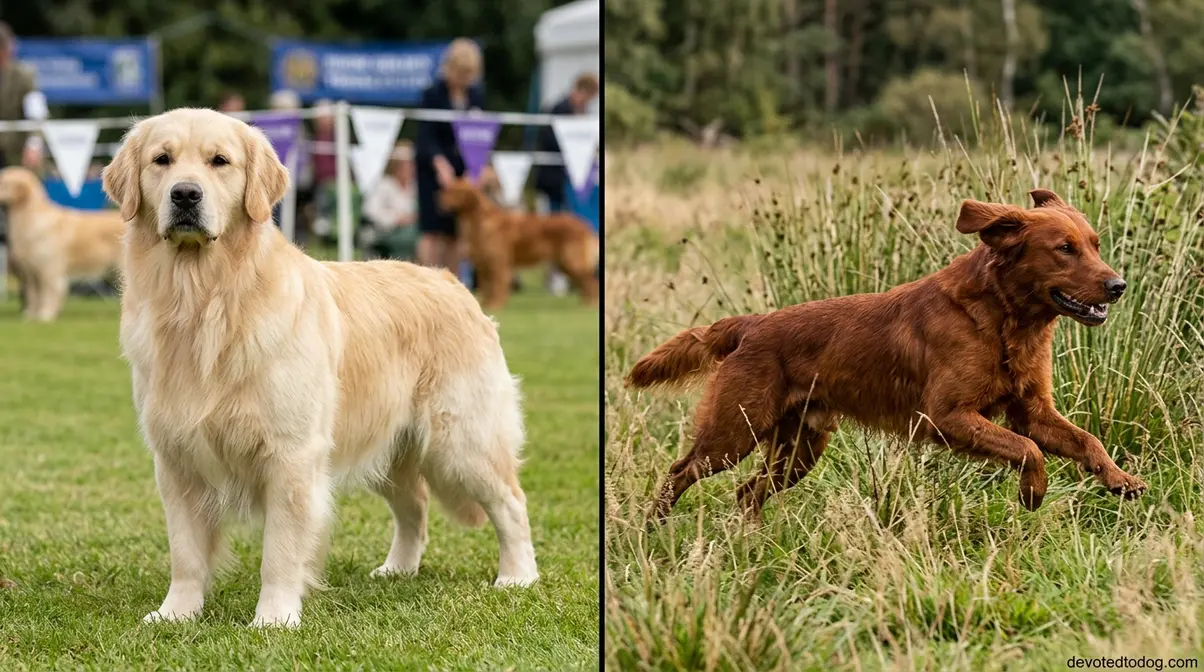
The American Golden Retriever is the most common variety registered with the AKC, and the dog most North Americans picture when they hear “Golden Retriever.” Its coat ranges from rich golden to dark golden; cream or white coloring is considered a fault under the AKC standard, which is why American Goldens look noticeably darker than their English cousins. Males typically weigh 65–75 lbs and females 55–65 lbs, with a slightly leaner head profile than English lines (AKC official Golden Retriever breed standard, 2025).
Temperamentally, the American Golden is eager, active, and highly trainable, the GRCA breed standard describes the overall character as “eager, alert, and self-confident.” Field-bred American Goldens in particular push the high end of the energy spectrum, making them outstanding dogs for active families, hikers, and anyone who wants a sport or working partner. The American Golden held the #3 spot on the AKC’s most popular breeds list for 2025 (AKC, 2025), trailing only the French Bulldog and Labrador Retriever, a reflection of just how deeply embedded this type is in American dog culture.
If you want to understand the differences between English and American Golden Retrievers in more depth, that comparison covers the physical and temperamental contrasts in detail.
The Canadian Golden Retriever takes a noticeably different shape, taller, leaner, and with a shorter, darker coat.
Canadian Golden Retriever

The Canadian Golden Retriever is the most overlooked of the three official types, most online guides give it one vague sentence or skip it entirely. That’s a disservice to anyone doing serious research. The Canadian type is recognized by the Canadian Kennel Club with its own distinct standard, and it differs from both the American and English varieties in meaningful ways.
Physically, Canadian Goldens tend to run taller (males can reach 24 inches at the shoulder, compared to the American’s 23-inch maximum) and leaner, with a shorter, less feathered coat and a darker golden coloring. This combination of height and reduced coat feathering often causes Canadian Goldens to be confused with field-bred American Goldens, both look leaner and less “fluffy” than English lines. The key distinction: Canadian Goldens reflect a specific CKC breeding standard, while field-bred Americans are a purpose-based sub-type within the AKC standard.
The AKC history of the Golden Retriever’s origin traces the breed back to 1868, when Lord Tweedmouth crossed a Yellow Wavy-Coated Retriever with a Tweed Water Spaniel. That foundation stock eventually spread to North America and the UK (AKC, 2025).
Temperamentally, Canadian Goldens share the same friendly, loyal, and intelligent character as all Goldens, with a slightly more athletic presentation. If you encounter a tall, lean, shorter-coated Golden that doesn’t quite match the fluffy “teddy bear” image, there’s a good chance you’re looking at a Canadian line.
The English Golden Retriever, often called the British Golden or the “teddy bear” type, is the calmest and most visually distinct of the three official varieties.
English Golden Retriever (British)

The English Golden Retriever, also called the British Golden, is the type most associated with the cream-colored “teddy bear” look. Its most recognizable feature is the broader, more “squared-off” head, the term Golden Retriever owners use instinctively to describe the blockier, more rounded skull and wider muzzle of British lines. The build overall is stockier and more muscular than American or Canadian types, and the coat ranges from cream to light golden. Importantly, the UK Kennel Club standard accepts a much wider color range than the AKC, which is why cream coloring, a fault in American show rings, is perfectly standard in English lines (Waggel’s overview of the three types).
On temperament, English lines, particularly show-bred English Goldens, are generally considered the calmest type of Golden Retriever. English lines tend to have a slightly more mellow and relaxed demeanor compared to American field lines, making them excellent choices for families with young children, therapy dog programs, and owners who prefer a dog that’s content with moderate daily activity rather than two-hour runs.
One important clarification: “English Cream Golden Retriever Golden Retriever” is a marketing term, not an official classification. An English Cream is simply an English Golden with a cream-colored coat. No separate breed exists, and no special health superiority comes with the label. Breeders use “English Cream” to signal a desirable coat color, and often to justify premium pricing. Now you know better.
If you’re looking for the calmest Golden Retriever, English lines, especially show-bred English Goldens, are your best bet.
Now that you know the three regional types, a visual comparison makes the differences much easier to remember.
Side-by-Side Comparison: American vs. Canadian vs. English
All three types share the same core character, friendly, loyal, and highly intelligent, but their physical differences are meaningful enough to influence your decision. Use this table as a quick-reference guide:
| Trait | American | Canadian | English (British) |
|---|---|---|---|
| Coat Color | Rich to dark golden | Dark golden | Cream to light golden |
| Build | Athletic, medium | Tall, lean | Stocky, broad |
| Head Shape | Moderate | Slender | Broad, “squared off” |
| Weight (Male) | 65-75 lbs | Similar to American | 65-75 lbs |
| Coat Length | Long, feathered | Shorter, less feathered | Long, dense |
| Energy Level | High | High-Medium | Medium |
| Calmest Type? | No | No | ✓ Yes (show lines) |
| Kennel Club | AKC | CKC | UK Kennel Club |
Despite these differences, all three types are registered as one breed by their respective kennel clubs. The regional label tells you what the dog looks like; the working line (field vs. show) tells you how it will act in your home, which is the next essential piece of the puzzle.
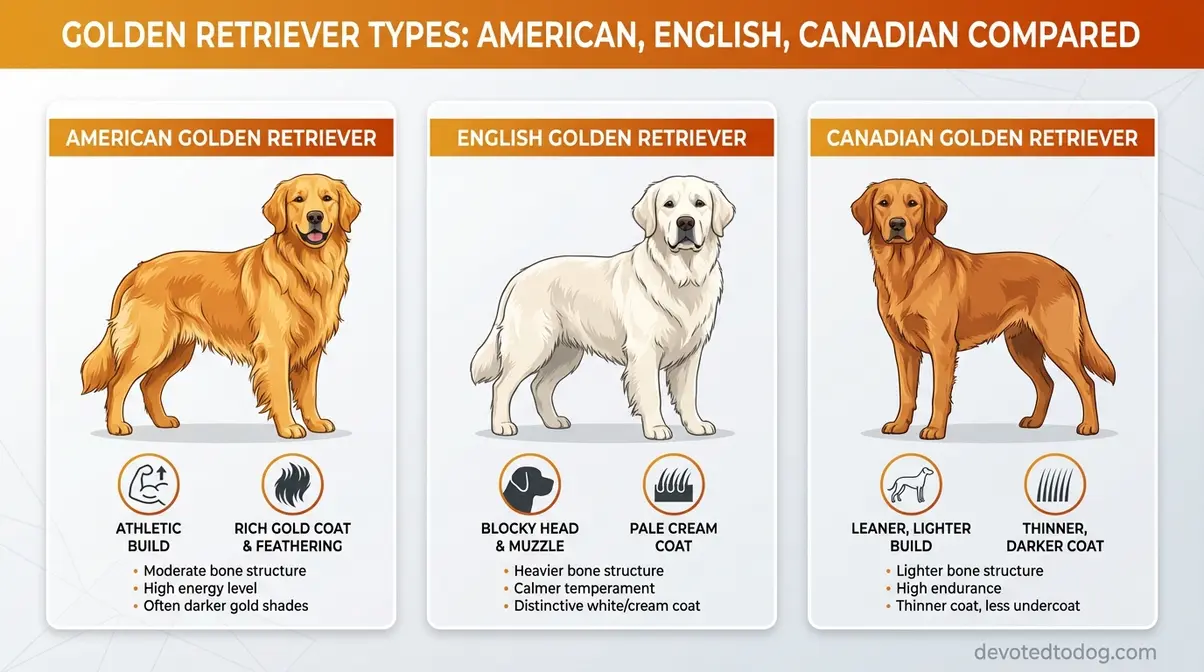
Caption: American, Canadian, and English Golden Retrievers share the same breed roots but differ noticeably in coat color, build, and head shape.
Beyond regional origin, Golden Retrievers also vary dramatically in coat color, and this is where a lot of confusion (and some marketing myths) come in.
How Do Golden Retriever Colors and Coats Differ?
Coat color in Golden Retrievers runs a genuine spectrum, from near-white cream through standard rich gold to deep copper-red, and each shade maps reliably to a regional type. Coat color in Golden Retrievers is a reliable indicator of regional type, cream and light gold signal English lines, while rich gold to dark red indicate American or field-bred lines. Knowing this connection helps you evaluate breeders’ claims more critically and understand what a puppy’s coat color actually tells you about its background.
The Golden Retriever Color Chart: From Cream to Dark Red
Use this Golden Retriever color chart as a quick reference: the lightest end of the spectrum, cream and pale gold, belongs almost exclusively to English (British) lines. A light golden retriever is most often an English line dog. The AKC does not accept cream as a standard color for American Goldens; it’s listed as a fault. The UK Kennel Club, by contrast, accepts a much broader range that includes cream, which is why English Goldens look so dramatically different from American ones. This color divergence developed over decades of separate breeding under different standards.
Standard rich golden, the shade most people picture, spans American and Canadian lines and represents the most common color across the breed. A dark golden retriever, by contrast, sits one step deeper on the spectrum: rich amber to mahogany-gold, still well within AKC standards but visibly darker than the average American Golden. It’s the color the AKC standard was built around, and it’s what you’ll see on the majority of American Goldens in show rings and family homes alike.
At the darkest end sits the red or copper-toned Golden, sometimes called an orange golden retriever for its warm rust hue, most commonly seen in field-bred American lines. These dogs carry the darkest accepted shade under the AKC standard. Red and copper Goldens are the rarest color variant, and they typically pair their darker coat with a shorter, denser texture and a leaner, more athletic build, a visual package that reflects their working-dog heritage. Understanding Golden Retriever coat development and stages can help you anticipate how a puppy’s color will shift as it matures.
It’s worth saying plainly: an “English Cream Golden Retriever” is simply an English Golden Retriever with a cream-colored coat. There is no separate breed, no special health superiority, and no official classification behind the label. It is a marketing term, one that some breeders use to charge significantly higher prices. The cream color is beautiful and legitimate; the premium attached to the name rarely is.
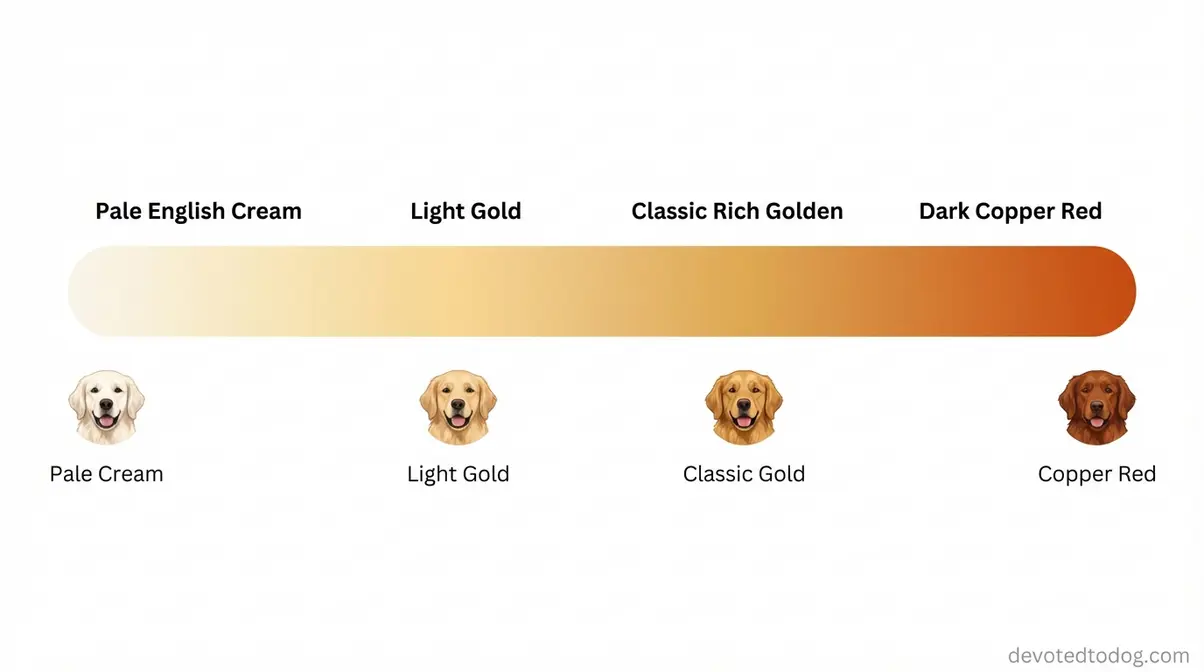
Caption: The Golden Retriever color spectrum, cream and pale gold indicate English lines; rich gold to dark red indicate American or field-bred heritage.
Color tells you a lot about a Golden’s regional background, but coat length and texture reveal something just as important: whether the dog was bred for the show ring or the field.
Coat Types and Grooming Differences
The coat differences between Golden Retriever types aren’t just cosmetic, they reflect the breed’s working history and directly affect your grooming commitment.
Show-line Goldens, particularly English types, carry long, dense, heavily feathered coats with pronounced feathering around the ears, chest, legs, and tail. This is the classic “fluffy Golden” look, and it comes with a real maintenance requirement. Show-line coats need brushing three to four times per week to prevent matting and manage shedding. If you’re drawn to that iconic “teddy bear” appearance, factor that grooming time into your decision.
Field-bred Goldens wear a shorter, denser, less feathered coat that is more “wirey” in texture, the term used naturally in Golden Retriever communities to describe the field dog’s practical, work-ready coat. This coat is more water-resistant (an advantage for retrieving waterfowl), lower maintenance, and dries faster after outdoor activity. Grooming needs are considerably lighter than show lines.
As the diagram below shows, the field-bred Golden’s leaner head profile differs noticeably from the show-line’s broader, more rounded head, and that physical difference extends through the entire body.
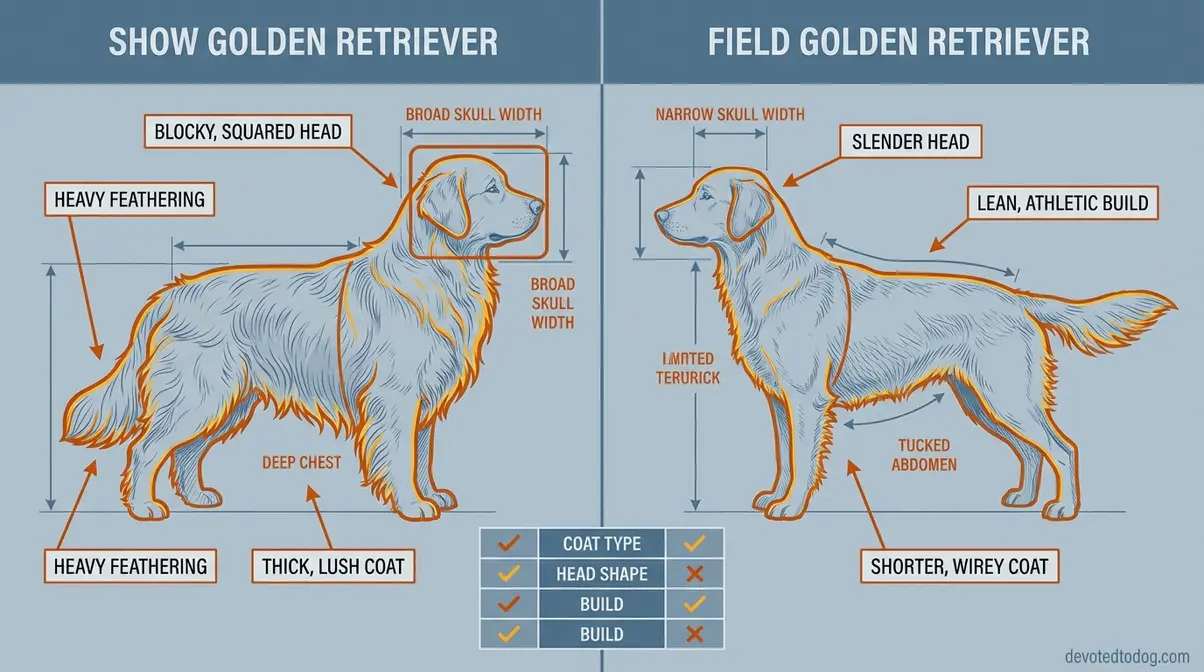
Caption: The show Golden’s broad, squared-off head (left) versus the field Golden’s narrower, more athletic profile (right), the clearest visual marker of the working vs. conformation split.
Dark Golden Retriever: Mahogany and Deep Red Shades
The dark golden retriever sits at the deepest end of the standard color spectrum and most often comes from American or field-bred lines. This shade includes mahogany, dark mahogany, dark red, and dark brown variations, all of which fall within the AKC standard. A dark golden retriever puppy typically lightens slightly as it matures, so a deep red puppy may settle into a warm dark gold by age two.
You’ll find dark goldens most often in field/hunting lines because deeper coat color (see our red Golden Retriever guide) was historically valued for blending in during waterfowl retrieves. Cream and pale-gold lines, common in show-line and English breeding, were selected for the opposite trait.
Brown Golden Retriever: Is It Actually a Thing?
A “brown golden retriever” almost always describes one of three things: a deep mahogany dark golden (still within breed standard), a chocolate-coat Golden Retriever mix (often crossed with a Lab), or a misidentified breed entirely. True brown is not a recognized Golden Retriever color. The AKC standard explicitly limits coat color to “rich, lustrous golden of various shades.”
If you see a brown golden retriever puppy advertised, ask the breeder for the parents’ AKC registration and color designations on file. A reputable English cream or American golden breeder will always be able to provide both. A “brown golden” without paperwork is most often a Golden Retriever lab mix, sometimes sold under invented marketing names.
Other Color Names: Orange, Copper, Gray, and Light Golden
You’ll see informal color terms used by breeders and online communities that don’t appear in the AKC standard but describe shades within the recognized spectrum:
- Orange golden retriever: falls between standard gold and dark red, typically from American working lines
- Copper golden retriever: a marketing term for the deeper red end, similar to mahogany
- Light golden retriever: pale gold, between cream and standard gold, often from English-American crosses
- Gray golden retriever: usually a senior coat change as goldens age (their muzzle and face whiten naturally), not a true color variant
Golden Retriever Color Chart at a Glance
| Shade | AKC Standard? | Common Names | Most Common Type |
|---|---|---|---|
| Cream | ✅ Yes | English Cream, White Golden | English (British) |
| Light Golden | ✅ Yes | Light, Blonde, Pale Gold | English / American crosses |
| Standard Golden | ✅ Yes | Gold, Standard Gold | American |
| Dark Golden | ✅ Yes | Dark Gold, Mahogany | American |
| Red / Dark Red | ✅ Yes | Red Golden Retriever, Fox Red, Copper | Field / Hunting line |
| Black | ❌ No | “Black Golden Retriever” (mix breed) | Not breed-standard |
| Brown / Chocolate | ❌ No | Often Lab-Golden mix | Not breed-standard |
| Gray | n/a | Senior coat change, not a color | Aging coat, all types |
Those coat differences aren’t cosmetic, they reflect the most fundamental split within the Golden Retriever world: field dogs vs. show dogs.
Field or Show Golden Retriever: Which Type Fits Your Life?
The field vs. show distinction is where the types of golden retrievers become most personally relevant. Regional type (American, Canadian, English) shapes what a Golden looks like. Working type (field vs. show) shapes what it’s like to live with one. Field Golden Retrievers need 90 or more minutes of vigorous daily exercise; show-line Goldens typically thrive with 60–90 minutes of moderate activity, a gap that translates directly into lifestyle compatibility.
This is where the Type-Match Framework becomes most useful: field vs. show is the clearest lifestyle split in the Golden Retriever world. Match your energy level and daily routine to the working type first, then choose your preferred regional type for the look you want.
The Field (Working) Golden Retriever
The Field Golden Retriever is a working-line dog bred for hunting and retrieving, and every physical feature reflects that purpose. The build is smaller and more slender than show lines, with a leaner head profile, a shorter and denser coat that sheds water efficiently, and a body built for endurance rather than the show ring. Males in field lines often run 55–70 lbs, lighter than their show-line counterparts. The coat texture is what Golden Retriever owners call “wirey”, not coarse in the negative sense, but practical and close to the body rather than flowing and feathered.
Energy is the defining characteristic. Field Goldens were bred to work all day alongside hunters, and that drive doesn’t disappear in a suburban backyard. Plan for 90 or more minutes of vigorous daily activity, running, swimming, fetch, hiking, or structured dog sports. Without that outlet, field Goldens can become frustrated and destructive. Their temperament remains the classic Golden warmth, but with a more intense focus and working drive that sedentary owners often find overwhelming.
Show Goldens occupy the opposite end of the spectrum, same lovable personality, but bred for a very different purpose.
The Show (Conformation) Golden Retriever
The Show Golden Retriever, also called a conformation Golden, “conformation” referring to show-ring competition where dogs are judged against the breed standard, is the blocky, calm, heavily coated dog that dominates family photos and therapy dog programs. The frame is broader and heavier, the head carries that characteristic “squared-off” shape, and the coat is long, dense, and heavily feathered. Show Goldens are simply larger-feeling dogs than field lines, even when weight is similar.
The Golden Retriever community describes the difference better than any breed standard can:
“Essentially 2 types of goldens; ‘show’, generally have a more squared off head and thicker body. ‘field’, smaller, more slender. hair is usually more wirey.”
, Golden Retriever owner, r/goldenretrievers community
Energy-wise, show Goldens are moderate. They still need daily exercise, no Golden is a couch potato, but 60–90 minutes of moderate activity satisfies them. They’re more content with family life, more apartment-friendly (with sufficient walks), and more naturally suited to calm households, therapy work, and families with young children. For a deeper look at how these two types compare in practice, see our full guide on comparing field and show Golden Retrievers.
The table below makes the field vs. show comparison easy to reference at a glance.
Field vs. Show: Quick Comparison
Use this table to match your lifestyle to the right working type before you contact a breeder:
| Trait | Field Golden | Show Golden |
|---|---|---|
| Build | Lean, athletic | Broad, stocky |
| Head Shape | Slender, narrower | “Squared off,” broad |
| Coat | Shorter, denser, “wirey” | Long, thick, heavily feathered |
| Energy Level | Very High | Medium |
| Daily Exercise | 90+ min vigorous | 60-90 min moderate |
| Best For | Active owners, hunters, hikers | Families, therapy work, calmer homes |
| Grooming Needs | Lower | Higher |
The Type-Match Framework is straightforward: if your lifestyle is active and outdoorsy, choose field. If you want a calm family companion, choose show. The regional type, American, Canadian, or English, determines coat and look. The working type, field vs. show, determines energy and lifestyle fit. Get the working type right first, then choose the regional type for the aesthetics you prefer.
There’s one more classification that’s genuinely important, and often overlooked: what’s happening inside these dogs’ bodies.
What Health Risks Should Every Golden Retriever Owner Know?
Whichever type of Golden Retriever you choose, the breed shares the same baseline health profile. Approximately 60 to 65 percent of Golden Retrievers develop cancer in their lifetime, the highest rate of any breed, with hemangiosarcoma and lymphoma the leading causes of death (NCBI 2018). Hip and elbow dysplasia, heart conditions like subvalvular aortic stenosis, and pigmentary uveitis are also more common in Goldens than in the general dog population.
These risks apply to every type of Golden Retriever, but field-bred lines typically show slightly later onset and English Cream lines have shown lower cancer mortality in some European studies (though no peer-reviewed US data confirms a meaningful difference). For a complete breakdown of symptoms, screening tests, and what to expect at each life stage, read our complete guide to Golden Retriever health issues and our Golden Retriever life expectancy article.
Are Miniature Golden Retrievers a Real Breed?
No, the miniature golden retriever is not a recognized breed. The AKC, GRCA, and Canadian Kennel Club all standardize one Golden Retriever breed at adult heights of 21.5 to 24 inches. What breeders sell as a “miniature golden retriever” or “comfort retriever” is almost always a Golden Retriever crossed with a Cocker Spaniel or Toy/Miniature Poodle, designed to produce a smaller adult size (35 to 50 lbs instead of 55 to 75 lbs). For a full breakdown of size differences, expected adult weights, lifespan considerations, and how to evaluate breeders selling smaller Goldens, read our complete guide on miniature vs standard Golden Retriever.
Frequently Asked Questions
What are the three types of Golden Retrievers?
The three types of Golden Retrievers are the American, Canadian, and English (British) Golden Retriever. Each type developed under a separate kennel club breed standard after the Golden was exported from Scotland in the early 20th century. They differ in coat color, build, and temperament, while sharing the same friendly, loyal, and intelligent character. English Goldens are the stockiest and calmest; Canadian Goldens are the tallest and leanest; American Goldens fall in between with a richer golden coat. All three types are recognized as one breed by their respective kennel clubs, the AKC, CKC, and UK Kennel Club.
What is the calmest Golden Retriever breed?
English Golden Retrievers are generally considered the calmest type of Golden Retriever. English (British) lines, particularly show-bred dogs, tend to have a more mellow and relaxed demeanor compared to American field lines. This makes them excellent choices for families seeking a gentler companion or for therapy dog work. American field-bred Goldens are the most energetic type, often requiring 90 or more minutes of vigorous daily exercise. That said, individual temperament varies, early socialization and training matter as much as breed type.
What are the 4 types of Golden Retrievers?
There are 3 official types of Golden Retrievers, American, Canadian, and English, though many people refer to a “fourth type” based on purpose: the Field Golden Retriever. The Field Golden is a working-line dog bred for hunting, with a leaner build and shorter coat than show-line Goldens. Show Goldens (also called conformation Goldens) are the fifth commonly referenced category. Some sources also count the English Cream and Miniature Golden as distinct types, though neither is an official AKC-recognized classification. The simplest framework: 3 regional types (American, Canadian, English) + 2 purpose-based types (Field, Show).
What is the silent killer in Golden Retrievers?
The “silent killer” in Golden Retrievers is Hemangiosarcoma, an aggressive cancer that originates in the blood vessel walls. It most commonly develops in the spleen, heart, or liver, and typically shows no symptoms until the tumor ruptures, causing sudden internal bleeding that can be immediately life-threatening. By the time signs appear, the disease is usually advanced. Regular veterinary checkups, including abdominal ultrasounds after age 6, are the best available early-detection strategy. Consult your veterinarian immediately if your Golden shows sudden lethargy, pale gums, or abdominal swelling, these can be signs of a ruptured hemangiosarcoma.
What dog is known as the heartbreak breed?
The Golden Retriever is known as the “heartbreak breed” due to its unusually high susceptibility to cancer. Studies indicate that up to 65% of Golden Retrievers die from cancer, the highest rate of any breed studied (NCBI, 2018). The most common types are Hemangiosarcoma, Lymphoma, Osteosarcoma, and Mast Cell Tumors. Despite this sobering reality, Goldens consistently rank among the most beloved family dogs in the world. Proactive veterinary care, healthy weight management, and regular screenings can meaningfully support your Golden’s quality of life and longevity.
What were Golden Retrievers bred for?
Golden Retrievers were originally bred for retrieving waterfowl on Scottish hunting estates in the mid-1800s. Lord Tweedmouth developed the breed in 1868 by crossing a Yellow Wavy-Coated Retriever with a Tweed Water Spaniel, aiming for a dog that could swim cold lochs, mark downed birds, and deliver them softly to hand. That working purpose explains why field-line Golden Retriever hunting dogs still carry exceptional water tolerance, soft mouths, and 90+ minute endurance today, even in homes that never go near a duck blind. Show-line Goldens were bred from the same stock for the calmer, blockier conformation phenotype, but the working drive is genetically present in every Golden.
How much do Golden Retrievers weigh?
Adult male Golden Retrievers typically weigh 65 to 75 lbs and adult females 55 to 65 lbs, per AKC and CKC breed standards (AKC, 2025). Field-bred lines often run lighter (males 55 to 70 lbs) because they’re bred for endurance over bulk. English (British) show lines tend toward the heavier end and feel stockier even at the same weight, thanks to their broader frame. Puppies reach 90% of adult weight by 12 months and full adult weight by 18 to 24 months. If your Golden is significantly outside these ranges, ask your vet whether it reflects body condition (overweight or underweight) or simply line variation.
What are the different kinds of Golden Retrievers?
The different kinds and different types of Golden Retrievers fall into two main classification systems: 3 regional types (American, Canadian, English/British) and 2 working types (field and show). Among the broader varieties of retrievers (Labrador, Chesapeake Bay, Flat-Coated, Curly-Coated, Nova Scotia Duck Tolling), the Golden is the second most popular in the US. Some sources also reference English Cream as a distinct kind, but it’s a marketing term for cream-coated English Goldens, not an official classification. Miniature Golden Retrievers are crossbreeds (Golden × Cocker Spaniel or Poodle), not a true Golden variety. The simplest framework: regional type tells you what the dog looks like; working type tells you what it acts like; everything else is marketing or crossbreeding. For a deeper comparison of English Golden vs American Golden, our dedicated guide breaks down the day-to-day differences side by side.
Bringing It All Together
For prospective Golden Retriever owners, understanding the types of golden retrievers is the essential first step toward a good match. The three official regional types, American, Canadian, and English, differ in build, coat, and energy level in ways that matter day-to-day. Field lines need an active owner; show lines suit a calmer household. And regardless of type, 65% of Goldens are affected by cancer (NCBI, 2018), making proactive veterinary care as important as choosing the right type in the first place.
The Type-Match Framework cuts through the noise: match your lifestyle to the type, not just the look. If you want the “teddy bear” English Cream aesthetic and a calmer temperament, go English show. If you want an athletic partner for outdoor adventures, go American or Canadian field. If you want a compact Golden-type dog, a Mini Golden crossbreed can work, just go in knowing exactly what it is. The right Golden for you exists; you simply need to know where to look.
Start by reading our full comparison of American vs English Golden Retriever differences to go deeper on the two most searched types. Then connect with a reputable breeder who health-tests both parents and can speak specifically to working line vs. show line within their program. The more informed you are going in, the more rewarding every year with your Golden will be.
Related reading:
Readers comparing options often find our piece on Best Golden Retriever Mixes helpful for additional context.
If this topic interests you, our companion article on 25+ Golden Retriever Fun Facts: Bizarre Truths (2026) covers more detail.