
Yes, golden retrievers are genuinely, measurably smart, ranked 4th out of 138 dog breeds in the most comprehensive canine intelligence study ever conducted. And yet, somehow, your Golden just sprinted face-first into the sliding glass door for the third time this week.
That contradiction is real. Every Golden owner knows it. The breed is simultaneously capable of learning complex commands in under five repetitions and acting completely blindsided by their own reflection. This isn’t a flaw in the data. It’s what we call “The Stupidest Genius Paradox”, and once you understand it, everything about your dog suddenly makes sense.
In this guide, you’ll learn exactly how golden retrievers are smart, why the goofiness is a feature rather than a flaw, and what all of it means for training your dog day to day.
of 138 (Coren, 2009)
working obedience
2-year-old level
top breed signal
Author Credentials
📝 Written by: Coral Drake
✅ Reviewed by: Brianna York, Former Veterinary Technician
📅 Last updated: 5 May 2026
ℹ️ Transparency Notice
This article evaluates Golden Retriever intelligence based on Stanley Coren’s ‘Intelligence of Dogs’ rankings, AKC breed standard, and peer-reviewed canine cognition research. All claims have been verified by our editorial team.
How Smart Are Golden Retrievers, Really?
Golden Retrievers rank 4th out of 138 dog breeds in the most comprehensive canine intelligence study ever conducted, meaning they learn new commands in fewer than 5 repetitions and obey known commands on the first try over 95% of the time. That’s not just impressive for a dog breed; it puts them in rare company. To understand what that ranking really means, though, you need to look at all three types of intelligence your Golden carries, and the genetic science that makes them wired this way.
The 4th Smartest Dog Breed Explained
Are golden retrievers smart dogs? The data says yes, decisively. Stanley Coren, a canine psychologist and author of The Intelligence of Dogs, surveyed over 200 obedience trial judges to rank 138 breeds based on how quickly they learn and retain new commands. This wasn’t a casual poll. Coren’s research was published through the American Psychological Association, giving it the kind of scientific credibility that distinguishes it from breeder marketing.
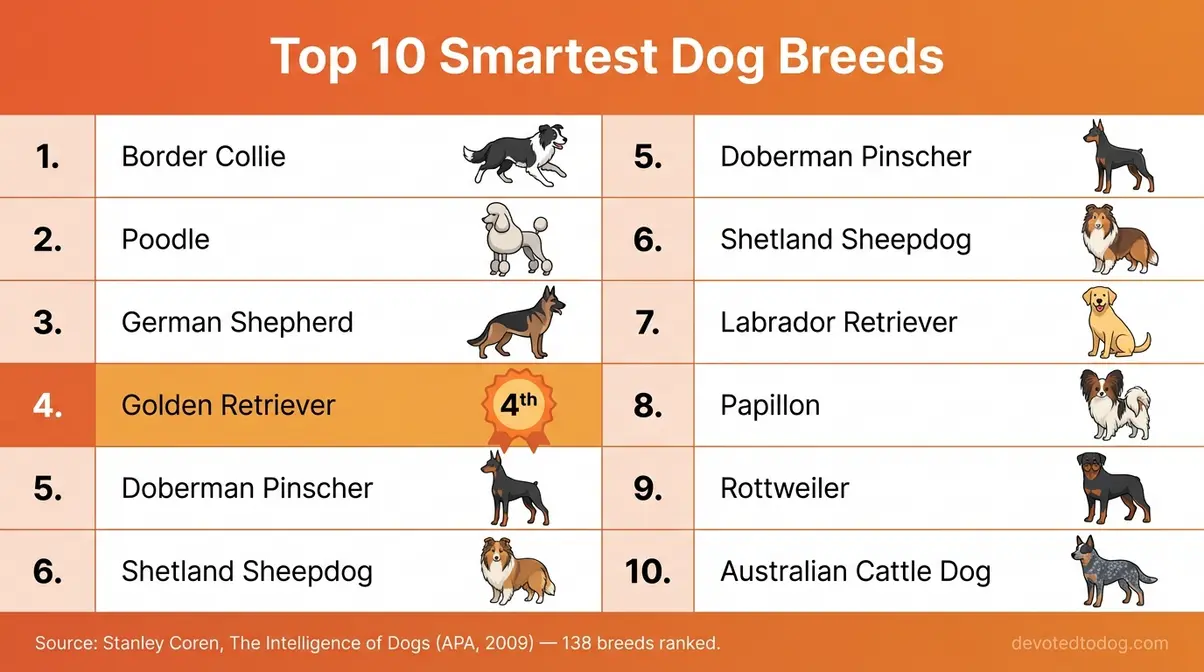
Golden Retrievers rank as the 4th smartest dog breed in working and obedience intelligence out of 138 breeds (Coren, American Psychological Association, 2009). They sit just behind Border Collies (#1), Poodles (#2), and German Shepherds (#3), and ahead of Dobermans, Shetland Sheepdogs, and Labrador Retrievers.
Here’s what “4th” looks like in practice. Most dogs need 25-40 repetitions to learn a new command. Your Golden needs fewer than 5. Think of it like a classroom: if the average student needs to read a chapter four times before it sticks, your Golden is the kid who raises their hand before you finish the sentence. They also obey known commands on the first try more than 95% of the time, a consistency that makes effective Golden Retriever puppy training methods far more accessible than with most other breeds.
But obedience intelligence is only one piece of the puzzle. To understand why golden retrievers are a “weird mix of smart and dumb,” you need to see all three types of intelligence they carry.
Three Types of Golden Intelligence
This is exactly how smart golden retrievers are across three distinct dimensions, and why a single ranking number doesn’t capture the full picture.
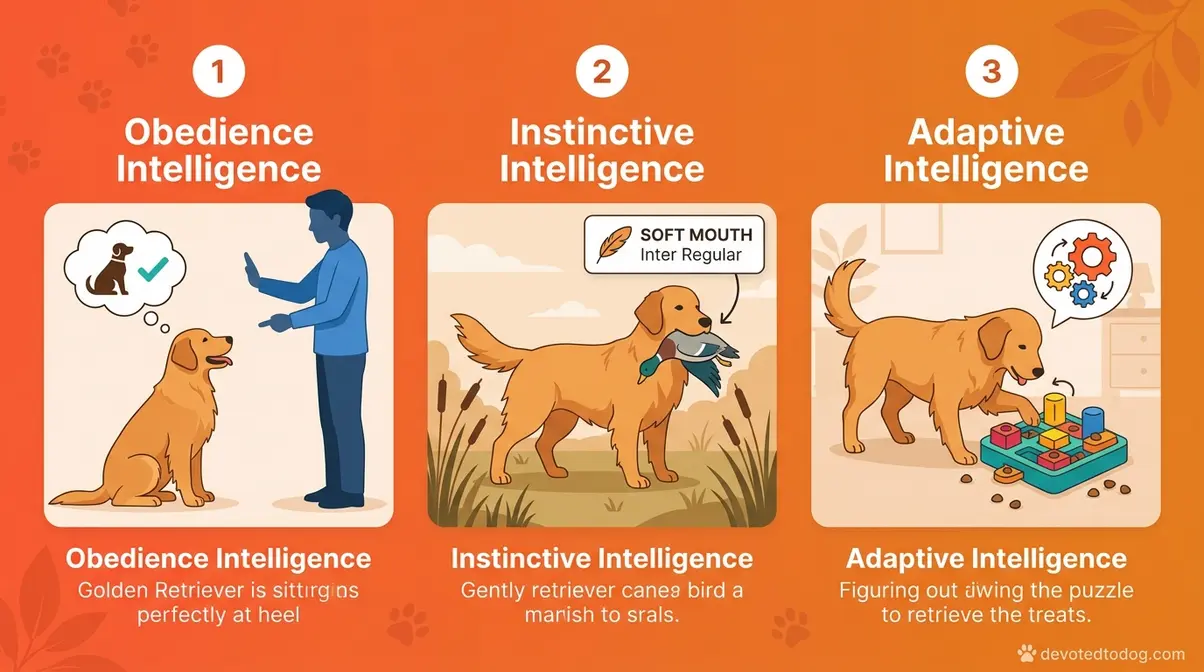
Obedience intelligence (how quickly a dog learns and retains commands from a human) is what Coren’s ranking measures. This is where Goldens score in the top 3% of all breeds. It’s the reason leash training techniques for Golden Retrievers tend to produce faster results than with most other dogs. Why this matters: a high obedience intelligence score means your training sessions are genuinely efficient.
Instinctive intelligence is what the breed was bred to do, in Goldens’ case, retrieving game birds for hunters without damaging them. Their mouths are famously “soft.” They can carry a raw egg without cracking it. This is hardwired intelligence, not trained behavior. Why this matters: it explains why your Golden instinctively brings you things when you’re upset, or carries a toy to greet guests at the door. That behavior isn’t random, it’s instinct doing exactly what it was designed to do.
Adaptive intelligence (problem-solving ability) is where individual variation appears. Some Goldens are absolute puzzle-solvers; others will stare at a Kong toy for 20 minutes and then go find a sock. Owner consensus across Golden Retriever communities confirms this variation, and it’s the honest nuance behind “not all golden retrievers are equally smart.” This is also where the “goofy” moments live. Imagine instinctive intelligence as factory settings, obedience intelligence as how fast you can install new apps, and adaptive intelligence as whether your dog can troubleshoot when the app crashes. Goldens excel at the first two. The third? Depends on the individual dog.
A survey of hundreds of obedience judges formed the backbone of Coren’s foundational research, ranking dog breeds based on their ability to learn and retain new commands (Marine Biological Laboratory).
So far, so impressive. But here’s where it gets interesting, and where the science gets genuinely surprising.
The ROMO1 Gene and Trainability
This is why golden retrievers are so smart, it’s not just training, it’s genetics. A landmark 2026 genomic study published in PNAS (Proceedings of the National Academy of Sciences) by researchers at the University of Cambridge analyzed behavioral traits across a large sample of Golden Retrievers using genome-wide association studies. The finding that made headlines: biddability, the willingness to take direction from a human, is genetically linked to a specific gene called ROMO1 (Cambridge University / PNAS, 2026).
In humans, ROMO1 is associated with intelligence, emotional sensitivity, and depression. In Golden Retrievers, it sits within a genome-wide significant locus for trainability. The 2026 PNAS genomic study on heritable dog behaviors found that traits like biddability and human-directed sociability are highly heritable in the breed, meaning Golden Retrievers aren’t just trained to want to please you. They’re born already wanting to (PNAS, 2026).
A 2017 study on breed trainability and sociality further confirmed that Golden Retrievers rank exceptionally high in trainability, with genetic factors explaining a significant portion of their human-directed social behavior. The research supports the same conclusion: this is a dog whose cooperative drive is wired in at the DNA level (PubMed/NIH, 2017).
In plain terms: other dogs can be trained to want to please you. Golden Retrievers are born already wanting to.
Understanding why they’re smart makes the “goofy” behavior even more confusing, until you look at it through the right lens.
What Is the Goofy Paradox?

“If you’ve owned a golden they are a weird mix of smart and dumb. It’s hard to explain but they can learn a lot of commands but will never stop…”
, Golden Retriever owner, Reddit community
That quote captures something every Golden owner feels. “The Stupidest Genius Paradox” is real, documented, and completely explainable, and this section is where it gets resolved. The goofiness isn’t a contradiction to their intelligence. It’s a direct expression of it.
Emotional Intelligence Superpowers
Emotional intelligence, the ability to read and respond to human emotions, is a category entirely separate from Coren’s obedience ranking. And this is where Golden Retrievers don’t just score well. They’re exceptional.
Goldens are wired to read body language, tone of voice, and emotional cues with remarkable accuracy. This is why golden retrievers are so friendly, they’re literally built to read and respond to human emotion. It’s also why they’re among the most widely used therapy and emotional support dogs in the world. The AKC describes the breed as “devoted,” and that word carries more scientific weight than it might seem.
Their so-called “clinginess” is a direct expression of this attunement, they’re not needy, they’re attuned. If you’ve struggled with understanding Golden Retriever separation anxiety, this is the root cause: a dog this bonded to you finds your absence genuinely distressing. Cornell University’s College of Veterinary Medicine notes that highly social breeds like retrievers form such strong attachments to their owners that they can be particularly prone to separation anxiety when left alone (Cornell Veterinary Medicine).
This emotional sensitivity is also why harsh training backfires, a preview of what we’ll cover in the next section. A dog this tuned in to your emotional state will shut down if you’re frustrated with them. If you’ve ever had a rough day and your Golden immediately appeared with their favorite toy, that’s not coincidence. That’s emotional intelligence at work.
But the goofiness, the zoomies, the face-plants, the perpetual enthusiasm for literally everything, where does that fit in?
Compared to a Human Toddler
Research by Stanley Coren suggests that the average dog has the mental capacity of a 2- to 2.5-year-old human child, and Golden Retrievers, as one of the most intelligent breeds, perform at the upper end of this range. According to the APA, average dogs can understand more than 150 words and signals, while the top 20% of the most intelligent breeds can reach up to 250 (Coren, APA, 2009).
In practical terms, this means your Golden is absorbing far more than the command words you’re actively teaching. Contextual words, “walk,” “car,” “treat,” “vet”, get filed away whether you intend to teach them or not. They’re not just learning commands; they’re building a working vocabulary of your daily life.
Now think about what a 2.5-year-old toddler is actually like. Curious. Enthusiastic. Easily distracted. Absolutely convinced that every single thing they encounter is the most exciting thing that has ever happened. Sound familiar? A toddler at that age isn’t dumb, they’re cognitively loaded and emotionally wide open to the world. The same is true of your Golden.
This is “The Stupidest Genius Paradox” in action. The same cognitive level that allows a Golden to absorb hundreds of contextual words also means they’re genuinely, sincerely thrilled about the garden hose every single time. Their capacity for joy isn’t a bug in their intelligence. It’s the direct output of it. For more on how this emotional responsiveness shows up in daily behavior, see the signs of affection in dogs.
Why Goofiness Is a Feature, Not a Bug
The zoomies, the derpy expressions, the Christmas tree incident, none of it means your Golden is dumb. Owner consensus across Golden communities is remarkably consistent on this point: the “stupid” moments happen when a Golden’s enthusiasm outpaces their impulse control. Not because they lack the intelligence to know better. They know. They just really, really wanted to do the thing.
Their goofiness is a product of two things working together: emotional sensitivity (they feel everything intensely) and perpetual enthusiasm (they care about everything deeply). Both are expressions of high emotional intelligence, not contradictions to it. A Golden that knocks over the Christmas tree isn’t dumb. It’s a dog with the emotional intelligence to be genuinely excited about Christmas. The tree just got in the way.
This is also why they make such extraordinary family dogs. Their emotional attunement makes them naturally gentle with children, patient with other pets, and sensitive to the energy of the household. The goofiness and the warmth come from exactly the same place.
Now that you know why they’re smart and why the goofiness makes sense, let’s talk about how to actually put that intelligence to work.
Are Golden Retrievers Easy to Train?

Are golden retrievers easy to train? Yes, with the right approach. Golden Retrievers learn new commands in fewer than 5 repetitions and obey known commands on the first try over 95% of the time, making them one of the most trainable breeds in the world (Coren, APA, 2009). The one catch: their emotional sensitivity means the method matters enormously. Get the approach right, and training a Golden is one of the most rewarding experiences in dog ownership. Get it wrong, and their emotional intelligence becomes a liability.
5 Positive-Reinforcement Examples
Are golden retrievers easy to train with positive reinforcement? Consistently, yes. Across professional trainers and Golden Retriever owner communities, the feedback is the same: this breed responds to positive reinforcement with a speed and enthusiasm that makes training feel less like work and more like a game. A 2017 study on breed trainability and sociality confirmed that Golden Retrievers rank exceptionally high in trainability, with genetic factors driving their human-directed social behavior (PubMed/NIH, 2017).
Here are five specific techniques you can start today, each one matched to how a Golden’s brain actually works. For a complete framework, the Golden Retriever puppy training guide walks through these in detail.
Step 1: The Two-Treat Method
Show one treat in a closed fist. Wait for your Golden to stop pawing at it. The moment they back off, mark with “yes” and give a second treat from your other hand. This works because it rewards the decision to disengage, not just compliance, and Goldens, with their emotional intelligence, catch on to the intent of training very quickly.
Step 2: Name Recall on a Long Line
Attach a 20-foot training lead. Call their name, mark with a clicker or “yes,” and reward heavily when they come, not just a treat, but genuine enthusiasm. Goldens respond to your energy. Match their level, and recall training becomes one of the easiest things you’ll teach.
Step 3: The “Settle” Command
Ask for a down-stay on a designated mat, treat for duration, and gradually extend the time. Their emotional sensitivity means they can learn to self-regulate, but only if you give them a clear, consistent signal that calm behavior is the path to rewards.
Step 4: Vocabulary Building
Say the name of an object consistently before handing it over, “ball,” “leash,” “treat.” You’re not formally training, but their vocabulary-absorption capacity means they’re filing those words away. This is how Goldens develop the contextual word understanding Coren’s research documents.
Step 5: The Emotional Check-In Rule
When you feel frustrated during a session, stop and ask for something easy, something your Golden already knows cold. End on a win, reward big, and come back to the hard stuff tomorrow. Frustration in your voice triggers a shutdown response in a dog this emotionally attuned. The session didn’t fail; it just needs to end at a high point.
These techniques work because of how a Golden’s brain is wired. But that same wiring has one significant vulnerability.
Why Harsh Training Backfires
This emotional sensitivity is part of why golden retrievers can be a lot of work to train correctly, but it’s also why the payoff is so high when you get the approach right.
Golden Retrievers are highly attuned to their owner’s emotional state. Frustration, raised voices, or physical correction don’t just fail, they actively trigger a shutdown response where the dog becomes anxious and unable to process new information. A dog that seemed “slow” in a frustrated owner’s hands often becomes a star student with a calm, positive trainer. The dog didn’t get smarter. The training environment did.
This is the training downside of high emotional intelligence: a dog this sensitive to your emotions needs you to be regulated before they can be regulated. That’s more emotionally demanding than working with a less sensitive breed. The good news is that the same sensitivity making them vulnerable to harsh methods makes them exceptionally responsive to encouragement. They want to make you happy. Your job is to give them clear, consistent signals about what “happy” looks like.
For a practical starting point, teaching your Golden to walk on a leash without pulling is one of the best early tests of this principle, it requires calm, consistent positive reinforcement and pays off quickly when done right.
Now let’s put their intelligence in context, because knowing Goldens are 4th smartest is more meaningful when you can see how they stack up against the breeds most often compared to them.
How Do Goldens Compare to Labs and German Shepherds?
German Shepherds rank slightly higher than Goldens in Coren’s study (#3 vs. #4), while Labrador Retrievers rank lower (#7). But intelligence rankings don’t tell the whole story, temperament and trainability differ in practical ways that matter for most families, and the “right” breed depends heavily on your lifestyle and experience level.
Side-by-Side Intelligence Comparison
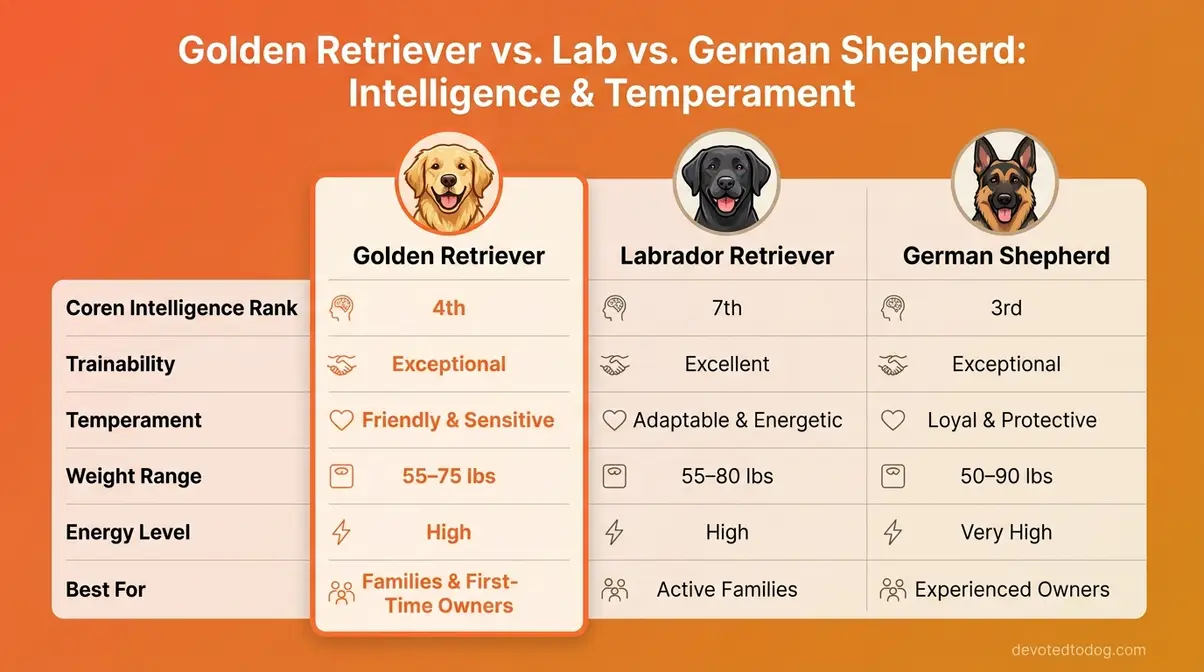
German Shepherds rank 3rd in canine intelligence, just one spot ahead of Golden Retrievers, while Labrador Retrievers rank 7th (Coren, The Intelligence of Dogs). In day-to-day trainability, the practical difference between 3rd and 4th is minimal. The more meaningful differences show up in temperament and handling requirements.
| Trait | Golden Retriever | Labrador Retriever | German Shepherd |
|---|---|---|---|
| Coren Intelligence Rank | 4th / 138 breeds | 7th / 138 breeds | 3rd / 138 breeds |
| Trainability | Exceptional (< 5 reps) | Excellent (< 5 reps) | Exceptional (< 5 reps) |
| Temperament | Friendly, gentle, emotionally sensitive | Outgoing, energetic, adaptable | Loyal, confident, protective |
| Weight Range | 55-75 lbs | 55-80 lbs | 50-90 lbs |
| Energy Level | High (2+ hrs/day) | High (1-2 hrs/day) | Very High (2+ hrs/day) |
| Best For | Families, therapy, first-time owners | Active families, first-time owners | Experienced owners, working roles |
Labs and Goldens are nearly identical on intelligence and size, the key distinction is emotional sensitivity. Goldens are more attuned to human emotion, which makes them slightly better therapy dogs and generally more in sync with household dynamics. Labs are slightly more stoic and adaptable, which some owners find easier to manage. In terms of size, Labs and Goldens are nearly identical, with Labs running slightly heavier at the upper end of their range.
German Shepherds rank one spot higher (#3 vs. #4), but the practical difference in daily trainability is minimal. GSDs require more experienced handling due to their protective instincts, a trait that’s an asset in working roles but demands a more structured approach from the owner.
For a deeper breakdown of the retriever family specifically, the Golden Retriever vs. Labrador Retriever comparison covers the nuances in detail.
Which Breed Fits Your Lifestyle?
Choosing between these three breeds comes down less to raw intelligence, they’re all exceptional, and more to what kind of owner you are and what you need from a dog.
Choose a Golden Retriever if you want a family dog with high emotional attunement, you’re a first-time owner willing to commit to positive reinforcement training, or you’re looking for a therapy or emotional support dog. Their sensitivity is their superpower, but it requires a patient, consistent owner to reveal it. If you’re also weighing Golden subtypes, the differences between English and American Golden Retrievers are worth understanding before you decide.
Choose a Labrador Retriever if you want similar intelligence with slightly less emotional sensitivity, you have a very active lifestyle, or you prefer a dog that’s a bit more stoic and adaptable. Labs are forgiving of inconsistent training in ways Goldens are not.
Choose a German Shepherd if you have dog ownership experience, you want a working or protection role, and you can handle higher intensity. GSDs reward experienced handlers enormously, but they’re not the right fit for a first-time owner looking for an easy companion.
Before you decide, here’s an honest look at the challenges that come with owning a dog this smart.
What Are the Downsides of Owning a Very Smart Dog?
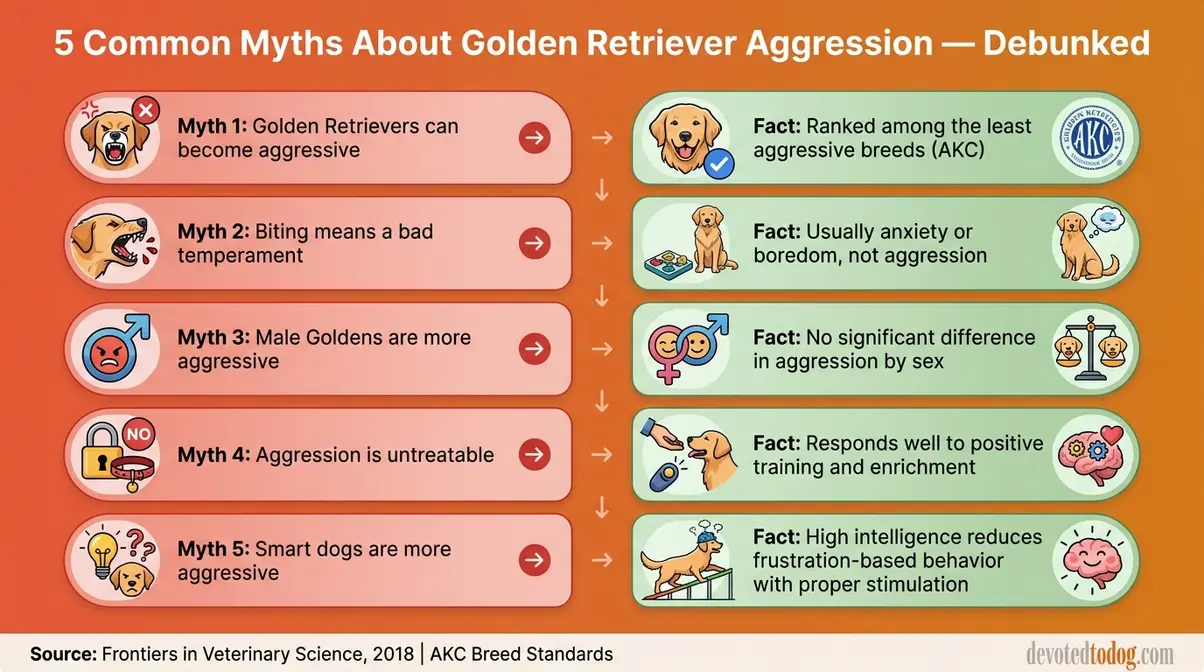
Golden Retrievers are not aggressive, they’re consistently ranked among the least aggressive breeds. But high intelligence combined with high energy and strong social needs creates specific challenges that unprepared owners find genuinely difficult. Knowing what you’re signing up for isn’t a reason to walk away. It’s a reason to prepare.
What Is Their Main Weakness?
Golden Retrievers’ main weaknesses are their high-energy needs and emotional sensitivity, not aggression. A 2018 study in Frontiers in Veterinary Science found that individual differences in cognition directly contribute to a dog’s need for mental stimulation, and to their success (or frustration) in working roles. The 2018 study on working dog cognition confirms what Golden owners experience daily: a smart, under-stimulated dog doesn’t sit quietly (Frontiers in Veterinary Science, 2018). For more on Golden Retriever aggression and its causes, the key finding is consistent, what looks like aggression is almost always anxiety or boredom, not temperament.
Here are the three challenges that Golden owners consistently report:
- Boredom destruction. A bored Golden redecorates. Their intelligence means they need mental stimulation, puzzle feeders, training sessions, enrichment games, in addition to physical exercise. Without it, expect chewed furniture and creative reinterpretations of your garden. This isn’t misbehavior. It’s an under-stimulated brain finding its own outlet.
- Separation anxiety. Their emotional attunement makes them prone to significant distress when left alone for long periods. This is the flip side of that extraordinary social bond, and it’s one of the most common challenges reported in Golden owner communities. Address it early with gradual alone-time training.
- Heavy shedding. Unrelated to intelligence, but worth naming honestly: Golden Retrievers shed substantially year-round, with two heavy shedding seasons annually. It’s the #1 practical complaint from owners, and no amount of training changes it.
Each of these is manageable with preparation. None of them are reasons to walk away from the breed. They’re things to plan for.
The biggest practical challenge? The energy levels, and the question every Golden owner eventually asks.
At What Age Do Goldens Calm Down?
Golden Retrievers typically don’t fully calm down until age 2-3, meaning owners should expect 1-2 years of high-energy puppy behavior (AKC). They have a prolonged puppy phase, high energy, perpetual enthusiasm, and a talent for creative chaos that can last well into their second year. Understanding when Golden Retrievers become calmer helps set realistic expectations and keeps owners from misreading normal puppy behavior as a permanent trait.
During that 2-3 year window, they need at least 1-2 hours of exercise per day plus dedicated mental stimulation. This is the honest answer behind search queries like “why golden retrievers are the worst”, it’s not aggression or difficult temperament. It’s energy management during a long, enthusiastic puppy phase.
The upside is significant: their high trainability means the energy can be channeled. A trained Golden is dramatically easier to manage than an untrained one. The investment in training pays dividends quickly, often within the first few weeks of consistent work. Are golden retrievers expensive to own? Yes, food, veterinary care, and grooming costs are real and ongoing. The full breakdown of the cost of owning a Golden Retriever is worth reviewing before you commit, alongside an honest look at common Golden Retriever behavior issues so nothing catches you off guard.
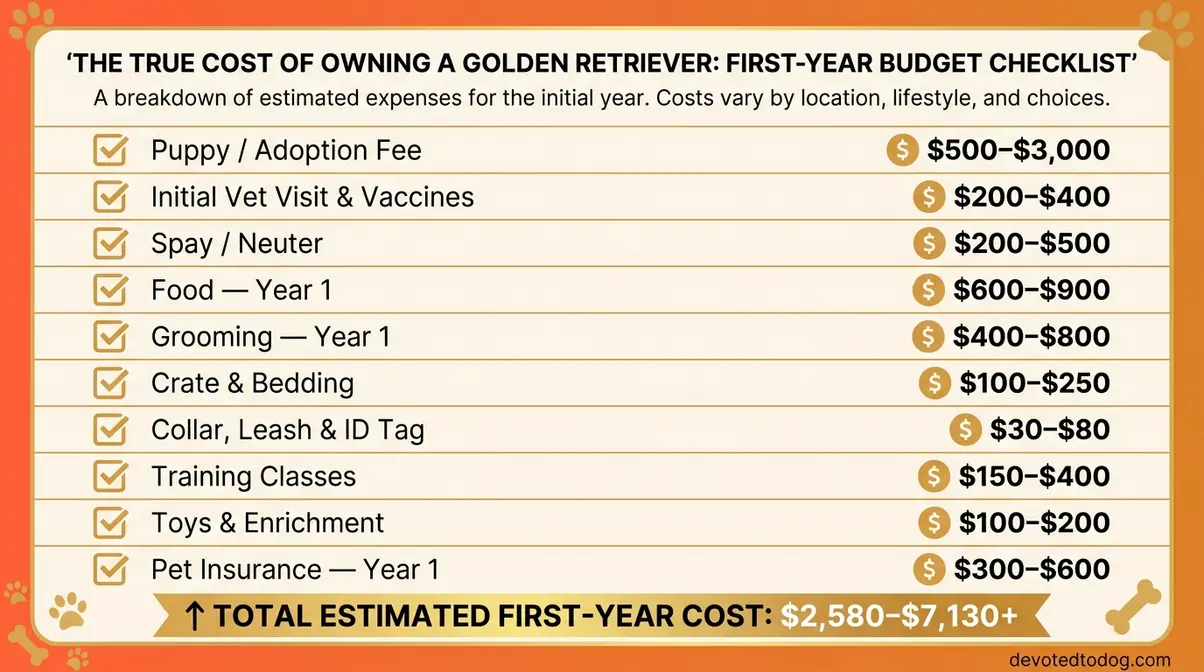
Now, the questions we hear most often, answered directly.
Golden Retriever Intelligence FAQs
Where do they rank in intelligence?
Golden Retrievers rank 4th out of 138 dog breeds in Stanley Coren’s landmark study on canine intelligence (Coren, 2009). They place just behind Border Collies (1st), Poodles (2nd), and German Shepherds (3rd). In practical terms, this means they learn new commands in fewer than 5 repetitions and obey known commands on the first try over 95% of the time. This ranking specifically measures obedience and working intelligence, not emotional or adaptive intelligence, where Goldens also score exceptionally high.
What dog has the highest IQ?
Border Collies are recognized as the dog breed with the highest IQ according to Stanley Coren’s intelligence rankings (Coren, 2009). They consistently top every major canine intelligence study due to their extraordinary ability to learn commands, solve problems, and execute complex herding tasks with minimal direction. Golden Retrievers rank 4th, placing them in highly impressive company just a few spots behind the top of the list.
Are Goldens smarter than Labs?
Golden Retrievers rank slightly higher than Labrador Retrievers in obedience intelligence. According to Coren’s study, Goldens rank 4th while Labs rank 7th out of 138 breeds. However, the practical difference in daily trainability is minimal, as both breeds learn new commands in fewer than five repetitions. The main distinction lies in their emotional sensitivity, with Goldens being more attuned to human emotions and Labs being slightly more adaptable.
Do they have separation anxiety?
Golden Retrievers are highly prone to separation anxiety due to their strong social bonds and emotional intelligence. They form deep attachments to their owners and can experience significant distress when left alone for extended periods. Proper crate training and gradually building up their alone time can help mitigate this anxiety effectively.
So, Are Golden Retrievers Smart? The Verdict
For anyone asking “are golden retrievers smart”, the answer is an unambiguous yes. Golden Retrievers rank 4th out of 138 dog breeds in the most comprehensive canine intelligence study ever conducted, learning new commands in fewer than 5 repetitions and understanding a vocabulary comparable to a 2- to 2.5-year-old child (Coren, APA, 2009). The “goofy” behavior isn’t a contradiction to that ranking, it’s the same emotional intelligence and perpetual enthusiasm that makes them the world’s most beloved family dog.
“The Stupidest Genius Paradox” resolves beautifully once you understand that Golden Retrievers carry three distinct types of intelligence. Their obedience intelligence makes them exceptionally fast learners. Their instinctive intelligence makes them natural retrievers, therapy dogs, and emotionally attuned companions. And their emotional intelligence, confirmed at the genetic level by the ROMO1 gene research from Cambridge University and PNAS, is the reason your Golden already knows you had a rough day before you’ve said a word.
Ready to put that intelligence to work? Start with consistent positive-reinforcement training, five minutes a day, every day, with calm energy and genuine enthusiasm. The results will surprise you. For a step-by-step framework built specifically for the breed, our Golden Retriever puppy training guide has everything you need to get started.
Related reading:
Curious where the breed comes from? Read the breed’s history.