
You’ve probably watched your Golden Retriever wag their tail enthusiastically at the letter carrier, but late at night, when an unfamiliar car parks outside, will they actually protect you? It’s one of the most common questions new owners ask, and the answer to whether are golden retrievers protective is more nuanced than a simple yes or no.
Many owners feel a quiet worry: their dog is wonderfully friendly with everyone, strangers included, which raises a fair question about whether that friendliness comes at the cost of real-world protection. Are golden retrievers protective enough to matter, or are they simply too warm-hearted to serve as any kind of security?
By the end of this guide, you’ll understand exactly how Golden Retrievers are protective, what their natural limits are, and five practical ways to sharpen their watchdog behaviors. We’ll cover their instincts, temperament, training techniques, health considerations, and honest alternatives, everything you need to make a confident decision.
not guard dog
protective instincts
AVMA data
sharpen instincts
Author Credentials
📝 Written by: Coral Drake
✅ Reviewed by: Brianna York, Former Veterinary Technician
📅 Last updated: 5 May 2026
ℹ️ Transparency Notice
This article assesses Golden Retriever protective and guard dog instincts based on AKC breed standard, GRCA temperament data, and certified canine behaviorist analysis. All claims have been verified by our editorial team.
| Trait | Golden Retriever (Family Watchdog) | True Guard Dog (e.g. GSD, Rottweiler, Doberman) |
|---|---|---|
| Will alert-bark at strangers? | Often (territorial bark) | Yes, with intent |
| Will physically defend owner? | Sometimes, in extreme threat scenarios | Yes, trained or instinctive |
| Will attack an intruder? | Rarely (low-confidence aggression) | Yes, if threat perceived |
| Bite inhibition | High (soft mouth, retrieve heritage) | Lower (working bite developed for grip) |
| Bonding with stranger | Quick, friendly | Slow, suspicious |
| Recommended use | Family alert dog, NOT guard dog | Personal protection, security |
| Trait | Golden Retriever (Family Watchdog) | True Guard Dog (e.g. GSD, Rottweiler, Doberman) |
|---|---|---|
| Will alert-bark at strangers? | Often (territorial bark) | Yes, with intent |
| Will physically defend owner? | Sometimes, in extreme threat scenarios | Yes, trained or instinctive |
| Will attack an intruder? | Rarely (low-confidence aggression) | Yes, if threat perceived |
| Bite inhibition | High (soft mouth, retrieve heritage) | Lower (working bite developed for grip) |
| Bonding with stranger | Quick, friendly | Slow, suspicious |
| Recommended use | Family alert dog, NOT guard dog | Personal protection, security |
| Trait | Golden Retriever (Family Watchdog) | True Guard Dog (e.g. GSD, Rottweiler, Doberman) |
|---|---|---|
| Will alert-bark at strangers? | Often (territorial bark) | Yes, with intent |
| Will physically defend owner? | Sometimes, in extreme threat scenarios | Yes, trained or instinctive |
| Will attack an intruder? | Rarely (low-confidence aggression) | Yes, if threat perceived |
| Bite inhibition | High (soft mouth, retrieve heritage) | Lower (working bite developed for grip) |
| Bonding with stranger | Quick, friendly | Slow, suspicious |
| Recommended use | Family alert dog, NOT guard dog | Personal protection, security |
| Trait | Golden Retriever (Family Watchdog) | True Guard Dog (e.g. GSD, Rottweiler, Doberman) |
|---|---|---|
| Will alert-bark at strangers? | Often (territorial bark) | Yes, with intent |
| Will physically defend owner? | Sometimes, in extreme threat scenarios | Yes, trained or instinctive |
| Will attack an intruder? | Rarely (low-confidence aggression) | Yes, if threat perceived |
| Bite inhibition | High (soft mouth, retrieve heritage) | Lower (working bite developed for grip) |
| Bonding with stranger | Quick, friendly | Slow, suspicious |
| Recommended use | Family alert dog, NOT guard dog | Personal protection, security |
Are Golden Retrievers Protective?
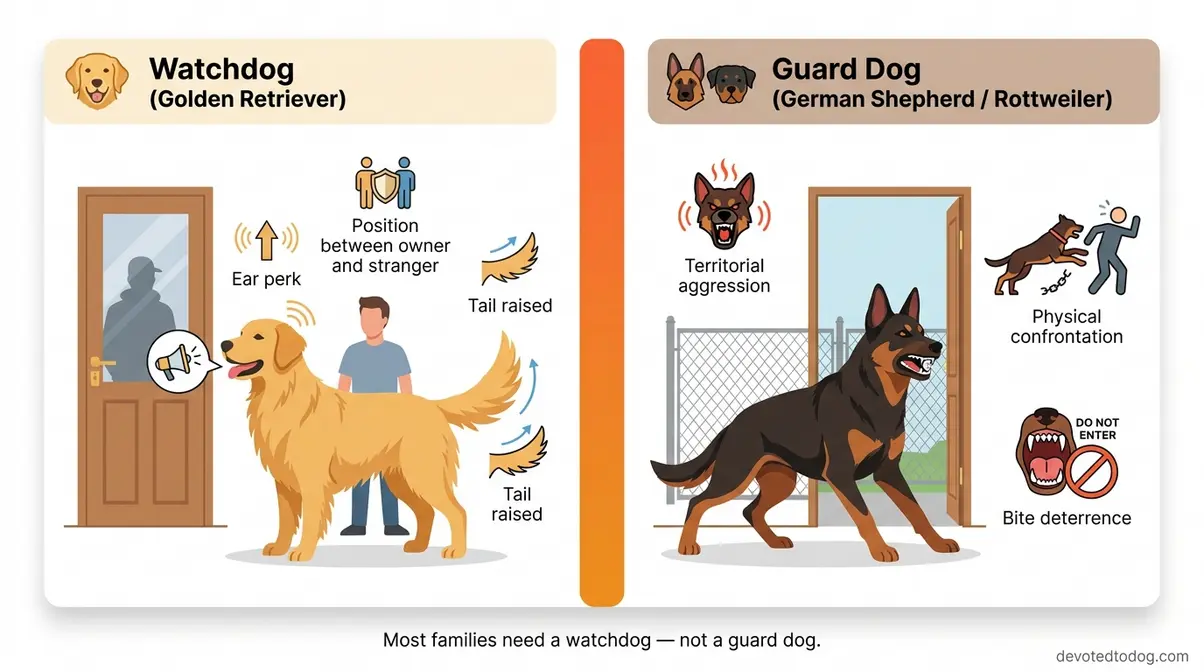
Golden Retrievers are protective dogs, but not in the way most people expect. The key is understanding the difference between a watchdog (a dog that alerts its owner to unusual activity) and a guard dog (a dog trained to physically confront threats). Golden Retrievers are natural watchdogs whose alert barking and loyal presence create a genuine layer of home security, just not through aggression. For most families, that distinction matters enormously.
What “Protective” Really Means
A watchdog is a dog that notices changes in its environment, an unfamiliar sound, a stranger at the gate, a car that doesn’t belong, and communicates that to its owner through barking or behavior change. A guard dog, by contrast, is trained or bred to physically confront and deter threats through intimidation or force.
Golden Retrievers are natural watchdogs. They notice the world around them, react to the unfamiliar, and reliably communicate that reaction to you. This is the heart of “The Friendly Protector Paradox”, the concept that a Golden’s genuine value to home security comes from deterrence through alert barking and physical presence, not aggression. Their bark says someone is here. That signal alone stops most opportunistic threats.
One owner on Reddit’s r/goldenretrievers community put it perfectly:
“My golden is very protective of our home and property and family and will bark at intruders. But she is also super friendly and probably never…”
That’s the paradox in action. The alerting behavior is real and reliable. The aggression simply isn’t there, and as you’ll see, that’s not a flaw. So what does that protective instinct actually look like day to day?
Natural Alert Behaviors to Expect
Golden Retrievers are protective of their owners in ways that are easy to observe once you know what to look for. Owner-reported experiences across Golden Retriever owner communities consistently show that these dogs bark reliably at strangers and unfamiliar sounds, even in highly socialized dogs, and then wag their tails the moment a guest is formally introduced (Golden Retriever owner forum, 2026).
Common alert behaviors include:
- Alert barking at the door when someone approaches or knocks
- Positioning between you and a stranger, standing slightly in front of their owner when an unfamiliar person enters
- Standing at attention, ears forward, body still, scanning the environment
- Following you closely when someone new enters the home
- Low growling in rare cases when genuinely alarmed by something unusual
These behaviors are rooted in prey drive, a dog’s natural instinct to notice and react to movement and change in their environment. Golden Retrievers have this instinct even without aggression training. Individual variation matters, too: some Goldens are more alert than others, and early socialization shapes how these instincts express themselves. A well-socialized Golden still barks at strangers, they simply stop when told.
Here’s the honest part, though, and it’s important to set realistic expectations before you rely on your Golden for home security.
Why They Make Poor Guard Dogs
Golden Retrievers are protective of their family, but not through physical confrontation. They were selectively bred over generations for retrieving game and cooperating with humans. Their genetic temperament prioritizes friendliness and non-aggression over territorial defense. This is intentional, not accidental.
The data supports this clearly. Golden Retrievers are notably under-represented in dog bite incidents compared to other popular breeds, according to AVMA dog bite risk data, evidence of their fundamentally non-aggressive temperament (AVMA, 2026). That means a Golden is extremely unlikely to physically confront an intruder. Their barking, however, deters most opportunistic threats on its own.
For more context, see the truth about Golden Retriever aggression, the data consistently shows this breed near the bottom of bite incident lists.
If your primary goal is aggressive physical deterrence, a Golden is the wrong breed. Breeds like German Shepherds and Rottweilers are purpose-built for guarding and will physically confront threats. But for alert-based home security alongside a warm family companion, Golden Retrievers are highly effective. Their greatest perceived weakness, being overly friendly, is actually what makes them so safe to have around children, guests, and other pets.
The good news? You don’t have to accept your Golden’s natural instincts as a ceiling. With the right training, you can meaningfully sharpen their watchdog behaviors.
Will a Golden Retriever attack an intruder?
It is unlikely, though not impossible. Most Golden Retrievers will alert-bark at intruders but will rarely engage physically. The breed was selected for soft mouth, friendliness, and bite inhibition over centuries of retriever breeding, the opposite traits of true guard dogs. In extreme scenarios where their owner is in clear physical danger, some Goldens have shown defensive behavior, but this is the exception, not the rule. If you need a dog that will attack an intruder, look at protection breeds like Belgian Malinois, German Shepherd, Doberman, or Rottweiler, all bred and trained specifically for this role.
Can Golden Retrievers be guard dogs?
Not effectively. Can golden retrievers be guard dogs? Technically yes (any dog can bark), but they are poorly suited to the role. True guard dogs require: territorial drive, suspicion of strangers, controlled aggression, and bite confidence, all traits selectively bred OUT of Goldens for 150+ years. A golden retriever guard dog or golden retriever protection dog setup is more theatrical than functional, the dog will likely greet the intruder by wagging its tail. For serious property or personal protection, hire a security service or train a working-line GSD or Belgian Malinois. The golden retriever guard role is realistically limited to alert-barking.
Will a Golden Retriever protect you?
Maybe, in specific contexts. Will a golden retriever protect you depends on three factors: (1) how strong the owner-dog bond is; (2) how clear the threat is to the dog; (3) the individual dog’s temperament. Most Goldens will physically position themselves between their owner and a perceived threat, will alert-bark loudly, and may show defensive posturing. Whether they will physically engage an attacker is much less certain. Are golden retrievers good protectors of children? Yes, in the alert-and-stay-close sense. Trained protection? No. Reliable physical defense? No. Loyal and devoted family member who will sound the alarm? Absolutely.
Will a Golden Retriever attack an intruder?
It is unlikely, though not impossible. Most Golden Retrievers will alert-bark at intruders but will rarely engage physically. The breed was selected for soft mouth, friendliness, and bite inhibition over centuries of retriever breeding, the opposite traits of true guard dogs. In extreme scenarios where their owner is in clear physical danger, some Goldens have shown defensive behavior, but this is the exception, not the rule. If you need a dog that will attack an intruder, look at protection breeds like Belgian Malinois, German Shepherd, Doberman, or Rottweiler, all bred and trained specifically for this role.
Can Golden Retrievers be guard dogs?
Not effectively. Can golden retrievers be guard dogs? Technically yes (any dog can bark), but they are poorly suited to the role. True guard dogs require: territorial drive, suspicion of strangers, controlled aggression, and bite confidence, all traits selectively bred OUT of Goldens for 150+ years. A golden retriever guard dog or golden retriever protection dog setup is more theatrical than functional, the dog will likely greet the intruder by wagging its tail. For serious property or personal protection, hire a security service or train a working-line GSD or Belgian Malinois. The golden retriever guard role is realistically limited to alert-barking.
Will a Golden Retriever protect you?
Maybe, in specific contexts. Will a golden retriever protect you depends on three factors: (1) how strong the owner-dog bond is; (2) how clear the threat is to the dog; (3) the individual dog’s temperament. Most Goldens will physically position themselves between their owner and a perceived threat, will alert-bark loudly, and may show defensive posturing. Whether they will physically engage an attacker is much less certain. Are golden retrievers good protectors of children? Yes, in the alert-and-stay-close sense. Trained protection? No. Reliable physical defense? No. Loyal and devoted family member who will sound the alarm? Absolutely.
Will a Golden Retriever attack an intruder?
It is unlikely, though not impossible. Most Golden Retrievers will alert-bark at intruders but will rarely engage physically. The breed was selected for soft mouth, friendliness, and bite inhibition over centuries of retriever breeding, the opposite traits of true guard dogs. In extreme scenarios where their owner is in clear physical danger, some Goldens have shown defensive behavior, but this is the exception, not the rule. If you need a dog that will attack an intruder, look at protection breeds like Belgian Malinois, German Shepherd, Doberman, or Rottweiler, all bred and trained specifically for this role.
Can Golden Retrievers be guard dogs?
Not effectively. Can golden retrievers be guard dogs? Technically yes (any dog can bark), but they are poorly suited to the role. True guard dogs require: territorial drive, suspicion of strangers, controlled aggression, and bite confidence, all traits selectively bred OUT of Goldens for 150+ years. A golden retriever guard dog or golden retriever protection dog setup is more theatrical than functional, the dog will likely greet the intruder by wagging its tail. For serious property or personal protection, hire a security service or train a working-line GSD or Belgian Malinois. The golden retriever guard role is realistically limited to alert-barking.
Will a Golden Retriever protect you?
Maybe, in specific contexts. Will a golden retriever protect you depends on three factors: (1) how strong the owner-dog bond is; (2) how clear the threat is to the dog; (3) the individual dog’s temperament. Most Goldens will physically position themselves between their owner and a perceived threat, will alert-bark loudly, and may show defensive posturing. Whether they will physically engage an attacker is much less certain. Are golden retrievers good protectors of children? Yes, in the alert-and-stay-close sense. Trained protection? No. Reliable physical defense? No. Loyal and devoted family member who will sound the alarm? Absolutely.
Will a Golden Retriever attack an intruder?
It is unlikely, though not impossible. Most Golden Retrievers will alert-bark at intruders but will rarely engage physically. The breed was selected for soft mouth, friendliness, and bite inhibition over centuries of retriever breeding, the opposite traits of true guard dogs. In extreme scenarios where their owner is in clear physical danger, some Goldens have shown defensive behavior, but this is the exception, not the rule. If you need a dog that will attack an intruder, look at protection breeds like Belgian Malinois, German Shepherd, Doberman, or Rottweiler, all bred and trained specifically for this role.
Can Golden Retrievers be guard dogs?
Not effectively. Can golden retrievers be guard dogs? Technically yes (any dog can bark), but they are poorly suited to the role. True guard dogs require: territorial drive, suspicion of strangers, controlled aggression, and bite confidence, all traits selectively bred OUT of Goldens for 150+ years. A golden retriever guard dog or golden retriever protection dog setup is more theatrical than functional, the dog will likely greet the intruder by wagging its tail. For serious property or personal protection, hire a security service or train a working-line GSD or Belgian Malinois. The golden retriever guard role is realistically limited to alert-barking.
Will a Golden Retriever protect you?
Maybe, in specific contexts. Will a golden retriever protect you depends on three factors: (1) how strong the owner-dog bond is; (2) how clear the threat is to the dog; (3) the individual dog’s temperament. Most Goldens will physically position themselves between their owner and a perceived threat, will alert-bark loudly, and may show defensive posturing. Whether they will physically engage an attacker is much less certain. Are golden retrievers good protectors of children? Yes, in the alert-and-stay-close sense. Trained protection? No. Reliable physical defense? No. Loyal and devoted family member who will sound the alarm? Absolutely.
How Do You Encourage Protective Behaviors?
Picture this: a knock at the door at 10 PM. Your Golden’s ears prick up, they trot to the door, and let out three sharp barks. That moment, natural, instinctive, and completely untrained, is exactly what these five techniques will help you build on. These tips work with The Friendly Protector Paradox, not against it. You’re amplifying what your Golden already does naturally, not trying to turn them into something they’re not.
Estimated time: 2-4 weeks of daily practice
Tools needed: Small training treats, a standard leash, and a willing helper
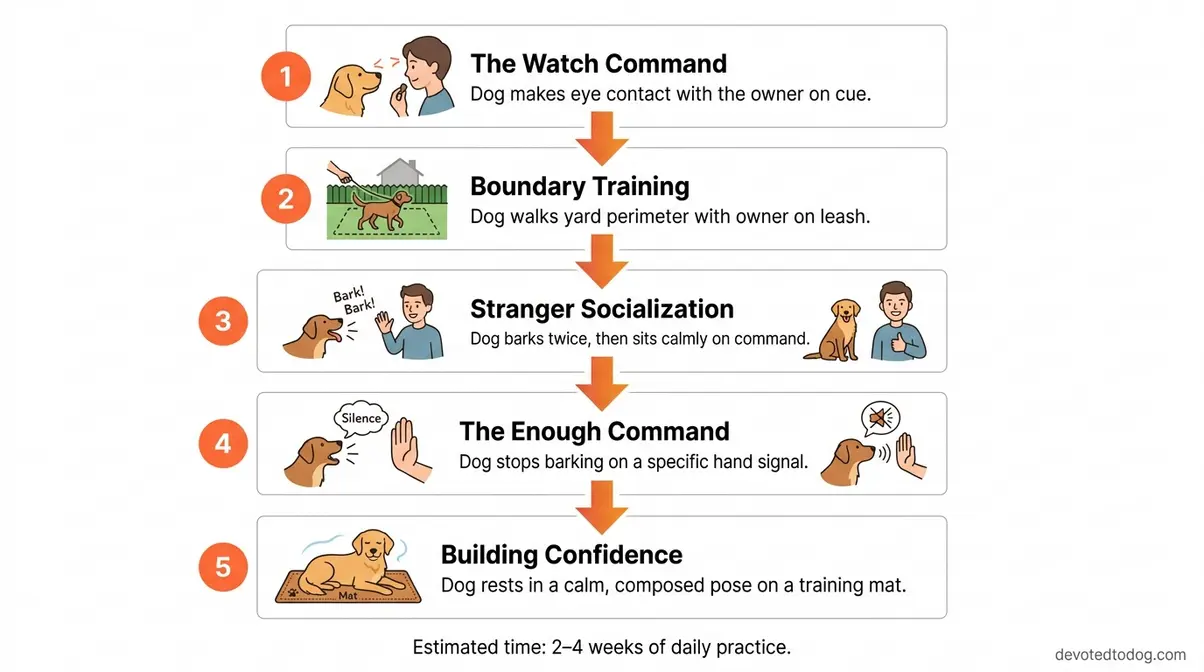
Tip 1: The “Watch” Command
The “Watch” command, a cue that tells your dog to focus attention on you and the immediate environment, is the foundation for all watchdog behavior training.
Step 1: Establish Eye Contact
Hold a treat at eye level and say “Watch” in a calm, firm voice.
Step 2: Reward Immediately
The moment your Golden makes eye contact, reward with the treat and verbal praise (“Yes!”).
Step 3: Build Duration
Practice 5 repetitions twice daily for one week, gradually extending the duration of eye contact before rewarding.
Why this works: A dog that pays attention to you notices when your attention shifts toward something unusual. Eye contact builds the attunement that underpins every other protective behavior.
Expected outcome: Within 7-10 days, your Golden should respond to “Watch” consistently in low-distraction environments. For common Golden Retriever behavior training tips that complement this foundation, our full behavior guide covers the most frequent challenges owners encounter.
Once your Golden reliably watches on command, you can start building their boundary awareness.
Tip 2: Boundary Training
To formalize your Golden’s mild territorial instinct,their natural recognition of “their space”,take them on a structured perimeter patrol. Start by walking the edge of your yard or home with your Golden on-leash, using an upbeat and purposeful tone. At key points like the front gate, back door, or side fence, stop to let the dog sniff, and say “Good patrol” encouragingly. Repeating this routine three to four times per week for two weeks teaches your dog that these boundaries are worth monitoring. Many Golden owners report that after two weeks of boundary walks, their dog automatically checks the yard perimeter when let outside in the morning.
Boundary awareness means nothing if your dog can’t tell the difference between a welcome visitor and an unwanted one, that’s where controlled socialization comes in.
Tip 3: Stranger Socialization
This technique teaches your Golden that barking is their job, and your approval is the signal to stand down, the precise watchdog role you want.
- Have a friend approach your home as a “stranger,” without greeting your dog immediately.
- Allow your Golden to alert bark once or twice to cultivate their natural protective instinct.
- After 2 barks, calmly say “Enough” and redirect with a sit command.
- Once you formally introduce and welcome the “stranger,” allow your Golden to greet them warmly.
Why this works: This sequence teaches your dog to ward off unwanted visitors with a bark and then defer to your judgment. To reinforce this pattern consistently, you’ll need a reliable command that tells your Golden when to stop barking.
Tip 4: The “Enough” Command
Alert barking, controlled barking in response to unusual stimuli, is only useful if your dog can stop on command.
Step 1: Allow the Alert
When your Golden barks at something, let them bark 2-3 times to acknowledge the trigger.
Step 2: Issue the Command
Say “Enough” in a calm, even tone. Avoid shouting, as that escalates arousal and makes stopping harder.
Step 3: Redirect and Reward
Hold a treat near their nose. The moment they stop barking to sniff, say “Yes!” and reward.
Step 4: Fade the Treat
Practice daily for two weeks. Gradually fade the treat so the verbal reward alone maintains the behavior.
Why this works: A dog that stops barking on command becomes one of the most effective deterrents you can have, you get the alert without the nuisance, and you stay in control of the situation.
Tip 5: Building Confidence
An anxious, under-socialized dog barks at everything (useless) or at nothing (also useless). Building your Golden’s overall confidence ensures they only bark when something genuinely warrants attention. Enroll your Golden in basic obedience classes to build the confidence that supports consistent behavior. Practice “place” training,teaching your dog to go to a designated mat and remain calm,to build impulse control. Exposing your Golden to varied environments, sounds, and people from puppyhood ensures they are more reliably alert, not less. Confidence removes the noise, allowing a well-adjusted Golden to focus its alert energy on genuine threats to protect us daily.
Professional note: For owners seeking more advanced protection training, consult a certified professional dog trainer (CPDT-KA). Attempting guard dog training without professional guidance can create behavioral problems that are difficult to reverse.
What Are Their Smart, Friendly, and Loyal Traits?
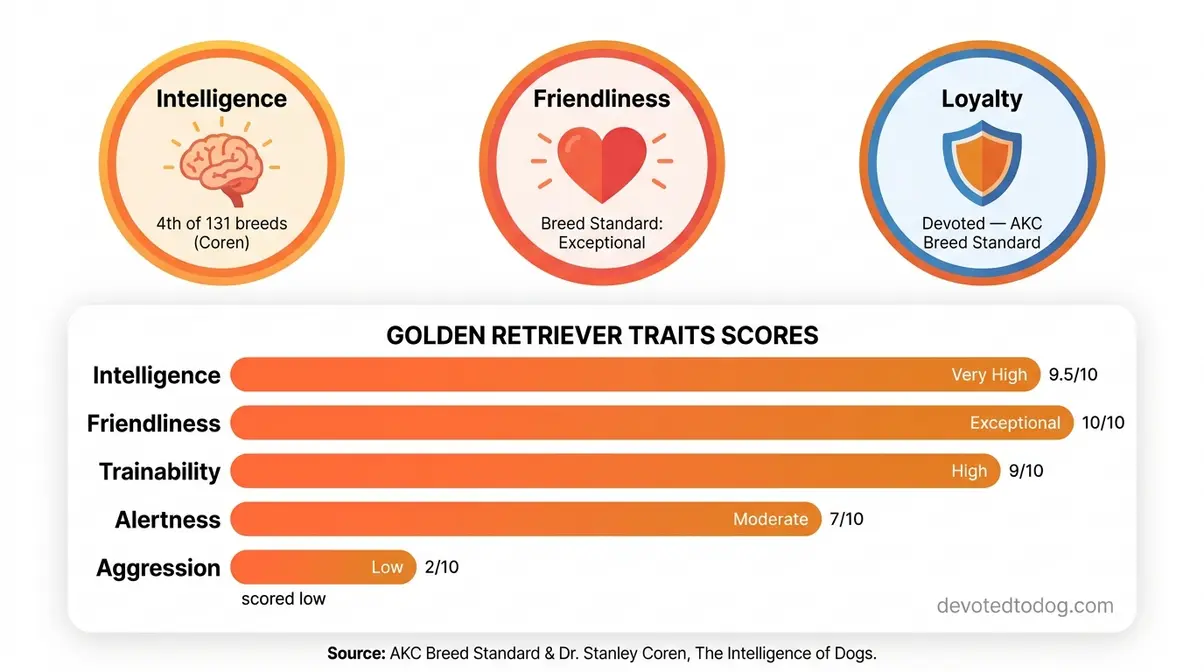
According to the AKC Golden Retriever breed standard, the Golden Retriever is defined by three core traits: intelligence, friendliness, and devotion to family (AKC, 2026). For anyone evaluating this breed for home security, that combination is both reassuring and clarifying, it explains why Goldens are so trainable for watchdog behaviors, and why aggression is simply not part of their design.
Intelligence and Trainability
The American Kennel Club characterizes the Golden Retriever breed standard as fundamentally intelligent, friendly, and devoted, not aggressive or territorial by design (AKC, 2026). That intelligence has a measurable dimension: in Dr. Stanley Coren’s landmark book The Intelligence of Dogs, Golden Retrievers rank 4th out of 131 breeds in working and obedience intelligence, behind only the Border Collie, Poodle, and German Shepherd. Coren defines this category as the ability to learn a new command in fewer than five repetitions and follow it 95% of the time or more.
For anyone wondering how smart Golden Retrievers really are, that ranking has a direct practical implication: the five training techniques in the previous section are achievable for most owners within 2-4 weeks of consistent daily practice.
The Friendly Protector Paradox connects directly here. A highly trainable dog is a more useful watchdog than an aggressive dog that can’t be controlled. Golden Retrievers used as guide dogs, search-and-rescue dogs, and therapy animals demonstrate the same reliable responsiveness you’re building with watchdog training, it’s the same cognitive hardware, applied to a different task.
Their intelligence explains why Goldens respond so well to training, but what about the side of their personality that gives some owners pause?
Friendliness With Strangers
Golden Retrievers are friendly by breed standard, and that is not a training failure. It is the result of deliberate selective breeding for a cooperative, non-territorial temperament. Are golden retrievers aggressive to strangers? Almost never, and by design. Specific behaviors you’ll typically see include greeting strangers with a wagging tail, actively seeking petting from unfamiliar people, and rarely displaying territorial growling.
That said, physical presence matters. Golden Retrievers are medium-large dogs, 55-75 lbs for females, 65-75 lbs for males, and are golden retrievers strong enough to serve as a visual deterrent? Yes. A 70-pound Golden barking at a door is a meaningful deterrent to an opportunistic intruder, even if that same dog would happily accept pets from that person moments later.
For a deeper look at understanding Golden Retriever behavior patterns, including how friendliness and alertness coexist in the breed, our behavior guide covers the most common temperament questions owners encounter.
Understanding their personality helps set realistic expectations, but what about the full picture? Every breed has trade-offs, and Golden Retrievers are no exception.
What Are the Honest Pros and Cons?
The Best Family Dogs
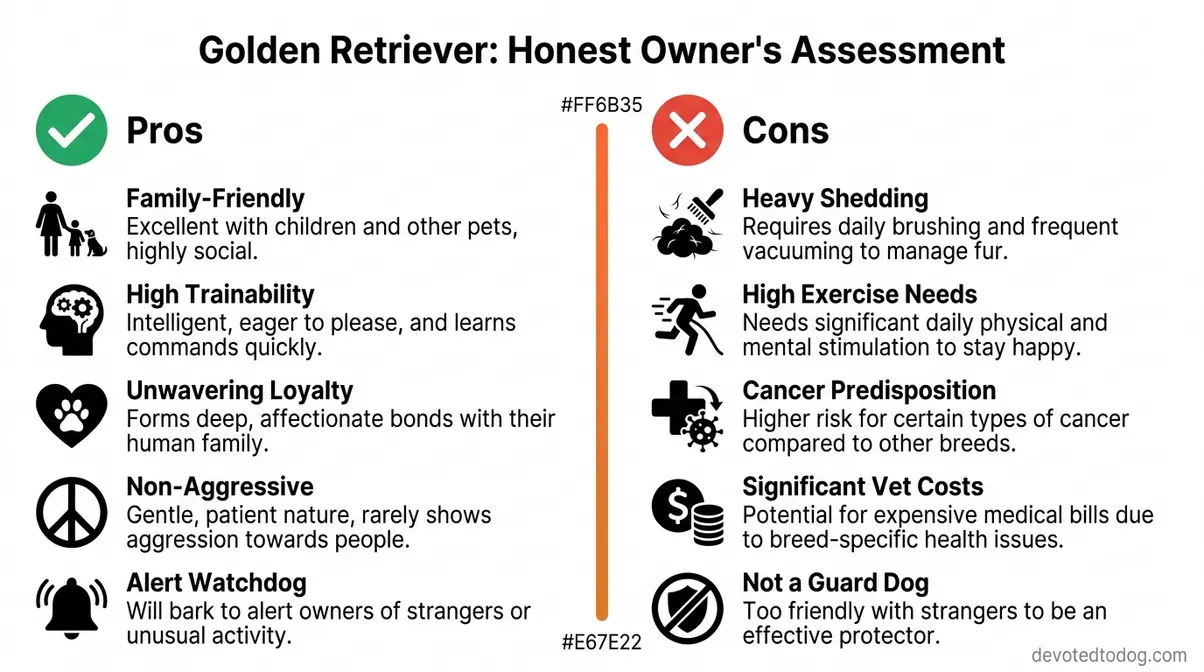
Golden Retrievers earn their reputation as exceptional family dogs through a combination of patience, emotional intelligence, and adaptability. They are gentle with young children, calm around elderly family members, and adaptable to apartment or house living, provided they get sufficient daily exercise.
Their emotional intelligence is particularly notable. Golden Retrievers are among the most empathetic dog breeds, sensing emotional distress and providing comfort, which is why they are so widely used as therapy and emotional support animals. Their trainability extends this further: guide dog programs, search-and-rescue teams, and therapy organizations all rely on Goldens because their willingness to learn makes them adaptable to almost any household role.
According to AVMA cancer risk findings, Golden Retrievers carry a significantly higher relative risk for bone, cardiac, liver, lymphatic, and spleen cancers compared to other popular breeds, a trade-off every prospective owner should understand alongside these genuine strengths (AVMA, 2026).
Here’s the honest balance sheet:
| Pros | Cons |
|---|---|
| Exceptional with children and elderly | Heavy shedding year-round |
| Highly intelligent, 4th most trainable breed | Needs 1-2 hours of vigorous exercise daily |
| Loyal, devoted family companion | Significant cancer predisposition |
| Non-aggressive temperament | Potential for above-average vet costs |
| Reliable alert watchdog | Not suitable as a traditional guard dog |
For practical strategies on managing Golden Retriever shedding, our grooming guide covers the tools and routines that make the biggest difference. Of course, no breed is perfect, and being honest about the downsides is part of responsible ownership.
What’s the Main Downside?
When asking are golden retrievers protective, you must weigh their excellent alerting capabilities against their heavy shedding, exercise needs, and significant predisposition to serious health conditions. The honest answer to “why golden retrievers are the worst” is almost always one of three things: the shedding surprised them, the energy level wore them out, or the vet bills shocked them.
Shedding is a genuine daily commitment. Golden Retrievers shed heavily year-round, with two major seasonal shedding periods. Plan for brushing 3-4 times per week minimum, and accept that golden fur becomes part of your home’s décor.
Exercise demands are significant. Goldens require 1-2 hours of vigorous activity daily. Under-exercised Goldens become destructive and anxious, this is one of the most frequently cited causes of behavioral problems in the breed. If your lifestyle doesn’t accommodate that commitment, this may not be the right breed for you.
Health costs are the most serious consideration. Their predisposition to cancer, hip dysplasia, and heart conditions means above-average lifetime veterinary expenses. This isn’t a reason to avoid the breed, but it is a reason to budget carefully and seriously consider pet insurance before bringing a Golden home.
Speaking of health, the single most important thing every Golden Retriever owner needs to understand is the breed’s relationship with cancer.
What Physical Traits and Health Risks Should You Know?

What Is the Silent Killer?
The silent killer in Golden Retrievers is most commonly hemangiosarcoma, a highly aggressive cancer of the blood vessels that typically affects the spleen or heart. It earns its reputation as the “silent killer” because tumors commonly form internally and can grow for months with no outward signs. By the time symptoms appear, sudden collapse, pale gums, labored breathing, the disease is often in an advanced stage.
The Morris Animal Foundation’s Golden Retriever Lifetime Study, a longitudinal study following 3,044 Golden Retrievers, has identified hemangiosarcoma, osteosarcoma, lymphoma, and high-grade mast cell tumors as the primary cancer types affecting the breed. According to PubMed data, hemangiosarcoma incidence in Golden Retrievers increases sharply after age 6 and becomes the most common cancer in the breed by age 8 (PubMed, 2026).
The elevated cancer rate has both a genetic component (a founder effect from a small breeding population in 19th-century Scotland) and an environmental dimension, which means owners can take some protective steps even if they can’t change their dog’s genetics.
What to do: Schedule bi-annual veterinary check-ups for Goldens over age 5, and ask your vet about abdominal ultrasound screening, the most effective early detection tool for hemangiosarcoma. For a full overview of conditions to watch for, see Golden Retriever common health issues and warning signs.
Consult your veterinarian for personalized screening recommendations, this information is not medical advice.
Cancer is the most serious health concern, but it’s not the only one. A complete picture of Golden Retriever health includes several other conditions worth knowing.
Other Common Health Issues
Golden Retrievers are strong, athletic dogs, medium-large in build, weighing 55-75 lbs with a dense double coat and high endurance, but their physical capabilities come with structural vulnerabilities worth understanding before you commit to the breed.
Common conditions to prepare for:
- Hip dysplasia, a malformation of the hip joint (the ball and socket don’t fit properly) that leads to arthritis and chronic pain over time. Common in large breeds; Golden Retrievers have elevated risk. Prevention: maintain a healthy weight and avoid over-exercise during puppyhood when joints are still developing.
- Subvalvular aortic stenosis (SAS), a narrowing of the aorta (the heart’s main artery) that can cause heart murmurs and, in severe cases, sudden cardiac death. Regular cardiac screening is recommended, particularly for dogs intended for breeding.
- Obesity, perhaps the most preventable risk factor. Excess body weight dramatically worsens hip dysplasia and is associated with increased cancer risk.
According to Cornell University veterinary data on canine cancer, hemangiosarcoma is a highly malignant cancer commonly affecting the spleen or heart of older, large-breed dogs like Golden Retrievers, and early detection remains the most effective intervention (Cornell University College of Veterinary Medicine, 2026).
The single most effective thing you can do for your Golden’s long-term health is maintain a healthy body weight. For a complete overview of what to expect across the breed’s lifespan, explore our guide to Golden Retriever lifespan and major health risks.
Knowing the full picture of Golden Retriever health helps you prepare. But what if, after all this, your primary goal really is serious home security? That requires an honest conversation.
When Aren’t Goldens the Right Fit?
For most families, a Golden Retriever’s alert barking provides meaningful deterrence to opportunistic intruders. But for high-risk security environments, breeds purpose-built for protection offer capabilities that Goldens simply cannot match. Knowing the difference is part of making the right decision for your household.
Most Protective Dog Breeds?
If your security needs go beyond alert barking, if you need a dog that will physically confront a threat, guard livestock, or serve in personal protection work, three breeds are purpose-built for that role:
- German Shepherd, the world’s most widely used police and military protection breed; combines high intelligence, athleticism, and strong territorial instinct
- Rottweiler, naturally territorial and physically powerful; historically developed for livestock and estate guarding; one of the oldest known guard dog breeds
- Doberman Pinscher, purpose-bred for personal protection; fast, highly alert, and strongly loyal to a single handler
All three require experienced handling and professional obedience training from the start. They are not recommended for first-time dog owners, and that’s a genuine comparative advantage for the Golden. If your household includes young children, elderly family members, or owners new to dogs, the Golden Retriever’s non-aggressive temperament is often the safer and more practical choice, even from a pure home security standpoint.
The right dog depends entirely on your specific security needs, family situation, and experience level.
Making the Right Security Choice
Here’s a simple two-path framework to guide your decision:
Path A, “I want a family companion that also deters casual threats”: A Golden Retriever is an excellent choice. Apply the five training techniques from the earlier section, and you’ll have a reliable alert watchdog that’s also safe around everyone in your home.
Path B, “I need aggressive physical deterrence or personal protection work”: Consider a German Shepherd, Rottweiler, or Doberman Pinscher. Consult a certified professional trainer before acquiring any of these breeds.
The Friendly Protector Paradox applies to most families, and most families need Path A, not Path B. The most honest answer to “are golden retrievers protective?” is: yes, for the kind of protection most families actually need, a trained Golden Retriever is remarkably effective.
Still have questions? Here are the answers to the most common things Golden Retriever owners ask.
Frequently Asked Questions
Do They Protect Their Owners?
Golden Retrievers protect their owners as watchdogs, they reliably alert bark at strangers, position themselves between their owner and a perceived threat, and deter opportunistic intruders through their size and sound. Their friendly temperament means they are unlikely to physically confront a threat. However, their loyalty and alertness make them genuinely attentive to their family’s safety.
Are Goldens High Maintenance?
Yes, Golden Retrievers are considered high maintenance due to their heavy shedding, high daily exercise requirements, and significant predisposition to serious health conditions. They shed year-round and require brushing three to four times per week. They also need one to two hours of vigorous exercise daily to avoid destructive behavior. Their elevated risk for cancer, hip dysplasia, and heart conditions can result in above-average lifetime veterinary costs. However, these challenges are highly manageable with pet insurance, a consistent grooming routine, and regular vet visits.
What Smells Do Goldens Hate?
Golden Retrievers dislike strong, sharp smells, particularly citrus fruits (lemons, oranges, limes), vinegar, rubbing alcohol, and concentrated perfumes or household cleaners. Their sensitive noses, estimated to be 10,000 to 100,000 times more sensitive than a human’s, make intense or synthetic scents genuinely overwhelming. This sensitivity can be used practically, as citrus sprays or diluted vinegar are often used as pet-safe deterrents to keep dogs away from specific areas of the home. If your Golden shows distress around a scent, remove the source and ventilate the area promptly.
Can a Golden Be a Guard Dog?
While they make excellent watchdogs that will alert you to strangers, Golden Retrievers are fundamentally poor guard dogs. They lack the natural aggression and territorial instincts required to physically confront an intruder.
Do Goldens Bark at Night?
A well-adjusted Golden Retriever typically will not bark excessively at night unless they sense something unusual in their environment. Because of their strong watchdog instincts, they will alert bark if they hear unfamiliar footsteps or see a strange vehicle outside. Consistent training and confidence-building can help them distinguish between normal nighttime noises and genuine threats.
Conclusion
For families seeking a loyal companion that also provides meaningful home security, Golden Retrievers are protective dogs in the way that matters most for most households, reliable alert barking, strong family loyalty, and a physical presence that deters opportunistic intruders. According to AVMA data, Golden Retrievers are notably under-represented in dog bite incidents, confirming their fundamentally non-aggressive nature. Our team at Devoted to Dog recommends combining basic watchdog training, realistic expectations, and regular veterinary care as the foundation of responsible Golden ownership.
The Friendly Protector Paradox holds true for the vast majority of families: a Golden’s greatest perceived weakness, being overly friendly, is actually its greatest strength. A dog that greets your guests warmly and barks reliably at 2 AM when something feels wrong is exactly the balance most families need. That’s not a compromise. That’s the right dog for most homes, and it connects directly to the worry you started with when you first asked whether your Golden could really protect you. If you are still wondering, are golden retrievers protective, the answer is a resounding yes,just in their own unique way.
Start with Training Tip 1, the “Watch” command, this week. It takes 10 minutes per day and produces consistent results within 7-10 days. When you’re ready to go deeper, explore our complete guide to Golden Retriever common health issues and warning signs to stay ahead of the breed’s most serious health risks.
Keep reading: the breed’s true temperament and the complete guide.