
Your 7 month old golden retriever was a total sweetheart last month, and now you’re Googling “is my puppy broken?” at midnight. You’re not alone, and your dog is not broken.
The sudden hyperactivity, the mouthiness that’s back with a vengeance, the “forgetting” every command they knew, this is the adolescent phase hitting in full force, and most online guides completely miss what’s actually driving it. They give you “be consistent” and call it a day, which is about as useful as telling someone with a migraine to “drink water.”
By the end of this guide, you’ll understand exactly what’s happening inside your 7 month old golden retriever’s brain, what to expect physically, and six specific steps to manage the chaos. We’ll cover size and weight norms, the science behind teenage rebellion, a feeding transition guide, and a full growth timeline, plus a FAQ section answering every common question owners ask at this stage.
females 35-45 lbs
5-min rule × 7
transition at 6-7mo
it ends
What’s Actually Happening at 7 Months?

At 7 months, a Golden Retriever enters a distinct adolescent window that most owners aren’t warned about. This phase runs from approximately 6 to 18 months, per developmental research, and 7 months is often the point where it lands hardest. The behavioral changes you’re seeing are not random; they follow a predictable neurological pattern with a specific cause and a manageable arc.
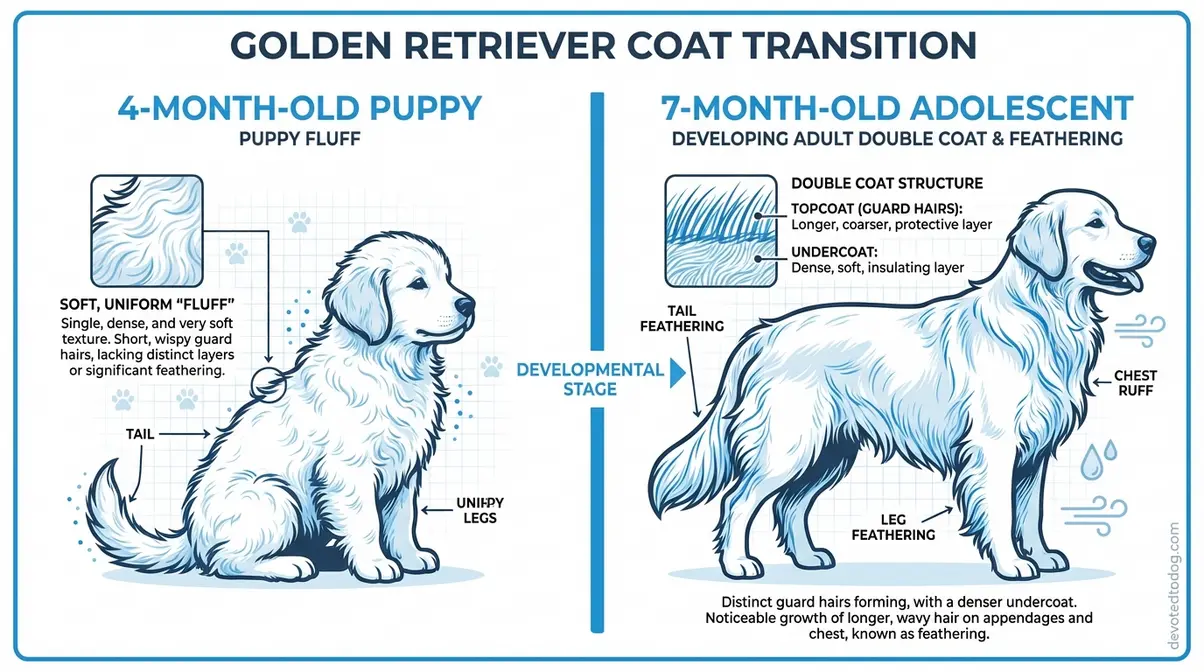
Caption: The coat transition from soft puppy fluff to a denser adult double coat is one of the most visible changes in a 7 month old golden retriever.
Teenage Phase Explained: 6-18 Months
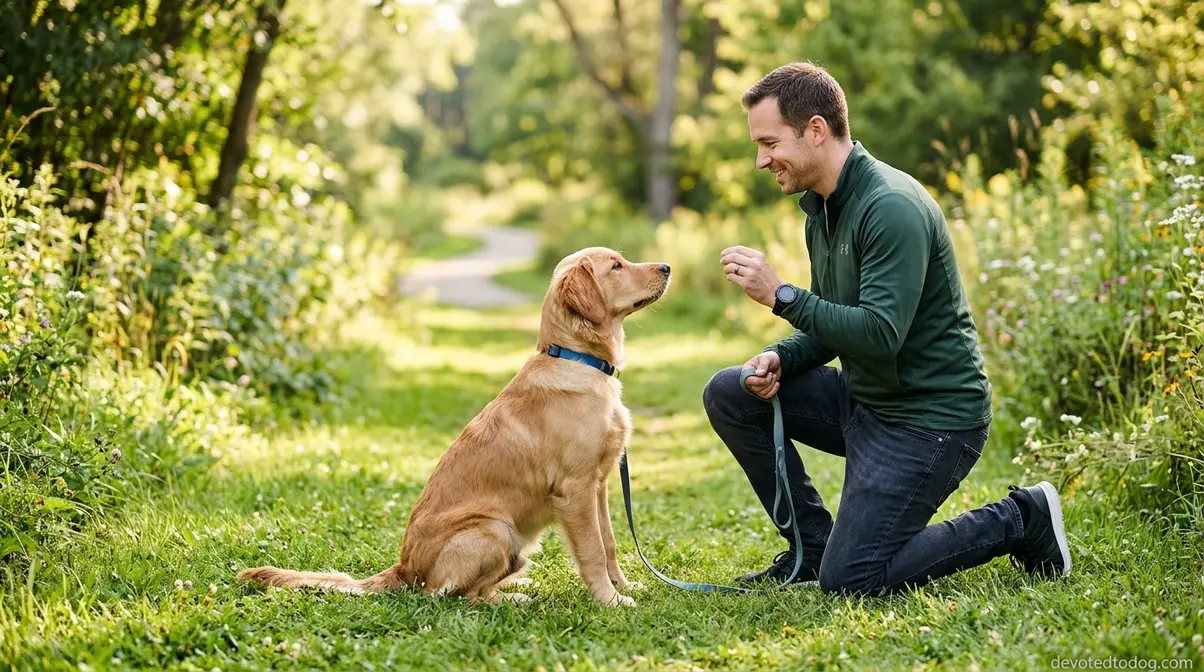
At 7 months, Golden Retriever behavior shifts because of a specific neurological event, what we call the “Dopamine Surge Phase”. This is the 6-18 month window when adolescent neurochemistry (dopamine and adrenaline) floods the developing canine brain, temporarily overwhelming an underdeveloped prefrontal cortex and producing the behavioral chaos owners experience as “teenage rebellion.”
“At 7 months, dogs enter a 12-month adolescent window, meaning their sudden impulsivity is a neurological reality, not a training failure.” (Cornell University)
Cornell University on adolescent puppy brain development confirms that adolescent puppies exhibit increased impulsivity because their prefrontal cortex, the brain’s self-control center, has not yet fully developed. This is the same mechanism behind human teenage behavior.
A peer-reviewed study published in Biology Letters found that dogs show measurable “conflict-like behaviour” during adolescence specifically directed at their primary caregivers, not at strangers (NIH, 2020). Your dog sits perfectly for the neighbor but ignores your “sit” command. This is not stubbornness; it’s adolescent conflict behavior directed at attachment figures.
For context on how male and female Golden Retrievers may experience this phase differently, see our guide on differences between male and female Golden Retrievers.
What Your 7-Month-Old Looks Like Now
Physically, your dog is going through a transformation that’s just as dramatic as the behavioral one. The puppy fluff is giving way to a denser, wavier adult coat, the chest and tail feathering become more pronounced, and the texture shifts noticeably. This is normal coat development, not a health concern.
Body proportions look distinctly gangly at this stage. The legs appear longer relative to the body because the skeleton is growing faster than muscle mass fills in. Female Golden Retrievers often develop their adult coat slightly earlier than males, so some variation between the sexes is expected. You can track the full development of their adult coat and shedding in our dedicated coat guide.
7 Months in Human Years
A 7-month-old Golden Retriever is roughly equivalent to a 9-12 year-old child in human developmental terms, old enough to have opinions and push boundaries, too young to fully self-regulate. The classic “7 dog years = 1 human year” rule is outdated; more accurate models suggest dogs age rapidly in early life, with that rate slowing considerably after the first two years. At 7 months, your dog is developmentally a preteen: curious, impulsive, and emotionally driven.
Understanding where your dog falls developmentally sets the stage for the most anxiety-inducing question most owners ask: is my dog the right size?
How Are Size, Weight, and Physical Development at 7 Months?

At 7 months, a male Golden Retriever typically weighs 40-50 lbs and a female weighs 35-45 lbs, according to growth data from Pawlicy’s Golden Retriever growth and weight chart. They stand at roughly two-thirds of their adult height but will continue to fill out in muscle and frame until 18 months. Significant variation is normal within these ranges; consult your vet if your dog falls dramatically outside them.
“At 7 months, male Golden Retrievers typically weigh 40-50 lbs and females 35-45 lbs, roughly two-thirds of their adult size, with significant filling-out still ahead.” (Pawlicy, 2026)
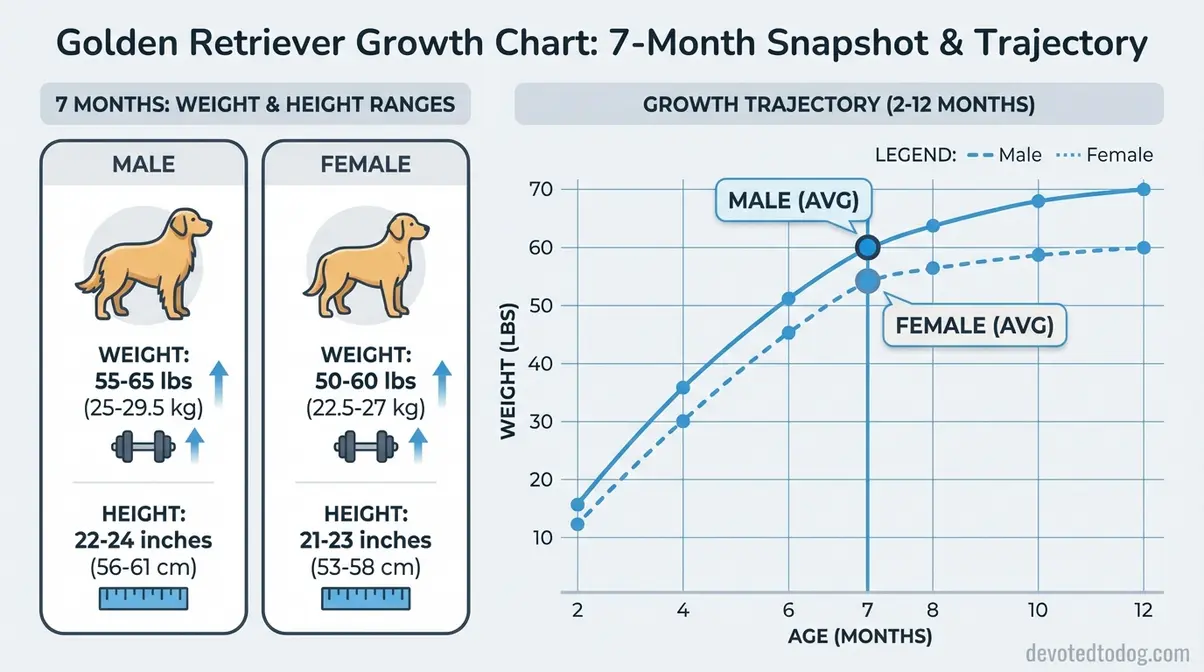
Caption: Weight and height ranges for a 7 month old golden retriever, males and females follow slightly different growth trajectories through 18 months.
How big is a Golden at 7 months?
The table below shows the expected weight and height progression across the 6-8 month window, which owners can use to quickly assess whether their dog is on track.
| Age | Male Weight | Female Weight |
|---|---|---|
| 6 months | 35-45 lbs | 30-40 lbs |
| 7 months | 40-50 lbs | 35-45 lbs |
| 8 months | 45-55 lbs | 40-50 lbs |
Adult males reach 65-75 lbs; adult females reach 55-65 lbs. At 7 months, your dog is still far from their final weight. Tracking large breed puppy weight trajectory is critical during rapid growth to prevent joint and skeletal issues, according to evidence-based canine growth standards (NIH, 2017).
It’s also worth noting that Golden Retriever lines vary. Field-bred Goldens often run 5-10 lbs lighter than show lines at the same age, this is breed variation, not a health concern.
Height and That Awkward Gangly Phase
At 7 months, most Goldens stand approximately 19-22 inches at the shoulder, with males toward the higher end of that range. The 7-month-old Golden Retriever size looks disproportionate because skeletal growth outpaces muscle development, it’s the same “all legs” look human teenagers get. This resolves naturally as the dog fills out through 12-18 months. The awkward teenager look is actually a reliable sign they’re on track.
Coat Development and Shedding
At 7 months, 7 month old golden retriever shedding increases noticeably because the puppy’s single-layer “puppy fluff” coat is being replaced by a thicker, double-layer adult coat. This transition is normal and temporary. Daily brushing of 10-15 minutes dramatically reduces loose hair accumulation, a slicker brush combined with an undercoat rake is the right tool combination for this stage.
One practical detail: at 7 months, most Golden Retrievers need a collar sized 14-18 inches. Measure monthly, they’re still growing fast enough that a collar that fits today may be too snug in six weeks. For a full breakdown of what to expect through each coat transition, see our guide on development of their adult coat and shedding.
How Do You Manage Behavior and the Teenage Phase?
At 7 months, behavioral regression in Golden Retrievers is not a training failure, it is a predictable neurological event. Research published in Biology Letters shows dogs experience measurable “conflict-like behaviour” during the adolescent phase, directed specifically at their primary caregivers rather than strangers (NIH, 2020). The same dog that sat perfectly for a stranger will ignore your commands. This is temporary and manageable with the right tools.
“The root issue is over-arousal, not too much energy. At 7 months, the brain is flooded with dopamine and adrenaline.”
, Golden Retriever owner community consensus (r/puppy101)
Why Your Golden Forgets Everything
The prefrontal cortex, responsible for self-control and problem-solving, is the last brain region to fully develop in dogs. At 7 months, it’s still under construction. This neurological reality explains why the 7 month old golden retriever behavior owners find most frustrating (ignoring known commands, impulse-driven chaos) isn’t stubbornness, it’s developmental.
“Dogs trained before 6 months show a 50% reduction in adolescent destructive behavior, proving early foundations are temporarily overridden, not lost.” (NIH, 2021)
Research on pre-adolescent puppy training found that dogs receiving consistent training before 6 months showed significant reductions in destructive behavior, aggression, and compulsive behavior during adolescence (NIH, 2021). Early training foundations are not lost, they’re temporarily overridden by neurochemistry. They come back.
Potty training regression is also common at this stage for the same reason. Don’t panic; revert to basics, more frequent outdoor trips and shorter indoor windows between them. To identify red flag behaviors in puppies versus normal adolescent regression, see our behavior guide.
6 Steps for the Dopamine Surge Phase

These six protocols are your Dopamine Surge Phase survival toolkit, specific, named, and designed for the neurological reality of a 7-month-old. Why does my 7 month old golden retriever bite? Step 1 answers that directly.
- The Drop It Protocol (for mouthiness): When your puppy mouths, immediately freeze and say “drop it” in a calm, flat voice. The moment the mouth releases, reward with a treat within 2 seconds. Repeat 5-10 times per session. Expected outcome: 80% reduction in mouthing within 5-7 days of consistent use. For persistent cases, our full guide on how to curb persistent biting and nipping behaviors provides additional protocols.
- The Brain Work Swap (for hyperactivity): Replace 10 minutes of physical exercise with a puzzle feeder, sniff mat, or “find it” game. Cognitive work tires the Dopamine Surge brain more effectively than physical running, mental stimulation engages the prefrontal cortex directly, which is exactly what needs exercising.
- The Enforced Nap Routine (for over-arousal): At 7 months, puppies still need 14-16 hours of sleep daily. If your dog can’t settle, crate them for a 1-hour enforced nap with a chew or Kong. Over-arousal, not excess energy, is the root cause of most behavior issues at this stage. Owner consensus across Golden Retriever communities on r/puppy101 and r/dogs consistently identifies enforced rest as the single most effective intervention for the “suddenly unhinged” behavior spike.
- The 5-Minute Exercise Rule (for joint safety): Limit structured exercise to 5 minutes per month of age, twice daily, so 35 minutes maximum per session at 7 months. This widely-used guideline protects developing growth plates during the rapid skeletal growth phase. While the rule’s origin is informal (commonly cited by UK veterinary professionals), the underlying principle, limiting high-impact repetitive exercise in large-breed puppies, is well-supported by veterinary consensus.
- Threshold Training (for boundary-testing): Practice “sit” and “stay” in progressively more distracting environments, start in the living room, move to the yard, then a quiet street. Regression in distracting environments is normal and expected; it simply means you’ve found the dog’s current stimulation threshold. Work just below that threshold until reliability returns, then raise the bar.
- Controlled Departure Practice (for independence): Practice leaving the room for 30-second intervals, returning calmly. Build up to 5 minutes over two weeks. This develops tolerance for independence without triggering separation anxiety, a genuine risk during the attachment-heavy teenage phase.
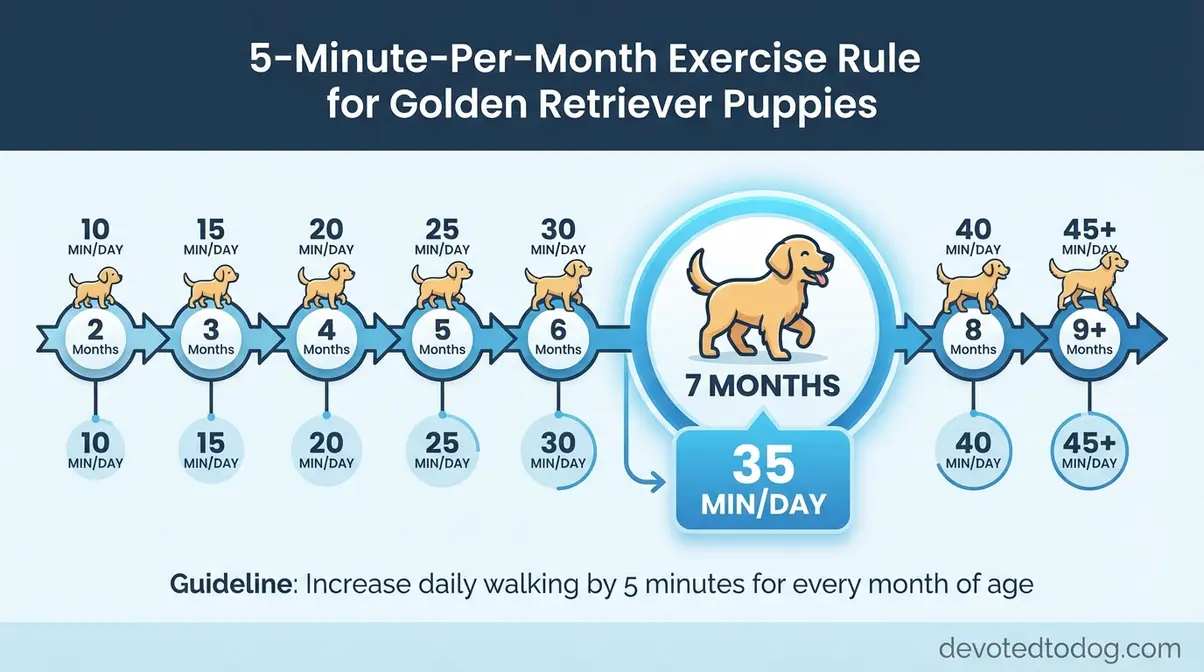
Caption: The 5-Minute Rule caps structured exercise at 35 minutes per session for a 7 month old golden retriever, protecting growth plates during the rapid skeletal growth phase.
For a visual walkthrough of these training steps, watch our video guide on teenage phase behaviors.
Over-Arousal & Enforced Nap Protocol
Over-arousal is the hidden driver most owners completely miss. It occurs when stimulation, play, visitors, noise, floods the brain faster than the underdeveloped prefrontal cortex can regulate it. The dog appears “hyper” but is actually overwhelmed.
Signs of over-arousal include zoomies that escalate rather than wind down, biting that intensifies during play (not decreases), inability to respond to known commands, whale eye, and frantic panting. These are neurological overload signals, not defiance.
The intervention is straightforward: calmly and without drama, place the dog in the crate with a chew or Kong. Silence and low stimulation for 60 minutes. The dog should emerge noticeably calmer. This is not punishment, it’s neurological first aid. A dog’s tendency to bite is influenced by five interacting factors: heredity, early experiences, socialization, training, and health, per AVMA guidelines on dog bite prevention (AVMA). When those factors converge with over-arousal, the risk escalates.
One important clarification for owners worried that “my 7 month old golden retriever is aggressive”: the vast majority of cases at this age are over-arousal, not true aggression. The distinction matters because the interventions are different. True red flags are covered in the Limitations section below.
How Should You Feed Your 7-Month-Old Golden?
At 7 months, a Golden Retriever should eat 3-4 cups of high-quality large-breed puppy food per day, divided into 2-3 meals. How much should a 7 month old golden retriever eat depends on your specific food’s caloric density, always follow the feeding guide on the bag and adjust for your dog’s body condition score. Veterinary standards recommend transitioning from 3 meals to 2 meals daily at 6 months of age, per the Merck Veterinary Manual feeding recommendations (Merck Veterinary Manual).
⚠️ Veterinary Disclaimer: This feeding information is for general guidance only. Consult your veterinarian to determine the appropriate diet and portion size for your individual dog.
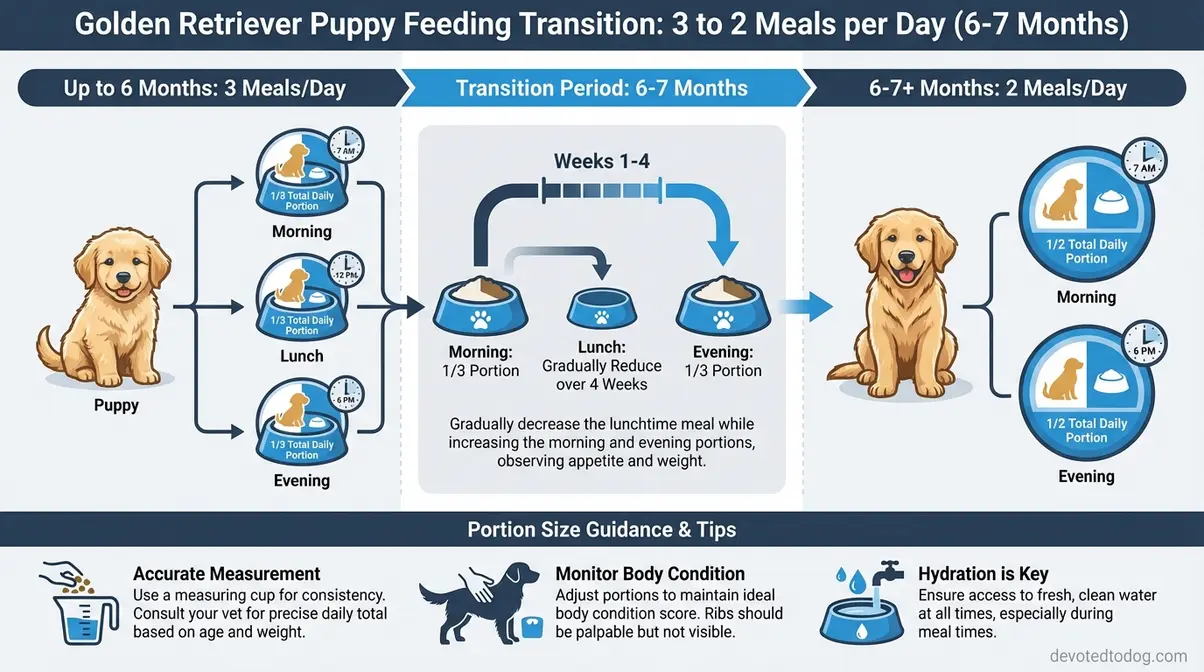
Caption: Transitioning to 2 meals per day by 6-7 months helps regulate blood sugar and reduces bloat risk in a rapidly growing adolescent Golden Retriever.
How much should a 7-month-old eat?
For a 40-50 lb dog at 7 months, the general guideline is 3-4 cups of large-breed puppy food per day, split across 2 meals. Highly active dogs may need slightly more. The exact feeding amounts for growing puppies vary by food brand, so treat the cup measurement as a starting point, not a fixed rule.
Large-breed puppy food is non-negotiable at this stage. Regular puppy food contains higher calcium levels that can accelerate bone growth too quickly, increasing joint disease risk. According to the VCA Animal Hospitals large breed nutrition guide, large breed puppies require balanced calcium and phosphorus ratios to prevent skeletal abnormalities during rapid growth (VCA Animal Hospitals). Hill’s Science Diet Large Breed Puppy is frequently cited by Golden Retriever owners in community forums as a trusted choice, but always verify with your vet.
Transitioning to 2 Meals a Day
“Transitioning to 2 meals daily by 6 months regulates blood sugar, preventing the energy spikes that fuel teenage hyperactivity.” (Merck Veterinary Manual)
How much should a 7 month old golden retriever eat during the transition period? The same total daily amount, just redistributed. Shift from 3 to 2 meals gradually over 7-10 days to avoid digestive upset. Start by folding the midday meal into the morning and evening portions in small increments.
One behavioral note: food-guarding and resource aggression around mealtimes can emerge during adolescence. If you notice stiffening, growling, or snapping near the food bowl, address it immediately with positive reinforcement protocols, not by removing the bowl mid-meal, which can escalate the behavior.
What to Feed (and What to Avoid)
The best dog food for a 7 month old golden retriever carries an AAFCO statement for “growth, large breed.” Tufts University veterinary nutrition guidelines note that AAFCO now mandates growth-categorized pet foods specify if they meet large-breed requirements, look for this on the label (Tufts University Petfoodology, 2017).
- Foods to never give your Golden Retriever:
- Chocolate (all types)
- Grapes and raisins
- Xylitol (found in many “natural” peanut butter brands, always check Kong filler labels)
- Onions and garlic
- Macadamia nuts
- Alcohol and caffeine
For a comprehensive breakdown of high-quality nutrition options by life stage, see our full Golden Retriever food guide.
What Is the Growth Timeline from 3 to 12 Months?
Golden Retrievers reach full physical maturity around 18 months but continue to mentally mature until age 2-3, meaning the teenage phase is a long game, not a quick fix. The table below contextualizes the 7-month adolescent phase within the full first-year arc, so you can see where you are and what’s coming.
Month-by-Month Milestones Table
| Age | Approx. Weight | Key Behavior | Key Development |
|---|---|---|---|
| 3 months | 15-25 lbs | Eager to please, high trainability | Socialization window open |
| 4 months | 20-30 lbs | Playful, some mouthing | Teething begins |
| 5 months | 25-38 lbs | Energy increasing, first boundary-testing | Teething peaks |
| 6 months | 35-45 lbs (M) / 30-40 lbs (F) | Adolescence begins | Hormonal changes start |
| 7 months | 40-50 lbs (M) / 35-45 lbs (F) | Teenage phase in full swing | Dopamine Surge Phase |
| 8 months | 45-55 lbs (M) / 40-50 lbs (F) | Continued testing | Growth plate development |
| 10 months | 55-65 lbs (M) / 45-55 lbs (F) | Gradual calming begins | Filling out in muscle |
| 12 months | 65-75 lbs (M) / 55-65 lbs (F) | More consistent behavior | Near adult height |
For owners curious about what they experienced at six months or what to expect in the eighth month, those guides provide age-specific detail.
The Angel Phase vs. The Teenage Phase
“Golden Retrievers reach physical maturity at 18 months but mentally mature until age 3, making the teenage phase a long-term developmental marathon.”
The “Angel Phase” (roughly 2-6 months) is when Golden Retriever puppies are highly trainable, eager to please, and relatively manageable. This is precisely why so many owners feel blindsided at 7 months, four months of relative ease creates a false baseline. The 6 month old golden retriever that seemed so responsive was operating with lower hormone levels and a more compliant neurological state.
The AKC training timeline identifies this same shift, noting that the Teenage Rebellion Phase (6-18 months) requires owners to recommit to consistent training rather than assuming the foundations laid earlier will hold without reinforcement. They will hold, but they need active maintenance right now.
Should You Adopt an Older Golden Retriever?
If you’re searching for a 7 month old golden retriever for sale or adoption, the experience differs significantly from raising a puppy from 8 weeks. The adolescent phase begins immediately, there’s no Angel Phase buffer, but there are genuine advantages that make the “teenage rescue” a rewarding path for the right owner.
Pros and Cons of Getting an Older Puppy
“While purchasing a puppy can cost over $2,000, adopting an adolescent Golden from a rescue typically ranges from $400 to $850, offering significant savings.”
- Pros of adopting at 7 months:
- Past the most fragile early puppy weeks
- Often partially house-trained and socialized
- You can assess personality and energy level before committing
- Typically less expensive than 8-week puppies from reputable breeders
- Cons to prepare for:
- May have ingrained habits (good or bad) from the previous home
- House training may need a full reset regardless of prior progress
- The adolescent phase starts immediately, expect the Dopamine Surge Phase from day one
- Building trust and attachment takes time; the conflict behavior noted in the NIH study may be more pronounced during the bonding period
When finding a trustworthy breeder or rescue organization, always request a full behavioral assessment and veterinary history for any dog older than 12 weeks.
Where to Find a 7-Month-Old Golden
Golden Retriever-specific rescue organizations operate in most US regions, search “Golden Retriever Rescue ” for local options. Breed-specific Facebook groups also post rehoming listings regularly. Reputable breeders occasionally have older puppies available from returned litters or “keeper” pups that didn’t work out for show or breeding programs. Before committing, understand the costs involved beyond the initial adoption or purchase price.
What Red Flags Should Make You Seek Help?
Most of what owners label “aggressive” at 7 months is over-arousal, and the distinction matters because the response is completely different. Here’s how to tell them apart.
Teenage Behavior vs. True Red Flags
“While 90% of adolescent biting is over-arousal, stiff body posture combined with unprovoked growling requires immediate professional behavioral intervention.” (Regina Humane Society)
- Normal (do not panic):
- Mouthiness that stops when you freeze or redirect
- Zoomies, especially after crating or high-stimulation periods
- Ignoring commands in distracting environments
- Potty training regression (lasts 1-2 weeks typically)
- Selective hearing, counter-surfing, chewing
- Red flags (seek professional help):
- Stiff body posture combined with growling directed at family members
- Resource guarding with teeth, not just hovering over food, but snapping or biting
- Extreme fearfulness that doesn’t resolve with calm, low-pressure exposure
- Unprovoked biting that draws blood
Adolescent behavioral changes are normal during Stage 5 (6-18 months), according to puppy developmental stages and behaviour guidance, but true aggression signals require professional evaluation (Regina Humane Society).
When to Seek Expert Help
- If your Golden shows true aggression (not over-arousal), contact a certified applied animal behaviorist (CAAB) or veterinary behaviorist, not a general trainer. The distinction in credentials matters for cases involving genuine aggression.
- If behavioral issues coincide with physical symptoms (lethargy, changes in appetite, pain responses when touched), consult your veterinarian first to rule out medical causes of aggression before any behavioral intervention.
- If house training regression is severe and persistent beyond two weeks, ask your vet to rule out a urinary tract infection, a common and easily treated cause of sudden indoor accidents.
Frequently Asked Questions
What are the hardest puppy months?
The hardest months with a Golden Retriever puppy are typically between 6 and 18 months, the adolescent or “teenage” phase. During this window, hormonal changes cause behavioral regression, increased mouthiness, and boundary-testing that can feel like your training has evaporated. This is when their prefrontal cortex is still developing while their body reaches near-adult size. The peak difficulty usually falls between 8 and 12 months. Consistent positive reinforcement and structured rest protocols are the most effective tools for navigating this period.
What are red flag behaviors in puppies?
Red flag behaviors in 7-month-old puppies include stiff body posture combined with growling toward family members, unprovoked snapping that draws blood, and aggressive resource guarding involving teeth rather than simply hovering near food. True aggression directed at family members warrants evaluation by a certified applied animal behaviorist or veterinary behaviorist, rather than a general trainer.
What is the hardest age for a Golden?
The hardest age for a Golden Retriever puppy is the adolescent stage, which begins around 5-6 months and peaks between 8 and 18 months. Boundary-testing, training regression, and high arousal levels converge during this window. The encouraging reality: Golden Retrievers are people-pleasers by nature, and consistent training during the Dopamine Surge Phase yields measurable behavioral improvement by 18-24 months as the prefrontal cortex matures.
For owners navigating a 7 month old golden retriever, the adolescent phase is the hardest, and most temporary, part of the journey. A Golden Retriever at 7 months is neurologically wired for chaos, with an underdeveloped prefrontal cortex flooding the brain with dopamine and adrenaline, per Cornell University College of Veterinary Medicine. The good news: dogs trained consistently before 6 months emerge from adolescence significantly calmer, and the Dopamine Surge Phase peaks by 8-12 months before gradually resolving through 18 months.
The Dopamine Surge Phase framework gives you something most puppy guides don’t: a name for the chaos, and therefore power over it. The six steps in this guide, the Drop It Protocol, Brain Work Swap, Enforced Nap Routine, 5-Minute Exercise Rule, Threshold Training, and Controlled Departure Practice, are not permanent crutches. They’re a focused 6-month toolkit that becomes unnecessary as the prefrontal cortex matures and your adolescent Golden grows into the devoted, steady companion they’re bred to be.
Start tonight with the Enforced Nap Protocol. If your dog can’t settle, crate them for 60 minutes with a chew and low stimulation. Done consistently for 7 days, that single change produces a measurable shift in baseline arousal. For a complete breakdown of portion sizes and nutritional needs, explore the exact feeding amounts for growing puppies and the full expected weight and height progression on devotedtodog.com.
Brianna York is a former veterinary technician with hands-on clinical experience in canine health. She contributes medical accuracy review to DevotedToDog health articles and validates clinical claims against current AVMA, AAHA, and OFA standards.
Find out when Goldens reach full size.