✅ Veterinarily Reviewed
You brought home a fluffy, 12-week-old bundle of chaos — and now you’re Googling everything at midnight. If you’re wondering whether your 3 month old Goldendoodle is eating enough, sleeping too much, or biting because something is wrong, you’re not alone.
Here’s what most puppy guides won’t tell you: the 3-month window is not just another phase. It is the single most important developmental period for establishing lifelong habits. Miss it, and you spend years correcting problems that were entirely preventable at week 12.
By the end of this guide, you’ll know exactly how much to feed your puppy, how to predict her adult size, and how to stop biting in its tracks — so you can stop second-guessing and start enjoying her. This guide covers five systems: development, size, feeding, training, and daily routine.
Key Takeaways: Your 3-Month-Old Goldendoodle at a Glance
At 12 weeks, your 3 month old Goldendoodle weighs 6–32 lbs depending on size — and the habits you build now shape her behavior for life.
- Feed 3 meals/day spaced evenly; no free-feeding at this age
- Mini Goldendoodles weigh 6–12 lbs at 12 weeks; standards reach 18–32 lbs
- Potty breaks every 3 hours — her bladder can’t hold longer yet
- The Three-Strikes Rule stops biting faster than any other method
- Socialization window closes around 14–16 weeks — act now
How We Built This Guide: The recommendations in this article were developed by synthesizing current guidelines from Tier 1 veterinary sources — including the Ohio State University College of Veterinary Medicine, UC Davis School of Veterinary Medicine, the American Kennel Club, and the U.S. Food and Drug Administration — alongside developmental research from Texas A&M College of Veterinary Medicine and reported experiences from owner communities. All health-related claims are cited. This guide is reviewed by a certified professional dog trainer with veterinary consultation.
Contents
- Development, Teething, and Coat Growth at 3 Months
- Size & Weight: 3-Month-Old Goldendoodle
- Feeding and Nutrition: Schedules and Foods to Avoid
- Training, Behavior, and Socialization: The 12-Week Window
- Your 3-Month-Old Goldendoodle’s Perfect Daily Routine
- Common Mistakes New Owners Make (And How to Avoid Them)
- Frequently Asked Questions
Development, Teething, and Coat Growth at 3 Months
At 3 months, your Goldendoodle — a crossbreed of Golden Retriever and Poodle — is in the most active developmental window of her life. Baby teeth are erupting, her adult coat is beginning to push through, and her brain is forming connections at a speed it will never match again. According to the Texas A&M veterinary puppy timeline, the 3-month stage places a puppy squarely within the critical socialization and juvenile phases, making every new experience she has this week disproportionately important. Understanding what’s normal right now — and what isn’t — saves you from unnecessary midnight panic.
This is what veterinary experts and the devotedtodog.com team call “The 12-Week Turning Point”: the moment where physical maturation and behavioral learning converge. The chewing, the sleeping, the coat changes — they’re all connected, and they’re all happening on purpose.
🐾 Action This Week: Buy 2–3 puppy-safe chew toys (rubber Kongs or Nylabones) before the teething discomfort peaks. Freeze one Kong stuffed with wet food for immediate relief. Introduce a soft brush for 5 minutes daily to begin grooming tolerance training.
Goldendoodles between 3–6 months are in the juvenile growth phase, approaching approximately 75–80% of their adult size by 6 months — meaning the nutrients and experiences you provide now directly determine adult bone density and muscle development. For a visual walkthrough of what to expect this week, watch our short video guide below.
When sleep looks like a problem — but isn’t: Many new owners rush to the vet worried their puppy sleeps too much. In most cases, this is completely normal. A 3-month-old Goldendoodle needs 16–18 hours of sleep for healthy neurological development, according to breed-specific guidelines (Goldendoodle Report, 2026). The red flag is NOT sleep — it’s sleep combined with refusal to eat, vomiting, or lethargy even when awake. If your puppy wakes up, eats enthusiastically, and plays hard before crashing again, she is doing exactly what she should be doing.
For an overview of 3-month-old Goldendoodle care, the full companion guide covers additional context on this developmental stage.
Understanding what’s happening physically is the foundation. Now let’s look at the number one question new owners ask: how big should she actually be right now?
Physical Changes: Coat, Teeth, and Body at 12 Weeks
Your 3 month old Goldendoodle is going through visible changes almost daily. The most noticeable: her teeth. Puppies have 28 deciduous teeth — also called baby teeth — and according to the American Kennel Club’s teething timeline, the incisors (front teeth) begin loosening and falling out between weeks 12 and 16 (AKC, 2026). At 12 weeks, those baby teeth are fully in place and razor-sharp. They stay until adult teeth push through between 4–6 months, when the full set of 42 permanent teeth gradually replaces them.
The second change you’ll notice: her coat. The soft, fluffy puppy coat is beginning to give way to the adult coat — the wavy or curly fur that replaces the softer puppy coat. This transition can make her look slightly uneven or “patchy” in texture. That’s not a health issue; it’s a normal developmental shift. You may also notice her paws look oversized relative to her body — a reliable indicator of future size — and her ears are beginning to drop more fully than they did at 8 weeks.
Think of a 12-week Goldendoodle as somewhere between the round-faced newborn look of breeder photos and the leaner, more defined look she’ll have at 6 months. If you’re comparing her to photos from week 8, the differences will be striking.
Transition: While the physical changes are fascinating, it’s the teething discomfort driving most of the chewing — and the biting — you’re dealing with right now.
Teething: What to Expect and How to Help
At 3 months, your puppy’s 3 month old Goldendoodle behavior around chewing is driven almost entirely by teething. She is in the early teething phase: baby teeth are loosening, adult teeth are beginning their push, and her gums are uncomfortable. According to the Texas A&M veterinary puppy timeline, the 3-month developmental stage marks the beginning of teething discomfort and peak socialization readiness — both happening simultaneously.
Normal teething symptoms include:
- Excessive chewing on anything within reach
- Mild gum redness or slight swelling
- Increased drooling
- Occasional small blood spots on toys (from a loose tooth releasing)
Symptoms that warrant a vet visit:
- Significantly swollen gums or refusal to eat
- A retained baby tooth alongside an erupting adult tooth after 6 months
- Broken teeth or visible tooth trauma
Three evidence-backed relief strategies:
- Frozen rubber Kong stuffed with wet food — the cold temperature reduces gum inflammation; the chewing urge is satisfied safely
- Chilled (not frozen) rope toy — gentle texture satisfies the need to gnaw without risking cracked teeth
- Nylabone puppy-specific chew — designed for the pressure of puppy jaws, not adult-strength chewing
One critical warning: never give ice cubes to a puppy. They can crack baby teeth, turning a discomfort issue into a veterinary emergency.
There’s also an important distinction to make early. Teething chewing is purposeful — your puppy is targeting specific objects with intention. Anxiety chewing is different: random, destructive, and occurring primarily when she is alone. If chewing only happens in your presence and stops when she’s engaged, it’s teething.
Transition: Teething drives the biting — but it also drives the sleep. Here’s why your puppy seems to crash hard after every play session.
How Much Sleep Does a 3-Month-Old Goldendoodle Need?
A 3 month old Goldendoodle typically sleeps 16–18 hours per day — and that number is not a sign of lethargy. It’s a biological necessity. According to multiple breed-specific veterinary sources, puppies at this age sleep more than adult dogs (who average 12–14 hours) because sleep is when the brain consolidates learning and the body grows fastest (Goldendoodle Report, 2026; My Doodle Crush, 2026).
“A 3-month-old Goldendoodle sleeps 16–18 hours per day — not from laziness, but because sleep is when the brain consolidates learning and the body grows fastest.”
At this age, your puppy naturally follows a structured “play → eat → potty → nap” cycle. A typical morning looks like this: 20 minutes of active play, then a meal, then an immediate outdoor potty trip, then a 90-minute nap in her crate. This isn’t random — it’s her nervous system doing exactly what it’s supposed to do. The diagram below shows a typical morning cycle for a 3-month-old Goldendoodle.
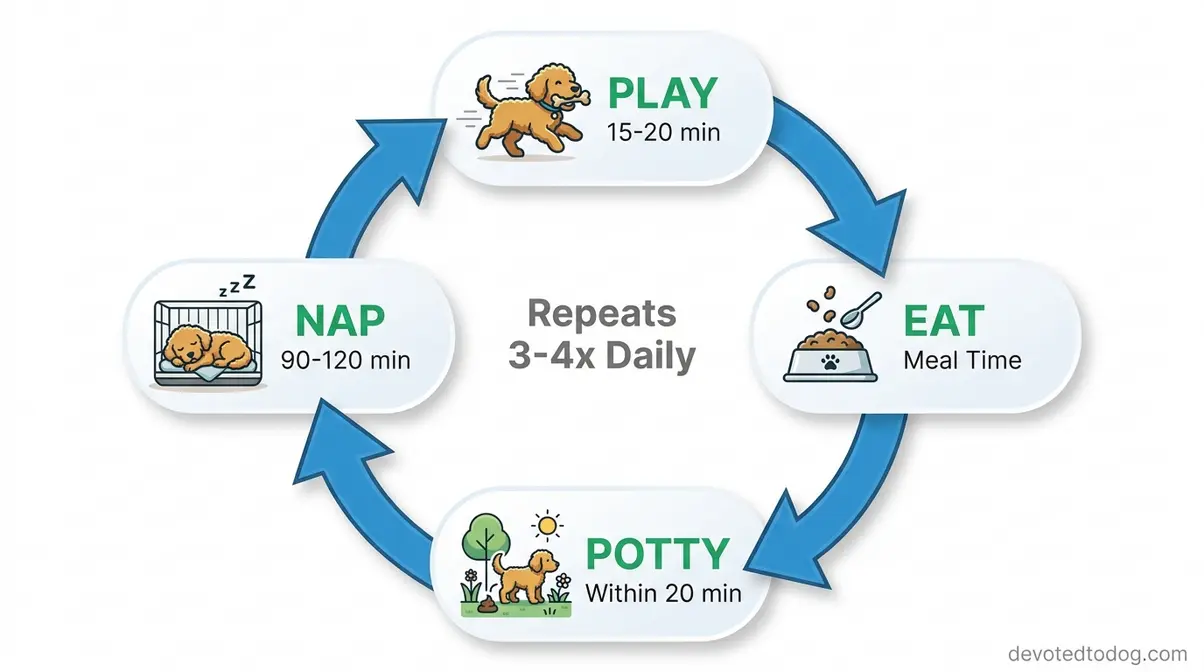
Why this matters: If you interrupt naps to keep her engaged, you’re working against her development. Overtired puppies bite more, have more accidents, and are harder to train. Protect the nap.
Transition: Now that you understand what’s happening physically, let’s answer the question every new owner asks first: how big should my puppy actually be right now?
Size & Weight: 3-Month-Old Goldendoodle
Size at 12 weeks varies dramatically by type — a Mini Goldendoodle and a Standard Goldendoodle can differ by 20 or more pounds, and both are completely healthy. According to the A-Z Animals Goldendoodle size chart, a Mini Goldendoodle at 12 weeks typically weighs 6–12 lbs, while a Standard Goldendoodle reaches 18–32 lbs. If you’ve been comparing your puppy to a generic “Goldendoodle” chart without knowing which size class applies to your dog, you may have been comparing her to the wrong template entirely.
“At 12 weeks, a Mini Goldendoodle typically weighs 6–12 lbs while a Standard Goldendoodle reaches 18–32 lbs — a difference that reflects their entirely different adult size trajectories.”
This is also where The 12-Week Turning Point becomes tangible: size at 12 weeks is the most reliable early predictor of adult weight, making this data genuinely actionable — not just interesting.
📏 Action This Week: Weigh your puppy on a bathroom scale (hold puppy, step on scale, subtract your weight). Record the number and compare to the chart below. If your puppy’s weight falls outside the range for their size class, mention it at your next vet visit — don’t panic, but do document.
Mini Goldendoodles weigh 6–12 lbs at 12 weeks and will reach approximately 15–35 lbs at adulthood (A-Z Animals Goldendoodle size chart) — meaning their nutritional needs per pound are higher than a Standard Goldendoodle’s. Feeding a Mini the same volume as a Standard at this age risks overfeeding and joint strain.
The size myth: Many breeders and websites describe “the Goldendoodle” as if it’s one standardized dog. It isn’t. A 3-month-old Mini and a 3-month-old Standard can differ by 20+ pounds — and both are perfectly healthy. The only meaningful comparison is your puppy against her own size class. For a deeper breakdown, see our full Goldendoodle size guide by type and your 3-month-old Goldendoodle’s size and development for additional context.
Now that you know your puppy’s healthy weight range, let’s make sure you’re feeding the right amount to stay in it.
Weight Ranges by Size: Mini, Medium, and Standard at 12 Weeks
Your puppy’s 3 month old Goldendoodle weight is one of the first numbers worth knowing. The table below gives you a scannable reference for all three size classes at exactly 12 weeks (Source: A-Z Animals Goldendoodle size chart):
| Size Class | Weight at 12 Weeks | Estimated Adult Weight |
|---|---|---|
| Mini Goldendoodle | 6–12 lbs | 15–35 lbs |
| Medium Goldendoodle | 12–18 lbs | 30–45 lbs |
| Standard Goldendoodle | 18–32 lbs | 45–75 lbs |
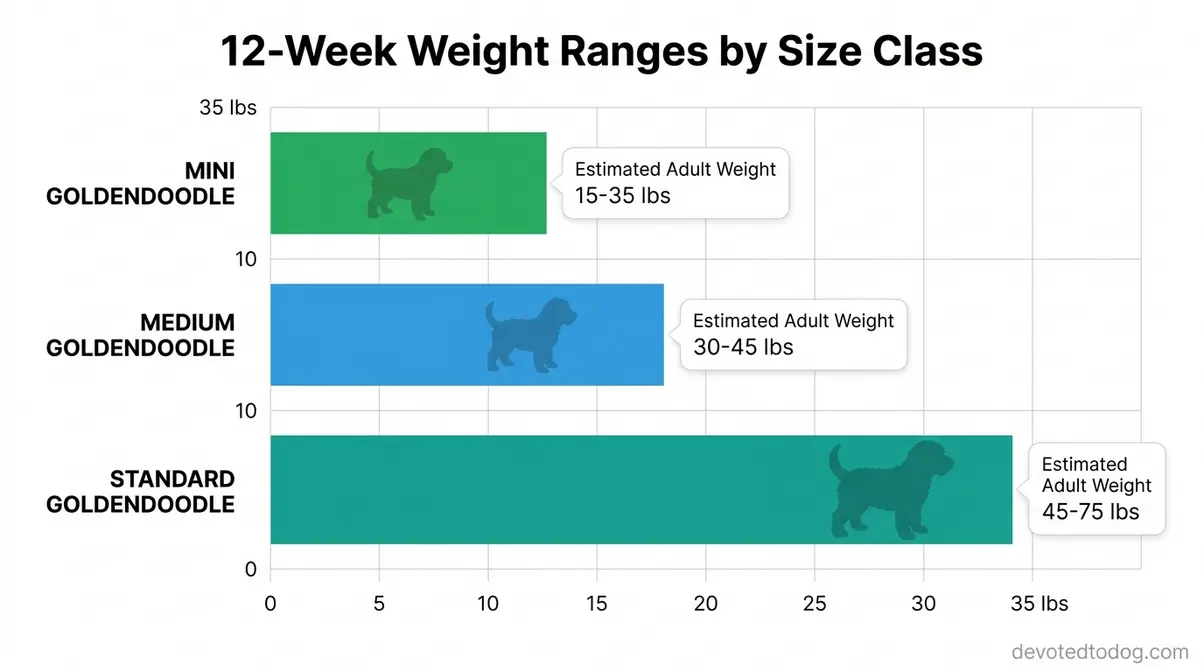
Which size class your puppy falls into is determined by the parent breeds used in the cross. A Mini Goldendoodle, a cross between a Miniature Poodle and a Golden Retriever, will always trend smaller than a Standard Goldendoodle — the full-size version reaching 45–75 lbs at adulthood — which is bred from a Standard Poodle. Within each size class, male puppies typically weigh slightly more than females at 12 weeks.
Transition: The table gives you the range — but what if you want to predict exactly where your puppy will land as an adult?
How to Predict Your Adult Goldendoodle’s Size
Knowing how much should a 3 month old Goldendoodle weigh is useful — but predicting her adult size is even more powerful. Breeders commonly use a straightforward multiplication formula, verified by size data from the A-Z Animals Goldendoodle size chart:
Step-by-step formula:
- Weigh your puppy at exactly 12 weeks
- Identify her size class (Mini/Medium or Standard)
- Apply the multiplier:
- Mini or Medium: 12-week weight × 2.5 = estimated adult weight
- Standard: 12-week weight × 2 = estimated adult weight
Worked example — Mini: Your Mini Goldendoodle weighs 8 lbs at 12 weeks. 8 × 2.5 = 20 lbs estimated adult weight.
Worked example — Standard: Your Standard weighs 25 lbs at 12 weeks. 25 × 2 = 50 lbs estimated adult weight.
This is an estimate, not a guarantee. Genetics, nutrition, and spay/neuter timing all influence final adult weight. The most reliable predictor remains breeder records for both parent dogs — if your breeder can share the parents’ weights, use that data alongside the formula.
Transition: Now that you can estimate her adult size, let’s make sure her current size stays healthy — starting with what goes in her bowl.
Mini Goldendoodle vs. Standard: Key Differences at 3 Months
Your 3 month old mini Goldendoodle and a Standard of the same age look and behave quite differently. Three key differences at 12 weeks:
- Weight: Mini weighs 6–12 lbs; Standard weighs 18–32 lbs
- Energy level: Minis tend to have slightly higher energy per pound at this age
- Feeding amount: Minis eat less total volume (½–¾ cup/day); Standards eat more (1–1.5 cups/day)
Mini Goldendoodles also reach their adult size faster — around 7–10 months — compared to Standards, who continue growing until 12–18 months. A Mini Goldendoodle at 3 months is roughly the size of a large cat; a Standard is closer to a mid-size terrier.
Transition: Whether Mini or Standard, every Goldendoodle at 12 weeks needs the same thing: the right fuel. Here’s exactly what to feed her.
Feeding and Nutrition: Schedules and Foods to Avoid
At 3 months, your Goldendoodle needs 3 structured meals per day of puppy-specific food — not adult food, not free-feeding, not table scraps. According to the AKC’s puppy feeding fundamentals guide, meal frequency at this age should be consistent and timed. Why does this matter beyond basic nutrition? Because your feeding schedule and your potty schedule are the same schedule — the AKC potty training guide confirms that meals stimulate the digestive system and create a potty urge within 15–20 minutes, making every meal a built-in training opportunity.
This is The 12-Week Turning Point in action: the feeding schedule you set now becomes the metabolic baseline your dog carries into adulthood. Getting it right this week is not just about today’s nutrition — it’s about who she becomes.
🍽️ Action This Week: Set three phone alarms for your puppy’s meal times (suggested: 7 AM, 12 PM, 5 PM). Check your current peanut butter brand’s label for “xylitol” — if it’s listed, discard it immediately. Your puppy’s food should say “complete and balanced for puppies” on the label.
“The FDA warns that xylitol — found in sugar-free gum, some peanut butters, and candies — can cause a rapid, life-threatening drop in blood sugar in dogs, even in small amounts.” (FDA warning on xylitol toxicity in dogs)
On raw feeding: Raw feeding has a passionate following, but for a 3-month-old Goldendoodle, an AAFCO-approved commercial puppy kibble is the safer, more reliably balanced choice. Raw diets carry bacterial contamination risks that are especially dangerous for puppies with developing immune systems. If you want to transition to raw, do so after 6 months and under veterinary supervision.
For a visual walkthrough of safe vs. dangerous foods for your puppy:
You now control what goes in — next, we tackle the behavior challenges that come out: biting, zoomies, and potty accidents.
How Much to Feed a 3-Month-Old Goldendoodle
When thinking about your 3 month old Goldendoodle weight and how feeding affects it, the golden rule is simple: follow the puppy food bag’s feeding chart as your baseline, then adjust based on your puppy’s body condition. Ribs should be palpable (you can feel them with light pressure) but not visible. If you can see ribs clearly, she needs more food. If you can’t feel them at all, she may be getting too much.
Body condition scoring — a simple 1–9 scale veterinarians use to assess a dog’s weight — places a healthy 3-month puppy at a 4–5 out of 9. Ask your vet to walk you through this at your next visit.
Typical daily feeding ranges by size class, divided into 3 meals (always defer to your specific bag’s instructions, as calorie density varies by brand):
| Size Class | Daily Amount | Per Meal |
|---|---|---|
| Mini (6–12 lbs) | ½–¾ cup | ~¼ cup |
| Medium (12–18 lbs) | ¾–1 cup | ~⅓ cup |
| Standard (18–32 lbs) | 1–1.5 cups | ~½ cup |
(Ranges based on AKC and Purina puppy feeding guidelines — verify against your specific food’s label.)
Why puppy food and not adult food? Kibble — dry dog food formulated for puppies — contains higher protein and fat content to support rapid growth. Adult kibble lacks the caloric density a 3-month-old needs for bone and muscle development. Look for “complete and balanced for puppies” or “all life stages” on the label.
If your 10-lb Mini is eating ½ cup per day and looking thin (ribs clearly visible), increase to ¾ cup and recheck body condition after one week.
Transition: Knowing how much to feed is step one. Step two is when to feed — because timing your meals directly controls your potty training success.
The 3-Meal Daily Feeding Schedule
Your 3 month old Goldendoodle thrives on consistency. Puppies’ digestive systems adapt to a predictable schedule — irregular feeding means irregular potty timing means more accidents. Here is a reliable 3-meal structure:
| Meal | Time | Immediate Action |
|---|---|---|
| Meal 1 | ~7:00 AM | Outdoor potty break within 20 minutes |
| Meal 2 | ~12:00 PM | Outdoor potty break within 20 minutes |
| Meal 3 | ~5:00 PM | Outdoor potty break within 20 minutes |
The schedule in numbered steps:
- Morning meal (~7:00 AM): Serve food, then take outside within 20 minutes
- Midday meal (~12:00 PM): Same routine; followed by potty break, then nap
- Evening meal (~5:00 PM): Serve by 5 PM — no food after 6 PM to reduce overnight accidents
The transition note: At 8 weeks, most breeders send puppies home on 4 meals per day. By 12 weeks, 3 meals per day is appropriate. At 6 months, you’ll transition to 2 meals per day. Each reduction in meal frequency should happen gradually over 5–7 days to avoid digestive upset.
Transition: Now that feeding is scheduled, there’s one more critical thing to know: what your puppy must never eat.
What should Goldendoodles not eat?
One of the most important questions new owners ask is: what should Goldendoodles not eat? The answer includes several common household items that are highly toxic to dogs.
Foods to keep away from your Goldendoodle — permanently:
- Chocolate (all types — dark chocolate is most toxic due to higher theobromine concentration)
- Grapes and raisins (can cause sudden kidney failure, even in small amounts)
- Onions and garlic (damage red blood cells, causing anemia)
- Xylitol (an artificial sweetener — causes a blood sugar crash within 30–60 minutes)
- Macadamia nuts (cause neurological symptoms including tremors and weakness)
- Alcohol (even small amounts cause dangerous central nervous system effects)
- Cooked bones (splinter easily and cause internal puncture injuries)
(Sources: FDA list of dangerous items for pets; FDA warning on xylitol toxicity in dogs)
Xylitol deserves special attention. This artificial sweetener hides in places most owners don’t expect: sugar-free gum, certain peanut butters labeled “natural,” some vitamin supplements, and even certain brands of yogurt. The FDA specifically warns that xylitol can cause a rapid, life-threatening drop in blood sugar in dogs, even in small amounts. Before using peanut butter as a Kong stuffing or training treat, read the entire label.
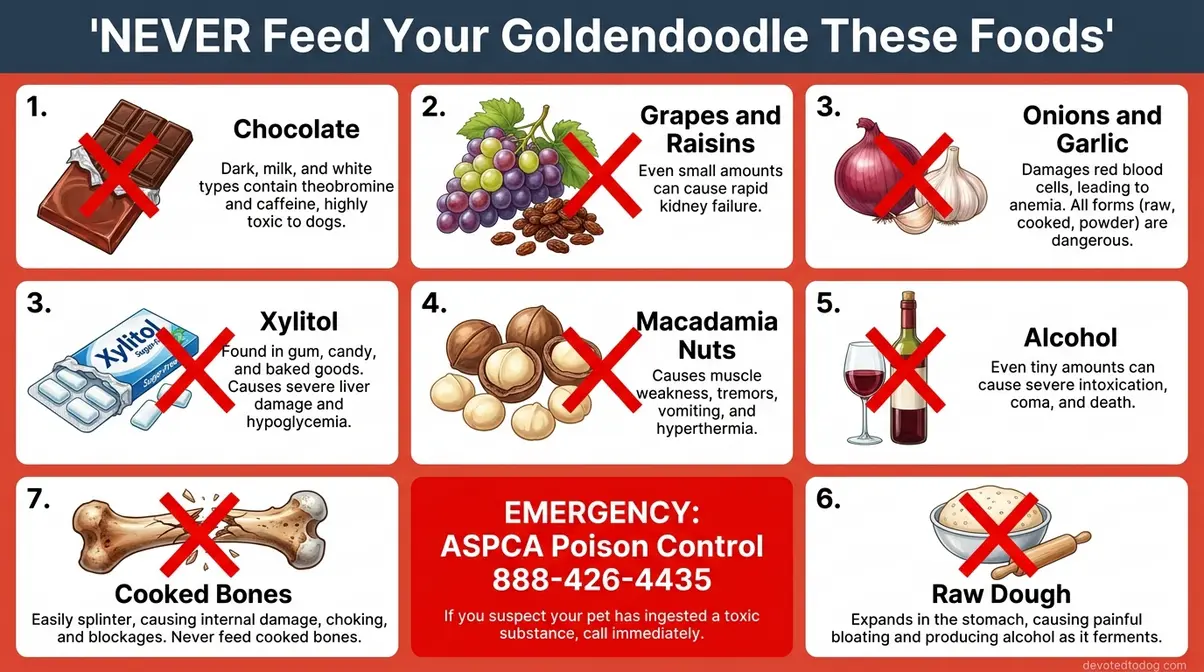
If you suspect ingestion: Call the ASPCA Animal Poison Control Center at 888-426-4435 or your veterinarian immediately. Do not wait for symptoms to appear.
Transition: You’ve got feeding handled. Now for the part that tests every new owner’s patience: the biting, the accidents, and the zoomies.
Training, Behavior, and Socialization: The 12-Week Window
The three most common 3 month old Goldendoodle behavior challenges — biting, potty accidents, and energy bursts — are not signs of a problem dog. They are predictable, age-appropriate behaviors with specific, evidence-based solutions. According to the Ohio State veterinary behavior guide, a puppy who learns that biting produces attention — even negative attention — will bite more, not less. Having a named system, rather than a collection of tips, is what separates owners who make progress in days from those who struggle for months.
“According to Ohio State University’s Veterinary Medical Center, a puppy who learns that biting produces attention — even a negative reaction — will bite more, not less. The solution is withdrawing all attention the moment biting occurs.”
🎓 Action This Week: Write down 5 new experiences to introduce your puppy to before Week 16: (1) a new person, (2) a different floor surface, (3) a car ride, (4) a new outdoor environment, (5) another dog. Each exposure should be calm, positive, and treat-rewarded. The socialization window closes faster than most owners expect.
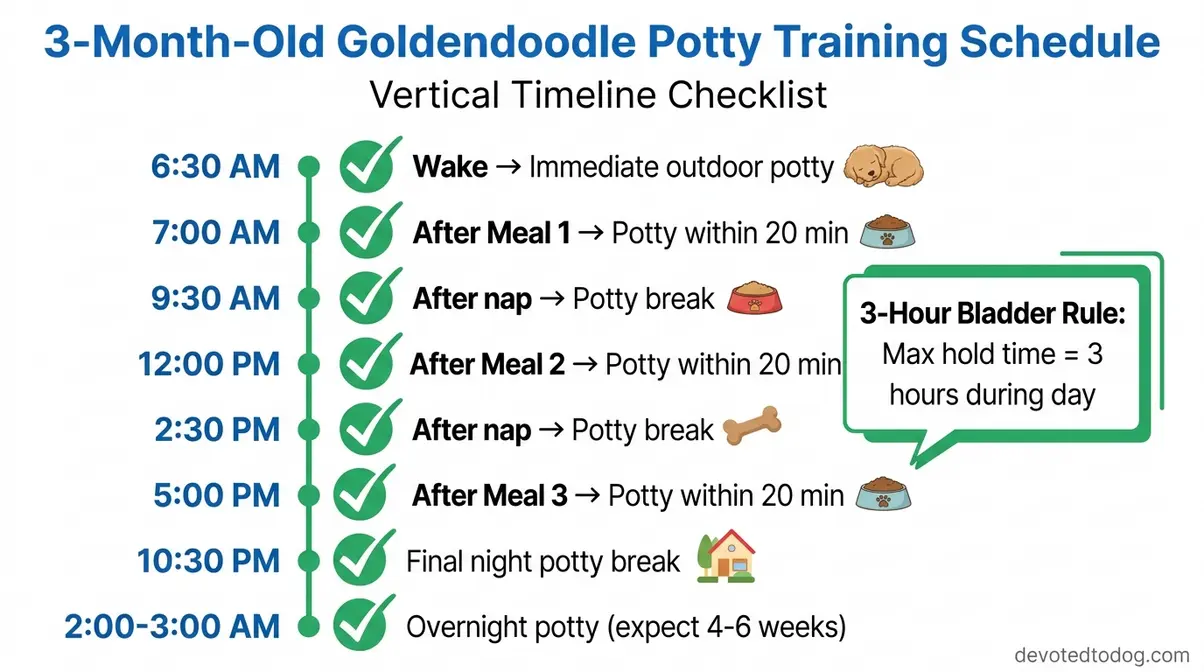
The Ohio State University College of Veterinary Medicine states that a puppy’s bladder capacity is approximately one hour for every month of age (Ohio State veterinary housetraining guide) — meaning your 3-month-old Goldendoodle can realistically hold her bladder for about 3 hours maximum during the day. Expecting her to hold longer sets her up to fail, not to learn.
On scolding for accidents: Many owners instinctively scold a puppy caught mid-accident. This doesn’t teach her where to go — it teaches her to hide when she needs to go. The only effective response to an indoor accident is a calm, neutral clean-up with an enzymatic cleaner that neutralizes the scent markers. Prevention is the schedule, not the punishment.
Biting and potty training are the immediate fires. But there’s a longer-game challenge that most owners miss entirely: the socialization window is closing. Here’s what to do before it does.
Potty Training: Using the 3-Hour Bladder Rule
“Overnight she is unlikely to be able to control her toilet as her little bladder and bowel are underdeveloped and not strong enough to hold all night…”
This is exactly right — and it’s the most important thing to understand about 3 month old Goldendoodle potty training. Her bladder is not misbehaving. It is simply not capable of what you’re asking it to do yet.
According to the Ohio State veterinary housetraining guide, bladder capacity is approximately 1 hour per month of age. At 3 months, that means a maximum of 3 hours during the day. Overnight, this drops further — expect 1–2 night trips outside for the first several weeks. The AKC potty training guide recommends taking puppies out first thing in the morning, last thing at night, and immediately after playing or napping.
The potty schedule (numbered steps):
- Take outside immediately after waking
- Take outside 15–20 minutes after every meal
- Take outside after every nap
- Take outside every 2–3 hours during the day as a baseline
- Last trip outside at 10–11 PM; first trip at 6–7 AM
When an indoor accident happens, clean it with an enzymatic cleaner — this neutralizes scent markers that would otherwise attract her back to the same spot. Do NOT scold. The schedule is the solution.
For a complete step-by-step breakdown, see the complete Goldendoodle potty training guide.
Transition: The bladder rule solves the accidents. The Three-Strikes Rule solves the biting. Here’s how it works.
Biting and Nipping: The Three-Strikes Rule
3 month old Goldendoodle biting is one of the most common concerns new owners raise — and the most misunderstood. According to UC Davis guidelines on puppy nipping, puppy nipping is a normal, non-aggressive developmental behavior used to explore the environment and soothe teething discomfort. It is not dominance. It is not aggression. Establishing this clearly reduces owner panic — and panic-based responses (yelling, physical correction) make the behavior worse.
The Three-Strikes Rule is a bite redirection framework from devotedtodog.com: after three consecutive redirections fail, the owner ends all play for 2 minutes — teaching the puppy that biting equals the end of fun, not punishment.
The Three-Strikes Rule — numbered steps:
- Strike 1: Puppy bites → say “Ouch” in a calm, neutral tone and redirect immediately to a chew toy
- Strike 2: Puppy bites again within the same play session → redirect again without scolding
- Strike 3: Puppy bites a third time → end all play immediately; stand up, turn away, and ignore for exactly 2 minutes
- After 2 minutes, resume play. Repeat the cycle as needed
Why it works: The Ohio State veterinary behavior guide advises withdrawing all attention — not scolding — to stop biting behavior, because puppies bite to engage. Remove the reward (engagement), and you remove the motivation. Most puppies need 3–5 consistent days of the Three-Strikes Rule before bite frequency begins to drop noticeably.
What NOT to do: Never physically correct, yell, or use a spray bottle. These create fear-based associations, not learning — and fear-based responses in a Goldendoodle often manifest as anxiety and avoidance rather than behavior change. For a full plan, see the step-by-step puppy biting and nipping plan.
Transition: Once biting is under control, there’s one more urgent task before Week 16: the socialization window.
Socialization: Why the Next 2 Weeks Are Critical
Your 3 month old Goldendoodle behavior during socialization experiences this week will shape her response to the world for years. According to the Texas A&M veterinary puppy timeline, the primary socialization window runs from 3–12 weeks, with a secondary window extending to 14–16 weeks. After that, new experiences are processed with more caution and anxiety. If your puppy is 12 weeks old today, you have approximately 2–4 weeks left in the optimal window.
Socialization checklist — introduce these before Week 16:
- New people (different ages, hats, glasses, beards, uniforms)
- New surfaces (grass, gravel, tile, carpet, stairs)
- Sounds (vacuum cleaner, car engine, children playing, thunder recordings)
- Other animals (calm, vaccinated dogs are ideal)
- Car rides (short, positive, treat-rewarded)
- Being handled (ears examined, paws touched, mouth opened gently)
Fear periods: Between 8–10 weeks, puppies go through a first fear period. A single frightening experience during this window can create lasting anxiety. Keep all new introductions positive, brief, and treat-rewarded. If your puppy shows signs of stress (tail tucked, refusing treats, trembling), end the session and try again another day with a lower-intensity version of the same experience.
After a big socialization session, expect puppy zoomies — those sudden bursts of frantic running that look alarming but are entirely normal. It’s the nervous system processing new stimuli. Let her run it out in a safe, enclosed space.
Transition: You’ve got the developmental milestones, the size data, the feeding schedule, and the training framework. Now let’s put it all together into a single daily routine you can actually follow.
Your 3-Month-Old Goldendoodle’s Perfect Daily Routine
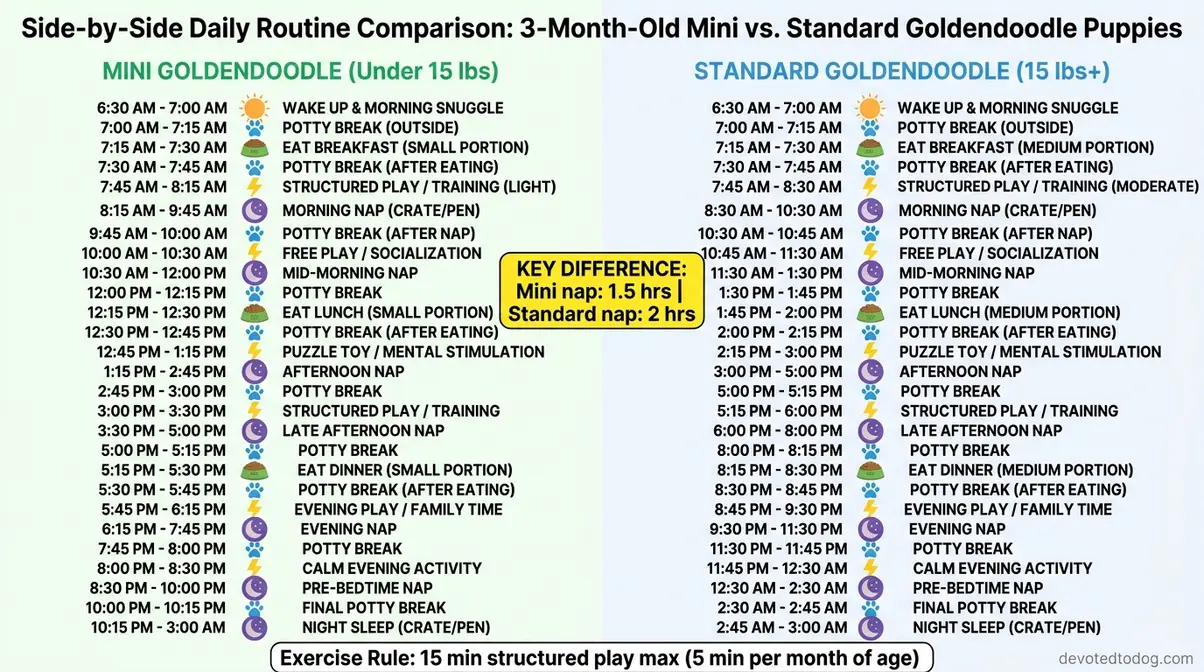
A consistent daily routine is the most effective tool you have as a new owner. When your 3 month old Goldendoodle eats, plays, potties, and naps at predictable times, her behavior becomes predictable too. Below are two schedules: one for Mini Goldendoodles (under 15 lbs) and one for Standard Goldendoodles (15 lbs and over).
The AKC references the guideline of approximately 5 minutes of structured exercise per month of age, once or twice daily (AKC, 2026) — meaning a 3-month-old needs roughly 15 minutes of structured play twice a day. This matters because over-exercising a puppy at this age stresses developing growth plates and can cause long-term joint damage. The goal is structured short bursts, not exhaustion.
⏰ Action This Week: Print or screenshot the schedule that matches your puppy’s size. Set 3 phone alarms for meal times today. Post the schedule somewhere visible (fridge, phone lock screen). Consistency for the first 2 weeks is more important than perfection.
A note before you start: The schedule below isn’t just logistics — it’s the daily expression of everything covered in this guide. Feed at consistent times, and potty training becomes predictable. Play at consistent times, and biting episodes decrease. This is what the 12-Week Turning Point looks like in practice.
“A consistent daily routine is the single most effective tool for potty training a 3-month-old Goldendoodle — because when meals happen at the same time every day, so do potty urges.”
These schedules work when everything is going right. Now let’s talk about what to do when something goes wrong.
Sample Schedule: Mini Goldendoodle (Under 15 lbs)
Your 3 month old mini Goldendoodle has slightly higher energy per pound than her Standard counterpart — her 15-minute play sessions can include more active games like fetch and tug. Here is a full day:
- 6:30–7:00 AM: Wake → immediate outdoor potty break → 15 min active play
- 7:00 AM: Meal 1 → outdoor potty break within 20 minutes
- 7:30–9:30 AM: Nap in crate (1.5 hours)
- 9:30 AM: Outdoor potty break → 15 min play or short training session
- 12:00 PM: Meal 2 → outdoor potty break within 20 minutes
- 12:30–2:30 PM: Nap in crate (2 hours)
- 2:30 PM: Outdoor potty break → 15 min play
- 5:00 PM: Meal 3 → outdoor potty break within 20 minutes
- 5:30–7:30 PM: Calm play, socialization, grooming brush practice
- 8:00–9:00 PM: Wind-down time; no food after 6 PM
- 10:00–10:30 PM: Final outdoor potty break → crate for night
- 2:00–3:00 AM: Overnight potty break (expect this for 4–6 weeks)
Transition: Standard Goldendoodles follow a similar rhythm but with slightly longer rest periods between play sessions due to their larger body mass.
Sample Schedule: Standard Goldendoodle (15 lbs+)
Your 3 month old Goldendoodle at Standard size grows faster and needs slightly more rest between activity periods. The structure below mirrors the Mini schedule with three key adjustments:
- 6:30–7:00 AM: Wake → immediate outdoor potty break → 15 min gentle play (no jumping)
- 7:00 AM: Meal 1 → outdoor potty break within 20 minutes
- 7:30–9:30 AM: Nap in crate (2 hours — slightly longer than Mini)
- 9:30 AM: Outdoor potty break → 15 min calm play or leash introduction
- 12:00 PM: Meal 2 → outdoor potty break within 20 minutes
- 12:30–2:30 PM: Nap in crate (2 hours)
- 2:30 PM: Outdoor potty break → 15 min play
- 5:00 PM: Meal 3 → outdoor potty break within 20 minutes
- 5:30–7:30 PM: Calm play, socialization, grooming practice
- 8:00–9:00 PM: Wind-down; no food after 6 PM
- 10:00–10:30 PM: Final outdoor potty break → crate for night
- 2:00–3:00 AM: Overnight potty break (expect this for 4–6 weeks)
- Mini vs. Standard schedule differences at a glance:
- Nap duration: Mini 1.5 hrs vs. Standard 2 hrs between sessions
- Exercise intensity: Mini handles more active play; Standard needs gentler sessions to protect growth plates
- Feeding amount: See the feeding table in the Feeding section above
Transition: Now that you have a complete daily plan, let’s cover the mistakes that trip up even the most prepared owners.
Common Mistakes New Owners Make (And How to Avoid Them)
Every new owner makes at least one of these mistakes in the first month. Knowing them in advance doesn’t make you a perfect owner — it makes you a prepared one.
Common Pitfalls to Avoid at 3 Months
Pitfall 1: Punishing overnight accidents
The scenario: Your puppy has an accident in the crate or on the floor at 2 AM. You scold her. What goes wrong: she doesn’t connect the scolding to the act of eliminating — she connects it to your presence near the accident. The result is a puppy who hides accidents rather than signaling she needs to go out. How to avoid it: clean with enzymatic cleaner, adjust your overnight potty break timing, and say nothing.
Pitfall 2: Letting the puppy “cry it out” in the crate indefinitely
The scenario: You put your puppy in the crate and leave the room for 20 minutes of crying. What goes wrong: prolonged distress without resolution creates crate anxiety, not crate comfort. How to avoid it: use gradual crate introduction — start with the door open, toss treats inside, close for 30 seconds, then open. Build duration over days, not hours.
Pitfall 3: Free-feeding (leaving food out all day)
The scenario: You fill the bowl in the morning and leave it available. What goes wrong: you lose all control over the potty schedule, because you no longer know when she ate. How to avoid it: switch to timed 3-meal feeding immediately and remove the bowl between meals.
Pitfall 4: Over-exercising to tire the puppy out
The scenario: You take her for a 45-minute walk hoping she’ll sleep longer. What goes wrong: growth plates in a 3-month-old Goldendoodle are still soft cartilage — repetitive high-impact exercise at this age risks long-term joint damage. How to avoid it: follow the 5-minutes-per-month-of-age guideline for structured walks; free play in a safe space is less risky.
Why are so many doodles being rehomed?
Doodles are frequently rehomed when owners underestimate their needs — particularly their energy, grooming requirements, and intelligence. Goldendoodles require professional grooming every 6–8 weeks to prevent painful matting, significant daily exercise, and consistent mental stimulation. Without early training and socialization, behavioral issues develop quickly. Research suggests that “job-focused breeds” like Poodle crosses need structured routines to thrive. Starting training, socialization, and grooming habits at 3 months dramatically reduces rehoming risk.
When to Call Your Vet
Some situations require professional evaluation, not a schedule adjustment. Call your veterinarian — or the ASPCA Poison Control Center at 888-426-4435 — if you observe any of the following:
- Lethargy combined with refusal to eat for more than 24 hours
- Vomiting or diarrhea more than twice in one day
- Suspected ingestion of any toxic food — call immediately, before symptoms appear
- Gums that are pale, blue, or white — this signals a medical emergency
- Retained baby teeth after 6 months — adult teeth visible alongside baby teeth require veterinary intervention
This guide is for informational purposes only. Always consult your veterinarian for health or nutrition concerns specific to your dog.
Frequently Asked Questions
How big should a GoldenDoodle be at 3 months?
A 3-month-old Mini Goldendoodle typically weighs 6–12 lbs, while a Standard Goldendoodle weighs 18–32 lbs at the same age (A-Z Animals). Size varies significantly based on parent breeds — a puppy in the upper range of her size class is not overweight; she may simply have larger parent genetics. Use the 12-week weight × 2 (Standard) or × 2.5 (Mini) formula to estimate adult weight. If your puppy falls significantly outside these ranges, consult your veterinarian.
Do Goldendoodles like water?
Yes — most Goldendoodles enjoy water, a trait inherited from both parent breeds. Golden Retrievers were bred to retrieve waterfowl, and Poodles were originally water retrievers. This heritage makes many Goldendoodles natural swimmers with enthusiasm for lakes, pools, and rain puddles. At 3 months, introduce water gradually with shallow, calm environments and positive reinforcement. Not every Goldendoodle will be water-obsessed — individual personality varies considerably even within the same litter.
What is a teddy bear golden?
A “teddy bear golden” is an informal term for a Golden Retriever or Goldendoodle puppy with a round face, short muzzle, and fluffy, plush coat that resembles a stuffed animal. It is not a recognized breed or official size classification — the term is used primarily by breeders and on social media to describe aesthetic appearance. English Cream Golden Retrievers and F1B Goldendoodles are most commonly described this way. When a breeder uses this term, ask for specifics about parent breeds and size class.
Which is the calmest doodle?
Among doodle breeds, Bernedoodles (Bernese Mountain Dog × Poodle) and Sheepadoodles (Old English Sheepdog × Poodle) are generally considered the calmest. Goldendoodles fall in the middle range — energetic and playful, but responsive to training and capable of calm behavior when well-exercised and mentally stimulated. Calmer temperament within any doodle breed often depends more on individual breeding lines than the breed itself. If low energy is a priority, discuss temperament with the breeder before selecting a puppy.
How do you say “I love you” in dog speak?
Dogs experience love through slow blinking, calm eye contact, and relaxed body language — not through human-style hugging. A slow, deliberate eye blink toward your dog communicates calm trust, and sitting quietly beside her without demanding interaction sends a strong bonding signal. Yawning in your dog’s presence signals that you are relaxed and non-threatening. Physical touch — gentle stroking along the back, not the top of the head — is the most universally appreciated form of canine affection.
What do Goldendoodles not like?
Goldendoodles generally dislike being left alone for long periods, loud sudden noises, and rough handling. As a highly social breed, Goldendoodles are prone to separation anxiety when isolated for extended hours. They are also sensitive to harsh training methods — punishment-based approaches often backfire with this breed. Most Goldendoodles also dislike being ignored during active hours; they are bred for engagement. Consistent routines, positive reinforcement, and ample social interaction address most Goldendoodle dislikes effectively.
Prices and recommendations verified as of July 2026.
For new Goldendoodle owners, the 3-month milestone is the most important window for establishing lifelong habits. Your 3 month old Goldendoodle can hold her bladder for approximately 3 hours, needs 3 structured meals per day, and is in the final weeks of her socialization window. At 12 weeks, a Mini Goldendoodle weighs 6–12 lbs and a Standard reaches 18–32 lbs — both healthy ranges with entirely different adult trajectories. The decisions you make this week — the schedule you set, the training you start — determine who she becomes.
You started this guide feeling overwhelmed. The 12-Week Turning Point framework gives you a system, not just a list of tips: feeding schedule, size awareness, the Three-Strikes Rule for biting, and a size-differentiated daily routine. Every element connects. When the feeding schedule is consistent, the potty training works. When the potty training works, the anxiety drops. When the anxiety drops, you can actually enjoy her.
Start today by setting three meal-time alarms, saving the daily schedule that matches your puppy’s size, and introducing one new socialization experience this week. Your 3-month-old Goldendoodle is ready to learn — and so are you.