You’ve fallen for a Golden Retriever, that warm, goofy grin, the feathery tail, the way they lean into you like you’re the best thing that ever happened to them. The problem is your allergies. So you’ve been Googling at midnight, hoping someone will tell you it’s fine.
If you’re asking, “are Golden Retrievers hypoallergenic?” here is the honest answer: no, they are not. Their heavy-shedding double coat distributes dander year-round, and even people with mild allergies often react. Without the right information, you could bring home a dog that makes your symptoms significantly worse.
This guide explains exactly why Golden Retrievers trigger allergies, walks you through seven proven management strategies, covers the breed’s other real challenges, and points you toward alternatives that may be a better fit, whether you decide to manage or move on.
⚕️ Medical & Veterinary Disclaimer
The information in this article is for educational purposes only and does not constitute medical or veterinary advice. If you have allergies or health concerns related to pet ownership, please consult a qualified allergist or veterinarian before making any decisions.
heavy shedder
spring + fall
management plan
Poodle, PWD, F1B
Author Credentials
📝 Written by: Coral Drake
✅ Reviewed by: Brianna York, Former Veterinary Technician
📅 Last updated: 5 May 2026
ℹ️ Transparency Notice
This article addresses Golden Retriever shedding, dander, and allergy compatibility based on AAAAI guidelines, AKC breed standard, and veterinary allergy research. All medical claims have been verified by our editorial team.
Why Are Golden Retrievers Not Hypoallergenic?
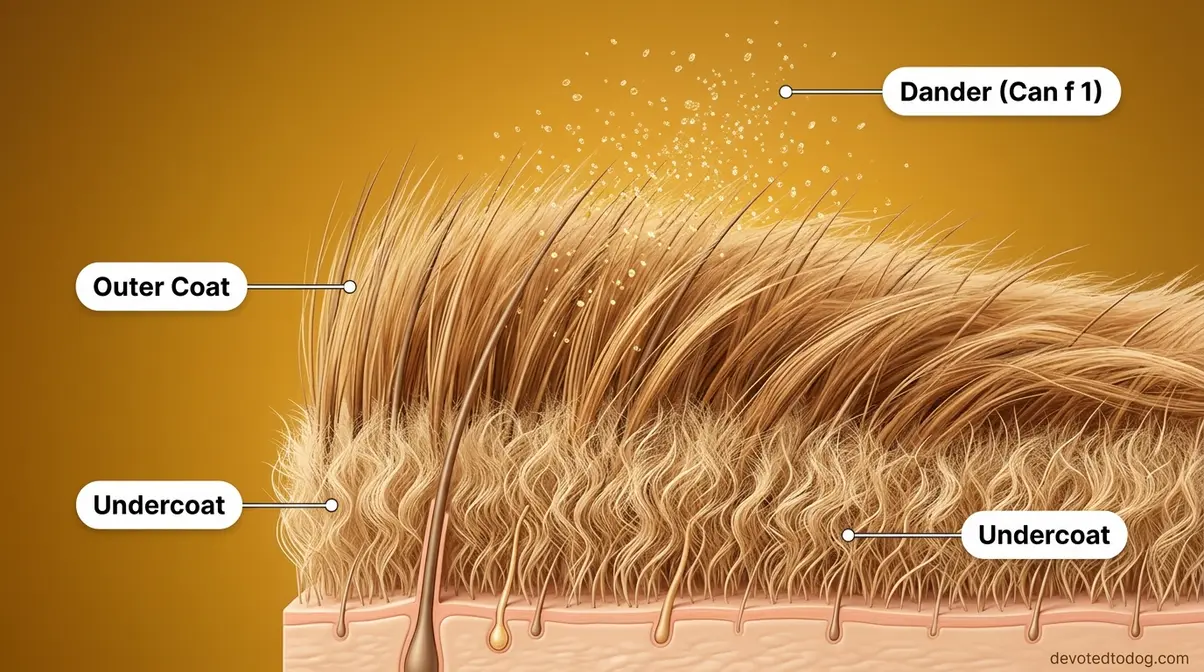
When people search online to find out, are golden retrievers hypoallergenic, they are often hoping for a simple yes. Unfortunately, Golden Retrievers are not hypoallergenic dogs, their double-coated structure sheds year-round, releasing the allergenic protein Can f 1 (the primary allergenic protein found in dog skin cells, saliva, and urine) continuously into your home environment. A study on Can f 1 allergen levels published in the Journal of Allergy and Clinical Immunology found no scientific evidence to classify any dog breed as truly hypoallergenic, Can f 1 levels in homes with so-called hypoallergenic dogs were not significantly lower than in other homes (Henry et al., 2012). For allergy sufferers considering this breed, that finding matters enormously.
Defining “Hypoallergenic” for Dogs
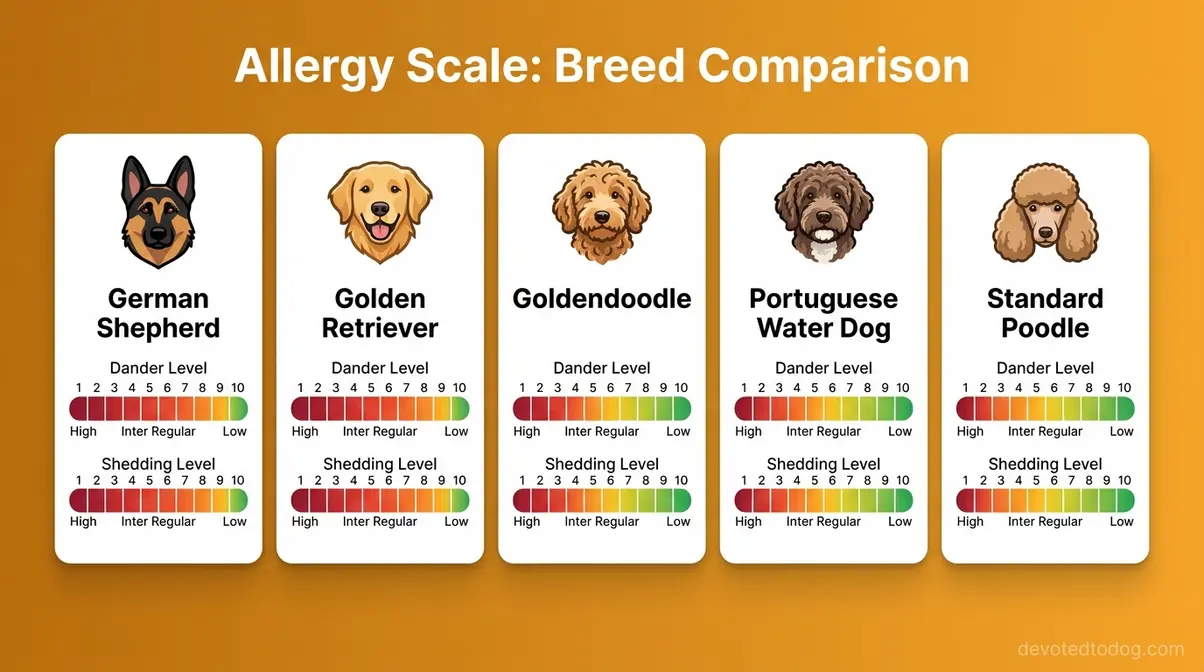
“Hypoallergenic” means less likely to cause an allergic reaction, not allergy-free. Think of it like “low-calorie” versus “zero-calorie”: there’s a meaningful difference. Every dog produces dander (tiny, invisible flakes of dead skin), saliva, and urine. All three contain allergenic proteins. There is no dog that produces none of them.
The American Kennel Club is clear on this point: no dog is completely hypoallergenic, though certain breeds shed less and may produce fewer airborne allergens (AKC). When breeders advertise a dog as hypoallergenic, they typically mean the dog sheds less hair, but hair is not the allergen. Dander is. That distinction is what makes “hypoallergenic” a marketing term, not a scientific classification.
With that definition in place, here’s why the Golden Retriever in particular is one of the more challenging breeds for allergy sufferers.
Dander, Saliva, and the Double Coat
Golden Retrievers have a heavy-shedding double coat, a dense, insulating undercoat beneath a longer outer coat. Both layers shed year-round, with dramatic “blowouts” in spring and fall. More shedding means more dander distributed across every surface in your home: furniture, bedding, clothing, even rooms the dog never enters.
The two main allergens to know are Can f 1 (the primary protein, found in skin cells, saliva, and urine, not just hair) and Can f 2 (a secondary protein). Both are microscopic and airborne. This matters because no amount of grooming can eliminate a protein produced inside the dog’s body, you can reduce how much gets into the air, but you cannot stop the source.
For people asking whether Golden Retrievers are bad for asthma: yes, the fine dander particles and shed hair can irritate airways and worsen asthma symptoms in sensitive individuals. If you or a family member has asthma, consulting an allergist before making any decision is essential.
Think of dander like invisible glitter: once it’s in your home, it settles everywhere, and it keeps coming.
The Can f 5 Exception and Dog Sex
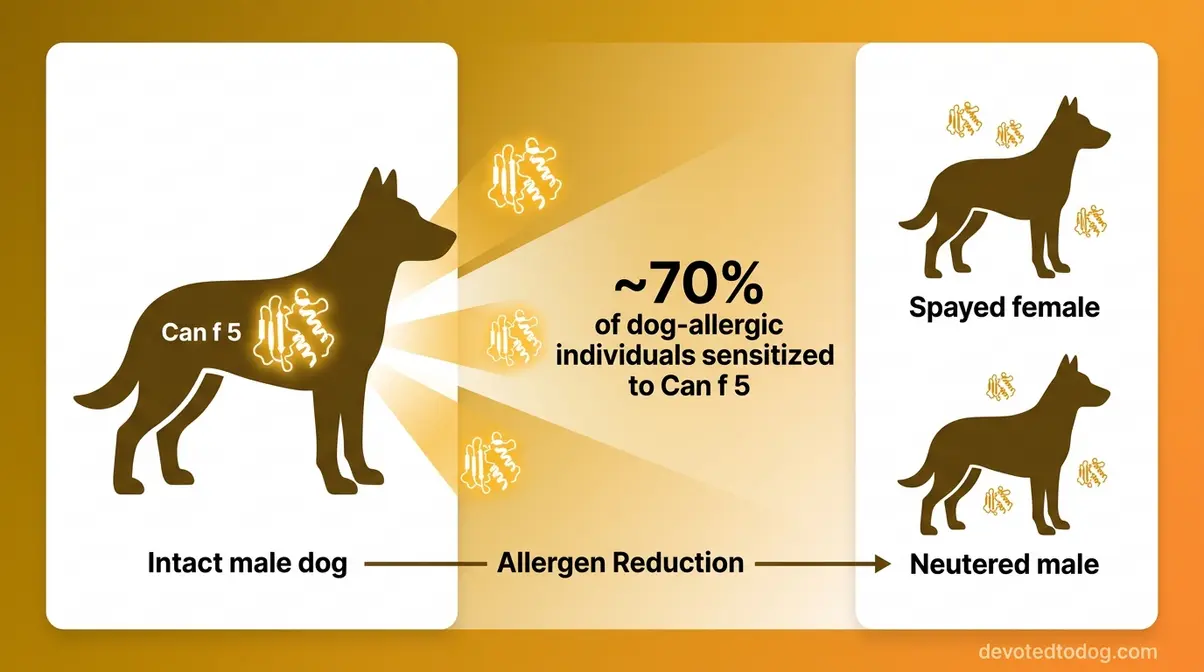
Here’s a nuance no competitor covers: Can f 5 (an allergenic protein found specifically in the urine and prostate fluid of intact male dogs) is produced exclusively by unneutered males. Research from the Thermo Fisher Scientific Allergen Encyclopedia confirms Can f 5 is an androgen-regulated protein, meaning testosterone drives its production. Studies suggest roughly 70% of dog-allergic individuals show IgE sensitization to Can f 5 (Thermo Fisher, e226).
The practical implication: if you’re set on a Golden Retriever and have known dog allergies, a spayed female or a neutered male may produce fewer total allergens than an intact male. This is an area where consulting a veterinarian about neutering and its potential impact on allergen levels is essential, individual responses to Can f 5 vary significantly.
Now that you know why Golden Retrievers trigger allergies, let’s address a common question: does choosing a specific type of Golden, like a mini or an English Cream, change anything?
Do Golden Retriever Variations Make a Difference?
If you are still wondering are golden retrievers hypoallergenic when it comes to specific variations, the answer remains the same. No Golden Retriever variation, mini, English Cream, or standard, produces meaningfully fewer allergens than another, because all share the same double-coat biology and Can f 1 protein production. For anyone hoping a specific variation solves the allergy problem, the biology simply doesn’t support it. No matter which variation you’re considering, the first factor of The Allergy Reality Check, allergen load, remains essentially the same across all Golden Retriever types.
English Cream and Mini Goldens
Are English Cream Golden Retrievers hypoallergenic? No. The English Cream Golden Retriever, a lighter-coated variety sometimes called a “White Golden,” carries the same double coat, the same Can f 1 production, and the same shedding patterns as the American-type Golden Retriever. Lighter fur color does not indicate lower dander output, the allergen comes from skin cells, saliva, and urine, not pigmentation.
The Mini Golden Retriever (a crossbreed typically mixing a Golden Retriever with a smaller breed like a Cocker Spaniel or Poodle) may shed slightly less depending on which parent’s coat dominates. However, the Golden Retriever genetics mean significant dander production remains. Golden Cocker Retrievers follow the same logic: the Cocker Spaniel parent is also a moderate shedder, so the cross doesn’t solve the problem.
If a breeder tells you their English Cream or Mini Golden is hypoallergenic, ask them to show you the science, because it doesn’t exist. For a deeper look at English Cream Golden Retriever characteristics and coat traits, the breed profile covers what actually differs between varieties.
The reason no variation works is rooted in biology, and understanding it will save you from a costly mistake.
Why Coat Color Doesn’t Stop Allergens
Is there such a thing as a hypoallergenic Golden Retriever? No, and here’s why. Can f 1 is produced at the cellular level, in skin cells, saliva, and urine. A lighter coat or a smaller body doesn’t change this production one bit. The allergen exists independent of the coat.
Shedding frequency does affect how much dander gets airborne, a lower-shedding dog distributes less. But even low-shedding Golden Retriever mixes still produce Can f 1 continuously. The difference is in distribution, not in whether the allergen exists. For a full breakdown of the three main types of Golden Retrievers and what genuinely differs between them, that guide covers coat, temperament, and lineage in detail.
If you’ve accepted that no Golden Retriever is truly hypoallergenic but still want one, the good news is there are proven strategies that can make it work.
How Do You Live With a Golden If You Have Allergies?

Are Golden Retrievers ok for allergies? For mild allergy sufferers who commit to a structured management routine, it can be possible, but it requires consistent effort on multiple fronts. Factor 2 of The Allergy Reality Check is management effort. Here’s what a realistic management routine actually looks like, broken into three areas: grooming, home environment, and medical support.
Grooming Strategies to Reduce Dander
The heavy-shedding double coat of a Golden Retriever means grooming isn’t optional, it’s your first line of defense against dander buildup. A consistent routine physically removes Can f 1 protein from the coat before it sheds into your air and furniture.
Estimated Time: 30-45 minutes per session
Tools Needed: Undercoat rake (Furminator-style), deshedding or hypoallergenic shampoo, grooming wipes.
Step 1: Brush 3-4 times per week
Use an undercoat rake to pull loose fur before it sheds into your home. For context on how to manage Golden Retriever shedding, the shedding guide includes seasonal timing advice.
Step 2: Bathe every 2-4 weeks
Wash with a deshedding or hypoallergenic shampoo, this physically removes Can f 1 protein from the coat surface. For product recommendations, see the guide to best deshedding shampoos for Golden Retrievers.
Step 3: Wipe down after brushing
Use a damp grooming cloth to capture remaining dander before it becomes airborne.
Step 4: Groom outdoors when possible
This keeps the bulk of shed dander outside rather than redistributing it through your home’s air.
Step 5: Book professional grooming
Schedule visits every 6-8 weeks during heavy shedding seasons (spring and fall) to manage undercoat volume.
A 2022 study published in PMC found that HEPA air filtration reduced airborne dog allergen (Can f 1) levels by a median of 89.3% in tested bedrooms, confirming that grooming combined with air filtration is significantly more effective than grooming alone (Punsmann et al., 2022). A deshedding shampoo used every 3 weeks, paired with weekly brushing, is one of the most cost-effective ways to reduce circulating dander at the source.
Grooming handles the dander at the source. But once it’s airborne, your home environment is your second line of defense.
Home Environment Changes That Work
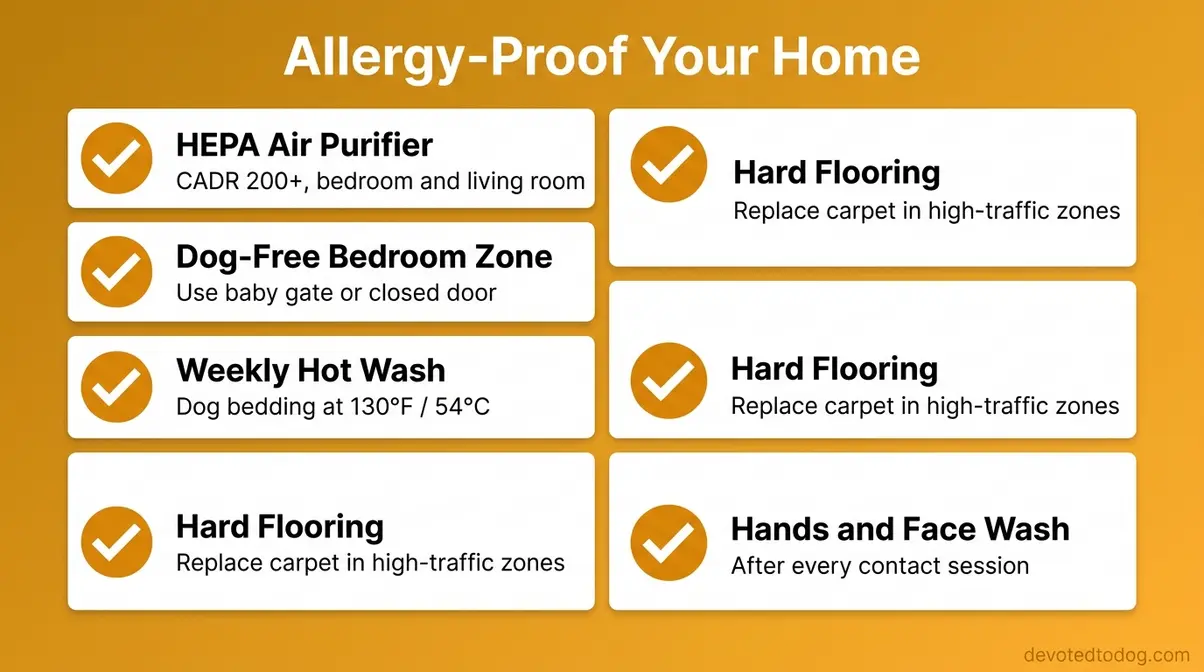
Dander, a common allergen, is microscopic and persistent, it clings to soft surfaces and recirculates through your home’s air for hours. These four changes address it systematically:
- HEPA air purifier: Place a HEPA air purifier (rated for pet dander, minimum CADR of 200) in the rooms where your dog spends the most time. HEPA filters capture particles as small as 0.3 microns, well within the size range of dog dander. A controlled study found that maintaining a single HEPA-filtered bedroom as a pet-free zone reduced nighttime allergy symptoms by 56% (Air Oasis, 2026). Prioritize the bedroom and living room.
- Dog-free bedroom zone: Designate at least one room, ideally the bedroom, as a strict no-dog zone using a baby gate or closed door. This gives allergy sufferers a dander-reduced sanctuary for the hours that matter most.
- Weekly washing routine: Wash dog bedding, throws, and any fabric your dog contacts weekly in hot water (≥130°F / 54°C) to remove dander. Wash your own hands and face after contact.
- Hard flooring over carpet: If possible, replace carpeting in high-traffic dog areas. Carpet traps and holds dander; hard floors can be mopped clean.
Home management reduces your exposure to dander. But for some allergy sufferers, environmental changes alone aren’t enough, and that’s where medical options come in.
Medical Options for Allergy Sufferers
For human allergy sufferers, several over-the-counter antihistamines can reduce sneezing, itchy eyes, and nasal congestion:
- Cetirizine (Zyrtec), once-daily, less sedating
- Loratadine (Claritin), non-drowsy, good for daytime use
- Diphenhydramine (Benadryl), faster-acting but causes drowsiness; requires dosing every 8 hours
An allergist can recommend the most appropriate option for your specific symptom profile. Do not self-prescribe dosages, individual needs vary.
For severe allergies, allergen immunotherapy (allergy shots) can gradually desensitize your immune system to dog allergens over 3-5 years. It’s the most effective long-term solution for severe dog allergy sufferers and requires an allergist’s supervision.
One note: some readers search “Is Zyrtec or Benadryl better for dogs?”, this refers to giving antihistamines to a dog for the dog’s own allergies. That question is answered in the FAQ below, but it always requires veterinary guidance before dosing any medication.
Always consult a qualified allergist for human allergy treatment, and a licensed veterinarian before administering any medication to your dog.
Managing allergies with a Golden Retriever takes commitment. Before you decide, it’s worth understanding the full picture, including downsides beyond allergies.
What Are the Downsides Beyond Allergies?
Golden Retrievers are genuinely wonderful dogs. They’re also a significant commitment, and for some households, the challenges go beyond dander management. Knowing what you’re signing up for is part of making the right decision.
What Is the Downside of a Golden?

Golden Retrievers are a high-energy working breed that needs 1-2 hours of exercise per day. Without adequate activity, they can develop destructive behaviors, chewing, digging, and persistent barking. This is a real time commitment for busy owners or anyone with a demanding schedule.
The shedding demand is equally significant. That heavy-shedding double coat means daily vacuuming during shedding season and weekly vacuuming year-round, on top of the grooming protocol outlined above.
On the question of temperament: Golden Retrievers are not typically aggressive. Their large size and exuberant energy can, however, be overwhelming for small children or elderly family members. For a clear-eyed look at the truth about Golden Retriever aggression, the evidence is reassuring, but their boisterousness is real. For owners navigating fixing common Golden Retriever behavior problems, early training and socialization make a meaningful difference.
If the grooming routine in the previous section felt like a lot, it is. For owners who can commit to it, the reward is one of the most loyal, affectionate breeds in the world. For owners who can’t, this may not be the right match.
Beyond the day-to-day challenges, there’s one health concern every prospective Golden Retriever owner should know about.
What Is the Silent Killer in Goldens?
Hemangiosarcoma (HSA) is an aggressive cancer of the blood vessel walls that often develops without visible symptoms until it’s advanced. It most commonly forms internally, in the spleen, heart, or liver, and the first sign is often sudden internal bleeding, which can become life-threatening within hours.
According to Cornell University College of Veterinary Medicine, an estimated 1 in 5 Golden Retrievers will develop hemangiosarcoma, a rate significantly higher than in most other dog breeds, making regular veterinary check-ups essential for this breed (Cornell Vet, 2021). Data published in a epidemiological analysis of haemangiosarcoma in dogs confirms it is a highly prevalent malignant tumor in the Golden Retriever breed, often developing without symptoms until advanced stages (PubMed, 2023). Research from Cornell University College of Veterinary Medicine continues to track incidence and develop early-detection protocols (Cornell Vet, 2021).
Regular bi-annual veterinary check-ups, including abdominal ultrasounds for dogs over age 7, are currently the best tool for early detection. Researchers at UW-Madison are also developing vaccines targeting hemangiosarcoma cells, which represents a promising direction for the future.
Knowing this risk means you can plan proactively with your veterinarian. This is empowering information, not a reason to panic. Speak with your veterinarian about a screening schedule appropriate for your dog’s age and health.
If you’re reconsidering the Golden Retriever after reading this section, you’re not alone, and there are genuinely wonderful alternatives that offer a similar temperament with far fewer allergy concerns.
What Are the Best Hypoallergenic Golden Alternatives?
No dog is 100% hypoallergenic, but Standard Poodles, Portuguese Water Dogs, and F1B Goldendoodles shed significantly less than Golden Retrievers, making them meaningfully better options for allergy sufferers. When applying The Allergy Reality Check, factor 1, allergen load, is where these breeds genuinely outperform the Golden Retriever. They still produce Can f 1, but in lower quantities and with far less airborne distribution.
Goldendoodles: Better, Not Perfect
The Goldendoodle, a Golden Retriever-Poodle crossbreed popular with allergy sufferers, is the most common first alternative people consider. But not all Goldendoodles are created equal, generation matters enormously.
- F1 Goldendoodles (50% Golden, 50% Poodle) can shed as much as a purebred Golden Retriever. Their coat outcome is genetically unpredictable.
- F1B Goldendoodles (75% Poodle, 25% Golden) are more reliably low-shedding and are the generation most often recommended for allergy sufferers.
This reality is well understood in the Golden Retriever community. One widely shared perspective from the r/goldenretrievers community captures it directly:
“F1 goldendoodles are notoriously the least likely to be hypoallergenic. Doodles generally are also just not well bred dogs.”
Even F1B Goldendoodles are not guaranteed hypoallergenic, they still produce Can f 1. Breeding quality also varies widely, so research your breeder carefully. If you’re set on a Doodle, look specifically for an F1B or F2B generation from a reputable breeder who performs health testing. For a full breakdown, see Golden Retriever vs. Goldendoodle key differences.
If you want a more predictably low-allergen dog, these breeds offer a more reliable starting point.
Top Low-Shedding Breed Alternatives
Standard Poodle, One of the most reliably low-shedding large breeds. High intelligence and trainability comparable to Golden Retrievers. Their curly coat traps dander rather than releasing it into the air, which meaningfully reduces airborne allergen load. Requires professional grooming every 6-8 weeks.
Portuguese Water Dog, A medium-sized, energetic, family-friendly breed with a wavy or curly coat that sheds minimally. Made widely known as the Obama family’s dog. Excellent temperament match for families drawn to the Golden’s friendliness and playfulness.
Labrador Retriever, Labradors are NOT hypoallergenic, they shed heavily and produce significant dander. However, research published in PMC found that Labrador Retrievers had significantly lower salivary Can f 1 levels than Golden Retrievers (p < 0.05), making them a marginally better option for mild allergy sufferers (PMC, 2016). For anyone searching whether are Labrador Retrievers hypoallergenic: the answer is no, but the allergen data does favor them slightly over Goldens. See the Golden Retriever vs. Labrador Retriever: full comparison for a detailed breakdown.
Giant Schnauzer, A large, low-shedding breed worth considering for those who want a bigger dog. Their wiry coat produces less airborne dander than double-coated breeds.
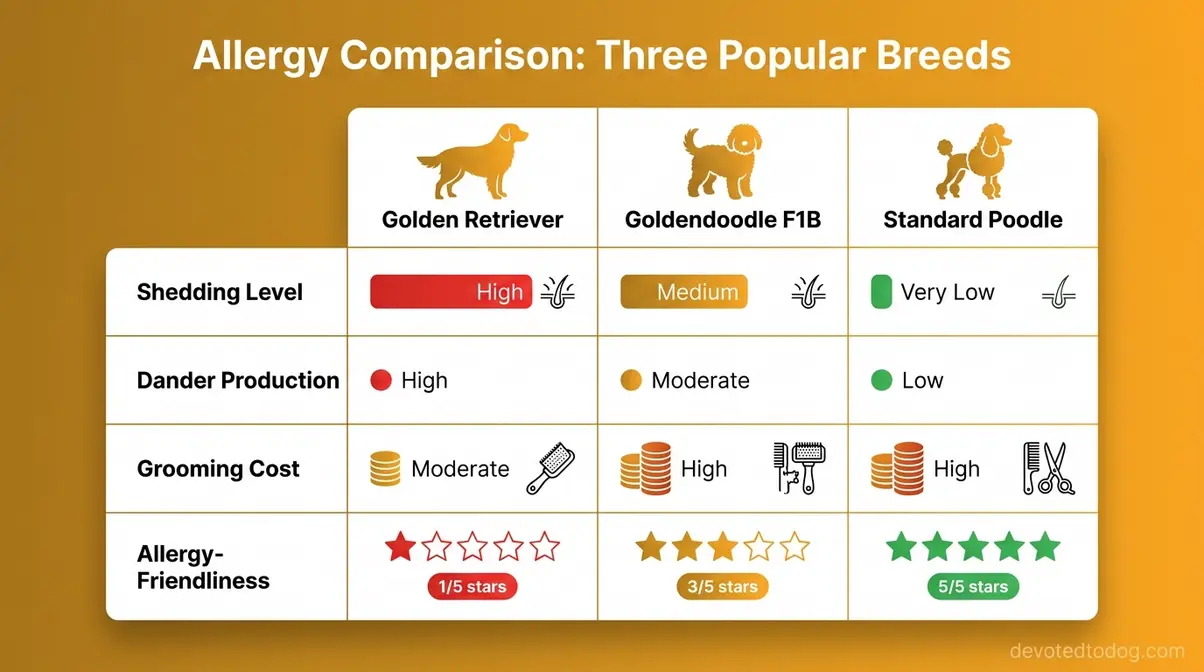
| Breed | Shedding Level | Dander Production | Grooming Cost | Allergy-Friendliness |
|---|---|---|---|---|
| Golden Retriever | High (Year-round) | High | Moderate | 1/5 (Not recommended) |
| Goldendoodle (F1B) | Low to Moderate | Moderate | High | 3/5 (Varies by dog) |
| Standard Poodle | Very Low | Low | High | 5/5 (Excellent) |
Before making your final decision, it’s worth knowing a few common mistakes allergy sufferers make when adopting a dog.
When Should You Reconsider, and What Mistakes Should You Avoid?
Common Pitfalls Managing Allergies
Even well-intentioned owners make these mistakes, and each one can significantly undermine your management efforts:
- Relying on grooming alone. Grooming reduces surface dander but doesn’t eliminate Can f 1 production. Many allergy sufferers assume weekly brushing solves the problem, it doesn’t if you’re not also managing air quality with HEPA filtration and washing routines. Grooming is one layer of a multi-layer strategy.
- Trusting a “hypoallergenic” breeder claim. No breeder can genetically engineer a hypoallergenic Golden Retriever. If a breeder makes this claim, treat it as a red flag about their overall credibility, the science simply doesn’t support it.
- Skipping an allergy test before adopting. Spend several hours with a Golden Retriever at a shelter or a friend’s home before committing. A brief 20-minute visit may not trigger a reaction that sustained exposure would. Your real-world multi-hour response is far more predictive than a short visit.
When a Golden Is the Wrong Choice
For some people, no management strategy will make a Golden Retriever livable. These are the scenarios where the honest advice is to choose a different breed:
- Severe asthma triggered by dog dander. No routine eliminates the risk entirely. Consult a pulmonologist before proceeding, the consequences of a poorly managed decision here are serious.
- Existing sensitization to multiple pets. If you already react to cats, dust mites, or other animals, adding a heavy shedder significantly compounds your total allergen load. Existing sensitization makes new pet allergies more likely to be severe.
- A household where no one can maintain the management routine. Allergen levels build rapidly without consistent grooming and cleaning. If the routine can’t be sustained by everyone in the home, the strategy will fail.
Frame this as informed decision-making, not defeat. If you’re unsure, speak with a board-certified allergist before bringing any dog home.
Frequently Asked Questions
Are Golden Retrievers ok for allergies?
Golden Retrievers are generally not suitable for people with dog allergies. Their dense, double-coated breed structure sheds heavily year-round, releasing significant amounts of dander containing the Can f 1 protein. While mild allergy sufferers might manage with rigorous cleaning, those with moderate-to-severe allergies should consider lower-shedding alternatives.
What is the most hypoallergenic dog?
No dog is 100% hypoallergenic, but the Standard Poodle is consistently regarded as one of the best choices for allergy sufferers due to its curly, low-shedding coat. Other strong options include the Portuguese Water Dog, Bichon Frise, and Giant Schnauzer, all produce fewer airborne allergens than heavy shedders like Golden Retrievers. These breeds have hair (rather than fur) that grows continuously and traps dander more effectively instead of releasing it into the air. Individual allergy responses vary, so spending time with a specific dog before adopting is always the safest approach.
What dog breed is worst for allergies?
Breeds with thick, double coats that shed year-round are the worst for allergy sufferers, and the Golden Retriever ranks among the most challenging. Other heavy shedders that frequently trigger severe reactions include the German Shepherd, Siberian Husky, and Alaskan Malamute. The combination of high dander production and year-round shedding makes these breeds particularly problematic for sensitive individuals.
Is Zyrtec or Benadryl better for dogs?
For dogs with allergies, cetirizine (Zyrtec) is often preferred over diphenhydramine (Benadryl) because it causes less sedation and has a longer duration of action. Benadryl is faster-acting and more widely available but causes drowsiness and requires more frequent dosing, typically every 8 hours versus Zyrtec’s once-daily schedule. Dosing for dogs is based on body weight and must be calculated by a veterinarian, never use human-formulated products containing xylitol, which is toxic to dogs. Always consult your veterinarian before giving any antihistamine to your dog, as individual health conditions affect safety and appropriate dosing.
What dog is the most clingy?
The Vizsla is frequently cited as the clingiest dog breed, often called “Velcro dogs” for their need to be in constant physical contact. Other notably clingy breeds include the Labrador Retriever, Golden Retriever, and Border Collie. These breeds bond intensely with their families and can develop separation anxiety if left alone for long periods.
What smells do Golden Retrievers hate?
Golden Retrievers, like most dogs, are strongly averse to citrus smells, vinegar, and certain essential oils such as eucalyptus and tea tree. According to the American Kennel Club, a dog’s sense of smell is estimated to be 10,000 to 100,000 times more sensitive than a human’s, making strong chemical odors particularly overwhelming. Citrus peels or diluted white vinegar spray are commonly used as safe deterrents. Never use essential oils directly on a dog, as many are toxic.
What Is the Final Answer and Your Next Step?
For allergy sufferers wondering, are golden retrievers hypoallergenic, the answer is a clear no. Their heavy-shedding double coat distributes Can f 1 protein year-round, and a study on Can f 1 allergen levels confirmed that no breed can be scientifically classified as hypoallergenic (Henry et al., 2012). With the right management routine, grooming, HEPA filtration, and medical support, mild allergy sufferers may find it workable. For moderate-to-severe allergies, a Standard Poodle or F1B Goldendoodle is a more reliable match.
The Allergy Reality Check comes down to three factors: the allergen load of the breed, the management effort you’re realistically able to sustain, and your personal symptom tolerance. You came here hoping the answer was yes. The honest answer is no, but the right answer for you depends on where you land on all three of those factors.
Before making any decision, spend several hours with a Golden Retriever at a shelter or a friend’s home. Your real-world reaction over multiple hours is the most reliable data point you have. Devotedtodog.com has in-depth guides on every breed and comparison mentioned here to help you take that next step with confidence.
Keep reading: how much Goldens shed and the best de-shedding brush.