
You’ve decided on a Golden Retriever, one of the most popular family dogs in America. But when you start calling breeders, you keep hearing two words: “field line” and “show line.” What’s the difference, and does it actually matter?
It absolutely does. Choose the wrong type and you could end up with a dog that’s too high-energy for your apartment, or one that’s too mellow for your active outdoor lifestyle. Getting this decision right before you bring a puppy home saves years of frustration. Many families ask exactly this question.
In this guide, you’ll learn the exact differences between field and show Golden Retrievers, in temperament, appearance, and health, so you can choose the right dog for your specific life. We cover how to read a pedigree, what each type looks like up close, and the one health factor every prospective Golden owner needs to know before signing any paperwork.
vigorous activity
moderate activity
Kent et al., 2018
no line advantage
Author Credentials
📝 Written by: Coral Drake
✅ Reviewed by: Brianna York, Former Veterinary Technician
ℹ️ Transparency Notice
This article compares Field-bred and Show-line Golden Retrievers based on AKC, GRCA, and breeder data. All claims have been verified by our editorial team. Our goal is to help you choose the type that matches your lifestyle and energy expectations.
📅 Last updated: 5 May 2026
What Are the Key Differences at a Glance?
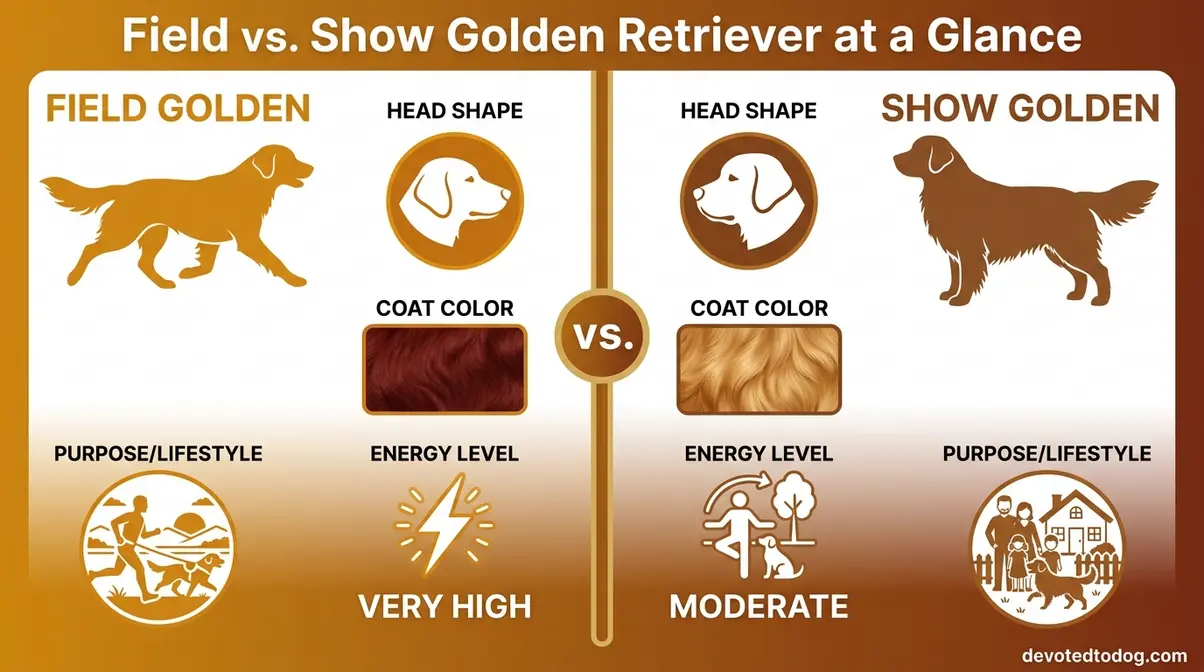
Field and show Golden Retrievers are the same AKC-registered breed, but bred for entirely different purposes. Field Goldens are bred for hunting and retrieving work, while show Goldens are bred for conformation (dog show) standards and family companionship. This difference in breeding purpose shapes everything from their energy level to their coat color, and it’s the most important factor in choosing the right dog for your home.
Rather than asking which type is “better,” the Lifestyle-Match Framework asks a simpler question: which type matches your daily life? Keep that question in mind as you read through this guide.
What Are Field and Show Goldens?

When breeders talk about a “show vs field golden retriever,” they’re describing two distinct breeding tracks within one breed. A Field Golden Retriever is a working-line Golden whose ancestors were selected for hunting ability, retrieving instinct, and all-day stamina. Look at a field-bred dog’s pedigree and you’ll see titles like “WC” (Working Certificate) or “WCX” (Working Certificate Excellent), formal certifications from the Golden Retriever Club of America (GRCA) that prove the dog’s natural retrieving abilities. An “FC” (Field Champion) title from AKC retriever field trials is the highest field distinction.
A Show Golden Retriever, by contrast, is a conformation-line Golden bred to match the AKC breed standard as judged in dog shows. “Conformation” means judged on physical breed standards, think precise measurements, coat quality, and movement. Show-line pedigrees carry titles like “CH” (Champion) or “GCH” (Grand Champion).
Here’s the critical point most people miss: the American Kennel Club (AKC), the primary purebred dog registry in the US, does NOT register separate “field” or “show” Golden Retrievers. Both are simply “Golden Retrievers” in AKC records. The distinction lives entirely in the breeding purpose and the titles in the pedigree. You can read about the three commonly described Golden Retriever types to understand where English Cream Goldens fit into this picture, too.
Think of it like two different job tracks within the same company. One team runs marathons (field); the other works in a formal office (show). Same company, very different daily demands.
The GRCA’s official breed guide emphasizes the breed’s foundational purpose as a working retriever, noting it should not be judged with undue emphasis on an abundant coat, a reminder that the field roots of the Golden Retriever are built into the standard itself.
Understanding why these two lines exist makes the physical differences, which we’ll cover next, much easier to interpret.
Side-by-Side Comparison Table
The table below summarizes the key differences between a field golden retriever vs show golden retriever. Use it as a quick reference while reading the detailed sections.
| Feature | Field Golden Retriever | Show Golden Retriever |
|---|---|---|
| Primary Purpose | Hunting, retrieving, field work | Dog shows (conformation), companionship |
| Build | Lean, athletic, agile | Stocky, heavy-boned, robust |
| Head Shape | Wedge-shaped, narrower skull | Blocky, broader skull |
| Coat Color | Dark gold to deep red/mahogany | Light cream to honey gold |
| Energy Level | Very high, needs a “job” | Moderate, calmer family dog |
| Trainability | Intense, focused, working drive | Eager to please, gentler drive |
| Typical Weight (male) | 60-70 lbs | 65-75 lbs (UKC standard) |
| AKC Recognition | One breed standard | One breed standard |
| Grooming Needs | Lower, shorter, denser coat | Higher, longer coat needs brushing 3-4×/week |
| Best For | Active owners, hunters, dog sports | Families, first-time owners, therapy dog roles |
Note: Most pet Golden Retrievers are a mix of field and show lines. Pure field or show lines require pedigree verification (explained in the identification section below).
“Field and show Golden Retrievers are the same AKC-registered breed, separated only by their breeding purpose and the competition titles in their pedigree”, this is the most important distinction most breeder websites never explain clearly.
The table gives you the overview. Now let’s dig into the history behind why these two lines developed so differently, because it explains everything.
How the Breed Split Into Two Lines
Golden Retrievers were originally bred in Scotland in the mid-1800s as hunting dogs. Their entire purpose was to retrieve waterfowl for hunters without damaging the bird, work that required stamina, a soft mouth, and a love of water. This is the field-line foundation, and it’s why the breed is called a “retriever” in the first place.
As dog shows gained popularity in the late 1800s and early 1900s, breeders began selecting Goldens for appearance, the “blocky head,” fuller coat, and heavier build that show judges favored. The field line vs show line golden retriever split grew slowly, over generations of selective breeding pressure pulling each group in a different direction. Field breeders kept selecting for athleticism, drive, and working instinct. Show breeders kept selecting for the AKC conformation standard, the ideal physical look.
By the time you’re choosing a puppy today, these two lines have been selectively bred for different traits for over 100 years. That’s long enough to produce real, consistent differences in energy, build, and temperament, even though both dogs carry the same breed registration papers.
“With that context in mind, let’s look at the most visible difference: what these two types of Goldens actually look like.”
How Do Physical Differences Compare?
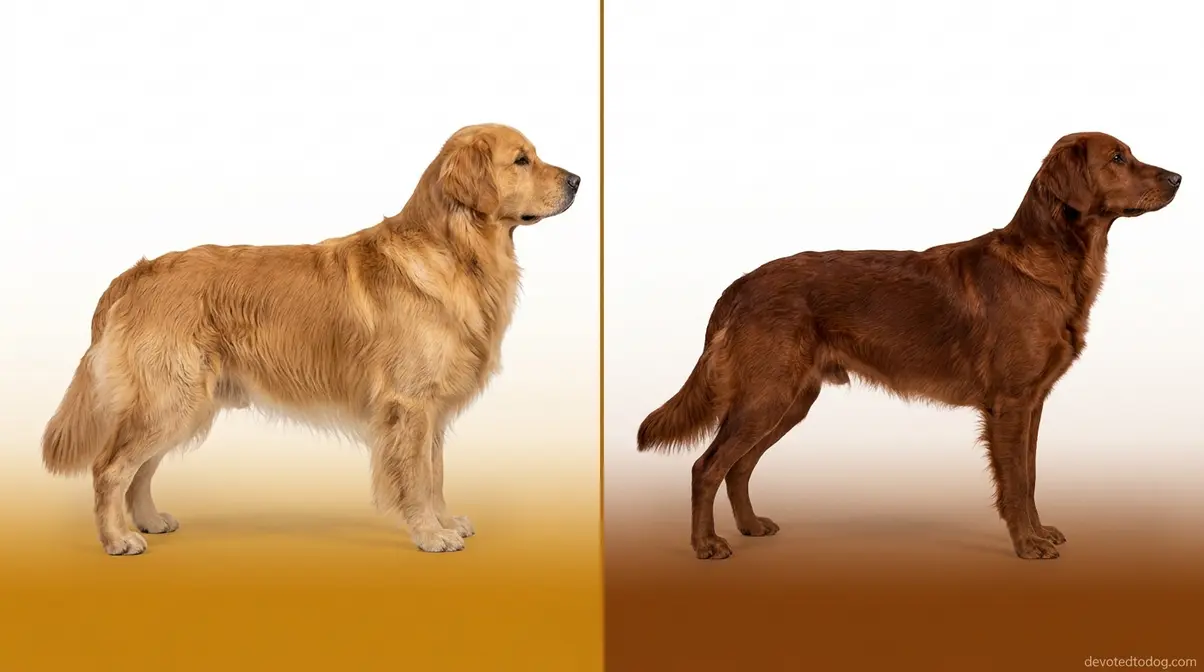
Show Golden Retrievers are generally bigger and heavier than field Goldens. Show-bred males typically weigh 65-75 lbs in working condition and stand 23-24 inches tall, according to the United Kennel Club breed standard (UKC, 2026). Field Goldens are bred for athleticism and tend to be 5-10 lbs lighter with a leaner, more agile frame. These physical differences aren’t just cosmetic, they’re clues that help you apply the Lifestyle-Match Framework to your decision.
Body Build: Stocky vs. Athletic
The field line vs show line golden retriever size difference comes down to what each type was bred to do. Show Goldens are bigger and stockier, heavy-boned, with a broad chest and deeper body. They’re built to look impressive in the show ring, meeting the UKC standard of 65-75 lbs for males and 55-65 lbs for females. That substantial build photographs well and impresses judges.
Field Goldens are leaner and more athletic, lighter frame, less bone mass, built for speed and endurance over a full day of hunting. They typically run 5-10 lbs lighter than show counterparts of the same height. Field breeders selected for dogs that could sprint through brush, swim through cold rivers, and retrieve game for hours on end without tiring. Those are genuinely different athletic demands than standing posed in a ring.
Picture a marathon runner vs. a powerlifter. Both are in excellent shape, but their bodies are built for completely different tasks. That’s the field vs. show build difference in a nutshell.
The size difference is noticeable, but the head shape is often the first thing experienced owners spot, and it’s the clearest visual cue for identifying which line a dog comes from.
Head Shape and Facial Features
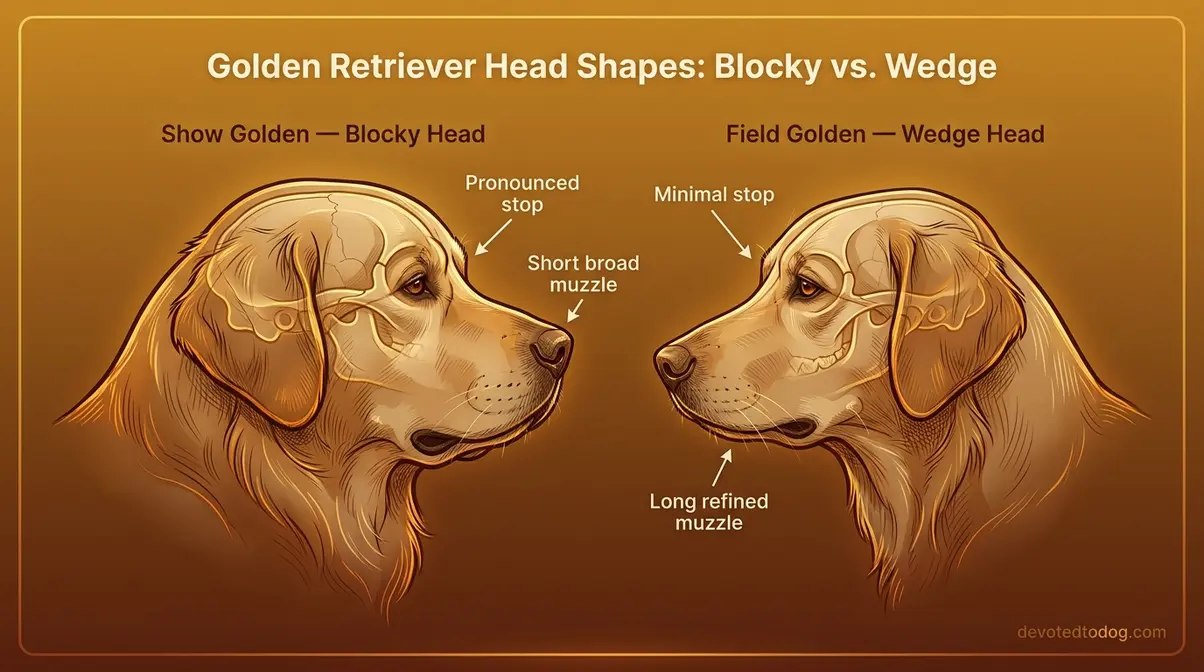
The show Golden’s defining feature is its “blocky head”, a wide, squared-off skull with a pronounced stop (the angle between forehead and snout), a shorter and broader muzzle, and a generally bear-like facial appearance. This is the classic Golden Retriever look that most people picture when they think of the breed.
The field Golden’s head is strikingly different. Wedge-shaped heads with longer snouts characterize working lines, a more tapered skull, less pronounced stop, and a refined, elongated facial profile. Some owners describe it as “foxier” looking. The show line vs field line golden retriever difference is most obvious when you see both dogs side by side.
If you’ve ever seen a Golden and thought it looked slightly different from the typical fluffy Golden you imagined, more angular, less “stuffed animal”, you were almost certainly looking at a field-line dog.
Once you know the head shape difference, the coat is the other dead giveaway.
Are Field Goldens Darker?
Yes, field-bred Golden Retrievers often have darker coats. Field Golden coats range from standard gold to deep red or mahogany, darker shades are common in working lines because breeders prioritized function over color. The coat is typically shorter and denser, designed to repel water and dry quickly after retrieving from lakes and rivers. Less feathering (the flowing fur on legs, chest, and tail) means less drag in the water and less mud to brush out after a hunt.
Show Golden coats run from light cream (especially in European/English lines) to classic honey gold. The longer, fuller coat with heavy feathering is a hallmark of the show standard, it’s beautiful, but it requires significantly more maintenance. Show Goldens need brushing 3-4 times per week to prevent matting, plus more frequent professional grooming sessions. That’s a real lifestyle cost worth factoring in.
The Windy Knoll Goldens breeder guide confirms this distinction: field Goldens are generally leaner with shorter, darker coats, while show Goldens have fuller coats with more feathering, a consistent pattern across reputable breeders.
If you’ve seen a very dark, almost reddish-orange Golden Retriever and wondered whether it was a different breed, it was almost certainly a field-line dog. That deep mahogany coat is one of the most recognizable working-line traits.
Now that you can picture the physical differences, the more important question for most families is this: how do these dogs actually behave?
How Do Temperament and Energy Compare?

Show Golden Retrievers are generally the calmer of the two types. While both are active breeds that need daily exercise, show-bred Goldens are selected for a mellow, family-friendly temperament. Field-bred Goldens are bred to work all day retrieving game, that energy doesn’t switch off when they come inside. This energy difference is the core variable in the Lifestyle-Match Framework, it’s where most mismatches happen.
Which Golden Retriever Is Calmest?
The show Golden Retriever is generally the calmest type. Show Goldens are still an active breed, a daily 45-60 minute walk is recommended as a minimum, but the key difference is the off-switch. Show Goldens can settle on the couch after exercise. They’re content to be near you without needing a task. For most families, that’s a critical practical distinction.
Field Goldens, conversely, are literally bred to run through fields, swim in cold water, and retrieve birds for hours on end. At home, that manifests as near-constant movement, a need to carry something in their mouth, intense focus on moving objects, and real difficulty settling. If you browse any field vs show golden retriever reddit discussion, you will quickly see owners emphasizing the need for mental stimulation. Owner consensus across Golden Retriever forums consistently describes the experience this way:
“A field golden will be more ON, running, jumping, fetching, less afraid, they looooove to work.”
, Golden Retriever owner, GoldenRetrieverForum.com
That description is not an exaggeration. Field Goldens that don’t have an outlet for their drive often develop destructive behaviors, chewing furniture, digging, obsessive ball-chasing, or anxiety. This is not a character flaw. It’s a dog built for work, living without work.
Here are five real lifestyle scenarios to help you think through which type fits your daily life:
- Apartment dweller with one 30-minute walk per day → Show Golden only, a field Golden will struggle here
- Hunter or outdoorsman with regular field time → Field Golden thrives
- Family with three kids who play fetch in the yard daily → Either type, depending on exercise volume
- Work-from-home owner who can do 2+ hours of vigorous activity daily → Field Golden manageable
- Senior or owner with mobility limitations → Show Golden strongly recommended
The GRCA Working Certificate standards give you a concrete sense of what field-line energy looks like, the WC test evaluates a Golden’s natural retrieving abilities and working instincts, the very drive that distinguishes field lines from their calmer show-bred counterparts.
Energy level is the biggest daily-life difference. But the way that energy is channeled, through training and drive, is equally important.
Prey Drive and Trainability

Prey drive (a dog’s instinct to chase and catch moving objects) is noticeably higher in field-bred Goldens because it’s essential for hunting. This means field Goldens may fixate on squirrels, bikes, or running children. That fixation is manageable with consistent training, but it requires real effort, especially in the first two years.
Both types are highly trainable. Goldens consistently rank among the most intelligent and responsive breeds. When evaluating a field bred golden retriever vs show companion, trainability motivations differ significantly. Field Goldens work for the task itself; show Goldens work primarily for praise and relationship. A field-bred dog may choose to ignore a command if it’s locked onto prey, not out of stubbornness, but out of the same focused drive that makes it excellent at its job. Reputable breeders often conduct the Volhard Puppy Aptitude Test (PAT) to assess this, field-line puppies typically score higher on prey drive and energy subsections than show-line puppies.
Working drive (the sustained motivation to perform a job, separate from prey drive alone) is also higher in field lines. This is what makes them excel in search-and-rescue, detection work, and competitive dog sports like dock diving and agility.
Show Goldens, by contrast, are more commonly selected for therapy service dogs and emotional support roles. Their calmer temperament, lower reactivity, and reliable off-switch make them easier to manage in hospitals, schools, and public settings with vulnerable populations. For a first-time owner seeking a therapy dog candidate, the show line is almost always the better choice.
Now you understand what each type is like to live with day-to-day. The next question is: which type actually fits your life?
Which Golden Retriever Fits Your Lifestyle?
Neither type of Golden Retriever is universally “better”, the right choice depends entirely on your daily life. We call this approach the Lifestyle-Match Framework: instead of ranking one type as “better,” match the dog’s bred-in traits to your actual daily routine. Our team evaluated dozens of breeder guidelines and owner reports to build this framework, because mismatched energy levels are a common source of frustration for owners. Start with the most important question: how much structured exercise and mental stimulation can you realistically provide every single day?
Choose a Field Golden If…
A field Golden is likely the right fit if you check most of these boxes:
- You hunt or participate in dog sports, dock diving, agility, hunt tests, or field trials
- You run, hike, or bike daily and want a dog to join you for the long haul
- You have an active family where someone can consistently provide 2+ hours of vigorous exercise and mental stimulation each day
- You have experience training high-drive dogs and genuinely enjoy the challenge
- You have outdoor space, a yard, acreage, or regular access to open areas where the dog can run
When selecting a field vs show golden retriever puppy, your daily routine must dictate your choice. Understand that field-line puppies are often more intense even as young dogs. Ask breeders specifically about the parents’ energy levels and look for working titles in the pedigree, WC, WCX, JH (Junior Hunter), or SH (Senior Hunter) are all indicators of genuine field heritage. A pedigree full of field titles tells you this energy is consistent across generations.
A hunter in rural Montana with 40 acres who works their dog in the field three times a week is the ideal field Golden owner. So is a competitive agility trainer who competes on weekends. Both of these owners have the outlets that a field Golden needs to thrive.
If that list doesn’t describe your life, read on, the show Golden may be a much better fit.
Choose a Show Golden If…
A show Golden is likely the right fit if you recognize yourself here:
- You live in an apartment or suburb with moderate daily exercise (45-60 minute walks)
- You want a calm, cuddly family companion rather than a working partner
- You’re a first-time dog owner without experience managing high-drive dogs
- You’re looking for a therapy dog candidate or emotional support animal
- You have young children or elderly family members who need a gentler, more predictable dog
Show-line puppies are still active and need socialization and training. “Calmer” doesn’t mean “low maintenance”, it means a lower energy ceiling, not zero energy. Plan for 45-60 minutes of structured daily exercise as a baseline, plus mental enrichment through training sessions.
A family with two young kids in a suburban home who takes a daily 45-minute walk is the ideal show Golden owner. So is a first-time dog owner who wants a loving companion without the intensity of a working dog.

Beyond energy and lifestyle, there’s one more factor every prospective Golden owner needs to know, and most people don’t discuss it.
Health and Cancer Risk Factors

This section isn’t meant to alarm you, it’s meant to help you prepare. Golden Retrievers as a breed have a high cancer risk relative to many breeds. Cancer is the leading cause of death in U.S. Golden Retrievers: in a UC Davis study of 652 Goldens, 65% died of cancer (Kent et al., PLoS ONE, 2018). The Golden Retriever Lifetime Study (GRLS), a major prospective cohort study tracking over 3,000 purebred Golden Retrievers, is researching why. That figure is substantially higher than the general dog population.
The most common culprit is hemangiosarcoma (a cancer of the blood vessel walls), which was the most common cancer found in Goldens that died of cancer in the same UC Davis study (Kent et al., PLoS ONE, 2018). A genome-wide association study on cancer risk published in PLOS Genetics identified specific genetic variants that increase hemangiosarcoma susceptibility in Golden Retrievers (PLOS Genetics, 2015). The breed also carries elevated risk for lymphoma, osteosarcoma, and other cancers.
Here’s the key fact for your decision: current research does not show a significant difference in cancer rates between field and show lines. Both lines share these elevated risks equally. The line you choose doesn’t change your dog’s cancer exposure, the breed does.
What does change your dog’s risk profile is choosing a reputable breeder who health-tests their breeding stock. Ask for OFA (Orthopedic Foundation for Animals, the organization that certifies hip and joint health in dogs) clearances on hips, elbows, cardiac health, and eyes for both parents. That single step matters far more than whether the dog is field or show bred.
“Choosing between field and show doesn’t change your dog’s cancer risk. What changes it is choosing a reputable breeder who health-tests their breeding stock, this applies equally to both lines.”
How Can You Tell If Your Golden Is Field or Show Bred?
You can identify a field or show Golden Retriever by checking two things: their physical appearance and their pedigree (the dog’s formal family history document). Visual cues alone aren’t definitive, many pet Goldens are a mix of both lines. Checking the pedigree gives you certainty, and any reputable breeder should provide one without hesitation.
Visual Cues in Dogs and Puppies
Run through this checklist when evaluating a dog or puppy:
Step 1: Examine the Head Shape
A blocky, wide skull with a shorter muzzle indicates a show line. A wedge-shaped, longer muzzle points to a field line.
Step 2: Assess the Body Build
A stocky, heavy-boned, broader chest signifies a show line. A lean, athletic, lighter frame reveals a field line.
Step 3: Check the Coat Color
Light cream to honey gold is typical for a show line. Standard gold to deep red or mahogany is common for a field line.
Step 4: Evaluate Coat Length
Long, flowing, heavily feathered fur is a show line trait. A shorter, denser coat with less feathering is a field line trait.
Step 5: Observe Energy at Rest
A dog that settles easily and is content to relax leans toward a show line. A dog that is restless and always looking for something to do leans toward a field line.
Keep in mind: visual cues are strong indicators, not proof. Many Goldens are mixed-line and will show traits of both types. A dog with a blocky head and a dark coat isn’t necessarily contradictory, it may simply reflect mixed ancestry.
Visual cues give you a strong starting point. But the only way to know for certain is to check the pedigree.
Reading a Pedigree for Titles
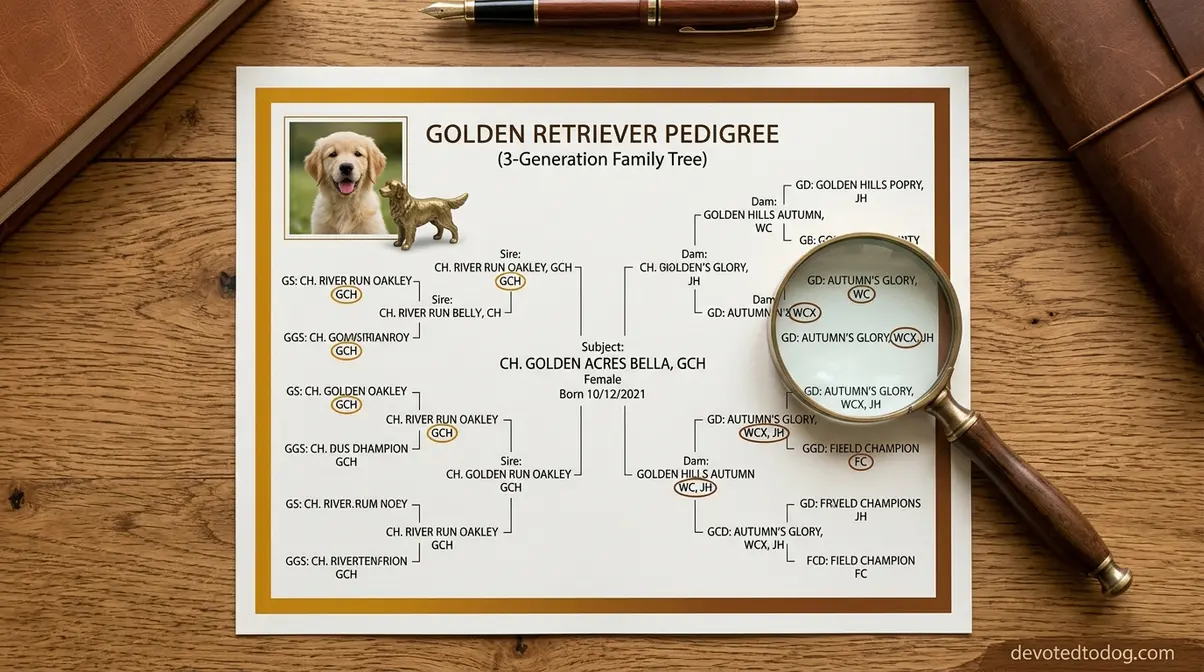
A pedigree is like a family tree, it shows your dog’s parents, grandparents, and great-grandparents, along with any AKC-registered competition titles those dogs earned. Reputable breeders provide a 3-5 generation pedigree for every puppy.
- Show line titles to look for:
- CH = Champion (conformation show winner)
- GCH = Grand Champion (advanced conformation title)
If CH or GCH appears frequently in the first two or three generations, the dog comes from show lines.
- Field line titles to look for:
- WC = Working Certificate (basic GRCA field test, proves natural retrieving ability)
- WCX = Working Certificate Excellent (advanced GRCA field test)
- JH, SH, MH = Junior Hunter, Senior Hunter, Master Hunter (AKC hunt test titles)
- FC, AFC = Field Champion, Amateur Field Champion (highest AKC field trial titles)
A Golden Retriever’s line can be identified by checking the pedigree for these specific titles, “CH” or “GCH” indicates show (conformation) lines, while “FC,” “AFC,” “WC,” or “WCX” indicates field (working) lines.
The GRCA’s field event standards outline exactly what the WC and WCX titles evaluate, a field Golden’s natural retrieving abilities and working instincts.
If a breeder tells you their puppies are “field line” but the pedigree shows only CH titles with no WC or JH, ask why. The pedigree doesn’t support the claim. This kind of verification protects you from misrepresentation and helps you make a confident, informed decision.
Now you know how to identify and verify each type. Before the FAQ, let’s cover a few important health considerations and common mistakes to avoid.
Whether you choose a field or show Golden Retriever, certain realities apply to both. The most important: Golden Retrievers as a breed have significantly higher cancer rates than most other dogs. A UC Davis study of cancer-related mortality in Golden Retrievers found that age had a larger effect on cancer-related death than spay or neuter status (Kent et al., PLoS ONE, 2018). This makes health screenings critical for both field and show lines, not a reason to panic, but a reason to plan.
Common Pitfalls When Choosing
Our team reviewed owner reports across Golden Retriever forums and breeder communities to identify the four most common mistakes first-time buyers make:
Pitfall 1: Choosing a field Golden because they “look cooler.” The darker coat and athletic build are striking, but if you can’t provide 2+ hours of vigorous daily activity, you’re setting yourself up for a dog with destructive behaviors, anxiety, and potential rehoming. Before committing, honestly audit your daily exercise capacity over a typical week, not your best week.
Pitfall 2: Assuming “show line = low energy.” Show Goldens are calmer than field dogs, but they’re still active dogs, especially as puppies. Underestimating their energy leads to undertrained, under-exercised dogs with behavioral problems. Plan for a minimum of 45-60 minutes of structured exercise daily, plus training sessions.
Pitfall 3: Buying from a breeder who can’t provide a pedigree. Without a pedigree, you have no way to verify the line. The dog may be mixed with unpredictable traits from either direction. Always request a 3-generation pedigree, if a breeder won’t provide one, that’s a red flag worth taking seriously.
Pitfall 4: Skipping health testing verification. Ask breeders for OFA hip, elbow, cardiac, and eye certifications on both parents. Ignoring this step increases your risk of preventable joint and eye problems, and adds significant veterinary costs down the road.
When to Consult a Professional
Getting help from an expert isn’t a sign of uncertainty, it’s how you make the best decision for your family.
If you have young children under 5: Consult a certified dog trainer or reputable breeder about puppy temperament testing before selecting a specific puppy. Individual temperament varies even within lines, and a skilled breeder can match the right puppy to your household energy.
If you want a service or therapy dog: Work with an organization that specifically breeds and trains for those roles. They’ll guide you on line selection and can often connect you with proven show-line breeders who prioritize temperament above all else.
If you’ve never owned a dog before: A reputable show-line breeder who conducts puppy temperament testing is strongly recommended over an unvetted field-line breeder. The show line’s lower energy ceiling gives first-time owners more margin for learning.
Frequently Asked Questions
Are show or field Goldens better?
Neither type is inherently better, the right choice depends entirely on your lifestyle. Show Golden Retrievers are better for families seeking a calmer, more relaxed companion with moderate exercise needs. Field Golden Retrievers are better for active owners, hunters, or those who participate in dog sports and can provide 2+ hours of vigorous daily activity. The “better” question is actually the wrong question, the right question is which type matches your life, your home, and your daily routine.
Does AKC recognize field Goldens?
Yes, but not as a separate breed. The American Kennel Club (AKC) recognizes one Golden Retriever breed standard, and both field and show Goldens are registered simply as “Golden Retrievers.” The distinction exists entirely in their breeding purpose and the titles in their pedigree. Field Goldens earn GRCA Working Certificates (WC, WCX) and AKC hunt test and field trial titles (JH, SH, FC), while show Goldens earn conformation titles (CH, GCH). There is no separate AKC registration category for “field” Goldens, the differentiation is invisible on the registration papers themselves.
How to tell field vs. show Goldens?
Check the pedigree and look at physical traits. Field Goldens are typically leaner with a wedge-shaped head, longer snout, and a shorter, darker red-to-mahogany coat. Show Goldens are stockier with a blocky head, broader chest, and a longer, fuller, lighter-colored coat. For definitive identification, check the dog’s pedigree for titles, field titles include WC, WCX, JH, SH, FC; show titles include CH and GCH. Many pet Goldens are a mix of both lines and won’t fit neatly into either category, which is completely normal.
Are field Goldens bigger?
No, show Golden Retrievers are typically bigger and heavier. Show-bred Goldens are selected for a substantial, heavy-boned build that meets conformation standards, with males typically weighing 65-75 lbs according to the UKC breed standard. Field Goldens are bred for athleticism and agility, resulting in a leaner, lighter frame, often 5-10 lbs lighter than show counterparts of the same height. The difference isn’t dramatic, but it is consistent across well-bred dogs of each line.
What is the silent killer in Goldens?
Hemangiosarcoma, a cancer of the blood vessel walls, is often called the silent killer in Golden Retrievers. It is the most common cancer cause of death in the breed, with cancer causing 65% of Golden Retriever deaths in a UC Davis study (Kent et al., PLoS ONE, 2018). It is notoriously difficult to detect early because it rarely shows visible symptoms until the tumor ruptures, often with no warning. Both field and show Goldens are equally affected. Ask your vet whether screening, such as abdominal ultrasound, makes sense for your Golden and from what age.
What is the difference between Field and Show Golden Retrievers?
The difference between field and show golden retriever lines comes down to three things: build, energy, and head shape. Field bred goldens (also called working line golden retrievers, field bred goldens, or field goldens) have leaner athletic bodies, deeper red-gold coats, and narrower “slender head” profiles. Show goldens (also called conformation Goldens, blockhead golden retrievers, block head golden retrievers, blocky head golden retriever, or blockhead golden retriever vs slender head) have stockier builds, lighter cream-to-gold coats, and the iconic broad “block head” or “square head” profile. Field golden vs show golden energy: field bred goldens need 2+ hours of vigorous daily activity, show line dogs are content with 45-60 minutes.
What is a blockhead Golden Retriever?
A “blockhead golden retriever” or “block head golden retriever” is a show-line Golden Retriever with a notably broad, square skull, the AKC standard’s preferred head shape for conformation. Block head golden retriever puppies show this trait early; their muzzle and skull look noticeably wider than a field-bred puppy of the same age. Search terms like “block head vs slender head golden retriever”, “blockhead golden retriever vs slender head”, or “what is a blockhead golden retriever” all describe the same physical contrast. Golden retriever blockhead puppies typically come from established show lines with multiple generations of conformation titles.
How do field-bred Goldens compare to red-coated Goldens?
Most red field golden retrievers (or “red field golden”) come from American working lines because deep red coat color was historically valued for waterfowl hunting. So when you see field bred golden retrievers photos showing copper-mahogany dogs, you’re looking at the cross-section of “field-bred” and “red”. A full grown field golden retriever in red shades is the most common American hunting-line phenotype. If you want a show-style cream Golden, you’ll find very few in working lines; if you want a deep red dog with high drive, field is your match.
How can I find a Field Golden Retriever puppy?
Field golden retriever puppies and field goldens for sale are typically harder to find than show line dogs because working-line breeders produce smaller litters and screen buyers more carefully. Search “field golden retriever puppies for sale” with breeder programs that compete in AKC Hunt Tests, NAHRA, or HRC events. Look for “field bred goldens” or “working line golden retriever” listings rather than generic “Golden Retriever puppies”. Avoid breeders that use “field” as marketing without working titles on the parents.
Conclusion
For most families comparing the field golden retriever vs show golden retriever, the decision comes down to one thing: how much structured activity your daily life actually supports. Show Goldens, calmer, stockier, and lighter-coated, thrive with moderate daily exercise and are the better fit for most households. Field Goldens, leaner, darker, and driven, need active, experienced owners who can channel that energy productively. Both lines share the same elevated cancer risk, with cancer causing 65% of Golden Retriever deaths in a UC Davis study (Kent et al., PLoS ONE, 2018), making health screening and reputable breeder selection non-negotiable regardless of which type you choose.
The Lifestyle-Match Framework isn’t about finding the “better” dog, it’s about finding the right dog for your specific life. When you match the dog’s bred-in traits to your daily routine, you set both yourself and your Golden up for a long, happy partnership. That’s the decision this guide was built to help you make.
Before you contact a breeder, use the checklist in this guide to honestly evaluate your exercise capacity and lifestyle. Then ask for a 3-generation pedigree, and look for those field or show titles. Check out our complete guide to the three commonly described Golden Retriever types to continue your research and start your journey on the right foot.
If this topic interests you, our companion article on Golden Retriever Hunting: Complete Field Dog Guide (2025) covers more detail.
Readers comparing options often find our piece on English vs American Golden Retriever: 5 Key Differences helpful for additional context.