
Short-haired Golden Retrievers are not a separate breed. But some Goldens genuinely do have shorter coats, and there’s a real scientific reason why.
If you’ve been scrolling through photos of fluffy Goldens wondering why yours looks different, you’re not alone. The answer matters for how you groom and care for your dog, and one common mistake can permanently damage their coat.
This guide covers exactly why some Goldens have shorter coats, how to tell a field-bred Golden from a show-bred one, the grooming protocol that keeps your dog safe, and where to find a shorter-coated Golden if that’s what you’re after.
all purebred Goldens
puppy → adult
show-line maintenance
causes permanent damage
Author Credentials
📝 Written by: Coral Drake
✅ Reviewed by: Brianna York, Former Veterinary Technician
📅 Last updated: 4 May 2026
ℹ️ Transparency Notice
This article explains coat-length variations in Golden Retrievers based on AKC breed standard, GRCA, and breeder records. All claims have been verified by our editorial team.
Do Short-Haired Golden Retrievers Really Exist?
No officially recognized short-haired Golden Retriever breed exists. The American Kennel Club (AKC), the official U.S. breed registry, classifies the Golden Retriever coat as medium length with a dense, water-repellent double coat and characteristic feathering. That said, coat length still varies meaningfully from dog to dog, and understanding why is the key to resolving the confusion. This variation is what we call “The Golden Coat Spectrum”: coat length in Golden Retrievers isn’t a simple short-or-long binary. It’s a spectrum shaped by three forces, genetics, breeding line, and life stage.
What the AKC Breed Standard Says
According to the official AKC Golden Retriever breed standard, the breed’s coat is described as “dense and water-repellent with good undercoat” and of “medium length” (AKC, 2026). The standard specifically calls out feathering, the longer, fringe-like hair on the neck, thighs, underside of the tail, and back of the forelegs, as a defining characteristic of the breed’s appearance.
The AKC does not recognize a “short-haired” variety. This is the authoritative answer to the question. If you see a breeder advertising “AKC-registered short-haired Goldens” as a separate type, that’s a red flag, no such official classification exists. For a deeper look, the truth about short-haired Golden Retrievers covers this common misconception in detail.
The FGF5 Gene and Coat Length
Here’s the piece of information that no competitor covers, and it changes everything.
The FGF5 gene (Fibroblast Growth Factor 5) acts like a “coat length switch” in dogs. Think of it like eye color genetics: a dog needs two copies of the “short” gene variant to grow a short coat. Golden Retrievers don’t have even one copy of that short variant. According to UC Davis genetic testing on coat length, five recessive variants in the FGF5 gene are associated with long hair in dogs, and all purebred Golden Retrievers carry these long-hair variants (UC Davis Veterinary Genetics Laboratory, 2026).
According to an NIH genetic study on dog coat length, a purebred Golden Retriever cannot genetically produce a short coat, all purebred Goldens carry the recessive long-hair FGF5 variants that make medium-to-long coats inevitable (NIH/PMC, 2026).
To be clear about the genetics: purebred Goldens are homozygous for the long-hair FGF5 variant, meaning they carry two copies of the long-hair gene, and both copies point in the same direction. A Golden-looking dog with a noticeably short coat almost always indicates a mix, especially with a Labrador Retriever, which commonly carries the short-hair variant.
UC Davis offers an actual genetic test for coat length, which can be useful for owners of mixed breeds who want certainty about what their dog carries.
Why Do Some Have Short Hair?
Your Golden Retriever likely has shorter hair for one of three reasons: breeding line, age, or mixed heritage. So if the gene always produces a longer coat in purebreds, why do some Goldens look noticeably shorter than others? Three things explain it:
- Breeding line, Field-bred Goldens are selectively bred for athleticism and working ability. Their coats are naturally shorter and flatter than show-bred dogs, even though both are purebred. (Full explanation in the next section.)
- Age / Puppy coat, All Golden puppies have short coats. The full adult coat with feathering typically doesn’t appear until 12 to 24 months. If your puppy has fluff only behind his ears and on the back of his legs, that’s classic puppy coat, not a sign of a “defective” Golden.
- Mixed heritage, A Golden × Lab cross (Goldador) often inherits the Lab’s shorter coat gene. (Full explanation in the Mixes section.)
None of these make your dog any less of a Golden in personality or health. Now that you know why coats vary genetically, let’s look at the other major factor, your dog’s age.
How Does Golden Retriever Coat Development Work?
“He has some fluff behind his ears and on the back of his legs but otherwise pretty short hair. Did anyone else’s puppy look like this?”
Sound familiar? You’re not alone. This is one of the most common concerns new Golden owners share online, and the answer is almost always the same: wait.
The Puppy Coat Phase (0-6 Months)
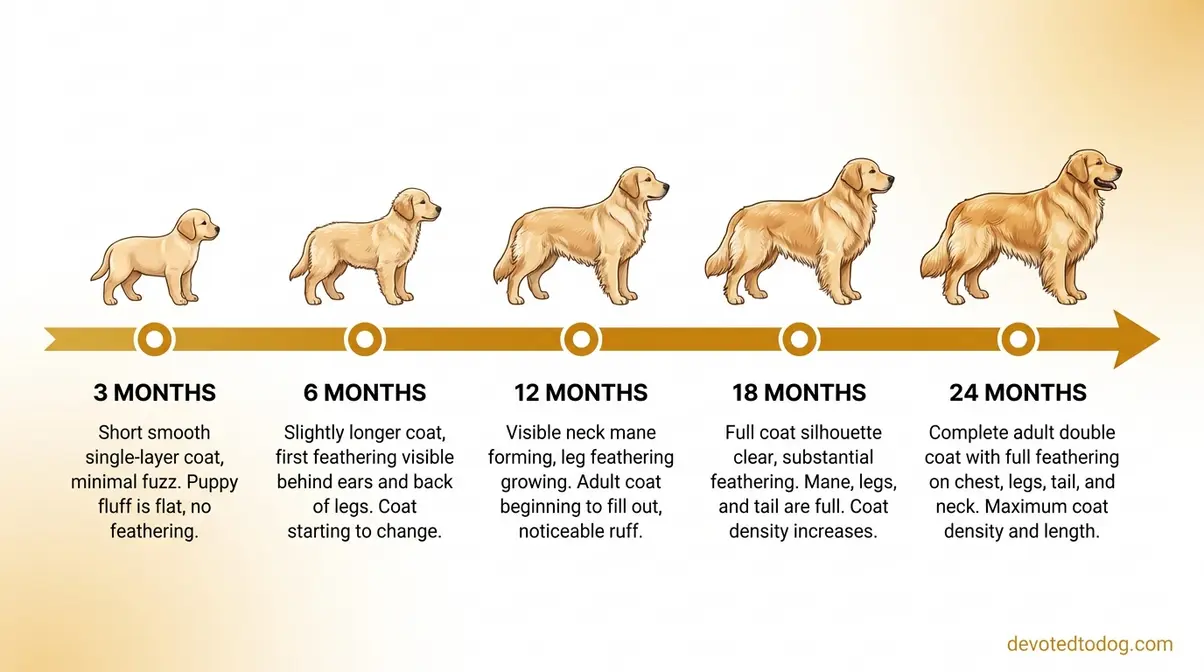
All short haired golden retriever puppies, and all Golden puppies, period, are born with a short, soft, single-layer coat. This is the puppy coat: it has no feathering, minimal volume, and is nothing like the fluffy show-line Golden most people picture. This initial coat is incredibly soft to the touch and requires very little maintenance compared to the adult coat.
The puppy coat serves a developmental purpose. It’s lighter and easier for the puppy to regulate temperature before the full double coat grows in. This is completely normal across the entire breed, regardless of what the adult coat will eventually look like.
If your 3-month-old Golden has a smooth, short coat with a little fuzz behind the ears, that’s exactly what a healthy Golden puppy looks like. For a detailed look at what to expect at each stage, the complete Golden Retriever coat development timeline is a useful reference.
The Awkward Coat Transition
Between 6 and 18 months, the adult double coat begins replacing the puppy coat in a process that is deliberately uneven. Feathering appears first behind the ears and on the backs of the legs, exactly what the owner quote above describes, while the body coat may still look relatively short and flat. Many owners refer to this as the “teenage phase” of Golden Retriever development.
During this phase, your short haired golden retriever puppy may look “patchy” or uneven. This is completely normal. It is not a sign of a health problem or a permanently short coat.
Field-bred Goldens transition more quickly, and their adult coat will be shorter and flatter. Show-bred Goldens develop more dramatic feathering over the same period. By 12 months, most Goldens will have visible feathering on the legs and a thickening neck mane. By 18 months, the full coat silhouette is usually clear.
When Does the Full Coat Appear?
Golden Retriever puppies are born with short, soft puppy coats, the full adult coat with feathering typically appears between 12 and 24 months of age, with most dogs showing a complete coat silhouette by 18 months. The AKC notes that the signs of maturity phase (18-24 months) is when the full coat and feathering require routine grooming, consistent with what Golden Retriever owner communities and breeders consistently report.
“Full coat” doesn’t mean maximum fluffiness. It means the double-coat structure, a soft insulating undercoat plus a weather-resistant topcoat, is fully developed, and the feathering on legs, chest, tail, and neck is complete.
Field-bred Goldens will have a “full coat” that looks significantly shorter and flatter than a show-bred Golden’s full coat, and both are correct for their breeding line. If your Golden is under 18 months and has a shorter coat, the honest answer is: wait. The full coat is almost certainly still coming.
Now let’s look at the most significant factor in adult coat variation: breeding line.
How Do Field-Bred and Show-Bred Goldens Differ in Coat?
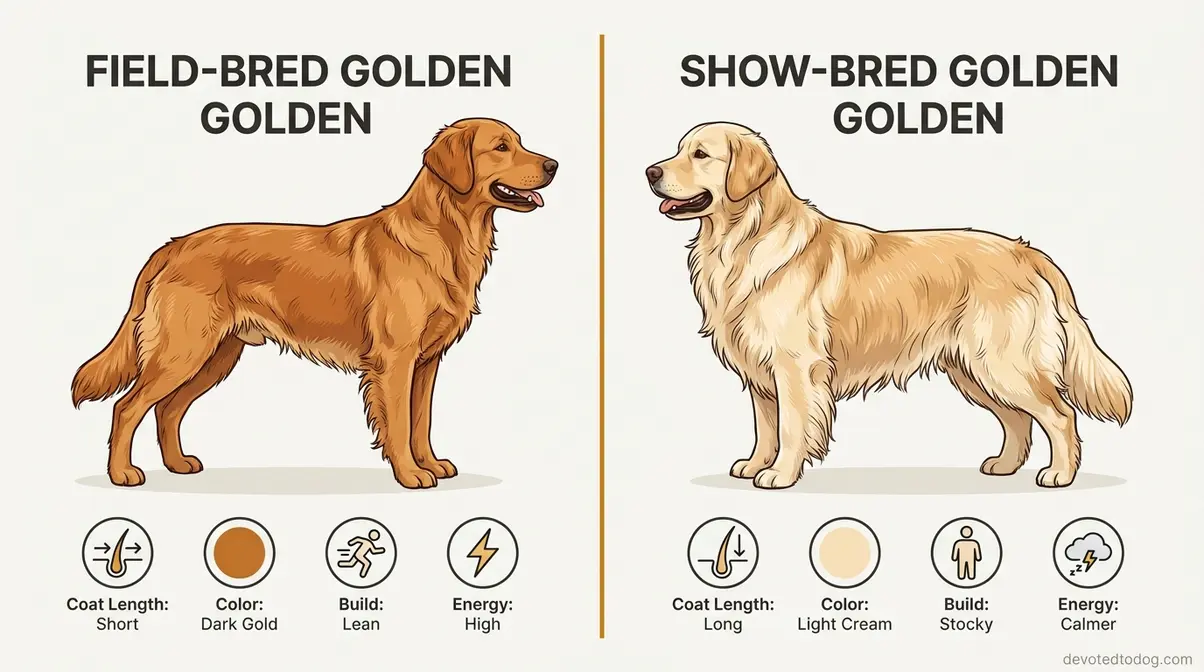
The most significant natural cause of coat variation in purebred Goldens is breeding line. Field-bred and show-bred Goldens are both 100% purebred Golden Retrievers, but their coats look remarkably different. This is the breeding-line axis of what we call the Golden Coat Spectrum: where your dog sits on the spectrum depends heavily on which type of breeding produced them.
| Feature | Field-Bred Golden | Show-Bred Golden |
|---|---|---|
| Coat length | Shorter, flatter, less feathering | Longer, fuller, dramatic feathering |
| Coat texture | Denser, slightly coarser | Silkier, more flowing |
| Color | Often darker gold to red | Lighter cream to classic gold |
| Build | Leaner, more athletic | Stockier, broader head |
| Energy level | Higher, bred to work all day | Calmer, bred for temperament |
| Purpose | Hunting, field trials | Conformation shows, family pet |
Show-Bred Goldens: The Classic Look
Show-bred Golden Retrievers are bred to match the AKC breed standard’s aesthetic ideal. They carry the longer, flowing show coat with full feathering on the legs, chest, neck mane, and tail, the look most people associate with the breed. If you’ve seen a Golden Retriever in a movie or dog food commercial, you’ve almost certainly seen a show-bred dog.
Their coats are typically lighter in color (cream to classic gold) with a silkier texture. Grooming is more time-intensive: regular brushing 2-3 times per week minimum is needed to prevent matting in the feathering. The British or English Golden Retriever is a common show-bred variety, often stockier with a lighter, cream-colored coat.
Field-bred Golden Retrievers have noticeably shorter, flatter coats than show-bred lines, but both are purebred Goldens that share the same friendly temperament. For a detailed comparison, the field-bred vs. show-bred Golden Retriever comparison breaks down the differences across coat, temperament, and health.
On the opposite end of the Golden Coat Spectrum is the field-bred Golden, the dog most likely to be mistaken for a “short-haired” breed.
Field-Bred Goldens: The Shorter Coat
When comparing long hair vs short haired golden retriever appearances, the field-bred Golden is the clearest real-world example of the shorter end of the spectrum. Field-bred Golden Retrievers are bred for hunting and fieldwork, not conformation shows (competitions judged on how closely a dog matches the breed standard). Their breeding has selected for athleticism, speed, and endurance, which means a shorter, denser, more practical coat that doesn’t tangle in brush and dries faster after water retrieves.
Field-bred Goldens often have darker coats, deep gold to reddish-gold, with noticeably less feathering. The coat is still a double coat: they still have an undercoat and topcoat. But the overall length is much shorter than a show-bred Golden’s.
Red-colored field Goldens are especially striking and are sometimes mistaken for a separate breed. The “red short haired golden retriever” you may have seen online is simply a field-bred Golden with darker pigment. If you’re looking at a Golden that appears more athletic, shorter-coated, and reddish in color, you’re almost certainly looking at a field-bred line. Explore the full range of types of Golden Retrievers to see how dramatically breeding lines can affect appearance.
Before we move on to grooming, there’s one common myth worth addressing directly.
The Black Short-Haired Golden Myth
A black short haired golden retriever does not exist as a purebred dog. The Golden Retriever breed standard recognizes only gold, light gold, and dark gold coat colors, a black coat is not genetically possible in a purebred Golden Retriever.
Black “Golden Retrievers” are almost always Golden × Flat-Coated Retriever mixes or Golden × Labrador mixes. The black color comes from the Lab or Flat-Coat parent, not the Golden genetics.
The combination of black + short coat in a “Golden” is almost certainly a mixed-breed dog. If a breeder is selling “black Golden Retrievers,” they are either selling a mixed breed or misrepresenting the dog. Neither is necessarily a problem, but you should know what you’re getting. If you already have a black-coated mix, that dog is still wonderful, just not a purebred Golden.
Which Golden Type Is the Calmest?
British or English Golden Retrievers are generally considered the calmest type. Their breeding standards emphasize a composed, gentle temperament suited to family life, and they tend to mature more quickly than American lines. American field-bred Goldens typically have the highest energy levels due to their working heritage. Individual temperament varies significantly within any type, socialization, training, and environment matter as much as breeding line. If calmness is a priority, ask breeders specifically about the parent dogs’ temperament, not just their type.
Now that you understand why coat length varies, let’s talk about what you should, and absolutely should not, do about it.
How Do You Groom a Short-Coated Golden Safely?
Every Golden Retriever, including a shorter-coated short haired golden retriever from field-bred lines, has a double coat: a two-layer coat system with a soft insulating undercoat and a weather-resistant topcoat. This structure is the source of one of the most dangerous grooming mistakes owners make. Grooming a double coat safely requires specific tools and techniques that are very different from what works on single-coated breeds.
Why You Should Never Shave a Golden
⚠️ Critical warning: Never shave a Golden Retriever’s double coat.
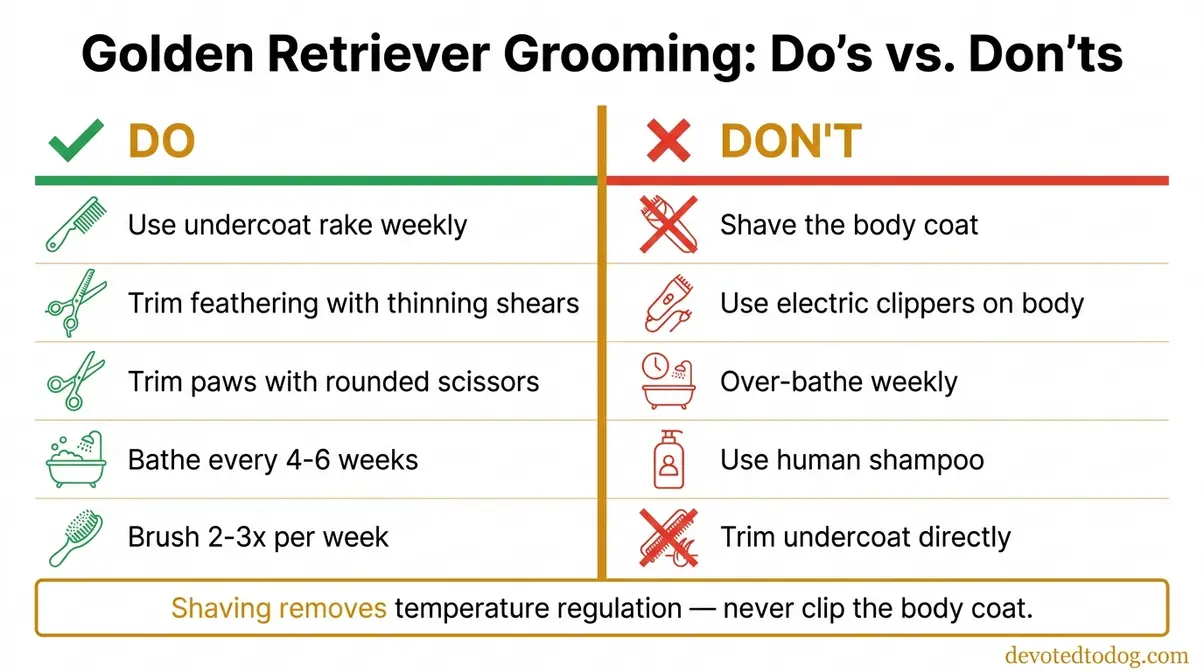
A Golden Retriever’s double coat is a natural temperature regulation system. The undercoat insulates in winter AND reflects heat in summer. Shaving removes this system entirely, leaving the dog more vulnerable to heat stroke and sunburn, not less. Texas A&M veterinary experts recommend brushing over shaving for double-coated breeds during warm months, as the double coat naturally thins and regulates temperature (Texas A&M College of Veterinary Medicine, 2026).
The GRCA guidelines on coat and grooming state explicitly that a Golden’s body coat should show no signs of clippering or barbering (Golden Retriever Club of America, 2026).
Shaving can also cause post-clipping alopecia, a condition where the coat grows back incorrectly: patchy, a different texture, or not at all in some cases. This damage can be permanent. A shaved Golden in summer isn’t cooler, it’s a sunburned Golden with no coat protection. For effective alternatives, managing Golden Retriever shedding covers the brushing routines that actually work.
The solution to summer shedding is brushing, not shaving.
Safe Trimming Techniques
Trimming (with scissors or thinning shears) is fundamentally different from shaving (with clippers at the skin level). Trimming the topcoat lightly, especially around the ears, paws, and tail, is acceptable and won’t damage the double coat structure. These are called outline trims: trimming only the outermost edges of the coat for a neater appearance.
Here is a safe grooming protocol for your shorter-coated Golden:
Step 1: Brush thoroughly first.
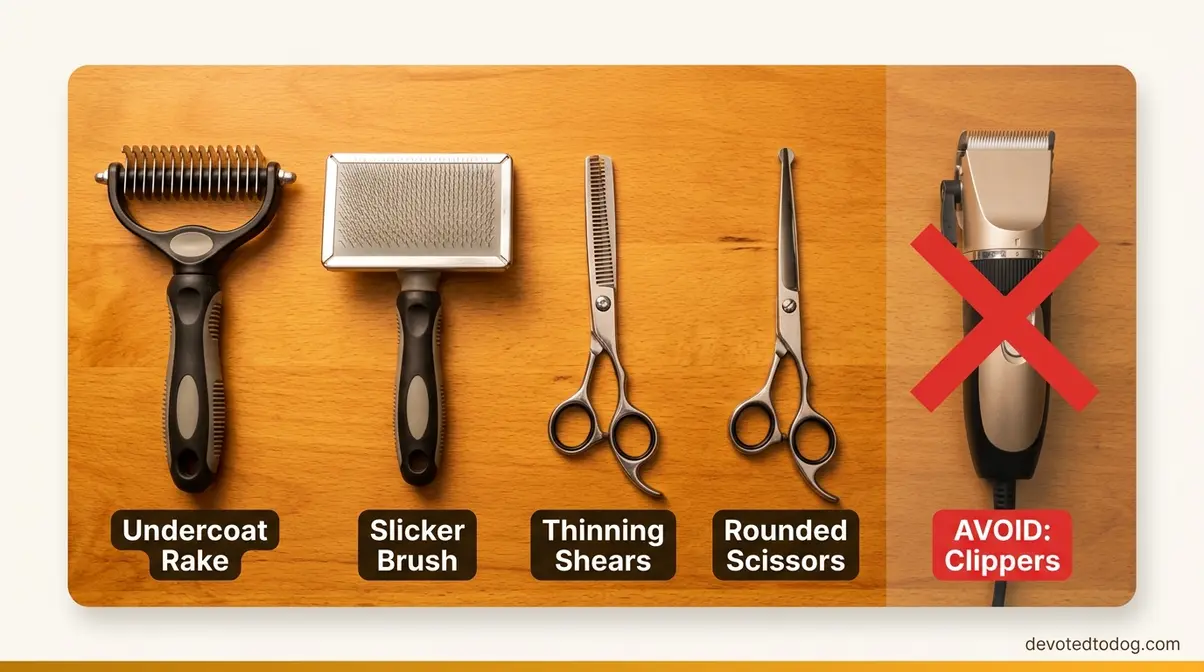
Use an undercoat rake, a grooming tool with long, wide-set teeth designed to remove loose undercoat without cutting the topcoat, to clear loose fur before any trimming. Never trim a dirty or matted coat.
Step 2: Trim around the ears.
Use thinning shears to neaten the ear feathering. Cut parallel to the hair growth direction to avoid blunt lines.
Step 3: Tidy the paws.
Trim the hair between the paw pads and around the foot edges with rounded-tip scissors. This improves traction and reduces debris tracking.
Step 4: Neaten the tail.
Shape the tail feathering into a fan shape with thinning shears, this is one of the areas where a little tidying makes the biggest visual difference.
Step 5: Trim the belly and groin area lightly.
This reduces matting and keeps the dog comfortable without touching the topcoat.
Step 6: Never trim the body coat.
Leave the back, sides, and neck coat alone. A professional groomer familiar with double-coated breeds will follow this approach, if yours reaches for full-body clippers, redirect them.
Best Tools for Double Coats
The right tools make safe grooming much easier. Investing in high-quality grooming tools early on will save you time and keep your dog comfortable. Here’s what belongs in your kit:
- Undercoat rake, removes loose undercoat without cutting the topcoat; essential during shedding season
- Slicker brush, removes tangles and debris from the topcoat; use gently and in the direction of hair growth
- Thinning shears, for trimming feathering and tidying edges without cutting bluntly
- Rounded-tip scissors, for paw and ear trimming where precision matters
- Deshedding tool (Furminator-style), use sparingly; overuse can damage the topcoat
Tools to avoid on the body coat: electric clippers, thinning shears used on the undercoat directly, or scissors for large-area trimming.
For specific product recommendations, the guide to best brushes for Golden Retrievers covers what actually works for double-coat management.
Do Short-Haired Goldens Shed Less?
No, Golden Retrievers with shorter coats still shed significantly, regardless of coat length. All Golden Retrievers have a double coat that sheds year-round, with two heavy seasonal blows (spring and fall) where shedding dramatically increases. A shorter-coated field-bred Golden may produce slightly less visible hair volume simply because the individual hairs are shorter. Regular brushing, at least 2-3 times per week, is the most effective way to manage shedding for any Golden. No grooming technique, including shaving, eliminates shedding, it only changes where the hair ends up.
If you love the Golden temperament but want a naturally shorter coat from day one, there are excellent alternatives worth considering.
What Are the Golden Retriever Mixes and Alternatives?
If you want to stay on the short end of the Golden Coat Spectrum from day one, a short haired golden retriever mix may be your best path. These crosses combine the Golden’s famous temperament with a naturally shorter coat, without the long-term grooming commitment of a show-bred Golden. The key is knowing which mixes actually deliver on that shorter coat.
The Goldador (Golden Lab Mix)
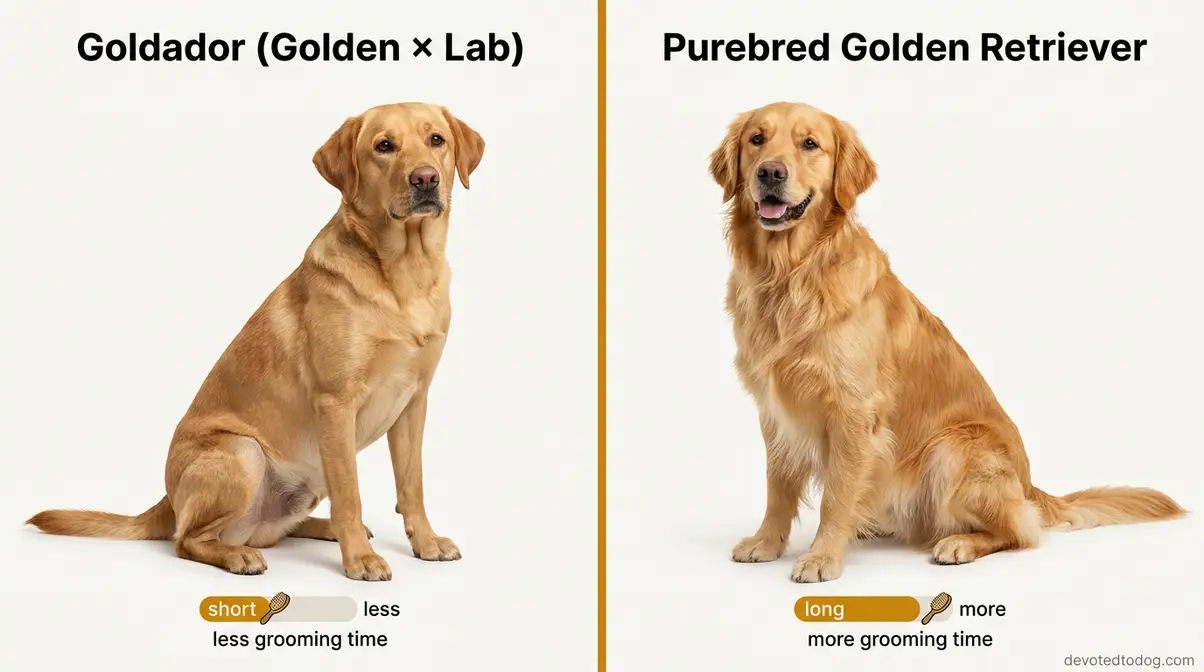
The Goldador is a Golden Retriever × Labrador Retriever, one of America’s most popular family dogs, mix. Because Labrador Retrievers commonly carry the short-hair FGF5 variant, many Goldadors inherit a noticeably shorter, denser coat than a purebred Golden.
The Goldador (Golden Retriever × Labrador mix) typically inherits the Lab’s shorter coat while retaining the Golden’s friendly, trainable personality. The result is often described as the “best of both breeds”, the Golden’s emotional intelligence and the Lab’s slightly more compact, lower-maintenance coat.
If you want the Golden personality with a coat that’s significantly easier to manage, the Goldador is the most natural starting point. For a full breakdown, the Golden Retriever Lab mix (Goldador) guide covers temperament, health, and what to expect from this cross.
Other Golden Mixes with Shorter Coats
The Goldador isn’t the only option. Several other short haired golden retriever mix crosses offer a similar personality with a shorter coat:
- Golden × Boxer, shorter coat, high energy, deeply loyal; tends toward the Boxer’s smooth single coat
- Golden × Beagle (Beago), shorter coat, smaller size, friendly and curious; great for apartment dwellers
- Golden × Pitbull, shorter coat, strong and muscular, affectionate with family; requires confident handling
With any mix, coat length, temperament, and size will vary depending on which parent’s genes are dominant. Ask the breeder or rescue specifically about the individual dog’s coat and temperament, there’s considerably more variation in mixes than in purebreds. For a broader look, best Golden Retriever mixes covers the most popular crosses with honest notes on what to expect.
Purebred Alternatives to Goldens
If you’d prefer a purebred dog with a shorter coat and a similar personality, two breeds stand out:
- Labrador Retriever, the most obvious choice. Similar temperament (friendly, trainable, great with families), naturally short coat, slightly higher energy. Labs and Goldens share the same “retriever family” enthusiasm, the swap is seamless for most families.
- Chesapeake Bay Retriever, another retriever breed with a shorter, wavy, water-resistant coat. More independent than Goldens but similarly athletic and loyal; a good fit for active owners who want a working-line temperament.
If the Golden’s personality is the priority and the long coat is the obstacle, a Labrador is the most straightforward swap.
Where Do You Find and Buy a Short-Haired Golden Retriever?
Ready to find your own shorter-coated Golden? Because “short-haired” isn’t a separate breed, the process is the same as finding any purebred Golden, with one important twist: you’re specifically looking for field-line or working-line breeders.
How Much Do They Cost?
A short haired golden retriever for sale from a reputable breeder costs the same as any purebred Golden, between $1,000 and $3,500, with many quality breeders pricing puppies around $2,000 (Spot Pet Insurance, 2026; Rover, 2026). Since “short-haired” is not a separate breed, there is no price premium or discount for coat length.
Field-bred Golden puppies from working lines may cost slightly more due to the rarity of quality working bloodlines, but the range is broadly similar. For a complete picture of lifetime costs, the full Golden Retriever cost breakdown covers everything from puppy purchase to veterinary care.
Adoption from a Golden Retriever rescue is a more affordable option, typically costing $200-$500 in adoption fees. Adult field-bred Goldens occasionally appear in breed-specific rescues, worth checking before purchasing.
Finding a Reputable Field Breeder
Finding the right breeder matters more than finding the lowest price. Here’s how to approach it:
- Start with the GRCA breeder directory. The Golden Retriever Club of America (GRCA), the AKC’s official parent club for the breed, lists breeders who have agreed to a Code of Ethics. Filter specifically for “field” or “working” lines.
- Verify health testing. Reputable field-line breeders test their dogs for OFA hip and elbow certifications, cardiac clearances, and eye certifications, even with a working focus.
- Ask specific questions. “What are the parent dogs’ coat lengths?” and “Are these dogs from hunting or working lines, or show lines?” A good breeder will answer both without hesitation.
For step-by-step guidance, how to find a reputable Golden Retriever breeder walks through the full vetting process.
Red Flags to Watch Out For
Knowing what to look for also means knowing what to avoid:
- Breeder advertising “AKC-registered short-haired Golden Retrievers” as a distinct breed
- No health testing certificates for parent dogs, this is non-negotiable
- Puppies available immediately with no waiting list (reputable breeders typically have one)
- Price significantly below $800 (a puppy mill signal) or above $5,000 without clear justification
- Unwilling to let you visit the facility or meet the parent dogs in person
A reputable breeder will ask you questions, about your home, your experience with dogs, and your plans for the puppy. That’s a green flag.
What Common Grooming Mistakes and Health Risks Should You Avoid?
Even well-intentioned owners make grooming choices that cause real harm. Golden Retriever owner communities consistently report the same recurring mistakes, most of which come from applying human hair logic to a dog with a very different coat structure.
Top Grooming Pitfalls to Avoid
Pitfall 1: Shaving the body coat. An owner thinks shaving will help with summer heat. The consequence: the double coat’s temperature regulation is removed, increasing sunburn and heat stroke risk, and potentially causing permanent coat damage (post-clipping alopecia). The fix: use an undercoat rake to remove loose undercoat instead of reaching for clippers.
Pitfall 2: Over-bathing. Bathing weekly to manage shedding strips the natural oils from the double coat, causing dryness and, counterintuitively, increased shedding. The fix: bathe every 4-6 weeks maximum using a dog-specific shampoo formulated for double coats.
Pitfall 3: Ignoring the undercoat. Brushing only the topcoat with a regular brush leaves the undercoat untouched. Mats form close to the skin, causing discomfort and skin issues that worsen over time. The fix: use an undercoat rake or deshedding tool at least weekly, working in sections.
Pitfall 4: Using human hair products. Human shampoo and conditioner have a different pH than dog skin. The consequence is skin irritation, dryness, and coat damage. The fix: dog-specific grooming products only, every time.
When to See a Vet or Groomer
Some situations call for professional help, and knowing the threshold matters.
See a professional groomer when: the coat is severely matted (never attempt to remove severe mats at home with scissors, the risk of cutting the skin is high), when you’re unsure about trimming technique, or when your dog is anxious about home grooming sessions.
Consult your veterinarian if you notice sudden coat changes, this is a health matter, not just a grooming issue. Patchy coat loss, sudden texture changes, or excessive itching can signal thyroid issues, allergies, or skin conditions. Any unexpected change in your dog’s coat warrants a vet visit, not a grooming appointment.
Frequently Asked Questions
Is there a short-haired Golden?
No, there is no officially recognized short-haired Golden Retriever breed. However, some purebred Goldens naturally have shorter coats due to their genetics, particularly field-bred or working lines selectively bred for athleticism. A Golden-looking dog with a noticeably short coat is most often a Golden × Labrador mix.
What are the three Golden types?
The three main types of Golden Retrievers are the American, British (English), and Canadian varieties. British Goldens tend to be stockier with lighter coats, American Goldens are lankier with darker gold coats, and Canadian Goldens are leaner with thinner coats. Within these types, “field-bred” and “show-bred” distinctions significantly affect coat length and energy level. All three types share the same friendly temperament.
How much do short-haired Goldens cost?
A short-haired Golden Retriever costs the same as any purebred Golden,between $1,000 and $3,500 from a reputable breeder (Spot Pet Insurance, 2026). Since “short-haired” is not a separate breed, there is no price premium or discount for coat length. Field-bred Golden puppies from working lines may cost slightly more due to the rarity of quality working bloodlines. Adoption from a Golden Retriever rescue is a more affordable option, typically costing $200-$500 in adoption fees. Prices vary by location, breeder reputation, and the puppy’s lineage.
Can you keep their hair short?
You can trim a Golden Retriever’s coat to maintain a neater appearance, but you should never shave it. Trimming the feathering around the ears, paws, and tail with scissors or thinning shears is safe and widely practiced. Shaving the body coat, however, removes the double coat’s ability to regulate temperature and can cause permanent coat damage.
Field-bred vs. show-bred differences?
Field-bred Golden Retrievers are bred for hunting and fieldwork, while show-bred Goldens are bred to match the AKC’s aesthetic breed standard. Field-bred Goldens have shorter, denser coats, leaner athletic builds, and higher energy levels. Show-bred Goldens have longer, flowing coats with full feathering, stockier builds, and calmer temperaments. Both are purebred Golden Retrievers with the same friendly, trainable personality.
Are short-haired Golden Retrievers a separate breed?
No. Short-haired golden retrievers are not a separate breed, they are simply Golden Retrievers with shorter coats than the show-line standard. The retriever short hair phenotype is most common in field-bred (working line) Goldens, where shorter coats are practical for retrieving in water. A short hair golden retriever puppy from working lines will keep its shorter coat for life, while show-line puppies develop longer feathering between 12 and 24 months.
Why is my Golden Retriever short-haired?
Three main reasons: (1) field/working line genetics , these breeders select for shorter, denser, more practical coats; (2) age , puppy coats are short and grow into longer adult coats between 12 and 24 months; (3) coat shedding cycle , twice-yearly heavy shedding can temporarily make a Golden look short-haired. A ‘golden retriever short’ coat from a reputable breeder is normal and within the AKC standard.
Why Is Your Golden Exactly Right As-Is?
For anyone wondering about their short haired golden retriever, the answer is reassuring: shorter coats in Golden Retrievers are normal, natural, and common, especially in field-bred lines and young dogs. The FGF5 gene means a truly short-haired purebred Golden is genetically impossible, but the Golden Coat Spectrum naturally produces a wide range of coat lengths from the same breed (NIH/PMC, 2026). Your dog isn’t unusual, they’re just on a different part of the spectrum.
The Golden Coat Spectrum has three axes: genetics (the FGF5 gene), breeding line (field vs. show), and life stage (puppy coat vs. adult coat). Understanding which axis explains your dog’s coat resolves the confusion immediately. That short-coated puppy with fluff only behind his ears? Give it time. The Golden Coat Spectrum almost always delivers the full, feathered adult coat by 18-24 months, and even if the coat stays shorter, a field-bred Golden is every bit the dog the breed is famous for.
If you’re ready to find a shorter-coated Golden, start with the GRCA’s breeder directory and ask specifically for field-line dogs. And if you’re managing the coat you already have, grab the right tools, an undercoat rake, a slicker brush, and thinning shears, and never reach for the clippers. For finding the right breeder, how to find a reputable Golden Retriever breeder is the place to start.
Curious where the breed comes from? Read the Golden Retriever’s origins.