
“We seriously cannot decide on a male or female golden! I need pros and cons of both lol! We also have 2 young kids! We just want them to grow up with the best dog!”
, Golden Retriever owner community, r/goldenretrievers
If that sounds familiar, you’re in good company. Families ask this question every single day, and the answers they get, from breeders, neighbors, and random corners of the internet, are all over the place.
Here’s the honest truth: choosing the wrong gender won’t ruin your experience. But picking a gender whose natural tendencies clash with your household’s energy level, schedule, and space can make the first two years harder than they need to be. A “Velcro dog” in a chaotic household, or an independent female in a family that craves maximum cuddle time, these mismatches are real, and they’re avoidable.
By the end of this guide on the male vs. female Golden Retriever, you’ll know exactly which gender fits your lifestyle, backed by breed standards, veterinary research, and the real experiences of Golden owners. We cover temperament, size, trainability, health, and a practical decision framework so you can stop second-guessing and start preparing.
AKC standard
AKC standard
males 2-3 yrs
UC Davis spay/neuter study
Author Credentials
📝 Written by: Coral Drake
✅ Reviewed by: Brianna York, Former Veterinary Technician
📅 Last updated: 5 May 2026
ℹ️ Transparency Notice
This article compares male and female Golden Retrievers based on AKC breed standard, GRCA growth data, and peer-reviewed veterinary research on sex-related health differences. All claims have been verified by our editorial team and reviewed for medical accuracy.
Temperament: Who’s More Affectionate?

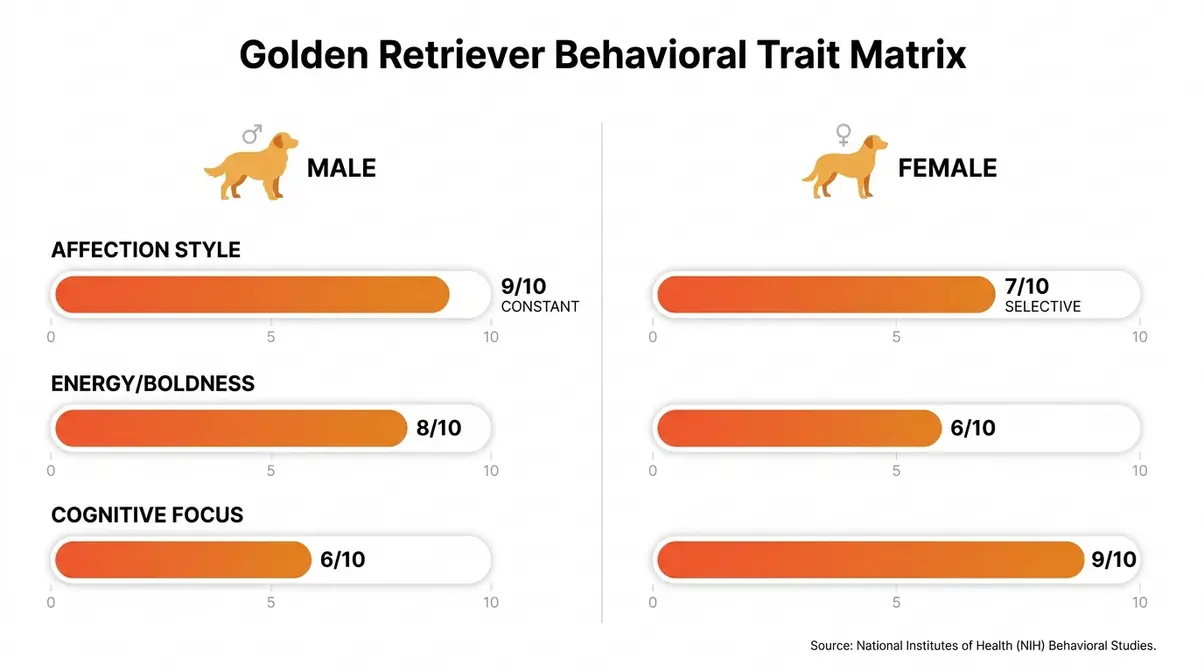
Both male and female Golden Retrievers are deeply affectionate, but they express it in noticeably different ways. Males tend to show affection constantly, following you from room to room and seeking physical contact throughout the day. Research published in the National Institutes of Health (NIH) journal PMC confirms that male dogs generally exhibit higher boldness and assertiveness, while female dogs demonstrate stronger visual focus during cognitive tasks (NIH research on dog behavioral differences, PMC, 2018). For your family, this means a male may feel like a perpetual companion, and a female may feel like a thoughtful one.
The “Velcro Dog” vs. the Independent Spirit

Are male or female Golden Retrievers more affectionate? Males are typically more overtly affectionate, they’re the breed’s classic “Velcro dogs,” meaning dogs that follow their owners everywhere and actively seek constant physical contact. Females are equally loving, but they tend to show it on their own schedule. Both genders are genuinely warm; the difference is in the delivery.
A male Golden may wait outside the bathroom door or press against your leg while you cook dinner. A female may settle on her bed across the room, and then choose to come over when she decides it’s cuddle time. Owner communities consistently use the word “cuddly” for males and “headstrong” or “stubborn” for the female’s independent streak.
If you work from home, a male Golden Retriever will likely spend the entire day sleeping under your desk, resting his chin on your feet, and nudging your arm for pets during Zoom calls. They thrive on physical proximity and can become visibly distressed if shut out of your home office. A female, conversely, is often perfectly content to sleep on the living room sofa while you work in the next room. She knows where you are and will periodically check in, but she doesn’t require constant physical contact to feel secure. This subtle difference in attachment style is why many remote workers who need uninterrupted focus sometimes lean toward female Goldens, while those who want a constant co-worker prefer males.
NIH research on dog behavioral differences (PMC, 2018) supports this pattern: males score higher on boldness and assertiveness, while females rely more on visual cues and show stronger focus during learning tasks. In plain language, males are emotionally “louder,” and females are mentally sharper in structured settings.
If you have young kids who want a dog glued to their side all day, a male may feel like the perfect match. If your household values a dog that’s loving but gives everyone breathing room, a female fits that picture well.
Affection style is just one piece of the puzzle. How each gender manages energy throughout the day is equally important, especially for families with young children.
Energy Levels and Social Behavior
Male Golden Retrievers tend to be more exuberant and boisterous in social situations. They’re more “sticky and affectionate” with strangers, the kind of dog who loves everyone immediately, rushes the front door when guests arrive, and has a higher play drive overall. This social indiscrimination is one of the things families with kids love most about male Goldens.
Female Goldens can be more selective. They may take slightly longer to warm up to new people and are less likely to launch themselves at every visitor. Owner consensus from Golden Retriever communities on Reddit and Facebook notes that females can be “more independent and stubborn at times”, which isn’t a flaw, just a different personality style.
One important note on territorial behavior: both genders are generally non-territorial. However, intact (meaning not spayed or neutered) females may show more resource-guarding behavior during heat cycles, a pattern worth knowing if you plan to delay spaying.
For a household with frequent visitors or young kids’ playdates, a male’s universal friendliness is often a social asset. Understanding these energy patterns is the first step in applying The Lifestyle Alignment Method, matching the dog’s natural output to your household’s actual daily rhythm.
Beyond research and breeder data, the most vivid picture of these differences comes from the people who’ve lived with both genders.
What Real Owners Say About Male and Female Goldens
Owner communities paint a consistent picture when it comes to golden retriever male vs. female personality. Across r/goldenretrievers and Golden Retriever Facebook groups, the contrast shows up again and again:
“My males would crawl into your lap at any opportunity. My female will come for love, then go do her own thing.”
, r/goldenretrievers community
“Girls love you, but the boys are in love with you.”
, Golden Retriever owner community consensus
“I’ve had both and they both are perfect pups. It really comes down to what energy fits your home.”
, Utah Golden Retrievers Facebook group
There’s a lovely answer buried in that last quote to the question “How do you say ‘I love you’ in dog language?” A male Golden’s constant shadow-following IS his “I love you.” A female’s choosing to settle next to you, rather than across the room, is hers. Neither is less meaningful. They’re just different dialects of the same devoted breed.
Individual personality and upbringing ultimately shape affection style more than gender alone. Now that you understand personality differences, let’s look at the physical side, because size and build affect everything from your living space to your grocery bill.

How Do Physical Differences Compare?
| Age | Male Weight (lbs / kg) | Female Weight (lbs / kg) | Notes |
|---|---|---|---|
| 3 months | 22-30 lbs / 10-14 kg | 20-28 lbs / 9-13 kg | Females slightly lighter from puppyhood |
| 6 months | 40-55 lbs / 18-25 kg | 35-50 lbs / 16-23 kg | Both reach ~60-70% adult weight |
| 12 months | 55-70 lbs / 25-32 kg | 50-60 lbs / 23-27 kg | Females reach near-adult weight first |
| 18 months | 60-75 lbs / 27-34 kg | 55-65 lbs / 25-29 kg | Males still filling out |
| Adult (24 mo+) | 65-75 lbs / 29-34 kg | 55-65 lbs / 25-29 kg | Males average about 10 lbs heavier (AKC, 2025) |
| Healthy weight range | Body condition score 4-5/9 | Body condition score 4-5/9 | Same scale, sex-neutral |

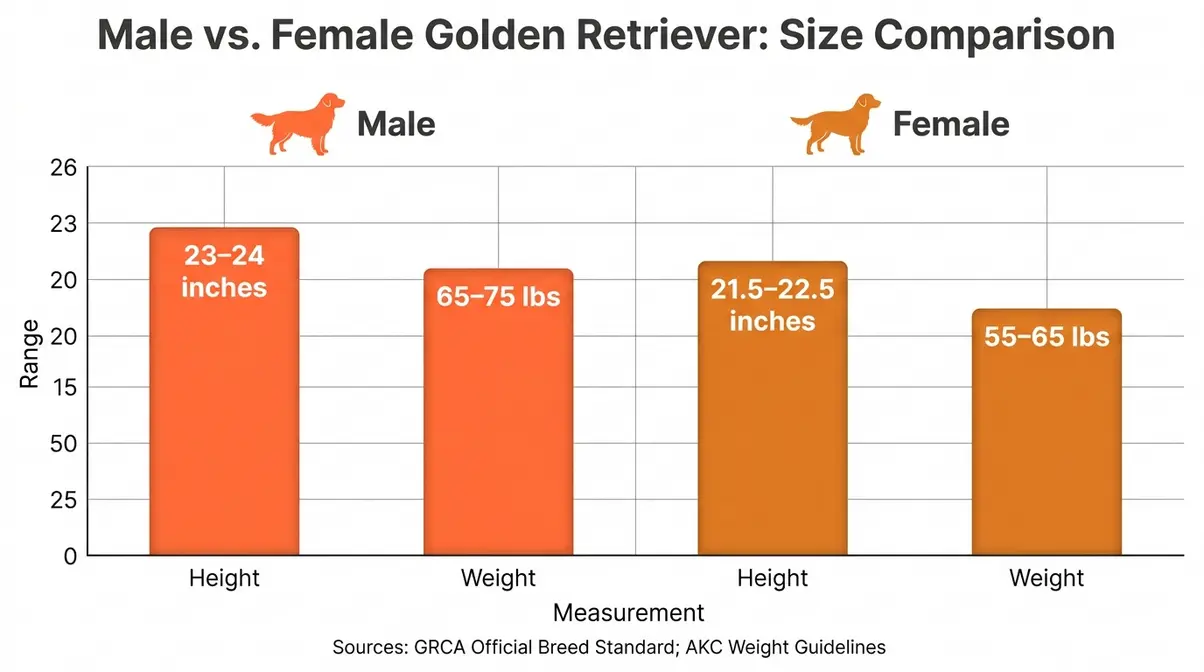
When comparing a male vs. female Golden Retriever, size is the most immediate and measurable difference. Males are consistently taller and heavier than females by breed standard, a gap of roughly 10 pounds and 1.5 inches in height. The Golden Retriever Club of America (GRCA), the official breed registry, and the American Kennel Club (AKC), the leading canine organization in the United States, both document these ranges clearly. Size affects food costs, space requirements, and how much pulling power you’re managing on a leash.
| Trait | Male Golden Retriever | Female Golden Retriever |
|---|---|---|
| Height (at withers) | 23-24 inches | 21.5-22.5 inches |
| Weight | 65-75 lbs | 55-65 lbs |
| Build | Stockier, broader chest | Leaner, more refined |
| Head Shape | Larger, blockier | Slightly smaller, finer |
| Coat | Often thicker, heavier mane | Slightly finer, less ruff |
| Temperament | Overtly affectionate, “Velcro” | Loving but more independent |
| Trainability | Slower maturity (2-3 years) | Faster maturity (18 months) |
| Health Focus | Joint disorder risk if neutered early | Cancer risk linked to spay timing |
| Avg. Lifespan | 10-12 years | 10-12 years |
Sources: Golden Retriever Club of America official breed standard; American Kennel Club weight guidelines.
Height and Weight: The Numbers Side by Side

Male vs. female Golden Retriever size differences are officially documented by both major breed authorities. The official GRCA height standards specify males at 23-24 inches at the withers (the highest point of the shoulder blade), while females measure 21.5-22.5 inches. The AKC weight guidelines for Golden Retrievers place males at 65-75 lbs and females at 55-65 lbs.
To put that in perspective: a 75-lb male is roughly the weight of a large 10-year-old child. That’s a meaningful difference when you’re wrangling a leash, lifting a dog into a car, or catching a dog who’s about to knock over a toddler.
The roughly 10-lb gap matters for apartment dwellers, older owners, or households with very young children who may be bowled over by an exuberant larger dog. If you live in a smaller home or need a dog that’s easier to lift onto a vet table, the female’s smaller frame is a practical advantage, not just an aesthetic one.
For a full picture of how both genders grow from puppyhood to adulthood, see these Golden Retriever growth and size charts by age.
Size is the most visible difference. But look closer and you’ll notice the male’s “big blocky head” and heavier coat, details that Golden Retriever owners talk about constantly.
Head Shape, Coat, and Build
Golden retriever male vs. female appearance differences go beyond the scale. Males have a larger, broader skull, the iconic “big blocky heads” that owners frequently seek out. Their neck ruff (the fur around the neck and chest) is heavier and more dramatic, giving them a bear-like, imposing look that many families find irresistible.
Female Goldens have a more refined, slightly smaller head. Their coat is often described as slightly finer with less dramatic ruff, and their body profile is leaner, some owners describe the female as more “elegant” in build. Many owners specifically seek out males for their iconic big blocky heads and heavier mane, while others prefer the female’s sleeker silhouette.
One thing that doesn’t differ: both genders have the breed’s characteristic dense, water-repellent double coat. Neither is “low shedding.” Both need brushing at least 2-3 times per week to manage shedding and prevent matting. The AKC weight guidelines for Golden Retrievers note that males typically weigh 65-75 lbs with a broader build; females weigh 55-65 lbs with a more refined frame (AKC).
Appearance is personal preference. Health, however, is not, and this is where the male vs. female decision gets more serious.
Health Considerations and the Spay/Neuter Decision

What is the silent killer in Golden Retrievers? Cancer. Golden Retrievers have one of the highest cancer rates of any breed, with cancer causing 65% of deaths in a UC Davis study of the breed (Kent et al., PLoS ONE, 2018). The timing of spay or neuter surgery significantly affects this risk, and this is the single most underreported finding in this topic space.
UC Davis School of Veterinary Medicine, one of the top veterinary research institutions in the world, studied 759 Golden Retrievers and found striking results. Of males neutered before 12 months, 10% were diagnosed with hip dysplasia, double the rate in intact males, and 5% had cranial cruciate ligament (CCL) tears, versus none of the intact males (Torres de la Riva et al., PLoS ONE, 2013). A 2020 UC Davis follow-up found one or more joint disorders in 25% of male Goldens neutered before 6 months, versus 5% of intact males (Hart et al., Frontiers in Veterinary Science, 2020). The UC Davis study on neutering health risks also found that spay timing affected cancer rates in females compared to intact (meaning not spayed or neutered) females, with late-neutered females showing elevated rates of hemangiosarcoma (a blood vessel cancer) (UC Davis, 2013/updated).
The 2013 study recorded no CCL tears in intact males, but hip dysplasia still occurred in intact males at about half the early-neutered rate, so leaving a male intact lowered joint risk rather than removing it. For females, the cancer findings were particularly concerning. The data revealed that females spayed after 12 months of age had about four times the hemangiosarcoma rate of intact and early-spayed females, and mast cell tumors appeared only in the late-spayed group, making the decision highly nuanced. Veterinary oncologists emphasize that hormones play a crucial role in the closure of growth plates and the development of a robust immune system. Removing these hormones too early disrupts the dog’s natural structural and immunological development.
These findings apply equally to English Cream Golden Retrievers, which are the same breed as American Golden Retrievers and share the same health profile.
This doesn’t mean don’t spay or neuter, it means discuss timing with your vet. Ask your vet which timing fits your dog, because the same research found different risks for males and females. The gender you choose matters less for long-term health outcomes than the spay/neuter decision you make, and when you make it.
Now that you understand the physical and health picture, the next question most owners ask is: which gender is easier to train?
Trainability: Which Gender Learns Faster?

Female Golden Retrievers generally mature mentally faster than males, which gives them a slight training advantage in early puppyhood, but both genders are among the most trainable dog breeds in the world. Female Goldens typically reach mental maturity around 18 months, while males may not fully settle into consistent, focused behavior until age 2 or even 3. For a first-time owner, that timeline difference is real and worth planning around.
Owner consensus from r/goldenretrievers and professional breeder communities widely confirms the female maturity advantage, and it’s something Devoted to Dog’s review of Golden Retriever owner communities reinforces consistently.
For a visual walkthrough of Golden Retriever adolescence and training timelines, watch this overview:
Mental Maturity Timelines: Who Grows Up First?

Are girl or boy Golden Retrievers easier to train? Female Golden Retrievers are often slightly easier to train in early puppyhood because they reach mental maturity around 18 months. Males typically stay in their “puppy phase”, playful, easily distracted, and boundary-testing, until age 2 or even 3.
For a beginner, “mental maturity” means the ability to hold focus on a command for longer periods, respond consistently instead of selectively, and regulate impulsive behavior. A female at 12 months is often acting like a “teenager.” A male at 12 months is still very much a “kid.”
Housetraining reflects this too. Females often housetrain slightly faster due to earlier maturity. Males may have more accidents during the extended adolescent phase, not because they’re less intelligent, but because their impulse control simply hasn’t caught up yet. For a deeper look at how this plays out over time, see when Golden Retrievers calm down and mature.
Understanding the timeline is helpful. But what do you do about it? Here are six specific training scenarios, three for males, three for females.
6 Scenario-Based Training Strategies for Each Gender
Both genders are highly motivated by pleasing their owners, which is what makes Goldens so trainable. The strategies below address the specific challenges each gender presents during the puppy and adolescent phases. Professional trainer consensus and breeder community experience back each approach.
For Male Golden Retrievers (the “distractible Velcro male”):
- The Park Recall Problem: At 10-12 months, a male may ignore recall commands the moment a squirrel appears. Practice recall with high-value treats (chicken, not kibble) in progressively distracting environments, start at home, then a quiet yard, then a park. Build the habit before the distraction arrives.
- The Boundary-Testing Phase (8-18 months): Males may “forget” commands they knew perfectly at 6 months. Return to basics, 5-minute training sessions twice daily. Consistency beats duration every time during adolescence.
- The Separation Anxiety Spiral: Male Velcro dogs can develop separation anxiety more readily than females. Start crate training from day one, and practice “alone time” in 5-minute increments before leaving for work. Small, regular exposures prevent the anxiety from taking root.
For Female Golden Retrievers (the “independent fast-maturers”):
- The “I Know Better” Moment: Females may show selective listening, they understand the command, but choose when to comply. Reward voluntary compliance immediately and enthusiastically. Never repeat a command more than twice; repetition teaches them that delay is acceptable.
- The Heat Cycle Distraction (intact females): During heat cycles, which occur roughly every 6 months, focus and behavior may shift noticeably. Reduce training intensity during this period. Focus on reinforcing known commands rather than introducing new learning, you’ll get better results with less frustration.
- The Early Obedience Window: Females between 8-14 months are often in their “golden window” of trainability. Introduce advanced commands, heel, stay, leave it, during this period. They absorb new skills faster than males at the same age, and those habits stick.
The training challenges peak at a specific age for male Golden Retrievers, and knowing when to expect it helps you prepare.
The Hardest Age for Male Golden Retrievers

The hardest age for a male Golden Retriever is typically between 8 and 18 months, their adolescence (the developmental period between puppyhood and full adulthood, typically 8-18 months in dogs). During this period, males may seem to “forget” training, test boundaries repeatedly, and have more energy than focus.
During this adolescent phase, male Golden Retrievers undergo significant hormonal and developmental changes that temporarily override their natural desire to please. You might notice your previously perfectly behaved male suddenly ‘forgetting’ how to walk on a loose leash, or ignoring the ‘drop it’ command when he steals a sock. This period requires immense patience. Professional trainers often refer to this as the ‘management phase’,your goal isn’t necessarily to teach new, complex tricks, but rather to manage his environment so he doesn’t practice bad habits. Using long lines during park visits, utilizing baby gates to prevent counter-surfing, and maintaining a strict daily routine can prevent adolescent regression from becoming permanent behavior. Remember that physical exercise alone won’t tire out an adolescent male; mental stimulation through puzzle toys, snuffle mats, and short obedience drills is essential to drain that excess teenage energy.
This isn’t stubbornness, it’s developmental. Slower mental maturation compared to females means the impulse-control circuitry simply isn’t fully online yet. Reassure yourself: this is normal, it’s temporary, and it responds well to structure.
What gets you through it: consistent short sessions (5-10 minutes, twice daily), high-value rewards, and physical exercise before training to burn off energy. A tired Golden is a focused Golden. Most male Golden Retriever temperament shifts happen around 24-30 months, owners consistently report that their male Golden has “clicked” into a calm, obedient companion by that age. The adolescent chaos is real, but it ends.
“Female Golden Retrievers typically reach mental maturity at 18 months, while males may not fully mature until 2-3 years of age”, making early training comparisons gender-influenced but not gender-deterministic.
With all these differences in mind, it’s time to make the call. Here’s how to weigh everything and choose the gender that actually fits your life.
How Do You Make Your Decision (Pros and Cons)?
Neither gender is objectively better, the best Golden Retriever for your family is the one whose natural traits align with your lifestyle. Both males and females are loving, highly trainable, and excellent with children. The differences between a male or female Golden Retriever are real but manageable with the right preparation. AKC experts on dog gender stereotypes confirm that canine experts consistently find individual personality and socialization outweigh gender as predictors of a dog’s temperament (AKC, 2026).
Male Golden Retriever: Pros and Cons
A male Golden is the right choice if you want a loyal shadow who’s always “on”, and you have the patience for a longer puppy phase.
Pros:
- More overtly affectionate, the classic “Velcro dog” who stays by your side throughout the day
- Larger, imposing presence (some families prefer this for safety perception and visual impact)
- Tends to stay playful and puppy-spirited longer, great for active families with kids who want an energetic play partner
- Generally more socially indiscriminate, loves strangers, guests, and new dogs almost immediately
- Those iconic “big blocky heads” and heavier mane that many owners specifically seek out
Cons:
- Longer adolescent phase (8-18 months of boundary-testing and selective focus)
- Higher food costs due to larger size, about 10 lbs more than females adds up over a decade
- More prone to separation anxiety if left alone frequently, given their Velcro nature
- Can be more boisterous, may knock over toddlers due to larger size and exuberance
- Early neutering significantly increases joint disorder risk, timing of neutering must be discussed with your vet
Where males excel at constant companionship, females take a different approach, offering affection with a side of independence.
Female Golden Retriever: Pros and Cons
A female Golden is the right choice if you want a dog that’s loving but gives everyone breathing room, and you’re ready to navigate heat cycles if you delay spaying.
Pros:
- Faster mental maturity, slightly easier to train in early puppyhood, with fewer adolescent setbacks
- Smaller, lighter frame, easier to handle physically, lower food costs, better fit for smaller living spaces
- More independent, less likely to develop separation anxiety if you work outside the home
- Often described as more focused during training sessions (NIH behavioral research, PMC, 2018)
- Excellent with children, affectionate without being physically overwhelming
Cons:
- Heat cycles (every ~6 months) if kept intact, behavioral changes, hygiene management, and attracting male dogs
- Can be more “headstrong”, selective listening is more common, especially in adolescence
- Less overtly cuddly on demand, some owners find the female’s independent affection style less satisfying
- Spay timing affects cancer risk, timing of spaying must be discussed with your vet
- Some owners describe females as “moodier,” though AKC experts on dog gender stereotypes caution this is often individual variation, not a gender trait (AKC, 2026)
Now for the real question: which one is right for your specific household?
Which Gender Fits Your Lifestyle? (The Lifestyle Alignment Method)
The Lifestyle Alignment Method is the practice of evaluating a dog’s natural gender tendencies against your household’s actual daily energy, schedule, and affection needs, rather than choosing based on stereotypes. It asks one simple question: does this gender’s natural traits fit the life your family actually lives, not the idealized version?
Use this table to map your situation:
| Your Situation | Recommended Gender | Reason |
|---|---|---|
| Family with young children (ages 2-8) | Either, slight edge to females | Females less likely to knock over toddlers; both are excellent with kids |
| First-time dog owner | Female | Faster maturity = faster training wins = more confidence for new owners |
| Active family / outdoor lifestyle | Male | Higher energy and play drive matches active households |
| Apartment / smaller home | Female | Smaller frame, slightly less boisterous indoors |
| Single owner who wants a “shadow” | Male | The Velcro dog experience is strongest with males |
| Owner who travels frequently | Female | Less prone to separation anxiety |
| Already have a male dog at home | Female | Reduces same-sex dominance tension |
The Lifestyle Alignment Method asks you to consider whether your living space and physical capacity, leash-handling, car space, toddler safety, actually accommodate a 75-pound male, or whether a 60-pound female is the more realistic match for your life right now.
No table can replace meeting the actual puppy. Individual personality varies enormously, ask your breeder to match you based on temperament testing, not just gender. Our guide to choosing your Golden Retriever puppy walks you through exactly what to look for.
Made your decision? If you’re leaning female, the next question most owners have is: what should I name her?
What Are Some Female Golden Retriever Name Ideas?
Choosing a name for your female Golden Retriever is one of the genuinely fun parts of the process. The best names suit the breed’s warm, sunny personality, and ideally, they’re easy to call across a dog park. These lists draw from what Golden Retriever owner communities consistently favor and suggest.
Popular Names for Female Golden Retrievers
These names consistently top Golden Retriever owner communities’ favorite lists, and for good reason. Each suits the female Golden’s affectionate, joyful character:
- Bella, the perennial favorite; warm and classic
- Goldie, leans into the breed’s signature coat color
- Honey, suits the breed’s famously sweet temperament
- Daisy, bright and cheerful, matches a Golden’s sunny energy
- Luna, popular across all breeds; elegant and easy to call
- Sadie, friendly and approachable, like the dog herself
- Rosie, cheerful and feminine, a natural fit
- Maggie, classic, sturdy, and always easy to shout at the park
- Molly, warm and friendly, another enduring favorite
- Sunny, captures the Golden’s famously optimistic personality
If you’d prefer something less common, here are some names that stand out in the dog park.
Unique Female Golden Retriever Names
Nature-inspired names complement the Golden’s outdoor-loving personality beautifully. There’s also a practical training benefit worth noting: a less common name is less likely to be confused with common commands or other dogs at the park.
- Clover, fresh and nature-forward, suits a dog who loves the outdoors
- Wren, short, sharp, and easy to call; a bird name with quiet elegance
- Saffron, golden-hued, perfectly on-brand for the breed
- Maple, warm and autumnal, suits a golden-coated dog naturally
- Juniper, adventurous and distinctive, great for active families
- Hazel, soft and warm, with a classic feel that’s not overused
- Ember, a beautiful nod to the breed’s rich golden coat tones
Tips for Naming Your Female Golden
When selecting the perfect name, keep canine hearing and training mechanics in mind. Dogs respond best to names with two syllables and hard consonant sounds (like ‘K’, ‘T’, or ‘D’), which cut through background noise effectively. Names ending in a vowel sound,particularly the ‘ee’ sound like in Sadie or Daisy,naturally encourage a higher-pitched, happy tone of voice when calling, which Golden Retrievers respond to enthusiastically. Avoid names that sound too similar to basic obedience commands; for example, ‘Fay’ sounds too much like ‘stay,’ and ‘Kit’ can be easily confused with ‘sit.’ Take a few days to observe your new puppy’s personality before making a final decision,sometimes a ‘Luna’ turns out to be more of a ‘Maple’ once she settles into her new home.
Before you finalize your choice, it’s worth understanding one important limitation of all gender-based comparisons.
When Does Individual Personality Trump Gender?
All gender differences in Golden Retrievers are tendencies, not guarantees. The honest truth is that individual personality variation between dogs of the same gender is larger than the average difference between the two genders. This isn’t a reason to ignore the comparison; it’s a reason to use it as a starting point, not a final answer.
Why Stereotypes Don’t Always Apply
Three real scenarios where the “typical” gender pattern breaks down:
Scenario 1: A well-socialized, well-bred female can be just as “Velcro” as any male, individual attachment style varies enormously based on genetics and early socialization, not gender alone.
Scenario 2: A male from a calmer bloodline may be far less energetic than a female from a high-drive working line. Bloodline and breeder selection shape temperament more than gender in many cases.
Scenario 3: Training quality matters more than gender. A female with inconsistent training will underperform a well-trained male in every behavioral metric. The human half of the equation matters just as much as the dog’s gender.
As AKC experts note, canine experts emphasize that individual personality and socialization outweigh gender in determining temperament, a finding that should reassure any family feeling pressured to make a “perfect” gender choice.
The same logic applies to other factors that matter even more than gender.
When to Consider Other Factors First
Sometimes other decision factors outweigh gender entirely:
Breeder quality is the biggest one. A puppy from a health-tested, temperament-screened litter, regardless of gender, will outperform any gender stereotype. Prioritize the breeder over the gender every time.
Meeting the actual puppy matters more than any guide. Temperament testing at 7-8 weeks reveals individual personality more accurately than any gender comparison. A shy male and a bold female from the same litter will have vastly different adult personalities.
Your existing pets may tip the scale. Same-sex aggression risk, more common in female-female and dominant male-male pairings, may matter more than any other factor if you already have a dog at home.
These factors don’t replace the gender comparison, they complement it. Use this guide to narrow your choice, then let the puppy itself make the final call.
What is the average weight of a female Golden Retriever?
The average weight of a female Golden Retriever is 55 to 65 pounds (25-29 kg) at full adult size, per AKC breed standard. Field-bred females often run lighter (50-60 lbs / 23-27 kg) due to leaner working-line conformation. Show-line females trend toward the heavier end. The female golden retriever weight chart kg values: 6 months ~16-23 kg, 12 months ~23-27 kg, adult 25-29 kg. An adult female golden retriever outside this range may be either underweight or overweight, body condition score (BCS 4-5/9) matters more than the exact pound figure.
What is the average weight of a male Golden Retriever?
The average male Golden Retriever weight is 65 to 75 pounds (29-34 kg) at full adult size, about 10 lbs heavier than females. Show lines run heavier (often 70-80 lbs); field lines run lighter (60-70 lbs). The weight of full grown golden retriever males stabilizes around 18-24 months, slightly later than females. Normal weight for golden retriever males is the AKC and GRCA standard of 65-75 lbs. A golden retriever healthy weight depends on frame size and activity, body condition score is the better metric.
Are male or female Golden Retrievers better?
Neither sex is objectively “better”, the male or female golden retriever pros and cons depend on your household. Male Goldens tend to be slightly more goofy, affectionate-clingy, and physically larger; they may not mature emotionally until 2-3 years. Female Goldens tend to be slightly more independent, mature faster (around 18 months versus 2-3 years for males), and are typically about 10 lbs lighter. Whether you should pick male or female golden retriever comes down to: do you want a slightly bigger, more clingy goofball (male) or a slightly more independent, faster-maturing companion (female)? Individual personality varies more within each sex than between them.
What is the difference between a girl golden retriever and a boy golden retriever?
Boy vs girl golden retriever differences are subtle but consistent across the breed. The “girl golden retriever” (female) is usually about 1.5 inches shorter at the shoulder, about 10 lbs lighter, and matures emotionally earlier than males (around 18 months versus 2-3 years). The boy (male) is bigger, blockier-headed, and often more goofy and physically clingy. The difference between male and female golden retriever in temperament is small; the bigger predictors are line (field vs show), early socialization, and individual genetics. So if you’re choosing between a girl golden retriever puppy and a boy from the same litter, prioritize personality match over sex.
Frequently Asked Questions
Are Female Golden Retrievers More Affectionate?
Both male and female Golden Retrievers are deeply affectionate, but males tend to be more overtly so,following owners from room to room. Females are equally loving but express it more selectively, often choosing when to cuddle rather than always demanding attention. Owner communities consistently describe males as “Velcro dogs” and females as “loving but on their own terms.”
Are Girl or Boy Golden Retrievers Easier to Train?
Female Golden Retrievers are often slightly easier to train in early puppyhood because they mature mentally faster than males. Females can typically maintain focus for longer periods by 12-14 months, while males of the same age may still be in their “distracted puppy” phase. The main challenge with males is their extended adolescent phase (8-18 months), where they may seem to “forget” commands. However, with consistent training, both genders become equally obedient adults.
Is It Better to Get a Boy or a Girl Golden Retriever?
Neither gender is objectively better,the best Golden Retriever is the one whose natural tendencies align with your household’s lifestyle and energy level. Males tend to be more overtly affectionate and stay puppy-like longer, while females mature faster and are slightly easier to train early. Ultimately, individual personality, breeder quality, and socialization matter far more than gender in predicting your dog’s temperament.
What Is the Hardest Age for a Golden Retriever Male?
The hardest age for a male Golden Retriever is typically between 8 and 18 months,the adolescent phase. According to veterinary developmental guidelines, males may test boundaries, seem to forget previously learned commands, and have more energy than focus during this window. This is a normal developmental phase driven by slower mental maturation compared to females, not stubbornness or a training failure. Short, consistent training sessions (5-10 minutes, twice daily) with high-value rewards are the most effective strategy. Most male Goldens emerge from adolescence as calm, obedient companions by 24-30 months.
Breed standards and veterinary research cited in this guide are current as of January 2026. Consult your veterinarian for the latest spay/neuter timing recommendations specific to your dog.
How Do You Make the Confident Final Choice?
For families choosing between a male or female Golden Retriever, the decision comes down to lifestyle fit, not gender quality. Males weigh 65-75 lbs and tend toward constant, Velcro-style affection with a longer puppy phase. Females weigh 55-65 lbs, mature faster, and express love more selectively. Both are exceptional family dogs, and according to Devoted to Dog’s review of owner communities and veterinary research, the spay/neuter timing decision has a greater impact on long-term health than gender choice alone.
The Lifestyle Alignment Method asks one question: does your household’s daily energy, space, and patience match this gender’s natural tendencies? Use the decision table in this guide to map your situation, then meet the puppies and let individual personality make the final call.
Ready to take the next step? Our guide to choosing your Golden Retriever puppy walks you through temperament testing, breeder vetting, and what to look for at your first litter visit, so you bring home the right dog, not just the right gender.
Keep reading: how big each sex gets and the full breed profile.