

Your Golden Retriever puppy has leapt at your chest for the fourth time today, and now it has your sleeve in its mouth. Before you panic, know this: that mouthy, bouncy chaos is not bad behavior. It is golden retriever behavior doing exactly what the breed was designed to do.
The problem is that most breed guides skip the hard parts. They promise a sunny, easygoing companion without warning you about the phase when your well-trained pup seems to forget everything it ever learned.
In this guide, you will get an honest, age-by-age breakdown of golden retriever behavior, including the traits that make the breed wonderful and the challenges that catch most owners off guard. You will find the core personality traits, a behavioral timeline from puppyhood to senior years, the most common problems and how to fix them, and answers to the questions owners ask most.
Golden Retriever behavior is shaped by a retrieving heritage that makes the breed friendly, mouthy, and high-energy, especially between 8 and 18 months, the phase researchers call peak adolescent rewiring.
- The Adolescent Reset: Most Goldens appear to “forget” training between 8-18 months. This is normal and temporary.
- Friendliness is genetic: Purdue University research ranks Golden Retrievers among the least aggressive breeds toward people and other dogs.
- Individual variation matters: An Arizona State University study found individual personality often outweighs breed stereotypes.
- Field vs. show lines differ: Working-line Goldens need significantly more daily exercise than show-line companions.
- Neutering timing: Research shows neutering has little impact on core personality traits, but may affect some fear responses.
What Is Golden Retriever Behavior Really Like?

Golden Retriever behavior is rooted in more than 150 years of selective breeding for a dog that retrieves game, works closely with humans, and never picks a fight. That heritage explains three things you will notice immediately: a mouth that always wants to hold something, a social drive that borders on needy, and an intelligence that makes training both easy and, occasionally, very creative.
The Core Traits Every Owner Notices
Golden Retriever behavior traits come as a package deal, and understanding where each one comes from makes them much easier to live with.
Mouthy behavior is the first surprise for most new owners. A Golden that grabs your wrist or carries your shoe is not being aggressive. It is doing its job. Goldens were bred to retrieve birds without damaging them, which means a soft, always-occupied mouth is literally in their DNA. The fix is straightforward: keep a tug rope or ball nearby, use a clear “leave it” cue, and redirect every time. The mouthy phase surprises nearly every first-time owner.
Social drive is the second defining trait. Goldens genuinely suffer when isolated. This is not neediness in a negative sense. It is the same cooperative instinct that made them excellent hunting partners. Left alone for long stretches regularly, that social drive becomes the root of separation anxiety.
Intelligence rounds out the core picture. Purdue University aggression research confirms that Golden Retrievers rank among the least aggressive breeds toward both humans and other dogs (2024). A 2026 University of Cambridge study of 1,300 Golden Retrievers also identified specific genes linked to trainability and activity level, suggesting these traits run deeper than training alone (University of Cambridge via ScienceDaily, 2026). For a deeper look at what that intelligence means day to day, see the intelligence and unique behavioral characteristics of Golden Retrievers.
Across Golden Retriever owner communities, the consistent feedback is that the pros far outweigh the cons, provided you go in with honest expectations. If your Golden is panting heavily after a play session, that is also normal high-energy behavior. You can understand why your Golden Retriever might pant excessively in a dedicated guide. And when your dog places a paw on your leg and stares at you, that is social drive in action. You can interpret the meaning behind your dog putting a paw on you for more context on that specific behavior.
That friendliness does come with a catch, which you will read about in the age section below.
Field Lines vs. Show Lines: Does It Change the Personality?
The behavior of golden retriever individuals varies more than most people realize, and one of the biggest reasons is breeding line. This is a concrete, practical distinction that most breed guides skip entirely.
Field-line Goldens (sometimes called working-line or American-type) were bred for stamina, focus, and drive. They can require 90 minutes or more of vigorous exercise per day. Under-stimulated, they become destructive fast.
Show-line Goldens (the blocky, cream-colored type many people picture) were bred for temperament and conformation. They are generally calmer and more tolerant of downtime, but still need 45-60 minutes of daily activity.
| Trait | Field Line | Show Line |
|---|---|---|
| Energy level | Very high | High |
| Exercise need | 90+ min/day | 45-60 min/day |
| Best for | Active owners, working roles | Families, companion roles |
An Arizona State University study on breed and behavior found that individual personality often plays a larger role than breed stereotypes (2022). In other words, your specific dog matters as much as its breed. For a full breakdown, see the distinct personality traits of field vs. show Golden Retrievers.
Knowing your Golden’s line helps set expectations. What shapes behavior even more, though, is age. The same dog can feel like three completely different animals across its first two years.
What Is the “Golden Retriever Boyfriend” Personality?

The “golden retriever boyfriend” trope describes someone who is enthusiastic, loyal, openly affectionate, and not remotely subtle about wanting your attention. This maps almost perfectly onto the breed’s actual behavioral profile.
The trope went viral because Golden owners recognized their dog in it immediately. The breed’s tendency to greet everyone at full speed, lean against you, and carry a toy as a gift are all documented behaviors rooted in that same social, people-focused gundog heritage. If this is what you are looking for in a dog, you have found the right breed. That warm, exuberant personality does not stay constant. It shifts, sometimes dramatically, as your Golden moves through its life stages.
How Does Golden Retriever Behavior Change by Age?
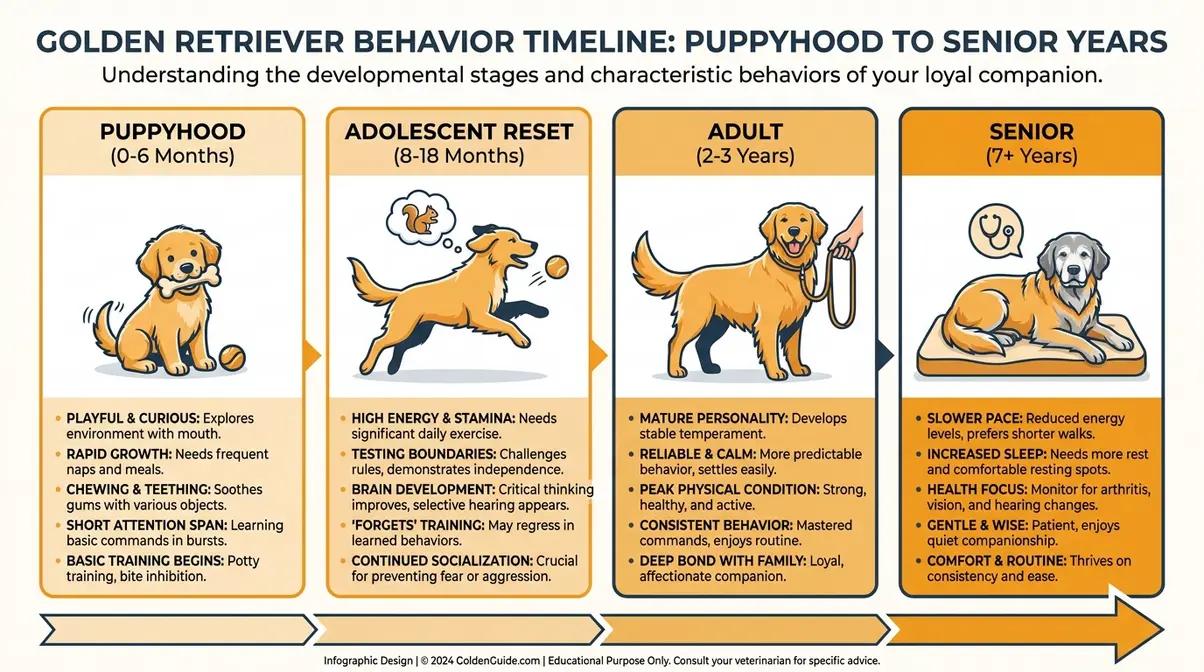
Golden Retriever behavior changes more dramatically across the first two years than most owners expect. Data from the Golden Retriever Lifetime Study, a long-term Morris Animal Foundation project tracking over 3,000 Golden Retrievers, confirms that behavioral traits vary significantly by age, sex, and neuter status. Knowing what stage your dog is in changes how you respond to what you are seeing.
The Golden Retriever Behavior Stages
Golden Retriever Lifetime Study behavioral data confirms that behavioral traits vary significantly by age, sex, and neuter status (NCBI, 2024). The table below gives you a quick reference for each life stage. For a deeper look at the age-by-age behavioral development of Golden Retrievers, there is a dedicated guide linked here.
| Age Stage | Typical Behaviors | What You May Notice | What Helps |
|---|---|---|---|
| 0-6 months | Socialization window, bite inhibition learning | Follows you everywhere, easily startled, mouthing everything | Early training, positive exposure, short sessions |
| 8-18 months (“The Adolescent Reset”) | Boundary testing, selective hearing, counter surfing | Jumping spikes, ignores known commands, high distractibility | Consistency, high-value rewards, short frequent sessions |
| 2-3 years | Energy plateau, training consolidates | Calmer greetings, more reliable recall | Continued reinforcement, mental enrichment |
| 7+ years | Slower pace, possible CDS | Sleep pattern changes, occasional confusion | Vet checkups, gentle exercise, routine |
The 0-6 month window is the most important for socialization. Missing it does not ruin a dog, but it does make the work harder later.
The row that surprises owners most is the adolescent phase. Here is what is actually happening inside your dog’s brain during that period, and what you can do about it.
What Is the Adolescent Reset, and How Do You Survive It?
The Adolescent Reset is the 8-18 month window when a Golden Retriever’s brain undergoes rapid rewiring, causing them to temporarily test every boundary they previously accepted. This is the article’s most important concept for frustrated owners to understand, because it reframes regression as biology rather than failure.
Canine adolescence involves the same prefrontal-cortex-lagging-behind-impulse-control pattern seen in human teenagers. The AVMA behavioral research on senior Golden Retrievers highlights the Golden Retriever Lifetime Study’s tracking of behavioral changes across life stages (2021), confirming this window is well-documented. Across owner communities on forums and Facebook groups, the consistent theme is that Goldens enter a teenager phase around 9 months, testing boundaries and showing independence, with most settling back down by age 2-3.
Here are four protocols that work during this phase:
- Shorten training sessions to 5 minutes. Adolescent Goldens lose focus faster than puppies. Several short sessions beat one long, frustrating one.
- Return to basics. If your dog has “forgotten” sit or stay, reteach it as if they are brand new to the command. They are not broken. The neural pathway just needs reinforcement.
- Increase physical exercise first. A 30-minute off-leash run before a training session reduces distraction by clearing excess energy. Exercise is not a reward here. It is a prerequisite.
- Use high-value rewards only. Kibble loses its appeal during this phase. Switch to small pieces of cooked chicken or cheese and watch your dog’s attention sharpen.
Most Goldens complete the Reset by age 2-3 and settle into the calm, polite companions their owners hoped for. For more on this specific period, see the guide on adolescent behavior of a 1-year-old Golden Retriever.
The Adolescent Reset is temporary. But some Golden Retriever behavior problems are patterns that can persist without intervention. Here is what to watch for and how to address each one.
What Are the Most Common Golden Retriever Behavior Problems?
Most Golden Retriever behavior problems are not aggression or dominance. They are the predictable side effects of a breed built for high-energy work in a household with no job to do. Virginia Tech service dog behavioral research found that Golden Retrievers were significantly less likely to be dismissed from working programs for behavioral problems compared to other breeds. The issue is almost always under-stimulation or inconsistent training, not a flawed temperament.
The 5 Behaviors That Trip Up Most Owners
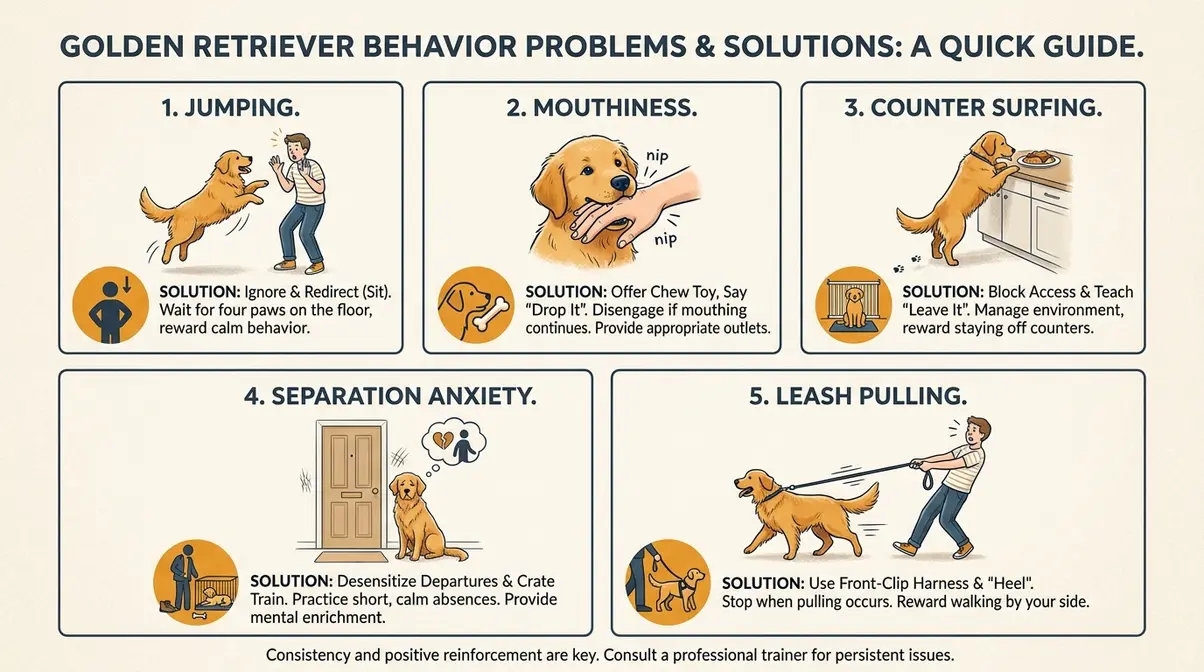
Most of these behaviors intensify during The Adolescent Reset. What looks like stubborn golden retriever behavior at 10 months is usually under-stimulation combined with a brain in active rewiring. The good news is that each behavior below has a straightforward fix.
- Jumping on people: Goldens jump because it has worked before. Someone petted them, so they repeat it. Fix: turn your back and cross your arms every single time, without exception. Every person in the household must do this consistently. One exception undoes a week of progress.
- Mouthy behavior: Normal retrieval instinct, not aggression. What looks like golden retriever puppy aggressive behavior is almost always play drive. Fix: say “leave it,” then immediately offer a tug rope or ball. Redirect every time. See the full guide on how to stop Golden Retriever puppy biting and nipping.
- Counter surfing: A 70-pound dog at counter height can reach anything. Fix: management first (clear counters of food), then train “off” with a food lure and reward four paws on the floor.
- Separation anxiety: Separation anxiety is a distress response that occurs when a dog is left alone longer than it can comfortably tolerate. Goldens left alone for more than 4-5 hours regularly often develop distress behaviors: destructive chewing, howling, house-training regression. Fix: crate training early, gradual alone-time increases, and puzzle feeders for mental engagement.
- Leash pulling: They are strong and excited. Fix: stop walking the moment tension hits the leash. Resume only when the leash goes slack. It feels slow at first. It works.
If you have ever typed “I hate my golden retriever puppy” at 11pm, you are not alone. These behaviors are almost always temporary. For a comprehensive breakdown, visit common Golden Retriever behavior problems with causes and fixes.
One behavior that often worries new owners sits in a different category entirely: whether a Golden will actually protect them if something goes wrong.
Will a Golden Retriever Protect You?
The honest answer is: probably not in the way you are picturing. Goldens rank among the friendliest breeds toward strangers, which means an intruder is more likely to get a tail wag than a confrontation. The Purdue aggression data cited earlier supports this directly.
They will often bark to alert you, which is sometimes called alarm barking, but they are unlikely to take physical action. If protection is a priority, this is the wrong breed for that specific job. Frame it positively: their non-aggressive nature is exactly why they excel as therapy dogs, service dogs, and family companions. For a realistic look at the protective and guarding instincts of Golden Retrievers, the dedicated article covers this in full.
When Should You Get Professional Help?
Some situations call for a certified professional dog trainer (CPDT-KA credential) rather than a self-guided approach:
- Biting that draws blood
- Aggression toward children that persists after four weeks of consistent work
- Separation anxiety that causes self-injury
Consult a veterinarian if sudden behavior changes occur in an adult dog. Pain and thyroid issues can both present as behavioral changes and are often mistaken for training problems.
Always consult your veterinarian before attributing sudden behavioral shifts to training issues alone.
Beyond training challenges, some behavioral differences between individual Goldens come down to biology. One of the most common questions owners have is whether a male or female will behave differently.
How Do Male and Female Golden Retrievers Differ in Behavior?
Male and female Golden Retrievers share the same core temperament, but individual tendencies differ. A prospective cohort study on neutering and behavior found that neutering Golden Retriever crossbreeds before or after puberty had little to no significant impact on their future behavior (NCBI, 2022). What you choose matters less than how consistently you train.
Male vs. Female: A Side-by-Side Look
The table below covers the most commonly asked traits. Neither sex is objectively better. The goal is matching the right dog to your household.
| Trait | Male | Female |
|---|---|---|
| Typical size | 65-75 lbs | 55-65 lbs |
| Energy level | Slightly higher | Slightly lower |
| Maturity rate | Slower (2-3 years) | Faster (18-24 months) |
| Trainability | High | High |
| Affection style | More boisterous | Slightly more independent |
| Common behavioral tendency | Marking (unfixed), jumping | Heat cycle changes (unfixed) |
These are tendencies, not rules. Individual personality, training quality, and line (field vs. show) will have a far larger effect on your dog’s behavior than sex. For a full breakdown of the behavioral differences between male and female Golden Retrievers, the dedicated comparison article goes deeper on each trait.
Spaying and neutering introduce their own behavioral questions, and the science here may surprise you.
Does Spaying or Neutering Change Your Golden’s Personality?
Neutering reduces urine marking and roaming in males. Spaying eliminates heat cycle behavioral changes in females, including restlessness, increased vocalization, and clingy behavior. However, research on neutering and fear-based behavior indicates that neutering does not positively affect non-sexually dimorphic behaviors (behaviors not tied to reproductive hormones), such as fear-based responses. In some cases, it may actually increase them (NCBI, 2025).
VCA Animal Hospitals guidance on neutering notes that behavioral training remains essential regardless of neuter status. The surgery changes hormones, not habits. For female Goldens specifically, the heat cycle and related behaviors in female Golden Retrievers guide covers what to expect during each cycle.
Once you understand your Golden’s individual traits and life stage, the final question most prospective owners ask is how it compares to the other popular retriever: the Labrador.
How Does a Golden Retriever Compare to a Labrador in Behavior?
Both breeds are friendly, trainable retrievers. But they differ in ways that matter for your household. Here is a quick comparison of the traits owners ask about most.
| Behavioral Trait | Golden Retriever | Labrador Retriever |
|---|---|---|
| Sensitivity to correction | Higher | Lower |
| Separation anxiety risk | Higher | Moderate |
| Trainability | Very high | Very high |
| Typical energy level | High (field lines: very high) | High |
| Tendency to mouth/carry | High (retrieval instinct) | Moderate |
| Friendliness to strangers | Very high | Very high |
Golden Retrievers tend to be more sensitive and emotionally responsive than Labradors, making them slightly easier to train with positive reinforcement but more prone to separation anxiety. If you want a dog that responds deeply to your emotional state and thrives on close human connection, the Golden is the stronger fit. If you want a slightly more independent partner who handles time alone a bit better, the Labrador may suit you better. For the full picture, see the complete behavioral comparison of Golden Retrievers and Labrador Retrievers.
Frequently Asked Questions About Golden Retriever Behavior
What are the behavioral issues of Golden Retrievers?
Golden Retrievers most commonly develop behavioral issues like jumping on people, mouthy behavior, counter surfing, and separation anxiety when their exercise and mental stimulation needs are not met. These are not aggression problems. They are energy management problems. Consistent daily exercise (at least 45-60 minutes for adults), positive reinforcement training, and clear boundaries established from puppyhood prevent most of these issues from becoming entrenched habits.
What is the hardest stage of a Golden Retriever?
The hardest stage for most Golden Retriever owners is adolescence, roughly between 8 and 18 months of age. During this period, called The Adolescent Reset in this guide, Goldens have peak energy, test every boundary they have learned, and may seem to forget commands they mastered as puppies. This is normal brain development. With consistent training and patience, most Goldens settle significantly by age 2 to 3.
What is the personality of a working Golden Retriever?
A working or field-line Golden Retriever has a higher drive, more intense focus, and significantly greater exercise needs than a show-line companion. They are still friendly and eager to please, but their personality is geared toward tasks. Working Goldens thrive with a job: retrieving, agility, scent work, or competitive obedience. Without adequate outlets, they become restless and may develop destructive behaviors faster than their show-line counterparts.
What are the negatives of owning a Golden Retriever?
The main downsides of owning a Golden Retriever are heavy shedding, high exercise demands, a strong tendency toward mouthiness, and significant separation anxiety risk. They also carry a higher-than-average cancer risk compared to most breeds. Goldens are not suited for owners who travel frequently or cannot commit to daily vigorous exercise. Their social needs are genuine and ongoing, not something they outgrow.
What is the silent killer in Golden Retrievers?
The “silent killer” in Golden Retrievers is hemangiosarcoma, an aggressive cancer of the blood vessels that typically shows no symptoms until it has reached an advanced stage. It accounts for roughly one in five Golden Retriever deaths. Because it progresses without obvious signs, regular veterinary checkups are critical for early detection. If your Golden shows sudden collapse, pale gums, or unexplained lethargy, seek emergency veterinary care immediately.
Veterinary Disclaimer: This information is educational only. Consult your veterinarian for any health concerns about your dog.
Related Golden Retriever Behavior Guides
Each behavior below has a full deep-dive of its own. Use these alongside the age-by-age framework above:
- Golden Retriever barking: why it happens and how to curb it
- Why your dog barks at "nothing"
- Golden Retriever separation anxiety
- Are Golden Retrievers aggressive? What reactivity really means
- Calming your Golden’s car anxiety
- Calming fireworks and thunderstorm anxiety
- Golden Retriever personality facts
- Why your dog lies on you
- Why your dog won’t settle or lie down
What You Now Know About Golden Retriever Behavior
Golden Retriever behavior is a product of genetics, life stage, and training consistency working together. The breed ranks among the least aggressive toward humans and other dogs (Purdue University Canine Welfare Science Center, 2024), but their high social drive and retrieval instincts create real challenges if those needs are not met. A 2026 University of Cambridge study of 1,300 Goldens further confirmed that trainability and anxiety have a genetic basis, which means your dog’s starting point is real, but it is not a ceiling. The best approach combines daily vigorous exercise, positive reinforcement training from day one, and realistic expectations about the adolescent phase.
If your Golden is currently in The Adolescent Reset, the 8-18 month window when everything you taught seems to evaporate overnight, know that this is the most well-documented phase in canine development. It is not a sign you failed. It is a sign your dog’s brain is doing exactly what it should. The behaviors will stabilize. Your consistency now is what determines how quickly.
Start with the two resources that address the most common turning points: the age-by-age calming guide and the dedicated behavior problems breakdown linked throughout this article. If you are still in the puppy stage, the biting and nipping guide is the most practical next read.
➤ Golden Retriever behavior is manageable at every stage when you understand what is driving it and respond with consistency rather than frustration.
Related gear: see our guide to enrichment toys.