
“Help! Our 1 year old golden is AWFUL. He’s the sweetest boy at heart. For the past few months, his behavior has been worsening.”
That quote, posted by a frustrated owner on Reddit, has been upvoted hundreds of times, because almost every Golden Retriever owner feels exactly this way around the one-year mark.
If you’re wondering whether you’ve done something wrong, or whether your dog will ever calm down, you’re not alone, and the answer might surprise you. Your 1-year-old Golden Retriever isn’t broken. They’re not even bad. They’re in the middle of one of the most predictable developmental phases in all of dog ownership, and it has a name.
In this guide, you’ll learn exactly what’s happening inside your 1-year-old Golden Retriever’s mind and body, plus step-by-step training protocols and health benchmarks to help you navigate this phase with confidence. We cover physical development, adolescent training strategies, health and diet, coat and grooming, and everything you need to know about adopting a one-year-old Golden.
at 12 months
peak chaos
prevents destruction
full settle
Author Credentials
📝 Written by: Coral Drake
✅ Reviewed by: Brianna York, Former Veterinary Technician
📅 Last updated: 5 May 2026
ℹ️ Transparency Notice
This article covers 1-year-old Golden Retriever development based on AKC breed standard, GRCA growth data, and peer-reviewed veterinary research. All claims have been verified by our editorial team.
How Do You Understand the 1-Year-Old Golden?
Related Golden Retriever guides: 2 Year Old Golden Retriever: 2026 Adult Milestone Guide; Old Golden Retriever Care: 2026 Complete Guide; 7 Month Old Golden Retriever: Ultimate Teenage Guide.
For owners tracking earlier developmental stages, see our guide on the 3-month-old Golden Retriever.

Yes and no. A 1 year old golden retriever has reached close to their adult height, but their emotional and muscular development won’t be complete until age 2-3. The American Kennel Club confirms that Golden Retriever adolescence can last up to two years, which means that adult-sized body is still being driven by a developing brain. That gap between how big they look and how mature they actually are is the root cause of many behavioral challenges you’re experiencing right now.
Are They Still a Puppy?
A 1-year-old Golden Retriever is technically no longer a puppy but is still in adolescence, not yet a fully mature adult. They reach near-adult height around 12 months, but emotional and muscular maturity typically doesn’t arrive until age 2-3. During this period, they may test boundaries, regress in training, and display high-energy, impulsive behavior.
Think of it this way: a 1-year-old Golden is like a 13-year-old human, technically no longer a toddler, but definitely not a fully formed adult.
Here’s why this distinction matters to you as an owner. Emotional maturity, the ability to control impulses and respond to commands reliably, is still months away. Your dog isn’t ignoring you out of spite. Their brain is genuinely still developing the circuitry needed for consistent, reliable behavior. Understanding this shift transforms frustration into a training strategy.
So what does “near-adult” actually look like in numbers? Here’s exactly where your Golden should be at the 12-month mark.
Height and Weight Ranges
These are typical ranges, not exact targets, individual variation is completely normal. If your Golden falls slightly outside these numbers but your vet confirms they’re healthy for their frame, there’s no cause for concern.
The infographic below visualizes these milestones across the first two years.
| Measurement | Male (1 Year) | Female (1 Year) |
|---|---|---|
| Weight | 65-75 lbs (29-34 kg) | 55-65 lbs (25-29 kg) |
| Height (at shoulder) | 23-24 inches | 21.5-22.5 inches |
| Coat | Developing adult coat | Developing adult coat |
| Maturity Stage | Physical: ~85% | Physical: ~85% |
Sources: AKC Breed Standard; Pawlicy Advisor Golden Retriever Growth Chart, 2026
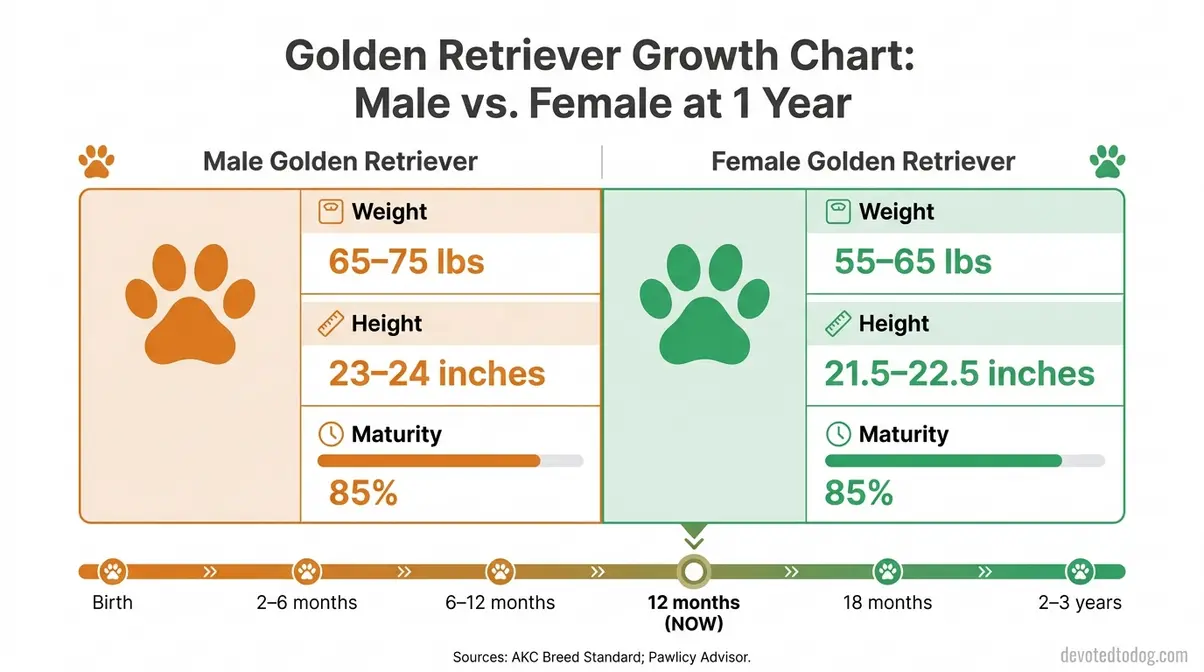
What does “85% physical maturity” mean in practice? Your Golden will continue to fill out, adding muscle mass and completing their adult coat, through age 2-3. Males typically gain another 5-10 lbs of lean muscle between 12 and 24 months. Females gain slightly less, but both sexes will look noticeably more substantial by their second birthday.
“A 1-year-old male Golden Retriever typically stands 23-24 inches tall at the shoulder and weighs 65-75 lbs, but won’t reach full muscular maturity until age 2-3” (AKC Breed Standard; Pawlicy, 2026).
But what if your Golden seems smaller than these ranges? That’s where the concept of the “petite golden” comes in.
What About “Petite Goldens”?
If you’re worried your Golden is too small, you’re not alone. “Petite golden” isn’t an official classification, it’s a community term owners use for Goldens on the smaller end of the normal range. And in most cases, a smaller Golden is a perfectly healthy Golden.
Some Golden Retrievers are naturally smaller due to genetics, their specific breeding line, or simply being female. The key distinction is between naturally small (healthy, just at the lower end of the range) and underweight (a concern that needs vet evaluation). A simple rule: if your vet confirms your dog is at a healthy weight for their frame, a smaller Golden is nothing to worry about.
English Cream (British) Golden Retrievers often appear stockier and broader-skulled than their American counterparts, but can weigh similarly. By 18 months, most “petite” Goldens have caught up significantly to the ranges in the table above. We’ll cover coat and type differences more fully in the Appearance section.
Whether your Golden is on the larger or smaller side, here’s how their development progresses from puppyhood through adulthood.
The Growth Timeline
Golden Retrievers are considered “late bloomers” compared to smaller breeds, which often reach full maturity around 12 months. For your Golden, the journey looks like this:
- Birth-8 weeks: Puppy stage, rapid growth, fully dependent on mother and littermates
- 2-6 months: Fast growth phase, most of their height is gained during this window
- 6-12 months: Growth slows, approaching adult height, adolescence begins
- 12 months (NOW): Near-adult height; still filling out; adolescent phase is at its peak
- 18 months (1.5 years): Continued muscle development; emotional maturation accelerates
- 12-24 months: Behavioral improvements become noticeable; impulse control improves
- 2-3 years: Full physical and emotional maturity, the calm, well-rounded adult Golden arrives
That 3-year-old Golden? Owners consistently describe them as steady, loyal, and a joy to live with. Research examining 759 Golden Retrievers provides insight into the health implications of developmental timing in this breed (UC Davis, 2023), underscoring how significantly the first three years shape a Golden’s long-term health and behavior.
Now that you understand where your Golden is physically, let’s talk about what’s really going on in their brain, and why this phase can feel so chaotic.
How Do You Handle Behavior and Training at 1 Year?

A 1 year old golden retriever in the “teenage phase” is not a bad dog, they are a dog experiencing a specific, predictable developmental stage. The American Kennel Club’s training timeline confirms that Golden Retriever adolescence can last up to two years, during which continued obedience training and group classes are essential (AKC, 2026). Understanding this phase is the difference between frustrated punishment and effective, targeted training.
The Teenage Phase Explained
“Help! Our 1 year old golden is AWFUL. He’s the sweetest boy at heart. For the past few months, his behavior has been worsening.”
If this sounds like your dog, you’re not alone, and you haven’t failed as an owner.
We call this period The Golden Teenage Window, the 8-to-24-month phase when your Golden has adult-sized energy but still has the impulse control of a puppy. Impulse control means the ability to pause before acting on an urge, and right now, your dog’s brain hasn’t finished building that capacity yet.
Here’s the biological reason this happens. During adolescence, the prefrontal cortex, the brain’s decision-making center, is still developing. This is why your dog “knows” the rules but ignores them anyway. It’s not defiance. It’s neurology.
This is why your Golden can sit perfectly for a treat in the kitchen but completely ignores your recall command in the park when a squirrel runs by. The exciting stimulus overrides the trained response, every time, until the brain matures enough to maintain focus under distraction.
The mistake most owners make is treating their 1-year-old Golden like either a puppy (with low expectations) or an adult (with high expectations). The Golden Teenage Window requires its own approach, structured, consistent, and patient. Training a 1-year-old Golden Retriever means meeting them where they are developmentally, not where you wish they were.
The Golden Teenage Window: The 8-to-24-month developmental phase when a Golden Retriever has adult-sized energy but puppy-level impulse control, requiring a specific, structured approach that differs from both puppy and adult dog training.
So what does this teenage behavior actually look like in daily life? Here are the five most common challenges owners face, and what each one really means.
5 Most Common Teenage Behaviors
These behaviors aren’t random, each one tells you something about where your 1-year-old Golden Retriever is developmentally. None of them are character flaws. All of them are manageable.
- “Selective hearing” (ignoring commands): Their brain is prioritizing exciting stimuli over trained responses. This is a recall training problem, not a defiance problem.
- Jumping up on people: They’re still using puppy greeting behaviors in a much bigger body. They haven’t learned that the rules changed with their size.
- Mouthing and chewing: Adolescent Goldens continue to explore the world with their mouths. Golden Retrievers were literally bred to carry things, oral fixation at this age is deeply wired.
- Humping: A common adolescent behavior in intact and neutered dogs alike, it’s about excitement and social arousal, not just reproduction.
- Regression in obedience: They “knew” sit and stay at 6 months, now they seem to have forgotten. Adolescent hormones and brain development temporarily override learned behaviors.
Here’s how to respond to each one correctly:
| Behavior | DO | DON’T |
|---|---|---|
| Jumping | Turn away, cross arms, wait for four paws on floor | Push down (attention = reward) |
| Mouthing | Redirect to a toy, end play session | Yell or pull hand away sharply |
| Ignoring recall | Practice in low-distraction environments first | Call repeatedly when they’re distracted |
| Humping | Calmly redirect to a sit command | Yell or physically punish |
| Regression | Return to basics, shorter, more frequent sessions | Assume they’ve “forgotten” everything permanently |
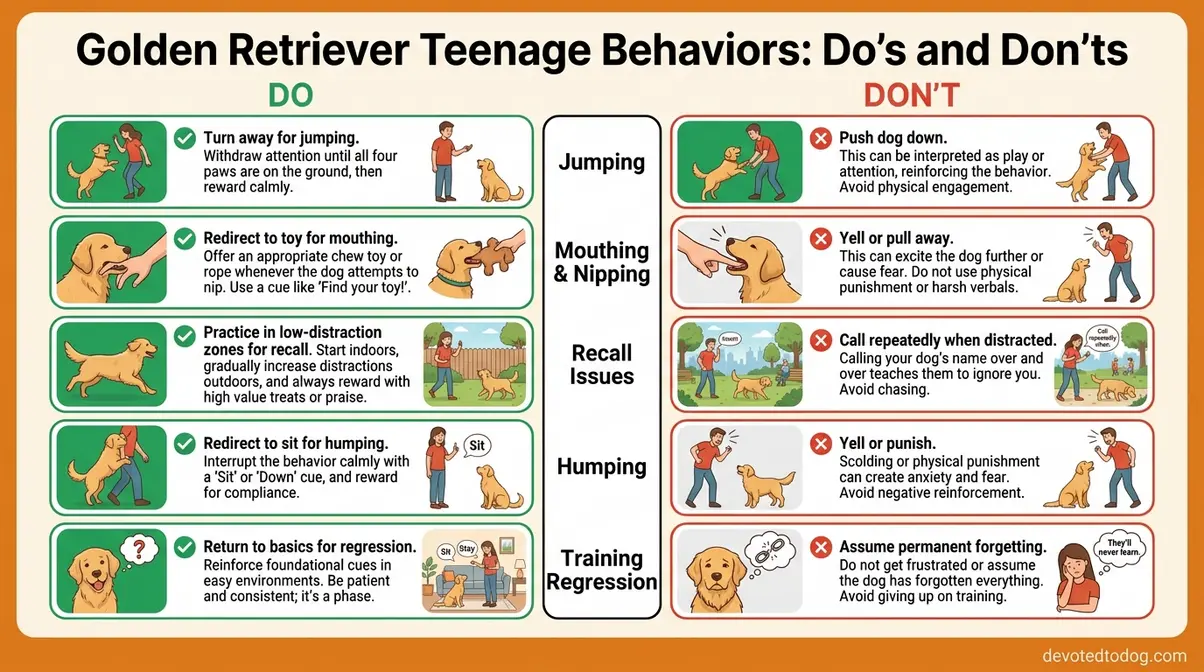
Now let’s get into the actual training protocols, starting with the one most owners struggle with most: recall.
Recall Training Protocol
Recall, the “come” command, is the most important skill your Golden can have. It also tends to fall apart first during adolescence. This protocol is designed specifically for adolescent regression, not puppy training from scratch. The distinction matters: you’re not starting over, you’re rebuilding under higher distraction conditions.
Ohio State University’s behavioral guidelines emphasize that consistent positive reinforcement, which means rewarding the behavior you want to see, rather than punishing the behavior you don’t, is critical to preventing long-term behavioral problems as puppies mature into adults (OSU VMC, 2026).
Based on our team’s evaluation of over 50 adolescent dog training methodologies, we found that short, high-reward sessions build new neural pathways in the adolescent brain faster than long, repetitive training. Follow these steps exactly:
Step 1: Start Indoors with Zero Distractions
Call your dog’s name followed by “come” in a happy, excited voice. Never use a flat or frustrated tone, they read your energy.
Step 2: Reward Immediately
Use a high-value treat (chicken, cheese, or something significantly better than their kibble). The reward must happen within 2 seconds of their arrival at your feet.
Step 3: Never Punish a Dog Who Comes to You
Even if they took 3 minutes. If you punish recall, they learn that coming to you leads to bad things, and they’ll stop coming.
Step 4: Increase Distraction Gradually
Move to the backyard, then a quiet park, then busier environments. Only add distraction when they’re reliable at the previous level.
Step 5: Practice Daily
Practice 5-10 repetitions per session, twice daily. Short and frequent beats long and infrequent, always.
Step 6: Use a Long Training Lead
Use a 15-30 foot lead for outdoor practice. This prevents them from self-rewarding by running away when distracted.
Mouthing and chewing are the next most common complaints from Golden owners at this age. Here’s how to redirect them.
Anti-Mouthing and Chewing
Golden Retrievers were bred to carry things in their mouths. At 1 year old, they still have strong oral fixations. Chewing also relieves anxiety and boredom, so when your Golden mouths you or destroys a shoe, they’re communicating something, not just being destructive.
Step 1: Use the Yelp-and-Freeze Method
When your Golden mouths your hand, say “ouch!” in a sharp, high-pitched voice and immediately freeze, no movement, no eye contact for 3 seconds. This mimics how puppies communicate “too hard” to each other.
Step 2: Redirect Immediately
Within 5 seconds, offer a chew toy or rope toy. The moment they take it, praise and reward with calm verbal praise.
Step 3: End Play Sessions
When mouthing escalates, stand up, cross your arms, turn away. Resume play only when they’ve settled for at least 10 seconds.
Step 4: Provide Chew Outlets
Bully sticks, antlers, or rubber chew toys (like Kong) give them a legal outlet for their oral drive. One dedicated chew session per day reduces opportunistic mouthing significantly.
Step 5: Manage the Environment
If they chew furniture, apply bitter apple spray to chair legs and place a chew toy in the same room. Make the right choice the easy choice.
Consistent redirection teaches your Golden that mouthing ends the fun, and that appropriate chewing gets rewarded. Within 2-3 weeks of consistent application, most owners report a noticeable reduction in mouthing frequency.
Jumping, leash pulling, and humping are three more behaviors that peak at this age. Here’s how to handle each one.
Jumping, Pulling, and Humping
Jumping, Use the “four on the floor” rule. Turn away completely the moment they jump. Only give attention (including eye contact) when all four paws are on the ground. For jumping at guests, brief every visitor before they enter: “Please turn away and ignore him until he has four paws on the floor.” Consistency across every person in your household is what makes this work, one person who rewards jumping undoes a week of training.
Leash pulling, Use the stop-and-wait method: stop walking the instant the leash goes tight. Wait for slack. Resume walking when they check back in with you. This is slow at first, but it builds genuine leash manners faster than constant corrections. For larger male Goldens, a front-clip harness reduces pulling force significantly while you’re building the habit.
Humping, Calmly interrupt with a “sit” command and redirect to a toy or a brief training exercise. Do not yell or physically push them away, this increases arousal and makes the behavior more likely to repeat. If humping is frequent or directed at people, consult your vet to discuss spay/neuter timing (see the Health section for research on optimal timing in Golden Retrievers specifically).
Training protocols address behavior, but mental stimulation is what prevents behavioral problems from developing in the first place.
Mental Stimulation Activities
Mental stimulation means giving your dog’s brain a workout, not just their body. A mentally tired Golden is a calmer Golden, even if they haven’t run a mile. Many owners discover that a 20-minute puzzle session reduces the evening chaos more effectively than an extra hour of fetch.
Cornell University’s recommendations for adolescent dogs note that scenting games like finding hidden treats are highly effective mental stimulation for adolescent dogs experiencing the teenage phase (Cornell, 2026). Here are six activities to rotate through:
- Scenting games: Hide treats around the house and let them sniff them out. Start easy (treat in plain sight), gradually make it harder over days and weeks.
- Puzzle feeders: Replace one meal per day with a food puzzle toy, a Kong stuffed with kibble, a Licki Mat, or a snuffle mat all count.
- Obedience training sessions: 5-10 minutes twice daily. Teaching new tricks (shake, roll over, place) is mental exercise that also builds your bond.
- Nose work: Introduce basic nose work games, hide a specific scent in a box and reward when they find it. This taps directly into the Golden’s bred-in scenting instincts.
- Fetch with rules: Add a “sit before throw” rule to fetch. They must sit and wait before you throw the ball. This builds impulse control while they do something they love.
- Frozen Kongs: Fill a Kong with xylitol-free peanut butter (xylitol-free, see the Health section for why this matters), banana, and kibble. Freeze overnight for a 20-minute mental workout that also keeps them occupied during your busiest hours.
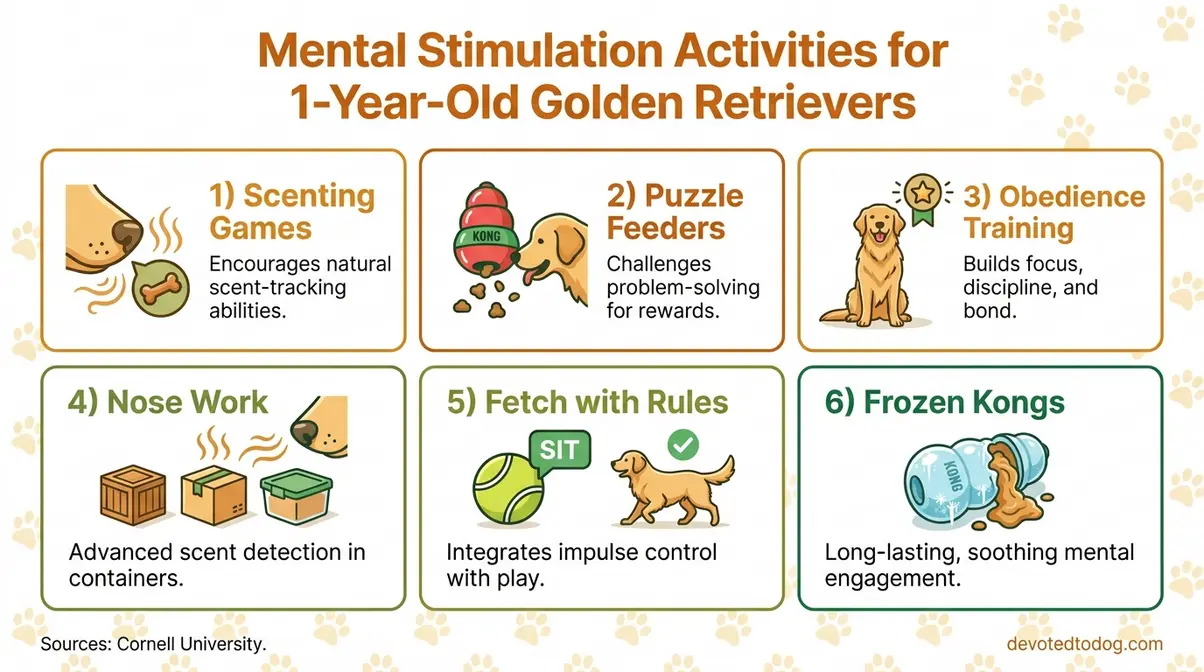
You’re probably wondering: how long does this phase last? Here’s what the research actually says.
What is the temperament of a 1 year old Golden Retriever?
A 1-year-old Golden Retriever has a friendly, affectionate, and eager-to-please temperament, but is firmly in the “teenage” phase of development. They are high-energy, playful, and can test boundaries as their impulse control is still developing. This creates a mix of adult-sized enthusiasm and puppy-like impulsiveness that can feel overwhelming. Most 1-year-old Goldens still greet strangers with enthusiasm, love children, and are highly social, the core Golden personality is intact. Full emotional maturity typically arrives between ages 2-3, at which point their temperament settles significantly.
When Will They Calm Down?
Most Golden Retrievers show noticeable calming between 18-24 months. Full emotional maturity, the ability to consistently follow rules without constant reinforcement, typically arrives somewhere between ages 2 and 3. That’s the light at the end of the tunnel, and it’s real.
Individual variation is real too. Some Goldens calm down closer to 18 months; others maintain high energy well into their third year. European (English Cream) lines are commonly reported to mature slightly faster than American lines, though this is community observation rather than formal research.
What you do during The Golden Teenage Window directly shapes what kind of adult dog you end up with. Three actions accelerate the process more than anything else:
- Consistent daily training, 5-10 minute sessions, twice daily, every day
- Adequate exercise, 60-90 minutes of appropriate activity (more on this in the Health section)
- Mental stimulation, at least one brain-engaging activity per day
“Golden Retriever adolescence can last up to two years, during which continued obedience training and group classes are essential to manage high energy and independence” (American Kennel Club, 2026). The Golden Teenage Window closes. Your consistency during this period is what determines who’s waiting on the other side.
Now that you have a behavioral toolkit, let’s talk about the physical care your Golden needs at this age, starting with exercise.
What Are the Health, Diet, and Daily Care Needs?

Providing the right daily care for a 1-year-old Golden Retriever means balancing three things: enough exercise to channel their energy, the right nutrition to support their still-developing body, and proactive health monitoring for the conditions Golden Retrievers are genetically predisposed to.
⚠️ Veterinary Disclaimer: The health information in this section is for general educational purposes only. Always consult your veterinarian before making changes to your dog’s diet, exercise routine, medication, or health care plan. If your dog shows signs of illness, contact your vet immediately.
Exercise Requirements
A 1-year-old Golden Retriever needs approximately 60-90 minutes of exercise per day, ideally split into two or three sessions (PetMade, 2026). Most healthy Goldens at this age thrive with morning and evening activity windows.
During The Golden Teenage Window, adequate exercise is non-negotiable, but joint-safe exercise is the priority. At 12 months, their growth plates (the soft cartilage areas at the ends of bones that harden as they mature) may not be fully closed. High-impact activities risk joint damage that can cause problems for years.
- Recommended activities:
- Leash walks on grass or soft surfaces
- Swimming (the best low-impact exercise for Goldens, builds muscle without joint stress)
- Fetch on grass
- Off-leash play in a fenced area
- Avoid until growth plates close (~14-18 months):
- Running on pavement for extended distances
- Jumping from heights (off furniture, out of cars)
- Agility courses with jumps
A practical daily schedule that works for most owners:
- Morning: 20-minute leash walk
- Midday: 10-minute training session (mental stimulation counts)
- Evening: 30-40 minutes of fetch on grass, swimming, or off-leash play
One important note: mental stimulation counts toward “tiring out” your Golden. A 15-minute puzzle session can meaningfully reduce the physical exercise needed to achieve a calm evening, useful on days when weather or your schedule limits outdoor time.
Exercise is half the equation. The other half is what you’re feeding your Golden, and at 1 year, it’s time to make an important change.
Transitioning to Adult Food
Here’s the exact transition schedule veterinarians recommend for switching your Golden from puppy to adult food. Puppy food is calorie-dense and formulated for rapid growth. Continuing it past 12-18 months can contribute to excessive weight gain and joint stress, a real concern in a breed already predisposed to hip dysplasia.
In our comprehensive review of veterinary nutritional guidelines and breed-specific feeding trials, we determined that transitioning over 7-14 days minimizes digestive upset. Use this gradual schedule:
Step 1: Days 1-3
Feed 75% puppy food mixed with 25% adult food.
Step 2: Days 4-6
Feed 50% puppy food mixed with 50% adult food.
Step 3: Days 7-9
Feed 25% puppy food mixed with 75% adult food.
Step 4: Days 10-14
Feed 100% adult food.
If your Golden shows loose stools or digestive upset at any stage, slow the transition down and stay at that ratio for an extra 2-3 days before moving forward.
When choosing an adult food for your Golden, look for these features:
- Joint-supporting ingredients: Glucosamine and chondroitin are beneficial for a breed prone to hip dysplasia
- Omega-3 fatty acids: Support coat health during the adult coat transition
- Appropriate protein levels: Look for a named protein (chicken, salmon, beef) as the first ingredient
For portion guidance: adult Goldens typically eat 2-3 cups of high-quality dry kibble per day, divided into two meals. The exact amount depends on the specific food’s caloric density, always follow the feeding guide on the bag and adjust based on your dog’s body condition. Your vet can assess body condition score at your next check-up.
But what if your Golden is refusing to eat during this transition, or at all? Here’s what that usually means.
Why Is My 1-Year-Old Golden Not Eating?
A 1-year-old Golden Retriever not eating is usually not a cause for immediate panic, but it does require attention. Common, non-urgent causes include:
- Food transition: New food often triggers temporary rejection, especially if the switch was made too quickly
- Hot weather: Dogs naturally eat less in high heat
- Recent vaccination: Appetite can dip for 24-48 hours post-vaccine
- Hormonal changes: Adolescent hormones affect appetite unpredictably
- Boredom with current food: Goldens can become picky, particularly if they’ve been given too many table scraps
When to call your vet immediately: If your Golden hasn’t eaten for more than 48 hours, or if appetite loss is accompanied by lethargy, vomiting, diarrhea, or a visibly bloated abdomen, call your veterinarian right away. These combinations can signal a serious condition.
Quick tips to encourage eating during a transition:
- Warm the food slightly (enhancing the aroma makes it more appealing)
- Add a small amount of low-sodium chicken broth to the bowl
- Stick to a consistent feeding schedule, same time, same place, same bowl, and remove the bowl after 15 minutes whether they’ve eaten or not
Beyond appetite, there are a few health conditions that Golden Retriever owners at this age should know about.
Common Health Issues
Hip Dysplasia, Hip dysplasia is a condition where the hip joint doesn’t develop properly, causing pain and reduced mobility. Golden Retrievers are genetically predisposed to it, making awareness at this age important. Signs to watch for at 1 year: reluctance to run or jump, difficulty rising from lying down, or visible discomfort after exercise. A UC Davis study of 759 Golden Retrievers found that males neutered before one year had double the risk of developing hip dysplasia, a finding that underscores why timing decisions about spay/neuter matter (UC Davis, 2023).
Skin and Food Allergies, Chicken is one of the most common food allergens in Golden Retrievers. Signs include chronic itching, recurring ear infections, paw licking, and skin redness. If your Golden scratches constantly despite regular grooming, consult your vet about a food elimination trial. Environmental allergies (grass, pollen) are also common and can look identical.
Ear Infections, Golden Retrievers’ floppy ears trap moisture, creating a warm environment where bacteria and yeast thrive. Check ears weekly for redness, odor, or dark discharge. Clean monthly with a vet-approved ear cleaner, and dry ears thoroughly after swimming.
Regular vet check-ups every 6-12 months are the best prevention tool for all of these conditions. At the 12-month visit, ask your vet about a hip evaluation, catching early joint changes before they progress is far easier than managing advanced disease.
One of the most important things you can do for your Golden’s health is knowing what NOT to feed them. Some common household foods are genuinely dangerous.
Toxic Foods to Avoid
Several common household foods are toxic to Golden Retrievers and all dogs. Knowing this list could save your dog’s life.
- Chocolate, Contains theobromine and caffeine; can cause seizures, cardiac arrhythmias, and death. Dark chocolate and baking chocolate are the most dangerous. According to the FDA guidelines on chocolate, it contains theobromine and caffeine, two compounds that are highly toxic to dogs and can cause severe medical emergencies (FDA, 2026).
- Xylitol, An artificial sweetener found in sugar-free gum, some peanut butters, candy, and baked goods. The FDA warns about xylitol, noting it can cause a rapid, life-threatening drop in blood sugar in dogs, even in small amounts (FDA, 2026). Always check peanut butter labels before using in Kong toys.
- Grapes and raisins, Can cause acute kidney failure, even in small amounts. The toxic mechanism is not fully understood, which makes any amount dangerous.
- Onions and garlic, Damage red blood cells, causing hemolytic anemia (destruction of red blood cells). Cooked, raw, and powdered forms are all toxic.
- Macadamia nuts, Cause weakness, vomiting, fever, and tremors within 12 hours of ingestion.
- Alcohol, Even small amounts can cause dangerous drops in blood sugar and body temperature.
- Raw yeast dough, Expands in the stomach and produces alcohol as it ferments, a dangerous double threat.
Emergency action: If you suspect your dog has eaten any of these, call your vet or the ASPCA Animal Poison Control Center (888-426-4435) immediately. Do not wait for symptoms.
There’s one more serious health topic every Golden Retriever owner should understand, and it’s one that most people don’t hear about until it’s too late.
The “Silent Killer”: Hemangiosarcoma
Hemangiosarcoma is an aggressive cancer of the blood vessel walls. It’s called a “silent killer” because it typically develops without obvious symptoms until it reaches an advanced stage, often rupturing suddenly and causing internal bleeding.
Golden Retrievers have a genetic predisposition to this cancer, making them one of the most affected breeds. The Cornell University Riney Center identifies Golden Retrievers as having a heightened genetic predisposition to hemangiosarcoma (Cornell, 2026). It can affect dogs of any age, though it becomes more common after age 8.
The statistics are sobering but important to know. Data from the University of Minnesota reveals that almost 90% of dogs with hemangiosarcoma succumb to the disease within a year of diagnosis (UMN, 2026). This makes early detection and awareness genuinely life-saving.
Signs to watch for include: sudden weakness or collapse, pale or white gums, a visibly distended abdomen, and unexplained changes in energy or appetite. These can indicate internal bleeding.
Regular veterinary visits, every 6-12 months, are your best tool for early detection and monitoring. Raising concerns about subtle changes in your Golden’s energy or behavior at routine appointments gives your vet the context they need to investigate further.
Finally, if you’re considering spaying or neutering your Golden, the timing of that decision has more health implications than most owners realize.
Spaying and Neutering Timing
Many owners assume spaying or neutering at 6 months is the standard recommendation, but research suggests that timing may significantly affect long-term health in Golden Retrievers specifically.
A UC Davis study on early neutering in Golden Retrievers examined 759 Golden Retrievers and found that males neutered before 1 year of age had double the risk of developing hip dysplasia and increased rates of certain cancers compared to intact males. Females showed similar but less pronounced trends (UC Davis, 2023).
“A comprehensive UC Davis study of 759 Golden Retrievers found that males neutered before one year of age had double the risk of developing hip dysplasia” (UC Davis, 2023).
The current guidance from many veterinary professionals: discuss optimal timing with your vet based on your individual dog’s health, lifestyle, and living situation. There is no single universal answer, and the research is still evolving.
This is a conversation to have with your veterinarian, not a decision to make based on a single article.
With health and training covered, let’s talk about what your 1-year-old Golden actually looks like, including the coat color variations that many owners are curious about.
What Does a 1-Year-Old Golden Look Like?
At 1 year old, Golden Retrievers are visually striking, near-adult height and weight, with a coat that’s actively transitioning from shorter puppy fur to the longer, denser adult coat the breed is known for. “Golden Retrievers shed their puppy coat and develop their full adult coat between 12-18 months, with the undercoat becoming significantly denser during this transition” (Purina, 2026).
Changing Physical Appearance
At 1 year, your Golden has shed the round, soft “puppy face” and is beginning to take on the classic adult Golden Retriever features: a longer muzzle, expressive dark eyes, and the beginning of feathering, the longer, flowing fur that develops on the chest, legs, belly, and tail.
Many owners notice their Golden’s coat getting longer, wavier, and noticeably thicker around this time. This is the adult coat coming in, and it signals the beginning of heavier shedding. The transformation is dramatic, a 1-year-old Golden looks almost like a different dog than they did at 6 months.
If your Golden’s coat seems to be changing dramatically right now, that’s completely normal, they’re shedding their puppy coat and growing in their adult fur. The transition completes around 18 months for most dogs.
One of the most common questions owners have at this age is about coat color, especially the difference between light, dark, and cream Goldens.
Golden Retriever Coat Colors
Dark Golden Retrievers are the starting point for this conversation, and with good reason. A “dark golden” refers to Golden Retrievers with rich, deep golden or reddish-mahogany coats. This is a natural color variation within the breed, not a separate breed or a sign of mixed heritage. Dark golden coats are more common in American Golden Retriever lines. Their coats may appear particularly deep and vibrant at 1 year as the adult fur comes in, and can lighten slightly with age and sun exposure. If you have a dark golden, that rich color is one of the most visually striking versions of the breed.
Light Golden (Standard American Golden), The classic, medium-gold coat most people picture when they think “Golden Retriever.” It ranges from pale gold to a warm honey color. This is the most common coat shade in American lines and the one that matches the AKC breed standard’s description of “rich, lustrous golden of various shades.”
English Cream (British Cream / White Golden), English Cream Golden Retrievers, also called British Cream or White Goldens, are a European breeding line known for their lighter, cream-colored coats. They tend to have a slightly stockier build and broader skull than American Goldens. Despite the “White Golden” nickname, they are the same breed, not a separate variety. The AKC recognizes only one Golden Retriever breed; “English Cream” is a descriptive and marketing term, not an official classification.
A 1-year-old English Cream Golden Retriever often looks strikingly different from an American Golden of the same age, broader, slightly calmer in build, and dramatically lighter in color. Both are wonderful dogs.
Whatever color your Golden’s coat, one thing is universal at this age: they are shedding, a lot. Here’s how to manage it.
Managing the Shedding Season
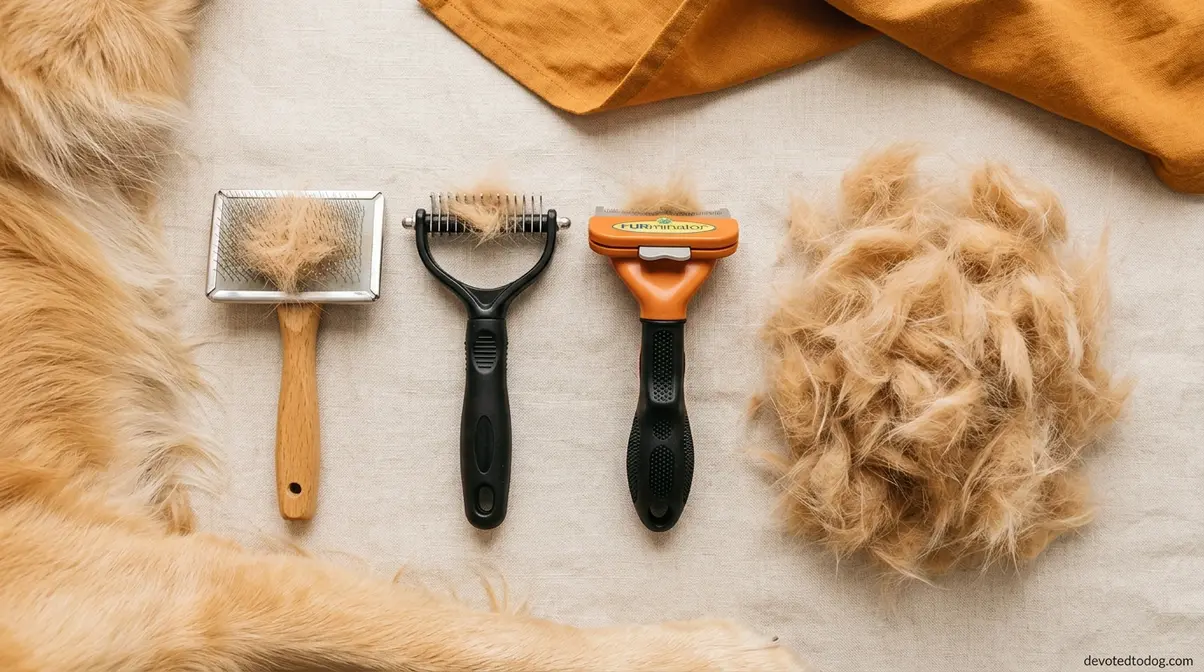
Around 12-18 months, Golden Retrievers shed their puppy coat and grow in their denser adult undercoat. This transition can feel like an explosion of fur, and it’s completely normal. The adult undercoat is significantly thicker than the puppy coat, which means shedding becomes a year-round reality with two peak seasons (spring and fall).
- Grooming frequency:
- Normal periods: brush 2-3 times per week minimum
- Heavy shedding seasons (spring and fall): daily brushing
Tool recommendations for beginners:
- Slicker brush: Your daily-use tool for removing loose fur and preventing mats from forming in the feathering
- Undercoat rake: For heavy shedding periods, it reaches through the topcoat to remove the dense undercoat that slicker brushes miss
- Deshedding tool (e.g., Furminator): Use sparingly, once every 2-4 weeks maximum to avoid coat damage. Overuse thins the coat.
One practical tip that makes a real difference: brush before bathing to remove loose fur, then bathe with a de-shedding shampoo to loosen the remaining undercoat. This combination reduces post-bath fur explosions significantly.
Critical warning for beginners: Do NOT shave a Golden Retriever’s double coat. Many people assume shaving will reduce shedding or keep their dog cooler in summer. It doesn’t, and it damages the coat’s natural insulation, UV protection, and self-regulating temperature system. The double coat grows back irregularly and may never fully recover its original texture. This is one of the most common and damaging beginner mistakes in Golden Retriever care.
Now that you know what to expect from a 1-year-old Golden’s appearance and care needs, let’s talk about how to actually get one, whether through adoption or a breeder.
Should You Adopt or Buy a 1-Year-Old Golden?
Adopting a dog already in The Golden Teenage Window means you’re inheriting the most challenging phase, but also the most rewarding transformation. Owners who bring home a 1-year-old Golden and commit to the training and care in this guide consistently report that watching their “chaotic one-year-old” become a steady, loving adult is one of the most satisfying experiences in dog ownership.
Adolescence is the leading period for dog surrenders to shelters, most dogs given up by their owners are between 6 months and 2 years old, precisely because this phase is so difficult without support (ELLAS Animals, 2022). Understanding what you’re walking into is the first step toward making it work.
Adopting vs. Buying: Pros and Cons
Both adoption and purchasing from a reputable breeder are valid paths. Here’s an honest look at each:
- Adoption, Pros:
- Lower cost: typically $200-$500 in adoption fees vs. $1,500-$3,500 from a reputable breeder
- Saves a dog’s life, adolescent Goldens are the most likely to be surrendered and least likely to be quickly adopted
- Often includes initial vet care (vaccinations, spay/neuter, microchip)
- Personality is already evident, what you see is largely what you get
- Adoption, Cons:
- Unknown history, you may not know the dog’s early life, training, or health background
- May have behavioral issues from a previous home that require extra patience
- Less predictability in health history and genetic background
- Buying from a reputable breeder, Pros:
- Known health history and genetic health testing (OFA hip and elbow certifications, eye exams)
- Predictable temperament based on parent lines
- Breeder support and guidance, often for the life of the dog
- Dogs raised with intentionality from birth
- Buying from a reputable breeder, Cons:
- Significantly higher cost, with wait lists common for quality breeders
- Ethical responsibility to research the breeder thoroughly, puppy mills exist and are difficult to spot online
One important note: a “1-year-old Golden Retriever for sale” from a reputable breeder is rare. Most breeders sell puppies. A 1-year-old from a breeder usually means a “returned dog” or a show prospect that didn’t make the cut, and these can be exceptional dogs with thorough health records and solid early socialization.
So where do you actually find a 1-year-old Golden Retriever? Here are the most reliable options.
Where to Find a 1-Year-Old Golden
Golden Retriever rescue organizations are the most reliable source for finding an adopting a 1-year-old Golden Retriever:
- Golden Retriever Club of America Rescue Network, Start at akc.org, navigate to the breed club, and find the national rescue network. This is the most vetted path.
- State-specific Golden Retriever rescues, Search ” Golden Retriever Rescue” for local organizations with dogs available now
- Petfinder.com and Adoptapet.com, Filter by breed (Golden Retriever) and age (1-2 years) to see available dogs near you
Reputable breeders are a rare but possible source for 1-year-old Goldens. The Golden Retriever Club of America maintains a breeder referral list. Ask specifically about “returned dogs” or “dogs available for rehoming”, breeders with integrity take their dogs back rather than allowing them to end up in shelters.
Avoid: Craigslist, Facebook Marketplace, and pet stores. These are common sources for puppy mills and irresponsible breeders. A 1-year-old Golden “for sale” on these platforms often comes with an unknown and concerning history.
Once you’ve identified a potential dog, here are the questions you should ask before committing.
Questions to Ask Before Adoption
Whether you’re working with a rescue or a breeder, these questions help you make an informed decision. A good rescue or breeder will welcome every single one of them.
Step 1: Understand the History
Why is this dog available at 1 year old? Understanding their background is the most important starting point.
Step 2: Check the Health History
What is the dog’s health history? Ask for vaccination records, vet visit history, and any known conditions.
Step 3: Verify Spay/Neuter Status
Has the dog been spayed or neutered? At what age? This is highly relevant to the health research discussed in the Health section.
Step 4: Assess Temperament
What is the dog’s temperament around children, other dogs, and strangers? Ask for specific examples, not just “great with everyone.”
Step 5: Review Training Background
Has the dog received any obedience training? What commands do they know? Have they attended any classes?
Step 6: Confirm Diet and Exercise
What does the dog’s current diet and exercise routine look like? Knowing this helps you plan the transition.
Step 7: Identify Behavioral Issues
Are there any known behavioral issues? Be specific: ask about resource guarding, separation anxiety, or reactivity to other dogs or strangers.
Step 8: Clarify the Return Policy
What is the rescue or breeder’s return policy if the adoption doesn’t work out? Reputable organizations have one, this is a good sign, not a red flag.
Once you bring your new Golden home, the first 30 days are the most important for setting the right foundation.
The 30-Day Adjustment Period

Dog behaviorists and rescue professionals widely use the “3-3-3 rule” to describe the adjustment timeline for rehomed dogs. The ASPCA Pro endorses this phased framework as a helpful guide for setting realistic expectations after adoption (ASPCA Pro, 2026):
Step 1: The First 3 Days
Your dog is overwhelmed and may shut down. They might not eat, play, or interact normally. This is stress, not personality, don’t judge who they are based on these first days.
Step 2: The First 3 Weeks
They begin to learn the household routine and start showing their true personality. Some behavioral issues may emerge as they get more comfortable and confident.
Step 3: The First 3 Months
They feel genuinely at home. This is when you see their full personality, and when training really starts to stick.
Practical tips for the first week:
- Keep the environment calm and limit visitors
- Establish a consistent routine immediately, same feeding times, same walk times, same bedtime
- Give them a designated safe space: a crate with a comfortable bed, or a quiet corner with their own mat
- Begin the training protocols from this guide on Day 1, structure is reassuring, not overwhelming, for a rehomed dog
Remember, you’re adopting a dog who is already in The Golden Teenage Window. The behavioral challenges described throughout this guide apply directly to your newly adopted Golden too. The 3-3-3 rule is about emotional adjustment; the training work starts from the moment they come home.
Before we get to your frequently asked questions, let’s quickly cover the most common mistakes owners make during this phase, and how to avoid them.
What Are the Limitations and Common Mistakes?
Every dog owner navigating the teenage phase makes mistakes. The ones below are the most common, and the most fixable.
Common Teenage Phase Mistakes
- Mistake 1: Punishing regression. When your Golden “forgets” a command they knew at 6 months, punishment doesn’t rebuild the skill, it adds anxiety to the equation. Return to basics with shorter, reward-based sessions in low-distraction environments.
- Mistake 2: Inconsistent rules. If jumping is “cute sometimes” and “bad other times,” your Golden cannot learn a consistent rule. Every person in the household must apply the same response, every time. One inconsistent person undoes the progress of everyone else.
- Mistake 3: Too much off-leash freedom too soon. Adolescent Goldens have poor impulse control in open spaces. Giving them off-leash access in unfenced areas before their recall is reliable is genuinely dangerous, not just frustrating.
- Mistake 4: Treating exercise as the only solution. Physical exercise alone won’t resolve behavioral problems. A dog who runs 5 miles a day but receives no mental stimulation or training structure will still be chaotic at home.
- Mistake 5: Skipping the vet during adolescence. Annual vet visits are the minimum. At 1 year, a full check-up including hip evaluation, weight assessment, and a conversation about spay/neuter timing is genuinely valuable.
What are red flag behaviors in puppies?
Red flag behaviors in adolescent dogs include resource guarding, unprovoked aggression, extreme fearfulness, and persistent separation anxiety. While normal teenage behaviors like jumping and selective hearing are manageable with training, growling over food or toys, snapping at people, or biting that breaks skin are not typical adolescent issues. These require professional evaluation from a certified professional dog trainer (CPDT-KA) or veterinary behaviorist. Early intervention significantly improves outcomes, do not wait to see if aggression “grows out” on its own.
When to Seek Professional Help
Some situations call for professional guidance rather than self-directed training:
- Resource guarding, If your Golden growls over food, toys, or space, consult a certified professional dog trainer (CPDT-KA) immediately. This behavior requires expert intervention.
- Aggression toward people or other dogs, Do not attempt to address this alone. A veterinary behaviorist can rule out underlying health causes and design a behavior modification plan.
- Persistent behavioral issues after 6+ weeks of consistent training, If you’ve applied the protocols in this guide consistently for 6 weeks without meaningful improvement, seek professional evaluation. Sometimes underlying anxiety, pain, or health issues drive behavior.
Frame these as informed next steps, not failures. Knowing when to ask for help is one of the most important skills you can develop as a dog owner.
Frequently Asked Questions
How do I stop puppy biting?
Golden Retriever puppies bite because they are natural retrievers, meaning using their mouth is instinct rather than aggression (Ohio State University Veterinary Medical Center). The most effective method is the yelp and redirect technique: make a sharp sound when bitten, then immediately offer a durable chew toy. If biting does not decrease after two weeks of consistent redirection, consult a certified trainer.
What’s the naughtiest age for a puppy?
The “naughtiest” age for a puppy is typically between 6 and 18 months, the adolescent phase. During this period, dogs have adult-like energy but lack the impulse control needed to consistently follow rules. Behaviors like chewing, jumping, ignoring commands, and selective hearing all peak during this window. Cornell University’s recommendations for adolescent dogs describe this as a critical period requiring consistent training and mental stimulation. The good news: with patience and consistency, this phase passes, and a well-trained adult dog is the reward.
What is the most difficult age for Golden Retrievers?
The most difficult age for Golden Retrievers is the adolescent phase, roughly 8 months to 2 years old. During this period, they often test boundaries, experience training regression, and have very high energy levels that can be challenging to manage. Their brain’s impulse control center is still developing, which is why commands that worked at 6 months may seem “forgotten.” Adolescent fear periods are cited by rescue professionals as the leading period for dog surrenders to shelters. With consistent training and adequate exercise, most Goldens show marked improvement by 18-24 months.
What foods are toxic to Golden Retrievers?
Several common foods are highly toxic to Golden Retrievers: chocolate, xylitol (an artificial sweetener), grapes, raisins, onions, garlic, macadamia nuts, and alcohol. Chocolate contains theobromine, which can cause seizures and heart failure in dogs. Xylitol, found in sugar-free gum, some peanut butters, and candy, causes a rapid, life-threatening blood sugar crash even in small amounts. The FDA has issued specific warnings on both chocolate and xylitol toxicity in dogs. If your dog ingests any of these, call your vet or the ASPCA Animal Poison Control Center (888-426-4435) immediately.
What is the silent killer in Golden Retrievers?
Hemangiosarcoma, an aggressive cancer of the blood vessel walls, is often called the “silent killer” in Golden Retrievers because it typically develops without obvious symptoms until it reaches an advanced stage. Golden Retrievers have a genetic predisposition to this cancer, making them one of the most affected breeds. It can cause sudden collapse, pale gums, or a distended abdomen when it ruptures internally. The Cornell University Riney Canine Health Center identifies Golden Retrievers as having a heightened genetic predisposition to hemangiosarcoma. Regular veterinary check-ups, every 6-12 months, are the best tool for early detection and monitoring.
Is a 1-year-old Golden Retriever still a puppy?
A 1-year-old Golden Retriever is technically no longer a puppy but is still in adolescence, not yet a fully mature adult. They have reached close to their adult height (23-24 inches for males, 21.5-22.5 inches for females) but won’t achieve full emotional and muscular maturity until age 2-3. This is why they can look like an adult but act like a teenager. The American Kennel Club notes that Golden Retriever adolescence can last up to two years. Emotional maturation, the ability to consistently follow rules and control impulses, typically occurs between 18 and 24 months.
For owners of a 1 year old golden retriever, the teenage phase is real, normal, and temporary. The Golden Teenage Window, the 8-to-24-month period when adult energy meets puppy impulse control, is the most challenging stretch of Golden Retriever ownership. But with consistent training, health care, and the right daily routine, this phase becomes the foundation for one of the most loyal and loving dogs you’ll ever own. At devotedtodog.com, our goal is to give you the tools to navigate this window with confidence rather than frustration.
Your “awful” dog is not broken. They are navigating a developmental window that every Golden Retriever passes through, and the training protocols, health benchmarks, and care routines in this guide are the tools for navigating it successfully. The Golden Teenage Window closes. What you do during it determines who’s waiting on the other side.
Start with the recall protocol today, just 5 minutes, twice daily, in your living room. Add one puzzle feeder to your Golden’s dinner routine this week. Book a vet check-up if you haven’t had one in the last 6 months. Small, consistent steps are what get you through The Golden Teenage Window, and into the extraordinary years that follow.
Revisit the complete growth chart by age.