- Author: Coral Drake
Your Golden won’t go near the car without shaking. You’ve tried coaxing, treats, and just pushing through it, and none of it has worked. Golden retriever car anxiety is one of the most frustrating problems owners face, because the harder you push, the worse it gets.
Car anxiety is one of several stress behaviors owners face. Our Golden Retriever behavior guide puts it in context alongside other common issues.
Every trip to the vet, park, or groomer becomes a battle. Forcing a panicking dog into the car does not build tolerance; it deepens the fear. By the end of this guide, you will know exactly why your Golden struggles with car rides and have a step-by-step plan to change that, starting today. This guide covers the root causes, The Trust Ladder desensitization protocol, car setup tips, and when to call your vet.
Golden retriever car anxiety is common and treatable: a study of 155 dogs found that 43.6% experienced travel-related distress, but gradual desensitization can reverse this.
- The root cause matters: Motion sickness and behavioral fear need different fixes.
- The Trust Ladder works: 8 steps, starting with a parked car and high-value treats.
- Setup reduces stress: A secured crate or harness cuts pacing and panic.
- Vets have options: Anti-nausea and anti-anxiety medications exist for severe cases.
Why Does Your Golden Retriever Fear Car Rides?
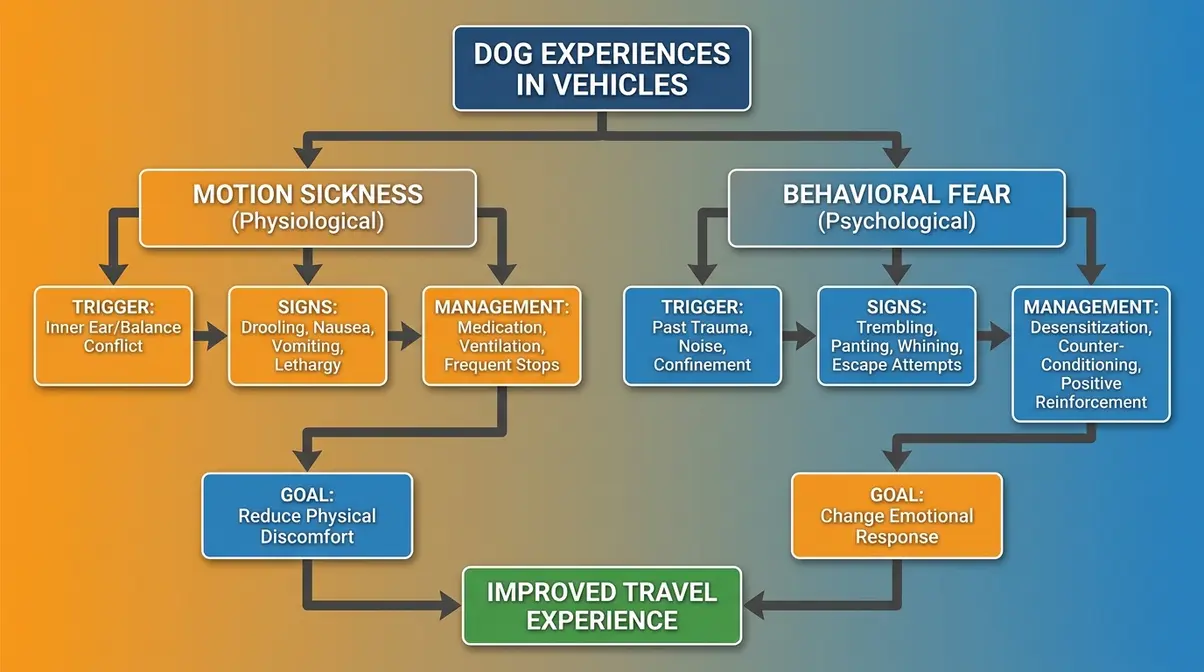
Golden retriever car anxiety usually comes from one of two sources: physical motion sickness or learned behavioral fear. A travel anxiety epidemiology study of 155 dogs found that 43.6% experienced travel-related issues including panting, restlessness, and vomiting. Knowing which type your dog has determines which solution to use, and it shapes which rung of The Trust Ladder you start on.
This is the right instinct. Most owners assume their Golden is just being dramatic. The data says otherwise: over 84% of dogs show at least mild fear or anxiety in everyday situations, according to a 2026 analysis of more than 43,000 dogs from the Dog Aging Project (Texas A&M University, 2026). For Golden Retrievers specifically, a 2026 study published by the Morris Animal Foundation identified anxiety-related genes in the breed that parallel human anxiety and neuroticism. Car anxiety is not a personality flaw. It is often a medical and behavioral issue that responds well to the right approach. For more context on breed-wide patterns, see common Golden Retriever behavior problems.
Is It Motion Sickness or Behavioral Fear?
Motion sickness is a physical response caused by conflicting signals in the inner ear during movement. It is especially common in puppies under 6 months, because the vestibular system (the inner-ear structure that controls balance and spatial orientation) is still developing during this time. Signs include yawning, drooling, lip-licking, and vomiting. The good news: many puppies grow out of motion sickness naturally as their vestibular system matures around 12-16 weeks and beyond. Car ride anxiety rooted purely in motion sickness often improves significantly once the puppy reaches 6-12 months.
Behavioral fear is an anxiety response learned from negative past experiences. A Golden Retriever who associates the car with a painful vet visit, a scary accident, or simply a lack of early exposure can develop a conditioned fear response. Signs look different from motion sickness: panting, shaking, whining, refusing to approach the car, and attempts to escape. This type of car ride anxiety does not improve on its own. This is why forcing your Golden into the car almost always makes things worse, not better.
Many Golden Retrievers have both simultaneously. Motion sickness worsens the fear, and fear heightens nausea. Addressing both together is the most effective path forward.
How Can You Tell If Your Dog Is Stressed in the Car?
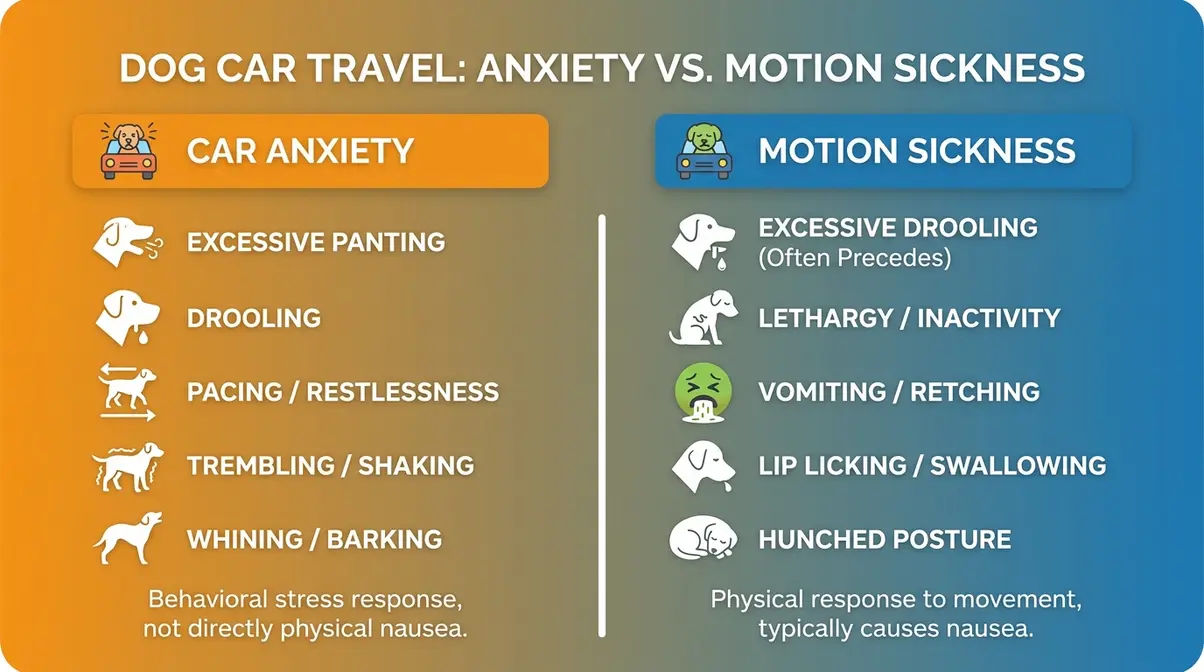
Learning to read your Golden’s stress signals is essential before you start any training. If you push past these signals, you will set progress back.
- Mild stress signals:
- Panting (when it’s not hot)
- Yawning repeatedly
- Lip-licking
- Turning their head away from you
- Tail held low
- Moderate stress signals:
- Drooling
- Trembling or shaking
- Whining
- Refusing high-value treats like chicken or cheese
- Severe stress signals:
- Vomiting
- Defecating
- Frantic pacing
- Attempting to escape the vehicle
The most important rule: if your Golden refuses high-value treats, stop the session immediately. Treat refusal means the stress level is too high for learning to occur. End the session calmly and try again tomorrow at a lower-intensity step. Once you can read these signals reliably, you are ready to start The Trust Ladder protocol.
How Do You Desensitize a Golden Retriever to Car Rides?
Desensitization (a gradual exposure technique that teaches your dog the car is safe through repeated, low-stress experiences) is the most evidence-backed approach for anxious dogs in cars. The Trust Ladder is a gradual 8-step protocol where each step builds on the last, and your dog decides the pace. According to University of Michigan Health, desensitization works through inhibitory learning, where the brain learns through repeated safe exposure that a feared trigger is no longer dangerous.
Coral Drake, staff author at devotedtodog.com, developed this protocol based on positive reinforcement (a training method that rewards desired behavior immediately to strengthen it) principles and large-breed-specific ergonomics for Golden Retrievers in the 60-80 lb range.
Before You Start: Prerequisites
Building a positive association with the car begins before you ever open a door. Gather these items first:
- High-value treats: Chicken, cheese, or hot dog pieces cut to thumbnail size. These must be foods your Golden does not get at other times. Regular kibble will not work for anxious dogs during Golden Retriever positive reinforcement training.
- A leash: For a controlled, calm approach to the car.
- Time, not trips: Sessions are 5-10 minutes maximum. Do not combine a training session with an actual errand.
- A calm owner: Dogs read human stress. If you are tense about the session, your Golden will be too.
- No food for 2-3 hours before: Reduces nausea risk during early sessions.
With your treats ready and a calm mindset, here is The Trust Ladder.
The 8-Step Trust Ladder Protocol
The ASPCA desensitization guidelines emphasize one core rule: keep every session shorter than the time it takes for the dog to become upset, gradually increasing duration from seconds to minutes over weeks. These 8 steps follow that principle exactly.
- Approach the car. Walk your Golden on leash to within 10 feet of the parked car. Reward with a treat and praise. Walk away. Repeat 3-5 times, then end the session. Why: the car itself is the first trigger, and simply being near it without anything bad happening is the first lesson.
- Touch the car. Let your Golden sniff and touch the car exterior. Reward every interaction. Do not open the door yet. Why: familiarity reduces the novelty threat, and sniffing is a calming behavior you want to reinforce.
- Open the door. Open the car door and let your Golden look inside. Reward for looking. Do not pressure entry. Why: the open door is a new visual stimulus, and your dog needs to decide it is safe before stepping closer.
- Treats near the door. Toss treats just inside the doorway so your Golden has to reach in to get them. Do not push or lift. Why: the dog chooses to engage, which builds genuine confidence rather than forced compliance.
- Enter and exit freely. Let your Golden jump in and immediately jump out. Reward the entry. Do not close the door. Why: removing the “trapped” feeling is especially critical for large breeds who cannot easily turn around in a small space.
- Sit in the parked car. Encourage your Golden to sit or lie down in the car with the engine off. Sit with them. Feed treats for 2-3 minutes, then close the door briefly. Why: stillness and calm inside the car is the target behavior you are training toward.
- Engine on, parked. Start the engine while your Golden is in the car. Feed treats continuously. Turn the engine off after 1-2 minutes. Why: the engine sound and vibration are separate triggers from the car itself, and they need their own desensitization step.
- Short drive to a fun destination. Drive 2-3 minutes to a park or somewhere your Golden loves. Keep the first drive under 5 minutes. End on a positive experience. Why: the destination rewires the car’s association from “bad thing happens” to “good thing happens.”
Large-Breed Note: For Golden Retrievers over 50 lbs, never lift them into the car during training. Use a dog ramp or encourage them to jump in independently. Forced lifting during a fear response can create a secondary fear of being handled, adding a new problem on top of the existing one.
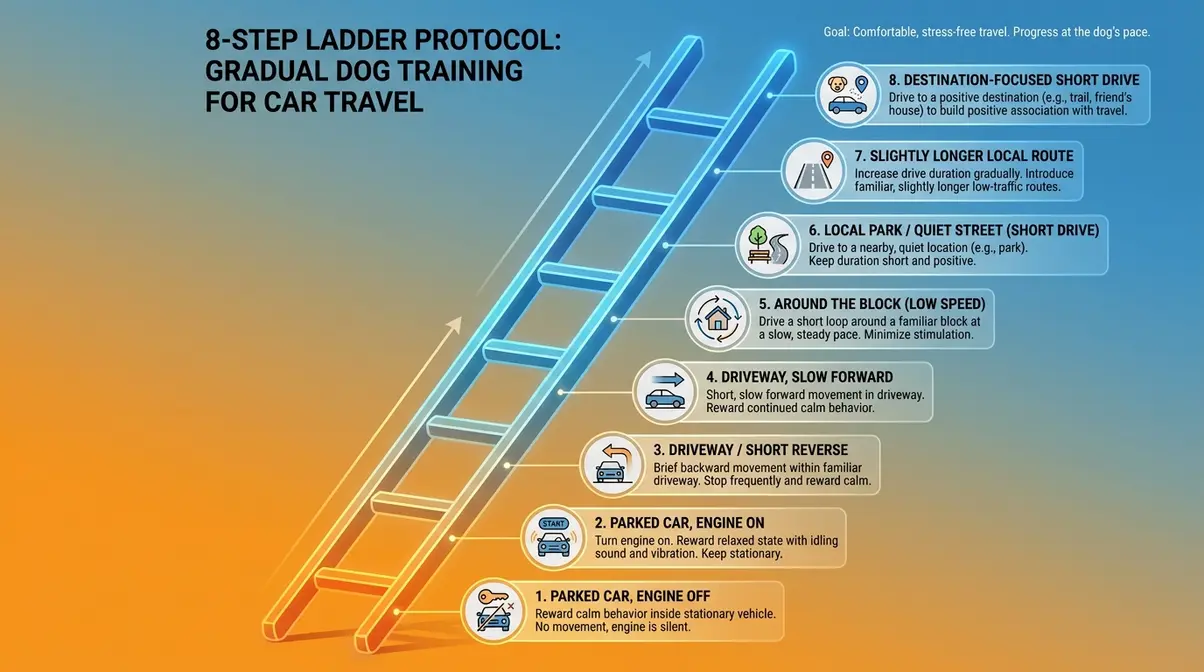
For dogs who are also working on crate training as a foundation for car confidence, the two protocols complement each other well.
Common Mistakes: The most common mistake is rushing. One good session does not mean your Golden is ready for the next step. If your dog refuses treats at any point, stop immediately and end the session positively. Progress is measured in weeks, not days. Skipping rungs because your dog “seemed fine” is the fastest way to undo three weeks of work.
The protocol works best when your car is already set up to help your Golden feel safe.
Setting Up the Car as a Safe Space for Your Golden Retriever
A well-set-up car makes each rung of The Trust Ladder easier to climb. Cornell University veterinary guidelines recommend fasting your dog 4-6 hours before travel to reduce nausea risk, and securing them in a properly sized crate or harness. Texas A&M veterinary guidance adds that creating positive associations before stressful events, including “happy visits” to the car without driving, significantly reduces anxiety responses.
Restraint Options: Crate vs. Harness
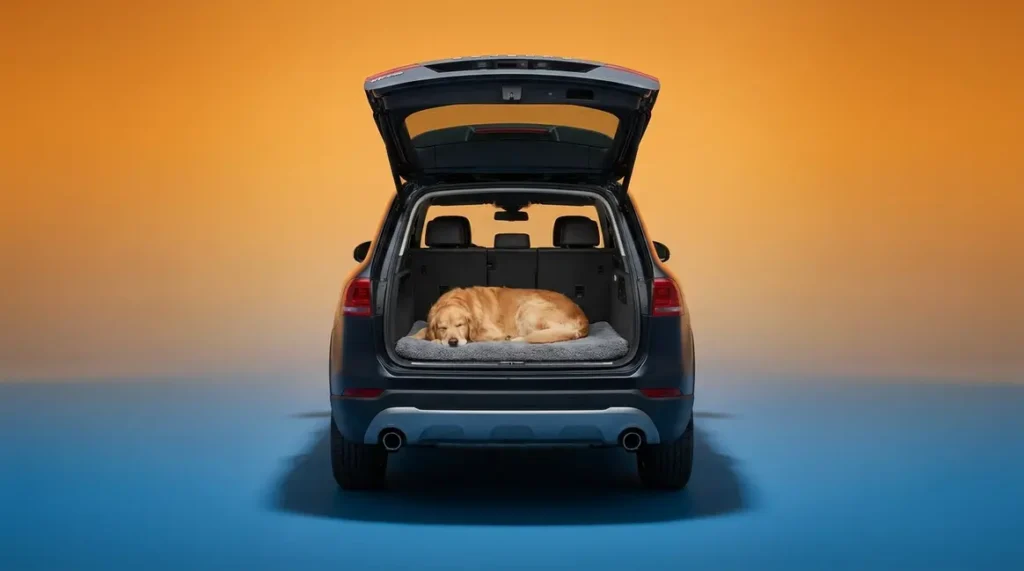
A crash-tested crate (a crate certified to withstand impact forces in a vehicle accident) is the recommended choice for anxious dogs. The enclosed, den-like space reduces visual stimulation from passing traffic and movement, which directly lowers arousal. For a 60-80 lb Golden Retriever, use a 36-42″ crate. Critically, the crate should be only large enough for your dog to stand, turn, and lie down. A crate that is too large allows sliding during turns, which increases anxiety. Secure it in the cargo area of an SUV or the back seat with tie-downs. See our guides to crash-tested car crates for Golden Retrievers and anxiety-reducing dog crates for specific recommendations.
A safety harness is a better option for dogs who are already comfortable in the car and simply need restraint. It must attach to the seat belt anchor. Regular collars are not safe restraints in a moving vehicle and should never be used as the primary attachment point.
Whichever option you choose, introduce it the same way you introduce the car: gradually, with treats, so your Golden associates it with calm and relaxed experiences from the start.
Comfort, Scent, and Temperature
Small sensory changes inside the car make a measurable difference for anxious Goldens:
- Familiar scent: Place a worn T-shirt or your Golden’s regular blanket in the crate. Familiar scent reduces cortisol (the stress hormone) in dogs and signals that this space is safe.
- Adaptil spray: Adaptil is a synthetic version of the calming pheromone mother dogs produce, available as a spray. Apply it to the crate interior 15 minutes before travel. Do not spray directly on the dog.
- Temperature: Cool the car to under 70°F before loading your Golden. Golden Retrievers have a dense double coat and overheat quickly. A hot car increases panting and nausea.
- Ventilation: Crack a window for fresh air. Fresh air reduces nausea during movement. Do not allow your dog to hang their head out, as this creates an injury risk at speed.
For Goldens with hip dysplasia (a common condition in the breed) or older dogs, dog ramps for easier car entry eliminate the stress of jumping and protect joints during repeated boarding and exiting.
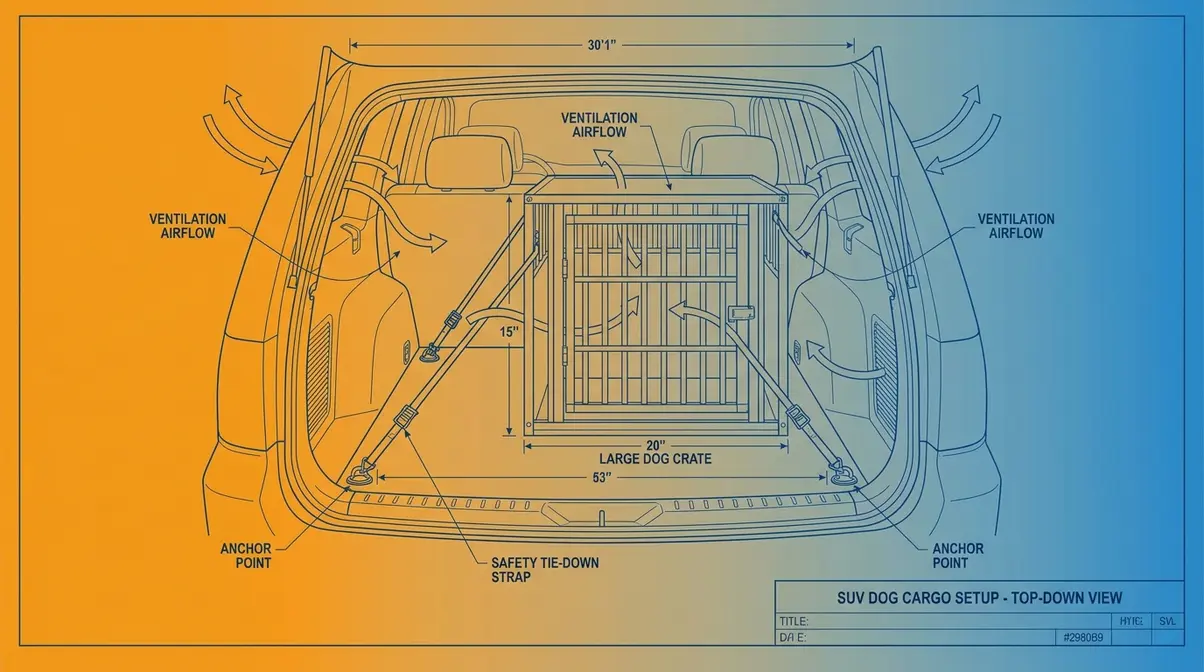
Car setup and training work best together. But if your Golden’s anxiety extends beyond the car, there is a broader context worth understanding.
Managing General Anxiety in Golden Retrievers

The 3-3-3 rule is a guideline suggesting newly adopted or highly anxious dogs need 3 days to decompress, 3 weeks to learn routines, and 3 months to fully settle into a home. Applied to car training: a Golden with generalized anxiety may need 3 weeks of daily Trust Ladder sessions before they are comfortable sitting in a parked car, compared to a few days for a dog whose anxiety is limited to the car.
Car anxiety is sometimes one symptom of a broader anxiety pattern. Three signs suggest the car is not the only trigger:
- Your Golden shows fear or stress in multiple locations, not just near the car.
- They show signs of separation anxiety in Golden Retrievers: destructive behavior when left alone, excessive barking or howling, or house-training regression.
- They react with fear to noise events like thunderstorms or fireworks.
If your Golden shows all three, the Trust Ladder still works. However, dogs with generalized anxiety may need to repeat each rung of The Trust Ladder multiple times before progressing to the next. NCBI research on canine anxiety treatment confirms that systematic desensitization and counterconditioning are the most successful treatments for canine anxiety-related problems (NCBI, 2020). The process takes longer, but the mechanism is the same.
Age also plays a role. Understanding when Golden Retrievers naturally calm down with age can help you set realistic expectations for your training timeline.
If The Trust Ladder is not making progress after several weeks, or if your Golden’s anxiety is severe, it is time to bring in professional support.
When Should You Call the Vet About Car Anxiety?

Veterinary Disclaimer: This article is reviewed by Brianna York, Former Vet Tech, and is for informational purposes only. It does not constitute veterinary medical advice. Always consult your veterinarian before administering any medication or supplement to your dog.
Most cases of Golden Retriever car anxiety respond to the Trust Ladder protocol and proper car setup. Some cases need veterinary support. According to the University of Illinois College of Veterinary Medicine, owners should ask their vet about anti-anxiety medicine or motion sickness medications before any trip if their dog has shown severe travel distress.
Signs It Is Time to Call the Vet
Call your vet if any of the following apply:
- Your Golden vomits on every car ride despite fasting 3-4 hours beforehand.
- Your Golden shows severe panic responses (defecating, frantic escape attempts) after 4 or more weeks of consistent Trust Ladder work with no improvement.
- Your Golden needs to travel urgently for a vet appointment or emergency and cannot handle the car at all.
When you call, describe the specific symptoms, how long they have been occurring, whether you have tried desensitization, and which destinations trigger the most distress. This gives your vet the information they need to recommend the right support.
Medication categories (overview only, no dosages):
- Cerenia: Cerenia is a prescription anti-nausea medication approved by the FDA for use in dogs. It addresses the motion sickness component of car anxiety and can make early training sessions more productive by removing the nausea trigger.
- Trazodone: Trazodone is a prescription anti-anxiety medication sometimes used for situational anxiety in dogs. It targets the behavioral fear component. Your vet will determine the appropriate dosage based on your dog’s weight and health history.
- Benadryl: Benadryl (diphenhydramine) is an over-the-counter antihistamine sometimes suggested for mild anxiety due to its sedative side effects. It is not FDA-approved for this use in dogs, and the correct dosage depends on your dog’s weight, age, and health history. Never administer it without vet guidance.
- Natural options: Adaptil spray (covered in the car setup section), and calming chews containing L-theanine or melatonin are options worth discussing with your vet. They are not replacements for training, but they may support it.
Whether or not you involve a vet, the principles stay the same: patience, consistency, and trust.
Frequently Asked Questions About Golden Retriever Car Anxiety
How do I calm my dog’s anxiety in the car?
Use gradual desensitization, starting with short sessions in a parked car before attempting any drives. Reward every calm behavior with high-value treats like chicken or cheese, and progress only when your Golden accepts treats freely, which signals that stress is low enough for learning to happen. Most dogs show meaningful improvement within 2-4 weeks of daily 5-10 minute sessions. For severe cases, consult your vet about anti-nausea or anti-anxiety medication to use alongside training.
Why does my golden retriever not like car rides?
Most golden retrievers dislike car rides because of motion sickness, a negative past experience (like a vet visit), or a lack of early positive exposure during puppyhood. The movement and engine vibration can be disorienting, especially for puppies whose inner-ear system is still developing. Many dogs also associate the car exclusively with stressful destinations. Both physical and psychological causes are treatable with consistent desensitization training, and results depend on the dog’s age, history, and training consistency.
Does Benadryl help dogs with car anxiety?
Benadryl (diphenhydramine) may help some dogs with mild car anxiety due to its sedative side effects, but it is not FDA-approved for this use in dogs. The correct dosage depends on your dog’s weight, age, and health history, and giving the wrong amount can cause serious side effects. Always consult your veterinarian before giving your Golden Retriever any medication, including over-the-counter options. Your vet may also recommend more targeted solutions like Cerenia for nausea or Trazodone for anxiety.
What is the best setup for a golden retriever in a car?
The best car setup for a golden retriever is a crash-tested crate (36-42 inches) secured in the cargo area, or a well-fitted safety harness clipped to a seat belt anchor. Add a familiar blanket or worn T-shirt for scent comfort, and spray Adaptil in the crate 15 minutes before departure. Keep the car cool (under 70°F) and crack a window for fresh air. For Goldens over 50 lbs, use a dog ramp to avoid forced lifting, which protects their joints and prevents a secondary fear of being handled.
Start Small and Build From There
For Golden Retriever owners dealing with car anxiety, the most important thing to know is that this is a solvable problem. Research shows over 43% of dogs experience travel-related distress, but the same science that explains the problem also provides the solution. Golden retriever car anxiety responds well to gradual desensitization, a proper car setup, and, when needed, veterinary support. The key is consistency over speed.
The Trust Ladder works because it puts your Golden in control of the pace. Every rung they climb builds genuine confidence, not just tolerance. That shift, from a dog who fears the car to one who sees it as a neutral or positive space, is achievable for most Golden Retrievers within 4-8 weeks of daily practice.
Start today with Step 1: walk your Golden to within 10 feet of a parked car, give three treats, and walk away. That is the whole session. If they took the treats, you are already on the Ladder. For more support on crate training as part of this process, see our guide to crate training a Golden Retriever puppy.
With patience, high-value treats, and The Trust Ladder protocol, most Golden Retrievers can learn to ride calmly in the car within 4-8 weeks of consistent daily practice.
If this topic interests you, our companion article on Dog Car Sickness: 5-Step Guide to Stop It Fast covers more detail.