“My 3-month-old Golden Retriever continues to terrorize me, all day every day. She bites me constantly.”, Golden Retriever Owner, Reddit
Bite inhibition is a core lesson of the puppy phase. Our complete Golden Retriever training guide places it in the wider age-by-age roadmap.
If that quote sounds like your life right now, you are not alone, and your puppy is not broken.
Every failed attempt to stop the biting chips away at the joy you imagined having with your puppy. Without the right technique, the biting often gets worse before it gets better. But here is what those generic “just say no” articles never tell you: Golden Retriever puppy biting follows a predictable developmental pattern, and there is a structured system, backed by veterinary science, not guesswork, designed to address it at every stage.
By the end of this guide, you will have a clear, 8-step system to teach your Golden Retriever puppy how to control their bite and become the gentle companion they are bred to be. We will cover why puppies bite, the step-by-step 4-Phase Bite Inhibition Blueprint, long-term prevention strategies, and the warning signs that tell you it is time to call a professional.
Teaching a Golden Retriever puppy to stop biting requires the 4-Phase Bite Inhibition Blueprint, a consistent system combining vocal signals, redirection, attention withdrawal, and lifestyle management.
- Biting is normal but must be trained from 8 weeks onward, not tolerated “until they grow out of it”
- The 4-Phase Blueprint (yelp → redirect → time-out → prevent) works for all household members
- Teething peaks between 3 and 7 months, the most critical window for bite inhibition training
- Red flag biting (growling + stiffening + snapping) requires a vet or certified trainer, not more patience
Why Your Golden Retriever Puppy Bites (And When It Gets Better)

Golden Retriever puppies bite for one simple reason: it is how they explore the world. Bite inhibition, the ability to control the force of a bite, is a skill they must learn, and they cannot learn it without guidance from you. The good news: biting is predictable, developmental, and trainable.
Understanding the “why” behind those needle-sharp teeth makes the “how” of training feel far more achievable. Golden Retriever puppies typically enter their most challenging behavioral phase between 5 and 18 months of age, requiring consistent training and patience throughout adolescence (Purdue University Extension on puppy adolescence). Knowing that timeline exists, and that it ends, changes everything.
Is Puppy Biting Normal? What the Experts Say
Golden Retriever puppy biting is completely normal behavior, and understanding that is your first step toward stopping it. Every puppy bites, it is how they play, explore, and relieve teething discomfort. The Golden Retriever, a breed renowned for its gentle temperament and historically trained for soft-mouthed retrieving, still bites hard as a puppy because bite inhibition is learned, not innate.
What Golden Retriever owners call “land sharks” is actually a puppy using their primary tool for interaction. The key distinction is between normal nipping, loose, wiggly body, pauses when you yelp, redirects easily, and problematic biting that is continuous, escalating, and accompanied by a stiff body. That contrast matters enormously for how you respond.
Validate your frustration: the “land shark” phase feels endless. But UC Davis guidelines on puppy nipping confirm that without proper training, normal puppy nipping can progress to unsafe behavior, which means the work you do now is genuinely protecting your future (UC Davis School of Veterinary Medicine). Most puppies with consistent training show significant improvement by 5–6 months.
The key is knowing exactly when your puppy’s biting is most intense, and that depends on where they are in their teething timeline.
The Soft Mouth Instinct: Why Goldens Are Extra Mouthy
Golden Retrievers were bred in Scotland to retrieve waterfowl and carry it back without crushing it. That trait is called a soft mouth, and it is the same drive that sends your puppy’s mouth toward your hands. The behavior you are training is not a flaw to erase. It is the breed’s soft-mouth history showing up in your living room, and your job is to teach it gentle limits.
Many Goldens also do something owners call cobbing: a gentle, rhythmic nibble on your hand or arm, like eating corn off the cob. Soft, slow cobbing with a relaxed body is affection, not aggression. Hard pressure is what you are training away.
Watch for the signs that play is tipping into overstimulation: dilated pupils, a slightly stiffer body, and fast, busy tail wagging. Those cues tend to show up just before gentle mouthing turns into frantic nipping. Catch them, and you can redirect or end the session before it escalates.
The Golden Retriever Teething Timeline: 3 to 8 Months
Puppy teething is a major driver of biting intensity, and most owners are never given the specific numbers. Golden Retriever puppies start with 28 baby teeth. Around 3–4 months (12–16 weeks), those baby teeth begin loosening and falling out. By 6–7 months, a full set of 42 adult teeth has typically emerged, according to the American Kennel Club’s teething timeline (AKC, 2026).
The timeline below shows exactly when to expect peak biting intensity.
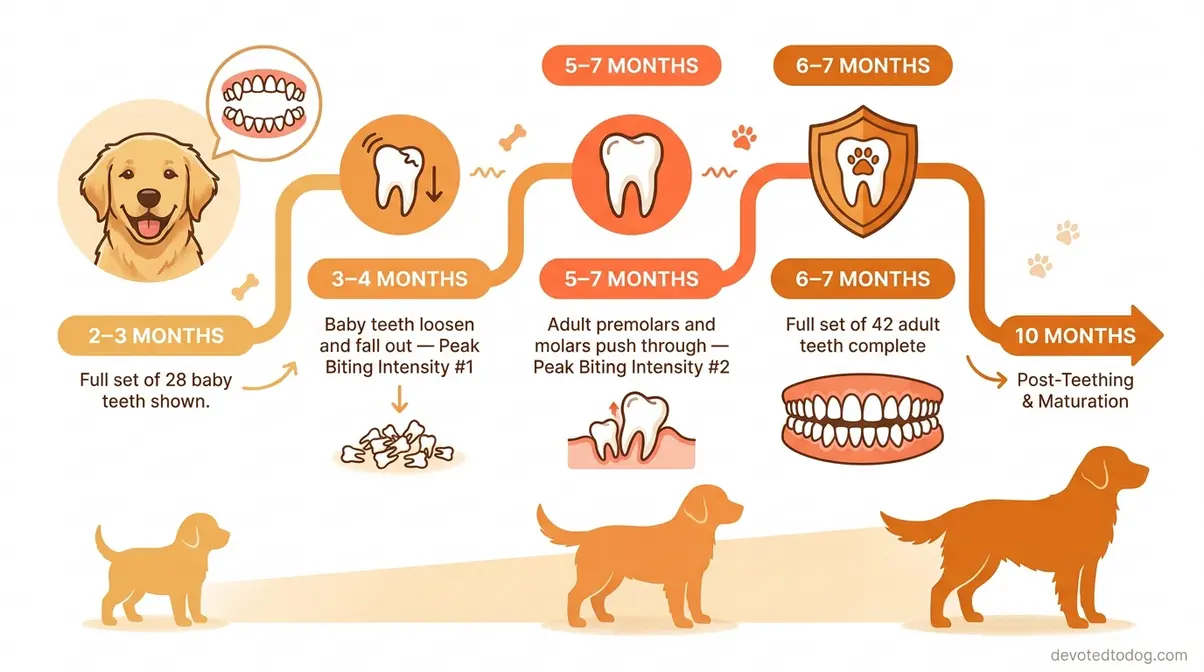
During this teething window, puppies experience genuine gum discomfort that drives them to chew and bite more intensely than usual. There are two peak biting intensity periods: around 3–4 months when baby teeth loosen and begin falling out, and again around 5–7 months when adult premolars and molars push through (AKC, 2026). This is the phase most owners find unbearable, the biting is not aggression, it is pain relief.
If your 4-month-old Golden Retriever feels like a “snapping turtle,” it is almost certainly teething-related, and it will ease as adult teeth settle in. For a full picture of your puppy’s physical development alongside this timeline, see our guide to Golden Retriever puppy growth stages.
Teething explains the intensity, but the developmental stage your puppy is in explains the duration. Here is what the teenage phase looks like for Golden Retrievers.
The Hardest Months: Understanding the Teenage Phase
The adolescent phase, sometimes called the “teenage phase”, typically begins around 5–6 months and can last until 18 months to 2 years. During this window, puppies test every boundary they were previously taught. Purdue University Extension on puppy adolescence identifies this stage as the most difficult developmental period for a puppy, requiring consistent training and daily structure (Purdue University Extension).
Cornell University’s tips for the teenage puppy phase emphasize that surviving puppy adolescence requires strict rules, routines, and physical exercise to channel the puppy’s energy constructively (Cornell University, Riney Canine Health Center). Without that structure, the adolescent phase is when many owners feel closest to giving up.
Many owners describe months 8–12 as the most difficult: the puppy is physically strong enough to cause real discomfort but not yet mentally settled. If your 9-month-old Golden Retriever seems to have “forgotten” all their training, they haven’t, they are testing. Stay the course. For a realistic picture of when the chaos settles, see our guide on when Golden Retrievers calm down.
Anecdotally, many owners report that female Goldens tend to mature slightly faster, though individual temperament varies far more than gender.
Understanding your puppy’s developmental stage is half the battle. The other half is giving them enough varied experiences early, which is exactly what the 7-7-7 Rule is designed to do.
The 7-7-7 Socialization Rule Explained

The Rule of 7s is a puppy socialization guideline that addresses one of the hidden causes of intense biting: under-socialization. According to the SPCA’s Rule of 7s socialization checklist, by the time a puppy is 7 weeks old, they should have experienced:
- 7 different surfaces (grass, carpet, tile, gravel, wood, concrete, sand)
- 7 different locations (backyard, park, car, friend’s home, pet store, sidewalk, stairs)
- 7 different people holding or interacting with them (SPCA of Wake County)
Why does this matter for biting specifically? Puppies that are under-socialized become fearful or overstimulated, and fear and overstimulation directly increase biting intensity. A puppy that has only ever seen one home and two people is far more reactive, and bitey, than one with varied, positive early experiences.
The Rule of 7s is a guideline, not a strict checklist. Even if your puppy missed early socialization, continued positive exposure reduces reactivity and nipping at any age. However, ASPCApro guidelines on safe socialization stress that during socialization, owners must closely monitor their puppy’s reactions, watch for signs of overwhelm like cowering, a tucked tail, or freezing, and stop the session if they appear (ASPCApro).
Now that you understand why your puppy bites and what developmental phase they are in, here is the 4-Phase Bite Inhibition Blueprint, a step-by-step system you can start today.
Step-by-Step: How to Stop Your Golden Retriever Puppy from Biting
The 4-Phase Bite Inhibition Blueprint organizes the following 8 steps into four phases: Phase 1 (Immediate Response, Steps 1–2), Phase 2 (Withdrawal, Step 3), Phase 3 (Commands, Steps 4–5), and Phase 4 (Prevention, Steps 6–8). Work through the phases in order, each one builds on the last.
The infographic below summarizes all four phases at a glance, print it out and post it somewhere the whole household can see.
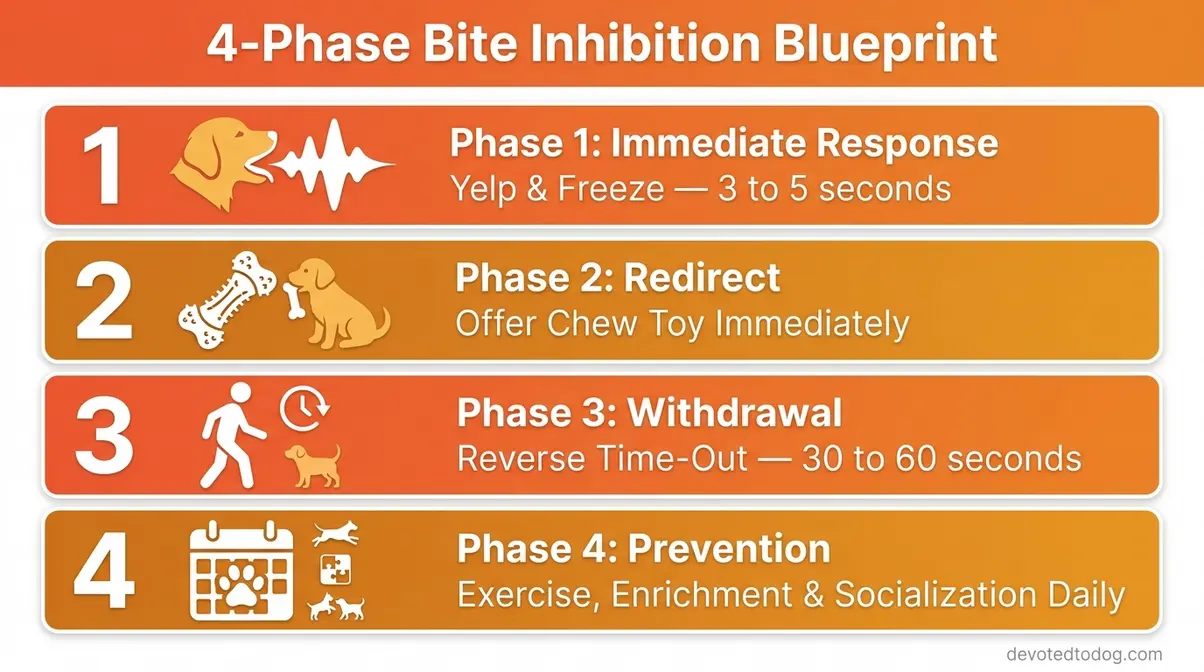
The most effective response to puppy biting combines an immediate vocal signal, toy redirection, and a brief withdrawal of attention, a three-part sequence that teaches bite inhibition without punishment (UC Davis guidelines on puppy nipping, UC Davis School of Veterinary Medicine).
Step 1, Respond Immediately: The Yelp and Withdraw Technique
The yelp and withdraw technique is the foundation of bite inhibition training and the first action in Phase 1. When your puppy bites, immediately let out a high-pitched “Ouch!” or “Yelp!”, loud enough to startle them but not so loud as to frighten them. This mimics the sound a littermate would make when bitten too hard.
The moment you yelp, go completely still and stop all interaction for 3–5 seconds. Do NOT pull your hand away quickly, rapid withdrawal triggers the puppy’s chase instinct and makes biting worse.
Why this works: in the litter, when a puppy bites too hard, the bitten puppy yelps and play stops. You are using the same communication signal to teach bite inhibition naturally. UC Davis guidelines on puppy nipping confirm that consistent vocal feedback is one of the most effective methods for teaching puppies to moderate bite pressure (UC Davis School of Veterinary Medicine).
Picture this scenario: your 10-week-old Golden is playing and clamps down on your wrist. You say “Ouch!” in a high voice, freeze, and turn your face away. The puppy pauses, that pause is the learning moment.
One nuance most guides skip: a high-pitched yelp overexcites some puppies, a caveat the AKC’s expert tips on puppy mouthing spell out. If your Golden bites harder after the “Ouch!”, drop the yelp and go straight to silent withdrawal (Step 3).
Once the puppy pauses after your yelp, immediately move to Step 2, redirect their mouth before they re-engage.
Step 2, Redirect to an Appropriate Chew Toy
The moment the puppy pauses after your yelp, calmly offer a chew toy, a rope toy, a frozen Kong, or a rubber teething toy. Place it gently in their mouth rather than waving it in front of them; waving excites them and can restart the biting cycle.
The key phrase to use: “Here, chew THIS.” Use the same word every time so the puppy begins associating that cue with acceptable chewing. Consistency in language speeds up learning considerably.
Why this works: the puppy’s urge to bite does not disappear, it needs an outlet. Redirecting teaches them what to bite, not just that biting is unwanted. That distinction is crucial for a breed with a natural retrieving instinct.
Keep a chew toy in your pocket during every play session so redirection is instant, a 5-second delay gives the puppy time to re-engage with your hands. Three effective chew toy types for Golden Retriever puppies:
- Frozen washcloths, soothing for teething gum discomfort
- Rubber Kongs stuffed with peanut butter, occupies the puppy for 15–30 minutes
- Rope toys, satisfies the tugging and mouthing instinct
Do NOT offer rawhide to puppies, it poses a choking hazard and can cause digestive issues.
If redirection alone is not working, if your puppy keeps coming back for your hands, it is time to escalate to Step 3.
Step 3, Use the Reverse Time-Out Method
The Reverse Time-Out, a technique where you remove yourself from play for 30–60 seconds to signal that biting ends all fun, is the most powerful tool for persistent biters. This is the “reverse” of a traditional time-out: you remove the fun (yourself), not the puppy.
Here is the full step-by-step execution:
- Puppy bites your hand or clothing
- Say “Ouch!” immediately (Step 1)
- Offer the chew toy (Step 2)
- If biting continues, calmly say “Too bad” or “All done”
- Stand up and leave the room, or step over a baby gate, for 30–60 seconds
- Return calmly, without fanfare
Why this works: dogs are deeply social animals. For a Golden Retriever, the most powerful consequence is the removal of your attention and company. This technique teaches that biting = fun ends immediately, every single time.
Picture this: your 14-week-old Golden bites your ankle while you are walking. You stop, say “Ouch!”, offer the toy. She ignores it and bites again. You say “All done,” step over the baby gate, and wait 45 seconds. She learns that biting makes you disappear.
One critical caveat: the Reverse Time-Out only works if you are consistent. One family member who laughs at the biting undoes everyone else’s work.
If your puppy follows you out of the room, a short leash tether to a sturdy piece of furniture works the same way as the baby gate: you step just out of reach and the game pauses.
Once your puppy understands that biting stops the fun, you can add verbal commands to give them a reliable off-switch.
Step 4, Teach the “Off” or “Leave It” Command
Choose one command, “Off,” “Leave it,” or “Enough”, and use it exclusively. Mixing commands confuses puppies and slows progress significantly.
Training sequence:
- When the puppy approaches to bite, say “Off” in a calm, firm voice (not a shout)
- Immediately redirect to a toy
- When the puppy takes the toy instead of your hand, praise immediately: “Good off!” or “Yes!”
Why this works: verbal deterrence gives the puppy a predictable signal. Over time, “Off” alone becomes enough to interrupt the biting impulse, without needing a yelp or a time-out every single interaction.
By 5 months, a well-trained Golden Retriever should pause and look at you when they hear “Off.” That moment of eye contact is your window to redirect. Plan for 4–6 weeks of consistent daily practice before this command reliably interrupts the biting impulse, that timeline is normal and expected (CPT Dog Training, 2026).
Commands work when a puppy is alert and engaged. For moments when they are overstimulated, the full “wild thing” mode, the Go-Limp Technique is more effective.
Step 5, Practice the Go-Limp Technique
When an overstimulated puppy is in full “land shark” mode, biting everything, seemingly unable to stop, the Go-Limp Technique can interrupt the arousal cycle. Instead of pulling away or reacting, go completely limp and still.
How to do it: sit or lie on the floor, cross your arms over your body, and go completely quiet. Ignore the puppy entirely. Most puppies disengage within 30–60 seconds because the “prey” has become uninteresting.
Why this works: overstimulated puppies are triggered by movement and noise. Stillness removes both stimuli and de-escalates the arousal state faster than any command can. You are not rewarding the biting, you are removing the fuel that drives it.
This technique is specifically for overstimulation, not aggression. If the puppy continues biting hard with growling or body stiffening, skip ahead to the Red Flag section below.
Steps 1–5 address biting in the moment. Steps 6–8 build the long-term foundation that makes biting less likely to happen at all.
Step 6, Socialize with Other Puppies
Puppies learn bite inhibition most efficiently from other puppies. When a puppy bites a littermate too hard, the bitten puppy yelps and stops playing, delivering the exact feedback humans are trying to replicate, but with far more immediacy and consistency than we can manage.
Enroll in a puppy socialization class during the 8–16 week window, which certified trainers consistently identify as the most sensitive period for social learning. Look for classes that allow supervised off-leash play, not just obedience drills. If a class is not accessible, arrange regular playdates with vaccinated, similarly-sized puppies. Even 2–3 sessions per week makes a measurable difference in biting intensity.
As a bonus, puppy classes fulfill multiple items from the 7-7-7 Rule simultaneously, new people, new locations, and new surfaces all in one outing.
Socialization reduces the intensity of biting. But to reduce the frequency, you need to actively reward the behavior you want to see.
Step 7, Reward Gentle Mouth Behavior
Most owners focus entirely on stopping the biting. Equally important is rewarding the moments when the puppy touches your hand gently, licks, or simply sniffs without biting.
When your puppy makes gentle contact, immediately say “Gentle!” in a warm voice and give a small treat or praise. Be fast, the reward needs to land within 1–2 seconds of the gentle behavior to make the connection clear.
Why this works: positive reinforcement works faster than punishment alone because it tells the puppy exactly what to do, not just what to stop doing. You are building a new habit, not just suppressing an old one.
During hand-feeding sessions, hold a treat in a closed fist. Only open it when the puppy sniffs or licks, not when they bite or paw. Within 5–10 repetitions, most puppies begin offering gentler contact because they have learned what earns the reward.
Individual techniques only work if every person in your home uses them the same way. Step 8 is what makes everything else stick.
Step 8, Make It a Household Rule: Consistency Above All
Consistency in puppy training is not a nice-to-have, it is the entire system. If one person yelps and withdraws while another laughs and wrestles with the puppy, the puppy learns that biting is sometimes acceptable. That partial reinforcement is actually harder to extinguish than if no training had happened at all.
Practical household consistency checklist:
- Post the 4-Phase Blueprint somewhere visible (fridge, dog crate area, entryway)
- Hold a 5-minute “family training meeting” so everyone uses the same commands and reactions
- Children especially need to practice the yelp-and-freeze technique before interacting with the puppy
With 100% household consistency, most Golden Retriever puppies show measurable improvement in biting frequency within 2–4 weeks of training, with significant reduction by 16–20 weeks of age (CPT Dog Training, 2026; Seattle Humane Society, 2026). The key word is consistent, skipping even one day resets progress.
For a complete daily training schedule built around these 8 steps, see our complete Golden Retriever puppy training guide.
These 8 steps address biting when it happens. The next section covers how to reduce how often it happens in the first place.
Management and Lifestyle: Preventing Biting Before It Starts

A bored Golden Retriever puppy is a biting puppy. Before reaching for a training technique, check the basics: is your puppy getting enough physical exercise, mental stimulation, and chew outlets? Meeting these three needs daily reduces biting frequency more than any single training method alone.
Exercise Requirements for Your Biting Puppy
The widely cited guideline for puppy exercise, supported by veterinary rehabilitation specialists and Purina’s nutritional team, is 5 minutes of structured exercise per month of age, twice per day (Toronto Vet Rehab, 2026; Purina, 2026). A 3-month-old Golden therefore needs approximately 15 minutes of walking or active play, twice a day.
For Golden Retriever puppies specifically, avoid high-impact exercise, jumping, running on hard surfaces, or repetitive ball-chasing, before 12–18 months, as their growth plates are still developing. Focus instead on fetch on grass, gentle tug-of-war, and leash walks at the puppy’s natural pace.
Timing matters as much as duration. Schedule a vigorous play session before training sessions and before situations where biting typically spikes, after meals, before bedtime, and during the late-afternoon “zoomies” window. A 15-minute game of fetch before dinner can meaningfully reduce after-dinner nipping by giving your puppy a legitimate outlet for their energy before they redirect it to your ankles.
Physical exercise addresses energy. Mental stimulation addresses boredom, and for Golden Retrievers, boredom biting can be just as intense as energy biting.
Mental Stimulation and Enrichment Activities
A puppy that receives adequate physical exercise and mental stimulation is significantly less likely to engage in excessive nipping, as boredom is one of the primary drivers of unwanted mouthing behavior. Golden Retrievers are working dogs bred for retrieving tasks, without a job, they create their own, and biting your hands is one of them.
Five specific enrichment activities that reduce biting by keeping the puppy’s brain engaged:
- Frozen Kong, stuff with peanut butter or wet food, freeze overnight; a frozen Kong, a rubber chew toy stuffed with food and frozen to extend chewing time, occupies a puppy for 15–30 minutes
- Sniff walks, let the puppy stop and sniff freely; mental effort tires them as effectively as physical exercise
- Puzzle feeders, feed meals from a puzzle toy instead of a bowl, turning every meal into a mental workout
- Basic training sessions, 5-minute sessions of sit, down, and recall; the mental concentration exhausts puppies faster than a walk
- Rotating chew toys, cycle through 3–4 toys weekly to maintain novelty; a puppy who has been chewing the same rope toy for three weeks will ignore it and return to your hands
Rotate the chew toy selection weekly to keep novelty high. Novelty is what holds a puppy’s attention, and attention on the toy means less attention on you.
Even with perfect exercise and enrichment, mistakes happen. The following section covers the training errors that most commonly keep the biting cycle going.
Why Is Your Adolescent or Adult Golden Still Mouthy?
Many owners see a welcome lull once the adult teeth are in. Then, somewhere in the teenage phase, the mouthing comes back during greetings and play, and now it comes from a bigger, stronger dog. It is boundary testing, and the same system still works.
The lull itself is a trap. When the biting eases, it is tempting to relax the rules. Treat those calmer weeks as maintenance, not graduation: keep the same marker words, the same redirection, and the same consequence, so the teenage wave meets a rule your puppy already knows.
Adult mouthing needs a slightly different mindset. The ASPCA’s guide to mouthing in adult dogs notes that an adult’s jaws can hurt far more than puppy teeth, that adults are less sensitive to our reactions than puppies are, and that time-outs are often effective for adolescent and adult dogs. So lean on Step 3 and Step 4 more than on the yelp.
Two habits help most with older Goldens:
- Build “Leave it” around your hands. Hold a treat in a closed fist at nose level and wait. The moment your dog backs off or looks away, say “Leave it” and reward from your other hand. Then practice with an open hand, then your wrist, then during petting. A minute or two of practice before a petting session heads off mouthing before it starts.
- Settle before attention. Ask your Golden to lie on a mat for 30–60 seconds before you pet or greet them. Calm comes first, and attention is the reward for it.
Common Mistakes That Make Puppy Biting Worse
Many well-intentioned owners accidentally reinforce biting, not through neglect, but through instinct. The five most common mistakes that prolong puppy biting are physical punishment, rough play, inconsistent reactions, yelping too quietly, and delayed responses, each one teaches the puppy the opposite of what you intend.
- Pulling your hand away quickly, Rapid withdrawal triggers the puppy’s prey instinct, causing them to lunge harder. Always go still first, then redirect.
- Playing rough with your hands, Using hands as toys teaches the puppy that hands are for biting. Use toys for all interactive play, without exception. Tug-of-war is fine as long as your puppy reliably lets go on “Drop it.” The game is not the problem; hands as targets are.
- Inconsistent reactions, Laughing one time and yelping the next confuses the puppy entirely. Every person, every time, every bite must receive the same calm, immediate response.
- Physical punishment, Tapping, flicking, or pushing the puppy’s nose away can increase fear and escalate biting into aggression. The AKC and UC Davis both advise against physical correction for puppy biting, recommending positive interruption methods instead.
- Giving up too soon, Most owners see measurable improvement at 2–4 weeks of consistent training. Quitting at week one restarts the learning cycle from zero, and the puppy carries no memory of the progress made.
Avoiding these mistakes keeps your training on track. But sometimes, biting goes beyond normal puppy behavior, and knowing the difference is critical.
When Biting Becomes a Red Flag: Signs to Watch For
Most Golden Retriever puppy biting is normal, and trainable. But a small percentage of biting signals something more serious: fear, pain, or resource guarding. Knowing the difference protects your family and ensures your puppy gets the help they actually need.
Normal Play Biting vs. Aggressive Biting: How to Tell the Difference
Normal play biting and red flag aggressive biting look and feel completely different once you know what to watch for. Use the flowchart below to assess your puppy’s biting behavior.
- Normal play biting signs:
- Loose, wiggly body during play
- Pauses or startles when you yelp
- Redirects to a toy willingly
- No growling or snarling
- Biting intensity decreases over consistent training sessions
- Red flag biting signs, per Ohio State University Veterinary Medical Center:
- Body stiffening before or during biting
- Growling or snarling while biting
- Cowering before biting (fear-based)
- Snapping at nothing (air snapping)
- Biting that escalates in intensity despite consistent training
Ohio State University’s warning signs for puppy behavior confirms that stiffening, cowering, and snapping are red flag behaviors that are not normal in puppies (Ohio State University Veterinary Medical Center). True aggression in puppies, marked by growling, body stiffening, and snarling during biting, requires professional evaluation, not a wait-and-see approach.
Tufts University research on fear-based aggression explains that true biting accompanied by growling and teeth-baring is a form of aggression often rooted in fear-based aggression, biting that stems from anxiety or pain rather than play, distinguishing it fundamentally from normal puppy mouthing (Tufts University).
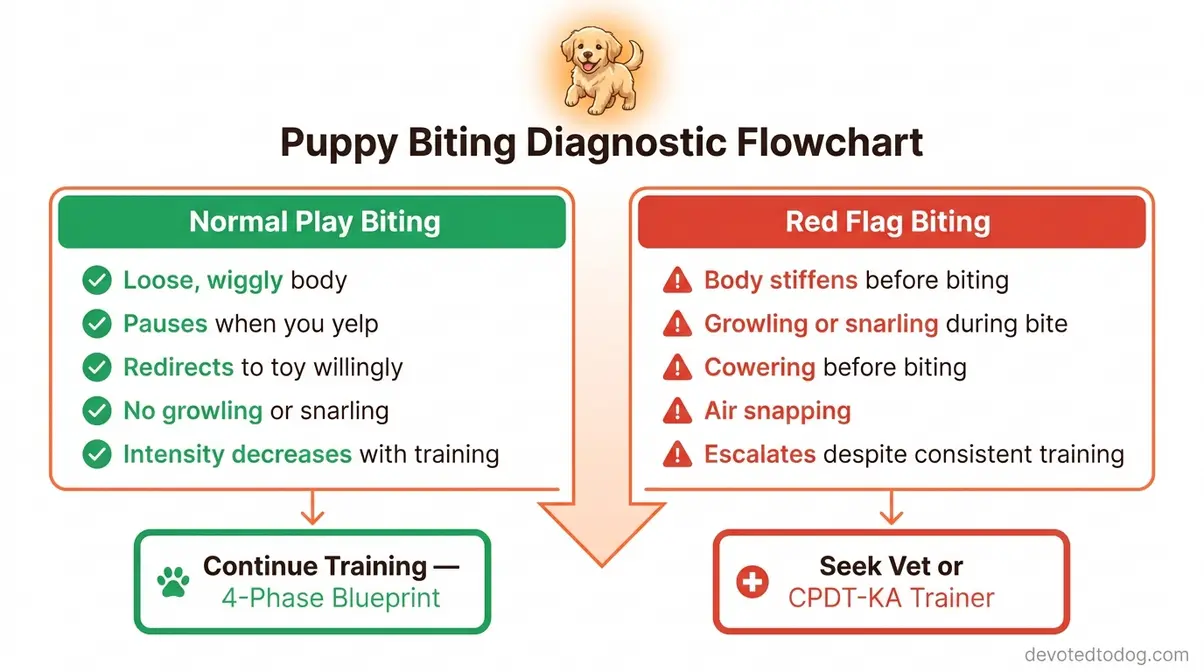
If you checked more than two items in the red flag column, it is time to bring in a professional.
When to Call a Professional Trainer or Veterinarian
Seeking professional help for puppy biting is not failure, it is the responsible choice. A veterinary behaviorist, a veterinarian with advanced training in animal behavior, or a Certified Professional Dog Trainer (CPDT-KA) can help address persistent or escalating biting in ways that most owners simply cannot replicate at home.
Seek professional guidance if any of the following apply:
- Biting draws blood more than once
- Biting is accompanied by growling or snarling
- Your puppy is over 6 months old and biting has not reduced despite 4+ weeks of consistent training
- Any household member, especially a child, is frightened of the puppy
- Your puppy growls or snaps when approached near food, toys, or a resting spot (resource guarding)
- Biting is aimed at one specific person and getting more frequent or intense
Not every growl is a warning. A high-pitched play growl during tug or chase is normal. A low, sustained growl with a hard stare or a stiff body that does not stop when you disengage is different, and resource guarding will not resolve on its own with the techniques in this guide. To find a credentialed trainer near you, search the Certification Council for Professional Dog Trainers (CCPDT) directory.
A certified trainer has seen hundreds of cases like yours. What feels impossible to solve alone often has a straightforward solution with expert eyes, and professional intervention can help address the issue within 2–4 sessions in many cases. For context on the full range of behaviors that may warrant professional support, see our guide to common Golden Retriever behavior problems.
Before we get to your questions, here is one more topic that comes up frequently for new Golden Retriever owners, how to tell their puppy apart from a Labrador.
Golden Retriever vs. Labrador Puppy: Quick Breed Comparison
Golden Retrievers and Labrador Retrievers are frequently confused, especially as young puppies. The most reliable distinguishing features are coat and head shape, not color alone, a yellow Labrador can look surprisingly similar to a Golden Retriever at first glance.
| Trait | Golden Retriever | Labrador Retriever |
|---|---|---|
| Coat | Long, wavy or feathered; requires regular grooming | Short, dense double coat; low maintenance |
| Head Shape | Broader, more rounded skull with a gentle expression | Wider, blockier head with a more pronounced stop |
| Tail | Long, feathered, carried level or slightly upward | Thick “otter tail”, round and tapered, no feathering |
| Build | Slightly leaner, more elegant frame | Stockier, more muscular build |
Both breeds are friendly, highly trainable, and prone to similar puppy biting behaviors during the teething and adolescent phases. Coat color alone is not a reliable identifier, yellow Labradors are commonly mistaken for Golden Retrievers. For a complete side-by-side comparison of temperament, training, shedding, and health, see our complete Golden Retriever vs. Labrador comparison.
Frequently Asked Questions
What to do when my golden retriever pup is always biting?
Use the “redirect and disengage” strategy every single time your puppy bites, without exception. When your puppy bites, let out a high-pitched “Ouch!” to signal it was too hard, then immediately redirect their mouth to an appropriate chew toy. If biting continues, use a Reverse Time-Out by leaving the room for 30–60 seconds. This teaches your puppy that biting makes the fun stop, one of the most powerful lessons a social dog can learn. Results require consistency from every person in the household; one exception can reset days of progress.
What is the hardest age for a golden retriever puppy?
The most challenging age for a Golden Retriever puppy is typically 5 to 18 months, during the adolescent “teenage” phase. This window is when puppies test every boundary they were previously taught, and biting, jumping, and energy levels often spike. Many owners find months 8 to 12 the most difficult, as the puppy is physically strong but not yet mentally settled. The good news: consistent training during this phase creates the calm, gentle adult Golden Retriever the breed is known for. Patience and routine are the most important tools during adolescence.
What is a red flag puppy’s behavior?
A red flag in a puppy’s behavior is biting that is accompanied by growling, body stiffening, or snarling, signs that the biting stems from fear or aggression, not play. Normal play biting involves a loose, wiggly body and stops when you yelp; red flag biting escalates despite your response. Other warning signs include air snapping, cowering before biting, and biting that draws blood repeatedly. These behaviors should be evaluated by a veterinarian or certified dog trainer as early as possible. Early intervention dramatically improves outcomes for puppies showing fear-based aggression.
What is the 7-7-7 rule for puppies?
The “Rule of 7s” is a puppy socialization guideline suggesting that by 7 weeks of age, a puppy should have experienced 7 different surfaces, 7 different locations, and been held by 7 different people. The goal is to build a confident, well-adjusted dog by exposing them to varied, safe, positive experiences early in development. Well-socialized puppies are less reactive and typically bite with less intensity. The Rule of 7s is a guideline, not a strict requirement, any positive socialization during the first 16 weeks is beneficial. If your puppy missed early socialization, continued positive exposure at any age can still reduce fearfulness and biting.
Why is my Golden Retriever so mouthy?
Golden Retrievers are mouthy by design. They were bred to carry game gently in their mouths, and that soft-mouth instinct is the same drive that sends a puppy’s mouth toward your hands. Puppies also mouth to explore, to relieve teething discomfort, and to play. Gentle, slow nibbling with a relaxed body is normal and often affectionate. The goal of training is not to erase the instinct but to teach your Golden how gentle their mouth must be around people.
At what age do Golden Retrievers stop biting?
There is no single birthday, but there are two milestones. Teething-driven biting usually eases once the full set of adult teeth is in, typically by 6 to 7 months. A second wave of mouthing often appears during the teenage phase, which can run to 18 months. With consistent training, most owners see measurable improvement within 2 to 4 weeks, and many Goldens keep a gentle, mouthy streak for life. That is fine as long as the pressure stays soft.
Is it normal for an adult Golden Retriever to still be mouthy?
Yes, gentle mouthing during play or greetings is common in adult Goldens, and the breed’s soft mouth makes it more likely. The concern is pressure and context, not mouthing itself. Adult jaws hurt more than puppy teeth, so keep using redirection, time-outs, and a solid “Leave it.” If an adult dog’s mouthing comes with a stiff body, a hard stare, or a low growl, treat it as a red flag and contact a professional.
Moving Forward with the Blueprint
For new Golden Retriever owners dealing with out of control nipping, the 4-Phase Bite Inhibition Blueprint provides a structured, science-backed system to teach bite inhibition without punishment. Most puppies show measurable improvement within 2–4 weeks of consistent application, the key word being consistent. With the right techniques and realistic expectations about the teething timeline (3–7 months) and the teenage phase (5–18 months), your “land shark” puppy will become the gentle, soft-mouthed companion Golden Retrievers are bred to be.
The 4-Phase Bite Inhibition Blueprint works because it addresses biting at every level: in the moment with the yelp and redirect, after the moment with the Reverse Time-Out, and before the next moment through exercise, enrichment, and socialization. You are not a bad dog owner, you just needed a system, and now you have one.
Start with Phase 1 today, practice the yelp and redirect technique in your very next play session. Even one consistent repetition is more progress than a week of inconsistent reactions. For a complete daily training schedule that reinforces all 8 steps, explore our complete Golden Retriever puppy training guide and put the full blueprint into action.
Related reading:
To curb destructive chewing during teething, see the best anti-chew sprays for dogs.
Alliyah Strange is a CPDT-KA certified dog trainer and behaviorist. She reviews DevotedToDog training and behavior articles for accuracy and alignment with current positive-reinforcement, force-free training standards.