
If you share your home with a Golden Retriever who won’t stop barking, you know the exhaustion. The non-stop barking at 2am, the neighbors noticing, the guilt of not knowing how to help your dog, it adds up fast. Golden Retrievers have a reputation for being gentle, calm family dogs, which makes all that noise even more confusing.
Barking is one chapter of the breed’s behavior story. Our complete Golden Retriever behavior guide covers the rest, stage by stage.
“Need help with barking and digging, this is my Daisy girl!! She’s 1 and a half, she’s never been destructive or barky but as she’s gotten older I’ve realised she’s starting to dig more holes and barking tonnes when I’m at work.”, Golden Retriever owner, Reddit
Every bark you ignore without understanding the trigger might be reinforcing the behavior. By the end of this guide, you’ll know exactly why your Golden Retriever is barking and have a step-by-step plan to reduce it, starting today. We cover the 5 most common triggers, age-specific puppy advice, proven training techniques, and what to do when barking signals something more serious.
Golden retriever barking has specific, identifiable causes, and with the right approach, you can reduce excessive barking in as little as 2–4 weeks of consistent training.
- The Bark Decoder Framework: Identify the trigger first, classify the bark type, then apply the matching fix
- Puppies calm down between ages 2–4; the adolescent phase (6–18 months) is the hardest
- The “Quiet” command and the 3 Bark Rule are the two most effective techniques
- Night barking in Goldens often links to their acute hearing, not anxiety
- See a vet if barking is sudden, new, or accompanied by other behavioral changes
- Table of Contents
- Why Do Golden Retrievers Bark? The 5 Most Common Triggers
- Golden Retriever Puppy Barking: Age Stages and Early Training
- How to Stop Your Golden Retriever from Barking: Step-by-Step Methods
- Golden Retriever Barking at Strangers, at Night, and at Other Dogs
- What Does a Golden Retriever’s Bark Sound Like?
- When Golden Retriever Barking Is a Warning Sign
- Frequently Asked Questions
Why Do Golden Retrievers Bark? The 5 Most Common Triggers
Golden Retrievers are not the most excessive barkers, but they are vocal dogs with a strong instinct to communicate. A 2025 study from Texas A&M veterinary research found that more than 99% of U.S. dogs exhibit at least one behavior problem, excessive vocalization ranks among the most commonly reported. That means understanding why your Golden barks is the first step to managing it.
Are Golden Retrievers Big Barkers?
Golden Retrievers barking a lot is not exactly their reputation among breed experts. Compared to Beagles, Siberian Huskies, or Yorkshire Terriers, Goldens rank as moderate barkers, they were bred as hunting retrievers, not guard dogs. Alarm barking exists in the breed, but it isn’t their dominant trait.
That said, when a Golden does bark, it carries weight. According to Dickinson College breed notes, Golden Retrievers rarely bark, but when they do, it is typically a deep, loud, and sharp bark, which can feel excessive even if it happens infrequently.
“Barking a lot” is also relative. A few barks a day when the mail arrives? That’s normal alert barking. Thirty minutes of non-stop barking when you leave the house? That warrants attention. Setting that baseline expectation helps you figure out whether you have a training challenge or a breed-normal dog who just sounds louder than you expected.
So if Goldens aren’t natural excessive barkers, why does yours seem to bark at everything? The answer usually comes down to one of five triggers.
The 5 Main Reasons Your Golden Is Barking

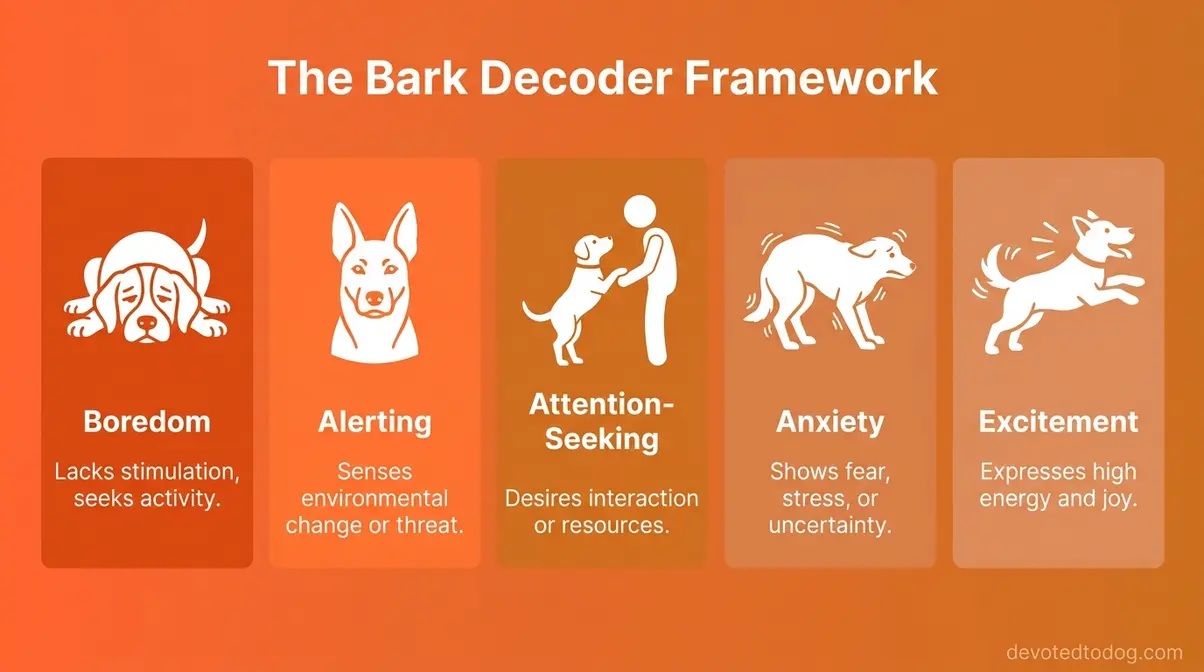
Understanding golden retriever barking behaviors and types starts with identifying which trigger applies to your specific dog. Here are the five primary causes:
- Attention-seeking / Demand barking, Your Golden has learned that barking gets a reaction from you. Even negative attention, scolding, looking at them, walking over, counts as a reward in their mind.
- Boredom and under-stimulation, Golden Retrievers need 1–2 hours of exercise daily. Without it, they create their own entertainment. Usually that means noise.
- Alert barking, They heard or saw something unfamiliar. This is instinctive and normal in small doses. Think of it like your dog’s version of sending you a text message: “Hey, something’s happening out there.”
- Anxiety or stress, Separation anxiety (fear of being alone) is common in this breed and can cause non-stop barking when you leave. This is one of the most frequently reported issues in Golden Retriever owner communities.
- Excitement, High-arousal moments like greeting you at the door or spotting their leash trigger happy, high-pitched barks. These are joyful, not problematic, unless they escalate.
Breed instincts and underlying health issues are two additional factors worth noting, the Limitations section below covers the medical angle in detail.
The first step in The Bark Decoder Framework is identifying which of these triggers is causing the bark in your dog. A Golden who barks only when you pick up your keys is showing anxiety. A Golden who barks at the window at passing strangers is alert barking. These need different fixes, applying the wrong technique to the wrong trigger is why most owners feel stuck.
Why Does My Golden Retriever Bark at Nothing?

One of the most frustrating moments for owners is when their dog seems to bark at nothing, staring at a blank wall, barking into an empty hallway. You’re not imagining it, and your dog isn’t losing their mind. Dogs can hear sounds four times farther away than humans can (Hearing Sense, 2020), and their frequency range extends well beyond ours. What sounds like silence to you is often a distant car door, wildlife in a neighboring yard, or pipes vibrating inside the walls.
Other causes of apparent “bark at nothing” include visual stimuli like a shadow moving across the floor, a flicker of light from a passing car, or anxiety-triggered phantom alerting, where a stressed dog becomes hypervigilant and reacts to things that aren’t a genuine threat.
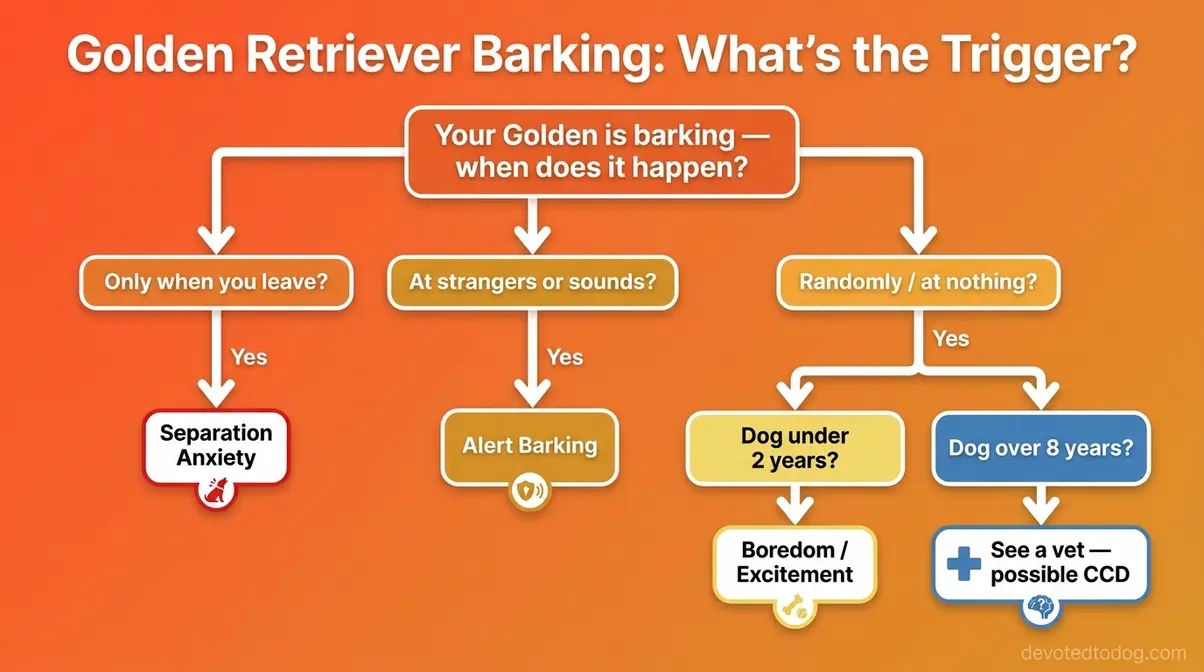
In senior Golden Retrievers, barking at nothing can be an early sign of Canine Cognitive Dysfunction (CCD), a medical condition covered in the Warning Signs section below. If your dog is over 8 years old and this behavior is new, that’s the first place to look.
If your Golden stares at the wall and barks, they may be hearing pipes, insects in the walls, or a neighbor’s TV through the insulation. You can verify this by checking whether why your dog seems to bark at nothing follows a pattern, same time of day, same location, which usually points to a predictable external sound source.
Now that you understand the “why,” let’s look at how this plays out differently depending on your dog’s age, especially if you have a puppy.
Golden Retriever Puppy Barking: Age Stages and Early Training
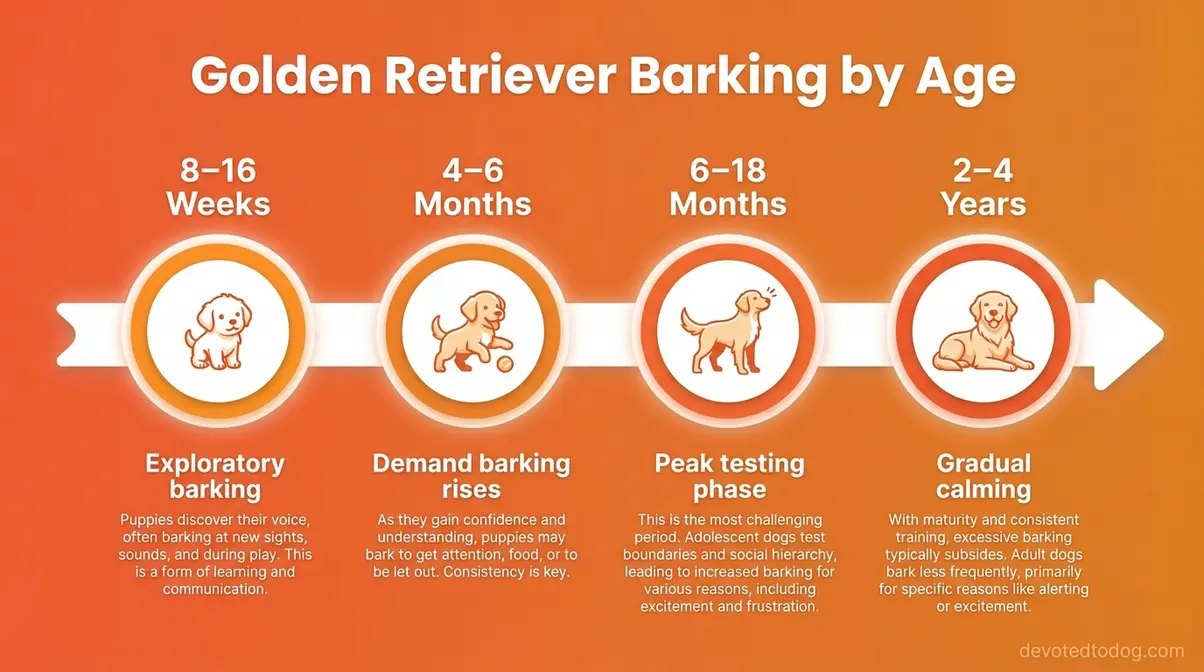
Golden Retriever puppy barking is almost always normal, temporary, and manageable with early, consistent training. Most puppies “find their voice” between 6 and 16 weeks, and the intensity typically peaks during the adolescent phase (6–18 months). Understanding what’s developmentally normal at each stage helps you respond correctly, rather than accidentally making it worse.
When Do Golden Retriever Puppies Start Barking?
Puppies begin vocalizing between 2–4 weeks of age with whimpers and small sounds. True barking typically develops between 6–16 weeks, though some puppies find their voice earlier or later. Early barking is exploratory, the puppy is learning what sounds they can make and what responses those sounds produce. This is the critical window for shaping behavior.
According to Homeward Bound Golden Retriever Rescue guidelines, Golden Retrievers need to experience different people, places, and noises during development to stay balanced. Puppies who miss this early exposure are more likely to develop fear-based barking later.
Female and male Golden Retrievers may mature at slightly different rates, males often take longer to settle into calmer behavior, based on community consensus among breed owners and rescue organizations. At 8 weeks, your puppy’s bark is mostly reaction, they’re startled, hungry, or lonely. By 4 months, they’re actively testing whether barking gets them what they want.
The early weeks are manageable. It’s the adolescent phase, what many owners call the “hardest age”, where most people struggle.
What’s the Hardest Age for Golden Retrievers?
Golden retriever puppy barking a lot reaches its peak during the adolescent phase, roughly 6 to 18 months. During this time, Goldens test boundaries, seem to “forget” their training, and combine high energy with impulsive behavior that can feel like regression. Most Golden Retrievers calm down between 2 and 4 years of age, but the adolescent phase from 6 to 18 months is often the most challenging period for owners.
Here’s what to expect at each stage, and what to prioritize:
| Age | Typical Barking Behavior | What to Prioritize |
|---|---|---|
| 8–16 weeks | Exploratory, reactive | Socialization; gentle redirection |
| 4–6 months | Demand barking increases | Ignore demand barks; reward quiet |
| 6–18 months | Peak testing; boundary-pushing | Consistent “Quiet” command; daily exercise |
| 2–4 years | Gradual calming | Maintain training; add mental enrichment |
At 9 months, many owners report their Golden seems to have “regressed”, barking at things they used to ignore, jumping again, pulling on the leash. This is normal adolescent behavior, not a training failure. Consistent training during adolescence is the single biggest predictor of a calmer adult dog, as Homeward Bound Golden Retriever Rescue guidelines confirm, fear-based barking often stems from insufficient environmental exposure during this phase.
For a structured approach to this period, the golden retriever puppy training guide covers the adolescent phase in detail.
Two of the most common puppy-specific problems owners face are crate barking and demand barking. Here’s exactly how to handle both.
How to Handle Crate Barking and Demand Barking
Crate barking is barking that happens when your puppy is left in their crate, especially at night. Puppies in crates are separated from their family, which triggers distress vocalization, it’s instinctive, not defiant. Here’s how to address it:
- Make the crate a positive space before expecting quiet. Feed meals inside the crate, add a worn t-shirt for your scent, and place familiar toys inside.
- Practice short separations during the day before attempting overnight crating. Five minutes, then ten, building gradually.
- If they bark in the crate at night, wait for a 2-second pause in barking before going to them. Never respond to active barking, doing so teaches them that barking works.
For more detail on building crate comfort, see this crate training your golden retriever puppy guide.
Demand barking is when your dog barks specifically to get something, your attention, a treat, a toy. It’s the canine equivalent of a toddler’s tantrum: loud, persistent, and surprisingly effective if you give in. As Cornell University’s guide to excessive barking identifies, demand barks are a specific category where the dog sounds as if demanding a treat or action from the owner.
The key rule: any response, including telling them “no,” making eye contact, or pushing them away, teaches them barking works. The fix is complete, consistent non-response. Turn your back, leave the room, do not speak.
If your Golden barks at you while you’re on the phone, they’ve learned that barking interrupts you, which counts as attention. Move to another room until they’re quiet, then return calmly.
There’s one more puppy behavior that often comes packaged with barking, biting. Here’s how to manage both at once.
Puppy Barking and Biting: Managing Two Problems at Once
Golden retriever puppy barking and biting often appear together in puppies aged 8–20 weeks because both behaviors are rooted in the same high-arousal state. The puppy is overstimulated, overtired, or frustrated, and both barking and biting are their way of expressing it.
The response strategy is the same for both: reduce arousal first. Stop play, remove your attention, and allow the puppy to calm down for 2–3 minutes before re-engaging. Do not shout, spray water, or use physical corrections, these increase arousal and typically make biting worse, not better.
Ohio State University puppy behavior guidance notes that alarm barking and lunging at people or animals is not a normal fearful response in a puppy without a history of trauma. If your puppy’s barking and biting during play is accompanied by stiff posture, growling, or snapping that feels different from normal play, consult a certified trainer or veterinary behaviorist.
If your puppy bites and barks during play, the game ends immediately. Walk away without speaking. Puppies learn quickly that biting and barking = end of fun. Most puppies connect this within a few days of consistent application.
Now that you know what’s developmentally normal, let’s move to the part most owners are really here for: how to actually stop the barking.
How to Stop Your Golden Retriever from Barking: Step-by-Step Methods
There are three proven techniques for reducing golden retriever barking, and they all rely on the same principle: reward the behavior you want, ignore the behavior you don’t. Positive reinforcement (rewarding quiet) is the most effective approach, according to Tufts University veterinary behaviorists. Here’s how to implement each technique, starting today.
Positive reinforcement, rewarding quiet behavior, is the most effective and humane method for reducing excessive barking in dogs, according to veterinary behaviorists at Tufts University’s Cummings School of Veterinary Medicine, one of the top veterinary schools in the United States.
Steps 2 and 3 of The Bark Decoder Framework, classify the bark, apply the matching response, are exactly what this section delivers.
What You’ll Need Before You Start Training
Before jumping into techniques, gather these basics:
- High-value treats, small pieces of chicken, cheese, or commercial training treats. Something your dog finds irresistible, not just their regular kibble.
- A quiet space with minimal distractions for initial training sessions. Outdoors with neighborhood noise is too hard at first.
- A clicker (optional but helpful), a clicker marks the exact moment of good behavior so your dog learns faster.
- 5–10 minutes per day, short, consistent sessions outperform long, occasional ones every time.
Ready? Here’s the first technique, and the most important one.
Step 1, Teach the “Quiet” Command
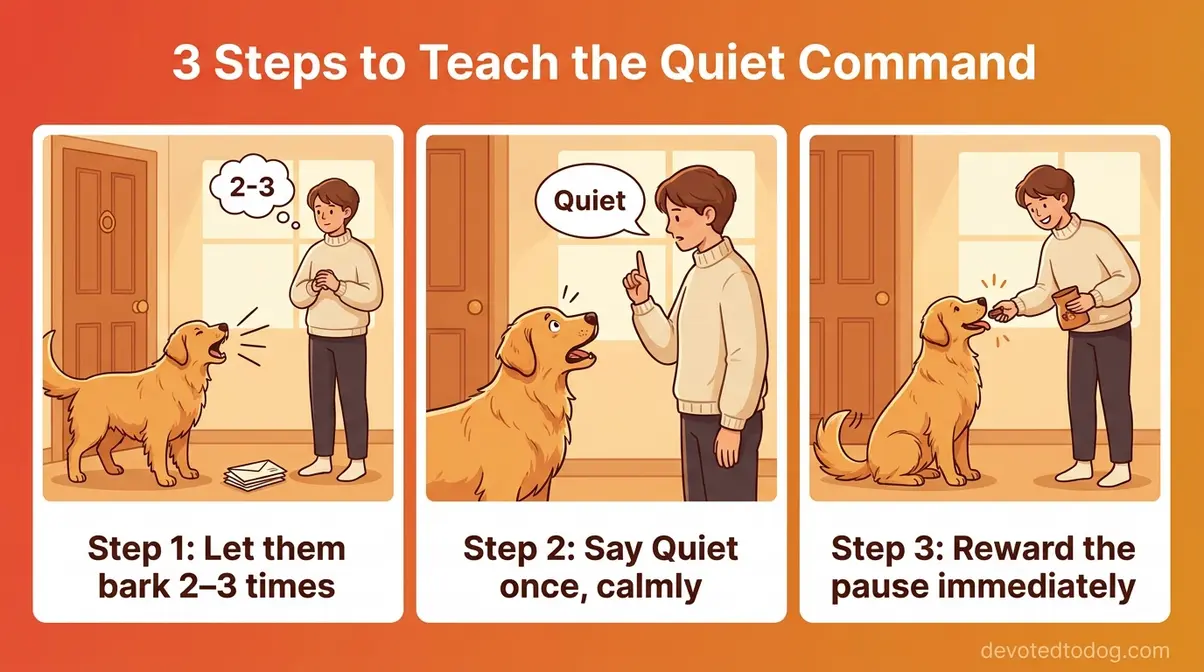
Learning how to get a golden retriever to stop barking starts here. The “Quiet” command works by giving your dog an alternative behavior, silence, and rewarding it. You’re not punishing the bark; you’re teaching what earns the reward. Here are the numbered steps:
- Wait for your Golden to bark naturally, or create a trigger (ring the doorbell, knock on the wall).
- Let them bark 2–3 times. Do not shout, wave your hands, or react in any way.
- In a calm, firm voice, say “Quiet” once. Do not repeat it.
- The moment they pause, even for just 1 second, immediately mark it (click or say “Yes!”) and give a treat.
- Gradually increase the required quiet time before rewarding: 1 second → 3 seconds → 10 seconds → 30 seconds.
- Practice 5–10 repetitions per session, once or twice a day.
The most common timing error: owners wait too long to reward. The treat must arrive within 2 seconds of the quiet moment, otherwise your dog doesn’t connect the reward to the silence. At first, your Golden will look confused. That’s fine. They’re learning. Most dogs make the connection within 3–5 sessions.
According to Tufts University guidelines on territorial barking, once a dog stops barking on cue, owners should begin rewarding intermittently, not every time, to reinforce the quiet behavior long-term.
Once your Golden starts responding to “Quiet,” you’re ready to layer in the 3 Bark Rule, a technique that works with their instincts instead of against them.
Step 2, The 3 Bark Rule: Allow, Then Stop
If you’re dealing with a golden retriever barking problem that feels out of control, the 3 Bark Rule is one of the most practical frameworks available. The 3 Bark Rule allows your dog to bark up to three times before you give the “Quiet” command, acknowledging their instinct to alert you while teaching self-control.
Why it works: Golden Retrievers are bred to communicate. Completely suppressing all barking creates frustration, which can make the behavior worse over time. Giving them an “allowed” outlet makes the “Quiet” command feel fair rather than arbitrary. Here’s how to implement it:
- When a trigger occurs (doorbell, stranger passing, another dog outside), stay calm and allow your dog to bark up to 3 times.
- After the third bark, say “Quiet” once in a calm, neutral voice.
- The moment they stop, reward immediately with a treat and calm praise.
- If they continue past 3 barks before you give the command, redirect with a “Sit”, then reward the sit.
The goal is not silence, it’s control. A dog that barks twice and then looks to you for guidance is a trained dog. Tufts University veterinary behaviorists recommend that once dogs stop acting up for attention, owners reward the quiet behavior intermittently to reinforce it. Results typically appear within 5–10 consistent training sessions.
Training commands address the behavior, but if your Golden is barking because they’re bored, no command will fix the root cause. That’s where Step 3 comes in.
Step 3, Exercise and Mental Enrichment
Golden Retrievers need 1–2 hours of physical exercise daily. Under-exercised Goldens barking a lot is almost a given, they create their own stimulation when they don’t get enough outlets. Mental stimulation is equally important and often overlooked. A tired brain is a quiet brain.
Try these enrichment ideas instead of a second bowl of kibble:
- Puzzle feeders and snuffle mats, feed meals this way to turn eating into a 15-minute mental workout
- Training sessions, 10 minutes of obedience work equals roughly 30 minutes of physical exercise in mental effort
- Frozen Kongs, stuff with peanut butter or wet food and freeze overnight; occupies most dogs for 20–30 minutes
- Scent work games, hide treats around the house or yard and let your dog hunt for them
For dogs that bark when left alone, increase exercise before departing, provide a stuffed Kong at the moment of departure, and consider a dog-appeasing pheromone (DAP) diffuser, though note that current evidence for DAP efficacy in adult dogs with separation anxiety is mixed, and it works best as part of a broader management plan rather than a standalone solution (Veterinary Evidence, 2021).
Now let’s cover what NOT to do, because some common responses to barking actually make the problem worse.
Common Mistakes That Make Barking Worse
If your golden retriever won’t stop barking despite your efforts, check whether you’re making one of these common errors:
- Shouting “No!” or “Stop!”, To your dog, your raised voice sounds like barking back. It increases their arousal and validates the behavior rather than stopping it.
- Giving attention to stop the barking, Even negative attention (pushing them away, making eye contact, walking over) teaches that barking produces a result.
- Inconsistency, Allowing barking sometimes and correcting it other times teaches your dog that the behavior is sometimes rewarded. This is the single most common mistake owners make.
- Punishment-based tools (shock collars, citronella spray collars), These suppress the symptom without addressing the cause and frequently increase anxiety-driven barking over time.
The alternative to all of these is consistent, calm, positive reinforcement, which is exactly what the techniques above provide.
The techniques above work for general barking. But what about specific situations, like when your Golden barks at strangers, barks all night, or loses their mind on walks?
Golden Retriever Barking at Strangers, at Night, and at Other Dogs
Does your Golden go from calm to chaos the moment a stranger walks by? Golden retriever barking at strangers, at night, or at other dogs usually has a specific root cause, and each one needs a targeted response. Step 2 of The Bark Decoder Framework is classifying the bark, territorial, fear-based, or reactive, before choosing your response. Here’s a trigger-by-trigger breakdown.
Barking at Strangers: Territorial or Fear-Based?
Golden retriever barking at strangers falls into two distinct categories, and they require different responses. Learning to tell them apart is one of the most useful skills you can develop as an owner.
Territorial barking: Your dog stands tall, ears forward, tail up. They’re saying “this is my space.” The body posture is confident, even assertive.
Fear-based barking: Your dog barks but backs away, tail tucked, ears flat, body low. They’re saying “you scare me.” The bark sounds aggressive, but the dog is actually frightened.
| Bark Type | Body Language | Response Strategy |
|---|---|---|
| Territorial | Upright, ears forward, tail raised | “Quiet” command + redirect to sit; reward calm behavior near stranger |
| Fear-based | Backing away, tail tucked, ears flat | Controlled exposure; stranger drops treats without eye contact |
For territorial barking, use the “Quiet” command and redirect to a sit. Reward calm behavior when the stranger is present. Gradually reduce the distance to the trigger over multiple sessions.
For fear-based barking, do NOT force interaction, that increases fear. Instead, practice controlled exposure: have the stranger drop treats on the ground without making eye contact. Over days, your Golden learns that strangers = good things happen. Tufts University guidelines on territorial barking advise rewarding dogs intermittently once they stop barking on cue, this reinforces the quiet behavior more durably than rewarding every time.
If your Golden barks at the mail carrier every day, they’re practicing and reinforcing the behavior. Use management (close the window, move your dog to another room) while you work on the training protocol.
Daytime barking at strangers is frustrating. Nighttime barking is exhausting. Here’s what’s causing it, and it may surprise you.
Golden Retriever Barking at Night: Why It Happens
Golden retriever barking at night is one of the most disruptive problems owners report, and it’s often misunderstood. The most common cause isn’t anxiety or bad behavior. Dogs can hear sounds four times farther away than humans (Hearing Sense, 2020), and their hearing frequency range extends well beyond ours. What triggers nighttime barking is often completely inaudible to you: distant wildlife, neighbors returning home at midnight, a car door slamming two streets away, or raccoons moving through a neighboring yard.
This is breed-specific and not a training failure. It’s your Golden doing exactly what their senses are wired to do, they’re just doing it at 3am.
In senior Golden Retrievers (8+ years), nighttime barking can signal Canine Cognitive Dysfunction (CCD), the dog equivalent of dementia. Signs include disorientation, barking at walls or into empty spaces, and disrupted sleep patterns. According to Cornell University’s guide to excessive barking, cognitive changes in senior dogs are a recognized medical cause of excessive barking, not a behavior problem to be trained away.
Management techniques for nighttime barking:
- Place a white noise machine near your dog’s sleeping area to mask external sounds.
- Ensure adequate exercise before bedtime, a physically tired dog settles more quickly.
- Move your dog’s bed away from windows facing the street or a busy area.
- If using a crate, cover it with a blanket to reduce visual stimuli from passing headlights.
If your Golden is barking through the night and it’s a new behavior in a dog over 8 years old, schedule a vet appointment before trying training techniques. The cause may be medical, not behavioral.
Nighttime barking affects you. Barking on walks affects your whole neighborhood. Here’s how to manage a Golden who reacts to other dogs.
Barking at Other Dogs on Walks: Reactive Behavior
Golden retriever barking at other dogs on walks is one of the most common complaints in owner communities, and one of the most manageable with the right approach. A reactive dog is one that overreacts to common stimuli, like another dog on the street, with barking, lunging, or growling. It doesn’t mean your dog is aggressive; it means they’re overstimulated. Cornell University research on reactive dogs confirms that reactive dogs become overly aroused by common stimuli, leading them to lunge, bark, and growl when focused on a trigger, this is a trainable condition, not a character flaw.
Cornell University’s Riney Canine Health Center notes that reactive dogs become overly aroused by common stimuli, leading them to lunge, bark, and growl when focused on a trigger.
Common causes in Goldens: insufficient socialization during puppyhood, leash frustration (they want to greet the dog but can’t), or underlying fear. The management technique that works best for most owners is the “Look at That” (LAT) game:
- When your Golden notices another dog, calmly say “Look at that”, not as a command, just a calm observation.
- The moment they glance at the dog and then look back at you, reward immediately with a high-value treat.
- Repeat consistently. Over time, your dog learns: other dog = look at owner = treat.
Success in reactive dog training happens at the distance where your dog can notice the trigger without reacting. If your Golden can walk calmly past a dog at 30 feet but loses control at 10 feet, train at 35 feet until they’re reliable, then slowly decrease the distance.
One more specific trigger deserves attention, and it’s the one that hits hardest when you’re not even home.
Barking When Left Alone: Is It Separation Anxiety?
Golden retriever barking when alone is one of the most reported problems, and Daisy’s story from the introduction is a perfect example of it. “Barking tonnes when I’m at work” is a phrase that appears constantly in owner communities, and it points to one of two things: a dog adjusting to alone time, or true separation anxiety.
Separation anxiety is a clinical condition, not just a dog being “dramatic.” Signs include barking within the first 30 minutes of owner departure, destructive behavior, pacing, and house-soiling that only happens when alone. A dog that barks for 5 minutes then settles is adjusting. A dog that barks non-stop for hours and destroys furniture may have true separation anxiety requiring professional intervention.
A practical first step: practice departure desensitization. Pick up your keys, put on your shoes, then sit back down without leaving. Repeat this until the cues stop triggering anxiety. For a full protocol, the golden retriever separation anxiety guide covers the complete step-by-step approach.
Some owners want to hear what a Golden’s bark actually sounds like, especially those considering the breed. Here’s a quick audio and video guide.
What Does a Golden Retriever’s Bark Sound Like?
If you’ve only ever heard a Chihuahua or a terrier, a Golden Retriever’s bark can be startling. It’s deep, resonant, and authoritative, what you’d call a “big dog” bark. There’s nothing shrill or yappy about it. As Dickinson College breed notes document, Golden Retrievers rarely bark, but when they do, it is typically a deep, loud, and sharp bark. Golden Retrievers produce a deep, loud, and sharp bark when they do vocalize, which can sound alarming despite being one of the calmer barking breeds overall. Puppy barks are quite different, higher-pitched, shorter, and less developed.
Adult Golden Retriever Bark
The adult golden retriever barking sounds you’ll hear most often fall into three distinct types. The short alert bark is sharp and single, one clean “woof” to flag something unusual. The demand bark is repeated and rhythmic, your dog has decided they want something and they’re making their case. The excited bark is rapid and slightly higher-pitched than their baseline, triggered by high-arousal moments like seeing their leash.
Some owners also report what’s affectionately called the “whisper bark”, a very soft, low-volume vocalization that Goldens sometimes produce when they want something but seem to be trying to be polite about it. It’s one of the more charming quirks of the breed.
According to Dickinson College breed notes, Golden Retrievers are known to rarely bark, but when they do, the sound is distinctly full-bodied and loud compared to their generally calm demeanor.
Puppy barks sound quite different, here’s what to expect from a young Golden.
Golden Retriever Puppy Bark
The golden retriever puppy barking sound is a different experience entirely from the adult version. Early puppy barks (8–12 weeks) often sound more like yelps or squeaks than true barks, they’re short, high-pitched, and almost comical compared to what this dog will eventually produce.
The golden retriever barking sound changes significantly between 8 weeks and 12 months as the dog’s vocal cords develop and mature. Many owners describe early puppy sounds as “adorable” rather than alarming, it’s only around 4–6 months that the bark starts to carry real volume and authority.
Now for the part of the article that can make a real difference to your dog’s long-term health: knowing when barking is a warning sign, not just a habit.
When Golden Retriever Barking Is a Warning Sign
Most barking is behavioral. Some barking is medical. Knowing the difference protects your dog.
Medical Causes of Excessive Barking
A sudden increase in barking, especially in a dog with no recent environmental change, is the key signal that something medical may be happening. Specific conditions to be aware of:
- Pain: A dog in pain may vocalize more, especially when touched or moved. Sudden-onset barking in a previously quiet dog warrants a vet visit, not a training session.
- Cognitive Dysfunction Syndrome (CDS): Senior dogs (8+ years) may bark at nothing, pace, and seem confused or disoriented. This is a medical condition, not a behavior problem, and it requires veterinary assessment.
- Thyroid issues: Hyperthyroidism can cause increased restlessness and vocalization. It’s less common in dogs than cats, but it does occur.
- Hearing loss: Paradoxically, dogs losing their hearing may bark more as they lose the feedback loop that regulates their own vocalizations.
Cornell University’s guide to excessive barking identifies multiple medical and cognitive causes of excessive barking, making a vet consultation the correct first step when barking is sudden and new.
One condition worth noting: hemangiosarcoma, an aggressive cancer of the blood vessels, is sometimes called the “silent killer” in Golden Retrievers because it can develop with few outward symptoms. Sudden behavioral changes, including new or unusual barking patterns in a senior dog, are one of the reasons regular vet check-ups matter. The FAQ below covers this in more detail.
When to Call Your Vet or a Professional Trainer
Knowing when to get help is part of being a great dog owner, not a sign of failure.
- See your vet if:
- Barking is sudden and new in a previously quiet dog
- Barking is accompanied by other changes (appetite loss, lethargy, disorientation)
- Your dog is 8+ years old and barking at nothing or through the night
- Barking is accompanied by apparent pain (yelping when touched or moved)
- Consult a certified trainer or veterinary behaviorist if:
- You’ve been consistent with training for 4+ weeks with no improvement
- Barking is accompanied by aggression (growling, snapping at people or other dogs)
- Your dog has true separation anxiety, barking for hours when alone, with destructive behavior
Frequently Asked Questions About Golden Retriever Barking
Do Golden Retrievers bark a lot?
Golden Retrievers are moderate barkers, they’re not the most vocal breed, but they’re not quiet either. They bark to communicate excitement, alert to strangers, seek attention, or express boredom, but they are not classified as excessive barkers by breed standards. Without consistent training and adequate daily exercise, however, barking can escalate into a daily nuisance. Individual dogs vary considerably, some Goldens are naturally much quieter than others, depending on genetics, environment, and early training.
At what age do goldens calm down?
Most Golden Retrievers calm down between 2 and 4 years of age, once they pass through their adolescent phase. The adolescent period from 6 to 18 months is the most energetic and vocal stage, dogs test boundaries, seem to forget their training, and exhibit high-energy behavior that frustrates even experienced owners. Consistent daily exercise and obedience training during adolescence significantly accelerates the calming process. Some Goldens remain high-energy into their third year, especially without sufficient mental and physical stimulation.
How do I get my Golden Retriever to stop barking?
To stop a Golden Retriever from barking, teach the “Quiet” command using positive reinforcement, reward silence, never punish the bark. Ensure your dog gets 1–2 hours of daily exercise and mental stimulation to prevent boredom-driven barking, and ignore attention-seeking barks completely rather than reacting to them. Most dogs respond to consistent “Quiet” command training within 3–5 training sessions. If barking persists after 4+ weeks of consistent training, consult a certified dog trainer or veterinary behaviorist for a personalized plan.
What is the 3 bark rule?
The 3 Bark Rule allows your dog to bark up to three times before you give the “Quiet” command, acknowledging their instinct to alert while teaching self-control. After the third bark, calmly say “Quiet” once, the moment they stop, immediately reward with a treat and calm praise. This technique works with the dog’s natural communication instinct rather than trying to suppress it entirely. Results typically appear within 5–10 training sessions when applied consistently every time a trigger occurs.
Which dog breed barks the most?
Beagles, Siberian Huskies, and Yorkshire Terriers are generally considered the most vocal dog breeds, significantly more so than Golden Retrievers. Beagles were bred for scent hunting and use their distinctive bark (called a “bay”) to communicate with hunters, making prolific vocalization deeply instinctive for the breed. Golden Retrievers rank as moderate barkers, they have the instinct to alert but are not classified as high-barking breeds by major kennel clubs. Breed tendency is a baseline; individual training and environment have a larger impact on daily barking levels than breed alone.
What is the hardest age for Golden Retrievers?
The adolescent phase, roughly 6 to 18 months, is widely considered the hardest age for Golden Retriever owners. During this period, Goldens test boundaries, seem to “forget” their training, exhibit high energy, and may bark more than they did as younger puppies. Consistent daily training sessions of 10–15 minutes during this phase are the single most effective way to navigate it successfully. Most owners report a noticeable shift toward calmer, more settled behavior around the 2-year mark.
What is the silent killer in Golden Retrievers?
Hemangiosarcoma, an aggressive cancer of the blood vessels, is often called the “silent killer” in Golden Retrievers because it can develop without obvious symptoms until it is advanced. Golden Retrievers are disproportionately affected by this cancer compared to other breeds, and it can cause sudden collapse with very little warning. Regular veterinary check-ups, including abdominal ultrasounds for dogs over 8 years, are the primary tool for early detection. If your senior Golden shows sudden behavioral changes, including new or unusual barking patterns, schedule a vet appointment promptly.
What to Do Starting Tonight: Your Golden Retriever Barking Action Plan
For Golden Retriever owners struggling with non-stop barking, the good news is that this breed responds exceptionally well to positive reinforcement training, most dogs show measurable improvement within 2–4 weeks of consistent practice. A 2025 study from Texas A&M School of Veterinary Medicine, a leading U.S. veterinary research institution, found that more than 99% of U.S. dogs exhibit at least one behavior problem, which means you’re not alone, and your dog is not broken. At Devoted to Dog, the consistent finding across owner communities is that the dogs who improve fastest are the ones whose owners identify the trigger before applying any technique.
The Bark Decoder Framework, identify the trigger, classify the bark, apply the matching response, gives you a structured starting point for any barking situation. Most owners react to the bark itself. This framework flips that habit: it trains you to observe first and react second. That single shift is what separates owners who make progress from those who stay frustrated. Every section of this guide is organized around that three-step sequence because it’s the counterintuitive insight that competitors consistently miss.
Start tonight with Step 1. The next time your Golden barks, pause before reacting and ask: what triggered this? Was it the doorbell? Your departure? Boredom? Then match the technique from this guide to that specific trigger. If you’re not sure yet, that’s fine, keep watching, keep noting the pattern, and come back to the relevant section. Consistent observation is the first act of training.
Alliyah Strange is a CPDT-KA certified dog trainer and behaviorist. She reviews DevotedToDog training and behavior articles for accuracy and alignment with current positive-reinforcement, force-free training standards.
Related gear: see our guide to enrichment toys.