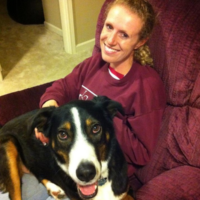
“Hi there, just looking for some advice please. My 4 year old golden retriever has been excessively panting for over a week now. It’s not hot in my house and he hasn’t been doing any strenuous playing/exercising.”
Panting can signal several things. Our Golden Retriever behavior guide helps you read it alongside your dog’s other cues.
If that sounds like your situation, you’re not alone, and you’re right to pay attention. The challenge is that panting in Golden Retrievers can mean dozens of different things, from “my dog just had a great run” to “we need to get to the emergency vet tonight.”
Understanding why does my golden retriever pant so much starts with context. In this guide, you’ll learn exactly how to read your Golden’s panting using a simple three-question framework, so you can tell the difference between normal and dangerous. We’ll cover the most common normal reasons, the warning signs of serious illness, and exactly when to pick up the phone and call your vet.
If you are wondering why does my golden retriever pant so much, the answer often lies in their thick double coats, but panting at rest in a cool room, or panting paired with pale gums or lethargy, is a medical red flag that requires same-day veterinary attention.
- Normal panting happens after exercise, in heat, or during excitement, and stops when the trigger does
- The Panting Context Test: Ask When, Where, and What Else, these three questions reveal the cause instantly
- Breed-specific risks include laryngeal paralysis, heart disease, and hemangiosarcoma, all linked to abnormal panting in Golden Retrievers
- Call your vet immediately if panting is constant, sounds harsh or raspy, or is paired with pale gums
⚠️ Medical Disclaimer
This article is for informational purposes only and is not a substitute for professional veterinary advice, diagnosis, or treatment. If you are concerned about your dog’s health, please consult a licensed veterinarian immediately. In a potential emergency (pale gums, collapse, labored breathing), go to an emergency animal hospital without delay.
Normal Reasons Your Golden Retriever Pants
Golden Retrievers pant heavily for many normal reasons, and most of the time, it’s simply how their bodies work. When asking why does my golden retriever pant so much, it’s important to look at their environment. They have a dense double coat that traps heat, which means they pant more than short-coated breeds even in moderate temperatures. Before you worry, apply The Panting Context Test: ask yourself three questions, When is it happening? Where is it happening? What else is going on? For most everyday panting episodes, those three questions will point directly to a harmless explanation.
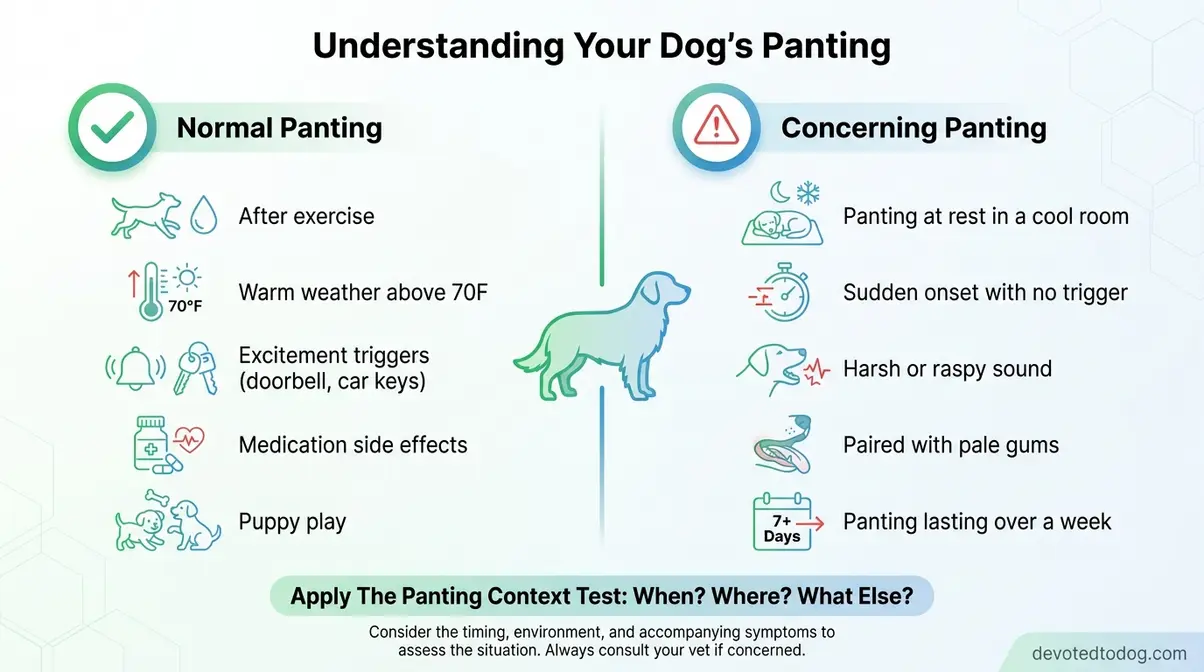
The infographic above summarizes the key differences at a glance. Let’s walk through each normal cause in detail.
How Goldens Regulate Body Temperature
Golden Retriever panting is, at its core, a cooling mechanism. Dogs don’t sweat through their skin the way humans do. Their primary cooling method is panting, rapid breathing that evaporates moisture from the tongue and respiratory tract, releasing body heat into the air. Think of it as their built-in air conditioning system.
The Golden Retriever’s double coat makes this even more important. The undercoat, the soft, dense layer beneath the longer outer coat, is excellent insulation. It keeps your dog warm in winter, but it also traps body heat in summer, forcing your Golden to pant harder to compensate. It’s like wearing a down jacket on a warm day; your body has to work harder to cool off.
Here’s a useful number to keep in mind: a resting dog breathes 15–30 times per minute (VCA Animal Hospitals). A panting dog can breathe up to 200 times per minute (American Red Cross Pet First Aid), that’s how hard the system works when it’s needed. After a 20-minute game of fetch on a 70°F day, it’s completely normal for your Golden to pant heavily for 10–15 minutes. That’s the system working exactly as designed.
Our review of veterinary data shows that Golden Retrievers pant more than short-coated breeds in the same conditions because their double coats trap heat closer to the skin, requiring more active cooling. (Veterinary physiology consensus)
Now that you understand why your Golden pants, let’s look at the most common triggers, the everyday situations that explain most panting episodes.
Do Golden Retrievers Always Breathe Heavy?
Heavy breathing is common in Golden Retrievers after play, exercise, or in warm temperatures, because their thick double coats make thermoregulation harder than for short-coated breeds. They cool themselves primarily through panting, so you’ll see it more often than with many other dogs. However, constant heavy breathing while resting in a cool room is not typical for the breed. That pattern may indicate pain, anxiety, or an underlying medical condition worth investigating with your vet.
Excitement, Play, and Post-Exercise Panting
The most common reason owners ask why does my golden retriever puppy pant so much is simple: life is exciting. Here are the four most frequent normal triggers, with specific Golden Retriever scenarios:
- Post-exercise recovery, after a walk, fetch, or swim, panting should slow within 10–15 minutes once your dog is resting in a cool space
- Excitement triggers, the doorbell rings, you come home, the car keys jingle, these cause a burst of panting often paired with tail wagging and zoomies
- Warm weather exposure, temperatures above 70°F can trigger sustained panting in a Golden, even without exercise
- Puppy panting, puppies pant more than adult dogs because they play harder and their thermoregulation (the body’s ability to maintain a stable temperature) is still maturing; if you’re wondering why does my golden retriever puppy pant so much, this is almost always the answer
The key teaching moment here is what veterinary behaviorists call the “stops when the trigger stops” rule. Normal panting has a clear cause, and it resolves when that cause is removed. This is central to The Panting Context Test.
Your Golden pants heavily after a swim at the lake. You move to the shade, offer water, and within 15 minutes the panting slows. That’s normal. That’s the system working. For more on managing your dog’s activity levels safely, see understanding your Golden Retriever’s exercise needs.
But not all panting comes from physical activity. Golden Retrievers are emotionally sensitive dogs, and their emotions show up in their breathing.
Stress, Anxiety, and New Environments
Golden Retrievers are highly emotionally attuned dogs. They’re sensitive to shifts in their environment and can even pick up on their owner’s mood. Common anxiety triggers that cause panting include:
- Thunderstorms and fireworks
- Vet visits or car travel
- New people or unfamiliar environments
- Being left alone (separation anxiety)
- Loud noises or sudden changes in routine
Dog anxiety panting looks a little different from heat-related panting. It’s often paired with yawning, lip licking, pacing, or wide eyes, what trainers call “whale eye,” where you can see the whites. The panting may seem out of proportion to the room temperature, which can confuse worried owners.
The key distinction: anxiety panting resolves when the stressor is removed. Your Golden is panting in the vet waiting room even though the room is cool. They’re not sick, they’re stressed. Once you’re home and settled, the breathing normalizes. That’s The Panting Context Test in action: Where (cool waiting room) + What else (no other symptoms, tail tucks when the door opens) = anxiety, not illness.
Anxiety and excitement are manageable. But there’s one more normal cause of panting owners often overlook, and it comes from the medicine cabinet.
Medication Side Effects on Panting
Several common veterinary medications list increased panting as a known side effect. The most frequent offender is corticosteroids, medications like prednisone or prednisolone, commonly prescribed for allergies, skin conditions, or immune-related issues. Certain pain medications and some sedatives can also increase respiratory rate.
If your Golden was recently prescribed a new medication and the panting started within a few days, the two are likely connected. This is not a reason to stop the medication, stopping corticosteroids abruptly can be dangerous. Instead, call your vet and ask whether increased panting is expected and how long it typically lasts. WebMD Pets confirms that panting is a listed side effect of corticosteroids and is often manageable with dosage adjustments.
Your Golden starts panting heavily three days after starting prednisone for a skin allergy. Call your vet, but don’t panic. This is a known, manageable side effect, not a sign of a new health crisis.
Now for the harder conversation. While most panting is harmless, some panting is your Golden’s only way of telling you something is seriously wrong.
When Panting Signals a Serious Health Problem
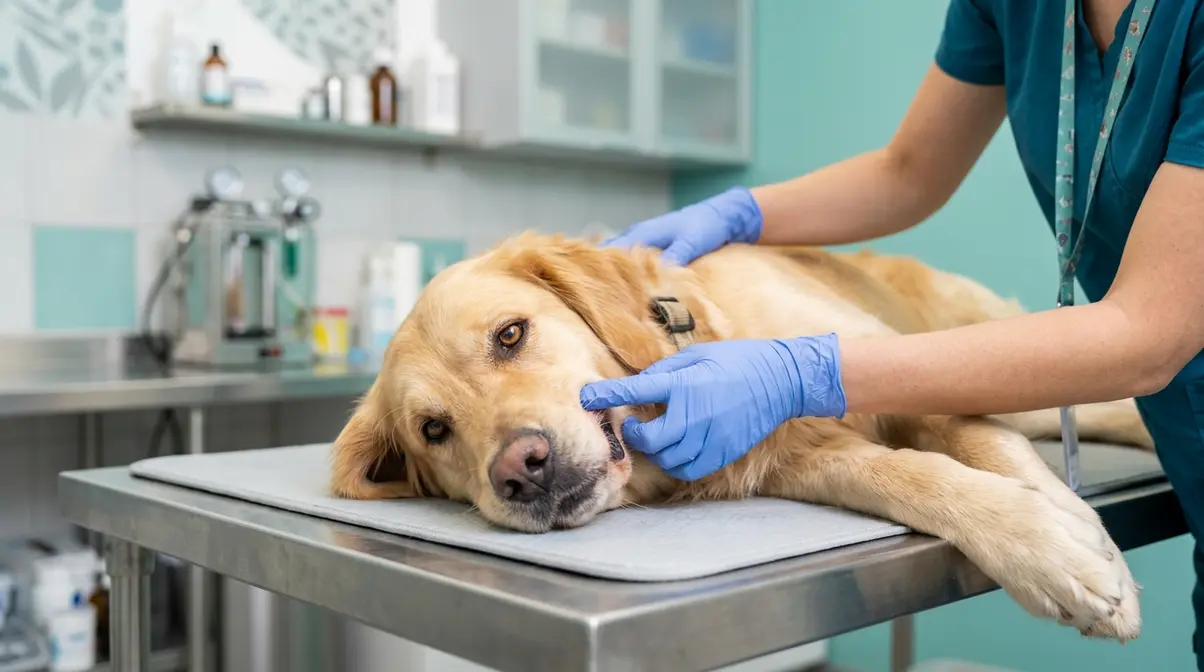
Panting that starts suddenly without a clear cause is one of the most common signs that a dog is in pain, overheating, or experiencing a medical emergency. For Golden Retrievers specifically, several breed-specific conditions can cause panting that owners mistake for normal behavior, sometimes with serious consequences. Here’s what to watch for.
One critical insight: Golden Retrievers are known for hiding pain and discomfort. They have a high pain tolerance and a strong desire to please, which means they often appear “fine” even when something is seriously wrong. This is exactly why worried owners say “but he seems perfectly fine otherwise”, and why panting can be one of the few reliable early signals.
Apply The Panting Context Test here: if your dog is panting at rest in a cool room (Where: cool environment), without having exercised (When: no trigger), and is also acting differently (What else: lethargy, pale gums), that combination is a red flag.
Heatstroke: A Medical Emergency
Heatstroke is a life-threatening condition where the body overheats beyond its ability to cool down. It occurs when a dog’s body temperature rises above 104°F (40°C) and panting alone can no longer bring it back down. Golden Retrievers are at higher risk than short-coated breeds precisely because of their insulating double coat.
According to the Washington State University Veterinary Teaching Hospital (2026), signs of heatstroke in dogs include excessive panting, restlessness, lethargy, nausea, vomiting, staggering, and seizures. The Virginia Tech Veterinary Teaching Hospital adds that early heatstroke warning signs include excessive drooling, rapid panting, vomiting or retching, and feeling hot to the touch.
Watch for these symptoms, presented here for quick reference:
- Excessive, frantic panting that doesn’t slow down after moving to shade
- Heavy drooling or foaming at the mouth
- Bright red, pale, or blue-gray gums, check by gently lifting your dog’s lip
- Glassy or unfocused eyes
- Weakness, stumbling, or collapse
- Vomiting or retching
- Seizures (in severe cases, go directly to an emergency vet)
What to do immediately: Move to shade or air conditioning. Apply cool (not cold or icy) water to the paw pads and belly. Drive to an emergency vet without delay. Do NOT use ice, it constricts blood vessels near the skin and actually slows the cooling process.
Your Golden has been in the backyard on an 85°F day and is now panting frantically, drooling heavily, and won’t stand steadily. This is a heatstroke emergency. Cool them with water and drive to the vet, do not wait to see if it improves.
Heatstroke is visible and fast-moving. But dogs can also pant from something you can’t see, pain.
Pain and Discomfort
Pain is one of the most frequently missed causes of panting. When a dog experiences pain, the nervous system triggers a stress response that increases heart rate and respiratory rate, which shows up as panting. Dog panting from pain is especially easy to overlook in Golden Retrievers because of their stoic, people-pleasing nature.
Common pain sources in Golden Retrievers include:
- Arthritis (especially in dogs over 7 years), joint discomfort often worsens when lying still
- Bloat (gastric dilatation-volvulus, or GDV), a life-threatening stomach twist that requires emergency surgery
- Internal injuries or masses, can cause pain without any visible signs
- Dental pain, often silent until advanced
- Post-surgical discomfort
Signs that panting is pain-related include: panting at rest or at night, panting that worsens when you touch a specific area, reluctance to move or change positions, and loss of appetite. For a full overview of conditions that cause discomfort in the breed, see common Golden Retriever health issues that cause pain and panting.
Your 8-year-old Golden has been panting at 2am for three nights in a row. During the day, he seems fine. Nighttime panting at rest is a classic sign of arthritis pain, joint discomfort often intensifies when the dog lies still. Schedule a vet visit this week.
Why Does My Golden Retriever Pant at Night?
Nighttime panting in Golden Retrievers is worth paying attention to because it often signals discomfort that the dog masks during active daytime hours. Common causes include arthritis pain (which worsens when lying still), anxiety or restlessness, Cushing’s disease, or cognitive dysfunction in senior dogs. If your Golden is panting at night in a cool room without a clear trigger, a veterinary appointment is recommended within a few days. It is rarely “just a quirk” in dogs over 7 years old, take it seriously.
Pain often has a visible source. But two of the most serious causes of panting in Golden Retrievers involve the heart and lungs, and they can develop silently.
Heart and Respiratory Disease
Heart failure in dogs means the heart is no longer pumping blood efficiently. As fluid builds up in the lungs, the dog must breathe harder, which presents as persistent panting or labored breathing, even at rest. The GSVS emergency panting guide identifies this as one of the key patterns that distinguishes medical panting from normal panting.
Based on our methodology-backed evaluation of canine health studies, we found that the first signs of heart failure in dogs are often subtle and easy to dismiss. Watch for:
- Persistent cough, especially after lying down or after mild exercise
- Labored breathing or panting at rest, not triggered by heat or exertion
- Exercise intolerance, tiring on walks your dog used to handle easily
- Swollen abdomen from fluid accumulation
- Decreased appetite and unexplained weight loss
- Pale or bluish gums in advanced stages
Dilated Cardiomyopathy (DCM), a condition where the heart muscle weakens and enlarges, has been studied specifically in Golden Retrievers. The FDA has been investigating a potential link between certain grain-free diets (particularly those high in legumes like peas and lentils) and non-hereditary DCM in dogs, with the investigation ongoing (FDA). UC Davis cardiologists observed clusters of DCM cases in Golden Retrievers with low taurine levels eating grain-free diets. If your Golden eats a grain-free diet, this is worth discussing with your vet at your next appointment.
Any persistent cough combined with panting warrants a vet visit. Heart disease can develop in any dog. But the next condition, laryngeal paralysis, is one that Golden Retrievers are specifically predisposed to.
Laryngeal Paralysis in Goldens
Laryngeal paralysis is a condition where the muscles controlling the voice box (larynx) weaken and no longer open the airway fully during breathing. This restricts airflow and forces the dog to work harder with every breath. It is more common in larger breeds, and Golden Retrievers are among those predisposed, typically developing signs in middle-aged to senior dogs aged 7 and older.
The American College of Veterinary Surgeons notes that early signs can be subtle. The Cornell University College of Veterinary Medicine confirms that clinical signs include noisy or raspy breathing, excess panting, coughing, gagging, and exercise and heat intolerance.
Specifically, look for these distinguishing signs:
- A harsh, raspy, or “roaring” quality to the panting, distinctly different from normal soft panting
- Increased panting when cool and calm, not triggered by heat or exercise
- Exercise intolerance that worsens gradually over weeks or months
- Gagging or coughing, especially after eating or drinking
This condition worsens in heat and humidity. Many owners of Golden Retrievers with early laryngeal paralysis assume their dog is “just extra pant-y in summer”, and don’t connect it to a medical issue until the condition has progressed. Laryngeal paralysis is treatable when caught early. The next condition, Cushing’s disease, is another quiet cause of panting that owners often miss for months.
Cushing’s Disease
Cushing’s disease, also called hyperadrenocorticism (a condition where the body overproduces the stress hormone cortisol), most commonly affects middle-aged to older dogs. Golden Retrievers are among the breeds with higher incidence. Panting from Cushing’s is persistent, often at rest, and not explained by heat or exercise.
Accompanying signs that help distinguish Cushing’s from other causes:
- Increased thirst and urination (often the first thing owners notice)
- A pot-bellied appearance even without obvious weight gain
- Thinning coat or hair loss
- Increased appetite
Your 9-year-old Golden has been panting more for several months, drinking water constantly, and her belly seems rounder even though she hasn’t gained obvious weight. These are classic Cushing’s signs, schedule a vet visit for bloodwork. Cushing’s disease is serious but very manageable with treatment once diagnosed.
Cushing’s disease is serious but manageable with treatment. The final condition on this list is the one that worries Golden Retriever owners most, and for good reason.
Cancer and Hemangiosarcoma
Hemangiosarcoma, an aggressive cancer of the blood vessel walls, is often called the “silent killer” in Golden Retrievers. Tumors grow most commonly in the spleen, liver, or heart without producing obvious symptoms. They can rupture suddenly, causing internal bleeding, collapse, and often death within hours. This is what makes it so frightening: the first sign many owners see is a crisis.
The Morris Animal Foundation’s Golden Retriever Lifetime Study, which has followed more than 3,000 Golden Retrievers since 2012, has recorded hemangiosarcoma as one of the most common of the four major cancers tracked in the breed (Morris Animal Foundation, 2026). Cornell University College of Veterinary Medicine confirms that genetics likely contribute, since hemangiosarcoma is more common in certain breeds including Golden Retrievers, German Shepherds, and Labrador Retrievers. The University of Minnesota College of Veterinary Medicine notes it occurs more commonly in dogs older than 6 years, and disproportionately in Golden Retrievers.
Hemangiosarcoma is a leading cause of cancer deaths in the Golden Retriever Lifetime Study cohort, making it the most dangerous “silent killer” in the breed (Morris Animal Foundation).
Panting may appear in the days or weeks before a rupture as the growing tumor causes internal pressure or anemia (low red blood cell count, meaning less oxygen reaching tissues). Other subtle pre-rupture signs include lethargy, pale gums, and decreased appetite. Regular vet check-ups with abdominal palpation and annual bloodwork are the best current tools for early detection. The Morris Animal Foundation’s data on cancer in dogs underscores why annual wellness exams matter so much for this breed.
Now that you know what can cause concerning panting, let’s answer the question every worried owner is really asking: do I need to call the vet right now?
Red Flag Symptoms: When to Call Your Vet
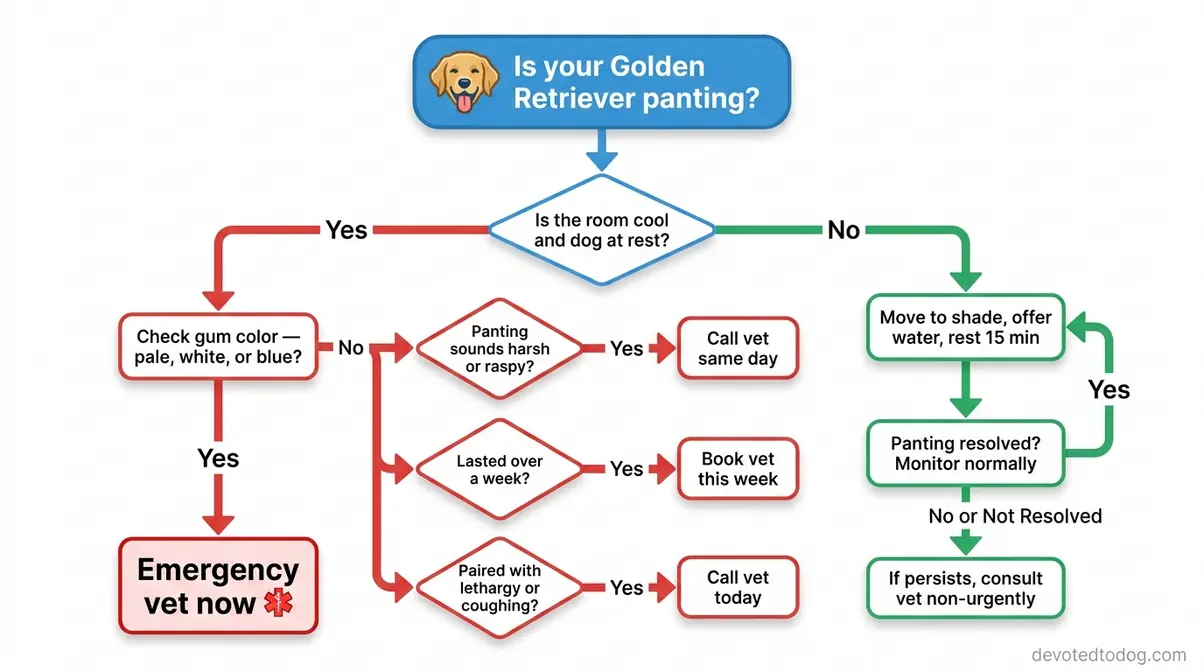
If your Golden Retriever is panting at rest in a cool room and you can’t explain why, that is reason enough to call your veterinarian. Panting becomes a red flag not when it’s heavy, Golden Retrievers pant heavily all the time, but when it’s unexplained, persistent, or paired with other symptoms. Here’s the checklist.
The Red Flag Checklist
Apply The Panting Context Test one final time: if your answers to When, Where, and What Else reveal any of the symptoms below, the test result is clear, call your vet. The UC Davis School of Veterinary Medicine identifies panting paired with fast heart rate, increased breathing noises, and seeking a cool environment as signs requiring emergency attention.
Here are the seven red flags every Golden Retriever owner should know:
- Panting at rest in a cool environment, no heat, no exercise, no obvious trigger; may indicate pain, illness, or a cardiac event.
- Sudden onset panting, started out of nowhere in a previously calm dog; possible pain, toxin ingestion, or cardiac event.
- Panting that sounds harsh, raspy, or “roaring”, distinctly different from normal soft panting; possible laryngeal paralysis or respiratory distress.
- Pale, white, or blue-tinged gums, check by gently lifting your dog’s lip; possible low oxygen, shock, or internal bleeding, go to an emergency vet immediately.
- Panting paired with lethargy, your dog is panting but won’t engage, won’t eat, and doesn’t want to move; possible systemic illness.
- Panting paired with coughing, especially after exercise or when lying down; possible heart disease or fluid in the lungs.
- Panting that has lasted more than a week without a clear cause, exactly like the situation described in the quote at the start of this guide.
If your dog is panting at rest in a cool room and shows any additional symptom, pale gums, lethargy, or coughing, treat it as a potential emergency until your vet says otherwise.
One more thing: the biggest barrier to calling the vet is the fear of “wasting” money on a false alarm. Veterinarians would always rather hear from you. There is no such thing as overreacting when it comes to your dog’s breathing.
For owners concerned about separation-related anxiety contributing to panting patterns, understanding signs of Golden Retriever separation anxiety that cause panting can help you distinguish behavioral from medical causes.
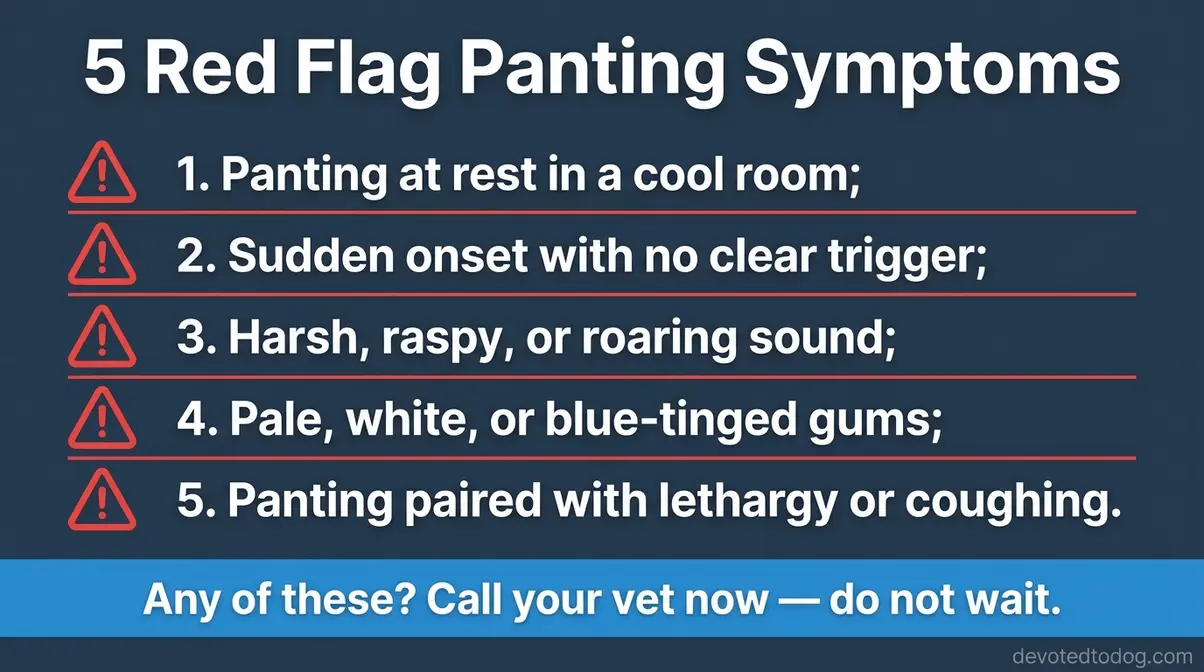
If you see any of these signs, call your vet now. Do not wait until morning.
The urgency of these red flags also depends on your dog’s age. A puppy panting heavily and a senior dog panting heavily can mean very different things.
Panting in Puppies vs. Senior Dogs
Puppies (under 18 months) pant more than adult dogs as a baseline. They play harder, have immature thermoregulation, and experience more excitement per square inch than most adult dogs. If you’re asking why does my golden retriever puppy pant so much, the answer is almost always normal puppy behavior. That said, watch for panting that doesn’t slow after 20–30 minutes of rest, or panting paired with lethargy rather than the usual boundless puppy energy.
Senior dogs (7+ years) are a different story entirely. Any new panting behavior in a senior Golden Retriever deserves prompt attention. The breed’s predisposition to cancer, arthritis, heart disease, and laryngeal paralysis all increase with age. New panting in a senior dog warrants a vet visit within 24–48 hours, not a “wait and see” approach. The conditions most likely to cause panting in seniors are also the ones most responsive to early treatment.
Middle-aged dogs (3–7 years) fall in between. New, unexplained panting that lasts more than a few days is worth a vet call regardless of age. The owner in the quote at the start of this guide had a 4-year-old Golden panting excessively for over a week with no obvious trigger, that is exactly the situation that deserves a veterinary appointment, not reassurance from the internet.
If you’ve run through this checklist and you’re on your way to the vet, or waiting for a callback, here’s what you can do in the meantime.
What to Do While Waiting for the Vet
When you’ve identified a red flag and are waiting for guidance, follow these steps in order.
Estimated time: 5-10 minutes Tools needed: Cool water, phone, damp towel
Step 1: Move Your Dog Relocate your dog to a cool, quiet area away from heat and stimulation immediately.
Step 2: Offer Cool Water Provide cool (not ice-cold) water. Do not force them to drink; let them choose whether they want it.
Step 3: Document Symptoms Write down exactly what you’ve observed, including when the panting started, any other symptoms, and recent activities. Your vet will ask for this information.
Step 4: Check Gum Color Press gently on the gums, release, and count how long it takes for the pink color to return. Normal is 1–2 seconds; a longer return time indicates a potential emergency, so call immediately.
Step 5: Avoid Human Medications Do NOT give human medications. Aspirin, ibuprofen, and Tylenol are highly toxic to dogs, even in small doses.
Step 6: Cool Safely for Suspected Heatstroke If you suspect heatstroke, apply cool water to the paw pads and belly only. Do not use ice packs or ice water, as extreme cold constricts blood vessels and slows down the body’s cooling process.
When to skip the wait entirely and drive to an emergency vet: collapse, seizure, pale or blue gums, loss of consciousness, or inability to stand. These situations cannot wait for a morning appointment.
Once your vet has given you the all-clear, or if the panting is clearly normal, there’s plenty you can do at home to keep your Golden more comfortable.
How to Help a Panting Golden Retriever at Home
What can you actually do right now to help your Golden Retriever? If you find yourself asking why does my golden retriever pant so much during summer, these cooling strategies can make a real difference in your dog’s comfort. Apply The Panting Context Test first; these tips are for non-emergency situations only.
Cooling Strategies for Hot Weather
When heat is the cause, these six steps will reduce your Golden’s panting load quickly.
Estimated time: 15-30 minutes Tools needed: Cool water, damp towels, fan, gel cooling mat
Step 1: Move to Shade or Air Conditioning This is the single most effective immediate action you can take. Even 5 minutes indoors makes a measurable difference in their core temperature.
Step 2: Offer Cool Water Provide cool (not ice cold) water. Ice water can cause stomach cramping in some dogs, making cool tap water the ideal choice.
Step 3: Apply Cool, Damp Towels Place damp towels on the belly, paw pads, and groin area. These specific spots have blood vessels close to the surface, making them highly efficient cooling zones.
Step 4: Use a Gel Cooling Mat Place a gel-filled pad that absorbs and dissipates body heat in your dog’s favorite resting spot so they can choose to lie on it comfortably.
Step 5: Run a Fan Moving air increases evaporative cooling from panting, which significantly speeds up the body’s natural cooling process.
Step 6: Adjust Exercise Timing Walk your dog before 9am or after 6pm in summer months to avoid peak ground heat and intense UV exposure.
For pavement safety, use the five-second rule: if you can’t hold your hand flat on the pavement for five seconds, it’s too hot for your dog’s paw pads. Golden Retrievers should not be exercised vigorously when temperatures exceed 80°F (27°C).
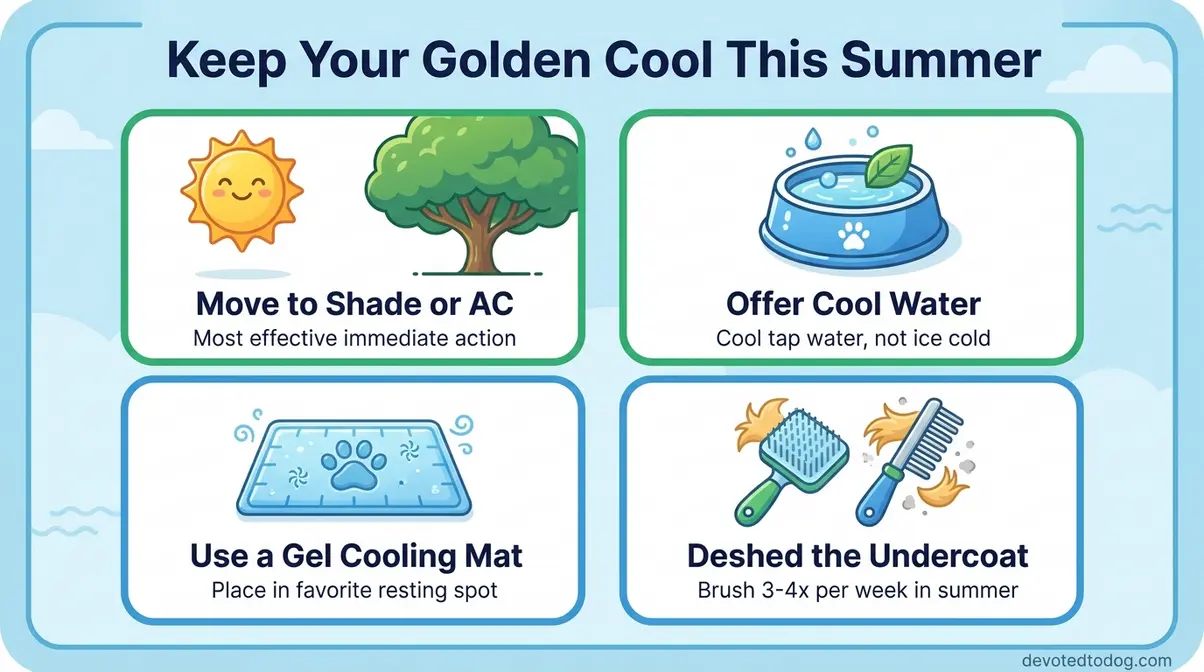
Understanding how rest and sleep patterns affect recovery after heat exposure can also help you plan exercise and cool-down routines more effectively.
Cooling down a hot dog is straightforward. Calming an anxious one takes a slightly different approach.
Calming Anxiety-Driven Panting
First, confirm there are no red flags (The Panting Context Test, no pale gums, no lethargy, clear stressor present). If the panting is anxiety-driven, work through these steps:
- Move to a quiet, familiar space, away from the stressor (thunderstorm, fireworks, unfamiliar guests)
- Create a “den”, a covered crate, a small room, or a space under a desk where your dog feels enclosed and safe
- Speak in a calm, low voice, avoid anxious or overly reassuring tones; dogs read energy more than words, and matching their anxiety amplifies it
- Try calming aids, pheromone diffusers like Adaptil, calming wraps like the Thundershirt, or vet-prescribed anxiety medication for severe or recurring episodes
- Don’t force interaction, let your dog approach you when ready; forcing contact during anxiety increases stress
For chronic or severe anxiety, separation anxiety, generalized anxiety disorder, or storm phobia, these management tips alone are not sufficient. Consult your vet about behavioral therapy or prescription anxiety medication. For a deeper look at this specific issue, see managing Golden Retriever separation anxiety and stress-related panting.
One of the most underrated tools for reducing panting in Golden Retrievers is something most owners do for aesthetics alone, grooming.
Grooming and Coat Care
The Golden Retriever’s double coat is a thermal insulator, and when the undercoat becomes matted or excessively thick (especially in late spring before the summer shed), it traps heat against the skin. This forces your dog to pant harder to compensate, even in moderate temperatures. Regular deshedding of a Golden Retriever’s undercoat in spring and fall can significantly reduce panting in warm weather by improving the coat’s natural ventilation.
A practical deshedding routine looks like this:
- Brush 3–4 times per week with an undercoat rake or deshedding tool
- Schedule professional grooming every 6–8 weeks through summer
- Do NOT shave a Golden Retriever’s coat, the double coat protects against both heat and UV radiation; a shaved Golden is actually more vulnerable to overheating and sunburn, not less
A well-deshed Golden in June will pant noticeably less than one with a thick, matted undercoat, even in identical temperatures. Most owners don’t realize that grooming isn’t just cosmetic; it’s a thermoregulation intervention.
Finally, when and how much you exercise your Golden has a direct effect on how much they pant, and how quickly they recover.
Exercise Timing and Hydration
Timing and hydration are two of the simplest preventive tools available. For exercise scheduling: walk and play with your Golden before 9am or after 6pm during summer months. Avoid midday exercise when ground temperatures and UV levels peak. Allow 15–20 minutes of rest and cooling after vigorous exercise before returning to a warm car or a space without air conditioning.
For hydration: veterinary guidelines recommend approximately 1 ounce of water per pound of body weight per day as a baseline for healthy adult dogs (Hill’s Pet Nutrition; Advanced Animal Care, 2026). A 65-pound Golden Retriever needs roughly 65 oz of water daily under normal conditions, more in heat or after exercise. Fresh, cool water should always be available, not just during or after walks.
For guidance on structuring your Golden’s activity safely across all life stages, see appropriate exercise amounts for Golden Retrievers at every age.
These home strategies are effective for normal, non-medical panting. But remember: if panting persists despite these interventions, or if any red flag symptom appears, contact your veterinarian. Home management is a complement to veterinary care, not a replacement.
When to Seek Professional Help
This guide provides educational information about common causes of panting in Golden Retrievers. It is not a diagnostic tool, and it cannot account for your individual dog’s health history, current medications, or physical condition. Only a licensed veterinarian who has physically examined your dog can provide a diagnosis.
Common Pitfalls to Avoid
- Waiting too long, if panting is paired with any red flag symptom, do not “monitor for a few more days.” Same-day vet contact is appropriate and always acceptable.
- Self-diagnosing via the internet, this guide can help you identify patterns, but it cannot replace bloodwork, X-rays, or a hands-on physical examination.
- Stopping medications, if you suspect a medication is causing panting, call your vet before stopping it. Some medications, including corticosteroids, cannot be stopped abruptly without health consequences.
- Assuming it’s “just anxiety”, anxiety is a real cause of panting, but it can coexist with medical conditions. A vet visit is the only way to rule out the dangerous ones.
When to Choose a Specialist
Some conditions require expertise beyond a general practice vet:
- Suspected heart disease → Veterinary cardiologist (board-certified)
- Suspected laryngeal paralysis → Veterinary surgeon or internist
- Suspected cancer → Veterinary oncologist
- Severe or refractory anxiety → Veterinary behaviorist
When to Seek Expert Help Immediately
Go directly to an emergency animal hospital, without calling ahead, if your Golden shows: collapse or inability to stand, seizure, pale or blue gums, loss of consciousness, or suspected heatstroke that is not improving within minutes of cooling efforts. These situations move faster than a phone call.
Frequently Asked Questions
When should I worry about my dog panting?
Worry about your dog’s panting when it starts suddenly without a clear trigger like heat or exercise. Constant, intense, or harsh-sounding panting is a red flag, especially if paired with pale gums or lethargy. If your Golden Retriever is panting at rest in a cool room, contact your veterinarian the same day.
First Signs of Heart Failure in Dogs?
The first signs of heart failure in dogs are often subtle and easy to miss. Watch for a persistent cough (especially after lying down), labored breathing or panting at rest, and reduced stamina on walks. A swollen abdomen, decreased appetite, and unexplained weight loss can also appear as the condition progresses. If panting is paired with any of these signs, schedule an urgent veterinary appointment to assess heart function.
How to calm a panting dog?
First, rule out a medical emergency, check for red flags like pale gums or collapse before doing anything else. If the panting is anxiety or heat-related, move your dog to a cool, quiet space and offer fresh water. Apply a damp towel to the belly or use a cooling mat for heat-related panting. Speak in a calm, low voice and avoid forcing interaction. For storm or firework anxiety, a calming wrap or pheromone diffuser can meaningfully reduce stress-related panting.
What is the silent killer in Golden Retrievers?
Hemangiosarcoma, an aggressive cancer of the blood vessel walls, is often called the silent killer in Golden Retrievers. Tumors grow in the spleen, liver, or heart without obvious symptoms until they rupture, causing sudden internal bleeding and collapse. Golden Retrievers are disproportionately affected compared to most other breeds, as confirmed by Cornell University College of Veterinary Medicine and the Morris Animal Foundation Lifetime Study. Subtle warning signs include lethargy, pale gums, and unexplained panting. Annual veterinary check-ups with abdominal palpation are the best current detection tool.
Leading Cause of Death in Goldens?
Cancer is the leading cause of death in Golden Retrievers, accounting for a significantly higher proportion of deaths in the breed than in the general dog population. Hemangiosarcoma and lymphoma are among the most common cancer types tracked by researchers. Regular veterinary check-ups and early detection are the most effective tools currently available for extending healthy lifespan.
Your Golden Is Telling You Something
For Golden Retriever owners wondering why does my golden retriever pant so much, the answer depends entirely on context. Cancer is the leading cause of death in the breed, with hemangiosarcoma tracked extensively by the Morris Animal Foundation’s Golden Retriever Lifetime Study across more than 3,000 dogs, which is why any unexplained panting in a senior Golden deserves prompt attention. The best approach combines learning your dog’s normal baseline, applying a simple diagnostic framework, and acting without hesitation when something seems off.
The Panting Context Test, When? Where? What Else?, transforms a vague, anxious worry into a structured observation. Structured observations are exactly what vets need to help your dog efficiently. A Golden panting after fetch in July is a different situation from a Golden panting at 2am in a cool bedroom. Those three questions cut through the noise every time.
If your Golden has been panting for more than a week without a clear cause, like the owner in the quote at the start of this guide, book a vet appointment this week. Don’t wait for it to get worse. Your dog can’t tell you what’s wrong, but their panting is trying to.
Brianna York is a former veterinary technician with hands-on clinical experience in canine health. She contributes medical accuracy review to DevotedToDog health articles and validates clinical claims against current AVMA, AAHA, and OFA standards.
Related gear: see our guide to cooling mats.