
One day your Golden was a goofy, manageable puppy. Then they turned two, and suddenly they’re counter-surfing, ignoring every command they used to know, and treating your house rules like polite suggestions. If you’re feeling overwhelmed or worried that something is wrong, you’re not alone. The reason this is happening is more predictable than you think, and it has a name.
This guide is built specifically for owners of a 2 year old golden retriever navigating this exact moment. By the end, you’ll understand what’s happening in your Golden’s body and brain at age two, so you can respond with confidence instead of frustration. We’ll cover their physical milestones, the “teenage” behavioral phase, adult nutrition, the 24-month health screening checklist, and what to know if you’re considering adopting a 2-year-old Golden.
What to Know Before Reading: This guide assumes you’re not a dog training professional. Every technical term is explained in plain English when it first appears. If you’re here because your dog just turned two and things feel harder, you’re in exactly the right place.
at 24 months
brain catches up
behavior resolved
hip/elbow/cardiac
Author Credentials
📝 Written by: Coral Drake
✅ Reviewed by: Brianna York, Former Veterinary Technician
📅 Last updated: 5 May 2026
ℹ️ Transparency Notice
This article covers 2-year-old Golden Retriever maturation based on AKC, GRCA, and veterinary research. All claims have been verified by our editorial team.
| 2-Year-Old Stage | Physical | Behavioral | Care Focus |
|---|---|---|---|
| Weight | Males 65-75 lbs / Females 55-65 lbs | Full adult size, weight stable | Adult-food maintenance |
| Coat | Full adult coat with complete feathering | , | Brush 3-4x/week, professional groom 6-8 weeks |
| Energy | Settled adult energy | Calmer, more focused | 60 min/day exercise |
| Training | , | Reliable on basic commands | Advanced training, sport activities |
| Health | OFA hip/elbow x-rays complete | , | Annual cardiac, eye, thyroid screening |
| Spay/Neuter | Most owners completed by now | , | Adjust diet for spay/neuter metabolism |
What Are the 2-Year-Old Physical Milestones?
For owners tracking earlier developmental stages, see our guide on the 3-month-old Golden Retriever.

A 2-year-old Golden Retriever is not a puppy, they have reached their full adult height and weight. However, physical adulthood does not mean emotional maturity. This is what we call “The Golden Adolescence Gap”: the developmental disconnect between a fully grown body and a brain that’s still catching up. Understanding this distinction is the single most useful thing you can take away from this section. It explains almost everything confusing happening with your dog right now.
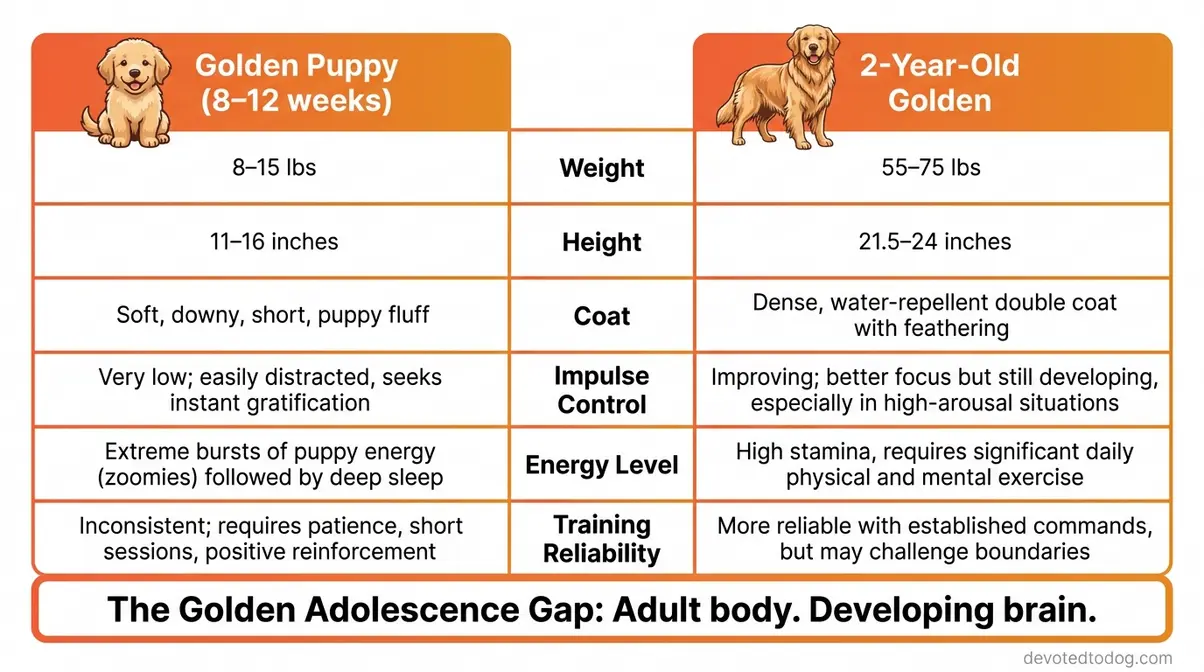
For more on what comes after this phase, see our guide on when Golden Retrievers calm down.
Is a 2-Year-Old Golden Retriever Still a Puppy?

A 2-year-old Golden Retriever is not a puppy. They have reached their full adult height and weight, and most veterinary and breed authorities consider dogs over 18 months to be adults (clubk9lasvegas.com). That said, many Goldens retain high-energy, puppy-like behavior well into their third year as their emotional maturity catches up to their physical size.
This is The Golden Adolescence Gap in action. Think of it like a 16-year-old human: fully grown, capable of adult-level physical tasks, but still developing the emotional regulation and impulse control that comes with true maturity. Purdue University’s Canine Welfare Science notes that while a dog’s foundational behavioral period closes by 14 weeks, emotional regulation continues developing into year three.
The good news? This phase is normal, expected, and temporary. Most Golden owners report a meaningful shift toward calmer behavior between ages 2.5 and 3. You’re not doing anything wrong. Your Golden isn’t broken. They’re just in the Gap.
Adult Height, Weight, and Physical Development
At two years, your Golden Retriever has reached their full adult height. Weight may fluctuate slightly until age 2.5, and muscle mass continues building throughout this period.
According to AKC (American Kennel Club) breed standards and Purina breed data, here’s what a healthy 2-year-old Golden looks like:
| Sex | Height at Shoulder | Healthy Weight Range |
|---|---|---|
| Male | 23-24 inches | 65-75 lbs |
| Female | 21.5-22.5 inches | 55-65 lbs |
(Source: Purina breed standards; AKC Golden Retriever breed standard)
Individual weight varies based on genetics, diet, and activity level. A Golden who is 5-10 lbs over range is common at this age, especially if they were still eating calorie-dense puppy food recently. For a complete breakdown of growth milestones by month, see our Golden Retriever growth chart and weight milestones.
A quick at-home weight check: Run your hands along your Golden’s ribcage. You should be able to feel individual ribs without pressing hard, but you shouldn’t see them. If you can’t feel ribs at all, your dog may be carrying extra weight. If you can see ribs clearly, they may be underweight. When in doubt, ask your vet.
Your 2-Year-Old Golden Retriever in Human Years
A 2-year-old Golden Retriever is roughly equivalent to a 24-year-old human, according to the AKC’s updated dog-years formula for large breeds (AKC, 2026). The old “multiply by 7” rule doesn’t hold up, large breeds age faster in their first two years, then slow down.
What does 24 in human terms actually mean for your dog? They’re physically capable, energetic, and in their prime, but not fully “settled” in their behavior or decision-making. Think of your Golden like a 24-year-old who just moved into their first apartment. They know the rules. They’re just still testing how strictly those rules apply.
This human-years framing helps explain why the 2-year mark feels so turbulent. Your dog is in the equivalent of young adulthood, and young adulthood is, famously, not the calmest phase of life.
Coat Development and Grooming at Two Years
By age 2, most Goldens have developed their full adult double coat. The undercoat becomes noticeably denser, and some dogs shift slightly in coat color, often deepening to a richer golden or, in some cases, lightening. If you’ve noticed your dog developing a golden retriever dark golden tone, this is completely normal and tends to stabilize by age 3. Field-type Goldens tend toward shorter, flatter coats; show-type Goldens often have longer, wavier coats.
Shedding increases significantly as the adult coat fully establishes. Twice-yearly “coat blows”, heavy seasonal shedding, become more pronounced at this age. Plan for it.
For grooming at two years: brush 3-4 times per week minimum. Professional grooming every 6-8 weeks helps manage shedding and keeps the coat healthy. The most effective tool combination for a 2-year-old Golden is a slicker brush plus an undercoat rake, used together, they remove loose undercoat before it ends up on your furniture.
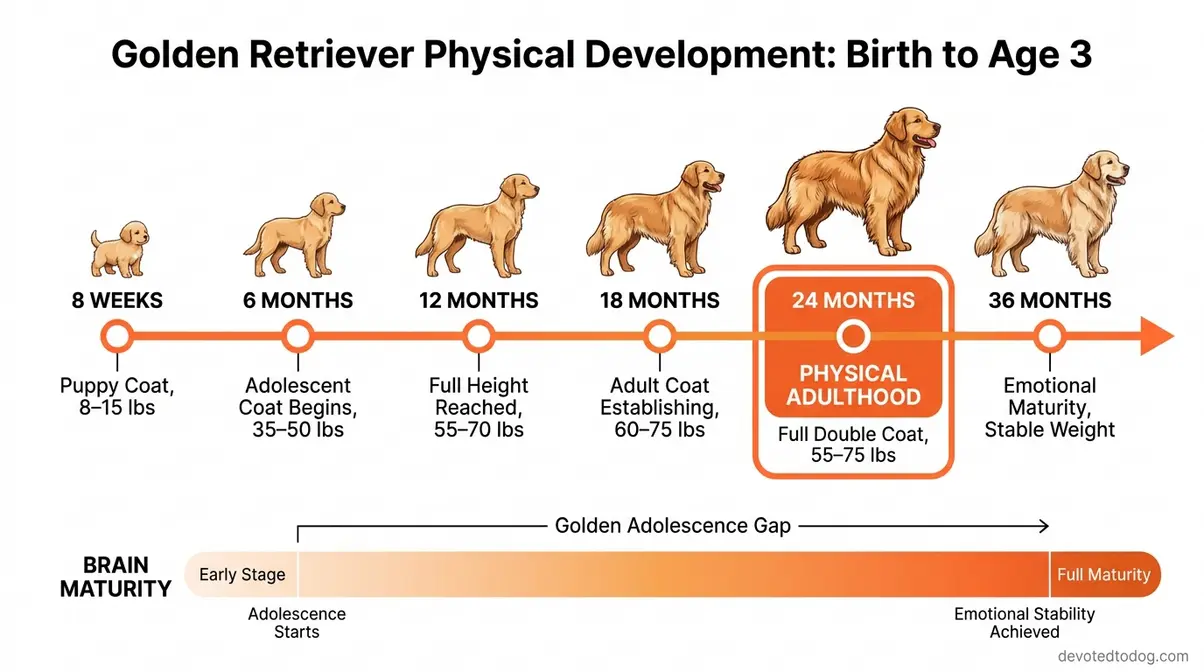
Now that you have a clear picture of what your Golden looks like at two, let’s talk about the part that’s probably brought you here: their behavior.
How Do You Survive the ‘Teenage’ Phase?
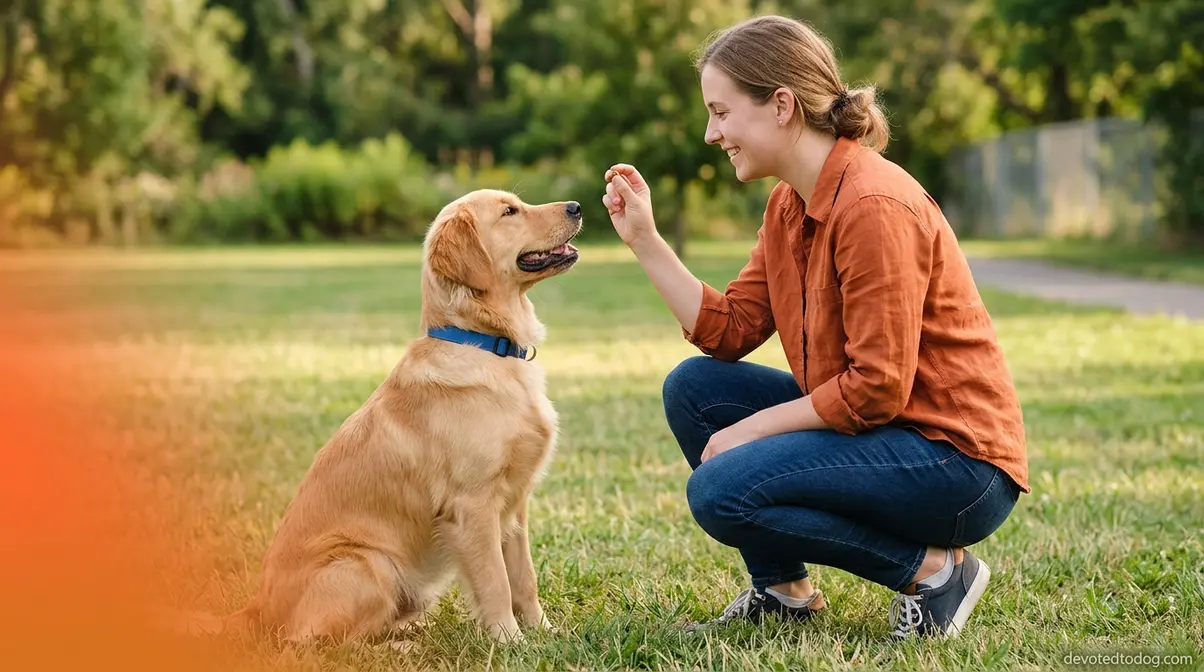
If you own a 2 year old golden retriever, this is when they are most likely to become more reactive and challenging to manage. According to the PDSA, Golden Retrievers need at least 2 hours of exercise per day, and owners who under-exercise their dogs consistently see destructive behavior spike (PDSA, 2026). The behaviors feel sudden, but they’re predictable. Understanding why they happen is the first step to fixing them.
“Our 2-year-old Golden Retriever is the sweetest, and not generally an anxious dog, but bedtime is a different story.”
This quote captures what Golden Retriever owner communities report consistently: it’s not that your dog has become a different animal. It’s that the Gap between their physical energy and their emotional self-regulation is at its widest right now. Bedtime resistance, counter-surfing, and boundary-testing are textbook symptoms of a dog whose body is ready to run a marathon but whose brain is still learning to pump the brakes.
For a broader look at age-related patterns, our guide to common Golden Retriever behavior problems covers the full picture.
Why Your Golden Is Acting Out: The Golden Adolescence Gap
The Golden Adolescence Gap is the developmental window where a dog’s body has reached full adult size, but the brain areas governing impulse control and emotional regulation are still maturing. For Golden Retrievers, physical adulthood arrives around 12-18 months. Social and emotional maturity? That typically extends to age 2.5-3.
Purdue University’s Canine Welfare Science research confirms that while foundational behavioral patterns are established early, emotional regulation continues developing well into a dog’s third year. This means a 2-year-old Golden has the energy reserves of a fully grown adult dog paired with the impulse control of an adolescent, which is a genuinely difficult combination for everyone involved.
Homeward Bound Golden Retrievers, a Golden Retriever rescue and education organization, identifies the 18-month to 2.5-year window as the peak challenge period for most owners, when “teenage-like rebellion” is at its most pronounced and selective listening is at its most frustrating (Homeward Bound Goldens, Surviving Adolescence).
The analogy that resonates most with owners: your Golden knows the house rules perfectly well. Their willingness to comply is what’s wavering, not their understanding. This is the Gap in action. Their body has the energy of an adult; their impulse control is still catching up.
Social maturity, the technical term for this brain development milestone, is distinct from physical maturity. It’s the point at which a dog can reliably self-regulate in stressful or exciting situations. For most Goldens, that arrives closer to age 3. Until then, your job is to manage the environment and meet their needs, not to win a battle of wills.
Now that you understand why this is happening, let’s tackle the most common, and most alarming, behavior: sudden reactivity and aggression.
Managing Reactivity and Sudden Aggression
First, an important distinction: reactivity and aggression are not the same thing. Reactivity means barking, lunging, or overreacting to stimuli, a 2-year-old Golden losing their mind when they see another dog on a walk. True aggression means growling with intent, snapping, or biting. Most 2-year-old Goldens show reactivity, not true aggression. Knowing the difference matters because the response is different.
Serious aggression problems, growling, snapping, and stiffening, are not normal developmental phases. According to Ohio State University’s College of Veterinary Medicine, these behaviors require professional assessment, not home correction. If you’re seeing true aggression, skip to the “When Basic Training Isn’t Working” section and contact a professional immediately.
Common reactivity triggers at this age include resource guarding (growling near food or toys), leash reactivity (lunging at other dogs or strangers on walks), and handling sensitivity (snapping when touched in certain areas). For deeper context on understanding Golden Retriever aggression, our dedicated guide covers the full spectrum.
6 step-by-step techniques for managing reactivity:
- Identify the trigger first. Keep a 3-day behavior log noting exactly when, where, and what preceded the reaction. You can’t fix what you can’t see.
- Increase distance from the trigger. If your Golden reacts to other dogs, start training at 20 feet away. Gradually reduce distance over weeks, not days.
- Use counter-conditioning (rewarding calm near the trigger). Every time the trigger appears, immediately give a high-value treat, chicken, cheese, hot dog. The goal: trigger = good things happen. Repeat 50+ times before expecting change.
- Practice “Look at That” (LAT). Ask your dog to look at the trigger, then look back at you for a reward. This redirects attention and builds impulse control over time.
- Avoid punishment-based corrections. Yelling or leash jerks increase anxiety and worsen reactivity. Positive reinforcement, rewarding the behavior you want to see more of, is the evidence-based approach.
- Consult a CPDT-KA (Certified Professional Dog Trainer, Knowledge Assessed) for serious aggression problems. A certified trainer provides a structured behavior modification plan beyond what any article can offer.
Troubleshooting, Common Mistakes:
- ❌ Flooding your dog (forcing them to “get used to” the trigger by moving closer): This worsens reactivity and damages trust.
- ❌ Saying “it’s okay” during a reaction: This inadvertently rewards the reactive state, your dog reads your soothing tone as confirmation that their reaction is appropriate.
- ✅ Fix: Calmly remove your dog from the situation. Practice at a lower intensity next session. Progress is measured in weeks, not days.
Reactivity is stressful, but it’s often the everyday destructive behaviors, the digging, the chewing, the counter-surfing, that wear owners down the most.
Stopping Destructive Behaviors: Chewing, Digging, Counter-Surfing
These behaviors spike at 2 years for a simple reason: your Golden has adult energy levels but may not be getting enough physical and mental outlet. Boredom plus energy plus the Golden Adolescence Gap equals destruction. If your dog is engaged in obsessive digging, turning your yard into a construction site, or perfecting their counter-surfing technique while you cook dinner, assume they’re under-exercised first. That’s almost always the root cause.
Separation anxiety can also drive destructive behavior, but there’s a key tell: if the destruction only happens when you’re away, anxiety is likely the cause rather than boredom. In that case, consult your vet before starting any training program.
6 step-by-step techniques for managing destructive behavior:
- Audit daily exercise first. A 2-year-old Golden needs at minimum 1-2 hours of vigorous exercise per day (PDSA recommendation). If they’re destroying things, assume under-exercise before assuming misbehavior.
- Designate a “dig zone.” For obsessive digging, create a sandbox or a specific garden corner where digging is permitted. Bury toys to encourage use. Every time they dig elsewhere, redirect them calmly to the zone.
- Rotate chew toys every 3 days. Novelty matters enormously. A toy that’s been available for a week loses its appeal. Rotating keeps things interesting and redirects chewing energy productively.
- Use baby gates for counter-surfing. Management beats correction. If your Golden can’t reach the counter, they can’t surf it. Remove the opportunity while you train the behavior.
- Teach “leave it” with progressive difficulty. Start with low-value items on the floor, reward for ignoring. Gradually increase to higher-value items near the counter. Expect 4-6 weeks of consistent practice before it holds reliably.
- Provide mental enrichment daily. A Kong stuffed with frozen peanut butter, puzzle feeders, or 20-minute sniff walks (where your dog leads by nose) can be as tiring as physical exercise. A mentally tired Golden is a calm Golden.
Across Golden Retriever owner communities, a consistent pattern emerges: owners who doubled daily exercise time and added one puzzle feeder per day reported destructive behaviors dropping noticeably within 2-3 weeks.
Destructive behaviors usually have a clear external cause you can manage. Mouthiness is a little different, it’s about communication.
Dealing with Mouthiness and Boundary Testing
A 2-year-old Golden who mouths or nips is usually communicating excitement or testing boundaries, not being aggressive. Golden Retrievers were bred as retrievers, which means they are genetically wired to use their mouths. This makes mouthiness deeply ingrained behavior. It’s also behavior that must be addressed consistently before it escalates, because a 65-lb adult Golden with a mouthing habit is no longer charming.
The good news: four techniques, applied consistently by every member of your household, resolve most cases within 4-6 weeks.
4 step-by-step correction techniques:
- Yelp and freeze. When they mouth, make a sharp “ouch” sound and go completely still. This mimics how littermates signal “too hard.” Then redirect immediately to a chew toy. The freeze removes the reward (your movement and attention).
- Turn your back. Remove all attention for 15-30 seconds immediately after mouthing. Inconsistency is the enemy here, every family member must do this, every time, without exception.
- Tether training during high-excitement moments. During greetings or play, keep your Golden on a short leash attached to your waist. This gives you immediate control to redirect before mouthing begins.
- Reward four-paws-on-floor greetings. Every time your Golden greets you without jumping or mouthing, immediately reward with a treat and calm praise. Make the calm greeting the most rewarding option available.
Normalize this for yourself too: mouthiness at this age is embarrassing, but it’s not a character flaw. It’s a breed tendency meeting an undertrained habit. Consistent correction wins.
Whether you’re dealing with mouthiness, digging, or reactivity, there’s one solution that underlies all of them: exercise.
Exercise and Mental Stimulation: The Real Fix for High Energy
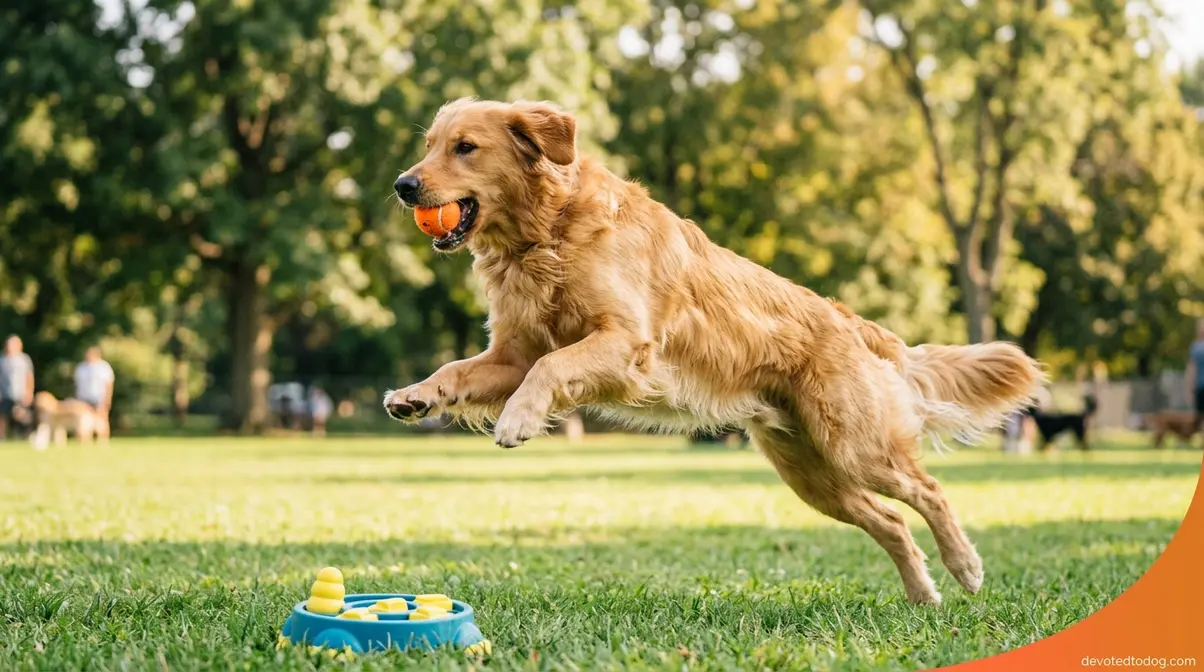
Here’s the most important insight in this entire article: the single most effective intervention for 2-year-old Golden behavioral issues is adequate physical and mental exercise. Most owners default to “more training” when the real fix is “more tired dog.” These are not the same thing.
The PDSA recommends at least 2 hours of exercise per day for Golden Retrievers, and at 2 years old, your Golden is at peak energy (PDSA, 2026). Under-exercising is the number one root cause of destructive and reactive behavior in this breed at this age.
6 types of exercise that work best at two years:
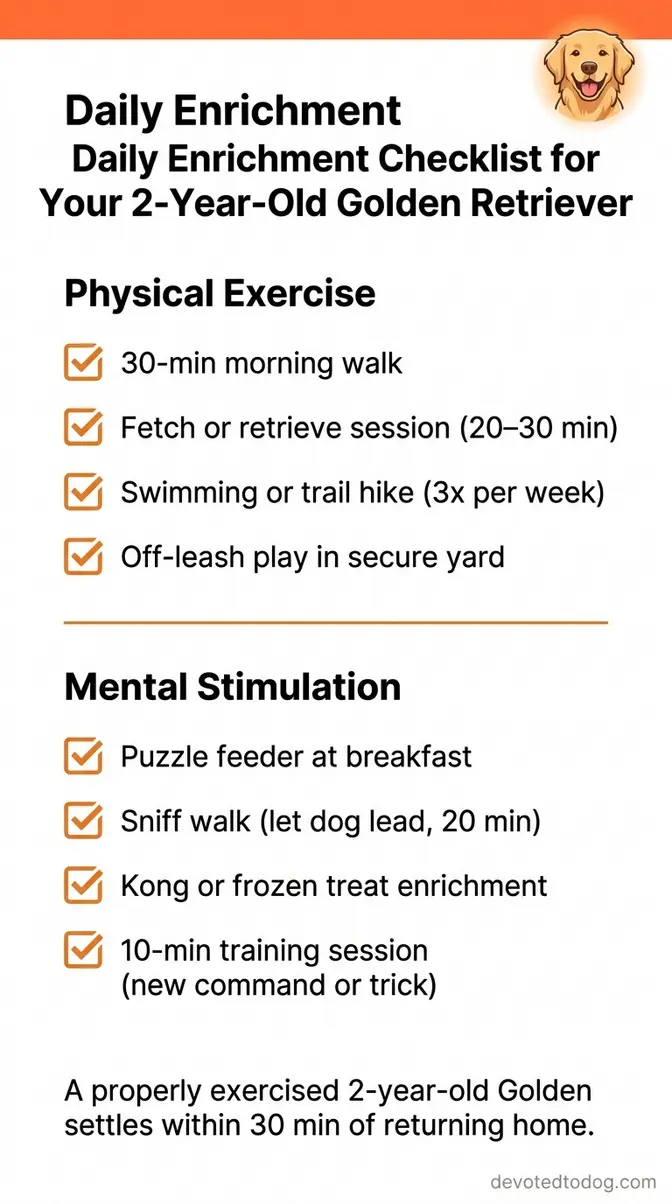
- Fetch and retrieve games. Goldens are born retrievers. Twenty to 30 minutes of active fetch burns more energy than a 45-minute leash walk, and it channels a breed instinct productively.
- Structured leash walks. Two 30-minute walks daily, with at least one on varied terrain (trails, parks) for additional sensory stimulation.
- Swimming. Low-impact on joints, high-energy expenditure. Even 15 minutes in water is roughly equivalent to 45 minutes of land exercise, ideal for a breed with joint health concerns.
- Sniff walks. Let your Golden lead by nose for 20 minutes. Mental stimulation from sniffing is as tiring as physical exercise. This is not a lazy walk, it’s a workout for their brain.
- Dog sports. Agility, obedience, nose work, and dock diving channel breed instincts productively. These are especially effective for high-drive Goldens who act like “food thieves” at home.
- Puzzle feeders at mealtimes. Replace the bowl with a Kong, snuffle mat, or puzzle feeder. This adds 10-15 minutes of mental work twice daily with zero extra effort from you.
The Tired Dog Test: A properly exercised 2-year-old Golden should settle independently within 30 minutes of returning home from exercise. If they’re still frantic an hour later, they need more.
Exercise and training solve most behavioral issues. But when they don’t, here’s what to do next.
When Basic Training Isn’t Working: Next Steps
If consistent positive reinforcement training over 4-6 weeks hasn’t produced noticeable improvement, it’s time to escalate. This is not a failure, it’s a sign that your dog needs a personalized assessment that no article can provide.
Three escalation options, in order of severity:
- Certified Professional Dog Trainer (CPDT-KA). For behavioral issues like mouthiness, counter-surfing, and mild reactivity. Find a certified trainer through the Certification Council for Professional Dog Trainers (CCPDT) at ccpdt.org.
- Veterinary Behaviorist (DACVB, Diplomate of the American College of Veterinary Behaviorists). For serious aggression, fear-based behavior, or suspected anxiety disorders. This is a veterinarian with a specialty in animal behavior, the highest level of professional support available.
- Your regular veterinarian, first. Before assuming behavior is the cause, rule out medical causes. Pain from hip dysplasia or other orthopedic issues common in Golden Retrievers can present as sudden behavioral change. If your Golden’s behavior changed suddenly with no obvious trigger, consult your vet before beginning any training program.
With behavioral challenges addressed, let’s turn to the other major shift at age 2: their nutritional needs.
How Should You Feed Your 2-Year-Old Golden?
At age 2, your Golden Retriever’s nutritional needs have permanently shifted, they are now an adult, not a puppy, and puppy food can cause serious weight gain. Cornell University’s Riney Canine Health Center notes that maintaining a lean body weight throughout a dog’s life is one of the most impactful things an owner can do for long-term health and longevity (Cornell University Riney Canine Health Center). This section gives you a specific feeding chart, a food transition guide, and the 24-month health screening checklist, so you can act now.
For our complete breakdown of food options, see our guide to the best dog food for Golden Retrievers. And for breed-specific health context, our common Golden Retriever health issues guide covers what to watch for at every age.
Transitioning from Puppy Food to Adult Food
Most Golden Retrievers should transition to adult large-breed food between 12-18 months. If your 2-year-old is still on puppy food, switch now. Puppy formulas are calorie-dense and designed for rapid growth that has already stopped, continuing them past 18 months contributes directly to weight gain and potential joint stress.
Tufts University’s Petfoodology experts note that maintaining consistent lean body weight is crucial for dogs, even if they act constantly hungry or food-motivated (2026). A 65-lb Golden who acts like a “food thief” at every meal is not starving, they’re a Golden Retriever.
What to look for in adult food: Find the AAFCO (Association of American Feed Control Officials, the organization that sets nutritional standards for pet food) statement “complete and balanced for adult maintenance” on the label. It’s usually on the back, near the ingredient list. Large-breed adult formulas have specific calcium-to-phosphorus ratios that support joint health. Avoid “all life stages” formulas for dogs over 60 lbs, these are often calorie-dense enough to cause weight gain in an adult dog.
How to transition (numbered steps, follow this exactly to avoid digestive upset):
- Days 1-3: 75% old food, 25% new food
- Days 4-6: 50% old food, 50% new food
- Days 7-9: 25% old food, 75% new food
- Day 10 onward: 100% new food
Monitor for digestive upset, loose stools or vomiting, at each stage. If upset occurs, slow the transition by 2-3 additional days at that ratio before moving forward.
Knowing which food to buy is step one. Knowing exactly how much to feed is step two, and this is where most owners go wrong.
How Much to Feed: Portion Guide by Weight and Activity Level
Portion size depends on three variables: your dog’s body weight, their activity level, and the calorie density of their specific food (measured in calories per cup). Always check your food’s feeding guide first, then use the chart below as a cross-reference.
The chart below is based on approximately 350-400 calories per cup, typical for quality large-breed adult formulas.
| Weight | Low Activity (<1 hr exercise/day) | Moderate Activity (1-2 hrs/day) | High Activity (2+ hrs/day) |
|---|---|---|---|
| 55 lbs | 2.5 cups/day | 3 cups/day | 3.5 cups/day |
| 65 lbs | 3 cups/day | 3.5 cups/day | 4 cups/day |
| 75 lbs | 3.5 cups/day | 4 cups/day | 4.5 cups/day |
Based on ~350-400 calorie/cup adult large-breed food. Adjust for your specific food’s calorie density. Consult your vet for a personalized recommendation.
Treat limits matter more than most owners realize. Cornell University dietary recommendations advise that treats should make up no more than 10% of a dog’s total daily caloric intake. For a 65-lb moderately active Golden eating 3.5 cups (approximately 1,225 calories), that’s roughly 122 treat calories per day, about 8-10 small training treats. More than that, and you’re quietly adding weight.
Cornell University canine weight loss guidelines also note that for dogs already carrying extra weight, weight-loss diets should contain approximately 300 calories per cup to manage obesity safely.
Weight check: If you can’t easily feel your Golden’s ribs, reduce portions by 10% for two weeks and recheck. Small adjustments, consistently applied, make a significant difference over months.
Feeding the right amount is critical. Feeding the wrong things can be dangerous, here’s what to keep away from your Golden entirely.
Toxic Foods to Keep Away From Your Golden Retriever
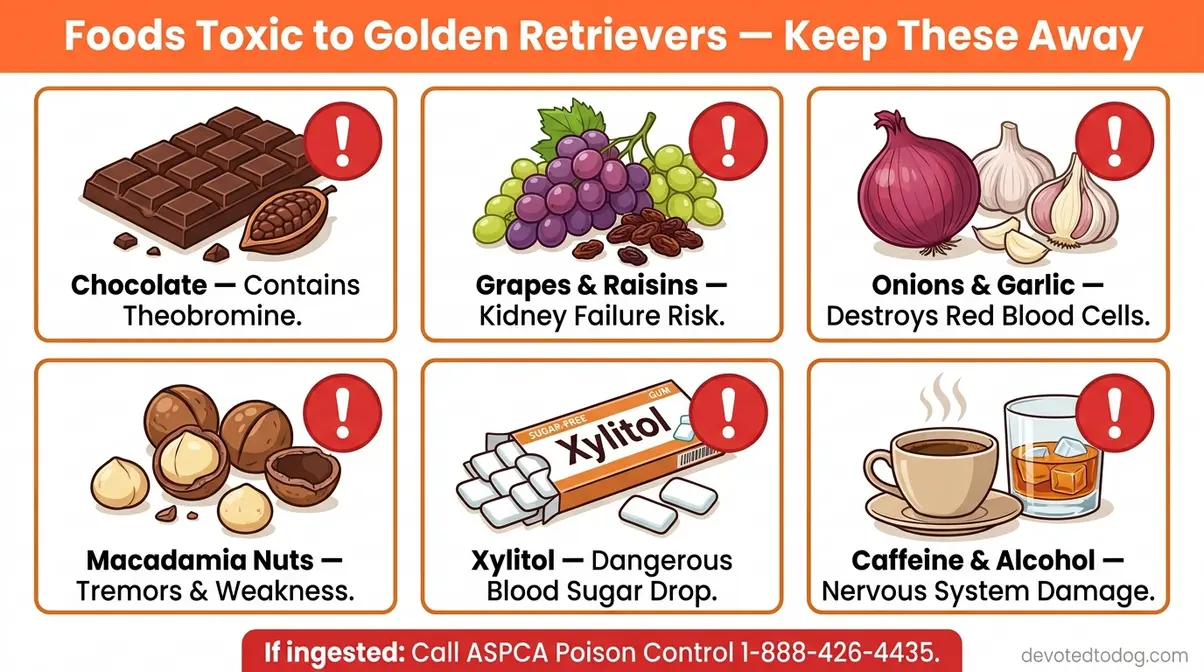
Several common household foods are toxic to all dogs, including Golden Retrievers. Because Goldens are notorious “food thieves” who will eat nearly anything within reach, knowing this list is especially important. These are not foods to limit, they are foods to eliminate completely from your dog’s access.
| Food | Why It’s Dangerous |
|---|---|
| Chocolate | Contains theobromine, toxic in all amounts; dark chocolate is most dangerous |
| Grapes and raisins | Can cause sudden kidney failure; even small amounts are dangerous |
| Onions and garlic | Damage red blood cells; cause anemia; all forms (raw, cooked, powder) are toxic |
| Macadamia nuts | Cause weakness, tremors, and vomiting |
| Xylitol (artificial sweetener) | Found in sugar-free gum and some peanut butters; causes dangerous blood sugar drop |
| Alcohol and caffeine | Affect the nervous system; even small amounts can be life-threatening |
(Source: GoodRx Pet Health, foods poisonous to dogs)
If your Golden ingests any of these: Contact your veterinarian or the ASPCA Animal Poison Control Center at 1-888-426-4435 immediately. Do not induce vomiting unless directed by a vet, in some cases, this can cause additional harm.
With nutrition covered, let’s address the health screenings that are specifically recommended at the 24-month mark.
The 24-Month Health Screening Checklist
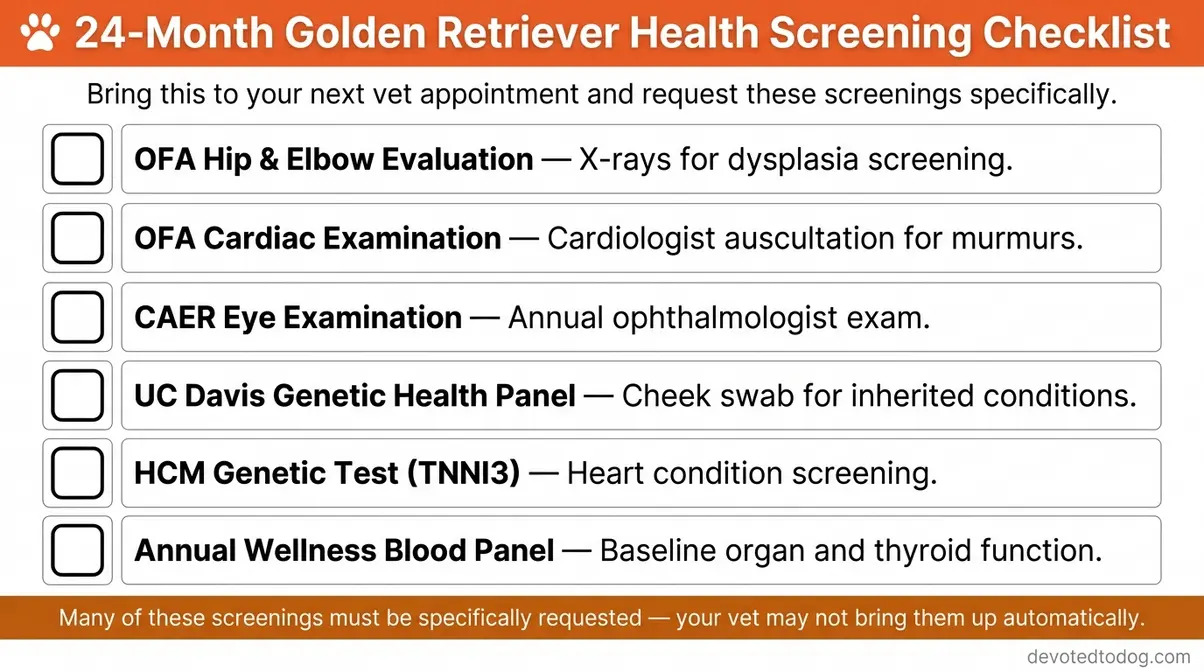
The OFA (Orthopedic Foundation for Animals, the organization that establishes breed health standards) recommends specific screenings at 24 months because skeletal development is complete at this age, allowing accurate baseline readings. Many veterinarians won’t bring these up proactively, you may need to request them specifically. Print this checklist and bring it to your next appointment.
24-Month Golden Retriever Health Screening Checklist:
- OFA Hip and Elbow Evaluation. X-rays evaluated by OFA-certified radiologists to screen for hip and elbow dysplasia, conditions Golden Retrievers are at elevated risk for. This is the definitive screening, and 24 months is the recommended minimum age for an official OFA rating.
- Cardiac Examination (OFA Cardiac). Auscultation by a board-certified cardiologist to screen for heart murmurs and early signs of cardiac disease. This is different from the basic stethoscope check your regular vet performs.
- Eye Examination (CAER). Annual eye exam by a board-certified ophthalmologist using the CAER (Companion Animal Eye Registry) protocol. Cataracts and pigmentary uveitis are breed-specific concerns in Golden Retrievers.
- Genetic Health Panel (Recommended). The UC Davis Golden Retriever genetic health panel screens for Congenital Ichthyosis, Degenerative Myelopathy, and other inherited conditions specific to the breed. This can be done via a simple cheek swab.
- HCM Genetic Test (TNNI3 mutation). HCM (Hypertrophic Cardiomyopathy, a serious heart condition) screening via genetic test. NC State University HCM screening for Golden Retrievers provides targeted testing for the TNNI3 mutation associated with this condition in the breed.
- Annual Wellness Blood Panel. Baseline bloodwork to assess organ function, thyroid levels, and overall health. Establishing a “normal” baseline at 2 years makes future comparison much more meaningful.
Cornell University’s benefits of canine DNA testing advises owners to share DNA test results with their veterinarian for accurate interpretation, results mean more in clinical context.
Now that you know what to feed and what to screen for, let’s look at a different scenario: what if you’re just now bringing a 2-year-old Golden into your home?
Should You Adopt or Buy a 2-Year-Old Golden?
Adopting or buying a 2-year-old Golden Retriever offers real advantages over raising a puppy, you skip the most intensive training phase and often get a dog that’s already house-trained. The Golden Adolescence Gap still applies to newly adopted 2-year-olds, so expect 3-6 months for their full personality to emerge in your home. This section covers where to find them, what to expect, and how to prepare your home before they arrive.
For guidance on finding the right source, see our guides on finding reputable Golden Retriever breeders and the full Golden Retriever adoption guide.
Adopting vs. Buying: Honest Pros and Cons
Both paths lead to a wonderful dog. The right choice depends on your situation, your experience level, and what you’re prepared to manage. Here’s an honest look at both.
- Pros of adopting a 2-year-old:
- You skip the destructive puppy phase (most of the time)
- Many rescue Goldens already know basic commands and are house-trained
- Lower upfront cost than a puppy from a reputable breeder
- You’re giving a dog a second chance, many 2-year-olds enter rescue through no fault of their own, typically due to owner circumstances or lifestyle changes
- Things to be aware of with adoption:
- Unknown behavioral history, a rescue may have experienced trauma, resource guarding, or anxiety that wasn’t fully disclosed
- The Golden Adolescence Gap is still fully active at 2, you are not getting a “calm adult dog”
- Some pre-existing habits may require investment in professional training to address
- Pros of buying from a reputable breeder:
- Full health history and OFA clearances for both parents
- Known temperament lineage and breeder support throughout the dog’s life
- The ability to select a dog specifically bred for the traits you want
Neither option is objectively better. Both require patience, consistency, and realistic expectations about the 2-year developmental phase.
Once you’ve decided which path is right for you, here’s where to start looking.
Where to Find a 2-Year-Old Golden Retriever: Rescues, Breeders, and Rehoming
Rescue organizations are the most reliable source for finding adult Goldens. These organizations specialize in rehoming adult Goldens and typically assess temperament, provide basic training, and disclose known behavioral issues before placement.
- Recommended starting points:
- Golden Retriever Club of America (GRCA) National Rescue, grca.org/rescue
- Adopt a Pet, adoptapet.com (filter by breed and age)
- Petfinder, petfinder.com (search “Golden Retriever” + “Adult” + your zip code)
- Local breed-specific rescues, search ” Golden Retriever rescue”
Reputable breeders occasionally rehome young adult dogs, returned dogs or dogs that didn’t continue in a breeding program. Contact the GRCA breeder referral service for leads. Always request OFA health clearances for both parents and the individual dog. You can also search for a “2 year old female golden retriever for sale” through GRCA-affiliated breeders, this is the safest route when purchasing from a private source.
Where to be cautious: Avoid “2 year old golden retriever for sale near me” listings on Craigslist or Facebook Marketplace. These sources carry high risk of undisclosed behavioral or health issues, and there is no accountability if problems emerge after purchase.
- Questions to ask before committing:
- Why is this dog being rehomed?
- What is their training history?
- Are there any known behavioral issues, resource guarding, reactivity, anxiety?
- Is a trial visit or foster-to-adopt period available?
Once you’ve found your dog, the work of preparation begins before they even walk through your door.
Preparing Your Home Before They Arrive
Most rescue and rehomed dogs need 3 days to feel safe, 3 weeks to learn the routine, and 3 months to feel truly at home. This is called the “3-3-3 Rule,” and it’s widely referenced across rescue organizations for good reason. During the decompression period, avoid overwhelming your new dog with visitors, outings, and new experiences. Let them settle.
Pre-arrival checklist, complete before pickup day:
- Secure the yard. Check fence height (6 feet minimum for an adult Golden) and all gate latches. Goldens can jump, dig under, and problem-solve their way through gaps.
- Puppy-proof the house. Even at 2 years, a new environment triggers exploratory behavior. Secure trash cans, remove toxic plants, lock away cleaning products and medications.
- Set up a “safe space.” A crate, dog bed, or quiet corner where they can retreat voluntarily. Don’t force interaction with this space, let them discover it and choose it.
- Stock up on supplies. Adult large-breed food (ask the rescue or breeder what they’re currently eating to avoid an abrupt diet transition), collar with ID tag, leash, food and water bowls, and chew toys.
- Schedule a vet appointment within the first week. Establish care, review vaccination records, and complete a baseline health check, especially important if health history is incomplete.
- Identify a trainer if needed. If the dog has known behavioral issues, have a CPDT-KA trainer lined up before they arrive. It’s much easier to begin proactively than to scramble after problems escalate.
Whether you’re a long-time Golden owner or preparing to welcome your first, knowing the limitations and warning signs is just as important as the care advice.
What Risks and Limitations Should You Watch For?
This article provides general guidance for 2-year-old Golden Retriever owners. It does not replace professional veterinary or behavioral assessment. Some situations require immediate professional attention, and knowing the difference protects your dog.
Warning Signs That Require Immediate Veterinary Attention
These are not “normal 2-year-old behaviors.” Each one warrants a call to your vet without delay.
- Sudden behavioral change with no obvious trigger. If your Golden was calm and becomes reactive or aggressive overnight, rule out pain before assuming behavioral cause. Hip dysplasia, dental pain, and ear infections can all present as sudden behavioral shifts.
- True aggression, snapping, biting, or resource guarding with intent. As Ohio State University’s College of Veterinary Medicine is clear: these behaviors are not normal developmental phases. Seek a veterinary behaviorist (DACVB), not a YouTube training video.
- Unexplained weight loss or gain. Despite consistent feeding, significant weight change warrants bloodwork to rule out thyroid disorders or other metabolic conditions.
- Collapse or sudden weakness. This is a medical emergency. Hemangiosarcoma, an aggressive cancer of the blood vessels, affects Golden Retrievers at higher rates than most other breeds. According to the Golden Retriever Lifetime Study, hemangiosarcoma was diagnosed in approximately 7.65% of the 3,044-dog cohort (Veterinary and Comparative Oncology, 2023). It develops with few symptoms until it reaches an advanced stage, often causing sudden collapse from internal bleeding. Get to an emergency vet immediately.
- Persistent lameness lasting more than 48 hours. Limping in a 2-year-old Golden warrants an OFA hip and elbow evaluation sooner than the scheduled 24-month screening.
When to Choose a Different Approach
Standard training techniques work for the majority of 2-year-old Goldens, but not all of them. If consistent positive reinforcement over 4-6 weeks hasn’t produced measurable improvement, escalate to a certified professional. The techniques aren’t wrong; your dog may need a personalized assessment.
For Goldens adopted with unknown histories, do not attempt to address serious behavioral issues without professional guidance. The stakes are higher when you don’t know what a dog has experienced.
When in doubt, consult your veterinarian. This article provides general guidance and does not replace professional veterinary or behavioral assessment.
Frequently Asked Questions
Is a 2-Year-Old Golden Retriever Still a Puppy?
No, a 2-year-old Golden Retriever is considered a fully grown adult dog. They have reached their full height (21.5-24 inches) and weight (55-75 lbs depending on sex), according to AKC breed standards. However, most Goldens retain high-energy, puppy-like behavior until age 2.5-3 as their emotional maturity catches up to their physical size, creating the “Golden Adolescence Gap”.
What Is the Most Difficult Age of a Golden Retriever?
The most difficult age for a Golden Retriever is the adolescent period, which spans roughly 6 months to 2.5 years. Peak challenge for most owners occurs between 18 months and 2.5 years. During this specific window, energy levels are highest and impulse control is still developing. This phase brings increased reactivity, boundary testing, and selective listening. These are the hallmarks of “teenage-like rebellion.” Fortunately, consistent positive reinforcement training and adequate daily exercise (1-2 hours minimum) are highly effective tools to manage this stage.
What’s the Best Dog Food for Golden Retrievers?
The best dog food for a 2-year-old Golden Retriever is a high-quality large-breed adult formula carrying the AAFCO statement “complete and balanced for adult maintenance.” Large-breed formulas support joint health through optimized calcium-to-phosphorus ratios, which is critical for a breed prone to hip dysplasia. Look for real meat as the first ingredient and avoid formulas with excessive fillers or those labeled “all life stages” for dogs over 60 lbs.
What Foods Are Toxic to Golden Retrievers?
Several common human foods are toxic to Golden Retrievers and all dogs. The most dangerous include chocolate, grapes, and raisins, which can cause sudden kidney failure. Onions and garlic are also highly toxic because they damage red blood cells and cause anemia. Macadamia nuts and anything containing xylitol,an artificial sweetener found in some peanut butters,must be strictly avoided. Alcohol and caffeine are also highly dangerous in any amount. If your Golden ingests any of these, contact your vet or the ASPCA Poison Control Center (1-888-426-4435) immediately.
What Is the Silent Killer in Golden Retrievers?
The “silent killer” in Golden Retrievers most commonly refers to hemangiosarcoma, an aggressive cancer of the blood vessels. This disease develops with few or no obvious symptoms until it reaches an advanced stage, often causing sudden collapse from internal bleeding. According to the Golden Retriever Lifetime Study, hemangiosarcoma was diagnosed in approximately 7.65% of the 3,044-dog study cohort, making it the most common cancer in the group. Regular veterinary check-ups, including abdominal ultrasounds for middle-aged and senior Goldens, are the best early detection strategy. There is no routine screening test at age 2, but owner awareness is critical.
How to Make a Golden Retriever Laugh?
Golden Retrievers don’t laugh the way humans do, but they do produce a breathy, forced-exhale sound during play that researchers consider a canine equivalent of laughter. You can encourage this response by engaging in active play, as fetch, tug-of-war, and silly interactions tend to elicit it most reliably. Mimicking the sound yourself (a breathy “huh-huh-huh” exhale) can also trigger playful responses in some dogs.
What Is a Red Flag Puppy’s Behavior?
Red flag behaviors in a young dog, including 2-year-old Golden Retrievers, include unprovoked growling or snapping. Extreme resource guarding, which involves aggressive protection of food, toys, or space, is another major warning sign. An inability to settle after adequate exercise can also indicate underlying issues. Persistent fearfulness that doesn’t improve with gradual exposure should not be ignored. According to Ohio State University’s College of Veterinary Medicine, growling, snapping, and stiffening are behaviors that require professional assessment rather than home correction attempts. These signs suggest the dog may benefit from evaluation by a veterinary behaviorist (DACVB) or a certified professional dog trainer (CPDT-KA).
What Annoys Dogs the Most?
Dogs, including Golden Retrievers, are most commonly bothered by inconsistent rules, forced interactions, and direct eye contact from strangers, which they can read as a threat. Loud, unpredictable noises and being disturbed while eating or sleeping are also common irritants. For 2-year-old Goldens specifically, being under-exercised and then expected to be calm is a significant frustration trigger that often leads to “teenage-like rebellion”.
How Do You Bring It All Together?
For owners of a 2 year old golden retriever, the most important realization is this: the challenging behavior, the food transition, and the health screenings all connect back to one thing, The Golden Adolescence Gap. Their body is adult; their brain is catching up. According to PDSA guidelines, 2 hours of daily exercise combined with consistent positive reinforcement resolves most 2-year-old Golden behaviors significantly by age 3. Devoted to Dog’s team has reviewed the full landscape of owner pain points at this age, and the data is consistent: exercise and patience are the two most underused tools.
The Golden Adolescence Gap isn’t a flaw in your dog, it’s a predictable developmental phase with a predictable end. Understanding this concept changes everything about how you respond to your Golden right now. Instead of frustration when they counter-surf or ignore a command, you have context: this is a dog whose body grew up before their brain caught up. That’s not defiance. That’s development. And it passes.
Start with the 24-Month Health Screening Checklist at your next vet visit, request the OFA hip, elbow, and cardiac screenings specifically. Then use the Daily Enrichment Checklist to build a routine that addresses both energy needs and mental stimulation. The work you put in at two pays dividends for the next decade of your Golden’s life.