How much to feed a Golden Retriever puppy depends on age, weight and the calories in the food. Start with the feeding guide on your large-breed puppy food label, split it across 3 to 4 meals a day until about 6 months, then adjust by checking that you can feel your puppy’s ribs. The chart below shows typical daily amounts as starting points, and your vet can confirm what suits your puppy. For the full breed overview, see our Golden Retriever guide.
Breeder feeding charts put a Golden puppy at roughly 1.5 to 4 cups a day, but that range is nearly useless without knowing how much your puppy needs at this stage of growth. Overfeeding is a common mistake for new owners, and it can add to the joint and weight problems this breed is prone to.
A Golden Retriever puppy who gains weight too fast may face a higher risk of joint problems later, and those start at the food bowl. In this guide, you’ll find a precise golden retriever puppy feeding chart by age and weight, plus the Body-First Feeding Method, a framework that teaches you to assess your puppy’s condition so you can adjust portions with confidence, not just follow a number on a bag. We cover the week-by-week chart, essential feeding rules, health risks to watch for, growth milestones, and behavior tips, everything a new Golden owner needs in one place. A full veterinary disclaimer is included below, please read it before making any dietary changes.
8wk to 6mo
2 after 6mo
never exceed 10%
before/after meals
⚠️ Veterinary Disclaimer: This guide provides general feeding information for educational purposes only. Every puppy is different. Always consult your veterinarian before making significant changes to your puppy’s diet, especially if you notice signs of illness, unusual weight gain or loss, or digestive issues.
What Does the Golden Retriever Puppy Feeding Chart Look Like?

The golden retriever puppy feeding chart below gives typical daily amounts from 8 weeks through 12 months, broken down by age, weight, and gender, compiled from two Golden Retriever breeder feeding charts (named below). Royal Canin’s guidance is to spread the daily allowance across three meals a day until six months old (Royal Canin, 2026). These amounts are starting points: check the feeding guide on your puppy food label, ask your vet, and let your puppy’s body condition be the final guide.
One fact that most competitor guides overlook: the feeding amounts on a bag are calibrated for an average dog at average activity. A very active puppy may need more than the chart suggests, and a less active house puppy may need less. That gap matters more than most owners realize.
Golden Retriever puppies are fed 3 to 4 meals per day until about six months of age (Fox Creek Veterinary Hospital, 2026), and breeder charts start around 1.5 cups a day at 8 weeks, rising to 3-4 cups by 6 months.
Feeding Chart: 8 Weeks to 6 Months
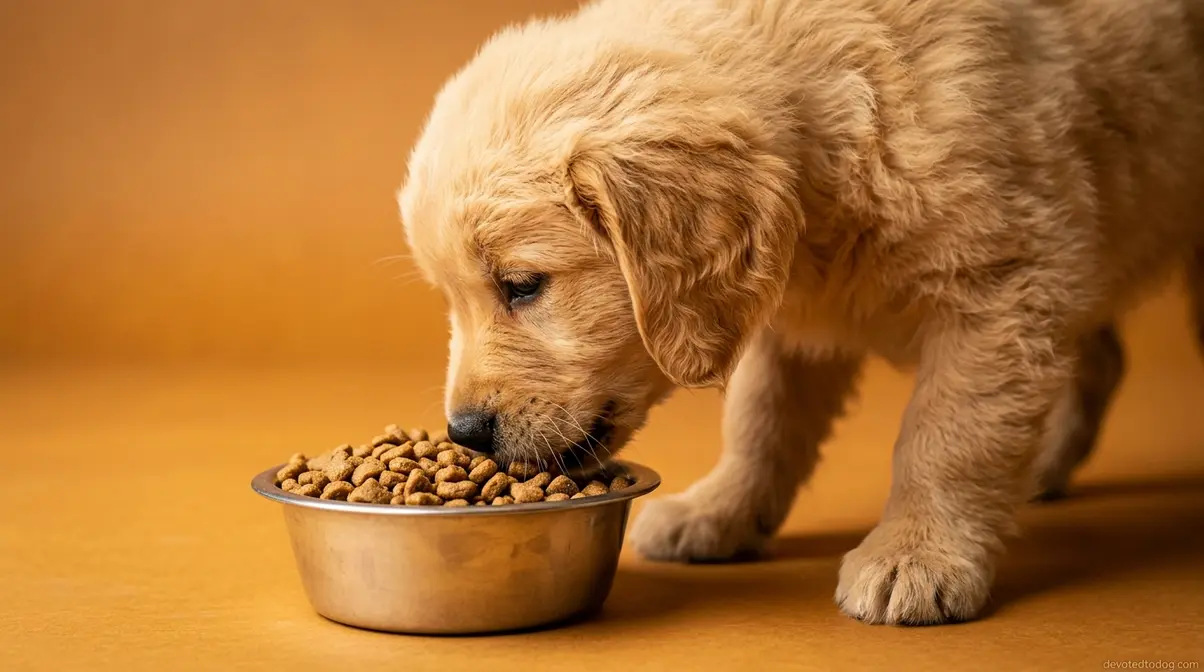
This first six-month window is the most critical growth period your Golden Retriever puppy will go through. The golden retriever puppy feeding chart below reflects amounts from two Golden Retriever breeder feeding charts, mygoldenretrieverpuppies.com and summerbrookgoldens.com. They are not a veterinary standard, so use them as a starting point and confirm with your vet.
| Age | Approx. Weight | Daily Amount (Cups) | Meals Per Day |
|---|---|---|---|
| 8 weeks | 8-12 lbs | 1.5 cups | 3-4 |
| 10 weeks | 10-15 lbs | 1.75 cups | 3-4 |
| 12 weeks | 13-18 lbs | 2 cups | 3-4 |
| 4 months | 22-30 lbs | 2.5 cups | 3 |
| 5 months | 30-40 lbs | 3 cups | 3 |
| 6 months | 38-50 lbs | 3-3.5 cups | 3 |
For larger breeds like Golden Retrievers, nutritional experts recommend spreading their daily food allowance across three meals a day until they reach six months of age (Royal Canin, 2026). This isn’t arbitrary, smaller, more frequent meals support blood sugar stability, match the limited stomach capacity of a young puppy, and meaningfully reduce the risk of bloat.
Is 3 cups a day too much for a 5-month-old Golden puppy? For most average-sized males, 3 cups is within the normal range. For a smaller female or a less active puppy, it may be slightly high. Rather than adjusting based on the number alone, use the body condition check below. A 5-month-old male Golden weighing around 40 lbs would typically need approximately 3 cups per day, split across 3 meals of 1 cup each.
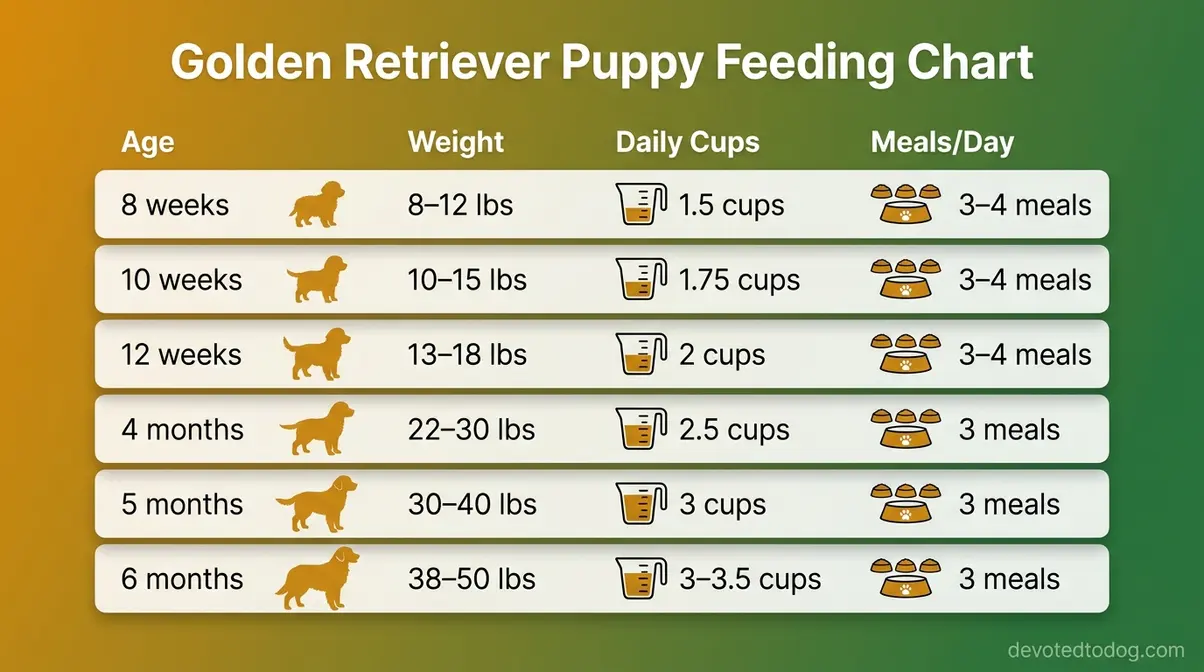
📥 Save this chart: for easy reference at feeding time.
Once your puppy crosses the six-month mark, their growth rate slows, and so should their meal frequency. Here’s what the chart looks like from 6 months through their first birthday.
Feeding Chart: 6 Months to 12 Months
The golden retriever feeding chart by age for the second half of the first year reflects slower growth, a reduced meal schedule, and a gradual shift toward adult-sized portions. Meal frequency drops from 3 to 2 per day at the 6-month mark, but watch for the behavioral cue, not just the calendar.
| Age | Approx. Weight | Daily Amount (Cups), Male | Daily Amount (Cups), Female | Meals Per Day |
|---|---|---|---|---|
| 6 months | 40-55 lbs | 3-3.5 cups | 2.5-3 cups | 2-3 |
| 7 months | 45-60 lbs | 3.25-3.75 cups | 2.75-3.25 cups | 2 |
| 9 months | 52-65 lbs | 3.5-4 cups | 3-3.5 cups | 2 |
| 12 months | 60-70 lbs | 3.5-4 cups | 3-3.5 cups | 2 |
A 9-month-old male Golden weighing approximately 60 lbs will typically need 3.5-4 cups per day, split into 2 meals of roughly 1.75-2 cups each.
When to transition to adult food: Golden Retrievers are a large breed, their growth plates close later than smaller breeds. The AKC recommends that large breeds transition to adult food around 12-15 months of age (AKC, 2026), not at 12 months like smaller dogs. For our complete view of how feeding amounts support healthy development, see our Golden Retriever growth and weight milestones guide.
One distinction worth noting: English (Cream) Golden Retrievers tend to be slightly stockier with a broader build. Their weight may track 5-10 lbs heavier than the American Golden Retriever chart at equivalent ages, without that indicating overfeeding. Apply the Body-First Feeding Method to confirm.
The chart tells you how much, but the bag tells you which food. Here’s how to adjust portions correctly as your puppy grows, using body weight as your guide.
How to Adjust Portions by Weight and Body Condition

Most high-quality kibble bags list feeding amounts by weight range, for example, “20-30 lbs = 2 cups.” Use your puppy’s current weight to find the starting point, then adjust by ±10% based on body condition.
- Here’s the simple formula:
- Find your puppy’s current weight on the bag’s feeding guide
- Start at the midpoint of the suggested range
- Check body condition weekly (feel the ribs with light finger pressure)
- Adjust by ±¼ cup based on what you feel, not what you see
This is the foundation of the Body-First Feeding Method, rather than following the chart rigidly, you check one thing every week: can you feel your puppy’s ribs easily with light finger pressure, without pressing hard? If yes: correct weight. If no: reduce by 10%. If ribs are visible: increase by 10%. You can use your puppy’s current weight and the formula above as a simple calculator for any food brand.
If the bag says a 40-lb dog needs 2.5 cups but your puppy’s ribs feel padded, drop to 2.25 cups for two weeks and reassess. Highly active puppies may need more; a relaxed house puppy may need less.
Golden Retrievers don’t come in one size, and neither does their appetite. Here’s how feeding amounts differ between male and female puppies.
Male vs. Female Feeding Differences
The golden retriever feeding chart by age male versus female distinction matters more than most guides acknowledge. Males grow larger and faster, adult males typically reach 65-75 lbs compared to females at 55-65 lbs. During the key growth phase from 4 to 9 months, males generally need somewhat more food than females of the same age.
| Gender | 4-Month Daily Amount | 6-Month Daily Amount | 12-Month Daily Amount |
|---|---|---|---|
| Male | 2.5-3 cups | 3-3.5 cups | 3.5-4 cups |
| Female | 2-2.5 cups | 2.5-3 cups | 3-3.5 cups |
These are ranges, a smaller female may eat at the low end; a large male may be at the high end. The golden retriever feeding chart by age female figures reflect that females simply reach their adult size earlier and with less total mass. Body condition (the Body-First Feeding Method) overrides any chart number.
If you have a female Golden puppy and she’s consistently leaving food in the bowl, that’s a healthy sign, don’t force her to finish it.
Now that you have the amounts, you need to know which food those cups should contain. Here’s how to read your puppy food bag, and why Royal Canin’s Golden Retriever formula is worth understanding as a benchmark.
How to Read Your Puppy Food Label (Royal Canin Example)
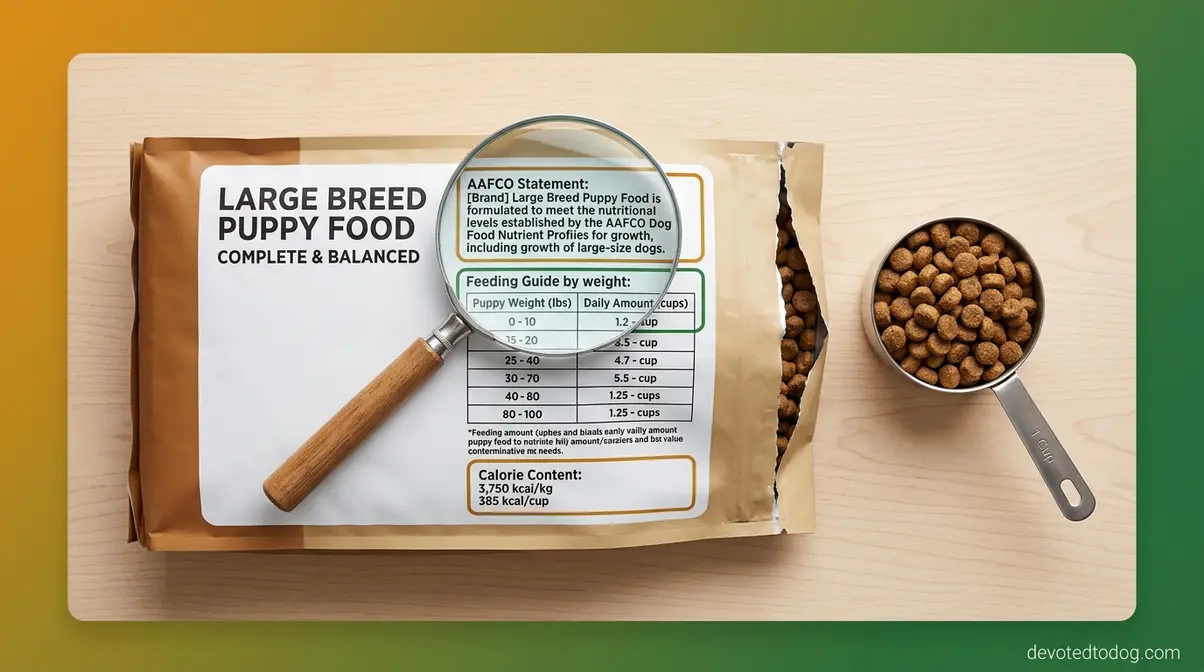
The feeding guide on every bag is a starting point calibrated for an average dog at average activity, it is not a fixed prescription. Three key things to look for on any label:
- Feeding amounts by weight, find your puppy’s current weight range and use the midpoint
- AAFCO nutritional adequacy statement, the Association of American Feed Control Officials (AAFCO) is the body that sets nutritional standards for pet food. Look specifically for “formulated for large-breed puppies” or “growth of large-size dogs”, not just “all life stages”
- Caloric content (kcal/cup), this number matters more than volume
Royal Canin’s breed-specific Golden Retriever puppy formula is explicitly designed to meet the nutritional needs of purebred Golden Retrievers from 8 weeks up to 15 months of age (Royal Canin, 2026). Their bag provides a feeding table by weight that aligns closely with the chart above.
Here’s why caloric density matters: if your kibble contains 350 kcal/cup and your puppy’s daily need works out to ~900 kcal (an illustration, not a target), that is approximately 2.5 cups. Switch to a 300 kcal/cup food and suddenly you need 3 cups for the same caloric target. The cup count changes; the nutrition goal doesn’t.
On wet versus dry food: dry kibble is generally recommended as the primary food for Golden Retriever puppies for dental health and caloric predictability. Wet food works as a topper but counts toward the 10% treat budget, it is not a free addition. For an AKC-aligned reference, consider downloading our free feeding chart PDF, this targets the specific needs of owners searching for printable guidance.
The chart is only as useful as the habits around it. In the next section, we cover the feeding rules that separate healthy, well-nourished Golden Retrievers from puppies developing bad habits early.
What Are the Essential Feeding Rules Every Owner Must Know?

The most effective golden retriever puppy advice comes down to three non-negotiable rules: consistent meal times, strict treat limits, and a food that meets AAFCO large-breed puppy standards. According to veterinary feeding guidelines for puppies, puppies under 6 months should eat 3 to 4 meals per day, not 2, to support stable blood sugar and reduce bloat risk (Fox Creek Veterinary Hospital, 2026). Getting these rules right from week one prevents the picky eating habits and weight problems that are far harder to correct at 6 months.
The bag says one thing, the breeder said another, and a forum post said something different entirely. These rules cut through that noise.
Veterinary guidelines recommend feeding Golden Retriever puppies 3 to 4 meals per day until they reach 6 months of age, and treats should make up no more than 10% of their daily caloric intake (Fox Creek Veterinary Hospital, 2026).
How Many Meals Per Day by Age
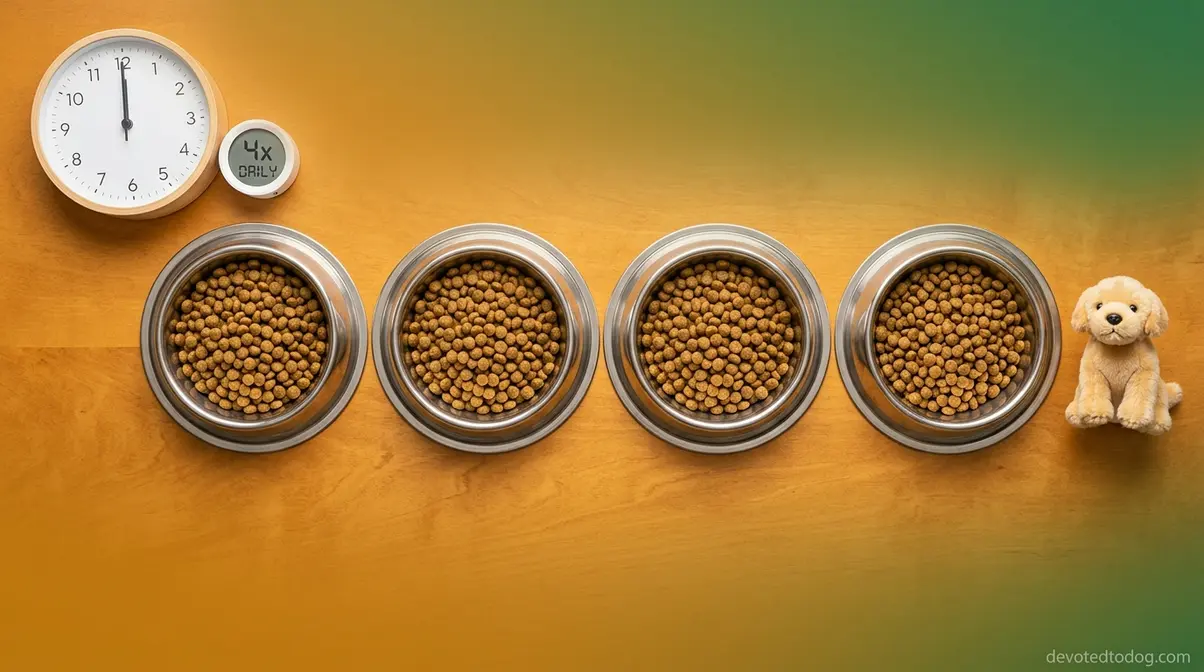
The meal frequency schedule is one of the most practical pieces of information in this entire guide. Here’s the age-based breakdown:
- 8-12 weeks: 4 meals per day, tiny stomach capacity, blood sugar regulation, and preventing hypoglycemia in very young puppies all require this frequency
- 3-6 months: 3 meals per day, stomach capacity has grown; 3 meals maintains stable energy without overloading digestion
- 6-12 months: 2 meals per day, once growth rate slows and stomach capacity increases, twice-daily feeding is appropriate
- 12+ months: 2 meals per day, adult schedule, maintain indefinitely
Veterinary feeding guidelines for puppies confirm that feeding 3 to 4 meals per day until 6 months of age supports stable blood sugar and reduces the risk of bloat (Fox Creek Veterinary Hospital, 2026).
The transition signal matters as much as the timeline. Don’t drop to 2 meals at exactly 6 months based on the calendar. Watch for your puppy starting to leave food in the bowl at the third meal, that’s the behavioral cue to transition. If your 5-month-old Golden is cleaning the bowl at all 3 meals and seems hungry between feeds, stick with 3. If they’re leaving food consistently, consider transitioning to 2.
Meal frequency is only half the equation. The other half is what happens between meals, specifically, how many treats you’re giving and whether they’re quietly blowing past your puppy’s daily calorie budget.
The 90/10 Treat Rule: What It Means and Why It Matters
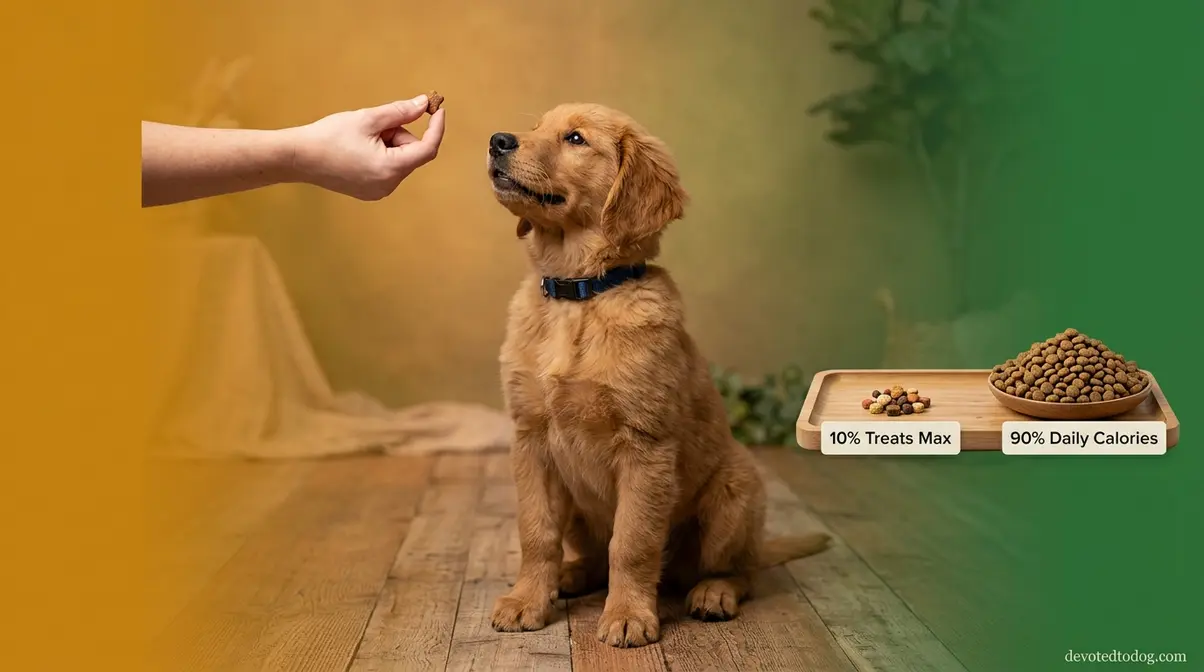
The 90/10 rule for dogs is precise: 90% of your puppy’s daily calories must come from their complete, balanced main meals. The remaining 10% is the absolute maximum for treats, table scraps, food toppers, and supplements combined, not just treats alone.
Here’s the math most owners never see. If your puppy needs 900 kcal/day, their treat budget is 90 kcal maximum. A standard small training treat runs about 5 kcal, that’s 18 treats before you hit the limit. Manageable. But a freeze-dried meat treat can be 20-25 kcal each, meaning just 4 of those treats hits the daily limit. During a 15-minute training session, it’s easy to give 20+ small treats. Use your puppy’s kibble as training treats, same food, zero extra calories.
Exceeding the 10% limit does two things: it disrupts the nutritional balance of a complete kibble (the meals are formulated as complete nutrition, add too much of anything else and you dilute that balance), and it contributes caloric excess that strains developing joints. The veterinary feeding guidelines for puppies reinforce that treats make up no more than 10% of daily caloric intake (Fox Creek Veterinary Hospital, 2026).
The 90/10 rule only works if the 90% is actually high-quality nutrition. Here’s what to look for when choosing a kibble for your Golden Retriever puppy.
Choosing a High-Quality Large-Breed Puppy Kibble
The single most important label check: look for the AAFCO nutritional adequacy statement specifically for large-breed puppies. Not just “all life stages.” Not just “puppies.” Large-breed puppy formulas have controlled calcium and phosphorus ratios to prevent too-rapid bone growth, a documented risk factor for orthopedic disease in Golden Retrievers.
- Look for:
- A named protein source as the first ingredient (chicken, salmon, lamb, not “meat meal” or unnamed by-products)
- DHA for brain and eye development during the critical early months
- Glucosamine and chondroitin for joint support, especially important for this breed
- Avoid:
- Artificial preservatives (BHA, BHT)
- Corn syrup or added sugars
- Unnamed meat by-products as the primary protein source
The high quality kibble you choose sets the foundation for everything else in this guide. For our full breakdown of specific brands by budget and life stage, see our guide to choosing high-quality kibble for your Golden Retriever.
Even the best kibble can become a problem if your puppy learns they can refuse it for something better. Here’s how to prevent that from happening.
How to Prevent Picky Eating Habits
Golden Retrievers are naturally food-motivated, picky habits are almost always owner-created, not breed-specific. Three rules that prevent them:
- Put the bowl down for 15 minutes, then pick it up, regardless of whether it’s finished. Do this consistently for 3-4 days. Almost all puppies self-regulate within a week.
- Never add table scraps or broth to entice a refuser, this trains your puppy to hold out for better options. It creates the exact picky habits owners fear, and it’s nearly impossible to undo once established.
- Sudden refusal after consistent eating is a vet signal, not a behavior issue, if a previously food-enthusiastic puppy keeps refusing meals, ask your vet before treating it as behavior.
Most Golden Retriever puppies are naturally food-motivated. If yours is consistently refusing meals, check whether you’ve recently changed food brands abruptly. Always transition over 7-10 days to discourage picky habits and avoid digestive upset.
Following these feeding rules protects your puppy’s health day-to-day. But some risks go deeper, and every Golden Retriever owner needs to know about them before they become emergencies.
What Health and Nutrition Risks Should You Watch For?
Overfeeding a Golden Retriever puppy isn’t just a weight problem, it’s a risk factor for two life-threatening conditions: gastric dilatation-volvulus (GDV) and the obesity-driven joint disease that can rob your dog of years of comfortable movement. Cornell University’s College of Veterinary Medicine describes GDV as a sudden and life-threatening condition where the stomach distends with air or food, requiring immediate veterinary intervention (Cornell University College of Veterinary Medicine, 2026). Understanding these risks, and how your feeding choices directly affect them, is the difference between a healthy puppy and an emergency vet visit.
Gastric dilatation-volvulus (GDV), commonly known as bloat, is a sudden and life-threatening condition where the stomach distends with air or food, and larger, deep-chested breeds are at higher risk (Cornell University College of Veterinary Medicine, 2026).
What Is Bloat (GDV) and How Does Feeding Affect It?
Gastric dilatation-volvulus (GDV), commonly known as bloat, occurs when the stomach distends with gas or food and then twists on itself (volvulus), cutting off blood supply to the stomach and spleen. Without immediate treatment, it can be fatal within hours. Recognizing the symptoms early is critical.
- Symptoms of GDV to watch for:
- Unproductive retching (trying to vomit with nothing coming up)
- Visibly distended or hard abdomen
- Sudden restlessness or inability to get comfortable
- Excessive drooling
- Sudden weakness or collapse
If you see these signs, this is a veterinary emergency, call your vet immediately.
Feeding-related risk factors include: eating too fast, consuming one large meal instead of smaller meals spread across the day, vigorous exercise soon after eating, and (controversially) using elevated food bowls. The elevated bowl debate is ongoing, some studies suggest elevation increases risk in large breeds, so our team recommends consulting your vet on bowl height.
GDV is known to have a genetic component in Golden Retrievers. Genetics may play a part, and it is a complex condition with both genetic and environmental influences, so ask your vet what applies to your puppy. This means asking your breeder about the parents’ history is a legitimate and proactive prevention strategy, not an overreaction.
- Five steps to prevent bloat:
- Feed several smaller meals instead of 1 large meal per day
- Use a slow-feeder bowl if your puppy eats quickly
- No vigorous play or exercise right before or after meals, and ask your vet how long to wait
- Ask your breeder whether GDV has occurred in the puppy’s lineage
- Know the symptoms, GDV is a life-threatening condition known as bloat requiring immediate veterinary care (Cornell University College of Veterinary Medicine, 2026)
For a complete overview of health warning signs beyond nutrition, see our guide to common health concerns in Golden Retrievers.
Bloat is the acute emergency. But chronic overfeeding causes a slower, more insidious problem, and the signs are easy to miss if you don’t know what to look for.
Signs Your Golden Retriever Puppy Is Being Overfed
The goal is to keep your puppy weight stable and within the healthy range for their age, not to maximize their size. These are the specific, observable signs that your Golden is being overfed:
- Cannot feel ribs without pressing firmly, healthy puppies have ribs easily felt with light finger pressure, no pressing required
- No visible waistline from above, when you look down at your puppy, you should see a slight narrowing behind the ribcage
- Belly appears rounded or distended after meals, some roundness after eating is normal; persistent distension is not
- Low energy or lethargy compared to typical puppy activity levels
- Frequent loose stools or digestive upset, overloaded digestion is a consistent early sign
- Rapid weight gain faster than your vet’s growth guidance for a young Golden
- Difficulty breathing or excessive panting during light play
The gold standard check: run your fingers along your puppy’s ribcage. You should feel each individual rib with light pressure, but the ribs should not be visible through the coat. This is the “feel the ribs, don’t see them” rule that experienced Golden Retriever owners live by.
Some puppies naturally carry more or less weight due to genetics and frame size. The rib check is more reliable than visual assessment alone, especially in Golden Retrievers whose thick, fluffy coats can hide their actual body shape.
Knowing the signs of overfeeding is step one. The Body-First Feeding Method gives you a weekly system to catch problems before they become visible.
Body Condition Scoring: The Body-First Feeding Method
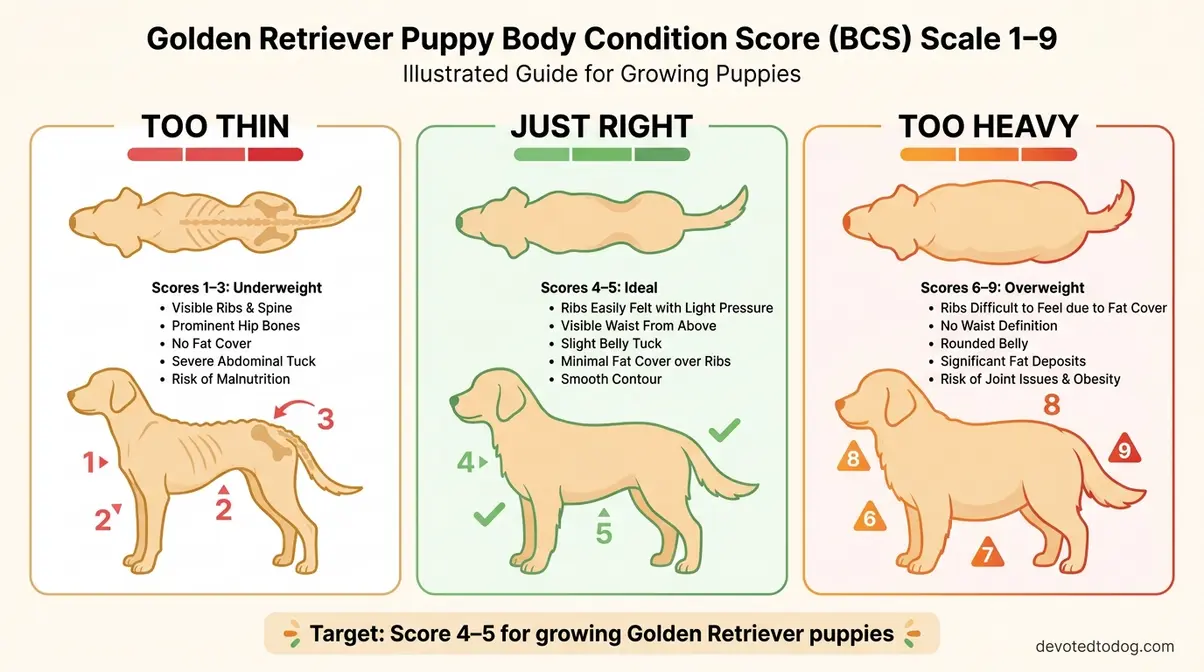
Body Condition Scoring (BCS) is a 1-9 scale used by veterinarians to assess whether a dog is underweight (1-3), at an ideal weight (4-5), or overweight (6-9). For a growing Golden Retriever puppy, the target score is 4-5, lean, but not thin.
“It’s better to be too thin than too heavy.”
This is the core principle of the Body-First Feeding Method, and exactly how experienced Golden Retriever owners think about nutrition. A slightly lean puppy grows into healthier joints. A slightly heavy puppy risks orthopedic damage during the rapid growth phase, when bones and joints are at their most vulnerable.
The Body-First Feeding Method replaces rigid cup-counting with a weekly physical assessment. Here’s the 3-step weekly check:
- Run your fingers along the ribcage, feel individual ribs with light pressure (no pressing). Each rib should be distinct.
- Look down at your puppy from above, you should see a slight waist narrowing behind the ribcage, like a gentle hourglass.
- Look from the side, the belly should tuck upward slightly behind the ribcage, not hang level or sag.
- What to do based on results:
- All 3 pass → maintain current portions
- Ribs invisible or belly round → reduce by ¼ cup for two weeks, then reassess
- Ribs prominent or clearly visible → increase by ¼ cup for two weeks, then reassess
Consult your veterinarian if you’re uncertain about your puppy’s BCS, they can confirm the score during a routine check-up and adjust your feeding plan accordingly.
The Body-First Feeding Method protects against overfeeding. But there’s a health risk in Golden Retrievers that proper feeding alone cannot prevent, and every owner should know about it.
Cancer and Your Golden’s Long-Term Health
Cancer is a serious concern in this breed. In a UC Davis study of 652 Goldens, 65% died of cancer (Kent et al., PLoS ONE, 2018, PMC5800597). Healthy weight supports overall health, but nutrition is not a cancer cure or prevention strategy. Talk to your veterinarian about routine check-ups and breed-specific screening.
Understanding the health risks helps you feed with purpose. Now let’s look at the bigger picture, how your puppy grows and develops across their first year, and what benchmarks to watch for.
What Are the Golden Retriever Puppy Growth Milestones?
Golden Retriever puppies grow remarkably fast in their first year, and each developmental stage changes what they need from their food, their schedule, and their owner. Here’s what to expect at each milestone and how to adjust your feeding approach accordingly.
Across Golden Retriever owner communities, the consistent concern is the same: “Is my puppy growing on track?” These benchmarks give you a reliable reference, while keeping in mind that healthy puppies can vary significantly within the ranges shown.
Golden Retriever puppies typically weigh 8-12 lbs at 8 weeks, 30-40 lbs at 4 months, and 52-65 lbs by 9 months, with males consistently tracking 10-15 lbs heavier than females throughout the first year (Dogster, 2026; Pawlicy, 2026).
Golden Retriever Puppy Weight and Height Chart by Age
Golden Retriever puppy age and growth benchmarks vary by gender throughout the first year. Height growth (measured at the shoulder/withers) largely completes by 9-12 months, but weight and muscle mass continue developing until 18-24 months. This is precisely why the transition to adult food is delayed beyond 12 months for Goldens.
| Age | Male Weight | Female Weight | Approx. Height (Both) |
|---|---|---|---|
| 8 weeks | 8-12 lbs | 7-10 lbs | 8-12 inches |
| 3 months | 17-27 lbs | 15-22 lbs | 10-14 inches |
| 4 months | 25-35 lbs | 20-28 lbs | 12-16 inches |
| 6 months | 41-57 lbs | 35-46 lbs | 16-20 inches |
| 9 months | 57-65 lbs | 48-58 lbs | 19-22 inches |
| 12 months | 60-70 lbs | 50-60 lbs | 21-24 inches |
Sources: Dogster (2026), Pawlicy (2026)
If your 6-month-old male Golden weighs 55 lbs, he’s at the high end of normal. Apply the Body-First Feeding Method, if his ribs are easily felt, his weight is healthy for his frame. If they’re padded, reduce by ¼ cup.
English (Cream) Golden Retrievers tend to be slightly stockier with a broader build. Their weight may track 5-10 lbs heavier at equivalent ages without indicating overfeeding. For our complete month-by-month breakdown, see our guide to Golden Retriever puppy growth and development stages.
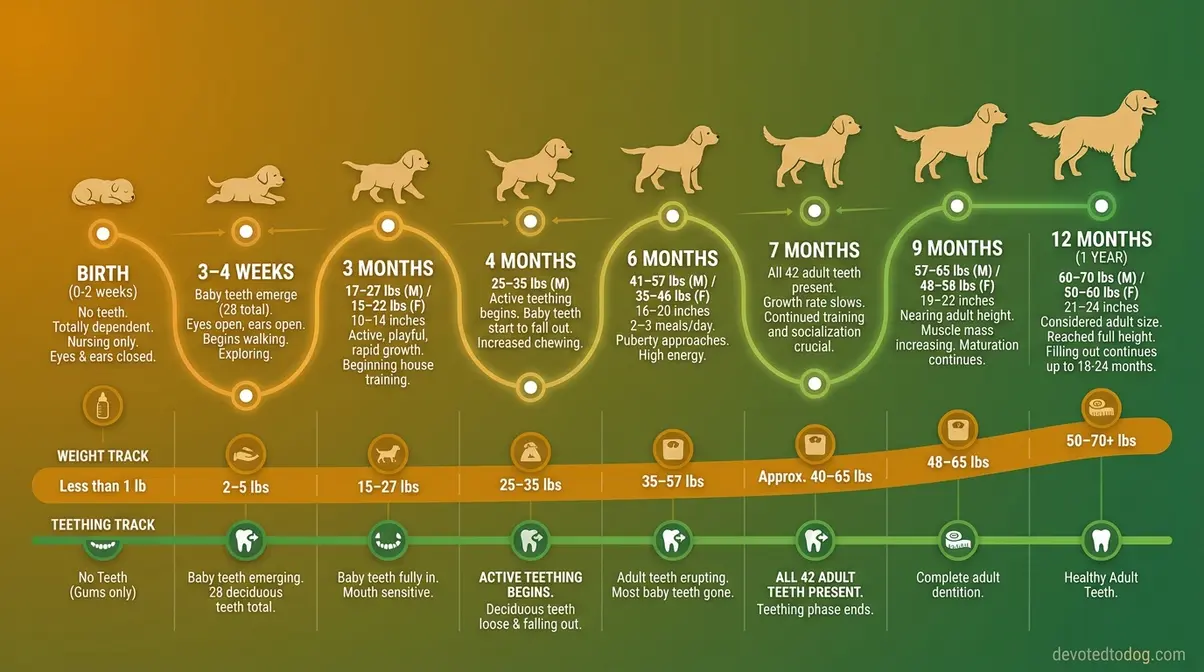
As your puppy grows, their teeth do too, and the teething process directly affects their eating habits and food preferences.
Golden Retriever Puppy Teething Timeline
The golden retriever puppy teeth chart follows a predictable pattern, understanding it helps you interpret sudden changes in eating behavior without panic.
- Teething stages:
- Birth-3 weeks: No teeth present
- 3-4 weeks: Deciduous (baby) teeth begin emerging, 28 total
- 3-4 months: Adult teeth begin replacing baby teeth; you may find small teeth around the house
- 4-7 months: Active teething, all 42 adult teeth emerge during this window
During the active teething phase (4-7 months), some puppies experience a temporary appetite dip. This is common and not a feeding emergency.
How teething affects feeding: Puppies may prefer slightly softer food during peak teething. Adding a small amount of warm water to kibble softens it without changing the nutritional profile. You can also use a wet food topper, but keep it within the 10% treat budget. Do NOT switch to wet food entirely; this creates the picky habits owners fear and makes the transition back to dry kibble difficult.
The teething-chewing connection is important for bowl choice: during teething, puppies chew everything, including their food bowl. A metal or ceramic bowl is more durable than plastic, easier to sanitize, and doesn’t retain bacteria in chew marks.
If your 4-month-old suddenly seems less interested in meals, check their mouth, you may see swollen gums or a loose baby tooth. Soften the kibble slightly and monitor. If refusal continues, call your vet.
Understanding development milestones helps you recognize what’s normal, including what a very young puppy needs when they first come home.
What to Expect from a 5-Week-Old Golden Retriever Puppy
A 5-week-old Golden Retriever puppy should still be with their mother and littermates, full stop. Responsible breeders (see our Golden Retriever breeders by state) do not release puppies until at least 8 weeks of age, and many reputable breeders wait until 10-12 weeks for optimal socialization. If you encounter a 5-week-old puppy, it needs veterinary guidance on feeding immediately.
At 5 weeks, puppies are beginning the weaning process, transitioning from nursing to solid food alongside continued nursing. Breeders typically introduce a high-quality wet puppy food or moistened kibble slurry at this stage. Feeding amounts at 5 weeks are managed entirely by the breeder, not the future owner.
If you are fostering or have a 5-week-old Golden Retriever for any reason, contact your veterinarian immediately for a feeding plan. This situation is beyond the scope of a standard golden retriever puppy feeding chart, it requires individualized veterinary guidance based on the puppy’s weight and health status.
By the time your puppy comes home at 8 weeks, the feeding chart is your guide. But feeding is just one piece of raising a happy, well-adjusted Golden Retriever. Here’s what to know about their behavior and care.
What Are the Behavior and General Care Tips?
Golden Retriever puppies are among the most rewarding, and most demanding, breeds to raise in their first year. Understanding their natural temperament and common behavioral patterns makes every feeding, training, and play session more effective.
What most owners don’t realize is that feeding schedule consistency directly supports behavioral stability. A puppy who eats at predictable times is calmer, more trainable, and less prone to anxiety-driven behaviors. The feeding chart and the behavior tips below are not separate topics, they reinforce each other.
Crate Training and Managing Separation Anxiety
The crate is not punishment. It is a den, a safe space, and one of the most effective training tools available to new Golden Retriever owners, particularly for puppies who are left in the crate to explore their boundaries.
- 5 practical crate training tips:
- Introduce the crate gradually, feed meals inside it with the door open for the first week
- Close the door for short periods (5-10 minutes) while you remain in the room before extending duration
- Exercise your puppy before crating, a tired puppy settles faster and with less protest
- Provide a high-value chew toy inside the crate to create a positive association
- Increase crate duration slowly over 1-2 weeks, do not jump from 10 minutes to 4 hours
The “golden retriever puppy left crate to explore” scenario, where a puppy released from the crate immediately becomes destructive or anxious, signals they haven’t yet associated the crate with calm. The solution isn’t a bigger crate or less crating; it’s a more gradual introduction with higher-value rewards inside.
Here’s the often-overlooked connection: feed meals in the crate, then crate the puppy for a calm rest after eating. This routine simultaneously builds positive crate association and reduces the post-meal activity that contributes to bloat risk. Two training goals, one routine.
For our full 7-rule daily training framework, see our comprehensive Golden Retriever puppy training guide.
Managing what happens inside the crate is one challenge. Managing what happens after a high-energy playdate is another.
Managing Energy After Playdates
Golden Retriever puppies don’t self-regulate exercise well, they will play until they collapse. An exhausted Golden Retriever puppy after a playdate is common and generally safe, as long as the puppy is allowed to rest fully afterward.
- Watch for these post-playdate warning signs that warrant a vet call:
- Limping or favoring a leg after rest
- Excessive panting that continues long after play ends
- Refusal to stand or bear weight
The 5-minute rule for puppy exercise: A common rule of thumb is about 5 minutes of structured exercise per month of age, twice daily, so a 4-month-old gets about 20 minutes. It is a rough guide only; ask your vet what suits your puppy’s joints.
Feeding timing around playdates matters directly: do not feed a large meal right before or after vigorous play. Let your puppy settle and rest before offering food, and ask your vet how long to wait. Exercising soon after eating is a listed bloat risk factor.
Understanding why your puppy behaves the way they do starts with knowing their breed. Here’s what makes Golden Retrievers uniquely wonderful, and uniquely challenging, as puppies.
Understanding Golden Retriever Puppy Temperament
Golden Retrievers are defined by a handful of core traits that directly affect how you feed and train them:
- Highly food-motivated, makes training easy; makes overfeeding tempting
- Social and people-oriented, separation anxiety is common, especially in the first weeks home
- Gentle-mouthed, mouthing and biting are developmental, not aggression
- Curious and exploratory, they will investigate everything, including the food bag if left accessible
The food motivation is a double-edged trait. Golden Retrievers will eat past fullness if food is available. This breed requires structured mealtimes and measured portions more than most, free-feeding (leaving food out all day) is not recommended and actively undermines the Body-First Feeding Method.
Food-related behavior problems, counter-surfing, garbage raiding, begging, are almost entirely preventable with consistent feeding schedules, measured portions, and proper food storage (that means a sealed container, not the open bag). For solutions to the most frequent behavioral challenges, see our guide to addressing common Golden Retriever behavior problems.
Even with the best feeding plan and behavioral foundation, mistakes happen. Here are the most common feeding errors Golden Retriever owners make, and how to avoid them.
What Common Feeding Mistakes Should You Avoid?
Even well-intentioned owners make predictable feeding mistakes. These are the most common ones, and the specific signs that mean it’s time to call your vet.
The Most Common Overfeeding Mistakes
These four mistakes account for the majority of weight problems our team sees reported across Golden Retriever owner communities:
- Using the bag’s feeding guide without adjusting for activity level, the bag is calibrated for an average dog. An active Golden may need more; a sedentary one may need less. Always adjust.
- Not counting treat calories in daily totals, freeze-dried treats, wet food toppers, training rewards, and table scraps all count toward the daily calorie budget. Many owners track the kibble perfectly and forget everything else.
- Free-feeding (leaving food available all day), this eliminates your ability to monitor intake, undermines mealtime structure, and makes it impossible to apply the Body-First Feeding Method accurately.
- Giving adult food to a puppy, adult formulas have different calcium and phosphorus ratios than large-breed puppy formulas. Feeding adult food to a growing Golden can disrupt bone development during the most critical growth window.
If you’re already seeing weight issues or digestive problems, it may be time to change course.
When to Switch Foods or Consult Your Vet
Switching food is appropriate in these specific scenarios:
- Persistent loose stools after 2 weeks on a new food, may indicate a protein or ingredient intolerance; consult your vet before switching again
- Puppy consistently refuses meals and is losing weight, behavioral refusal and illness-driven refusal look similar; rule out health issues first
- Approaching 12-15 months, transition to adult food using a 7-10 day gradual mix (25% new / 75% old → 50/50 → 75% new / 25% old → 100% new)
Do NOT switch food based on one or two refused meals. This is usually behavioral, a puppy testing whether something better is coming, and switching food rewards the behavior and creates the picky habits you’re trying to avoid.
Some situations go beyond what a feeding chart can solve.
When Professional Veterinary Guidance Is Essential
Call your veterinarian, do not wait and monitor, in these situations:
- Noticeable weight loss without a dietary change
- Refusal to eat in a puppy that was previously eating normally
- Visible bloating or unproductive retching, this is a GDV emergency. Call immediately; do not wait for a morning appointment.
- Lethargy and disinterest in food that does not pass, could indicate illness, pain, or a serious underlying condition
- Ribs clearly visible through the coat or belly appears distended, both are signs of a body condition problem requiring professional assessment
This article is general information, not veterinary advice. For your puppy’s feeding plan, talk to your veterinarian.
This guide is educational. For personalized dietary advice, your veterinarian is always the best resource. Consult your vet at your puppy’s 12-week check-up to confirm your feeding plan is appropriate for your specific dog.
Frequently Asked Questions
How much should a Golden Retriever puppy eat per day?
A Golden Retriever puppy typically needs between 1.5 and 4 cups of large-breed puppy food daily, depending on age and size. Younger puppies (8-12 weeks) start around 1.5 cups split across 3-4 meals, while older puppies (9-12 months) may need 3.5-4 cups across 2 meals. Males generally eat somewhat more than females at equivalent ages. Check the feeding guide on your puppy food label, and ask your vet. Amounts come from breeder charts, so also adjust for your food’s caloric density and adjust based on body condition, the ribs should be easily felt but not visible.
What are signs of overfeeding a puppy?
Signs of overfeeding a puppy include an inability to feel ribs without pressing firmly, no visible waistline from above, and a rounded or distended belly after meals. An overfed puppy may also show reduced energy, frequent loose stools, or weight gain faster than expected for their age. The most reliable check: run your fingers lightly along the ribcage, you should feel each rib with gentle pressure, not have to press to find them. If you’re unsure, your vet can assign a Body Condition Score at the next check-up.
Is 3 cups a day for my 5-month-old golden puppy too much?
For most 5-month-old Golden Retriever puppies, 3 cups per day is within the normal range, appropriate for average-sized males but potentially slightly high for smaller females or less active puppies. Rather than adjusting based on the number alone, check body condition: if you can’t easily feel your puppy’s ribs or they have no visible waistline, reduce by ¼ cup. If ribs are prominent, increase slightly. Body condition is always a more reliable guide than a fixed cup count. When in doubt, consult your veterinarian.
What is the 90/10 rule for dogs?
The 90/10 rule for dogs means that 90% of a dog’s daily calories must come from their complete and balanced main meals, with no more than 10% coming from treats, food toppers, table scraps, or supplements combined. For a Golden Retriever puppy needing 900 calories per day, the treat budget is 90 calories maximum. Exceeding this disrupts the nutritional balance of a complete kibble and contributes to excess weight gain. Use kibble as training treats to stay within the limit effortlessly.
How Do You Feed Your Golden Puppy with Confidence?
For new Golden Retriever owners, getting the golden retriever puppy feeding chart right from week one prevents the most common and costly health problems this breed faces. Starting at 1.5 cups at 8 weeks and scaling to 3-4 cups by 6 months, split across 3 to 4 meals daily, gives your puppy the fuel for healthy growth without the overfeeding risk that strains developing joints. Males and females need different amounts, activity level changes the math, and the bag’s numbers are always a starting point, not a final answer.
The Body-First Feeding Method gives you a tool that no chart can replace, the ability to assess your puppy’s body condition weekly and adjust portions before small imbalances become health problems. Remember: it’s better to be too thin than too heavy. Your puppy’s ribs are your most reliable guide. Every week, run your fingers along that ribcage. That 10-second check tells you more than any number on a bag.
Start this week by bookmarking this guide for monthly reference and scheduling a vet check at 12 weeks, where you can confirm your feeding plan with a professional who knows your specific puppy. Download the Golden Retriever Puppy Feeding Chart PDF for easy reference at feeding time, and consult your veterinarian any time you notice unusual weight changes, digestive issues, or appetite shifts. Your Golden deserves a feeding strategy as individual as they are.
Related reading:
If this topic interests you, our companion article on How Long Do Goldendoodles Live? 2026 Guide covers more detail.
If this topic interests you, our companion article on Best Slow Feeder Dog Bowls: Top 10 Picks for 2026 covers more detail.
Related gear: see our guide to the best foods for Goldens.
If your puppy has a sensitive stomach, see the best sensitive stomach dog foods.