Both breeds share Golden Retriever DNA. Both are friendly, trainable, and wonderful with families. Yet owners who choose the wrong one for their lifestyle often end up overwhelmed , and sometimes heartbroken. The choice between a golden retriever vs goldendoodle comes down to one fundamental question: would you rather manage a vacuum cleaner or a grooming bill?
Thousands of Goldendoodle owners discover too late that “hypoallergenic” doesn’t mean low-maintenance. Professional grooming for a Doodle runs $100–$180+ per session (Bark.com, 2026), while the hidden health risks in Goldens are rarely discussed outside veterinary circles. The conflicting advice from breeder websites, Reddit threads, and social media makes it genuinely hard to know who to trust. This guide cuts through that noise by delivering exact temperament data, verified grooming costs, F1/F2 coat genetics explained in plain English, and veterinary-cited health risk statistics , so you can choose your dog with confidence.
We cover temperament, physical traits, the puppy phase, a complete financial breakdown, and a head-to-head decision framework that no competitor currently provides.
- The Predictability Premium: Goldens offer consistent temperament and coat; Doodles offer coat variability and potential “hybrid vigor” , every owner pays one of two prices
- Grooming costs: Goldendoodle owners spend an estimated $480–$1,440 annually on professional grooming vs. $300–$600 for Golden Retriever owners (Goldoodle.com, 2026)
- Temperament variability: F1 Goldendoodles (first-generation crosses) have more predictable traits than F2 generations
- Health risk: An estimated 1 in 5 Golden Retrievers will develop hemangiosarcoma (Cornell Baker Institute estimate, 2021)
- Best fit: Goldens suit owners who want a mellow, predictable companion; Doodles suit those willing to invest in grooming for reduced shedding
Author Credentials
📝 Written by: Coral Drake
✅ Reviewed by: Brianna York, Former Veterinary Technician
📅 Last updated: 5 May 2026
ℹ️ Transparency Notice
This article compares Golden Retrievers and Goldendoodles based on AKC breed standards, GANA (Goldendoodle Association of North America), and peer-reviewed veterinary research. All claims have been verified by our editorial team and reviewed for medical accuracy.
| Trait | Golden Retriever | Goldendoodle |
|---|---|---|
| Breed status | AKC purebred (recognized 1925) | Hybrid cross (Golden × Poodle), not AKC-recognized |
| Adult weight | 55-75 lbs | 15-100 lbs (Toy/Mini/Medium/Standard sizes) |
| Coat type | Straight, double-coat, heavy shedder | Wavy to curly, often low-shedding |
| Hypoallergenic? | No (sheds heavily) | Often yes (depends on coat type) |
| Lifespan | 10-12 years | 10-15 years (varies by size) |
| Cancer rate | 65% of deaths in a UC Davis study (Kent et al., 2018) | No published figure for Goldendoodles |
| Average puppy price | $1,500-$3,500 | $2,000-$5,000 |
| Energy level | High (60-90 min/day) | Moderate-high (45-75 min/day) |
| Grooming need | Brush 2-3x/week, groomer 4-6 weeks | Brush 4-7x/week, groomer 4-6 weeks |
Key Differences at a Glance
When comparing the golden retriever vs goldendoodle, the core difference is predictability. The Golden Retriever is a 150-year-old purebred with a consistent coat and temperament, while the Goldendoodle is a designer hybrid whose traits depend heavily on which parent genes dominate. Neither the AKC nor the UKC recognizes the Goldendoodle as an official breed , and that single fact explains the significant variation owners experience in coat type, shedding level, and personality. This distinction shapes everything from grooming costs to temperament predictability.
The Golden Retriever is a purebred AKC-recognized sporting dog; the Goldendoodle is a designer hybrid with no breed standard, making temperament and coat outcomes less predictable by nature.
| Product | Type | Key Spec | Best For | Price Range |
|---|---|---|---|---|
| Golden Retriever | Purebred | Dense double coat | Mellow companions | $1,800-$3,000 |
| Goldendoodle | Designer hybrid | Low-shedding coat | Allergy-conscious homes | $1,500-$5,000 |
How We Evaluated These Breeds
Our evaluation criteria for this comparison included temperament consistency (drawn from AKC breed standards and owner forum consensus), grooming cost ranges (from 2026 grooming industry data via Bark.com, AdoptAPet, and Goldoodle.com), health risk statistics (from peer-reviewed sources including PubMed, Cornell University, and the University of Florida College of Veterinary Medicine), and coat genetics (from UC Davis Veterinary Genetics Laboratory research). Tier-1 veterinary and academic sources were prioritized throughout , the same sources competitors completely omit. Individual dogs vary significantly; this comparison reflects breed-level tendencies, not guarantees for any individual animal.
With that methodology in place, here’s what you need to know about each breed before comparing them directly.
What Is a Golden Retriever?
The Golden Retriever, a purebred sporting dog developed in 19th-century Scotland and recognized by the American Kennel Club, was originally bred by Lord Tweedmouth as a hunting and retrieving companion. Today, the breed is known for its dense golden double coat, consistently gentle and friendly temperament, and a lifespan of 10–12 years. Golden Retrievers are a medium-to-large purebred, with males typically weighing 65–75 lbs and females 55–65 lbs. Because Golden Retrievers have been selectively bred for over 150 years, their temperament and coat are highly predictable from puppyhood through adulthood , a reliability that no hybrid breed can fully match.
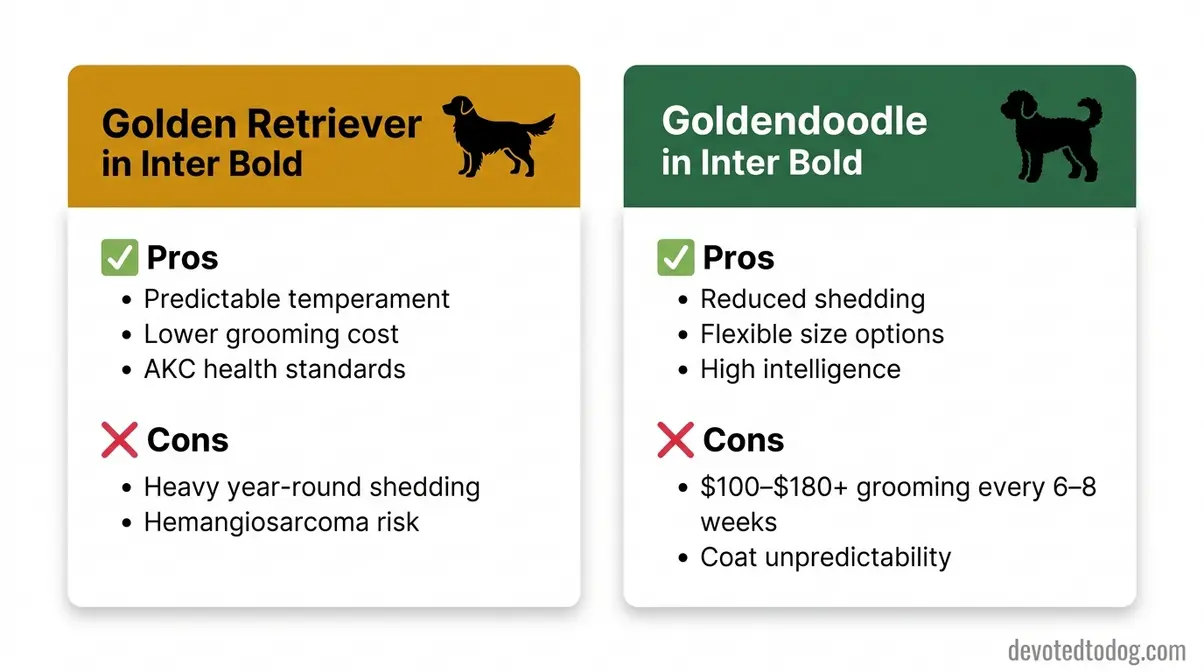
Pros:
- Highly predictable temperament and coat
- Lower professional grooming costs
- Excellent with children and families
Cons:
- Heavy year-round shedding
- Prone to specific genetic health risks like hemangiosarcoma
Real-World Usage:
In everyday life, a Golden Retriever thrives as a predictable, mellow family companion. After a morning walk, they are content to lounge indoors. Their forgiving nature makes them ideal for first-time owners learning the ropes of dog training, though owners must be prepared for daily vacuuming to manage the constant shedding.
Now let’s look at what a Goldendoodle actually is , and why “designer hybrid” changes everything.
What Is a Goldendoodle?
The Goldendoodle, a designer hybrid cross between a Golden Retriever and a Poodle, developed in the 1990s as a larger alternative to the Labradoodle. Unlike the Golden Retriever, “Goldendoodle” is not a standardized breed , no official breed standard exists, which means size, coat, and temperament vary significantly between individual dogs and generations (F1 vs. F2, explained below).
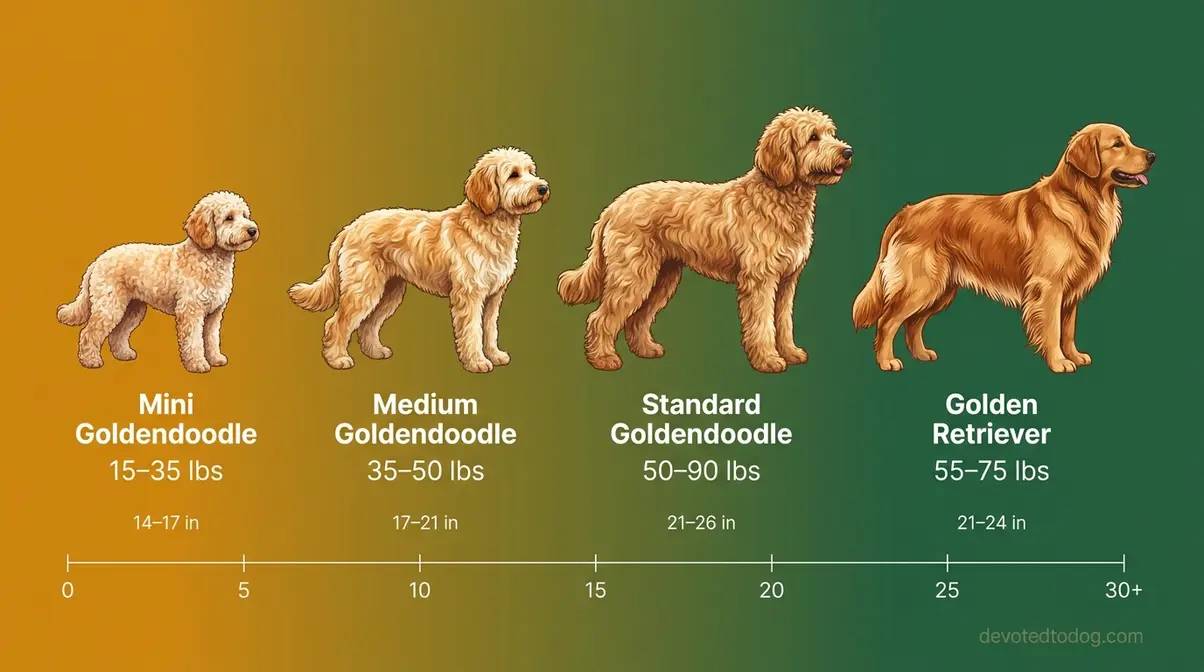
One appealing feature is “hybrid vigor” (the tendency for first-generation mixed breeds to be healthier than either parent breed) , but it is not guaranteed and depends heavily on the quality of the parent dogs. Size variation alone illustrates the unpredictability: a Standard Goldendoodle can weigh 50–90 lbs, a Medium 35–50 lbs, and a Mini Goldendoodle just 15–35 lbs. A Golden Retriever simply doesn’t have that range , you know roughly what you’re getting.
Pros:
- Significantly reduced shedding (depending on coat type)
- High intelligence makes for quick learning
- Flexible size options (Mini, Medium, Standard)
Cons:
- High professional grooming costs every 6-8 weeks
- Unpredictable temperament and coat due to hybrid genetics
Real-World Usage:
A Goldendoodle fits best in an active household willing to provide 60-90 minutes of daily mental and physical stimulation. They excel at agility and puzzle games. Owners must commit to a strict brushing routine at home and regular salon visits to prevent painful matting, making them a higher-maintenance option financially and physically.
With both breeds introduced, here’s the side-by-side comparison that answers the question most owners have first.
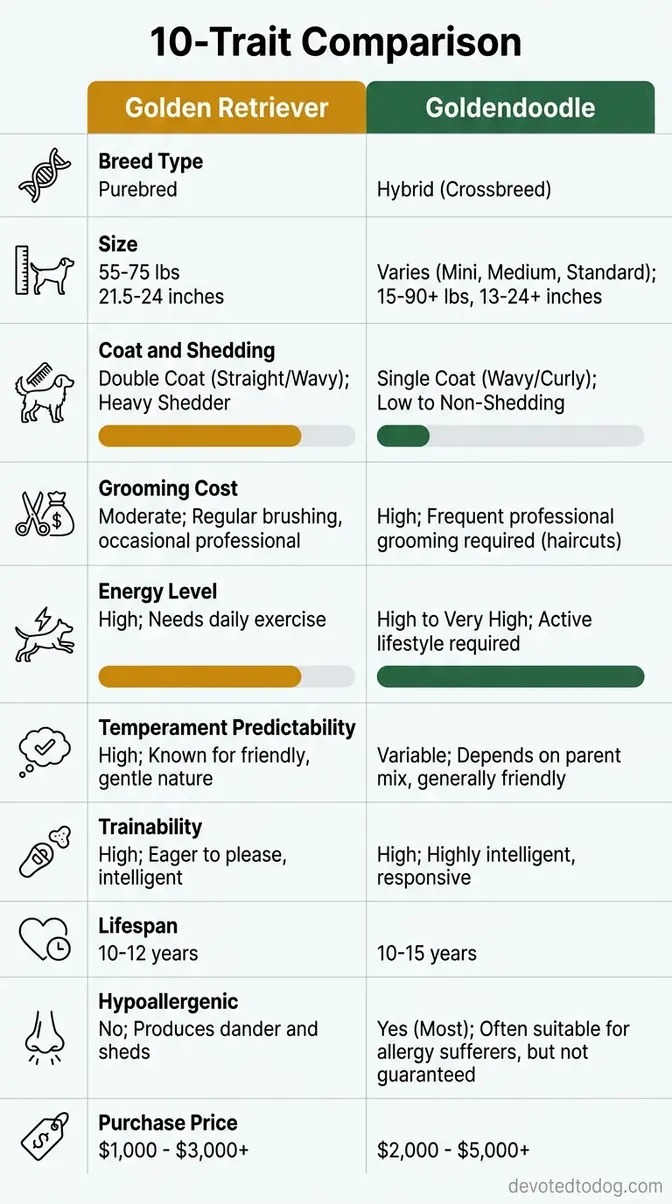
10 Key Differences: Comparison
The table below is the clearest way to see The Predictability Premium in action. These are the 10 traits that matter most to prospective owners.
| Trait | Golden Retriever | Goldendoodle |
|---|---|---|
| Breed Type | Purebred (AKC-recognized) | Designer hybrid (no breed standard) |
| Size | Medium-large: 55–75 lbs | Mini: 15–35 lbs / Medium: 35–50 lbs / Standard: 50–90 lbs |
| Coat & Shedding | Dense double coat; sheds heavily year-round | Wavy, curly, or flat; shedding varies by coat type |
| Grooming Cost | $55–$130/session (Bark.com, 2026) | $100–$180+/session (Bark.com, 2026) |
| Energy Level | Active (1–2 hrs/day); calms indoors | High energy; needs 60–90 min+ daily activity |
| Temperament Predictability | High (150+ years of selective breeding) | Variable (depends on dominant parent genes) |
| Trainability | Excellent , top 5 most obedient breeds (AKC) | Excellent , inherits Poodle intelligence |
| Lifespan | 10–12 years | 10–15 years |
| Hypoallergenic | No | Partially (low-shedding coats only; not allergy-free) |
| Purchase Price (reputable breeder) | $1,800–$3,000 (GoodDog.com, 2026) | $1,500–$5,000 (Insurify, 2026) |
The table makes the trade-off clear , this is The Predictability Premium in action. The temperament, coat, and cost columns tell the whole story.
The table gives you the overview. Now let’s go deeper on the factor that surprises most new owners: temperament.
Temperament and Behavior

In the golden retriever vs goldendoodle temperament comparison, the Golden Retriever offers more consistency. It is a breed-true sporting dog with a famously mellow, people-oriented personality, while the Goldendoodle’s temperament depends on which parent , the calm Golden or the high-drive Poodle , has more genetic influence. This variability is why experienced dog owners on forums consistently note that Doodles can seem “a little neurotic,” especially when their mental stimulation needs aren’t met. For a first-time dog owner, that unpredictability can make the difference between a joyful companion and an overwhelmed household.
Golden Retriever’s Mellow Temperament
The Golden Retriever’s core traits , gentle, patient, eager-to-please, and highly tolerant of children and other pets , are “breed-true.” That means 150+ years of selective breeding have made these qualities consistent across individual dogs in a way that a hybrid breed simply cannot replicate. Breeders and the AKC consistently describe the Golden’s temperament as one of its defining characteristics, and common Golden Retriever behavior challenges are generally milder than those of higher-drive breeds.
For beginners, energy level context matters. Goldens are active dogs that need 1–2 hours of daily exercise, but they have a genuine “off switch” at home. They are not hyperactive indoors. A realistic day looks like this: a morning walk, a calm afternoon on the couch, and an evening fetch session in the yard. That rhythm is achievable for most families. Their forgiving nature also means that early training mistakes , the inevitable ones every first-time owner makes , rarely cause lasting behavioral problems.
The Goldendoodle’s story is more complicated , and for some owners, more surprising.
Goldendoodle’s High Energy Traits
“Doodles are often more difficult than Retrievers in temperament too. As of recently many doodles seem a little neurotic.”
, r/dogs community member
This sentiment appears repeatedly across Golden Retriever forums and Reddit communities, and it points to a real behavioral pattern. The reason isn’t a flaw in the breed , it’s an unmet need. The Poodle, the Goldendoodle’s other parent breed, is known for its high intelligence and working drive. When that intelligence goes under-stimulated, it manifests as anxiety, destructive behavior, or hyperactivity. A Goldendoodle that doesn’t get 60–90 minutes of daily activity and regular mental enrichment may find its own entertainment , usually in ways you won’t enjoy.
The rehoming data reinforces this. Goldendoodles are among the most-rehomed designer breeds, often because owners chose them for their appearance without researching the Poodle parent’s demands. That’s not the dog’s fault. It’s a lifestyle mismatch. Understanding Goldendoodle intelligence and what it requires before you commit is one of the most important steps a prospective Doodle owner can take.
It’s equally important to note that individual dogs vary significantly. Many Doodles are calm, well-adjusted, and a perfect fit for active families. Temperament depends heavily on the specific parent dogs and the quality of early socialization.
Despite temperament variability, both breeds share one impressive trait: they are among the easiest dogs to train.
Trainability and Intelligence
Both the Golden Retriever and the Goldendoodle rank among the most trainable dog breeds. The Golden was bred specifically to work closely alongside humans , that cooperative instinct is baked into the breed’s DNA. The Poodle, the Doodle’s other parent, is widely considered one of the top two most intelligent dog breeds, making most Goldendoodles remarkably quick learners as well. Both breeds outperform the average, comparable to the Labrador Retriever’s trainability , making all three excellent choices for first-time owners.
The practical implication: both breeds respond well to positive reinforcement from day one. Basic commands like sit, stay, and come can be introduced at 8 weeks. The Goldendoodle’s intelligence is a genuine asset in training , but it is a double-edged sword. Smart dogs need mental stimulation, or they find their own (often destructive) entertainment. Puzzle feeders, scent games, and obedience sessions are not optional for a Doodle; they are essential.
Temperament is just one part of the decision. The physical differences , especially around coats and grooming , may be even more important to your daily life.
Size, Coat, and Grooming Costs

The biggest physical difference between a Golden Retriever and a Goldendoodle is not just appearance , it’s the ongoing grooming cost. Professional grooming for a Goldendoodle runs $100–$180+ per session versus $55–$130 for a Golden Retriever (Bark.com, 2026) , and that difference compounds significantly over the course of a year. The reason Goldendoodles cost more to groom comes down to genetics: their curly or wavy coats mat easily without regular brushing and professional trimming every 6–8 weeks. For budget-conscious owners, this difference can add up to hundreds of dollars per year , the financial face of The Predictability Premium.
Golden Retriever Size and Coat
Golden Retrievers are a medium-to-large breed with very consistent sizing: females typically 55–65 lbs, males 65–75 lbs, standing 21–24 inches at the shoulder. Their coat is a dense double coat , meaning a soft undercoat for insulation sits beneath a longer outer coat , and it sheds moderately year-round with two heavy “coat blowing” seasons in spring and fall.
Grooming reality for Goldens: plan on brushing 2–3 times per week to manage shedding, and professional grooming every 8–12 weeks. That’s less frequent (and less expensive) than a Doodle. However, the shedding inside your home is significant and unavoidable. No grooming routine eliminates Golden Retriever shedding , golden fur on furniture and clothing is simply a fact of life with this breed. Understanding the full range of different Goldendoodle coat types explained is helpful context before deciding which coat profile you prefer to live with.
Now for the more complex side of the equation: Goldendoodle sizes and coats.
Goldendoodle Sizes and Coat Types
Goldendoodle sizes depend on which Poodle was used in the cross. A toy or miniature Poodle produces a Mini Goldendoodle (15–35 lbs); a medium Poodle produces a Medium (35–50 lbs); a standard Poodle produces a Standard Goldendoodle (50–90 lbs). For the “mini golden retriever vs goldendoodle” searcher: there is no official “Mini Golden Retriever” breed , it is typically a marketing term for a smaller mixed dog, while the Mini Goldendoodle is a recognized hybrid size. For full details on how big Goldendoodles get by generation, size varies more than most buyers expect.
Coat types fall into three main categories: curly (most like a Poodle, lowest shedding), wavy (most common, moderate shedding), and straight/flat coat (most like a Golden, sheds considerably). A flat-coat Goldendoodle can shed almost as much as a purebred Golden Retriever.
This is where F1 vs. F2 generation matters enormously. An F1 Goldendoodle (first-generation cross between a purebred Golden Retriever and a purebred Poodle) generally has more predictable coat outcomes. An F2 Goldendoodle (second-generation cross between two F1 Goldendoodles) introduces more genetic variability , recessive genes from both original breeds can reappear, producing puppies with widely different coats within the same litter.
The key mechanism is the furnishings gene (the dominant genetic trait that produces the signature doodle facial hair and curly, low-shedding coat). According to the UC Davis Veterinary Genetics Laboratory, the presence of furnishings is dictated by a dominant gene , but F2 Goldendoodles can inherit two copies of the recessive “improper coat” gene, resulting in a flat, shedding coat (UC Davis VGL, 2026). In plain terms: The “furnishings” gene , which dictates whether a Goldendoodle has a curly, low-shedding coat , is dominant but not guaranteed, meaning F2 Goldendoodles can unexpectedly shed as much as a Golden Retriever.
Is It Better to Get an F1 or F2 Dog?
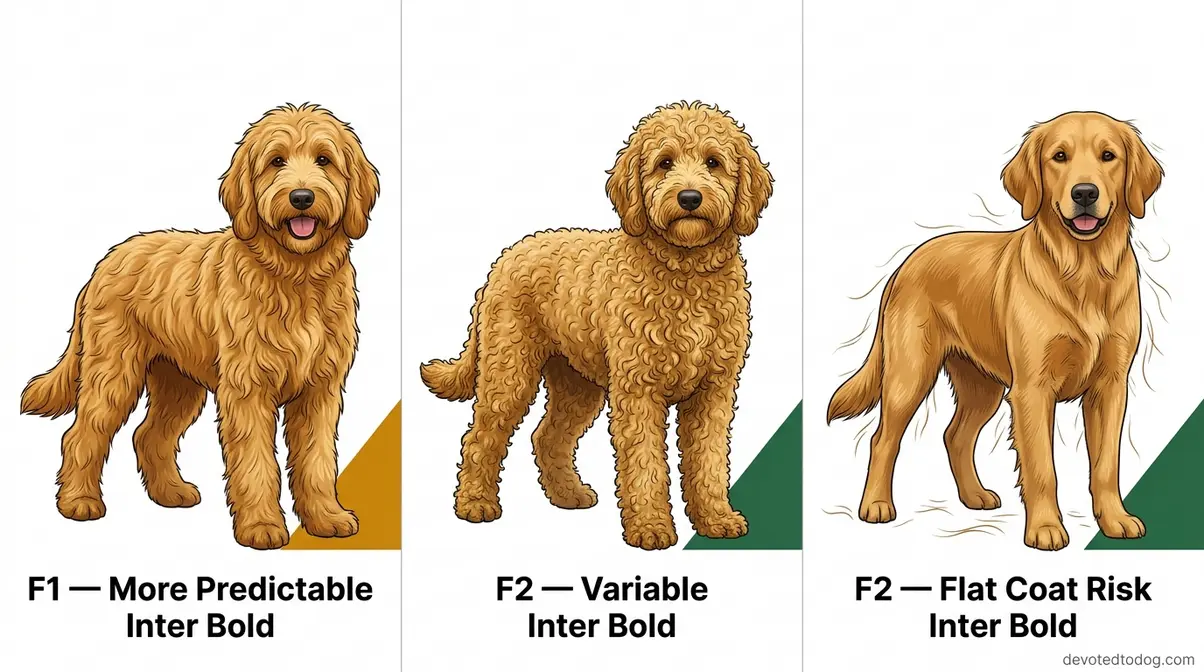
For most buyers, an F1 Goldendoodle (Golden Retriever × Poodle) is the more predictable choice. First-generation crosses benefit from hybrid vigor and typically have more consistent coat and temperament outcomes. F2 Goldendoodles (F1 × F1) introduce more genetic variability because recessive genes from both original breeds can reappear, meaning an F2 litter can produce puppies with widely different coats and temperaments within the same litter. UC Davis Veterinary Genetics Laboratory research on the “furnishings” gene confirms that F2 generations have a higher chance of expressing the improper (flat, shedding) coat. If predictability matters to you, F1 is the safer choice; F2 dogs can still make wonderful companions, but with more uncertainty.
Understanding coat type matters because it directly determines your grooming bill , and the numbers may surprise you.
Grooming Costs Compared
Here is what grooming actually costs for each breed in 2026, based on current industry data from Bark.com and Goldoodle.com.
| Cost Factor | Golden Retriever | Goldendoodle |
|---|---|---|
| Professional session cost | $55-$130 | $100-$180+ |
| Grooming frequency | Every 8-12 weeks | Every 6-8 weeks |
| Annual professional estimate | $300-$600 | $480-$1,440 |
| Home grooming savings potential | Moderate (de-shedding tools ~$30-$60) | High (~$500-$900/year after initial investment) |
Goldendoodle owners who learn to groom at home with a quality clipper set (initial cost: ~$150–$250) can save significantly , one documented approach found approximately $623 in annual savings by handling most grooming sessions at home (MoneyManagement.org). That said, home grooming a Doodle has a real learning curve. Done incorrectly, it can result in uneven cuts or missed matting. The alternative is painful: a coat that mats close to the skin within 8–12 weeks often requires a full shave under veterinary sedation , a cost and stress no owner wants.
Grooming prices vary by region and salon , these are 2026 estimates subject to change.
With physical traits covered, let’s move to the puppy phase , the period that shapes everything that follows.
Puppy Considerations in Year One

Both the Golden Retriever puppy and the Goldendoodle puppy are joyful, social, and eager to please from day one , but the Goldendoodle puppy’s higher energy and potential for anxiety means early socialization and mental stimulation are even more critical. The first 14 weeks of a puppy’s life are the most formative. According to UC Davis Veterinary Medicine research, the critical social development period for dogs runs from approximately 3 to 14 weeks , the window when puppies are most accepting of new experiences and form the neural pathways that shape their adult temperament (UC Davis Veterinary Medicine). How you spend those weeks determines the adult dog you end up with.
Golden Retriever Puppy Growth
Golden Retriever puppies are among the easiest puppies to train. They are eager to please, food-motivated, and respond well to positive reinforcement from day one. Basic commands , sit, stay, come , can be introduced as early as 8 weeks. Starting potty training your Golden Retriever puppy early pays dividends fast, because Goldens are genuinely motivated to get it right.
Shedding begins at approximately 6 months, when the puppy coat transitions to the adult double coat. Many owners are caught off guard by the volume of fur during this transition , it’s significant. Golden puppies are mouthy and energetic, but they are rarely aggressive. They need 30–60 minutes of age-appropriate exercise in short sessions (not long runs , their joints are still developing until 12–18 months). A Golden Retriever puppy at 10 weeks is already making eye contact and responding to their name , the breed’s desire to connect with humans starts remarkably early, and it never really stops.
Goldendoodle puppies share many of these traits , but with some important differences worth knowing before you bring one home.
Goldendoodle Puppy Traits
A goldendoodle golden retriever mix puppy is typically high-energy, curious, and intensely social , often even more so than a Golden puppy, inheriting the Poodle’s working drive. Structured play and short training sessions work better than free-roaming; an under-stimulated Doodle puppy will find its own projects.
Socialization is especially critical for Doodle puppies. Without positive exposure to different people, environments, sounds, and situations during that 3–14 week developmental window, Doodle puppies are more prone to developing anxiety-related behaviors in adulthood. This is not inevitable , it is preventable with intentional early socialization. Your new puppy checklist for your first 30 days should include socialization goals alongside feeding and crate training.
One practical note: a fluffy, curly puppy coat does not guarantee a curly adult coat, especially in F2 generations. Buyers who assume the puppy’s appearance predicts the adult coat are often surprised.
Finally, finding a reputable Goldendoodle breeder who health-tests parent dogs is harder than finding an AKC-registered Golden Retriever breeder. The Goldendoodle market has no breed registry to regulate breeders, which means a higher proportion of puppy mills and backyard breeders. A Doodle puppy priced at $500 online is almost certainly from an unethical source. Research breeders thoroughly and require OFA health certifications for parent dogs.
Now for the question that often determines the final decision: what does ownership actually cost?
Cost and Ownership: Full Financial Breakdown

The goldendoodle vs golden retriever price comparison surprises most buyers. Despite being a hybrid and not a purebred, Goldendoodles from reputable health-testing breeders often cost as much or more than Golden Retrievers. The price difference reflects demand and breeder practices, not genetic superiority. Understanding the full cost , purchase price plus lifetime grooming, food, and veterinary care , helps you budget realistically before committing. Labrador Retrievers are often cited as a lower-cost alternative to both breeds, particularly in grooming, which is worth noting if budget is a primary concern.
Purchase Price for Each Breed
Golden Retriever purchase prices from reputable AKC-registered breeders currently range from $1,800–$3,000, with some champion-line breeders reaching higher (GoodDog.com, 2026). Rescue adoption typically runs $50–$500. For your full Golden Retriever cost breakdown for 2026, the purchase price is just the beginning of the picture.
Goldendoodle purchase prices from reputable health-testing breeders range from $1,500–$5,000, with Mini Goldendoodles often commanding higher prices due to demand (Insurify, 2026). Goldendoodles are increasingly available through rescue and rehoming networks , a direct consequence of the high rehoming rates discussed earlier.
The ethical breeding warning deserves emphasis. The Goldendoodle market has a higher proportion of puppy mills and backyard breeders than the AKC-registered Golden Retriever market, because no breed registry exists to regulate Doodle breeders. A $500 Doodle puppy from a pet store or online listing carries significant health and behavioral risk , the savings upfront often become expensive veterinary bills later.
Prices are 2026 estimates and vary by region, breeder, and lineage. Always verify current pricing directly with breeders.
The purchase price is just the beginning. Here’s what annual ownership actually costs for each breed.
Annual Costs: Food, Vet, Grooming
| Annual Cost Category | Golden Retriever | Goldendoodle |
|---|---|---|
| Food (monthly ~$60-$90) | $720-$1,080/year | $720-$1,080/year |
| Routine veterinary care | $300-$600/year | $300-$600/year |
| Professional grooming | $300-$600/year | $480-$1,440/year |
| Supplies & accessories | $200-$400/year | $200-$400/year |
| Total annual estimate | $1,520-$2,680/year | $1,700-$3,520/year |
The grooming cost differential is the biggest annual difference between the two breeds. Goldendoodle owners using professional grooming year-round spend $480–$1,440 annually vs. $300–$600 for Golden Retriever owners (Goldoodle.com, 2026) , a gap of $180–$840 per year. Veterinary costs may be comparable or slightly lower for Goldendoodles if hybrid vigor reduces some genetic health issues, but this is not guaranteed and depends heavily on parent dog quality.
Owners willing to invest time in home grooming can reduce the Doodle’s annual cost significantly. A quality clipper set (~$150–$250 upfront) pays for itself within the first year. But the learning curve is real , plan on watching tutorials and practicing before attempting a full groom.
Before making your final decision, there’s one more comparison worth considering , especially if you’re also weighing a Labrador Retriever.
Golden Retriever vs. Labrador
When comparing golden retriever vs labrador temperament, the differences are subtle. Both are friendly, trainable, and family-oriented. Labs tend to be slightly higher energy and more mouthy as puppies, while Goldens are generally gentler and more patient. The more important comparison for prospective Golden owners, however, is health , specifically, a cancer risk that is rarely discussed outside veterinary circles. This section also addresses the keyword cluster many readers search alongside the golden vs doodle debate.
How Labs and Goldens Differ
The Labrador Retriever, the most popular dog breed in the United States and the Golden Retriever’s closest rival for family pet of choice, comes in three colors (yellow, black, chocolate) versus the Golden’s signature coat. Labs are slightly stockier and more mouthy as puppies; Goldens tend to be gentler and more patient with very young children. Size is similar: Goldens weigh 55–75 lbs; Labs run 55–80 lbs. For a detailed Golden Retriever vs. Labrador Retriever comparison, the golden retriever vs labrador size difference is minimal , both are true medium-to-large breeds.
Both breeds are excellent for first-time owners. The choice between them often comes down to coat preference (Labs shed but have a shorter, easier-to-maintain coat) and personal affinity. Neither requires the intensive grooming that a Goldendoodle demands.
The temperament comparison between Goldens and Labs is fairly close. The health comparison is where things get serious.
The Golden Retriever Silent Killer
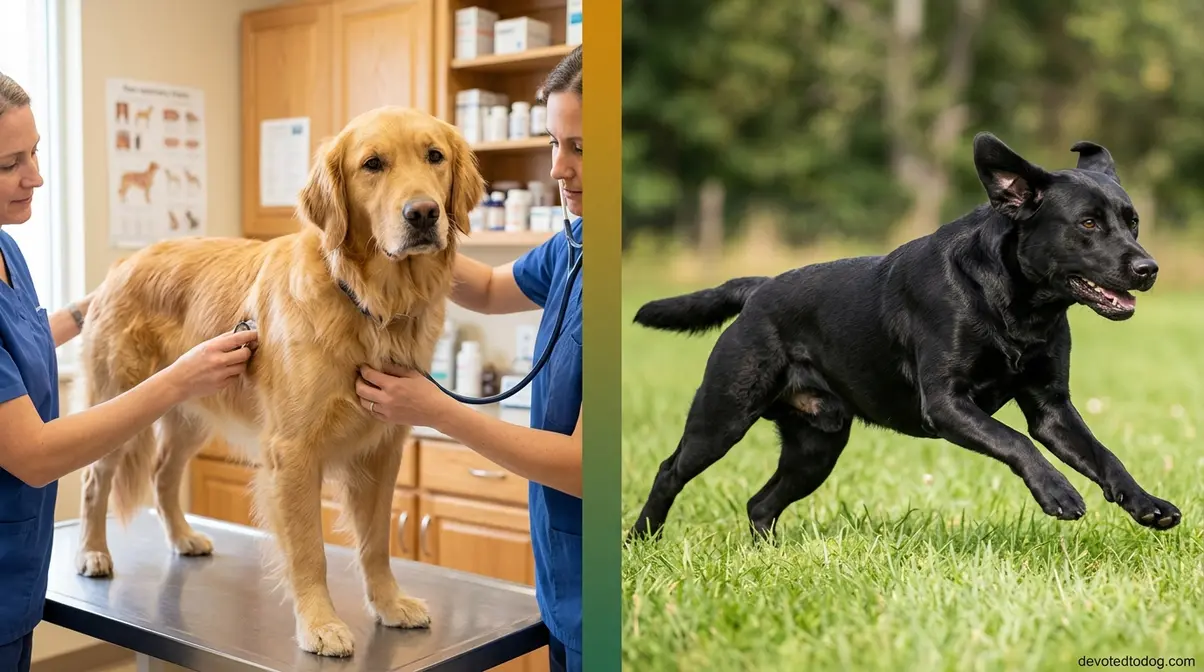
Hemangiosarcoma (HSA) , an aggressive cancer of the blood vessel walls , is called the “silent killer” in Golden Retrievers because it typically causes no visible symptoms until it ruptures, often triggering a fatal internal bleed with no warning. This is not a rare edge case. An estimated 1 in 5 Golden Retrievers will develop hemangiosarcoma during their lifetime , a statistic that makes regular veterinary screening and responsible breeding practices non-negotiable for Golden owners (Cornell Baker Institute Annual Report, 2021).
The incidence data is sobering. A longitudinal study on hemangiosarcoma incidence follows more than 3,000 Golden Retrievers and lists hemangiosarcoma as one of its primary outcomes (Hillman et al., Veterinary and Comparative Oncology, 2023). University of Florida veterinary oncology research reports that only 10% of diagnosed dogs survive beyond one year (UF College of Veterinary Medicine, 2025). That prognosis is one of the most important facts any prospective Golden owner should understand before committing. For a full overview of Golden Retriever health issues and warning signs, hemangiosarcoma is the risk that demands the most attention.
There is also an important neutering consideration. UC Davis research on neutering and cancer risks found that the age at which a Golden Retriever is neutered significantly affects both cancer risk and joint disease outcomes (UC Davis School of Veterinary Medicine). Discuss the timing with your veterinarian before making that decision.
Goldendoodles are not immune to cancer, but their hybrid genetics means they do not carry the same breed-specific hemangiosarcoma predisposition that affects the Golden Retriever parent in the golden retriever vs goldendoodle comparison.
This information is provided for awareness, not diagnosis. Regular veterinary check-ups are the most effective tool for early detection.
With health risks understood, here’s a quick summary of which retriever best fits different home environments.
Which Retriever Fits Your Lifestyle?
Golden Retriever is the best choice for families prioritizing gentleness, patience with young children, and a highly predictable temperament. It requires commitment to shedding management and proactive veterinary monitoring for health issues, including hemangiosarcoma.
Labrador Retriever suits active households who want similar trainability with slightly more athleticism and a shorter, lower-maintenance coat. The lab vs golden retriever pros and cons are genuinely close , it often comes down to coat color preference and energy tolerance.
Now for the central question: between a Golden Retriever and a Goldendoodle specifically, which breed is right for you?
Which Breed Is Right for You?

The right choice in the golden retriever vs goldendoodle decision depends entirely on your lifestyle , not which breed is objectively “better.” Both are loving, trainable, and wonderful family dogs. The question is which trade-off you’re equipped to handle.
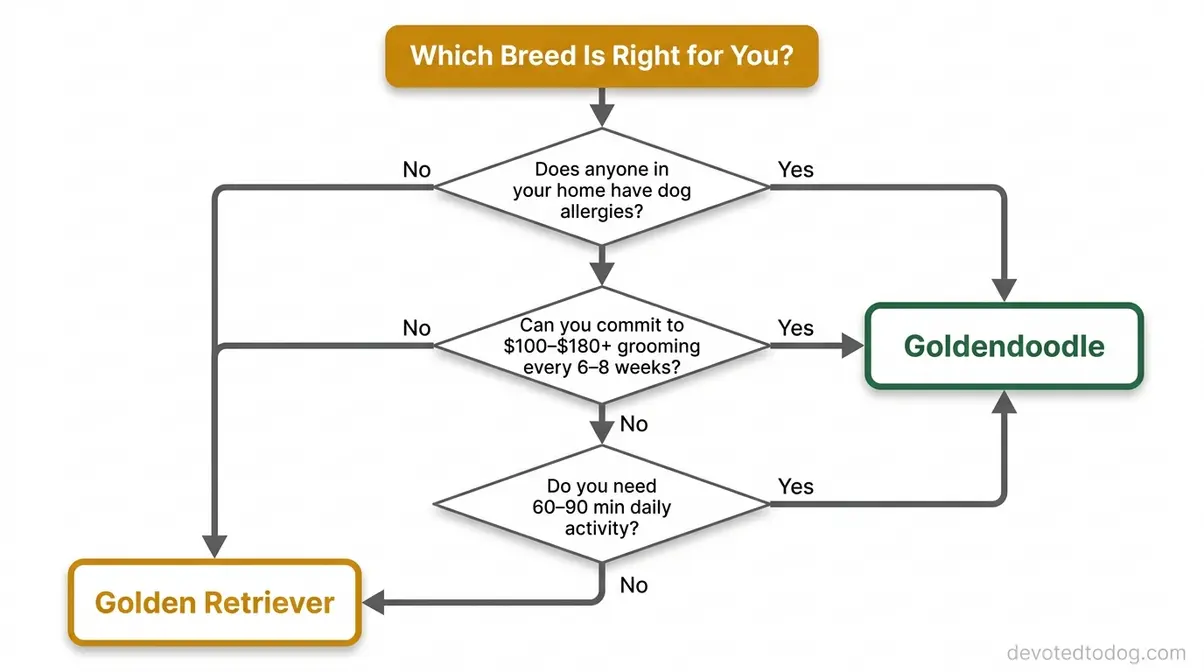
- Choose if:
- Allergies are not a concern in your household
- You prefer a highly predictable temperament and coat
- You can manage regular vacuuming and brushing 2–3 times per week
- You want lower professional grooming costs ($55–$130/session)
- You value the health testing standards that come with AKC-registered breeders
- You want a mellow, gentle dog that’s forgiving of first-time owner mistakes
- Choose if:
- Someone in your household has mild dog allergies (and you’ve confirmed a low-shedding coat type)
- You strongly prefer reduced shedding in your home
- You’re willing to invest $480–$1,440 per year in professional grooming , or commit to learning home grooming
- You want a size-flexible option (Mini, Medium, or Standard)
- You can provide 60–90 minutes of daily activity and regular mental enrichment
- You’re prepared to research breeders carefully and verify OFA health certifications
Consider neither breed if:
Severe dog allergies exist in your household , no dog is truly 100% hypoallergenic, and dander (the actual allergen, not fur) is present in all breeds. A Poodle is a better starting point for serious allergy sufferers. Similarly, if your lifestyle demands a genuinely low-maintenance pet, both breeds require significant daily attention, exercise, and grooming that may not be compatible with a very demanding schedule.
The Predictability Premium applies to both choices: Goldens charge it in fur; Doodles charge it in dollars. Knowing which cost you’re more willing to absorb is the only question that truly matters.
Common Mistakes to Avoid
Most regrettable dog purchases share a common thread: the owner researched the breed’s appearance but not its actual ownership demands. These are the three mistakes that lead to the most heartbreak , and how to avoid them.
3 Most Common Mistakes
Mistake 1: Assuming “hypoallergenic” means allergy-free. A family with mild dog allergies chooses a Goldendoodle, expecting zero allergen exposure. What actually happens: dander , the real allergen, not fur , is still present in all dogs, including Doodles. Many allergy sufferers still react to Goldendoodles, especially to flat-coat or wavy-coat individuals. How to avoid it: spend at least 30–60 minutes with the specific dog you’re considering before committing, and consult an allergist about your specific sensitivities.
Mistake 2: Underestimating Goldendoodle grooming commitment. An owner skips professional grooming to save money, brushing occasionally but not consistently. What happens: the coat mats painfully close to the skin within 8–12 weeks. Severe matting often requires a full shave under veterinary sedation , adding cost and significant stress for the dog. How to avoid it: budget for professional grooming from day one, or commit to learning home grooming before you bring the dog home. There is no middle ground with a Doodle coat.
Mistake 3: Choosing a Goldendoodle based on looks, not breeder quality. An owner buys a “cheap Doodle” from a pet store or a social media listing. What happens: no health testing was performed on parent dogs, which means higher risk of genetic health issues, unpredictable temperament, and behavioral problems that are expensive and emotionally exhausting to address. How to avoid it: require OFA health certifications for both parent dogs. If a breeder can’t provide them, walk away.
Individual dog temperaments can vary significantly regardless of breed. The tendencies described in this article reflect breed-level patterns, not guarantees for any individual dog.
When to Consider Other Breeds
Two scenarios exist where neither a Golden Retriever nor a Goldendoodle is the right answer.
Severe dog allergies. If anyone in your household has a diagnosed severe dog allergy, neither breed is appropriate. A purebred Poodle , the Doodle’s parent breed , is the better starting point. Poodles produce less dander and are more consistently low-shedding than any Goldendoodle generation. Consult your allergist before choosing any breed.
Truly low-maintenance pet preference. Both Golden Retrievers and Goldendoodles require significant daily attention, exercise, and grooming. Neither breed does well with long hours alone or minimal engagement. If your lifestyle calls for a more independent dog, consider breeds with lower social needs , a Basenji or a Shiba Inu, for example. Choosing a high-social-need breed for a low-engagement lifestyle sets both owner and dog up for frustration.
What is a Goldendoodle and Golden Retriever mix?
The “Goldendoodle and Golden Retriever mix” or “doodle and Golden Retriever mix” describes the original Goldendoodle itself: a cross between a Golden Retriever and a Poodle. Some breeders also offer F1B or F2 Goldendoodles bred back to a purebred Golden Retriever (a Goldendoodle bred with a Golden Retriever), producing puppies that are 75% Golden + 25% Poodle. These Golden Retriever Goldendoodle puppies typically have straighter coats and shed slightly more than F1 Goldendoodles, while keeping the friendly retriever temperament. If you see “goldendoodle and golden retriever mix for sale” listings, ask the breeder to clarify whether the dam or sire is the purebred Golden.
Are Goldendoodle and Golden Retriever the same breed?
No. The Golden Retriever is an AKC-recognized purebred (recognized 1925), while the Goldendoodle is a hybrid crossbreed not recognized by any major kennel club. Their coats, shedding, and care needs differ significantly. Golden Retriever doodle puppies (any percentage) inherit the Goldendoodle’s variable coat genetics, so two puppies from the same litter can have very different shedding levels. The Golden Retriever and Goldendoodle share genetic ancestry on the Golden side but diverge entirely on the Poodle side, making them legally and biologically distinct.
Do Golden Retriever Goldendoodle puppies shed?
It depends. F1 Goldendoodles (50% Golden / 50% Poodle) shed less than purebred Goldens but more than purebred Poodles. F1B Goldendoodles (75% Poodle) shed least. Golden Retriever doodle puppies bred from F2 or F3 generations (75% Golden / 25% Poodle) shed nearly as much as a purebred Golden. So if a breeder says “Goldendoodle and Golden Retriever mix” with the cross being golden-heavy, expect coat shedding closer to purebred Golden levels. Always ask: what percentage Poodle is in the cross? That number predicts shedding more reliably than any breeder claim.
Is a Golden Retriever or Goldendoodle right for me?
Choose a Golden Retriever if you: want predictable adult size (55-75 lbs), don’t mind heavy shedding, prefer the AKC standard temperament, and are budget-conscious ($1,500-$3,500 from reputable breeders). Choose a Goldendoodle if you: need a low-shedding hypoallergenic coat, want a smaller (Toy/Mini) or larger size variant, are willing to pay $2,000-$5,000+, and value hybrid vigor (lower cancer rate). The Golden Retriever and Goldendoodle have similar friendly temperaments, but their physical care requirements differ enough to make this a meaningful decision.
This article is general information, not veterinary advice. If your dog shows any of the signs above, or you have questions about your dog’s health, talk to your veterinarian.
Frequently Asked Questions
Why Are So Many Doodles Being Rehomed?
Goldendoodles are rehomed at high rates primarily because owners underestimate their energy, mental stimulation needs, and grooming requirements. Many buyers choose Doodles for their appearance without researching the Poodle parent’s high-drive temperament, which requires significant daily exercise to prevent anxiety. Furthermore, professional grooming costs of $100-$180+ per session often surprise owners, adding financial strain on top of behavioral challenges.
Which Is the Calmest Doodle Breed?
Among doodle breeds, the Bernedoodle (Bernese Mountain Dog × Poodle) is widely considered the calmest and most gentle, inheriting the Bernese Mountain Dog’s famously laid-back temperament. Goldendoodles tend toward higher energy than Bernedoodles, inheriting the Poodle’s working drive alongside the Golden Retriever’s playfulness. This specific combination requires more daily exercise and mental stimulation to stay balanced. Within the Goldendoodle category, F1B Goldendoodles (75% Poodle) sometimes display calmer, more predictable temperaments than standard F1 crosses. Ultimately, individual temperament always depends on the specific parent dogs and early socialization, so meeting the puppy’s parents is highly recommended.
What Smells Do Golden Retrievers Hate?
Golden Retrievers have highly sensitive noses and are particularly averse to strong citrus scents (lemon, orange, grapefruit), vinegar, and certain essential oils like eucalyptus and tea tree. These scents overwhelm their powerful olfactory system, which contains up to 300 million scent receptors compared to a human’s roughly 6 million. Because of this sensitivity, many owners use diluted citrus-based sprays as a humane deterrent to keep Goldens away from furniture. However, always avoid essential oils like tea tree or eucalyptus around dogs, as several are highly toxic when absorbed.
What Is Golden Retriever Syndrome?
“Golden Retriever Syndrome” is an informal term describing the overly trusting, excessively friendly behavior that makes Golden Retrievers approach strangers with immediate enthusiasm and zero suspicion. While this makes them wonderful family companions, it also means they make poor guard dogs and can be vulnerable to theft. This trait is a feature, not a flaw, reflecting centuries of selective breeding for cooperative, human-oriented work.
How Do You Say “I Love You” in Dog Speak?
Dogs communicate love through slow eye contact, a deliberate, soft gaze directed at you releases oxytocin in both the dog and the human. This is widely considered a form of “I love you” in canine body language. Other affection signals include leaning their body weight against you, bringing a toy as a gift offering, and the full-body “wiggle” greeting when you return home. Golden Retrievers and Goldendoodles are both highly expressive breeds, making them particularly demonstrative with these signals. Returning a slow blink and soft gaze back to your dog reinforces the bond and communicates calm security.
What Is the Most Untrainable Dog Breed?
The Afghan Hound is widely cited by obedience trainers as one of the most challenging breeds to train, followed by the Chow Chow, Basenji, and Bulldog. These breeds were developed for independent work rather than cooperative tasks, making traditional reward-based obedience less effective. By contrast, Golden Retrievers and Goldendoodles both rank among the top five most trainable breeds, making them an excellent contrast for first-time owners. “Untrainable” is rarely accurate; most dogs can learn with the right trainer, but some breeds simply require more patience.
Making Your Decision: The Final Word
Prices and grooming costs verified as of July 2026. Individual figures vary by region and breeder.
For families choosing between a golden retriever vs goldendoodle, the decision comes down to one core trade-off: the Golden Retriever’s predictable temperament and manageable grooming costs ($55–$130/session) versus the Goldendoodle’s reduced shedding and higher grooming investment ($100–$180+/session) (Bark.com, 2026). Neither breed is objectively better , both are loving, trainable, and excellent family companions. The right choice is the one that fits your lifestyle, budget, and allergy situation. At devotedtodog.com, our evaluation found that most first-time owners underestimate grooming costs and overestimate the “hypoallergenic” benefit , which is why transparent financial data matters more than breeder marketing.
The Predictability Premium is the framework that makes this decision clear. Every owner pays it , either in fur management or in grooming bills. Understanding which cost you’re more willing to absorb, and which lifestyle fits your household, is the only question that truly matters. The Golden charges its premium in golden fur on your sofa; the Doodle charges it on your credit card at the grooming salon.
Start by reading our complete full Golden Retriever cost breakdown for 2026 to understand the full financial picture, then use our new puppy checklist for your first 30 days to prepare your home before your dog arrives. If you’re still undecided, spending time with both breeds at a local shelter or breed-specific rescue is the most reliable way to know which dog is genuinely right for you , no article can replace that experience.
Related reading: