
You’ve already fallen for the breed — the question isn’t whether to get a Golden Retriever, it’s how to choose a golden retriever puppy who’s the right match for your home and your life. Most first-time buyers walk into a breeder’s home with good intentions and walk out overwhelmed, second-guessing their choice for weeks.
The cost of choosing wrong is real: a temperament mismatch that surfaces at 18 months, an unethical breeder who disappears after the sale, or genetic health conditions that don’t show up until your dog is three years old. None of these outcomes are inevitable — but they’re common when the selection process runs on gut feeling alone.
This guide gives you a step-by-step framework — from vetting breeders before you ever see a pup from a litter to evaluating individual puppies using observable criteria — so you can choose with confidence, not guesswork. You’ll work through four stages: breeder verification, litter assessment, type and trait evaluation, and long-term planning.
Time Required: 2-4 weeks (Research, Vetting, and Visits)
- What You Need:
- Green Flag / Red Flag Breeder Checklist
- Volhard Temperament Test printout
- Access to the OFA public database
Key Takeaways: How to Choose a Golden Retriever Puppy
Choosing the right Golden Retriever puppy starts before you visit the litter — verifying health clearances and breeder ethics are the highest-impact decisions you’ll make.
- Use the Green Flag / Red Flag Framework to evaluate breeders and individual puppies against observable checkpoints, not gut feelings alone
- Health clearances matter most: Verify OFA hip, elbow, cardiac, and CAER eye certifications before committing to any litter
- The “middle puppy” principle: Avoid the first to rush you and the one that lags behind — confident, curious, and calm is the target temperament
- Temperament is observable: Simple Volhard-style tests during your visit reveal dominance, sociability, and noise sensitivity in under 10 minutes
- Socialization timing is critical: Puppies have a sensitive development window between 3 and 14 weeks — choose a breeder who actively uses this period
Step 1: Vet Breeders & Health Clearances

Choosing a reputable breeder is the single most important step in how to choose a good golden retriever puppy. Puppy mills and backyard breeders produce puppies with unpredictable temperaments and undetected genetic health conditions that don’t surface until years after you’ve fallen in love with your dog. The Green Flag / Red Flag Framework — a binary checklist that converts every breeder interaction into an observable pass/fail checkpoint — makes this evaluation systematic rather than stressful.
Golden Retriever breeders participating in the OFA’s CHIC program commit to public health screening protocols that have significantly lowered rates of hip and elbow dysplasia in the breed (OFA CHIC health screening protocols). That’s the standard you’re looking for. Everything in this section is designed to help you verify whether a breeder actually meets it.
Green Flag / Red Flag Breeder Framework
Understanding puppy personalities starts before you ever meet the puppies — it starts the moment you first speak with the breeder. A reputable breeder’s behavior is itself a series of observable signals. The Green Flag / Red Flag Framework turns those signals into a pass/fail checklist you can work through in a single phone call or email exchange.
Green Flag vs. Red Flag: Golden Retriever Breeder Checklist
| Observable Behavior | Green Flag ✅ | Red Flag 🚩 |
|---|---|---|
| Breeder asks about your lifestyle | Yes — screens buyers carefully | No — just wants the sale |
| Puppies available immediately | No — has a waitlist | Yes — multiple litters ready now |
| Can you meet the mother? | Yes — in person, on-site | No — or “she’s not available” |
| Multiple breeds available | No — specializes in Goldens | Yes — 4+ breeds listed |
| Written health guarantee | Yes — minimum 2 years genetic | No guarantee or verbal only |
| Take-back clause in contract | Yes — will accept dog if needed | No — “all sales final” |
| Offers to “meet in a parking lot” | Never | Yes — avoids home visits |
| Pressures you to decide quickly | Never | Yes — “only one puppy left” |
| AKC papers presented as proof of quality | No — explains pedigree distinction | Yes — “AKC registered” is the only credential offered |
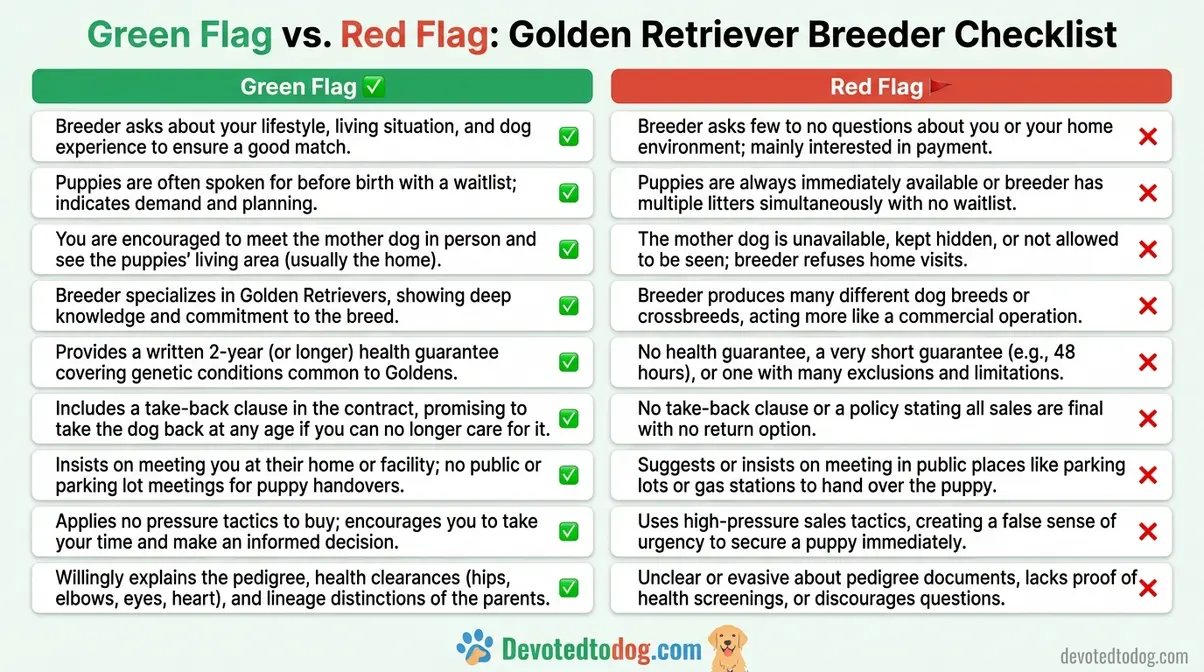
One important distinction worth understanding: AKC registration papers are a record of lineage, not a measure of quality. A quality pedigree means a history of health-tested, titled ancestors. Breeders who lead with “AKC registered!” as their primary credential without mentioning health clearances are a Yellow Flag, at minimum. According to the Golden Retriever Club of America (GRCA), the national breed club and authoritative voice on breed standards, ethical breeders are expected to perform specific health screenings before breeding — registration alone satisfies none of those requirements.
For a deeper look at vetting breeders before you even call them, see our guide on how to find a reputable Golden Retriever breeder.
Once you’ve confirmed the breeder passes the Green Flag checklist, the next step is verifying the specific health clearances that protect your future Golden Retriever from the breed’s most common genetic conditions.
Required Golden Health Checks
One of the most reliable ways to choose a good golden retriever puppy is to start with the parents’ verified health records — not the breeder’s word about them, but the actual public database entries. The Orthopedic Foundation for Animals (OFA), the leading canine health registry, maintains a searchable public database where any buyer can verify a dog’s clearances in minutes.
Four clearances are non-negotiable for Golden Retriever breeding dogs. The first is the OFA Hip Evaluation, which screens for hip dysplasia using X-ray evaluation. Acceptable ratings are Excellent, Good, or Fair. A rating of Borderline or worse is a Red Flag for that breeding dog, and dogs must be at least 24 months old for final certification.
The second requirement is the OFA Elbow Evaluation. This screens for elbow dysplasia, another common heritable condition in the breed. It also requires the dog to be 24+ months for final certification. Preliminary evaluations under 24 months are allowed but don’t count toward CHIC certification.
Third is the OFA Cardiac Exam. Performed by a board-certified cardiologist, this exam screens for subvalvular aortic stenosis (SAS), a serious congenital heart condition. A standard vet exam is not sufficient to clear this requirement.
Finally, the CAER Eye Examination (formerly CERF) is mandatory. Performed by a board-certified veterinary ophthalmologist, it screens for hereditary eye conditions. The GRCA requires annual eye exams for breeding dogs throughout their life.
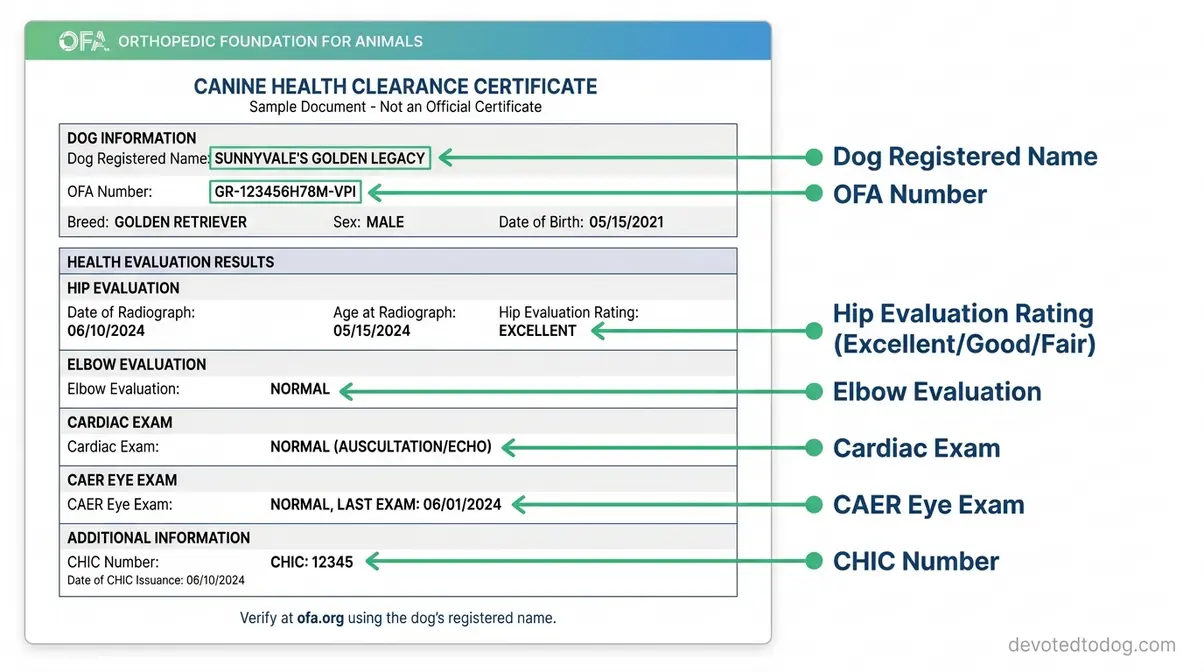
Understanding why these clearances matter starts with knowing which common health issues in Golden Retrievers are most prevalent in the breed.
What CHIC certification means: The OFA’s Canine Health Information Center (CHIC) program certifies dogs that have completed all required screenings for their breed and made the results public. A CHIC number on a parent dog is one of the strongest Green Flags in the entire process — it means the breeder didn’t just do the tests, they made the results publicly visible regardless of outcome.
To verify: ask the breeder for the registered names of the sire and dam, then search both on the OFA database at ofa.org yourself before your visit. A reputable breeder will give you these names without hesitation. Hesitation — or an inability to provide registered names — is a Red Flag.
Health clearances tell you about the parents’ genetics. Now you need to know what to say when you call the breeder — because the questions you ask reveal as much about them as their answers do.
Exact Questions to Ask the Breeder
Experienced breeders consistently report that unprepared buyers ask the wrong questions — focusing on color, price, and availability rather than health and temperament. The six questions below are copy-paste ready for a phone call or email. Use them in order.
- “Can I visit and meet the mother and father in person?”
- “Can you share the OFA registered names for both parents so I can verify their clearances on the OFA database?”
- “What does your health guarantee cover, and for how long?” (Look for: minimum 2 years for genetic conditions)
- “Do you require the puppy to be returned to you if I can no longer keep it?” (A return clause signals a breeder who cares about placement, not just profit)
- “How do you socialize the litter before 8 weeks?” (Look for: specific mention of handling, sounds, surfaces, and novel objects)
- “What questions do you have for me about my home and lifestyle?”
Question 6 is the most revealing of all. A breeder who doesn’t ask about your lifestyle, your yard, your experience with dogs, or your daily routine is a Red Flag. Reputable breeders screen buyers as thoroughly as buyers screen them — they care about where their puppies go. A breeder who simply takes your deposit without a single question about your life has told you something important about their priorities.
Contracts should include a return clause and a health guarantee of at least two years for genetic conditions. Anything shorter is a Yellow Flag worth questioning directly.
With your breeder verified and your visit scheduled, the next challenge is walking into a room full of Golden Retriever puppies and knowing exactly what to look for — starting with how to read the litter.
Step 2: Evaluate Litter & Temperament

When visiting a litter to pick out a puppy with a good temperament, observe before you touch. Watching how puppies interact with each other and with a stranger for 10–15 minutes tells you more than any single interaction will. According to UC Davis School of Veterinary Medicine, a puppy’s critical social development period for puppies occurs between 3 and 14 weeks — making the breeder’s socialization practices during this window the strongest predictor of adult temperament (UC Davis School of Veterinary Medicine). Puppies between 6 and 8 weeks are in the ideal window for temperament observation: old enough to show consistent behavioral patterns, young enough that those patterns haven’t been masked by pack hierarchy.
According to UC Davis School of Veterinary Medicine, a puppy’s critical social development period occurs between 3 and 14 weeks — making the breeder’s socialization practices during this window the strongest predictor of adult temperament (UC Davis School of Veterinary Medicine). Every minute you spend observing the litter before picking up a puppy is time well invested.
Puppy Archetypes: Alpha to Middle Pup
Understanding how to pick a puppy from a litter by personality comes down to recognizing three consistent archetypes. Across Golden Retriever communities, experienced breeders and owners report the same patterns in nearly every litter:
The Alpha (Dominant) is the first to come to you. This puppy climbs on siblings, resource-guards toys, and meets every new stimulus with forward momentum. High energy and confident, the Alpha puppy can become a wonderful dog — but often needs an experienced handler who can provide firm, consistent boundaries. For a first-time owner looking for a calm companion, the Alpha archetype is a Red Flag. The boldest puppy in the litter is frequently the most dominant, and dominance without experienced guidance becomes a management challenge at 60 pounds.
For context on how these early personality traits evolve over time, see our guide on understanding Golden Retriever temperament development.
The Observer (Submissive/Shy) is the one that lags behind. This puppy hangs back, approaches strangers slowly or not at all, and startles easily. Without significant, sustained socialization, the Observer archetype can develop into an anxious adult — prone to fear-based behaviors and reactive responses. This archetype is a Red Flag for busy households with young children, loud environments, or owners who can’t commit to intensive early socialization work.
The Middle Pup (Balanced) is what most families are actually looking for. Curious but not pushy, plays well with siblings without bullying, recovers from mild startles, and is okay chillin when the chaos settles down. This puppy approaches you with interest, can be redirected, and doesn’t demand to be the center of attention every second. It’s the Green Flag archetype for most first-time owners.
The community wisdom on this point is direct:
“If you are able to pick out of the litter, go for the middle puppy. Don’t go for the first to come to you nor the one that lags behind.”
Purdue University’s Canine Welfare Science center notes that at exactly three weeks of age, puppies enter a sensitive period for socialization at three weeks where their hearing and vision are fully developed, allowing breeders to begin gentle temperament assessments (Purdue University). By the time you visit at 6–8 weeks, you’re seeing the cumulative result of weeks of early development — which is exactly why the breeder’s practices before your visit matter as much as what you observe during it.
Knowing the archetypes tells you what you’re looking for. The next step is running a few simple tests to confirm which archetype a specific puppy falls into — without relying on a 10-second first impression.
Simple Volhard Temperament Tests
Running simple tests is the most reliable way to pick a calm puppy from a litter, because pack behavior masks individual temperament. The boldest puppy in a group may be much calmer alone. The Volhard Puppy Aptitude Test (PAT) is a standardized framework developed to evaluate a puppy’s degree of dominance, submission, and sociability through specific exercises — it’s used by professional breeders, shelters, and working dog programs worldwide. The Volhard Puppy Aptitude Test exercises assess behavioral traits including social attraction, following instinct, restraint response, and sensory sensitivity (University of Texas at Dallas).
Ask the breeder for a quiet moment to test each puppy individually, away from the litter. The tests should be performed when the litter is calm — not right after feeding or a play session. Here are four simplified Volhard-inspired tests any prospective buyer can run:
- Social Attraction Test — Crouch down a few feet away from the puppy and call it gently, without touching it first. Does it come readily with a relaxed body and tail? Green Flag for sociability. Does it hesitate, take one step and stop? Yellow Flag — note it but don’t rule out. Does it ignore you entirely or back away? Red Flag for low sociability or stress.
- Following Test — Stand up and walk slowly away from the puppy, encouraging it verbally without crouching or coaxing. Does it follow you with confidence? Green Flag for attachment and willingness to bond. Does it freeze and watch? Red Flag for anxiety or low drive for human connection.
- Restraint Test — Gently roll the puppy onto its back and hold it there for 30 seconds with light pressure on the chest. Does it struggle briefly, then relax and make eye contact? Green Flag for balanced, trainable temperament. Does it fight continuously and vocalize throughout? Red Flag for high dominance. Does it go completely limp and freeze without resistance? Red Flag for extreme submission or fear-based shutdown.
- Sound Sensitivity Test — Make a sharp, sudden sound (keys jingling, hands clapping once) near but not directly at the puppy. Does it startle, then recover within a few seconds and move toward the sound to investigate? Green Flag for resilience. Does it hide, freeze, or fail to recover within 30 seconds? Red Flag for anxiety-prone temperament that will require significant desensitization work.
Understanding which early behaviors are normal and which signal a problem is covered in our guide to common Golden Retriever puppy behaviors.
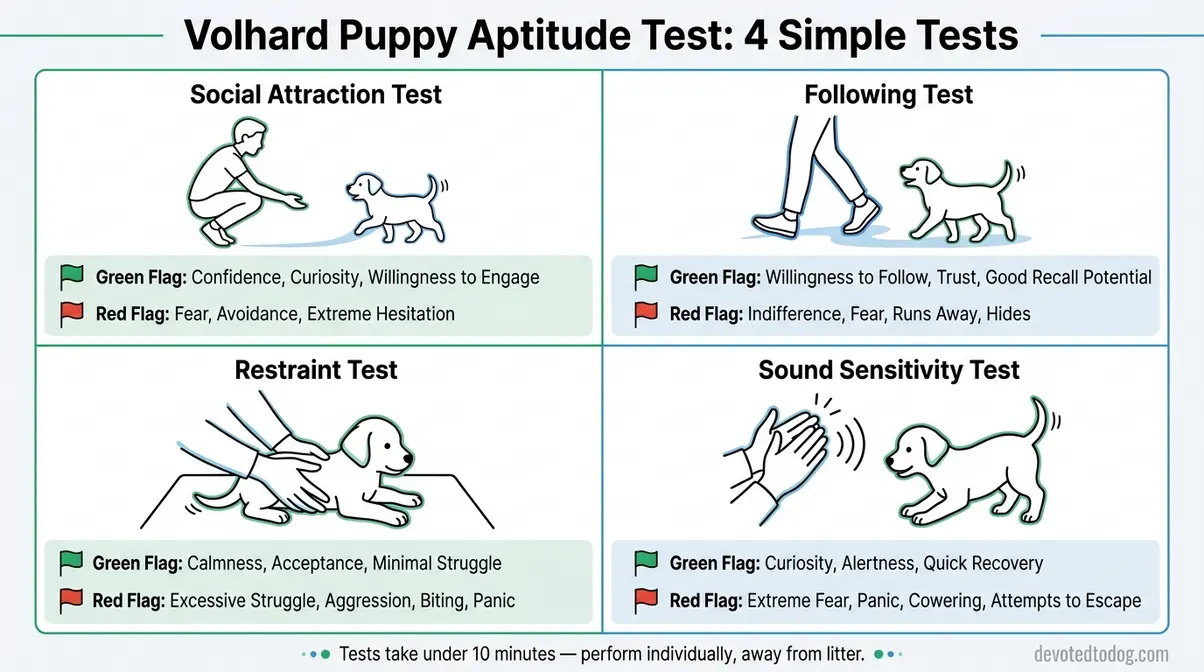
These tests tell you about the individual puppy. But the most reliable predictor of your puppy’s adult temperament isn’t the puppy at all — it’s the parents.
What Parents Tell You About Your Dog
When choosing a golden retriever puppy from a litter, the mother’s behavior is the single most informative data point in the entire visit. A mother dog who is calm, friendly, and confident with strangers is a strong Green Flag — temperament has a significant genetic component, and an anxious or fearful dam is a meaningful Red Flag for the whole litter’s genetic predisposition. If the breeder won’t let you meet the mother in person, leave.
Apply the Green Flag / Red Flag Framework directly: a mother who greets you with a wagging tail, accepts gentle handling, and settles quickly after initial excitement is a Green Flag. A mother who barks excessively at your arrival, hides from you, or shows resource-guarding behavior around the litter is a Red Flag — regardless of how charming the individual puppies appear.
If the sire is on-site or the breeder can show current video of him, observe the same traits: approachability, recovery from mild stress, playfulness without aggression. Ask the breeder directly: “How would you describe the mother’s temperament with strangers, children, and other dogs?” A breeder who knows their dogs will answer specifically — with stories, examples, and honest caveats. Vague answers like “she’s fine” or “she’s a great dog” are a Yellow Flag.
According to UC Davis School of Veterinary Medicine, a puppy’s critical social development period for puppies occurs between 3 and 14 weeks, making this the ideal window to observe baseline temperament and sociability (UC Davis School of Veterinary Medicine). What you see in the mother at your visit is a preview of the genetic ceiling your puppy is working within.
You’ve evaluated the breeder, the parents, and the individual puppies. The next step is making sure you’re choosing the right type of Golden Retriever for your specific lifestyle — because not all Goldens are built the same.
Step 3: Types, Gender & Physical Traits

When choosing a golden retriever puppy, the type of Golden — field-bred vs. show-quality — and the breeder’s specialization matter as much as the individual puppy’s temperament. A field-bred puppy from a show-line breeder, or the reverse, is a mismatch that becomes apparent at 18 months when your dog’s energy level either overwhelms or underwhelms your household. Choosing a field-bred puppy from a show-line breeder (or vice versa) is itself a Red Flag in the Green Flag / Red Flag Framework — make sure the breeder specializes in the type that actually matches your lifestyle.
Field Bred vs. Show Quality Goldens
Show-quality Golden Retrievers from conformation lines tend to have calmer, more biddable temperaments than field-bred lines, which are selectively bred for high energy, drive, and endurance in hunting scenarios (GRCA breed standards). Understanding this distinction before you visit a breeder saves months of frustration.
Field-bred Goldens are bred for hunting and field work. They have higher energy, more independence, and stronger prey drive — traits that make them exceptional working dogs but demanding household companions. American field-bred lines are the most energetic and confident of all Golden types, according to breeders specializing in these lines. Their build tends to be leaner and more athletic, with a shorter, darker coat. They’re well-suited for active families, hunters, or owners with significant outdoor time. For a first-time owner in a suburban home who wants a calm companion, a field-bred puppy is a mismatch.
Show-quality (conformation) Goldens are bred to the AKC breed standard. They’re generally calmer, more biddable, and heavier-coated — the classic “Golden” look most people picture. The Golden Retriever Club of America (GRCA) breed standard describes ideal temperament as friendly, reliable, trustworthy, and eager without being “constantly turned on” — a description that fits conformation lines more naturally than field lines. These dogs are better suited for families, therapy work, and general companionship.
English Cream / European Goldens are a third type increasingly popular in the US — lighter in coat color, often bred for calmer temperaments, and originating from European bloodlines. Note that “English Cream Golden Retriever” is a marketing term, not an AKC-recognized variety. All are Golden Retrievers under the breed standard. Their temperament varies significantly by breeder and bloodline — “English Cream” alone is not a guarantee of calmness.
| Product | Type | Key Spec | Best For | Price Range |
|---|---|---|---|---|
| Field-Bred Golden | Working Dog | High Energy | Active families, hunters | $1,500 – $2,500 |
| Show-Quality Golden | Conformation | Moderate Energy | Families, therapy | $2,000 – $3,500 |
| English Cream Golden | European Line | Variable Energy | Companionship | $2,500 – $4,000 |
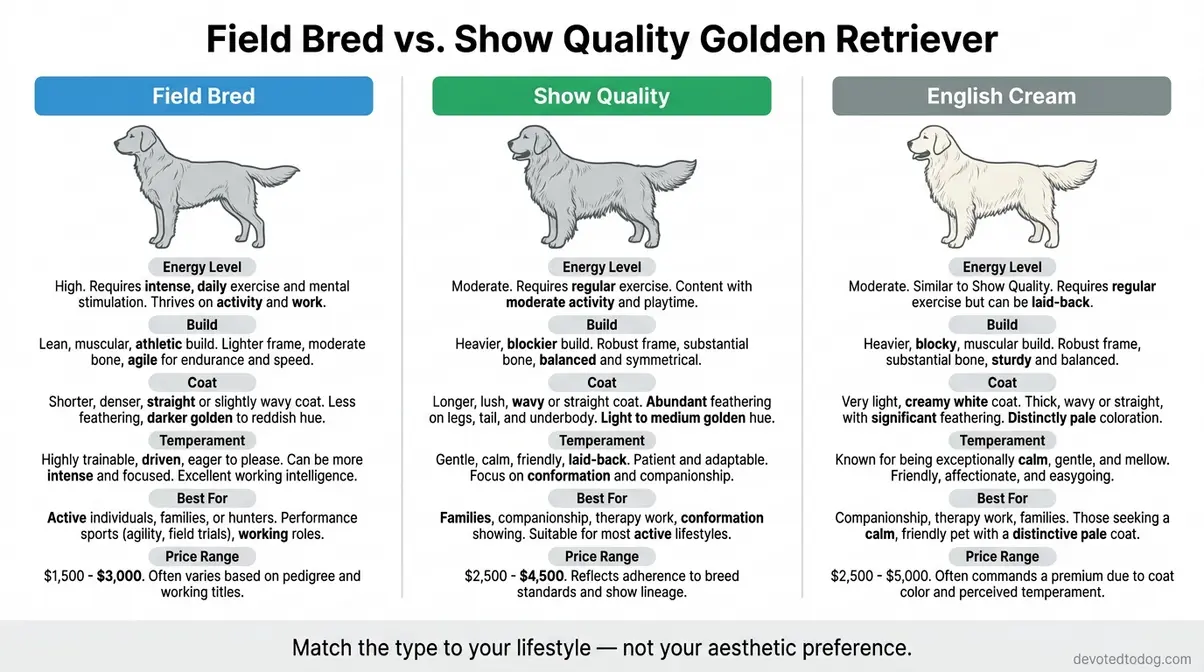
For a complete breakdown of all three regional varieties, see our guide to different types of Golden Retrievers.
Once you’ve chosen the type that matches your lifestyle, the question of male vs. female is the next decision most buyers wrestle with — and it’s far less significant than most people expect.
Male vs. Female Goldens: A Comparison
The honest bottom line on this decision: individual personality variation within a litter is far more significant than sex. A calm male from a balanced litter beats an anxious female from a stressed litter every time. That said, there are general tendencies worth knowing when selecting a puppy from the litter.
Males typically range from 65–75 lbs at maturity and often take longer to mature emotionally — the adolescent phase can persist until 2–3 years old. Many owners describe intact or recently neutered males as more “in your face” affectionate, more persistent, and occasionally more boisterous. Neutering timing affects development; your veterinarian can advise on the latest guidance for large breeds.
Females run slightly smaller at 55–65 lbs and often mature faster, which can make early training feel smoother. They can be more independent than males, which some owners interpret as aloofness. Spaying timing also matters for musculoskeletal development — another conversation for your vet.
The breeder’s knowledge of the individual puppies’ personalities matters more than any sex preference you bring to the visit. A good breeder who has observed the litter daily for 7–8 weeks knows which puppy will suit your household better than a general rule about gender ever will.
Regardless of sex, all well-bred Golden Retriever puppies share certain physical characteristics that signal healthy development — here’s what to look for during your visit.
Physical Signs of a Well-Bred Puppy
At 7–8 weeks, a healthy, well-bred Golden Retriever puppy should show these observable physical markers — no veterinary training required:
- Bright, clear eyes — no discharge, cloudiness, or redness
- Clean ears — no odor, no dark debris (debris can indicate ear mites or infection)
- Soft, full coat — no bald patches, no excessive scratching or skin irritation
- Round but not distended belly — a noticeably bloated or hard belly can indicate parasites and warrants veterinary attention before purchase
- Alert, curious demeanor — should be active and engaged when awake, not lethargic or glassy-eyed
- Even gait on all four legs — no obvious limping, favoring, or unusual movement patterns
You’ve chosen the right breeder, assessed the litter, and identified a puppy with the right type and temperament. The final piece of the puzzle is thinking ahead — specifically, how big your puppy will get and what the first few months will actually look like.
Step 4: Predict Adult Size & Expectations

Before you finalize your choice, two long-term questions deserve honest answers: how big will this puppy get, and how hard will the first few months be? Both are predictable with the right information — and both are common sources of buyer’s remorse when ignored.
How to Estimate Puppy Adult Size
Knowing how to tell how big a puppy will get is more reliable than most first-time buyers realize. Three practical methods give you a reasonable size estimate before you commit:
- Parent Size Method (Most Reliable) — Ask the breeder for both parents’ weights. The AKC breed standard sets adult weight at 65–75 lbs for males and 55–65 lbs for females. A puppy’s adult weight typically falls between the parents’ weights, making this the single most predictive data point available at 7–8 weeks.
- Paw Size Observation — Large, disproportionately “floppy” paws relative to the puppy’s body suggest significant growth remaining. This isn’t a precise method, but it’s a useful visual cue at 7–8 weeks. A puppy whose paws already look proportional to its body may be closer to its adult size than a puppy with oversized, clumsy feet.
- Weight Formula — A widely used estimation method for large breeds: double the puppy’s weight at 4 months. Multiple veterinary and breeder sources confirm this as a practical rule of thumb for Golden Retrievers specifically. Example: a puppy weighing 28 lbs at 4 months will likely reach approximately 56 lbs as an adult. This is an estimate, not a guarantee — genetics, diet, and health all influence final size.
Ask the breeder for the puppy’s current weight at 7–8 weeks and both parents’ weights. With those three data points, you can build a reasonable size picture before committing.
Veterinary experts at Texas A&M emphasize that the crucial socialization stage lasts up to 12 weeks — meaning the window for shaping your puppy’s confidence and behavior begins the moment they come home at 8 weeks (Texas A&M School of Veterinary Medicine). Size and socialization planning go hand in hand: a 70-lb dog who missed early socialization is a significantly harder management challenge than a well-socialized one.
For a week-by-week breakdown of Golden Retriever weight milestones from 8 weeks to adulthood, see our Golden Retriever puppy growth chart.
Now that you have a size estimate, the final reality check is understanding what the first months of puppyhood actually feel like — so you’re not blindsided by the “hardest month.”
What is the hardest month of a puppy?
For most Golden Retriever owners, months 4-6 are the hardest. By this point, your puppy has enough size and energy to cause real chaos—chewing baseboards, jumping on guests, and exhibiting selective hearing when you call their name. They lack the impulse control to self-regulate. This adolescent phase is when many first-time owners wonder if they chose the wrong puppy, but they almost certainly didn’t.
Chewing, jumping, and boundless energy peak during this window. Consistent positive reinforcement training during months 2-6 yields dramatic results with Goldens, who are famously quick learners when engaged correctly. The difficulty is finite and manageable, provided you go in with accurate expectations.
The first two weeks at home (weeks 8-10) also deserve honest acknowledgment. Separation anxiety, night crying, and house-training accidents are nearly universal experiences. They are normal developmental responses to a major transition, not signs of a problem puppy. If you’re bringing home a spring puppy during peak season, budget 2-4 weeks of disrupted sleep. It passes.
While breeders begin observing temperament as early as 3 weeks, prospective buyers should not visit before 6-7 weeks. Earlier visits don’t give you meaningful behavioral data, and the puppies are still in a critical developmental window that benefits from minimal disruption.
Even with the best preparation, every puppy selection process has common pitfalls. Knowing them in advance is the last step in choosing with confidence.
Common Mistakes to Avoid
Reputable breeders and veterinary behaviorists agree that most first-time buyer mistakes aren’t about bad intentions — they’re about missing information at a critical moment. The five mistakes below account for the majority of temperament mismatches and post-purchase regret in the Golden Retriever community.
5 Mistakes First-Time Buyers Make
- Choosing based on color or coat — Golden Retriever coat color, from light cream to deep gold, has zero correlation with temperament or health. Choosing the “prettiest” puppy without running temperament tests is the single most common mistake across the breed community. Color is cosmetic; temperament is consequential.
- Visiting only once — Experienced Golden Retriever community members consistently recommend visiting the litter at least twice, at different times of day. A puppy can appear calm at 10 a.m. after a nap and chaotic at 4 p.m. after play. Two visits reveal consistency; one visit reveals a moment.
- Ignoring the mother — Accepting a breeder who won’t let you meet the mother in person is the highest-risk decision in the entire process. The mother’s temperament is the strongest genetic predictor available to you. No exception to this rule is worth making.
- Skipping health clearance verification — Trusting a breeder’s verbal assurance without checking the OFA database yourself takes five minutes to avoid and years of veterinary bills to regret. The database is public, free, and searchable by the dog’s registered name.
- Falling for the “first to come to you” puppy — The first pup from a litter to rush toward a stranger is often the most dominant. That confidence is appealing in the moment. For first-time owners seeking a calm companion, it’s frequently a mismatch that surfaces at 14 months.
When a Golden Retriever Isn’t a Fit
Balanced guidance requires naming the scenarios where a Golden Retriever — even a perfectly chosen one — may not be the right fit:
Very small living spaces with no consistent daily outdoor access create a mismatch. Goldens need meaningful exercise; a dog that can’t burn energy reliably redirects it into destructive behavior. This isn’t a character flaw — it’s a breed characteristic.
Households where a dog will be alone for 8+ hours daily are a harder fit for Goldens than for less social breeds. Golden Retrievers are highly social and prone to separation anxiety. A breed with lower social needs may serve that household better.
Severe pet allergies deserve honest consideration. Goldens are moderate-to-heavy shedders year-round — not hypoallergenic by any measure. This is information, not discouragement. The right match considers it.
Frequently Asked Questions
How to identify a good Golden puppy?
A good Golden Retriever puppy is alert, curious, and physically healthy—with bright clear eyes, clean ears, a full coat, and a round but not distended belly. It should approach strangers with interest rather than fear, play with littermates without excessive aggression, and recover quickly from mild startles. A balanced temperament is the clearest indicator of a well-bred, well-socialized puppy. Working with a reputable breeder who knows each puppy’s individual personality significantly improves your ability to identify the right match for your household.
What is the 7-7-7 rule for dogs?
The 7-7-7 rule is a socialization framework for newly homed puppies: in the first week, expose them to seven different surfaces, seven different locations, and seven different types of objects or toys. According to veterinary behaviorists, the goal is to build confidence through structured novelty, making the puppy less likely to develop fear-based behaviors later. For Golden Retriever puppies, applying this rule during weeks 8-12 has the greatest long-term impact on temperament.
How to pick a show quality Golden?
Picking a show quality Golden Retriever puppy requires working with a breeder who specializes in conformation lines and understands the AKC breed standard in detail. At 7-8 weeks, look for a broad skull, dark brown almond-shaped eyes, strong bone structure, and a balanced, symmetrical build. These traits are early predictors of conformation potential, though final evaluation requires a specialist’s eye. A confident, outgoing temperament is equally important for the show ring, where dogs must perform calmly under pressure and handling from judges. Most reputable show breeders will help identify which puppies in the litter have the strongest show potential, making this a collaborative process.
Which type of Golden is the calmest?
Show-quality (conformation) Golden Retrievers tend to have calmer, more biddable temperaments than field-bred lines, which are selectively bred for high energy and hunting drive. English Cream or European Goldens are also frequently cited for mellow temperaments, though this varies significantly by individual breeder and bloodline. The most reliable way to find a calm Golden Retriever is to meet the parents in person and discuss temperament directly with a breeder who knows their litter well.
What is the 10-10-10 rule for puppies?
The 10-10-10 rule for puppies is a socialization guideline recommending that puppies meet 10 new people, visit 10 new places, and experience 10 new situations during their first few months at home. It builds on the same principle as the 7-7-7 rule, using structured, positive exposure to novelty to create more confident adult dogs, as supported by canine welfare experts. For Golden Retriever puppies, this window closes around 12-14 weeks, making early socialization efforts particularly high-impact. Always consult your veterinarian about safe socialization practices before your puppy’s vaccination series is complete.
Making Your Final Decision
For first-time Golden Retriever owners, how to choose a golden retriever puppy comes down to three verifiable decisions: the breeder’s health clearances, the individual puppy’s temperament test results, and the type of Golden that matches your household energy level. The Green Flag / Red Flag Framework gives you an objective checkpoint for each decision — replacing anxiety with observable criteria and gut feelings with a structured evaluation system that experienced breeders have used for decades.
The framework works because it removes the pressure of a single visit. Every Green Flag builds confidence. Every Red Flag tells you something useful — either about this specific breeder, this specific litter, or this specific puppy. A breeder with all Green Flags is worth the waitlist. The process of evaluation is itself a signal: breeders who welcome your questions, invite your scrutiny, and encourage you to verify their health clearances are the breeders worth waiting for.
Start today by searching the OFA database for any litter you’re considering — it takes five minutes and immediately separates breeders who meet the health standard from those who don’t. Then bookmark the Volhard test checklist above to bring with you on your visit. At Devoted to Dog, we recommend printing both the Green Flag / Red Flag breeder checklist and the four Volhard tests before you walk through the door — arriving prepared is the single biggest advantage a first-time buyer can have.