Training a Golden Retriever is one of the most rewarding things you will do as a dog owner, and one of the most confusing if you do not know what to expect at each age. This guide on how to train a Golden Retriever maps the full training journey from 8 weeks to adulthood, stage by stage.
Table of Contents
- Why Golden Retrievers Are Uniquely Trainable
- The Training Ladder: Your Stage-by-Stage Roadmap
- Foundation Phase: 8 to 16 Weeks
- Building Obedience: 4 to 6 Months
- The Adolescent Phase: 6 to 18 Months
- Adult Training and Advanced Skills
- Common Training Mistakes to Avoid
- Frequently Asked Questions
There is nothing quite like the first days with a new Golden Retriever puppy. The excitement is real, the puppy is stinking cute, and the urge to start training immediately is strong. Then, somewhere around eight months, the dog that once sat on command in five seconds flat starts ignoring you completely. That moment, when training feels like it stopped working, is exactly what this guide is built for.
By the end of this guide, you will know exactly what to work on at every age, why your dog behaves the way it does at each stage, and which dedicated resource to read when you need step-by-step depth. The framework that makes all of this manageable is called The Training Ladder, and it starts right here.
Golden Retrievers consistently rank among the most trainable breeds, according to the AKC, because they are intelligent, food-motivated, and eager to please.
- Start early: The window from 8 to 16 weeks is the most critical for shaping behavior, positive exposure during this period has the greatest lasting impact.
- Expect a dip: Most Goldens regress between 6 and 18 months. This is a normal developmental phase driven by hormonal changes, not a training failure.
- Use The Training Ladder: Match your training goals to your dog’s developmental stage, Foundation, Obedience, Adolescence, Mastery, not a generic tip list.
- Link to depth: Each stage in this guide connects to a dedicated spoke article for step-by-step detail.
- Positive reinforcement works: Reward-based methods are the foundation of every technique in this guide, supported by a retriever training resource hosted at the University of Texas.
Why Golden Retrievers Are Uniquely Trainable
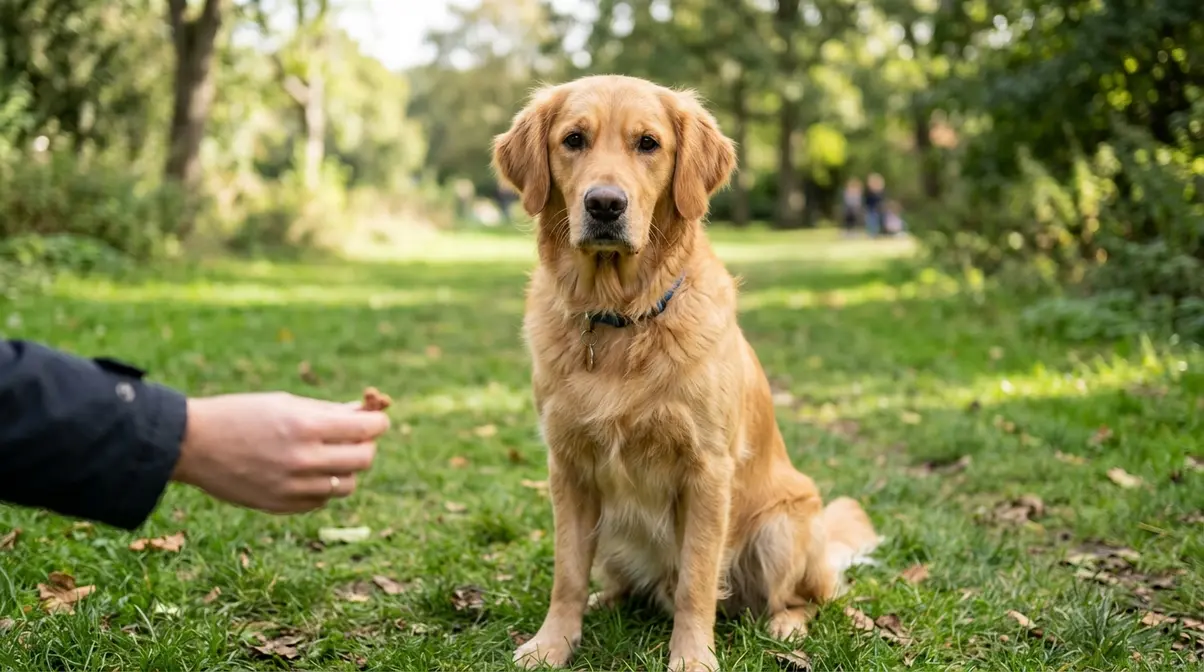
Golden Retrievers are among the easiest breeds to train. The AKC classifies them as one of the most trainable sporting breeds, a distinction rooted in their original purpose as handler-directed gundogs. They were selectively bred to work in close partnership with a human, which means responding to cues is not something they tolerate. It is something they are wired to enjoy. If you are wondering how easy it is to train a Golden Retriever, the short answer is: easier than most breeds, but not without effort. For anyone learning how to train a Golden Retriever, that instinct is a significant advantage.
Three specific breed traits make positive reinforcement particularly effective with Goldens. First, their intelligence allows them to connect a behavior to a reward quickly, often within just a few repetitions. Second, their food motivation means treats function as a reliable, powerful training currency at almost every age. Third, their handler-orientation. A term for the instinct to look to a human for direction rather than act independently, means your Golden genuinely wants to know what you want.
Reward-based training is the method backed by veterinary behavior science, and it works especially well with Goldens, who are already predisposed to engagement. The American Veterinary Society of Animal Behavior recommends reward-based methods for all dog training, and the Puppy Care and Training 101 guide from Homeward Bound Golden Rescue reinforces this, noting that foundational training principles align closely with the breed’s natural eagerness to cooperate.
That said, “easy to train” does not mean effortless. Goldens are high-energy, deeply social dogs, and those traits make training not just beneficial but necessary. An untrained Golden is still an enthusiastic, powerful animal that will jump on guests, pull toward every dog on the street, and find its own entertainment when bored. The energy that makes them wonderful also makes structure essential.
This is where The Training Ladder comes in. Rather than a flat list of tips and tricks, this guide organizes every training milestone by your dog’s developmental stage. You can read more about understanding their behavior at every age or get the Golden Retriever pros and cons before you begin. The next section introduces the full framework.
The Training Ladder: Your Stage-by-Stage Roadmap
The Training Ladder is a four-stage developmental framework that maps Golden Retriever training milestones to specific age ranges, giving owners a clear mental model of where their dog is and what comes next. Training a Golden Retriever from 8 weeks to adulthood takes roughly 18 months of active work. But the effort looks very different at each stage.
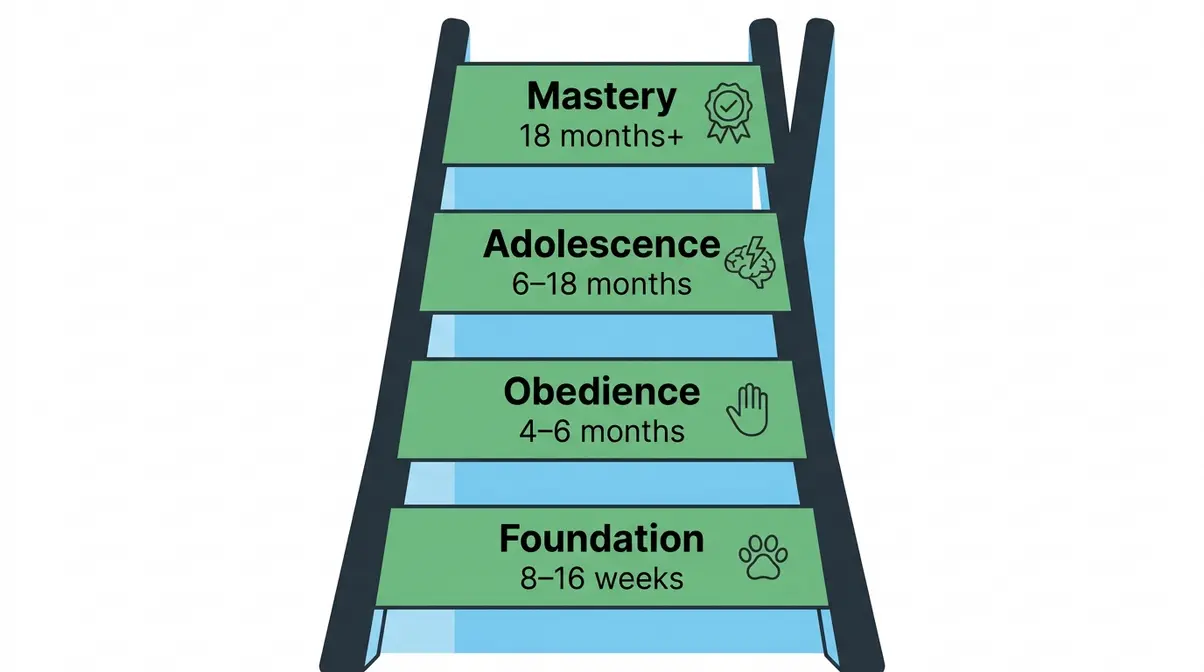
| Rung | Age Range | Primary Goal | Common Mistake |
|---|---|---|---|
| 1, Foundation | 8 to 16 weeks | Socialization, crate, potty, sit | Starting too late or skipping crate |
| 2, Obedience | 4 to 6 months | Stay, come, leash manners, bite inhibition | Inconsistent commands across family members |
| 3, Adolescence | 6 to 18 months | Rebuilding reliability through regression | Punishing regression instead of reinforcing |
| 4, Mastery | 18 months+ | Proofing, advanced skills, off-leash | Stopping training once the dog “seems fine” |
Each rung below links to a dedicated spoke article for step-by-step depth. This guide frames the journey; the spokes handle the detail. If you are wondering how long it takes to train a Golden Retriever, the honest answer is that the active foundation phase runs about 18 months. But the rewards of each rung show up quickly when you know what you are working toward.
Use this table as an at-a-glance map of what to train at each age. Each stage builds on the one before it, and every skill below is expanded in its own section.
| Stage (Rung) | Age | What to train | Focus / goal |
|---|---|---|---|
| Rung 1: Foundation | 8–16 weeks | Socialization, name recognition, first command (Sit), crate and potty training, gentle handling | Shape behavior during the most neurologically sensitive window; build positive associations |
| Rung 2: Building Obedience | 4–6 months | Stay, Come, the Three D’s (duration, distance, distraction), leash manners, bite inhibition | Consistency over perfection, aim for ~80% reliable responses in a quiet room |
| Rung 3: Adolescence | 6–18 months | Proofing existing commands, maintaining recall, working patiently through regression | Hold the line through hormonal changes; do not give up when your dog seems to “forget” training |
| Rung 4: Mastery (Adult) | 18+ months | Off-leash recall on a long line, advanced and fetch/hunting skills, proofing in new environments | Reliability everywhere; off-leash safety is the top priority |
Foundation Phase: 8 to 16 Weeks
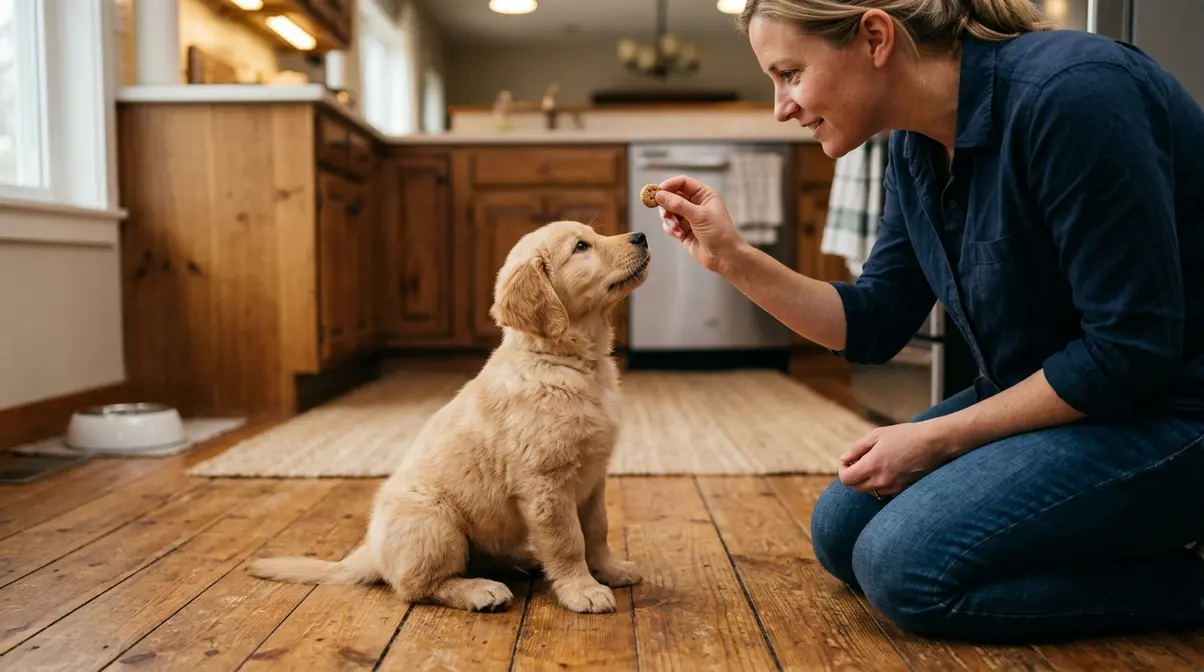
The 8-to-16-week window is the most neurologically sensitive period in your Golden Retriever puppy’s development. The AKC identifies 8 to 12 weeks as the primary socialization window for puppies, a period when positive exposure to people, sounds, and environments has the greatest lasting impact on long-term behavior. Our week-by-week puppy socialization guide walks through exactly what to expose your Golden to and when. What you do in these first weeks shapes your dog’s relationship with the world for years. A predictable daily rhythm makes all of this easier, so it helps to start from a ready-made Golden Retriever puppy schedule for weeks 8 to 16. This is Rung 1 of The Training Ladder, and it is the most important rung to get right.
Before training begins in earnest, make sure your home is ready. Read our guide on how to puppy-proof your home to remove hazards and set your puppy up for success from day one. For a complete deep-dive into everything covered in this stage, see our complete Golden Retriever puppy training guide.
First Commands to Teach Your Golden Retriever Puppy
Before teaching any command, teach your puppy its name. Name recognition is the zeroth command. The prerequisite for every recall and attention exercise that follows. Say your puppy’s name in a cheerful tone and reward any eye contact immediately. Most puppies learn this within a day or two of arriving home.
Once name recognition is solid, four commands form the foundation of all future training: Sit, Down, Come, and Stay. These are not arbitrary starting points. Sit leads directly to Stay; Come is a safety command that could one day prevent a serious accident; Down builds impulse control that carries into every advanced skill on The Training Ladder.
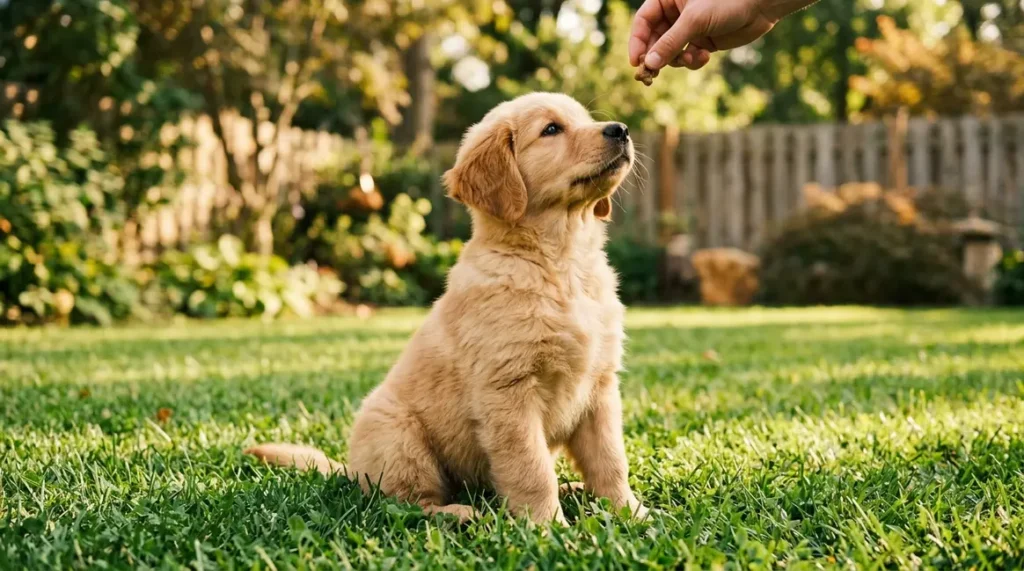
The lure-and-reward method works well for teaching a 9-week-old Golden Retriever puppy to sit:
- Hold a treat at your puppy’s nose level.
- Slowly move the treat back over the puppy’s head, toward its tail.
- As the puppy’s bottom touches the floor, say “Sit” clearly once.
- Reward immediately with the treat and calm praise.
- Release with a word like “okay” before the puppy gets up on its own.
Keep sessions to 3 to 5 minutes. Puppy attention spans are short, and ending on a success matters more than length. Reward-based training techniques are the foundation of effective puppy development, as the AKC explains in its guide to positive reinforcement training. A 10-week-old puppy can learn Sit reliably within 3 to 5 short sessions like these; Down typically follows within the same week once Sit is solid.
One practical detail most guides skip: consistency across every family member matters from the first session. If one person says “Sit” and another says “Sit down,” the puppy learns two different cues for the same behavior. Pick one word per command and use it every time.
Once your puppy knows its name and can Sit reliably, the next two priorities are crate training and potty training, and both are worth their own dedicated guides. Once potty training clicks, the next step is teaching your dog to alert you when it needs to go outside.
Crate Training and Potty Training: Your First Two Priorities
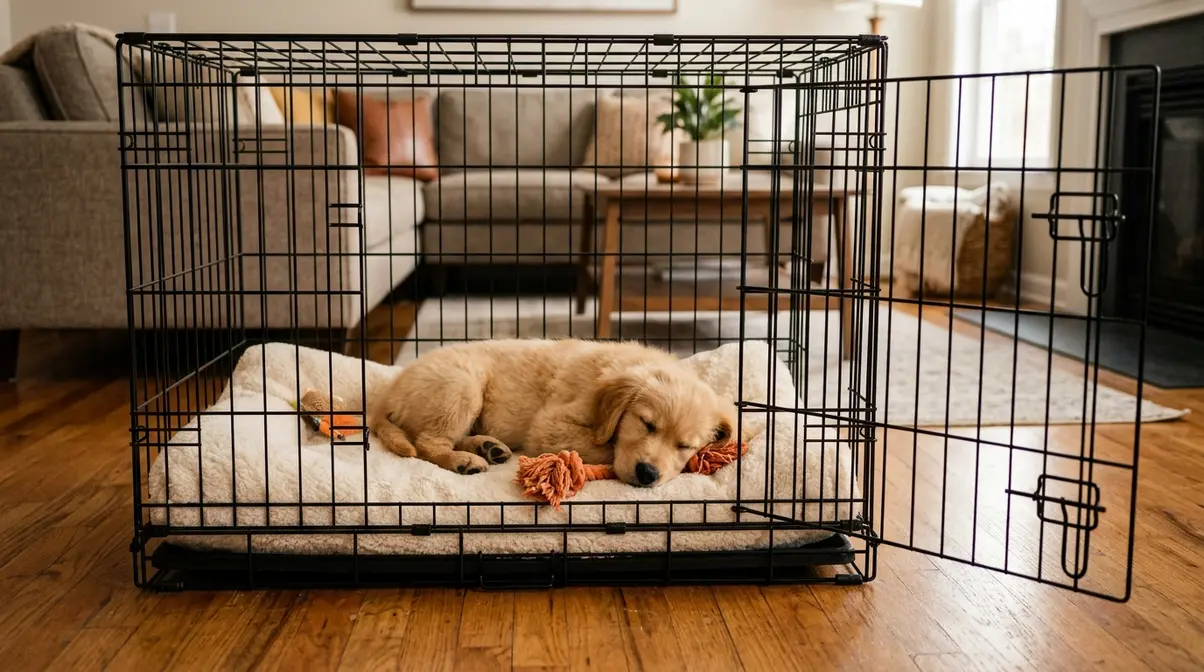
Crate training and potty training work best when treated as a system rather than two separate tasks. The crate creates a natural schedule: puppies instinctively avoid soiling their sleeping area, which means a properly sized crate becomes your most effective potty training tool. When your puppy is in the crate, it is holding. When you let it out, you take it directly outside. That rhythm is the engine of house-training.
The core rule of potty training is straightforward: take your puppy outside every 1 to 2 hours, and immediately after every meal, nap, and play session. Puppies at this age have very limited bladder control, and the timing of your response matters more than any correction. When accidents happen indoors, clean the area with an enzymatic cleaner to eliminate the scent marker. Do not punish the puppy. Punishment after the fact teaches nothing and can make your puppy anxious about eliminating in front of you, which makes outdoor training harder, not easier.
For selecting the right dog crate size and setup, see our dedicated resource. If you are exploring options for an indoor dog potty for apartment living or overnight use, we cover those as well. For the complete step-by-step process, see crate training your Golden Retriever puppy and potty training your Golden Retriever puppy.
Building Obedience: 4 to 6 Months
At four months, something shifts. Your Golden has more attention span, more impulse control, and enough foundation from Rung 1 to handle real obedience work. This is Rung 2 of The Training Ladder, and the primary goal is not perfection. It is consistency. A dog that responds reliably 80 percent of the time in a quiet room is ready to start building reliability in more challenging environments.
Before adding complexity, do a quick check: if Sit is not solid, Stay will not stick. Rung 1 commands are the prerequisite for everything in this stage of training a Golden Retriever dog.
Teaching Stay, Come, and the Three D’s
Stay is the command most owners teach incorrectly, not because the technique is complicated, but because they skip the structure. Stay has three components, and you must build them separately before combining them:
- Duration, how long the dog holds the position. Start with 3 seconds in a quiet room before adding anything else.
- Distance, how far away you move from the dog. Add this only after the dog can hold a Stay for 15 to 30 seconds reliably.
- Distraction What is happening around the dog. This is the last component to add and the hardest to build.
A dog that can Stay for 30 seconds in the kitchen is not the same as a dog that can Stay for 5 seconds in a park. Build each D separately. Practice Stay in the kitchen first (low distraction), then the backyard (medium), then the front yard with foot traffic (high). Add Duration only after the dog is reliable at each distraction level.
Training your Golden Retriever to come reliably is one of the most important safety skills you will teach. Come carries one non-negotiable rule: never punish a dog for coming to you, even if it took 10 minutes. If your Golden finally returns after three calls and you scold it, you have just taught it that coming to you leads to something unpleasant. Always reward the Come, every single time, no matter how long it took or how frustrated you are. Cornell University College of Veterinary Medicine notes that consistent positive reinforcement at this stage is critical; without it, managing reactive behavior becomes significantly harder as the dog matures.
Proofing The process of practicing a command in new environments until it works reliably everywhere, begins here. A command is not trained until it works in at least five different locations. That is the standard for Rung 2.
Leash Manners: How to Leash Train a Puppy
The core principle of leash training is simple: forward motion is the reward for a loose leash. The moment the leash goes tight, you stop moving. Your Golden quickly learns that pulling gets it nowhere, literally. Consistency is everything here. One family member who allows pulling undoes the work of everyone else.
During the learning phase, a no-pull harness to help with leash training reduces the physical strain on both dog and handler while the habit is being built. You may also want to explore using the right training collar depending on your dog’s size and pulling intensity. For the complete step-by-step process, see leash training your Golden Retriever.
Bite Inhibition: How to Stop Puppy Biting and Nipping
Bite inhibition is a learned skill, not a personality trait. Golden Retriever puppies bite because it is how they explore the world and how they played with their littermates. It is completely normal behavior, not aggression. The goal is not to eliminate mouthing overnight but to teach the dog to control the pressure of its bite and eventually redirect entirely.
The core technique is straightforward: when your puppy bites too hard, say “ouch” or yelp sharply and immediately withdraw all attention for 30 seconds. You are mimicking the feedback a littermate would give. Repeat consistently, and the puppy learns that hard biting ends the interaction. For the complete guide on this behavior, see stopping Golden Retriever puppy biting.
The Adolescent Phase: 6 to 18 Months
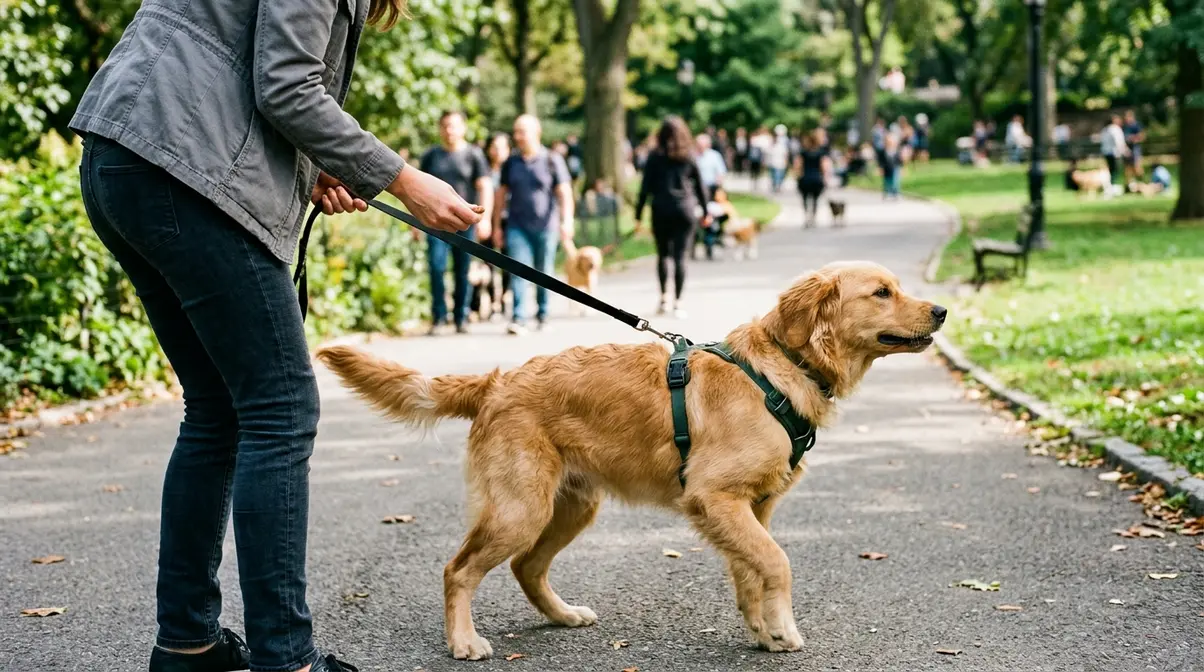
The adolescent phase is the most challenging period for most Golden Retriever owners, and it is the stage where many give up. Between 6 and 18 months, your Golden may seem to forget commands it knew reliably at 5 months, become easily distracted, and start testing every boundary you set. This is Rung 3 of The Training Ladder. And it is the rung most owners fall off. The good news: this phase is completely normal, completely temporary, and completely manageable with the right strategies.
Why Golden Retrievers Regress During Adolescence
The regression owners experience during this period is not stubbornness. It is neurology. Between 6 and 12 months, hormonal changes significantly affect impulse control The ability to pause and choose a behavior rather than react immediately. The prefrontal cortex, the part of the brain responsible for decision-making and self-regulation, is still actively developing during this window. Training consensus among canine behaviorists indicates that your Golden is not ignoring you because it forgot its training. It is ignoring you because its brain is literally less capable of overriding distraction than it was at 4 months.
The second fear period, which typically occurs between 6 and 14 months, adds another layer. A dog that walked calmly past other dogs at 4 months may suddenly lunge at 8 months. A sound that never bothered it before may now trigger a strong reaction. This is a normal developmental stage, and it passes. The key is not to interpret these responses as regression or failure. They are a signal that the dog needs more patient, consistent reinforcement, not less.
Separately, the ASPCA on canine territorial behavior notes that territorial behavior typically appears as dogs mature between one and three years of age. This broader behavioral shift overlaps with the tail end of the adolescent phase and underscores why consistent training during this entire window is essential. The commands your Golden learned in Rungs 1 and 2 are still in there. They just need more repetitions in more environments to rebuild reliability under the new level of distraction the adolescent brain creates.
Understanding why the regression happens makes the five strategies below much easier to apply consistently.
Five Strategies for Managing the Teenage Phase
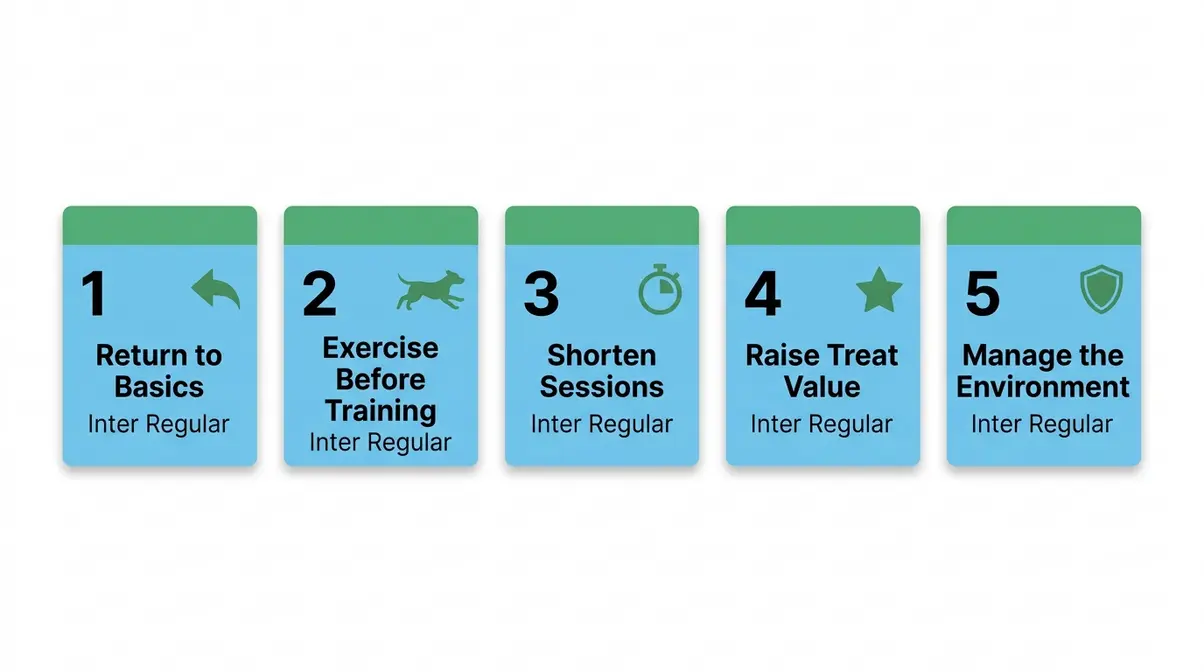
Training a Golden Retriever through adolescence requires a shift in approach, not a change in values. These five strategies address the specific challenges of the 6-to-18-month window:
- Return to Basics. Go back to Rung 1 commands, Sit, Down, Come, in low-distraction environments. Rebuild reliability before adding distraction back in. This is not a step backward. It is maintenance, and it is exactly what the dog needs at this stage.
- Increase Exercise Before Training. A 20-minute walk or active play session before a training session reduces arousal and improves focus. A tired Golden is a trainable Golden. For a dog that is bouncing off the walls, trying to train first is working against the biology of the moment.
- Shorten Sessions, Increase Frequency. Instead of one 15-minute session, do three 5-minute sessions spread through the day. Adolescent dogs have shorter focus windows than either puppies or adults. Ending each session on a successful repetition builds momentum and keeps training a positive experience.
- Raise Treat Value. If your Golden is ignoring chicken, try cheese or hot dog. High-distraction environments require high-value rewards. The treat that worked reliably in the kitchen may not be motivating enough at the dog park. Matching treat value to distraction level is one of the most practical and most overlooked adjustments at this stage.
- Manage the Environment. If your Golden cannot yet resist pulling toward other dogs, do not practice recall at the dog park. Set the dog up to succeed by controlling the environment until reliability is rebuilt. Impulse control is a skill that develops gradually. You build it by creating situations where the right choice is easy, then slowly increasing difficulty. For more on managing common behavior problems like mouthiness during this phase, our behavior guide covers the adolescent period in detail.
Apply strategies 3 and 4 together for the fastest progress: three 5-minute sessions per day using high-value treats, in progressively more distracting environments over 4 to 6 weeks. Most owners see meaningful improvement within that window when they stay consistent.
Adult Training and Advanced Skills
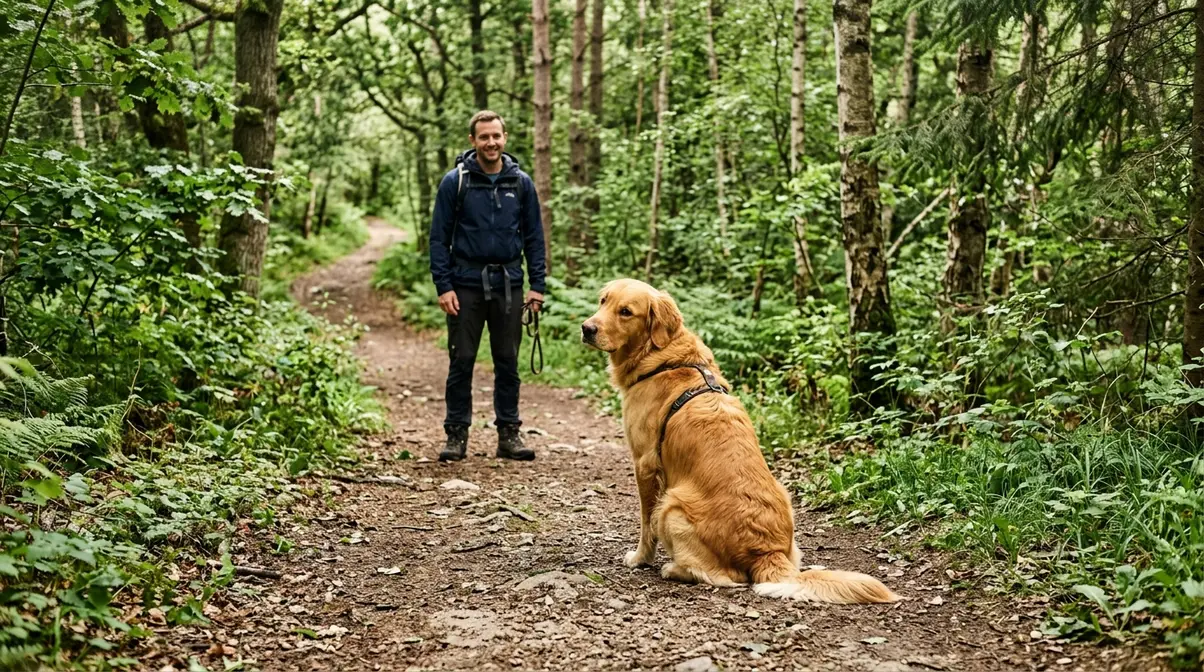
At 18 months, your Golden enters Rung 4 of The Training Ladder: Mastery. The shift here is significant. You are no longer teaching new behaviors from scratch. You are proofing existing ones in real-world environments and, for some owners, adding advanced skills that align with the breed’s original purpose. Training never ends for a Golden Retriever. It evolves. An adult Golden that is not mentally stimulated will find its own stimulation, and that stimulation is rarely something you will enjoy.
Reinforcing Obedience in New Environments
Proofing is the primary adult training task. It means practicing every command in at least five new environments: pet stores, parks, busy streets, friends’ homes, and anywhere else your dog will encounter in real life. A command is only reliable when it works everywhere. Not just in the kitchen where you taught it.
Off-leash recall is the most important advanced skill for safety, and it requires a patient, structured approach. Build it on a long line, 15 to 30 feet, before removing the leash entirely. Practice Come on a 20-foot long line in a park, where the line gives you a safety net while the dog builds reliability at distance and distraction. How to train a Golden Retriever to walk off leash follows the same progression: long line first, then gradual removal of the physical connection as reliability is confirmed. The Golden Retriever Club of America provides curated reading and viewing resources for owners who want to continue structured training and mental enrichment throughout adulthood.
Fetch, Hunting, and Off-Leash Skills
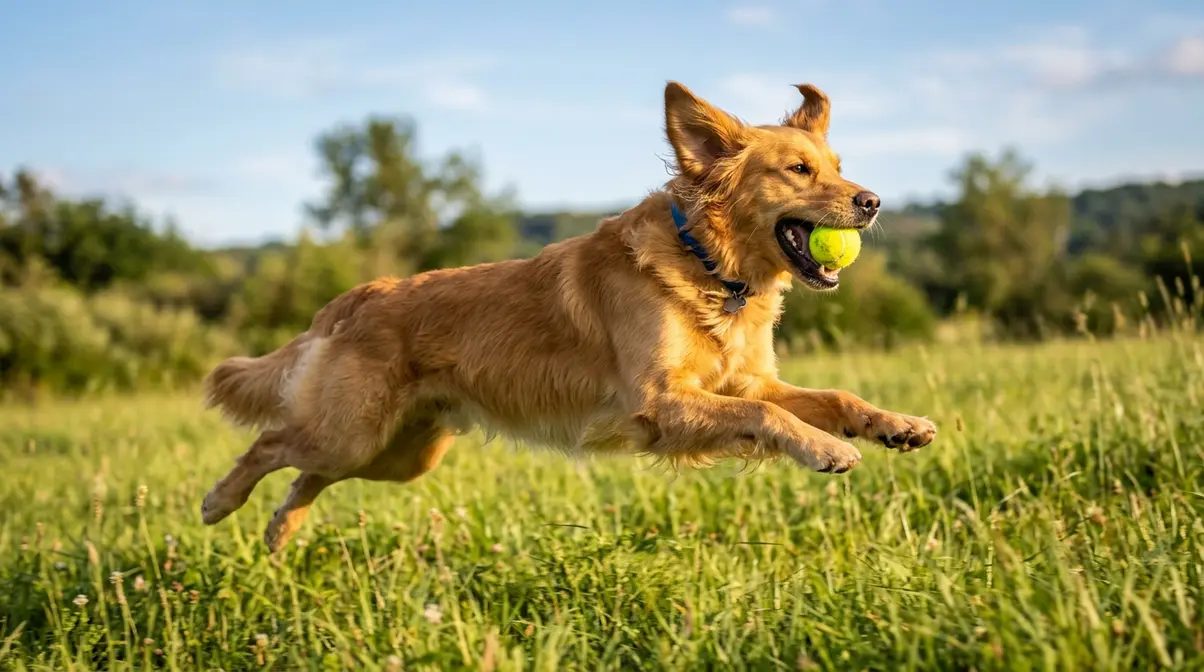
Fetch is more than a game for a Golden Retriever. It is the expression of the breed’s core retrieving instinct, and it can be shaped into formal field work for owners who want to go further. A dog that reliably fetches and returns to hand has already demonstrated the foundation of advanced retrieving work. For our complete step-by-step guide to teaching fetch, the dedicated spoke covers everything from introducing the retrieve to building distance and reliability.
If you want to train your Golden Retriever for hunting, the foundation is all four rungs of The Training Ladder plus breed-specific field skills. Hunting training requires mastering all Rung 1 through 3 commands first, then adding specific skills like soft-mouth retrieving, steady sit at the flush, and confident water entry. The Step-by-Step Retriever Training guide from Ducks Unlimited covers advanced retriever skills including water introduction and the steady sit. For our Golden Retriever hunting guide, see our dedicated resource. If you are starting from scratch with a young dog specifically suited for field work, see finding a field-bred Golden Retriever to understand how field lines differ from show lines in temperament and drive.
Common Training Mistakes to Avoid
Even well-intentioned owners make these five mistakes. Check your current habits against this list, catching one early is worth weeks of retraining.
- Using inconsistent commands. If “Come,” “Here,” and “Come here” are all used for the same behavior, your dog learns three separate cues rather than one reliable command. Pick one word per behavior and use it every time, across every family member in the household.
- Punishing a slow recall. If your Golden finally comes after three calls and you scold it, you have just taught it that coming to you leads to something unpleasant. Always reward the Come, no matter how long it took. The return is the behavior you are reinforcing. The delay is a separate problem to address through proofing.
- Skipping proofing. A command that works in the kitchen is not trained. It is practiced in one context. Proof every command in at least five environments before calling it reliable. This is the step most owners skip and the reason most “trained” dogs fall apart at the dog park.
- Stopping training after puppyhood. Adult Goldens that are not mentally stimulated will find their own stimulation. According to the ASPCA, destructive chewing is a common sign of separation anxiety and under-stimulation. Both of which increase when structured activity stops. Training does not end at 18 months. It shifts to maintenance and enrichment.
- Using the crate as punishment. The crate should be a safe, positive space your dog chooses willingly. Sending a dog to the crate as a consequence for bad behavior destroys its value as a management and house-training tool. The crate works because the dog sees it as a den. Punishment breaks that association quickly and permanently.
Frequently Asked Questions
Is a Golden Retriever easy to train?
Golden Retrievers are among the easiest breeds to train. They are intelligent, highly food-motivated, and bred to work closely with a human handler, which makes them naturally responsive to positive reinforcement. Most puppies can learn basic commands like Sit and Down within a few short sessions. Consistency and short, frequent training sessions matter more than any special technique. Expect steady progress from 8 weeks onward.
What not to do with a Golden Retriever?
Avoid harsh corrections, yelling, or punishment-based training with a Golden Retriever. They are sensitive dogs that shut down under pressure and respond far better to reward-based methods. Do not leave them alone for extended periods without exercise or mental stimulation first, as boredom leads to destructive behavior. Do not skip the adolescent training phase, consistency during the 6-to-18-month window is what separates a well-behaved adult from a difficult one.
How do you discipline a Golden Retriever?
Discipline a Golden Retriever by redirecting unwanted behavior and rewarding the correct alternative. If your dog jumps up, turn away and withhold attention until all four paws are on the floor, then reward immediately. Avoid physical corrections or raised voices. A firm, calm “no” followed by a redirect is more effective than punishment. The goal is to show the dog what to do, not just what to stop.
What is the most difficult age for Golden Retrievers?
The most difficult age for Golden Retrievers is typically between 6 and 18 months, during the adolescent phase. Dogs in this stage often seem to forget their training, become easily distracted, and test boundaries. This is a normal developmental period driven by hormonal changes and brain maturation. Consistent positive reinforcement, shorter training sessions, and higher-value treats help owners navigate this phase.
Can Golden Retrievers be left alone for 8 hours?
Adult Golden Retrievers can tolerate being left alone for up to 8 hours, but it is not ideal. They are social dogs and can develop separation anxiety with prolonged isolation. Puppies under 6 months should not be left alone for more than 2 to 3 hours due to potty needs and socialization requirements. For any dog left alone for a full workday, a midday walk or dog walker significantly reduces stress and destructive behavior.
Conclusion
For Golden Retriever owners, knowing how to train a Golden Retriever stage by stage is the difference between a rewarding experience and a frustrating one. The adolescent phase, between 6 and 18 months, is the most common point where owners lose momentum, but it is also the most manageable when you understand the neurology behind the regression. The core recommendation is simple: follow The Training Ladder stage by stage, use the spoke articles for step-by-step depth at each rung, and do not stop training once your dog reaches adulthood.
The Training Ladder exists because training a Golden Retriever is not a single task. It is a four-stage journey with a different goal at each rung. The excitement you feel with a newly arrived puppy is exactly the energy to channel into Rung 1. The overwhelm that hits at 8 months is a signal that you have reached Rung 3, not that something went wrong. Owners who follow The Training Ladder through all four rungs consistently find that their adult Goldens are calmer, more responsive, and more enjoyable companions. The investment in the difficult adolescent phase pays dividends for the next decade.
Your next step depends on where you are right now. If your Golden is 8 to 12 weeks old, start with our complete Golden Retriever puppy training guide for the full Foundation Phase walkthrough. If you are already in the adolescent phase and feeling the friction, bookmark the behavior guide and return to the five strategies in Rung 3 whenever you need a reset. The ladder is always there, you just have to keep climbing.