
“Hey everyone! First time dog mom and I am struggling with the crate, playpen, and potty training! Any tips for me?! We’re in an apartment and he’s a 10 week golden retriever!”
, First-time Golden Retriever owner, r/goldenretrieversCrate training is one of the first skills in the 8-to-16-week foundation. It fits into the wider roadmap in our Golden Retriever training guide by age.
📖 Part of our pillar guide: Best Dog Crates 2026: Buying Guide for Every Dog & Use Case, compare every crate type, size, and use case in one place.
If you recognize yourself in that post, take a breath, the overwhelm you’re feeling is completely normal, and crate training a golden retriever puppy does not have to be a battle of wills. If you are still in the research phase, learn how to choose a golden retriever puppy before buying your supplies.
The problem isn’t your puppy’s stubbornness. Most guides treat Golden Retrievers like any other dog, ignoring the breed’s specific sensitivity to confinement and their need for a carefully paced introduction. Rush the process, and you create the very anxiety you were trying to avoid.
In this guide, you’ll learn a step-by-step framework called The Den-Building Ladder, a phased approach backed by veterinary behavioral science that transforms the crate from a source of stress into your puppy’s chosen safe haven. We’ll cover equipment selection, the 10:1 desensitization rule, a printable 7-day schedule, and a nighttime crying protocol, everything you need, in the right order.
- Estimated Time: 7–14 days
- Tools & Materials Needed:
- 48-inch wire crate with divider panel
- Washable, chew-resistant crate mat
- High-value training treats
- Kong toy and peanut butter
- Blanket or crate cover
When crate training a golden retriever puppy, it works best when you follow a phased, breed-specific approach, Golden Retrievers are sensitive dogs who need gradual desensitization, not rushed confinement.
- The Den-Building Ladder works in three phases: introduction → positive association → extended duration
- The 10:1 rule means completing 10 short crating sessions before extending to one longer one, preventing your puppy from associating the crate with unpredictable long confinement
- Nighttime crying is normal for 3–7 nights; a consistent response protocol resolves it faster than ignoring it
- Crate size matters: a Golden Retriever puppy needs a 48-inch crate with a divider panel, sized for an adult but adjusted as the puppy grows
- The 6-month regression is a predictable developmental phase, knowing it’s coming prevents owners from giving up when it arrives
Why Golden Retrievers Excel at Crate Training
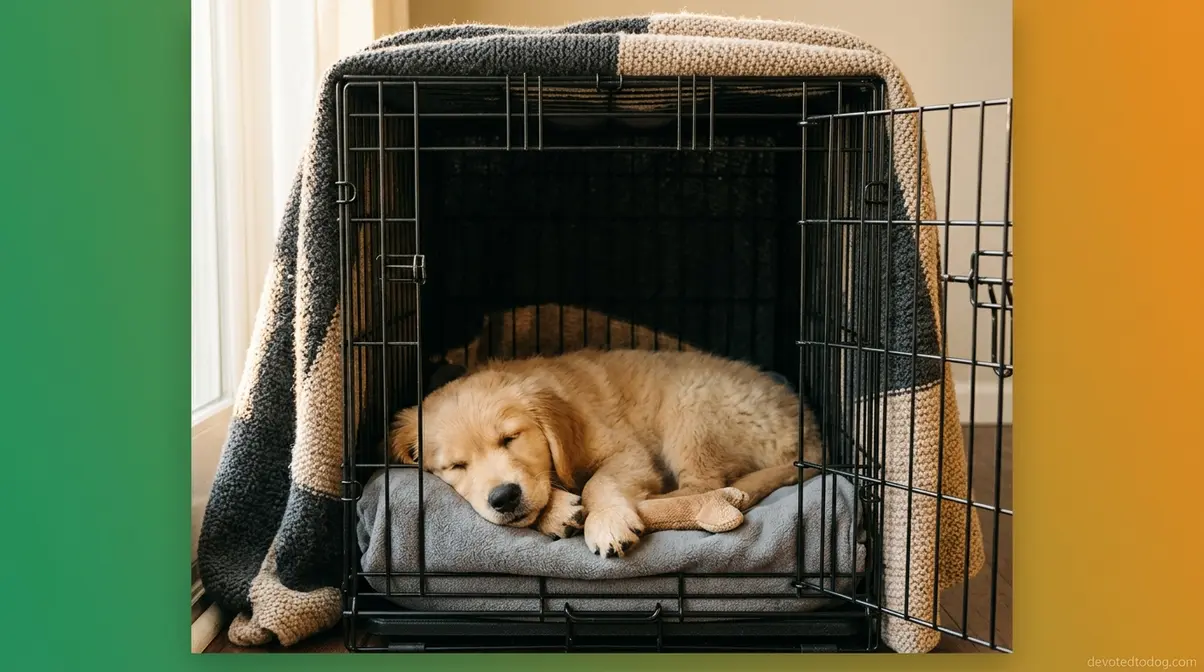
Golden Retrievers do exceptionally well with crate training because of their breed-specific combination of denning instinct and eager-to-please temperament. According to Texas A&M veterinary behaviorists, crate training not only helps with housebreaking but also significantly reduces overall household stress when introduced correctly (Texas A&M, 2026). That means The Den-Building Ladder works with this breed’s natural wiring, not against it.
The Golden Retriever Den Instinct
Golden Retrievers are neurologically wired to seek enclosed, secure spaces, a behavioral echo of their ancestral need for a protected resting area. For this breed specifically, that denning instinct pairs with high social sensitivity: your puppy wants to feel near you, not isolated. That combination is precisely why crate training a golden retriever puppy, when introduced gradually, feels natural rather than punishing.
The critical mindset shift is this: a crate used as punishment triggers anxiety, while a crate introduced as a chosen den triggers calm. These are opposite neurological responses to the same physical object. The difference is entirely in the introduction method.
Picture this: by Day 3 or 4 of The Den-Building Ladder, many Golden Retriever puppies walk into the crate voluntarily, door open, no treats required, simply because they’ve learned it’s theirs. That’s the end goal. Not compliance. Choice.
Golden Retrievers’ eager-to-please temperament makes them among the most responsive breeds to positive reinforcement crate training, typically adjusting within 7–14 days when introduced gradually (across Golden Retriever owner communities, this timeframe is the consistent reported experience).
Understanding why the crate works for Golden Retrievers is the first step. But knowing when the process gets hard, and that it’s temporary, is what keeps most first-time owners from giving up.
What is the hardest month of a puppy?
For most Golden Retriever owners, the hardest month is Month 2 of ownership, roughly weeks 9–12. The two hardest developmental windows in golden retriever puppy crate training are this initial phase (8–12 weeks) and adolescence (6–18 months). During the first window, everything is new, your puppy has limited bladder control, no established routine, and zero understanding of what the crate means. It feels chaotic. It passes within 2–4 weeks with consistency.
The second hard period, the 6-month regression, catches most owners completely off guard. A previously crate-trained Golden who suddenly starts whining again around 6–8 months is not failing. They’re hitting an adolescent fear period driven by hormonal and behavioral changes. This is not a sign that crate training didn’t work; it’s a predictable developmental phase that requires a brief return to Phase 2 reinforcement.
“If your 8-month-old Golden suddenly starts whining again after sleeping quietly for months, you’re likely hitting the adolescent fear period, not starting over.” That reassurance matters. The regression is temporary, and the Troubleshooting section covers exactly how to handle it.
Now that you understand what to expect from your breed, let’s make sure you have the right equipment before you start, because the wrong crate size is one of the most common reasons crate training fails.
Choosing the Right Crate and Equipment
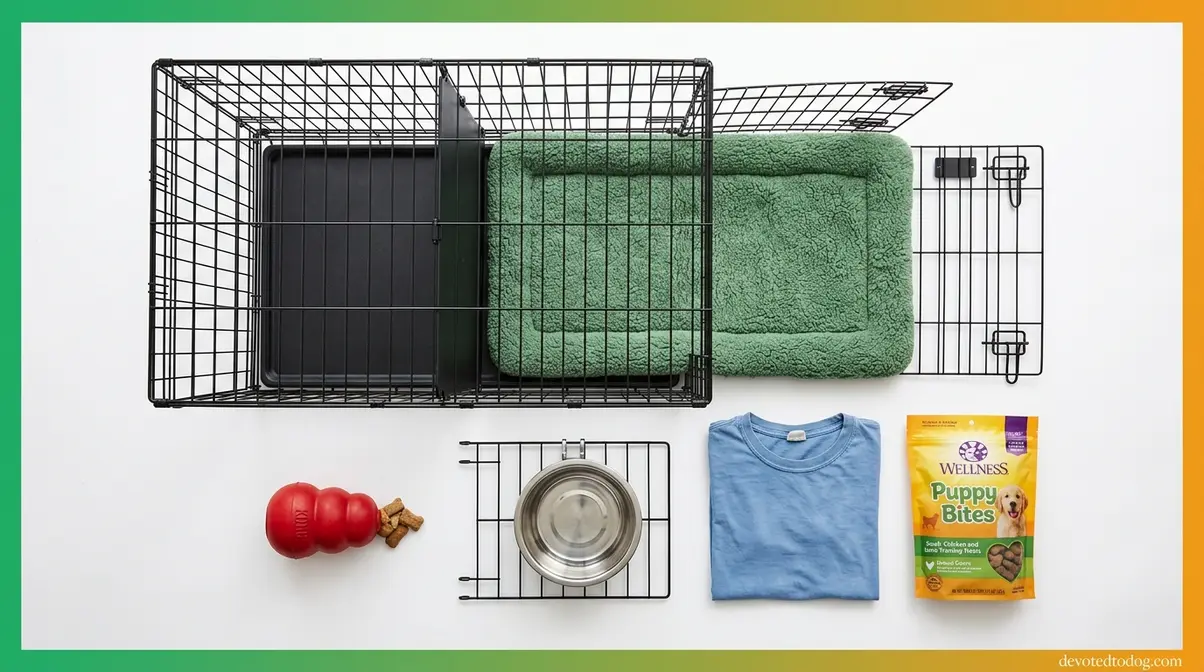
The right crate for a Golden Retriever puppy is a 48-inch wire crate with a divider panel, not the smallest available size, and not a crate sized only for puppyhood. According to Ohio State University’s Indoor Pet Initiative, a properly sized crate prevents inappropriate elimination by limiting the excess space that encourages puppies to sleep in one corner and eliminate in another (Ohio State University, 2026). This single setup decision determines whether crate training takes 7 days or 7 weeks.
Wire vs. Plastic Crates
For most Golden Retriever puppy owners, a wire crate is the recommended starting point. Wire crates offer maximum ventilation, fold flat for storage, include a divider panel, and, critically, allow your puppy to see you. That visibility reduces isolation anxiety in a breed with high social sensitivity. Look for heavy-gauge wire with a double-door design for flexibility in placement.
Plastic airline-style crates offer a more enclosed, den-like environment. Some anxious Golden Retrievers actually respond better to the darker, quieter space, particularly dogs who seem overstimulated in a wire crate. They’re also preferable for travel. The trade-off is less ventilation, which matters in warmer climates.
The practical middle ground: start with a wire crate and add a crate cover. A simple blanket draped over three sides transforms a wire crate into the enclosed den environment some Golden Retrievers prefer, without the ventilation compromise. If your puppy shows persistent anxiety in a wire crate after two full weeks of The Den-Building Ladder, consider switching to plastic or adding the cover as a first step.
You can explore our top-rated dog crates for golden retrievers for specific product recommendations across both types.
Once you’ve chosen your crate type, the next critical decision is size, and this is where most first-time owners make a costly mistake.
Crate Size Chart by Age and Weight
The smartest approach to crate sizing is to buy the adult size once and use a divider panel to create a puppy-appropriate space. Adult Golden Retrievers typically reach 55–75 lbs and need a 48-inch crate, confirmed by both the AKC and PetMD’s crate sizing guide (PetMD, 2026). Buying a smaller crate now means buying again in four months.
The divider panel is the key: it restricts the crate to just enough space for the puppy to stand, turn around, and lie down. No extra room means no “bedroom and bathroom” situation where the puppy sleeps at one end and eliminates at the other.
Use this chart as your guide. Measure your puppy’s length from nose to tail base and add 4 inches for the ideal crate length at each stage.
| Puppy Age | Approx. Weight | Recommended Crate Length | Width (approx. cm) | Notes |
|---|---|---|---|---|
| 8–12 weeks | 8–15 lbs | 30 inches (divider in 48″) | ~76 cm | Set divider at 30″ mark |
| 3–4 months | 15–30 lbs | 36 inches | ~91 cm | Adjust divider forward |
| 5–6 months | 30–45 lbs | 42 inches | ~107 cm | Divider near removal |
| 7+ months (adult) | 55–75 lbs | 48 inches | ~122 cm | Remove divider entirely |
According to UC Davis School of Veterinary Medicine, proper crate sizing limits a puppy’s unsupervised access and significantly reduces housebreaking accidents (UC Davis, 2026).
A 48-inch wire crate with a divider panel is the recommended setup for a Golden Retriever puppy, it accommodates adult size while preventing the oversized space that leads to potty accidents in the back corner.
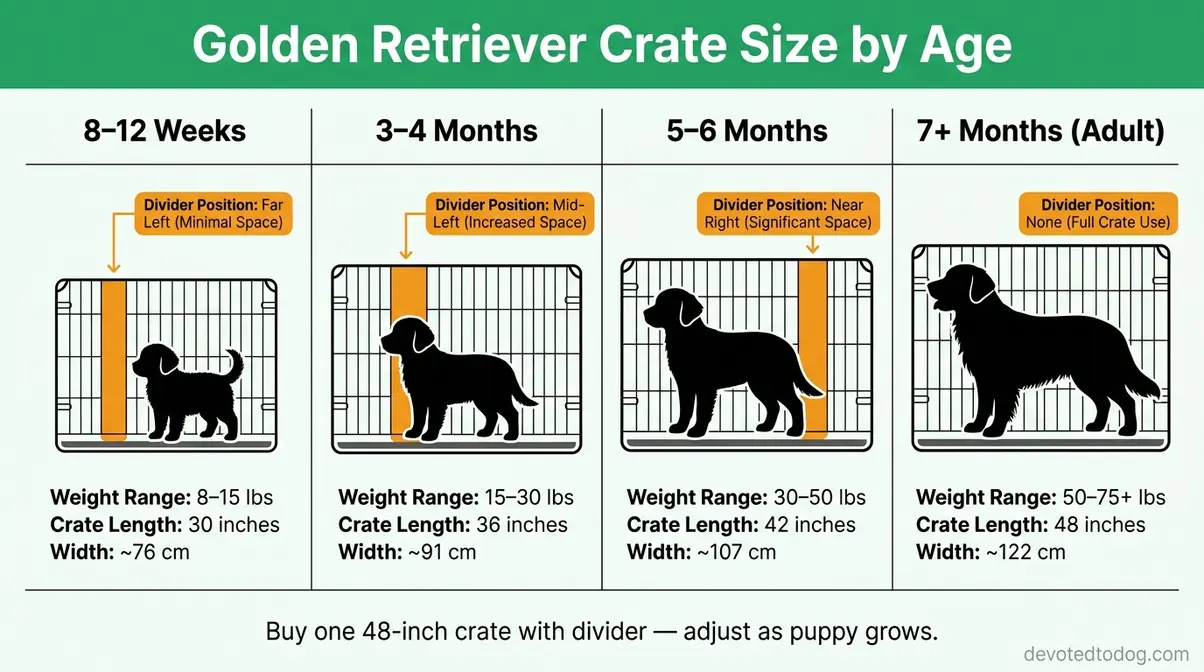
With the right crate in place, the final equipment step is making the inside feel safe and inviting, because what you put inside the crate on Day 1 matters more than most guides acknowledge.
What to Put Inside Your Puppy’s Crate
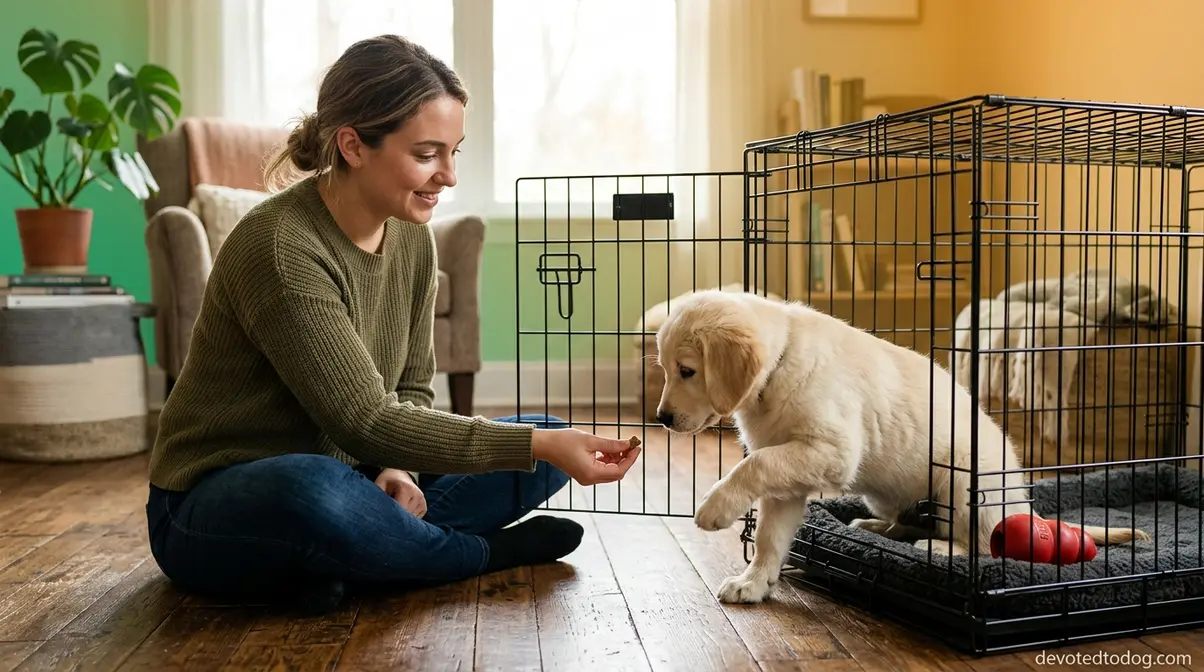
Crate training a golden retriever puppy succeeds faster when the interior feels genuinely comfortable from the first session. Here’s what belongs inside, and what to leave out.
- ✅ DO include:
- A washable, chew-resistant crate mat or orthopedic puppy bed
- A worn t-shirt with your scent for the first week (a powerful comfort signal for a social breed)
- A Kong toy stuffed with frozen kibble and a small amount of peanut butter
- A small water bowl clipped to the crate door, not loose on the floor
- ❌ DON’T include:
- Loose fabric or plush toys that can be shredded and ingested
- Food bowls that tip and soak the bedding
- Puppy pads, placing them inside the crate teaches your puppy that elimination inside is acceptable, directly undermining housebreaking
A frozen Kong stuffed with peanut butter and kibble gives your Golden Retriever puppy something to focus on when you first close the door, reducing whining by giving them a job to do. Pair it with the best dog beds for Golden Retrievers for a setup that’s both comforting and durable.
Your crate is set up. Now comes the most important moment, and the one most owners rush: the very first introduction.
Phase 1 – Introduce Your Puppy to the Crate
The first 24–48 hours of crate introduction are the most important. Phase 1 of The Den-Building Ladder is a no-pressure introduction where the crate door stays open and your puppy chooses to explore. The Ohio State University Veterinary Medical Center confirms that a crate serves as a crucial safe resting place when introduced correctly, and that getting this phase right eliminates the majority of long-term crate resistance (Ohio State VMC, 2026). Rushing it is the single most common cause of prolonged nighttime crying.
Setting Up the Perfect Crate Space
Before your puppy ever sees the crate, placement matters. For the first 2–4 weeks, put the crate in your bedroom, or wherever you sleep. Your Golden Retriever can hear you, smell you, and process the new sleeping arrangement without the added stress of complete separation. After the puppy sleeps through the night consistently, you can gradually move the crate to its permanent location.
- Prepare the environment before the first introduction:
- Drape a blanket over three sides to create a den-like enclosure
- Place the crate mat and a worn t-shirt inside
- Position the crate door so it opens away from foot traffic, the puppy should never feel cornered
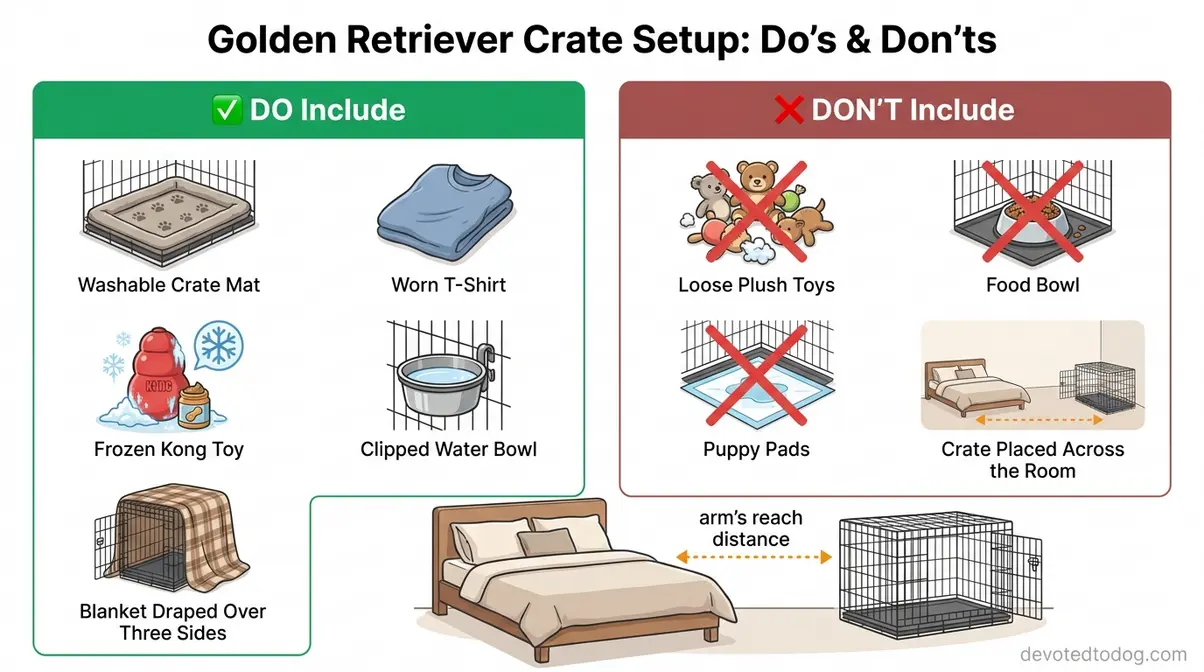
Across Golden Retriever owner communities, the consistent feedback is that placing the crate next to the bed, close enough to reach a hand in, dramatically reduces first-night crying compared to placing it across the room. This is crate training golden retriever puppy 101: proximity is your ally in week one.
With the crate positioned and prepared, you’re ready for the moment your puppy first sees it, and how you handle the next 15 minutes sets the tone for everything that follows.
The No-Pressure First Introduction
The most effective first crate introduction keeps the door open and uses only positive reinforcement, forcing a puppy into a closed crate on Day 1 can create lasting anxiety that takes weeks to reverse (Animal Humane Society, 2026). Follow these steps exactly, in order.
This is Rung 1 of The Den-Building Ladder: the puppy learns the crate is safe before they ever spend time inside it.
Step 1: Place High-Value Treats Place high-value treats (small chicken pieces or kibble) just inside the crate entrance, not at the back yet.
Step 2: Let the Puppy Approach Sit on the floor beside the crate. Let your puppy approach on their own terms. No coaxing, no pushing.
Step 3: Mark and Reward When your puppy steps one paw inside, mark with a calm “yes” and offer a treat from your hand.
Step 4: Move Treats Further Inside Gradually place treats further inside over 3–4 repetitions, never past the point where the puppy is comfortable going.
Step 5: End the Session Properly After 10–15 minutes, end the session. Do not close the door on Day 1, Session 1.
Step 6: Repeat Throughout the Day Repeat 2–3 times throughout the first day, spacing sessions at least 1 hour apart.
Never pick the puppy up and place them inside the crate. Never close the door on the first session. Never use a stern voice near the crate, the crate must remain a neutral-to-positive space at all times.
Your puppy is now curious about the crate, maybe even stepping inside voluntarily. Phase 2 is where you turn that curiosity into a genuine love for their den, using a deceptively simple technique called the 10:1 rule.
Phase 2 – The 10:1 Rule for Associations
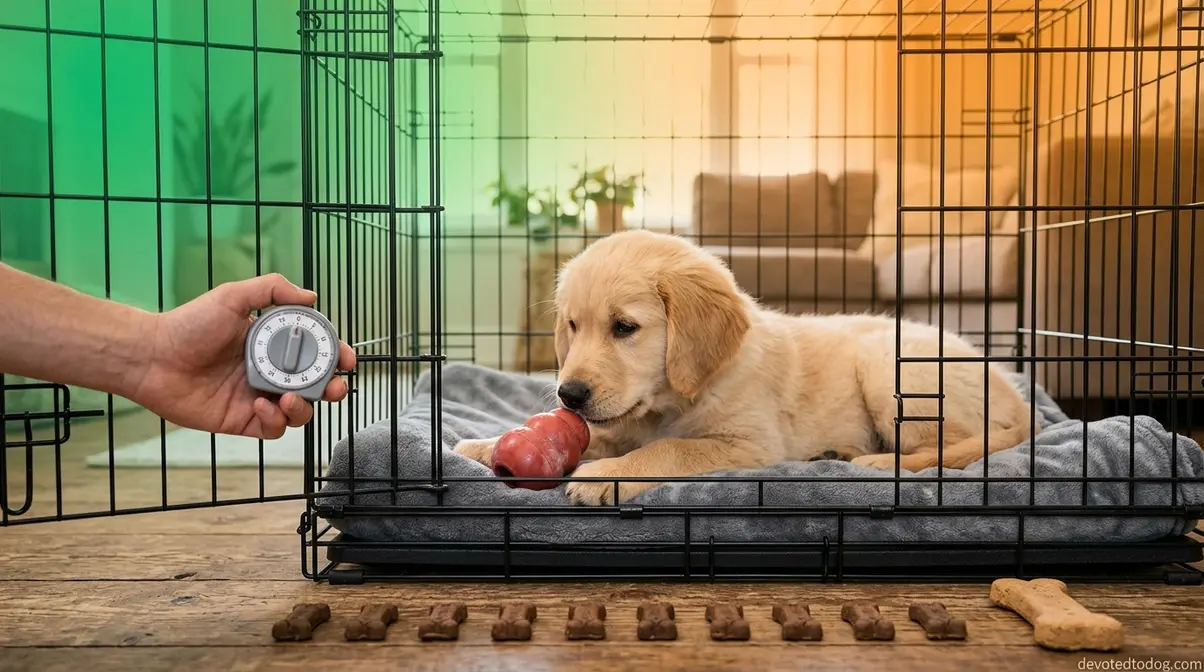
How do you get a Golden Retriever puppy to genuinely love their crate? When you begin crate training a golden retriever puppy, accelerating the process dramatically happens when you weaponize the 10:1 rule, a method that uses short, successful repetitions to build a positive association before the puppy ever experiences a long crating session. Per the American Pomsky Kennel Club crate training guide, the 10:1 principle specifically teaches puppies that crate time is variable and never overly long (APKC, 2026). This is the technique that separates owners who succeed in 7 days from those still struggling at 7 weeks, and zero major competitors explain it clearly.
What Is the 10:1 Rule?
The 10:1 rule for puppy crate training means completing 10 short crating sessions, typically 2–5 minutes each, with you present, before extending to one longer session of 20–30 minutes. This teaches your Golden Retriever puppy that the crate closes and opens, that confinement is brief and unpredictable, and that good things (treats, praise) happen inside every single time.
Why does it work? Variability prevents your puppy from learning that “door closing = long time alone.” When the crate experience is consistently brief and positive 10 times before it’s ever extended, the association locks in before anxiety has a chance to form.
Here’s exactly how the 10 sessions break down:
Step 1: Sessions 1–5 (Ultra-Short) Puppy enters, door closes for 2 minutes, door opens, treat and calm praise. You remain visible throughout.
Step 2: Sessions 6–9 (Moderate Extension) Extend to 3–5 minutes. You stay in the room but move around naturally.
Step 3: Session 10 (Longer Duration) Extend to 15–20 minutes. You may briefly leave the room.
On Day 3, your Golden Retriever puppy should be completing 10:1 cycles without whining. If they’re still crying at Session 3, shorten the duration, not the number of repetitions. The repetitions are what build the association; the duration is the variable you control.
The 10:1 rule, completing 10 short crating sessions before extending to one longer session, prevents puppies from learning that entering the crate always means a long, unpredictable confinement (APKC, 2026).
The 10:1 rule tells you when to crate. Now let’s cover what to use inside the crate during those sessions to make every repetition a positive experience.
Your Association-Building Toolkit
Crate training a golden retriever puppy accelerates dramatically when you weaponize the three most powerful positive reinforcers: high-value treats, meal feeding, and frozen Kongs. Use all three deliberately.
- Treats:
- Use small chicken pieces, freeze-dried liver, or puppy kibble for crate entry
- Reserve your highest-value treat exclusively for crate sessions, the crate becomes the only source of that reward
- This specificity matters: novelty and exclusivity make the association stronger
- Meals:
- Feed all meals inside the crate for the first two weeks
- Start with the bowl just inside the entrance, then move it progressively further back with each meal
- By Day 7, the bowl should be at the back of the crate with the door closed during feeding
- Toys:
- Frozen Kongs stuffed with kibble and a small amount of peanut butter are the gold standard for extending crate time
- Prepare 3–5 Kongs in advance and freeze them overnight, a frozen Kong lasts 15–20 minutes, which is exactly the duration you’re building toward
- By Day 5, most Golden Retriever puppies walk into the crate voluntarily when they see you pick up the Kong, the association is already forming
To master the potty training aspect of crate training, remember that every crate release should be followed immediately by an outdoor potty break before any play begins.
With the 10:1 rule in practice and your treat toolkit ready, the final piece of Phase 2 is a structured schedule, because consistency is what makes the association stick.
7-Day Crate Training Schedule
Save this schedule or print it and stick it on your fridge. It integrates the 10:1 rule with potty break timing, giving you a clear daily plan for the first week of golden retriever crate training.
Key rule for every crate release: Take your puppy outside immediately, before any play or interaction. This pairs the crate with the potty routine from Day 1.
| Day | AM Sessions | PM Sessions | Max Single Duration | Notes |
|---|---|---|---|---|
| 1–2 | 3× open-door explorations | 3× open-door, treats | Door closed: 0 min | No door closing yet |
| 3 | 5× 10:1 cycles (2 min) | 5× 10:1 cycles (2 min) | 2 min | Owner present, in sight |
| 4–5 | 5× 10:1 cycles (3–5 min) | 5× 10:1 cycles (3–5 min) | 5 min | Owner in room, moving |
| 6 | 3× 10:1 cycles (10 min) | 3× 10:1 cycles (10 min) | 10 min | Owner may step out briefly |
| 7 | 2× 20-min sessions | 2× 20-min sessions | 20 min | First overnight attempt |
After 7 days of consistent 10:1 sessions, your Golden Retriever puppy should be comfortable with 20-minute crating periods. Phase 3 is about extending that to the durations you actually need, without triggering anxiety.
Phase 3 – Extend Duration and Practice Alone Time
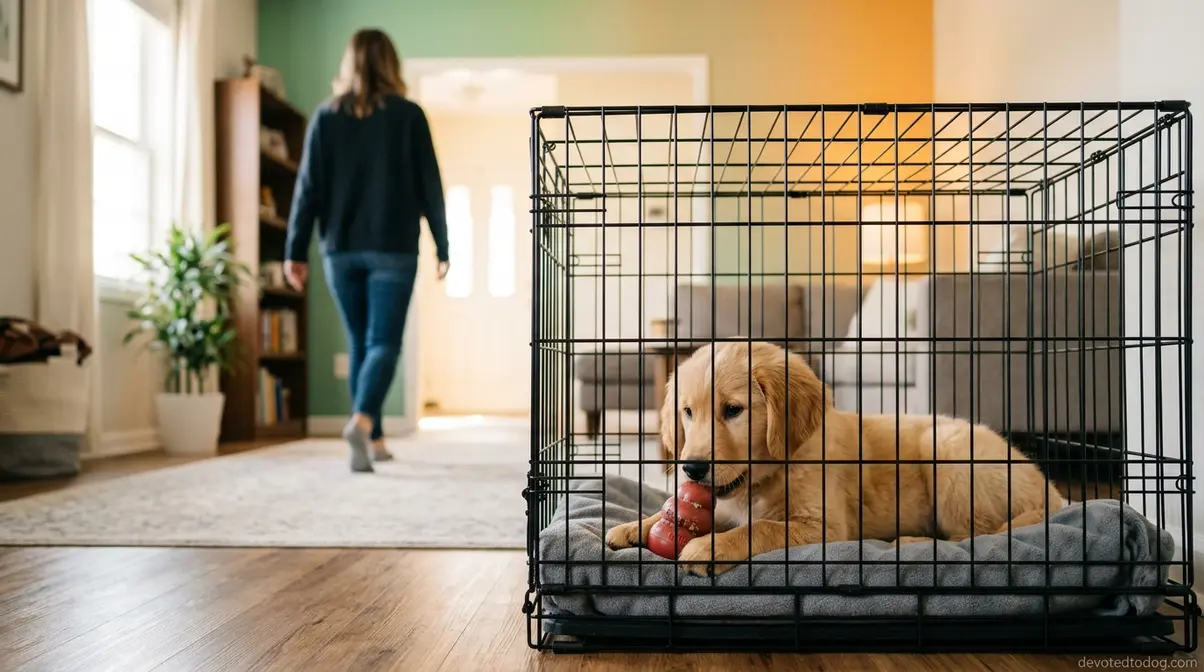
Phase 3 of The Den-Building Ladder is where crate training graduates from short sessions into the real-world durations you need. The foundational rule is simple: Golden Retriever puppies should not be crated for more than 1 hour per month of age during the day. Exceeding this limit before the puppy is ready is the most common cause of the anxiety regression owners experience at 6 months, and it’s entirely preventable.
How Long Can They Stay in a Crate?
The “1 hour per month of age” rule is the standard guideline for daytime crating, confirmed by both the American Kennel Club and the Karen Pryor Academy’s positive crate training guide (AKC, 2026). Overnight limits are more generous because puppies sleep, but they still need at least one middle-of-the-night potty break in the early weeks.
| Puppy Age | Max Daytime Crate Duration | Max Overnight Duration | Notes |
|---|---|---|---|
| 8–10 weeks | 1 hour | 3–4 hours | Frequent potty breaks essential |
| 3 months | 3 hours | 4–5 hours | Bladder control improving |
| 4 months | 4 hours | 5–6 hours | Potty break midday if working |
| 5–6 months | 4–5 hours | 6–7 hours | Nearing adult capacity |
| 7+ months | 4–6 hours | Up to 8 hours | Adult maximum |
Golden Retriever puppies should not be crated for more than 1 hour per month of age during the day, a 3-month-old puppy’s maximum daytime crate duration is 3 hours (AKC, 2026).
One important caveat: these are maximums, not targets. A 10-week-old Golden in an apartment should be crated for no more than 1–1.5 hours during the day before a potty break. Plan your schedule around your puppy’s bladder, not the other way around. If your puppy is showing distress before reaching the time limit, shorten the session.
Now that you know the duration limits, the next challenge is teaching your puppy to stay calm when you actually leave the room, the step that prepares them for nighttime and full workdays.
Building Up to Full-Day Confinement
The “absence ladder” is a specific escalation method that prevents the sudden leap from “owner visible” to “owner gone for 8 hours”, the leap that triggers separation anxiety in dogs who were otherwise progressing well.
Follow this progression:
Step 1: Week 2 (Out of Sight) Owner in room but not visible, sit behind a closed door for 5–10 minutes.
Step 2: Week 3 (Short Departure) Owner leaves the house for 30 minutes, returns calmly with no fuss.
Step 3: Week 4 (Extended Departure) Extend to 1–2 hours, with a midday potty break if needed.
Step 4: Month 2 (Full Workday) Work toward a full workday (4–6 hours), with midday break if under 5 months.
- Watch for these three signs that you’re escalating too fast:
- Excessive drooling or panting after release
- Frantic, sustained pawing at the crate door
- Self-injury attempts (rubbing nose or paws raw against the wire)
If any of these appear, step back one rung on the absence ladder for 3–5 days before trying again. Most Golden Retriever puppies are ready for a 4-hour alone session by 14–16 weeks when The Den-Building Ladder is followed consistently. Rushing to 8 hours at 12 weeks is the primary trigger for separation anxiety.
Even after successful Phase 3, be aware that a regression at 6 months is normal, the Troubleshooting section covers exactly how to handle it when crate training golden retriever puppy at night or during the day becomes difficult again.
Daytime crating is one challenge. The nighttime crate training experience, with its inevitable crying, is what keeps most puppy owners awake in more ways than one. Here’s exactly how to handle it.
Nighttime Training and Handling Crying
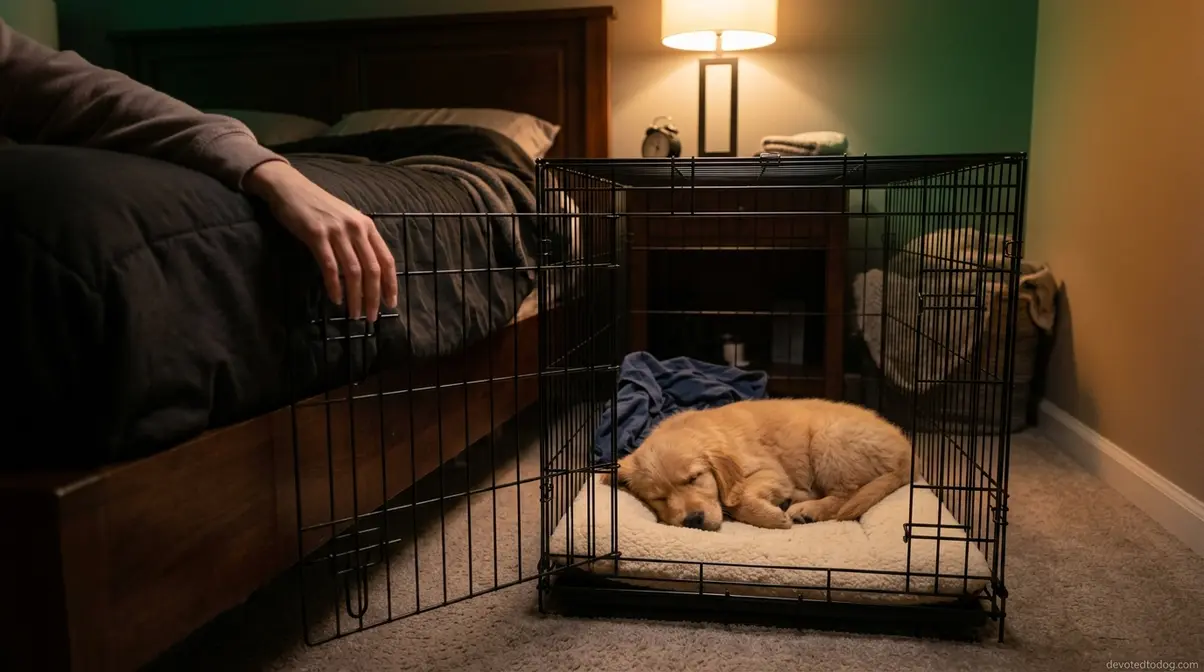
It’s 2am. Your Golden Retriever puppy has been crying for 20 minutes. Do you go to them, or wait? Nighttime crate training for a Golden Retriever puppy typically involves 3–7 nights of crying before the puppy adjusts, and whether you respond or wait depends on one critical distinction. According to veterinary behaviorist Wailani Sung, DVM, DACVB, brief crying is normal and acceptable; escalating or persistent crying signals a genuine need that requires a response (PetMD, 2026). Learning to tell the difference is the skill that gets both you and your puppy through the first week.
Where should your puppy sleep on the first night?
For the first night, and the first 2–4 weeks, place the crate in your bedroom. Position it close enough that you can reach a hand in to offer reassurance without removing the puppy from the crate. This recommendation aligns with Wailani Sung’s guidance on consistent bedtime routines and reducing separation-related distress.
Golden Retrievers are highly social dogs. Complete isolation on the first night means your puppy is simultaneously adjusting to a crate and sleeping away from their littermates for the first time. That’s two major stressors at once. Bedroom placement removes one of them.
For the first-night bedtime routine, follow these steps:
- Restrict water 1–2 hours before bedtime to reduce overnight potty needs
- Take your puppy on a final, active potty break immediately before placing them in the crate
- Place a worn t-shirt in the crate for scent comfort
- Set an alarm for a 3–4am potty break for the first 1–2 weeks
Across Golden Retriever owner communities on Reddit and Facebook, the consensus is consistent: puppies placed in a crate next to the bed settle faster and cry for shorter periods on Night 1 than puppies placed in a separate room. The social proximity is not coddling, it’s breed-appropriate management.
With your puppy in the bedroom and the pre-sleep routine in place, here’s the exact protocol for when the crying starts, because it will, and knowing what to do in advance makes all the difference.
The Nighttime Crying Protocol
The goal is not to ignore your puppy, it’s to respond to need (potty) rather than preference (company). That distinction, once understood, relieves enormous guilt for first-time owners and makes the protocol much easier to follow consistently.
As Wailani Sung, MS, PhD, DVM, DACVB (Diplomate of the American College of Veterinary Behaviorists) notes, it’s acceptable to let a puppy cry for a few minutes before checking on them, but persistent or escalating crying requires a brief, boring potty break, not ignoring (PetMD, 2026). Here’s the exact protocol:
Step 1: Wait 3–5 Minutes Before responding to any crying, set a timer. Many puppies self-settle within this window.
Step 2: Assess Escalation If crying escalates or continues past 5 minutes, take the puppy out of the crate on a leash. No talking, no eye contact, no play.
Step 3: Conduct a Boring Potty Break Walk directly to the designated potty spot. Wait 3–5 minutes.
Step 4: Reward Elimination If they eliminate, offer quiet, calm praise (“good potty”), then immediately back to the crate.
Step 5: Return to Crate Regardless If they don’t eliminate, return to the crate anyway. The break is about checking the need, not rewarding the crying.
Step 6: Avoid Reinforcing Behaviors Do NOT turn on lights, play, give treats for crying, or bring the puppy into bed, even once.
The “boring potty break” protocol is the key. You’re teaching your puppy that crying produces a bathroom trip, not warmth, play, or freedom. Within 3–7 nights, most Golden Retriever puppies stop the nighttime crying cycle because the reward simply isn’t worth the effort.
Once you’ve survived the first week of nights, you’ll start encountering daytime challenges, and for some owners, a confusing setback around 6 months that feels like starting over. Here’s how to troubleshoot everything.
Troubleshooting Crate Training Problems
Even with The Den-Building Ladder followed carefully, specific problems arise. This section covers the four most common failure points, with diagnostic criteria and actionable solutions, not generic “be patient” advice.
Anxiety Crying vs. Potty Signals
Intermediate owners want specific diagnostic criteria, not just “check if they need to go.” Here are three behavioral signals that distinguish anxiety crying from a genuine potty need:
- Signs of anxiety crying (emotional, not physical):
- Whining or barking that starts immediately when the door closes (before any time has passed)
- Crying that’s rhythmic, sustained, and doesn’t escalate, it holds a consistent pitch
- Puppy appears calm and normal when the door is open, distressed only when closed
- Signs of a potty-break need:
- Whining that begins 1–2 hours after the last potty break
- Restlessness, circling, or sniffing inside the crate
- Crying that escalates in urgency rather than holding a consistent pitch
True separation anxiety, a clinical condition distinct from normal adjustment crying, is characterized by frantic, panicked behavior: self-injury, excessive salivation, destructive behavior immediately upon isolation. If you’re observing this pattern consistently after two weeks of The Den-Building Ladder, consult a certified professional dog trainer or a Diplomate of the American College of Veterinary Behaviorists (DACVB) rather than continuing to troubleshoot alone.
Handling Potty Accidents
Potty accidents inside the crate almost always trace to one of three causes: the crate is too large (puppy can sleep at one end and eliminate at the other), the puppy was left in the crate beyond their age-appropriate limit, or puppy pads were placed inside.
If accidents are happening, work through this checklist:
- Check the crate size, is the divider panel set correctly for the puppy’s current size? They should be able to stand, turn, and lie down, with minimal extra space.
- Review your duration limits, cross-check against the age-based table in Phase 3. Even 30 minutes over the limit can be too long for a young puppy.
- Remove any puppy pads immediately, their presence signals that elimination inside is acceptable.
- Clean the crate thoroughly with an enzymatic cleaner after any accident, residual scent encourages repeat elimination in the same spot.
To master the potty training aspect of crate training alongside your crate work, treat every crate release as a mandatory potty trip, leash on, outside first, play second.
Handling the 6-Month Regression

The 6-month regression in crate training is a predictable developmental phase caused by hormonal changes during adolescence, not a sign that crate training has failed. Research from Homeward Bound Golden Retriever Rescue and multiple canine behaviorists confirms that adolescent Golden Retrievers experience fear periods between 6–18 months that can temporarily undo previously reliable behaviors (Homeward Bound Goldens, 2026).
What the regression looks like: a puppy who slept quietly for months suddenly starts whining, refusing to enter, or showing renewed resistance to the crate door closing. It typically emerges between 6–9 months and can last 4–8 weeks if mishandled.
How to handle it:
- Do not remove the crate. Many owners pack it away at the first sign of regression, this is the mistake that turns a temporary phase into a permanent problem.
- Return to Phase 2 briefly. Spend 3–5 days running 10:1 cycles again. Reintroduce frozen Kongs and meal feeding inside the crate.
- Avoid punishment. The regression is hormonal and behavioral, not defiance. Responding with frustration or force extends the phase.
- Maintain consistency. The regression resolves faster when the crate routine stays unchanged.
Most Golden Retrievers return to their pre-regression baseline within 2–4 weeks of returning to Phase 2 reinforcement.
Common Crate Training Mistakes
Across Golden Retriever owner communities and certified trainer consensus, these are the five mistakes that derail crate training most reliably:
- Using the crate as punishment. Even once. If the crate becomes associated with being in trouble, the positive association you’ve built collapses.
- Extending duration too fast after early success. A puppy that sleeps quietly at 20 minutes is not ready for 4 hours. Follow the phase structure.
- Responding to crying with comfort. Picking up a crying puppy teaches them that crying works. The boring potty break protocol is the correct response, not cuddling.
- Skipping the 10:1 rule because “the puppy seems fine.” Puppies who appear fine at Day 3 often regress at Day 10 when durations are extended without the repetition foundation.
- Crating for more than the age-appropriate maximum. This is the single most common cause of true separation anxiety development in Golden Retrievers. The limits in the Phase 3 table are not suggestions.
When to seek professional help: If your puppy shows signs of true separation anxiety (self-injury, frantic behavior, inability to settle even with The Den-Building Ladder followed correctly for 3+ weeks), contact a certified professional dog trainer (CPDT-KA) or a board-certified veterinary behaviorist (DACVB).
These cases require individualized assessment, not more of the same approach. Do not hesitate to reach out to a professional if the standard methods are not yielding progress.
Frequently Asked Questions
Do Golden Retrievers do well with crate training?
Golden Retrievers do exceptionally well with crate training when introduced using a gradual, positive reinforcement approach. Their eager-to-please temperament and denning instinct make them naturally receptive to the crate as a safe space. Most Golden Retrievers adjust within 7–14 days when the introduction is phased correctly. The breed’s high social sensitivity does mean complete isolation on the first night can increase anxiety, bedroom placement in the first weeks consistently produces faster results, according to owner community consensus on r/goldenretrievers.
What is the 10:1 rule for puppy crate training?
The 10:1 rule means completing 10 short crating sessions before extending to one longer session. Sessions 1–5 last 2 minutes each; Sessions 6–9 extend to 3–5 minutes; Session 10 reaches 15–20 minutes. This variability prevents your puppy from learning that “door closing = long confinement.” The American Pomsky Kennel Club crate training guide describes this principle as one of the most effective methods for building a positive crate association without triggering anxiety (APKC, 2026).
What are the hardest months with a Golden Retriever puppy?
The two hardest periods are 8–12 weeks and 6–18 months. The initial phase (8–12 weeks) involves no bladder control, no routine, and maximum chaos, it passes within 2–4 weeks with consistency. The adolescent phase (6–18 months) brings the 6-month regression, where previously crate-trained dogs suddenly resist again due to hormonal changes. Neither period signals failure. Both are predictable developmental windows that respond to consistent, positive training methods.
Should I ignore my puppy crying at night in a crate?
Do not fully ignore nighttime crying, but don’t rush in immediately either. Wait 3–5 minutes first; many puppies self-settle within that window. If crying escalates, take your puppy on a brief, boring potty break (leash only, no play, no eye contact). As veterinary behaviorist Wailani Sung, MS, PhD, DVM, DACVB notes on PetMD, responding to persistent crying with a potty break addresses genuine need without rewarding the behavior with attention or play (PetMD, 2026). Never bring the puppy into bed, even once, as this resets the association.
Do I just let my puppy cry while crate training?
Brief crying is acceptable; prolonged or escalating crying requires a response. The goal is not to ignore your puppy, it’s to respond to need (potty break) rather than preference (company). Set a 3–5 minute timer when crying starts. If the puppy settles, great. If crying escalates, conduct a boring potty break. Never respond with treats, play, or comfort for crying itself, as this teaches the puppy that crying produces rewards. Most puppies reduce nighttime crying significantly within 3–7 nights of consistent protocol.
How long does it take to crate train a Golden Retriever?
Most Golden Retrievers adjust to their crate within 7 to 14 days when using a gradual, positive reinforcement approach. The exact timeline depends heavily on the puppy’s individual temperament and your consistency with the 10:1 rule. While they may sleep quietly at night within the first week, building the stamina for longer daytime crating (up to 4 hours) typically takes 14 to 16 weeks of age. Rushing the process often extends the training timeline by creating anxiety setbacks.
What is the silent killer in Golden Retrievers?
The silent killer in Golden Retrievers is bloat (gastric dilatation-volvulus, or GDV), a life-threatening condition where the stomach fills with gas and twists. It is not directly related to crate training, but it is highly relevant to Golden Retriever owners: avoid feeding your puppy a large meal immediately before or after crate time, and never exercise vigorously right after meals. GDV requires immediate emergency veterinary care. If your Golden shows signs of a distended abdomen, unproductive retching, or sudden restlessness after eating, contact a veterinarian immediately.
Should I cover my Golden Retriever’s crate at night?
Covering your Golden Retriever’s crate at night is highly recommended, especially if you are using a wire crate. Draping a breathable blanket over three sides of the crate transforms the open wire structure into a secure, den-like environment that blocks visual stimulation. This helps the puppy settle down faster and signals that it is time to sleep. Always leave one side uncovered to ensure proper ventilation, particularly in warmer climates where Golden Retrievers can easily overheat.
Your Den-Building Ladder Recap
Successfully crate training a golden retriever puppy becomes manageable, and genuinely effective, when you treat it as a phased process rather than a single event. The Den-Building Ladder works because it respects both the breed’s social sensitivity and its instinct for a secure den space. Follow the phases in order: introduce without pressure, build positive association through the 10:1 rule, then extend duration gradually using age-appropriate limits. That sequence is what separates the owners who succeed in 7 days from those still struggling at 7 weeks.
The Den-Building Ladder also gives you a recovery framework. When the 6-month regression arrives, and it will, you don’t start over. You return to Phase 2 for a few days, rebuild the association, and move forward again. The framework holds at every stage.
Start today with Phase 1. Set up the crate in your bedroom tonight, place a worn t-shirt inside, and let your puppy explore on their own terms. Run your first 10:1 cycle tomorrow morning. By the end of Week 1, you’ll have a puppy who walks into their crate voluntarily, and a routine that carries you through every challenging month ahead. Whether you are just learning how to find reputable golden retriever breeders or already have your puppy at home, consistency is your greatest tool.
Alliyah Strange is a CPDT-KA certified dog trainer and behaviorist. She reviews DevotedToDog training and behavior articles for accuracy and alignment with current positive-reinforcement, force-free training standards.
For travel or smaller spaces, consider a soft-sided crate.
If this topic interests you, our companion article on How Long Can a Dog Be in a Crate? Safe Time Limits covers more detail.