“Hi from Ted, 5 months old serial leash puller to the point I can’t even hold him now on lead. He is so strong he actually walks on his front legs to pull me along.” , Golden Retriever owner, r/goldenretrieversThat message could have come from thousands of frustrated owners. If walks have become something you dread instead of enjoy, the problem isn’t your dog, it’s that nobody gave you a system built for a Golden Retriever. Generic dog advice ignores the breed-specific challenges: the greeting frustration, the adolescent surge at 6 months, the sheer physical enthusiasm of a dog who genuinely wants to be everyone’s best friend simultaneously. This guide shows you how to train your golden retriever to walk on a leash using a proven, step-by-step method, starting indoors and building to confident walks in any environment. You’ll move through four phases: choosing the right gear, introducing the leash properly, building loose-leash walking skills, and stopping pulling with techniques that actually work for strong pullers.
Key TakeawaysLearning how to train your golden retriever to walk on a leash using positive reinforcement and structured repetition helps most owners see improvement within 2–4 weeks of daily practice.
- Start indoors: Remove outdoor distractions before your first training session
- Reward the J-shape: Only move forward when the leash hangs slack (a “J” shape between your hand and the harness clip)
- Use the Golden 10-10-10 Framework: 10 seconds walking, 10-second reward pause, 10-second reset, a structured training cycle designed for Golden Retrievers’ high energy
- Stop all forward movement the instant the leash tightens, every single time, without exceptions
- Puppies need shorter sessions: 3–5 minutes maximum to match their attention span
What You Need Before You Start
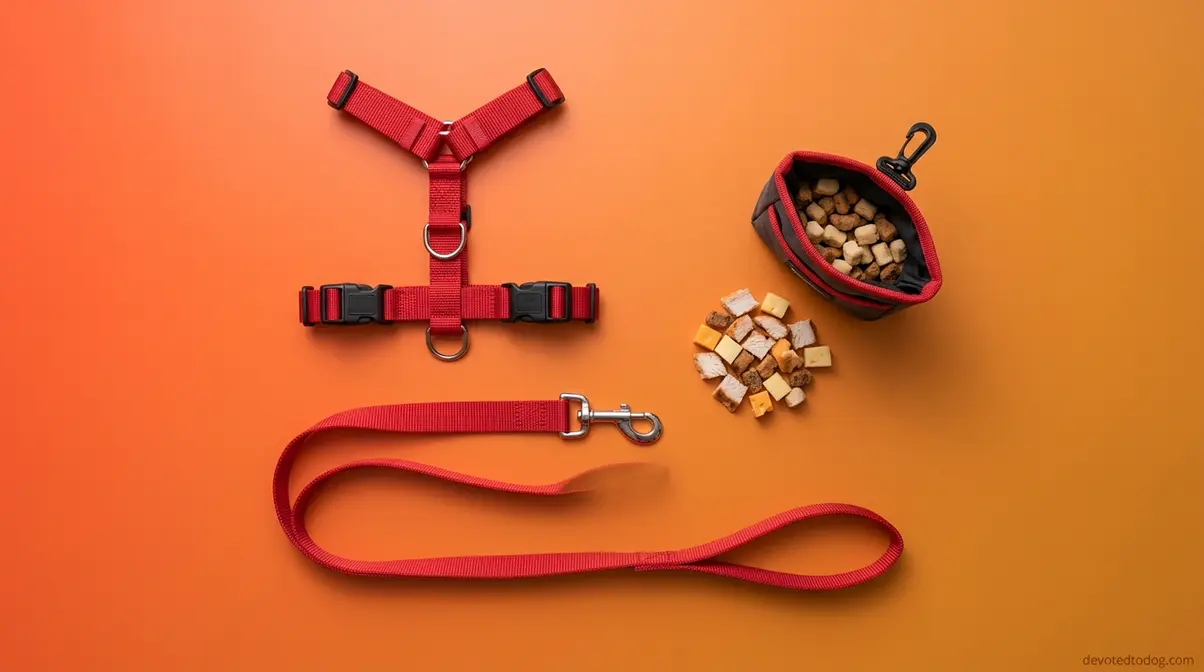
- Estimated Time: 3–6 months for full loose-leash mastery
- Tools/Materials:
- Front-clip harness
- Standard 6-foot nylon or leather leash
- High-value training treats (chicken, cheese)
- Treat pouch
Choosing the Right Leash and Harness
Knowing how to train a dog to walk on a harness starts with understanding which harness does what. When a dog wearing a front-clip harness pulls forward, the leash attachment point at the chest turns their body sideways, physics slows them down without any pain or punishment. That mechanical advantage is why front-clip harnesses are the top recommendation for Golden Retrievers that pull. Here’s a quick comparison of every option you’ll encounter:| Equipment Type | Best For | Key Advantage | Key Disadvantage |
|---|---|---|---|
| Front-clip harness | Serial pullers, strong dogs | Redirects momentum; discourages pulling | Requires proper fit; can restrict gait if too tight |
| Back-clip harness | Calm walkers, small dogs | Comfortable; easy to put on | Gives no control over pulling direction |
| Head halter (Gentle Leader/Halti) | Very strong pullers; reactive dogs | Maximum steering control | Takes adjustment time; some dogs resist it |
| Standard flat collar | Dogs with basic leash manners | Simple; everyday use | Can injure neck/trachea if dog pulls hard |
| Retractable leash | NOT recommended for training | None during training | Teaches pulling by rewarding tension |
Setting Realistic Expectations
Knowing how to train your golden retriever to walk on a leash starts with understanding that this is a process, not a quick fix. Most Golden Retrievers show visible improvement within 2–4 weeks of daily 10–15 minute sessions. Full loose-leash mastery in distracting outdoor environments, the busy park, the neighborhood full of squirrels, can take 3–6 months. That’s normal, not a failure. One distinction that matters immediately: training sessions are not exercise walks. Early training sessions are short, focused learning moments. Your dog still needs physical exercise, yard play, fetch, a run in a fenced area, separately while leash training is in progress. Trying to exercise a pulling dog and train them at the same time in the first weeks rarely works for either goal. Consistency matters more than any single technique. If one family member allows pulling to the mailbox because they’re running late, the dog just learned that pulling works sometimes. Every person in the household must use the same rules, the same commands, and the same response to pulling, every single time. A quick family meeting before you start is worth more than a week of solo training sessions. If your Golden is 5 months old and has been pulling since week one, expect 4–8 weeks of consistent daily practice before you see reliable improvement on your street. You can also explore various dog training collars to supplement your approach as training progresses. The AVMA guidelines for walking your dog recommend short, frequent walks with rests to prevent handler and dog frustration building to a breaking point (AVMA, 2026). With the right gear on your Golden and the right mindset in your head, you’re ready to start. Let’s begin where all great leash training starts: indoors.Step 1: Introduce the Collar and Leash
The first step to teaching loose-leash walking is always indoors. The Purdue Canine Welfare Center leash introduction recommends starting in a comfortable, distraction-free space and keeping initial sessions very short for dogs new to wearing collars and leads, this applies whether you’re training a new puppy or an adult Golden (Purdue, 2026). The goal of this entire phase is not walking, it’s building a positive emotional response to the harness and leash so your Golden sees them as signals for good things, not restraint. You’ll use the Golden 10-10-10 Framework in Step 3, but right now, your only goal is making the leash feel like a good thing. Positive reinforcement, a training approach where you reward the behavior you want to see more of, never punishing the behavior you want to stop, drives every step in this phase. You’ll also need high-value treats: small, soft, smelly rewards like chicken, cheese, or commercial training treats that your dog loves more than their regular kibble. The higher the value, the faster the learning.Step 1: Let Your Dog Sniff the Leash
This phase applies whether you’re training a new puppy or an adult Golden starting from scratch. The process is simple:- Place the leash flat on the floor. Do nothing. Wait.
- When your Golden approaches and sniffs it, even a curious glance, immediately mark it with a cheerful “Yes!” and drop a treat near the leash.
- Do the same with the harness. Set it on the floor. Let your dog put their nose through the neck opening on their own terms. Reward every voluntary interaction.
- Repeat for 2–5 minutes per session. Run 2–3 sessions before moving to Step 2.
Step 2: Practice Wearing the Harness
- Clip the harness on. Immediately give 5–6 small treats in quick succession, before your dog has time to think about the new sensation.
- Take the harness off. Wait 30 seconds. Put it back on. Reward again. Repeat 3–4 times.
- Watch for the green light: your Golden starts wagging when they see the harness come out. That’s your signal to move forward.
- Next, attach the leash clip and let it drag on the floor. Watch your dog’s reaction. If they freeze or panic, go back to Step 1 for two more days. If they move normally, reward and proceed.
- Keep each wearing session under 5 minutes. Never leave a dragging leash unattended, it can catch on furniture and startle or injure your dog.
Step 3: Take Your First Steps Together
Here’s how to teach your puppy to walk on a leash in its most fundamental form:- Hold the leash loosely. Take one step away from your dog.
- Call them to you with a cheerful voice: “Come here! Yes!”
- The moment they take one step toward you, give a treat. That’s the session.
- Repeat 5 times. End the session.
Step 2: Teach Loose-Leash Walking
When figuring out how to train your golden retriever to walk on a leash, remember that loose-leash walking is a skill built through repetition and well-timed rewards, not a behavior that appears overnight. A University of Wisconsin leash training study found that the “Major-Minor Walking Program”, rewarding loose-leash moments as significant events while applying consistent consequences for pulling, was the most effective approach for teaching loose-leash walking (University of Wisconsin, 2026). In this section, you’ll learn the attention game, the J-shape leash concept, the indoor-to-outdoor progression, and how to adapt these steps if you have an older adopted Golden.Step 4: The Attention Game
Before your dog can walk on a loose leash, they need to check in with you voluntarily. Here’s how to build that habit:- Stand still with your Golden on leash. Hold treats in your closed fist at your side.
- Wait. Say nothing. Your dog will sniff, look around, and eventually glance at you.
- The moment they make eye contact, even a half-second glance, mark it immediately: “Yes!” and reward.
- Repeat 10 times per session. Once your Golden is checking in reliably, take one step. If they follow and maintain attention, reward. Take two steps. Build gradually.
Step 5: Reward the J-Shape Leash
The J-shape leash is the specific arc of slack that a properly held leash makes when your dog is walking at your side without pulling, it looks like the letter “J” hanging between your hand and the harness clip. This is the position you always reward. The rule is simple: J-shape = walk continues and occasional treat. Tight leash = you stop. No yelling, no jerking. Just stop. Every. Single. Time.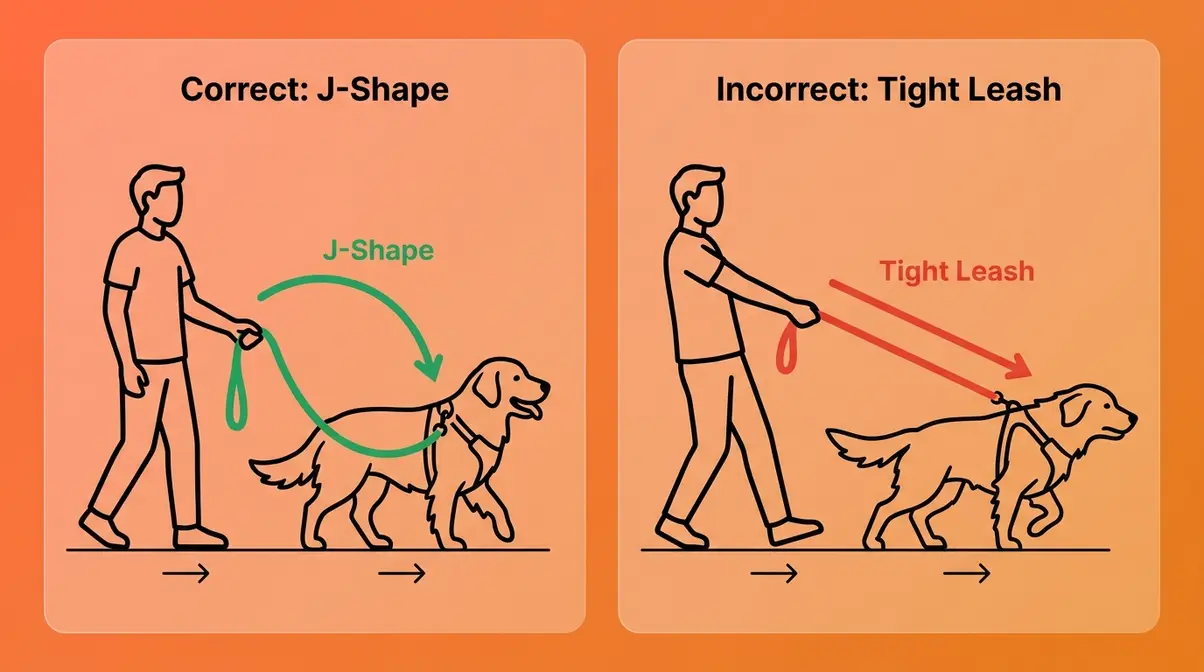
Step 6: Moving Indoors to Outdoors
Training your golden retriever to walk on a leash outside requires a deliberate progression, the mistake most owners make is going directly from living room to sidewalk. The correct path is a 5-level ladder:- Level 1: Living room, zero distractions, your dog knows this environment cold
- Level 2: Front porch or driveway, mild new smells, slightly more stimulation
- Level 3: Quiet residential street, early morning, low foot traffic
- Level 4: Normal neighborhood walk, moderate distractions, other dogs possible
- Level 5: Park or busy area, high distraction, advanced stage only
Adapting for Older Golden Retrievers
When it comes to how to train an older dog to walk on a leash, the good news often surprises people: adult Golden Retrievers have longer attention spans than puppies, which actually accelerates learning once you have their focus. A 2-year-old dog can hold concentration for longer sessions than an 8-week-old puppy. However, older dogs who have never been leash trained, or who were always walked on a slip lead, may have stronger pulling habits or more anxiety around new equipment. The Purdue Canine Welfare Center leash introduction recommends starting in a distraction-free space with very short initial sessions for dogs new to leash wearing, regardless of age (Purdue, 2026). Start at Level 1 (indoors) regardless of the dog’s age, even for a 5-year-old Golden. Do not skip the equipment desensitization phase because the dog “should be past that.” Use higher-value treats for older dogs, real chicken, hot dog slices, because they may be less food-motivated than puppies. Also increase session frequency: three short sessions per day rather than one longer session produces faster results. A 3-year-old rescue Golden who has only ever been walked on a slip lead may lunge and panic in a front-clip harness on day one. Spend 3–4 days on equipment desensitization alone. The patience pays off in weeks, not months. You’ve built the foundation. Your Golden knows the J-shape. Now comes the challenge that brings most owners to search for help: what to do when your dog pulls anyway, and pulls hard.Step 3: Stop Golden Retriever Pulling
Stopping leash pulling requires one consistent principle: remove the reward of forward movement every single time the leash tightens. According to UC Davis Veterinary Medicine, the “Be a Tree” method, becoming an immobile object until the leash goes slack, is highly effective for pullers because it removes forward progress as the reward entirely (UC Davis, 2026). In this section, you’ll learn why Golden Retrievers pull, three proven techniques to stop it, and how to combine them into the Golden 10-10-10 Framework, this guide’s original structured training cycle.https://www.youtube.com/watch?v=v1ftuJIJjTw
Why Golden Retrievers Pull on Leash
Understanding why your dog pulls is the first step to stopping it. Dogs pull because pulling has always worked. Every time a Golden lurched toward a smell and their owner stumbled forward, the dog learned a clean lesson: pulling = I get to go where I want. This is the reinforcement history, and it’s built from the owner’s behavior, not the dog’s stubbornness. Golden Retrievers have a specific pulling trigger called “greeting frustration”, an intense drive to rush toward other people and dogs. Unlike many breeds that pull to explore or escape, Goldens pull to connect. They aren’t being defiant; they’re being overwhelmingly social. This distinction matters for choosing the right technique. Then, around 6 months, something shifts. Confidence surges. Attention span drops. Physical strength increases dramatically. Dogs that were making real progress may suddenly regress, pulling harder than they did as young puppies. Research from the UNL Dog Cognition Lab research on impulsivity identifies impulsivity as a key behavioral trait that peaks during adolescence, making it harder for young dogs to resist distractions and maintain trained behaviors (UNL, 2026). If your 6-month-old Golden was doing well at 4 months and suddenly seems to have “forgotten” everything, you haven’t failed. The adolescent phase is real, documented, and temporary. Now that you understand why your Golden pulls, here’s how to stop it, starting with the simplest and most powerful technique.Technique 1: The “Be a Tree” Method
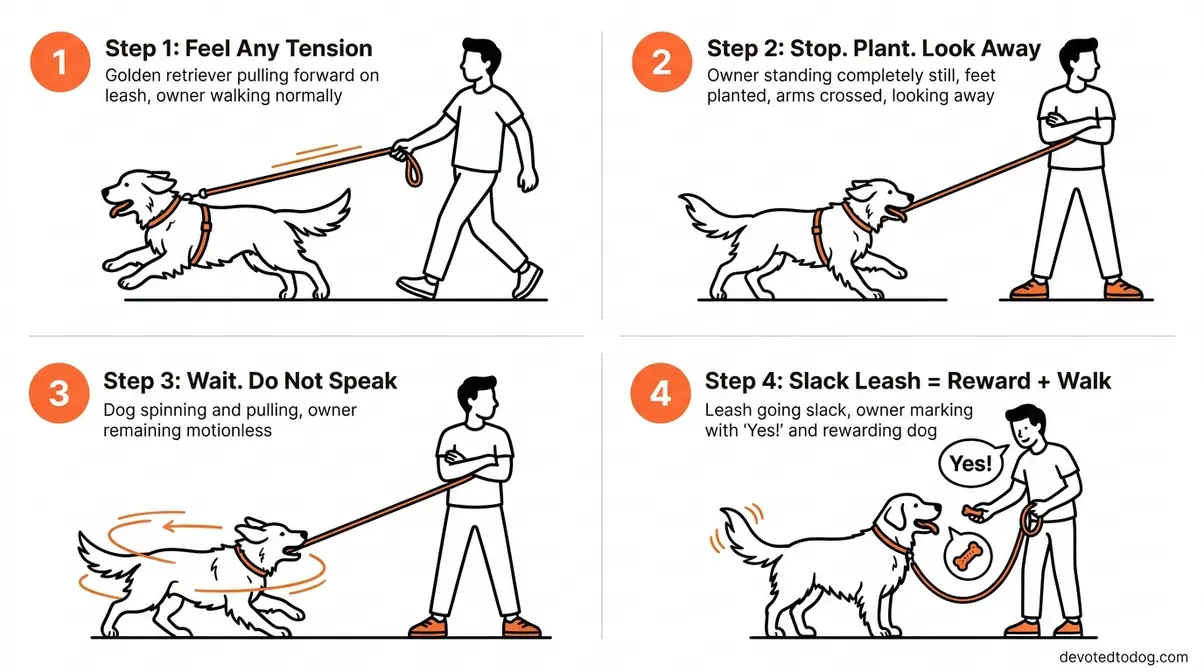
The “Be a Tree” method is a technique where you become completely stationary the moment the leash tightens, no movement, no talking, no eye contact, until the leash goes slack. Here’s how to execute it:- Walk with your Golden on leash. The moment you feel any tension, not when the dog is at the end of the leash, but at the first hint of tightening, stop completely.
- Plant your feet. Cross your arms. Look away. Do not speak. Do not jerk the leash.
- Wait. Your Golden will likely jump, spin, or pull harder. Keep waiting.
- The moment the leash goes slack, even for a half-second, mark it: “Yes!” and reward. Then walk forward.
- Repeat every single time the leash tightens.
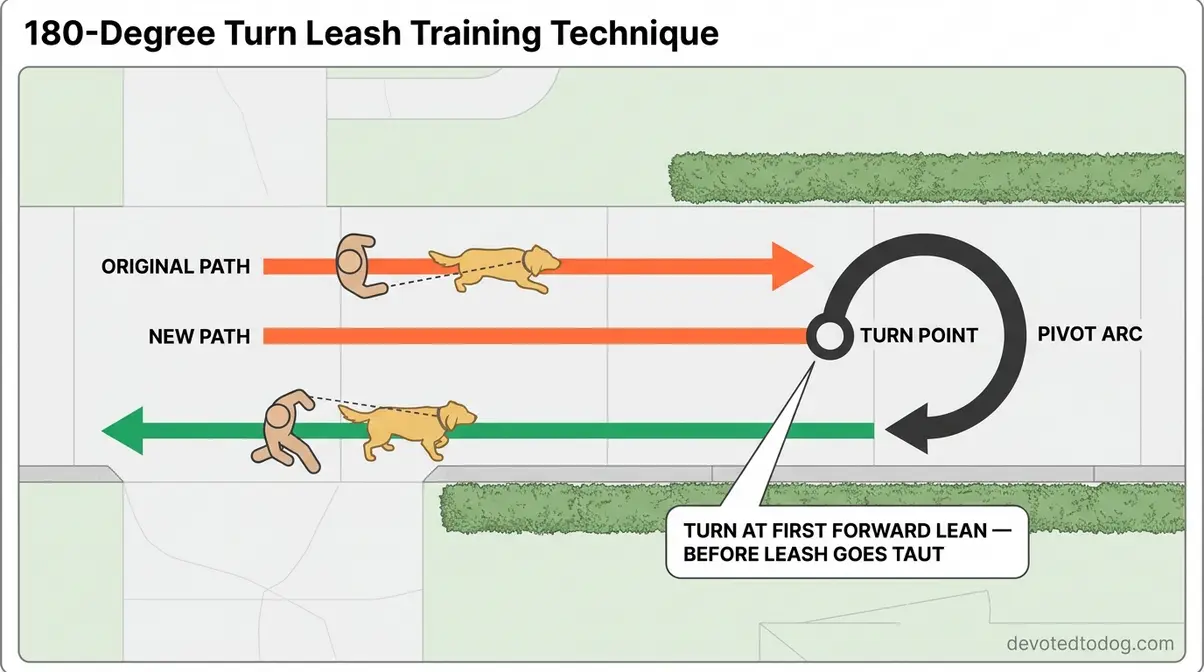
Technique 2: The 180-Degree Turn
The 180-Degree Turn technique is one where you abruptly turn and walk in the opposite direction the moment your dog begins to pull, redirecting their attention back to you. Timing is everything, and most guides get it wrong.- Walk with your Golden. Watch for the first sign of forward lean, a subtle shift in weight, not a full lunge.
- Before the leash goes fully tight: pivot and walk briskly in the opposite direction.
- As you turn, use a cheerful, upbeat voice: “Let’s go!” You want your dog to think following you is the most exciting option available.
- The moment they catch up and walk beside you, reward enthusiastically.
Technique 3: Penalty Yards
Penalty Yards is a technique where you walk backward several steps when your dog pulls, actively removing the forward progress they were trying to achieve. Instead of stopping (Be a Tree) or turning around (180-Degree Turn), you reverse direction and reclaim the ground you had gained together. A University of Wisconsin leash training study found that the “Major-Minor Walking Program”, treating loose-leash moments as “major” rewarded events and tight-leash moments as “minor” infractions met with Penalty Yards, was the most successful approach for teaching loose-leash walking across different dog personalities (University of Wisconsin, 2026). Penalty Yards works best for “selective pullers”, dogs who walk nicely in quiet areas but lose control near specific triggers like other dogs, people, or squirrels. Use Penalty Yards specifically when approaching the trigger zone. You see a dog 30 feet ahead. Your Golden starts pulling. Walk backward 5 steps. Wait for the J-shape. Walk forward again. If they pull again, walk backward again. You control the approach pace, and your Golden learns that pulling actually moves them away from what they want. Now you have three techniques. The question is: how do you combine them into a consistent training session? That’s where the Golden 10-10-10 Framework comes in.The Golden 10-10-10 Framework
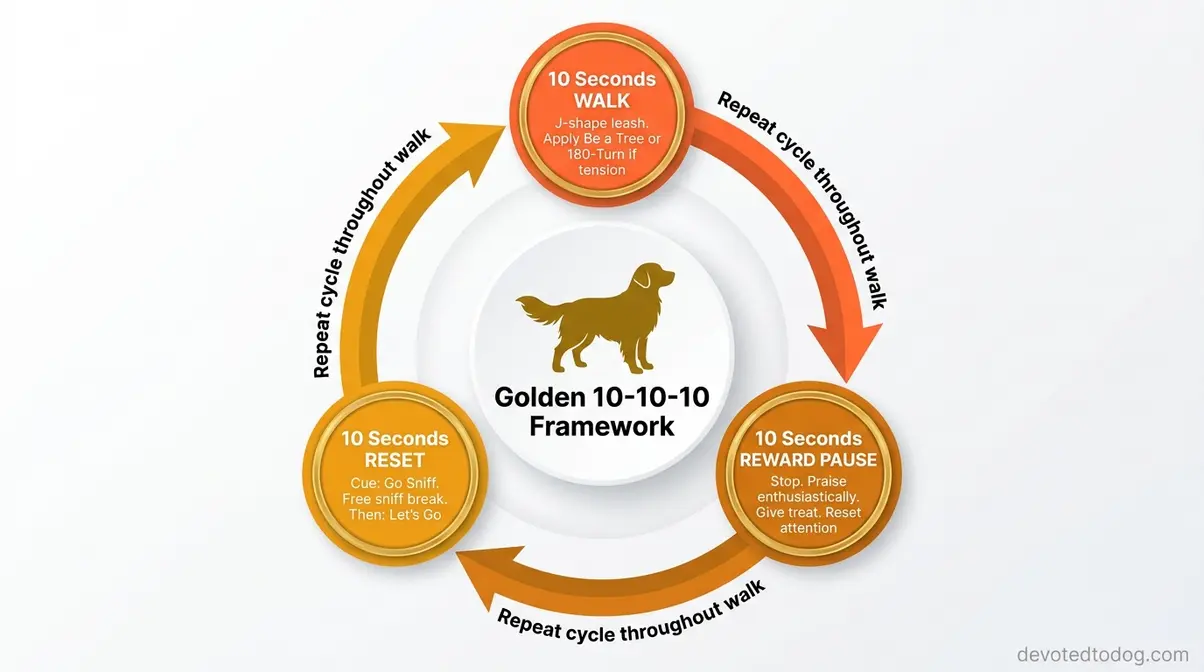
The Golden 10-10-10 Framework is a structured 30-second training cycle designed specifically for Golden Retrievers’ high energy and short focus windows: 10 seconds of focused loose-leash walking → 10-second reward pause → 10-second reset (sniff break or stand still). Repeat the cycle throughout the walk. Here’s how to run the cycle:- Walk (10 seconds): Use the J-shape as your guide. If the leash tightens, apply Be a Tree or the 180-Degree Turn immediately.
- Reward pause (10 seconds): Stop. Praise enthusiastically. Give a treat. This resets your Golden’s attention on you before excitement builds toward a distraction.
- Reset (10 seconds): Give the cue “Go sniff.” Let your dog sniff freely for 10 seconds. Then “Let’s go”, and repeat the cycle.
Step 4: Puppy Leash Training Guide
Golden Retriever puppy leash training requires a gentler, game-based approach that matches a young dog’s short attention span and high distractibility. The goal isn’t formal heel work, it’s building positive associations and a habit of following you. A comprehensive genomic study from Arizona State University found that individual training and environment matter more than breed stereotypes in determining behavior outcomes, meaning the work you put in during these early months has an outsized effect on the adult dog your Golden becomes (ASU, 2026). The Texas Tech Animal Behavior Clinic recommends starting with just one step while maintaining your puppy’s attention with a high-value reward, then gradually increasing distance over multiple short sessions (Texas Tech, 2026).How to Get a Golden Puppy to Walk?
Golden retriever puppy leash training starts indoors in a distraction-free space to build positive associations with the collar and leash before any outdoor sessions begin. Use high-value treats to lure your puppy to your side and reward every 2–3 steps with a loose leash. Keep sessions to 3–5 minutes to match their short attention span. Most Golden Retriever puppies show visible improvement within 1–2 weeks of daily indoor sessions before transitioning outside. If your puppy refuses to move, crouch down, use an excited voice, and let them come to you, never pull.Puppy Leash Training Age Milestones
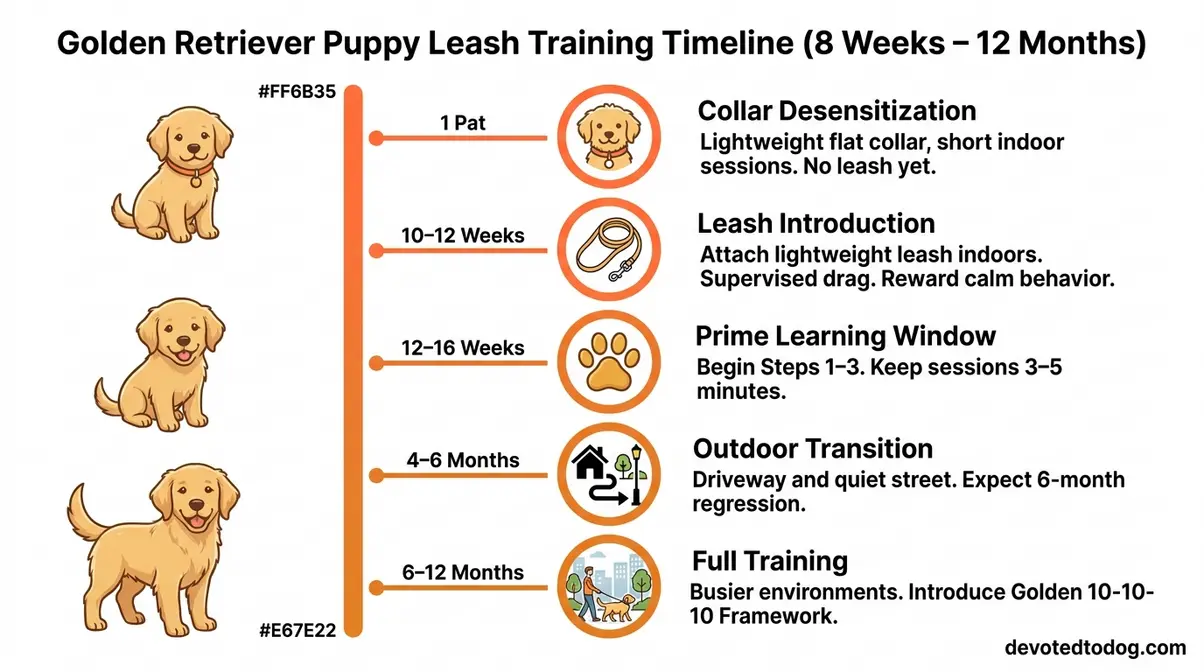
How to train your puppy on a leash depends on their age, and starting at the right phase makes everything easier. Here are the milestones:- 8 weeks: Begin collar desensitization indoors. Let your puppy wear a lightweight flat collar for short periods. No leash yet.
- 10–12 weeks: Attach a lightweight leash indoors. Let the puppy drag it supervised. Reward calm behavior.
- 12–16 weeks: Begin Steps 1–3 from this guide. Keep sessions 3–5 minutes. This is the prime learning window.
- 4–6 months: Begin outdoor training at Level 1–2 (driveway, quiet street). Expect some regression around 6 months, the adolescent phase is coming.
- 6–12 months: Progress to busier environments. Introduce the full Golden 10-10-10 Framework.
Step 1: Make the Leash Exciting
Teaching your puppy to walk on a leash begins with a simple rule: the leash must only ever mean good things. Use the same leash desensitization from Step 1 of the main guide, but make it even more game-like. Toss treats near the leash. Play with a toy near the leash. Feed your puppy dinner right next to the leash. The goal is a clear mental association: leash = excitement, not anxiety. Golden Retriever puppies, a breed known for their eager-to-please temperament, are exceptionally responsive to positive reinforcement. Use your voice enthusiastically. “Yes! Good puppy!” delivered with genuine excitement, paired with a treat, creates a faster association than treats alone. Your tone of voice is a reward in itself for this breed. Do not use the leash to restrain or correct the puppy at this stage. The moment the leash becomes associated with restriction, you’ve created a negative association that takes weeks to undo, and those weeks are training time you can’t get back. Pick up the leash. Immediately give your puppy a treat before you’ve even attached it. Put it down. Repeat 5 times. Within two days, your puppy will be running to the leash when they see it. Your puppy loves the leash. Time to use that enthusiasm in your first indoor training game.Step 2: Indoor Training Games
How to train my puppy to walk on a leash becomes much simpler when you frame it as play rather than practice. Two games build all the skills you need:- Game 1, “Follow the Treat”:
- Hold a treat at your hip, at your puppy’s nose level.
- Walk 3 steps. Give the treat.
- Repeat 5–8 times, then end with a play reward (tug or fetch).
- Game 2, “Name and Reward”:
- Say your puppy’s name.
- The moment they look at you, mark with “Yes!” and give a treat.
- Attach this to movement: say their name, walk 3 steps while they follow, treat.
Step 3: Managing Puppy Distractions
When your puppy first steps outside, expect them to completely forget everything they learned indoors. This is normal, and it’s not a setback. The outdoor environment is overwhelming. New smells, sounds, movement, temperature changes. Their brain is processing a flood of information, not ignoring you. The solution isn’t more repetition, it’s environment management. Go outside at low-distraction times: early morning, quiet areas, short grass. Start with one step in the new environment before asking for anything more. Your highest-value treats are mandatory outdoors. If chicken works indoors, bring something even better outside, real cheese, hot dog slices. The outdoor environment competes hard for your puppy’s attention, and your treats need to compete harder. For puppies that sit down and refuse to move, a phenomenon sometimes called a “puppy strike”, do not pull. Instead, crouch down, make yourself small and exciting, pat the ground, and use a playful voice. Most Golden puppies will trot over immediately when they see this, reward that choice like they just won the Olympics. If the puppy still won’t move after 30 seconds of encouragement, pick them up and try again in a quieter spot. Forcing a frozen puppy forward creates anxiety; choosing a less overwhelming environment and trying again creates confidence. When training a puppy on a leash outdoors, keep sessions to 5–7 minutes maximum at first. Your puppy freezes on the front porch, overwhelmed. Don’t pull. Crouch down, slap your knees, use your most ridiculous excited voice: “Come here! Yes!” Your Golden puppy’s social drive almost always wins. When they trot over, reward big. Puppy training takes patience. Adult dog training takes consistency. Both can go sideways, and when they do, the next section will help you diagnose and fix the most common mistakes.Common Leash Training Mistakes
Most leash training plateaus happen because of inconsistency, allowing pulling on “easy” walks while correcting it on “training” walks teaches the dog that pulling sometimes works (UC Davis School of Veterinary Medicine, 2026). This section covers the five most common mistakes, the 6-month regression phase that catches almost every Golden owner off guard, and when to call in professional support.5 Common Leash Training Mistakes
These five patterns derail more leash training programs than any other cause:- Allowing pulling on “easy” walks. Scenario: You let the dog pull to the mailbox because you’re in a hurry. Consequence: The dog learns pulling works sometimes, and intermittent reinforcement makes the behavior stronger, not weaker. Fix: Every walk is a training walk. No exceptions, no off days.
- Sessions that are too long. Scenario: 30-minute training walks for a 12-week puppy. Consequence: The puppy shuts down; training starts to feel aversive. Fix: 5–10 minutes maximum for puppies, 15–20 minutes for adult dogs. Always end on a success.
- Yelling or leash-jerking. Scenario: Yanking the leash or scolding when the dog pulls. Consequence: Increases anxiety and can actually increase pulling intensity as the dog becomes more aroused. Fix: Stop walking (Be a Tree) instead of responding physically. Silence and stillness are more effective than corrections.
- Skipping the indoor phase. Scenario: Going straight to outdoor walks without any indoor foundation work. Consequence: The dog is overwhelmed; there are no trained behaviors to reinforce. Fix: 3–5 indoor sessions before any outdoor training, this is not optional.
- Inconsistency across family members. Scenario: One person allows pulling; another corrects it. Consequence: The dog learns to pull with the “easy” person and maintains that habit with everyone. Fix: A 5-minute family meeting, everyone uses the same rules, same commands, same response to pulling. No exceptions.
6-Month Adolescent Regression Phase
Around 5–8 months, Golden Retrievers enter adolescence. Hormones surge, confidence increases, and the dog seems to “forget” training. Pulling that had improved may suddenly return, sometimes worse than at the very beginning. This is not a permanent setback. Research from UNL’s Dog Cognition Lab shows that impulsivity peaks during the adolescent phase, making it harder for young dogs to maintain trained behaviors around distractions, this is a documented neurological shift, not a character flaw (UNL, 2026). Most Golden Retrievers move through the adolescent phase by 12–18 months, and the training invested before adolescence is not lost, it returns once the hormonal surge stabilizes. When regression hits, return to basics: go back to indoor training sessions, reduce session length, increase treat value. Restart the Golden 10-10-10 Framework at its simplest level, 10 seconds walking, reward, reset. Your 7-month Golden was walking beautifully at 4 months and is now dragging you down the street again. Go back to driveway sessions. Use your highest-value treats. Within 2 weeks, you’ll see the skills return.Hardest Age for a Golden Puppy?
The hardest age for a Golden Retriever puppy is typically between 5 and 8 months, when the adolescent phase begins and previously learned behaviors can temporarily regress. During this period, hormonal changes increase confidence and impulsivity, making it harder for the puppy to focus during training sessions, pulling that had improved often returns, sometimes worse. Most Golden Retrievers move through this phase by 12–18 months, and training invested before adolescence does return once the hormonal surge stabilizes. Returning to shorter indoor sessions with higher-value treats during this phase is the most effective recovery strategy.When to Call a Professional Trainer
Consider a professional trainer if any of these apply:- Your dog is physically dangerous to walk, dragging you into traffic, causing injuries to you or others
- Pulling is accompanied by reactive behavior: lunging, barking, growling at people or other dogs
- You’ve been consistent for 8+ weeks with no measurable improvement
Frequently Asked Questions
How to Walk a Stubborn Puppy?
For a stubborn puppy that pulls or refuses to walk, use the “Be a Tree” method: stop completely the moment the leash tightens and wait for it to go slack before moving forward. You can also try the 180-Degree Turn, walk briskly in the opposite direction the moment pulling starts, then reward your puppy for catching up and walking beside you. Consistency is the key variable; applying these techniques on every single walk, without exceptions, produces results within 1–3 weeks.What Is the 10-10-10 Rule for Dogs?
The 10-10-10 rule for dogs is a structured training cycle: 10 seconds of focused loose-leash walking, a 10-second reward pause, and a 10-second reset (sniff break), repeated throughout the walk. This cycle works particularly well for Golden Retrievers because it matches their high energy with frequent reinforcement, preventing the buildup of excitement that leads to pulling. Most owners see calmer, more attentive walking within 5–7 days of consistently applying the 10-10-10 cycle on every walk. Puppies can start with a modified 5-5-5 version (5 seconds each) and build up to the full 10-10-10 as they mature.Hardest Age for Golden Retrievers?
For most owners, the hardest age for Golden Retrievers is the adolescent phase between 6 and 18 months, when the dog has adult-level energy but not yet adult-level impulse control. During this window, Goldens may ignore commands they mastered as puppies, pull harder on the leash, and test boundaries more persistently. Consistent daily training through the adolescent phase, even just 10–15 minutes, dramatically shortens its duration and helps them settle into calmer behavior by 18–24 months.Hardest Part of Owning a Golden?
The hardest parts of owning a Golden Retriever are managing their high energy levels, which require significant daily exercise, and handling their heavy shedding, which demands regular grooming. Their intelligence also requires consistent mental stimulation, as bored Goldens can quickly become destructive Goldens. Most Golden Retriever owners report that the adolescent phase (6–18 months) is the peak challenge period for energy, training regression, and leash pulling.Silent Killer in Golden Retrievers?
The silent killer in Golden Retrievers is cancer, particularly hemangiosarcoma, a fast-spreading cancer of the blood vessel walls that often shows no symptoms until it is in an advanced stage. Golden Retrievers have one of the highest cancer rates of any breed, and cancer caused 65% of deaths in a UC Davis study of the breed (Kent et al., PLoS ONE, 2018). Annual bloodwork, physical examinations, and knowing your dog’s baseline energy and behavior can help catch warning signs earlier. Consult your veterinarian about breed-specific cancer screening protocols recommended for Golden Retrievers.How Do Dogs Say “I Love You”?
Dogs say “I love you” through several consistent behaviors: soft, relaxed eye contact, leaning against you, following you from room to room, and bringing you their favorite toy. Golden Retrievers are particularly expressive, their full-body wiggle, tendency to press against your legs, and the relaxed open “smile” expression are all clear affection signals. The consistent leash training work you’re doing right now builds exactly the kind of trust that makes these affection signals more frequent and more genuine.Calmer Walks Start Today
Mastering how to train your golden retriever to walk on a leash without pulling is achievable at any age, whether you’re starting with an 8-week-old puppy or a 3-year-old rescue. The University of Wisconsin leash training study found that structured reward-based programs consistently outperform correction-based methods for loose-leash walking (University of Wisconsin, 2026). The best approach, as devotedtodog.com has outlined across this guide, combines a front-clip harness for physical management, the “Be a Tree” method for immediate pulling correction, and the Golden 10-10-10 Framework for long-term habit building. The Golden 10-10-10 Framework is the bridge between frustration and confidence. If you’ve been the person getting dragged down the street, the serial puller situation that feels impossible to fix, the 10-second cycle gives you a structure for every single walk. Walk, reward, reset. That rhythm replaces the chaos with a pattern your Golden can learn to predict and lean into. Your first step today: put the harness on the floor, drop three treats next to it, and let your Golden sniff. That’s it. That’s Step 1. From there, follow the progression in this guide, indoors first, then the driveway, then the quiet street. Most owners who commit to daily 10–15 minute sessions see real, lasting improvement within 2–4 weeks. Your calmer walks are closer than you think.
Reviewed by Alliyah Strange, Certified Dog Trainer & Behaviorist (CPDT-KA)
Alliyah Strange is a CPDT-KA certified dog trainer and behaviorist. She reviews DevotedToDog training and behavior articles for accuracy and alignment with current positive-reinforcement, force-free training standards.
Leash skills build through adolescence. Our age-by-age Golden Retriever training guide shows how they connect to the rest of your dog’s training.