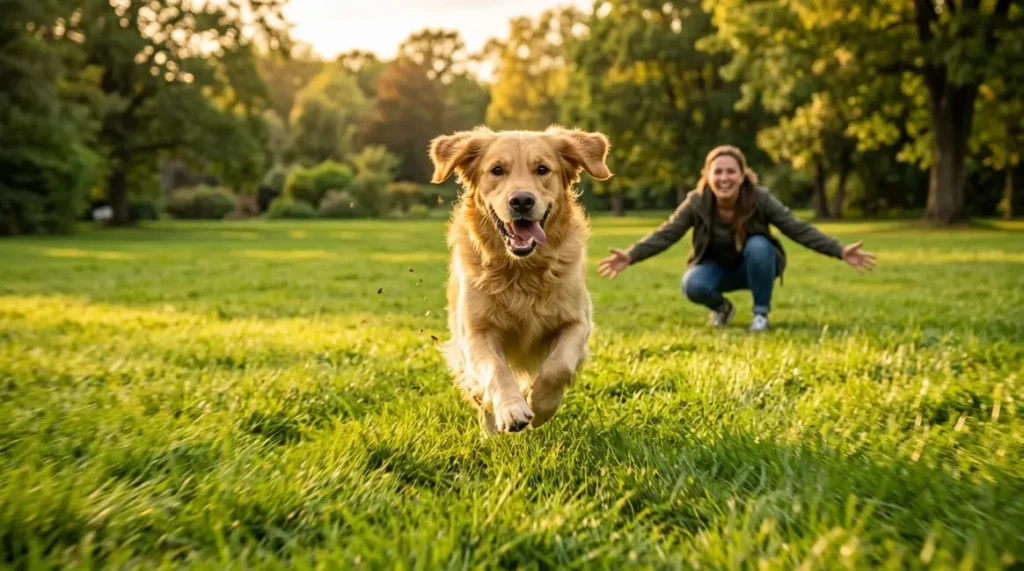
If your Golden Retriever bolts toward another dog and completely ignores your “come,” you are not alone, and it is not a character flaw. Across Golden Retriever owner communities, one of the most common frustrations sounds something like this: terrible recall, zero recall, no idea what to do. The anxiety of a dog that won’t return is real, especially off-leash, and the breed’s social, scent-driven nature makes the problem feel impossible to solve.
It is not impossible. Golden retriever recall training works when coming to you is consistently more rewarding than whatever your dog is running toward. That is the core idea behind every step in this guide.
By the end, you will have a 4-step training plan, a toolkit for when things go wrong, and a clear understanding of why your Golden breaks recall in the first place. The plan moves from the name game indoors through long-line training, distraction proofing, and true off-leash practice, with a troubleshooting section for the specific scenarios that frustrate owners most.
Golden retriever recall training works when coming to you is more rewarding than any distraction. This is The Recall Value Equation, and most recall failures are fixable once you understand it.
- Start indoors: Build the name game in a zero-distraction space before adding distance or distractions. This is where the equation tips easily in your favor.
- Long line first: Never practice off-leash recall until your Golden succeeds on a 15-30 ft long line. Every repetition on the long line is a winning repetition.
- Never punish a return: Scolding a dog who comes back late poisons the recall cue permanently, reducing reward value to zero.
- Emergency recall is separate: Teach a distinct emergency cue (such as “HERE”) for high-stakes situations, and pair it exclusively with the highest-value reward your dog knows.
What You’ll Need Before You Start
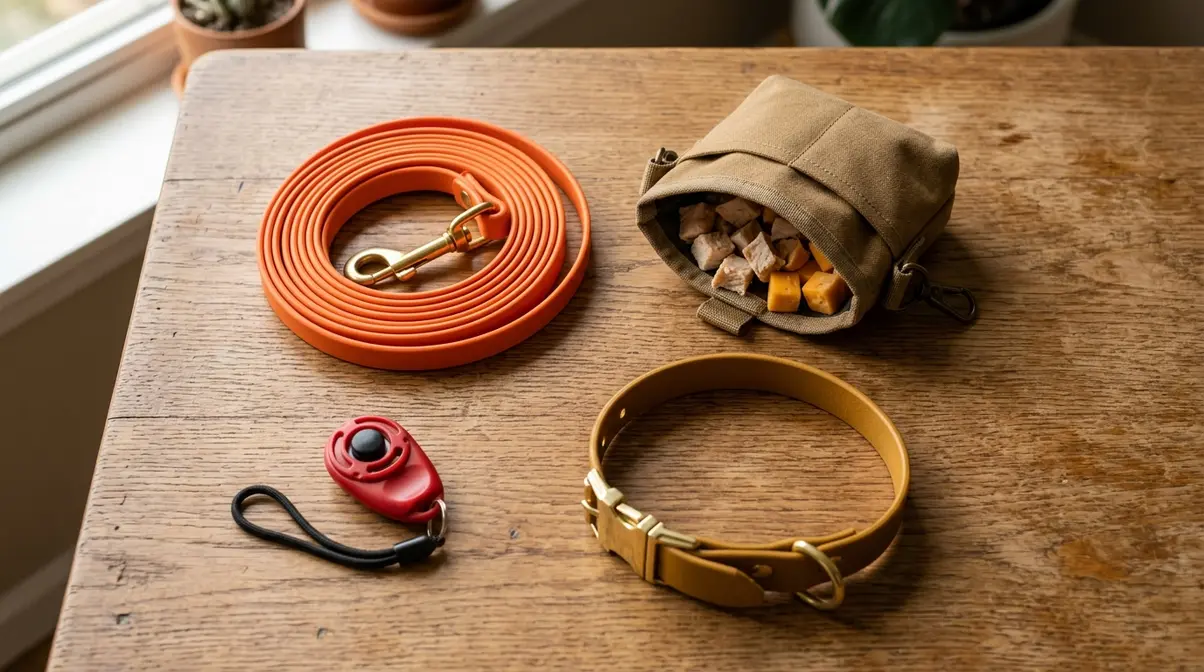
Before your first session, gather these four things. The right preparation is not just logistics. The treat you choose makes the difference between a Golden who sprints toward you and one who trots over reluctantly, and that gap matters more than any training technique.
If you are starting from scratch with a younger dog, our complete guide to training your Golden Retriever at every age covers the full developmental picture. If your dog is still a puppy working on foundational commands, start with our Golden Retriever puppy training guide before this one.
Tools you will need:
- Long line: a 15-30 foot training lead (biothane or nylon, not a retractable leash). This is distinct from a standard leash and is the most important tool in this guide.
- High-value treats: real chicken, cheese, or hot dogs. Not kibble. The reward quality directly affects The Recall Value Equation, and kibble rarely tips the equation in your favor against a squirrel.
- Treat pouch: keeps rewards accessible within 2 seconds, which is the critical window for marking correct behavior.
- Flat collar or harness: attach the long line here. Never a slip lead.
Positive reinforcement is a must in new command training, according to Texas A&M School of Veterinary Medicine. Treats are one of the most effective motivators, especially during the early stages when the association is still forming.
Plan for 5-10 minute daily sessions. Most Goldens reach reliable recall in 4-8 weeks of consistent practice. The mindset shift that matters most: recall is a game your Golden wins every time, not a command they pass or fail. Frame every session as a win, and your dog will start treating it that way too.
If a puppy context arises and you need indoor management solutions during training downtime, you can also browse indoor potty options for young dogs still working on house training.
Now, before you call your Golden’s name even once, it helps to understand exactly why they are ignoring you in the first place.
Why Golden Retrievers Struggle With Recall
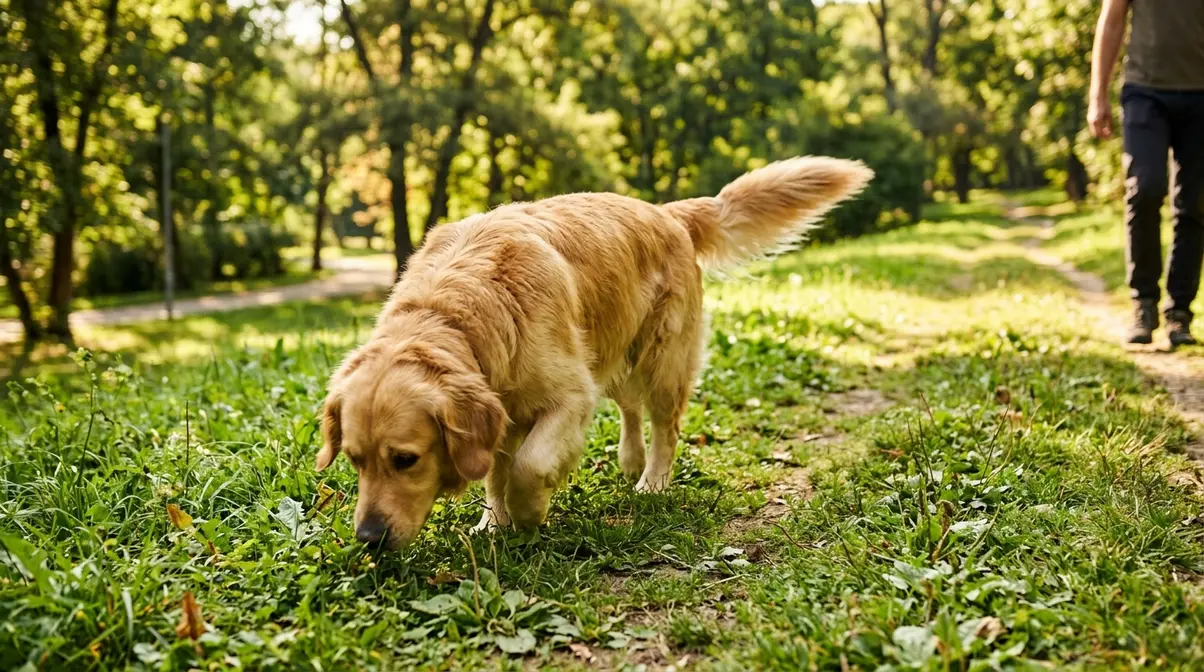
Picture this: your Golden is 30 feet away, nose down in a scent trail, tail spinning like a rotor. You call “come.” Nothing. You call again, a little louder. They glance up, register you exist, and go back to the smell. This is not a training failure. It is The Recall Value Equation in action, and right now, the smell is winning.
Breed instincts play the biggest role. Golden Retrievers were bred to range and retrieve at a distance from their handler. Their instinct is to explore the environment, not orbit the owner. The AKC describes them as “eager, alert, and self-confident,” and all three of those traits compete directly with recall. According to reliable recall training guidance from the AKC, working against a dog’s ranging instinct requires active, consistent training rather than a simple command repetition. Understanding the typical Golden Retriever personality helps explain why the breed is so prone to this: their sociability and curiosity are features, not bugs, but they require management during recall training.
Adolescence makes it worse. Between roughly 6 and 18 months, a Golden’s brain is undergoing rapid development. The prefrontal cortex, which governs impulse control, is still forming. A dog that had decent recall at 4 months may seem to forget everything at 9 months. This is normal and temporary. Recall training basics from Dogs Trust confirms that recall regression during adolescence is one of the most common reasons owners seek help, and the answer is not stricter commands but a return to fundamentals. For a deeper look at what is happening developmentally, see our guide on understanding their behavior at every age.
The Recall Value Equation explains the mechanism. Here is the framework: Recall Reliability = (Reward Quality x Enthusiasm) divided by Distraction Level. If the distraction outweighs the reward, the dog will not come. This is not defiance. It is physics. Every step in this guide is designed to increase the left side of the equation (reward quality times enthusiasm) while systematically reducing the right side (distraction level) through controlled exposure. The higher the distraction level, the higher your reward quality must be to tip the equation in your favor.
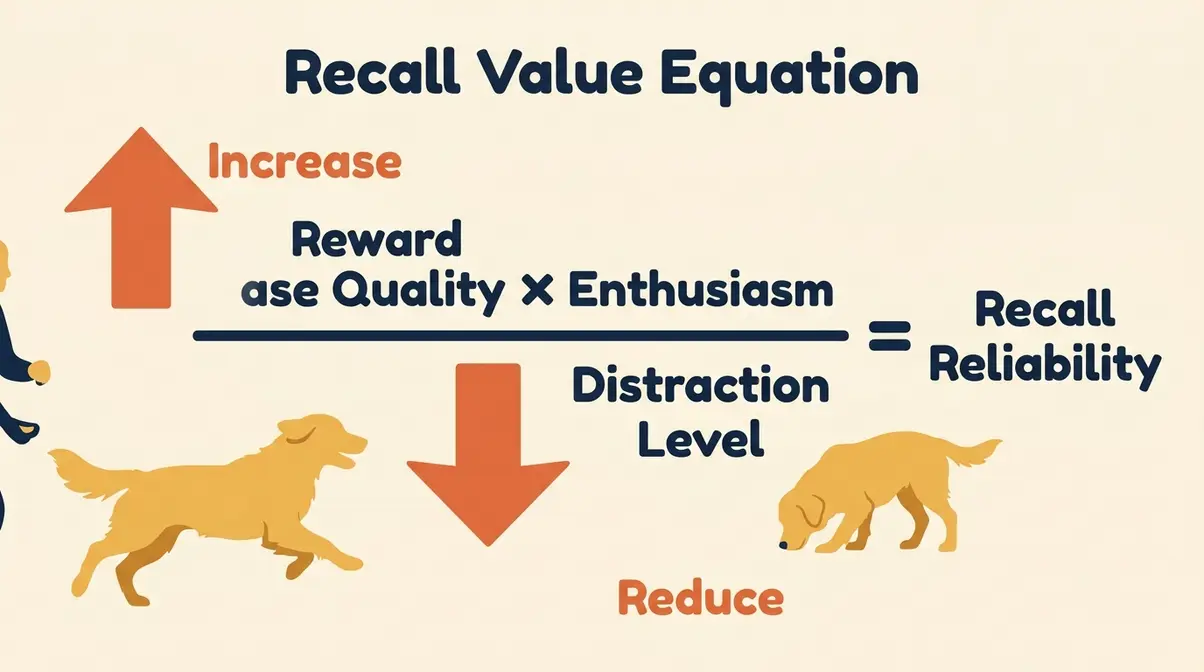
The good news is that The Recall Value Equation is something you can actively manage. Here is how to start tipping it in your favor.
Step 1: Teach the Name Game to Build a Recall Foundation
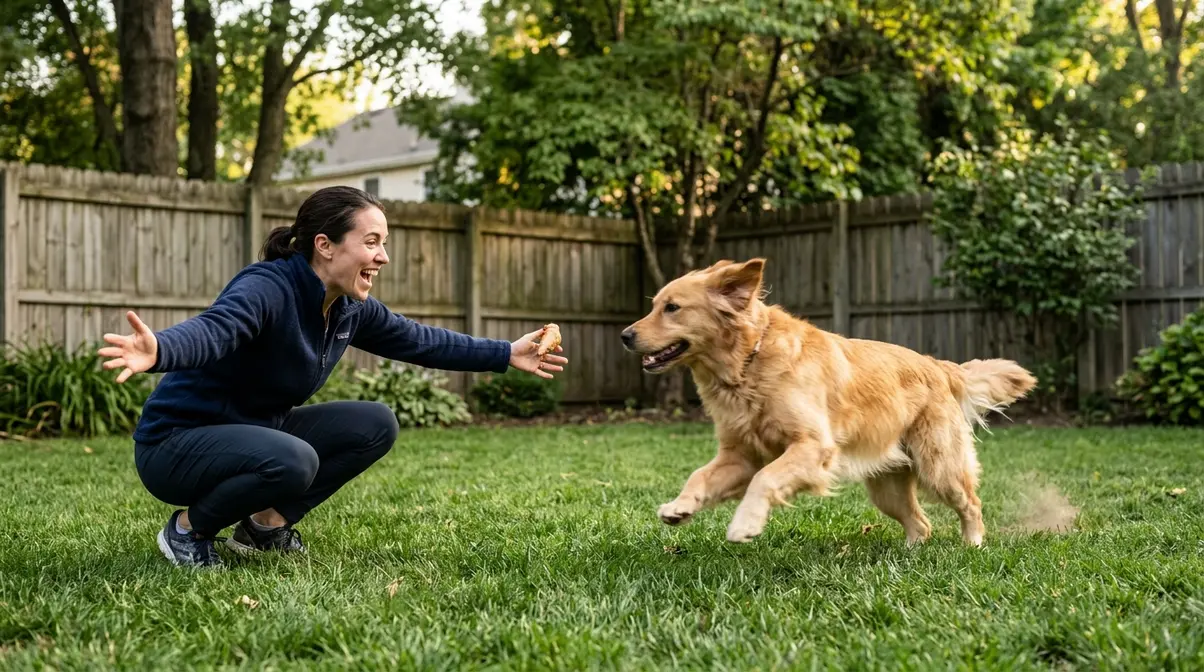
Research shows that a reward delivered within 2 seconds of a behavior is significantly more effective than one delivered later. This is not a guideline. It is the entire foundation of the name game, and it is why this step comes before you ever say “come” to your dog. According to the definition of positive reinforcement from Virginia Tech’s College of Veterinary Medicine, rewarding a desired behavior with treats, toys, petting, or other things the dog enjoys is the foundation of effective recall training.
Most guides tell you to start indoors. This one explains why the name game specifically, and not your recall cue word, is the correct first step. The recall cue must be kept clean. That means it is only used when success is guaranteed. Using “come” before your Golden is ready poisons the cue, and a poisoned cue is very difficult to recover. The name game builds the turning-toward-you behavior without touching the recall word at all.
How to run the name game:
- Choose a quiet indoor space with no other dogs, toys, or food visible.
- Say your Golden’s name once, in a neutral tone. Not excited. Not stern. Just their name.
- The moment they turn toward you, mark the behavior with “yes” or a clicker click. This is the marker: a clicker or verbal “yes” used to mark the exact instant the correct behavior happens.
- Deliver a high-value treat (chicken, cheese, or hot dog) within 2 seconds of the marker.
- Repeat 10-15 times per session. Keep sessions under 10 minutes.
- Do not use your recall cue word (“come”) yet. The name game is completely separate. Using “come” before the dog is reliable poisons the cue before you have even built it.
In The Recall Value Equation terms, this step keeps the distraction level near zero by design. Even a modest treat tips the equation heavily in your favor at this stage. That is the point: build the behavior in the easiest possible conditions before adding any complexity.
Checkpoint: Your Golden should now turn toward you reliably 9 out of 10 times when you say their name indoors. When you hit that rate, move to Step 2.
Once the name game is solid indoors, it is time to add distance. And that is where the long line becomes your best tool.
Step 2: Extend Distance Using a Long Line
The long line is the single most important tool in recall training, and most owners skip it. Here is why it works: the long line prevents your dog from ever successfully ignoring the recall cue. Every repetition is a successful repetition, because the line ensures they always arrive. That is a fundamentally different training history than one where the dog has learned that ignoring “come” is an option. Teaching a reliable recall in manageable distance-based steps, starting close and extending gradually, is a core principle in University of Missouri dog training guidance.
This is also where you introduce the recall cue word for the very first time.
How to use the long line:
- Attach the long line to a flat collar or harness. Never a slip lead.
- Let your Golden move away from you in a low-distraction outdoor space, such as your backyard or a quiet park.
- When they are 10-15 feet away, say your recall cue once (“come” or “here”) in a happy, upbeat tone.
- If they turn and run toward you: celebrate loudly. Deliver the highest-value treat you have. Make it a moment.
- If they do not respond within 2 seconds: gently guide them toward you using the long line. No jerking. No repeating the cue. When they arrive, still reward warmly. The reward is for arriving, not for speed.
- Gradually increase distance as your success rate climbs.
In Recall Value Equation terms, the long line keeps the distraction level manageable while you build the reward association with the recall cue. The cue starts to mean something good before it is ever tested against real-world distractions.
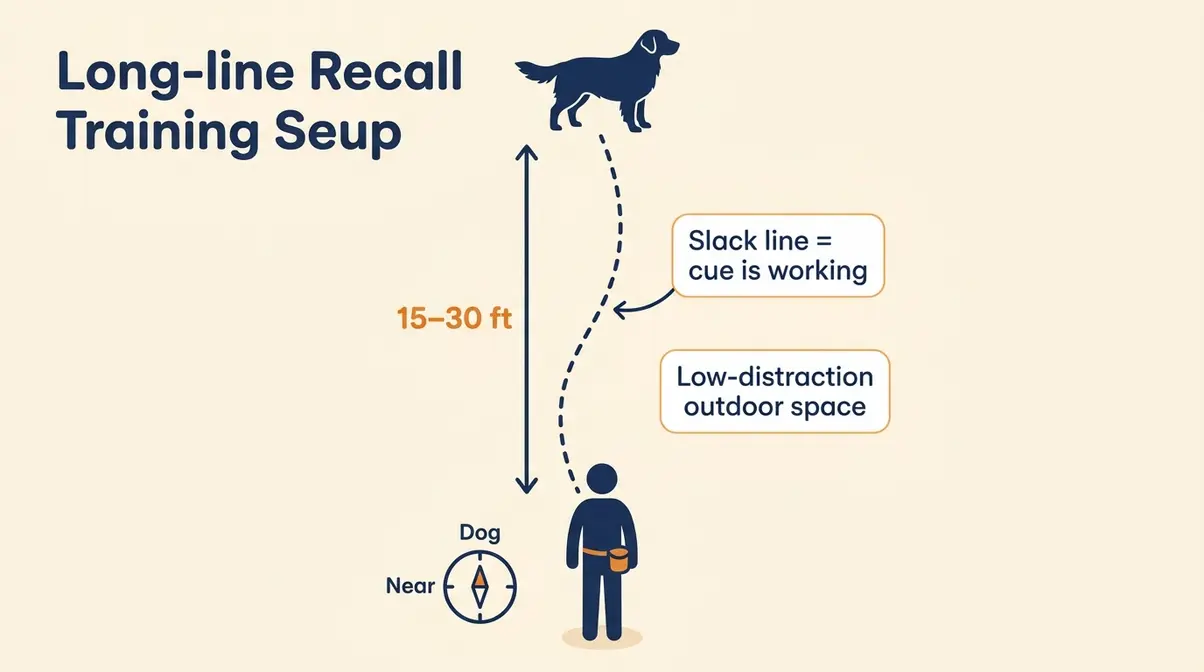
Checkpoint: Your Golden should now be running toward you on the first call, with the long line hanging slack. That slack line means the cue is working.
With a reliable recall on the long line, you are ready for the hardest part: other dogs, squirrels, and everything else your Golden finds more interesting than you.
Step 3: Proof Your Golden’s Recall Around Distractions
Your Golden comes perfectly in the backyard. So why does the dog park feel like starting from scratch? Because a behavior learned in one environment does not automatically transfer to another. Proofing is the process of teaching recall in every environment your dog will ever encounter, and it requires a structured approach. Without structure, most owners accidentally jump to distraction levels their dog is not ready for, which rehearses failure rather than success.
This step uses a sub-framework called The Distraction Ladder, which sits within The Recall Value Equation. It is a ranked progression of five distraction levels, and it tells you exactly where to train and when to advance.
The Distraction Ladder:
- Level 1: Mild smells. Grass, light outdoor scents, no other animals visible.
- Level 2: Distant people. Strangers 50 or more feet away, no interaction.
- Level 3: Distant dogs. Another dog visible but 30 or more feet away, no interaction.
- Level 4: Nearby dogs. Another dog 10-15 feet away, on leash.
- Level 5: Off-leash dogs. The highest distraction level for most Goldens. Attempt only after Step 4 is complete.
The rule is simple: do not move up a level until your Golden succeeds 9 out of 10 times at the current level. As you move up, increase reward quality proportionally. At Level 4, use the highest-value treat your dog will work for. This is The Recall Value Equation in direct practice: as the denominator (distraction level) rises, the numerator (reward quality times enthusiasm) must rise with it.
According to troubleshooting a poor recall guidance from Iowa State University Extension’s obedience curriculum, when a dog fails to come immediately when called, the recommended approach is to revert to the dog’s name to regain attention before re-issuing the recall command. That principle maps directly to the Distraction Ladder: if your dog fails at a given level, drop back to the level below and rebuild.
Keep the long line on through all of Step 3. It comes off only in Step 4.
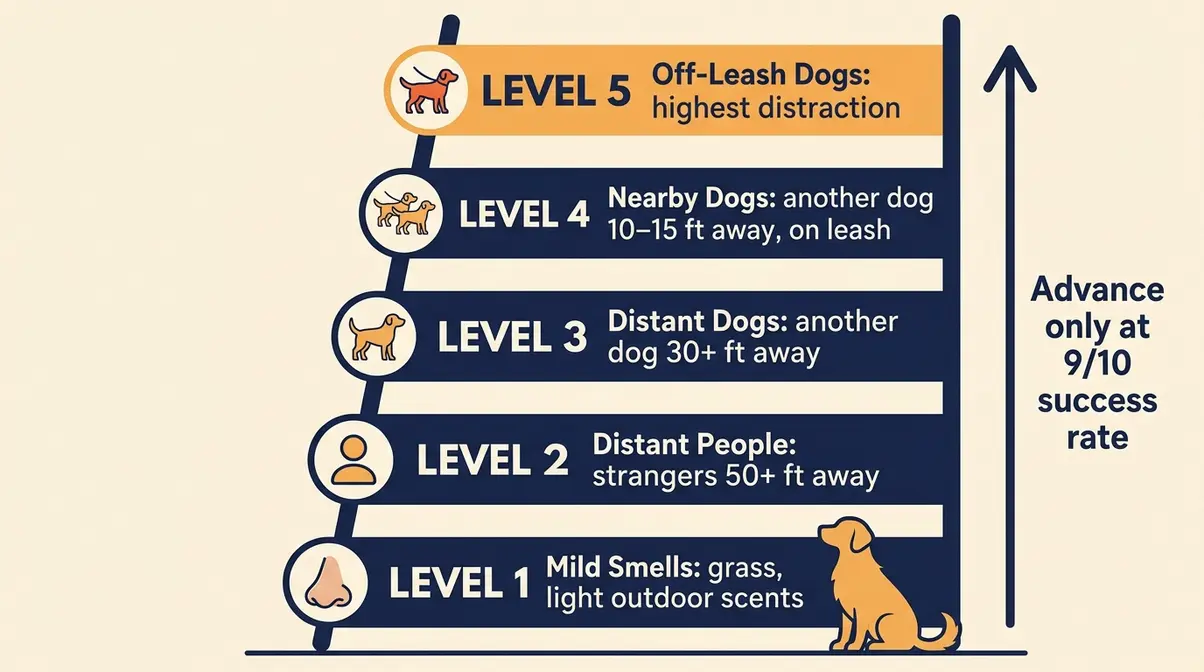
Checkpoint: Your Golden should be coming reliably at Level 3 (distant dogs) before you consider removing the long line. If they are not, stay at Level 3.
Once your Golden is reliable at Level 4 on the long line, you are ready to try the final step: true off-leash recall.
Step 4: Practice Off-Leash Recall in Safe Environments
Off-leash recall is not a separate skill. It is the same skill your Golden has been building since Step 1, now practiced without the safety net of the long line. The enclosed space is non-negotiable at this stage. Until your dog is reliable at Distraction Level 4 consistently, an open space with gaps or gates is not a training environment. It is a safety risk.
This step also introduces a concept that separates dogs with reliable recall from dogs with situational recall: the “party” reward.
How to practice off-leash recall:
- Choose a fully enclosed space. A fenced backyard is ideal. An enclosed dog park during off-hours also works.
- Remove the long line. Keep the treat pouch on.
- Call your recall cue once. Wait.
- When your Golden arrives: deliver the “party” reward. Treats first, then verbal praise, then a brief game of tug or a ball throw. Make it the best 10 seconds of their day. Every single time.
- Never call your dog to you for something they dislike, such as a bath, nail trim, or the end of playtime. Walk to them instead. Protect the cue. This is called cue poisoning: when a recall cue becomes associated with negative outcomes, the dog learns to avoid it.
The “party” reward is how you maximize the left side of The Recall Value Equation at the highest distraction levels. Treats alone are good. Treats plus praise plus play is better. According to benefits of positive reinforcement-based training from Tufts University’s Cummings School of Veterinary Medicine, reward-based training is beneficial because it is genuinely enjoyable for both the dog and the handler. That enjoyment is what makes the “party” reward work: your Golden is not just getting food. They are getting the best version of you.
Checkpoint: Your Golden should be sprinting toward you off-leash in an enclosed space. If they are hesitating, go back to Step 3 at Distraction Level 3.
Now that you have the 4-step progression, here are three games that make recall faster and more enthusiastic. A Golden who loves the game comes back faster than one who merely tolerates it.
Three Training Games That Make Recall Irresistible
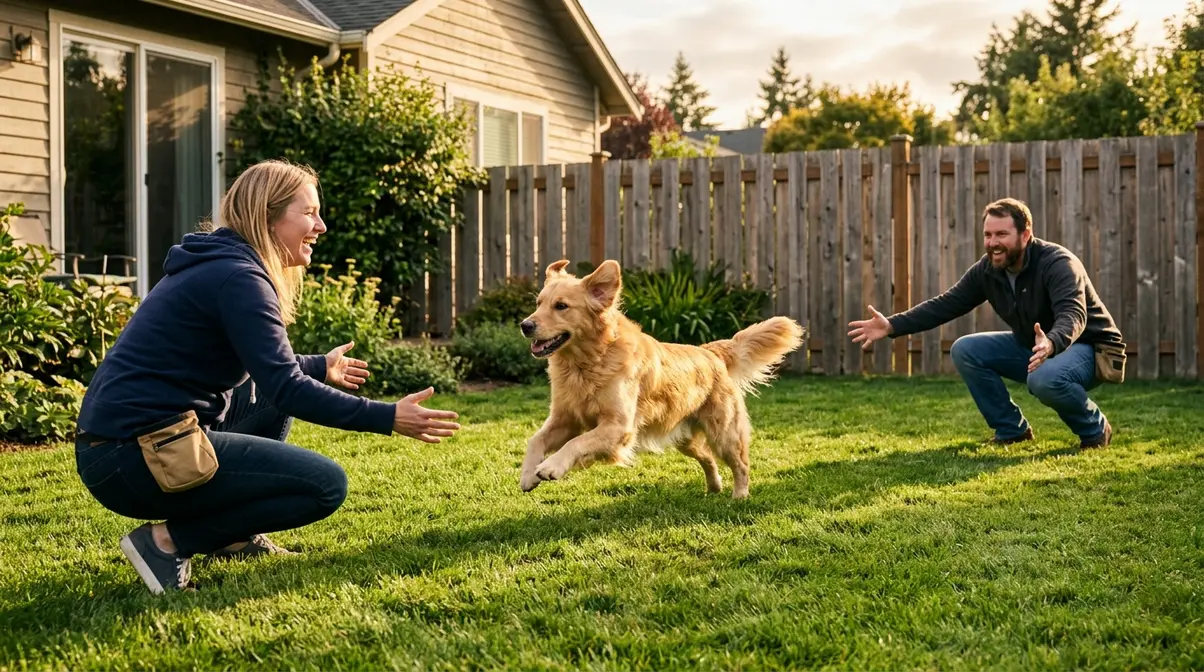
Games are not supplements to the 4-step plan. They are accelerators. Golden Retrievers have a natural retrieving drive and a social nature that most recall training leaves completely untapped. These three games are designed specifically to leverage both, and each one targets a different element of The Recall Value Equation. This is a genuine edge in golden retriever recall training that generic obedience guides rarely address. According to reliable recall training guidance from the AKC, making recall training a game with high-value rewards and enthusiastic praise is one of the most effective ways to build a reliable come command.
Game 1: Ping Pong Recall
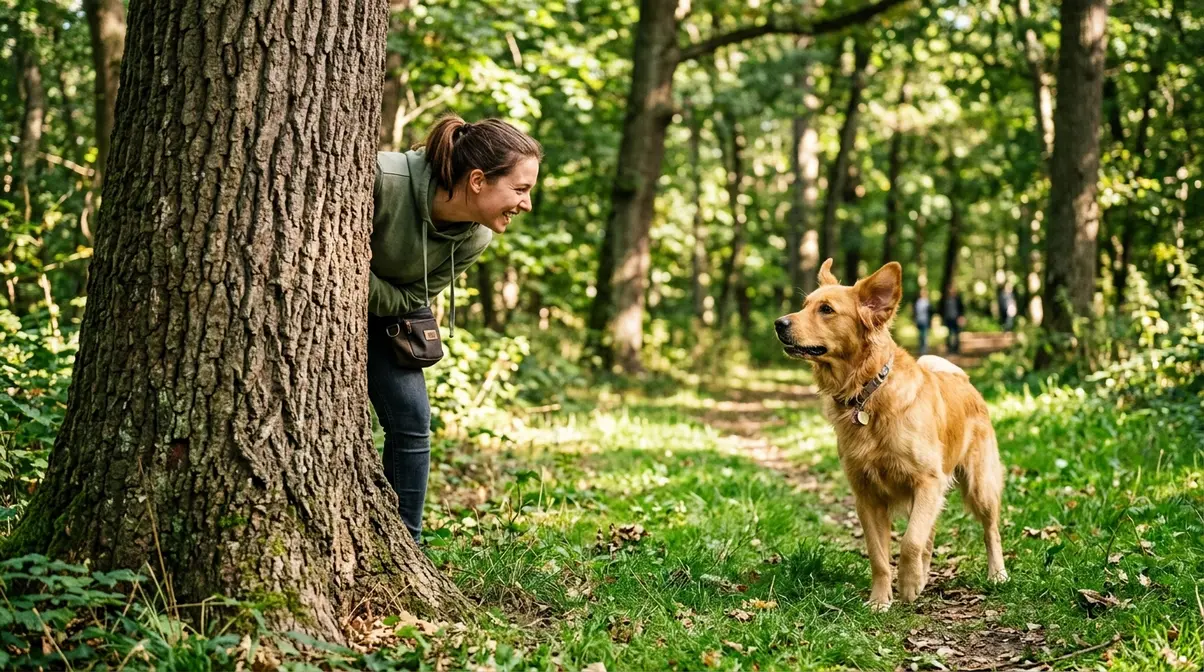
Two handlers, 20-30 feet apart. Handler A calls the dog by name, then gives the recall cue. The dog runs to Handler A and gets a treat and enthusiastic praise. Immediately, Handler B calls. The dog runs to Handler B. Repeat 5-6 times per session, then stop before the dog tires of the game.
What the dog is learning: speed. Running fast means the reward comes faster. Two excited humans are more rewarding than one, which increases the Enthusiasm multiplier in The Recall Value Equation. Keep the energy high on both ends. If either handler goes flat, the game loses its pull.
Game 2: Hide and Seek Recall
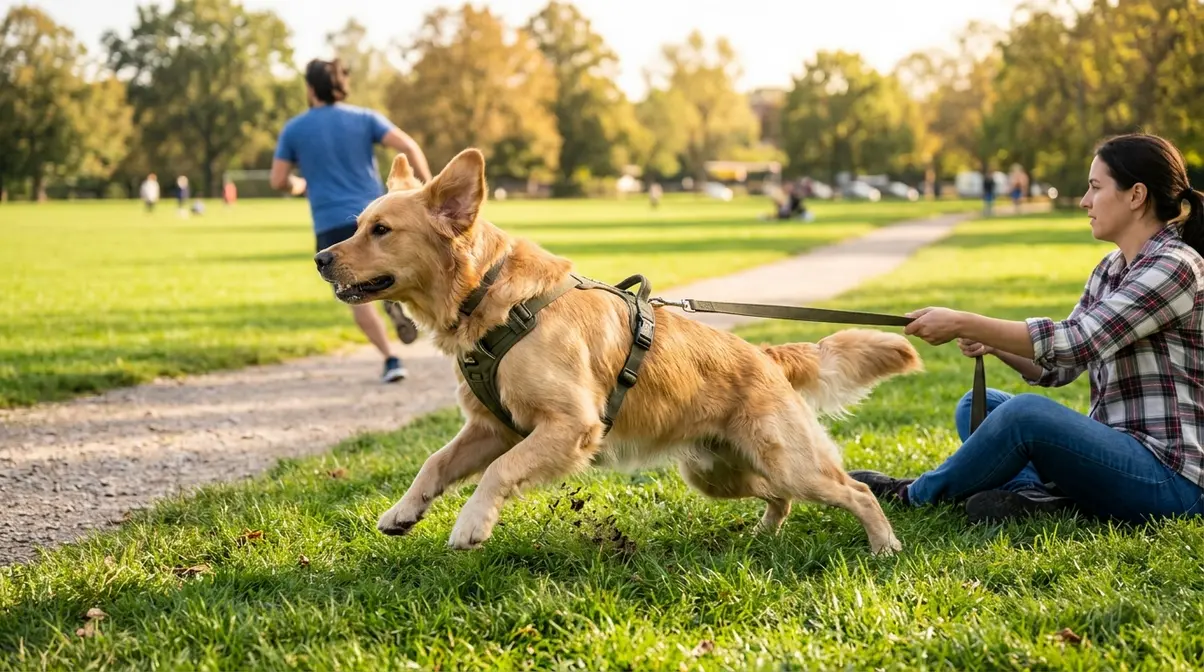
While your Golden is occupied sniffing or exploring, quietly move behind a tree, a car, or around a corner. Then call the recall cue. When your dog finds you, deliver the “party” reward.
What the dog is learning: urgency. Losing sight of you becomes a cue to find you immediately. This increases the Reward Quality side of the equation because finding the owner becomes intrinsically rewarding, not just treat-driven. Start with easy hiding spots. Your Golden should succeed every time, especially in the early sessions.
The third game works especially well for Goldens who are not highly treat-motivated. It uses their prey drive instead.
Game 3: Restrained Recall
A second person holds your dog gently by the harness. You run away from the dog (not toward them), then call the recall cue. The second person releases your Golden. You keep moving until your dog catches up, then deliver the “party” reward immediately.
What the dog is learning: explosive speed and drive. They are chasing, not just responding. This activates the retrieving instinct directly, which dramatically increases Enthusiasm. For Goldens who seem uninterested in food rewards during training, this game often works when treats fail. The drive to chase is older and stronger than the drive to earn a kibble.
Two additional games worth trying with a larger group: Round Robin Recall (three or more people in a circle, each calling in turn) and Surprise Recall (calling from an unexpected location, such as a different room or behind a bush). Both build the same urgency and speed as the games above.
Games build enthusiasm. But even the most game-trained Golden can develop habits that quietly destroy their recall. Here is what to watch for.
Common Recall-Killers to Avoid
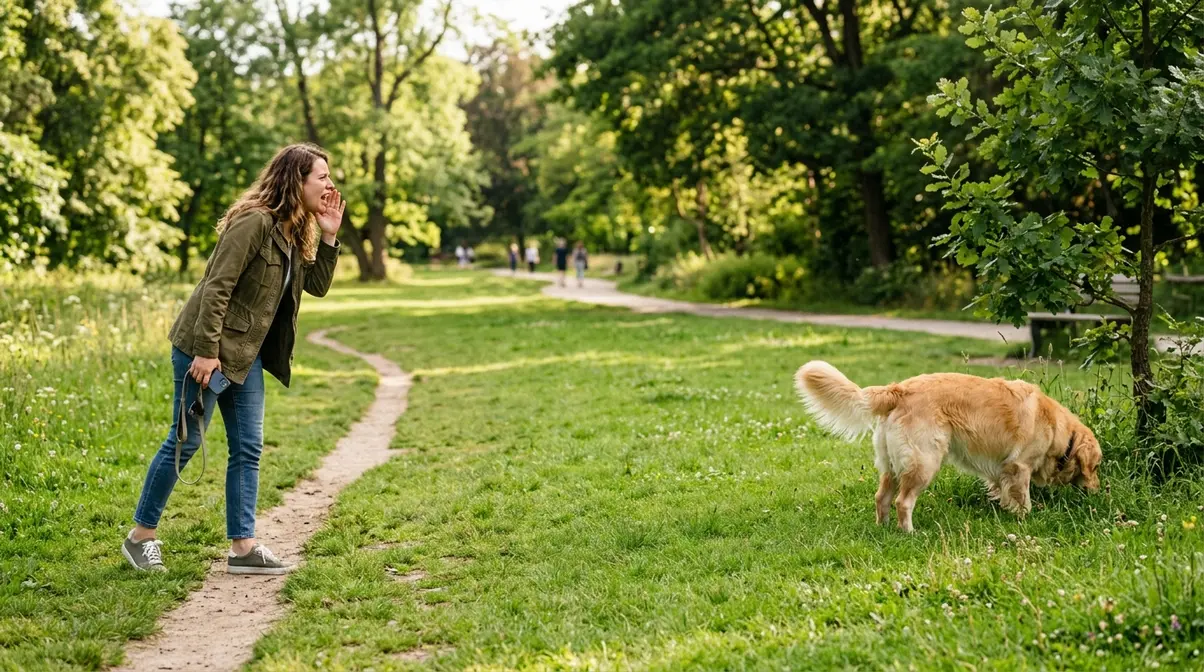
Even owners who follow the 4-step plan can accidentally train their Golden to ignore recall. These five habits are the most common culprits, and each one has a straightforward fix. None of them are character flaws. They are easy patterns to fall into, and they are just as easy to swap out.
According to troubleshooting a poor recall guidance from Iowa State University Extension’s training curriculum, repeating a command before the dog responds teaches the dog that the first call is optional. That pattern directly undermines recall reliability in recall training golden retriever contexts, and it is the most common mistake owners make.
- Repeating the cue. Calling “come, come, COME” teaches your dog that the first call is a suggestion. What the dog learns: the real recall starts on the third repetition. Fix: say it once, then use the long line to guide them toward you if they do not respond. Reward warmly on arrival regardless.
- Calling the dog for unpleasant things. Using recall to bring your Golden in for a bath, nail trim, or the end of a play session pairs the cue with something they dislike. What the dog learns: coming to you ends the fun. Fix: walk to your dog for anything unpleasant. Protect the recall cue for positive outcomes only.
- Punishing a slow or reluctant return. Scolding a dog who takes 30 seconds to come destroys the behavior you are trying to build. What the dog learns: returning equals punishment. Fix: reward every return, no matter how long it took. You are not rewarding the slowness. You are keeping the cue positive.
- Practicing off-leash before the dog is ready. Removing the long line at Distraction Level 2 because the dog “seems ready” rehearses failure. What the dog learns: ignoring recall is possible. Fix: keep the long line on until your Golden is reliable at Level 4. The long line is not a crutch. It is the tool that prevents failure from becoming a habit.
- Inconsistent rewards. Rewarding recall sometimes but not others works fine for maintaining a behavior that is already solid. It does not work for building one that is still developing. What the dog learns: it is worth checking whether a reward is coming before deciding whether to bother. Fix: reward every successful recall during the building phase. Vary the reward type (treat versus praise versus play), but always reward.
If your Golden is already showing one of these patterns, the Troubleshooting section below has a step-by-step fix for each scenario.
How to Teach an Emergency Recall
Your everyday recall cue is for the park. Your emergency recall is for the moment your Golden spots a gap in the fence and starts running toward traffic. These two cues must be completely separate. The emergency one must be treated like a fire extinguisher: rarely used, always charged.
Here is why the separation matters. Your everyday recall cue loses some power every time it is used without a high-value reward, or every time it is used in a situation where the dog does not respond. The emergency cue avoids both problems because it is used sparingly and always paired with the best reward your dog has ever received. Recall training basics from Dogs Trust recommends teaching a separate emergency recall cue, distinct from the everyday “come” command, and pairing it exclusively with the highest-value rewards to preserve its power for genuine safety situations.
In Recall Value Equation terms, the emergency cue works because it has been paired exclusively with the highest possible reward. The Reward Quality x Enthusiasm value is off the chart, because the dog has never experienced this cue in any other context.
How to build the emergency recall:
- Choose a distinct cue word or sound your dog has never heard before. “HERE,” said once and sharply, works well. A specific whistle pattern is another option.
- For the first two weeks, pair this cue exclusively with a jackpot reward: a small handful of real chicken, a piece of cheese, or the single food item your Golden values most. A jackpot reward is an unusually large or high-value treat delivered to mark an exceptional response.
- Practice 2-3 times per week maximum. Always in a situation where your Golden will succeed. Never test the emergency cue in a high-distraction environment until the association is deeply established.
- Never use the emergency cue for routine recalls. Reserve it for genuine safety situations only.
- Once a month, recharge the cue: call it once in a low-distraction environment and deliver the jackpot reward. This keeps the cue value high, which is the learned association between the cue and the reward it predicts.
Checkpoint: Your Golden should respond to the emergency cue instantly, even when mildly distracted, because it has been paired exclusively with the highest-value reward they know.
Even with all of this in place, some Goldens will still have specific recall problems. Here is how to diagnose and fix the most common ones.
Troubleshooting: When Your Golden Still Won’t Come
Is your Golden doing everything right in the backyard but falling apart at the dog park? Or coming 9 out of 10 times, but that 10th time is always when it matters most? Here are the five most common recall failure scenarios and exactly how to fix each one.
Scenario 1: My Dog Runs Toward Me, Then Veers Away
Problem: Your Golden approaches but peels off before reaching you.
Cause: Recall has been paired with something your dog dislikes, such as leashing up, bath time, or the end of play. The dog has learned that getting close means the fun stops. This is cue poisoning at close range.
Fix: Practice “touch and release” for two weeks. Call your Golden, reward them when they arrive, then immediately say “go play” and release them back to the activity. Coming to you must never mean the fun ends. After two weeks of consistent touch-and-release, your dog will start treating arrival as a gateway back to play rather than an exit from it.
Scenario 2: My Dog Ignores Recall Around Other Dogs
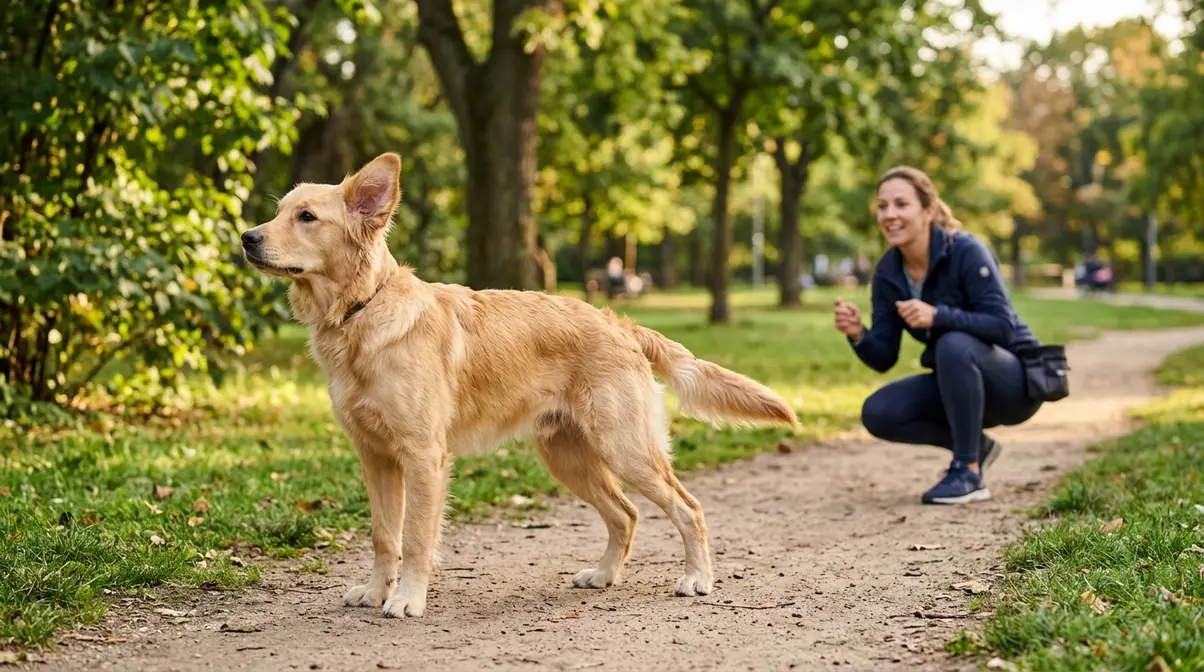
Problem: Reliable recall in the backyard, zero recall at the dog park.
Cause: The dog park is Distraction Level 5. Your training has only been proofed to Level 3. The Recall Value Equation is completely out of balance at that distraction level.
Fix: Go back to Level 3 on the long line. Work up the Distraction Ladder systematically. Do not attempt off-leash recall near other dogs until your Golden is reliable at Level 4 with the long line slack. According to recall training in dogs guidance from UC Davis School of Veterinary Medicine, dogs who fail recall in high-distraction environments should be returned to a lower-distraction setting and rewarded for successful responses before progressing.
Scenario 3: My Dog Comes for Treats but Not Without Them
Problem: Your Golden comes reliably when you are wearing a treat pouch, but ignores recall when you are not.
Cause: Your dog has learned to read the treat pouch as a signal that training is happening. No pouch equals no training equals no particular reason to comply.
Fix: Always wear the treat pouch during outdoor time, whether you are actively training or not. Vary when treats are delivered: sometimes immediately on arrival, sometimes after a brief pause, sometimes replaced with verbal praise or play. The goal is that your Golden can never predict whether a treat is coming. Unpredictability keeps the behavior strong.
Scenario 4: My Dog Had Great Recall as a Puppy but Now Ignores Me
Problem: Recall was solid at 4-5 months and has seemingly disappeared at 9-12 months.
Cause: Adolescence. The prefrontal cortex is still developing, and impulse control temporarily decreases during this window. This is normal, well-documented, and temporary. See our guide on understanding their behavior at every age for the full developmental picture.
Fix: Treat your Golden as a new dog. Restart from Step 1. Do not skip steps because “they knew this before.” The adolescent brain is genuinely different from the puppy brain, and the foundation needs to be rebuilt with that brain in mind. Most owners who restart completely see reliable recall return within 3-4 weeks.
Scenario 5: My Dog Is Not Treat-Motivated
Problem: Your Golden shows little or no interest in treats during recall training.
Cause: The reward is not high enough, the dog is not hungry enough during sessions, or the dog’s primary drive is play rather than food.
Fix: Try Game 3 (Restrained Recall). It uses prey drive instead of food drive, and it often works when treats fail entirely. Beyond that: train before meals rather than after, upgrade from kibble to real chicken or cheese, and if your dog is toy-motivated, use a tug toy as the arrival reward instead of treats. The reward type matters less than whether it genuinely excites your dog.
This article is general information, not veterinary advice. If your dog shows any of the signs above, or you have questions about your Golden’s health or behavior, talk to your veterinarian.
Frequently Asked Questions About Golden Retriever Recall
Are Golden Retrievers good at recall?
Golden Retrievers have strong recall potential because they are eager to please and highly trainable. However, they are also social, scent-driven, and easily distracted by other dogs, smells, and people, which means reliable recall is a trained skill rather than a natural default. With consistent positive reinforcement training, most Goldens develop excellent recall. Without it, their friendly, exploratory nature tends to win over any verbal command.
What to do when your dog ignores your recall?
Do not chase your dog or repeat the recall cue. Instead, run in the opposite direction to trigger their chase instinct. If your dog is on a long line, guide them gently toward you without jerking the lead. When they arrive, reward warmly regardless of how long it took. Never punish a dog for returning, even if they were slow. Punishment poisons the recall cue and makes the next attempt harder.
How to teach a dog who fails at recall?
Start over in a low-distraction environment indoors. Use the highest-value treats your dog will work for, such as real chicken or cheese rather than kibble. Keep sessions to 5-10 minutes. If your dog fails a recall attempt, use a long line to guide them back, then immediately try an easier version from a shorter distance. Every session should end on a successful repetition so the association stays positive.
Which dog breed has the best recall?
Border Collies and working-line Labrador Retrievers are widely considered to have the strongest natural recall, largely because their herding and retrieving instincts keep them closely attuned to their handler. Golden Retrievers rank well among family breeds when consistently trained. Recall reliability in any breed is more a product of consistent training and reward history than breed genetics alone.
What is the silent killer in Golden Retrievers?
Hemangiosarcoma, a cancer of the blood vessel walls, is often called the silent killer in Golden Retrievers because it rarely shows symptoms until it ruptures. The breed has a significantly elevated cancer risk compared to most other breeds. For a full overview of the health conditions Golden Retrievers face, see our guide on common Golden Retriever health problems.
What is the life expectancy for a golden retriever?
Golden Retrievers typically live 10 to 12 years, though this varies based on genetics, diet, and health management. Cancer is the leading cause of death in the breed, affecting a disproportionately high percentage of Goldens. For a detailed look at the factors that influence lifespan, see our guide on the average life expectancy for a Golden Retriever.
Are there vicious Golden Retrievers?
Golden Retrievers are one of the least aggressive dog breeds and are rarely involved in serious bite incidents. Aggression in any dog, including Goldens, is almost always rooted in fear, pain, or a history of poor socialization rather than breed temperament. For a full look at the breed’s personality and what shapes it, see our guide on the typical Golden Retriever personality.
What are signs that a dog doesn’t like you?
Signs a dog is uncomfortable around a person include turning away, yawning, lip-licking, a tucked tail, flattened ears, and moving away when approached. A dog that consistently avoids eye contact or leaves the room when someone enters is signaling discomfort, not defiance. These signals are distinct from recall refusal, which is typically about distraction and reward value rather than any personal feeling toward the owner.
Bringing It All Together
For Golden Retriever owners struggling with recall, the solution is not a stricter command. It is a higher-value equation. Reliable golden retriever recall training works when coming to you is consistently more rewarding than whatever your dog is running toward. The 4-step progression, from the name game through long-line training, distraction proofing, and true off-leash practice, builds that equation systematically. The Training Games module accelerates it by tapping directly into the breed’s natural drive and social energy.
The Recall Value Equation is the lens through which every recall problem can be diagnosed. If your Golden is failing at a specific distraction level, the answer is not to repeat the command louder. It is to increase the reward, reduce the distraction, and rebuild the association one successful repetition at a time. The Distraction Ladder tells you exactly where to restart.
Start with the name game today. Five minutes, indoors, high-value treats. If your Golden turns toward you 9 out of 10 times by the end of the week, move to the long line. For the full training framework that recall fits into, see our complete guide to training your Golden Retriever at every age.
➤ Reliable recall is not about a louder command. It is about making you more rewarding than every distraction your Golden will ever encounter.
Related gear: see our guide to training collars.