
Your Golden Retriever puppy watches your face, tail wagging, eager to figure out what you want, but the connection between “outside” and “potty” just isn’t clicking yet. Potty training a Golden Retriever puppy is genuinely achievable within 4–6 weeks of consistent effort, but only when your method matches your puppy’s developmental stage. Every accident cleaned up without the right technique actually reinforces the wrong habit, resetting your timeline by days.
Potty training is an early milestone on the training ladder. See where it fits in our complete Golden Retriever training guide.
By the end of this guide, you’ll have a breed-specific schedule, five proven techniques, and a troubleshooting framework so you can house-train your Golden with confidence, and finally stop dreading potty time. We’ll cover what to expect, a daily schedule, core techniques, accident troubleshooting, and tips for apartments and working owners.
“I have a 5 month old golden retriever who is still not potty trained… he will randomly pee in his kennel while in it and then sometimes while playing he will pee on my carpet. It’s exhausting.”
If this sounds familiar, you’re not failing. You’re missing a framework.
What You’ll Need:
- Before diving in, gather these supplies:
- Enzymatic cleaner (a cleaning product that breaks down urine proteins to eliminate scent markers, critical for preventing repeat accidents)
- High-value treats (small, soft, and smelly, chicken pieces or commercial training treats)
- A properly sized crate (just big enough for your puppy to stand, turn, and lie down)
- A designated outdoor potty spot
- A consistent verbal cue (e.g., “go potty” or “outside”, pick one and never change it)
Potty training a Golden Retriever puppy typically takes 4–6 weeks for reliable habits, with full bladder control developing by 5–6 months of age, success depends on matching your schedule to your puppy’s current developmental phase.
- The 3-Phase Potty Training Window: Training progresses through three phases (8–12 wks, 12–16 wks, 4–6 mo), each requires a different approach
- Frequency matters: Puppies under 12 weeks need outdoor trips every 30–60 minutes while awake (Ohio State University Indoor Pet Initiative)
- Accidents aren’t failure: Regression is normal during adolescence (6–18 months), adjust your schedule, don’t panic
- Crate training accelerates results: Used correctly, a crate leverages a puppy’s natural instinct not to soil their sleeping area
- Enzyme cleaners are non-negotiable: Standard cleaners leave scent markers that attract puppies back to the same spot
Are Golden Retrievers Easy to Potty Train? What to Expect
Golden Retriever puppies are among the easiest breeds to house-train, thanks to their intelligence and natural eagerness to please. According to the Ohio State University Indoor Pet Initiative, puppies can typically hold their bladder for approximately one hour per month of age, meaning an 8-week-old Golden needs a trip outside roughly every hour while awake. But “easy” only applies when your golden retriever puppy training method matches your puppy’s developmental stage, which is exactly what this guide covers.
How Long Does Potty Training a Golden Retriever Puppy Take?
At what age should a Golden Retriever be potty trained? The honest answer is that there are two milestones you need to track separately, and conflating them is the #1 source of owner frustration.
Milestone 1: Reliable habits. Most Golden Retriever puppies achieve reliable house-training within 4–6 weeks of a consistent schedule. This is when accidents become the exception rather than the routine, your puppy understands the concept and is usually successful. Check out this foundational golden retriever puppy training guide for a broader overview of what to expect across all training areas.
Milestone 2: Full bladder control. Physical muscle control develops through 5–6 months of age. A puppy can “know the rules” well before their body can reliably follow them. This is why a 14-week-old Golden who’s been accident-free for a week suddenly has three accidents in a row, the understanding is there, but the physical holding capacity isn’t fully developed yet.
Compared to notoriously stubborn breeds like Beagles, Bulldogs, and Basset Hounds, Golden Retrievers are considerably faster to train. The breeds hardest to potty train, Dalmatians, Chow Chows, Basenjis, share a streak of independence that works against schedule-based training. Goldens are wired to please, which means positive reinforcement lands faster and sticks longer.
- Individual variation is real, though. Some Golden Retriever puppies catch on in 1–2 weeks; others need the full 5–6 weeks. Three factors drive most of that variation:
- Age when training started, an 8-week-old builds habits faster than a 12-week-old who has already developed indoor patterns
- Schedule consistency, inconsistent owners produce inconsistent dogs
- Carpet habits, a puppy allowed to eliminate indoors unsupervised for even a few days develops a surface preference that takes extra effort to override
A concrete milestone example: a typical 10-week-old Golden may go 3–4 days without an indoor accident, then have a rough day. That’s normal Phase 1 behavior, not regression, not failure. It means the puppy is still learning.
Understanding the timeline is only half the picture, the other half is knowing which phase your puppy is in right now.
The 3-Phase Potty Training Window
The 3-Phase Potty Training Window is the framework this guide is built on, the observation that Golden Retriever potty training progresses through three distinct developmental phases, each requiring a different approach. Most training guides treat house-training as a single continuous process. It isn’t. Applying Phase 2 strategies to a Phase 1 puppy is the most common reason capable owners feel like they’re failing.
Here’s how each phase maps to your Golden’s development:
| Phase | Age | What’s Happening | Goal | Trip Frequency |
|---|---|---|---|---|
| Phase 1: Learning | 8–12 weeks | Bladder muscles physically underdeveloped; cannot hold urine more than 30–60 min while awake | Build the “outside = potty” association | Every 30–60 minutes while awake |
| Phase 2: Reliability | 12–16 weeks | Bladder control extends to 1–2 hours; puppy begins signaling (sniffing, circling) | Build the signaling habit; reduce accidents to 1–3/day | Every 1–2 hours; watch for signals |
| Phase 3: Independence | 4–6 months | Near-adult bladder control; can hold 3–4 hours | Transition to signal-response trips; brief unsupervised time | Every 3–4 hours; respond to signals |
Phase 1 (8–12 weeks): Your puppy’s bladder muscles are still developing, they simply cannot hold urine for more than 30–60 minutes while awake. The goal here is not reliability; it’s creating the association between “outside” and “going potty.” Expect 3–6 accidents per day as completely normal. Key strategy: trips every 30–60 minutes, immediate reward within 3 seconds of elimination.
Phase 2 (12–16 weeks): Bladder control improves to 1–2 hours. Your Golden begins to show pre-elimination signals, sniffing in circles, wandering toward a corner. The goal shifts to building the signaling habit. Accidents should drop to 1–3 per day with a good schedule. Key strategy: actively watch for signals, extend trip intervals incrementally as reliability improves.
Phase 3 (4–6 months): Physical bladder control reaches near-adult levels. Accidents become truly exceptional rather than routine. Key strategy: transition from proactive, scheduled trips to signal-response trips, start trusting your pup with brief supervised independence.
Self-diagnosis: If your 14-week-old Golden is still having 4+ accidents daily, they are likely still operating in Phase 1 territory. Increase trip frequency before changing any other variable. The phase, not the technique, is the problem.
Now that you know which phase your puppy is in, you can recognize exactly what they need before they go, starting with reading their signals.
Signs Your Golden Retriever Puppy Needs to Go
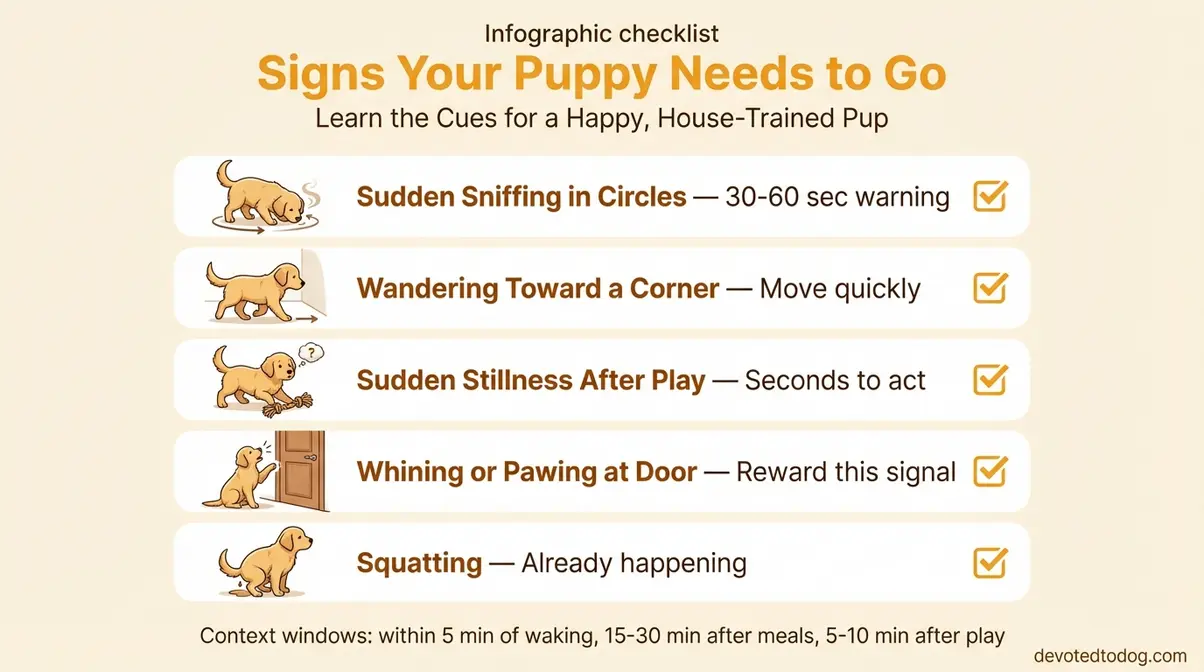
Potty training a Golden Retriever puppy becomes dramatically easier when you can read the 20-second warning before an accident. Here are the five most reliable pre-elimination signals, ranked from most actionable (earliest) to last resort:
- Sudden sniffing in circles, the most actionable early signal; you have 30–60 seconds to act
- Wandering away from play toward a corner or wall, the puppy is seeking privacy; move quickly
- Sudden stillness after active play, the energy drop precedes squatting by seconds
- Whining or pawing at the door, a learned signal in Phase 2+ puppies; reward this immediately
- Squatting or beginning to squat, last resort; the puppy is already going
- Equally important are predictable context windows, not behavioral signals, but times when elimination is almost guaranteed:
- Within 5 minutes of waking from any nap
- Within 15–30 minutes of eating
- Within 5–10 minutes of an active play session ending
The Humane Society potty training guidance advises taking puppies outside at least every two hours and immediately after waking, play, and meals, these context windows are the reason why.
When you miss a signal: No punishment. No nose-rubbing. Calmly clean the area with enzymatic cleaner and move on. Punishment after the fact confuses rather than teaches, your puppy cannot connect a correction to something that happened 30 seconds ago.
When your 10-week-old Golden starts circling the living room rug after playtime, that’s a Phase 1 signal, you have approximately 20–30 seconds to get outside.
Knowing the signs is essential, but recognizing them only helps if you have a schedule that puts you outside at the right times in the first place.
The Golden Retriever Puppy Potty Training Schedule
The most effective golden retriever puppy potty training schedule takes your puppy outside every 30–60 minutes while awake and immediately after every meal, nap, and play session. The Ohio State University Indoor Pet Initiative recommends taking puppies to their toilet area on a consistent schedule, using a verbal cue, and allowing enough time for elimination, approximately one trip per hour per month of age as a baseline. As your puppy moves through the 3-Phase Potty Training Window, you’ll gradually extend these intervals, but only when accidents have been reliably rare for at least 5–7 days.
Daily Potty Break Frequency by Age
The golden retriever puppy potty training schedule starts with a simple rule of thumb: a puppy can hold their bladder for approximately one hour per month of age. A 2-month-old can hold it for roughly 2 hours at most; a 4-month-old for up to 4 hours. The Missouri Department of Corrections’ Puppies for Parole training manual confirms that puppies can typically hold their urine for about four hours, a useful ceiling for older Phase 3 puppies.
The 10-10-10 Rule is a structured outdoor routine that complements any age-based schedule: take your puppy outside for 10 minutes, stay 10 feet from their designated toilet area, and supervise for 10 minutes afterward. The 10-minute outdoor window gives your puppy time to settle and eliminate without distraction. The 10-foot proximity keeps you close enough to reward immediately without hovering. The 10-minute post-trip supervision prevents the classic “went outside but didn’t go, then had an accident the moment you came back in” problem.
The Louisa County Government housetraining guide notes that potty break frequency can range from every 10 minutes to once an hour, depending on age, breed, and prior training history. That range reflects the real variation you’ll see across The 3-Phase Potty Training Window. An 8-week-old in Phase 1 needs trips at the shorter end; a 5-month-old in Phase 3 can comfortably manage the longer end.
Check out potty training schedules that work for any puppy breed for comparison approaches if you have multiple dogs at different stages.
A practical example: “An 8-week-old Golden Retriever puppy waking from a 45-minute nap needs to go outside within 2 minutes of waking, not after you finish your coffee.”
These frequency rules give you the outer boundaries, now let’s put them into a specific daily schedule you can actually follow.
Sample Daily Potty Training Schedule
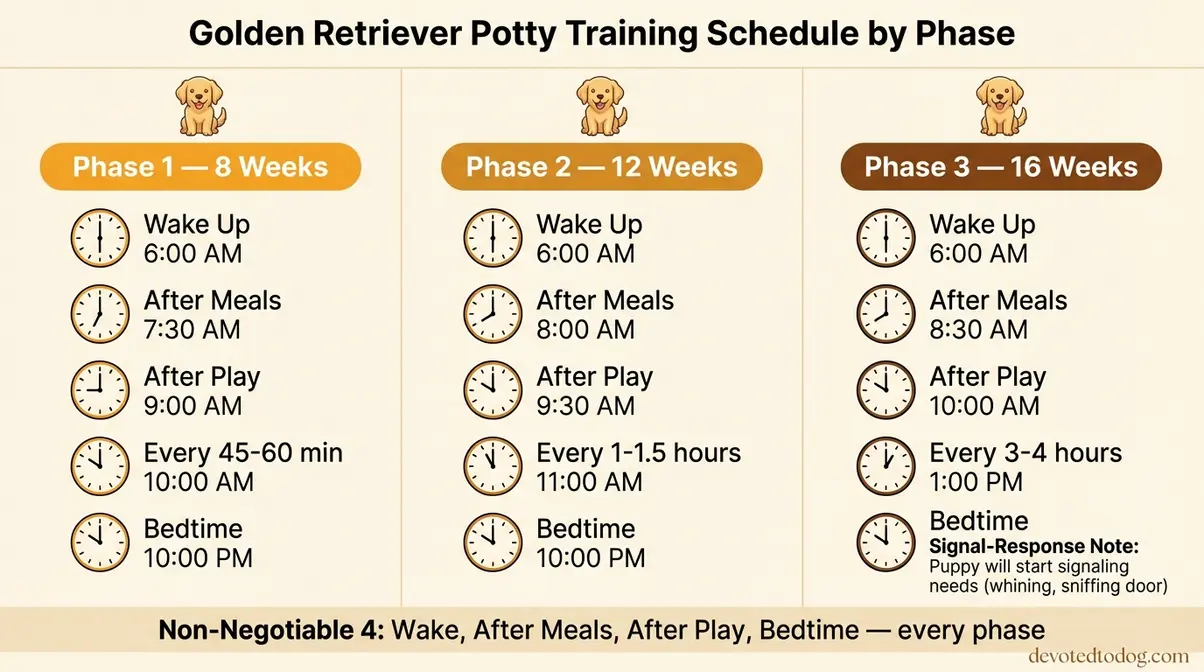
The three schedules below map directly to each phase of the 3-Phase Potty Training Window. Notice how trip frequency decreases as your Golden matures, and how the “non-negotiable four” anchor points never change.
- The Non-Negotiable Four (every age, every phase):
- Immediately upon waking (within 2 minutes)
- Within 15 minutes of every meal
- Within 5 minutes of any play session ending
- Last trip before bed
Phase 1 Sample Schedule, 8 Weeks
| Time | Activity | Action |
|---|---|---|
| 7:00 AM | Wake up | Immediately outside, no detours |
| 7:15 AM | Breakfast | Outside within 15 minutes |
| 8:00 AM | Play session | Outside immediately after |
| 8:30 AM | Crate rest | Monitor for stirring |
| 9:30 AM | Wake from nap | Immediately outside |
| 10:00 AM | Play session | Outside within 5 minutes of ending |
| 10:45 AM | Crate rest | , |
| 11:45 AM | Wake, outside | Trip before lunch |
| 12:00 PM | Lunch | Outside within 15 minutes |
| 12:30 PM | Play / training | Outside after play ends |
| 1:00 PM | Nap | Monitor |
| 2:00 PM | Wake, outside | Immediately |
| (Repeat pattern) | , | Every 45–60 minutes while awake |
| 9:30 PM | Last trip | Calm, businesslike, back to crate |
Phase 2 Sample Schedule, 12 Weeks
| Time | Activity | Action |
|---|---|---|
| 7:00 AM | Wake up | Immediately outside |
| 7:15 AM | Breakfast | Outside within 15 minutes |
| 8:30 AM | Play session | Outside after play |
| 9:30 AM | Nap | Monitor for signals |
| 11:00 AM | Wake, outside | Every 1.5 hours while awake |
| 12:00 PM | Lunch | Outside within 15 minutes |
| 1:30 PM | Play / training | Outside after |
| 3:00 PM | Nap | , |
| 4:30 PM | Wake, outside | , |
| 6:00 PM | Dinner | Outside within 15 minutes |
| 8:00 PM | Last play | Outside after |
| 10:00 PM | Final trip | Calm, back to crate |
Phase 3 Sample Schedule, 16 Weeks
| Time | Activity | Action |
|---|---|---|
| 7:00 AM | Wake | Outside immediately |
| 7:15 AM | Breakfast | Outside within 15 minutes |
| 10:00 AM | Midmorning | Scheduled trip |
| 12:00 PM | Lunch | Outside within 15 minutes |
| 3:00 PM | Afternoon | Scheduled trip |
| 6:00 PM | Dinner | Outside within 15 minutes |
| 8:30 PM | Evening | Respond to signals + scheduled trip |
| 10:30 PM | Bedtime | Final trip |
If you’re away during the day, a dog walker or neighbor covering the midday trips is essential for puppies under 16 weeks, they physically cannot hold it for 8 hours.
Daytime schedules are manageable, the real challenge for most Golden Retriever owners is what happens at 2 AM.
Nighttime Potty Training: Managing the 2 AM Wake-Up
Golden retriever potty training at night requires a different mindset than daytime training: the goal isn’t to eliminate nighttime trips immediately, it’s to make them calm, brief, and boring. Young puppies in Phase 1 (8–12 weeks) physically cannot hold their bladder through an 8-hour night. Expect 1–2 nighttime trips as completely normal. No play, no enthusiastic praise, a quiet “good dog,” then straight back to the crate.
- The alarm method gives you control over the nighttime schedule instead of reacting to accidents:
- Note the time your puppy typically wakes you (or has an accident at night)
- Set an alarm for 30 minutes before that time
- Take the puppy outside calmly and quietly, treat the trip as purely functional
- Every 5–7 accident-free nights, push the alarm back by 15 minutes
- Repeat until your puppy can sleep through the night without a trip (typically by 12–16 weeks)
Crate placement matters more than most owners realize. Keep the crate in or near your bedroom for the first 8–12 weeks. This lets you hear your puppy stir before they cry, and before they have an accident. Virginia Tech Veterinary Medicine advises that puppies should be taken outside consistently while awake and immediately after play sessions, with patience as the essential ingredient, the same principle applies to the nighttime window when your puppy stirs.
A practical scenario: a 10-week-old Golden in a crate near your bed will typically stir, whine briefly, then go quiet. That 30-second window is your cue. If you catch it, they’ll go outside, eliminate, and settle back down in under 5 minutes. Miss it, and you’re cleaning the crate at 2 AM and restarting the scent-elimination process.
With your schedule in place, the next step is making sure the techniques you use during those outdoor trips actually build the right habits.
Proven Potty Training Techniques for Golden Retriever Puppies
To train a Golden Retriever puppy to pee outside, combine three techniques: crate training to prevent unsupervised indoor accidents, a designated outdoor potty spot with a consistent verbal cue, and immediate positive reinforcement delivered within 3 seconds of elimination. Purdue Extension’s puppy training guidance emphasizes frequent elimination opportunities and consistent routines as the foundation of reliable house-training for Golden Retrievers. Each technique reinforces the others, crate training fails without a schedule, and a schedule fails without reliable rewards.
Crate Training as Your Potty Training Foundation
Crate training, the practice of using a properly sized crate as a safe, den-like space that leverages a puppy’s instinct not to soil their sleeping area, is the single most powerful structural tool in your potty training toolkit. The complete guide to crate training your Golden Retriever puppy covers the full setup process, but here’s the essential foundation.
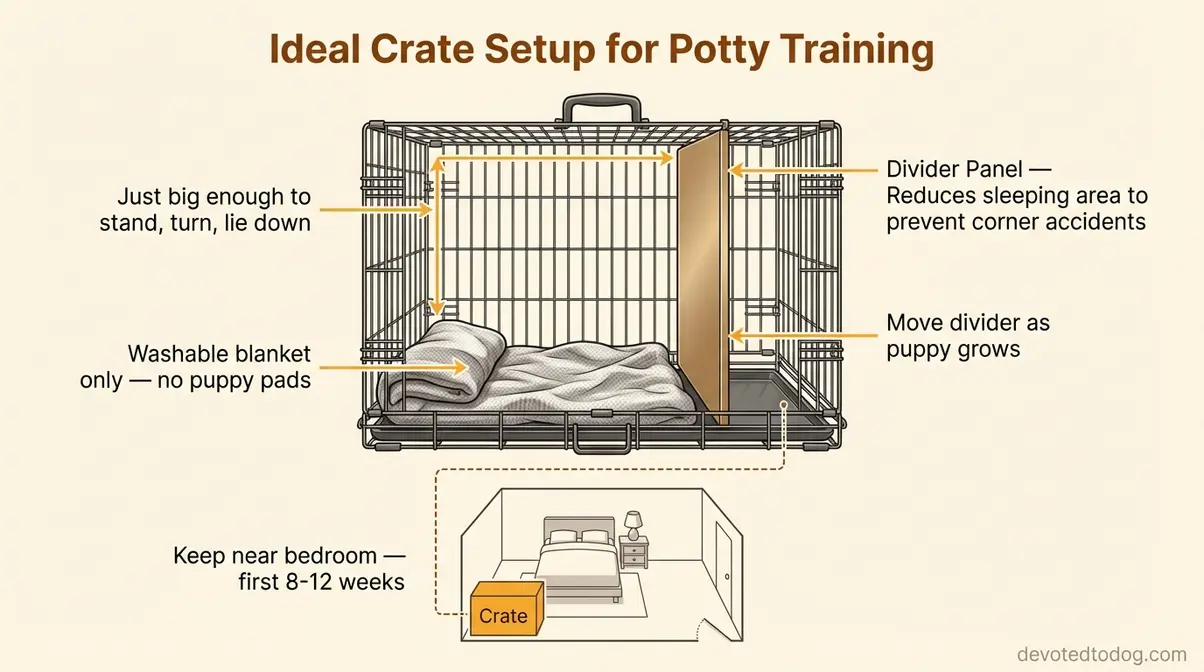
The correct crate size rule: just large enough for your puppy to stand, turn around, and lie down. A crate with extra space allows the puppy to use one end as a bathroom, this is the #1 cause of “puppy peeing in the crate” problems, which we’ll cover in depth in the troubleshooting section.
- Crate introduction steps:
- Place the crate in your main living area or bedroom, not an isolated room where the puppy feels abandoned
- Line it with a washable blanket only, no puppy pads (pads signal that going inside is acceptable)
- Introduce the crate with treats and praise before closing the door for the first time; let the puppy explore it freely
- Never use the crate as punishment, it must remain a positive, safe space
- For an 8–10-week-old Golden, maximum crate time while awake is 30–60 minutes
- If your puppy cries after a recent potty trip, wait 2–3 minutes before responding, if they haven’t had a recent trip, take them outside immediately
The Purdue Extension puppy training guide reinforces that frequent elimination opportunities paired with consistent crate routines form the reliable foundation of house-training, the crate structure and the outdoor schedule work as a system, not independently.
Once your puppy is comfortable in the crate, the next step is teaching them exactly where outside they should go, and getting a verbal cue that travels with them for life.
Designating a Potty Spot and Using a Verbal Cue
- The scent of previous eliminations acts as a natural “go here” signal for puppies, which is why choosing one consistent outdoor spot and returning to it every single time accelerates the learning process faster than rotating locations. Your designated spot should be:
- Easily accessible (you’ll be walking here 10+ times a day)
- The same spot every single time, no exceptions in the first 4–6 weeks
- Away from the play area (mixing play and potty creates distraction)
Walk directly to the spot every time. No detours, no sniffing stops on the way out. The walk to the spot should feel businesslike, save the play and exploration for after a successful elimination.
Verbal cue training works like this: pick ONE phrase, “go potty,” “outside,” “do your business”, and say it in a calm, consistent tone as the puppy is eliminating in the right spot. Not as a command before they go, but as a label during the behavior. The association builds over 10–20 successful repetitions. After 2–3 weeks, most Golden Retrievers will begin to eliminate on cue, a genuinely useful behavior for travel, vet visits, and rainy nights when you want the trip to be brief.
On puppy pads: they’re generally not recommended for Golden Retrievers being trained to go outside. Pads teach the concept of “going on a surface inside,” which creates confusion and often extends the training timeline by weeks. The exception is apartment training, covered fully in the challenging situations section.
When your 12-week-old Golden squats on the designated grass patch and you say “good potty!” in an upbeat tone while they’re still squatting, that’s the exact association you’re building.
The verbal cue means nothing without the reward that makes it worth repeating, and the timing of that reward is where most owners unknowingly undermine their own training.
Positive Reinforcement: Timing and Reward Selection
Golden retriever puppy potty training tips come down to one rule that most owners get slightly wrong: positive reinforcement must be delivered within 3 seconds of the desired behavior. A treat given after the puppy re-enters the house rewards the walk back, not the elimination. This single timing error can extend your training timeline by weeks.
Treat selection matters more than owners realize. Use high-value, soft treats, small chicken pieces, commercial training treats, exclusively for outdoor potty success. Save lower-value treats for basic obedience. The higher the value, the faster the association builds. Your puppy’s nose is their primary decision-making tool; smelly treats carry more reinforcement weight than dry biscuits.
- The 3-step reward sequence:
- Say your praise word (“good potty!”) in an upbeat tone while the puppy is still eliminating, not after they finish
- Deliver the high-value treat within 3 seconds of the last squat
- Add brief play or affection as a secondary reward, 30 seconds of enthusiastic praise after the treat
This sequence creates a powerful three-part reinforcement: verbal marker → food reward → social reward. Golden Retrievers are highly social dogs, and that third step often matters as much as the treat itself. Across Golden Retriever owner communities, the consensus is that combining all three reward elements, especially in Phase 1, produces noticeably faster results than treats alone.
Even with the best technique, accidents will happen, and how you respond in those moments determines whether your training progresses or stalls.
Troubleshooting Accidents and Setbacks
Golden retriever potty problems almost always have a specific, fixable cause, wrong crate size, missed schedule window, adolescent regression, or a medical issue. Before changing your entire training approach, identify which category the accident falls into. Across Golden Retriever owner communities, the most consistent finding is that persistent accidents in puppies over 12 weeks trace back to schedule inconsistency, not a training method failure. Use the troubleshooting framework below to diagnose the cause before adjusting your approach.
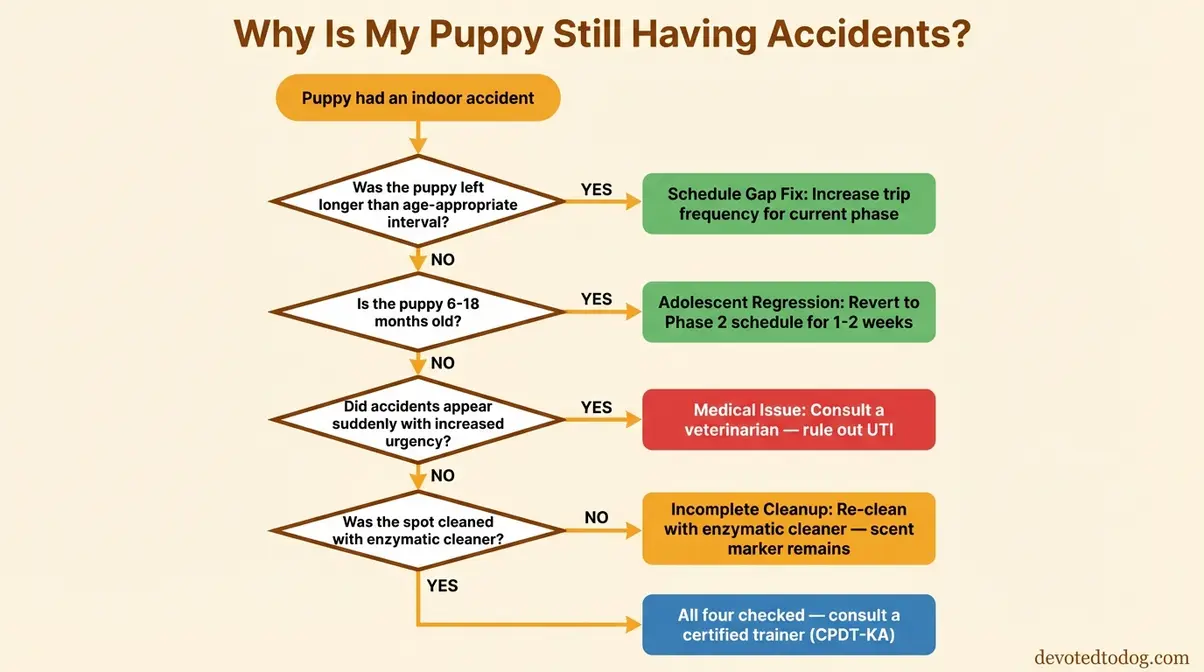
Why Is My Puppy Still Having Accidents?
Golden retriever potty problems are rarely mysterious, they fall into one of four diagnosable categories. Work through this list before making any changes to your training method:
- Schedule gap, your puppy is being left too long between trips for their current phase. An 8-week-old left for 2 hours in Phase 1 territory will almost certainly have an accident. Check your phase, check your intervals.
- Adolescent regression, common at 6–18 months, this is the Phase 3 challenge that catches owners off guard. Previously reliable habits temporarily deteriorate during hormonal changes. Potty training regression during adolescence is normal and temporary, it does not mean your training has failed, only that your schedule needs temporary tightening. Solution: revert to Phase 2 schedule frequency for 1–2 weeks, then ease back.
- Medical issue, a UTI, bladder stones, or other condition can cause sudden indoor accidents in a previously reliable puppy. If accidents appear suddenly with increased frequency or urgency, consult a veterinarian before assuming it’s behavioral. Rule out medical causes first.
- Incomplete cleanup, scent markers from previous accidents attract repeat soiling. Enzymatic cleaners use biological enzymes that break down urine proteins completely, the only type of cleaner that fully eliminates the scent signal that draws your puppy back to the same spot. Standard household cleaners mask the odor to human noses but leave detectable protein residues that dogs can still smell.
Golden Retrievers also experience fear stages at approximately 8–11 weeks and again at 6–18 months. During these periods, stress can trigger accidents even in well-trained puppies. Patience and positive reinforcement are more effective than schedule tightening alone during these windows.
Submissive urination, involuntary leaking triggered by excitement or fear, is not a training failure and is not corrected by potty training alone. If your puppy leaks small amounts when greeted or handled, avoid direct eye contact and crouching during greetings, and build confidence through positive, calm interactions. This typically resolves on its own by 6–12 months.
For a broader look at behavioral patterns alongside house-training, common Golden Retriever behavior problems and solutions covers the full range of what owners encounter in the first year.
One of the most frustrating and confusing accident types is when a puppy who seemed crate-trained suddenly starts soiling their own sleeping space.
Why Is My Golden Retriever Peeing in the Crate?
When your Golden starts to pee in his kennel, it almost always traces back to one of three specific causes, and each has a direct fix:
- Crate is too large, the most common cause, and the most overlooked. If the crate has extra space, the puppy treats one corner as a bathroom and retreats to the other end to sleep. Solution: use a crate divider to reduce the interior to sleeping-area-only size. This single fix resolves crate accidents for the majority of owners who try it.
- Left too long, the puppy physically could not hold it. Check the age-based maximum: 1 hour per month of age while awake. A 2-month-old should not be crated for more than 2 hours at a stretch. If your schedule has gaps longer than this, the crate accidents are a schedule problem, not a crate problem.
- Prior bad habits, a puppy from a pet store, shipping environment, or previous home may have learned to eliminate in their sleeping space and lost the instinct to keep it clean. This takes longer to correct but is completely fixable. More frequent trips, enzymatic cleaning of the crate lining after every accident, and extra patience are the tools. Progress is slower, expect 2–4 additional weeks, but the instinct can be rebuilt.
Weather hesitation is a related issue: some Golden Retrievers resist going outside in rain or cold. The fix is simple, use a high-value treat to reward going outside regardless of weather. Don’t skip outdoor trips because of rain. Skipping teaches your puppy that indoor alternatives become acceptable when conditions are uncomfortable.
The owner who described their 5-month-old still having accidents in the crate was almost certainly dealing with cause #1 or #2. If the crate is properly sized and the schedule is tight, crate accidents become genuinely rare by 14–16 weeks.
Whether the accident happens in the crate or on the carpet, the cleanup method you use in the next 10 minutes determines whether it becomes a repeat location.
Cleaning Up Accidents the Right Way
When your puppy does pee on your carpet, the cleanup protocol you follow in the next 10 minutes has more impact on future accidents than anything else you do. Standard household cleaners, including many popular pet sprays, mask the odor to human noses but fail to break down urine proteins. Dogs’ noses are estimated to be 10,000 to 100,000 times more sensitive than ours; the scent marker remains fully detectable to your puppy even when you can’t smell anything. That’s why puppies return to the same spots repeatedly.
- Enzymatic cleaner protocol, 5 steps:
- Blot the accident immediately, do not scrub (scrubbing spreads the proteins deeper into carpet fibers and a wider area)
- Apply enzymatic cleaner generously, saturate the area, not just the surface
- Let it sit for the time specified on the product label (typically 5–10 minutes), the enzymes need contact time to break down the proteins
- Blot dry with a clean cloth; do not steam-clean before enzymatic treatment (heat permanently sets urine proteins into fibers)
- Keep your puppy away from the area until fully dry
The Louisa County housetraining guide specifically recommends enzymatic cleaners for accident cleanup to fully eliminate the scent markers that attract repeat soiling, this is consistent with current veterinary guidance across all major sources.
No-punishment protocol: if you catch the accident in progress, calmly clap your hands once and say “outside” in a neutral tone, then carry the puppy outside immediately. If you discover it after the fact, clean quietly without any reaction directed at the puppy. Dogs cannot connect a correction to a past event, punishment after the fact only creates confusion and anxiety, not learning.
The core techniques work well in a house with a yard, but what if your situation doesn’t fit the standard setup?
Potty Training in Challenging Situations
Potty training a Golden Retriever puppy while working or living in an apartment is entirely achievable, it just requires adapting the standard schedule to your specific constraints. According to the Missouri Department of Corrections’ Puppies for Parole training manual, puppies can typically hold their urine for about four hours, meaning a standard 8-hour workday creates a gap that must be filled. The solutions below don’t require a yard or a work-from-home schedule, just a bit of planning.
Potty Training While Working Full-Time
Raising a Golden Retriever puppy while working presents a math problem: an 8-week-old Golden can hold it for 1–2 hours maximum while awake, and a standard workday creates a 6–7 hour gap. This isn’t a training problem, it’s a logistics problem. Here are three solutions in order of effectiveness:
- Dog walker or pet sitter, arrange midday trips every 2–3 hours for puppies under 12 weeks. The walker should follow the same verbal cue and reward protocol you use, not just open the door and hope for the best. Consistency of method matters as much as frequency.
- Doggy daycare, the most effective solution for full-time working owners with puppies under 16 weeks. Supervised potty training continues while you’re at work, and socialization is a valuable side benefit. Research daycares that use positive reinforcement methods specifically.
- Puppy playpen with indoor grass patch, an indoor grass patch (a tray of real or artificial grass designed for puppies without yard access) gives your puppy an appropriate indoor option when external help isn’t available. This delays full outdoor training but prevents carpet accidents. Think of it as a temporary bridge, not a permanent solution.
The “lunch break dash”, coming home at midday for a 15-minute potty trip, is the minimum viable solution for puppies 12–16 weeks. It does not work for puppies under 12 weeks who need trips every 1–2 hours; the gap is still too long.
Weekend intensive training can partially compensate for inconsistent weekday coverage. Committing to a trip every 30 minutes on weekends, with high-value rewards and consistent cues, accelerates the core association even when weekday follow-through is imperfect. Progress will be slower, expect the 4–6 week window to stretch to 8–10 weeks, but the training absolutely still works.
Apartment dwellers face a different version of the same challenge, not time gaps, but physical access to an appropriate outdoor space.
Potty Training a Golden Retriever in an Apartment
How to potty train a Golden Retriever in an apartment comes down to one core challenge: young puppies face a 2–5 minute delay between “I need to go” and “I’m outside.” A Phase 1 puppy cannot hold it through a lobby and elevator ride reliably. Three apartment-specific solutions address this directly:
- Designated outdoor spot nearby, identify the closest patch of grass or approved outdoor area and use it as your exclusive potty spot. Always go to the same location. The scent buildup from consistent use actually helps accelerate the association.
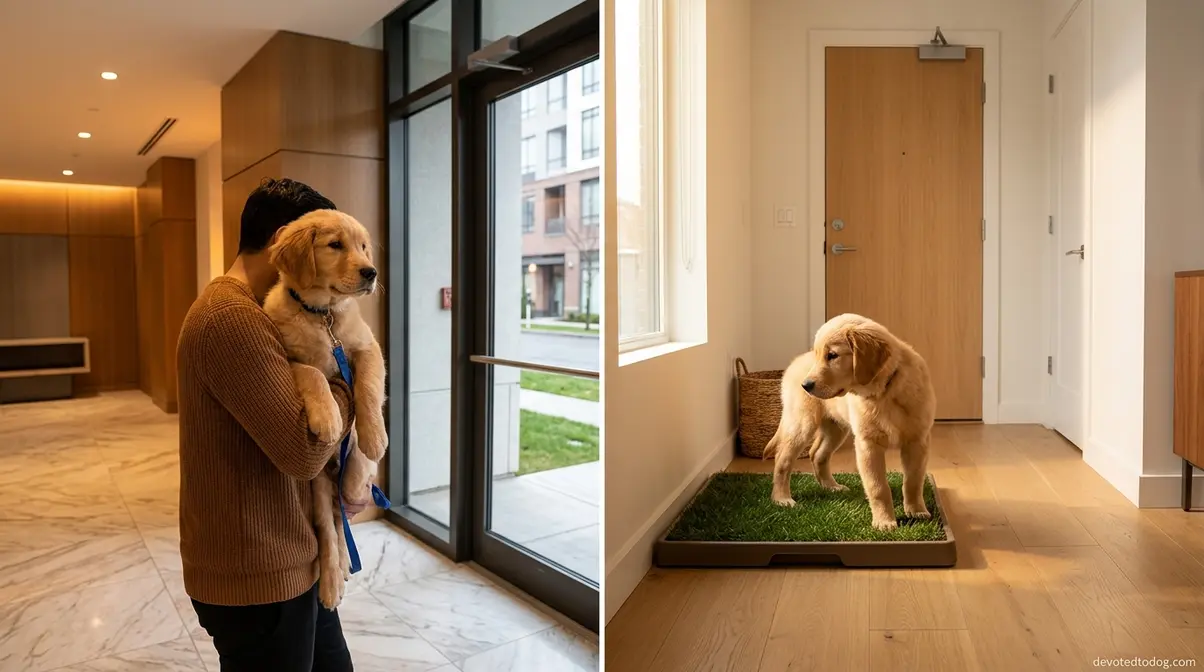
- Indoor grass patch or balcony potty tray, place an indoor grass patch near the door as a backup option for emergencies. Teach it as the backup, not the primary destination. Gradually phase it out as bladder control improves through Phase 2 and Phase 3.
- Carry method for young puppies, for Phase 1 puppies, carry them to the elevator rather than walking. Walking stimulates elimination; carrying reduces accidents in hallways and common areas. As your puppy gains bladder control in Phase 2, you can transition to walking on leash.
Signal-to-door training works the same way as house training, reward the puppy for going to the door as a signal, but factor in that your response window needs to be faster. Reward the door signal behavior enthusiastically; it’s doing more work in an apartment than it would in a house with immediate yard access.
Check your building’s pet policy for designated relief areas; some buildings have indoor pet relief stations or designated outdoor strips. Use whatever approved space is available, and use it consistently.
A 14-week-old Golden on the 12th floor, carried to the elevator, walked directly to the designated sidewalk grass strip, rewarded immediately for eliminating, learns the full sequence in 3–4 weeks. Apartment training typically takes 2–4 weeks longer than house-with-yard training, so set your expectations accordingly and don’t interpret slower progress as a method failure.
Even the best training plan has common mistakes that can quietly undermine months of progress, knowing what to avoid is just as important as knowing what to do.
Common Potty Training Pitfalls to Avoid
Five specific mistakes account for the majority of potty training frustrations in Golden Retriever owners. Naming them directly saves you weeks of wasted effort.
Mistakes That Slow Down Your Progress
- Punishment for accidents, Scenario: puppy has an accident while you weren’t watching; owner scolds. Consequence: puppy learns to hide when they need to go, behind furniture, in corners, making accidents harder to catch. Fix: interrupt only if caught in the act (one calm clap); clean quietly otherwise.
- Inconsistent schedule, Scenario: perfect schedule on weekdays, relaxed schedule on weekends. Consequence: extends training timeline by 2–4 weeks; the puppy’s internal clock never fully sets. Fix: keep the same schedule anchor points on weekends even if individual times shift.
- Delayed rewards, Scenario: treat given after puppy re-enters the house. Consequence: puppy associates the treat with coming inside, not with eliminating outside. Fix: treat within 3 seconds of elimination, while still outside, this one adjustment alone can accelerate Phase 1 progress noticeably.
- Too-large crate, Scenario: puppy has extra space in the crate. Consequence: puppy eliminates in one corner and sleeps in the other, bypassing the instinct that makes crate training work. Fix: use a divider to reduce interior to sleeping-area-only size.
- Skipping trips in bad weather, Scenario: it’s raining; owner decides to skip the outdoor trip. Consequence: puppy learns that indoor accidents are acceptable alternatives during uncomfortable weather. Fix: use high-value treats to make outdoor trips rewarding regardless of conditions, the treat value should outweigh the discomfort.
When to Call a Vet or Professional Trainer
Two scenarios warrant escalation beyond schedule adjustments.
Call your vet if you notice a sudden increase in accident frequency or urgency in a puppy who was previously reliable. Sudden changes, especially if accompanied by straining, blood in urine, or excessive water consumption, can indicate a UTI, bladder infection, or other medical issue. Rule out physical causes before assuming behavioral regression. This is particularly important for puppies between 4–8 months, when adolescent regression and medical issues can look identical from the outside.
Contact a certified professional dog trainer (look for CPDT-KA certification) if your puppy is over 6 months old and still having more than 1–2 accidents per week despite consistent schedule and technique. A professional can assess whether there’s a behavioral pattern, anxiety, resource guarding, or a learned habit, that requires direct observation to diagnose and address. Most behavioral issues caught before 12 months respond well to professional guidance.
Frequently Asked Questions
Are golden retriever puppies easy to potty train?
Golden Retriever puppies are among the easiest breeds to potty train, thanks to their high intelligence and natural eagerness to please. Most Golden Retrievers achieve reliable house-training within 1–5 weeks of consistent training, with full bladder control typically developing by 5–6 months of age. Unlike independent breeds such as Basset Hounds or Chow Chows, Golden Retrievers respond quickly to positive reinforcement and consistent schedules. Results vary based on when training begins, schedule consistency, and whether the puppy has developed any indoor habits before training starts.
What is the 10 10 10 rule for puppy potty training?
The 10-10-10 rule for puppy potty training means taking your puppy outside for 10 minutes, staying 10 feet from their designated toilet area, and supervising for 10 minutes afterward. This structured routine helps puppies develop bladder control by establishing a clear, repeatable sequence. The 10-minute outdoor window gives the puppy adequate time to settle and eliminate without distraction. The 10-foot distance prevents the owner from inadvertently hovering during elimination. This rule works best for puppies in Phase 2 of the 3-Phase Potty Training Window (12–16 weeks), when they’re building reliability but still benefit from structure.
At what age should a golden retriever puppy be fully potty trained?
A Golden Retriever puppy should be reliably potty trained between 4 and 6 months of age, when physical bladder control reaches near-adult levels. While many Golden Retrievers grasp the basic concept within 1–5 weeks of training, the muscles controlling bladder release continue developing through 5–6 months. Think of it like a toddler who understands toilet training but still needs reminders, the understanding comes before the physical reliability. Puppies started on consistent training at 8 weeks typically achieve full reliability faster than those who begin at 12 weeks or later.
What are the hardest months with a golden retriever puppy?
The hardest months with a Golden Retriever puppy are typically 8–11 weeks (first fear stage) and 6–18 months (adolescent fear stage). During these periods, puppies can become more sensitive to new experiences, people, and environments, making training and socialization more challenging. The adolescent stage (6–18 months) often coincides with potty training regression, when previously reliable habits may temporarily deteriorate. Patience and consistent positive exposure during fear stages are more effective than increased training pressure, pushing harder during fear stages often backfires.
What is the hardest puppy to potty train?
The hardest puppies to potty train are typically Dalmatians, Chow Chows, Beagles, Basset Hounds, Pomeranians, Bulldogs, Basenjis, and Jack Russell Terriers. These breeds tend toward stubbornness or independence, making the consistent schedule-and-positive-reinforcement approach less immediately effective. In contrast, Golden Retrievers rank among the easiest breeds to potty train, their eagerness to please significantly accelerates the learning process. Even easy-to-train breeds require consistency; the difference between a Golden and a Beagle is in how quickly they generalize the lesson, not whether they can learn it.
What is the silent killer in golden retrievers?
The “silent killer” in Golden Retrievers is hemangiosarcoma, an aggressive cancer of the blood vessels that often goes undetected until advanced stages. This disease progresses rapidly and accounts for a significant portion of Golden Retriever deaths, particularly in dogs over 8 years old. Because early symptoms are subtle or absent, regular veterinary check-ups and annual bloodwork are essential for early detection. This is unrelated to potty training, if your Golden is having sudden urinary accidents alongside other symptoms like lethargy, pale gums, or abdominal swelling, consult a veterinarian promptly.
What is the hardest dog to potty train?
The hardest dogs to potty train include Dalmatians, Chow Chows, Beagles, Basset Hounds, Pomeranians, Bulldogs, Basenjis, and Jack Russell Terriers. These breeds share traits like stubbornness, independence, or high distraction sensitivity that make consistent schedule-based training less effective initially. Even these breeds can be reliably house-trained with sufficient patience, consistency, and tailored positive reinforcement methods. Golden Retrievers are consistently rated among the easiest breeds to potty train by comparison, their cooperative temperament is a genuine training advantage.
What is the 3 day potty training trick?
The 3-day potty training method is an intensive, highly supervised approach designed to rapidly establish the outdoor elimination habit through constant reinforcement over a concentrated 72-hour period. It involves taking your puppy outside every 15–30 minutes, rewarding every outdoor elimination immediately, and using crating or tethering indoors to prevent unsupervised accidents. The method works best for puppies already in Phase 2 (12+ weeks), younger puppies in Phase 1 lack the bladder control to benefit fully. Most puppies still require 2–4 additional weeks of reinforcement even after a successful 3-day intensive, so treat it as an accelerator, not a complete solution.
What is the hardest breed of dog to potty train?
Breeds commonly identified as the hardest to potty train include Dalmatians, Chow Chows, Beagles, Basset Hounds, Pomeranians, Bulldogs, Basenjis, and Jack Russell Terriers. Their stubborn or independent temperaments require more consistent effort, tailored approaches, and extended timelines compared to eager-to-please breeds like Golden Retrievers. These breeds are not untrainable, they simply require a trainer willing to adapt the method to the breed’s learning style and accept a longer timeline. If you’re raising a Golden Retriever, you’re already starting with one of the most trainable breeds available.
What is a red flag puppy’s behavior?
Red flag puppy behaviors include unprovoked growling, stiff body posture, snarling, or displaying teeth, especially when associated with fear or pain rather than play. These behaviors go beyond normal puppy mouthiness and suggest potential underlying issues requiring professional evaluation. A puppy displaying these signs around food, handling, or strangers should be evaluated by a veterinarian or certified professional dog trainer promptly. Early intervention is significantly more effective than waiting, most behavioral issues are addressable when caught before 6 months of age, and the window for intervention narrows considerably after that.
Putting It All Together
For owners potty training a Golden Retriever puppy, success comes from matching your schedule to your puppy’s developmental phase, not from trying harder with the wrong approach. Most Golden Retrievers achieve reliable house-training within 4–6 weeks when owners follow a consistent, age-appropriate schedule (Ohio State University Indoor Pet Initiative). The most effective approach combines the 3-Phase Potty Training Window framework, a printed daily schedule, enzymatic cleanup protocols, and immediate positive reinforcement delivered within 3 seconds of outdoor elimination.
The 3-Phase Potty Training Window reframes every accident as a diagnostic signal rather than a failure, Phase 1 means more frequent trips, Phase 2 means watching for signals, Phase 3 means trusting your pup with brief independence. Knowing which phase you’re in changes everything. The owner frustrated by a 5-month-old still having accidents isn’t failing at training, they may simply be dealing with adolescent regression, a crate sizing issue, or an incomplete cleanup protocol, all of which have specific fixes.
Start with the age-appropriate schedule in this guide, print the signs checklist, and commit to 5 consistent days before evaluating progress. If you’re working on basic obedience alongside house-training, the full daily training framework covers everything from sit and stay to leash manners, building all the foundational skills together during the same developmental window.
For apartment living or overnight training, compare our roundup of the best indoor dog potties.
Alliyah Strange is a CPDT-KA certified dog trainer and behaviorist. She reviews DevotedToDog training and behavior articles for accuracy and alignment with current positive-reinforcement, force-free training standards.