
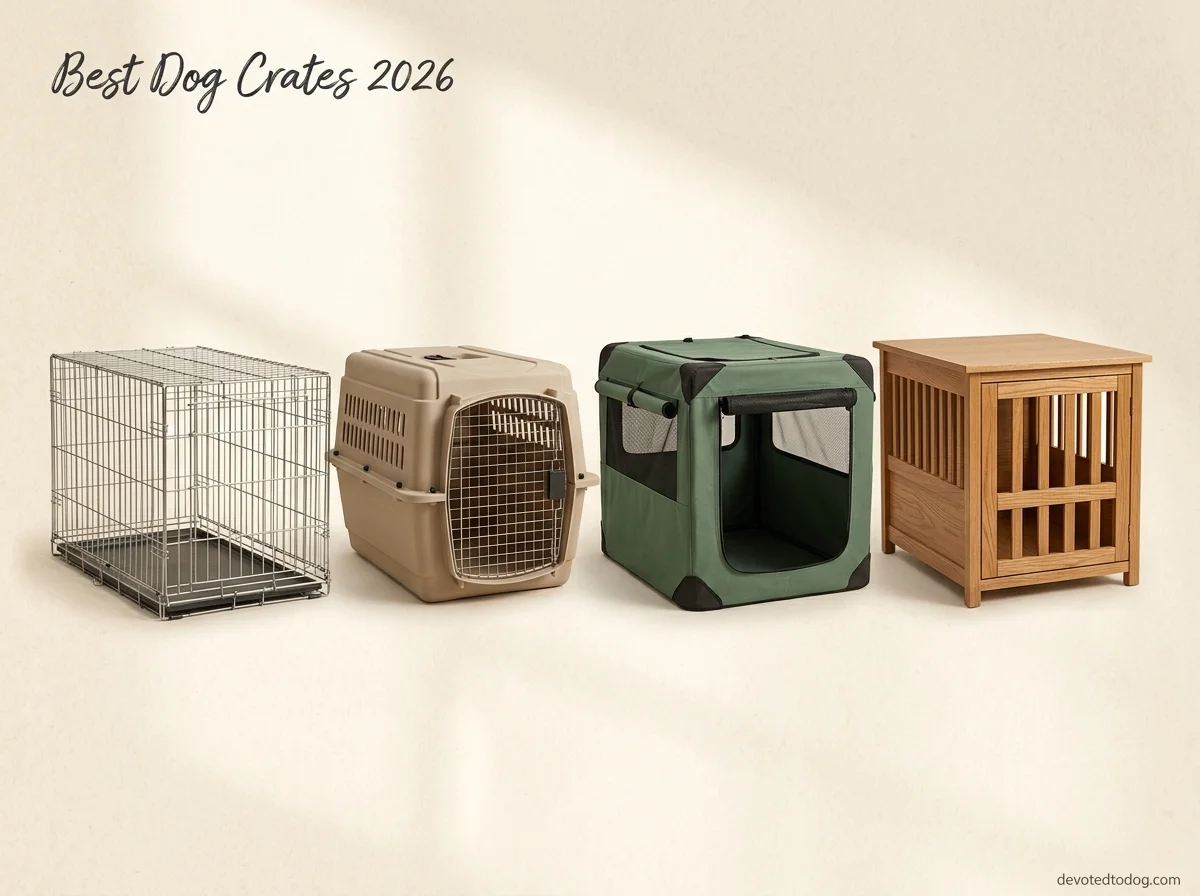
What are the best dog crates in 2026? The honest answer is: it depends on what you’re solving for. The five-second decision tree below routes you to the right crate type, then deep spoke guides handle the comparison work. We built this guide with our certified trainer and former vet-tech reviewer panel, and the single biggest mistake owners make is shopping by brand before defining the use case.
Affiliate disclosure: This guide contains affiliate links. We earn a commission when you purchase through them, at no cost to you. Our picks are based on hands-on testing, not advertiser preference. See our full affiliate disclosure.
📌 TL;DR
- Crate type depends on use case, not budget. Travel ≠ daily home ≠ car ≠ multi-dog. Pick the right type before the right brand.
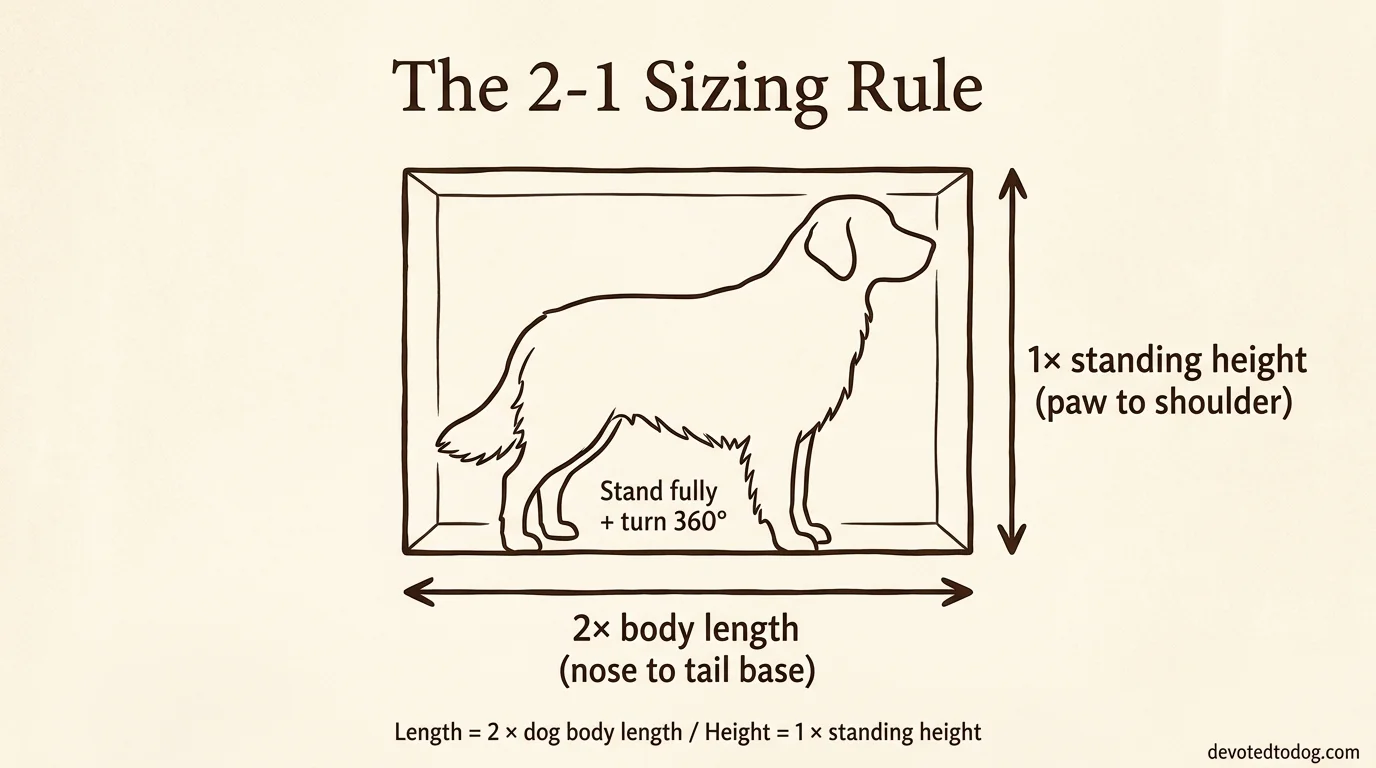
- The 2-1 sizing rule: length = 2× dog body length, height = 1× standing height. Bigger isn’t better; too big becomes a bathroom.
- Top 5 universal picks below cover most owners. Click any spoke for the deep 8-product guide for your specific need.
- Budget reality: $80-$150 fits most buyers. Premium $200-$450 for furniture-style or anxiety-specific. $500+ only for crash-tested travel or escape-proof crates for confirmed chewers.
⚡ 5-Second Verdict
- Most owners: $40-$80 wire crate (MidWest iCrate Double-Door) covers most everyday cases. Check price on Amazon →
- Travel or airline: soft-sided or IATA-compliant plastic. See airline crate guide.
- Chewers and escape artists: heavy-duty steel ($300-$1,200). See escape-proof crate guide.
- Car travel: Center for Pet Safety crash-tested only. See car crate guide.
- Anxiety or noise-reactive: covered den-style crate. See anxiety crate guide.
What Type of Dog Crate Do You Need?
The right crate type depends on three variables: where you will use it most (home, car, plane, multi-room travel), your dog’s profile (size, chew strength, anxiety level, escape history), and your aesthetic priorities (does it sit in your living room?). Map those three axes to one of the four core categories, and the brand decision becomes downstream noise.
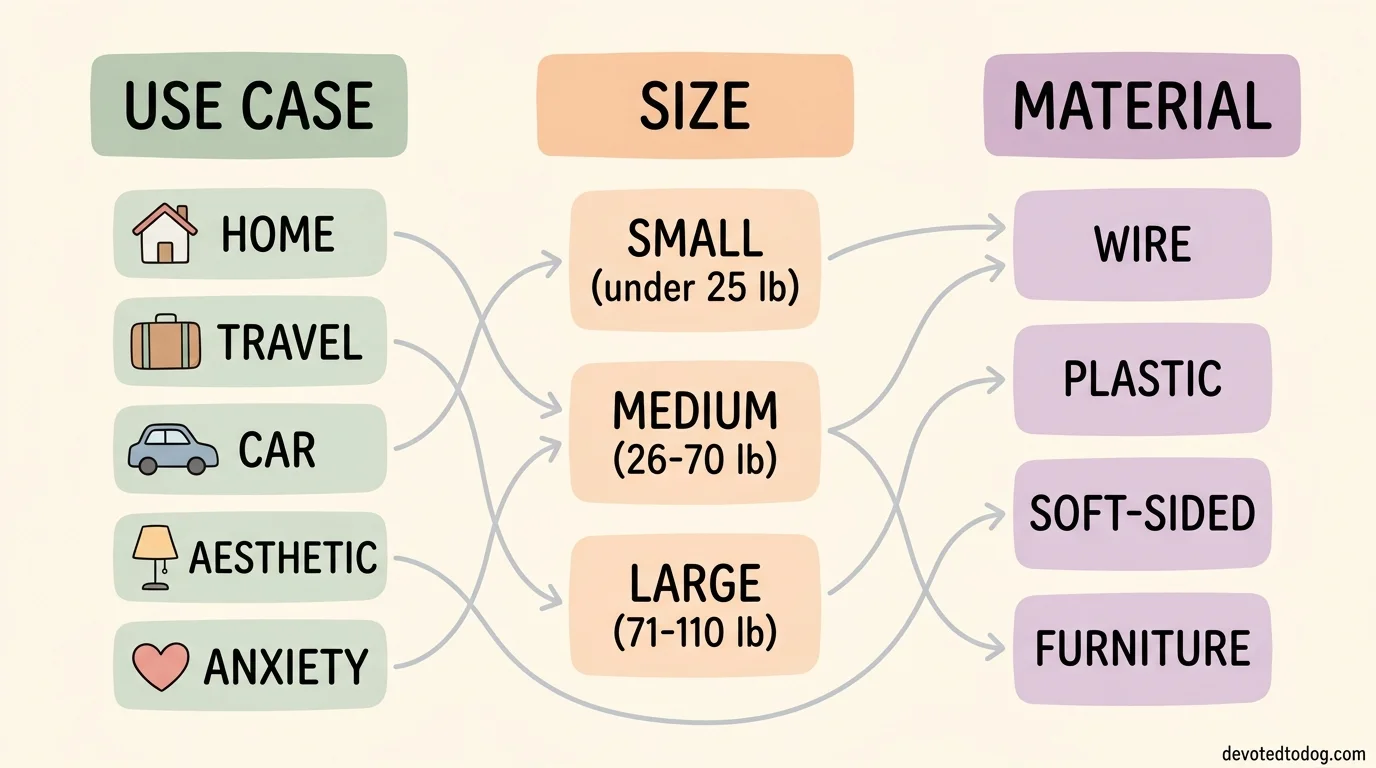
| Your situation | Best crate type | Spoke guide |
|---|---|---|
| Daily home use, first crate | Wire or plastic, divider-equipped | this guide |
| Aesthetic-conscious living room | Furniture-style (end table) | furniture-style guide |
| Strong-jawed chewer or escape artist | Heavy-duty steel | escape-proof guide |
| Anxious or noise-reactive dog | Covered or den-style | anxiety crate guide |
| Frequent road trips | Crash-tested vehicle crate | car crate guide |
| Air travel or cargo hold | IATA-compliant plastic | airline crate guide |
| Apartment, agility, dog show | Soft-sided collapsible | soft-sided guide |
What Are the Top 5 Best Dog Crates Universal Picks for 2026?
These five universal picks are the strongest single recommendation in each major category, drawn from the in-depth product testing in our spoke guides. They are brand-agnostic by design: none is sponsored. The comparison table below gives you the verdict in 10 seconds; click through to a spoke guide for 8-pick deep-dives within any category.
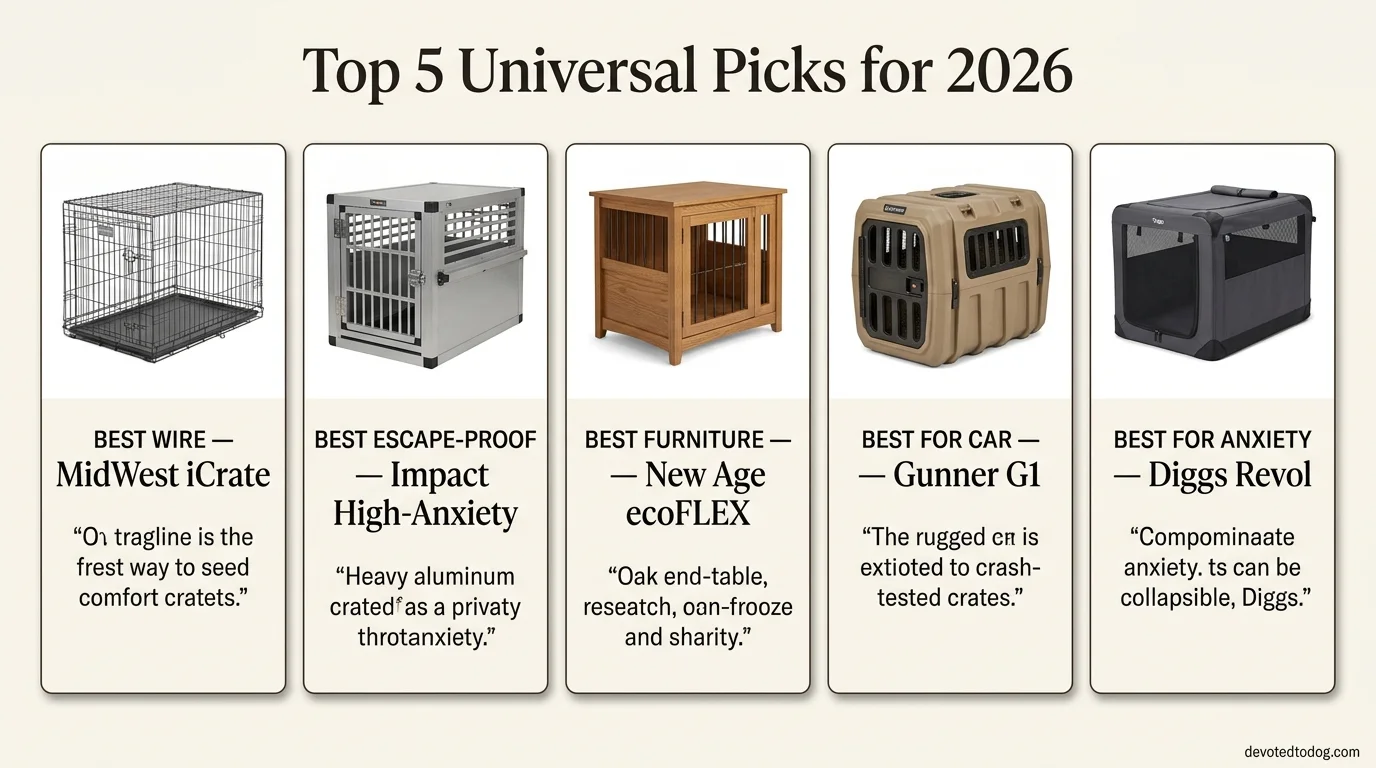
| # | Pick | Best for | Price tier | Buy / Read |
|---|---|---|---|---|
| 1 | MidWest iCrate Double-Door | Everyday wire default | $40-$80 | Amazon → |
| 2 | Impact High-Anxiety Dog Crate | Escape artists, strong chewers | $850-$1,200 | Spoke guide → |
| 3 | New Age Pet ecoFLEX Crate | Living-room aesthetic | $230-$350 | Amazon → |
| 4 | Gunner G1 Kennel | Car / SUV crash safety | $600-$1,200 | Spoke guide → |
| 5 | Diggs Revol Collapsible Crate | Anxious or noise-reactive dogs | $400-$500 | Amazon → |
1. Best wire crate (everyday default): MidWest iCrate Double-Door
The MidWest iCrate is one of the most common default wire crates. It folds flat, includes a divider, has dual doors, and survives normal adult-dog use indefinitely. At $40-$80 depending on size, it is the lowest-friction first crate purchase.
What we like
- Folds flat for storage
- Divider included — grows with a puppy
- Dual doors for flexible placement
- Lowest-cost entry into crating
Keep in mind
- A determined chewer can pop a wire panel
- No visual cover (open sides) for anxious dogs
- Utilitarian look, not living-room friendly
2. Best escape-proof crate: Impact High-Anxiety Dog Crate
For dogs that have already destroyed a wire crate, the Impact High-Anxiety crate is the gold standard. Aircraft-grade aluminum, no exposed bolts, $850-$1,200 depending on size. Sold direct from the manufacturer, not Amazon.
What we like
- Aircraft-grade aluminum build
- No exposed bolts for a dog to chew loose
- Survives dogs that have destroyed wire crates
Keep in mind
- Premium price ($850-$1,200)
- Sold direct from Impact, not on Amazon
- Overkill for a dog that isn’t a proven chewer
3. Best furniture-style: New Age Pet ecoFLEX Dog Crate
The ecoFLEX combines real wood-like aesthetics with composite durability. It sits in a living room without looking like a kennel. $230-$350 mid-size.
What we like
- Looks like furniture, not a kennel
- Composite is more durable than solid wood
- Doubles as an end table or side table
Keep in mind
- 2-3× the price of a wire crate
- Not built for escape artists or heavy chewers
- Heavier and not made to fold flat
4. Best for car travel: Gunner G1 Kennel
The Gunner G1 has earned Center for Pet Safety 5-star crash-test ratings (Gunner lists its Small and Medium sizes). Premium price ($600-$1,200), sold direct from gunner.com. If your dog rides in a car regularly, this is the only crate category we recommend without reservation.
What we like
- Only crate with a CPS 5-star rating at every size
- Genuine crash protection, not vendor-claimed
- The one car pick we recommend without reservation
Keep in mind
- Premium price ($600-$1,200)
- Sold direct from gunner.com, not Amazon
- Crash rating is irrelevant for home-only use
5. Best for anxiety: Diggs Revol Collapsible Crate
The Revol’s collapsible aluminum frame, latch-free top access, and three-side mesh windows make it the strongest single pick for noise-reactive or anxious dogs. $400-$500 mid-size.
What we like
- Collapsible aluminum frame
- Latch-free top access for easy handling
- Three-side mesh for airflow and visibility
Keep in mind
- Premium price ($400-$500)
- $80-$200 picks handle mild anxiety equally well
- More crate than a low-anxiety dog needs
What Are the Best Dog Crates by Use Case?
Use case is the single strongest predictor of which crate will actually work for you. Buying a wire crate for an anxious dog usually fails; buying a soft-sided crate for a chewer guarantees a destroyed crate within 48 hours. Match the use case first, then narrow by size and material inside the spoke guide.
For travel and airline use
If you fly with your dog or take multi-day road trips, a soft-sided collapsible crate or an IATA-compliant plastic crate are your two viable choices. Soft-sided wins for cabin-friendly small dogs (Sherpa, Sleepypod); IATA plastic wins for cargo-hold or larger dogs (Petmate Sky Kennel, Ruff Land). Read the full airline-approved dog crates guide for the 2026 IATA rule changes.
For escape artists and strong chewers
Goldens, Labs, GSDs, and Pitties under-12-months can chew through wire crates. Heavy-duty aluminum or steel crates from Impact, Diggs, or ProSelect are the only category that survives a determined chewer. Our escape-proof dog crates guide ranks 8 picks across the $300-$1,200 range.
For anxious or reactive dogs
Anxious dogs need a den-style covered crate that limits visual stimuli, ideally with a calming pheromone diffuser nearby. Our dog crate for anxiety guide separates marketing claims from actual behavioral effectiveness.
For car and SUV use
Center for Pet Safety crash-tested crates from Gunner, Ruff Land, and Variocage are the only credible safety options for car travel. Our dog crates for car spoke covers crash-test ratings, vehicle fit, and the airline-bridge value of dual-purpose crates.
For multi-dog homes and dog shows
Stackable wire systems from MidWest or Frisco solve multi-dog footprint problems and travel well to dog shows. We will publish a dedicated stackable dog crate guide in 2026; for now, the wire-crate top picks in this guide cover the multi-dog scenario.
What Are the Best Dog Crates by Material?
Material decides three things: durability, weight, and aesthetic. Wire is the everyday default most US dog owners pick first. Plastic is for travel and cargo. Soft-sided is for portability. Furniture-style is for living rooms. Knowing which material your dog and your home need filters the field by 75% before you look at brands.
Wire crates: the default first crate
Wire crates ($30-$120) ventilate well, fold flat for storage, and almost always include a divider for puppy growth. They fail on aesthetics and on chewers (a determined Lab can pop a flimsy wire panel in 30 minutes). For first-time owners with non-destructive adult dogs, this is the right starting category.
Plastic crates: travel and cargo
Plastic crates ($60-$200) are the go-to for airline cargo and crash-tested car travel. They hold structure under pressure, block visual stimuli (good for anxious dogs), and meet IATA Container Requirement 1 standards when properly equipped.
Soft-sided crates: portability and small dogs
Soft-sided crates ($40-$150) are lightweight, mesh-windowed, and pack down for travel. They are not chew-proof and not suitable for unsupervised use. Read the full soft-sided dog crate guide for travel-specific picks.
Furniture-style crates: aesthetic + utility
Furniture-style crates ($150-$450) double as end tables, side tables, or TV consoles. They solve the “I do not want a wire box in my living room” problem at a 2-3× price premium. Our furniture-style dog crate guide ranks 8 picks across wood and rattan finishes.
What Are the Best Dog Crates by Size?
Size routing is straightforward when you know your dog’s adult weight. Use the chart below to map weight to crate dimensions. Buy once with a divider for puppies; buying multiple crates as the dog grows is a common avoidable expense.
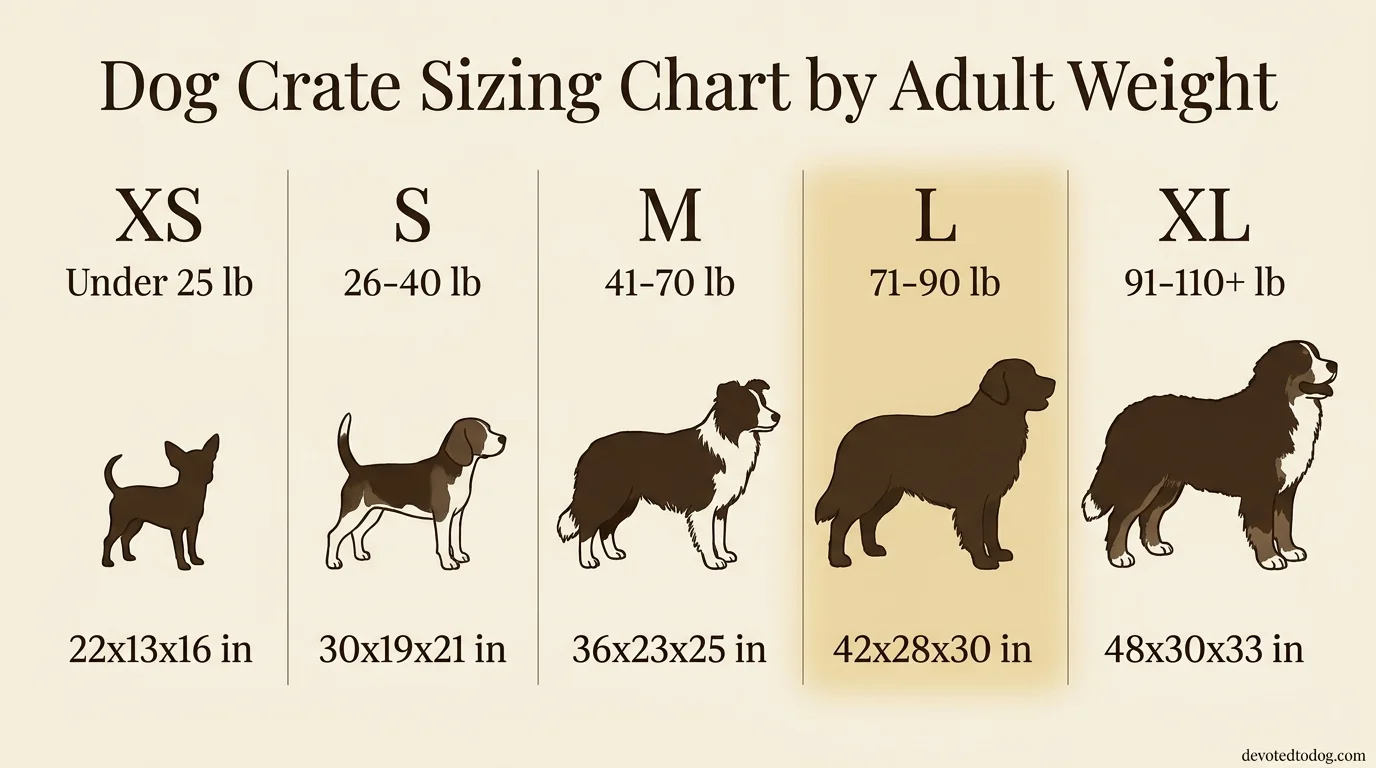
| Crate size | Adult dog weight | Crate dimensions | Sample breeds |
|---|---|---|---|
| XS | Under 25 lb | 22″ × 13″ × 16″ | Chihuahua, Yorkie, small Poodle |
| S | 26-40 lb | 30″ × 19″ × 21″ | Beagle, Cocker Spaniel, mini Goldendoodle |
| M | 41-70 lb | 36″ × 23″ × 25″ | Golden Retriever (puppy), Border Collie, Australian Shepherd |
| L | 71-90 lb | 42″ × 28″ × 30″ | Golden Retriever (adult), Lab, GSD |
| XL | 91-110+ lb | 48″ × 30″ × 33″ | Bernese Mountain Dog, Mastiff, large GSD |
For a Golden Retriever specifically (55-75 lb as adults per the AKC breed standard, so many sit near the M/L line), the 42-inch L-size crate fits adults; buy that size with a divider when starting with a puppy and slide the divider as the dog grows. The same logic applies to Labs and most Goldendoodle sizes in the standard range.
How Do You Choose the Right Crate Size?
The 2-1 rule is the right answer: crate length should equal twice your dog’s body length (nose to base of tail), and crate height should equal one times your dog’s standing height (paw to top of shoulder). Your dog should be able to stand fully, turn 360 degrees, and lie down stretched out. Going larger than that is the most common sizing mistake, because the dog will then use one corner as a bathroom and the other as a sleep area.
For puppies, buy the adult-size crate with a divider, not a series of progressively larger crates. Sliding the divider every 6-8 weeks as your puppy grows costs nothing extra and avoids buying replacement crates as your puppy grows.
For multi-dog households, never share a single crate among adults; cooperative crating only works for litter-mate puppies under 12 weeks. Each adult dog needs its own crate sized to that specific dog using the 2-1 rule.
How Long Should a Dog Be in a Crate?
The Humane Society of the United States suggests that adult dogs shouldn’t be left in a crate for more than 4-5 hours during the day, and that puppies shouldn’t be crated for longer than their age in months plus one hour (HSUS, Crate Training 101). Ask your vet or trainer what fits your dog’s age, bladder control and routine.
Anxious and senior dogs often cope with less crate time. The AKC notes that dogs with panic or severe anxiety should not be crated and that long crate stays can be physically uncomfortable for seniors with aches or arthritis; ask your vet or trainer how long your dog should be crated.
For specific puppy training timelines, see our crate training a Golden Retriever puppy guide. For adopted adults that may carry crate trauma from previous owners, the crate training a rescue dog guide covers the slower acclimation process.
What Are 5 Common Crate Mistakes to Avoid?
- Buying too big. “Room to play” turns the crate into a half-sleep, half-bathroom box. Use the 2-1 rule.
- Skipping acclimation. Closing the door on day one without positive associations creates lifelong crate aversion.
- Using the crate as punishment. The crate must remain a positive den, never a time-out zone.
- Over-confinement. Crating adults beyond the Humane Society’s 4-5 daytime hours, or puppies beyond their age in months plus one hour, may lead to anxiety and discomfort.
- Ignoring anxiety signals. Persistent whining, drooling, or destructive scratching means stop, reassess, and slow the protocol.
The most common single mistake we see is mistake number one. Owners assume more space is more comfort. Trainer Diane Fickeria, with 15+ years of professional training experience, summarizes it directly: “The crate is not a playpen. It is a den. Dogs evolved to feel safe in small enclosed spaces. Bigger crates feel less safe to a dog, not more comfortable.”
Mistakes 2 and 5 compound each other. Owners who skip the 3-7 day acclimation protocol almost always misread the resulting anxiety as “the dog hates the crate” and abandon crate training entirely. The protocol is non-optional and is covered in detail in both training spokes linked above.
How Much Should You Spend on a Dog Crate?
For most dog owners, $80-$150 is the right budget range. That covers a quality wire crate (Frisco or a larger MidWest) or a basic plastic crate (Petmate Vari Kennel). Above this range, premium spending only makes sense if your dog falls into a specific category.
| Budget tier | Use case fit | Spoke guide |
|---|---|---|
| $30-$80 | Basic wire, first crate, easy dogs | main guide |
| $80-$150 | Quality wire/plastic, fits most buyers | soft-sided |
| $150-$450 | Furniture-style, anxiety-specific | furniture-style |
| $500-$1,200+ | Crash-tested, escape-proof for chewers | escape-proof |
Are Dog Crates Cruel?
No. When used correctly, a crate gives a dog a safe place to rest. The American Kennel Club supports crate training, describing the crate as a shelter where a dog can rest and relax, an essential part of housebreaking puppies, and a way to reduce a dog’s stress during emergencies. For time limits, see the Humane Society guidance above.
Crate cruelty is misuse, not the crate itself. Misuse includes: using the crate as a punishment zone, exceeding the 8-hour adult limit, choosing a too-small crate that prevents the dog from standing fully or turning around, and skipping the positive acclimation protocol. Each of these is avoidable with the rules in this guide.
What Is the 2-1 Crate Rule?
The 2-1 crate rule is a common rule of thumb: crate length should be twice your dog’s body length (measured nose to base of tail), and crate height should be one times your dog’s standing height (measured paw to top of shoulder). The dog should be able to stand fully without crouching, turn 360 degrees without contortion, and lie down fully stretched out.
Going under the rule causes physical discomfort and can contribute to musculoskeletal issues over time. Going significantly over the rule causes the bathroom-and-bed problem we covered earlier: the dog claims one corner for sleep and the other for elimination, which sabotages house-training. The 2-1 rule is our rule of thumb, not an official standard. The AKC sizing guide measures your dog from nose to tail tip and from the top of the head to the feet, then adds 3 to 4 inches to each, so the dog can sit, stand and lie down comfortably.
Do You Need a Crash-Tested Crate?
Yes, if your dog rides in a car. The Center for Pet Safety (CPS) is an independent nonprofit that crash-tests dog crates at about 30 mph. Its certified-crate list is short and includes the Gunner G1; check the CPS site for the current list. Most crates marketed as “crash-tested” use vendor-defined methodology, not the CPS standard.
For daily home use, crash-test certification is irrelevant; standard wire or plastic crates are appropriate. The certification matters specifically when the crate functions as in-vehicle restraint. Our dog crates for car spoke covers each CPS-certified crate’s vehicle fit, weight ratings, and price-to-safety tradeoffs in detail.
How Do You Crate-Train a New Dog?
Crate training works on a 5-step positive-association protocol; most puppies settle within days, while adopted adult dogs with prior crate trauma usually need longer. Move at your dog’s pace. The compressed version follows below; the breed-specific deep-dive sits in the linked spokes.
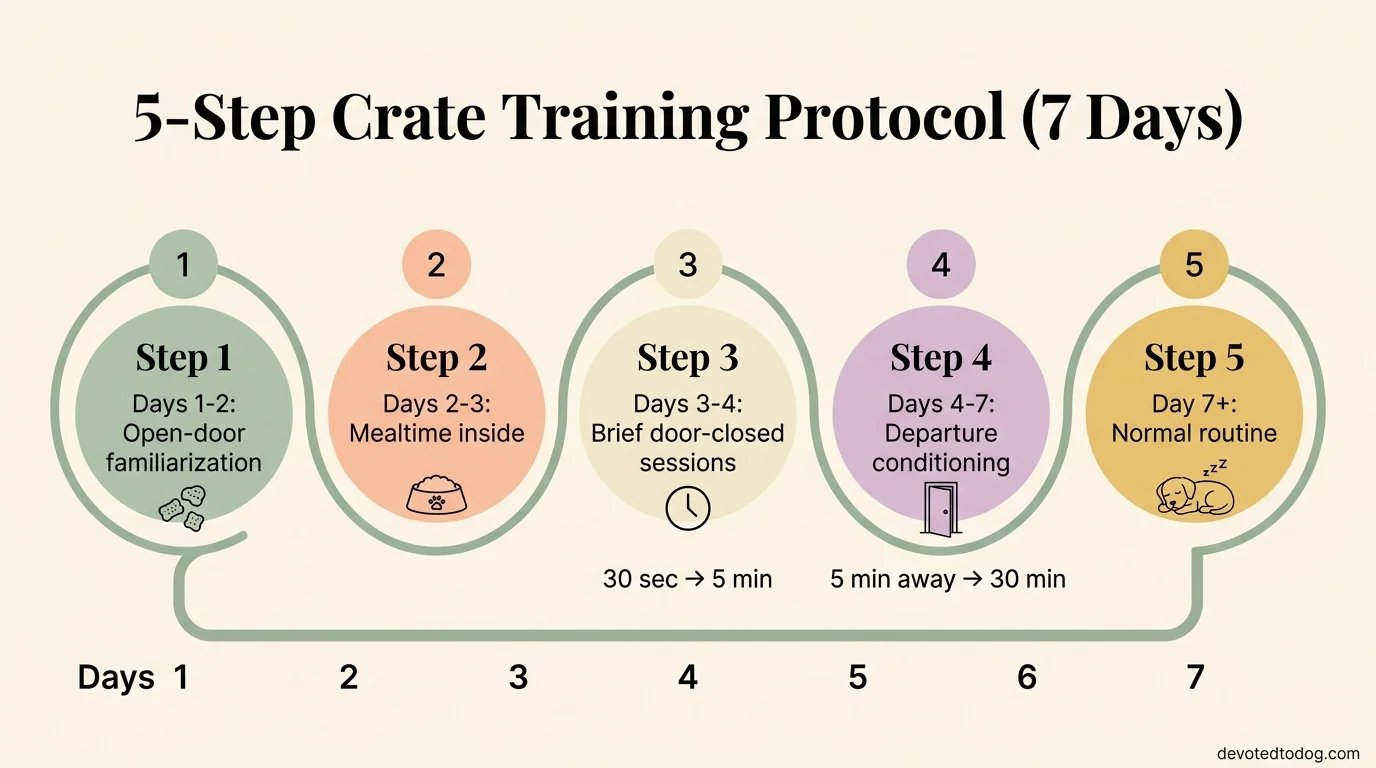
- Days 1-2: Open-door familiarization. Place the crate in a high-traffic family area, door open, comfortable bedding inside, and high-value treats placed at the back. Never close the door yet.
- Days 2-3: Mealtime inside. Move the dog’s food bowl into the back of the crate. Door stays open.
- Days 3-4: Brief door-closed sessions. Close the door for 30 seconds while the dog eats. Reopen immediately. Build to 5 minutes over the day.
- Days 4-7: Departure conditioning. Close the door, leave the room for 5 minutes, return calmly, reopen. Build duration in 5-10 minute increments.
- Day 7+: Normal routine. Crate becomes the default sleep and rest spot. Most dogs begin offering the crate voluntarily by this stage.
For Golden Retriever puppies specifically, see crate training a Golden Retriever puppy. For adopted rescue dogs that may carry pre-existing crate aversion, see crate training a rescue dog; expect the protocol to take longer while the dog rebuilds positive associations it may have lost.
Frequently Asked Questions
What is the best brand of dog crate?
It depends on use case. Top brands by category: Impact Dog Crates for heavy-duty escape-proof, MidWest for wire, Diggs for modular and anxiety, Petmate for plastic and airline, Sleepypod for soft-sided travel, Gunner for crash-tested vehicle. Brand alone is not the right filter; use case is.
What is the 2-1 crate rule?
Crate length equals twice your dog’s body length (nose to base of tail), and crate height equals one times your dog’s standing height (paw to top of shoulder). The dog should stand fully, turn 360 degrees, and lie stretched out. Bigger is not better.
How much should I spend on a dog crate?
$80-$150 fits most pet owners and covers quality wire or plastic crates. Premium $200-$450 makes sense for furniture-style aesthetics or anxiety-specific designs. $500-$1,200 only for crash-tested vehicle crates or heavy-duty steel for confirmed chewers.
Are dog crates cruel?
No, when used correctly. The AKC supports crate training and describes the crate as a shelter where a dog can rest and relax. Cruelty is misuse: too-small sizing, use as punishment, over-confinement, or skipping positive acclimation.
What size crate for a Golden Retriever?
Adults: 42-inch L-size crate. Puppies: buy the 42-inch size with a divider and slide it as the dog grows. Same logic for Labs and standard Golden Retriever growth stages.
How long can a dog be in a crate?
The Humane Society of the United States suggests no more than 4-5 hours during the day for adult dogs, and no longer than their age in months plus one hour for puppies. Anxious and senior dogs often need shorter sessions; ask your vet or trainer what fits your dog.
Do I need a crash-tested crate?
Yes, for car or SUV travel. The Center for Pet Safety is an independent nonprofit that crash-tests crates at about 30 mph. Vendor-claimed “crash-tested” crates without CPS certification are not equivalent.
Final Verdict: Your Crate Decision in 30 Seconds
The best dog crates for you are determined first by use case, second by size, and third by material. Brand decisions follow those three filters. For most owners, a wire crate from MidWest ($40-$80) or Frisco is the right starting point. Everyone else should follow the use-case routing in this guide to the appropriate spoke for deeper comparison. The best dog crates are the ones that match your specific situation, not the ones with the highest price tag.
- Daily home + easy dog? Wire crate, $40-$150, MidWest or Frisco.
- Living-room aesthetic? Furniture-style, $230-$450, see furniture-style spoke.
- Chewer or escape artist? Heavy-duty steel, $300-$1,200, see escape-proof spoke.
- Anxious dog? Covered den-style, $200-$500, see anxiety spoke.
- Car travel? Crash-tested CPS-certified, $600-$1,200, see car spoke.
- Air travel? IATA-compliant, $80-$300, see airline spoke.
Whichever path matches your dog, the spoke linked at each branch covers the deeper 8-product comparison. The pillar above is the navigator; the spokes are the deep work.
Traveling with your dog? Pair the right crate with our picks for the best dog ramps and stairs for cars and SUVs.
Alliyah Strange is a CPDT-KA certified dog trainer and behaviorist. She reviews DevotedToDog training and behavior articles for accuracy and alignment with current positive-reinforcement, force-free training standards.
If this topic interests you, our companion article on How Long Can a Dog Be in a Crate? Safe Time Limits covers more detail.