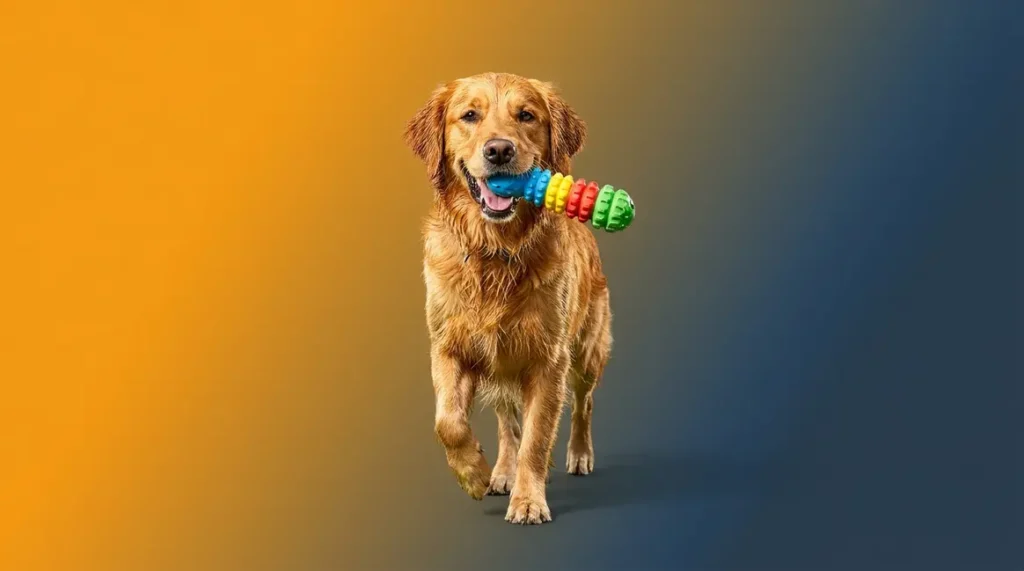
You throw the ball. Your Golden Retriever watches it land, sniffs the air, and looks back at you like you’ve made a terrible mistake. Golden Retrievers are literally bred to retrieve, which makes this moment feel especially confusing and personal.
Fetch is one of the advanced skills that builds on solid obedience foundations. See the full progression in our guide to training a Golden Retriever at every stage.
Without a clear method, most owners try a few more throws, get frustrated, and give up. That means missing out on one of the best bonding and exercise tools available to Golden Retriever owners.
By the end of this guide, you’ll know exactly how to build your Golden’s toy drive, teach a reliable fetch in five steps, and fix the keep-away problem that ruins the game for so many owners. This guide covers golden retriever fetch training basics from the ground up: motivation first, then mechanics, then troubleshooting.
Golden retriever fetch training basics start with building toy drive, not throwing distance. Most Goldens that ignore fetch haven’t been taught to value the toy yet.
- Start with toy value: Play tug or move the toy enticingly before you ever throw it.
- Use the Two-Toy Switch: A second toy solves both keep-away and drop-it refusal at once.
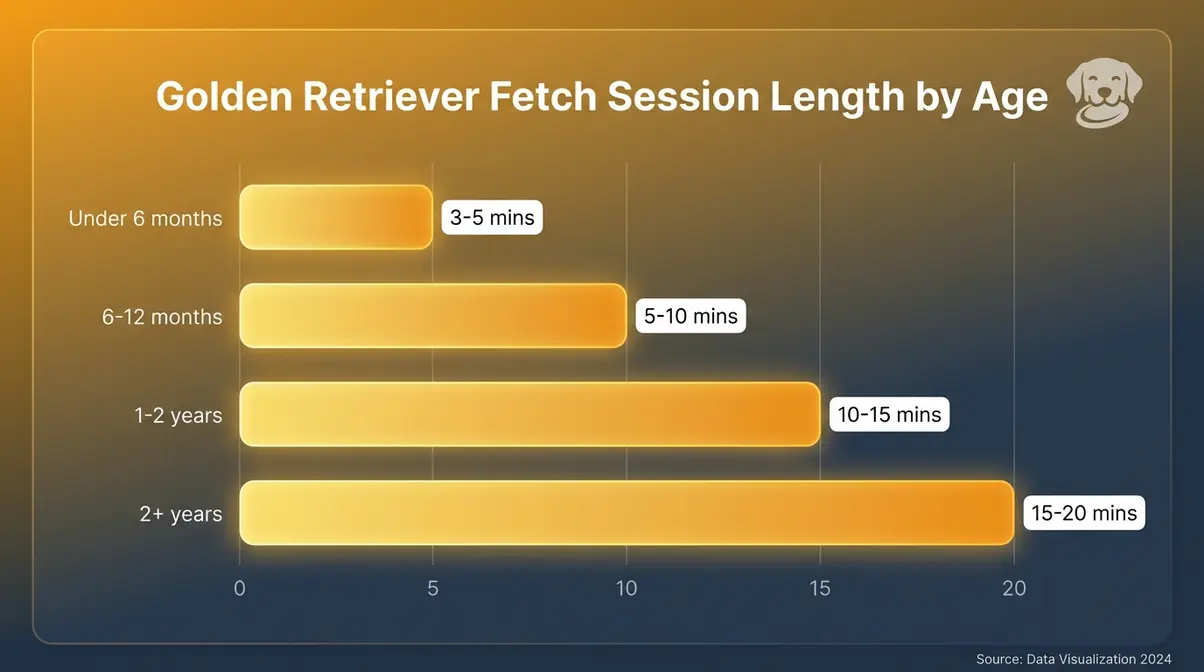
- Keep sessions short: 5-10 minutes for puppies; 15-20 minutes for adult dogs.
- Positive reinforcement works best: Reward your dog the moment they interact with the toy.
Why Won’t Your Golden Retriever Play Fetch?
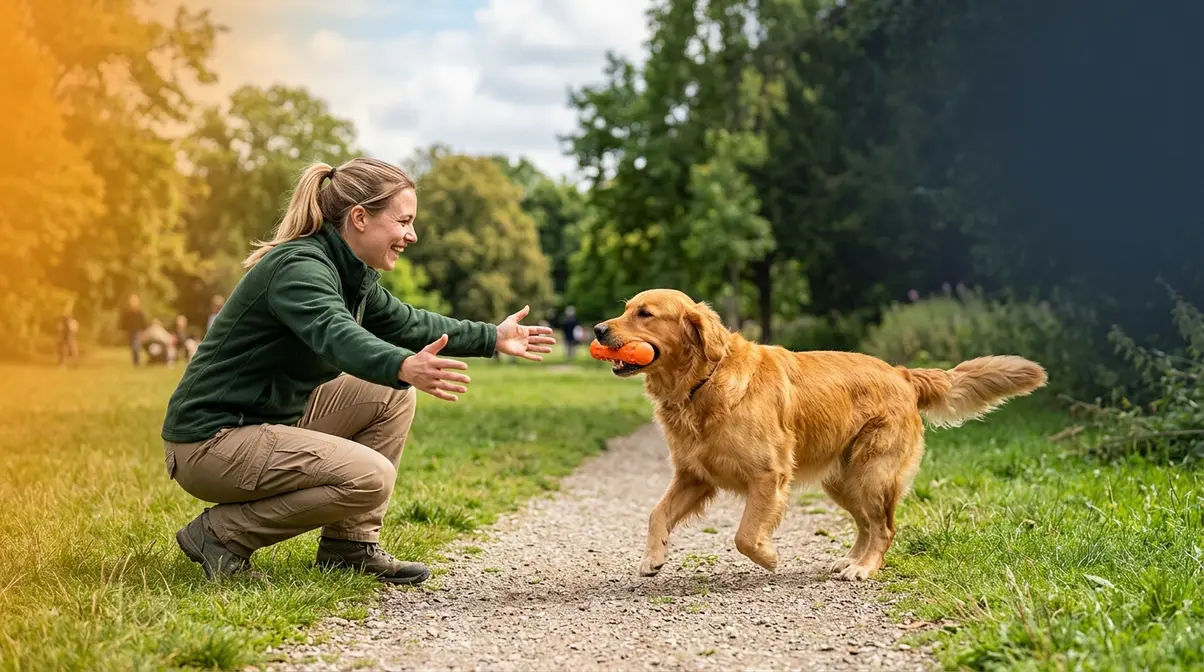
Golden Retrievers are natural retrievers by breeding, but toy value (the excitement your dog associates with a specific object) must be built before fetch training works. According to the Whole Dog Journal fetch training resource, shaping toy interest by rewarding incremental steps, including sniffing and touching the toy, is the foundation of a reliable retrieve (2026). If your dog ignores the ball, you don’t have a broken retriever. You have a dog that hasn’t yet learned the toy is worth caring about.
Sound familiar?
This frustration is incredibly common. The good news is that a reluctant retriever is a training problem, not a personality flaw.
Why Goldens Sometimes Ignore Toys
An uninterested Golden Retriever is not a broken one. Golden Retrievers, a sporting breed originally developed to retrieve game birds for hunters, were bred for cooperative retrieving alongside a human, not for solo toy play. Their retrieve instinct activates in the context of a game with you, not when a ball sits on the floor. This is exactly why “just throwing the ball” so often fails.
Toy value, the degree of excitement your dog associates with a specific object, must be built deliberately. A toy that sits in the living room all day is boring. A toy that only appears during training sessions feels special and exciting. Consider picking up some interactive dog toys that build engagement to rotate into your sessions and keep novelty high.
Over-arousal is the opposite problem. Some Goldens get so excited they grab the toy and sprint away, losing the cooperative element entirely. Both problems, too little interest and too much, are addressed in this guide.
How to Build Toy Value Step by Step
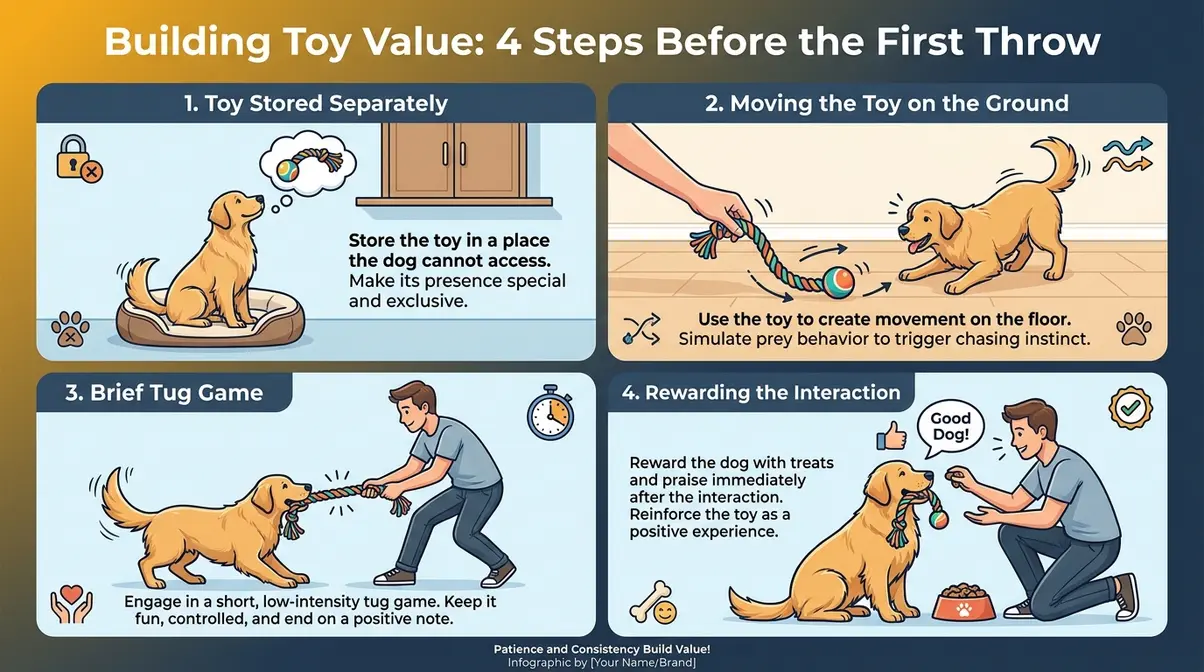
The following four steps happen before any throwing. Think of this as the prerequisite phase of fetch training.
- Store the toy separately. Keep fetch toys away from your dog’s everyday toys. Scarcity builds desire. A toy your dog can’t always access becomes a toy worth working for.
- Animate the toy. Move it along the ground like prey, bounce it, hide it behind your back. Golden Retrievers respond strongly to movement. A toy that moves is a toy worth chasing.
- Play a brief tug game. Ten to fifteen seconds of tug before any throwing activates your dog’s arousal in a controlled way and connects this specific toy to fun with you.
- Reward any interaction. The moment your dog sniffs, touches, or picks up the toy, say “yes!” in a bright voice and give a treat. This is positive reinforcement (rewarding a behavior immediately so your dog repeats it). Even the smallest interaction counts.
The UW-Madison Extension dog training handbook notes that requiring a dog to perform a simple behavior before receiving attention or play builds the value of the interaction and reinforces obedience simultaneously (2025).
Once your dog is genuinely excited about the toy, you’re ready for the five-step fetch training process.
How Do You Teach Your Golden Retriever to Fetch?
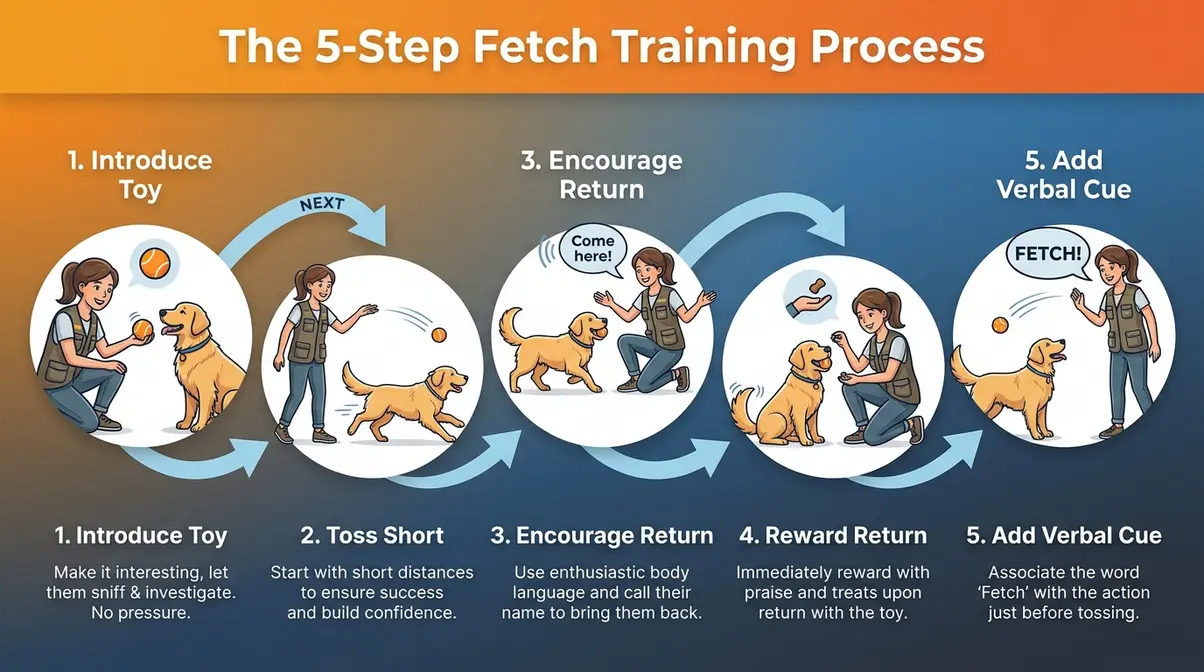
Here is the complete five-step process for golden retriever fetch training basics, from the first toss to a reliable return. The American Kennel Club’s Fetch program breaks retriever skills into four progressive levels, confirming that fetch is a learnable, structured behavior, not something dogs either have or don’t. You can read more at the American Kennel Club Fetch titles page (AKC, 2025). Work through each step in order. Skipping ahead before your dog is ready is the most common reason fetch training stalls.
Before You Start: What You Need
Before your first session, gather these supplies:
- One high-value fetch toy. A tennis ball, rubber ball, or soft bumper toy works well. Keep this toy stored away and bring it out only for fetch training.
- High-value treats. Small, soft, smelly treats your dog goes wild for, such as tiny pieces of cooked chicken or commercial training treats.
- A long leash. A 20-30 foot training lead for the first few sessions. This prevents your dog from running off with the toy.
- An enclosed space. A fenced yard, long hallway, or enclosed outdoor area. Starting in a small, distraction-free area is critical for beginners.
- Short sessions. Plan for 5-10 minutes maximum per session, especially for puppies.
For foundational commands your puppy needs before fetch, see our Golden Retriever puppy training guide.
The 5 Steps to a Successful Fetch
These five steps cover every stage of teaching your Golden to fetch. The Preventive Vet fetch training guide confirms that rewarding the return immediately and practicing in an enclosed, low-distraction space are two of the most effective strategies for teaching fetch reliably (2026).
- Introduce the toy. Hold the toy and make it exciting by moving it, doing a quick tug, or hiding it behind your back. When your dog shows interest, say “yes!” and give a treat. Repeat until your dog is clearly eager for the toy.
- Toss it short. Throw the toy just 3-5 feet away. Do not throw far yet. A short distance means less time for your dog to get distracted or wander off.
- Encourage the return. Use a happy, high-pitched voice to call your dog back. Crouch down, clap your hands, and make returning to you the most exciting thing happening. Do not chase your dog.
- Reward the return. The moment your dog comes back with the toy, even if they drop it 2 feet away, reward with a treat and enthusiastic praise. The return is the behavior you’re reinforcing, so reward it every time.
- Add the verbal cue. Once your dog is reliably returning, add the word “fetch” (or “go get it”) just before you throw. Your dog will start associating the word with the action. This is how a cue (a word or signal your dog learns to respond to) is built.
Why this works: Each step builds on the last. You’re teaching the game in pieces, not all at once. Dogs learn faster when one behavior is reinforced before the next is introduced.
Teaching “Drop It” (and Why It Matters)
“Drop It” is a cue (a verbal signal) that asks your dog to release whatever is in their mouth. Without it, fetch is a one-round game: your dog brings the toy back once and then holds it hostage.
To teach it: hold a high-value treat near your dog’s nose while they hold the toy. The moment they open their mouth to sniff the treat, say “drop it” and give the treat. Repeat 5-6 times per session.
Some retriever trainers prefer the word “Give” over “Drop It” because it implies a polite hand-off rather than a release. The Adelphi University retriever training guide notes that field trainers recommend “Give” and emphasize starting in a highly controlled setting to prevent the dog from ignoring commands (2001). Either word works; consistency matters more than the specific word you choose.
This treat-lure drill is also the foundation of The Two-Toy Switch covered in the next section.
How Do You Fix the Most Common Fetch Problems?
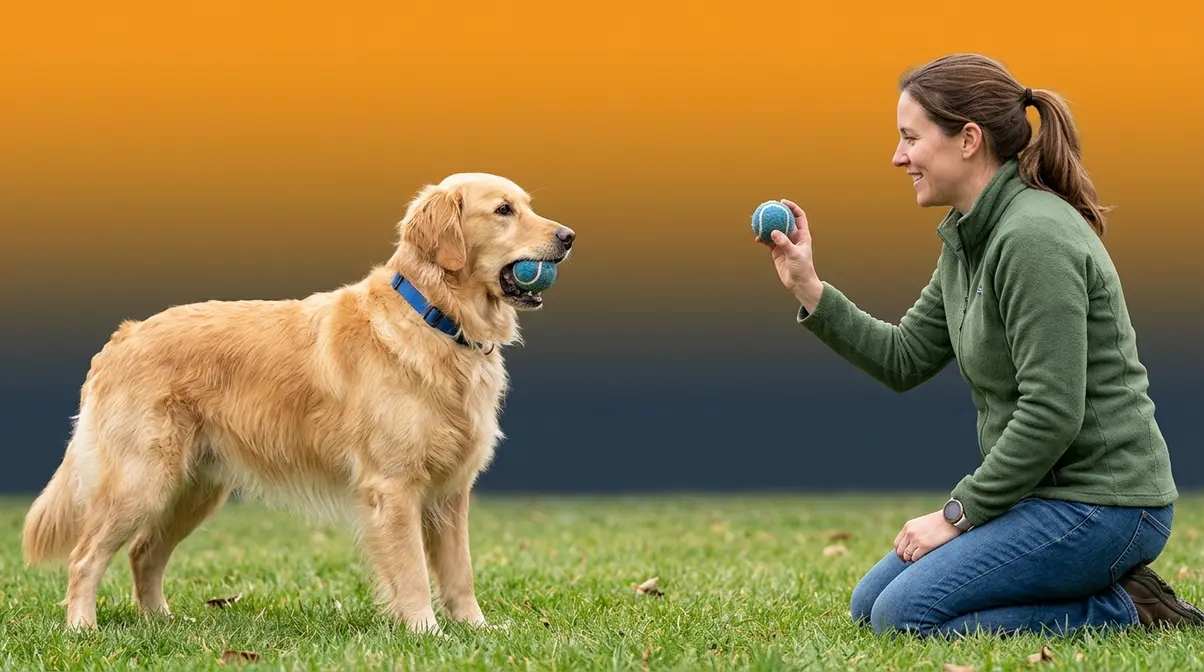
You throw the ball. Your dog gets it. And then nothing. Here is what is happening and how to fix it.
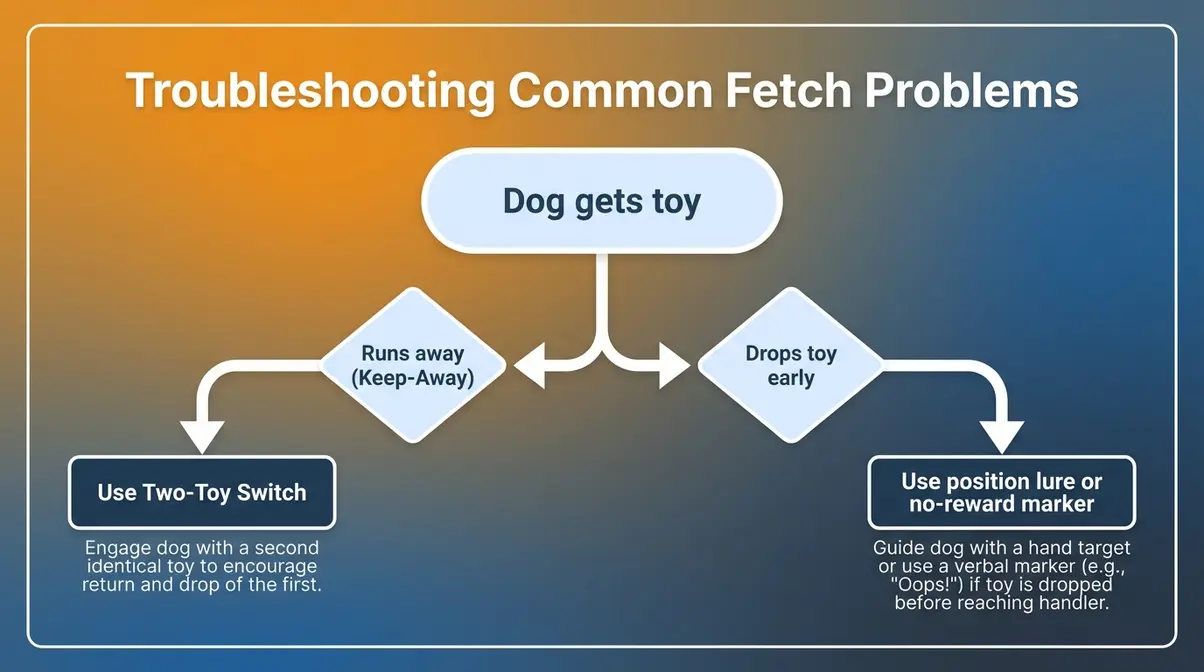
The two most common fetch problems are the keep-away game (your dog grabs the toy and runs) and the early drop (your dog drops the toy 10 feet away instead of at your feet). According to a board-certified veterinary behaviorist at Tufts veterinary behaviorist resources, chasing a dog who plays keep-away accidentally rewards the behavior by turning it into a second game (Tufts University, 2020). Both problems have the same root cause: your dog hasn’t yet learned that returning the toy to you is more rewarding than keeping it.
The Two-Toy Switch: How to Stop Keep-Away
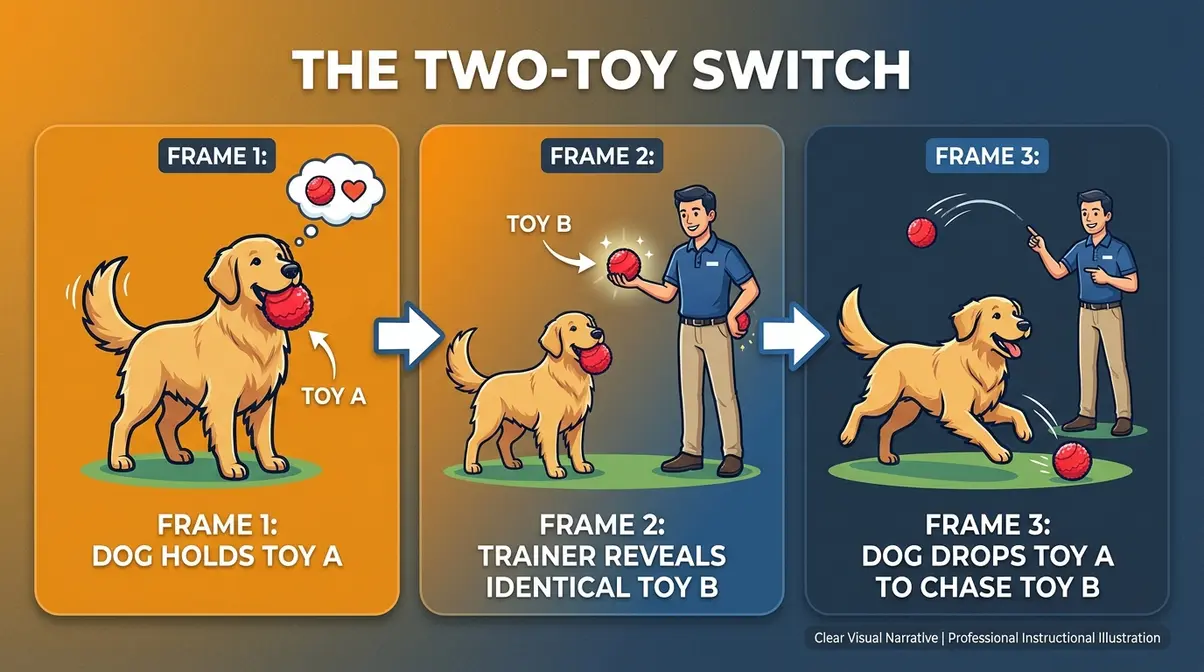
The Two-Toy Switch is a fetch troubleshooting technique where you use a second, equally exciting toy to motivate your dog to drop the first toy and return to you. Instead of chasing or pleading, you make the return more rewarding than the possession.
Here is how to do it:
- Start with two identical (or equally exciting) toys. Keep one hidden behind your back.
- Throw toy #1. When your dog picks it up, do not move toward them.
- Show toy #2. Make it exciting: bounce it, squeak it, make your dog want it.
- Your dog must drop toy #1 to come get toy #2. The moment they drop it, say “drop it” and throw toy #2.
- While your dog chases toy #2, calmly pick up toy #1. Repeat.
Why this works: Your dog learns that dropping the toy and returning to you is what triggers the next throw. Possession becomes less interesting than the game itself. As the Tufts behaviorist advice confirms, making the game more rewarding than possession is the key to stopping keep-away.
For dogs who won’t return at all, attach a 20-30 foot long leash before the session. Use it to gently guide your dog back. Don’t yank; just apply gentle pressure toward you.
If your dog’s keep-away habit is part of a broader pattern of attention-seeking, see our guide to Golden Retriever behavior problems and solutions.
When Your Dog Drops the Ball Too Early
The scenario: your dog picks up the toy, trots back in your direction, and drops it 5-10 feet away. They look at you. You look at the toy. Nobody wins.
Three fixes address this problem directly:
- Position lure. When your dog is returning, crouch down, make yourself small and exciting, and hold a treat right at your hip. Your dog has to reach you to get the treat. This pulls them all the way in.
- No-reward marker. If your dog drops early, turn your back and walk away. No throw, no treat, no reaction. Wait 10 seconds, then restart. Your dog quickly learns that dropping early ends the game.
- Short distance regression. If the early-drop persists, go back to 3-foot tosses for one full session. Rebuild the habit of delivering to your hand before increasing distance again.
Once your dog is returning reliably and dropping at your feet, you’re ready to think about session length and when to stop.
Is Every Golden Retriever Ready for Long Fetch Sessions?
Not quite. Age and physical condition determine how much fetch is safe, and puppies need far shorter sessions than adults.
| Dog Age | Recommended Session Length | Notes |
|---|---|---|
| Under 6 months | 3-5 minutes | Avoid repetitive impact; protect growth plates |
| 6-12 months | 5-10 minutes | Short, playful sessions only |
| 1-2 years | 10-15 minutes | Gradually increase distance and repetitions |
| 2+ years (adult) | 15-20 minutes | Watch for fatigue signs |
Growth plates are the soft areas of bone in puppies that harden by 12-18 months. Repetitive high-impact exercise before they close can cause lasting joint damage. The University of Minnesota FETCH program demonstrates that the high-level physical capabilities retrievers develop come from structured, progressive training, not rushed sessions (2025).
Watch for three fatigue signs: excessive panting, a slowing pace, or lying down mid-session. When any of these appear, end the game while your dog is still engaged. For a complete breakdown of exercise needs by age, see our guide to how much exercise Golden Retrievers need daily.
If your dog is a senior, overweight, or has a history of joint issues, talk to your vet before starting a regular fetch routine.
Frequently Asked Questions
How do I teach my Golden Retriever to fetch?
To teach your Golden Retriever to fetch, start by building toy value before you ever throw anything: animate the toy, play a brief tug, and reward your dog for any interaction with it. Once your dog is excited about the toy, toss it just 3-5 feet, encourage the return with a happy voice, and reward the moment they come back. The American Kennel Club’s Fetch program confirms that progressive, reward-based training is the most reliable path from zero to a consistent retrieve (AKC, 2025). For puppies, keep sessions to 5-10 minutes to protect developing joints.
What if my Golden Retriever isn’t interested in the toy?
If your Golden Retriever is not interested in the toy, the fix is to build the toy’s value before you throw it. Keep the toy stored away so it only appears at training time, then animate it by moving it along the ground or playing a quick game of tug to trigger your dog’s prey drive. Reward your dog with a treat and enthusiastic praise the moment they sniff, touch, or pick up the toy, even once. A dog that ignores a ball is not a reluctant retriever; it is a dog that has not yet learned the toy is worth caring about.
How do I stop my dog from playing “keep away” during fetch?
Stop the keep-away game by using the Two-Toy Switch: when your dog picks up toy #1, show them an equally exciting toy #2 instead of chasing them. Your dog must drop the first toy to earn the second, which teaches them that returning to you triggers the next throw. A 20-30 foot long leash during early training sessions also prevents runaway behavior without confrontation. Never chase your dog during keep-away, as this rewards the behavior by turning it into a second game.
Is 20 minutes of fetch enough?
For most healthy adult Golden Retrievers, 20 minutes of fetch is an excellent session that provides both physical exercise and mental engagement. For puppies under 12 months, however, sessions should be much shorter (5-10 minutes) to protect developing growth plates in the joints. Watch for signs of fatigue such as excessive panting, a slowing pace, or lying down mid-session, and end the game while your dog is still engaged. If your dog has joint issues or is a senior, consult your veterinarian before establishing a regular fetch routine. For more guidance, see how much exercise Golden Retrievers need.
What is the 7-7-7 rule for dogs?
The 7-7-7 rule for dogs is a puppy socialization framework that recommends exposing a puppy to seven different surfaces, seven different types of objects, and seven different locations before 7 weeks of age to build confidence and reduce fear responses. The rule was adapted from breeder Pat Hastings and is widely used by shelters and trainers to guide early development. The SPCA of Wake County Rule of Sevens notes that early, varied exposure helps puppies develop into adaptable, well-adjusted adult dogs (2018). For Golden Retrievers specifically, early socialization directly supports the cooperative temperament that makes fetch training easier later. See our Golden Retriever health and development guide for more on early development.
What is the silent killer in Golden Retrievers?
The “silent killer” in Golden Retrievers is hemangiosarcoma, a fast-moving cancer of the blood vessel walls that frequently shows no outward symptoms until it has reached an untreatable stage. Because it develops internally, most often on the spleen, heart, or liver, owners and even veterinarians can miss it until a sudden internal bleed occurs. Cornell University veterinary research has identified hemangiosarcoma as one of the most significant health threats facing the Golden Retriever breed (Cornell University, 2021). Annual veterinary exams and awareness of sudden weakness or collapse are the best early-detection tools available to owners.
Start Fetch Training Today: Your Next Steps
For beginner Golden Retriever owners, golden retriever fetch training basics come down to one principle: make the return more rewarding than the possession. Coral Drake’s review of these techniques at devotedtodog.com confirms that the most common cause of fetch failure is skipping the toy value-building step, not a lack of natural ability in the dog. The best approach combines toy value-building, a clear five-step progression, and a troubleshooting framework for the moments when things go sideways.
The Two-Toy Switch exists precisely for the owner who has tried everything and still hears “they both refuse to chase a ball, let alone bring it back to me.” A reluctant retriever is a training problem, not a personality flaw, and this framework addresses the root cause directly.
Tonight, spend 5 minutes with one stored toy and a handful of small treats. Animate the toy, reward any sniff or touch, and do not throw it yet. That single session is how fetch training starts.
➤ Your Golden Retriever already has the instinct to retrieve; your job is simply to make the game worth playing.
Related gear: see our guide to dog frisbees.