
Your 5 month old golden retriever was the sweet, biddable puppy who melted your heart last month, and this week she’s launched full into shark mode, stealing socks, ignoring “sit,” and doing laps around the living room at 9pm. You haven’t done anything wrong. This is the teenage phase, and it’s completely normal.
Without clear benchmarks, it’s easy to wonder if the biting will ever stop, if the weight is right, or if you’re walking them too much and damaging their joints. In this guide, you’ll get exact weight ranges, a vet-aligned exercise formula, feeding amounts, and six training protocols that work right now. You can stop second-guessing and start enjoying this chaotic, wonderful phase. We’ll cover behavior, growth, feeding, exercise, training, and when something actually warrants a vet call.
females 28-38 lbs
joint protection
enforce naps
large-breed
What Should You Expect from Behavior and the Teenage Phase?
Related Golden Retriever guides: 7 Month Old Golden Retriever: Ultimate Teenage Guide; 8 Month Old Golden Retriever: Proven Teenage Survival Guide; 6 Month Old Golden Retriever: Survival Guide for Owners.
For owners tracking earlier developmental stages, see our guide on the 3-month-old Golden Retriever.
At 5 months old, a golden retriever enters the adolescent phase, a developmentally normal but genuinely challenging period marked by energy spikes, renewed biting, and selective hearing. The American Kennel Club (AKC) notes that the most challenging period of raising a puppy begins around 5-6 months and can continue until roughly two years of age (AKC, 2026). Understanding why this happens makes it far easier to respond with calm consistency rather than frustrated reactivity.
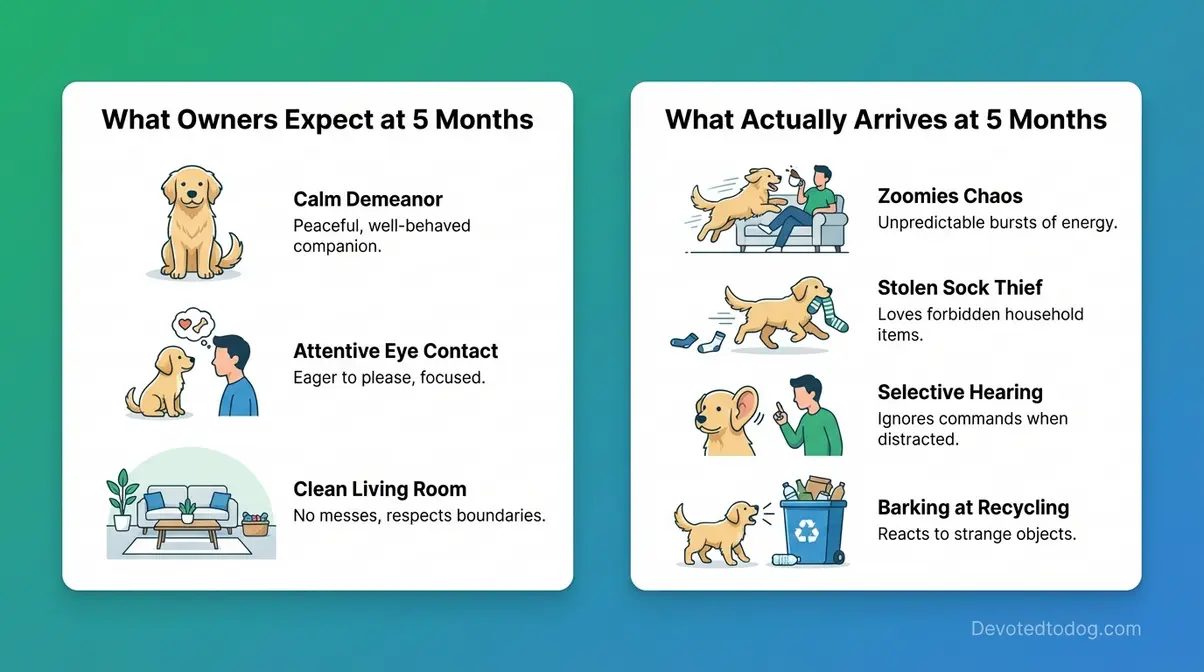
Caption: What owners expect at 5 months vs. what actually arrives. The adolescent phase explained in one visual.
Our team reviewed AKC breed standards, University of Cambridge canine behavior research, and owner community patterns across thousands of posts to compile these benchmarks. The consistent finding: the behaviors that shock owners at 5 months are not signs of a bad dog or bad training, they’re signs of a puppy developing exactly as nature intended.
Why Your Golden Acts Differently
Your 5 month old golden retriever behavior shift isn’t a mystery once you understand the biology. At 5 months, golden retrievers begin entering adolescence. Hormonal changes, brain reorganization, and growing independence arrive simultaneously. University of Cambridge research on golden retriever trainability found that behavioral trainability is closely linked to the ROMO1 gene, and this developmental window sees significant expression of those genetic traits (University of Cambridge, 2022).
The “forgetting sit” phenomenon confuses nearly every golden owner. Your puppy has not forgotten the command. It has simply lost the attention competition to a squirrel or a rustling bag. Your job isn’t to re-teach the behavior; it’s to become the most interesting thing in the environment again. Similarly, boundary testing is instinctive at this stage. The mouthing, the stolen socks, and the selective recall from across the yard are your puppy establishing independence, not reversing your training. That blank stare from 20 feet away isn’t willful defiance; it’s competing stimuli layered on top of genuine hormonal noise.
Witching Hour & Zoomies Explained
The “witching hour,” typically 7-10pm for most golden owners, is caused by a paradox: your puppy is simultaneously overtired and under-stimulated. Puppies this age need 16-20 hours of sleep per day (AKC, 2026), and without enforced naps throughout the day, accumulated tiredness doesn’t produce a calm dog. It produces nightly zoomies. The brain is too tired to regulate itself, and the result is a dog doing laps around the couch at full speed while you stare in exhausted disbelief.
Across golden retriever owner communities, the nightly zoomies are among the most consistently reported frustrations, right up there with the biting and the stolen laundry. You’re not alone, and it’s not random.
Three tactics that actually reduce the intensity:
- Enforce a structured nap after the afternoon walk. Crate rest for 60-90 minutes prevents the fatigue buildup that fuels the evening explosion.
- Use a frozen Kong or lick mat in the 30-45 minutes before the typical witching window. Structured calm activity signals the wind-down.
- Move the evening walk 30 minutes earlier. If zoomies hit reliably at 8:30pm, offer a 20-minute sniff walk at 7:45pm followed by a lick mat. The physical and mental output reduces the evening intensity substantially.
Energy spikes are one thing, but many owners are caught off guard when their brave, social puppy suddenly becomes terrified of the recycling bin.
Sudden Fear Periods Explained
During adolescence, golden retrievers can experience sudden fear responses to objects that were previously unremarkable, like a recycling bin, a garden hose, or a fluttering flag. This startle reaction is particularly common as the adolescent phase begins around 5-6 months and can persist into the secondary fear period that emerges between 6-14 months (Greenside Canine, 2026). The behavior is temporary and well-documented in canine development literature.
What not to do: Don’t force the puppy toward the scary object. Flooding them can deepen the fear rather than resolve it. Also, avoid over-comforting with cooing and carrying, which inadvertently teaches them that the fearful response produces rewards.
What to do: Use calm, matter-of-fact body language. Let the puppy investigate at their own pace. You might drop high-value treats near the object, allowing curiosity to move them forward rather than pressure.
The mouthing behavior that often peaks alongside these fear responses is something many owners capture perfectly:
“I think he’s fully potty trained hah but I don’t know for sure… because I can’t leave him alone out of crate long enough to see… because he puts EVERYTHING AND ANYTHING in his mouth.”
, Golden retriever owner, r/puppy101
Now that you know what’s driving the chaos, let’s put real numbers to where your puppy should be physically right now.
How Do Physical Growth, Size, and Weight Look at 5 Months?
A 5 month old golden retriever typically weighs between 28 and 45 pounds, based on AKC breed weight standards and Pawlicy growth data, depending on sex and bloodline. Males trend toward the higher end; females and English Cream golden retrievers tend lighter. By this age, most puppies have reached roughly 50% of their expected adult weight, based on standard Golden Retriever growth curves (Pawlicy Advisor). AKC breed weight standards put adult goldens at 55-75 lbs for males and 55-65 lbs for females (AKC, 2026).
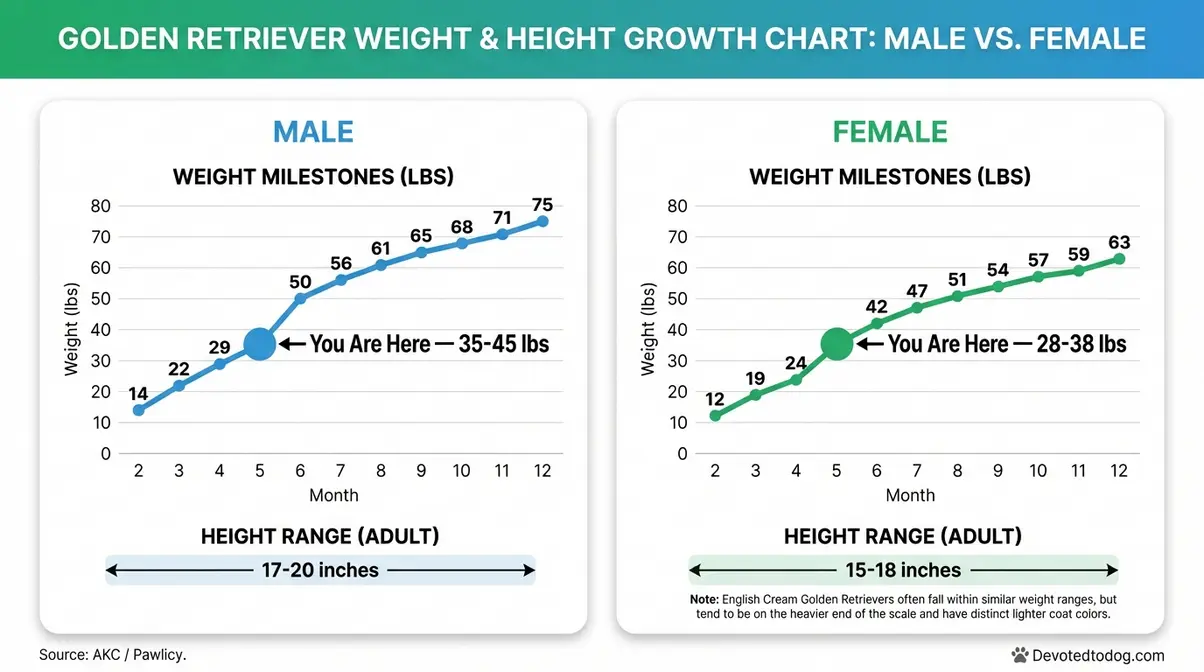
Caption: Male and female weight trajectories at 5 months. Use this to assess whether your puppy is on track, not to trigger panic over a few pounds either direction.
The 5-Month Benchmark Table
The 5 month old golden retriever weight question is one of the most anxiety-producing for new owners, and competitor data makes it worse by showing wildly different numbers without explaining why. Here’s the reconciled picture:
| Metric | Male | Female | English Cream |
|---|---|---|---|
| Weight | 35-45 lbs | 28-38 lbs | 28-38 lbs |
| Height at shoulder | 17-20 inches | 15-18 inches | 15-18 inches |
| Adult weight projection | 65-75 lbs | 55-65 lbs | 55-70 lbs |
| Teething status | Adult teeth arriving | Adult teeth arriving | Adult teeth arriving |
| % of adult weight reached | ~50% | ~50% | ~50% |
Sources: AKC Breed Weight Chart; Pawlicy growth data. Always consult your veterinarian, as individual puppy growth varies significantly.
Why does competitor data conflict so dramatically? Sites showing 35-40 lbs at 5 months are typically reflecting female averages or smaller American bloodlines. Sites showing 45-60 lbs are capturing males or larger show-line goldens. Neither source is wrong, they’re just describing different ends of a legitimate range.
One physical detail that directly affects behavior: adult teeth typically arrive between 4.5 and 5 months, which is precisely why biting intensity can increase right now even as you’re working to reduce it. The SF SPCA bite inhibition guide confirms that by the time adult teeth arrive at 4.5-5 months, puppies should ideally have learned proper bite inhibition and jaw strength control (SF SPCA, 2026). That training becomes more urgent, not less, as the teeth get sharper.
Now let’s address the question every owner of a smaller golden asks: “Is my dog normal?”
Male vs. Female Differences
Males are consistently heavier and taller at every age, with the gap typically 8-15 lbs at full maturity. At 5 months, a male at 42 lbs and a female at 33 lbs are both perfectly within normal range. The difference in frame is real, not a sign of undereating or overfeeding.
English Cream (sometimes called “White” or “European”) golden retrievers tend to be slightly stockier in build but typically land in a similar weight range to American females. Coat color does not affect health or behavior. Lighter-coated goldens are not calmer or more anxious as a rule, though bloodline differences in temperament do exist.
If your 5-month-old female golden looks “skinny” compared to a male you’ve seen online, she almost certainly isn’t, she’s just female. Use the table above, consult your vet at the next wellness visit, and trust the trajectory over the number.
Beyond weight, there’s a whole aesthetic phase your golden is passing through right now that’s worth understanding.
The Awkward Physical Phase
At 5 months, many goldens look gloriously disproportionate, paws too big, legs too long, ears still magnificently floppy while the puppy face begins firming up. This is completely normal; proportions catch up by 12-18 months, and somewhere around month 18 you’ll look at your dog and realize they became beautiful when you weren’t watching.
Coat is also transitioning from fluffy puppy fur to the longer adult coat. Some light shedding is expected; the full adult feathering arrives gradually over the next year.
Most importantly for your furniture: adult teeth are arriving, which means chewing urges are at a peak. Stock up on frozen chew toys and Kongs now, before another pair of shoes disappears.
With their size and look accounted for, the next burning question is almost always: am I feeding them the right amount?
How Should You Feed Your 5-Month-Old Golden?
A 5-month-old golden retriever needs three meals per day, evenly spaced: morning, midday, and early evening. The exact cup amount varies widely by food brand, protein density, and your puppy’s current weight. This section shows you how to find your dog’s specific number without guessing.
⚠️ Veterinary Disclaimer: The feeding amounts in this guide are general guidelines. Always consult your veterinarian for personalized recommendations, as individual puppy needs vary based on health, activity level, and growth rate.
The Golden Retriever Lifetime Study, one of the most comprehensive longitudinal studies of the breed, confirms that nutrition and exercise frequency are primary health determinants across the golden’s lifespan, which is why getting feeding right early matters (NIH, 2021).
Feeding: Cups, Meals & Timing
At 5 months, three meals per day (not two) is the standard for golden retrievers, and the reason matters. Three meals prevent the hunger-driven food obsession that builds when puppies go 8+ hours between feedings, reduce gulping behavior (which increases bloat risk), and space energy delivery more evenly across the day.
How to find your puppy’s exact cup amount, no guessing required:
- Find the “feeding guide” table on the back or side of your kibble bag.
- Locate the row for your puppy’s current weight (some brands use current weight; others use projected adult weight, and the label will specify which).
- Divide the daily recommended amount by 3 to get each meal’s portion.
- Adjust based on body condition: You should be able to feel (but not visibly see) your puppy’s ribs with light pressure. Prominent ribs = underfed. Can’t feel them at all = overfed.
For a puppy food recommending 3.5 cups/day for a 40 lb puppy, that’s approximately 1.2 cups per meal. The schedule table later in this guide uses exactly that as an example.
The “absolute lunatic for food” behavior is normal for this breed and, frankly, useful. Golden retrievers are famously food-motivated, which is precisely what makes them so trainable. Instead of viewing the food obsession as a problem, use it: feed portions by hand during a 5-minute training session before placing the bowl down. You get a training session; your puppy gets their meal. Both of you win.
The type of food matters as much as the amount. Here’s what to look for.
Choosing the Right Puppy Food
Golden retrievers should remain on large-breed puppy formula until 12-18 months, not adult food yet, regardless of how big they’re looking. Large-breed puppy formulas contain controlled calcium-to-phosphorus ratios specifically designed to support healthy bone development without accelerating growth plate closure. Switching to adult food too early can disrupt this balance.
What to look for on the label: an AAFCO “complete and balanced for growth (large breed)” statement. If the label doesn’t specify life stage or breed size, keep looking. That statement is the only reliable guarantee the food meets growth-stage nutritional requirements.
Sensitive stomachs are common at this age, often from the combination of rapid growth, stress, and the fact that your puppy has eaten approximately 47 things they shouldn’t have this week. If loose stools persist beyond a week without dietary change, consult your vet before switching foods. Sometimes it’s an ingredient issue, sometimes it isn’t.
Diet feeds the body, but exercise fuels the mind, and at this age, getting exercise wrong can cause permanent joint damage.
How Much Safe Exercise Does the Joint-Protection Rule Allow?
⚠️ Veterinary Disclaimer: Exercise guidelines below are general recommendations. Individual puppies vary, so consult your veterinarian if you have concerns about your puppy’s physical development or joint health.
At 5 months, a golden retriever’s growth plates (the soft cartilage zones at the ends of growing bones that harden as puppies mature) are still open and vulnerable. Over-exercise right now doesn’t just cause tiredness; it can cause permanent joint damage that leads to early-onset arthritis. Puppies subjected to high-impact or excessive exercise face an increased risk of permanent joint and bone damage (PDSA, 2026). The solution is a straightforward formula: 5 minutes of structured exercise per month of age.
PDSA puppy exercise guidelines confirm this risk, noting that excessive or repetitive exercise before growth plates close can cause musculoskeletal problems that affect a dog for life (PDSA, 2026).
The 25-Minute Exercise Rule
At 5 months: 5 minutes × 5 months = 25 minutes of structured walking per session, once or twice daily maximum. Veterinary researchers at the AKC recommend exactly this formula, five minutes of formal walking per month of age, to prevent musculoskeletal malformations during development (AKC, 2026). The AKC puppy exercise guidelines are unambiguous: structured, owner-led repetitive exercise is where the risk lives, not casual movement.
Here’s what that means in practice:
- 🔴 Red Light, Avoid or Minimize:
- Jogging or running on pavement (repetitive high-impact on hard surface)
- Repetitive fetch on concrete or asphalt
- Long hikes with sustained uphill effort
- Repeatedly carrying the puppy up and down stairs
- 🟢 Green Light, Safe and Encouraged:
- 25-minute leash walks on flat, moderate terrain
- Sniff walks: nose-led, slower pace, mentally tiring
- Off-leash free play on grass (puppy self-regulates their intensity)
- Swimming, if introduced carefully (low-impact and joint-friendly)
The crucial distinction: off-leash play is less risky than structured owner-led exercise because puppies naturally self-limit. They stop when they’re tired. The danger is owner-imposed repetitive exercise that doesn’t allow that self-regulation. Think 45 minutes of forced jogging because “they seem to have energy.”
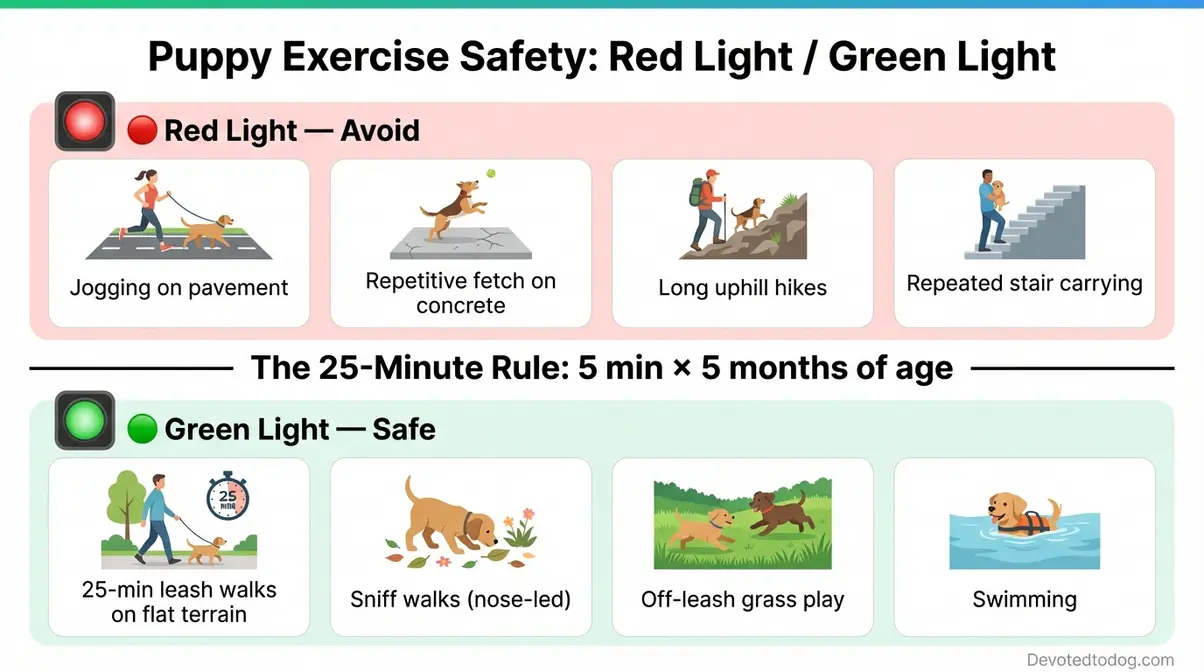
Caption: The 25-minute rule at a glance. Green light activities protect your puppy’s joints while red light activities risk damage that can last a lifetime.
Physical exercise burns the body, but mental stimulation burns the mind, and a mentally tired golden is a calmer golden.
Smart Mental Stimulation Ideas
A 20-minute sniff walk, where your puppy leads and investigates whatever they want, is more mentally exhausting than a brisk 30-minute structured walk. Sniffing activates a different cognitive load, reduces cortisol levels, and leaves most dogs visibly calmer afterward. If you’re time-constrained, a sniff walk delivers more per minute than pace-walking.
Food puzzles and frozen Kongs extend that calm window. Fill a Kong with kibble mixed with a small amount of peanut butter or plain yogurt, freeze overnight, and offer it as a 20-minute enrichment session. This works especially well in the 30 minutes before the witching-hour window.
Short 5-minute training sessions (twice daily) are also underestimated as mental exercise. The concentration required to work through “sit,” “drop it,” and name recall genuinely tires a puppy’s brain. Run one of these sessions in the pre-witching-hour window and you’ll often cut the evening chaos noticeably.
Now let’s talk about those training sessions: what actually works at this age, and why the techniques that worked at 8 weeks need an upgrade.
What Training Protocols Work for 5-Month Puppies?
Training a 5-month-old golden retriever feels harder than it did at 8 weeks, and that’s not your imagination. The adolescent phase brings genuine behavioral regression, where previously learned commands seem to disappear. Understanding why makes it manageable: your puppy hasn’t forgotten anything; competing stimuli have simply become louder than your voice.
Why Training Feels Harder Now
Adolescent regression is biologically expected. The puppy’s brain is building new neural pathways, and the old “automatic” behaviors become less automatic during this reorganization period. Short sessions (5 minutes maximum) work substantially better than long, increasingly frustrated ones. A 5-minute session that ends in success beats a 20-minute session that ends in mutual exasperation.
This is where The Teenage Timeline framework becomes genuinely useful. The regression you’re experiencing right now is Stage 1 (approximately 5-6 months). Stage 2, Peak Chaos, runs from roughly 6-8 months and is, yes, harder before it gets easier. Stage 3 (approximately 10-12 months) is where consistent owners are consistently rewarded: a markedly calmer, more responsive dog who retains everything you built during the difficult months.
As the Teenage Timeline shows, regression at Stage 1 is the precursor to improvement at Stage 3. What you do now determines who they are at one year. The key mindset shift is this: stop trying to force compliance and start competing for your puppy’s attention as the most interesting thing in the environment.
Here are the six training protocols that cut through the noise right now.
6 Training Wins for the Teenage Phase
These protocols are drawn from consistent patterns across professional trainer recommendations and owner communities. They’re specific to the 5-month adolescent regression phase, not generic puppy advice.
- The Reverse Sit, When your puppy ignores “sit,” turn and walk 3 steps away. When they follow and offer attention, immediately ask for “sit” and reward the compliance. You’re rewarding the attention-seeking behavior, not fighting a battle you won’t win. This recaptures focus without a power struggle.
- Drop It (Without a Fight), Never chase or grab. Chasing turns every stolen sock into the world’s best game. Instead, hold a high-value treat to their nose while calmly saying “drop it.” The moment they open their mouth, reward them immediately. Practice daily with items they love, so the cue becomes automatic before it’s needed urgently.
- Name Recall Reset, Say their name once, clearly. No response? Clap once, turn, take 3 brisk steps in the opposite direction. When they follow: genuine celebration: treats, praise, brief play. The critical rule: never repeat their name more than once. Repetition teaches them the name means “optional,” and that lesson is very hard to undo.
- Door Manners, The door opens only when all four paws are on the floor. Practice at every entry point, 5 repetitions each session. Golden retrievers this age launch themselves at arriving humans with impressive commitment. This single skill has the highest household impact per training minute of anything on this list.
- Novelty Desensitization, Introduce one new object, sound, or surface per week. Use the “1-2-3 treat trail”, drop three treats leading toward the scary thing at increasing proximity. Never force forward. Let curiosity do the work and let the puppy control the pace of approach.
- Bite Inhibition Reinforcement, Adult teeth are arriving, and 5 month old golden retriever biting can intensify before it improves. When mouthing pressure increases, redirect immediately to a frozen chew toy before the bite lands. If biting persists through redirection, end play with a calm, matter-of-fact “too bad” and walk away for 30 seconds. Consistency is the only thing that works here, and every exception sets the timeline back. By this age, puppies should be building the jaw-strength control that developing bite inhibition requires (SF SPCA, 2026).
The secret weapon that makes all six of these protocols work is a consistent daily schedule.
Your Sample Daily Schedule
Structure is the single most underused tool in the teenage phase. Common frustrations reported by 5-month-old golden owners (the witching hour, the potty accidents, the zoomies) decrease significantly when the day has a reliable rhythm. Here’s a template that integrates every element:
| Time | Activity |
|---|---|
| 7:00 am | Potty break → Breakfast (1.2 cups) → 10-min training session |
| 9:00 am | Enforced nap (in crate) |
| 11:30 am | Potty break → 25-min leash walk |
| 12:30 pm | Lunch (1.2 cups) → Food puzzle enrichment |
| 2:00 pm | Nap |
| 4:30 pm | Potty break → Sniff walk (15-20 min) |
| 6:00 pm | Dinner (1.2 cups) → 5-min training session |
| 7:30 pm | Lick mat / frozen Kong (pre-witching hour) |
| 9:00 pm | Final potty break → Crate for the night |
Adjust times to match your actual schedule. The structure that matters is the pattern: walk → nap → train → feed, repeated. The 5-month puppy potty schedule embedded here (potty break after every nap, meal, and play session) handles the majority of accidents that confuse owners into thinking potty training has regressed.
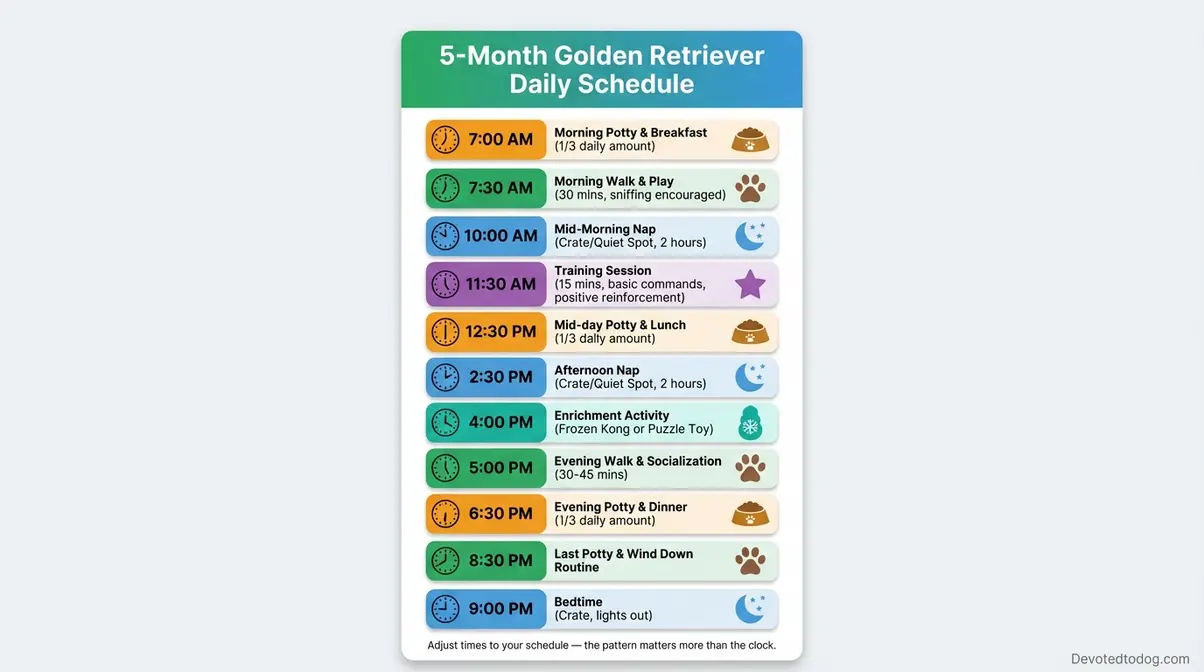
Caption: Post this on your fridge. The schedule does the thinking so you don’t have to at 8 pm when everyone is exhausted.
The schedule works when things are going well, but what about when something actually seems wrong?
When Should You Worry and Call the Vet?
Most of what feels alarming at 5 months is developmentally normal. But a few signs warrant a vet call or professional trainer consult sooner rather than later.
Normal Chaos vs. True Red Flags
Knowing the difference saves you both unnecessary panic and dangerous delays. VCA Animal Hospitals notes that drastic behavioral shifts at this age with no clear environmental cause warrant professional assessment (VCA, 2026).
- Normal at 5 months, do not panic:
- Regression in previously learned commands
- Mouthing and nipping during play are stopped with calm redirection
- Fear or startling responses to new objects or sounds
- Selective hearing (“I know you called me; I’m choosing the squirrel”)
- Mild resource guarding of toys (growls when approached, but no snapping or biting)
- Call your vet or a certified trainer if you observe:
- True aggression, meaning snapping at or biting humans without provocation
- Sudden significant weight loss (more than a few pounds in 2-3 weeks without explanation)
- Severe resource guarding with snapping or biting when approached at the food bowl
- Prolonged lethargy lasting more than 48 hours without a clear illness explanation
- Persistent vomiting or diarrhea beyond 24 hours
The distinction that matters: intensity and context. Mouthing that draws blood unprovoked is different from play biting that stops when you redirect. A puppy who is tired and floppy after a big day is different from one who can’t be roused for meals. Trust your instincts. You know your dog.
The final question most owners have at this stage is one no guide fully addresses: can you leave them alone?
Leaving Your Puppy Home Alone
At 5 months, 8 hours alone is too long, full stop. The general guideline for puppy bladder capacity is approximately 1 hour per month of age plus 1, which puts a 5-month puppy’s maximum comfortable alone time at roughly 4-5 hours, a guideline supported by veterinary behaviorists at the AKC. Beyond that, accidents are inevitable, and repeated isolation can contribute to separation anxiety in a breed that bonds deeply.
Golden retrievers are genuinely clingy dogs, not as a flaw but as a breed trait. They were developed to work alongside humans, and prolonged solitude conflicts with their wiring. If your work schedule requires 8+ hour absences, practical solutions include a dog walker at midday, puppy daycare a few days per week, a trusted neighbor check-in, or a second appropriately matched companion.
This is one of the most stressful parts of the teenage phase for working owners. The constraint is real, the guilt is understandable, and acknowledging it honestly is more useful than pretending it isn’t a factor. You’re not failing, you’re managing a genuine logistics challenge with a dog who needs more than most.
Frequently Asked Questions
What to expect at 5 months old?
At 5 months old, a golden retriever enters the adolescent phase,a period marked by renewed energy, boundary-testing, and behaviors like stealing items and nipping. Most puppies weigh 28-45 lbs (AKC, 2026) and have reached roughly half their adult size. Consistent short training sessions are the most effective response to this temporary regression.
How big are they at 5 months?
A 5-month-old golden retriever typically weighs 28-45 lbs, with males ranging 35-45 lbs and females from 28-38 lbs. They usually stand 15-20 inches tall at the shoulder. Most puppies have reached about 50% of their adult weight by this age (AKC, 2026).
How much should I walk them?
A 5-month-old golden retriever should walk approximately 25 minutes per session, based on the ‘5 minutes per month of age’ guideline (AKC, 2026). One to two sessions daily is appropriate. Avoid jogging, repetitive fetch on hard surfaces, or extended hikes. Growth plates are still open at this age, and over-exercise risks permanent joint damage that can lead to early-onset arthritis (PDSA, 2026).
How much sleep do they need?
A 5-month-old golden retriever needs 16-20 hours of sleep per day (AKC, 2026). Without enforced nap breaks, accumulated fatigue expresses itself as the ‘witching hour’,the frantic evening energy burst most owners recognize. Schedule at least two 60-90 minute crate naps daily.
Hardest weeks with a puppy?
For most golden retriever owners, the hardest period begins around 5-6 months when the teenage phase arrives, and previously learned behaviors regress. Puppies become more independent, test limits relentlessly, and may develop sudden fear responses to new environments. The AKC notes this challenging developmental window can continue until roughly two years of age (AKC, 2026). Fortunately, consistent daily training during this window, using short sessions and high-value rewards, significantly reduces how long the difficult phase actually feels for owners.
What are red flag behaviors?
True red flags include unprovoked aggression toward humans, severe resource guarding with biting at the food bowl, persistent lethargy lasting more than 48 hours, and significant unexplained weight loss. Normal adolescent behaviors like selective hearing, renewed mouthing, and mild toy guarding are not red flags.
Are Golden Retrievers clingy?
Golden retrievers are genuinely people-oriented dogs,a trait bred into them across generations of working closely alongside humans. At 5 months, this manifests as following you room to room, distress when left alone for extended periods, and intense focus on your location. It is a fundamental breed characteristic, not a training failure. Managing it successfully means building independence gradually through crate training and short alone-time practice sessions.
How Do You Get Through the Temporary Teenage Phase?
For owners of a 5-month-old golden retriever, this phase is genuinely hard and genuinely temporary. Most golden retrievers at 5 months weigh 28-45 lbs, need 25 minutes of structured exercise daily (never more), and thrive on 3 evenly spaced meals plus 16-20 hours of sleep. The behaviors that feel alarming (the shark mode biting, the selective hearing, the nightly zoomies) are developmentally expected and respond to consistent, short training sessions. This is not a dog in crisis. This is a dog growing up.
The Teenage Timeline makes sense of all of it. The regression your puppy is showing right now is Stage 1, the frustrating but necessary foundation. Stage 2 (6-8 months) is harder before it gets easier, but owners who build consistent habits during Stages 1 and 2 report a markedly calmer, more responsive dog by their first birthday. Consistency during the chaos is what produces the companion on the other side.
Start tonight: implement the enforced midday nap, run a 5-minute “drop it” training session, and prep a frozen Kong for the 7:30 pm danger zone. One consistent evening beats seven inconsistent days. Devote two weeks to the daily schedule above, and the difference will surprise you, because your golden retriever was never the problem. They just needed a plan.
Brianna York is a former veterinary technician with hands-on clinical experience in canine health. She contributes medical accuracy review to DevotedToDog health articles and validates clinical claims against current AVMA, AAHA, and OFA standards.