If you’ve been searching for a Goldendoodle puppy and stumbled across terms like “F1B,” “F2,” and “F2B,” you’re not alone — most buyers find these labels completely baffling. Breeders toss them around as if everyone already knows what they mean, and that leaves hopeful families second-guessing every decision.
Here’s the real cost of that confusion: some families bring home a puppy expecting zero shedding and end up with a dog that sheds more than their last pet. Buying the wrong generation for your allergies or lifestyle is an expensive, heartbreaking mistake — and it’s entirely preventable.
By the end of this guide, you’ll know exactly what an f2b goldendoodle is, how it compares to every other generation, and the one question most breeders won’t tell you to ask before you sign a contract. We’ll cover genetics, size, coat types, temperament, health, and how to find a breeder you can actually trust.
An F2B Goldendoodle is 62.5% Poodle and 37.5% Golden Retriever — bred specifically for a low-shedding, allergy-friendly coat with more predictability than earlier generations.
- Genetic makeup: Produced by crossing an F1 Goldendoodle with an F1B Goldendoodle
- The Furnishing Gene Factor: Coat shedding is only truly predictable when breeders DNA-test for furnishing genes — not just by generation label
- Best for: Families with mild to moderate allergies who want a reliably low-shedding dog with a classic “Teddy Bear” look
- F1B vs. F2B: F1B (75% Poodle) is better for severe allergies; F2B offers a better balance of Golden Retriever temperament
- Price range: Typically $1,800–$2,800 for standard sizes; Mini F2Bs typically run $2,500–$3,500 (as of Q1 2026 — verify current rates with local breeders)
F2B Goldendoodle Definition & Genetics
An F2B Goldendoodle is a second-generation backcross hybrid that is 62.5% Poodle and 37.5% Golden Retriever. It is produced by crossing an F1 Goldendoodle (50% Poodle) with an F1B Goldendoodle (75% Poodle). This specific breeding combination is designed to maximize low-shedding, allergy-friendly coat traits while retaining the Golden Retriever’s famously gentle temperament — making the F2B one of the most Poodle-dominant generations available from reputable breeders.
Embark Veterinary data on Goldendoodle genetics confirms that Goldendoodles inherit complex genetic traits from both Golden Retrievers and Poodles, which directly influences coat type and shedding predictability (Embark Veterinary, 2026).
What the “F2B” Label Means
Every letter and number in “F2B” tells you something specific about the dog’s background — once you know the code, you can decode any generation label a breeder uses.
“F” stands for filial, which is just a scientific way of saying “offspring of.” Think of it as a generation counter. The first time a Golden Retriever and a Poodle are crossed, you get an F1 (first generation). When those puppies grow up and are bred again, you get F2 (second generation).
“2” means this dog’s grandparents were the original purebred Golden Retriever and purebred Poodle cross. The F2B is one step removed from those originals.
“B” stands for backcross — this means one parent was bred back to a Poodle (or a more Poodle-dominant dog) to increase the Poodle genetics in the mix. Think of it like a recipe: more Poodle in the mix usually means a curlier, lower-shedding coat.
Armed with this, you can decode any label. “F1B mini Goldendoodle”? First generation (F1), backcrossed (B) to a Poodle, miniature size. It really is that simple.
Now that you know what the label means, let’s look at the actual numbers — specifically, how much Poodle and Golden Retriever DNA is in an F2B.
Genetic Percentage Breakdown
The F2B Goldendoodle’s defining characteristic is its genetic percentage: 62.5% Poodle and 37.5% Golden Retriever (pawsoflovegoldendoodles.com). This is what breeders and buyers often describe as the “65/35 ratio” — a close shorthand for the real split.
The parentage works like this: an F1 Goldendoodle (50% Poodle) is crossed with an F1B Goldendoodle (75% Poodle). Average those two together and you get 62.5% Poodle. As the family tree diagram below shows, both parents already carry significant Poodle genetics — which is precisely why F2Bs tend toward low-shedding coats.
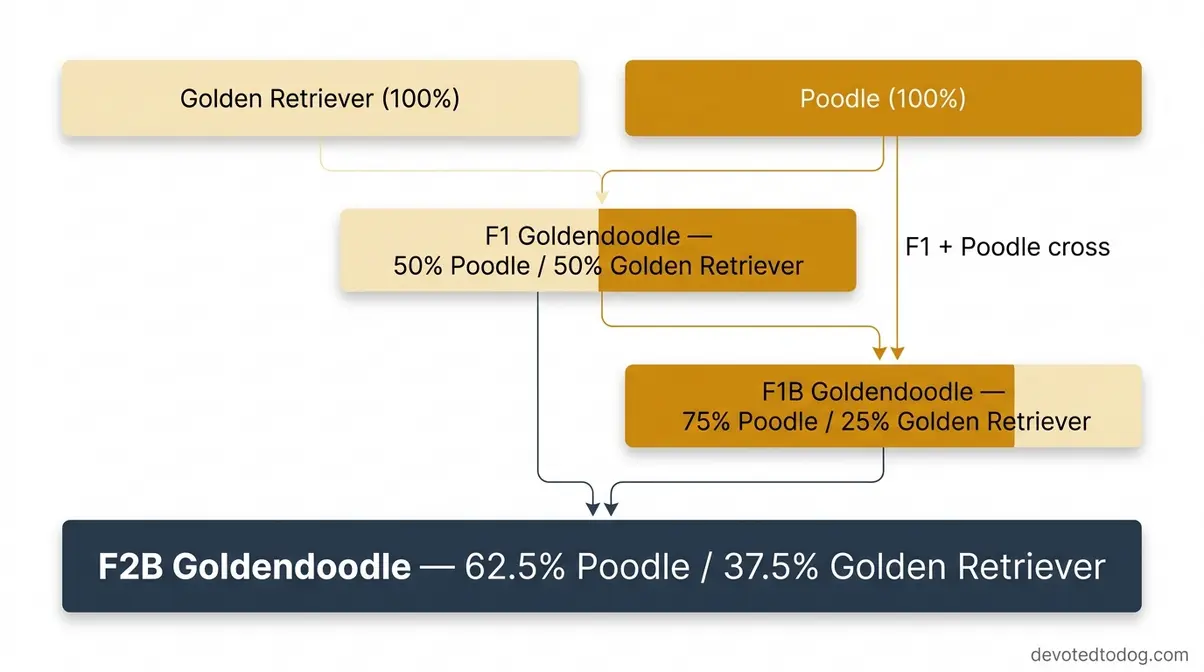
One important nuance: that 62.5% figure is an average for the generation, not a guarantee for every individual puppy. Littermates from the same F2B litter can vary in coat texture and shedding. For a deeper look at the F1B parent’s genetics, see our F1B Goldendoodle guide.
But here’s the critical detail most breeders won’t mention — knowing the generation percentage is only half the story when it comes to predicting your puppy’s coat.
The Furnishing Gene Factor
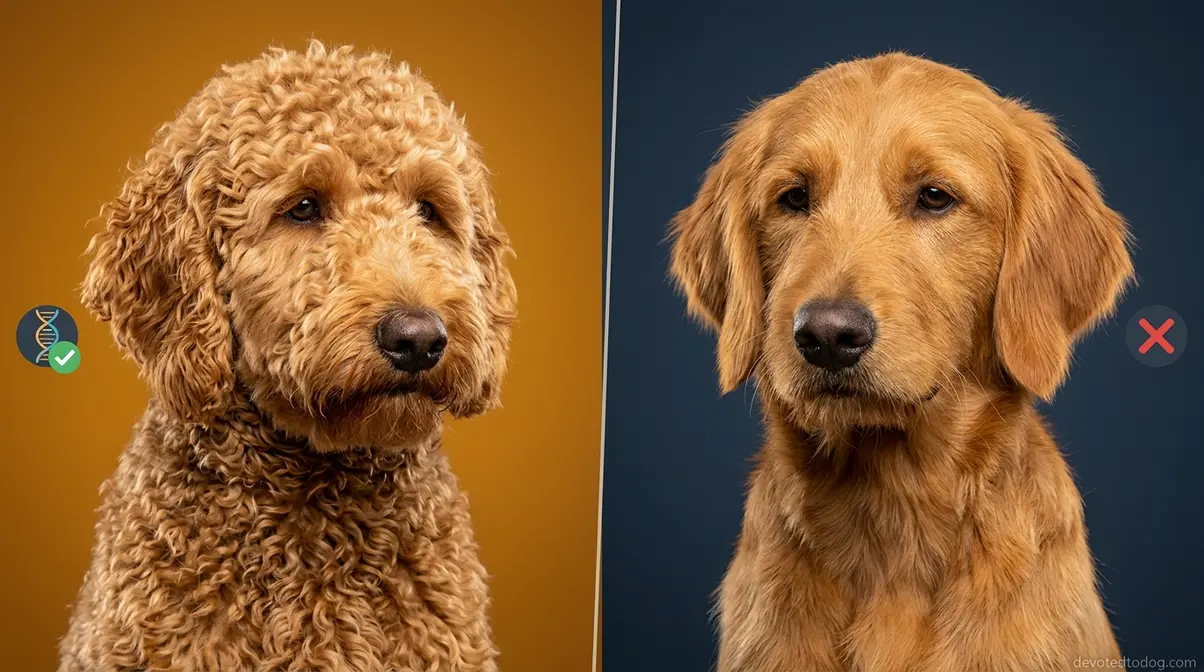
Here is the insight that separates informed buyers from disappointed ones: The Furnishing Gene Factor — the principle that F2B coat predictability depends not on the generation label alone, but on whether parent dogs carry the furnishing gene (F locus), making DNA testing the true predictor of low-shedding outcomes.
Furnishing genes (also called the F locus) are the specific genes that give Poodles their curly, low-shedding coat. When a Goldendoodle puppy inherits these genes from both parents, it gets a wavy or curly coat that sheds very little. When it doesn’t inherit them, it can have a flatter, straighter coat that sheds noticeably more — even if it’s technically an F2B.
An unfurnished F2B Goldendoodle — one that didn’t inherit the furnishing gene — will look different and shed more than most buyers expect. This is why the generation label alone is not enough information.
The good news: reputable breeders can DNA test their parent dogs for the furnishing gene before breeding. This is the single most important question you can ask: “Do you DNA test your breeding dogs for the furnishing gene (F locus)?” Any responsible breeder will know exactly what you mean and will be able to show you results.
Now that you understand what makes an F2B unique, let’s see how it stacks up against the other Goldendoodle generations — especially the popular F1B.
F2B vs. F1B vs. F1 Generations
The core difference between F1B and F2B Goldendoodles comes down to Poodle percentage and coat predictability. An F1B is 75% Poodle and tends to produce curlier, more reliably low-shedding coats. An F2B is 62.5% Poodle, offering slightly more Golden Retriever balance in both coat texture and temperament. Neither is universally “better” — the right choice depends entirely on your allergy needs and lifestyle.
An NIH study on designer crossbreed generations that included both F1B and F2B Goldendoodles in behavioral sampling found F1B represented 17.7% of the designer crossbreed sample studied, while F2B represented 2.0% — reflecting how much more common F1Bs currently are in the broader Goldendoodle population (National Institutes of Health, 2026). This means F2B puppies can be harder to find, but demand for them is growing as buyers seek that balanced coat-and-temperament sweet spot.
Four Main Generations
All four Goldendoodle generations are the same lovable breed — they just carry different amounts of Poodle and Golden Retriever DNA. That ratio is what drives differences in coat type, shedding, and allergy-friendliness.
| Generation | Poodle % | Coat Type | Shedding Level | Best For |
|---|---|---|---|---|
| F1 | 50% | Wavy | Moderate | Hybrid vigor priority |
| F1B | 75% | Curly | Low | Moderate-to-severe allergies |
| F2 | 50% | Variable | Unpredictable | Less common choice |
| F2B | 62.5% | Wavy to curly | Low | Balanced coat + temperament |
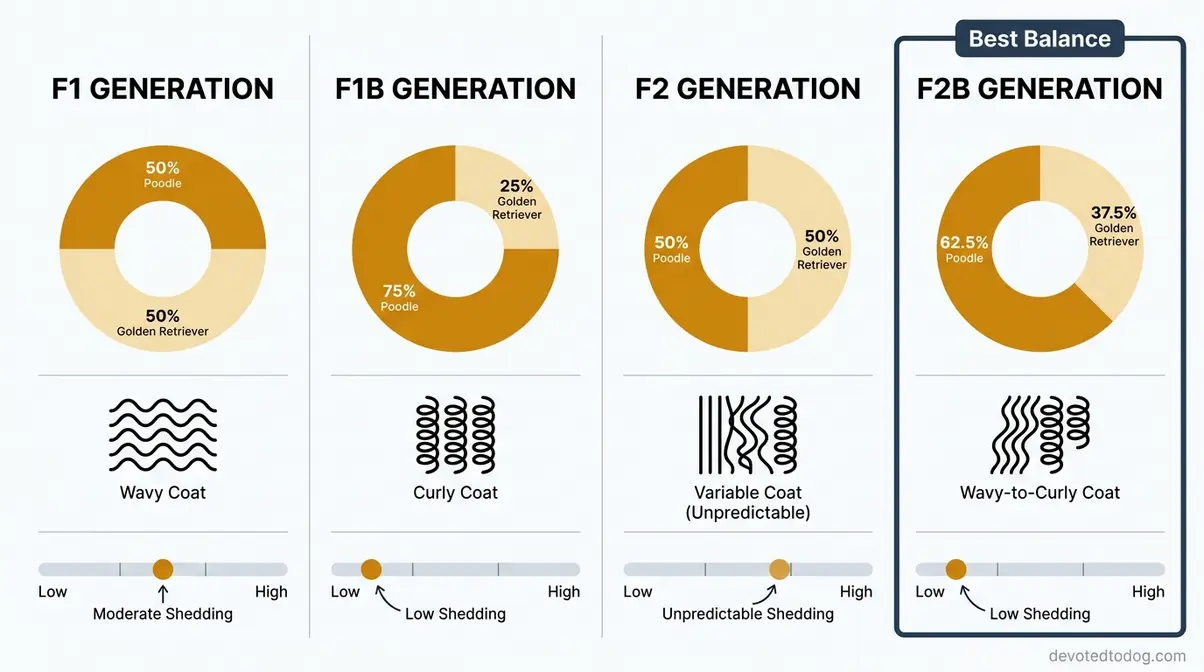
Dog owners across Goldendoodle communities put it well in a sentiment shared consistently across forums:
“F1s typically have a 50/50 ratio and F2Bs typically have a 65/35 ratio but it’s not guaranteed. Either way you’re going to get a good dog.”
— A common sentiment shared across Goldendoodle owner communities
That captures the honest truth: generation labels increase the probability of a low-shedding coat, but The Furnishing Gene Factor — DNA testing — is the only way to truly confirm it. Research published by the NIH included both F1B and F2B Goldendoodles in behavioral sampling of designer crossbreeds (National Institutes of Health, 2026).
Now let’s answer the question everyone actually wants answered: between F1B and F2B, which one is better for allergy sufferers?
FAQ: Difference Between F1B & F2B
The main difference between an F1B and an F2B Goldendoodle is their genetic makeup and parentage. An F1B is produced by crossing an F1 Goldendoodle (50% Poodle) with a purebred Poodle, resulting in 75% Poodle genetics. An F2B is produced by crossing an F1 Goldendoodle with an F1B Goldendoodle, resulting in 62.5% Poodle genetics. This 12.5% difference in Poodle content means F1Bs typically have curlier, more reliably low-shedding coats, while F2Bs often display wavy-to-curly coats with slightly more Golden Retriever characteristics. Both generations make excellent family pets — the choice comes down to allergy needs and personal preference for coat type and temperament.
F2B vs. F1B for Allergies
F2B Goldendoodles are 62.5% Poodle, compared to 75% for F1B — meaning F1B offers slightly more shedding predictability, while F2B offers a better balance of Golden Retriever temperament and coat quality.
For families where a member has moderate-to-severe pet allergies, the F1B Goldendoodle is typically the safer choice. Its higher Poodle content means a curlier coat with a stronger probability of low allergen production. The difference between F1B and F2B Goldendoodles, in practical terms, is that the F1B leans more Poodle in both look and shedding behavior.
The F2B, by contrast, hits a sweet spot for families with mild allergies who also want the classic “Teddy Bear” wavy look and a slightly softer, more Golden Retriever-influenced temperament. Dog owners consistently describe this generation as feeling more like a traditional Golden Retriever in personality — just with much less fur on the couch.
One thing applies equally to both generations: hybrid vigor, the health benefit that comes from genetic diversity, is strongest in F1 dogs and decreases slightly with each subsequent generation. An F2B has a little less genetic diversity than an F1 — not enough to be a dealbreaker, but worth knowing. Regardless of which generation you choose, asking your breeder about furnishing gene DNA testing is the single most important step for allergy sufferers.
Now that you can compare the generations, let’s look at who each one is actually right for.
Which Generation Is Right?
- Severe allergies, top priority is minimal shedding → Choose F1B (75% Poodle, curlier coat, most consistent low-allergen results)
- Mild to moderate allergies, want balanced temperament + classic “Teddy Bear” look → Choose F2B (62.5% Poodle, wavy-to-curly coat, Golden Retriever personality balance)
- No allergy concerns, want maximum genetic diversity and health → Choose F1 (50% Poodle, strongest hybrid vigor, most Golden Retriever traits)
Keep in mind that F1B vs. F2B mini Goldendoodle comparisons follow the same logic — the size variant doesn’t change the generation’s allergy profile. Once you’ve chosen your generation, the next question is: what will your F2B actually look like?
F2B Size, Coat Types, & Appearance
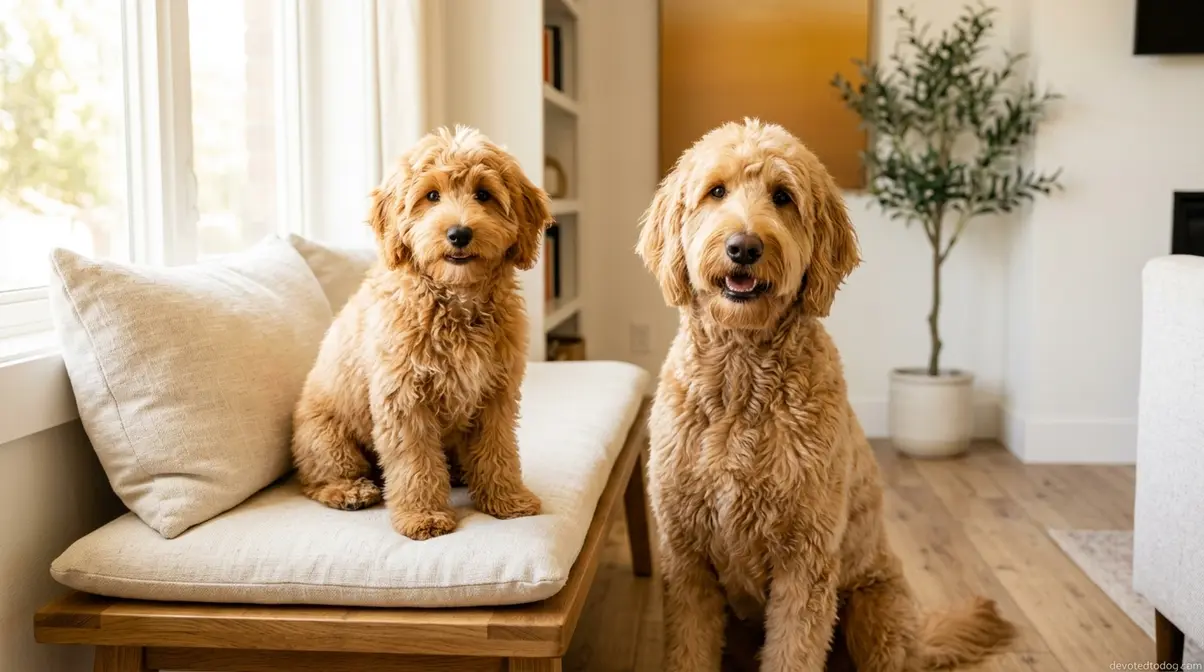
F2B Goldendoodles come in two main size categories — Mini and Standard — with coat types ranging from curly to straight depending on furnishing gene inheritance. Size is determined primarily by the Poodle parent used in breeding, while coat type is influenced by genetics from both parents.
Veterinary researchers at UC Davis emphasize that size and coat outcomes in multi-generational crosses involve complex genetic interactions that make individual puppy prediction difficult (UC Davis School of Veterinary Medicine, 2026). That said, the ranges below reflect what most F2B buyers can realistically expect.
Mini vs. Standard F2B Size
A Mini F2B Goldendoodle — a smaller variant bred using a Miniature Poodle parent — typically weighs 15–35 lbs and stands 13–20 inches tall at the shoulder when fully grown. Most Mini F2Bs reach their full size by 12–14 months (Dogster, 2026; Royal Mini Doodles, 2026).
A Standard F2B Goldendoodle, the full-sized version, typically weighs 50–90 lbs and stands 20–26 inches tall, reaching full size between 18–24 months (SpiritDog Training, 2026).
The single biggest factor determining your F2B’s size is the Poodle parent. A Miniature Poodle parent produces a Mini F2B; a Standard Poodle parent produces a Standard F2B. Even within a single litter, individual puppies can vary — so ask your breeder about the expected adult size range for your specific puppy’s parents.
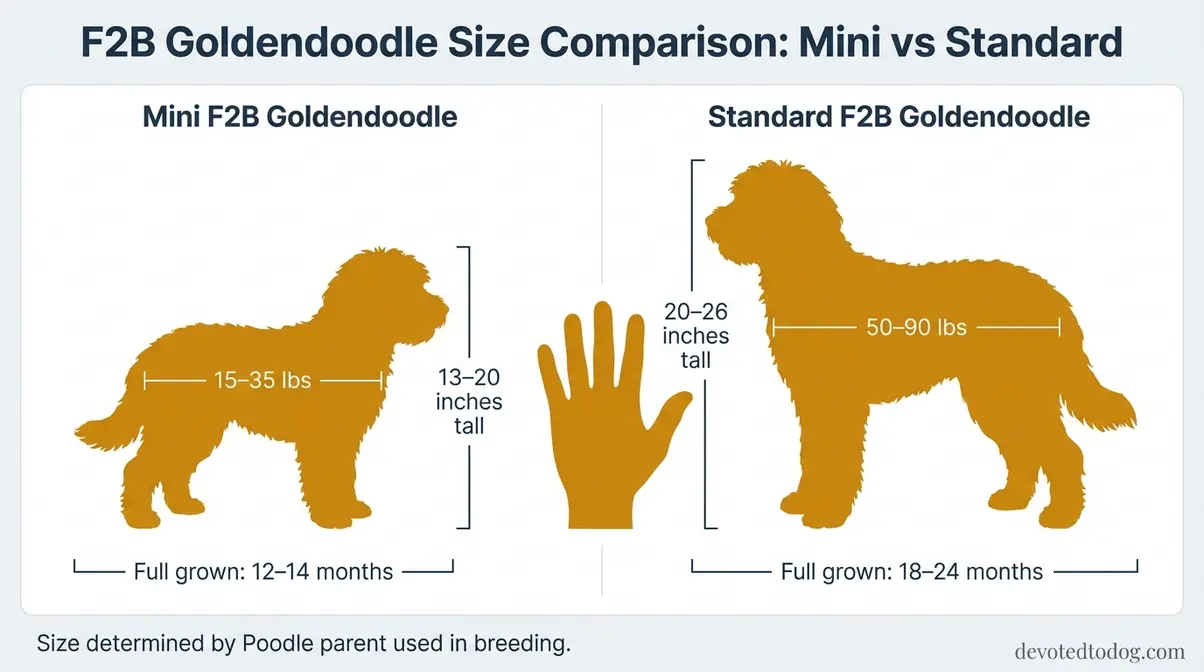
For a deeper look at what affects coat alongside size, see our guide to Goldendoodle coat types.
Size is just one part of the picture. The coat type your F2B inherits will affect both your grooming routine and your allergy experience — here’s what to expect.
F2B Coat Types Explained
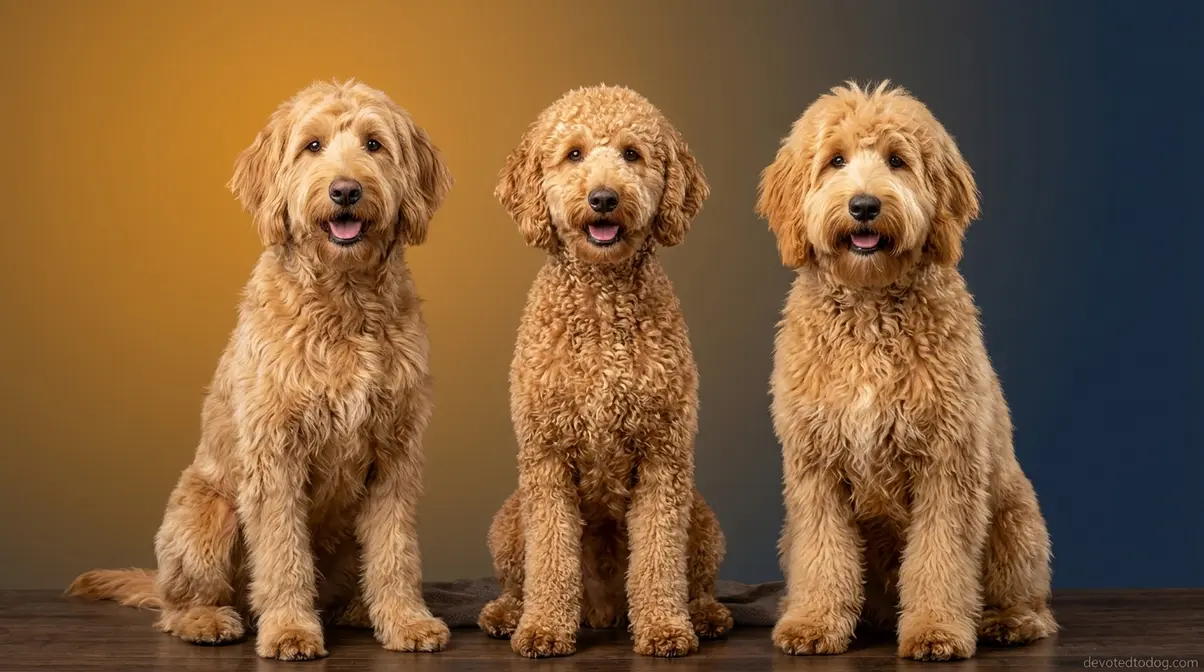
As the coat type guide below shows, F2B Goldendoodles can develop three distinct coat types — and which one your puppy inherits comes directly back to The Furnishing Gene Factor.
Curly coat — tightly curled like a Poodle, this coat sheds minimally and is the most allergy-friendly option. It requires professional grooming every 6–8 weeks and “takes a lot of combing” between appointments to prevent matting. A curly coat indicates the furnishing gene was inherited from both parents.
Wavy coat — the classic “Teddy Bear” look that most buyers are hoping for. Loose waves, low-to-moderate shedding, and somewhat easier to maintain than a fully curly coat. This coat type occurs when the furnishing gene is inherited from one parent. It’s the most common F2B coat type.
Straight coat — flatter and more like a Golden Retriever, this coat is “mostly fur” and sheds noticeably more than the other two types. A straight coat on an F2B typically indicates the furnishing gene was not inherited — this is the unfurnished F2B Goldendoodle outcome. It’s less common but possible, which is exactly why asking about DNA testing matters.
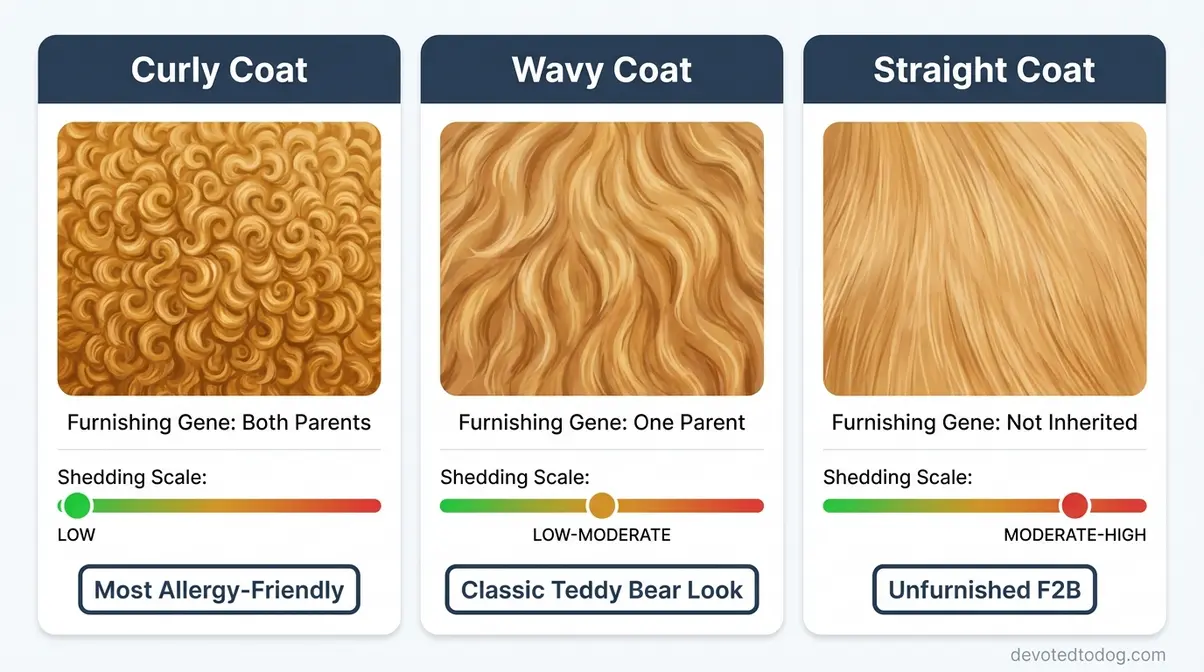
The “Teddy Bear” look most buyers want corresponds to the wavy or curly coat — both of which require the furnishing gene to be present. DNA testing by your breeder is the only reliable way to know which coat type to expect before your puppy is born.
F2B Goldendoodle Colors
F2B Goldendoodles come in a wide range of colors, none of which are generation-specific — color is determined by the genetics of the individual Golden Retriever and Poodle parents.
The most common colors include apricot, cream, golden, and chocolate. Less common but fully possible are a black F2B Goldendoodle, a red F2B Goldendoodle, and parti (multi-colored) coats. Cream and apricot remain the most popular choices among buyers, but black and chocolate F2Bs have a devoted following for their striking appearance.
Rare color patterns — like merle or parti — typically command a premium price from specialty breeders. If a specific color matters to you, discuss it with your breeder early, as availability varies significantly by litter.
The appearance of your F2B is just the beginning. Let’s look at what really matters for family life — temperament, shedding, and health.
Temperament, Health, and Shedding
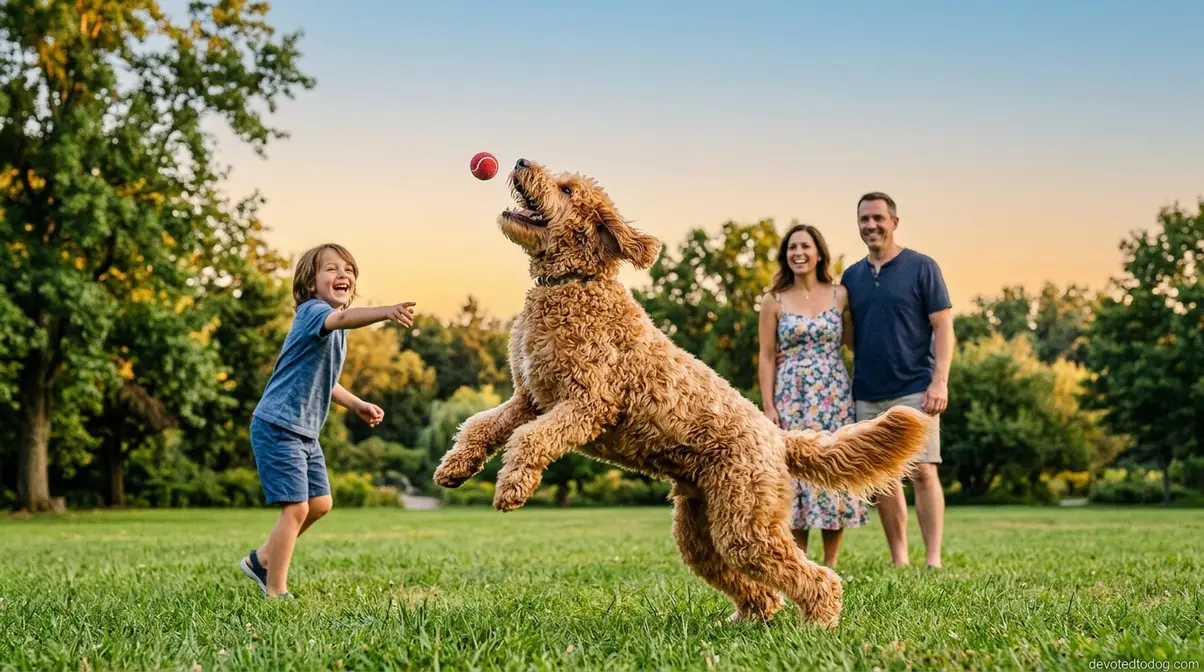
F2B Goldendoodles are widely regarded as one of the most family-friendly dog breeds available — inheriting the Golden Retriever’s patience and warmth alongside the Poodle’s intelligence and trainability. For families weighing this generation, understanding the shedding reality and key health considerations will help set accurate expectations from day one.
No dog is 100% hypoallergenic, but F2B Goldendoodles with the furnishing gene are among the lowest-shedding breeds available — making them a popular choice for families with mild to moderate pet allergies (PetMD, 2026).
F2B Goldendoodle Temperament
F2B Goldendoodles consistently rank among the most trainable and family-oriented dogs in any generation. Their characteristics blend the best of both parent breeds: the Golden Retriever’s gentle patience and the Poodle’s sharp intelligence and eagerness to please.
In terms of energy, expect moderate-to-high activity needs. Most F2Bs thrive with 30–60 minutes of exercise daily — walks, fetch, swimming, or simply running in the yard. They’re an excellent match for active families and adapt well to homes with children of all ages. Dog owners across online communities consistently describe F2B Goldendoodles as “velcro dogs” — they want to be wherever you are, whether that’s the couch or the hiking trail.
The “Teddy Bear” look isn’t just about appearance — the F2B’s temperament genuinely matches the nickname. They’re affectionate, social, and rarely aggressive. Early socialization still matters, though: any dog benefits from positive exposure to other animals, new people, and different environments during puppyhood.
For more on what to expect from the coat alongside that temperament, see our guide on do Goldendoodles shed.
The temperament is wonderful — but for many families, the real question is about shedding. Here’s the honest answer.
Shedding & Allergies
F2B Goldendoodle shedding is genuinely low — but not zero. Setting accurate expectations here matters more than any other single topic for allergy-concerned buyers.
“Low-shedding” means significantly less fur than a Golden Retriever, but it does not mean your home will be fur-free. The F2B is not — and no dog is — 100% hypoallergenic. According to PetMD’s list of hypoallergenic dogs, pet allergens come from dander and saliva, not just fur — but low-shedding breeds like Goldendoodles produce significantly fewer airborne allergens (PetMD, 2026). For families with mild to moderate sensitivities, this distinction makes the F2B an “allergy-friendly” choice, even if it’s not a clinical guarantee.
This is where The Furnishing Gene Factor becomes most actionable. An F2B with the furnishing gene will shed very little — close to the “low to non-shedding” experience most buyers hope for. An unfurnished F2B Goldendoodle (one that didn’t inherit the furnishing gene) will shed noticeably more than expected, even though it’s technically the same generation. This is not a breeder failure; it’s genetics. But a responsible breeder can reduce this risk dramatically through DNA testing.
If you’re an allergy sufferer, ask your breeder directly: “Have both parent dogs been DNA tested for the furnishing gene?” A reputable breeder will say yes and show you the results.
Beyond shedding, it’s worth knowing the health conditions that F2B Goldendoodles are predisposed to — so you can ask the right screening questions before you buy.
Common Health Issues
F2B Goldendoodle health issues are manageable and largely screenable — knowing them in advance helps you ask better questions and choose a healthier puppy.
Hip and elbow dysplasia are the most common structural concerns in larger Goldendoodles. Ask any breeder for OFA (Orthopedic Foundation for Animals) health screening certificates on both parent dogs — this is a baseline, non-negotiable marker of responsible breeding.
Ear infections are common in dogs with floppy ears and curly coats because moisture gets trapped in the ear canal. Regular ear cleaning (weekly or after swimming) prevents most cases entirely.
Hypothyroidism — an underactive thyroid — is worth knowing about specifically because of its coat connection. VCA Animal Hospitals notes that unexpected excessive shedding in typically low-shedding crossbreeds can be a symptom of underlying hormonal issues like hypothyroidism — a condition that is treatable when caught early (VCA Animal Hospitals on hypothyroidism and shedding, VCA Animal Hospitals, 2026). If your F2B suddenly starts shedding far more than expected, consult your vet.
Eye conditions (progressive retinal atrophy and cataracts) are also seen in the breed — ask about CAER (Canine Eye Registry Foundation) eye exam results for both parents.
F2B Goldendoodles generally live 10–15 years, with Mini variants often reaching the higher end of that range (PetMD, 2026; Walkin’ Pets, 2026).
With a clear picture of the F2B’s health and temperament, the next step is understanding what it costs — and how to find a breeder you can trust.
FAQ: Are F2B Doodles Desirable?
Yes — F2B Goldendoodles are highly desirable, particularly for families seeking a low-shedding, allergy-friendly companion with the classic “Teddy Bear” look. Their breeding specifically targets a higher Poodle content than the original F1 generation, producing coats that are more consistently low-shedding. They also retain the Golden Retriever’s gentle, patient temperament that makes Goldendoodles beloved family dogs. F2Bs are especially popular with families who want predictable coat qualities without going all the way to the 75% Poodle content of an F1B. Desirability ultimately depends on your specific needs — for allergy sufferers, always confirm furnishing gene testing with your breeder before purchasing.
F2B Price, Breeders, & Buying Guide

Prices and availability verified as of Q1 2026 — verify current rates with local breeders before purchasing.
F2B Goldendoodles sit in the mid-to-premium range of Goldendoodle pricing. PetMD’s overview of Goldendoodle shedding notes that Goldendoodles’ strong reputation as low-shedding dogs — a key factor in their continued popularity and premium pricing — is tied to their inherited coat genetics (PetMD, 2026).
How Much Does an F2B Cost?
The F2B Goldendoodle price varies by size, color, location, and breeder — but current market data from reputable breeders gives a reliable baseline.
Standard F2B Goldendoodle cost: approximately $1,800–$2,800 (Best Goldendoodles, 2026; J+A Family Doodles, 2026). F2B mini Goldendoodle price typically runs higher — around $2,500–$3,500 — because smaller size correlates with higher buyer demand and more complex breeding logistics.
Several factors push prices up or down within these ranges:
- Breeder reputation and health testing: Breeders who DNA test for the furnishing gene and provide OFA and CAER certificates appropriately charge more — and that premium is worth it.
- Geographic location: Urban markets and high-demand regions (Pacific Northwest, Northeast, Southern California) typically see prices at the top of these ranges.
- Coat color: Rare colors like merle, parti, or phantom command premiums of $200–$500 above standard pricing.
- Size: Mini F2Bs consistently price higher than Standards due to demand.
A higher price from a breeder who shows health test results is almost always a better investment than a lower price from a breeder who can’t. Budget beyond the purchase price, too — professional grooming every 6–8 weeks runs $75–$150 per session depending on your area.
Now that you know what to budget, here’s how to find a breeder you can actually trust.
Finding a Reputable Breeder
Finding reputable F2B Goldendoodle breeders takes a little more patience than finding F1B breeders — fewer breeders specialize in this generation, but the search is worth it.
Start with the Goldendoodle Association of North America (GANA) breeder directory. GANA member breeders commit to health testing standards, including OFA screenings and genetic testing — making the directory a reliable first filter.
Reputable breeders consistently share these practices: they health test parent dogs (OFA for hips/elbows, CAER for eyes), allow in-person visits before any deposit, provide written health guarantees, and keep puppies with their mother until at least 8 weeks. When you call a breeder, one of your first questions should be: “Can I visit and meet the parent dogs in person?” A trustworthy breeder will always say yes.
For F2B Goldendoodles for sale, other reliable starting points include the AKC Marketplace, word-of-mouth referrals from your local veterinarian’s office, and breed-specific Facebook groups where owners share breeder recommendations. Searching “F2B Goldendoodle for sale near me” in those community spaces often surfaces local breeders that don’t advertise widely online.
For comprehensive guidance on vetting any Goldendoodle breeder, see our full guide on finding a reputable Goldendoodle breeder.
Before you commit to any breeder, know these red flags — they could save you from an expensive and heartbreaking mistake.
Breeder Red Flags to Avoid
- No health testing documentation — If a breeder cannot provide OFA certificates and CAER eye exam results for both parent dogs, walk away.
- Can’t answer “Do you test for the furnishing gene?” — Any responsible F2B breeder should know immediately what this means. Hesitation or a blank response is a serious warning sign. This is The Furnishing Gene Factor in practice — the single most differentiating question you can ask.
- Requires full payment before you can visit or meet the puppy — Legitimate breeders welcome in-person visits. Upfront payment without a meeting is a hallmark of scam operations and puppy mills.
- Multiple breeds and multiple litters always available — A breeder producing five different doodle breeds simultaneously with litters always ready is almost certainly prioritizing volume over health and socialization.
Even with all this knowledge, there are a few common misconceptions about F2B Goldendoodles worth addressing before you make your final decision.
Misconceptions and Limitations
Myth: Always Low-Shedding
This is the most common — and most costly — misunderstanding about the F2B generation.
The F2B label increases the probability of a low-shedding coat, but it does not guarantee one. A puppy that doesn’t inherit the furnishing gene (The Furnishing Gene Factor) will shed moderately despite being a legitimate F2B. Buyers who don’t ask about DNA testing can feel genuinely misled — not because the breeder lied about the generation, but because generation labels don’t tell the whole story.
A second misunderstanding involves hybrid vigor. F2Bs have slightly less genetic diversity than F1 Goldendoodles, meaning the health advantages of hybrid vigor are somewhat reduced. This doesn’t make F2Bs unhealthy — but it does mean you should still request OFA and CAER certificates, rather than assuming “it’s a hybrid, so it must be healthy.” Health testing matters for every generation.
When an F2B Isn’t Right
The F2B is an exceptional dog — but it’s not the right fit for every situation.
Severe, clinical pet allergies: If a family member has doctor-confirmed pet allergies, an F1B (75% Poodle, more predictably curly coat) or a purebred Poodle is the safer choice. The F2B is excellent for mild-to-moderate sensitivities, not clinical severity.
Apartment living with limited activity: F2Bs have moderate-to-high energy needs. In a small space with no yard and a low-activity lifestyle, that energy can become frustrating for both dog and owner. A Cavapoo or similar lower-energy doodle mix may be a better fit.
First-time dog owners on a tight budget: The purchase price is just the beginning. Professional grooming every 6–8 weeks adds up quickly — budget $1,000–$2,000 per year in grooming and routine care. If that’s a stretch, consider whether the timing is right before committing.
Frame these as honest planning tools, not reasons to avoid the breed. The F2B is a genuinely wonderful family dog — for the right family, in the right circumstances.
Frequently Asked Questions
Which is better, F1B or F2B?
Neither is universally better — the right choice depends on your allergy severity and lifestyle priorities. F1B Goldendoodles are 75% Poodle, giving them a curlier, more consistently low-shedding coat — making them the better choice for moderate-to-severe allergies. F2B Goldendoodles are 62.5% Poodle, offering a slightly softer coat and more Golden Retriever temperament balance. Most allergy sufferers with mild sensitivities find the F2B an excellent fit, while those with stronger reactions tend to do better with an F1B. In either case, asking your breeder for furnishing gene DNA test results is the most reliable way to predict your specific puppy’s coat.
Are F1 or F2 Doodles better?
For most buyers, F1 Goldendoodles are generally preferred over F2 Goldendoodles — primarily because of coat predictability and hybrid vigor. F1 Goldendoodles (50% Poodle, 50% Golden Retriever) benefit most from hybrid vigor — the health advantage that comes from crossing two genetically diverse purebred lines. F2 Goldendoodles (produced by two F1 parents) have less genetic diversity and more variable coat outcomes, including a higher chance of unexpected shedding. That said, F2B Goldendoodles — a backcross of F1 and F1B — offer a significantly better alternative to F2, combining more Poodle genetics with improved coat consistency. Both F1 and F2 make loving pets, but if coat predictability matters to you, F1 or F2B are both stronger choices than F2.
Choosing Your F2B Goldendoodle
For families seeking a low-shedding, affectionate companion with the iconic “Teddy Bear” look, the F2B Goldendoodle delivers a compelling combination of traits. At 62.5% Poodle, this generation produces reliably wavy-to-curly coats, a gentle and highly trainable temperament, and a lifespan of 10–15 years. At Devoted to Dog, our evaluation of breeder data and community feedback consistently points to the F2B as the top choice for families with mild to moderate allergies who want Golden Retriever personality alongside Poodle coat qualities.
The Furnishing Gene Factor is the framework that separates confident buyers from confused ones. Generation labels set the probability — F2B’s 62.5% Poodle content makes a low-shedding coat more likely than an F1 or F2. But DNA testing for the furnishing gene sets the certainty. You came to this guide confused by breeder jargon; now you have the one question that cuts through all of it.
Your next step: before you put down any deposit, ask every breeder on your list for furnishing gene DNA test results and OFA health certificates for both parent dogs. Visit our F1B Goldendoodle guide if you’re still weighing generations, and check our finding a reputable Goldendoodle breeder guide before making contact. Give yourself 2–4 weeks to compare at least three breeders — a good breeder will respect the patience, and your future dog will be worth it.