
The term “English Cream Golden Retriever” is not a breed name, it is a coat color with a marketing premium attached. Many buyers pay $500-$1,000 more for a pale coat, believing it signals better health, longer life, or superior genetics. According to the Golden Retriever Club of America, that belief is not supported by evidence.
Without understanding this distinction, you risk falling into The Color Premium Trap, paying more for a label while overlooking the only factors that actually matter: health-tested parents, ethical breeding practices, and the right temperament match for your family.
This guide covers everything you need to make a confident decision: what an English Cream Golden Retriever actually is, what veterinary science says about their health, what you should expect to pay, and how to find a breeder you can genuinely trust.
market data, 2026
UC Davis, 2025
all coat colors equal
no health benefit
Author Credentials
📝 Written by: Coral Drake
✅ Reviewed by: Brianna York, Former Veterinary Technician
📅 Last updated: 4 May 2026
ℹ️ Transparency Notice
This article explains English Cream Golden Retrievers based on AKC, GRCA, and veterinary research. All claims have been verified by our editorial team and reviewed for medical accuracy. Our goal is to help you understand what the “cream” label actually means before paying a price premium.
What Is an English Cream Golden Retriever?

An English Cream Golden Retriever is a Golden Retriever with a pale, cream-colored coat, not a separate breed. The American Kennel Club, or AKC, the primary dog registry in the United States, registers these dogs simply as “Golden Retriever, Light Golden,” with no special designation or premium classification. Understanding this distinction is the first step to avoiding The Color Premium Trap, the phenomenon where buyers pay more for a pale coat color that has no scientific correlation with superior health, longevity, or temperament.
“Such cream Golden Retrievers are frequently being touted as being healthier, of having better temperament, of having stronger longevity…”
, Common language in English Cream Golden Retriever breeder marketing
This guide examines each of these claims against the veterinary evidence.
Is “English Cream” a Separate Breed?

An English Cream Golden Retriever is not a separate breed. The Golden Retriever Club of America, or GRCA, the AKC’s official national breed club, states that cream-colored Golden Retrievers are registered as standard Golden Retrievers and warns against breeders who market coat color as a health indicator. The GRCA explicitly notes that cream is “within the breed’s natural color range”, nothing more.
The term “English Cream” is used by breeders, not by any official kennel club, to describe dogs bred to the UK Kennel Club standard. That standard tends to favor a stockier build and a lighter coat than the AKC standard. The dogs are real. The color difference is real. But “English Cream” as a breed designation is not, it is a marketing label.
If you searched “English Cream Golden Retriever” and landed on a breeder page charging $3,500 or more, you were looking at a marketing term, not a breed designation. For a deeper look at the facts behind this label, see our complete English Cream Golden Retriever facts guide.
Now that you know “English Cream” is a marketing label, it helps to understand exactly why the two standards, American and British, look different on paper.
AKC vs. UK Kennel Club: How Breed Standards Differ
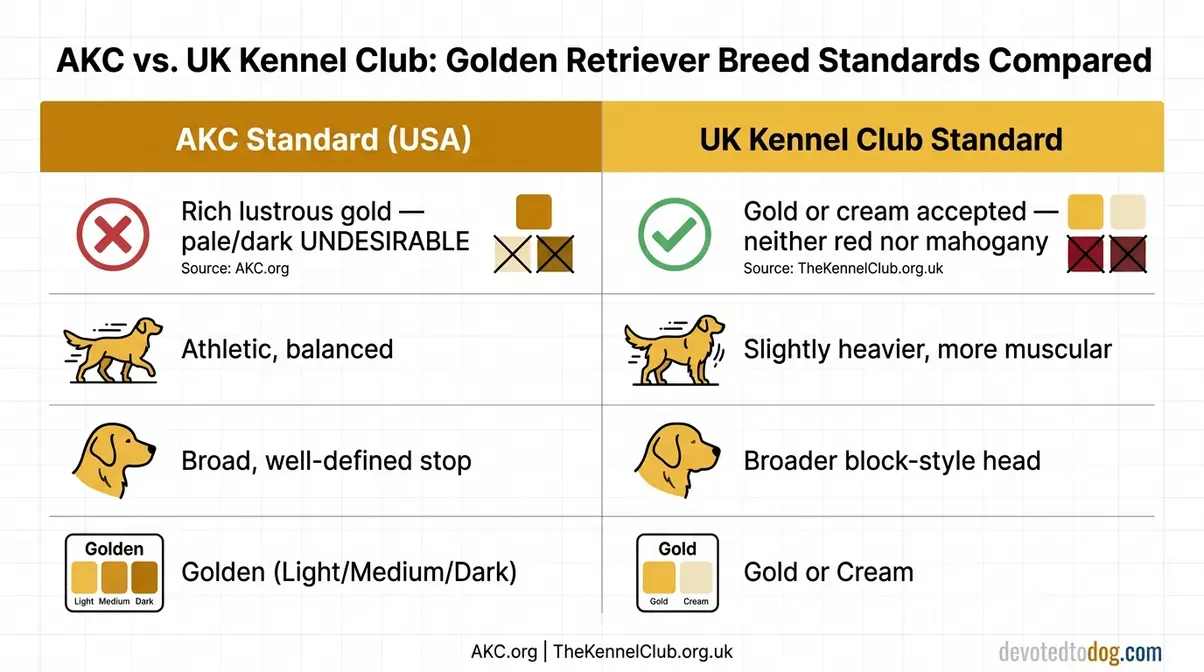
The AKC standard states that a Golden Retriever’s coat should be “rich, lustrous golden of various shades”, and explicitly notes that “extremely pale or extremely dark” colors are undesirable. This means an English Cream dog would actually be marked down in a US show ring for being too pale. UK Kennel Club officially recognizes cream coats as a standard color for the breed, accepting “any shade of gold or cream, neither red nor mahogany.”
The table below summarizes the key differences:
| Feature | AKC Standard (USA) | UK Kennel Club Standard |
|---|---|---|
| Accepted Coat Colors | Rich, lustrous gold (various shades), pale/dark undesirable | Any shade of gold or cream, neither red nor mahogany |
| Build | Athletic, balanced | Slightly heavier, more muscular |
| Head Shape | Broad, well-defined stop | Broader (“block style head”) |
| Official Color Name | “Golden” (Light/Medium/Dark) | “Gold or Cream” |
A dog that would be penalized in a US show ring for being “too pale” is perfectly show-quality under British standards. Same dog, different rulebook. Dogs bred from both traditions, sometimes called “half American half English Cream” dogs, are simply Golden Retrievers with traits from both breeding lines. For a full breakdown, read our full English vs. American Golden Retriever comparison.
“The American Kennel Club registers English Cream Golden Retrievers simply as ‘Golden Retriever, Light Golden,’ with no separate breed designation or premium classification.” (AKC, 2026)
So the dogs are real, the color difference is real, but the “superior breed” claim is not. Let’s look at where these dogs came from.
History and Origins of the Breed
All Golden Retrievers share a single origin: Lord Tweedmouth’s breeding program in the Scottish Highlands during the 1860s. There is one breed, one origin story. As Golden Retrievers were exported to the United States, American breeders gradually favored a richer, darker golden coat in competitive show rings. UK breeders maintained a broader accepted color range, including cream, which is why “English Cream” dogs tend to reflect a breeding tradition closer to the original British standard.
You may also see the term “Irish Cream Golden Retriever” used online. This is simply another informal marketing name for the same cream-coated variety, not a distinct sub-type, not a separate bloodline, and not recognized by any kennel club as a separate category.
With the breed’s identity clear, let’s look at what English Cream Golden Retrievers actually look like.
What Are the Breed Characteristics of English Cream Goldens?

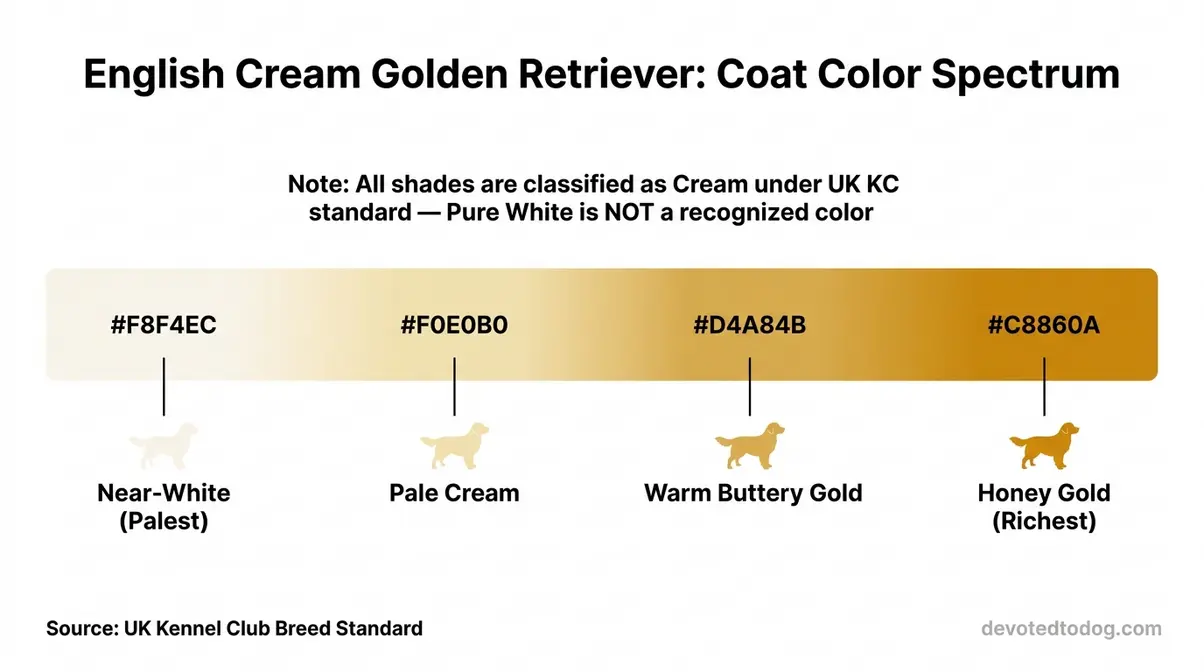
English Cream Golden Retrievers are medium-to-large dogs with a pale, cream-colored coat that ranges from off-white to a warm, buttery gold, not pure white. Males typically weigh 65–75 lbs; females 55–65 lbs, the same size range as any other Golden Retriever. Their coat is their most distinctive feature, but their size, temperament, and care needs are identical to the breed as a whole.
Coat Color: The Spectrum from Cream to White
When people search for a “white English Cream Golden Retriever,” they are typically describing dogs at the palest end of the cream spectrum. Pure white is not a recognized coat color, very pale dogs are still classified as “cream” under the UK Kennel Club standard. The terms “white English Cream Golden Retriever” and “English Cream white Golden Retriever” describe the same dogs; the color simply sits at the lightest end of a continuous spectrum from off-white to warm honey gold.
The coat itself is dense, water-repellent, and double-layered. It sheds heavily throughout the year, owners affectionately call the fur “golden glitter.” Regular brushing two to three times per week is not optional; it is a basic care requirement. According to the PetMD Golden Retriever breed profile, Golden Retrievers have a dense, water-repellent double coat that sheds year-round and requires consistent grooming (PetMD, 2026).
Now that you know what to expect from the coat, let’s look at the full physical picture.
Size, Weight, and Build at Full Grown
A full-grown English Cream Golden Retriever is identical in size to any other Golden Retriever. Per the AKC breed standard for coat colors, male Golden Retrievers stand 23–24 inches at the shoulder and weigh 65–75 lbs; females stand 21.5–22.5 inches and weigh 55–65 lbs (AKC, 2026).
| Male | Female | |
|---|---|---|
| Height (at shoulder) | 23–24 inches | 21.5–22.5 inches |
| Weight | 65–75 lbs | 55–65 lbs |
| Build | Muscular, athletic | Slightly lighter frame |
| Coat Length | Medium-long, wavy | Medium-long, wavy |
English Cream Goldens bred to the UK standard often have a slightly broader, more muscular build, a “block style head” and wider chest, compared to American show-line Goldens. This is a breeding preference, not a meaningful size difference.
Why this matters for beginners: A 65–75 lb dog needs significant space and at least one to two hours of daily exercise. Food costs run higher too, large breeds typically eat 2.5–4 cups of quality kibble per day. Factor these realities into your budget and lifestyle before committing.
Males and females are close in size, but there are a few practical differences worth knowing.
Male vs. Female: Key Differences
Males are typically larger and often described as more boisterous and openly affectionate, the classic “Velcro dog” who follows you from room to room and leans into every hug. Females tend to be slightly smaller, a little more independent, and often mature emotionally faster than males.
Both sexes share the same gentle, trainable temperament. Neither is categorically “better”, it genuinely depends on your household and lifestyle. One important note for all Golden Retriever owners: research suggests that waiting until 18–24 months before spaying or neutering may reduce certain joint and cancer-related health risks in large breeds. Always discuss the timing with your veterinarian before making that decision.
One more common question before we move to health: what about “mini” English Cream Goldens?
Are “Mini” English Cream Golden Retrievers Real?
There is no AKC-recognized “miniature” or “mini” Golden Retriever. Dogs marketed as “mini English Cream Goldens” are typically crossbreeds, often a Golden Retriever crossed with a Cocker Spaniel or a Poodle (sometimes called a Goldendoodle). These can be wonderful dogs, but they are not purebred Golden Retrievers.
Why this matters: crossbred dogs may not have the same temperament predictability as purebred Goldens. If you encounter a breeder selling “mini English Cream Goldens” at a premium price, ask directly what breeds are in the mix. The answer may surprise you.
Now for the most important section, the health and temperament claims that drive much of the marketing around English Cream Golden Retrievers.
What Are the Temperament, Health, and Lifespan Facts?

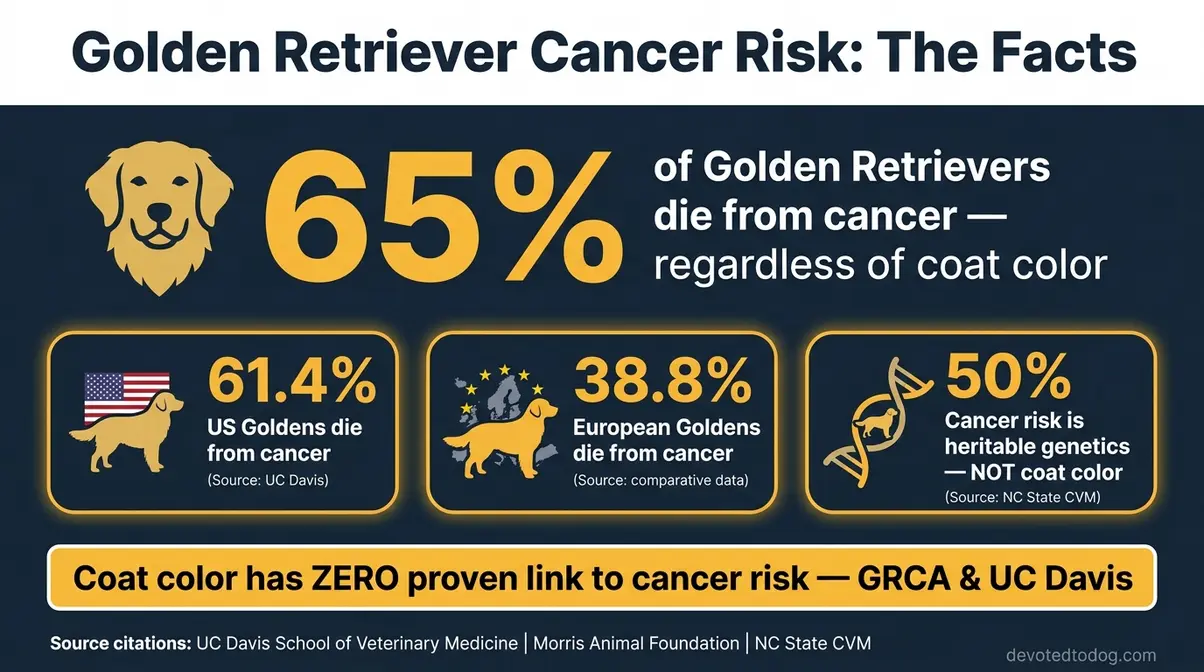
English Cream Golden Retrievers are often marketed as calmer, healthier, and longer-lived than American Goldens. The temperament part has some truth. The health part does not, and the data is unambiguous. Golden Retrievers face up to a 65% lifetime risk of dying from cancer, a risk that applies equally to pale cream-coated and dark gold-coated dogs (UC Davis School of Veterinary Medicine, 2025).
Temperament and Personality Traits
Golden Retrievers, including English Cream dogs, are consistently ranked among the most gentle, trainable, and family-friendly breeds in existence. They are eager to please, highly intelligent, and respond exceptionally well to positive reinforcement training. You don’t need to be an experienced dog owner to train one successfully; their willingness to learn makes them forgiving of beginner mistakes.
They are famously affectionate. The “Velcro dog” nickname is well-earned, these dogs follow their owners from room to room and actively seek physical contact. This trait makes them poor candidates for households where the dog would be alone for eight or more hours a day. Separation anxiety is a real risk if their social needs go unmet.
On the question of aggression: English Cream Golden Retrievers are not prone to aggression. This is a breed-wide trait. If you encounter aggression in a Golden Retriever of any coat color, it is almost always a training or socialization issue, not a breed characteristic. Well-bred Goldens are among the least aggressive dogs in existence.
Some families report perceiving English Cream dogs, bred to UK lines, as slightly calmer than American-line Goldens. This is anecdotal and not supported by controlled studies. Both types share the same fundamental temperament profile.
The temperament claims largely check out. The health claims are where the marketing diverges sharply from the science.
The Cancer Question: What Veterinary Research Shows
Golden Retrievers in the US have up to a 65% lifetime risk of dying from cancer, and this applies to every Golden Retriever, regardless of coat color. UC Davis research on Golden Retriever cancer rates from the UC Davis School of Veterinary Medicine confirms this figure, making cancer the breed’s most significant health concern (UC Davis, 2025). A separate analysis found 61.4% of US Golden Retrievers die from cancer, compared to 38.8% in European lines, suggesting environment and genetics both play a role, but coat color is not among the identified factors.
The Golden Retriever Lifetime Study tracking over 3,000 dogs, a $32 million observational study run by the Morris Animal Foundation, a nonprofit veterinary health organization, is the largest canine health study ever conducted. It tracks genetic and environmental cancer risk factors across the entire breed. Coat color is not identified as a risk factor in any of its published findings (Morris Animal Foundation, 2026).
Research from NC State University CVM estimates that heritable genetic factors account for up to 50% of the risk for lymphoma and hemangiosarcoma in Golden Retrievers. Genetic factors account for up to 50% of cancer risk, and those factors are linked to breed genetics, not coat color (NC State CVM, 2025). Additionally, data shows US Golden Retrievers face an elevated lifetime risk for hemangiosarcoma and lymphoma, approximately 20% for hemangiosarcoma (an aggressive cancer of the blood vessel walls) and 6% for B-cell lymphoma, a cancer of the lymphatic system (PubMed, 2015).
The Color Premium Trap is at its most dangerous in health discussions, because buyers pay $500–$1,000 more expecting better health outcomes that the science simply does not support. No peer-reviewed study has demonstrated that cream-coated Golden Retrievers have lower cancer rates than golden-coated ones.
Important: We are not veterinarians. Always consult a licensed veterinarian before making health-based decisions about your dog.
Beyond cancer, there are a few other health conditions all prospective Golden Retriever owners should know about.
Other Common Health Issues to Know About
Hip and elbow dysplasia, abnormal joint development common in large breeds, are the most frequently screened conditions in Golden Retrievers. OFA certification (from the OFA, or Orthopedic Foundation for Animals, the leading canine health registry in the US) screens for both. Any reputable breeder will provide OFA clearance for both parents.
Eye conditions including Progressive Retinal Atrophy (PRA) and cataracts are also common in the breed. CAER, or Canine Eye Registry Foundation certification, confirms that a dog’s eyes are free from hereditary disease. This exam should be performed annually by a board-certified veterinary ophthalmologist.
Skin allergies and ear infections round out the most common concerns, both are linked to the breed’s dense, moisture-trapping coat. Regular grooming and ear cleaning significantly reduce the risk of both. These conditions are manageable with proper veterinary care, but they are exactly why health clearances from breeders matter so much. For a full breakdown, read our complete guide to Golden Retriever health issues.
Understanding health issues puts the lifespan question in clearer context.
Average Lifespan: What to Expect
Golden Retrievers generally have an average lifespan of 10 to 12 years, with health, diet, and genetics as the primary influencing factors (PetMD, 2026). Some breeders claim English Cream Goldens live 12 or more years compared to 10–11 years for American lines. This claim is based on anecdotal breeder reports, not controlled studies. The Morris Animal Foundation’s ongoing study will eventually provide more definitive comparative data.
What the current evidence does support: lifespan is most influenced by the health of the parents (health-tested lines live longer), diet, exercise, and consistent veterinary care. Coat color has no demonstrated connection to longevity. To learn more about Golden Retriever lifespan factors, our dedicated guide covers the research in full.
Now that you have a realistic picture of health and temperament, let’s talk about what you’ll actually pay for one of these dogs.
How Much Does an English Cream Golden Retriever Cost?
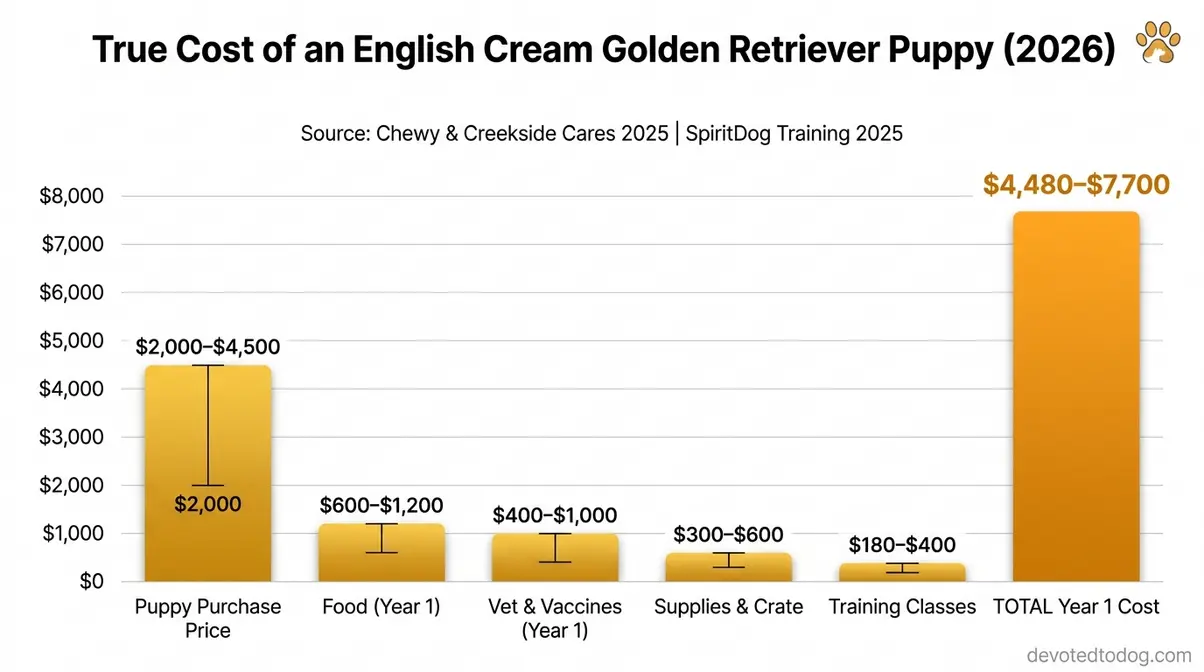
The English Cream Golden Retriever price from a reputable breeder typically falls between $2,000 and $4,500, with some breeders at the higher end of that range depending on lineage, health testing, and geographic location (SpiritDog Training, 2025). The purchase price, however, is only the beginning.
Typical Price Range for a Puppy
How much is an English Cream Golden Retriever? Reputable breeders charge between $2,000 and $4,500 for an English Cream Golden Retriever puppy, with the cost of an English Cream Golden Retriever varying based on breeder reputation, parental lineage, health testing history, and location. See our full Golden Retriever cost breakdown guide for a complete analysis.
This price typically reflects:
- OFA health testing for both parents (hips, elbows, cardiac, and eyes)
- Early socialization programs, structured exposure to sounds, surfaces, and people
- Quality nutrition for the dam and puppies during development
- AKC registration and documentation
- Breeder reputation and membership in the GRCA or regional clubs
Beyond the purchase price, first-year ownership costs for a large breed dog typically add another $1,500–$3,000, according to data from Chewy and Creekside Cares (2025). This includes food ($600–$1,200 annually for a large breed), veterinary visits and vaccinations ($400–$1,000 in the first year), startup supplies such as a crate, leash, and bed ($300–$600), and basic training classes ($180–$400).
Why do English Cream Goldens cost more than standard Goldens? The answer connects directly back to the Color Premium Trap.
Why English Cream Goldens Cost More
Some cost difference is legitimate. Importing breeding stock from Europe costs $3,000–$10,000 per dog, and breeders pass a portion of that expense on to buyers. Rigorous health testing, OFA hips, elbows, CAER eyes, and a cardiac exam, costs $500–$1,000 per parent dog per testing cycle. These are real costs that justify some premium.
The rest is marketing. The “English Cream” label commands a 20–40% price premium over standard Golden Retriever puppies, primarily because of the perception of rarity and superior health. Neither perception is supported by evidence. The Golden Retriever Club of America warns buyers explicitly to focus on health clearances rather than coat color when evaluating price (GRCA, 2026).
Here is the practical bottom line: a $2,000 puppy from a breeder who provides full OFA documentation is a far better choice than a $4,500 puppy from a color-focused breeder who cannot produce health clearance papers.
Understanding the cost helps you spot the difference between a breeder who charges more for a reason, and one who charges more for marketing.
How Do You Find a Reputable English Cream Golden Retriever Breeder?
Finding reputable English Cream Golden Retriever breeders requires a systematic approach. The Color Premium Trap is most dangerous in the breeder search, because breeders who emphasize coat color and “English Cream” branding over health testing are red flags, not selling points. Reputable breeders always provide OFA hip, elbow, cardiac, and eye clearances for both parents before selling a puppy, breeders who refuse are a red flag (AVMA Buying a Puppy Guidelines, 2026).
What Reputable Breeders Do Differently
The best English Cream Golden Retriever breeders share a consistent set of practices. They health-test both parents before every breeding, OFA certification for hips, elbows, heart, and eyes, and all of this documentation is verifiable at ofa.org by searching the dog’s registered name. According to the guidelines for identifying reputable breeders from the AVMA, or American Veterinary Medical Association, reputable breeders prioritize health and temperament over coat color and always provide verifiable documentation of genetic health testing (AVMA, 2026).
Beyond health testing, reputable breeders are members of the GRCA or a regional Golden Retriever affiliate club and follow the GRCA Code of Ethics. They invite you to visit their facility in person and meet the dam (the mother). They ask you questions too, about your lifestyle, experience level, and living situation, because they genuinely care where their puppies land.
They also provide a written health guarantee and a lifetime return policy: if you can no longer keep the dog for any reason, they take it back. That commitment is a hallmark of ethical breeding. For more guidance, read our complete guide to finding a reputable Golden Retriever breeder.
10 Questions to Ask Any English Cream Golden Retriever Breeder:
- Can I see OFA health clearances for both parents? (Ask for hip, elbow, cardiac, and eye)
- Are you a member of the GRCA or a regional Golden Retriever club?
- Can I visit your facility and meet the dam (mother)?
- How do you socialize puppies before they leave?
- What does your health guarantee cover, and for how long?
- Will you take the dog back if I can no longer keep it?
- How many litters do you breed per year?
- Can you provide references from previous buyers?
- Are the puppies AKC-registered?
- What do you feed the dam and puppies?
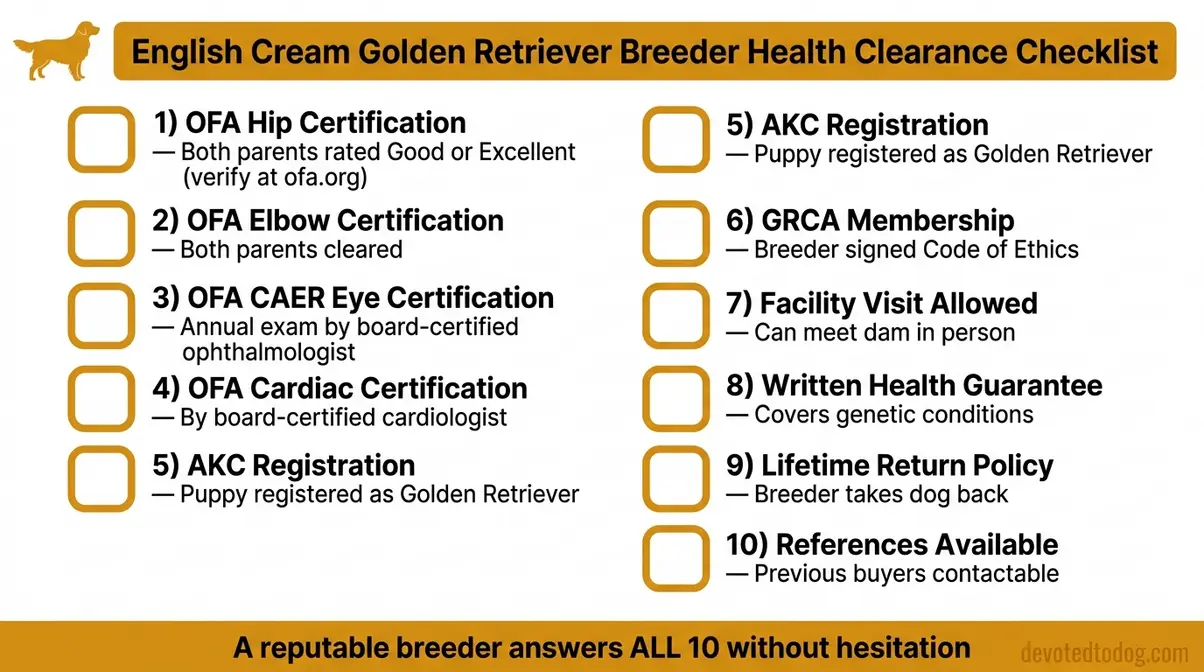
Knowing what a good breeder looks like makes it easier to spot the bad ones.
Red Flags and Warning Signs to Watch For
This is where buyers most commonly go wrong. The following red flags signal an unethical breeder, and applying this checklist before making any contact can save you thousands of dollars and significant heartbreak.
7 Red Flags That Signal an Unethical Breeder:
- No OFA health clearances for both parents
- Emphasis on “English Cream” or “rare white” color as the primary selling point
- Puppies always available, no waiting list
- Won’t allow facility visits or in-person meetings with the mother dog
- No GRCA membership or code of ethics reference
- Pressure to decide quickly or pay a non-refundable deposit before meeting the puppy
- No written health guarantee or return policy
Ethical breeders typically have wait lists of six to eighteen months. Immediate availability is not a convenience, it is a warning sign. When searching for English Cream Golden Retriever breeders near you, apply this checklist before making any contact. You can browse our Golden Retriever breeders directory by state to find GRCA-affiliated options in your region.
Once you’ve passed a breeder through the red-flag filter, ask specifically about health clearances, the documentation that matters most.
Required Health Clearances: OFA, CERF, and Cardiac Testing
Every reputable breeder should provide the following clearances for both parents before you pay a deposit:
- OFA Hip and Elbow Certification: Screens for dysplasia. Both parents should be rated “Good” or “Excellent.” Verify at ofa.org by searching the dog’s AKC registered name, the database is free and public.
- OFA CAER Eye Certification: Confirms absence of hereditary eye disease, including Progressive Retinal Atrophy and cataracts. This exam must be performed annually by a board-certified veterinary ophthalmologist.
- OFA Cardiac Certification: Rules out hereditary heart conditions. Performed by a board-certified cardiologist or an OFA-approved veterinarian.
- AKC Registration: Confirms the puppy is a purebred Golden Retriever. English Cream is not a separate registration category, the dog is simply registered as “Golden Retriever” with a light coat color designation. This is the relevant context for the term “English Cream Golden Retriever AKC”, there is no special AKC classification.
Health clearances are the only objective evidence that a breeder is prioritizing the dog’s wellbeing over coat color or profit. A breeder who hesitates, deflects, or cannot produce documentation should be removed from your list immediately.
With a reputable breeder identified, your next step is finding available puppies.
Where Can You Find English Cream Golden Retriever Puppies for Sale?
Finding English Cream Golden Retrievers for sale from reputable sources requires patience, and a willingness to wait for the right breeder rather than the first available puppy. Immediate availability is often a red flag. The right process takes time, and that time is worth it.
How to Search for Puppies Near You
When searching for an English Cream Golden Retriever near you, start with the GRCA’s Breeder Referral page at grca.org. This directory lists GRCA-member breeders who have signed the GRCA Code of Ethics, a meaningful baseline of accountability. Search by your state to find regional options.
AKC Marketplace at marketplace.akc.org lists AKC-registered litters. Filter by “Golden Retriever” and your state to find available puppies near you, including English Cream Golden Retrievers puppies. For state-specific searches, Indiana, Ohio, Minnesota, Texas, California, and others, check the GRCA directory first, then look for regional Golden Retriever club websites for state-specific breeder lists.
Be prepared to wait. Most reputable breeders have a six to eighteen month waitlist. This is entirely normal, and it is actually a positive sign that the breeder is not overbreeding. You can also find Golden Retriever puppies for sale in your state through our regularly updated directory.
Once you find a breeder with available puppies, here’s what the purchase process looks like.
What to Expect from the Purchase Process
Reputable breeders typically require a puppy application form before placing you on a waitlist. Expect a phone or video interview, this is the breeder assessing whether their puppy is a good match for your household. A deposit of $200–$500 is standard to hold your place. Confirm in writing that the deposit is refundable if the breeder cannot provide a puppy from the planned litter.
Puppy selection typically happens at seven to eight weeks, when temperament assessments are complete. Many reputable breeders match puppies to families based on temperament rather than letting buyers choose by appearance. You might not get to pick the palest puppy in the litter, but you are more likely to get the right dog for your life. An English Cream Golden Retriever puppy for sale from a breeder who does temperament matching is worth the wait.
If the six to eighteen month wait or the $2,000–$4,500 price tag feels out of reach, there’s another path worth exploring.
What Are Your Rescue and Adoption Options?
Adopting a Golden Retriever through a rescue organization is a legitimate, rewarding alternative to purchasing from a breeder. English Cream Golden Retriever adoption is possible through Golden Retriever-specific rescues that operate in every region of the United States, and the process is far more affordable than buying from a breeder.
Why Adoption Is Worth Considering
Golden Retriever adoption typically costs $200–$500. That fee includes spay or neuter surgery, up-to-date vaccinations, and a full veterinary health check, significantly less than a breeder puppy and with many costs already covered. The dog’s temperament is often already assessed by experienced foster families, which means you may get a clearer picture of the dog’s personality before committing.
One honest caveat: you are unlikely to find a puppy through rescue. Most rescue Goldens are adults between one and five years old. If a puppy is your priority, a reputable breeder is the right path. But if you are open to an adult dog, rescue organizations often have loving, healthy Goldens who need a second chance. To explore dog rescue and adoption options, our guide covers the full process.
Here’s where to start your search for a Golden Retriever rescue near you.
How to Find Golden Retriever Rescues
The GRCA maintains a national rescue network, visit grca.org and look for the Rescue section to find a regional coordinator in your area. National organizations like Golden Retriever Rescue Resource (grrrescue.org) also operate across multiple states and connect adopters with dogs in foster care.
Petfinder.com and Adoptapet.com aggregate listings from rescue organizations across all states. Search “Golden Retriever” with your zip code to see available dogs nearby, including English Cream Golden Retriever rescue near me results. One important note: rescue organizations do not typically distinguish by coat color. You are adopting a Golden Retriever, a wonderful, gentle companion, not an “English Cream.” The label disappears; the dog remains. To find Golden Retriever rescues near you by state, our state-by-state resource list is a good starting point.
Before making any final decision, there is one more section every prospective buyer should read.
What Common Misconceptions Should Buyers Avoid?
This section addresses the specific situations where English Cream Golden Retriever marketing misleads buyers, and provides honest guidance on when to seek professional help.
The Most Common Buyer Mistakes
Evaluating dozens of breeder listings and buyer experiences reveals four pitfalls that come up repeatedly. Each one is avoidable with the right information.
1. Paying a color premium without verifying health clearances. A buyer pays $3,500 for a “rare English Cream” puppy. No OFA papers are provided. The consequence: no protection against hip dysplasia or hereditary eye disease, conditions that can cost $3,000–$8,000 to treat. How to avoid it: always demand OFA clearance documentation before paying any deposit. If the breeder cannot produce it immediately, walk away.
2. Assuming “English Cream” means European import. Some breeders claim European bloodlines to justify a premium, but no import documentation exists. How to avoid it: ask for the dog’s AKC registered name and verify the ancestry yourself on the AKC or OFA database. Both are free and publicly searchable.
3. Skipping the facility visit. Purchasing a puppy without visiting the breeder’s home or facility significantly increases the risk of buying from a puppy mill operation. How to avoid it: never finalize a purchase without meeting the puppy and the mother in person. Video calls are not a substitute.
4. Choosing color over temperament testing. A cream-coated puppy that is poorly matched to your lifestyle will cause problems regardless of its beautiful coat. How to avoid it: ask the breeder about temperament assessment results, methods like the Volhard Puppy Aptitude Test can help match the right puppy to the right home.
When a Breeder Price Warrants Skepticism
Two specific scenarios should prompt serious skepticism:
First, if a breeder’s entire identity is built around coat color, the website features “rare white Goldens,” “English Cream only” branding, and beautiful photography, with no mention of health testing documentation, choose a different breeder. The emphasis is inverted.
Second, if the price exceeds $4,500 and no additional health documentation, champion pedigree, or specialized training program is provided as justification, the premium is pure marketing. Price and quality are not the same thing in the breeder market.
When to Consult a Veterinarian or Professional
Two moments matter most for professional consultation:
Before purchase: Have a licensed veterinarian perform a pre-purchase health exam on any puppy before you finalize the sale. This typically costs $50–$150 and is the single best protection against inheriting an undetected health problem. A vet can identify issues a breeder may have missed, or chosen not to disclose.
After purchase: Establish a veterinary relationship within the first week. Discuss spay and neuter timing at that first appointment, current research suggests waiting until 18–24 months for large breeds may reduce certain joint and cancer-related health risks.
Important: We are not veterinarians. All health information in this article is for educational purposes only. Always consult a licensed veterinarian before making health-related decisions for your dog.
Frequently Asked Questions
How Much Do English Cream Retrievers Cost?
A reputable English Cream Golden Retriever puppy costs between $2,000 and $4,500 as of 2026. Price varies based on the breeder’s reputation, the parents’ health testing history, lineage, and geographic location. Higher prices do not automatically mean better dogs, they often reflect marketing rather than superior breeding. First-year ownership costs (food, vet care, supplies, training) typically add another $1,500–$3,000 on top of the purchase price. Always prioritize breeders who provide full OFA and CAER health clearances over those charging a premium for coat color alone.
Are English Cream Golden Retrievers a Thing?
Yes, but English Cream Golden Retrievers are not a separate breed; they are Golden Retrievers with a pale, cream-colored coat. The American Kennel Club (AKC) and the Golden Retriever Club of America (GRCA) register them simply as “Golden Retriever, Light Golden,” with no special designation. The term “English Cream” is a marketing label used by breeders, not an official breed classification. The UK Kennel Club officially recognizes cream as an acceptable coat color, which is where much of the “English” designation originates. Understanding this distinction helps buyers avoid paying a premium for a label rather than for genuinely superior health testing.
Are English Cream Goldens Rare?
No, English Cream Golden Retrievers are not rare within the breed’s natural color range. The cream color is less common in American show lines, which favor a darker gold, but it is a standard and widely available color variation globally. The Golden Retriever Club of America explicitly warns against breeders who market these dogs as “rare” to justify higher prices. Cream-colored Golden Retrievers are available from breeders in every US state. “Rare” in a breeder’s listing is often a marketing signal, not a factual description, treat it as a prompt to ask more questions, not a reason to pay more money.
What Is the Silent Killer in Golden Retrievers?
The term “silent killer” in Golden Retrievers most often refers to hemangiosarcoma, an aggressive cancer of the blood vessel walls that frequently develops with few early warning signs. Lymphoma, a cancer of the lymphatic system, is another serious, fast-moving cancer common in the breed. Both diseases can progress significantly before obvious symptoms appear, which is why regular veterinary checkups are critical for all Golden Retrievers. Golden Retrievers face up to a 20% lifetime risk for hemangiosarcoma and a 6% risk for B-cell lymphoma (PubMed, 2015). Choosing a breeder who health-tests both parents and selecting from long-lived lines is the best available risk-reduction strategy, though it cannot eliminate the risk entirely.
Are English Cream Goldens More Expensive?
Yes, English Cream Golden Retrievers are typically marketed at a higher price than other Golden Retrievers. This premium is not because they are rarer or healthier, but primarily due to marketing that presents them as a premium or “exotic” variety. Some cost difference reflects legitimate expenses like importing European breeding stock, but the majority is branding. Expect to pay $2,000–$4,500 from a reputable English Cream breeder, compared to $1,000–$2,500 for a standard Golden Retriever from a quality breeder. Buyers should focus on health clearances rather than coat color when evaluating whether a price premium is justified.
What other names is the English Cream Golden Retriever called?
You’ll see the same dog sold under several different names, all of which describe the pale-coat coat color rather than a separate breed. Common variants include White Golden Retriever, Blonde Golden Retriever, British Cream Retriever, White Retriever, English Retriever, Cream Golden Retriever, and Irish Cream Golden Retriever. None of these is an official AKC, GRCA, or UK Kennel Club designation. They all refer to the same Golden Retriever breed with a coat that falls within the AKC standard’s “rich, lustrous golden of various shades” range, just at the palest end of that spectrum. If a breeder uses one of these names without explaining that it’s still a standard Golden Retriever, treat it as a marketing flag and ask for AKC registration paperwork on both parents.
What to Do Next: Your Action Plan
For prospective buyers, an English Cream Golden Retriever is a wonderful, affectionate family dog, but it is simply a Golden Retriever with a pale coat. Research from UC Davis shows the breed faces up to a 65% lifetime cancer risk regardless of coat color. The best approach combines three priorities: choosing breeders with full OFA and CAER health clearances, ignoring the “English Cream” price premium unless solid health documentation supports it, and considering rescue as a lower-cost alternative with dogs whose temperaments are already known.
The Color Premium Trap is real, buyers pay more for a label, not for better health outcomes. Coat color is the least important factor in choosing a healthy, well-bred Golden Retriever. The factors that actually matter, in order, are: health-tested parents, ethical breeding practices, and a temperament match for your household. Any breeder who leads with coat color and struggles to produce clearance paperwork has their priorities backwards.
Start by reviewing our vetted Golden Retriever breeder directory to find GRCA-affiliated breeders in your state. If you’re open to adoption, our rescue and adoption guide covers regional Golden Retriever organizations across the country. Either path leads to the same destination: a loyal, gentle companion who will be part of your family for 10–12 years, regardless of what shade of gold their coat happens to be.
Related reading:
Curious where the breed comes from? Read the breed’s origin and history.