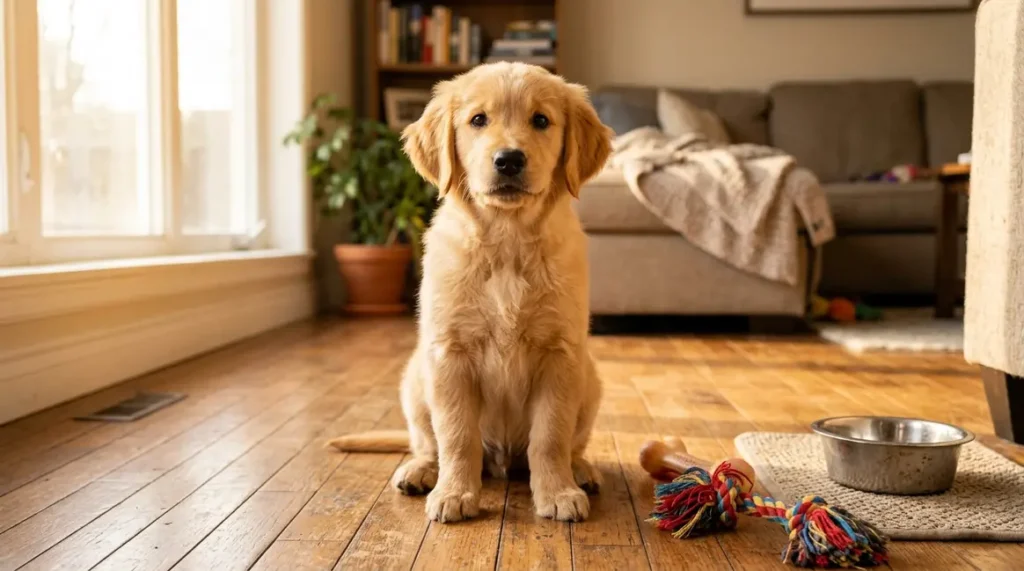
It’s 6 AM. Your Golden Retriever puppy is awake, whining, and staring at you from the crate. You have no idea whether to feed them first, take them outside, or let them play. The first morning home is exactly this disorienting. And it stays that way until you have a system.
Owners in Golden Retriever communities ask a version of this every single day: how do you build a realistic daily schedule for a 12-week-old puppy? You’re not alone in asking, and this guide is the answer.
In this guide, you’ll find three age-specific golden retriever puppy schedules, for 8, 12, and 16 weeks, plus the feeding, potty, crate, and sleep routines that make each one work. You’ll also find answers to the questions that keep new owners up at night, from vaccination timing to why your puppy bites everything.
A golden retriever puppy schedule from 8 to 16 weeks follows the same repeating rhythm: Play, Potty, Sleep, every 2 hours while awake. This is the Play-Potty-Sleep Cycle, and it structures every waking block in this guide.
- Sleep: Puppies at 8–12 weeks need 18–20 hours of sleep per day, skipping naps causes the overtired-puppy spiral that makes everything harder
- Potty: A 2-month-old puppy can hold its bladder for roughly 2 hours; add 1 hour per month of age (OSU VMC)
- Feeding: Three meals per day at 8–12 weeks; transition to two meals at 12–16 weeks
- Crate: Daytime naps in the crate build the habit that makes nighttime easier
- The Play-Potty-Sleep Cycle: Every waking block ends with a potty trip, no exceptions
What You’ll Need Before Starting
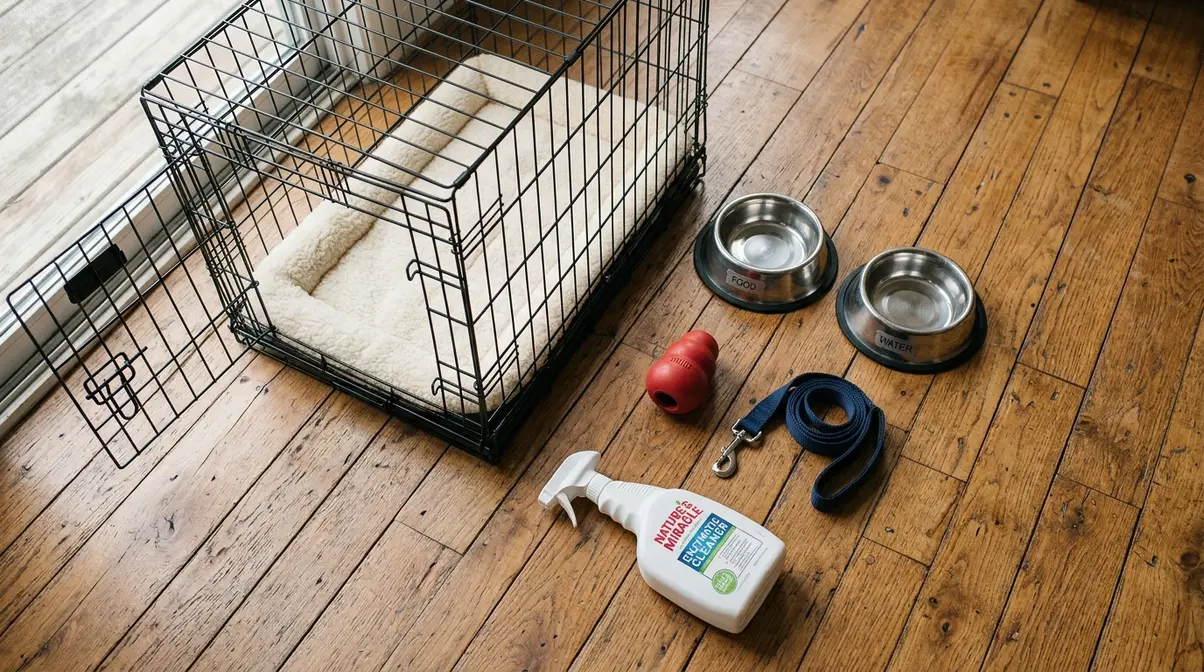
Before the schedule can work, a few things need to be in place. This isn’t a basic supplies checklist, it’s the short list of items and decisions that determine whether Day 1 goes smoothly or not.
Crate: Size matters more than most owners expect. The crate should give your puppy enough room to stand, turn around, and lie down comfortably. But not so much extra space that they can use a corner as a bathroom. A divider panel lets you expand the space as your Golden grows. See our guide to choosing the right crate for your Golden Retriever before you buy.
Feeding setup: Choose a large-breed puppy formula before the puppy comes home. Have two stainless steel bowls and a consistent feeding location ready. Switching foods after arrival adds digestive stress to an already stressful transition.
Potty supplies: Enzymatic cleaner is non-negotiable. It breaks down the scent markers that draw puppies back to the same spot indoors. Keep a leash by the door for outdoor potty trips, and a treat pouch nearby for immediate rewards.
Vet appointment: Virginia Tech veterinary experts recommend scheduling a first veterinary appointment before or immediately after bringing a new puppy home (2024). Don’t wait for something to go wrong.
Schedule printed or saved: The schedules in the next section work best when they’re visible, on the fridge, your phone lock screen, or printed out. You won’t remember the timing when you’re tired at 2 AM.
Once you have these in place, the schedule below will make sense from the first morning.
What Does a Golden Retriever Puppy Schedule Look Like?
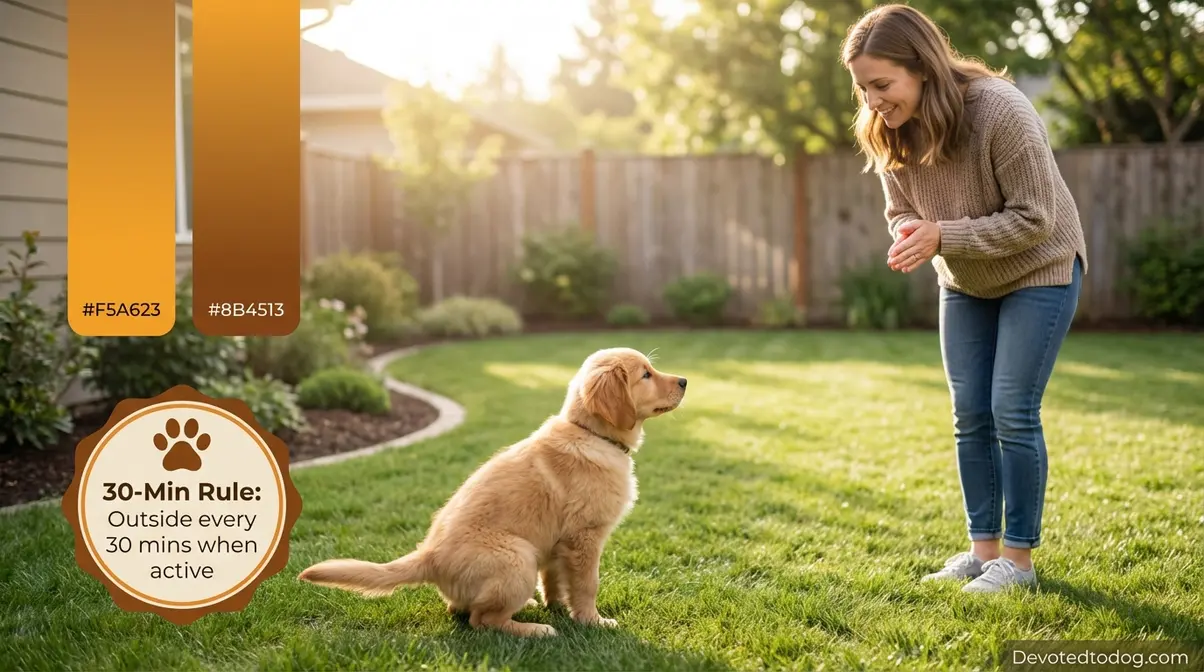
The Play-Potty-Sleep Cycle is the organizing principle behind every schedule in this section: every waking block begins with supervised play, ends with a trip outside to go potty, and closes with a crate nap. According to the Homeward Bound Goldens Puppy Care and Training 101 guide, structured daily routines are one of the most important foundations for a new puppy’s success.
Golden Retriever puppies at 8 weeks need 18–20 hours of sleep per day, with waking periods lasting no more than 30–45 minutes before rest is required. The OSU VMC’s rule of thumb for puppies is that they can hold their bladder for one hour per month of age, up to about 10 hours, so a 2-month-old gets roughly 2 hours between trips. These two numbers define the schedule’s rhythm at every age.
Why does enforcing the cycle matter so much? An overtired puppy bites more, sleeps worse, and is harder to train. Skipping one nap can trigger a spiral: the puppy becomes overstimulated, biting increases, the owner reacts with frustration, the puppy’s stress rises, and sleep quality degrades. The crate is the enforcement tool. Not a punishment, but the physical boundary that makes rest happen even when the puppy would rather keep playing.
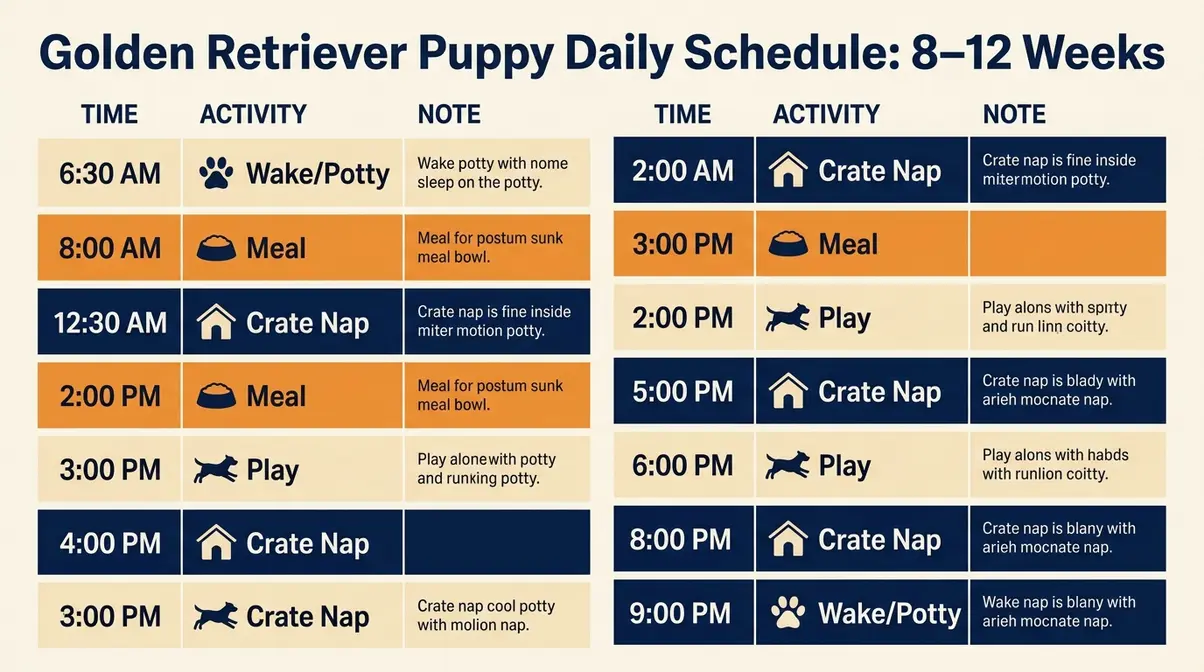
What Does an 8-Week-Old Puppy’s Day Look Like?
At 8 weeks, your puppy is at the very start of their critical socialization window. And their stamina is almost nothing. A schedule for a golden retriever puppy this age is built around short play bursts, immediate potty trips, and long crate naps.
| Time | Activity | Notes |
|---|---|---|
| 6:30 AM | Wake + immediate potty trip outside | Carry the puppy if needed, accidents happen in the 60 seconds between crate and door |
| 7:00 AM | Breakfast (Meal 1) | Feed in the crate with door open to build positive association |
| 7:30 AM | Supervised play + socialization | Max 20–30 minutes; introduce one new surface or sound |
| 8:00 AM | Potty trip + crate nap | 90 minutes to 2 hours; use a Kong with peanut butter to settle |
| 10:00 AM | Wake + potty trip | Outside immediately |
| 10:15 AM | Supervised play | 20–30 minutes; “tries to eat everything” phase peaks here, keep sessions short |
| 10:45 AM | Potty trip + crate nap | 90 minutes |
| 12:00 PM | Lunch (Meal 2) + potty trip | Feed, then outside |
| 12:30 PM | Supervised play | 20–30 minutes |
| 1:00 PM | Potty trip + crate nap | 90 minutes to 2 hours |
| 3:00 PM | Wake + potty trip | Outside immediately |
| 3:15 PM | Supervised play | 20–30 minutes |
| 3:45 PM | Potty trip + crate nap | 90 minutes |
| 5:00 PM | Dinner (Meal 3) + potty trip | Feed, then outside |
| 5:30 PM | Wind-down play | Calm, low-stimulation activity, 15–20 minutes |
| 6:30 PM | Potty trip + crate nap | 60–90 minutes |
| 8:30 PM | Final potty trip | Last chance before bed |
| 9:00 PM | Bedtime in crate | Lights low; minimal interaction |
| ~2:00 AM | Nighttime potty break | Set an alarm; quiet trip, no play, back in crate immediately |
The enforced nap is the most important discipline in this schedule. At 8 weeks, a puppy cannot self-regulate. They will keep playing until they collapse, and at that point the overtired behavior is already set in. The crate ends the play session before the spiral starts. Within a few days, most puppies begin settling within 5–10 minutes once the crate is established as a positive space.
These play blocks are also when socialization happens. Brief, positive exposure to new surfaces (grass, tile, gravel), new sounds, and new people during this window lays the foundation for a confident adult dog.
By 12 weeks, your puppy’s bladder is stronger and wake windows stretch, here’s how the schedule shifts.
How Does the Schedule Change at 12 Weeks?
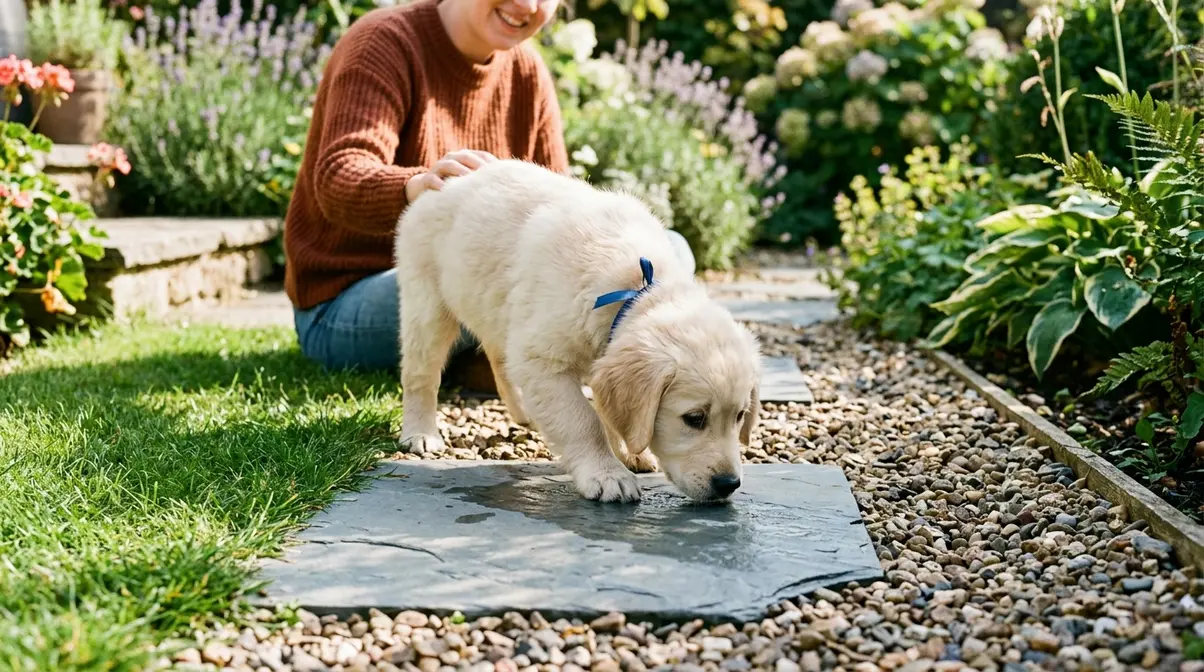
The golden retriever puppy schedule at 12 weeks looks similar to the 8-week version, but the windows are longer and the puppy is noticeably more capable. Wake windows extend to 45–60 minutes, naps may shorten slightly to 60–90 minutes, and training sessions can stretch to 5–10 minutes.
| Time | Activity | Notes |
|---|---|---|
| 6:30 AM | Wake + potty trip | Outside immediately |
| 7:00 AM | Breakfast (Meal 1) + potty trip | Feed, then outside within 15 minutes |
| 7:30 AM | Supervised play + training (5–10 min) | Sit, name recognition, come |
| 8:15 AM | Potty trip + crate nap | 60–90 minutes |
| 9:45 AM | Wake + potty trip | Outside immediately |
| 10:00 AM | Supervised play + socialization outing | 5-minute exposure to a new location or person |
| 10:45 AM | Potty trip + crate nap | 60–90 minutes |
| 12:00 PM | Lunch (Meal 2) + potty trip | Feed, then outside |
| 12:30 PM | Supervised play + training | 5–10 minutes |
| 1:15 PM | Potty trip + crate nap | 60–90 minutes |
| 3:00 PM | Wake + potty trip | Outside immediately |
| 3:15 PM | Supervised play | 45–60 minutes |
| 4:00 PM | Potty trip + crate nap | 60 minutes |
| 5:00 PM | Dinner (Meal 3) + potty trip | Feed, then outside |
| 5:30 PM | Wind-down play | Calm activity; 15–20 minutes |
| 6:30 PM | Potty trip + crate nap | 60 minutes |
| 8:30 PM | Final potty trip | |
| 9:30 PM | Bedtime in crate | |
| ~1:00 AM | Nighttime potty break (if needed) | Many puppies still need one at 12 weeks |
Around 10–12 weeks, many owners notice what experienced Golden owners call the “Angel Phase” The puppy seems calmer, more responsive, and easier to work with. This is real. It marks the end of the first fear imprint period, and the puppy is genuinely more receptive to new experiences. The schedule locks in good habits during this window, so take advantage of it.
The 12-week schedule should also include one brief socialization outing per day. A new surface, a new person, a new sound. Five minutes is enough. Understanding the importance of puppy socialization at this age will help you make the most of every play block. Note that many puppies receive their second round of vaccinations around 10–12 weeks, coordinate outings with your vet’s guidance on safe socialization before full protection.
At 16 weeks, the schedule starts to look more like a dog’s life than a newborn’s, here’s what changes.
What Changes at 16 Weeks?
By 16 weeks, your Golden’s bladder can hold roughly 4 hours, wake windows stretch to 1–2 hours, and the schedule begins to resemble a manageable adult routine. This is also when the golden retriever puppy training schedule becomes more structured, sessions can run 10–15 minutes, and skills like loose-leash walking and “stay” are within reach.
| Time | Activity | Notes |
|---|---|---|
| 6:30 AM | Wake + potty trip | Outside immediately |
| 7:00 AM | Breakfast (Meal 1) + potty trip | Now feeding twice daily; drop the midday meal |
| 7:30 AM | Supervised play + training (10–15 min) | Sit, stay, come, leash walking |
| 9:00 AM | Potty trip + crate nap | 60–90 minutes; still enforced |
| 10:30 AM | Wake + potty trip | Outside immediately |
| 10:45 AM | Supervised play + socialization | 60–90 minutes of activity |
| 12:15 PM | Potty trip + crate nap | 60–90 minutes |
| 2:00 PM | Wake + potty trip | Outside |
| 2:15 PM | Supervised play + training (10–15 min) | Second short session |
| 3:30 PM | Potty trip + optional short nap | Some puppies no longer need this nap |
| 5:00 PM | Dinner (Meal 2) + potty trip | Feed, then outside |
| 5:30 PM | Wind-down play | Calm activity; 15–20 minutes |
| 7:00 PM | Potty trip | |
| 9:00 PM | Final potty trip + bedtime | Many puppies now sleep through to 6 AM |
Around 14–16 weeks, some puppies enter the “Teenage Rebellion Phase” A second fear imprint period where they may seem to forget commands they knew days earlier and test every boundary you’ve set. This is normal development, not a training failure. The schedule is your anchor: consistent structure during this window prevents regression and carries you into the adolescent months. For a deeper framework on what comes next, see these foundational rules for daily puppy training.
The schedule gives you the when. The next section gives you the how, starting with the two skills that make or break the first 16 weeks: potty training and crate training.
How Do You Potty Train and Crate Train a Golden Retriever Puppy?
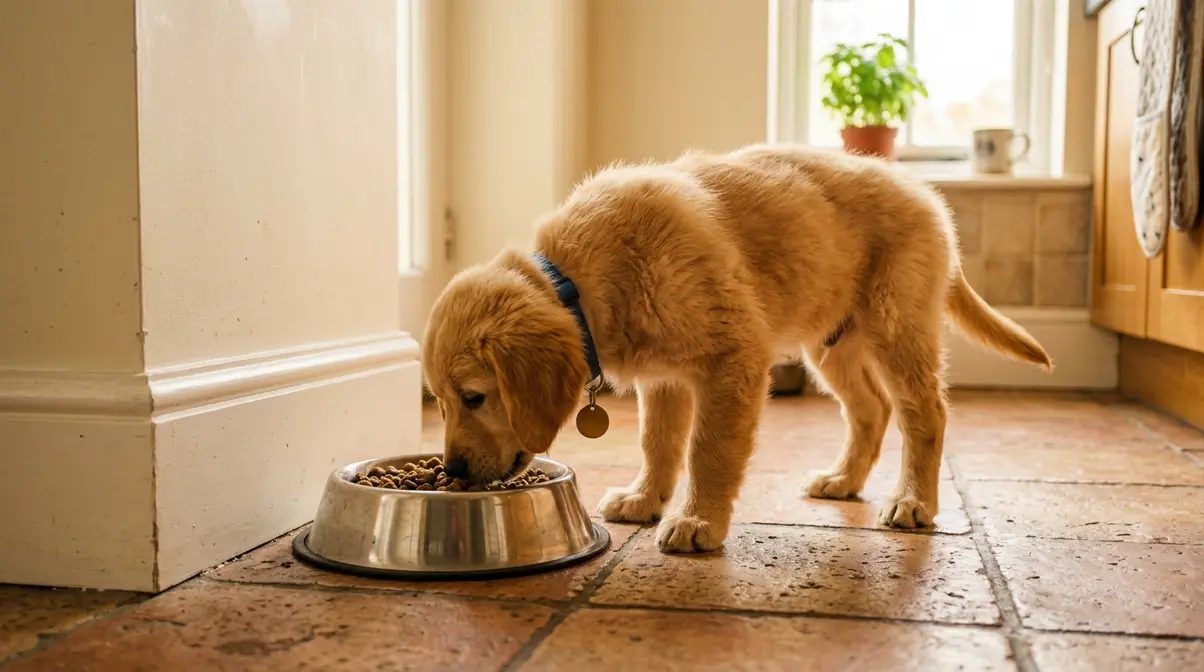
A 2-month-old puppy can typically hold its bladder for about 2 hours, one hour per month of age, making scheduled potty trips every 1.5–2 hours essential during the day. This is the OSU VMC’s rule of thumb for puppies, and it is the single most useful number to keep in mind for potty training a Golden Retriever puppy.
The Play-Potty-Sleep Cycle makes potty training almost automatic: because every play session ends with a trip outside, the owner is always initiating the trip before the puppy needs to “ask.” This removes the most common potty training mistake, waiting for the puppy to signal before they’ve learned the signal. For the first 8 weeks home, you initiate every trip. The schedule is the system.
How Do You Potty Train a Golden Retriever Puppy Step by Step?

Potty training a Golden Retriever puppy is less about teaching the puppy and more about managing the timing until their bladder catches up with their intentions. These six steps use the schedule as the foundation.
- Take the puppy outside immediately after waking. Within 60 seconds of the crate opening, carry them if needed. Accidents happen in the hallway, not from laziness.
- Use a consistent verbal cue. Say “go potty” in a calm, neutral tone as the puppy sniffs and circles. Repetition over days builds the association.
- Reward within 3 seconds of finishing elimination. The moment the puppy finishes (not after you’ve walked back inside), say “good potty” warmly and offer a small treat. Timing is everything, the reward must connect to the act.
- Take the puppy out after every meal, play session, and nap. No exceptions. This is the schedule doing the work, not the puppy’s self-control.
- For accidents indoors: clean without scolding. A puppy cannot connect punishment to an act that happened more than a few seconds ago. Scolding creates anxiety, not understanding. Clean thoroughly with enzymatic cleaner to remove the scent marker.
- As the puppy matures, begin teaching them to signal. At 12–16 weeks, you can start teaching your puppy to signal when they need to go outside A bell, a scratch at the door, or a sit by the exit.
The schedule in the section above is your potty training plan, every activity block ends with a trip outside. Male Golden Retriever puppies follow the same steps; they typically don’t begin leg-lifting until 6–12 months, so the “how to potty train a male golden retriever puppy” question is answered by exactly this approach.
Once the potty routine is solid, the crate becomes your most powerful training tool, here’s how to introduce it without stress.
How Do You Crate Train a Golden Retriever Puppy?
Crate training works because it gives the Play-Potty-Sleep Cycle a physical structure. Play ends, potty trip happens, and the puppy goes into the crate. Not as a consequence, but as the next natural step.
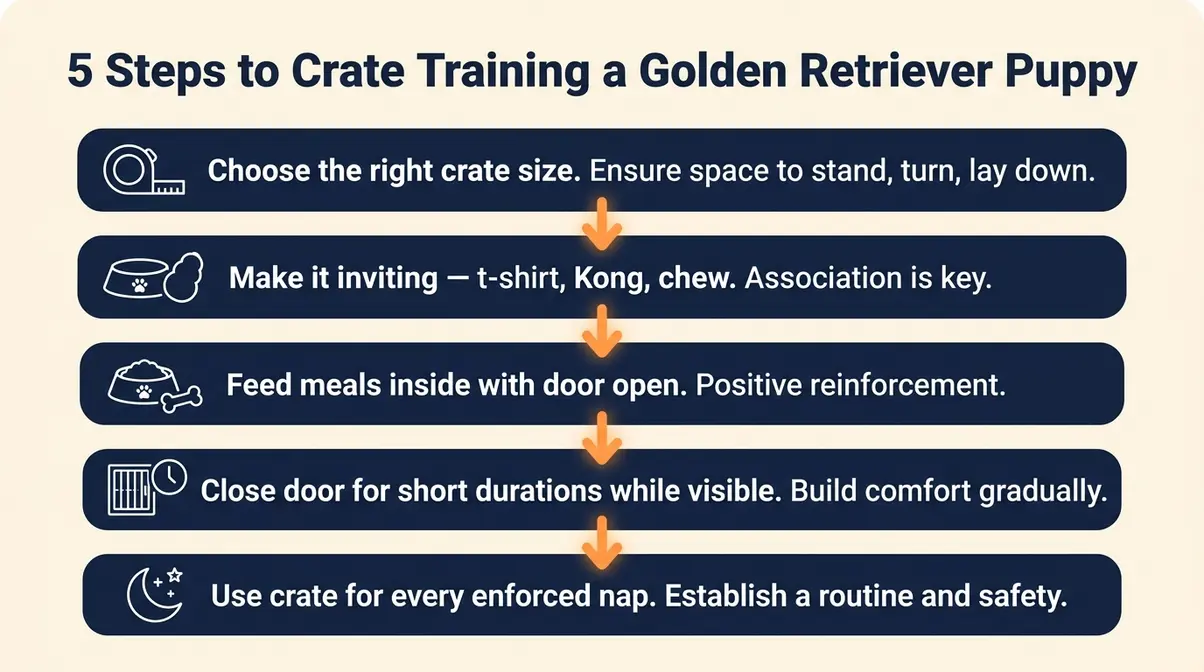
- Choose the right size. The crate should allow your puppy to stand, turn around, and lie down. But no more. A crate that’s too large allows a corner to become a bathroom. Use a divider panel in an adult-sized crate, or see our guide to choosing the right crate for your Golden Retriever for specific sizing recommendations.
- Make it inviting before the puppy enters. Place a worn t-shirt with your scent inside, along with a safe chew or a Kong stuffed with peanut butter. Let the puppy explore freely, no door closing yet.
- Feed meals inside the crate with the door open. This builds a food association that makes the crate a place the puppy wants to enter. After a few days, begin closing the door for the duration of the meal.
- Begin closing the door for short durations while you stay visible. Start at 5 minutes, then 10, then 20. If the puppy whines, wait for a 3-second pause before opening the door, opening during whining teaches that whining works.
- Use the crate for every enforced nap in the schedule. This is the Play-Potty-Sleep Cycle in action: play ends, potty trip happens, puppy goes in the crate. Consistency here is what makes nighttime crating feel natural rather than alarming.
Owner consensus in Golden Retriever communities consistently points to one tool above all others: a Kong stuffed with peanut butter and frozen overnight is the single most effective crate-settling tool for 8–12 week old puppies. Maximum crate duration by age: 8 weeks = 1–2 hours daytime; 12 weeks = 2–3 hours; 16 weeks = 3–4 hours. Never exceed these limits.
The crate handles daytime structure. The next section covers what your puppy eats, and how often, to keep that structure running smoothly.
What About Nighttime? When Will Your Puppy Sleep Through?
At 8–9 weeks, expect one or two nighttime potty breaks. Set an alarm for around 2 AM rather than waiting for crying, proactive trips keep everyone calmer and reinforce the potty-outside habit even in the middle of the night.
By 12 weeks, most Golden Retriever puppies can go 4–5 hours between trips. One nighttime break is still typical, usually around 1 AM if bedtime is 9:30 PM.
At 16 weeks, many puppies sleep through a full 9 PM to 6 AM stretch without a break. Some still need one. The practical pattern: last potty trip at 10–10:30 PM, first trip at 6–6:30 AM. The gap narrows as the puppy’s bladder matures. The FAQ section covers “Should I wake my 9-week-old puppy up to pee at night?” in full detail.
Now that the schedule and house-training basics are clear, let’s look at the fuel that powers it all: your puppy’s feeding routine.
What Should a Golden Retriever Puppy Eat, and How Often?
Meal timing is not just a nutritional decision, it’s a potty training decision. Golden Retriever puppies should eat three meals per day from 8 to 12 weeks, then transition to two meals at 12–16 weeks, with portions based on the specific food’s feeding guidelines and your puppy’s current weight. Consistent meal times are what make potty windows predictable, which is why feeding at random times is the number one reason potty training takes longer than it should.
Meals are anchor points in the Play-Potty-Sleep Cycle. Feed at 7 AM, 12 PM, and 5 PM, and you know a potty trip is needed within 15 minutes of each meal. Change the times daily, and the cycle loses its predictability.
How Much Should You Feed a Golden Retriever Puppy?
Feeding amounts vary by food brand, formula, and your puppy’s individual growth rate. Always check the feeding guidelines on your specific food’s packaging and confirm with your veterinarian before adjusting portions.
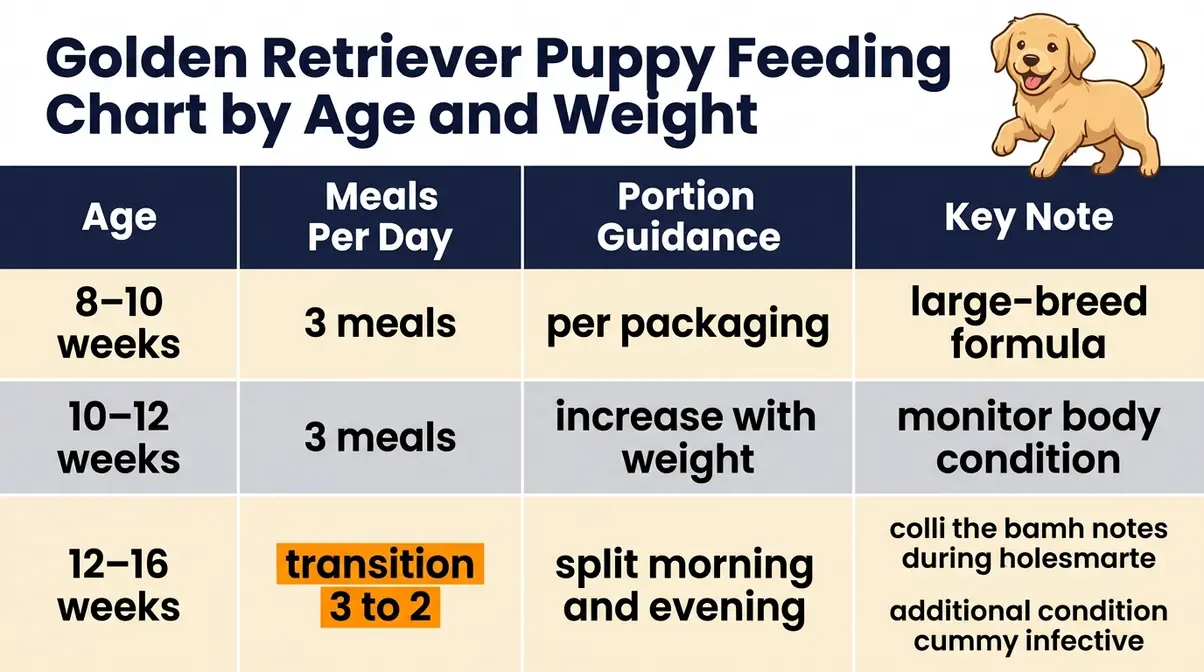
| Age | Meals Per Day | Portion Range | Notes |
|---|---|---|---|
| 8–10 weeks | 3 | Per food packaging (large-breed puppy formula) | Divide the daily recommended amount into 3 equal meals |
| 10–12 weeks | 3 | Per food packaging | Increase portions as weight increases; monitor body condition weekly |
| 12–16 weeks | Transition 3→2 | Per food packaging | Drop the midday meal gradually over 1–2 weeks; split the daily amount between morning and evening |
Body condition is the most reliable guide between vet visits. You should be able to feel your puppy’s ribs with light pressure. But not see them. If the ribs are hidden under a soft layer of fat, reduce portions slightly. Golden Retrievers are prone to weight gain from puppyhood, and the habits built now matter long-term. See our guide to maintaining a healthy weight for your puppy for a full body condition scoring walkthrough.
Free-feeding, leaving food out all day, is not recommended for Golden Retrievers. It removes the potty-timing anchor entirely and significantly increases obesity risk.
The schedule tells you when to feed. Choosing the right food is the other half of the equation.
What Food Is Best for a Golden Retriever Puppy?
Golden Retrievers are a large breed, and that matters for their food. Large-breed puppy formulas are specifically formulated with controlled calcium and phosphorus ratios to support slower, steadier bone development. Adult food fed before 12–18 months can disrupt this balance and increase the risk of developmental joint problems.
When reading labels, look for a named protein source as the first ingredient (chicken, salmon, or lamb), an AAFCO statement confirming the food is appropriate for “growth” or “all life stages,” and DHA for brain and eye development during the critical puppy window.
One ingredient category to discuss with your vet: grain-free formulas. The FDA has been investigating a potential link between grain-free diets and dilated cardiomyopathy (DCM) in dogs. The investigation is ongoing and not conclusive, but given Golden Retrievers’ already elevated cardiac risk, the conversation is worth having at your first vet appointment.
Golden Retrievers are also prone to food sensitivities. If your puppy develops loose stools, persistent itching, or recurring ear infections in the first weeks home, ask your vet about a limited-ingredient diet. For specific brand recommendations, see our guide to selecting the best dog food for Golden Retrievers.
Food and potty are sorted. Now for the part that surprises most new owners: how much sleep your puppy actually needs.
How Much Sleep Does a Golden Retriever Puppy Need?
Golden Retriever puppies at 8–12 weeks need 18–20 hours of sleep per day, with each waking period lasting no more than 30–60 minutes before rest is required. According to the Homeward Bound Goldens Puppy Care and Training 101 guide, daily sleep requirements and structured routines are foundational for young puppies’ development and trainability.
Sleep is not downtime in the schedule, it’s when the puppy’s brain consolidates training. Every potty trip, every sit command, every name recognition repetition gets processed during those crate naps. An overtired puppy literally cannot learn. The Play-Potty-Sleep Cycle treats sleep as the third and most critical leg: without enforced naps, the cycle breaks and everything else degrades.
Why Do Puppies Need So Many Enforced Naps?
The golden retriever puppy sleep schedule by age looks like this: 8-week puppies need 18–20 hours per day; 12-week puppies need approximately 16–18 hours; 16-week puppies need around 14–16 hours. The wake windows grow as the puppy matures, but the need for structured rest remains constant throughout this window.
Here’s what the overtired-puppy spiral looks like in practice: a missed nap leads to overstimulation, biting and growling increase, the owner reacts with frustration, the puppy’s stress rises, sleep quality degrades, and accidents become more frequent. Each step makes the next one worse. Naming this spiral matters because it gives owners a reason to enforce naps even when the puppy seems perfectly happy to keep playing.
The crate is the only reliable enforcement tool. A puppy who doesn’t want to stop playing will not choose to nap. The crate makes the choice for them. Once the crate is established as a positive space (from the crate training steps above), most puppies settle within 5–10 minutes. The wind-down play period helps: 15–20 minutes of calm, low-stimulation activity before crate time. A slow walk, gentle petting, a quiet chew, signals to the puppy that rest is coming. This transition is worth building into the schedule from Day 1.
A supportive, comfortable surface inside the crate also improves sleep quality. See our recommendations for finding a comfortable and supportive dog bed that fits inside a standard crate.
Enforced naps handle the daytime. Here’s what to do when the puppy wakes you up at 2 AM.
What Should You Do If Your Puppy Cries at Night?
Nighttime crying at 8–12 weeks is normal developmental behavior, not clinical separation anxiety. Your puppy has just left their littermates. The crying is a response to isolation, and it typically resolves by 12–16 weeks with a consistent routine. Knowing this distinction matters because it changes how you respond.
If the puppy cries and has had a potty trip within the last 2 hours, wait 3–5 minutes before responding. Many puppies will settle on their own. If the crying escalates, or if the puppy has been in the crate for more than 2 hours, take them out for a quiet potty trip: no play, no eye contact, back in the crate immediately after. Keep the lights low and your energy calm.
Two things to avoid: bringing the puppy into bed to stop the crying (this teaches that crying = bed access), and scolding. Both create new problems without solving the original one. When training an 8-week-old Golden Retriever puppy at night, the goal is simply to be consistent and boring, nighttime is not interesting, and the puppy will learn that.
Most Golden Retriever puppies sleep through the night, 9 PM to 6 AM without a break, by 14–16 weeks with a consistent schedule. The FAQ section covers this in more detail.
Sleep and potty are the foundation. Training is the structure you build on top, here’s what to teach first.
What Should You Train, and When, in the First 16 Weeks?
The golden retriever puppy training schedule works best when training sessions live inside the “play” block of the Play-Potty-Sleep Cycle. A 5-minute focused training session at 8 weeks, followed by a potty trip and a crate nap, is more effective than a 20-minute session that exhausts the puppy’s attention span. End every session on a success, before the puppy disengages. And you build confidence faster than pushing through fatigue.
At 8 weeks, a puppy’s attention span is roughly 3–5 minutes. That’s not a limitation to work around; it’s the design of the session. Short, frequent, and successful is the formula.
What Are the First Skills to Teach an 8-Week-Old Golden Retriever?
The golden retriever puppy training schedule for the first 8 weeks focuses on five core skills. All of them can be introduced during the play blocks, in 5-minute sessions.
- Name recognition. Say the puppy’s name once in a happy tone. Reward any eye contact within 3 seconds. Practice 10 repetitions per session. This is the foundation for every other skill.
- Sit. Lure with a treat held just above the nose. As the puppy’s bottom hits the floor, say “sit” and reward immediately. Five repetitions per session at 8 weeks.
- Come (recall). Crouch down, say “come” in a warm, enthusiastic tone, and reward generously when the puppy reaches you. Recall is the most important skill to build early and the most important to protect, never call the puppy to you for something unpleasant.
- Crate entry on cue. Toss a treat into the crate and say “crate” or “bed” as the puppy enters. This reinforces the crate association built in H2-2 and gives you a verbal cue for nap time.
- Loose-leash walking introduction. Begin at 12 weeks on a flat collar or harness. Five-minute sessions, reward for staying near your side.
Session length by age: 5 minutes at 8 weeks; 10 minutes at 12 weeks; 15 minutes at 16 weeks. Always end on a success, one clean sit, one enthusiastic recall, before the puppy loses focus.
Socialization is also a training priority at 8–12 weeks. Brief, positive exposures to new environments count as training; they don’t need to be formal. For a structured approach to what to expose your puppy to and when, see our foundational rules for daily puppy training and a complete age-by-age guide to training a Golden Retriever.
Training sessions go smoothly when the puppy is rested. But what about the biting? Here’s why it happens, and how to stop it.
Why Does a Golden Retriever Puppy Bite and Growl, and What Do You Do?
It is normal for puppies to bite, mouth, and nip at people’s hands But this behavior should be redirected consistently before it becomes a habit in adulthood. The ASPCA notes that mouthing and nipping in puppies is normal developmental behavior that should be redirected, not punished. Puppies explore the world with their mouths; biting during play at 8–16 weeks is not aggression.
The redirection technique is straightforward. When the puppy bites, say “ouch” in a neutral tone and immediately offer a chew toy. Do not pull your hand away sharply. The sudden movement triggers the chase instinct and often escalates the biting. Consistency across every person in the household is essential; if one family member allows mouthing and another corrects it, the puppy learns nothing useful.
Low growling during tug or active play is normal. It’s vocalization, not a warning. Growling when approached while eating or sleeping is a different signal entirely. If this occurs regularly, consult a certified professional dog trainer rather than trying to correct it yourself.
During the Teenage Rebellion Phase at 14–16 weeks, biting may temporarily increase as the puppy tests every boundary again. The response is the same: calm, consistent redirection. Do not escalate. The phase passes. Understanding the importance of puppy socialization during this window helps contextualize why the puppy is testing, they’re processing a flood of new information, and structure is what keeps them grounded.
If biting breaks skin regularly after 16 weeks, consult a certified professional dog trainer. That’s the threshold where professional support is more effective than schedule adjustments.
Behavior is manageable. Health is non-negotiable, here’s the vaccination schedule your puppy needs in the first 16 weeks.
What Vaccinations Does a Golden Retriever Puppy Need?
Core vaccinations for Golden Retriever puppies typically begin at 6 to 8 weeks of age, with boosters every 3 to 4 weeks until 16 weeks old. According to the AKC’s puppy vaccination guide, this initial series is the foundation of your puppy’s immune protection for the first year of life.
Here’s the editorial insight that most schedule articles miss: the socialization window (8–16 weeks) runs directly alongside the vaccination series. Waiting until full protection to begin socializing means missing the most critical developmental window in your puppy’s life. The solution is controlled, low-risk socialization before the series is complete, puppy classes that require vaccination proof, private yards of vaccinated dogs, and being carried in public spaces. The risk of behavioral problems from under-socialization outweighs the risk of exposure in controlled settings.
What Is the Core Vaccination Schedule for a Golden Retriever Puppy?
This schedule reflects general guidance from veterinary authorities. Your veterinarian will tailor the exact timing and vaccines to your puppy’s health history and local disease risk.
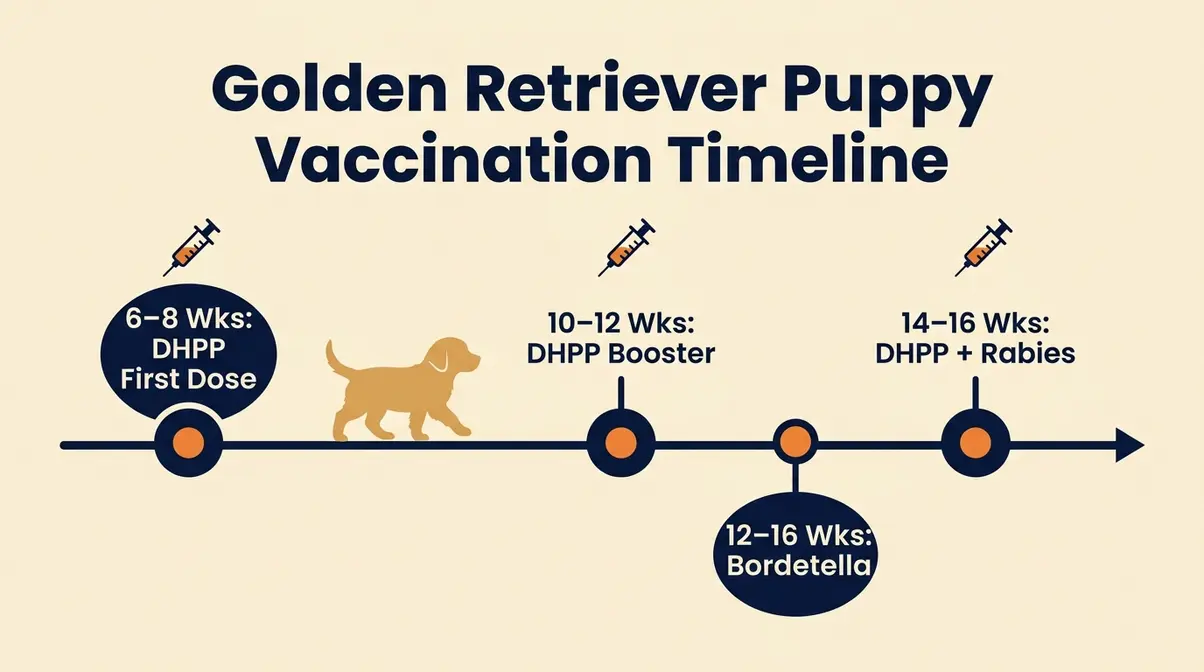
| Age | Vaccine | Notes |
|---|---|---|
| 6–8 weeks | DHPP (Distemper, Hepatitis, Parvovirus, Parainfluenza) | First dose; often administered by the breeder |
| 10–12 weeks | DHPP booster | Second dose; schedule with your vet |
| 14–16 weeks | DHPP booster + Rabies | Third DHPP dose; rabies is required by law in most US states |
| 12–16 weeks | Bordetella (kennel cough) | Recommended if your puppy will attend classes or boarding |
According to the ASPCA’s series of vaccinations guidance, puppies should begin receiving vaccinations at 6 to 8 weeks of age, with at least 3 vaccinations in the initial series before 16 weeks.
Full protection occurs approximately 2 weeks after the final DHPP dose. Until then, safe socialization options include puppy classes that verify vaccination records, visits to private yards with vaccinated dogs, and being carried in public areas. Ask your vet about leptospirosis and Lyme vaccines as well. These are recommended based on geographic location and lifestyle, and your vet is the right person to advise on both. For an overview of breed-specific conditions to discuss at these early visits, see our guide to common Golden Retriever health problems.
Vaccinations protect your puppy’s body. The next section looks at what’s happening in their mind, and why it matters for the schedule.
What Breed-Specific Health Issues Should You Watch for in the First 16 Weeks?
The puppy period is when patterns are established, including health patterns. A few Golden Retriever predispositions are worth knowing now, not because they’re likely to appear at 8 weeks, but because the habits you build early are preventive.
- Hip dysplasia. Golden Retrievers have a genetic predisposition to hip dysplasia, and early joint development is influenced by exercise. Avoid forced running, jumping from heights, and extended play on hard surfaces before 12–18 months when growth plates close. The schedule’s short, supervised play sessions are already protective. See our guide to preventing and identifying hip dysplasia for what to watch as your puppy grows.
- Heart conditions. Golden Retrievers are predisposed to subvalvular aortic stenosis (SAS), a narrowing of the aortic valve that can go undetected without a stethoscope. Ask your vet to listen to your puppy’s heart at every puppy visit. It takes 30 seconds and can catch early indicators.
- Weight management. Obesity significantly increases joint stress in Goldens, and the pattern begins in puppyhood. The feeding schedule and body condition monitoring from the feeding section are your preventive tools.
- When to call the vet promptly: Lethargy lasting more than 24 hours; refusal to eat for more than 12 hours; vomiting or diarrhea more than twice in a day; any limping or reluctance to bear weight.
The FAQ section addresses “What is the silent killer in Golden Retrievers?”. This overview covers the puppy-relevant highlights; your vet is the right source for breed-specific health screening.
Health checks are scheduled. Now for the question that surprises most owners: what is your puppy actually experiencing during these first 16 weeks?
What Is Your Puppy Thinking? Understanding Golden Retriever Development
Most owners focus entirely on what the puppy does. The biting, the accidents, the crying. Understanding what the puppy experiences during these weeks makes the schedule more intuitive. The Play-Potty-Sleep Cycle is not just a behavioral routine; it’s a developmental support structure designed to match what’s actually happening in your puppy’s brain and nervous system.
According to Adopt a Pet, adolescence is frequently cited as the most challenging phase of puppyhood, beginning around 6 months. Adolescence in Golden Retrievers typically begins around 6 months and can last until 18 months, making consistent schedule-based training during the 8–16 week window essential for long-term behavior. The habits you build now are the ones that carry you through the harder months.
What Is the 7-7-7 Rule for Puppies, and How Does It Fit the Schedule?
The 7-7-7 rule is a socialization heuristic used by trainers and breeders to guide early puppy exposure. The goal is to introduce a puppy to 7 different surfaces, 7 different locations, and 7 different people (with variations depending on the source) in the first 7 weeks of life. It’s a practical checklist, not an official veterinary standard. The exact formulation varies by trainer and breeder, and it should be framed as a useful goal rather than a clinical requirement.
Why does it matter for the schedule? The play blocks in the Play-Potty-Sleep Cycle are where socialization happens. A 10-minute play session that includes a new surface, grass, gravel, tile, or an introduction to a new person counts toward the 7-7-7 goal without requiring a separate outing. The schedule already creates the structure; socialization fills the content of the play blocks.
The first fear imprint period runs from approximately 8 to 11 weeks. Negative experiences during this window. A frightening noise, a painful encounter, a rough handling, have an outsized impact on long-term behavior. Keep play sessions positive, controlled, and short. Introduce new things one at a time, and let the puppy approach rather than forcing contact. The second fear period arrives at 6–14 months, which overlaps with the Teenage Rebellion Phase mentioned earlier.
For context on what happened before 8 weeks. The neonatal and transitional stages that shaped your puppy before they came home, see our guide to understanding newborn puppy development.
Understanding the developmental stages helps you read your puppy’s signals, including the ones that mean “I love you.”
What Does “I Love You” Look Like in Dog Language?
In dog language, “I love you” is a slow blink, a relaxed body, a soft tail wag, and leaning against your leg. These are signals of trust and attachment. Not just contentment. A puppy who brings you a toy, makes soft eye contact without stiffening, or chooses to sleep pressed against you is communicating that you are their safe person. Golden Retrievers are particularly expressive in this way; physical closeness and soft eye contact are central to how they bond. For a deeper look at breed-specific communication traits, see our guide to the typical Golden Retriever personality.
On the question of how long before a puppy forgets its mother: puppies begin forming new attachments within days of separation. By 3–4 weeks in a new home, most puppies have transferred their primary attachment to their new family. The mother bond doesn’t disappear. It is supplemented by new bonds. The schedule accelerates this process. Every time you take your puppy outside for a potty trip and reward them, you are building the trust that makes every other part of training work. Consistency is the language of attachment for a young dog.
Now that you understand the schedule and the puppy behind it, here are the most common places it goes wrong, and how to fix them.
Common Mistakes to Avoid With a Golden Retriever Puppy Schedule
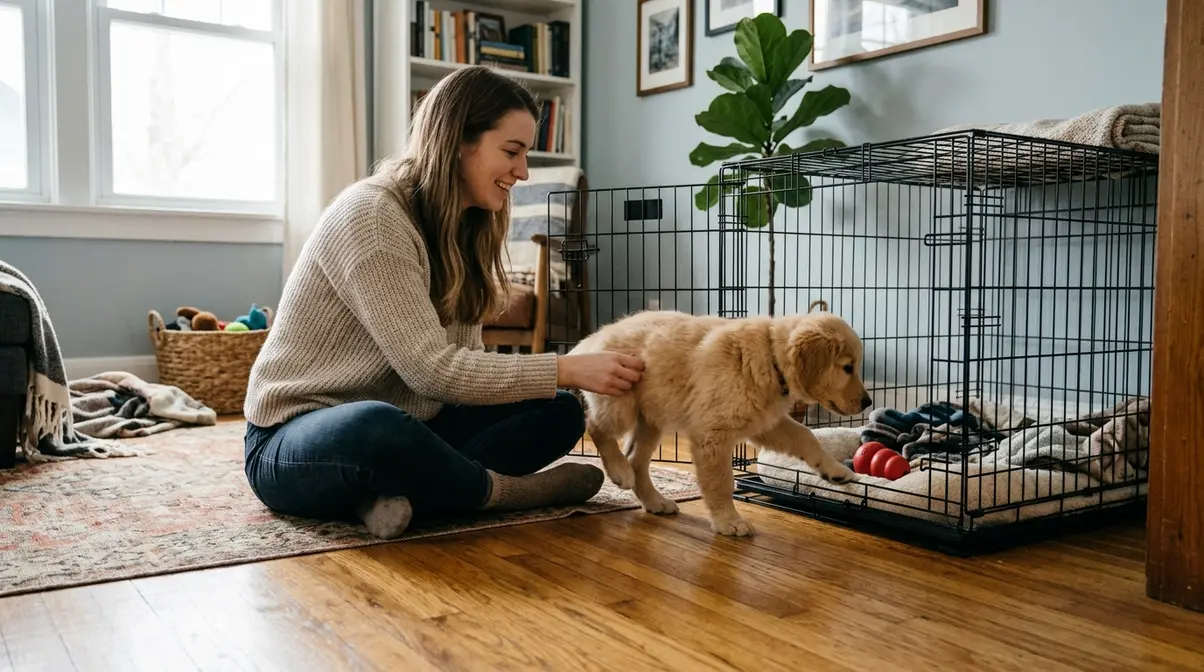
No schedule survives the first week perfectly. The goal is consistency over time, not perfection on Day 1. That said, there are predictable patterns where the schedule breaks down. And knowing them in advance makes them easier to catch.
The 3 Most Common Schedule Mistakes (and How to Fix Them)
1. Skipping enforced naps. The puppy seems fine, happy, playful, not tired. So the owner lets them keep going. What happens next is the overtired-puppy spiral: biting increases, the puppy becomes harder to redirect, sleep quality drops, and accidents multiply. The fix is using the crate for every nap, even when the puppy resists. The resistance is the signal that the nap is needed, not evidence it isn’t.
2. Inconsistent potty timing. Taking the puppy outside “when you remember” instead of after every activity removes the predictability the puppy needs to generalize the behavior. The puppy cannot predict when the next trip is coming, so they go indoors. The fix is simple and non-negotiable: every play session ends with a potty trip. The schedule is the system.
3. Using the crate as punishment. The puppy chews something, and the frustrated owner puts them in the crate. This association, crate equals consequence, makes every nap a battle and undermines the entire crate training process. The fix: the crate is always a positive, neutral space. Corrections happen outside the crate; rest happens inside it.
4. Feeding at irregular times. When meals happen at different times each day, potty timing becomes unpredictable. The Play-Potty-Sleep Cycle depends on meals as anchor points. Feed at the same times every day, 7 AM, 12 PM (or the transition to 7 AM and 5 PM at 12–16 weeks), and potty windows become predictable.
5. Expecting too much too soon. An 8-week-old puppy sleeping through the night, holding their bladder for 4 hours, or sitting reliably on the first day is not a realistic expectation. Frustration built on unrealistic expectations leads to inconsistency, which is the actual cause of slower progress. The FAQ section addresses the specific timeline questions.
When to Call a Trainer or Vet Instead of Adjusting the Schedule
Sometimes the schedule is not the problem. Three scenarios warrant professional support rather than a routine tweak.
Persistent aggression Not puppy biting and mouthing, but stiff body language, hard staring, or growling when approached while resting, warrants a consultation with a certified professional dog trainer. This is not a schedule issue.
Refusal to eat for more than 24 hours is a veterinary concern, not a feeding schedule concern. A puppy who consistently skips meals despite proper timing and a high-quality food should be seen by a vet.
Signs of illness, lethargy lasting more than 24 hours, vomiting or diarrhea more than twice in a day, limping, or any discharge from the eyes or nose, always warrant a vet call, not a schedule adjustment. Knowing when to escalate is a sign of a responsible owner.
Frequently Asked Questions About Golden Retriever Puppy Schedules
What Is a Good Schedule for a Golden Retriever Puppy?
A good golden retriever puppy schedule follows the Play-Potty-Sleep Cycle: every waking block includes supervised play, a potty trip, and a crate nap. At 8–12 weeks, wake windows last 30–60 minutes, with 90-minute to 2-hour naps between them; meals happen at 7 AM, 12 PM, and 5 PM. Most puppies need 18–20 hours of sleep per day at this age. The specific hour-by-hour breakdown shifts at 12 and 16 weeks as the bladder and attention span develop. Consistency matters more than perfection. The same routine every day is the goal.
Should I Wake My 9-Week-Old Puppy Up to Pee at Night?
Yes, a 9-week-old puppy cannot hold its bladder through the night and will need one or two nighttime potty breaks. Set an alarm for approximately 2 AM rather than waiting for crying; a quiet, low-stimulation trip outside, no play, no eye contact, keeps the puppy in sleep mode and makes it easier to settle them back in the crate. Most puppies can go 4–5 hours between trips by 12 weeks. By 14–16 weeks, many sleep through the night without a break.
Can I Let My 9-Week-Old Puppy Sleep Through the Night?
At 9 weeks, most Golden Retriever puppies cannot physically sleep through the night without a potty break. Their bladder can hold roughly 2 hours at this age, so expecting a full 8-hour stretch sets both of you up for accidents and frustration. And accidents in the crate can undermine the crate training process. A single nighttime trip at around 2 AM is the realistic expectation for the first 4–6 weeks home. Consistency with the nighttime routine is what shortens this period most reliably.
What Is the Hardest Age for a Golden Retriever Puppy?
Most owners find the adolescent phase, roughly 6 to 18 months, to be the most challenging period with a Golden Retriever. During this time, puppies may seem to forget their training, test every boundary, and develop selective hearing even after months of consistent work. This is sometimes called the “Teenage Rebellion Phase,” and it is a normal developmental stage, not a training failure. The schedule habits built at 8–16 weeks are precisely what carry you through it. A puppy with a strong routine foundation handles adolescence better than one without.
What Is the Hardest Week of a Puppy?
For most owners, the first week home is the hardest. The puppy is adjusting to a new environment, crying at night, and having frequent accidents throughout the day. The 8–11 week window is also the first fear imprint period, meaning negative experiences during this time have an outsized impact on long-term behavior. Owner consensus in Golden Retriever communities consistently points to weeks 1–2 as the most exhausting part of puppy ownership. A consistent schedule shortens this period significantly by giving the puppy predictability to settle into.
What Is the 7-7-7 Rule for Puppies?
The 7-7-7 rule is a socialization heuristic used by trainers and breeders to guide early puppy exposure. The goal is to introduce the puppy to 7 different surfaces, 7 different locations, and 7 different people, with variations by source, in the first 7 weeks of life. It is a practical checklist, not an official veterinary standard, and the exact formulation varies by trainer. The “play” blocks in a daily puppy schedule are where these exposures happen naturally, making socialization part of the routine rather than a separate effort.
What Is “I Love You” in Dog Language?
In dog language, “I love you” looks like a slow blink, a relaxed body, a soft tail wag, and leaning against you. These are signals of trust and attachment. A puppy who brings you a toy, sleeps near you, or makes soft eye contact is communicating comfort and bond. Golden Retrievers are particularly expressive; physical closeness and sustained soft eye contact are primary bonding behaviors for the breed. The consistent routine of a daily schedule builds exactly this kind of trust, every potty trip rewarded, every nap honored, every play session ended calmly.
What Is the Silent Killer in Golden Retrievers?
The term “silent killer in Golden Retrievers” most commonly refers to hemangiosarcoma, an aggressive cancer of the blood vessel walls that often shows no symptoms until it reaches an advanced stage. Golden Retrievers have a higher-than-average predisposition to this cancer, along with other serious conditions including subvalvular aortic stenosis and lymphoma. Regular veterinary check-ups, beginning in the puppy period, are the most reliable way to establish baselines and catch early warning signs. This topic is outside the scope of a schedule guide; consult your veterinarian for breed-specific health screening recommendations tailored to your puppy’s history.
Start Your Puppy’s First Day With a Plan
For new Golden Retriever owners, the first 16 weeks are the most important, and the most overwhelming. A consistent golden retriever puppy schedule built on the Play-Potty-Sleep Cycle reduces accidents, prevents the overtired-puppy spiral, and builds the trust that makes every training session easier. The three schedules in this guide, for 8, 12, and 16 weeks, give you a plan for every stage of this window, so you’re never standing at the crate at 6 AM wondering what comes next.
The Play-Potty-Sleep Cycle is the answer to that 6 AM moment. Play ends, potty trip happens, puppy goes in the crate. Every time. At every age in this window. The reader who felt overwhelmed at the start of this guide now has a repeating rhythm they can follow at any hour, a concrete, actionable system instead of a vague plan.
Print or save the 8-week schedule from this guide and follow it for 7 days. After one week of consistency, adjust the wake windows as your puppy’s bladder and attention span grow. When you’re ready for what comes after 16 weeks, our foundational rules for daily puppy training picks up exactly where this guide leaves off.
➤ A golden retriever puppy schedule isn’t about perfection, it’s about the Play-Potty-Sleep Cycle, repeated consistently, until the puppy’s brain and bladder catch up with your intentions.