

Written by Coral Drake · Last updated July 2026
Your Golden Retriever has just had her litter, and the puppies are smaller than you expected, their tiny faces pressed together under the heat lamp, making almost no sound. You want to know if everything is normal. That mix of wonder and worry is completely understandable.
Most guides you find online cover generic dog breeds. Your Golden is not a generic dog. Her newborn golden retriever puppies have breed-specific weight targets, a documented developmental window, and a known health risk called Fading Puppy Syndrome that most guides never mention at all. If you are also bringing a human baby home to an adult Golden, the same gap exists: generic advice tells you to “supervise your dog,” but it does not tell you how a Golden’s specific temperament shapes that introduction.
This guide covers everything from day-one appearance and weight checks through week-by-week developmental milestones, Fading Puppy Syndrome prevention, and a step-by-step protocol for introducing your Golden to a human newborn. All of it aligns with established veterinary neonatal guidelines.
Golden retriever newborn puppies weigh 14-16 oz at birth and enter a critical three-week window that shapes their survival and lifelong temperament.
- 1. Birth weight matters: Golden Retriever newborns should gain 1-3 grams per day per kilogram of anticipated adult weight throughout the neonatal period (Merck Veterinary Manual, 2024).
- 2. Hearing develops at 3 weeks: Newborn puppies are born deaf, with ear canals that remain sealed until approximately day 21.
- 3. The Golden Window: The first three weeks are when warmth, feeding, and early handling shape both health and temperament, making this period the most important of your puppy’s life.
- 4. Fading Puppy Syndrome occurs in roughly one in eight litters (PubMed, 2021) and is fatal without immediate intervention.
- 5. Safe baby introductions work: Golden Retrievers are consistently rated among the most baby-tolerant breeds, but supervised first meetings are non-negotiable for every dog.
What Does a Golden Retriever Newborn Look Like?

A golden retriever newborn puppy is smaller than most people expect, typically weighing between 14 and 16 ounces (400-450 grams) at birth (Merck Veterinary Manual, 2024). Their coat is short and darker than the adult shade you are used to seeing. Knowing what “normal” looks like on day one helps you spot problems before they become emergencies.
At Birth: Size, Coat, and Color
Newborn golden retriever puppies often surprise first-time breeders with how compact they are. A healthy birth weight falls between 14 and 16 ounces (roughly 400-450 g). Veterinary guidelines emphasize that the most common mistake new breeders make is not weighing puppies daily in the first week. A puppy losing more than 10% of its birth weight in the first 24 hours is a warning sign worth tracking closely, according to the Merck Veterinary Manual neonatal care guidelines (2024).
The coat color at birth is darker and shorter than the adult shade. An English Cream Golden may look almost buff or pale gold at birth, while a standard Golden may appear a rich amber. The adult shade develops over months, not weeks. You can learn more about this process in our guide to Golden Retriever coat development stages. If one puppy looks noticeably smaller than the others (sometimes called the runt), weigh it separately at each feeding to confirm it is gaining alongside the litter.
The eyes and ears are sealed completely at birth. Teeth have not erupted. Puppies move only by paddling motions, pushing toward warmth and the scent of their mother. This is completely normal and expected. Their fluffy Golden Retriever coat will not appear until well into the first month.
This is also where “The Golden Window” begins. The first three weeks of a golden retriever newborn’s life are what we call The Golden Window: the period when everything that happens shapes both survival odds and lifelong temperament. Miss a key milestone here, and recovery is genuinely difficult.
What Your Golden Cannot Do Yet
Understanding the sensory limitations of a newborn puppy is the foundation of good neonatal care. Eyes remain sealed for the first 10-14 days (meaning your puppy cannot see you yet). Ear canals stay closed until approximately day 21 (meaning your puppy cannot hear you either). These limitations are not a sign of illness. They are exactly how Golden Retriever newborn puppies are supposed to arrive.
The most critical limitation is thermoregulation. Your puppy cannot regulate its own body temperature at birth. This is the single most important fact for new owners to understand: a cold puppy is a puppy in danger.
If the mother is absent or a puppy is separated, you will also need to stimulate elimination manually. A gentle wipe with a warm, damp cloth over the puppy’s bottom mimics what the mother does with her tongue. Without this stimulation, orphaned puppies cannot urinate or defecate on their own.
| Sense/Ability | Status at Birth | When It Develops |
|---|---|---|
| Sight | Sealed (eyes closed) | Eyes open: Days 10-14 |
| Hearing | Sealed (ears closed) | Ears open: approximately Day 21 |
| Smell | Active from birth | Present immediately |
| Thermoregulation | None | Partially by Week 3 |
| Elimination | Requires stimulation | Self-sufficient approximately Week 3 |
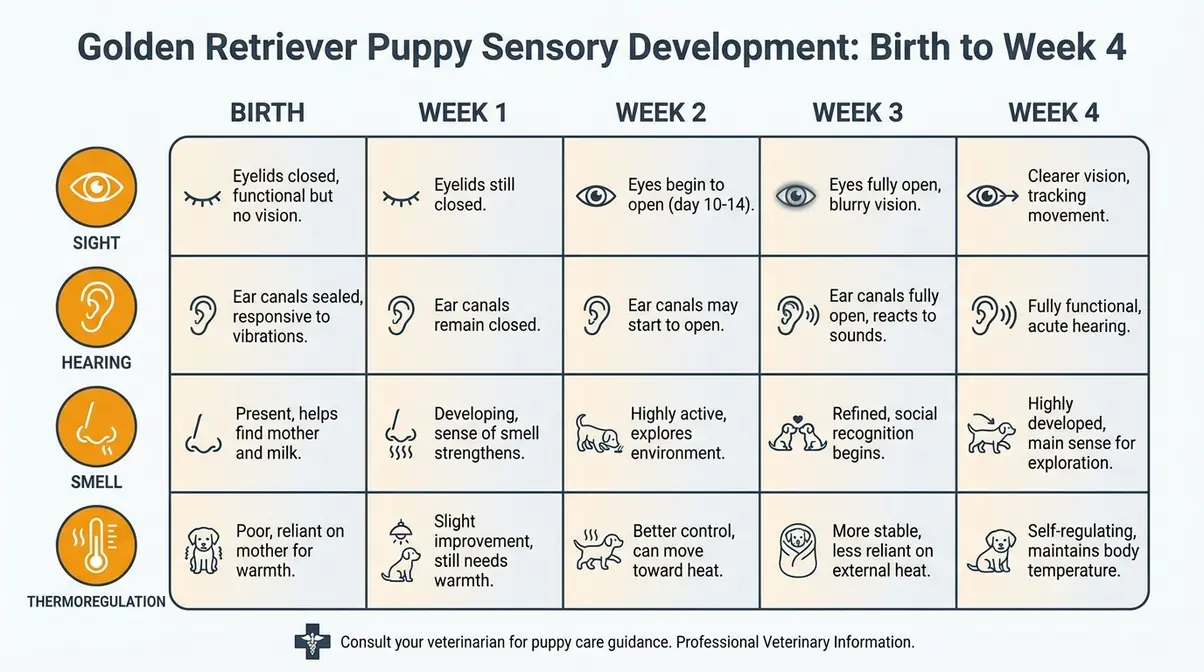
Understanding what your golden retriever newborn puppies cannot do is the foundation of everything in The Golden Window. The four weeks that follow determine how healthy and well-adjusted your puppies will become.
Golden Retriever Newborn Care: Weeks 1-4

Golden Retriever puppies should gain approximately 1-3 grams per day per kilogram of anticipated adult weight during the neonatal period, according to the Merck Veterinary Manual (2024). For a Golden with a typical adult weight of 65 lbs (29.5 kg), that translates to roughly 30-88 grams of gain per week. Missing this target by Day 3 is the earliest warning sign that something is wrong. Here is what you need to do each week.
Weeks 1-2: Warmth and Feeding
The whelping box temperature is your most important variable in the first two weeks. In Week 1, maintain the box at 85-90°F (29-32°C). In Week 2, you can reduce that slightly to 80-85°F (26-29°C). The reason is simple: newborn golden retriever puppies cannot shiver to generate heat. If the box is too cool, their energy goes toward survival rather than growth, according to the Merck Veterinary Manual neonatal care guidelines (2024).
Healthy nursing puppies feed every 1-2 hours in Week 1. If the mother is absent or a puppy is not latching, use a commercial puppy milk replacer. Do not substitute cow’s milk. Cow’s milk lacks the fat and protein ratio that dogs need, and it can cause digestive distress in newborns. For a full breakdown of feeding schedules as puppies grow, see our Golden Retriever puppy feeding guide.
Daily weigh-ins are non-negotiable in the first week. Use a kitchen scale that measures in grams, and record each puppy’s weight at the same time every day. A practical example: if a puppy weighed 425 g at birth and weighs 415 g on Day 2, that minor drop is acceptable. However, if a different puppy drops to 380 g on Day 3, that exceeds the ten percent danger threshold. Call your vet that day, not tomorrow.
Weeks 3-4: Eyes and Ears Open
Weeks 3 and 4 bring the most visible changes in your Golden litter. Eyes begin to open between Days 10 and 14. For the first few days after opening, they are extremely sensitive to light, so keep the whelping area dim. Do not use flashlights or bright overhead lighting directly above the box during this phase. Ears open around Day 21. Initial hearing is muffled, so avoid sudden loud noises during that first week of sound exposure.
First wobbly steps appear in Week 3. Puppies begin to interact with littermates, and real personalities start to emerge. This is the most socially critical phase of The Golden Window. Gentle handling by humans, just 3-5 minutes per puppy per day starting in Week 3, has been shown to support calmer temperament development in Golden Retrievers. According to the AVMA’s guidelines for newborn puppy resuscitation, warmth and stimulation in the early neonatal period are foundational to healthy development (AVMA, 2024).
Weaning begins in Week 4. Introduce a shallow dish of puppy gruel (puppy kibble soaked in warm water or puppy milk replacer) and let the puppies explore it. The mother will naturally begin to reduce nursing frequency on her own schedule. You can also start watching for the first tiny teeth appearing, which signals the transition to solid food. Our Golden Retriever puppy teething timeline covers what to expect as those first teeth emerge.
When Can a Puppy Hear You?
Newborn puppies are born deaf, with their ear canals completely sealed at birth. The canals begin to open around day 21 of life, and puppies start to recognize sounds and respond to their environment. Initial hearing is muffled and gradually sharpens over the following days, with full hearing typically developed by five weeks of age.
All of this week-by-week guidance is easier to track at a glance. Here is the breed-specific Golden Retriever newborn growth chart that most competitors do not publish.
Newborn Growth Chart: Weeks 1-4
Use this table as your weekly reference point. The weight ranges below are estimates based on the Merck Vet Manual formula (1-3 g/day/kg adult weight) applied to a Golden Retriever’s typical adult weight of approximately 65 lbs (29.5 kg), cited as (Merck Veterinary Manual, 2024; adapted for Golden Retriever adult weight).
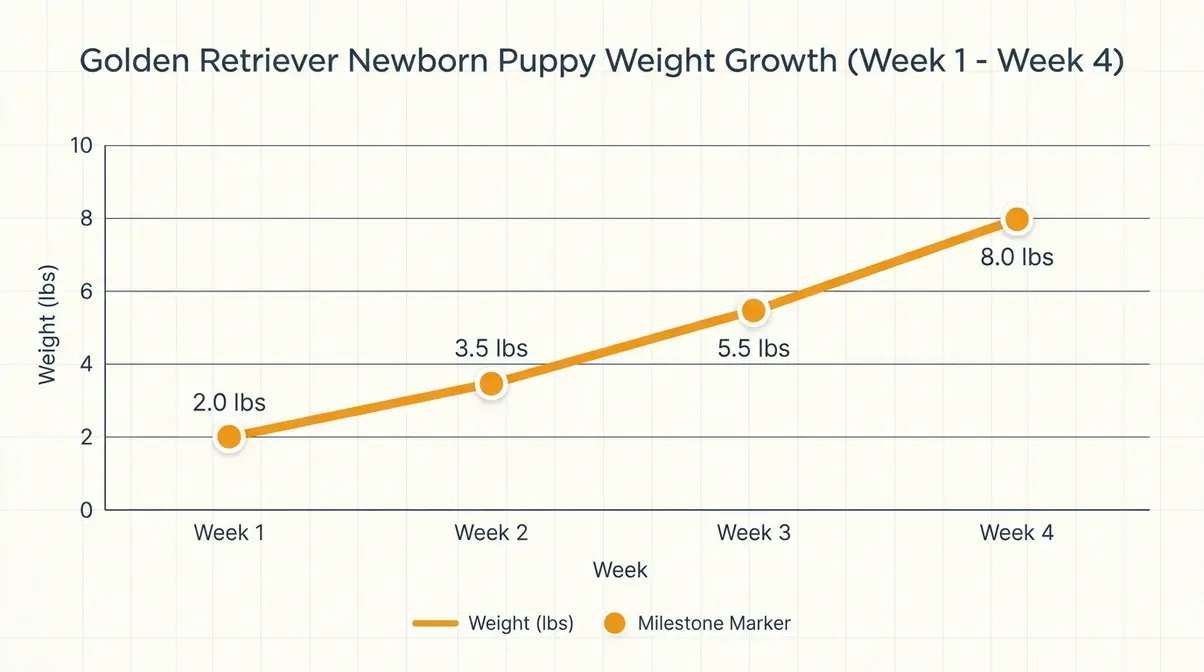
| Week | Approx. Weight Range | Key Milestone | Critical Care Task |
|---|---|---|---|
| Birth | 14-16 oz (400-450 g) | Eyes and ears sealed | Weigh daily; ensure nursing within 2 hours |
| Week 1 | 18-22 oz (510-620 g) | Paddling movement only | Maintain 85-90°F whelping box |
| Week 2 | 24-30 oz (680-850 g) | Eyes begin to open (Days 10-14) | Reduce box temp to 80-85°F |
| Week 3 | 32-40 oz (900 g to 1.1 kg) | Ears open (approximately Day 21), first steps | Begin gentle 3-5 min handling sessions |
| Week 4 | 40-50 oz (1.1-1.4 kg) | Exploring, playing, weaning begins | Introduce puppy gruel; start deworming |
If your puppy falls below the minimum weight in any week, do not wait until the next day to act. Contact your vet or an emergency animal hospital right away. A puppy that is not gaining weight is a puppy that needs professional support, not watchful waiting.
Key finding: Golden Retriever newborn puppies should gain 1-3 grams per day per kilogram of anticipated adult weight throughout the neonatal period. A 10% birth weight loss on day one is the maximum acceptable threshold. Puppies that exceed this loss by Day 3 require immediate veterinary evaluation. Source: Merck Veterinary Manual, 2024.
Your two-week-old Golden Retriever puppies have just entered one of the most demanding phases of The Golden Window. Here is what they specifically need at that stage.
What Do 2-Week-Old Golden Retriever Puppies Need?
Two-week-old golden retriever puppies need consistent warmth (whelping box at 80-85°F), nursing every 2-3 hours, and daily weight monitoring. Their eyes are beginning to open, but their ear canals are still sealed, so they are navigating their world almost entirely through smell and touch. At two weeks, your puppies are right in the middle of The Golden Window, and the care decisions you make now have lasting effects.
Eyes opening and light sensitivity are the defining feature of this stage. Eyes begin to open between Days 10 and 14, but for the first several days after opening, they are extremely sensitive to bright light. Keep the whelping area dim and avoid shining any direct light toward the puppies’ faces, according to the Blessed Vets neonatal care guide (2024).
Feeding at two weeks can stretch to every 2-3 hours as stomach capacity grows (compared to every 1-2 hours in Week 1). A well-fed puppy should look visibly rounder after nursing. If a puppy cries continuously after a nursing session, it may not be getting enough milk and may need supplemental feeding with a commercial puppy milk replacer.
Weight at two weeks is a clear health indicator. A healthy 2-week-old Golden should weigh approximately 24-30 oz (680-850 g), as shown in the growth chart above. If a puppy has not at least doubled its birth weight by Day 14, that is a signal to call your vet.
Your 2-week-old Golden puppy care checklist:
- Keep whelping box at 80-85°F (26-29°C)
- Weigh each puppy daily at the same time
- Ensure every puppy nurses every 2-3 hours
- Dim the whelping area lighting to protect newly opening eyes
- Watch for continuous crying, which signals a feeding or warmth problem
At four weeks, your Golden puppy’s world changes dramatically. Here is what to expect when that first-month milestone arrives.
Golden Retriever Puppy Milestones at One Month
The transformation between Week 1 and Week 4 in a Golden Retriever litter is one of the most dramatic in the dog world. One week they are silent, paddling bundles who cannot see or hear. Four weeks later, they are wobbling toward each other, batting tiny paws, and making their first recognizable sounds. By four weeks, your Golden puppy has tripled its birth weight, opened its eyes and ears, and started to wobble toward its littermates with genuine curiosity, according to Golden Retriever breed information from Devoted to Dog.
Physical changes at one month are striking. The signature Golden fluff starts to appear at 4 weeks, giving puppies that recognizable soft, rounded look. The full coat takes months to develop, and you can track the full timeline in our guide to Golden Retriever coat development stages. All senses are now active. Puppies respond to sound, track movement with their eyes, and use smell to identify their mother and littermates.
Behavioral changes are equally visible. Puppies begin to play-bite, attempt to bark, and establish early social dynamics within the litter. This is the start of the critical socialization window, when human handling has the greatest positive impact on temperament. Goldens socialized consistently during this period tend to be calmer and more confident with strangers at 8 weeks and beyond.
Care transitions at four weeks include the start of weaning, introduction of puppy gruel, and the recommended deworming schedule (typically at 2 weeks and again at 4 weeks). Your first vet visit is generally recommended between 6 and 8 weeks, but confirming the deworming protocol early is important for Golden Retriever lifespan and health outcomes long-term.
Watch for any puppy at four weeks that is still not engaging with littermates or is significantly smaller than the rest. Isolation and size disparity at this stage are signs worth discussing with your vet before the first scheduled visit.
Now that you know how golden retriever newborn puppies grow and develop, the question many families face is a different one entirely: how do you bring that dog home to a human newborn?
Introducing Your Golden to a Baby
Golden Retrievers are among the most baby-tolerant breeds, known for their gentle curiosity and soft mouths. But even the sweetest Golden needs a structured first introduction. The ASPCA (the American Society for the Prevention of Cruelty to Animals) and the American Veterinary Medical Association (AVMA) both recommend a controlled, graduated approach, especially for high-energy dogs meeting a newborn for the first time.
Are Goldens Good With Newborns?
Yes, Golden Retrievers are consistently ranked among the most gentle and patient breeds with newborn babies. Their retrieving heritage gave them naturally soft mouths and high tolerance for unpredictable movement, including grabbing and pulling. Across thousands of owner reports, the most common description is “gentle curiosity” rather than anxiety or aggression.
Preparing Before Baby Arrives
The two to four weeks before your baby arrives are the most valuable preparation time you have. Starting these steps early makes the actual introduction far smoother.
First, introduce baby scents before the arrival. Bring home a blanket or item of clothing the baby has worn in the hospital. Place it on the floor and let your Golden sniff it freely. Reward calm, relaxed investigation immediately. This step alone reduces anxiety on the actual arrival day. For more on how Golden Retrievers with children build their relationships, our dedicated guide covers the full picture.
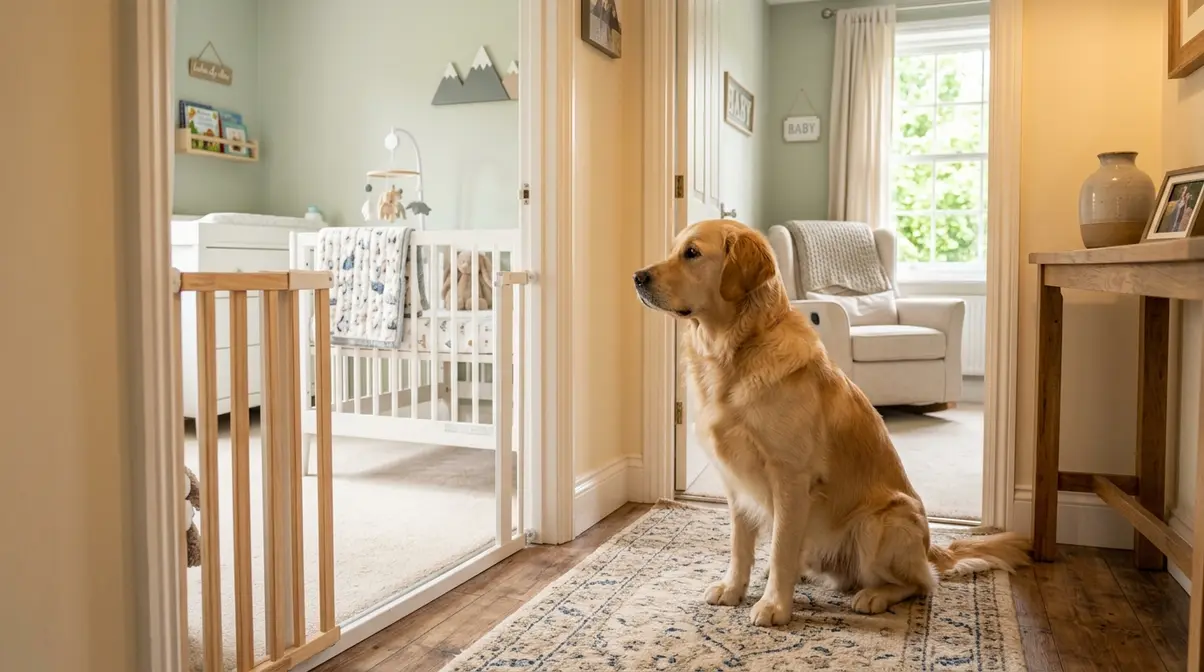
Second, establish new boundaries early. If the nursery will be off-limits, start enforcing that boundary now, not on the day the baby arrives. Use a baby gate or a closed door consistently so your Golden learns the rule before stress is added to the situation.
Third, reinforce the three obedience commands that matter most in the first weeks with a newborn: “sit,” “stay,” and “leave it.” Practice the “go to your place” command so your Golden has a clear retreat space when the baby is being fed or changed. The ASPCA tips for safe dog and baby interactions recommend letting your dog sniff the baby’s feet for a couple of seconds and praising gentle investigation (ASPCA, 2024).
On the day your baby actually comes home, a few specific steps make the difference between a smooth first meeting and an anxious one.
The First Meeting: A 5-Step Protocol
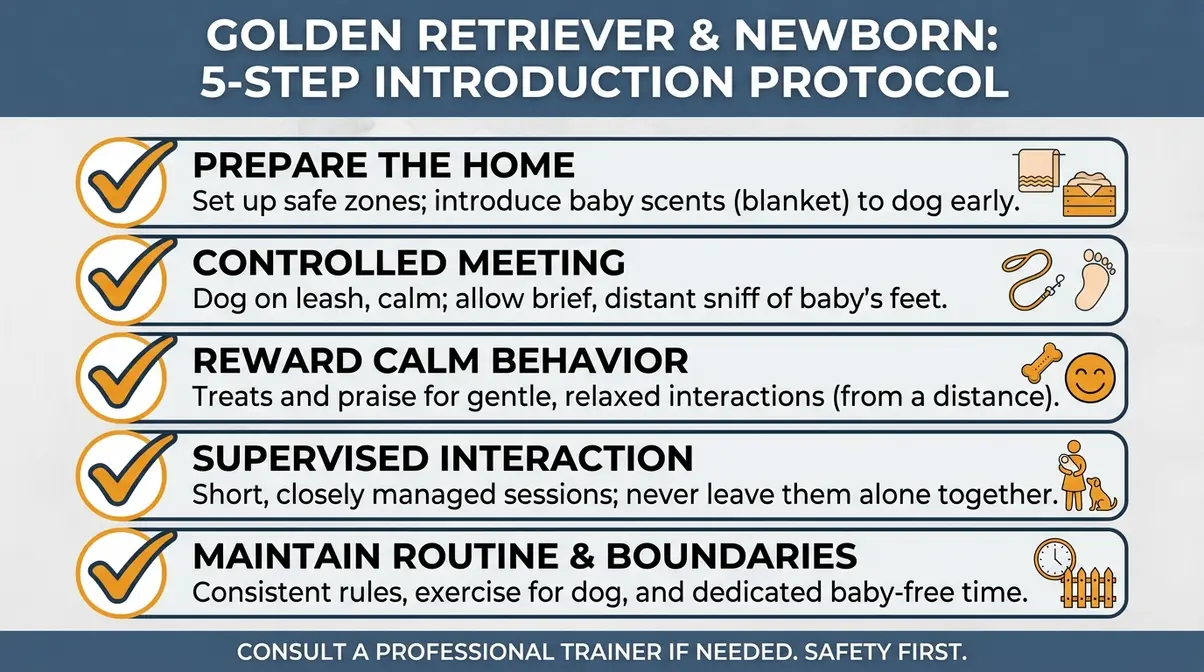
Here is the exact sequence recommended by veterinary behaviorists:
Step 1: Exercise your Golden before the baby arrives. A 30-minute walk burns off excitement energy and puts your dog in a calmer state for meeting something new.
Step 2: The adult who was not at the hospital enters first and greets the dog calmly. This prevents your Golden from associating the baby’s arrival with a chaotic, high-energy homecoming.
Step 3: Bring the dog to a controlled sitting position before the baby enters the room. Your Golden should be sitting or lying calmly before the baby crosses the threshold, as recommended in the step-by-step guide for introducing dogs to infants from VCA Animal Hospitals (2024).
Step 4: Let the Golden sniff the baby’s feet briefly. Praise calm behavior immediately and consistently. Feet are less threatening than faces for a first introduction.
Step 5: Keep first sessions under 5 minutes and repeat daily, gradually extending. Consistency over several days is more effective than one long, intense introduction.
The AVMA safety recommendations for dogs and children are clear: never leave a baby or small child alone with a dog, and be alert for potentially dangerous situations, taking preventive action before they escalate (AVMA, 2024).
Across Golden Retriever owner communities, the experience reported most often sounds like this:
This reflects the breed’s genuine tolerance. Hundreds of Golden Retriever families in owner communities describe the same pattern: gentle curiosity first, then acceptance, then that classic Golden protectiveness that makes them such sweet souls with tiny faces. It is worth noting, however, that we initially assumed all Goldens adapt immediately to babies. Community reports show that some dogs need 2-3 weeks of gradual exposure before they are fully relaxed around a newborn. Patience with the process is not a failure. It is normal.
If you are still choosing a puppy for your family, our guide on how to choose a Golden Retriever puppy covers temperament traits to look for from the start.
The introduction is the happy part. Now for the section every Golden Retriever owner needs to read, but most guides skip entirely.
Fading Puppy Syndrome Prevention
One of your golden retriever newborn puppies is crying constantly, not latching to nurse, and feels cold to the touch. This is the most common presentation of fading puppy syndrome (FPS), a condition where a seemingly healthy puppy declines rapidly and cannot recover without help. Early detection is the only effective intervention available.
Fading puppy syndrome is not one disease. It is an umbrella term for several conditions that all produce the same result: a puppy that was alive and apparently healthy begins to fade within the first two weeks of life. Understanding the three primary causes gives you the best chance of catching it in time.
The 3H Warning Signs: What to Watch For
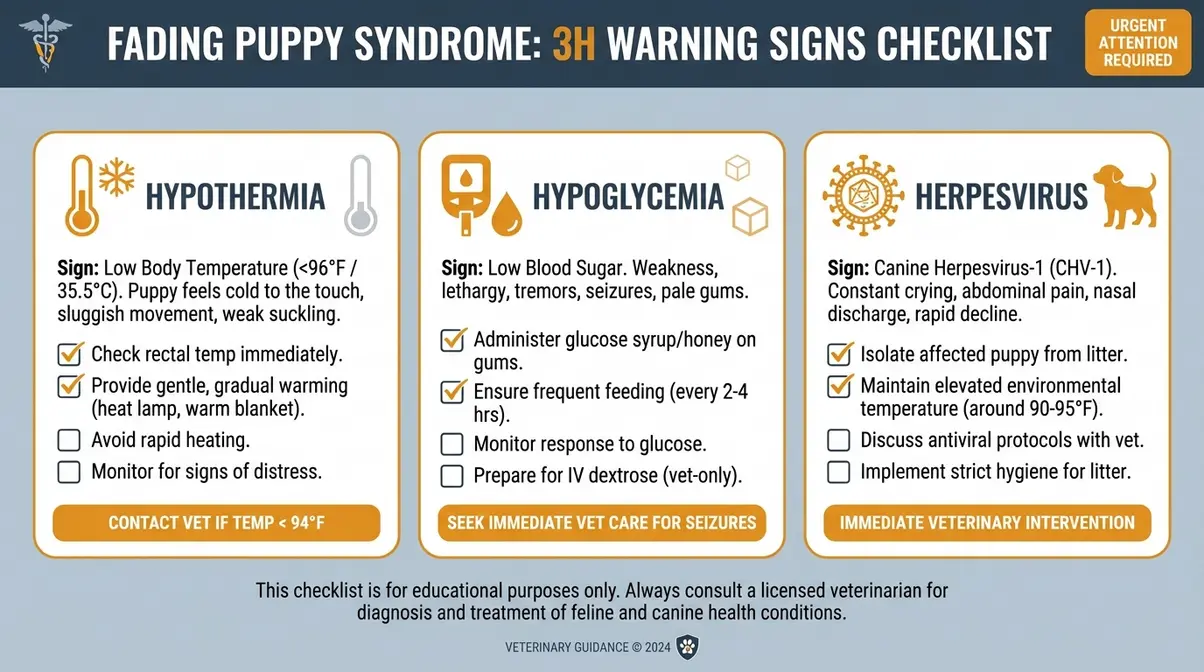
The 3H Framework covers the three most common causes of fading puppy syndrome in Golden Retriever newborn litters:
- Hypothermia (dangerously low body temperature): The puppy feels cold to the touch, stops moving toward the nipple, and may appear limp or unresponsive. Normal puppy body temperature in Week 1 is 95-99°F (35-37°C). A puppy below this range needs to be warmed gradually, not quickly, using a heating pad on the lowest setting wrapped in a towel.
- Hypoglycemia (low blood sugar): Constant crying, weakness, and paddling without forward movement are the classic signs. This occurs when a puppy cannot latch and nurse effectively. A puppy that cries for more than 30 minutes without nursing is a puppy that may be hypoglycemic. According to the clinical signs of fading puppy syndrome from the University of Illinois College of Veterinary Medicine, a leading veterinary research institution, symptoms include not eating well, restless crying, inability to be soothed by nursing, lack of weight gain, and abnormal temperature (University of Illinois, 2024).
- Herpesvirus (canine herpesvirus, CHV-1): This is the most feared cause because it can produce sudden death in an apparently healthy puppy with no prior warning. It often affects the whole litter simultaneously. According to UC Davis veterinary research on canine herpesvirus, herpesvirus has been associated with neonatal puppy death, with 100% mortality among confirmed littermates in affected cases (UC Davis Veterinary Medicine, 2024).
Knowing the warning signs is only useful if you know when the situation has moved beyond home care.
When to Call Your Vet Immediately
Call your vet or an emergency animal hospital right away if:
- A puppy has lost more than 10% of birth weight by Day 3
- A puppy cries constantly for more than 30 minutes without nursing
- A puppy feels cold to the touch and does not warm up within 20 minutes of being held
- Multiple puppies in the litter show the same symptoms simultaneously
- Any puppy dies suddenly without apparent cause (herpesvirus can spread rapidly through the litter)
Catching any one of these signs early is the difference between a healthy litter and a tragedy. Your vet is your best resource, and calling too early is always better than calling too late, according to the study on fading puppy syndrome mortality rates (PubMed, 2021).
Always consult your veterinarian for health concerns specific to your litter. This guide is for informational purposes only.
A reputable breeder will also have a vet relationship already in place before the litter arrives. If you are still building that network, our guide to finding a reputable Golden Retriever breeder is a good starting point.
You have the care guide, the growth chart, and the warning signs. Now, the most common questions Golden Retriever owners ask about newborns.
Frequently Asked Questions
Is it okay for a dog to be around a newborn baby?
Yes, it is generally safe for a well-trained dog to be around a newborn baby, provided every interaction is supervised by an adult. The key is a gradual, structured introduction before the baby arrives home, not a spontaneous first meeting. Dogs that are calm and have basic obedience training adapt most successfully. Never leave any dog alone with a baby, regardless of breed or temperament.
What is the hardest month of a puppy?
Most owners find weeks 8 to 12 to be the hardest period with a Golden Retriever puppy ((https://swifto.com/blog/caring-newborn-puppy-first-8-weeks)). This is when puppies are teething, exploring everything with their mouths, and require intensive house training. Consistent routines and positive reinforcement training make this phase significantly more manageable.
What is the silent killer in Golden Retrievers?
Hemangiosarcoma, an aggressive cancer of the blood vessel walls, is often called the “silent killer” in Golden Retrievers. It develops with few or no visible symptoms until it reaches an advanced stage, most commonly affecting the spleen, heart, or liver. Golden Retrievers are disproportionately affected compared to other breeds. In neonatal puppies, canine herpesvirus (CHV-1) plays a similar silent-killer role, causing sudden death with no prior warning signs. Regular veterinary check-ups are the most effective tool for early detection of both conditions.
How much should a newborn Golden Retriever sleep?
Newborn Golden Retriever puppies sleep for approximately 90% of the day during their first two weeks of life. This extensive rest is critical because their bodies are using almost all available energy for rapid growth and development. They typically only wake up to nurse every few hours before immediately falling back asleep.
When do Golden Retrievers get their full coat?
While the first signs of fluff appear around four weeks of age, a Golden Retriever does not develop its full adult coat until they are between 18 and 24 months old. The transition begins with the shedding of their soft puppy fur around three to four months of age. The adult coat comes in gradually, starting as a darker stripe down their back. The final adult shade is often closer to the color of their newborn ears than their newborn body.
Your Golden, Your Baby, Your Window
For Golden Retriever families, the neonatal period is both the most vulnerable and most formative window in your puppy’s life. Puppies that receive consistent warmth, proper nutrition, and early handling during The Golden Window develop into the calm, baby-tolerant adults that Golden Retrievers are famous for. Veterinary neonatal care protocols consistently point to the same conclusion: the first three weeks are irreversible, and the effort you invest there pays off for the entire lifespan.
Whether you are watching over a new litter or preparing your adult Golden for a human baby’s arrival, the same principle applies. Structure, patience, and veterinary guidance turn anxiety into confidence. The Golden Window is short, but the habits you build inside it shape everything that follows.
Ready to go deeper? Start with our guide on how to choose a Golden Retriever puppy for your family, explore the different types of Golden Retrievers to find your ideal match, or read about English Cream Golden Retriever characteristics if you are drawn to the lighter-coated variety. Always consult your veterinarian for health concerns specific to your litter.
➤ The Golden Window is short, but what you do inside it shapes your puppy’s health, temperament, and your family’s bond for life.