You bring your Goldendoodle puppy home, and the coat is… strange. It’s wavy in one spot, almost curly behind the ears, and completely flat along the back. Your breeder called it “scruffy.” You called it confusing. And you’re not alone — the same litter can produce three completely different coat textures, which is one of the things that makes goldendoodle coat types so genuinely puzzling for first-time owners.
Here’s why this matters: using the wrong brush on the wrong coat type can cause painful mats in under a week. Choosing a puppy without understanding coat genetics can mean unexpected shedding in an allergy-sensitive home. And skipping the grooming window during the puppy coat transition can lead to a shave-down at the groomer. In this guide, you’ll learn to identify all four Goldendoodle coat types, understand what genetics actually determine them, and get the exact grooming routine for each — so there are no surprises. We’ll cover identification, the four coat types, colors and markings, how generations affect coat outcomes, the puppy coat transition, and a quick FAQ.
Key Takeaways: Goldendoodle Coat Types at a Glance
Goldendoodles have four main coat types — wavy, curly, straight, and flat — each determined by the RSPO2 and KRT71 genes inherited from their Poodle and Golden Retriever parents.
- Wavy coats are the most common: low shedding, low-to-moderate maintenance, and allergy-friendly for most households
- Curly coats shed the least but require daily brushing to prevent matting
- Straight coats look like a Golden Retriever and shed moderately
- Flat (improper) coats lack the “furnishings” gene and shed the most
- The Coat Prediction Triangle — generation + DNA test + muzzle fur clues — is the most reliable way to predict your puppy’s adult coat
How to Tell What Coat Type Your Goldendoodle Has
Goldendoodles can have four distinct coat types, and identifying yours takes less than two minutes. The key is knowing what to look for: the curl pattern, the coat texture, and whether your dog has furnishings — the shaggy beard, mustache, and eyebrow hair that give doodles their distinctive fluffy face. Getting this right leads directly to the right grooming routine, which saves you time, money, and your dog a lot of discomfort.
For a complete visual guide to Goldendoodle coat types, photos make the differences instantly clear.
Before you start, find good lighting and have a fine-tooth comb handy. You’ll also want to check the fur while it’s dry — wet coats can make straight fur look wavy and curly fur look flat.
Follow these steps to identify your Goldendoodle’s coat type:
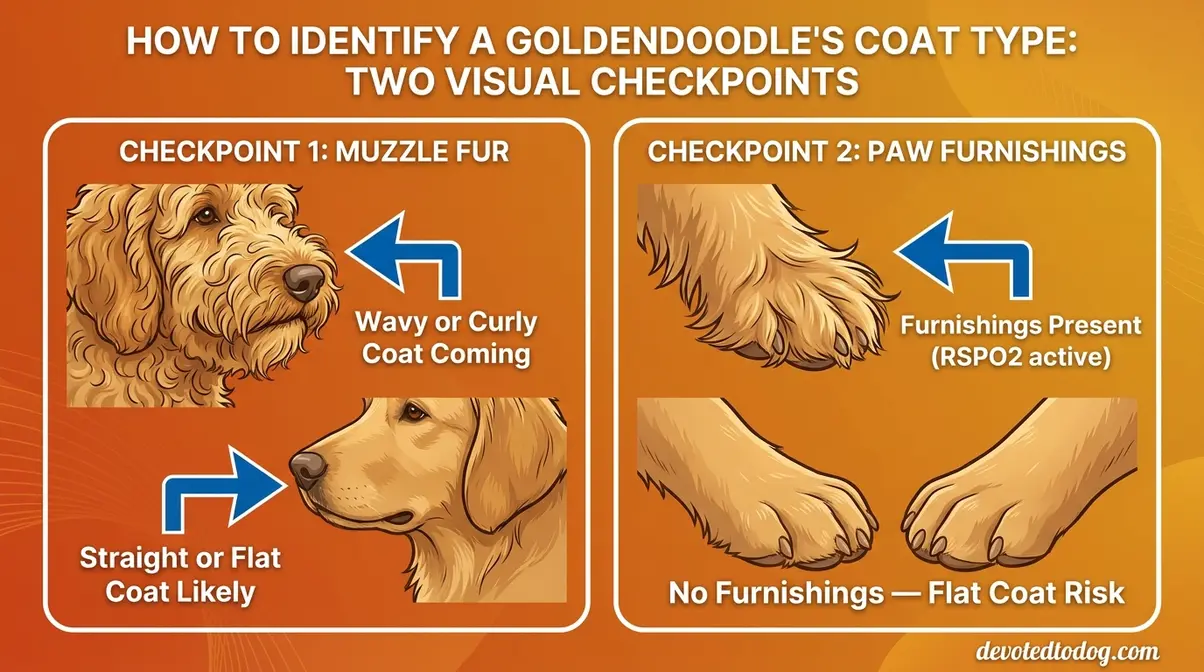
Step 1: Look at the Muzzle Fur Check if the fur around the muzzle is wavy and kinked, or if it lies flat against the face.
Step 2: Feel the Coat Texture Determine if the coat is soft and silky, or coarser and slightly springy.
Step 3: Check for Curl Look closely to see if there are tight ringlets, loose waves, or no curl pattern at all.
Step 4: Examine the Eyebrows and Paw Tufts Look for furnishings (shaggy eyebrow and paw hair), which indicate a non-flat coat.
Step 5: Consider the Puppy’s Age Note that puppies under 6 months may not show their final coat yet (see the Puppy Coat Transition section below).
Later in this guide, we’ll show you how to use The Coat Prediction Triangle — a simple three-factor system — to predict what your puppy’s adult coat will look like.
Now that you know what to look for, here’s exactly what each coat type looks like — and what it means for shedding, grooming, and allergies.
The 4 Goldendoodle Coat Types Explained
A Goldendoodle’s coat type is determined by which combination of genes it inherits from its Poodle and Golden Retriever parents. According to the University of Utah Genetic Science Learning Center, dog coat texture across all breeds is primarily controlled by just three genes: RSPO2 (furnishings), FGF5 (hair length), and KRT71 (curl) — making coat prediction a science, not a guessing game.
The four Goldendoodle coat types are:
- Wavy coat — soft S-shaped waves, low shedding, most common
- Curly coat — tight Poodle-like ringlets, minimal shedding, highest maintenance
- Straight coat — smooth like a Golden Retriever, moderate shedding
- Flat coat (improper coat) — lacks furnishings, sheds the most of all four types
(Each type is explained in detail below.)
The two genes that matter most for your Goldendoodle’s coat are RSPO2 (furnishings and texture) and KRT71 (curl pattern) — and both can be confirmed with a simple DNA test available through labs like UC Davis Veterinary Genetics Laboratory.
The Wavy Coat Goldendoodle
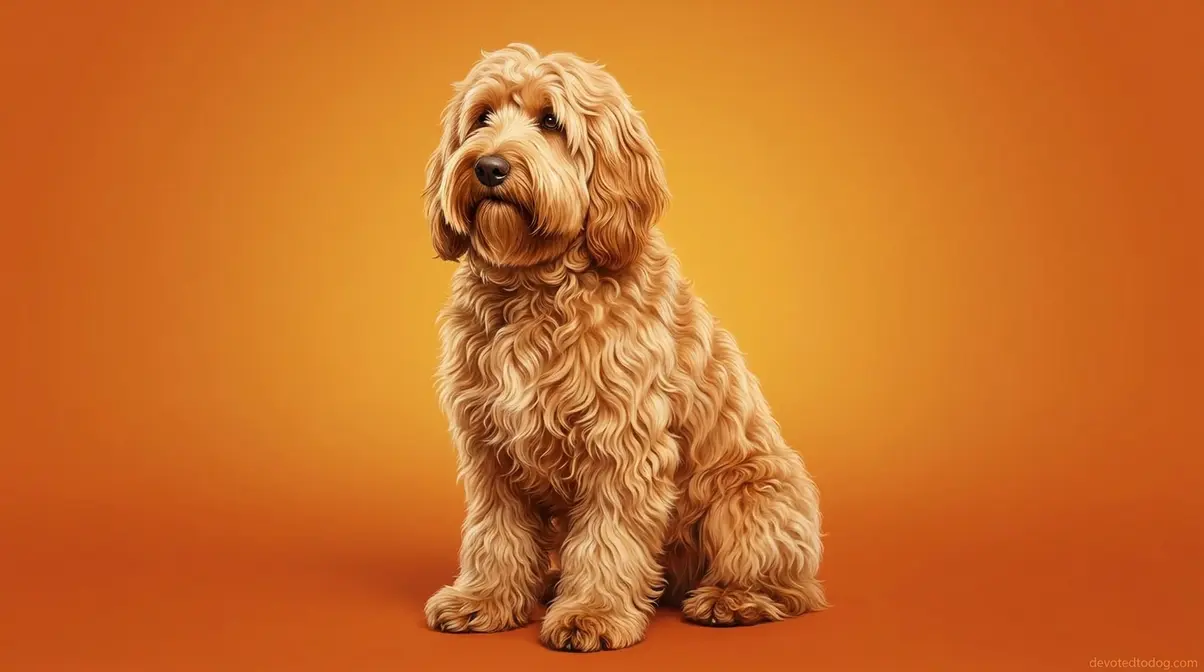
The wavy coat goldendoodle is the most recognizable — and the most common — result of a Goldendoodle cross. The coat displays loose, flowing S-shaped waves that fall somewhere between the Poodle’s tight curl and the Golden Retriever’s flat, straight fur. Owners often describe it as “teddy bear” or “fleece-like.” If you’ve ever pictured a Goldendoodle and thought “yes, that’s exactly it” — you were picturing a wavy coat.
Key Specs:
- Shedding: Low to moderate
- Grooming Frequency: 3–4 times per week
- Tools: Slicker brush + stainless steel metal comb
- Professional Grooming: Every 8–10 weeks
Why this coat looks the way it does comes down to one copy of the KRT71 curl gene. Think of the KRT71 gene as a dimmer switch for curl intensity: one copy turns the dial halfway up, producing waves rather than tight ringlets. The dog also carries the RSPO2 furnishings gene, so you get the full beard, eyebrows, and paw tufts — the complete doodle look. What this means for your dog: a wavy coat has the classic Goldendoodle appearance without the high-maintenance demands of a curly coat.
Dogs with the RSPO2 furnishings gene have a strong propensity to shed less than dogs without it, according to the genetic link between furnishings and lower shedding documented by UC Davis Veterinary Genetics Laboratory. However, no Goldendoodle is completely allergen-free — the wavy coat is allergy-friendly for most households, but not a guarantee for severe allergy sufferers.
- Grooming tools for a wavy coat:
- Slicker brush (removes surface tangles)
- Stainless steel metal comb (detects hidden mats)
- Professional scissor trim every 8–10 weeks
The wavy coat is the most common result in F1 Goldendoodles (50% Poodle, 50% Golden Retriever), and also appears frequently in F1B wavy coat Goldendoodles when the Poodle genetics don’t fully dominate. Puppy wavy coats may look straighter than the adult coat — the waves typically become more defined after 6 months.
If you’re looking for even less shedding and that classic Poodle-like fluffiness, the curly coat takes things a step further — but it comes with a grooming trade-off.
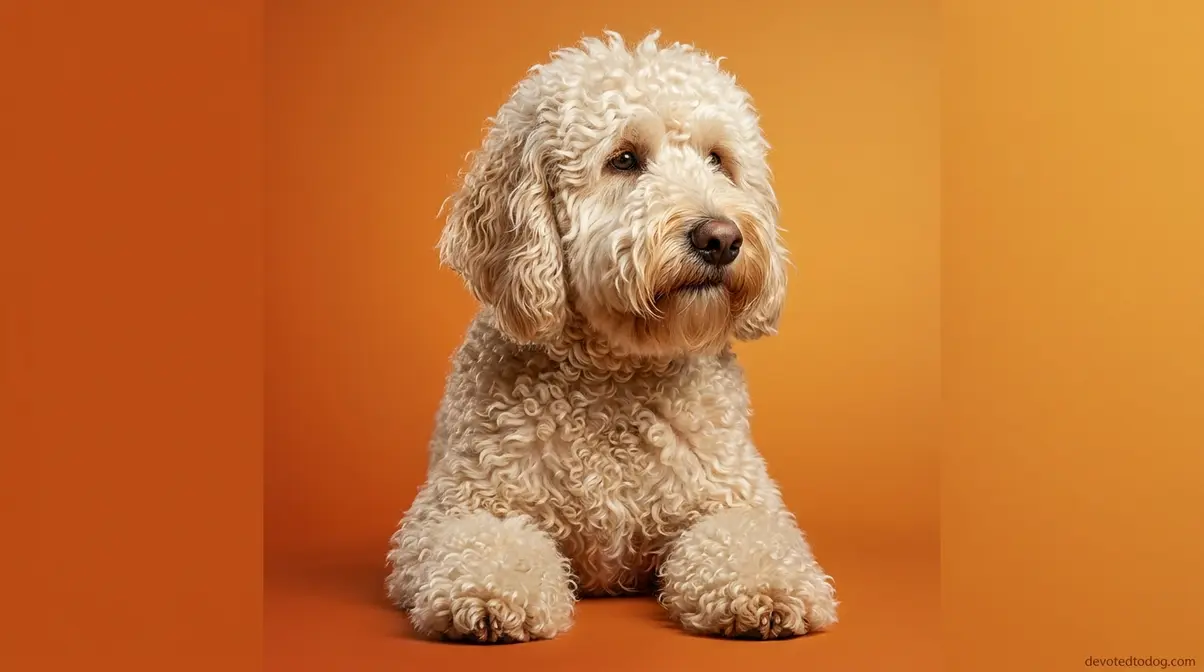
The Curly Coat Goldendoodle
The curly coat Goldendoodle has tight, dense ringlets that run consistently from head to tail — much like a Poodle’s coat. The curls feel springy and dense when you press them. This is the coat type most people associate with the word “hypoallergenic,” though that term is frequently misused (more on that in the Myths section). The curly coat is visually the most dramatic, and it’s also the most demanding to maintain.
Key Specs:
- Shedding: Very low to minimal
- Grooming Frequency: Daily
- Tools: Slicker brush + dematting rake + metal comb
- Professional Grooming: Every 6–8 weeks
Genetically, the curly coat results from two copies of the KRT71 curl gene — the dimmer switch turned all the way up. This is called homozygous, meaning the dog inherited one curl gene from each parent. The dog also has full furnishings (RSPO2 gene present), so the beard and eyebrow look is intact. According to the differences between shedding fur and non-shedding hair documented by the American Kennel Club, “hair-type” coats (like the Poodle’s curly coat) have a longer growth cycle, which means individual hairs stay on the dog longer before falling out — leading to significantly less shedding compared to “fur-type” coats. What this means for your dog: less hair on your furniture, but more tangles in the coat itself.
The curly coat is most common in F1B Goldendoodles (75% Poodle, 25% Golden Retriever), where the higher Poodle percentage increases the probability of two KRT71 gene copies. In puppies, curly coats can be harder to identify before 6 months — the ringlets often don’t fully form until the adult coat starts growing in.
Grooming is the non-negotiable trade-off. Skipping brushing for even 2–3 days can result in painful mats, especially behind the ears and under the armpits. Use a professional-grade slicker brush — a basic dollar-store brush won’t penetrate the curl density.
The straight coat sits at the other end of the spectrum — it looks more like its Golden Retriever parent, and that comes with a very different set of expectations around shedding.
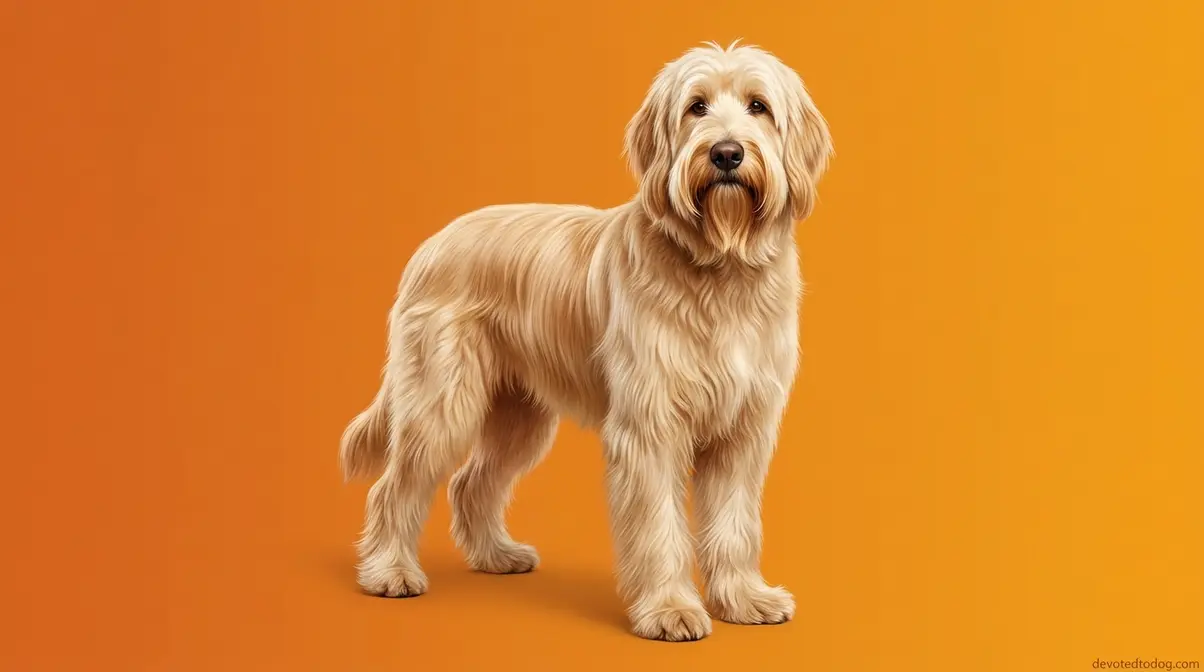
The Straight Coat Goldendoodle
The straight coat Goldendoodle has a long, smooth, flowing coat with no curl or wave. It looks very similar to a Golden Retriever — silky, flat, and elegant — but it still has furnishings. That’s the key distinction: the straight coat has the beard, eyebrows, and paw tufts. It still looks like a doodle. It just doesn’t have the waves or curls.
Key Specs:
- Shedding: Moderate
- Grooming Frequency: 2–3 times per week
- Tools: Pin brush + stainless steel metal comb
- Professional Grooming: Every 8–12 weeks
Genetically, the straight coat has zero copies of the KRT71 curl gene — but it DOES have the RSPO2 furnishings gene. This is the critical difference between a straight coat and a flat coat (see the next section). The furnishings gene is present; the curl gene simply isn’t. The Golden Retriever’s genetics are more dominant in this outcome.
According to the heavy shedding characteristics of Golden Retrievers documented by the American Kennel Club, Golden Retrievers possess a thick, water-repellent double coat that sheds heavily once or twice a year — a trait that can appear in straight-coated Goldendoodles. The straight coat inherits some but not all of this shedding tendency, making it a moderate shedder rather than a heavy one.
The straight coat is most common in F1 or F2 Goldendoodles where Golden Retriever genetics are more dominant. It’s often the surprise outcome for buyers who expected a wavy or curly coat. Not the best choice for allergy-sensitive households, but lower maintenance than either wavy or curly coats. Grooming is relatively straightforward: 2–3 brushing sessions per week keeps the coat tangle-free.
Then there’s the flat coat — the one type that’s often a surprise to new owners and breeders alike. It looks the most different from the “classic doodle” look, and understanding why requires a quick look at one specific gene.
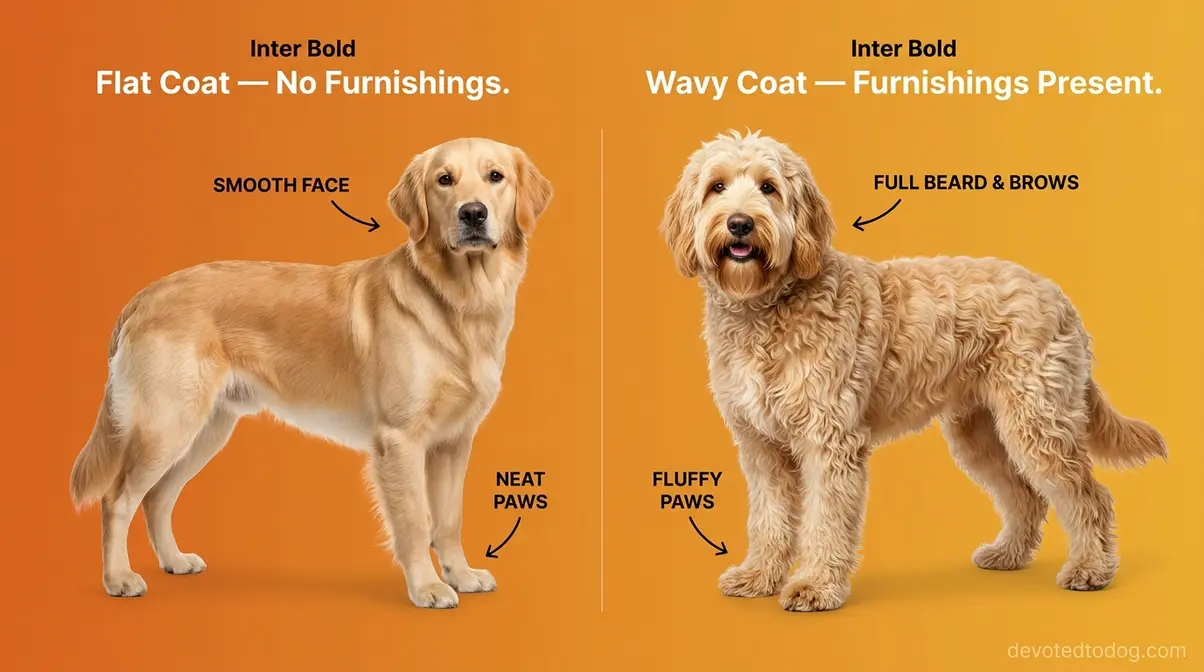
The Flat Coat (Improper Coat) Goldendoodle
A flat coat Goldendoodle — also called an improper coat — is the one that catches new owners off guard. The coat lies smooth and flat against the body, with no beard, no shaggy eyebrows, and no paw tufts. It looks like a Golden Retriever rather than a Poodle mix. Breeders use the term “improper coat” because the dog lacks the furnishings that are part of the standard doodle appearance.
Key Specs:
- Shedding: High (year-round, heavier in spring/fall)
- Grooming Frequency: 2–3 times per week
- Tools: Deshedding tool + pin brush
- Professional Grooming: Every 8–10 weeks
The genetics here are specific. According to UC Davis research on the RSPO2 furnishings gene, a dominant variant of the RSPO2 gene produces the desired “furnishings” (facial hair and eyebrows) in crossbreed dogs. A flat coat Goldendoodle lacks this dominant variant — it has two recessive copies, meaning no furnishings are produced. Without the RSPO2 gene active, the dog’s face and body look entirely unfurnished. What this means for your dog: the flat coat is the highest-shedding Goldendoodle coat type, and it is not allergy-friendly.
Flat coats can appear in any generation, but they’re more common in F1 and F2 Goldendoodles where the Golden Retriever’s recessive genes have a higher chance of combining. Responsible breeders use DNA testing to screen for the RSPO2 gene before breeding — this significantly reduces the likelihood of flat-coated puppies appearing in a litter. If you’re buying a puppy, ask your breeder directly: “Do you DNA test for the furnishings gene?”
Now that you know all four coat types, the most common question is: what’s the real difference between wavy and curly — and which one is better if you have allergies?
Wavy vs. Curly Goldendoodle — Which Is Right for You?
The core difference comes down to one gene copy. A wavy coat has one copy of the KRT71 curl gene; a curly coat has two. More copies = tighter curl. It’s that simple at the genetic level.
For shedding, the genetic link between furnishings and lower shedding from UC Davis Veterinary Genetics Laboratory shows that the RSPO2 furnishings gene is the more important factor for shedding reduction — not curl alone. Both wavy and curly coats have furnishings, so both shed significantly less than straight or flat coats. The difference between wavy and curly shedding is smaller than most people expect.
| Wavy Coat | Curly Coat | |
|---|---|---|
| Grooming commitment | 3–4x per week | Daily |
| Shedding level | Low | Very low to minimal |
| Allergy-friendliness | Good for most households | Best option for allergy households |
| Maintenance | Moderate | High |
| Best for | Most families | Allergy-sensitive households willing to brush daily |
The practical decision: if you can commit to 10 minutes of brushing three to four times per week, the wavy coat is the easier choice. If allergies are a genuine concern and daily brushing is non-negotiable, the curly coat is worth the commitment. This is the first corner of what we call The Coat Prediction Triangle — understanding your dog’s genetic mix is the foundation of predicting their coat.
For a quick side-by-side reference of all four coat types, the comparison chart below puts everything in one place.
Goldendoodle Coat Types at a Glance
Here’s a quick-reference comparison of all four Goldendoodle coat types. Use this chart to identify which column matches your dog — or to compare options before choosing a puppy.
| Coat Type | Shedding Level | Grooming Frequency | Tools Needed | Allergy-Friendly? | Most Common In |
|---|---|---|---|---|---|
| Wavy | Low | 3–4x per week | Slicker brush, metal comb | Yes (low-moderate) | F1, F1B |
| Curly | Very Low | Daily | Slicker brush, dematting rake | Best option | F1B, F1BB |
| Straight | Moderate | 2–3x per week | Pin brush, metal comb | Moderate | F1, F2 |
| Flat (Improper) | High | 2–3x per week | Deshedding tool, pin brush | No | F1, F2 |
Curly coats require daily brushing but shed the least; wavy coats offer the best balance of low maintenance and low shedding for most families.
For photos of each coat type and what they look like on real dogs, scroll back to the detailed sections above — or continue below to learn about Goldendoodle coat colors.
Based on The Coat Prediction Triangle framework — generation + genetics + puppy clues. See the Puppy Coat Transition section to predict which column applies to your puppy.
Goldendoodle Coat Colors and Markings
Goldendoodles can come in over eight recognized colors — from cream and apricot to black and chocolate — with coat color determined by entirely different genes than coat texture. This is an important distinction: the RSPO2 and KRT71 genes control coat texture and shedding, while a separate set of pigment genes controls color. A curly Goldendoodle can be any color. A flat coat can also be any color. The two systems are genetically independent.
Color, unlike coat texture, is not part of The Coat Prediction Triangle — it’s determined by entirely different genes and is harder to predict from generation alone.
The Most Common Goldendoodle Colors
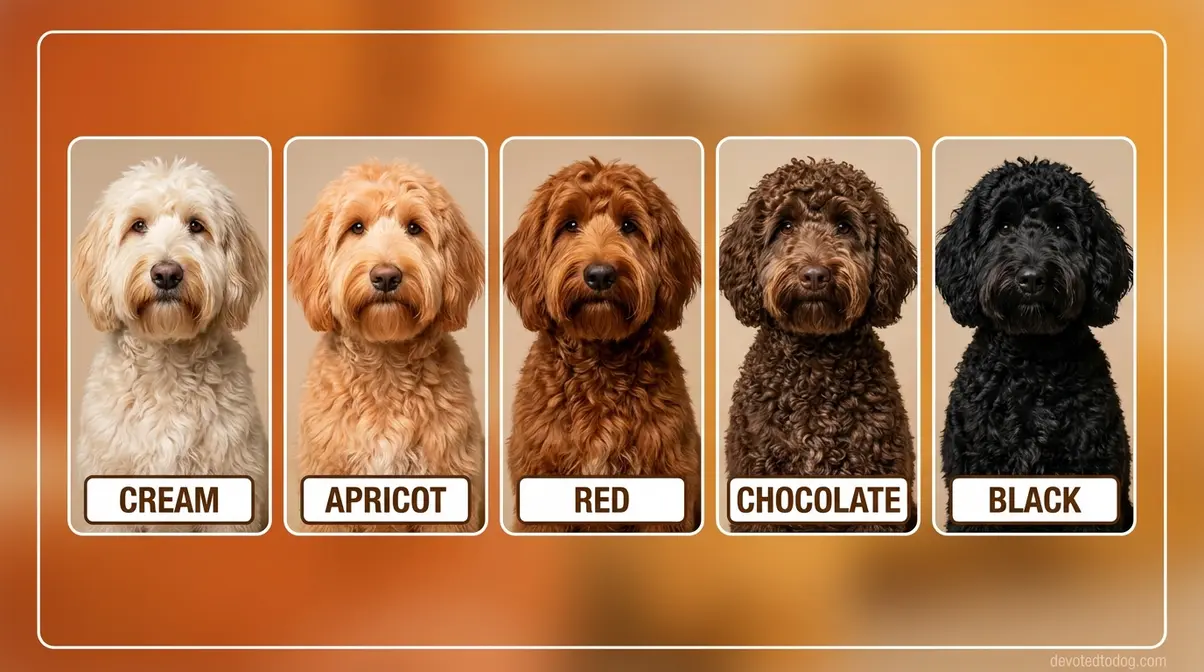
The most common Goldendoodle coat colors appear in rough order of frequency: cream and apricot together account for the majority of Goldendoodles you’ll see, largely because the Golden Retriever parent’s dominant pigment genes favor these warm tones.
Common Goldendoodle colors:
- Cream — the most common color, ranges from white to pale gold
- Apricot — warm peachy-orange, often fades to cream with age
- Red — deep auburn, the most sought-after color, fades noticeably over time
- Chocolate/brown — rich dark brown inherited from Poodle genetics
- Black — solid black, rare but possible in all generations
- Parti — at least 50% white with patches of a second color
- Grey/silver — uncommon, more frequent in Poodle-heavy generations
One of the most surprising things for new owners is color fading. Many Goldendoodles are born with vivid, saturated color that lightens dramatically as they age. This is called “clearing” and is related to the progressive greying gene inherited from the Poodle side. Apricot and red dogs are the most dramatic examples: most apricot Goldendoodles fade to cream by age two, and a deep red puppy may look a warm caramel or cream by 18 months. This is completely normal — it’s a predictable genetic trait, not a sign of poor breeding.
F1B Goldendoodle coat changes are often the most dramatic and well-documented, because the higher Poodle percentage amplifies the clearing gene’s expression. If you’re attached to a specific color, ask your breeder whether the parent dogs held their color into adulthood — this is the best predictor of what your puppy will look like at two years old.
Color and coat type are entirely separate. A deep red Goldendoodle can have a wavy, curly, straight, or flat coat — the color tells you nothing about texture or shedding. For a deeper look, explore all 18+ Goldendoodle colors and patterns in the full visual reference.
Beyond solid colors, Goldendoodles can also have distinctive marking patterns — and some of these, like “parti” and “abstract,” are terms that confuse even experienced owners.
Coat Patterns — Parti, Abstract, and Phantom Markings
Goldendoodle coat patterns are distinct from solid colors — they describe how color is distributed across the body, not what the color is. Three main patterns appear in the breed, and the Goldendoodle Association of North America (GANA), the breed’s primary registry, recognizes all three.
Parti — a coat with at least 50% white, with patches of another color (apricot, red, chocolate, or black) distributed across the body. The patches can appear anywhere. Parti looks similar to a spotted dog, with large, clearly defined blocks of two colors. This is a recognized pattern by GANA and is actively bred for by many specialty breeders.
Abstract or mismark — a primarily solid-colored dog with small white markings, typically on the chest, chin, toes, or tail tip. Less than 50% of the coat is white. Abstract markings are often mistaken for parti, but they’re genetically distinct — and much more subtle. Think of it as a solid-colored dog with a few white “accents.”
Phantom — a solid base color with tan or cream “points” appearing above the eyes, on the cheeks, chest, legs, and under the tail. The pattern resembles a Doberman or Rottweiler. Phantom Goldendoodles are less common but striking in appearance, and the pattern is possible in any generation.
Importantly, pattern and coat type are controlled by entirely different genes. A parti Goldendoodle can have a wavy, curly, or straight coat — the pattern and the texture have no relationship to each other. These patterns appear in both standard and Mini Goldendoodles with equal frequency. What you see in terms of pattern tells you nothing about shedding, grooming needs, or allergy-friendliness.
Now that you understand what your Goldendoodle’s coat type and color are, the next question most owners have is: “Why does my dog have this coat — and could a different generation have given me a different result?”
How Generations Affect Coat Type
Generation is the second corner of The Coat Prediction Triangle — and understanding it helps you set realistic expectations about coat outcomes. An F1B Goldendoodle (75% Poodle) has a significantly higher probability of a curly or wavy coat than an F1 (50% Poodle), making generation one of the most reliable coat predictors. However, generation alone doesn’t guarantee a specific coat — DNA testing is the only way to confirm what genes were actually passed on.
Here’s a plain-language breakdown of the four most common generations:
- F1 Goldendoodle — a first-generation cross: 50% Poodle, 50% Golden Retriever. Most likely produces wavy or straight coats. Coat outcomes are variable.
- F1B Goldendoodle — a first-generation backcross: 75% Poodle, 25% Golden Retriever. Higher probability of wavy or curly coats. The most popular generation for allergy-sensitive households. The f1b goldendoodle wavy coat is the most commonly requested outcome from this cross.
- F2 Goldendoodle — offspring of two F1 Goldendoodles: roughly 50% Poodle, 50% Golden Retriever, but with more genetic variation. Coat outcomes are the least predictable of any generation.
- F2B Goldendoodle — offspring of an F1B and an F1: approximately 62.5% Poodle. Produces a higher proportion of low-shedding coats than F1 or F2, with more predictability than F2.
According to the veterinary definition of F1 and F2 crossbreed generations from VCA Animal Hospitals, first-generation crossbreeds are a 50/50 mix of two purebred parents, while F2 generations are the offspring of two F1 crossbreeds — leading to more varied traits. This variability is exactly why DNA testing has become the standard tool for responsible breeders. Testing for KRT71 and RSPO2 before breeding removes most of the guesswork about f1b goldendoodle coat types and f2b goldendoodle coat types.
For a visual breakdown, see the generation flowchart below.
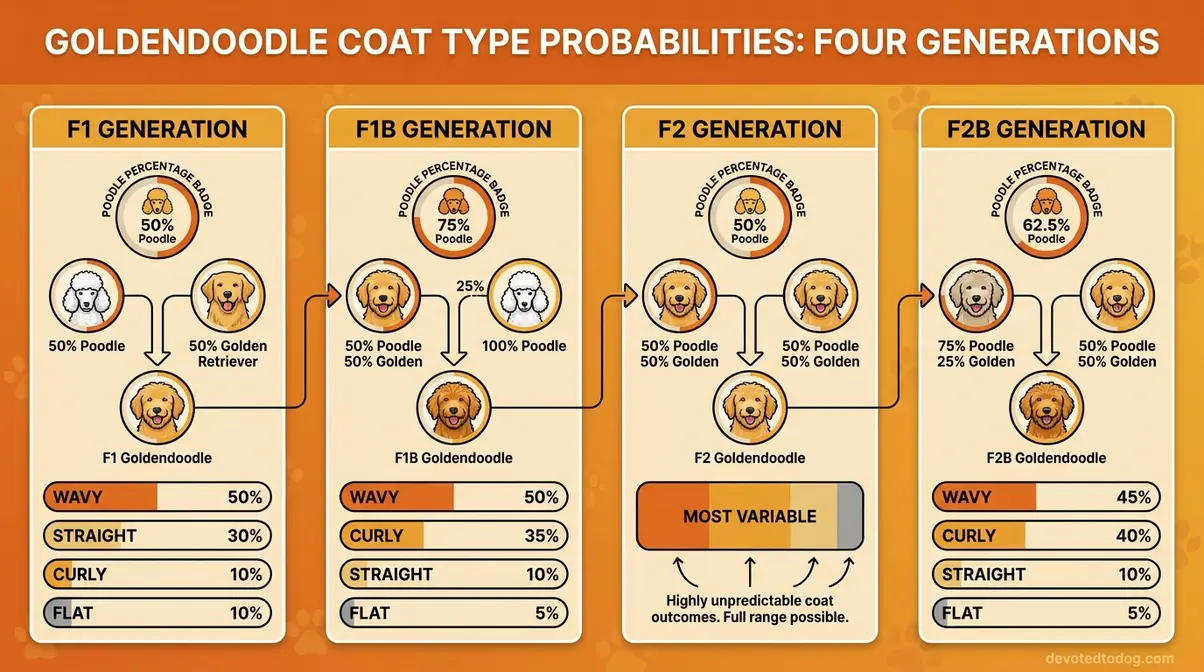
For a complete breakdown of each generation’s genetics, characteristics, and what to expect: learn about F1B Goldendoodle genetics and coats and discover F2B Goldendoodle coat types and characteristics.
The Goldendoodle Puppy Coat Transition
The Goldendoodle puppy coat transition is the period that surprises new owners most — and the one that causes the most grooming problems when owners aren’t prepared. Almost every Goldendoodle goes through a significant coat change, and knowing what to expect makes all the difference.
When Does a Goldendoodle’s Puppy Coat Change?
The Goldendoodle puppy coat transition typically begins around 5–6 months of age and is largely complete by 12–18 months — though some larger Goldendoodles continue changing until 24 months.
This experience is nearly universal. Consider this owner’s description, which captures the confusion perfectly:
“At 6 months my micro mini golden doodle has what seems to me a strange coat. His coat is: Curly Wavy Straight Soft Stiff Coarse Scruffy is what the breeder called it.”
If this sounds familiar, you’re not alone — and there’s a very good reason your puppy’s coat seems to be all of these things at once.
Here’s what’s actually happening. The puppy coat — the soft, fluffy coat a Goldendoodle is born with, which is replaced by the adult coat between 6 and 18 months — is a single layer of fine, soft fur. The adult coat is the permanent coat that reflects the dog’s genetic inheritance. During the transition, both coats are present simultaneously. The soft puppy fur tangles with the coarser, denser adult fur coming in underneath — creating that “Curly Wavy Straight Soft Stiff Coarse Scruffy” mix that so many owners notice. It’s not a problem. It’s a process.
The most dramatic coat changes occur between 6–12 months, with early signs appearing as young as 4–5 months and secondary changes continuing through 12–18 months. The process is gradual, not sudden — you won’t wake up one morning to a completely different dog. Color changes also happen during this period. Many apricot and red Goldendoodles lighten significantly during the coat transition, as the adult coat often comes in lighter than the puppy coat.
understand your Goldendoodle puppy’s coat transition in more detail, including what to expect at each stage from 8 weeks onward.
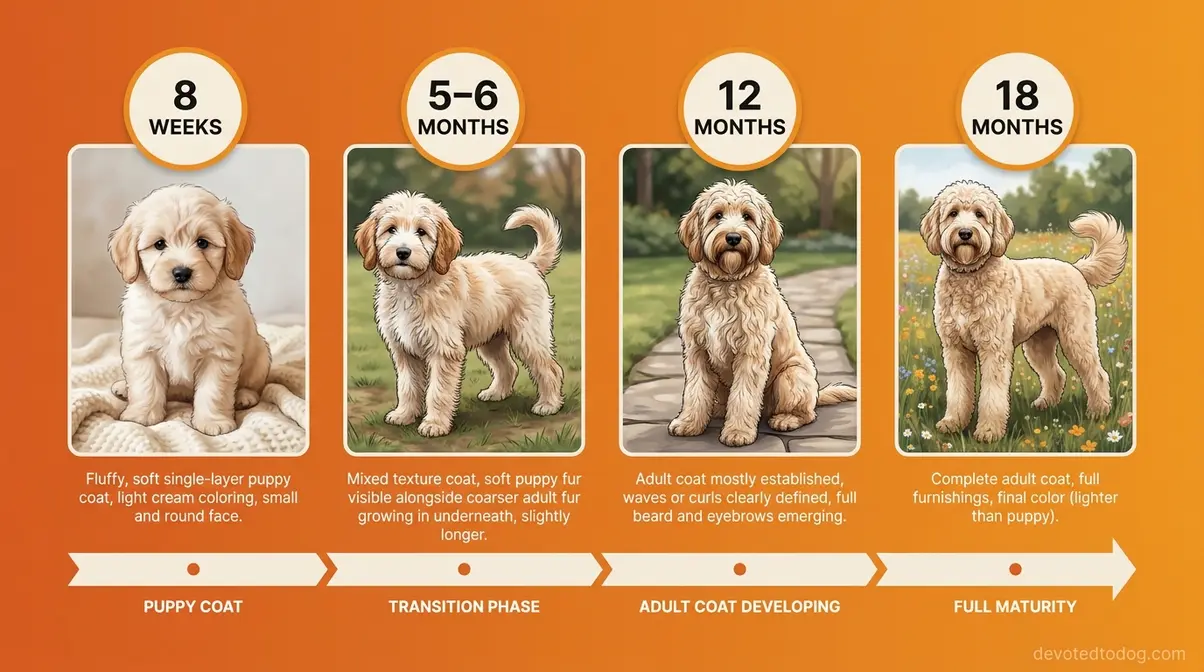
The good news? Your puppy’s coat is already sending you signals about what it will look like as an adult — you just need to know where to look.
Signs That Predict Your Puppy’s Adult Coat
This is the third and final corner of The Coat Prediction Triangle. Together, the three factors — (1) Generation, (2) DNA testing results for RSPO2 and KRT71, and (3) Early puppy clues — give you the most reliable adult coat prediction possible and eliminate most of the guesswork. Breeders commonly use the puppy clue method from as early as 6–8 weeks.
Three reliable early predictors to check:
1. Muzzle fur clue — the most reliable early indicator. Look at the fur growing around the muzzle at 6–8 weeks. If it shows a distinct wave or kink, the dog is likely to develop a wavy or curly adult coat. If the muzzle fur lies flat with no kink or wave, a straight or flat coat is more likely. This is the earliest visible signal, and breeders who work with multiple litters consistently report it as the most accurate predictor for a wavy coat goldendoodle puppy.
2. Paw tufts clue — does the puppy have fur growing between the toes and over the paws? Visible tufts of fur at the paws indicate that furnishings are active (the RSPO2 gene is expressing). This means the dog will NOT have a flat coat. No paw tufts at 6–8 weeks is an early signal of a potential flat or improper coat.
3. Overall body coat feel — gently run your fingers against the direction of coat growth. Resistance and springiness indicate curl genes are active. A smooth, flat feeling suggests a straight or flat coat. This test becomes more reliable after 8–10 weeks as the puppy coat thickens.
Using all three together gives you the most reliable prediction possible. A wavy coat Goldendoodle puppy typically shows gentle waves at the muzzle by 8 weeks, has visible paw tufts, and feels slightly resistant when brushed against the grain. A goldendoodle coat types puppy assessment at 6–8 weeks, combined with generation knowledge and DNA testing results, is the complete Coat Prediction Triangle in action.
Once you know what coat is coming, the most important thing is getting your grooming routine right during the transition — because this is when matting becomes a serious risk.
How to Groom Through the Coat Change
The puppy coat transition is the single most demanding grooming period in your Goldendoodle’s life. Both coats are present at the same time. The fine puppy fur tangles with the coarser adult fur growing in underneath, and mats — tight, compressed clumps of tangled fur that form when loose hair becomes trapped and twisted — can develop faster than at any other life stage. They form especially behind the ears, under the armpits, and around the collar area where movement is constant.
Grooming plan for the coat transition period:
- Brush daily during the transition — even for wavy-coat dogs that normally need only 3–4 sessions per week
- Use a slicker brush first to remove surface tangles and loose puppy fur
- Follow with a metal dematting rake or wide-tooth metal comb to work through the deeper undercoat layer
- Pay extra attention to high-friction zones every session: behind the ears, under the armpits, and along the collar line
- Schedule a professional groom at the start of the transition (around 5–6 months) to get a “puppy cut” that reduces total coat volume and mat risk
According to veterinary grooming recommendations for curly coats from VCA Animal Hospitals, slicker brushes are highly recommended for effectively grooming dogs with curly and wavy coats to prevent matting. However, the slicker brush alone isn’t sufficient during the transition — the metal comb is essential for finding hidden mats before they compress into solid clumps.
Warning sign: if you feel a solid, dense clump that doesn’t move after 2–3 brush strokes, that is a mat. Do NOT pull it. Use a dematting tool to work from the outside edges inward, or book a professional groomer. Pulling a mat hurts the dog and can tear the skin.
If you’re specifically looking at a Mini Goldendoodle, here’s what you need to know — their coats follow the same rules, but with a few size-specific nuances.
Mini Goldendoodle Coat Types
If you’re considering a Mini Goldendoodle, you’re probably wondering whether their coats are different from standard Goldendoodles. The short answer is: no, they’re not.
Do Mini Goldendoodles Have Different Coats?
Mini Goldendoodles can have any of the four coat types — wavy, curly, straight, or flat — with the same genetics and grooming requirements as their standard-sized counterparts. The RSPO2 and KRT71 genes work identically regardless of the dog’s size. A Mini Goldendoodle, a smaller version of the standard Goldendoodle typically produced by breeding a Golden Retriever with a Miniature Poodle, inherits coat genes from the same gene pool.
The Miniature Poodle parent passes on the same curl and furnishings genes as the Standard Poodle. Size is controlled by entirely separate genes — the IGF1 gene and related growth genes — which have no effect on coat texture, curl pattern, or shedding. What this means practically: if you’re choosing between a standard and mini Goldendoodle based on coat type, the same comparison table above applies to both.
One minor practical note: a Mini Goldendoodle may take slightly less time to brush due to lower total coat volume. A standard wavy coat might take 30–45 minutes per session; a mini wavy coat typically takes 15–20 minutes. The tools and technique are identical.
The Coat Prediction Triangle works exactly the same for Mini Goldendoodles — generation, DNA testing results, and puppy clues all apply. To explore Mini Goldendoodle size and characteristics in more detail, including weight ranges and size comparisons across generations, see the full size guide.
The most popular coat in Mini Goldendoodles — and the one most buyers specifically request — is the wavy coat.
The Most Popular Mini Goldendoodle Coat (The Wavy Look)
The mini goldendoodle wavy coat is the most requested coat type for the miniature version of the breed, and for good reason. It delivers the classic “teddy bear” appearance — the loose waves, the full beard, the shaggy eyebrows — without the daily brushing commitment that curly coats demand. For busy households who want the doodle look with manageable grooming, the wavy mini is the consistent first choice.
In Mini Goldendoodles, the wavy coat is common in F1B Minis (75% Miniature Poodle), which can also come out curly. One KRT71 gene copy is the genetic recipe for waves rather than curls or flat fur. F1 Mini Goldendoodles (50% Miniature Poodle) produce more variable outcomes, with a higher chance of straight coats appearing.
Grooming for a mini wavy coat follows the same frequency as a standard wavy — 3–4 sessions per week — but each session runs about 15–20 minutes rather than 30–45. The tools are identical: a slicker brush followed by a stainless steel metal comb. Professional grooming every 8–10 weeks keeps the coat at a manageable length.
If you’re searching specifically for a mini goldendoodle wavy coat, ask breeders for F1B Mini Goldendoodle litters and request DNA testing results for the KRT71 and RSPO2 genes. A breeder who tests knows exactly what coat probability each puppy carries — and that removes the guesswork entirely.
Before we wrap up, let’s address the most common misconceptions and problems owners encounter — starting with the one that catches almost every new Goldendoodle owner off guard.
Coat Myths, Problems, and What to Watch For
Understanding goldendoodle coat types means knowing not just what each coat looks like, but what can go wrong — and what’s simply misunderstood. This section covers the three issues that trip up new owners most often.
Matting — The Most Common Coat Problem
Matting happens to almost every first-time doodle owner at least once. It’s not a grooming failure — it’s what happens when you don’t know what you’re dealing with yet. Here are the three most common scenarios:
- Skipping brushing during the puppy coat transition. The most common cause of severe matting. Owners brush every few days because the puppy seems fine — but hidden mats are forming under the surface where the two coats meet. By the time they’re visible, they’re often too compressed to brush out. Prevention: daily brushing from 5 months onward, no exceptions.
- Missing high-friction zones. Behind the ears, under the armpits, and along the collar line mat first because constant movement twists the fur. These areas need attention at every brushing session — not just occasionally.
- Using the wrong brush. A slicker brush alone misses undercoat mats that form below the surface layer. Always follow the slicker brush with a metal comb or dematting rake to check for hidden tangles. If the comb snags, there’s a mat forming.
Using The Coat Prediction Triangle from the start — knowing your dog’s generation, getting a DNA test, and reading puppy clues early — also helps you anticipate grooming demands before they become problems.
The “Hypoallergenic” Myth — What No One Tells You
No dog breed is truly hypoallergenic — and this is one of the most commonly misunderstood aspects of the Goldendoodle breed. Dog allergies are triggered by a protein called Can f 1, found in a dog’s saliva, urine, and dander — not just fur. Every dog produces this protein, regardless of coat type.
What IS true: Goldendoodles with the RSPO2 furnishings gene (wavy and curly coats) produce significantly less loose hair, which means less dander is distributed around the home. According to UC Davis Veterinary Genetics Laboratory, dogs with the RSPO2 furnishings gene have a strong propensity to shed less — making them a meaningfully better choice for allergy-sensitive households, not an allergen-free one. The flat coat, which lacks this gene, offers no allergy advantage.
No Goldendoodle coat type can guarantee a reaction-free experience. If anyone in your household has severe dog allergies, spend time with the specific dog before committing to a purchase. Even some breeders overstate the hypoallergenic claim — and it’s worth approaching any “100% hypoallergenic” marketing with healthy skepticism.
When to See a Professional Groomer
Knowing when to hand grooming duties to a professional saves your dog from discomfort and saves you from a costly shave-down. Three clear thresholds:
- Any mat you can’t brush out in 3–4 strokes. Stop and see a groomer. Pulling a compressed mat hurts the dog and can damage the skin underneath. A groomer has the right tools to work through it safely.
- The puppy’s first full groom (at 5–6 months). Always professional. This sets the coat length baseline for the adult coat and gets your puppy comfortable with the grooming process early.
- A curly coat that hasn’t been professionally groomed in more than 8 weeks. The mat risk is high. Curly coats need professional attention every 6–8 weeks to stay manageable — not every 3 months.
This article is general information, not veterinary advice. If your dog shows any of the signs above, or you have questions about your Goldendoodle’s skin and coat, talk to your veterinarian.
Frequently Asked Questions
What kind of coat does my Goldendoodle have?
Your Goldendoodle likely has one of four coat types: wavy (soft, loose waves), curly (tight Poodle-like ringlets), straight (smooth, Golden Retriever-like), or flat/improper (no beard or eyebrows, highest shedding). To identify it, look at the fur around the muzzle — waves or kinks indicate a wavy or curly adult coat, while flat muzzle fur suggests straight or flat. Puppies under 6 months may show a mixed texture as their adult coat grows in. If you’re unsure, a DNA test for the RSPO2 and KRT71 genes provides a definitive answer.
Are F1 or F2 Goldendoodles better?
Neither F1 nor F2 Goldendoodles is definitively “better” — the right choice depends on your priorities for coat type and shedding predictability. F1 Goldendoodles (50% Poodle, 50% Golden Retriever, according to the Goldendoodle Association of North America) most often produce wavy or straight coats with low to moderate shedding, though outcomes vary from puppy to puppy. F2 Goldendoodles (offspring of two F1s) have less predictable coats — ranging from curly to straight — and some individuals may shed more than expected. If coat predictability matters to you, F1 or F1B generations are generally more reliable choices.
Which is better, F1B or F1BB Goldendoodle?
An F1B Goldendoodle (75% Poodle, 25% Golden Retriever, according to GANA breed standards) is often preferred for its low-shedding wavy or curly coat, making it suitable for most allergy-sensitive households. An F1BB Goldendoodle (87.5% Poodle) further increases the likelihood of a non-shedding, tightly curly coat — the top choice for families with more severe dog allergies. The F1BB’s higher Poodle percentage also means a higher grooming commitment, since curly coats require daily brushing. Choose F1B for a balance of low shedding and moderate grooming; choose F1BB if minimizing allergens is the top priority.
What is a flat coat or improper coat Goldendoodle?
A flat coat (also called an improper coat) Goldendoodle lacks the furnishings gene (RSPO2), meaning it doesn’t develop the characteristic beard, mustache, or shaggy eyebrows. Its coat resembles a Golden Retriever’s — smooth, straight, and lying flat against the body — and it sheds the most of the four coat types, year-round. Flat coats are not considered allergy-friendly and require a deshedding brush rather than a slicker brush. Responsible breeders use DNA testing to screen for the RSPO2 gene, which reduces the chance of flat-coated puppies appearing in a litter.
The Complete Picture
For new and prospective Goldendoodle owners, understanding goldendoodle coat types comes down to three genes and four outcomes. The RSPO2 gene determines whether your dog has furnishings — the beard, eyebrows, and paw tufts that define the doodle look — and strongly influences shedding levels. The KRT71 gene determines how tightly the coat curls. Together, these two genes produce wavy, curly, straight, or flat coats, with shedding levels and grooming demands that vary significantly across all four.
The Coat Prediction Triangle — generation + DNA testing + puppy clues — takes the guesswork out of the most confusing part of owning a doodle. The “strange coat” confusion you felt looking at your 6-month-old puppy? That’s the two coats transitioning simultaneously, and it’s temporary. Knowing your dog’s generation narrows the probability. A DNA test for RSPO2 and KRT71 confirms the genetics. And muzzle fur at 6–8 weeks gives you the first visible clue. Use all three together, and the answer is almost always clear.
Start by identifying which of the four coat types your dog has using the identification guide at the top of this article — then bookmark the comparison chart for your next grooming session. For readers who want to go deeper on colors and visual differences, explore all 18+ Goldendoodle colors and patterns in the full visual reference.