Your Golden Retriever puppy is already learning , the question is what. The moment those paws hit your floor, habits begin forming: where to eliminate, what to chew, how to get your attention. Golden retriever puppy training doesn’t start when you decide you’re ready. It starts on Day 1, whether you’re prepared or not.
Puppy training is the foundation phase of a longer journey. For the full stage-by-stage picture, see our complete guide to training a Golden Retriever at every age.
Every indoor accident, every bite on your hand, every sleepless night is a habit being formed right now , either by you, or by default. The cost of waiting even a week is real: the socialization window that shapes your puppy’s temperament for life begins closing around 16 weeks of age.
In this guide, you’ll get a phase-by-phase training blueprint , with exact daily schedules, behavioral fixes, and age-by-age timelines , so you can stop guessing and start making progress. We cover potty training, crate introduction, biting, core commands, leash work, feeding schedules, and when to call a professional.
Golden retriever puppy training works best when it starts on Day 1 , puppies begin forming habits from the moment they arrive home.
- Start immediately: The socialization window closes at ~16 weeks (UC Davis School of Veterinary Medicine) , missing it makes fear-based behaviors significantly harder to reverse
- The Puppy Phases Playbook: Angel Phase (2–6 months) → Land Shark Phase (3–6 months) → Teen Rebellion (6–18 months) , each phase needs different tactics, not the same response
- Potty training typically takes 4–6 months for full reliability, but most puppies show strong consistency within 4–6 weeks of a structured schedule; most puppies can hold their bladder approximately 1 hour per month of age
- Biting stops faster with redirection to chew toys than with punishment , Golden Retrievers are mouth-driven by breed design
- 5-minute sessions, 2–3 times daily outperform marathon training for puppies under 6 months
Starting Puppy Training on Day One
The day you bring home a Golden Retriever puppy , one of the most trainable yet mischievous breeds in the retriever family , is the first day of training, whether you treat it that way or not. Start golden retriever puppy training at 8 weeks old, the typical age puppies arrive home. According to UC Davis School of Veterinary Medicine, a Tier-1 veterinary research institution, the critical social development period for dogs runs from approximately 3 to 14 weeks of age. During this window, puppies are neurologically primed to accept new experiences as normal. Once it closes, fear-based behaviors become significantly harder to reverse.
That’s not a reason to panic , it’s a reason to act. A golden retriever puppy training schedule that begins on arrival gives you the best possible use over the next 18 months. The good news: Golden Retrievers are food-motivated, people-oriented, and genuinely eager to please. You have every advantage. What most owners lack isn’t willpower , it’s a map.
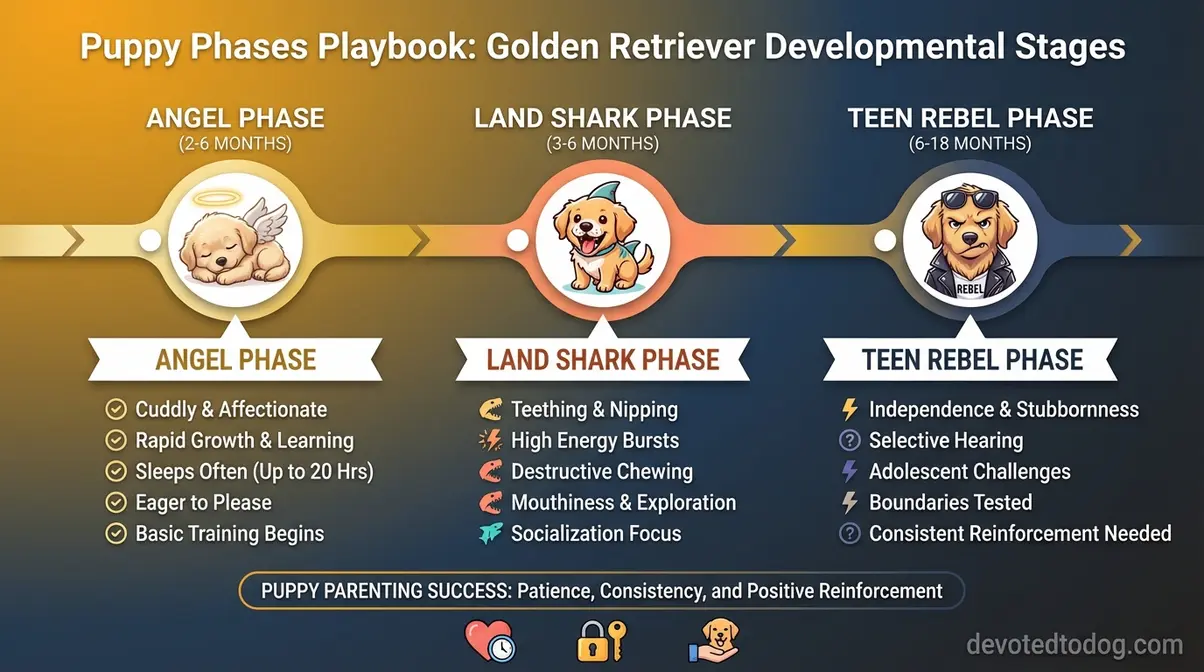
Caption: The Puppy Phases Playbook maps the behavioral arc from 8 weeks to 18 months , knowing which phase you’re in changes everything about how you respond.
The Three Puppy Phases to Expect
The Puppy Phases Playbook is a three-phase framework that gives owners a predictive roadmap rather than reactive advice. Each phase is temporary. Each phase has a specific playbook. Knowing which one you’re in changes everything.
Angel Phase (2–6 months): Your puppy is eager to please and relatively easy to impress. This is the highest-use window for socialization and command foundations. Use it aggressively. Every new surface, sound, and person you introduce now reduces fear responses later.
Land Shark Phase (3–6 months): Teething intensifies mouthing behavior , this is instinct, not aggression. Golden Retrievers were bred to use their mouths; during this phase, they simply can’t help it. Active management (covered in H2 #4) is your tool here, not punishment.
Teen Rebel Phase (6–18 months): Hormonal changes create what owners experience as “selective hearing.” Commands your puppy knew cold may suddenly seem forgotten. The AKC training timeline identifies this as a critical period requiring consistent reinforcement, noting it can temporarily disrupt previously learned behaviors. This is normal and temporary , not a training failure.
“Myth: Golden Retriever puppies are always easy. Fact: They’re still puppies. They get distracted. They get mischievous. They test boundaries.”
For a complete beginner’s guide to golden retriever puppy training, that truth is the starting point. Each phase requires a different response , the same approach that works at 10 weeks will frustrate you at 10 months.
Now that you know what’s coming, let’s look at what to do in those first 7 days , before habits have a chance to set.
Your First Week Survival Checklist
The first week with a golden retriever puppy feels chaotic because it genuinely is. Reduce the chaos with a concrete setup before your puppy arrives, then follow this sequence:
- Set up the crate before the puppy arrives. Place it in your bedroom, near your bed. Crate sizing matters: big enough for the puppy to stand up and turn around, not so large they can sleep in one corner and use another as a bathroom. A divider panel lets you resize as they grow.
- Establish the potty spot immediately. Choose one location in the yard and use it every single time. Scent recognition accelerates learning , the smell of previous success cues the behavior.
- Begin name recognition on Day 1. Say the puppy’s name, immediately follow with a treat and praise. Repeat 10–15 times per session, several sessions per day. Keep it simple.
- Limit house access. Use baby gates to create a puppy zone , one or two rooms maximum. A puppy loose in a large house will find trouble faster than you can follow.
- Schedule the first vet visit within 72 hours. Establish a baseline health record and confirm the vaccination schedule before socialization begins.
- Start socialization immediately , safely. New sounds (a running dishwasher, traffic noise), new surfaces (tile, grass, carpet), new people. The AVSAB position on when to start puppy classes recommends starting socialization as early as 7–8 weeks, provided the puppy has received initial vaccines at least 7 days prior.
- Set a daily schedule from Day 1: wake → potty → eat → play → nap. Repeat. Predictability is the foundation of house training.
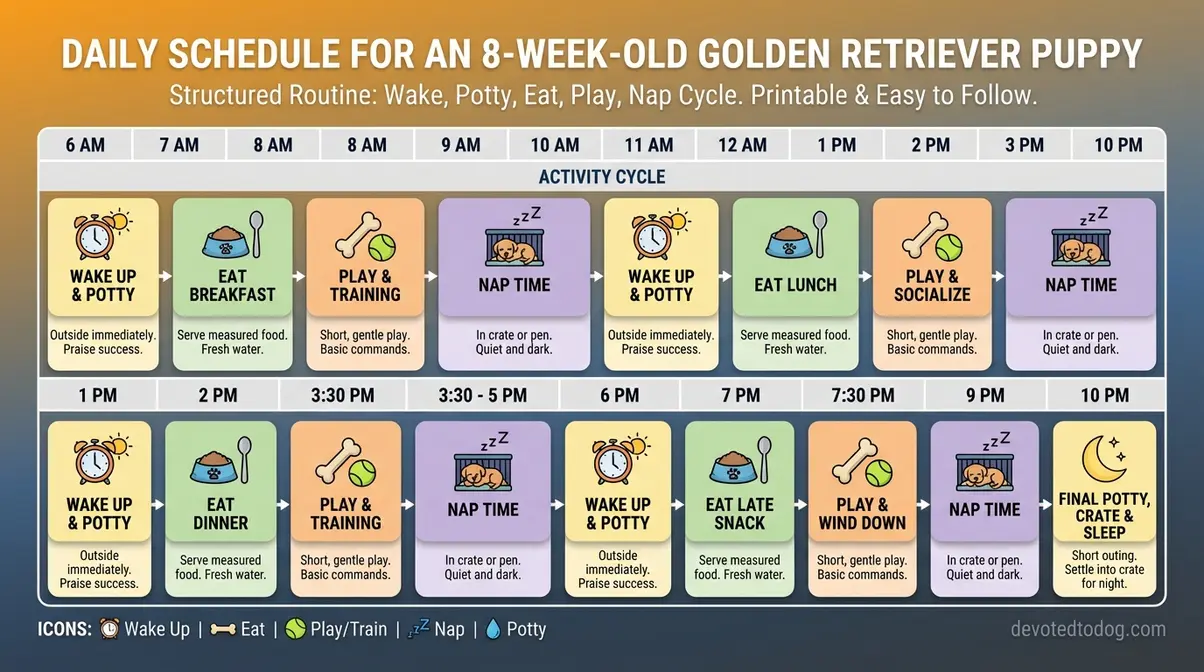
Caption: Print this schedule and post it where all family members can see it , consistency across people is as important as consistency across days.
One framework that makes the first week dramatically easier is understanding two rules that most guides skip entirely: the 10-10-10 rule and the 7-7-7 rule.
The 10-10-10 and 7-7-7 Rules
These two frameworks work together to structure your entire golden retriever puppy training schedule , one governs daily rhythm, the other governs socialization breadth.
The 10-10-10 Rule structures each training cycle throughout the day: 10 minutes of focused training (sit, name recognition, potty cues), followed by 10 minutes of active play, followed by 10 minutes of rest in the crate or a quiet spot. Then repeat. This isn’t a daily total , it’s a cycle. Running four to five of these cycles per day keeps sessions short enough to hold a puppy’s attention while preventing the mental fatigue that looks like stubbornness. A sample morning: training cycle from 8:00–8:30 AM, potty break, nap, then next cycle at 10:30 AM.
The 7-7-7 Rule is a socialization checklist, popularized by breeder and researcher Dr. Carmen Battaglia, based on exposing puppies to seven different categories of experience , surfaces walked on, locations visited, people met, objects encountered, and more. According to Rea Road Animal Hospital’s 7-7-7 guide, the rule covers seven key developmental components that shape how puppies engage with the world. Think of it as a minimum, not a ceiling , you’re not done at seven; you’re just starting.
How they work together: The 10-10-10 provides the daily structure that keeps training manageable. The 7-7-7 fills the “play” and “exploration” windows with purposeful socialization. Use both simultaneously starting Week 1.
With your schedule and framework in place, the next critical skill is potty training , and it’s more systematic than most owners expect.
Potty Training Your Golden Retriever Puppy
Potty training a golden retriever puppy is less about the puppy’s intelligence and more about your schedule consistency. House training a golden retriever puppy works on a simple principle: prevent accidents through supervision and timing, then reward success immediately. Most owners see reliable outdoor results within 4–6 weeks of following a structured routine , full nighttime reliability typically follows by 4–5 months.
A 10-week-old Golden Retriever puppy can hold its bladder for approximately 2–2.5 hours , leaving them alone for 3+ hours almost guarantees an indoor accident. Understanding that number is the foundation of the entire system.
The Outdoor Potty Routine
This sequence is how you train a golden retriever puppy to pee outside reliably. Follow it every time, without exception:
- Take your puppy outside immediately after: waking up from any sleep, finishing a meal, ending a play session, and every 2 hours during waking hours.
- Go to the same spot every time. Scent residue from previous successful trips acts as a cue , your puppy’s nose does half the work for you.
- Use a consistent verbal cue (“go potty,” “outside,” or any phrase you choose) while the puppy is actively eliminating. Over time, this phrase becomes a trigger.
- Reward within 3 seconds of the behavior , not when you get back inside, not after you’ve praised them for five seconds. Treat plus enthusiastic verbal praise, immediately.
- Wait outside for up to 5 minutes. If nothing happens, go back inside, keep the puppy in your direct sight or in the crate, and try again in 15 minutes.
- Track success with a simple tally. Patterns emerge , most puppies have predictable post-meal windows of 5–30 minutes. Knowing yours makes the schedule tighter.
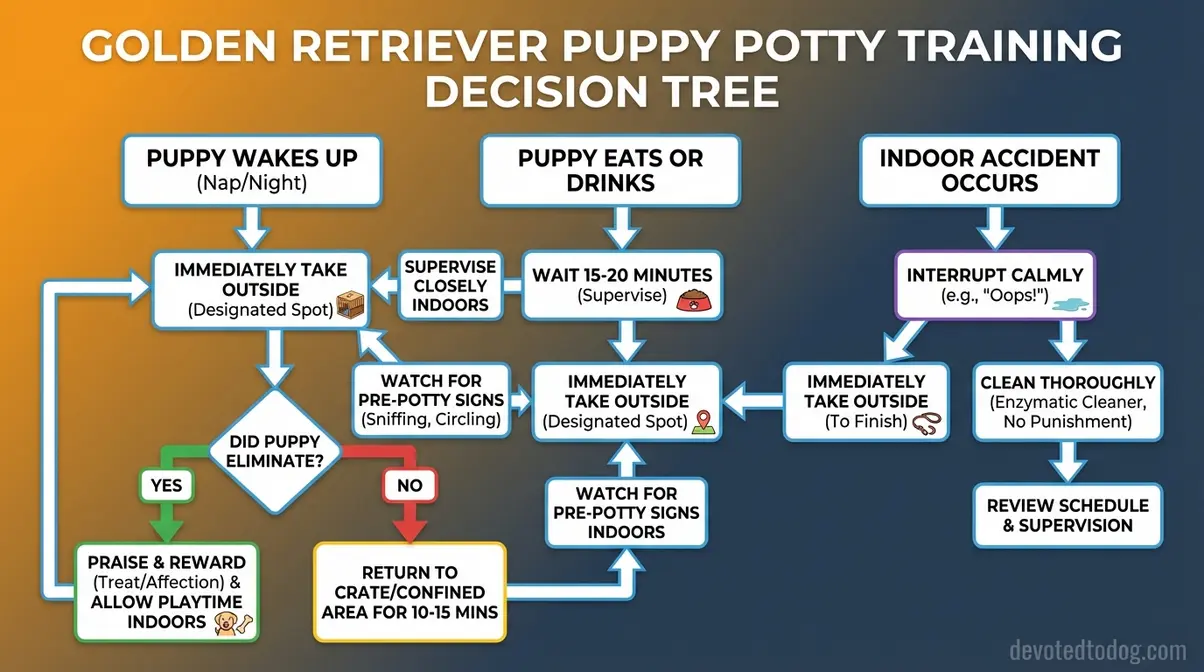
Caption: This flowchart covers every scenario , use it as a quick reference during the first four weeks when the routine is still being established.
Purdue University veterinary house training tips confirm that constant supervision and short, consistent outdoor trips are the most effective approach for new puppies. For a detailed walkthrough of how to potty train a golden retriever puppy, including common schedule variations, that resource covers the full system.
Even with the best routine, accidents will happen. Here’s exactly what to do when they do , and what NOT to do.
Handling Indoor Accidents
An indoor accident is information, not a failure. It means the schedule needs tightening , not that your puppy is “bad” or untrainable.
Immediate response: If you catch the accident in progress, interrupt calmly (no shouting, no dramatic reaction) and immediately take the puppy outside. If they finish outside, reward with genuine enthusiasm. If you find the accident after the fact, say nothing , puppies cannot connect a punishment to an action that happened more than a few seconds ago.
Cleaning matters more than most owners realize. Use an enzymatic cleaner , a cleaning product that chemically breaks down urine odor markers at the molecular level , rather than standard household cleaners. Standard products mask the smell to human noses but leave behind the chemical markers that tell your puppy “this is a bathroom spot.” Enzymatic cleaners eliminate those markers entirely, removing the scent signal that attracts repeat accidents.
What NOT to do: Rubbing a puppy’s nose in an accident, scolding after the fact, or using punishment-based corrections for house training mistakes all create anxiety without teaching anything. The puppy learns to fear you near the accident scene , not to go outside.
Understanding how long your puppy can actually hold it is the key to setting a realistic schedule.
Age-Based Puppy Bladder Guide
The general rule: one hour of bladder control per month of age, plus one. A 2-month-old puppy holds it for roughly 2 hours; a 3-month-old for 3 hours. Here’s what that means in practice:
| Age | Max Hold Time | Potty Trips Per Day |
|---|---|---|
| 8 weeks | ~2 hours | 8–10 |
| 10 weeks | ~2.5 hours | 7–8 |
| 3 months | ~3 hours | 6–7 |
| 4 months | ~4 hours | 5–6 |
| 6 months | ~6 hours | 4–5 |
Overnight strategy for the first 4–6 weeks: Last potty trip at 11 PM, set an alarm for 2–3 AM, then again at 5–6 AM. Ohio State University’s crate training benefits resource confirms that crate training prevents inappropriate elimination and helps establish a secure environment , making the crate your most important overnight tool.
A crate makes the potty schedule dramatically easier to enforce , and when done right, puppies actually love their crates.
Can a 10-week-old be left for 3 hours?
No , a 10-week-old Golden Retriever puppy should not be left alone for 3 hours. At this age, puppies can typically hold their bladder for approximately 2–2.5 hours maximum, following the general rule of one hour per month of age (Purdue University College of Veterinary Medicine). Leaving them longer risks indoor accidents and can contribute to separation anxiety formation. If your schedule requires absences longer than 2 hours during the day, arrange a midday check-in, dog walker, or puppy daycare to cover the gap.
Crate Training and Sleep Habits
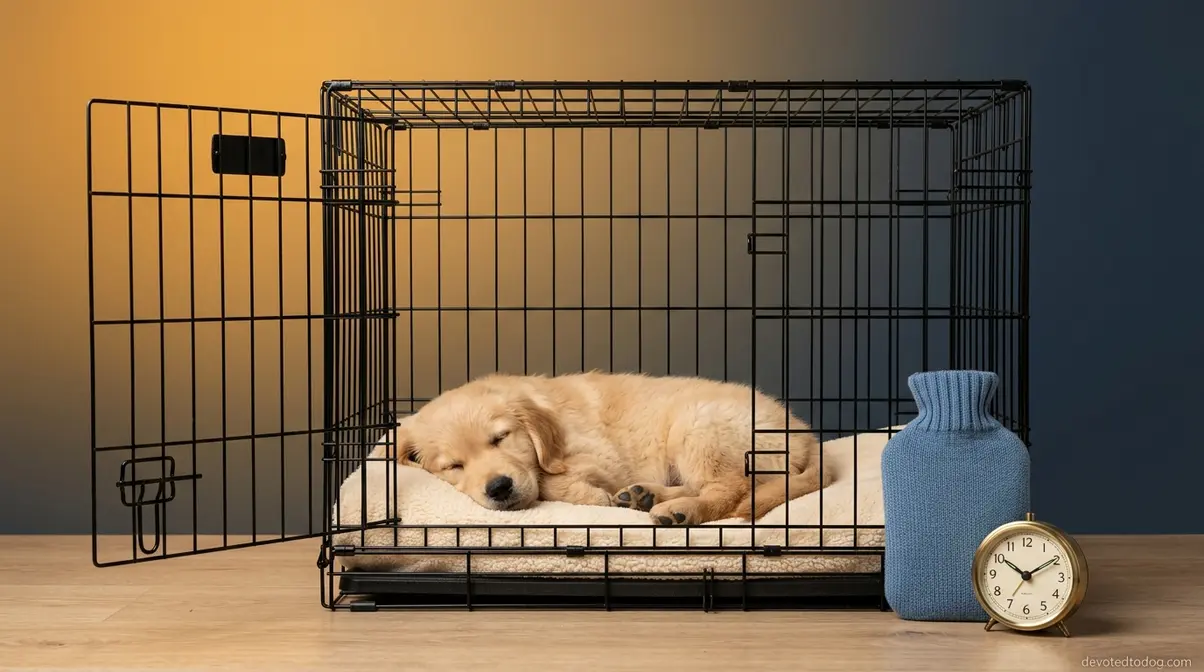
Crate training a golden retriever puppy is one of the highest-return investments of the first month , not as a punishment tool, but as a management and safety system. A properly introduced crate prevents accidents, protects your belongings, and gives your puppy a secure space they’ll choose voluntarily. The key word is “introduced.” A puppy thrown into a crate and left to cry learns that the crate means isolation. A puppy introduced gradually learns it means safety.
Puppies placed in crates near their owner’s bed during the first week show significantly lower stress signals than those isolated in another room, per Ohio State University’s crate training benefits guidance. That single setup decision shapes the first two weeks dramatically.
Where to Sleep the First Night
Place the crate in your bedroom, within arm’s reach of the bed. Your puppy just left their littermates and mother , the transition to silence and solitude in a separate room is unnecessarily harsh and creates the separation anxiety, a stress response that develops when puppies aren’t gradually taught to be alone, that you’ll spend months undoing. Proximity to you provides scent and sound comfort without creating a co-sleeping habit.
For crate training your golden retriever puppy in those first nights, two simple tricks make a measurable difference. First, the ticking clock trick: wrap a ticking analog clock in a towel and place it near (not inside) the crate. The rhythmic sound mimics the heartbeat of littermates. Second, a warm water bottle , wrapped securely in a towel and placed in one corner of the crate , provides warmth that replaces the pile of siblings your puppy is used to sleeping against.
What NOT to do: Don’t bring your puppy into your bed. The habit forms within days and becomes genuinely difficult to reverse. Most puppies sleep through the night by 4 months with a consistent crate routine.
Once you’ve chosen where the crate goes, the introduction process is everything , a rushed introduction creates crate resistance that’s hard to undo.
Step-by-Step Crate Introduction
How to crate train a golden retriever puppy correctly means going slower than you think you need to. Spread this over 3–5 days:
- Day 1: Place the crate open in the room with a treat inside. Don’t close it. Let the puppy explore freely , the goal is “this thing is interesting,” not “this thing is my den.”
- Day 2: Feed meals near the crate, then move the bowl just inside the door. Still no closing.
- Day 3: Feed meals fully inside the crate. Close the door during the meal, then open it immediately when they finish eating.
- Days 4–5: Extend closed time to 10 minutes after eating, then 30 minutes, then an hour , while you remain in the room. The puppy learns that closed door ≠ abandoned.
- Never use the crate as punishment. Not once. The crate must remain a positive space throughout puppyhood and adolescence.
Crate sizing reminder: The puppy should be able to stand up, turn around, and lie down comfortably. A crate large enough for a full-grown Golden will give a young puppy enough room to designate a bathroom corner , defeating the purpose entirely.
The hardest part for most owners isn’t the daytime crate , it’s the first few nights when the crying starts.
Managing Nighttime Crying
The most important skill in crate training golden retriever puppies at night is distinguishing between two very different sounds.
The “I’m lonely” whine is relatively steady, rhythmic, and doesn’t escalate dramatically. This is comfort-seeking behavior. Responding immediately , speaking, picking up, letting them out , reinforces the exact behavior you’re trying to reduce. Wait 5 minutes. If it settles, you’ve confirmed it was comfort-seeking.
The “I need to potty” cry escalates. It gets more urgent, more frantic, and doesn’t settle. At this age , a 10-week-old puppy can hold their bladder for approximately 2–2.5 hours maximum , this cry is almost always legitimate at night. Take the puppy outside immediately, with zero fanfare: no talking, no play, straight to the potty spot and straight back into the crate. No exceptions.
Most puppies adapt to nighttime crating within 1–2 weeks of consistent handling. The owners who struggle longest are those who respond inconsistently , sometimes picking up the puppy, sometimes not , because variable reinforcement is actually harder to extinguish than consistent reinforcement.
Once nights are manageable, daytime brings its own challenge: the biting. And with Golden Retrievers, this one is breed-specific.
Stopping Biting and Setting Boundaries
Golden retriever puppy biting is the complaint that fills every new owner’s search history around the 10–12 week mark. The Land Shark Phase of the Puppy Phases Playbook is real, it’s temporary, and it has a specific solution , but that solution requires understanding why it’s happening first.
When a puppy bites and the person retreats, the biting behavior is inadvertently reinforced , making consistent disengagement the most effective counter-technique, per Tufts University insights on fear-based biting. That single insight explains why the instinct to pull your hand away and yelp often makes the biting worse, not better.
Why Golden Retrievers Bite
Golden Retrievers were selectively bred over generations to use their mouths , retrieving game without damaging it requires extraordinary mouth awareness and drive. That same instinct shows up in your puppy as golden retriever puppy biting and growling during play. It’s not a character flaw; it’s a feature of the breed that requires active management.
During the Land Shark Phase (3–6 months), teething adds physical discomfort to the mix. Chewing and mouthing relieve the pressure of incoming adult teeth. Your hands, ankles, and furniture are convenient targets , not because your puppy dislikes you, but because they’re there.
Growling during play is usually normal. A play growl comes with a loose body, a wagging tail, and no fixed stare. A fear or warning growl comes with stiffening, a fixed stare, and potentially lip curling. The former responds to redirection; the latter may require professional evaluation. For more on how to stop your golden retriever puppy from biting, the distinction between these two behaviors is the critical first step.
Knowing WHY they bite makes the fix obvious: don’t retreat. Instead, use this three-step method.
The Redirect-and-Disengage Method
Training a golden retriever puppy not to bite requires consistency from every person in the household. If one family member allows nipping while others don’t, the puppy learns the behavior is variable , and variable reinforcement is harder to extinguish than consistent reinforcement.
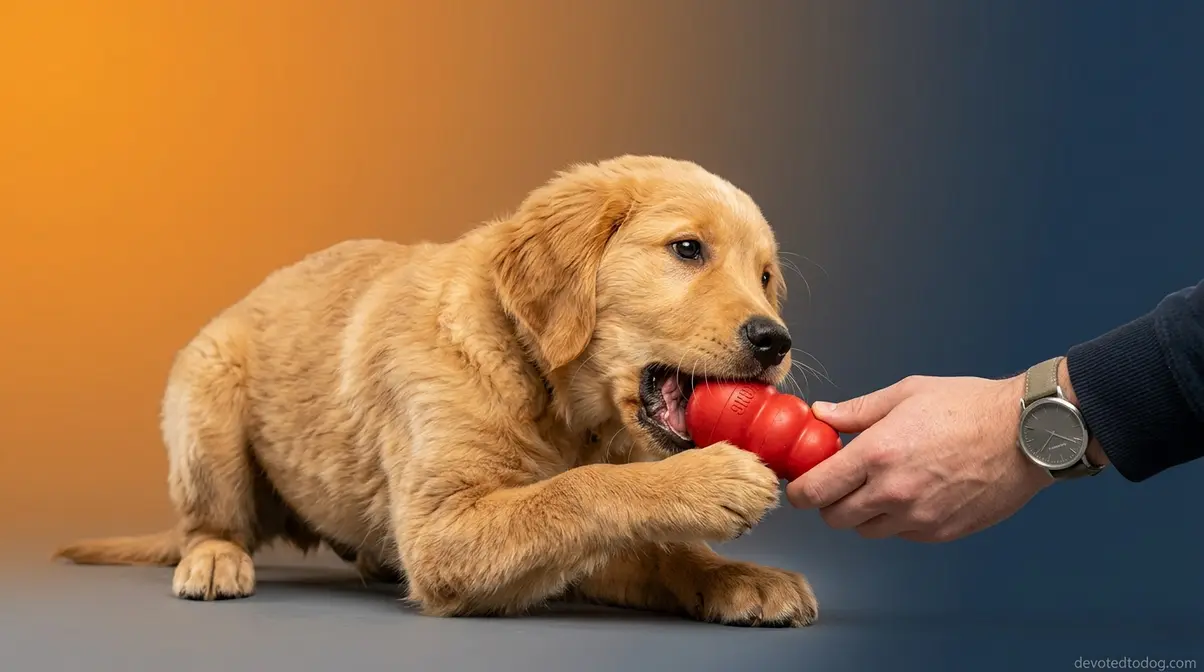
- Redirect: The moment teeth touch skin, immediately offer a chew toy , hold it out before removing your hand. The sequence matters: toy appears first, hand disappears second. This teaches the puppy what to bite, not just what not to bite.
- Praise: When they take the toy, mark the behavior immediately (“yes!” or a clicker click) and follow with a treat. You’re rewarding the toy choice, not the biting.
- Disengage: If biting continues after the redirect , or if they ignore the toy , stand up calmly and leave the room for 30–60 seconds. No eye contact, no scolding, no drama. The removal of your attention is the consequence. This reverse time-out is more effective than any physical correction.
Chew toy selection matters. Frozen Kongs, rubber chew rings, and rope toys work well. Avoid soft plush toys during the training phase , they teach the puppy that soft textures are acceptable to bite, which includes hands.
For a visual demonstration of the redirect-and-disengage technique:This takes 2–4 weeks of consistent application. Every family member must use the same protocol , no exceptions.
The biting usually peaks around 4–5 months, then eases , right before the teenage phase hits and introduces a whole new set of challenges.
Surviving the Teenage Rebellion
The Teen Rebel Phase of the Puppy Phases Playbook is when many owners mistakenly conclude that their training has failed. It hasn’t. Golden retriever puppy training progress doesn’t disappear during adolescence , it goes underground temporarily while hormonal changes run their course.
What actually happens: your puppy’s brain is undergoing significant neurological reorganization. The commands they knew cold at 5 months require more mental effort to access at 8 months. Combine that with increased independence and environmental curiosity, and you get what owners describe as “selective hearing.” The AKC training timeline notes this phase requires immense patience, as puppies may temporarily forget prior training due to hormonal changes.
- What to do differently during this phase:
- Shorten sessions further (3–5 minutes) and increase session frequency
- Use higher-value treats than you did in the Angel Phase , the distraction level is genuinely higher
- Go back to basics: sit, down, name recall. Rebuild confidence on commands they know before adding complexity
- Maintain the potty schedule even if the puppy seems to “know” it , regressions happen
Most Golden Retrievers emerge from the Teen Rebel Phase by 18–24 months as reliable, genuinely well-mannered dogs. The owners who get there are those who kept training through the resistance rather than waiting it out.
Before the teenage phase arrives, you want solid command foundations in place , because those are exactly what you’ll lean on when things get harder.
How do I stop my puppy from biting?
To stop your Golden Retriever puppy from biting, use consistent redirection rather than punishment. The moment your puppy nips, immediately offer a chew toy and praise them enthusiastically when they take it. If biting continues after the redirect, calmly leave the room for 30–60 seconds to remove your attention as a consequence. Because Golden Retrievers are natural retrievers, they explore with their mouths. This behavior responds well to the redirect-and-disengage method, but it usually requires 2–4 weeks of daily consistency from every family member to fully resolve.
Teaching Basic Golden Commands
The Angel Phase of the Puppy Phases Playbook is when command foundations set fastest. Golden retriever puppy training for basic commands works on a simple principle: lure the behavior, mark the moment it happens, reward immediately. Short sessions, high repetition, consistent markers. Dogs attending puppy classes before 12–20 weeks of age are significantly less likely to develop fearful or aggressive behaviors later in life (AVMA research on the benefits of early socialization) , which means the commands you teach now do more than teach commands. They build the behavioral foundation for everything that follows.
Teaching Sit, Down, and Stay
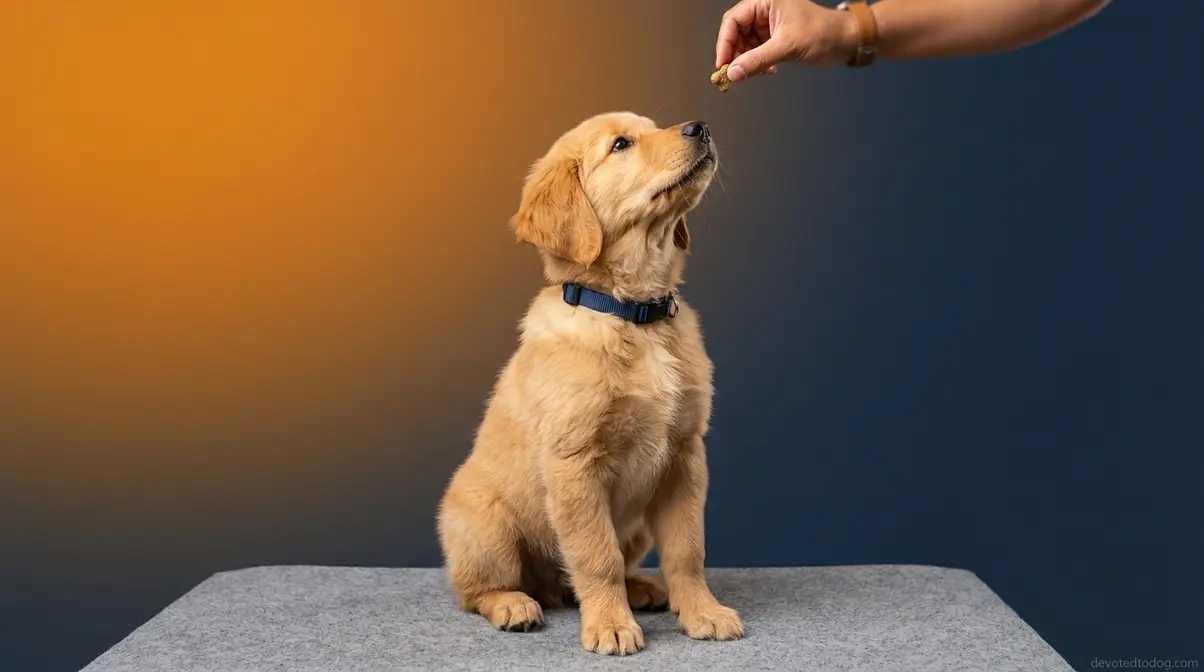
Training a golden retriever puppy to sit is the first command most owners try , and it’s the right starting point because success comes quickly, which builds both puppy confidence and owner motivation.
- Teaching Sit:
- Hold a small treat at your puppy’s nose level
- Slowly move the treat up and back over their head , their bottom naturally lowers as their nose follows the treat upward
- The moment their bottom touches the floor, say “sit” once
- Mark immediately (“yes!” or click) and deliver the treat
- Teaching Down (from Sit):
- Start from a sit position; hold the treat at nose level
- Slowly lower the treat straight down to the floor between their front paws
- As their elbows touch the floor, say “down” once
- Mark and reward immediately
- Teaching Stay:
- Begin with 1-second stays and add roughly 1 second per successful repetition
- Build the “3 Ds” separately: Distance (step away), Duration (hold the stay longer), Distraction (add noise or movement) , never add all three at once
- Always use a release word (“okay” or “free”) before the puppy breaks the stay on their own
Drop It / Leave It: Hold a treat in a closed fist. When the puppy stops mouthing your hand, open your fist. This builds the foundation for dropping stolen socks, leash biting, and the inevitable stolen sandwich. For basic obedience training commands in sequence, starting with these four creates the scaffolding for everything more complex.
Even the best commands fall apart if sessions run too long. Here’s the session structure that actually works with puppies.
The 5-Minute Training Rule
Puppies under 5 months have an effective attention span of roughly 5–10 minutes for structured training before mental fatigue sets in. Mental fatigue in puppies looks identical to stubbornness: they start sniffing the ground, yawning, looking away, or erupting into sudden zoomies. These aren’t defiance signals , they’re fatigue signals.
Recommended session structure: 5 minutes of focused training, 2–3 times daily. Morning, midday, and before dinner works well for most schedules. This revisits the 10-10-10 rule from the Foundations section , the reason that framework works is precisely because it respects the 5-to-10-minute ceiling.
- Signs your puppy has hit the wall:
- Repeated yawning during a session
- Sniffing the ground instead of watching you
- Suddenly going limp or flopping down
- Zoomies immediately following a command
One practical adjustment: exercise your puppy for 10–15 minutes before a training session. A tired puppy focuses better than a bouncing one. “A tired puppy is a good puppy” is one of the truest clichés in dog training.
The right treats make short sessions dramatically more effective , and for Goldens, treat selection is almost a science.
Clicker Training and Treat Selection
Clicker training uses a small handheld device to mark the exact moment of correct behavior , more precisely than a verbal marker, because the click is always the same sound, delivered at the same instant. For teaching new behaviors where timing is everything (like the exact moment a bottom touches the floor), a clicker gives you a precision advantage. Once a behavior is solid, you can phase out the clicker and rely on verbal markers.
- Treat criteria for Golden Retrievers:
- Small (pea-sized or smaller) , large treats break training flow while the puppy chews
- Soft and smelly , soft treats are eaten in one second; smelly treats hold attention in distracting environments
- Novel , rotate treat types to prevent treat fatigue. A puppy bored of chicken will light up for cheese
High-value treats (small chicken pieces, soft commercial training treats, cheese): reserve for new behaviors, distracting outdoor environments, and the Teen Rebel Phase when motivation dips.
Low-value treats (puppy kibble): use for practiced behaviors in low-distraction settings. This is where the feeding-as-training connection pays off , set aside 10–20 kibble pieces from each meal to use as training rewards.
Total golden retriever puppy training treats should account for no more than 10% of daily caloric intake (AKC). Adjust meal portions accordingly to avoid weight issues in a rapidly growing breed.
With commands building at home, the next challenge is taking that training outdoors , where the leash and the whole world become distractions.
Leash and Harness Training
Leash training a golden retriever puppy is best started indoors, before the outdoor environment adds a hundred competing stimuli. Reactive behavior on a leash can escalate into aggression if not addressed early , reward-based attention training in puppyhood is the most effective prevention, according to Cornell University advice on managing leash reactivity. That’s not a scare tactic , it’s the reason early leash work matters beyond just “not being dragged down the street.”
Choosing a Harness or Slip Lead
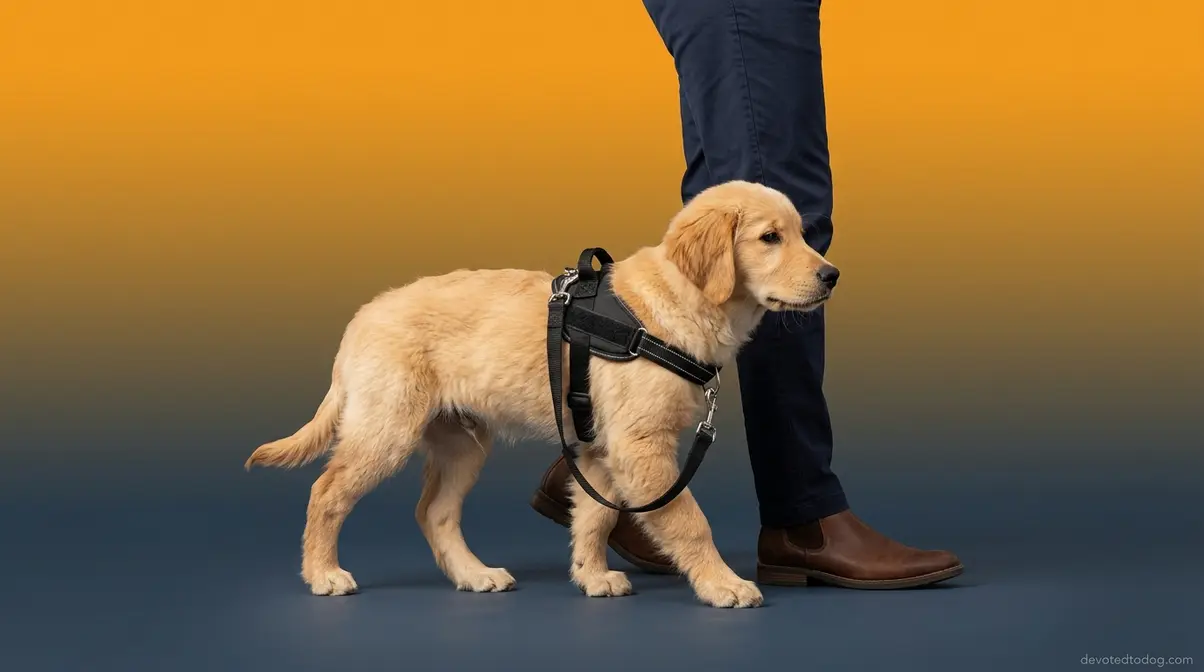
Golden retriever puppy harness training should start with a front-clip harness. When the leash attaches at the chest rather than the back, a pulling puppy gets redirected toward you rather than gaining forward momentum. Back-clip harnesses, counterintuitively, encourage pulling because the pressure point is behind the dog’s center of gravity , the dog leans into it.
A slip lead , a combined leash and collar loop that tightens when the dog pulls , is useful for training sessions requiring quick adjustments, but requires correct technique to avoid tracheal pressure. Not recommended as primary equipment for puppies under 4 months. A flat collar is fine for ID tags; it shouldn’t be the attachment point for a puppy that pulls.
Introduction tip: Put the harness on at home for 15-minute sessions before adding any leash. Let the puppy move around, eat their meal, and play while wearing it. By the time you clip the leash on for the first outdoor walk, the harness sensation is already familiar , one less variable to manage. For a full breakdown of leash training your golden retriever from introduction through advanced loose-leash work, that resource covers the progression in detail.
Once the harness is on and the puppy is comfortable, the actual leash-walking technique is simpler than most owners expect.
Teaching Loose-Leash Walking
Leash training a golden retriever puppy outdoors works on one principle: tension equals no forward progress. The moment the leash goes taut, all forward momentum stops. Here’s the full method:
- Start in the backyard or a low-distraction area , not the sidewalk in front of your house where squirrels and neighbors compete for attention
- The moment the leash goes taut, stop completely. Don’t pull back. Don’t say anything. Just stop.
- Wait for the puppy to return toward your side , even one step back in your direction counts
- Mark (“yes!”) and treat the moment they return, then continue walking
- Repeat. The puppy learns that a tight leash equals no forward progress, and a loose leash equals continued walking
Leash biting is common in overstimulated or under-exercised puppies. The fix: exercise before leash sessions, and carry a toy in your pocket to redirect immediately when the leash becomes the target.
Session length: Keep outdoor leash sessions to 5–10 minutes maximum for puppies under 4 months. Joint protection matters , Golden Retrievers are a large breed with growth plates that close around 12–18 months, and excessive forced exercise before then carries real orthopedic risk.
Most puppies show significant loose-leash improvement within 2–3 weeks of daily 10-minute sessions. Progress feels slow in Week 1 and accelerates noticeably in Week 2 , stay consistent.
With training foundations solid, the other major lever you have is nutrition , and feeding your Golden puppy the right amount at the right time directly supports training success.
Feeding, Growth, and Weight Guide
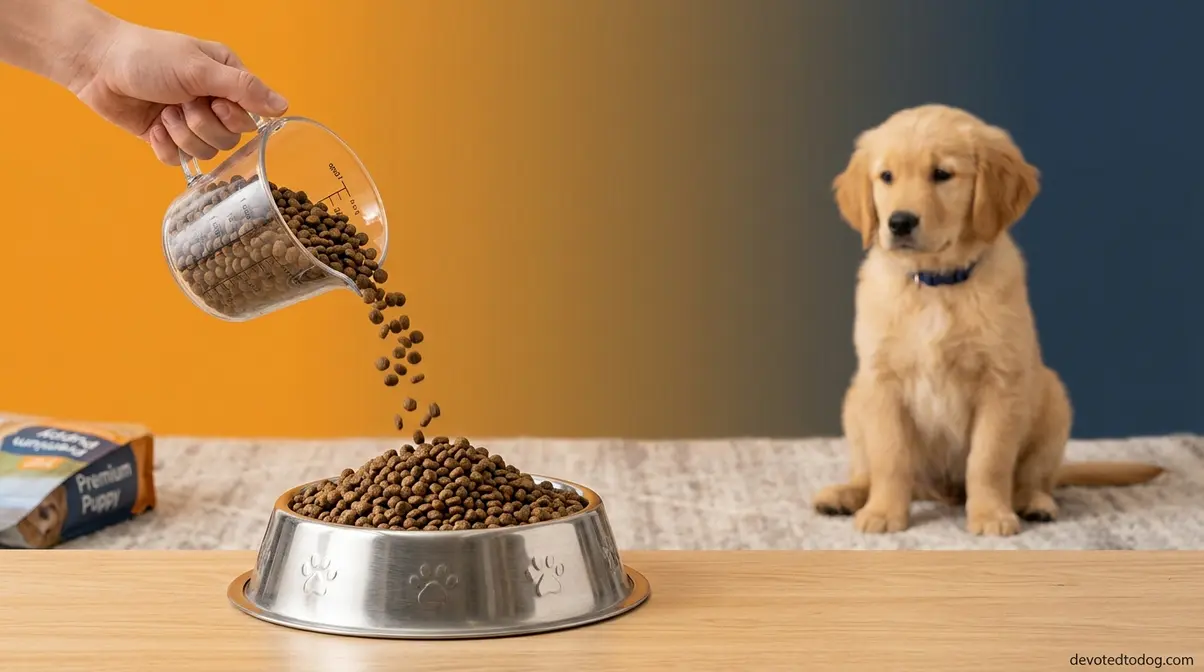
The golden retriever puppy feeding chart question is one of the most-searched topics for new owners , and for good reason. Overfeeding a rapidly growing large-breed puppy creates orthopedic problems; underfeeding creates developmental gaps. Getting the numbers right from Week 1 matters.
There’s also a training connection most guides miss: meal timing and kibble rationing can reduce your treat dependency significantly. Research published via NIH/PubMed indicates the 95th percentile birth weight for Golden Retriever puppies is up to 630 grams (clinical data on Golden Retriever puppy birth weights) , weight tracking from birth helps identify developmental outliers early, making the feeding schedule a health monitoring tool as much as a nutrition plan.
Puppy Feeding Chart (8-24 Weeks)
Feeding amounts vary by food brand, caloric density, and individual puppy weight , always check the specific bag and confirm with your vet. These figures represent general estimates for a puppy growing on the typical Golden Retriever curve:
| Age | Daily Amount (cups) | Meals Per Day | Approx. Weight (lbs) | Approx. Weight (kg) |
|---|---|---|---|---|
| 8 weeks | 1 – 1.5 | 3–4 | 8–12 | 3.6–5.4 |
| 3 months | 1.5 – 2 | 3 | 15–25 | 6.8–11.3 |
| 4 months | 2 – 2.5 | 3 | 25–35 | 11.3–15.9 |
| 6 months | 2.5 – 3 | 2–3 | 35–50 | 15.9–22.7 |
Feeding frequency: Three to four times daily for puppies under 4 months; two to three times daily from 4–6 months. Smaller, more frequent meals reduce blood sugar spikes and support the potty schedule , a puppy fed four times daily has more predictable post-meal elimination windows.
Using meals as training treats: Set aside 10–20 kibble pieces from each meal before you put the bowl down. Use those pieces as rewards during training sessions. This approach keeps the total calorie count accurate while maintaining the treat-based training system that positive reinforcement requires.
Critical warning: Overfeeding combined with under-exercise creates joint stress in a rapidly growing breed. Golden Retrievers are prone to hip dysplasia , excess weight during the growth phase meaningfully increases that risk. For a detailed golden retriever puppy feeding chart with brand-specific adjustments, that resource covers the variations.
Alongside feeding, tracking your puppy’s weight gives you early visibility into whether they’re developing on track.
Puppy Weight Milestones
Golden Retrievers grow rapidly in the first 6 months , weight roughly doubles every 4–6 weeks in early puppyhood. The golden retriever puppy weight chart above gives you the broad ranges; what you’re watching for is consistent progression within those bands, not exact numbers.
- Exercise limits by age (joint protection , follow these carefully):
- Under 3 months: free play only, no forced exercise (no running alongside bikes, no long hikes)
- 3–6 months: about 5 minutes of formal exercise per month of age, up to twice a day (a 4-month-old gets around 20 minutes), the rule of thumb published by The Royal Kennel Club
- 6+ months: gradually increase, still avoiding high-impact activities until 12–18 months
- When to call your vet:
- Puppy is clearly outside the expected weight range for their age
- Ribs are visibly protruding without any pressure (underweight) or completely impossible to feel with light pressure (overweight)
- Weight gain has stalled for more than two weeks
Golden retriever puppy development week by week isn’t just about weight , teeth, eye clarity, coordination milestones, and coat development all track alongside it. For a complete golden retriever puppy growth and weight chart with month-by-month milestones beyond weight, that resource covers the full developmental picture.
With training, crating, potty habits, and feeding all in motion, the last piece is knowing what tools and professional resources to reach for when you need help.
Tools, Classes, and Professional Help
Golden retriever puppy training classes accelerate everything covered in this guide , the distraction-proofing alone that comes from a class environment is worth the enrollment fee. But knowing which resources to choose, and when a professional is genuinely necessary, matters as much as the training itself.
The AKC S.T.A.R. Puppy program provides a structured 6-week foundation covering socialization, training, and owner education , making it the gold standard entry point for new Golden Retriever owners (American Kennel Club).
Best Golden Training Treats
Quick recap from the Commands section: small, soft, smelly, and novel. Rotate types to prevent treat fatigue. The full breakdown is in the Commands section above.
For class environments specifically: Bring your highest-value treats to every class session. The distraction level in a room full of other puppies is dramatically higher than your living room , your puppy’s motivation needs to match the difficulty. Small pieces of real chicken or cheese typically outperform commercial training treats in high-distraction settings.
Treat pouch: A belt-mounted treat pouch keeps your hands free and rewards instant. In class, fumbling for treats in a pocket costs you the timing window that makes positive reinforcement work.
Training treats should account for no more than 10% of daily caloric intake (AKC). On class days, reduce the meal portion slightly to compensate.
For many owners, a structured class accelerates everything covered in this guide , here’s how to find the right one.
Classes, Books, and Resources
The AKC S.T.A.R. Puppy program , the AKC S.T.A.R. Puppy program, a beginner obedience course offered through AKC-affiliated clubs nationwide , covers sit, down, stay, come, and socialization over six weeks. Find affiliated clubs at akc.org/events/training-programs/. The program is specifically designed for puppies and their owners, not experienced handlers.
- How to find golden retriever puppy training classes near you:
- Search ” puppy obedience class positive reinforcement”
- Ask directly whether the trainer uses punishment-based methods , if they do, leave. Aversive techniques (leash corrections, alpha rolls, punishment for accidents) create the fear-based compliance that produces aggression in the Teen Rebel Phase
- Look for instructors with CPDT-KA (Certified Professional Dog Trainer – Knowledge Assessed) credentials
Books: Look for titles authored by certified applied animal behaviorists (CAABs) or certified professional dog trainers (CPDTs). Credentials matter more than bestseller status. A book by a credentialed behaviorist published in the last five years will outperform a bestselling title from 15 years ago.
Video resources: UC Davis guidelines on the critical socialization window confirm the 3–14 week critical period, making early class enrollment essential , not optional. For the best dog training collars and tools that complement class work, that resource covers equipment selection in detail.
And finally , knowing when DIY training is no longer enough is one of the most important decisions a responsible owner can make.
When to Seek Professional Help
- Seek professional help when you observe any of the following:
- Growling accompanied by stiffening, lip curling, or snapping , not play growling, but warning signals
- Biting that breaks skin repeatedly despite 4+ weeks of consistent redirection using the method in this guide
- Fear-based behavior: cowering, freezing, or aggression directed toward strangers or family members
- You feel unsafe or overwhelmed in a way this guide doesn’t address
Who to contact: A Certified Professional Dog Trainer (CPDT-KA) for behavioral issues, or a Certified Applied Animal Behaviorist (CAAB) for more complex cases. These credentials are specific , a “certified trainer” without these acronyms may have no standardized training at all.
Disclaimer: This guide provides general training guidance for healthy Golden Retriever puppies. For severe behavioral issues, health concerns, or any situation involving safety risks to people or animals, consult a certified veterinary behaviorist or professional trainer in person. Online advice, including this guide, cannot replace hands-on professional assessment.
Limitations and Training Alternatives
Common Training Pitfalls
Inconsistency across family members is the single most common reason training stalls. If one person allows biting during play while others use the redirect-and-disengage method, the puppy learns the behavior is variable. Variable reinforcement , sometimes rewarded, sometimes not , is actually harder to extinguish than a consistently reinforced behavior. Every person in the household must use the same responses.
Sessions that run too long produce what looks like stubbornness but is actually exhaustion. A 20-minute training session with an 8-week-old puppy is asking a toddler to sit through a two-hour lecture. Mental fatigue is real, and it looks identical to defiance. Keep sessions under 10 minutes, full stop.
Punishment-based methods , yelling, leash jerks, alpha rolls , create fear-based compliance that frequently produces aggression during the Teen Rebel Phase. The puppy learns to suppress behavior out of fear, not to choose differently. When the hormonal changes of adolescence lower that fear threshold, suppressed behaviors resurface with added intensity.
Expecting generalization too soon is a normal owner mistake. A 10-week-old puppy who knows “sit” in the kitchen does not know “sit” in the park. New environments require re-teaching from the beginning. This is normal developmental behavior , not a training failure.
When to Choose Alternatives
If your schedule genuinely cannot accommodate 3–4 outdoor potty trips daily during the first 3–4 months, consider a professional dog walker or puppy daycare rather than extending the indoor schedule beyond bladder capacity. The house training timeline can extend significantly when accidents become regular , and regular accidents make the habit harder to break.
If crate training creates severe distress , vomiting, self-injury, or sustained panic beyond the first 2–3 nights , consult your veterinarian before continuing. Some puppies have separation anxiety that requires behavioral intervention, not just more patience and consistency.
Common Mistakes New Golden Owners Make, and How to Avoid Them
The Training Trifecta breaks down most often not because owners don’t care, but because small inconsistencies compound over time.The most important golden retriever puppy training tips are only as effective as the habits you build around them, and these five pitfalls are where most new owners quietly lose ground.
1. Repeating commands (Consistency pillar, the most common Trifecta breakdown). Saying “Sit, sit, SIT” teaches your puppy that the first repetition is optional. Give the cue once, wait 3 seconds, and reset if there’s no response, back up, re-lure, and try again. One cue, one chance. Breaking the Consistency pillar here is the single most common mistake new owners make, and it compounds: a puppy who learns that commands are optional at 10 weeks becomes a dog who ignores you at 10 months.
2. Inconsistent household rules. If jumping is “cute” when your puppy greets one family member but punished when they greet another, your puppy doesn’t learn not to jump, they learn that the rule depends on the human. Every person in the household must enforce the same rules, every time. Post the rules on the fridge if you need to.
3. Skipping or misusing the crate. Many new owners feel crating is unkind. Per Cornell University College of Veterinary Medicine, a properly introduced crate reduces anxiety and accelerates potty training, it gives your puppy a safe, predictable space that belongs to them. The error isn’t using a crate; it’s using it as punishment. The crate should always be associated with rest, safety, and calm, never with time-outs.
4. Mistaking red flag behaviors for training problems. This is the most important pitfall in this list. Sudden behavioral changes, unprovoked aggression, persistent house soiling after 5 months, new extreme fearfulness, or compulsive repetitive behaviors, may signal an underlying medical issue, not a gap in training. A 2024 study in the Journal of the American Veterinary Medical Association identifies these as indicators that warrant veterinary evaluation before any training intervention. As the JAVMA researchers note, treating a medical condition as a training problem doesn’t just fail, it delays care that the dog actually needs.
5. Skipping socialization during the critical window. Many new owners focus entirely on commands and overlook the 3–12 week socialization window. A Golden who learns “Sit” perfectly but never encounters strangers, stairs, or loud sounds during this period is far more likely to develop fear-based behaviors in adulthood, behaviors that are significantly harder to address than a missed command. Socialization isn’t optional; it’s the foundation that makes every other training tip work.
“For any behavior that is sudden, severe, or escalating, please consult your veterinarian before attempting training corrections. Behavioral changes can indicate underlying medical conditions that training cannot address.”
Golden Retriever Puppy Training FAQs
What is the 7-7-7 rule for dogs?
The 7-7-7 rule describes three acclimation phases in a puppy’s first seven months: seven days to decompress after coming home, seven weeks to establish core routines (potty schedule, crate, first commands), and seven months to generalize those behaviors to new environments. It’s a framework for pacing expectations, not a strict training protocol. Most new owners find it reduces overwhelm by breaking the process into manageable phases rather than one long stretch.
What is a red flag behavior in puppies?
Red flag behaviors in puppies include unprovoked aggression (biting without play context), resource guarding that escalates to snapping, sudden extreme fearfulness, persistent house soiling after 5 months of age, and repetitive compulsive behaviors. A 2024 study in the Journal of the American Veterinary Medical Association identifies these as indicators that may signal underlying medical issues, not just training gaps. Consult your veterinarian before attempting behavioral corrections for any of these signs.
How do you say “I love you” in dog language?
When your dog holds relaxed, soft eye contact with you during a quiet moment, that’s love in dog language. Dogs communicate affection through sustained, gentle eye contact, a slow blink during calm moments is a trust signal. Returning a slow blink, speaking in a low calm tone, and allowing your dog to approach on their own terms all register as affection. Calm, predictable handling builds the emotional bond that makes training feel like partnership.
Are golden puppies easy to train?
Golden Retriever puppies are among the easiest breeds to train because they are highly intelligent, eager to please, and strongly food-motivated. However, “easy to train” doesn’t mean effortless. They are still energetic, distractible puppies that require consistency and short, positive sessions. User consensus across Golden Retriever owner communities confirms that most owners see reliable responses to basic commands within 4–6 weeks of daily positive reinforcement training.
When to start training a golden puppy?
Start training your Golden Retriever puppy immediately , at 8 weeks old when you bring them home. Early training should focus on potty training, crate introduction, and basic socialization rather than complex commands. The critical socialization window closes around 16 weeks of age, making these first eight weeks biologically significant for shaping your dog’s long-term temperament. Puppies that begin positive reinforcement training before 12–20 weeks of age are significantly less likely to develop fearful or aggressive behaviors later in life (AVSAB).
What is the hardest month of a puppy?
The hardest period for most Golden Retriever owners is the adolescence phase, roughly between 6 and 18 months of age. During this stage, hormonal changes cause puppies to test boundaries and temporarily seem to “forget” previously learned commands. This phenomenon is a normal developmental phase, not a training failure.
For new Golden Retriever owners, the most important truth about golden retriever puppy training is this: structure wins. Puppies that receive consistent daily schedules, positive reinforcement, and phase-aware guidance from Day 1 develop into reliable, well-mannered dogs significantly faster than those trained reactively. The key benchmarks: potty training showing strong consistency by 6–8 weeks of a structured schedule, basic commands reliable by 4–5 months, and the teenage phase navigated with patience rather than panic.
The Puppy Phases Playbook , Angel Phase, Land Shark Phase, Teen Rebel Phase , exists so you stop being surprised and start being prepared. Each phase is temporary. Each phase has a specific playbook. The owners who struggle most are those who treat every phase like a crisis rather than a predictable milestone on a known map. That map is what you now have.
Start with the First Week Survival Checklist from this guide. Print the daily potty schedule. Set your 5-minute training session reminders. And if things get harder before they get easier , that’s the Land Shark Phase doing exactly what it’s supposed to do. You’ve got the map now. Use it.
Related reading:
Alliyah Strange is a CPDT-KA certified dog trainer and behaviorist. She reviews DevotedToDog training and behavior articles for accuracy and alignment with current positive-reinforcement, force-free training standards.
Related gear: see our guide to the right harness.