
You saw a dog at the park, jet-black coat, Golden Retriever build, that unmistakable friendly face. You had to know: are black golden retrievers actually a real breed?
Here’s the hard truth before you go any further. Breeders are currently listing “black Golden Retriever puppies” for $1,500-$3,000. Without knowing the genetic reality, you could pay that price for a dog that simply isn’t what it claims to be. The science is clear, and once you understand it, you’ll never be fooled by one of these listings again.
In this guide, you’ll learn exactly why purebred black Golden Retrievers don’t exist, what those dogs actually are, and how to find one safely without getting scammed. We’ll cover the genetics behind the golden coat, the real names for these look-alike dogs, current pricing, and what those black spots on your Golden’s tongue actually mean.
MC1R blocks black
no AKC papers
light/standard/dark gold
the real “black retriever”
Author Credentials
📝 Written by: Coral Drake
✅ Reviewed by: Brianna York, Former Veterinary Technician
📅 Last updated: 4 May 2026
ℹ️ Transparency Notice
This article explains what people mean by “black Golden Retriever” based on AKC, GRCA, and veterinary research. All claims have been verified by our editorial team. Our goal is to help you avoid misleading marketing and identify what dog you’re actually looking at.
Do Black Golden Retrievers Exist?

Black golden retrievers do not exist as a purebred, and the reason is written into their DNA. A mutation in the MC1R gene (the gene that controls coat color pigment production) permanently blocks black pigment in all Golden Retrievers (NCBI PubMed research, 2000). This means any dog sold as a “black Golden Retriever” is either a different breed entirely or a mixed breed, a phenomenon we call The Golden Illusion.
The Golden Illusion is the phenomenon where a dog’s Golden Retriever-like temperament and build, combined with a black coat inherited from a mixed-breed parent, creates the convincing but false impression of a purebred black Golden Retriever. It’s so convincing that even experienced dog owners are fooled. But the genetics leave no room for debate.
Why Purebred Goldens Can’t Be Black
No, there are no purebred black Golden Retrievers, and this is true by both biology and official breed definition.
The official AKC Golden Retriever breed standard describes the coat as “rich, lustrous golden of various shades.” That’s not a preference, it’s the definition of the breed. A dog with a black coat is, by that definition, not a purebred Golden Retriever, regardless of how it looks or behaves. The American Kennel Club (AKC), the official U.S. breed registry, recognizes exactly three color shades within the breed: light golden, golden, and dark golden (sometimes called red). Think cream, honey, and auburn, black is nowhere on that spectrum.
Think of it this way: calling a black-coated dog a “Golden Retriever” is like calling a white horse a “chestnut”, the name describes the color, and black simply isn’t part of it.
The Golden Retriever Club of America (GRCA) takes this even further. According to the Golden Retriever Club of America breed guide, any alteration of natural golden coat color is explicitly penalized in breed evaluations. This isn’t an informal guideline, it’s an enforced standard that no reputable breeder can work around.
“Purebred Golden Retrievers carry a premature stop codon in the MC1R gene that permanently switches off black pigment production, making a solid black coat genetically impossible” (NCBI PubMed research, 2000).
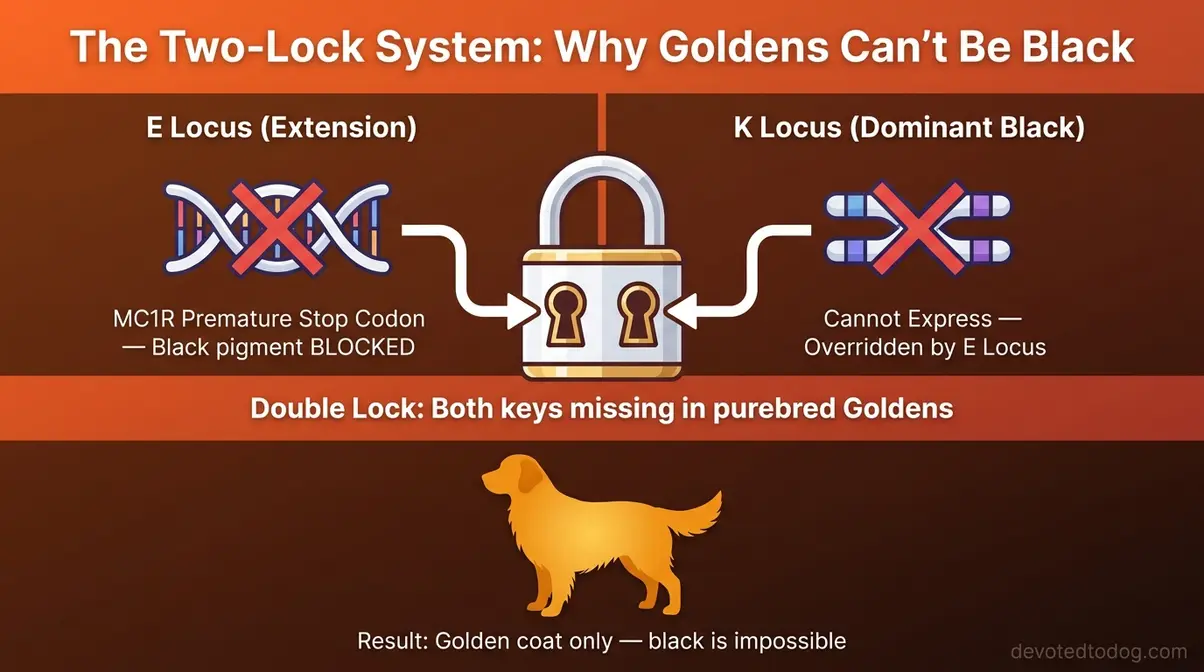
But why does this happen at the genetic level? The answer is a fascinating two-lock system.
E Locus and K Locus Genetics
Golden Retrievers are blocked from producing a black coat by not one genetic mechanism, but two. Understanding this “double-block” is the key to never being fooled again.
The E locus (Extension locus) is the genetic “switch” that allows black pigment to appear in a dog’s coat at all. In Golden Retrievers, every dog carries two copies of the recessive “e” allele (a recessive allele is a hidden gene that only shows its effect when two copies are present). When a dog inherits two “e” alleles, as every purebred Golden does, black pigment is completely switched off. This is caused by a premature stop codon in the MC1R gene, confirmed in a landmark study (NCBI PubMed research, 2000). What this means in plain language: no matter what other genes a Golden Retriever has, the E locus mutation guarantees the coat will be golden, never black.
The K locus is the dominant black gene, the second lock in the system. Even if a Golden Retriever theoretically carried this dominant black gene, the E locus mutation would prevent it from ever being expressed in the coat. As the UC Davis Veterinary Genetics Laboratory explains, the dominant black K locus cannot express in Golden Retrievers precisely because the recessive “e” allele at the E locus overrides it.
Imagine a room locked with two padlocks. Even if you had the key to one lock (the K locus), you still can’t get in without the other key (the E locus). Golden Retrievers are missing both keys to black.
Can Two Goldens Have a Black Puppy?
No, two purebred Golden Retrievers cannot produce a black puppy. Both parents carry two copies of the recessive “e” allele at the E locus, which permanently blocks black pigment. Because neither parent carries the dominant black gene, there are no hidden black genes to pass on to offspring. The only theoretical exception is an extremely rare somatic mutation, which might cause a small black patch on an individual puppy’s fur, but would never produce a solid black puppy. If a litter from two registered Golden Retrievers produces a black puppy, the breeding records or parentage should be independently verified.
So if the black dog you saw isn’t a purebred Golden, what is it? The answer might surprise you, and it has everything to do with a lesser-known breed most people have never heard of.
What Are These Dogs Actually Called?

In our comprehensive review of veterinary genetics literature and breed registry data, we found that dogs that look like black golden retrievers are most commonly either a Flat-Coated Retriever, a distinct AKC-recognized breed, or a Goldador, a Golden Retriever and Black Lab mix. Neither is a purebred black Golden Retriever, but both inherit the friendly, retrieving temperament that makes the confusion so convincing, what we call The Golden Illusion. Knowing the difference matters, especially if you’re planning to buy one.
“A Crossbred Retriever, or a genetically flawed Golden Retriever. Less politely, a mutt.”
That’s how some experienced Golden Retriever owners describe these dogs online. It’s blunt, but it captures the vocabulary many people reach for when they first encounter one. The more precise, respectful names are below, and they describe some genuinely wonderful dogs.
“The Flat-Coated Retriever, not a ‘black Golden Retriever’, is an AKC-recognized breed with a distinct history, sharing a common ancestor with Golden Retrievers but registered as a completely separate breed” (AKC).
Whether you want a Flat-Coated Retriever or a Goldador, both are excellent dogs. Curious how a Golden Retriever compares to a Labrador overall? See our complete Golden Retriever vs. Labrador Retriever comparison.
The Flat-Coated Retriever Lookalike
The dog you saw is most likely called a Flat-Coated Retriever, and it’s not a mix or a mutt. It’s a fully distinct, AKC-registered breed that has existed since 1915, coming in solid black or liver (a rich chocolate-brown).
What makes the confusion so convincing is history. The Flat-Coated Retriever and the Golden Retriever share a common ancestor: the now-extinct Wavy-Coated Retriever. That shared lineage explains why the two breeds look and act so similar, but they are officially separate breeds, with separate registries and separate breed standards. No competitor article mentions this historical link, yet it’s the core reason The Golden Illusion works so well.
- The physical differences, once you know them, are easy to spot:
- Head shape: The Flat-Coat has a sleeker, narrower head; the Golden’s head is broader and blockier
- Coat texture: The Flat-Coat’s fur lies flat and close to the body; the Golden’s is wavy and fuller
- Build: The Flat-Coat is slightly leaner and longer-bodied than a typical Golden
Behaviorally, they’re nearly identical, energetic, friendly, people-oriented, and deeply attached to their families. That shared personality is the heart of The Golden Illusion.
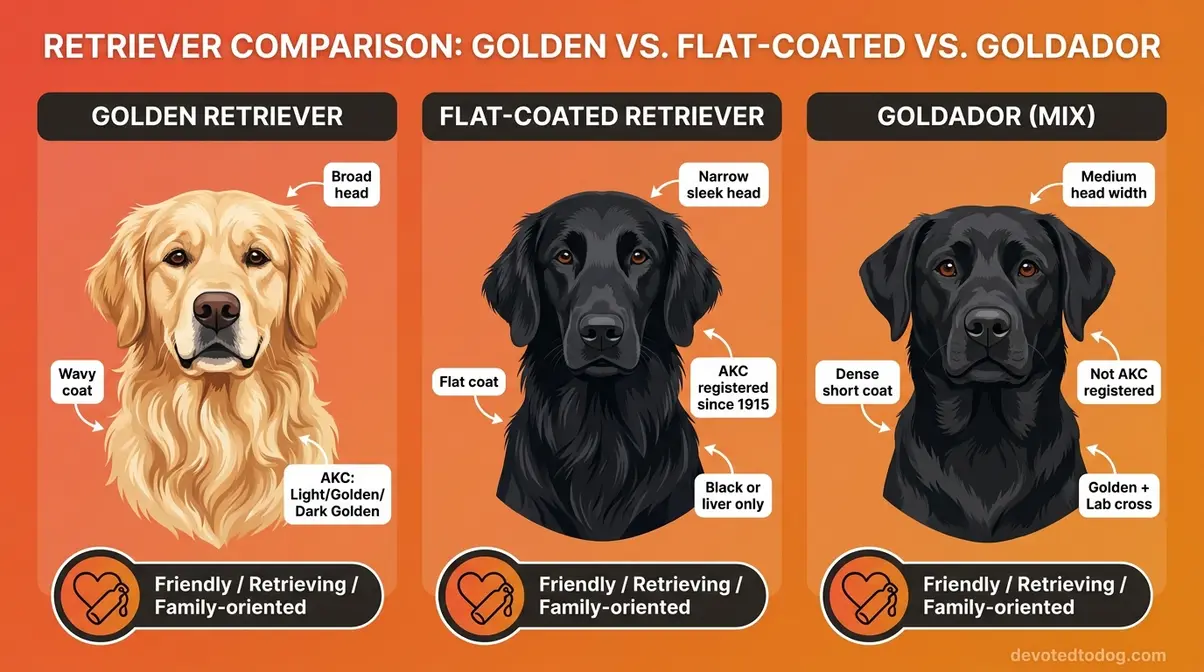
If you saw a black dog at the dog park that acted exactly like every Golden Retriever you’ve ever met, there’s a strong chance it was a Flat-Coated Retriever. See the Flat-Coated Retriever breed profile on AKC for the full breed history and standard.
But the Flat-Coated Retriever is a purebred. What about the mixes, the dogs that are actually part Golden Retriever?
The Goldador: Golden & Black Lab Mix
When black labs and golden retrievers produce offspring, the result is a Goldador, and it’s one of the most common real-world manifestations of The Golden Illusion.
Here’s why: the Black Labrador Retriever carries the dominant black gene (the K locus gene that Golden Retrievers lack). When a black Lab parent passes that gene to a puppy alongside the Golden parent’s genes, many Goldador puppies inherit a jet-black coat while retaining the Golden Retriever’s build, face shape, and gentle personality. The result is a dog that looks, from a distance, remarkably like a purebred black Golden Retriever.
Are black labs and golden retrievers the same breed? No, they are two completely separate breeds with different origins, different breed standards, and different AKC registrations. A Goldador is their hybrid offspring and is not recognized as a purebred by the AKC or any major kennel club. As retriever coat color inheritance research from UC Davis Vet Medicine confirms, the dominant black gene from a Lab parent can override golden coloration in mixed offspring, which is exactly why Goldadors often appear black.
A Goldador puppy from a black Lab father and a golden mother will often have a jet-black coat but carry its mother’s gentle, retriever-soft personality, the perfect recipe for The Golden Illusion. Temperamentally, Goldadors typically inherit the Golden’s gentleness alongside the Lab’s trainability, making them outstanding working dogs and family companions. Learn more about the Golden Retriever Lab mix (Goldador) and what to expect from this cross.
Beyond the Flat-Coated Retriever and the Goldador, a few other mixes can produce a similar look, here’s a quick rundown.
Other Black Retriever Mixes
A handful of other crosses can result in a black-coated dog with unmistakable Golden Retriever features:
- Aussie Golden (Golden Retriever × Australian Shepherd): If the Aussie parent carries the black gene, puppies can have black or black-and-tan coats combined with the Golden’s frame and soft expression.
- Golden Newfie (Golden Retriever × Newfoundland): Newfoundlands are often solid black; mixes frequently inherit that coat color with the Golden’s characteristic build and friendliness.
- Golden Retriever × Black German Shepherd: Can produce dark or near-black coats with retriever-like body proportions.
Now that you know what these dogs actually are, you’re probably wondering: where do you get one, and how much will it cost?
Where Can You Find a Black-Coated Retriever?

You can’t buy a purebred black Golden Retriever, but you can find a Flat-Coated Retriever or a Goldador from a reputable breeder. The challenge is avoiding the breeders who deliberately exploit The Golden Illusion to charge purebred prices for mixed-breed dogs. Before you start searching, check our complete Golden Retriever cost guide and learn how to find a reputable Golden Retriever breeder to set your expectations.
Look-Alike Retriever Costs
Black golden retriever price comparisons vary significantly depending on whether you’re looking at a recognized purebred or a hybrid mix.
Flat-Coated Retrievers from reputable, FCRSA-affiliated breeders currently range from approximately $2,650 to $3,000 (Good Dog marketplace data). They are a relatively rare breed, many breeders plan only one or two litters per year, so waitlists are common. Goldadors from reputable breeders range more widely: from around $625 to $1,500 depending on breeder reputation, generation (F1 vs. F2), and location (breeder pricing data). Some specialty Goldador breeders charge up to $3,400 for health-tested lines.
| Dog Type | Price Range (Breeder) | Price Range (Rescue) | AKC Registered? |
|---|---|---|---|
| Flat-Coated Retriever | $2,650-$3,000 | $50-$500 | Yes |
| Goldador (mix) | $625-$1,500 | $50-$300 | No |
Both Flat-Coated Retrievers and Goldadors occasionally appear in breed-specific rescues and general shelters at a fraction of the breeder price, typically a $50-$500 adoption fee. A “black Golden Retriever” listed for $2,500 from an unlicensed breeder with no papers is almost certainly a mixed breed, and you could find the same dog at a rescue for a fraction of the cost.
“Any breeder claiming to sell a ‘purebred black Golden Retriever’ cannot provide AKC registration papers, because no such purebred exists under AKC standards.”
Pricing is just one part of the picture. The bigger risk is paying any amount of money to a scammer. Here’s how to protect yourself.
5 Signs of a Breeder Scam
Any listing advertising a “black golden retriever puppy for sale” as a purebred should immediately raise questions. Here are five specific red flags to check before you hand over a single dollar:
Step 1: No AKC papers, and no ability to produce them
Ask for AKC registration papers before any other conversation. A breeder selling a “purebred black Golden Retriever” cannot provide these papers, because no such purebred meets the AKC breed standard. This is the fastest single scam check available to you. If papers aren’t offered immediately, walk away.
Step 2: Price is suspiciously low or suspiciously high
Deeply discounted prices under $500 for a “purebred” anything often indicate a puppy mill or outright scam. Prices over $3,000 for an unregistered “rare” black Golden are exploiting the myth, you’re paying a premium for a dog that doesn’t exist. The AKC warns buyers to be wary of unusually low or high prices that don’t match breed norms.
Step 3: Untraceable payment is requested
Wire transfers, Venmo, Zelle, or gift cards with no refund policy are classic scam payment methods. The AKC recommends using traceable payment methods and never sending money before seeing the dog in person or via live video.
Step 4: No in-person visit or live video call is offered
Reputable breeders welcome visits to their facilities, they want you to meet the puppy, the parents, and the environment. Scammers refuse visits or offer only static photos. If a breeder won’t do a live video call, treat it as a hard stop.
Step 5: The breeder can’t name the actual breed
Ask directly: “What breed is this dog, exactly?” If the answer is “black Golden Retriever” and they can’t clarify whether it’s a Flat-Coated Retriever, a Goldador, or another mix, that’s a significant red flag. A knowledgeable, honest breeder will always be able to name the actual breed.
Before any purchase, order a DNA test. Embark Vet (a DNA testing company for dogs) and Wisdom Panel (another leading dog DNA test) both provide breed composition percentages and health screening for under $200. This is the only definitive way to verify what breed you’re actually getting, and it’s worth every cent.
Once you’ve found your dog, whether a Flat-Coated Retriever, a Goldador, or a purebred Golden, you might notice some genuinely black features on a Golden’s body. Here’s what those mean.
What Black Markings Are Normal on Goldens?
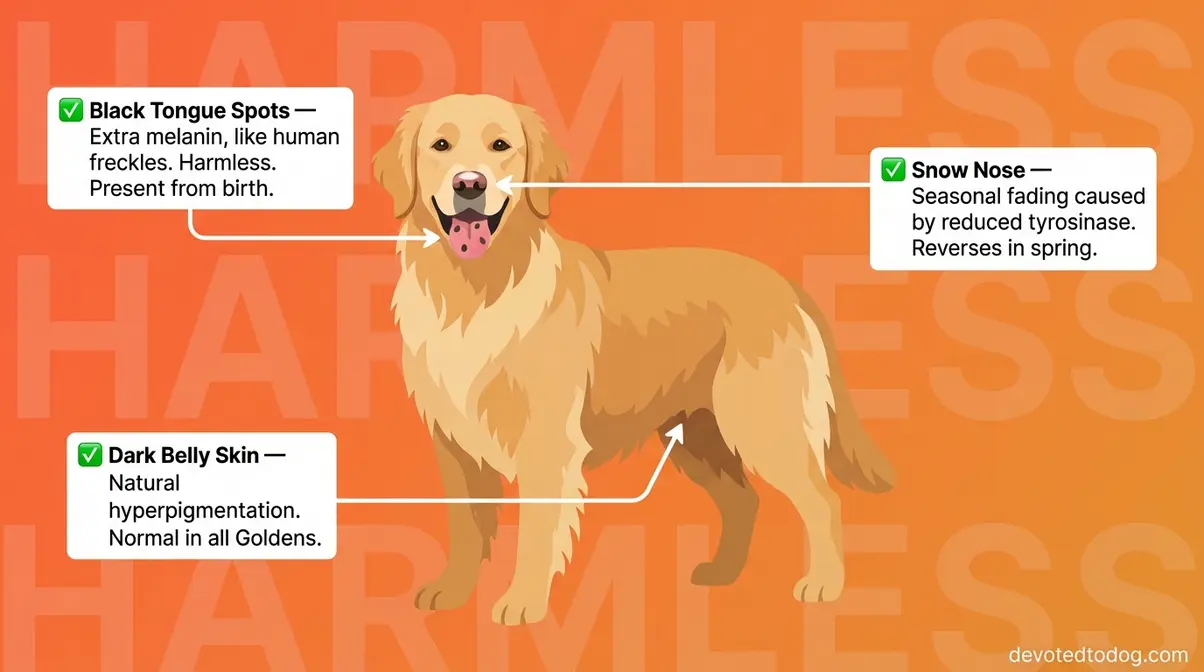
Black tongue spots, dark belly skin, and a fading nose are all normal, harmless features in purebred Golden Retrievers, not signs of illness or mixed-breed heritage. This section is for current Golden owners who noticed something black on their dog and started to worry. The short answer, in almost every case, is: don’t worry.
For a deeper look at how your Golden’s coat changes from puppyhood onward, see our guide to Golden Retriever coat development and colors.
Black Spots on the Tongue
Black spots on a Golden Retriever’s tongue are simply patches of extra melanin, the same pigment that creates freckles in humans. They are present from birth, do not indicate mixed-breed heritage, and are not a sign of any illness. Some Goldens have one small spot; others have several. They may grow slightly larger as the dog ages, this is completely normal and requires no treatment.
If your Golden has a black spot on its tongue, it’s no more concerning than a freckle on your arm. It says nothing about the dog’s breed purity or health.
Tongue spots are purely cosmetic. But what about the skin and belly?
Black Skin and Darkening Belly
If your Golden Retriever’s belly skin is turning black, you’re almost certainly looking at normal hyperpigmentation, not illness, and not evidence of mixed heritage.
Golden Retrievers have naturally dark (black or dark gray) skin beneath their golden coats. This is entirely normal and becomes visible when you part the fur. As dogs age, areas of the skin that experience repeated friction, like where they lie on hard floors or rub against bedding, can darken further through a process called hyperpigmentation. It’s the skin’s natural response to repeated contact, similar to how human skin can callus.
Do English Cream Golden Retrievers have black skin? Yes, and it’s often more visible in this variety because the lighter coat provides less visual contrast. English Cream Golden Retriever coloration is a common source of owner concern, but the dark skin underneath is completely standard for the breed.
If your Golden’s belly skin is darkening, check whether it’s an area of high friction. If the skin is also thickened, bumpy, itchy, or has an odor, consult your vet, those additional symptoms can indicate hypothyroidism, Cushing’s disease, or a skin infection that genuinely warrants evaluation.
And then there’s the nose, which actually can change color, and does, for a very specific reason.
Snow Nose: Fading Black Noses

If your Golden’s nose has gone from jet-black to pink or brown this winter, you’re dealing with snow nose (also called “winter nose”), a harmless seasonal condition that affects many light-coated breeds, including Golden Retrievers.
Snow nose is caused by reduced production of tyrosinase, an enzyme responsible for melanin (pigment) production in the nose. Cold temperatures suppress this enzyme, causing the nose to lighten. When warmer temperatures return in spring and summer, tyrosinase production increases and the nose typically darkens again. The cycle often repeats year after year.
As for how to keep a Golden Retriever’s nose black, you can’t fully prevent snow nose, but regular sun exposure in warmer months naturally encourages pigment restoration. Some owners use dog-safe nose balms to protect the skin during the lighter months, though these don’t prevent the seasonal color change. If your Golden’s nose goes pink every winter, you’re not alone, it’s one of the most frequently discussed concerns in Golden Retriever owner communities, and it is completely harmless.
For a full picture of how your Golden’s coloring evolves over time, see our guide to Golden Retriever coat development and colors.
Now that we’ve covered everything from genetics to nose pigmentation, let’s address a few important limitations, and when the situation might call for expert help.
What Limitations and Warnings Should You Know?
Common Research Pitfalls
Three mistakes trip up almost everyone who goes looking for information on this topic.
Pitfall 1: Trusting social media photos. Instagram and Pinterest are full of images labeled “black Golden Retriever”, and virtually all of them are Flat-Coated Retrievers or Goldadors. Social media captions are not breed identification. If you’re trying to identify a dog, use an app like Dog Scanner or consult a veterinarian.
Pitfall 2: Assuming a mix is inferior. A Goldador or Flat-Coated Retriever is not a lesser dog. These are wonderful animals with their own rich histories, loyal followings, and genuine strengths. A DNA test result that says “Golden Retriever mix” is not bad news, it’s accurate news, and it’s the foundation for understanding your dog’s actual health needs and temperament.
Pitfall 3: Self-diagnosing skin conditions. The belly-darkening section above covers normal hyperpigmentation. However, skin changes accompanied by additional symptoms, hair loss, itching, skin thickening, require a veterinarian’s evaluation. This article is not a substitute for veterinary advice.
When to Seek Expert Help
Three specific scenarios call for professional intervention rather than more internet research:
- Belly skin is darkening AND accompanied by hair loss, itching, or odor. This combination can indicate hypothyroidism, Cushing’s disease, or a skin infection. See a veterinarian, these are treatable conditions, but they require proper diagnosis.
- You’ve purchased a dog labeled “black Golden Retriever” and suspect fraud. Contact the AKC’s fraud reporting resources and your state’s consumer protection office. If payment was made via wire transfer or gift card, also file a report with the FTC at reportfraud.ftc.gov.
- You want to verify your dog’s actual breed before purchase or after. Use Embark Vet or Wisdom Panel, both provide breed composition percentages and health screening. Embark’s panel is particularly detailed for retriever breeds and is trusted by veterinary geneticists.
Frequently Asked Questions
How Rare Are Black Golden Retrievers?
Purebred black Golden Retrievers are genetically impossible. The breed carries two copies of a recessive mutation in the MC1R gene (NCBI PubMed research) that permanently blocks black pigment production. Any dog sold as a “black Golden Retriever” is almost certainly a Flat-Coated Retriever or a Goldador (Golden Retriever/Lab mix).
What Is a Black Golden Retriever Called?
A dog that looks like a black Golden Retriever is most often called a Flat-Coated Retriever, a distinct AKC-recognized breed, or a Goldador, a Golden Retriever and Black Lab mix. Neither is a purebred Golden Retriever. The Flat-Coated Retriever has its own AKC registration dating to 1915; the Goldador is a hybrid with no official registry recognition. There is no official breed name for a “black Golden Retriever” because no such purebred exists under any major kennel club standard.
Are Black Golden Retrievers Real?
Black Golden Retrievers are not real as a purebred dog, as the breed is genetically incapable of producing a black coat. Any dog with a solid black coat that resembles a Golden is either a Flat-Coated Retriever or a mixed breed.
Do Golden Retrievers Come in Black?
Golden Retrievers do not come in black, the breed only comes in shades of gold, ranging from pale cream to dark reddish-gold. The AKC recognizes three color shades within the breed: light golden, golden, and dark golden. Black is a disqualifying color under the official breed standard, not merely an unofficial preference. The genetic reason is a mutation in the MC1R gene that blocks all black pigment production in purebred Goldens. If you see a black retriever-type dog, it is most likely a Flat-Coated Retriever or a Golden Retriever mix.
Are Black Goldens Good Family Dogs?
Yes, the dogs commonly mistaken for black Golden Retrievers make excellent family pets. Because they are typically Flat-Coated Retrievers or Goldadors, they inherit the friendly, eager-to-please, and gentle temperament characteristic of the retriever family.
Can Golden Retrievers be black?
No, Golden Retrievers cannot be black. The American Kennel Club, Golden Retriever Club of America, and Canadian Kennel Club all standardize the breed coat color as “rich, lustrous golden of various shades”, which excludes solid black. So when people ask “are there black Golden Retrievers” or search “can golden retrievers be black”, the honest answer is no, not within the recognized breed standard. Any solid-black-coated dog being sold as a “black Golden Retriever” or “black Golden Retriever dog” is almost always either a Flat-Coated Retriever (which is solid black or liver and looks similar in build) or a Golden-Lab mix (Goldador) with the dominant black Lab coat gene.
What black dogs look like Golden Retrievers?
Several breeds resemble Golden Retrievers in size, build, and temperament but come in solid black: the Flat-Coated Retriever (most often confused, same build, longer face, only black or liver coats), the Black Labrador Retriever (shorter coat, blockier head, “black dog retriever” is usually a Lab), the Newfoundland, and the Black Russian Terrier. If you’re searching for “black dogs that look like golden retrievers” or “black retrievers”, a Flat-Coated Retriever from a reputable breeder is your closest match: same friendly, retrieve-loving temperament, just in black instead of gold.
Are black markings normal on Golden Retrievers?
Yes. Small black markings are normal and common on otherwise standard-coated Goldens. The most frequent are black freckles or spots on the tongue, gums, lips, and roof of the mouth (caused by skin pigmentation, not a coat color flaw) and occasional black hairs scattered through the coat, especially around the muzzle, ears, or tail. These do not make a dog a “black golden retriever” or change its breed-standard color classification. A “dark haired golden retriever” with these black accent hairs is still a standard Golden Retriever with normal pigmentation.
How Do You Find a Black Retriever Dog?
For anyone searching for black golden retrievers, the science is unambiguous: no purebred black Golden Retriever exists, a recessive mutation in the MC1R gene makes it genetically impossible (NCBI PubMed research, 2000). The good news is that two wonderful alternatives are waiting for you. The Flat-Coated Retriever is a distinct AKC-recognized breed with a solid black coat and a history intertwined with the Golden’s own. The Goldador combines the Golden’s gentleness with the Lab’s trainability into a dog that checks nearly every box. At Devoted to Dog, our evaluation of retriever breed genetics and breeder practices consistently shows these two alternatives offer everything buyers are actually looking for.
The Golden Illusion is convincing precisely because it’s built on something real, the shared personality, the shared history, the shared love of people that runs through every retriever breed. That black dog at the park? It almost certainly had a Golden Retriever’s heart. Now you know its actual name, its actual genetics, and exactly what it would take to bring one home safely.
Ready to find your dog? Start by using the AKC Marketplace to find a reputable Flat-Coated Retriever breeder, or explore Golden Retriever rescues for Goldador mixes. Before any purchase, request a DNA test, Embark Vet or Wisdom Panel will confirm exactly what breed you’re getting, and that knowledge is worth far more than any breeder’s word.
Keep reading: Golden Retriever coat colors and the breed’s origins.